

The DOI matches its Crossref record; 55 of the 55 references it cites were found in a registry or an index.
Social media use in healthcare: A systematic review of effects on patients and on their relationship with healthcare professionals
Open accessAbstract
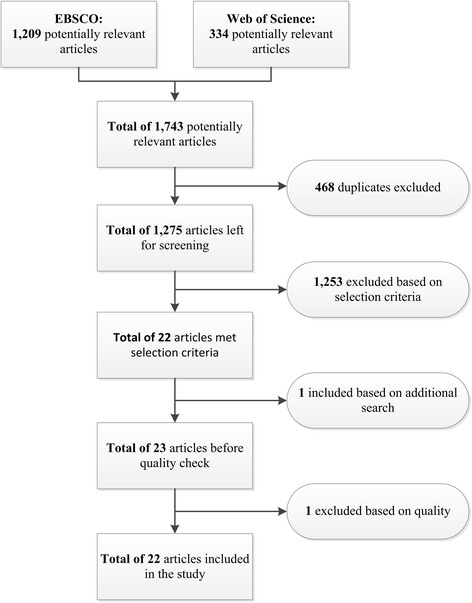
BACKGROUND: Since the emergence of social media in 2004, a growing percentage of patients use this technology for health related reasons. To reflect on the alleged beneficial and potentially harmful effects of social media use by patients, the aim of this paper is to provide an overview of the extant literature on the effects of social media use for health related reasons on patients and their relationship with healthcare professionals. METHODS: We conducted a systematic literature review on empirical research regarding the effects of social media use by patients for health related reasons. The papers we included met the following selection criteria: (1) published in a peer-reviewed journal, (2) written in English, (3) full text available to the researcher, (4) contain primary empirical data, (5) the users of social media are patients, (6) the effects of patients using social media are clearly stated, (7) satisfy established quality criteria. RESULTS: Initially, a total of 1,743 articles were identified from which 22 were included in the study. From these articles six categories of patients' use of social media were identified, namely: emotional, information, esteem, network support, social comparison and emotional expression. The types of use were found to lead to seven identified types of effects on patients, namely improved self-management and control, enhanced psychological well-being, and enhanced subjective well-being, diminished subjective well-being, addiction to social media, loss of privacy, and being targeted for promotion. Social media use by patients was found to affect the healthcare professional and patient relationship, by leading to more equal communication between the patient and healthcare professional, increased switching of doctors, harmonious relationships, and suboptimal interaction between the patient and healthcare professional. CONCLUSIONS: Our review provides insights into the emerging utilization of social media in healthcare. In particular, it identifies types of use by patients as well as the effects of such use, which may differ between patients and doctors. Accordingly, our results framework and propositions can serve to guide future research, and they also have practical implications for healthcare providers and policy makers.
Overview
The claims and statistics of this paper haven’t been checked yet.
Run the check — free, no account needed. It reads the open-access text and checks the sources it cites.
Integrity signals
Registry
Cites
Statistics
Figures
Verification
Claims the paper makes
The claims and statistics of this paper haven’t been checked yet.
Run the check — free, no account needed. It reads the open-access text and checks the sources it cites.
Claims other papers make about this one
Each is checked against this paper’s own text: does it say what the citing paper says it does?
The source backs part of the claim, not all of it — or backs it for a different population, condition or comparison.
In the citing paper
“Health promotion on social media also encouraged patients to seek medical attention more willingly [11].”
From Social Media Use Among Parents and Caregivers of Children With Rare Genetic Diseases: Scoping Review (2025) · cites this paper as [11]
Experimental — accuracy not yet measuredThe source backs part of the claim, not all of it — or backs it for a different population, condition or comparison.
In the citing paper
“Most patients discuss information they have found online with their health care provider”
From Social Media Use Among Parents and Caregivers of Children With Rare Genetic Diseases: Scoping Review (2025) · cites this paper as [11]
Experimental — accuracy not yet measuredThe source backs part of the claim, not all of it — or backs it for a different population, condition or comparison.
In the citing paper
“however, physicians often react negatively to discussions involving information sourced from social media [11-13].”
From Social Media Use Among Parents and Caregivers of Children With Rare Genetic Diseases: Scoping Review (2025) · cites this paper as [11]
Experimental — accuracy not yet measuredThe cited source says what the claim attributes to it.
In the citing paper
“Prior literature has highlighted both benefits and risks of social media in healthcare,4–13 but there remains limited understanding of how generational perspectives shape views of professionalism in healthcare social media use.”
From Evaluating perceptions of social media professionalism by healthcare workers (2026) · cites this paper as [5]
The cited source says what the claim attributes to it.
In the citing paper
“Social media use is also related to shorter relationships with health care providers, as online discussions prompted patients to seek specific providers [11].”
From Social Media Use Among Parents and Caregivers of Children With Rare Genetic Diseases: Scoping Review (2025) · cites this paper as [11]
The cited source says what the claim attributes to it.
In the citing paper
“social media empowers patients to be more informed and involved in their own care”
From Social Media Use Among Parents and Caregivers of Children With Rare Genetic Diseases: Scoping Review (2025) · cites this paper as [11]
The cited source says what the claim attributes to it.
In the citing paper
“allowing for improved communication with medical professionals [11,12].”
From Social Media Use Among Parents and Caregivers of Children With Rare Genetic Diseases: Scoping Review (2025) · cites this paper as [11]
The check wasn’t confident either way, so it gives no verdict — never disputed.
In the citing paper
“popularity of SM has also been embraced by health care professionals (HCPs) [5].”
From Dangers and Benefits of Social Media on E-Professionalism of Health Care Professionals: Scoping Review (2021) · cites this paper as [5]
Experimental — accuracy not yet measured
Self-check
Percentages, sums and reported differences re-computed from the paper’s own numbers.
The self-check needs the paper’s full text.
Citations
Cites
Preferred Reporting Items for Systematic Reviews and Meta-Analyses: the PRISMA statement
Moher, D., Liberati, A., Tetzlaff, J., Altman, D. G., & for the PRISMA Group (2009) · BMJ · doi:10.1136/bmj.b2535 · Cited by 83,823
Preferred reporting items for systematic reviews and meta-analyses: the PRISMA Statement.
(2009) · PubMed Central · Cited by 44,859
Users of the world, unite! The challenges and opportunities of Social Media
Kaplan, A. M., & Haenlein, M. (2010) · Business Horizons · doi:10.1016/j.bushor.2009.09.003 · Cited by 17,875 · cited 4×
“Among other uses, blogs can be used as personals diaries to express thoughts, feelings, and stories [9].”
BackgroundMethodInfluentialHappiness is everything, or is it? Explorations on the meaning of psychological well-being.
Ryff, C. D. (1989) · Journal of Personality and Social Psychology · doi:10.1037/0022-3514.57.6.1069 · Cited by 14,847 · cited 2×
“Moreover, “self-actualizers are described as having strong feelings of empathy and affection for all human beings and as being capable of greater love, deeper friendship, and more complete identification with others” [33].”
BackgroundPower, politics, and MIS implementation
Markus, M. L. (1983) · Communications of the ACM · doi:10.1145/358141.358148 · Cited by 2,224 · cited 1×
“According to the political variant of the interaction theory [49], “a product of the interaction of system”
BackgroundSocial capital, self-esteem, and use of online social network sites: A longitudinal analysis.
Steinfield, C., Ellison, N. B., & Lampe, C. (2008) · Journal of Applied Developmental Psychology · doi:10.1016/j.appdev.2008.07.002 · Cited by 1,919
Social Support Measurement and Intervention
(2000) · Oxford University Press eBooks · doi:10.1093/med:psych/9780195126709.001.0001 · Cited by 1,887 · cited 1×
“process of interaction in relationships which is intended to improve coping, esteem, belonging, and competence through actual or perceived exchanges of psychosocial resources” [19].”
BackgroundStandard Quality Assessment Criteria for Evaluating Primary Research Papers from a Variety of Fields
Kmet, L. M., Cook, L. S., & Lee, R. C. (2004) · University of Alberta Library · doi:10.7939/r37m04f16 · Cited by 1,682 · cited 3×
“The articles were assessed on their quality by using the standard quality assessment criteria as identified by [12].”
MethodInfluentialThe health-related functions of social support
Schaefer, C. A., Coyne, J. C., & Lazarus, R. S. (1981) · Journal of Behavioral Medicine · doi:10.1007/bf00846149 · Cited by 1,326 · cited 2×
“Social support is represented through five different categories and four of these categories were found to be common types of social media use by patients for health related purposes [18].”
BackgroundThe decision and the organization
MacDougall, C. D., & Wilson, H. (1965) · Marzani & Munsell eBooks · Cited by 1,149
Research works printed but not linked: 4
- Williams J. A new roadmap for healthcare business success. J Healthc Financ Manage Assoc. 2011;65(5):62–9.
- Mattson M, Hall JG. Health as communication nexus: A service-learning approach. Dubuque: Kendall Hunt; 2011.
- Sahoo FM, Mohapatra L. Psychological well-Being in professional groups. J Indian Acad Appl Psychol. 2009;35(2):211–7.
- Simon HA. Decision and organization. Amsterdam: North-Holland Publishing; 1972.
Cited by
Sorted by citations
Items 601–700 of 825
How is Social Media Used in the Context of Complementary and Alternative Medicine? A Scoping ReviewPreprint
Ng, J. Y., Verhoeff, N., & Steen, J. P. (2021) · Research Square · doi:10.21203/rs.3.rs-1048743/v1 · Cited by 1
Garg, D., & Vishnu, V. Y. (2022) · Neurology · doi:10.1212/wnl.0000000000200068 · Cited by 1
de Loos, E. R. (2022) · doi:10.26481/dis.20220407el · Cited by 1
‘Hidden gem’ within social media
Park, J. (2022) · International Journal of Pharmacy Practice · doi:10.1093/ijpp/riac050 · Cited by 1
Bauer, Z. (2022) · CUB Ph.D. Dissertations (Corvinus University of Budapest) · doi:10.14267/phd.2022029 · Cited by 4
Stem [Stem en Ervaringen van Moeders]
Vogels-Broeke, M. A. (2023) · doi:10.26481/dis.20230209mv · Cited by 1
Missed opportunities in social media to reduce maternal health disparities for Black women
George, N. (2022) · Scholars Archive - University at Albany (University at Albany, State University of New York) · doi:10.54014/eycn-grne · Cited by 1
The art of sharing: From research to outreach in the social media era
Mohammad, M., Mohamed, A. A., Dahmen, J., Bjerre-Bastos, J. J., & Pihl, A. F. (2025) · Experimental Physiology · doi:10.1113/ep092887 · Cited by 2
“It is estimated that a large proportion of the public now obtain their news from social media, and surveys suggest that a growing number of scientists also use these platforms to follow discoveries and discuss research (Brossard, 2013; Smailhodzic et al., 2016).”
Papathanassopoulos, S., & Giannouli, I. (2025) · Encyclopedia · doi:10.3390/encyclopedia5040195 · Cited by 2
Zakrzewski, D., Woźniak, J. S., Orłowska, J., Łukasiński, K., Renachowska, K., Kitewska, W., Kubziakowska, W., Sawicka, A., Zawadzka, M., & Mazurkiewicz-Bełdzińska, M. (2025) · Epilepsy & Behavior · doi:10.1016/j.yebeh.2025.110622
Dal‐Ré, R. (2018) · Medicina Clínica · doi:10.1016/j.medcli.2018.03.026
The role of online support groups in empowering people with type 2 diabetes
Almanea, A., Bath, P. A., & Sbaffi, L. (2018) · White Rose Research Online (University of Leeds, The University of Sheffield, University of York)
Collecting to the Core-Social Media in Education, Healthcare and Marketing
Megwalu, A., & Doherty, A. (2017) · Against the grain · doi:10.7771/2380-176x.7887
Use of Social Media as a Communication Tool for People with Serious Illness and Their Families
Hansen, D., Petrinec, A. B., & Harb, N. (2019) · Oxford University Press eBooks · doi:10.1093/med/9780190862374.003.0066
Stukus, D. R. (2019) · Springer eBooks · doi:10.1007/978-3-030-14439-5_11
U.S. Media Portrayal of Hearing Loss and Hearing Aids
Beukes, E. W., & Manchaiah, V. K. C. (2019) · The Hearing Journal · doi:10.1097/01.hj.0000558468.82774.8a
Knowledge Discovery and Hypothesis Generation from Online Patient Forums: A Research Proposal
Dirkson, A. R. (2019) · Annual Meeting of the Association for Computational Linguistics: Student Research Workshop (ACL SRW) · doi:10.18653/v1/p19-2009
“Patients indicate that they rely heavily on the experiences of others (Smailhodzic et al., 2016), for instance for learning how to cope with their illness on a daily basis (Burda et al.”
BackgroundAthletic Training Student and Student Aide Clinical Task Allowance in the Secondary School Setting
Winkelmann, Z. K., Huggins, R., & Eberman, L. E. (2019) · Internet Journal of Allied Health Sciences and Practice · doi:10.46743/1540-580x/2019.1848
Ducci, G. (2019) · SOCIOLOGIA DELLA COMUNICAZIONE · doi:10.3280/sc2019-057008
Role of IT and Social Media in Democratic Change
Tiwary, A. R., & Gupta, T. (2020) · Advances in electronic government, digital divide, and regional development book series · doi:10.4018/978-1-7998-1791-8.ch012
Conflicting demands that dental professionals experience when using social media
Greer, A. C., Stokes, C. W., Zijlstra‐Shaw, S., & Sandars, J. E. (2020) · BDJ Team · doi:10.1038/s41407-020-0230-3
Mustonen, R. (2018) · Journal of International Crisis and Risk Communication Research
Husain, F., & Motti, V. G. (2020) · arXiv (Cornell University) · doi:10.48550/arxiv.2005.07898
“Patient Emotional support (Taiminen, 2016; Smailhodzic et al., 2016) Complement healthcare professional services (Smailhodzic et al.”
BackgroundInfluentialPísek, J. (2020) · Economics Working Papers · doi:10.32725/ewp.2020.001
Role of Social Media in Health Professions Education
Brazil, V. A., Stokes-Parish, J. B., & Spurr, J. (2020) · Springer eBooks · doi:10.1007/978-981-13-6106-7_119-1
Resources for the gastroparesis patient
Rooker, C. T., Haston, C., Smith, S. M., Lombardi, M., DeGrazia-DiTucci, M., & VanHouten, M. A. (2020) · Elsevier eBooks · doi:10.1016/b978-0-12-818586-5.00041-7
Menon, M., & GEORGE, B. P. (2020) · Emerald Group Publishing Limited eBooks · doi:10.1108/978-1-83982-186-820201015 · Cited by 1
Branding hospitals on social media through health professionals
Aguerrebere, P. M. (2021) · Communication & Medicine · doi:10.1558/cam.38819
Soboń, M. (2020) · Problemy Zarządzania - Management Issues · doi:10.7172/1644-9584.89.9
Esen, M. F. (2021) · Journal of Medicine and Palliative Care · doi:10.47582/jompac.870310
“Ayrıca, hastalar tarafından gerçekleştirilen internet sorguları ve sosyal medya paylaşımları, sağlık kuruluşunun pazar konumunu güçlendirmek, marka yönetimi ve iyileştirilmiş hizmet sunumu için fırsat yaratmakta ve sağlık sistemine geniş bir yelpazede etki etmektedir (5).”
How the Royal Commission Health Services Program in Jubail, Saudi Arabia, is using social media?
Hassan, H., Alhodaib, H. I., Alanezi, F., AlThani, B., Althumairi, A., Alanzi, T. M., Alsalman, D., Alfayez, A., & Alameri, R. A. (2021) · Informatics in Medicine Unlocked · doi:10.1016/j.imu.2021.100638
How Social Media Contribute to Autists' Wellbeing
Feitosa, W. R., Silveira, D., & Andrade, L. (2021) · Advances in marketing, customer relationship management, and e-services book series · doi:10.4018/978-1-7998-7263-4.ch009
Velardi, P., & Lenzi, A. (2021) · Springer eBooks · doi:10.1007/978-3-030-58080-3_255-1
The breakthrough of digital health: Communication as the catalyst of the transformation of care
Sendra, A., Torkkola, S., & Govender, E. (2021) · Catalan Journal of Communication & Cultural Studies · doi:10.1386/cjcs_00047_2
Using Social Media to Inform Vitamin Usage Patterns in Bariatric Surgery Patients
Foroushani, S. M., Freeman, M. N., Ramos, T. A., Baker, J. W., Galvani, C. A., & Levy, S. M. (2021) · Bariatric Surgical Practice and Patient Care · doi:10.1089/bari.2021.0049
“27 The sample obtained in this study is geographically diverse and representative of a typical bariatric patient population (Table 1).”
Kroll, N., Claridge, R., & Teakle, N. (2021) · Perspectives of the ASHA Special Interest Groups · doi:10.1044/2021_persp-21-00079
Nguyen, M. P. (2021) · Queensland University of Technology · doi:10.5204/thesis.eprints.225903
Consumers� Gender Difference in Communicating with Doctors on Social Media: Survey Study (Preprint)Preprint
Wu, T., Zha, D., Deng, Z., Chen, Z., Zhang, D. “., Wang, R., & Feng, Z. (2018) · doi:10.2196/preprints.10852
Health professionals’ social media usage behaviour: A study of the perceived barriers (Preprint)Preprint
Khan, M. I., Loh, J. M. I., Saleh, A., & Quazi, A. M. (2019) · doi:10.2196/preprints.16051
(2020) · Emerald Group Publishing Limited eBooks · doi:10.1108/978-1-83909-394-420201013
Velardi, P., & Lenzi, A. (2022) · Springer eBooks · doi:10.1007/978-3-030-64573-1_255
Shoults, C. C., Dawson, L. C., Hayes, C. J., & Eswaran, H. (2022) · doi:10.2196/preprints.37514
Renner, S., Loussikian, P., Foulquié, P., Arnould, B., Marrel, A., Barbier, V., Mebarki, A., Schück, S., & Bharmal, M. F. (2022) · doi:10.2196/preprints.37518
Role of Social Media Promotion of Prescription Drugs on Patient Belief-system and Behaviour
Mukherjee, S. K., Kumar, J., Jha, A. K., & Rani, J. (2021) · IGI Global eBooks · doi:10.4018/978-1-6684-2414-8.ch019
Moreira, A., Alonso-Calvo, R., Muñoz, A., & Crespo, J. (2018) · doi:10.2196/preprints.11475
Misleading information generated in medical journals that reaches the citizen electronically
Dal‐Ré, R. (2018) · Medicina Clínica (English Edition) · doi:10.1016/j.medcle.2018.03.029
Improving Health and Efficiency With Strategic Social Media Use in Health Organizations
Aydın, G. (2021) · IGI Global eBooks · doi:10.4018/978-1-7998-8960-1.ch006
Multi-purpose use of social media for health purposes: scooping review of systematic reviewsPreprint
Nnamdi, O.-D. L., Soyinka, J. O., Iloka, O. C., Korie, M. C., Kevin-Asogwa, L. N., Cs, O., Odu, C. E., Gadzama, U. N., Iyevhobu, K. O., Enwere, O. O., et al. (2022) · Research Square · doi:10.21203/rs.3.rs-1694284/v1
Deguilhem, A., Malaab, J., Talmatkadi, M., Renner, S., Foulquié, P., Fagherrazi, G., Loussikian, P., Marty, T., Mebarki, A., Texier, N., et al. (2022) · doi:10.2196/preprints.39849
Role of Social Media in Hospital Branding
Nayal, P., & Pandey, N. (2022) · IGI Global eBooks · doi:10.4018/978-1-6684-6287-4.ch058
Anglade, C., Breton, M., Simard, F., Fitzpatrick, T., Fitzpatrick, M., Bruneau, G., & Gaboury, I. (2022) · doi:10.2196/preprints.34463
The Analysis on the Use of Social Media in Managing the Covid-19 Pandemic Information Flow
Chukwuere, J. E. (2022) · HOLISTICA – Journal of Business and Public Administration · doi:10.2478/hjbpa-2022-0004
La néphrologie 2.0 : communication avec les patients connectés et les professionnels de santé
Guerrot, D., de Nattes, T., Lanot, A., & Hazzan, M. (2022) · Néphrologie & Thérapeutique · doi:10.1016/j.nephro.2022.02.003
Anglade, C., Breton, M., Simard, F., Fitzpatrick, T., Fitzpatrick, M., Bruneau, G., & Gaboury, I. (2022) · JMIR Research Protocols · doi:10.2196/34463 · Cited by 1
Knowledge discovery and presentation using social media analysis in health domain
Wagih, H. M. (2022) · Elsevier eBooks · doi:10.1016/b978-0-323-90585-5.00012-6
Towards a New Model for Chronic Disease Consultations
Randine, P., Cooper, J. G., Hartvigsen, G., & Årsand, E. (2022) · Linköping electronic conference proceedings · doi:10.3384/ecp187014
Perceptual Difference Between Patient and Physician on Negative Aspects of Social Media Promotion
Mukherjee, S. K., Kumar, J., Pandey, V., Rani, J., Sarkar, A., & Jha, A. K. (2022) · Lecture notes in electrical engineering · doi:10.1007/978-981-19-2004-2_13
Impact of family determinants on internet addiction among adolescents in a rural block, Tamilnadu
Kaveri, P., Buvnesh Kumar, M., Peter, R. M., Shanthi, R. M., & Logaraj, M. (2022) · International Journal of Health Sciences · doi:10.53730/ijhs.v6ns5.10896
Digital Reputation Management in American Cancer Hospitals
Aguerrebere, P. M., Medina, E., & Pacanowski, T. G. (2022) · Central European Journal of Communication · doi:10.51480/1899-5101.15.2(31).5
Impact of Emotional Support and Medical Adherence on Social Media Branded Drug Promotion
Mukherjee, S. K., Kumar, J., Jha, A. K., Pandey, J. R., & Saha, S. K. (2022) · Lecture notes in networks and systems · doi:10.1007/978-981-19-5090-2_20
M, D. B. R., Peter, D. E., Narayan, V., K, D. R. E., Babu, D. A., & Nandimath, O. V. (2023) · International Journal of Social Science and Human Research · doi:10.47191/ijsshr/v6-i2-32
INTERAÇÕES VIRTUAIS DE FAMÍLIAS DE CRIANÇA COM CÂNCER: ESPAÇO POTENCIAL DE ATUAÇÃO DE ENFERMEIRA(O)S
de Mattos, C. X., & Cabral, I. E. (2023) · Cogitare Enfermagem · doi:10.1590/ce.v28i0.85720
“They offer the opportunity to learn and improve health communication, which can lead to increased demand for health care, among other aspects 8 .”
Backgroundde Mattos, C. X., & Cabral, I. E. (2023) · Cogitare Enfermagem · doi:10.1590/ce.v28i0.89246
Analysis of the state of medicine in Pakistan: challenges and future prospects
Shehbaz, A. (2022) · Futurity Medicine. · doi:10.57125/fem.2022.06.30.05
Health Literacy Implementation Principles: Pediatric Colorectal Program Development
Pasarón, R., Calisto, J. L., Gurucharri, B. P., & Levitt, M. A. (2023) · Journal of Pediatric Surgical Nursing · doi:10.1097/jps.0000000000000391
Gestión de la reputación online en los hospitales públicos españoles. Un análisis cuantitativo
Aguerrebere, P. M., Medina, E., & Pacanowski, T. G. (2023) · Revista Panamericana de Comunicación · doi:10.21555/rpc.v5i1.2888
Achieving SDG3.3 and 3d in the Era of Misinformation
Mphande, F. A. (2023) · Sustainable development goals series · doi:10.1007/978-981-99-4254-1_5
Mukherjee, S. K., Sarkar, A., Mukherjee, S., Kumar, J., & Jha, A. K. (2023) · Practice, progress, and proficiency in sustainability · doi:10.4018/978-1-6684-8634-4.ch007
The Use of Social Network Sites for Healthcare in Islamic Perspective
Mohamed, A., & Zeki, A. M. (2023) · Journal of Science and Technology · doi:10.20428/jst.v28i1.2033
THE IMPACT OF SOCIAL COMPARISON ON CONSUMER WELL-BEINGLITERATURE REVIEW
Elbayomy, D. R. M., & Metwally, A. H. (2023) · التجارة والتمويل · doi:10.21608/caf.2023.317362
“When customers compare themselves to peers to acknowledge that they are not the only ones in this situation (network support) or when customers compare themselves to peers to learn how other people deal with the condition (esteem support, emotional support, or information support), these social comparisons may appear…”
BackgroundO conteúdo e as informações de vídeos publicados no Youtube sobre doença celíaca são adequados?
Oliveira, A. L. T. F. D., Garcia, L. F., & de Oliveira, L. P. (2023) · Contribuciones a las Ciencias Sociales · doi:10.55905/revconv.16n.9-284
Tags for Tears: The Obstetric Anal Sphincter Injury Hashtag Ontology Project
Maliakal, C., Dieter, A. A., Iglesia, C. B., & Davenport, A. P. (2023) · Urogynecology · doi:10.1097/spv.0000000000001429
Omotayo, A. I., & Adesegha, D. K. (2024) · African Journal of Social Sciences and Humanities Research · doi:10.52589/ajsshr-ocqadrw9
“(Smailhodzic, Hooijsma, Boonstra, & Langley, 2016) When patients bring social media content to the consultation, this can lead to increased processes of sorting information, transforming the potential risk to the healthcare professional, and challenging the healthcare professional’s expertise.”
BackgroundCOVID-19 vaccine equity and health equity conversations on Twitter.
Jain, N. R., Zachary, I., & Boren, S. A. (2023) · PubMed Central
Patient and Caregiver Perception of Adenoidectomies: A Non‐Real‐World Social Media Analysis
Godbole, N. B., Paliwoda, E. D., Gajjar, A. A., Gupta, N. K., Nguyen, A. T., Nguyen, A. D., & Alexander, R. (2024) · OTO Open · doi:10.1002/oto2.100
Jung, H., Lee, J. W., & Lee, G. H. (2024) · Korean Medical Education Review · doi:10.17496/kmer.23.041
Características de los pacientes reumáticos que consultan fuentes de información digitales
Germain, M. P. I., Ávila, P., Fara, N., Pretini, J., Gaona, M. E., Pissani, P., Saavedra, M. A., Aquino, V., Echazu, M. E., Laffont, M., et al. (2024) · Revista Colombiana de Reumatología · doi:10.1016/j.rcreu.2023.11.007
“usuarios de Internet en Latinoamérica y el Caribe , por lo que como la televisión, la radio o la prensa escrita 4,5 .”
التفاعلية على موقع الفيسبوك ودورها في التوعية الصحية (كوفيد 19 - نموذجا)
العقيلي, ل. أ. (2024) · Al-Mağallah Al-ʿarabiyyaẗ Li Buḥūṯ Al-Itiṣāl wa Al-Iʿlām Al-Raqamī · doi:10.21608/ajscd.2024.339827
Reynolds, C. A., Mehta, M. P., Wu, S. A., Neuville, A. J., Ho, A., & Shah, C. M. (2024) · Hand · doi:10.1177/15589447241231293
Chavan, P. N. W. P. D., & Joseph, T. M. K. D. J. (2024) · European Economic Letters (EEL) · doi:10.52783/eel.v14i1.1231
“(Edin Smailhodzic, 2016)”
Tracing the Impact of Social Media on Social Cognition
Anthony, M., Kumar, G., Ranganathan, M., Karim, M. A., Reddy, K. J., & Vijay, M. (2024) · Advances in medical technologies and clinical practice book series · doi:10.4018/979-8-3693-1265-0.ch018
The Impact of Narratives on Healthcare Decision-Making in Online Discourse
Almaya, Z., & Mould, T. (2024) · American Journal of Undergraduate Research · doi:10.33697/ajur.2024.104
“11 Just as attention to the specific media formats used in medical decision-making is important, so too is the mode.”
BackgroundExposed secrets: Unmasking the ethical dilemma of orthodontic photographs on social media
Lakshmikantha, H. T. (2024) · International Journal of Applied Dental Sciences · doi:10.22271/oral.2024.v10.i2a.1917
Hakami, Z. W., Alassiry, A. M., Mohana, A. J. I., Somili, A. M., Masmali, L. M. H., Jabari, A. M., Shami, S. M. A., Halboub, E. S., & Marghalani, H. Y. A. (2024) · Saudi Journal of Oral Sciences · doi:10.4103/sjoralsci.sjoralsci_40_23
Enabling Semantic Topic Modeling on Twitter Using MetaMap.
Shyu, R., & Weng, C. (2024) · PubMed Central
Xu, S., Ware, D. P., & Plankey, M. W. (2024) · Georgetown Medical Review · doi:10.52504/001c.118699
medo odontológico sob a perspectiva dos usuários do X® (antigo twitter)
Soares, M. C. V., Laureano, I. C. C., Sales, G. B., Cavalcanti, S. D. L. B., Cavalcanti, A. L., & Cavalcanti, A. F. C. (2024) · Revista de Ciências Médicas e Biológicas · doi:10.9771/cmbio.v23i1.60798
Bianchi, E., & Grippaldi, E. (2024) · Estudos de Sociologia · doi:10.52780/res.v29i1.18980
Evidence-based performance measurement (a case study of Tehran medical sciences teaching hospitals)
Azamakhlaghi, A., Alimohammadzadeh, K., Hosseini, S. M., Maher, A., & Jafari, M. (2024) · Alexandria Journal of Medicine · doi:10.1080/20905068.2024.2381350
“…been on the production of empirical knowledge to improve clinical practice, since the last decade, the focus and emphasis have been on using research findings in practice with the aim of professional development of the health system and hospital [12,13] to be based on evidence has continued [14].”
DALKILIÇ, S., & Kurtoğlu, R. (2024) · Erciyes Üniversitesi İktisadi ve İdari Bilimler Fakültesi Dergisi · doi:10.18070/erciyesiibd.1311714
“…studies stating that the internet has a positive effect on patient empowerment (Forkner, 2003; 2010; Petric et al., 2017; Samoocha et al., 2010), there are also studies stating that health information on the internet can affect patients negatively (Kim et al., 2009; Smailhodzic et al. 2016).”
Perros, P. (2024) · Copernicus books · doi:10.1007/978-3-031-58287-5_4
Selak, T., & Prineas, S. (2024) · Oxford University Press eBooks · doi:10.1093/med/9780198858669.003.0022
Mukhamediyarov, M., & Bekaryssova, D. (2024) · Central Asian Journal of Medical Hypotheses and Ethics · doi:10.47316/cajmhe.2024.5.3.08
“It is also problematic that any user with access to social media can post advice on the treatment of various diseases, which may lead to undesirable health consequences [14].”
BackgroundBarnett, R. L., Gómez, D., Tevis, S. E. A., Vemuru, S. R., Oliveira, F. F. L., & Rojas, K. E. (2024) · Research Square · doi:10.21203/rs.3.rs-4870893/v1
Metadata
- Authors
- Smailhodzic, E., Hooijsma, W., Boonstra, A., & Langley, D. J.
- Affiliations
- University of Groningen (NL)
- Netherlands Organisation for Applied Scientific Research (NL)
- Venue
- BMC Health Services Research
- Published
- 2016-08-26
- Volume
- 16
- Issue
- 1
- Pages
- 442-442
- ISSN
- 1472-6963 (ISSN-L)
- PMC
- PMC5000484
- OpenAlex
- W2512433998
- Cited by
- 827
- References
- 55
- Citations by year
- 2026: 75 · 2025: 107 · 2024: 107 · 2023: 99 · 2022: 111 · 2021: 127 · 2020: 96 · 2019: 61 · 2018: 29 · 2017: 14
- FWCI
- 6.51
- Type
- journal article
- Language
- en
- Open access
- gold
- doi.org
- Licence
- cc-by
- Locations
- BMC Health Services Research (publishedVersion, cc-by)
- PubMed Central (publishedVersion, cc-by)
- PubMed (publishedVersion)
- Data Archiving and Networked Services (DANS) (acceptedVersion)
- TNO Repository (submittedVersion)
- University of Groningen research database (University of Groningen / Centre for Information Technology) (submittedVersion, cc-by)
- Repository hosted by TU Delft Library (TU Delft) (submittedVersion)
- Topics
- Social Sciences › Health › Social Media in Health Education
- Health Sciences › Health Professions › General Health Professions › Health Literacy and Information Accessibility
- Social Sciences › Sociology and Political Science › Impact of Technology on Adolescents
- Keywords
- social media use, patient self-management, psychological well-being, subjective well-being, social media addiction, privacy loss, social comparison, network support, patient-physician communication
- MeSH terms
- Female, Health Personnel, Humans, Male, Professional-Patient Relations, Self Care, Consumer Health Information, Social Media
About these checks
Registry, retraction, Cites and statistics results are computed, not judged, with one exception: a printed reference that no index lists is read once by a model before it counts as a citation error. Claims are extracted by a model and kept only when their quote appears verbatim in the text; each cited source is then checked, with a model’s help, for whether it says what the claim relies on. Those verdicts can be wrong — read the claim’s quote and the cited source before relying on one.
Statistics and arithmetic are recomputed, not judged.
Confidence bands are shown only for fields calibrated on our annotated test set. None is calibrated yet, so no band is shown.
What counts as a claim ›How we measure confidence ›How we check this ›
Are you an author, or do you see a problem with this page? Request a review
