

Context matters in implementation science: a scoping review of determinant frameworks that describe contextual determinants for implementation outcomes
Open accessThe DOI matches its Crossref record; 110 of the 111 references it cites were found in a registry or an index.
Abstract
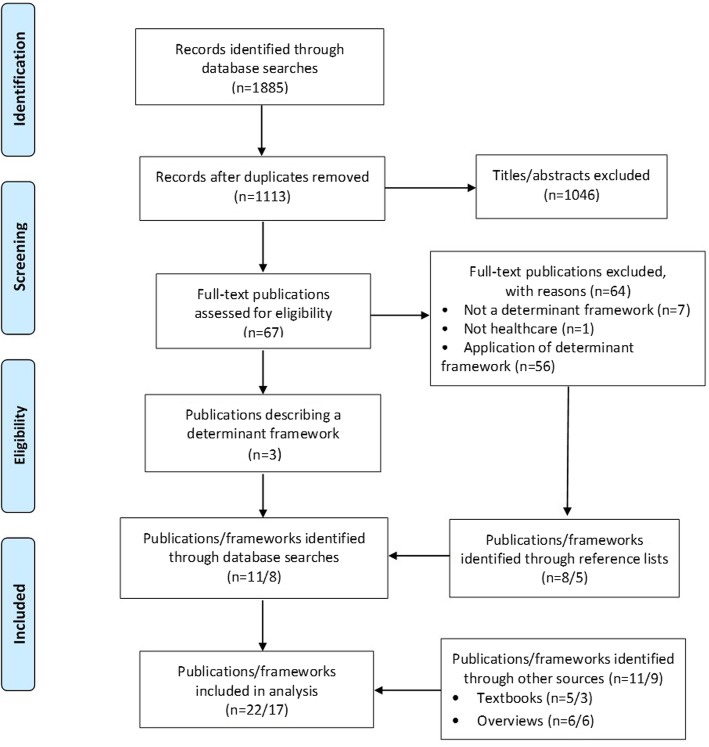
BACKGROUND: The relevance of context in implementation science is reflected in the numerous theories, frameworks, models and taxonomies that have been proposed to analyse determinants of implementation (in this paper referred to as determinant frameworks). This scoping review aimed to investigate and map how determinant frameworks used in implementation science were developed, what terms are used for contextual determinants for implementation, how the context is conceptualized, and which context dimensions that can be discerned. METHODS: A scoping review was conducted. MEDLINE and EMBASE were searched from inception to October 2017, and supplemented with implementation science text books and known published overviews. Publications in English that described a determinant framework (theory, model, taxonomy or checklist), of which context was one determinant, were eligible. Screening and inclusion were done in duplicate. Extracted data were analysed to address the study aims. A qualitative content analysis with an inductive approach was carried out concerning the development and core context dimensions of the frameworks. The review is reported according to the PRISMA guidelines. RESULTS: The database searches yielded a total of 1113 publications, of which 67 were considered potentially relevant based on the predetermined eligibility criteria, and retrieved in full text. Seventeen unique determinant frameworks were identified and included. Most were developed based on the literature and/or the developers' implementation experiences. Six of the frameworks explicitly referred to "context", but only four frameworks provided a specific definition of the concept. Instead, context was defined indirectly by description of various categories and sub-categories that together made up the context. Twelve context dimensions were identified, pertaining to different aggregation levels. The most widely addressed context dimensions were organizational support, financial resources, social relations and support, and leadership. CONCLUSIONS: The findings suggest variation with regard to how the frameworks were developed and considerable inconsistency in terms used for contextual determinants, how context is conceptualized, and which contextual determinants are accounted for in frameworks used in implementation science. Common context dimensions were identified, which can facilitate research that incorporates a theory of context, i.e. assumptions about how different dimensions may influence each other and affect implementation outcomes. A thoughtful application of the concept and a more consistent terminology would enhance transparency, simplify communication among researchers, and facilitate comparison across studies.
Overview
The claims and statistics of this paper haven’t been checked yet.
Free: it reads the open-access text and checks the first 5 claims that cite a source we can check. Create a free account to check every claim.
Integrity signals
Registry
Cites
Statistics
Figures
Verification
Claims the paper makes
The claims and statistics of this paper haven’t been checked yet.
Free: it reads the open-access text and checks the first 5 claims that cite a source we can check. Create a free account to check every claim.
Claims other papers make about this one
Each is checked against this paper’s own text: does it say what the citing paper says it does?
The source backs part of the claim, not all of it — or backs it for a different population, condition or comparison.
In the citing paper
“Understanding the end users, in this case, the students, is crucial and is known to facilitate successful implementation.23,24”
From Structured Development of Learning and Assessment Tasks to Prevent Generative AI Misuse and Enhance AI Literacy in the Faculty in Physiotherapy Education (2025) · cites this paper as [24]
Experimental — accuracy not yet measuredThe check wasn’t confident either way, so it gives no verdict — never disputed.
In the citing paper
“This call for hypothesis testing in implementation outcomes research has been echoed by a number of recent papers [21–24].”
From Ten years of implementation outcomes research: a scoping review (2023) · cites this paper as [23]
Experimental — accuracy not yet measured
Self-check
Percentages, sums and reported differences re-computed from the paper’s own numbers.
The self-check needs the paper’s full text.
Citations
Cites
Preferred Reporting Items for Systematic Reviews and Meta-Analyses: the PRISMA statement
Moher, D., Liberati, A., Tetzlaff, J., Altman, D. G., & for the PRISMA Group (2009) · BMJ · doi:10.1136/bmj.b2535 · Cited by 83,823
Preferred Reporting Items for Systematic Reviews and Meta-Analyses: The PRISMA Statement
Moher, D., Liberati, A., Tetzlaff, J., Altman, D. G., & The PRISMA Group (2009) · PLoS Medicine · doi:10.1371/journal.pmed.1000097 · Cited by 64,042 · cited 1×
“for Systematic Reviews and Meta-Analyses (PRISMA) guidelines [20].”
Preferred reporting items for systematic reviews and meta-analyses: the PRISMA Statement.
(2009) · PubMed Central · Cited by 44,859
Scoping studies: towards a methodological framework
Arksey, H., & O'Malley, L. (2005) · International Journal of Social Research Methodology · doi:10.1080/1364557032000119616 · Cited by 36,742
The Ecology of Human Development: Experiments by Nature and Design
Bronfenbrenner, U. (1979) · Harvard University Press eBooks · doi:10.4159/9780674028845 · Cited by 26,084
The qualitative content analysis process
Elo, S., & Kyngäs, H. (2008) · Journal of Advanced Nursing · doi:10.1111/j.1365-2648.2007.04569.x · Cited by 22,617
Wang, G., Ma, R., Qiao, G., Wada, K., Aizawa, Y., & Satoh, T. (2015) · Integrative Medicine International · doi:10.1159/000368408 · Cited by 18,657
Organizational culture and leadership
(1993) · Long Range Planning · doi:10.1016/0024-6301(93)90120-5 · Cited by 16,462
Damschroder, L. J., Aron, D. C., Keith, R. E., Kirsh, S. R., Alexander, J. A., & Lowery, J. C. (2009) · Implementation Science · doi:10.1186/1748-5908-4-50 · Cited by 14,496 · cited 11×
“, 2009 [15] Influences on implementation (outcomes) Based on analysis of the 19 theories, frameworks and models used in implementation science 5 categories (3 relate to contextual influences): • Intervention characteristics • Characteristics of individuals • Process • Inner setting • Outer setting Categories are refer…”
BackgroundMethodInfluentialThe ecology of human development : experiments by nature and design
Bronfenbrenner, U. (1979) · Cited by 12,580
Research works printed but not linked: 7
- Rycroft-Malone J Bucknall T Models and frameworks for implementing evidence-based practice: linking evidence to action 2010 Oxford Wiley-Blackwell
- Rainbird K Sanson-Fisher R Buchan H Identifying barriers to evidence uptake 2006 Melbourne National Institute of Clinical Studies
- World Health Organization (WHO) Identifying and addressing barriers to implementing policy options. In: SURE guides for preparing and using evidence-based policy briefs 2011
- Övretveit J The leaders’ role in quality and safety improvement: a review of the research and guidance 2005 Karolinska Institute Stockholm
- Weick KE The social psychology of organising 1969 Reading, MA Addison-Wesley
- Cappelli P Sherer PD The missing role of context in OB: the need for a meso-level approach Res Organ Behav 1991 13 55 110
- Jordan A Carlile O Stack A Approaches to learning – a guide for teachers 2008 New York Open University Press 1 251
Cited by
Items 501–600 of 1,000
Kokole, D., Mercken, L. A. G., Anderson, P., Mejía‐Trujillo, J., Pérez‐Gómez, A., Bustamante, I. V., Piazza, M., Rey, G. N., Arroyo, M., de León, A. P., et al. (2023) · Global Public Health · doi:10.1080/17441692.2023.2207410 · Cited by 4
“While all de fi nitions (Moore et al., 2014; Nilsen & Bernhardsson, 2019; Pfadenhauer et al., 2017; Steckler & Linnan, 2002) include the wider environment, some are broader, and include also additional factors beyond the wider environment as described in the introduction (e.g. Moore et al., 2014;…”
BackgroundInfluentialIshii, K., Takemura, Y., & Ichikawa, N. (2023) · Journal of Nursing Management · doi:10.1155/2023/8584029 · Cited by 4
“Activities within the context in which EBPs are implemented also infuence the implementation of EBPs [18–20]; in particular, learning in groups is signifcant [21].”
Bouma, S. E., Stevens, M. J., van der Woude, L. H. V., Diercks, R. L., & van den Akker‐Scheek, I. (2023) · Health Policy · doi:10.1016/j.healthpol.2023.104898 · Cited by 4
Frazier, M. C., Balis, L. E., Armbruster, S. D., Estabrooks, P. A., & Harden, S. M. (2023) · Translational Behavioral Medicine · doi:10.1093/tbm/ibad052 · Cited by 4
Lindström, R., Orrevall, Y., Belqaid, K., McGreevy, J., Ottenblad, A., Rothenberg, E. M., Slinde, F., Ottery, F. D., Jager‐Wittenaar, H., & Einarsson, S. (2024) · Scandinavian Journal of Caring Sciences · doi:10.1111/scs.13267 · Cited by 4
“Factors such as organisational support, resources and effective leadership may facilitate implementation [45] and have been highlighted as important key factors that impact HCPs' behaviour towards malnutrition screening practices [46].”
Wilson, D., Crengle, S. M., & Cram, F. (2020) · International Journal for Quality in Health Care · doi:10.1093/intqhc/mzaa084 · Cited by 4
Widyastuti, Y., Arenawati, A., & Prafitri, N. (2022) · JIPAGS (Journal of Indonesian Public Administration and Governance Studies) · doi:10.31506/jipags.v6i2.12885 · Cited by 4
Contingency management needs implementation science
Becker, S. J. (2024) · Addiction · doi:10.1111/add.16579 · Cited by 4
Tian, C. Y., Wong, E. L., Qiu, H., Liu, S., Wang, K., Wei, Y., Cheung, A. W.-L., Chen, Y., & Yeoh, E. (2025) · BMC Health Services Research · doi:10.1186/s12913-025-12507-0 · Cited by 5
Limato, R., Elmira, E. S., Yen, N. H., Quan, T. A., Yen, D. H., Limmathurotsakul, D., Karkey, A., Hamers, R. L., Patel, T. S., Lessa, F. C., et al. (2025) · BMJ Open Quality · doi:10.1136/bmjoq-2024-003074 · Cited by 4
Pelt, A. E. V., Casline, E. P., Cook, B. G. M., Phillips, G., Cestou, J., Mustanski, B. S., Saber, R., & Beidas, R. S. (2025) · Implementation Science Communications · doi:10.1186/s43058-025-00750-9 · Cited by 4
“Specifically, future work will leverage these ideas to operationalize actions through the systematic process of implementation mapping [28].”
Nielsen, J. V., Koch, S., Henriksen, T., Krølner, R. F., Lund, L., Brautsch, L. A. S., Ulrikkeholm, L. K., Damsgaard, C. T., Larsen, M. N., & Skovgaard, T. (2025) · Frontiers in Sports and Active Living · doi:10.3389/fspor.2025.1534123 · Cited by 3
Møller, K. E., Sørensen, J. L., Rosthøj, S., Trbovich, P., Grantcharov, T., & Strandbygaard, J. J. S. (2025) · Surgical Endoscopy · doi:10.1007/s00464-025-11966-0 · Cited by 3
“Promoting a change in how the SSC should be executed requires training [32], time [42], understanding of the context within which it should be carried out [47], and buy-in from all HCPs participating in the surgical procedure [15].”
Implementing research findings into nursing homes: A mixed-methods study
Muller-Schoof, I. J. M., Meekes, W. M. A., Raaijmakers, N., Schellekens, M., Rocdi, Y. A., & Luijkx, K. G. (2025) · International Journal of Nursing Studies · doi:10.1016/j.ijnurstu.2025.105179 · Cited by 3
Bernard, G., & Fischer, M. (2025) · HEC Forum · doi:10.1007/s10730-025-09555-8 · Cited by 3
“The review accepted studies, opinion papers, legal texts, and book chapters in English and German, including explanations, analyses, listings, discussions, or examples of macro-level CESS’ adoption and implementation factors as defined by Nilsen and Bernhardsson (2019).”
Blomberg, O., Sami, A., Farrand, P. A., Sörensdotter, R., Svedin, F., Brantnell, A., von Essén, L., Åberg, A. C., & Woodford, J. (2025) · Dementia · doi:10.1177/14713012251376774 · Cited by 4
“Understanding daughter caregivers ’ experiences of accessing and receiving support is important for developing an understanding of the context in which they provide care (Nilsen & Bernhardsson, 2019).”
Virtual Care, What Are We Measuring and What Should We Measure? Scoping Review of Reviews
Powis, M., Ali, A., Salmini, J., Hack, S., Fazelzad, R., Barbera, L. C., Berlín, A., Cheung, M. C., Vera, M. A. D., Edwards, A., et al. (2025) · Journal of Medical Internet Research · doi:10.2196/65312 · Cited by 4
“This informed the development of a set of recommendations for future work, particularly with respect to future evaluations, research needs, and theoretical or conceptual needs [15].”
Implementation science in Africa—whose epistemology counts?
Eboreime, E., Ibisomi, L., Itanyi, I. U., Kanya, L., Wamuti, B., Ohanyido, F., Ncayiyana, J. R., Habonimana, D., Kagura, J., Anjorin, O., et al. (2025) · The Lancet Global Health · doi:10.1016/s2214-109x(25)00414-0 · Cited by 3
van Scherpenseel, M. C., van Veenendaal, L. J., Barten, D., Veenhof, C., Emmelot‐Vonk, M. H., & Velde, S. J. T. (2025) · Implementation Science Communications · doi:10.1186/s43058-025-00814-w · Cited by 4
“Moreover, implementation efforts are inherently influenced by dynamic contextual changes, adding complexity [68, 69].”
Vis, C., van Bodegom‐Vos, L., Walters, B. H., Powell, B. J., Ista, E., & van Nassau, F. (2025) · Implementation Science · doi:10.1186/s13012-025-01477-w · Cited by 5
“Involvement of both implementation expertise and local stakeholders is relevant because determinants, and thus implementation strategies, are context and time-dependent and thus differ with context and change over time [1].”
Stephen, N. A., Cobian, K. P., Romero, A. L., Ramos, H. V., & Hurtado, S. (2026) · PLoS ONE · doi:10.1371/journal.pone.0343368 · Cited by 4
“We focus on institutional context, a key concept from implementation science [10], to better understand how institutional conditions can facilitate program longevity.”
Adam, T., Hennessy, S., Chachage, K., Massam, W., Swai, C. Z., Mtenzi, F. J., Paskali, J. H., Komba, A. A., Koomar, S., & Mwakabungu, F. (2026) · British Journal of Educational Technology · doi:10.1111/bjet.70057 · Cited by 4
Ilyas, M., Chivese, T., Hadi, M. A., Ncube, N. B. Q., & Khan, M. N. (2026) · International Journal of Clinical Pharmacy · doi:10.1007/s11096-026-02107-1 · Cited by 3
“In this review, multifaceted strategies generally out-performed education-only interventions, supporting the need to address multiple determinants of prescribing simultaneously, including knowledge, habits, norms, patient expectations, and organizational constraints [58].”
Measuring hidden demand and price behavior from US outbound health tourism spending
Ridderstaat, J. R. (2022) · Tourism Economics · doi:10.1177/13548166211067925 · Cited by 5
“Failure to account for these different circumstances and factors may limit study findings generalizability to different backgrounds (Nilsen and Bernhardsson, 2019) and may cause failure to replicate research (Tomoaia-Cotisel et al., 2013).”
BackgroundInfluentialLundgren, J. S., Ryding, J., Ghaderi, A., & Bernhardsson, S. (2023) · Scandinavian Journal of Psychology · doi:10.1111/sjop.12913 · Cited by 3
Self-citationCarey, L. M., Cahill, L. S., Blennerhassett, J. M., Nilsson, M., Lannin, N. A., Thijs, V., Hillier, S., Cadilhac, D. A.-M., Donnan, G. A., Morris, M. E., et al. (2023) · Healthcare · doi:10.3390/healthcare11233080 · Cited by 3
“Some of the broader contextual aspects of implementation [40,41] will also be investigated in the SENSe CONNECT study, including impact of therapist expertise on outcomes and cost-effectiveness.”
BackgroundComins, C. A., Mcingana, M., Genberg, B. L., Mulumba, N., Mishra, S., Phetlhu, D. R., Shipp, L., Steingo, J., Hausler, H., Baral, S., et al. (2024) · JAIDS Journal of Acquired Immune Deficiency Syndromes · doi:10.1097/qai.0000000000003491 · Cited by 3
“53 Of note, although structural-level barriers to HIV treatment access and adherence have been documented among FSWs in this setting, 54,55 few policy-related implementation determinants related to sex work criminalization emerged within this qualitative analysis.”
Claessens, D., Vervloet, M., Boudewijns, E. A., Keijsers, L. C. E. M., Slok, A. H. M., van Schayck, O. C. P., Winkens, B., & van Dijk, L. (2024) · BMC Health Services Research · doi:10.1186/s12913-024-11270-y · Cited by 4
“Interventions are deployed by users and this deployment is influenced by characteristics of the intervention itself, users’ personal skills and values, and their direct and indirect surroundings (e.g. barriers and facilitators) [6].”
BackgroundWei, G., Tan, J., Ma, F., Yan, H., Wang, X., Hu, Q., Wei, W., Yang, M., & Bai, Y. (2024) · BMC Health Services Research · doi:10.1186/s12913-024-11561-4 · Cited by 3
“It refers to the micro-, meso-, and macro-levels that can impact implementation [46].”
BackgroundInfluentialProcess and practice in New Zealand Enviroschool implementation
Proctor, R., Garrett, J. K., Stratford, R., Wyatt, K. M., Williams, A. J., & Guell, C. (2024) · Wellbeing Space and Society · doi:10.1016/j.wss.2024.100226 · Cited by 3
Ramanadhan, S., Cruz, J. L., Weese, M., Kirk, S., Rivard, M. K., Eisenkraft, A., Peterson, K., Kirk, J., Whitaker, A., Nwamuo, C., et al. (2024) · Translational Behavioral Medicine · doi:10.1093/tbm/ibae051 · Cited by 5
Schuler, C., Agbozo, F., Bansah, E., Preusse-Bleuler, B., Owusu, R., & Pfister, R. E. (2025) · Frontiers in Health Services · doi:10.3389/frhs.2025.1383292 · Cited by 4
Translating policy guidelines: a multiple case study of disease prevention in Sweden
Elg, M., Wihlborg, E., & Wiger, M. (2025) · BMC Health Services Research · doi:10.1186/s12913-025-13068-y · Cited by 4
“The varied nature of healthcare systems makes it difficult to create one-size-fits-all strategies, requiring adaptations for each context [11, 12].”
Chan, J. W. S., Hyde‐Page, A., Phongsavan, P., Raubenheimer, D., & Allman-Farinelli, M. A. (2025) · Nutrients · doi:10.3390/nu17162661 · Cited by 5
“It is thus important to understand how context, which describes the circumstances and factors surrounding implementation, can influence the desired outcomes [15,16].”
Dir, A. L., Patrick, B. M., Salino, S., DiClemente-Bosco, K., & Becker, S. J. (2025) · Implementation Science Communications · doi:10.1186/s43058-025-00783-0 · Cited by 3
“The Consolidated Framework for Implementation Research (CFIR) is a widely used determinant framework catego-rizing determinants across four domains [10]: external factors outside the organization (e.g., system-level policies and community support), factors within the organization implementintg the…”
Team-based visits within Swedish child healthcare services: a national cross-sectional study
Nygren, U. S., Tindberg, Y., Eriksson, L., Eriksson, H. G., Sandberg, H., & Nordgren, L. (2021) · Journal of Interprofessional Care · doi:10.1080/13561820.2021.1902960 · Cited by 3
Seaman, A. T., Steffen, M. J. A., Tiem, J. M. V., Wardyn, S. E., Santana, X., Miller, K. L., & Solimeo, S. L. (2021) · Osteoporosis International · doi:10.1007/s00198-021-06098-9 · Cited by 4
“The current work illustrates that these challenges arise from factors spanning individual and system levels [25] and that factors and their impact exist in complicated, tangled relationships with each other.”
BackgroundAlberto, L., Marshall, A. P., Walker, R., Pálizas, F., & Aitken, L. M. (2021) · Nursing and Health Sciences · doi:10.1111/nhs.12884 · Cited by 3
Schröder, K. (2021) · Linköping University medical dissertations · doi:10.3384/diss.diva-179586 · Cited by 4
Greenwald, H. P. (2023) · Canadian Public Administration · doi:10.1111/capa.12544 · Cited by 7
Enthoven, P., Menning, L., Öberg, B. E., Schröder, K., Fors, M., Lindbäck, Y., & Abbott, A. D. (2024) · Physiotherapy Theory and Practice · doi:10.1080/09593985.2023.2301436 · Cited by 3
“How easy or difficult it is to implement a MoC may partly depend on its complexity (Nilsen and Bernhardsson, 2019).”
Moore, R. A., Callaghan‐Koru, J. A., Vincenzo, J. L., Patton, S. K., Spear, M. J., Riklon, S., Alik, E., Ramos, A. P., Takamaru, S., McElfish, P. A., et al. (2024) · Frontiers in Health Services · doi:10.3389/frhs.2024.1338622 · Cited by 3
First‐line managers' experience of guideline implementation during the COVID‐19 pandemic
Fjordkvist, E., Eldh, A. C., Winberg, M., Joelsson‐Alm, E., & Nyman, M. H. (2024) · Journal of Advanced Nursing · doi:10.1111/jan.16204 · Cited by 3
“Implementation context is defined as, among other things, organizational culture and climate, readiness for change, support and structures, financial support, leadership and time availability, as well as patient preferences, attitudes and knowledge (Nilsen & Bernhardsson, 2019 ).”
Kirk, J. W., Stefánsdóttir, N. Þ., Andersen, O., Lindstroem, M. B., Powell, B. J., Nilsén, P., Tjørnhøj‐Thomsen, T., & Broholm-Jørgensen, M. (2024) · Journal of Health Organization and Management · doi:10.1108/jhom-01-2023-0022 · Cited by 3
“…implementation strategies can be perceived as linear, with context sliding into the background as a static factor or simply as a physical locality (Nilsen and Bernhardsson, 2019); however, we know that reality is much more complex and that we should strive to model that complexity to the extent…”
BackgroundKelly, Y., O’Rourke, N., Flynn, R., Hegarty, J. M., & Keyes, L. M. (2024) · Journal of Advanced Nursing · doi:10.1111/jan.16346 · Cited by 5
Context factors for implementation of clinical recommendations for chronic musculoskeletal pain
Ernstzen, D. V., & Louw, Q. A. (2024) · African Journal of Primary Health Care & Family Medicine · doi:10.4102/phcfm.v16i1.4318 · Cited by 5
“12,13,14,15”
BackgroundImplementing national care guidelines in local authorities in England and Wales: a theory-of-change
Bauer, A., Boaz, A., Breuer, E., Hoomans, T., Jasim, S., Knapp, M. R. J., Camus, J. M., & Malley, J. (2024) · BMC Health Services Research · doi:10.1186/s12913-024-11707-4 · Cited by 3
“Multi-facetted implementation strategies that target the most important contextual barriers have been found to be more effective than single strategies [18, 19].”
BackgroundParker, N. J., Elenko, J., Cullen, O., Alaggia, R., Bélanger, R., Cassidy, B., Warren, B., Maggie, B., Collin‐Vézina, D., Daignault, I. V., et al. (2024) · Child Protection and Practice · doi:10.1016/j.chipro.2024.100091 · Cited by 3
Köhler, M., Thaqi, Q., Kuske, S., Schwalbach, T., Riguzzi, M., & Naef, R. (2025) · International Journal of Nursing Studies Advances · doi:10.1016/j.ijnsa.2025.100305 · Cited by 4
“Methods: Contextual analysis is a key methodology within implementation science and serves as a basis for understanding and working with the influences inherent in local cultures, teams, and settings (Nilsen and Bernhardsson, 2019).”
Chalmer, R., Ayers, E. I., Weiss, E. F., Fowler, N. R., Telzak, A., Summanwar, D., Zwerling, J. L., Wang, C., Xu, H., Holden, R. J., et al. (2025) · JMIR Research Protocols · doi:10.2196/60471 · Cited by 4
“Given that cognitive impairment detection paradigms are not adopted widely in primary care, it is important to systematically identify and address potential factors that influence implementation outcomes, that is, implementation determinants [52].”
Tieman, J., & Lewis, V. J. (2021) · Healthcare · doi:10.3390/healthcare9050600 · Cited by 4
“There is a lot of emphasis on stakeholder engagement in policy and practice, but little evidence to demonstrate that a systematic approach to understanding context based on literature review, mapping and stakeholder workshops can lead to novel actions [37,38].”
BackgroundApplying Translational Science Approaches to Protect Workers Exposed to Nanomaterials
Schulte, P. A., Guerin, R. J., Cunningham, T. R., Hodson, L., Murashov, V. V., & Rabin, B. A. (2022) · Frontiers in Public Health · doi:10.3389/fpubh.2022.816578 · Cited by 4
Singh, B. K. S., Khor, B., Sahathevan, S., Gafor, A. H. A., Fiaccadori, E., Chinna, K., Ng, S., & Karupaiah, T. (2022) · Healthcare · doi:10.3390/healthcare10102090 · Cited by 2
“The Promoting Action on Research Implementation in Health Services (PARIHS) framework [14], unlike other theoretical models in implementation science [15], enables a defined process for implementing a health service, facilitates diagnostic analysis of framework elements [16], and aids in selecting appropriate implemen…”
MethodEllis, S. D., Brooks, J. V., Birken, S. A., Morrow, E., Hilbig, Z. S., Wulff-Burchfield, E. M., Kinney, A. Y., & Ellerbeck, E. F. (2023) · Implementation Science Communications · doi:10.1186/s43058-023-00441-3 · Cited by 2
“CFIR is not unique; the relevance of context is pervasive throughout implementation determinant frameworks [101].”
BackgroundProvider attitudes toward evidence-based practice in autism: a mini-review
DeLucia, E. A., Harden, S. M., & Scarpa, A. (2024) · Frontiers in Child and Adolescent Psychiatry · doi:10.3389/frcha.2024.1363532 · Cited by 2
Eisman, A. B., Martin, J. J., Hasson, R. E., & Kilbourne, A. M. (2024) · Journal of School Health · doi:10.1111/josh.13539 · Cited by 2
Using codesign to engage primary care practices in a participatory change process
Fadem, S. J., Crabtree, B. F., & Kleinman, L. C. (2025) · Healthcare · doi:10.1016/j.hjdsi.2025.100761 · Cited by 2
Hinrichs‐Kinney, L., Derlein, D. L., Pontiff, M. E., Malone, D. J., Holtrop, J. S., & Stevens‐Lapsley, J. E. (2025) · Implementation Science Communications · doi:10.1186/s43058-025-00747-4 · Cited by 2
Cullen, J., Jayamaha, N. P., Childerhouse, P., & McBain, L. (2025) · Journal of Primary Health Care · doi:10.1071/hc25021 · Cited by 2
Zuleni, E., Marsidin, S., & Hadiyanto, H. (2025) · International Journal of Innovative Research and Scientific Studies · doi:10.53894/ijirss.v8i4.8081 · Cited by 2
Prior, A., Logan, D., Masters, J., Greenwood, K., Vest, N. A., & Helle, A. C. (2025) · Journal of American College Health · doi:10.1080/07448481.2025.2533907 · Cited by 2
Badgett, N. M., Stegenga, S. M., & Contreras, B. P. (2025) · Behavior Analysis in Practice · doi:10.1007/s40617-025-01112-6 · Cited by 2
“Within implementation science, these needs, barriers, and strengths are often referred to as determinants (Nilsen & Bernhardsson, 2019).”
Liang, Z., & Zhang, H. (2025) · Journal of Healthcare Leadership · doi:10.2147/jhl.s547285 · Cited by 2
“4 Therefore, researchers should share this understanding in publications that present research results.”
Dubbeldeman, E. M., van der Kleij, R., Jong, J. C. K., Diderich, H. M., Gerding, I. L. L., & Crone, M. R. (2025) · Implementation Science Communications · doi:10.1186/s43058-025-00794-x · Cited by 2
“As described by Nilsen and Bernhardsson (2019), determinants exist at the micro level (e.g., professionals), meso level (e.g., teams, departments), and macro level (e.g., policy, funding), and emphasizes that these factors are not independent but interconnected.”
Sullivan, J. L., Miech, E. J., Shin, M. H., Chan, J., Shwartz, M., Borzecki, A. M., Abdulkerim, H., Yackel, E. E., Yende, S. P., & Rosen, A. K. (2025) · Implementation Science Communications · doi:10.1186/s43058-025-00797-8 · Cited by 2
“Contextual determinants—factors such as organizational culture, leadership, resources, and teamwork—can influence the implementation process and outcomes [2, 3].”
Rice, H. E., Housten, A. J., King, A. A., Reando, A., & L’Hotta, A. J. (2025) · Archives of Physical Medicine and Rehabilitation · doi:10.1016/j.apmr.2025.11.025 · Cited by 2
Bachouri-Muniesa, H., Verloigne, M., Casterad, J. Z., Lhuisset, L., Clemente, J. A. J., Bois, J. E., & Dieste, S. A. (2025) · Health Promotion International · doi:10.1093/heapro/daaf224 · Cited by 2
Moons, L., Ombelet, F., Deschodt, M., Roo, M. L. D., Oldenburger, E., Bossuyt, I., & Pype, P. (2025) · PLoS ONE · doi:10.1371/journal.pone.0338132 · Cited by 3
“However, it is important to emphasize that these mechanisms are highly context-dependent, and there is no one-size-fits-all recommendation [63,64].”
Folmer, C. R., Kuiper, M. E., & van Rooij, B. (2026) · PLoS ONE · doi:10.1371/journal.pone.0338675 · Cited by 2
Gilbert, A. S., Martinez, A., Farabi, S. S., Cortéz, A. S., Baumann, A. A., Haire-Joshu, D. L., Brownson, R. C., Morshed, A. B., & Tabak, R. G. (2026) · Translational Behavioral Medicine · doi:10.1093/tbm/ibaf088 · Cited by 2
Zhu, E. M., Buljac‐Samardžić, M., Ahaus, K., & Huijsman, R. (2026) · Health Research Policy and Systems · doi:10.1186/s12961-025-01440-7 · Cited by 2
“This approach translates the value of implementation science knowledge and tools beyond clinical settings, thereby improving research uptake through identifying and addressing organizational and systems determinants [25].”
Cervantes, L., Rizzolo, K. M., Ram, A., Glasgow, R. E., & Earnest, M. (2026) · Journal of General Internal Medicine · doi:10.1007/s11606-026-10169-0 · Cited by 2
Determinants of Qi Gong, Tai Chi, and Yoga Use for Health Conditions: A Systematic Review Protocol
Wexler, R. S., Joyce, C. T., Reichman, R., Pereira, C., Fanuele, E., Hurstak, E., Laird, L. D., Lavretsky, H., Wang, C., Saper, R. B., et al. (2026) · Global Advances in Integrative Medicine and Health · doi:10.1177/27536130261417682 · Cited by 3
“One reason for the absence of prior reviews may be the limited familiarity, awareness, or use of CFIR or other evolving determinant frameworks 44,75 within the clinical research communities studying mind-body movement interventions.”
Shankar, R., Devi, F., Joshua, J. W., & Ng, T. M. (2026) · Research in Social and Administrative Pharmacy · doi:10.1016/j.sapharm.2026.01.005 · Cited by 2
Sturesson, S. J., Bejerholm, U., Knutagård, M., Denvall, V., & Stylianides, K. C. (2026) · Implementation Science Communications · doi:10.1186/s43058-026-00875-5 · Cited by 2
“Adaptations to these external organizations in the Swedish and international IPS contexts are well known [35], and highlight the complexity of interventions requiring multi-stakeholder collaboration [20, 36–38].”
Donnelly, M. R., Liew, S., & Jolles, M. P. (2026) · Journal of Occupational Science · doi:10.1080/14427591.2026.2615275 · Cited by 2
“…context has been described as “not just as a backdrop” but “a constellation” (Damschroder et al., 2009, p. 3) of interacting circumstances, characteristics, and variables that influence multi-level outcomes (e.g., policy, system, organizational, community, individual) (Nilsen & Bernhardsson, 2019).”
Snyder, J. S., Canda, E., O’Brien, L. A., Reardon, E. E., Ogutu, E. A., Hoffman, S., Bagtas, P. R. C., Santos, F., & Freeman, M. C. (2026) · Implementation Science Communications · doi:10.1186/s43058-026-00872-8 · Cited by 2
“In contrast, an expanding implementation science literature provides more structured tools for conceptualizing and assessing context [60].”
Straiton, N., Muller, D. W., Macdonald, P. S., Wilson, K., Arriagada, A., Roy, D. A., Mills, N., Frost, S. A., McInnes, E., Inglis, S. C., et al. (2026) · Heart Lung and Circulation · doi:10.1016/j.hlc.2026.04.114 · Cited by 2
Otte, M., Gutiérrez‐Ibarluzea, I., & Dauben, H. (2026) · Frontiers in Pharmacology · doi:10.3389/fphar.2026.1869110 · Cited by 2
“Many frameworks treat these conditions are treated as external background factors rather than being systematically integrated into the core framework logic, limiting their explanatory power and practical utility (Nilsen and Bernhardsson, 2019).”
Measuring and Evaluating Clinical Context in Implementation Science Research
Woltz, P. C., Granger, B. B., & Reynolds, S. S. (2022) · AACN Advanced Critical Care · doi:10.4037/aacnacc2022664 · Cited by 2
Models of care for low back pain patients in primary healthcare: a scoping review protocol
Duarte, S. T., Nunes, C., Costa, D. S. A., Donato, H., & Cruz, E. B. (2022) · BMJ Open · doi:10.1136/bmjopen-2021-053848 · Cited by 3
“43 This study leans thematically on ‘The Framework to Evaluate Musculo-skeletal Models of Care’, which is focused on improving patient and system-relevant outcomes for musculoskeletal conditions and provides a ‘gold standard’ approach for the implementation of MoCs.”
BackgroundTafon, C., Sullivan, G., Self, S., & Sullivan, A. (2022) · Journal of Accounting and Finance · doi:10.33423/jaf.v22i4.5342 · Cited by 2
Μίσσιου, Α., Ntalaouti, E., Lionis, C. D., Εvangelou, Ε., & Tatsioni, A. (2023) · Journal of Clinical Epidemiology · doi:10.1016/j.jclinepi.2023.06.005 · Cited by 2
Implementation Research on the Effects and Results of a National Health Promotion Project
Dalbom, L., Tuominen, M., Löyttyniemi, E., & Rautava, P. T. (2023) · Health · doi:10.4236/health.2023.156044 · Cited by 2
Krupp, A. E., & Lopez, K. D. (2023) · Nurse Leader · doi:10.1016/j.mnl.2023.08.003 · Cited by 2
Wands, B., Hu, J., George-Gay, B., Alley, A. H., & Damico, N. K. (2023) · Journal of Nursing Education · doi:10.3928/01484834-20230815-10 · Cited by 2
Nooraie, R. Y., Qin, Q., Wagg, A., Berta, W. B., & Estabrooks, C. A. (2024) · Implementation Science Communications · doi:10.1186/s43058-024-00559-y · Cited by 2
“Communication networks are particularly important in the context of organizational change and process improvement [2], as individuals’ adoption and implementation of new behavior is influenced by local norms, peer support and pressure, and alignment of local opinion leaders [3].”
BackgroundProceedings of the 6th UK and Ireland implementation science research conference
Brooks, C., Bridges, J., Frankland, J., & Myall, M. (2024) · Implementation Science · doi:10.1186/s13012-024-01341-3 · Cited by 4
Hamash, M., Ghreir, H., & Mohamed, H. (2024) · Journal of Autonomous Intelligence · doi:10.32629/jai.v7i5.1547 · Cited by 2
Shire, S. Y., Shih, W., Chang, Y., Kodjoe, M., Nodzo, S., & Kasari, C. L. (2024) · Prevention Science · doi:10.1007/s11121-024-01696-5 · Cited by 2
“Organizations must flex and adapt over time to the needs of the community to remain relevant in their mission (Nilsen & Bernhardsson, 2019).”
Martens, N., Haverkate, T. M. I., Hindori‐Mohangoo, A. D., Hindori, M. P., Aantjes, C., Beeckman, K., Damme, A. V., Reis, R., Rijnders, M. E. B., van der Kleij, R., et al. (2024) · BMC Pregnancy and Childbirth · doi:10.1186/s12884-024-06720-8 · Cited by 5
“Moreover, funding is such a common obstacle [70, 76, 77] that a clear funding plan should be outlined in every implementation research proposal.”
BackgroundInfluentialMudiyanselage, K. W. W., Jörg, F., Mendis, M. S. D., Fuhr, D. C., & Busse, H. (2024) · Cambridge Prisms Global Mental Health · doi:10.1017/gmh.2024.75 · Cited by 2
“This difficulty arises from the research-to-practice gap, which is marked by notable differences between the efficacy of interventions in controlled settings and their effectiveness when applied in community settings (Nilsen and Bernhardsson, 2019).”
BackgroundTalking about practice: agency and its structural context in regional healthcare practice change
Philipp, S., & Amanatidis, A. (2024) · Regional Studies · doi:10.1080/00343404.2024.2409907 · Cited by 2
“Following this trajectory, healthcare practices, as the co-produced service between patients and healthcare professional(s), strongly depend on technologies such as diagnostic tools, drugs or medical devices (Greenhalgh et al., 2017; Nilsen & Bernhardsson, 2019).”
InfluentialFjæra, K. E., Lekhal, S., Lekhal, R., & Helseth, S. (2024) · Global Implementation Research and Applications · doi:10.1007/s43477-024-00139-1 · Cited by 2
“To establish a sustainable strategy that promotes uniform food and meal practices in line with national guidelines across kindergartens, we need a comprehensive understanding of context-specific determinants that can impact imple - mentation (Nilsen & Bernhardsson, 2019).”
Busza, J. R., Machingura, F., & Vuckovic, C. (2024) · Trials · doi:10.1186/s13063-024-08623-7 · Cited by 3
Dunleavy, K., Radunovich, H. L., Beneciuk, J. M., Hu, B., Yang, Y., Blythe, J. M., & Gurka, K. K. (2025) · JMIR Research Protocols · doi:10.2196/64817 · Cited by 2
“Understanding the context (circumstances and unique factors surrounding the study) will help explain results and provide implementation outcomes [43,61,62].”
The learning health system imperative in low‐resource contexts
Lewicki, P., Swarray‐Deen, A., & Moyer, C. A. (2025) · Learning Health Systems · doi:10.1002/lrh2.70002 · Cited by 2
“7 As a corollary, implementation strategies from high-resource settings may not generalize to lower resource settings.”
Matson, T. E., Lee, A. K., Miech, E. J., Wartko, P. D., Phillps, R. C., Shea, M. A., Altschuler, A., Campbell, A. N. C., LaBelle, C. T., Arnsten, J. H., et al. (2025) · Journal of Substance Use and Addiction Treatment · doi:10.1016/j.josat.2025.209642 · Cited by 3
Moore, J. L., Romney, W. M., Crowner, B. E., Hornby, T. G., & Graham, I. D. (2025) · Neurology Report · doi:10.1097/npt.0000000000000533 · Cited by 2
Gallagher, A., Murphy, C., Fitzgerald, J., & Law, J. (2021) · HRB Open Research · doi:10.12688/hrbopenres.13249.1 · Cited by 2
Metadata
- Authors
- Nilsen, P., & Bernhardsson, S.
- Affiliations
- Region Västra Götaland (SE)
- Corresponding author
- Bernhardsson, Susanne
- Venue
- BMC Health Services Research
- Published
- 2019-03-25
- Volume
- 19
- Issue
- 1
- Pages
- 189-189
- ISSN
- 1472-6963 (ISSN-L)
- PMC
- PMC6432749
- OpenAlex
- W2941268450
- Semantic Scholar
- 5761696aebadd7dde4d180778d844b700aefb54f
- Cited by
- 1,014
- References
- 111
- Citations by year
- 2026: 142 · 2025: 129 · 2024: 217 · 2023: 176 · 2022: 150 · 2021: 121 · 2020: 65 · 2019: 10
- FWCI
- 15.85
- Type
- journal article
- Language
- en
- Open access
- gold
- doi.org
- Licence
- cc-by
- creativecommons.org/licenses/by/4.0/ (tdm)
- Locations
- BMC Health Services Research (publishedVersion, cc-by)
- Europe PMC (PubMed Central) (publishedVersion, other-oa)
- PubMed Central (publishedVersion, cc-by)
- PubMed (publishedVersion)
- KTH Publication Database DiVA (KTH Royal Institute of Technology) (submittedVersion, other-oa)
- DOAJ (DOAJ: Directory of Open Access Journals) (submittedVersion, cc-by-sa)
- NORA - Norwegian Open Research Archives (submittedVersion, cc-by)
- Topics
- Health Sciences › Health Professions › General Health Professions › Health Policy Implementation Science
- Health Sciences › Health Professions › General Health Professions › Health Sciences Research and Education
- Health Sciences › Medicine › Public Health, Environmental and Occupational Health › Clinical practice guidelines implementation
- Keywords
- implementation context, contextual factors, implementation outcomes, organizational support, leadership, financial resources, interpersonal relationships, terminology consistency
- MeSH terms
- Implementation Science, Leadership, Evidence-Based Practice
About these checks
Registry, retraction, Cites and statistics results are computed, not judged, with one exception: a printed reference that no index lists is read once by a model before it counts as a citation error. Claims are extracted by a model and kept only when their quote appears verbatim in the text; each cited source is then checked, with a model’s help, for whether it says what the claim relies on. Those verdicts can be wrong — read the claim’s quote and the cited source before relying on one.
Statistics and arithmetic are recomputed, not judged.
Confidence bands are shown only for fields calibrated on our annotated test set. None is calibrated yet, so no band is shown.
What counts as a claim ›How we measure confidence ›How we check this ›
Are you an author, or do you see a problem with this page? Request a review
Data sources
Bibliographic data: Semantic Scholar, OpenAlex, Crossref.
Contains information from the Semantic Scholar Academic Graph Datasets, made available under the ODC Attribution License (ODC-BY 1.0).
Semantic Scholar’s data is described in: Kinney, R., et al. (2023). The Semantic Scholar Open Data Platform. arXiv:2301.10140.
