

Context matters in implementation science: a scoping review of determinant frameworks that describe contextual determinants for implementation outcomes
Open accessThe DOI matches its Crossref record; 110 of the 111 references it cites were found in a registry or an index.
Abstract
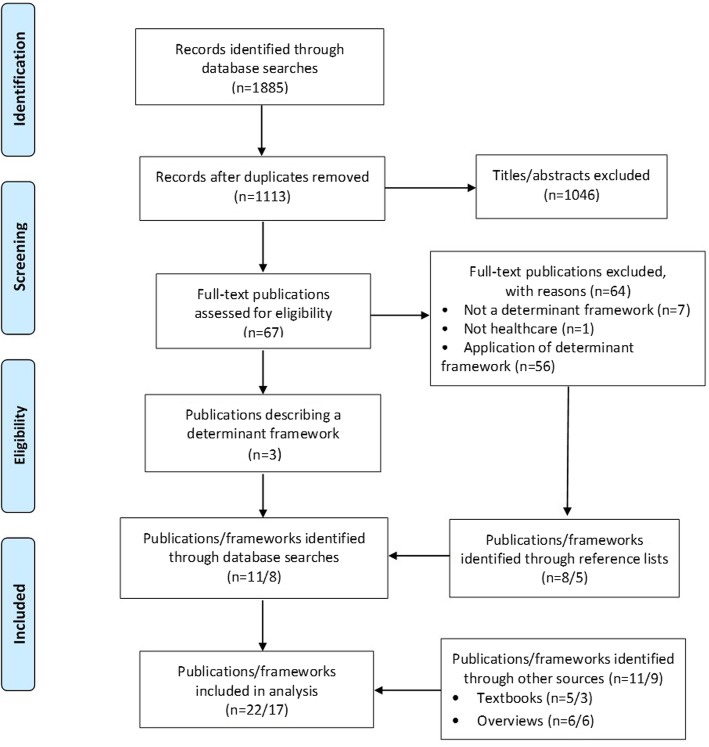
BACKGROUND: The relevance of context in implementation science is reflected in the numerous theories, frameworks, models and taxonomies that have been proposed to analyse determinants of implementation (in this paper referred to as determinant frameworks). This scoping review aimed to investigate and map how determinant frameworks used in implementation science were developed, what terms are used for contextual determinants for implementation, how the context is conceptualized, and which context dimensions that can be discerned. METHODS: A scoping review was conducted. MEDLINE and EMBASE were searched from inception to October 2017, and supplemented with implementation science text books and known published overviews. Publications in English that described a determinant framework (theory, model, taxonomy or checklist), of which context was one determinant, were eligible. Screening and inclusion were done in duplicate. Extracted data were analysed to address the study aims. A qualitative content analysis with an inductive approach was carried out concerning the development and core context dimensions of the frameworks. The review is reported according to the PRISMA guidelines. RESULTS: The database searches yielded a total of 1113 publications, of which 67 were considered potentially relevant based on the predetermined eligibility criteria, and retrieved in full text. Seventeen unique determinant frameworks were identified and included. Most were developed based on the literature and/or the developers' implementation experiences. Six of the frameworks explicitly referred to "context", but only four frameworks provided a specific definition of the concept. Instead, context was defined indirectly by description of various categories and sub-categories that together made up the context. Twelve context dimensions were identified, pertaining to different aggregation levels. The most widely addressed context dimensions were organizational support, financial resources, social relations and support, and leadership. CONCLUSIONS: The findings suggest variation with regard to how the frameworks were developed and considerable inconsistency in terms used for contextual determinants, how context is conceptualized, and which contextual determinants are accounted for in frameworks used in implementation science. Common context dimensions were identified, which can facilitate research that incorporates a theory of context, i.e. assumptions about how different dimensions may influence each other and affect implementation outcomes. A thoughtful application of the concept and a more consistent terminology would enhance transparency, simplify communication among researchers, and facilitate comparison across studies.
Overview
The claims and statistics of this paper haven’t been checked yet.
Free: it reads the open-access text and checks the first 5 claims that cite a source we can check. Create a free account to check every claim.
Integrity signals
Registry
Cites
Statistics
Figures
Verification
Claims the paper makes
The claims and statistics of this paper haven’t been checked yet.
Free: it reads the open-access text and checks the first 5 claims that cite a source we can check. Create a free account to check every claim.
Claims other papers make about this one
Each is checked against this paper’s own text: does it say what the citing paper says it does?
The source backs part of the claim, not all of it — or backs it for a different population, condition or comparison.
In the citing paper
“Understanding the end users, in this case, the students, is crucial and is known to facilitate successful implementation.23,24”
From Structured Development of Learning and Assessment Tasks to Prevent Generative AI Misuse and Enhance AI Literacy in the Faculty in Physiotherapy Education (2025) · cites this paper as [24]
Experimental — accuracy not yet measuredThe check wasn’t confident either way, so it gives no verdict — never disputed.
In the citing paper
“This call for hypothesis testing in implementation outcomes research has been echoed by a number of recent papers [21–24].”
From Ten years of implementation outcomes research: a scoping review (2023) · cites this paper as [23]
Experimental — accuracy not yet measured
Self-check
Percentages, sums and reported differences re-computed from the paper’s own numbers.
The self-check needs the paper’s full text.
Citations
Cites
Preferred Reporting Items for Systematic Reviews and Meta-Analyses: the PRISMA statement
Moher, D., Liberati, A., Tetzlaff, J., Altman, D. G., & for the PRISMA Group (2009) · BMJ · doi:10.1136/bmj.b2535 · Cited by 83,823
Preferred Reporting Items for Systematic Reviews and Meta-Analyses: The PRISMA Statement
Moher, D., Liberati, A., Tetzlaff, J., Altman, D. G., & The PRISMA Group (2009) · PLoS Medicine · doi:10.1371/journal.pmed.1000097 · Cited by 64,042 · cited 1×
“for Systematic Reviews and Meta-Analyses (PRISMA) guidelines [20].”
Preferred reporting items for systematic reviews and meta-analyses: the PRISMA Statement.
(2009) · PubMed Central · Cited by 44,859
Scoping studies: towards a methodological framework
Arksey, H., & O'Malley, L. (2005) · International Journal of Social Research Methodology · doi:10.1080/1364557032000119616 · Cited by 36,742
The Ecology of Human Development: Experiments by Nature and Design
Bronfenbrenner, U. (1979) · Harvard University Press eBooks · doi:10.4159/9780674028845 · Cited by 26,084
The qualitative content analysis process
Elo, S., & Kyngäs, H. (2008) · Journal of Advanced Nursing · doi:10.1111/j.1365-2648.2007.04569.x · Cited by 22,617
Wang, G., Ma, R., Qiao, G., Wada, K., Aizawa, Y., & Satoh, T. (2015) · Integrative Medicine International · doi:10.1159/000368408 · Cited by 18,657
Organizational culture and leadership
(1993) · Long Range Planning · doi:10.1016/0024-6301(93)90120-5 · Cited by 16,462
Damschroder, L. J., Aron, D. C., Keith, R. E., Kirsh, S. R., Alexander, J. A., & Lowery, J. C. (2009) · Implementation Science · doi:10.1186/1748-5908-4-50 · Cited by 14,496 · cited 11×
“, 2009 [15] Influences on implementation (outcomes) Based on analysis of the 19 theories, frameworks and models used in implementation science 5 categories (3 relate to contextual influences): • Intervention characteristics • Characteristics of individuals • Process • Inner setting • Outer setting Categories are refer…”
BackgroundMethodInfluentialThe ecology of human development : experiments by nature and design
Bronfenbrenner, U. (1979) · Cited by 12,580
Research works printed but not linked: 7
- Rycroft-Malone J Bucknall T Models and frameworks for implementing evidence-based practice: linking evidence to action 2010 Oxford Wiley-Blackwell
- Rainbird K Sanson-Fisher R Buchan H Identifying barriers to evidence uptake 2006 Melbourne National Institute of Clinical Studies
- World Health Organization (WHO) Identifying and addressing barriers to implementing policy options. In: SURE guides for preparing and using evidence-based policy briefs 2011
- Övretveit J The leaders’ role in quality and safety improvement: a review of the research and guidance 2005 Karolinska Institute Stockholm
- Weick KE The social psychology of organising 1969 Reading, MA Addison-Wesley
- Cappelli P Sherer PD The missing role of context in OB: the need for a meso-level approach Res Organ Behav 1991 13 55 110
- Jordan A Carlile O Stack A Approaches to learning – a guide for teachers 2008 New York Open University Press 1 251
Cited by
Items 701–800 of 1,000
Amuasi, J., Agbogbatey, M., Sarfo, F. S., Beyuo, A., Agasiya, P., Adobasom-Anane, A. G., Newton, S., & Ovbiagele, B. I. (2024) · BMJ Open · doi:10.1136/bmjopen-2024-084584 · Cited by 1
A data-to-value framework for freight ITS: Insights from a living lab
Vanga, R., Thiyagarajan, N., Gelper, S., Maknoon, Y., Duinkerken, M. B., & Tavasszy, L. A. (2024) · Research in Transportation Business & Management · doi:10.1016/j.rtbm.2024.101214 · Cited by 2
Leveraging Systemic Contributors and Adaptations to Sharpen Interventions: The IMPActS Workshop
Balkin, E. M., Maguire, L., Girth, A. M., & Rayo, M. F. (2024) · Proceedings of the Human Factors and Ergonomics Society Annual Meeting · doi:10.1177/10711813241269240 · Cited by 1
“Organizational support is also a critical determinant of implementation success and is included in virtually all published implementation science frameworks (Nilsen & Bernhardsson, 2019).”
Hearld, L. R., Pratt, M. C., Smith, D. L., Parman, M. A., Murphree, R., Michaels, K. P., Woods-Crawford, S., Rana, A., & Matthews, L. T. (2024) · Annals of Epidemiology · doi:10.1016/j.annepidem.2024.10.005 · Cited by 1
Hirsch, E. A., Fathi, J. T., Ciupek, A., & Carter‐Harris, L. (2024) · Implementation Science Communications · doi:10.1186/s43058-024-00658-w · Cited by 1
“Furthermore, dimensions of context are often interdependent, and successful implementation may depend on combinations of contextual factors [4].”
BackgroundA new model for the diagnostic assessment services trajectory for neurodevelopmental conditions
Jacques, C., Rivard, M., Mello, C., Abouzeid, N., Hérault, É., & Saulnier, G. (2024) · Frontiers in Rehabilitation Sciences · doi:10.3389/fresc.2024.1426966 · Cited by 1
Lowry, S., Low, J., Goff, L. M., Irwin, S., Sevdalis, N., Okeke, P., Brady, O., Curran, N., & Walker, A. (2024) · Journal of Human Nutrition and Dietetics · doi:10.1111/jhn.13396 · Cited by 1
“39 The application of EPIS for this purpose offered a useful and heuristic approach to identifying important contextual elements; these will need to be followed by a mapping to implementation support activities to address the contextual factors identi fi ed.”
Kirk, J. W., Nilsén, P., Andersen, O., Stefánsdóttir, N. Þ., Lindstroem, M. B., Powell, B. J., & Tjørnhøj‐Thomsen, T. (2024) · BMC Health Services Research · doi:10.1186/s12913-024-11980-3 · Cited by 1
“Concepts such as context, setting, and environment are frequently used interchangeably in IS [6].”
InfluentialComparative Analysis of Financial Management Models in Developed and Developing Countries
Andhayani, A., Arifin, A. Z., Baihaqi, B., Majid, J., & Fahrudin, F. (2024) · Journal Markcount Finance · doi:10.70177/jmf.v2i2.1284 · Cited by 1
“In terms of financial management, there are striking differences between developed and developing countries(Nilsen & Bernhardsson, 2019).”
Fox, M. T., Butler, J. I., Day, A. M. B., Durocher, E., Dahlke, S., Skinner, M. W., Nowrouzi‐Kia, B., Yamada, J., & Maimets, I. (2025) · PLoS ONE · doi:10.1371/journal.pone.0322138 · Cited by 1
“The implementation plan should be guided by an evidence-based, ecological framework that emphasizes the importance of local context [64].”
Advancing digital equity: a qualitative case study using the Implementation Research Logic Model
Santilli, J., Leedahl, S. N., Juris, J. J., McGregor, C. M., & Liebermann, E. (2026) · Implementation Science Communications · doi:10.1186/s43058-026-00880-8 · Cited by 1
“Ultimately, multiple combinations of variables contributed to the observed outcomes, reflecting the complex, context-dependent nature of evidence-based interventions in real-world settings [78].”
Using implementation science methods in critical care nursing – Part 2: Contextual analysis
Köhler, M., Verweij, L., & Naef, R. (2026) · Intensive and Critical Care Nursing · doi:10.1016/j.iccn.2026.104454 · Cited by 1
Fridell, M., Billsten, J., Holmberg, R. G., & Ivarsson, A. (2020) · Journal of Substance Abuse Treatment · doi:10.1016/j.jsat.2020.108123
Avaliação das estratégias de implementação de guias de prática clínica de alta qualidade
de Vasconcelos, L. P. (2020) · Digital Library of Theses and Dissertations (Universidade de São Paulo) · doi:10.11606/d.5.2020.tde-05072020-131628
Evaluation of a stepwise prevention program for cardiometabolic diseases in primary care
Badenbroek, I. F. (2020) · Utrecht University Repository (Utrecht University) · doi:10.33540/135
Sersli, S. (2020) · Summit (Simon Fraser University)
Lilja, J. L., Kimber, B., Eriksson, C. C.-G., Henriksson, B., & Skoog, T. (2021) · Frontiers in Psychiatry · doi:10.3389/fpsyt.2021.578048
“Another important aspect that influences implementation is the context and the frameworks within which an implementation is sanctioned (2, 10).”
BackgroundTaylor, N. J., Long, J. C., Gaff, C., North, K. N., Braithwaite, J., & Best, S. (2021) · Research Square · doi:10.21203/rs.3.rs-842219/v1
Methodological challenges of complex proactive primary care programs for older people
Smit, A. C. (2021) · Utrecht University Repository (Utrecht University) · doi:10.33540/837
Xiong, S., Abdi, H. I., Ghebre, R. G., Kulasingam, S., Lazovich, D., Mason, S. M., & Pratt, R. J. (2021) · Research Square · doi:10.21203/rs.3.rs-798142/v1
Phenix Dairy, group on stage at Uptown Theater, no. 815; Dairy
Studios, B. B. (1935)
Comparison of Mount Saint Helens Volcanic Eruption to a Nuclear Explosion.
Gould, K. E. (1981)
Oenze aigen bult dor in die vlakke polder: Een studie naar de geslotenheid van de Urker gemeenschap
van der Gaag, M. (2009) · Utrecht University Repository (Utrecht University) · Cited by 1
Patient-centred Care and Integration
Kaehne, A. (2022) · Emerald Group Publishing Limited eBooks · doi:10.1108/978-1-80117-978-220221012
Adolescent hookah pipe use: Comparing users’ and non-users’ harm perception, needs, and motivation
Kader, Z., Crutzen, R., & Roman, N. V. (2022) · Journal of Psychology in Africa · doi:10.1080/14330237.2022.2027631
“…may provide valuable insights on relevant solutions to reduce the phenomenon of hookah pipe use among South African adolescents, leading to their improved physical and mental health, minimising the country’s burden of substance use, and promote healthier lifestyles (Nilsen & Bernhardsson, 2019) .”
BackgroundDevelopment and validation of a nursing instrument for triage in occupational health services
Hall, B. S. C., Caribé, J. D. S., Viterbo, L. M. F., Vidal, D. G., & Katia, N. (2020) · ESPACIOS · doi:10.48082/espacios-a20v41n45p21
“The workplace has to be seen as a potential setting to develop several health problems including orthopaedic and mental disorders (Nilsen & Bernhardsson, 2019).”
BackgroundFrameworks and Methods for Implementing Interventions
Sidani, S., & Braden, C. J. (2021) · Wiley eBooks · doi:10.1002/9781119610113.ch16
Obstetric Telephone Triage: Development & Evaluation
Engeltjes, B. (2022) · doi:10.5463/thesis.32
Academic Systems-Based Practice: The Knack and How to Get It
Aron, D. C. (2023) · Springer eBooks · doi:10.1007/978-3-031-19535-8_15
O'BRIEN, A. (2023) · Cronfa (Swansea University) · doi:10.23889/suthesis.63004
Kokole, D. (2023) · Research Publications (Maastricht University) · doi:10.26481/dis.20230502dk
Williams, S. (2023) · Queensland University of Technology · doi:10.5204/thesis.eprints.239485
Roncelli, E. (2023) · Research Square · doi:10.21203/rs.3.rs-2928009/v1
A primer to implementation science and potential applications to precision medicine
Hearld, L. R. (2023) · Elsevier eBooks · doi:10.1016/b978-0-12-824010-6.00064-2
ครุฑางคะ, ก., & ว่องวาณิช, ส. (2019) · Chula Digiverse · doi:10.58837/chula.the.2019.1169
Rhoten, B. A., Jones, A. C., Maxwell, C. A., & Stolldorf, D. P. (2023) · Journal for Healthcare Quality · doi:10.1097/jhq.0000000000000406
“44 As the decision-makers for the distribution of organizational resources, leadership buy-in and support of MedRec initiatives are crucial for long-term sustainability.”
BackgroundOry, M. G., Lee, S., Alonzo, J. P., Dahlke, D. V., Pardo, N. E., & Smith, M. L. (2023) · Evaluation & the Health Professions · doi:10.1177/01632787231211920
“Contextual factors for implementing a strategy or intervention in a healthcare setting include a broad scope of characteristics of settings and circumstances of implementation (Nilsen & Bernhardsson, 2019).”
BackgroundKalseth, J., & Kaspersen, S. L. (2023) · Magma · doi:10.23865/magma.v26.1422
Xiong, S., Klesges, L. M., Doering, M. M., & Pratt, R. J. (2023) · BMJ Open · doi:10.1136/bmjopen-2023-078212
Experts' Opinions on Aging and Public Health
Ory, M. G., & Smith, M. L. (2024) · Frontiers research topics · doi:10.3389/978-2-8325-4287-3
Developing organizational context adjustments in project-based organizations (part 2)
Алондериене, Р., & Бусеро, А. (2023) · Управление проектами и программами · doi:10.36627/2075-1214-2023-4-4-254-269
Juskevicius, L. F. (2022) · Digital Library of Theses and Dissertations (Universidade de São Paulo) · doi:10.11606/t.7.2022.tde-08022024-175802
Bouma, S. E. (2024) · University of Groningen research database (University of Groningen / Centre for Information Technology) · doi:10.33612/diss.910418216
Mody, A., Filiatreau, L. M., Goss, C. W., Powell, B. J., & Geng, E. (2023) · Figshare · doi:10.6084/m9.figshare.24883601
Taylor, N. J., McKay, S., Long, J. C., Gaff, C., North, K. N., Braithwaite, J., Francis, J., & Best, S. (2023) · Figshare · doi:10.6084/m9.figshare.23722278
Taylor, N. J., McKay, S., Long, J. C., Gaff, C., North, K. N., Braithwaite, J., Francis, J., & Best, S. (2023) · Figshare · doi:10.6084/m9.figshare.23722275
Knowledge Implementation and Dissemination
Stevens, B., Swift, A., & Harrison, D. M. (2024) · Wiley eBooks · doi:10.1002/9781119645641.ch16
Dellabarca, P. (2024) · Open Access Victoria University of Wellington | Te Herenga Waka (Figshare) · doi:10.26686/wgtn.26036188
Puma, J. E., LaRocca, D., Risendal, B., & Leiferman, J. A. (2024) · Children and Youth Services Review · doi:10.1016/j.childyouth.2024.107850 · Cited by 1
Corcuff, M., Routhier, F., & Lamontagne, M. (2024) · medRxiv · doi:10.1101/2024.09.17.24313810
“Secondly, Nilsen and Bernhardsson [45] have demonstrated the importance of taking context into account to properly implement an intervention.”
MacPherson, H. A., Chou, T., DeMartino, E., Velotta, S. K., Elwy, A. R., & Wolff, J. C. (2024) · Cognitive and Behavioral Practice · doi:10.1016/j.cbpra.2024.08.005 · Cited by 1
Strategies for Implementing a Public Health Model for Adolescent Mental Health
Maerlender, A., Bray, P. G., & Wimpelberg, R. K. (2024) · Springer eBooks · doi:10.1007/978-3-031-68294-0_5
Jeter, E., Bacon, C. T., Johnson, R., Lane, H., & Randolph, S. D. (2024) · Community Health Equity Research & Policy · doi:10.1177/2752535x241305455
Organization Theory for Implementation Science (OTIS): reflections and recommendations
Birken, S. A., Baloh, J., Kegler, M. C., Huang, T. T. ‐., Lee, M., Adsul, P., Ryan, G. W., Peluso, A., Wagi, C. R., Randazzo, A., et al. (2024) · Frontiers in Health Services · doi:10.3389/frhs.2024.1449253
From the ‘what, so what, now what’ to the ‘what works, for who and why?’
Lockwood, P. (2024) · Radiography Open · doi:10.7577/radopen.6136
Paratore, S. K., Buchanan, K., Perrella, S. L., & Bayes, S. J. (2025) · ABREAST Conference · doi:10.3390/proceedings2025112019
“Additionally, the WAHPR represents a practice change, and it is well known that in healthcare, myriad “context readiness” challenges can hinder the successful implementation of changes such as this [2].”
Ishii, K., Takemura, Y., & Kitamura, A. (2025) · Journal of Nursing Management · doi:10.1155/jonm/6080964
“Te characteristics of the group in which the EBP is implemented, such as organizational climate and workplace environment, also relate to the implementation of EBPs [15–17].”
A continuity of midwifery care research mission, vision and agenda
Kuipers, Y., Aitken, Á., Jenkins, H., Hardie, K., & Corrigan, A. E. (2026) · BMC Health Services Research · doi:10.1186/s12913-026-14914-3
“Furthermore, there is limited evidence regarding the moderating or mediating effects of specific contextual factors and determinants on the successful implementation of a CMC research strategy, which impedes the effective integration of CMC policy, practice and science [8, 9].”
Dharni, N., Latuszynska, A., Dann, S.-A., Johns, N., Currie, G., & Kenyon, S. L. (2025) · Implementation Science Communications · doi:10.1186/s43058-025-00710-3
“Research recognises the role of both organisational and leadership support as key enablers of implementation context [15, 21–24].”
The Power of the Consumer Voice in Knowledge Translation of Deprescribing
Ailabouni, N. J., Terrill, B., & Freeman, C. R. (2025) · Advanced clinical pharmacy - research, development and practical applications/Advanced clinical pharmacy - research, development and practical applications · doi:10.1007/978-3-031-77314-3_5 · Cited by 1
The Wicked Problem of Context in Clinical Practice and Implementation Research
Aron, D. C. (2025) · Journal of Evaluation in Clinical Practice · doi:10.1111/jep.70120
Gap Analysis of Clinical Establishment Act Implementation in India and Assam: A Retrospective Study
Pallathadka, H., Roy, P. D., & Chowdhury, S. S. (2025) · Integrated Journal for Research in Arts and Humanities · doi:10.55544/ijrah.5.3.6
Melby, L. M. H., Anthun, K. S., & Toussaint, P. J. (2025) · Health Informatics Journal · doi:10.1177/14604582251344839
“8,12 By investigating such factors and their relationship at various stages of the implementation process, such as during the stage of preparation or pre-implementation, go-live or implementation, and sustainability, 13 we can get a better understanding of each of these stages.”
Lee, C. (2025) · Elsevier eBooks · doi:10.1016/b978-0-323-90391-2.00057-9
Lemmen, J., Mageto, S. N., Vik, T. A., Olbara, G., Kaspers, G. J. L., & Njuguna, F. M. (2025) · BMJ Open · doi:10.1136/bmjopen-2024-096741
Meyer, C., Schnitker, L., Appannah, A., Laver, K., O’Keefe, F., & Lowthian, J. A. (2025) · Dementia · doi:10.1177/14713012251356007
“The relevance of context for successful implementation is re fl ected in many frameworks and theories, including the IFAC, conceptualised at the micro, meso and macro levels (Nilsen & Bernhardsson, 2019).”
Tibane, C. C., Mafa-Theledi, O. N., Masebe, T., & Mathye, P. (2025) · International Journal of Learning Teaching and Educational Research · doi:10.26803/ijlter.24.7.10 · Cited by 1
Corcuff, M., Routhier, F., & Lamontagne, M. (2025) · Cities · doi:10.1016/j.cities.2025.106238
Aitken, E., Vindrola‐Padros, C., Hall, N., & collaborators, T. A. S. (2025) · Trials · doi:10.1186/s13063-025-08945-0
“Many interventions fail despite well-developed plans for execution because contextual factors can be powerful forces acting against real-world implementation [25].”
A knowledge translation perspective on improving adherence to removable appliances in adolescents
Tiwari, A., Perez-Garcia, A., & Flores‐Mir, C. (2025) · Seminars in Orthodontics · doi:10.1053/j.sodo.2025.07.014 · Cited by 1
Morse, B., Trinkley, K. E., Hoppe, J. A., Wagner, N. M., Tolle, H., Kautz, S. V., Bookman, K. J., Schilling, L. M., Henry, S. G., & Kwan, B. M. (2025) · Research Square · doi:10.21203/rs.3.rs-7236339/v1
Khan, M. H., Rasheed, W., Javed, H. A., & Anwar, H. M. (2025) · Pakistan Journal of Humanities and Social Sciences · doi:10.52131/pjhss.2025.v13i2.2860
Schouten, H. (2025) · doi:10.5463/thesis.1226
Relational factors influencing implementation in aged care: a literature review
Windle, A., Harvey, G., & Davy, C. P. (2025) · International Journal of Evidence-Based Healthcare · doi:10.1097/xeb.0000000000000523
Opening the Black Box: A Causal Pathway Methodology for Precise Implementation Strategy DesignPreprint
Pouzols, S., Raisaro, J. L., & Mabire, C. (2025) · Research Square · doi:10.21203/rs.3.rs-7396236/v1
Assessing PRISM context domains and RE-AIM outcomes: data from use of the iterative PRISM webtool
Glasgow, R. E., Ford, B. S., Ying, J., Rodriguez, C., Rabin, B. A., & Trinkley, K. E. (2026) · Implementation Science Communications · doi:10.1186/s43058-026-00982-3
“While TMFs are used in the majority of IS papers and grants, these applications seldom if ever include data on relationships among constructs within the TMF [1, 9, 12, 27].”
Evaluating rural/urban HPV vaccine completion rates in Iowa after the COVID-19 pandemic
Schaefer, D., & Semprini, J. (2026) · Research Connections · doi:10.1093/rescon/vmag091
Nodora, J., Gupta, S., Hurst, S., James, A. S., & Rabin, B. A. (2025) · Frontiers in Public Health · doi:10.3389/fpubh.2025.1617770
Implementation Science in Breast Reconstruction: A Guide to Closing the Research-to-practice Gap
Saikali, L. M., Mulugeta‐Gordon, L., & Azoury, S. C. (2025) · Plastic & Reconstructive Surgery Global Open · doi:10.1097/gox.0000000000007241 · Cited by 1
Training on Community Organizing to Support a Citywide Violence Prevention Initiative: A Case Study
Blackburn, N. A., Graham, P., Dorsainvil, M., Ramos, S., Ridenour, T. A., Yaros, A., Anyanwu, O., Fields-Johnson, D., & Johnson‐Lawrence, V. (2025) · Global Implementation Research and Applications · doi:10.1007/s43477-025-00196-0
“First, PRISM and RE-AIM provided an overall guiding evaluation framework including identifying and describing contextual influences as well as implementation (Nilsen & Bernhardsson, 2019).”
Diotte, F., Genest, C., Nemeh, R., Payant, A., Thomas, H., Arif, I., Tibbo, P. G., Spidel, A., Roy, M., Livet, A., et al. (2025) · Journal of Mental Health · doi:10.1080/09638237.2025.2595611
“…of the work context, and therefore of social norms (e.g.: the usage of a tool and access to adequate support from colleagues or managers, the reality of workers, the relevance of the protocol, etc.), when trying to implement new protocols (Nilsen and Bernhardsson, 2019; Spooner et al., 2018).”
Pragmatic Application of Implementation Science in Filipino Healthcare Environments.
Evangelista, L. S., Serafica, R. C., Reyes, A. T., Cacciata, M. C., Leyva, E. W. A., & Kawi, J. (2025) · PubMed
Tibane, C. C., & Mafa-Theledi, O. N. (2025) · Education and human development · doi:10.5772/intechopen.1008842
Xiong, B., Bailey, D. X., Stirling, C., Prudon, P., & Martin‐Khan, M. (2025) · Nursing Reports · doi:10.3390/nursrep15120428
“It involves establishing referral networks between health and social services [32], fostering community-academic partnerships [33], and gaining access to regional data warehouses or membership in integrated healthcare systems [34,35].”
Lorenzen, J. T., Carlsen, S., Klinker, C. D., & Christensen, J. H. (2025) · BMC Public Health · doi:10.1186/s12889-025-25879-z
“In the coding of contextual influences on PA promotion we applied a deductive approach, drawing on Nilsen and Bernhardsson’s 12 context dimensions, identified in a review of frameworks describing contextual determinants for implementation [35].”
van Tuijl, A. A. C., Wollersheim, H. C. H., Fluit, C. R. M. G., van Gurp, P. J., & Calsbeek, H. (2020) · Figshare · doi:10.6084/m9.figshare.13142197
Sarkies, M., Long, J. C., Pomare, C., Wu, W., Clay‐Williams, R., Nguyen, H. M., Francis‐Auton, E., Westbrook, J., Lévesque, J., Watson, D. E., et al. (2020) · Figshare · doi:10.6084/m9.figshare.13126752
Kerins, C., McHugh, S., McSharry, J., Reardon, C. M., Hayes, C., Perry, I. J., Geaney, F., Seery, S., & Kelly, C. (2020) · Figshare · doi:10.6084/m9.figshare.12135000
Mielke, J., Brunkert, T., Zúñiga, F., Simon, M., Zullig, L. L., & De Geest, S. (2024) · Figshare · doi:10.6084/m9.figshare.26554382
Haines, E. R., Dopp, A. R., Lyon, A. R., Witteman, H. O., Bender, M., Vaisson, G., Hitch, D., & Birken, S. A. (2021) · Figshare · doi:10.6084/m9.figshare.14490557
Harkko, J., Sipilä, N., Nordquist, H., Lallukka, T. M., Appelqvist‐Schmidlechner, K., Donnelly, M., & Kouvonen, A. M. (2024) · Figshare · doi:10.6084/m9.figshare.26637918
Piat, M., Wainwright, M., Cherkas, D., LeBlanc, S., Sofouli, E., Rivest, M.-P., Albert, H., Casey, R., O’Rourke, J. J., & Labonté, L. (2021) · Figshare · doi:10.6084/m9.figshare.16625620
Coumoundouros, C., Farrand, P. A., Hamilton, A., von Essén, L., Sanderman, R., & Woodford, J. (2023) · Figshare · doi:10.6084/m9.figshare.22610470
Movsisyan, A., Arnold, L., Copeland, L., Evans, R., Littlecott, H., Moore, G., O’Cathain, A., Pfadenhauer, L., Segrott, J., & Rehfuess, E. (2021) · Figshare · doi:10.6084/m9.figshare.13724973
Sarkies, M., Long, J. C., Pomare, C., Wu, W., Clay‐Williams, R., Nguyen, H. M., Francis‐Auton, E., Westbrook, J., Lévesque, J., Watson, D. E., et al. (2020) · Figshare · doi:10.6084/m9.figshare.13126749
Granberg, A., Matérne, M., Lundqvist, L.-O., & Duberg, A. (2021) · Figshare · doi:10.6084/m9.figshare.14767392
Metadata
- Authors
- Nilsen, P., & Bernhardsson, S.
- Affiliations
- Region Västra Götaland (SE)
- Corresponding author
- Bernhardsson, Susanne
- Venue
- BMC Health Services Research
- Published
- 2019-03-25
- Volume
- 19
- Issue
- 1
- Pages
- 189-189
- ISSN
- 1472-6963 (ISSN-L)
- PMC
- PMC6432749
- OpenAlex
- W2941268450
- Semantic Scholar
- 5761696aebadd7dde4d180778d844b700aefb54f
- Cited by
- 1,014
- References
- 111
- Citations by year
- 2026: 142 · 2025: 129 · 2024: 217 · 2023: 176 · 2022: 150 · 2021: 121 · 2020: 65 · 2019: 10
- FWCI
- 15.85
- Type
- journal article
- Language
- en
- Open access
- gold
- doi.org
- Licence
- cc-by
- creativecommons.org/licenses/by/4.0/ (tdm)
- Locations
- BMC Health Services Research (publishedVersion, cc-by)
- Europe PMC (PubMed Central) (publishedVersion, other-oa)
- PubMed Central (publishedVersion, cc-by)
- PubMed (publishedVersion)
- KTH Publication Database DiVA (KTH Royal Institute of Technology) (submittedVersion, other-oa)
- DOAJ (DOAJ: Directory of Open Access Journals) (submittedVersion, cc-by-sa)
- NORA - Norwegian Open Research Archives (submittedVersion, cc-by)
- Topics
- Health Sciences › Health Professions › General Health Professions › Health Policy Implementation Science
- Health Sciences › Health Professions › General Health Professions › Health Sciences Research and Education
- Health Sciences › Medicine › Public Health, Environmental and Occupational Health › Clinical practice guidelines implementation
- Keywords
- implementation context, contextual factors, implementation outcomes, organizational support, leadership, financial resources, interpersonal relationships, terminology consistency
- MeSH terms
- Implementation Science, Leadership, Evidence-Based Practice
About these checks
Registry, retraction, Cites and statistics results are computed, not judged, with one exception: a printed reference that no index lists is read once by a model before it counts as a citation error. Claims are extracted by a model and kept only when their quote appears verbatim in the text; each cited source is then checked, with a model’s help, for whether it says what the claim relies on. Those verdicts can be wrong — read the claim’s quote and the cited source before relying on one.
Statistics and arithmetic are recomputed, not judged.
Confidence bands are shown only for fields calibrated on our annotated test set. None is calibrated yet, so no band is shown.
What counts as a claim ›How we measure confidence ›How we check this ›
Are you an author, or do you see a problem with this page? Request a review
Data sources
Bibliographic data: Semantic Scholar, OpenAlex, Crossref.
Contains information from the Semantic Scholar Academic Graph Datasets, made available under the ODC Attribution License (ODC-BY 1.0).
Semantic Scholar’s data is described in: Kinney, R., et al. (2023). The Semantic Scholar Open Data Platform. arXiv:2301.10140.
