

Context matters in implementation science: a scoping review of determinant frameworks that describe contextual determinants for implementation outcomes
Open accessThe DOI matches its Crossref record; 110 of the 111 references it cites were found in a registry or an index.
Abstract
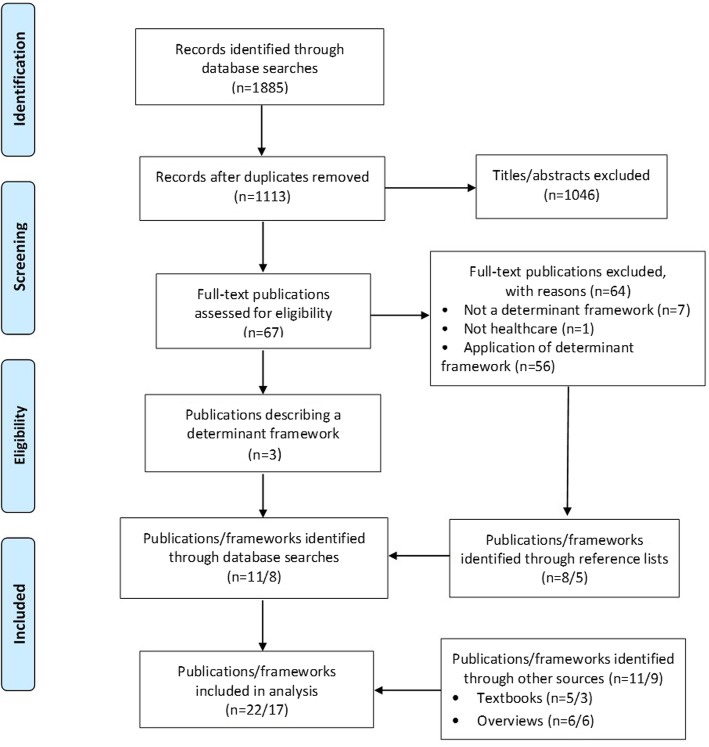
BACKGROUND: The relevance of context in implementation science is reflected in the numerous theories, frameworks, models and taxonomies that have been proposed to analyse determinants of implementation (in this paper referred to as determinant frameworks). This scoping review aimed to investigate and map how determinant frameworks used in implementation science were developed, what terms are used for contextual determinants for implementation, how the context is conceptualized, and which context dimensions that can be discerned. METHODS: A scoping review was conducted. MEDLINE and EMBASE were searched from inception to October 2017, and supplemented with implementation science text books and known published overviews. Publications in English that described a determinant framework (theory, model, taxonomy or checklist), of which context was one determinant, were eligible. Screening and inclusion were done in duplicate. Extracted data were analysed to address the study aims. A qualitative content analysis with an inductive approach was carried out concerning the development and core context dimensions of the frameworks. The review is reported according to the PRISMA guidelines. RESULTS: The database searches yielded a total of 1113 publications, of which 67 were considered potentially relevant based on the predetermined eligibility criteria, and retrieved in full text. Seventeen unique determinant frameworks were identified and included. Most were developed based on the literature and/or the developers' implementation experiences. Six of the frameworks explicitly referred to "context", but only four frameworks provided a specific definition of the concept. Instead, context was defined indirectly by description of various categories and sub-categories that together made up the context. Twelve context dimensions were identified, pertaining to different aggregation levels. The most widely addressed context dimensions were organizational support, financial resources, social relations and support, and leadership. CONCLUSIONS: The findings suggest variation with regard to how the frameworks were developed and considerable inconsistency in terms used for contextual determinants, how context is conceptualized, and which contextual determinants are accounted for in frameworks used in implementation science. Common context dimensions were identified, which can facilitate research that incorporates a theory of context, i.e. assumptions about how different dimensions may influence each other and affect implementation outcomes. A thoughtful application of the concept and a more consistent terminology would enhance transparency, simplify communication among researchers, and facilitate comparison across studies.
Overview
The claims and statistics of this paper haven’t been checked yet.
Free: it reads the open-access text and checks the first 5 claims that cite a source we can check. Create a free account to check every claim.
Integrity signals
Registry
Cites
Statistics
Figures
Verification
Claims the paper makes
The claims and statistics of this paper haven’t been checked yet.
Free: it reads the open-access text and checks the first 5 claims that cite a source we can check. Create a free account to check every claim.
Claims other papers make about this one
Each is checked against this paper’s own text: does it say what the citing paper says it does?
The source backs part of the claim, not all of it — or backs it for a different population, condition or comparison.
In the citing paper
“Understanding the end users, in this case, the students, is crucial and is known to facilitate successful implementation.23,24”
From Structured Development of Learning and Assessment Tasks to Prevent Generative AI Misuse and Enhance AI Literacy in the Faculty in Physiotherapy Education (2025) · cites this paper as [24]
Experimental — accuracy not yet measuredThe check wasn’t confident either way, so it gives no verdict — never disputed.
In the citing paper
“This call for hypothesis testing in implementation outcomes research has been echoed by a number of recent papers [21–24].”
From Ten years of implementation outcomes research: a scoping review (2023) · cites this paper as [23]
Experimental — accuracy not yet measured
Self-check
Percentages, sums and reported differences re-computed from the paper’s own numbers.
The self-check needs the paper’s full text.
Citations
Cites
Preferred Reporting Items for Systematic Reviews and Meta-Analyses: the PRISMA statement
Moher, D., Liberati, A., Tetzlaff, J., Altman, D. G., & for the PRISMA Group (2009) · BMJ · doi:10.1136/bmj.b2535 · Cited by 83,823
Preferred Reporting Items for Systematic Reviews and Meta-Analyses: The PRISMA Statement
Moher, D., Liberati, A., Tetzlaff, J., Altman, D. G., & The PRISMA Group (2009) · PLoS Medicine · doi:10.1371/journal.pmed.1000097 · Cited by 64,042 · cited 1×
“for Systematic Reviews and Meta-Analyses (PRISMA) guidelines [20].”
Preferred reporting items for systematic reviews and meta-analyses: the PRISMA Statement.
(2009) · PubMed Central · Cited by 44,859
Scoping studies: towards a methodological framework
Arksey, H., & O'Malley, L. (2005) · International Journal of Social Research Methodology · doi:10.1080/1364557032000119616 · Cited by 36,742
The Ecology of Human Development: Experiments by Nature and Design
Bronfenbrenner, U. (1979) · Harvard University Press eBooks · doi:10.4159/9780674028845 · Cited by 26,084
The qualitative content analysis process
Elo, S., & Kyngäs, H. (2008) · Journal of Advanced Nursing · doi:10.1111/j.1365-2648.2007.04569.x · Cited by 22,617
Wang, G., Ma, R., Qiao, G., Wada, K., Aizawa, Y., & Satoh, T. (2015) · Integrative Medicine International · doi:10.1159/000368408 · Cited by 18,657
Organizational culture and leadership
(1993) · Long Range Planning · doi:10.1016/0024-6301(93)90120-5 · Cited by 16,462
Damschroder, L. J., Aron, D. C., Keith, R. E., Kirsh, S. R., Alexander, J. A., & Lowery, J. C. (2009) · Implementation Science · doi:10.1186/1748-5908-4-50 · Cited by 14,496 · cited 11×
“, 2009 [15] Influences on implementation (outcomes) Based on analysis of the 19 theories, frameworks and models used in implementation science 5 categories (3 relate to contextual influences): • Intervention characteristics • Characteristics of individuals • Process • Inner setting • Outer setting Categories are refer…”
BackgroundMethodInfluentialThe ecology of human development : experiments by nature and design
Bronfenbrenner, U. (1979) · Cited by 12,580
Research works printed but not linked: 7
- Rycroft-Malone J Bucknall T Models and frameworks for implementing evidence-based practice: linking evidence to action 2010 Oxford Wiley-Blackwell
- Rainbird K Sanson-Fisher R Buchan H Identifying barriers to evidence uptake 2006 Melbourne National Institute of Clinical Studies
- World Health Organization (WHO) Identifying and addressing barriers to implementing policy options. In: SURE guides for preparing and using evidence-based policy briefs 2011
- Övretveit J The leaders’ role in quality and safety improvement: a review of the research and guidance 2005 Karolinska Institute Stockholm
- Weick KE The social psychology of organising 1969 Reading, MA Addison-Wesley
- Cappelli P Sherer PD The missing role of context in OB: the need for a meso-level approach Res Organ Behav 1991 13 55 110
- Jordan A Carlile O Stack A Approaches to learning – a guide for teachers 2008 New York Open University Press 1 251
Cited by
Items 101–200 of 1,000
Eboreime, E., Shalaby, R., Mao, W., Owusu, E., Vuong, W., Surood, S., Bales, K., MacMaster, F. P., McNeil, D. C., Rittenbach, K., et al. (2022) · BMC Health Services Research · doi:10.1186/s12913-022-07510-8 · Cited by 34
“Implementation context is “the set of circumstances or unique factors that surround a particular implementation effort” [38], while implementation outcomes are “effects of deliberate and purposive actions to implement new treatments, practices, and services” [39].”
BackgroundPike, A. E., Patey, A. M., Lawrence, R., Aubrey‐Bassler, K., Grimshaw, J., Mortazhejri, S., Dowling, S. K., Jasaui, Y., Bhatia, S., Duquettes, D., et al. (2022) · BMC Family Practice · doi:10.1186/s12875-022-01751-6 · Cited by 31
“BMC Primary Care (2022) 23:143 In addition, none of the studies completed to date are tied to the local context, widely considered responsible for study-to-study variation in the outcomes of implementation interventions [32].”
BackgroundLowenthal, E. D., Chapman, J., Ohrenschall, R., Calabrese, K., Baltrusaitis, K., Heckman, B. E., Yin, D. E., Agwu, A. L., Harrington, C. M., Solingen-Ristea, R. M. V., et al. (2024) · The Lancet HIV · doi:10.1016/s2352-3018(23)00301-6 · Cited by 32
Siira, E., Tyskbo, D., & Nygren, J. (2024) · BMC Primary Care · doi:10.1186/s12875-024-02516-z · Cited by 29
“…factors influencing implementation outcomes have highlighted that while sufficient financial resources and time availability are favourable conditions for implementation, their effectiveness is greatly enhanced when combined with supportive leadership and positive social relations [35, 36].”
BackgroundAlexander, P., Antony, J., & Cudney, E. A. (2021) · Total Quality Management & Business Excellence · doi:10.1080/14783363.2021.1945434 · Cited by 29
“The framework also considers the environmental context, which is relevant in practical circumstances (Nilsen & Bernhardsson, 2019).”
BackgroundAment, S. M. C., van den Broek, L. M., Everdingen, M. H. J. V. D. B.-V., Boyne, J. J., Maessen, J. M. C., Bekkers, S. C. A. M., Bellersen, L., Rocca, H. B., Engels, Y., & Janssen, D. J. A. (2022) · BMC Palliative Care · doi:10.1186/s12904-021-00896-y · Cited by 32
“Strengths and weaknesses An important strength of this study is the use of the evidence-based CFIR framework which is specific and detailed concerning contextual implementation determinants [21, 46].”
MethodThomas, A., Rochette, A., George, C., Iqbal, M. Z., Ataman, R., St‐Onge, C., Boruff, J. T., & Renaud, J. (2023) · Journal of Continuing Education in the Health Professions · doi:10.1097/ceh.0000000000000490 · Cited by 30
“87 More speci fi cally, we iden-ti fi ed fi ve main themes that seem to encompass all the characteristics of context: Leadership and Agency, Values, Supports, Policies, and Demands.”
BackgroundTransforming Team Performance Through Reimplementation of the Surgical Safety Checklist
Etheridge, J. C., Moyal‐Smith, R., Yong, T. T., Lim, S. R., Sonnay, Y., Lim, C., Tan, H. K., Brindle, M. E., & Havens, J. M. (2023) · JAMA Surgery · doi:10.1001/jamasurg.2023.5400 · Cited by 31
Chronic low back pain beliefs and management practices in Africa: Time for a rethink?
Ampiah, J. A., Moffatt, F., Diver, C. J., & Ampiah, P. K. (2019) · Musculoskeletal Care · doi:10.1002/msc.1424 · Cited by 28
Pfadenhauer, L. M. (2021) · International Journal of Health Policy and Management · doi:10.34172/ijhpm.2021.147 · Cited by 33
“1 While spatial aspects such as location and proximity emerged as critical in public health informed by complexity theory, 2,10,13 it has been less frequently taken up by determinant FMTs on implementation in healthcare.”
BackgroundA codesigned fit‐for‐purpose implementation framework for aged care
Meyer, C., Ogrin, R., Golenko, X., Cyarto, E., Paine, K., Walsh, W., Hutchinson, A. M., & Lowthian, J. A. (2022) · Journal of Evaluation in Clinical Practice · doi:10.1111/jep.13660 · Cited by 29
“Two recent reviews highlighted the challenge of defining and measuring context, with 12 dimensions crossing micro (individual), meso (organization) and macro (broader aged care landscape) levels.(26,36) A standardized approach to context mapping for the IFAC expands on the RAPT model components of alignment (i.”
BackgroundBaumann, A. A., Woodward, E. N., Singh, R. S., Adsul, P., & Shelton, R. C. (2022) · BMC Health Services Research · doi:10.1186/s12913-022-07882-x · Cited by 30
“There are preliminary guides to measuring context in D&I research [32], with some focused on equity [7].”
BackgroundHubeishy, M. H., Rolving, N., Poulsen, A. G., Jensen, T. S., & Rossen, C. B. (2022) · Disability and Rehabilitation · doi:10.1080/09638288.2022.2157501 · Cited by 31
“Thus, in order to attain successful implementation, it is of utmost importance that we identify the local barriers to implementing the guidelines by particular groups of health professionals [38,39].”
BackgroundVitorino, M. L., Henriques, M. A., Melo, G., & Henriques, H. R. (2025) · Intensive and Critical Care Nursing · doi:10.1016/j.iccn.2025.103976 · Cited by 31
Bouckley, T., Peiris, D., Nambiar, D., Mishra, S., Sood, T., Purwar, P., Elshaug, A. G., Landon, B. E., Pearson, S.-A., Huckel Schneider, C., et al. (2025) · International Journal for Equity in Health · doi:10.1186/s12939-025-02436-z · Cited by 22
“How determinants are considered should depend on the reform initiative, priorities, and context, which has been extensively detailed by others [32, 44, 47].”
Hald, A. N., Bech, M., & Burau, V. (2021) · Health Policy · doi:10.1016/j.healthpol.2021.01.007 · Cited by 27
Ethnography and user-centered design to inform context-driven implementation
Haines, E. R., Kirk, M. A., Lux, L., Smitherman, A. B., Powell, B. J., Dopp, A. R., Stover, A. M., & Birken, S. A. (2021) · Translational Behavioral Medicine · doi:10.1093/tbm/ibab077 · Cited by 34
Using an implementation science framework to advance the science of nursing education
Oermann, M. H., Reynolds, S. S., & Granger, B. B. (2022) · Journal of Professional Nursing · doi:10.1016/j.profnurs.2022.01.014 · Cited by 29
Vandervelde, S., den Bosch, N. V., Vlaeyen, E., de Casterlé, B. D., Flamaing, J., Belaen, G., Tuand, K., Vandendriessche, T., & Milisen, K. (2024) · Age and Ageing · doi:10.1093/ageing/afae123 · Cited by 30
Markey, K., MacFarlane, A. E., & Manning, M. (2023) · Journal of Advanced Nursing · doi:10.1111/jan.15821 · Cited by 26
Perry, A., Waterman, M. G., Dale, V., Moore, K., & House, A. O. (2021) · EClinicalMedicine · doi:10.1016/j.eclinm.2020.100702 · Cited by 26
Aerts, N., Anthierens, S., Bogaert, P. V., Peremans, L., & Bastiaens, H. (2022) · International Journal of Environmental Research and Public Health · doi:10.3390/ijerph19148467 · Cited by 30
Pilar, M. R., Jost, E., Walsh‐Bailey, C., Powell, B. J., Mazzucca, S., Eyler, A. A., Purtle, J., Allen, P. M., & Brownson, R. C. (2022) · Implementation Research and Practice · doi:10.1177/26334895221141116 · Cited by 30
“Also known as barriers, obstacles, enablers, or facilitators (Nilsen & Bernhardsson, 2019), we refer to these multi-level constructs as “policy determinants.””
BackgroundA novel framework to guide antibiotic stewardship nursing practice
Manning, M. L., Pogorzelska‐Maziarz, M., Hou, C. M., Vyas, N. M., Kraemer, M., Carter, E. J., & Monsees, E. (2021) · American Journal of Infection Control · doi:10.1016/j.ajic.2021.08.029 · Cited by 25
Implementing PrEP Services in Diverse Health Care Settings
Faro, E. Z., Mantell, J. E., Gonzalez-Argoti, T., Hoffman, S., Edelstein, Z. R., Tsoi, B. W., & Bauman, L. J. (2022) · JAIDS Journal of Acquired Immune Deficiency Syndromes · doi:10.1097/qai.0000000000002971 · Cited by 27
Measuring implementation: development of the implementation process assessment tool (IPAT)
Hartveit, M., Hovlid, E., Nordin, M. H. A., Øvretveit, J., Bond, G. R., Biringer, E., Assmus, J., Mariniusson, G. H., & Ruud, T. (2019) · BMC Health Services Research · doi:10.1186/s12913-019-4496-0 · Cited by 24
“The social setting, in which the individuals assess and make their decisions about supporting the implementation effort, is highlighted in most implementation frameworks [36].”
BackgroundAerts, N., Royen, K. V., Bogaert, P. V., Peremans, L., & Bastiaens, H. (2023) · Primary Health Care Research & Development · doi:10.1017/s1463423623000063 · Cited by 29
“The Consolidated Framework for Implementation Research (CFIR) (Damschroder et al ., 2009; Nilsen, 2015; Nilsen & Bernhardsson, 2019), a comprehensive framework consisting of constructs associated with successful implementation, was applied to further gain understanding in implementation…”
Contexts shaping the development and success of elite sport systems: a scoping review
Ramos, R. A. A., Bosscher, V. D., Pankowiak, A., & Valleser, C. W. (2023) · Sport Management Review · doi:10.1080/14413523.2023.2171276 · Cited by 25
“The term contextual dimension was adopted by Nilsen and Bernhardsson (2019) as “the categorisation of the contextual determinants (categories or sub-categories) described in the [studies]”.”
MethodFernando, M., Abell, B., Tyack, Z. F., Donovan, T., McPhail, S., & Naicker, S. (2023) · Journal of Medical Internet Research · doi:10.2196/45163 · Cited by 27
“Models alone, particularly simplified process models (ie, PDSA), do not typically examine the causal mechanisms for CDSS implementation or systematically investigate implementation factors, including barriers or facilitators [30,148].”
BackgroundIntegrating Social Needs into Health Care: An Implementation Science Perspective
Kepper, M. M., Walsh‐Bailey, C., Owens-Jasey, C., Gunn, R., & Gold, R. B. (2024) · Annual Review of Public Health · doi:10.1146/annurev-publhealth-071823-111332 · Cited by 28
“Social determinants of health (SDOH)—“the conditions in the environments in which people live, learn, work, play, worship, and age” (1, 62)—have a profound influence on health outcomes and health equity (see the definition quoted from Reference 43a).”
Angelini, E., Wolf, A., Wijk, H., Brisby, H., & Baranto, A. (2021) · BMC Health Services Research · doi:10.1186/s12913-021-06819-0 · Cited by 27
“Nilsen and Bernhardsson highlight the importance of, but difficulty in, addressing the influence of the external context on change [25].”
BackgroundLanfer, H. L., Rossmann, C., & Kargbo, S. I. (2022) · Journal of Religion and Health · doi:10.1007/s10943-022-01632-3 · Cited by 24
“It builds on contextual factors described by Nilsen and Bernhardsson (2019) and resulting challenges and opportunities of religious leaders during a) emergency and b) non-emergency settings.”
BackgroundMethodInfluentialCoumoundouros, C., Farrand, P. A., Hamilton, A., von Essén, L., Sanderman, R., & Woodford, J. (2023) · BMC Nephrology · doi:10.1186/s12882-022-03052-7 · Cited by 25
“Context is a broad concept referring to the factors that surround and influence an intervention such as the implementation setting, political environment, and user needs and preferences [40].”
BackgroundKelly, Y., O’Rourke, N., Flynn, R., O’Connor, L., & Hegarty, J. M. (2023) · BMJ Quality & Safety · doi:10.1136/bmjqs-2022-015287 · Cited by 31
“Literature reports implementation science as primarily focusing on bottom-up approaches 78 and policy implementation research typically focuses on system-level (top-down) approaches.”
Srivastava, S., Bertone, M. P., Basu, S., Allegri, M. D., & Brenner, S. (2023) · Health Research Policy and Systems · doi:10.1186/s12961-023-01012-7 · Cited by 25
“We additionally explored contextual elements influencing these drivers and implementation within each state [28].”
BackgroundBjörkdahl, A., Johansson, U. E., Kjellin, L., & Pelto‐Piri, V. (2023) · International Journal of Mental Health Nursing · doi:10.1111/inm.13222 · Cited by 26
“Research on the implementation context has mainly focused on local and organizational levels, but rarely on external health system levels, a level described as under-researched and in need of further exploration (Harvey et al., 2019; Nilsen & Bernhardsson, 2019).”
BackgroundMobilising context as complex and dynamic in evaluations of complex health interventions
Murdoch, J., Paparini, S., Papoutsi, C., James, H., Greenhalgh, T., & Shaw, S. E. (2023) · BMC Health Services Research · doi:10.1186/s12913-023-10354-5 · Cited by 23
“…of models and frameworks incorporating context as a central concept, guiding researchers to identify contextual determinants of healthcare delivery [11–13], develop implementation strategies, evaluate intervention implementation within different settings, and to inform the process of translating…”
BackgroundBrakema, E. A., van der Kleij, R., Poot, C. C., Chavannes, N. H., Tsiligianni, I., Walusimbi, S., An, P. L., Sooronbaev, T., Numans, M. E., Crone, M. R., et al. (2021) · BMJ Global Health · doi:10.1136/bmjgh-2020-003221 · Cited by 27
Seljelid, B., Varsi, C., Nes, L. S., Øystese, K. A., & Børøsund, E. (2021) · Journal of Medical Internet Research · doi:10.2196/22399 · Cited by 25
“context on implementation outcomes must be considered to understand the need to tailor interventions [51].”
Hanssen, D. J. C., Bos, L. R., Finch, T. L., & Rosmalen, J. G. M. (2021) · General Hospital Psychiatry · doi:10.1016/j.genhosppsych.2021.10.004 · Cited by 26
The role of quality improvement collaboratives in general practice: a qualitative systematic review
Knight, A. W., Tam, C. W. M., Dennis, S. M., Fraser, J. D., & Pond, D. C. (2022) · BMJ Open Quality · doi:10.1136/bmjoq-2021-001800 · Cited by 23
Eisman, A. B., Palinkas, L. A., Brown, S., Lundahl, L. H., & Kilbourne, A. M. (2022) · Implementation Research and Practice · doi:10.1177/26334895221124962 · Cited by 28
“We apply the consolidated framework for implementation research (CFIR) as our overarching framework because it identifies determinants, that is factors that enable or inhibit effective implementation across levels of influence (Damschroder et al., 2009; Nilsen & Bernhardsson, 2019).”
MethodNommsen‐Rivers, L. A., Black, M. M., Christian, P. S., Groh‐Wargo, S. L., Heinig, M. J., Israel-Ballard, K. A., Obbagy, J., Palmquist, A. E. L., Stuebe, A. M., Barr, S. M., et al. (2023) · American Journal of Clinical Nutrition · doi:10.1016/j.ajcnut.2023.01.020 · Cited by 25
“These contextual factors are critical to understand variation in implementation outcomes across populations [22].”
BackgroundGranberg, A., Matérne, M., Lundqvist, L., & Duberg, A. (2021) · BMC Health Services Research · doi:10.1186/s12913-021-06570-6 · Cited by 24
“This finding confirms findings from other studies showing similar organizational barriers restricting the implementation process [18, 21, 25, 48].”
ResultNarh-Bana, S., Kawonga, M., Odopey, S. A., Bonsu, F. A., Ibisomi, L., & Chirwa, T. F. (2022) · BMC Health Services Research · doi:10.1186/s12913-022-08295-6 · Cited by 23
“Our study was guided entirely by the Consolidated Framework for Implementation Research (CFIR) [31], one of the many determinant frameworks available for understanding contextual and other factors influencing the implementation of intervention of proven effectiveness [32].”
MethodCoumoundouros, C., Mårtensson, E., Ferraris, G., Zuidberg, J. M., von Essén, L., Sanderman, R., & Woodford, J. (2022) · JMIR Mental Health · doi:10.2196/41891 · Cited by 24
“Factors related to the implementing organization were classified within the mesolevel, with the wider implementation setting representing the macrolevel [49].”
BackgroundInfluentialContextual factors influencing the implementation of advanced practice nursing in Catalonia, Spain
Rivera, D., Prades, J., Guerra, S. S., & Borràs, J. M. (2023) · International Nursing Review · doi:10.1111/inr.12866 · Cited by 22
van der Laag, P. J., Dorhout, B. G., Heeren, A. A., Veenhof, C., Barten, D., & Schoonhoven, L. (2023) · Frontiers in Public Health · doi:10.3389/fpubh.2023.1253267 · Cited by 25
Verweij, L., Oesch, S., & Naef, R. (2023) · BMC Health Services Research · doi:10.1186/s12913-023-10285-1 · Cited by 25
“Context is defined as any feature of the circumstances in which an intervention is conceived, developed, implemented, and evaluated [9, 21].”
BackgroundKaminer, D., Booysen, D. D., Ellis, K., Kristensen, C. H., Patel, A., Robjant, K., & Sardana, S. M. (2024) · Journal of Traumatic Stress · doi:10.1002/jts.23031 · Cited by 26
What is context in knowledge translation? Results of a systematic scoping review
Schmitt, T., Czabanowska, K., & Schröder‐Bäck, P. (2024) · Health Research Policy and Systems · doi:10.1186/s12961-024-01143-5 · Cited by 24
“However, there is a growing interest in delving deeper into what context refers to, as evidenced by increasing research attention [31, 32, 37–41].”
BackgroundHollick, R. J., James, W. R., Nicoll, A., Locock, L., Black, C., Dhaun, N., Egan, A. C., Fluck, N., Laidlaw, L., Lanyon, P., et al. (2024) · The Lancet Rheumatology · doi:10.1016/s2665-9913(24)00082-1 · Cited by 22
Individual level predictors of implementation climate in child welfare services
Engell, T., Kirkøen, B., Aarons, G. A., & Hagen, K. A. (2020) · Children and Youth Services Review · doi:10.1016/j.childyouth.2020.105509 · Cited by 23
“…organizational and individual implementation determinants (i.e. factors that are believed or empirically shown to influence implementation outcomes, Nilsen & Bernhardsson, 2019) before or alongside implementation of practices likely increases chances of sustained implementation success (Aarons et…”
BackgroundTurner, M. W., Bogdewic, S., Agha, E., Blanchard, C., Sturke, R., Pettifor, A. E., Salisbury, K., Marques, A. H., Excellent, M. L., Rajagopal, N., et al. (2021) · Implementation Science Communications · doi:10.1186/s43058-021-00238-2 · Cited by 24
“Context has been routinely acknowledged as a factor affecting outcomes in the IS literature [12, 13].”
BackgroundKirk, J. W., Nilsen, P., Andersen, O., Stefánsdóttir, N. T., Grønfeldt, B., Brødsgaard, R., Pedersen, B. S., Bandholm, T., Tjørnhøj-Thomsen, T., & Pedersen, M. M. (2021) · BMC Health Services Research · doi:10.1186/s12913-021-07142-4 · Cited by 21
“Most frameworks used in implementation science emphasize an active view of organizational context, recognizing that the organization in which implementation occurs is not merely a passive backdrop to implementation [72].”
BackgroundLockwood, E. B., & Schober, M. M. (2024) · International Nursing Review · doi:10.1111/inr.12948 · Cited by 26
van Tuijl, A. A. C., Wollersheim, H. C. H., Fluit, C. R. M. G., van Gurp, P. J. M., & Calsbeek, H. (2020) · Implementation Science Communications · doi:10.1186/s43058-020-00082-w · Cited by 21
Implementation of infection prevention and control for hospitalized neonates: A narrative review
Nyantakyi, E., Caci, L., Castro, M., Schlaeppi, C., Cook, A., Albers, B., Walder, J., Metsvaht, T., Bielicki, J. A., Dramowski, A., et al. (2022) · Clinical Microbiology and Infection · doi:10.1016/j.cmi.2022.11.007 · Cited by 23
Martens, N., Crone, M. R., Hindori‐Mohangoo, A. D., Hindori, M. P., Reis, R., Hoxha, I. S., Abanga, J., Matthews, S., Berry, L. M., van der Kleij, R., et al. (2022) · Implementation Science Communications · doi:10.1186/s43058-022-00370-7 · Cited by 23
Gelman, R., Whelan, J., Spiteri, S., Duric, D., Oakhill, W., Cassar, S., & Love, P. (2023) · International Journal of Behavioral Nutrition and Physical Activity · doi:10.1186/s12966-023-01433-1 · Cited by 21
Wendt, J., Scheller, D. A., Banik, A., Łuszczyńska, A., Forberger, S., Zeeb, H., Scheidmeir, M., Kubiak, T., Lien, N., Meshkovska, B., et al. (2023) · BMC Public Health · doi:10.1186/s12889-023-15775-9 · Cited by 23
“These factors are also described as determinants or dichotomised according to their effect on the process in barriers, obstacles, impediments, enablers and facilitators in implementation science [14].”
BackgroundMerle, J. L., Benbow, N., Li, D. H., Zapata, J. P., Queiroz, A. A. F. L. N., Zamantakis, A., McKay, V., Keiser, B., Villamar, J. A., Mustanski, B. S., et al. (2024) · AIDS and Behavior · doi:10.1007/s10461-024-04331-0 · Cited by 21
“Broad scale, successful implementation of PrEP requires a comprehensive approach that addresses barriers and facilitators for both people in need of PrEP and organizations providing PrEP services [76].”
Roseen, E. J., Natrakul, A., Kim, B., & Broder‐Fingert, S. (2024) · Implementation Science Communications · doi:10.1186/s43058-024-00642-4 · Cited by 22
“Accurately identifying the determinants that impede (i.e. barriers) or allow (i.e. facilitators) the uptake of evidence-based practices is a central mission in implementation research [1].”
BackgroundEngell, T., Løvstad, A. M., Kirkøen, B., Ogden, T., & Hagen, K. A. (2021) · Children and Youth Services Review · doi:10.1016/j.childyouth.2021.106180 · Cited by 22
Taylor, S. P., & Kowalkowski, M. A. (2020) · Journal of General Internal Medicine · doi:10.1007/s11606-020-06220-3 · Cited by 22
Kearney, C. A., Fensken, M., & Dupont, R. (2025) · Frontiers in Education · doi:10.3389/feduc.2025.1553528 · Cited by 23
Aarons, G. A., Reeder, K., Sam-Agudu, N. A., Vorkoper, S., & Sturke, R. (2021) · Implementation Science Communications · doi:10.1186/s43058-021-00156-3 · Cited by 21
Nilsen, P., Potthoff, S., & Birken, S. A. (2022) · Frontiers in Health Services · doi:10.3389/frhs.2021.795144 · Cited by 25
“The collective level is often referred to as the context or environment, surrounding or setting in which behaviours occur (13).”
BackgroundInfluentialSelf-citationHeij, W., Sweerts, L., Staal, J. B., Teerenstra, S., Adang, E., van der Wees, P. J., der Sanden, M. W. G. N., & Hoogeboom, T. J. (2022) · Physical Therapy · doi:10.1093/ptj/pzac138 · Cited by 22
“30 A process analysis discussing barriers and facilitators of the implementation of Coach2Move will be published later.”
Hamm, R. F., Moniz, M. H., Wahid, I., Breman, R. B., Callaghan‐Koru, J. A., Implementation Science for Maternal Health National Working Group, Allyse, M. A., Bennet, I., Bingham, D., Blackman, K. C. A., et al. (2023) · Implementation Science Communications · doi:10.1186/s43058-023-00461-z · Cited by 20
Smith, A. W., DiMartino, L., Garcia, S. F., Mitchell, S. A., Ruddy, K. J., Smith, J. D., Wong, S. L., Cahue, S., Cella, D. F., Jensen, R. E., et al. (2023) · JNCI Cancer Spectrum · doi:10.1093/jncics/pkad073 · Cited by 21
Olsen, S., Lim, X. M. L., Alder, G., Stavric, V., & Signal, N. (2024) · Disability and Rehabilitation Assistive Technology · doi:10.1080/17483107.2024.2435571 · Cited by 21
“…with implementation science principles, which acknowledge the key roles that political, cultural, social, and economic contexts play in transforming healthcare practice [90–92]. this finding calls for the involvement of all stakeholders in the development, evaluation, and implementation of Rt.”
Downey, J., Shearn, K., Brown, N., Wadey, R., & Breckon, J. D. (2021) · BMC Health Services Research · doi:10.1186/s12913-021-06349-9 · Cited by 21
“The UK recommendations, however, provide no guidance on how to support the implementation of practice, despite calls to utilise determinant frameworks to build configurations of how context influences knowledge translation [10].”
BackgroundPiat, M., Sofouli, E., Wainwright, M., Albert, H., Rivest, M.-P., Casey, R., LeBlanc, S., Labonté, L., O’Rourke, J. J., & Kasdorf, S. (2022) · Evaluation and Program Planning · doi:10.1016/j.evalprogplan.2022.102054 · Cited by 22
Estabrooks, P. A., & Glasgow, R. E. (2023) · Frontiers in Public Health · doi:10.3389/fpubh.2023.1123349 · Cited by 19
Cooley, S. J., Jones, C. R., Moss, D., & Robertson, N. (2021) · British Journal of Clinical Psychology · doi:10.1111/bjc.12315 · Cited by 20
“…science in health care settings, with research revealing how the organizational culture (e.g., leadership, social support, resources, and readiness to change) is often the strongest predictor of service innovation and the adoption of innovation into routine practice (Nilsen & Bernhardsson, 2019).”
Hammarström, S., Lindroth, M., Nilsén, P., Nolskog, P., & Bernhardsson, S. (2021) · Sexual & Reproductive Healthcare · doi:10.1016/j.srhc.2021.100643 · Cited by 20
Self-citationGwayi-Chore, M.-C., Aruldas, K., Avokpaho, E., Chirambo, C. M., Kaliappan, S. P., Houngbégnon, P., Togbevi, C. I., Chabi, F., Nindi, P., Simwanza, J., et al. (2022) · BMC Health Services Research · doi:10.1186/s12913-022-08080-5 · Cited by 19
“Complex interventions, by definition, have numerous interrelated elements that impact both implementer processes and recipient responses, including their intervention components, implementation strategy, and contextual features [4, 5].”
BackgroundGálvez-Hernández, P., Gónzalez-Viana, A., Paz, L. G., Shankardass, K., & Muntaner, C. (2024) · JMIR Public Health and Surveillance · doi:10.2196/50379 · Cited by 21
“It is possible that some local organizations in BHAs were more or less likely to register assets on Assets and Health websites, influenced by context-specific factors such as management support and training on the platform [68].”
BackgroundMerle, J. L., Zapata, J. P., Quieroz, A., Zamantakis, A., Sanuade, O. A., Mustanski, B. S., & Smith, J. D. (2024) · Addiction Science & Clinical Practice · doi:10.1186/s13722-024-00478-2 · Cited by 19
“These determinants, which are essential for deploying, modifying, enhancing, or discontinuing evidence-based interventions, play a crucial role [26].”
BackgroundMehrotra, M. L., Petersen, M. L., & Geng, E. H. (2019) · JAIDS Journal of Acquired Immune Deficiency Syndromes · doi:10.1097/qai.0000000000002202 · Cited by 18
An Exploration of Implementation Enablers and Barriers for Norwegian School Meal Guidelines
Randby, J. S., Meshkovska, B., Holbæk, H., & Lien, N. (2021) · Global Implementation Research and Applications · doi:10.1007/s43477-021-00010-7 · Cited by 18
Applied psychology of sport injury: Getting to—and moving across—The Valley of death
Evans, L., & Brewer, B. W. (2021) · Journal of Applied Sport Psychology · doi:10.1080/10413200.2021.2015480 · Cited by 19
“…on implementation outcomes, not least because different determinants affect different types of context and practice changes, an understanding of the key factors and their effects is likely to be integral to closing the research-practice gap (Flottorp et al., 2013; Nilsen & Bernhardsson, 2019).”
BackgroundInfluentialMacKenzie, N. E., Chambers, C. T., Parker, J. A., Aubrey, E., Jordán, I., Richards, D. P., Marianayagam, J., Ali, S., Campbell, F. A., Finley, G. A., et al. (2022) · Canadian Journal of Pain · doi:10.1080/24740527.2022.2045192 · Cited by 18
“The context in which evidence is implemented can influence outcomes by way of factors including finances, support, and leadership.(53)”
BackgroundStan, J. H. V., Holmes, J. A., Wengerd, L. R., Juckett, L., Whyte, J., Pinto, S. M., Katz, L. W., & Wolfberg, J. (2022) · Archives of Physical Medicine and Rehabilitation · doi:10.1016/j.apmr.2022.09.021 · Cited by 19
Situational analysis of breast health care systems: Why context matters
Duggan, C. R., Dvaladze, A. L., Scheel, J. R., Stevens, L. M., & Anderson, B. O. (2020) · Cancer · doi:10.1002/cncr.32899 · Cited by 19
“Contextual domains range from the macro level (policies, guidelines, research findings, evidence, regulation, legislation, mandates, directives, recommendations, political stability, public reporting, benchmarking, and organizational networks) to the meso level (organizational culture, climate, readiness to change, an…”
BackgroundZhang, Y., Cook, C., Fallon, L. M., Corbin, C. M., Ehrhart, M. G., Brown, E. C., Locke, J. J., & Lyon, A. R. (2022) · Administration and Policy in Mental Health and Mental Health Services Research · doi:10.1007/s10488-022-01248-5 · Cited by 20
Kassianos, A. P., Plackett, R., Kambouri, M. A., & Sheringham, J. (2023) · BMC Medical Education · doi:10.1186/s12909-023-04422-x · Cited by 18
“, used to help understanding what influences implementation [31].”
MethodWarner, E. T., Huguet, N., Fredericks, M., Gundersen, D. A., Nederveld, A., Brown, M. C., Houston, T. K., Davis, K. L., Mazzucca, S., Rendle, K. A. S., et al. (2023) · Social Science & Medicine · doi:10.1016/j.socscimed.2023.116095 · Cited by 20
Implementation Science in School-Based, Universal-Level Intervention Research: A Scoping Review
Gallagher, A., Murphy, R., Eochaidh, C. N., Fitzgerald, J., Murphy, C., & Law, J. (2023) · Language Speech and Hearing Services in Schools · doi:10.1044/2023_lshss-22-00181 · Cited by 17
Development and Psychometric Testing of the Implementation Self-efficacy for EBP (ISE4EBP) Scale
Tucker, S., Zadvinskis, I. M., & Connor, L. (2020) · Western Journal of Nursing Research · doi:10.1177/0193945920925032 · Cited by 18
“Similarly, a scoping review by Nilsen and Bernhardsson (2019) found that the most widely addressed context dimensions for implementation science were organizational support, financial resources, social relations/support, and leadership.”
Nilsén, P., Seing, I., Ericsson, C., Andersen, O., Stefánsdóttir, N. Þ., Tjørnhøj‐Thomsen, T., Kallemose, T., & Kirk, J. W. (2020) · Implementation Science Communications · doi:10.1186/s43058-020-00065-x · Cited by 19
Zhang, Y., Cook, C. R., & Lyon, A. R. (2021) · School Mental Health · doi:10.1007/s12310-021-09412-2 · Cited by 18
“Results provide preliminary evidence for the widely acknowledged yet unsubstantiated association between school-level time allocation and treatment integrity of EBPPs (Nilsen & Bernhardsson, 2019).”
BackgroundResultFour strategic areas to advance equitable implementation of evidence-based practices in cancer care
Rendle, K. A. S., & Beidas, R. S. (2021) · Translational Behavioral Medicine · doi:10.1093/tbm/ibab105 · Cited by 19
“, determinants) to implementation [92].”
Pitt, K. M., & Dietz, A. R. (2021) · American Journal of Speech-Language Pathology · doi:10.1044/2021_ajslp-21-00152 · Cited by 17
Davis, M. M., Schneider, J. L., Petrik, A. F., Miech, E. J., Younger, B., Escaron, A. L., Rivelli, J. S., Thompson, J. H., Nyongesa, D. B., & Coronado, G. D. (2022) · The Annals of Family Medicine · doi:10.1370/afm.2772 · Cited by 17
“27,59 Research has shown that CRC screening rates are higher for those who attend ≥ 1 clinic visit in the prior year, compared Note: This figure displays how the same 3 factors operate in both the positive and negative solutions.”
Koester, M. N., Bejarano, C. M., Davis, A. M., Brownson, R. C., Kerner, J. F., Sallis, J. F., Steel, C., & Carlson, J. (2021) · Implementation Science Communications · doi:10.1186/s43058-021-00198-7 · Cited by 17
Sichel, C. E., & Connors, E. H. (2022) · Implementation Science Communications · doi:10.1186/s43058-022-00356-5 · Cited by 18
Windle, A., Javanparast, S., Freeman, T., & Baum, F. E. (2023) · Health Research Policy and Systems · doi:10.1186/s12961-023-01049-8 · Cited by 17
“A determinants framework in implementation science can facilitate consideration of which factors can be influ - enced to improve healthcare implementation [41].”
BackgroundIdentification and development of implementation strategies: the important role of codesign
van der Laag, P. J., Dorhout, B. G., Heeren, A. A., Veenhof, C., Barten, D., & Schoonhoven, L. (2024) · Frontiers in Health Services · doi:10.3389/frhs.2024.1305955 · Cited by 17
“Therefore, as addressed by Nilsen et al. (46), the difference in contexts highlights the importance of tailoring the implementation to speci fi c contexts.”
Background
Metadata
- Authors
- Nilsen, P., & Bernhardsson, S.
- Affiliations
- Region Västra Götaland (SE)
- Corresponding author
- Bernhardsson, Susanne
- Venue
- BMC Health Services Research
- Published
- 2019-03-25
- Volume
- 19
- Issue
- 1
- Pages
- 189-189
- ISSN
- 1472-6963 (ISSN-L)
- PMC
- PMC6432749
- OpenAlex
- W2941268450
- Semantic Scholar
- 5761696aebadd7dde4d180778d844b700aefb54f
- Cited by
- 1,014
- References
- 111
- Citations by year
- 2026: 142 · 2025: 129 · 2024: 217 · 2023: 176 · 2022: 150 · 2021: 121 · 2020: 65 · 2019: 10
- FWCI
- 15.85
- Type
- journal article
- Language
- en
- Open access
- gold
- doi.org
- Licence
- cc-by
- creativecommons.org/licenses/by/4.0/ (tdm)
- Locations
- BMC Health Services Research (publishedVersion, cc-by)
- Europe PMC (PubMed Central) (publishedVersion, other-oa)
- PubMed Central (publishedVersion, cc-by)
- PubMed (publishedVersion)
- KTH Publication Database DiVA (KTH Royal Institute of Technology) (submittedVersion, other-oa)
- DOAJ (DOAJ: Directory of Open Access Journals) (submittedVersion, cc-by-sa)
- NORA - Norwegian Open Research Archives (submittedVersion, cc-by)
- Topics
- Health Sciences › Health Professions › General Health Professions › Health Policy Implementation Science
- Health Sciences › Health Professions › General Health Professions › Health Sciences Research and Education
- Health Sciences › Medicine › Public Health, Environmental and Occupational Health › Clinical practice guidelines implementation
- Keywords
- implementation context, contextual factors, implementation outcomes, organizational support, leadership, financial resources, interpersonal relationships, terminology consistency
- MeSH terms
- Implementation Science, Leadership, Evidence-Based Practice
About these checks
Registry, retraction, Cites and statistics results are computed, not judged, with one exception: a printed reference that no index lists is read once by a model before it counts as a citation error. Claims are extracted by a model and kept only when their quote appears verbatim in the text; each cited source is then checked, with a model’s help, for whether it says what the claim relies on. Those verdicts can be wrong — read the claim’s quote and the cited source before relying on one.
Statistics and arithmetic are recomputed, not judged.
Confidence bands are shown only for fields calibrated on our annotated test set. None is calibrated yet, so no band is shown.
What counts as a claim ›How we measure confidence ›How we check this ›
Are you an author, or do you see a problem with this page? Request a review
Data sources
Bibliographic data: Semantic Scholar, OpenAlex, Crossref.
Contains information from the Semantic Scholar Academic Graph Datasets, made available under the ODC Attribution License (ODC-BY 1.0).
Semantic Scholar’s data is described in: Kinney, R., et al. (2023). The Semantic Scholar Open Data Platform. arXiv:2301.10140.
