

Context matters in implementation science: a scoping review of determinant frameworks that describe contextual determinants for implementation outcomes
Open accessThe DOI matches its Crossref record; 110 of the 111 references it cites were found in a registry or an index.
Abstract
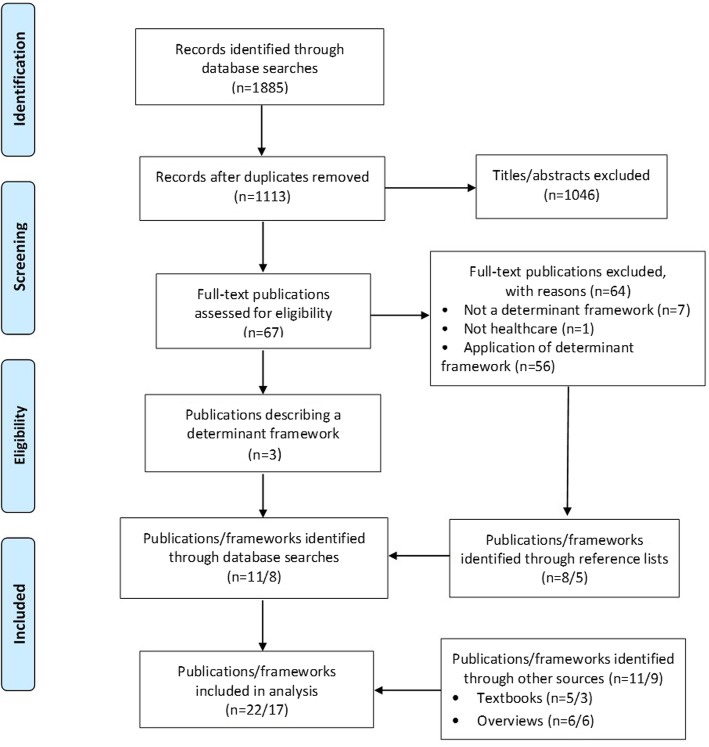
BACKGROUND: The relevance of context in implementation science is reflected in the numerous theories, frameworks, models and taxonomies that have been proposed to analyse determinants of implementation (in this paper referred to as determinant frameworks). This scoping review aimed to investigate and map how determinant frameworks used in implementation science were developed, what terms are used for contextual determinants for implementation, how the context is conceptualized, and which context dimensions that can be discerned. METHODS: A scoping review was conducted. MEDLINE and EMBASE were searched from inception to October 2017, and supplemented with implementation science text books and known published overviews. Publications in English that described a determinant framework (theory, model, taxonomy or checklist), of which context was one determinant, were eligible. Screening and inclusion were done in duplicate. Extracted data were analysed to address the study aims. A qualitative content analysis with an inductive approach was carried out concerning the development and core context dimensions of the frameworks. The review is reported according to the PRISMA guidelines. RESULTS: The database searches yielded a total of 1113 publications, of which 67 were considered potentially relevant based on the predetermined eligibility criteria, and retrieved in full text. Seventeen unique determinant frameworks were identified and included. Most were developed based on the literature and/or the developers' implementation experiences. Six of the frameworks explicitly referred to "context", but only four frameworks provided a specific definition of the concept. Instead, context was defined indirectly by description of various categories and sub-categories that together made up the context. Twelve context dimensions were identified, pertaining to different aggregation levels. The most widely addressed context dimensions were organizational support, financial resources, social relations and support, and leadership. CONCLUSIONS: The findings suggest variation with regard to how the frameworks were developed and considerable inconsistency in terms used for contextual determinants, how context is conceptualized, and which contextual determinants are accounted for in frameworks used in implementation science. Common context dimensions were identified, which can facilitate research that incorporates a theory of context, i.e. assumptions about how different dimensions may influence each other and affect implementation outcomes. A thoughtful application of the concept and a more consistent terminology would enhance transparency, simplify communication among researchers, and facilitate comparison across studies.
Overview
The claims and statistics of this paper haven’t been checked yet.
Free: it reads the open-access text and checks the first 5 claims that cite a source we can check. Create a free account to check every claim.
Integrity signals
Registry
Cites
Statistics
Figures
Verification
Claims the paper makes
The claims and statistics of this paper haven’t been checked yet.
Free: it reads the open-access text and checks the first 5 claims that cite a source we can check. Create a free account to check every claim.
Claims other papers make about this one
Each is checked against this paper’s own text: does it say what the citing paper says it does?
The source backs part of the claim, not all of it — or backs it for a different population, condition or comparison.
In the citing paper
“Understanding the end users, in this case, the students, is crucial and is known to facilitate successful implementation.23,24”
From Structured Development of Learning and Assessment Tasks to Prevent Generative AI Misuse and Enhance AI Literacy in the Faculty in Physiotherapy Education (2025) · cites this paper as [24]
Experimental — accuracy not yet measuredThe check wasn’t confident either way, so it gives no verdict — never disputed.
In the citing paper
“This call for hypothesis testing in implementation outcomes research has been echoed by a number of recent papers [21–24].”
From Ten years of implementation outcomes research: a scoping review (2023) · cites this paper as [23]
Experimental — accuracy not yet measured
Self-check
Percentages, sums and reported differences re-computed from the paper’s own numbers.
The self-check needs the paper’s full text.
Citations
Cites
Preferred Reporting Items for Systematic Reviews and Meta-Analyses: the PRISMA statement
Moher, D., Liberati, A., Tetzlaff, J., Altman, D. G., & for the PRISMA Group (2009) · BMJ · doi:10.1136/bmj.b2535 · Cited by 83,823
Preferred Reporting Items for Systematic Reviews and Meta-Analyses: The PRISMA Statement
Moher, D., Liberati, A., Tetzlaff, J., Altman, D. G., & The PRISMA Group (2009) · PLoS Medicine · doi:10.1371/journal.pmed.1000097 · Cited by 64,042 · cited 1×
“for Systematic Reviews and Meta-Analyses (PRISMA) guidelines [20].”
Preferred reporting items for systematic reviews and meta-analyses: the PRISMA Statement.
(2009) · PubMed Central · Cited by 44,859
Scoping studies: towards a methodological framework
Arksey, H., & O'Malley, L. (2005) · International Journal of Social Research Methodology · doi:10.1080/1364557032000119616 · Cited by 36,742
The Ecology of Human Development: Experiments by Nature and Design
Bronfenbrenner, U. (1979) · Harvard University Press eBooks · doi:10.4159/9780674028845 · Cited by 26,084
The qualitative content analysis process
Elo, S., & Kyngäs, H. (2008) · Journal of Advanced Nursing · doi:10.1111/j.1365-2648.2007.04569.x · Cited by 22,617
Wang, G., Ma, R., Qiao, G., Wada, K., Aizawa, Y., & Satoh, T. (2015) · Integrative Medicine International · doi:10.1159/000368408 · Cited by 18,657
Organizational culture and leadership
(1993) · Long Range Planning · doi:10.1016/0024-6301(93)90120-5 · Cited by 16,462
Damschroder, L. J., Aron, D. C., Keith, R. E., Kirsh, S. R., Alexander, J. A., & Lowery, J. C. (2009) · Implementation Science · doi:10.1186/1748-5908-4-50 · Cited by 14,496 · cited 11×
“, 2009 [15] Influences on implementation (outcomes) Based on analysis of the 19 theories, frameworks and models used in implementation science 5 categories (3 relate to contextual influences): • Intervention characteristics • Characteristics of individuals • Process • Inner setting • Outer setting Categories are refer…”
BackgroundMethodInfluentialThe ecology of human development : experiments by nature and design
Bronfenbrenner, U. (1979) · Cited by 12,580
Research works printed but not linked: 7
- Rycroft-Malone J Bucknall T Models and frameworks for implementing evidence-based practice: linking evidence to action 2010 Oxford Wiley-Blackwell
- Rainbird K Sanson-Fisher R Buchan H Identifying barriers to evidence uptake 2006 Melbourne National Institute of Clinical Studies
- World Health Organization (WHO) Identifying and addressing barriers to implementing policy options. In: SURE guides for preparing and using evidence-based policy briefs 2011
- Övretveit J The leaders’ role in quality and safety improvement: a review of the research and guidance 2005 Karolinska Institute Stockholm
- Weick KE The social psychology of organising 1969 Reading, MA Addison-Wesley
- Cappelli P Sherer PD The missing role of context in OB: the need for a meso-level approach Res Organ Behav 1991 13 55 110
- Jordan A Carlile O Stack A Approaches to learning – a guide for teachers 2008 New York Open University Press 1 251
Cited by
Items 601–700 of 1,000
Gagnon, M. (2021) · International Journal of Health Policy and Management · doi:10.34172/ijhpm.2021.179 · Cited by 2
Taylor, B., Hewison, A., Cross‐Sudworth, F., & Morrell, K. (2022) · BMC Health Services Research · doi:10.1186/s12913-021-07375-3 · Cited by 6
“The influences on adherence to rules are consistent with the evidence base regarding facilitators and constraints to change programmes in healthcare, such as capacity, funding, and organisational culture [56, 57].”
BackgroundNielsen, J. V., Skovgaard, T., Klein-Wengel, T. T., & Troelsen, J. (2022) · International Journal of Environmental Research and Public Health · doi:10.3390/ijerph19052544 · Cited by 4
“In a Danish context, the Municipality of Svendborg is close to an average Danish municipality on a number of relevant aspects [17], thus enhancing the relevance and possible dissemination of the programme to other Danish preschools [54,57].”
BackgroundGorgon, E. J. R., Maka, K., Sullivan, J., Nisbet, G., Hancock, M., Regan, G., & Leaver, A. M. (2022) · Musculoskeletal Care · doi:10.1002/msc.1695 · Cited by 2
Working Paper 40: Developing anti-corruption interventions addressing social norms
Camargo, C. B. (2022) · Basel Institute on Governance Working Papers · doi:10.12685/bigwp.2022.40.30 · Cited by 2
“2021; Nilsen and Bernhardsson, 2019) to further test the effectiveness of intervention approaches and address the question of scalability.”
BackgroundResultSheridan, S. (2023) · Patient Education and Counseling · doi:10.1016/j.pec.2023.107806 · Cited by 3
Application of Mixed Methods for International and Cross-Cultural Research
Hitchcock, J. H., & Onwuegbuzie, A. J. (2024) · Springer eBooks · doi:10.1007/978-3-031-69541-4_20 · Cited by 2
Luz, R. A. (2019) · Digital Library of Theses and Dissertations (Universidade de São Paulo) · doi:10.11606/t.7.2019.tde-22022021-161513 · Cited by 3
Dissemination and Implementation Science
Yilma, H., & Rimal, R. N. (2022) · Wiley eBooks · doi:10.1002/9781119678816.iehc0974 · Cited by 2
Galaviz, K. I., Sanders, M., & Gil‐García, Ó. F. (2024) · Frontiers in Public Health · doi:10.3389/fpubh.2023.1356063 · Cited by 2
Hall, S. F., Jones, A. S., & Maggiulli, L. (2022) · Human Services Organizations Management Leadership & Governance · doi:10.1080/23303131.2022.2062511 · Cited by 2
“Contextual factors across multiple levels (i.e., systemic, organizational, individual) can facilitate or hinder implementation and ultimately impact the effectiveness of an intervention (Nilsen & Bernhardsson, 2019).”
BackgroundMeloncelli, N. J. L., James, S. E., Riggs, K., & de Jersey, S. (2023) · International Journal of Evidence-Based Healthcare · doi:10.1097/xeb.0000000000000369 · Cited by 1
Bender, M., & Williams, M. D. (2024) · Journal of Advanced Nursing · doi:10.1111/jan.16395 · Cited by 2
“…‘context mat-ters’, but a recent scoping review also made clear that ‘there is considerable variation with regard to … how context is defined and conceptualized, and which contextual determinants are accounted for in frameworks used in implementation science’ (Nilsen & Bernhardsson, 2019 , p. 18).”
SUS: Uso de equipamentos inovadores para diagnóstico do câncer de mama
Oliveira, T. S., Júnior, C. V. B., Isidro-Filho, A., dos Santos, S. D. L. V., & de Oliveira, D. S. (2024) · Cadernos Gestão Pública e Cidadania · doi:10.12660/cgpc.v29.90669 · Cited by 22
Purtle, J., Stadnick, N. A., Mauri, A. I., Walker, S. C., Bruns, E. J., & Aarons, G. A. (2024) · Implementation Science · doi:10.1186/s13012-024-01401-8 · Cited by 1
“This measure was conceptualized as an indicator of the EPIS outer sociopolitical context in which policy implementation occurs, which can influence downstream policy implementation [78, 32].”
BackgroundDuarte, S. T., Moniz, A., Costa, D. S. A., Donato, H., Heleno, B., Aguiar, P. M. V., & Cruz, E. B. (2024) · BMC Health Services Research · doi:10.1186/s12913-024-11764-9 · Cited by 1
“However, it has been advocated that most implementation initiatives are not ready for widespread implementation due to insufficient supporting evidence [83].”
BackgroundRahardi, R. K., & Utami, S. F. (2024) · BAHASTRA · doi:10.26555/bs.v44i2.998 · Cited by 1
Nutrition Interventions in Aged Care: The Need and Challenges in the Aged Care Context
Bracci, E. L., Davis, C. R., & Murphy, K. J. (2024) · Recent Progress in Nutrition · doi:10.21926/rpn.2404019 · Cited by 1
Grønlie, A. A., Backer‐Grøndahl, A., Nes, R. B., Gomez, M. B., & Tømmerås, T. (2024) · Trials · doi:10.1186/s13063-024-08704-7 · Cited by 1
A model of implementation for the family check-up in community mental health settings
Stormshak, E. A., Mauricio, A. M., McWhirter, A. C., & Reiter, L. (2025) · Pedagogia Social Revista Interuniversitaria · doi:10.7179/psri_2025.46.03 · Cited by 1
“In the last decade, several implementation models and frameworks have been proposed, and their application in any implementation effort is now recognized as a standard for high-quality implementation (Nilsen et al. , 2019).”
Lockwood, P., Burton, C. R., Shaw, T., Woznitza, N., Compton, E., Groombridge, H., Hayes, N., Mane, U., O’Brien, A., & Patterson, S. (2025) · BMC Health Services Research · doi:10.1186/s12913-025-12356-x · Cited by 1
Pfundstein, I., Mauthner, O. E., Gschwind, C. O., Muser, O., Nickel, C. H., Trutschel, D., & Brunkert, T. (2025) · Journal of Advanced Nursing · doi:10.1111/jan.16822 · Cited by 1
Härle, K., Wennerholm, C., & Drott, J. (2025) · Journal of Advanced Nursing · doi:10.1111/jan.16988 · Cited by 3
“Due to the fast pace and high number of changes in the healthcare sector, where many healthcare professionals have negative experiences, it is important to consider the underlying influences on healthcare professionals' implementation intentions and behaviours (Nilsen and Bernhardsson 2019).”
van Schothorst, M. M. E., den Bleijker, N. M., van Harten, P. N., de Vries, N. K., & Deenik, J. (2025) · Implementation Research and Practice · doi:10.1177/26334895251351663 · Cited by 2
“These barriers and facilitators can manifest at different levels, including patient, provider, and organizational levels (Hébert et al., 2012; Nilsen & Bernhardsson, 2019).”
Women's Experience of Continuity During Antenatal Care: A Cross‐Sectional Study in The Netherlands
Cellissen, E., Hendrix, M. J. C., Budé, L. M., Shareef, N., Vogels‐Broeke, M., & Nieuwenhuijze, M. J. (2025) · Birth · doi:10.1111/birt.70008 · Cited by 2
“To enhance continuity of care, policies must align more closely with practical realities, ensuring clarity in content and consistency across both community and hospital settings [37, 38].”
Brown, L., Ziemann, A., Strydom, M., & Templeton, L. (2025) · Human Services Organizations Management Leadership & Governance · doi:10.1080/23303131.2025.2553900 · Cited by 1
“To our knowledge, existing frameworks largely omit the temporal dimension of historical and current pathways (Nilsen & Bernhardsson, 2019), despite early recognition of its importance in complex systems theory (Hawe et al., 2009).”
Robinson, S. A., Lipschitz, J. M., Ndiwane, N., Bixler, F. R., Etingen, B., Zocchi, M. S., Shimada, S. L., Palmer, J. A., Newton, T., Shah, N., et al. (2025) · Journal of Telemedicine and Telecare · doi:10.1177/1357633x251371113 · Cited by 2
Feasibility of a Reablement Programme in Community Care in the Netherlands; A Qualitative Study
Buma, L. E., Vluggen, S., Mouchaers, I., Zwakhalen, S. M. G., & Metzelthin, S. (2025) · International Journal of Integrated Care · doi:10.5334/ijic.9005 · Cited by 2
“We recommend future research incorporate contextual analysis to help interpretation of feasibility findings and guide tailored implementation, using contextual determinants as reviewed by Nilsen and Bernhardsson (2019) [49] providing useful direction.”
Turnbull, A. E., Zhang, S., Colantuoni, E., Bhattacharya, S., Hochberg, C. H., Moale, A. C., & Kerlin, M. P. (2025) · CHEST Journal · doi:10.1016/j.chest.2025.08.026 · Cited by 1
“10,11 These methods help implementation scientists design complex interventions to promote adoption of specific EBPs within a particular context.”
Malme, K. B., Berhe, N., Hunduma, F., Desalegn, H., & Johannessen, A. (2025) · BMC Health Services Research · doi:10.1186/s12913-025-13340-1 · Cited by 1
“We will begin by conducting a study of the context where the implementation will take place, and identify context-related barriers and facilitators [22].”
Drake, C., Webb, S., Anderson, L., Cummin, G., Tucker, M., Webster, A., Sperber, N. R., Coffman, C. J., Fullenkamp, N. K., Zullig, L. L., et al. (2025) · Archives of Physical Medicine and Rehabilitation · doi:10.1016/j.apmr.2025.09.032 · Cited by 1
Ko, C. Y., Giusti, A., Martin, G. P., & Dixon‐Woods, M. (2025) · Journal of the American College of Surgeons · doi:10.1097/xcs.0000000000001656 · Cited by 2
Bunkenborg, G., Frederiksen, J., Hansen, T. B., & Bucknall, T. K. (2025) · International Journal of Nursing Studies · doi:10.1016/j.ijnurstu.2025.105280 · Cited by 1
Hornick, M. M., Talwar, A. A., Voytik, M., Gala, Z. S., Amro, C., Khan, S., Deguchi, A. N., Dao, E., Khodyakov, D., Rendle, K. A. S., et al. (2025) · Journal of Surgical Research · doi:10.1016/j.jss.2025.09.089 · Cited by 2
How Formal and Informal Nurse Leaders Enact Shared Implementation Leadership in a Hospital Setting
Castiglione, S. A., Lavoie‐Tremblay, M., Kilpatrick, K., Gifford, W., & Semenic, S. E. (2025) · Journal of Advanced Nursing · doi:10.1111/jan.70374 · Cited by 1
“These findings debunk the often dominant assumptions implicit in determinant frameworks where leadership is assigned to individual managers, by highlighting the shared contributions of leaders in both lateral and vertical, formal and informal roles on hospital units (Nilsen and Bernhardsson 2019).”
Price, M. A., Mulkern, P. J., Condon, M., Rakhilin, M., Johansen, K., Lyon, A. R., Saldana, L., Pachankis, J. E., Woodward, S. A., Roeder, K., et al. (2025) · Implementation Science Communications · doi:10.1186/s43058-025-00809-7 · Cited by 1
“Implementation researchers consistently highlight the necessity of inner-setting-level (e.g., clinic, hospital) implementation strategies [156].”
Moore, S. A., Padilla, V. E., Touati, S., & Lyon, A. R. (2026) · Journal of School Psychology · doi:10.1016/j.jsp.2025.101525 · Cited by 1
Wainwright, H., Skouteris, H., Galvin, E., Savaglio, M., Sait, R., & Morris, H. (2026) · Child and Adolescent Social Work Journal · doi:10.1007/s10560-025-01078-y · Cited by 1
“Equally important is identifying strategies that create the conditions for effec - tive implementation (Damschroder et al., 2022; Nilsen & Bernhardsson, 2019; Powell et al., 2015; Weeks, 2021); that is, the ”how” we embed best practice transition planning across multiple systems and settings, to…”
Elam, M. E., Hillas, J. A., Moyal‐Smith, R., Padamsee, T. J., Birken, S. A., Brindle, M. E., & Park, K. U. (2026) · Annals of Surgical Oncology · doi:10.1245/s10434-025-19042-6 · Cited by 1
Drott, J., Forsberg, A. M., & Härle, K. (2026) · Journal of Advanced Nursing · doi:10.1111/jan.70524 · Cited by 1
“Organisations are known to be complex environments for knowledge translation due to cultures and disciplinary norms (Novotná et al. 2012), and these factors may lead to an incomplete implementation process and a return to pre-implementation behaviours (Nilsen and Bernhardsson 2019).”
Waldboth, V., Schuler, C., Willmann, R., Petry, H., Weber, M., Messerli, B. G., Hediger, H., Kramer, I., Stettler-Nemecek, G., Knoblauch, M., et al. (2026) · JMIR Research Protocols · doi:10.2196/82833 · Cited by 1
“The context analysis was necessary to better understand the specific institutional situation, overcome implementation challenges, and identify factors that may influence intervention uptake and study outcomes [58,59].”
Williams, M. V., White‐Williams, C., & Li, J. (2026) · Medical Clinics of North America · doi:10.1016/j.mcna.2025.11.012 · Cited by 1
Expert stakeholders on the role of qualitative research in World Health Organisation guidelines
Taylor, M., Garner, P., Oliver, S. R., & Desmond, N. (2026) · Health Policy and Planning · doi:10.1093/heapol/czaf105 · Cited by 1
Towards a Usability-Focused Security Culture Framework
Fallatah, W., Furnell, S., & Wagner, C. (2026) · Journal of Cybersecurity and Privacy · doi:10.3390/jcp6010034 · Cited by 1
Tabak, R. G., Schwarz, C. D., Haire-Joshu, D. L., Wang, J., Gilbert, A. S., & Steger-May, K. (2026) · Frontiers in Health Services · doi:10.3389/frhs.2026.1637060 · Cited by 2
Busca, E., Bassi, E., Milani, S., Massimo, D. S. D., Miotto, M., Tosatti, S., Zampelli, L., Jack, S. M., & Molin, A. D. (2026) · Nursing Research and Practice · doi:10.1155/nrp/8734311 · Cited by 1
van Nassau, F., Driessen, A., van Bodegom‐Vos, L., Walters, B. H., Ista, E., Keijser, W., van der Sluis, R. V. D. K. –., Welker, G. A., Wensing, M., & Vis, C. (2026) · Implementation Science Communications · doi:10.1186/s43058-026-00890-6 · Cited by 1
“Despite the applied nature of the field [21] and the relevance of context [22], these agendas miss addressing the needs of implementation practice.”
Westgard, C. M., Spigel, L., Neergheen, V. L., Eum, K.-D., Woodbury, S. R., Karlage, A., Lipsitz, S. R., Maloney, F. L., Short, T., Weiseth, A., et al. (2026) · BMC Health Services Research · doi:10.1186/s12913-026-14319-2 · Cited by 1
“On a broad level, it remains unclear how to define context [4], which aspects of context (if any) matter more than others, and how best to measure context [5, 6].”
Charitonos, K., Littlejohn, A. H., Dawadi, S., Vaidya, A., Owusu-Ofori, A. K., Goshtasbpour, F., & Giri, S. (2026) · British Journal of Educational Technology · doi:10.1111/bjet.70044 · Cited by 1
Zhou, Q., Liao, J., Liu, H., Jiang, Y., Wang, D., Chang, X., Wu, J., Xi, H., Wu, X., Chen, H., et al. (2026) · BMC Geriatrics · doi:10.1186/s12877-026-07317-w · Cited by 1
“Implementing falls prevention guidelines into practice often proves challenging due to the misalignment between current guidelines and local conditions [8].”
Tao, X., Peiris, D., Ma, Y., Zhang, Y., Song, H., Mao, L., & Zhang, P. (2026) · JMIR mhealth and uhealth · doi:10.2196/76699 · Cited by 1
“Finally, context matters in implementation science research [33].”
Wainwright, H., Skouteris, H., Galvin, E., Savaglio, M., & Morris, H. (2026) · Journal of Evidence-Based Social Work · doi:10.1080/26408066.2026.2643207 · Cited by 1
Designing an implementation study: rationale and considerations for design
Lewis, K. B., Straiton, N., Graham, I. D., & Lauck, S. (2026) · European Journal of Cardiovascular Nursing · doi:10.1093/eurjcn/zvag078 · Cited by 1
EdTech implementation research in low‐ and middle‐income countries
Major, L., Gichuhi, L., & Czerniewicz, L. (2026) · British Journal of Educational Technology · doi:10.1111/bjet.70061 · Cited by 1
An Implementation Science Approach to Assess Law Enforcement Deflection Programs
Ratemo, S., Suiter, E. A., McLean, K. D., Shneibaum, N., & Miller, B. L. (2026) · Justice Evaluation Journal · doi:10.1080/24751979.2026.2651743 · Cited by 1
Houlden, S., Culph, J., Day, S., Clemson, L. M., Poulos, C. J., Jeon, Y., Anstey, K. J., Kurrle, S. E., Scanlan, J. N., Spargo, C., et al. (2026) · Dementia · doi:10.1177/14713012261436963 · Cited by 2
Wainwright, H., Skouteris, H., Morris, S. L., Halfpenny, N., & Morris, H. (2026) · Global Implementation Research and Applications · doi:10.1007/s43477-026-00227-4 · Cited by 1
Murphy, D., Philpot, S. P., Bushby, B., Cornelisse, V. J., Grulich, A. E., Wright, E., & Bavinton, B. R. (2026) · Journal of the Association of Nurses in AIDS Care · doi:10.1097/jnc.0000000000000642 · Cited by 2
Yaddanapudi, L., Fisher, E., & Hahn, J. (2026) · International Journal of Qualitative Studies on Health and Well-Being · doi:10.1080/17482631.2026.2666722 · Cited by 1
“Consistent with implementation science frameworks emphasizing “context” (Nilsen & Bernhardsson, 2019), our study suggests that individual reflexivity can support more nuanced, practice-oriented engagement with contextual determinants.”
Taber, P. A., Dryden, E. M., Hunleth, J. M., Kahn, L. S., Laird, L. D., Winstead, T., & Murray, G. F. (2026) · Frontiers in Public Health · doi:10.3389/fpubh.2026.1707743 · Cited by 1
Shalev, L., Lubin, G., Kirresh, S., Barash, I., Tamari-Guterman, A., Bloemhof‐Bris, E., Hirschmann, S., Avni, A., Avirame, K., Linder, M., et al. (2026) · Frontiers in Digital Health · doi:10.3389/fdgth.2026.1810008 · Cited by 1
“One of the key factors affecting successful implementation is the context (40).”
Updating the critical steps of the quality implementation framework: an umbrella review of reviews
Hald, K., Ording, A. G., Jorsal, M., Midtgaard, J., Ellis, L. A., Spanos, S., Pagano, L., Fisher, G., Wandersman, A., Braithwaite, J., et al. (2026) · Implementation Science Communications · doi:10.1186/s43058-026-00954-7 · Cited by 1
“Psychological readiness encompasses motivation, enthusiasm, and self-efficacy concerning evidence-based practices [33, 40].”
InfluentialKrahe, M. A., Baker, S., Anderson, E., Strivens, E., & Larkins, S. (2026) · International Journal of Environmental Research and Public Health · doi:10.3390/ijerph23060713 · Cited by 2
“This breadth makes it well suited for synthesizing heterogeneous evidence across diverse technology-enabled care interventions [38].”
Torres, C., Mendes, F. J. M., Duarte, P., & Barbieri-Figueiredo, M. D. C. (2026) · Nursing Reports · doi:10.3390/nursrep16060183 · Cited by 1
“The guide was informed by literature on evidence-based practice implementation and addressed four domains: perceived organizational changes, influence on professional roles and practice, leadership involvement, and sustainability of implemented structures [15–17].”
McCullogh, E., Moore, S. A., Maher, R. A., Jannati, N., Muosieryiri, M., Macpherson, A., Beck, B., & Fuller, D. (2026) · Transportation Research Interdisciplinary Perspectives · doi:10.1016/j.trip.2026.102020 · Cited by 1
Grønlie, A. A., Backer‐Grøndahl, A., Nes, R. B., & Tømmerås, T. (2026) · Administration and Policy in Mental Health and Mental Health Services Research · doi:10.1007/s10488-026-01511-z · Cited by 1
Clinician and family perspectives on the use of single maintenance and reliever therapy for children
Eshghi, E., Ryan, G., Goulding, M., Spano, M. A., Simms, S. F., Agudelo, D. M., Seay, H., Bryce, A., Gerald, L. B., Bottar, A., et al. (2026) · Annals of Allergy Asthma & Immunology · doi:10.1016/j.anai.2026.03.030 · Cited by 1
Joshi, M., Linnansaari, A., Ngowi, J. E., Mwaniki, E., Kahshamba, K., & Atkins, S. A. (2026) · Systematic Reviews · doi:10.1186/s13643-026-03232-8 · Cited by 1
“A significant body of research within implementation science emphasizes the role of context but lacks a uniform definition of the concept [4–6].”
Thomas, D., Bricker‐Katz, G., Murray, E. L., Velleman, S. L., & Iuzzini-Seigel, J. (2026) · American Journal of Speech-Language Pathology · doi:10.1044/2026_ajslp-25-00551 · Cited by 1
Quantitative Evaluation of Produce Prescription Programs in the United States: A Scoping Review
Short, E., Houghtaling, B., Shanks, C. B., Zigmont, V. A., Stotz, S., Seligman, H. K., Long, C. R., Brown, M. R., Marriott, J. P., Park, M. S., et al. (2026) · Nutrition Reviews · doi:10.1093/nutrit/nuag084 · Cited by 1
Brik, A. B. (2026) · Public Administration and Development · doi:10.1002/pad.70094 · Cited by 1
Conlin, M., McLaren, D., MacDermott, S., Spelten, E. R., & Modderman, C. (2026) · American Journal of Evaluation · doi:10.1177/10982140261455349 · Cited by 1
Mcdonough, T., Ellett, L. M. K., Pano, A., Etherton‐Beer, C., Johnson, J. L., & Page, A. (2026) · Research in Social and Administrative Pharmacy · doi:10.1016/j.sapharm.2026.06.004 · Cited by 1
McCarthy, S. E., Finn, M., Valentelyte, G., Boland, F., Hogan, C., Jenkins, L., Keane, T., Mellon, L., Schwanberg, L., Walsh, A., et al. (2026) · BMC Health Services Research · doi:10.1186/s12913-026-15134-5 · Cited by 1
“The study’s mixed effectiveness findings (i.e. improved response to error but no overall safety culture change, and negative second victim experience trends) reinforce the complexity of capturing outcomes in applied safety culture intervention studies [36] and the impact of context [66].”
Ford, B. S., Glasgow, R. E., Mallard, K., Gomes, R., Gifford, M., Jamali, B., Brownson, R. C., Hamilton, A., Malone, S. M., & Rabin, B. A. (2026) · Frontiers in Health Services · doi:10.3389/frhs.2026.1855885 · Cited by 1
von Pfister, J., Schulz, N., Varanini, G., Ludot, A., Nal, J., Proestou, M., & Gottinger, A. (2026) · Environmental Policy and Governance · doi:10.1002/eet.70134 · Cited by 1
Silva, H. J. D. A., Saragiotto, B. T., Baroni, M. P., de Souza, C. G., Perea, J., Ferrari, A., Ferretti, G. M., Hespanhol, L., & Salvini, T. F. (2026) · Brazilian Journal of Physical Therapy · doi:10.1016/j.bjpt.2026.101657 · Cited by 1
Reflections on Post-Disaster University Research in the Aftermath of Hurricanes Irma and Maria
Francis, K. A., & Hendrickson, K. A. (2020) · Advances in higher education and professional development book series · doi:10.4018/978-1-7998-5826-3.ch010 · Cited by 2
Ocean governance in South Africa: Policy and implementation
Naidoo, A. (2020) · University of the Western Cape Electronic Theses and Dissertations Repository (University of the Western Cape) · Cited by 1
An Examination of Churn Within Australian Family Services: A Scoping Study
Hatzikiriakidis, K., Skouteris, H., Vicary, D., Fittock, N., Hogan, C., Diamond, S., Demeyer, C., Stopczynski, J., & O’Donnell, R. (2021) · Australian Social Work · doi:10.1080/0312407x.2021.1875017 · Cited by 1
“Consequently, policymakers and service providers within Australia are ill informed on how to mitigate churn within their local context (Cabassa & Stefancic, 2019; Nilsen & Bernhardsson, 2019).”
BackgroundBoss, M., Turner, J., Boss, P., Hartmann, P. E., Pritchard, D. A., & Clifford, R. M. (2021) · BMC Pregnancy and Childbirth · doi:10.1186/s12884-021-03775-9 · Cited by 1
“A common-sense approach is defined as the application of a group’s shared tacit knowledge [12].”
BackgroundMethodFactors Influencing Fidelity to a Calorie Posting Policy in Public Hospitals: A Mixed Methods Study
Kerins, C., Kelly, C. N. M., Reardon, C. M., Houghton, C., Toomey, E. C., Hayes, C. B., Geaney, F., Perry, I. J., McSharry, J., & McHugh, S. (2021) · Frontiers in Public Health · doi:10.3389/fpubh.2021.707668 · Cited by 1
Schippel, N., Hower, K. I., Zank, S., Pfaff, H., & Rietz, C. (2021) · Journal of Health Organization and Management · doi:10.1108/jhom-01-2021-0021 · Cited by 2
Amin, A., Nordén, M., Fomichov, V., Björnsson, B., Larsson, A. L., Sandström, P., & Drott, J. (2022) · European Journal of Cancer Care · doi:10.1111/ecc.13570 · Cited by 1
“…factor, such as a lack of time, heavy workload and high staff turnover, can negatively affect patient participation, patient information, implementation of interventions and new strategies in the workplace (Andersson et al., 2020; Fischer et al., 2016; Nilsen & Bernhardsson, 2019).”
Gallagher, A., Murphy, C., Fitzgerald, J., & Law, J. (2021) · HRB Open Research · doi:10.12688/hrbopenres.13249.2 · Cited by 2
Kalbarczyk, A., Hood, E., Azizatunnisa’, L., Cintyamena, U., Nigatu, F., & Baral, P. (2022) · Annals of Global Health · doi:10.5334/aogh.3730 · Cited by 3
“, how it is delivered, and by whom), must be tailored to specific contexts to meet local needs [21].”
BackgroundSchriger, S. H., & Beidas, R. S. (2022) · Oxford University Press eBooks · doi:10.1093/med-psych/9780198867791.003.0020 · Cited by 1
Maw, A., Huebschmann, A. G., & Jones, C. D. (2023) · Journal of Hospital Medicine · doi:10.1002/jhm.13139 · Cited by 1
Oluwoye, O. A., Lissau, A., Stokes, S., Selloni, A. T., James, N., Amiri, S., McDonell, M. G., & Anglin, D. M. (2023) · Implementation Science Communications · doi:10.1186/s43058-023-00476-6 · Cited by 1
“These intentions are often influenced by contextual factors which are a unique set of factors, circumstances, or characteristics of the environment that surround implementation efforts [27, 28].”
BackgroundChristensen, C., & Bellows, D. M. (2023) · Pediatric Physical Therapy · doi:10.1097/pep.0000000000001044 · Cited by 1
“33 The KTA cycle is a commonly used process model consisting of 2 phases: (1) a knowledge creation funnel with the best available evidence synthesized and made usable for”
BackgroundMethodInfluentialDeveloping organizational context adjustments in project-based organizations (part 1)
Алондериене, Р., & Бусеро, А. (2023) · Управление проектами и программами · doi:10.36627/2075-1214-2023-3-3-166-175 · Cited by 1
Extending the Choice Architecture Toolbox: The Choice Context Exploration
Hajdú, N., Aczél, B., & Szászi, B. (2023) · SAGE Open · doi:10.1177/21582440231216831 · Cited by 1
“Finding an adequate working definition of what context constitutes is challenging, because most studies provide a narrow conceptualization of context, and simply list contextual determinants of a construct (Nilsen & Bernhardsson, 2019; Rogers et al., 2020).”
BackgroundMoyal‐Smith, R., Marsteller, J. A., Barnett, D. J., Kent, P. S., Purnell, T. S., & Yuan, C. T. (2024) · Disaster Medicine and Public Health Preparedness · doi:10.1017/dmp.2024.20 · Cited by 1
“16 Context, or how interventions are woven together within a given environment, is a critical component of implementation, 17 and the constantly shifting context of disasters and complexity of roles and relationships involved in the HICS can pose challenges to implementation.”
BackgroundCapiau, M., Macq, J., & Thunus, S. (2024) · Health Research Policy and Systems · doi:10.1186/s12961-024-01112-y · Cited by 1
“As the sociology of science and technology and implementation science have shown, it is vital to incorporate the characteristics of the context for which it is intended into the assessment programme [48, 49].”
BackgroundÅkerlund, I. (2024) · Linköping University medical dissertations · doi:10.3384/9789180753753 · Cited by 2
Steinskog, T. D., Tranvåg, O., Ciliska, D. K., & Graverholt, B. (2024) · Scandinavian Journal of Caring Sciences · doi:10.1111/scs.13264 · Cited by 2
Sivertsen, D. M., Becker, U., Andersen, O., & Kirk, J. W. (2024) · Nordic Studies on Alcohol and Drugs · doi:10.1177/14550725241252256 · Cited by 1
“With this qualitative approach, it is possible to draw attention to those elements in the cross-sectoral collaboration that work as barriers or enablers in future implementation efforts (Green & Thorogood, 2009; Nilsen & Bernhardsson, 2019).”
BackgroundNahiruddin, N., Hirman, H., Imasita, I., & Irawan, Y. (2024) · AIP conference proceedings · doi:10.1063/5.0221242 · Cited by 1
Clinician Perspectives on Continuous Monitor Use in a Children’s Hospital: A Qualitative Study
Schondelmeyer, A. C., Sauers‐Ford, H. S., Touzinsky, S. M., Brady, P. W., Britto, M. T., Molloy, M. J., Simmons, J. M., Cvach, M. M., Shah, S. S., Vaughn, L. M., et al. (2024) · Hospital Pediatrics · doi:10.1542/hpeds.2023-007638 · Cited by 1
Metadata
- Authors
- Nilsen, P., & Bernhardsson, S.
- Affiliations
- Region Västra Götaland (SE)
- Corresponding author
- Bernhardsson, Susanne
- Venue
- BMC Health Services Research
- Published
- 2019-03-25
- Volume
- 19
- Issue
- 1
- Pages
- 189-189
- ISSN
- 1472-6963 (ISSN-L)
- PMC
- PMC6432749
- OpenAlex
- W2941268450
- Semantic Scholar
- 5761696aebadd7dde4d180778d844b700aefb54f
- Cited by
- 1,014
- References
- 111
- Citations by year
- 2026: 142 · 2025: 129 · 2024: 217 · 2023: 176 · 2022: 150 · 2021: 121 · 2020: 65 · 2019: 10
- FWCI
- 15.85
- Type
- journal article
- Language
- en
- Open access
- gold
- doi.org
- Licence
- cc-by
- creativecommons.org/licenses/by/4.0/ (tdm)
- Locations
- BMC Health Services Research (publishedVersion, cc-by)
- Europe PMC (PubMed Central) (publishedVersion, other-oa)
- PubMed Central (publishedVersion, cc-by)
- PubMed (publishedVersion)
- KTH Publication Database DiVA (KTH Royal Institute of Technology) (submittedVersion, other-oa)
- DOAJ (DOAJ: Directory of Open Access Journals) (submittedVersion, cc-by-sa)
- NORA - Norwegian Open Research Archives (submittedVersion, cc-by)
- Topics
- Health Sciences › Health Professions › General Health Professions › Health Policy Implementation Science
- Health Sciences › Health Professions › General Health Professions › Health Sciences Research and Education
- Health Sciences › Medicine › Public Health, Environmental and Occupational Health › Clinical practice guidelines implementation
- Keywords
- implementation context, contextual factors, implementation outcomes, organizational support, leadership, financial resources, interpersonal relationships, terminology consistency
- MeSH terms
- Implementation Science, Leadership, Evidence-Based Practice
About these checks
Registry, retraction, Cites and statistics results are computed, not judged, with one exception: a printed reference that no index lists is read once by a model before it counts as a citation error. Claims are extracted by a model and kept only when their quote appears verbatim in the text; each cited source is then checked, with a model’s help, for whether it says what the claim relies on. Those verdicts can be wrong — read the claim’s quote and the cited source before relying on one.
Statistics and arithmetic are recomputed, not judged.
Confidence bands are shown only for fields calibrated on our annotated test set. None is calibrated yet, so no band is shown.
What counts as a claim ›How we measure confidence ›How we check this ›
Are you an author, or do you see a problem with this page? Request a review
Data sources
Bibliographic data: Semantic Scholar, OpenAlex, Crossref.
Contains information from the Semantic Scholar Academic Graph Datasets, made available under the ODC Attribution License (ODC-BY 1.0).
Semantic Scholar’s data is described in: Kinney, R., et al. (2023). The Semantic Scholar Open Data Platform. arXiv:2301.10140.
