

The hospital-to-home care transition experience of home care clients: an exploratory study using patient journey mapping
Open accessThe DOI matches its Crossref record; 47 of the 47 references it cites were found in a registry or an index; 30 of the 40 sources its claims cite were checked for support.
Abstract
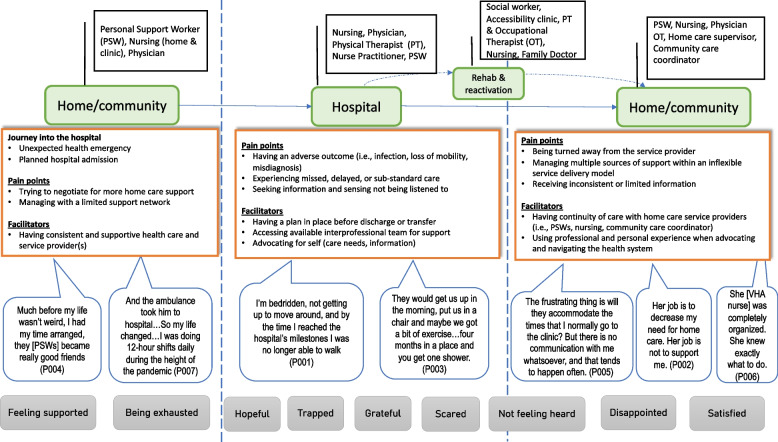
BACKGROUND: Care transitions have a significant impact on patient health outcomes and care experience. However, there is limited research on how clients receiving care in the home care sector experience the hospital-to-home transition. An essential strategy for improving client care and experience is through client engagement efforts. The study's aim was to provide insight into the care transition experiences and perspectives of home care clients and caregivers of those receiving home care who experienced a hospital admission and returned to home care services by thematically and illustratively mapping their collective journey. METHODS: This study applied a qualitative descriptive exploratory design using a patient journey mapping approach. Home care clients and their caregivers with a recent experience of a hospital discharge back to the community were recruited. A conventional inductive approach to analysis enabled the identification of categories and a collective patient journey map. Follow-up interviews supported the validation of the map. RESULTS: Seven participants (five clients and two caregivers) participated in 11 interviews. Participants contributed to the production of a collective journey map and the following four categories and themes: (1) Touchpoints as interactions with the health system; Life is changing; (2) Pain points as barriers in the health system: Sensing nobody is listening and Trying to find a good fit; (3) Facilitators to positive care transitions: Developing relationships and gaining some continuity and Trying to advocate, and (4) Emotional impact: Having only so much emotional capacity. CONCLUSIONS: The patient journey map enabled a collective illustration of the care transition depicted in touchpoints, pain points, enablers, and feelings experienced by home care recipients and their caregivers. Patient journey mapping offers an opportunity to acknowledge home care clients and their caregivers as critical to quality care delivery across the continuum.
Overview
CoChat Summary
TL;DR
This exploratory qualitative study used patient journey mapping to describe how seven home care clients/caregivers experienced the hospital-to-home transition in Southern Ontario. The map highlighted four themes: touchpoints, pain points, facilitators, and emotional impact, with communication and continuity of care emerging as central issues.
Key findings
- Seven participants (five clients and two caregivers) completed 11 interviews; participants were on average 66 years old (range 44 to 88), and five identified as female.
- Four themes emerged from the collective journey map: Touchpoints (“Life is changing”), Pain points (“Sensing nobody is listening” and “Trying to find a good fit”), Facilitators (“Developing relationships and gaining some continuity” and “Trying to advocate”), and Emotional impact (“Having only so much emotional capacity”).
- Participants reported harms or adverse experiences linked to being unheard, including loss of mobility and continence, hospital-acquired infection, functional decline, and emotional damage.
- Continuity with home care providers and self-advocacy were described as important facilitators of better transitions, while fragmented care and multiple agencies created burden and stress.
Methods
- Qualitative descriptive exploratory design using patient journey mapping; the study was conducted with a not-for-profit home care organization in select Southern Ontario urban regions in Canada.
- Purposeful sampling recruited home care clients who had a hospital admission in 2021 and then returned home with home care, plus caregivers who were unpaid or privately paid and met the English-language criteria.
- Data came from initial and follow-up semi-structured interviews (April–August 2022), analyzed inductively with content/thematic analysis to produce a collective patient journey map; follow-up interviews were used to validate the map.
Limitations
- The paper states that findings may not generalize to other populations and settings; it notes transferability rather than generalizability.
- The sample was small and homogeneous: seven participants, with limited diversity and English-only recruitment; the paper says this may exclude marginalized communities and people who do not speak English.
- The paper notes potential self-selection bias, including that people who could not effectively advocate for quality care transition may have been excluded; it also says some participants drew on multiple transition experiences, which may have blurred the hospital-discharge journey being studied.
Model-written summary. Check it against the paper before relying on it.
Integrity signals
Registry
Cites
Statistics
Figures
Verification
Claims the paper makes
17 Valid · 0 Not valid · 8 Not checked · 77 Own results and interpretations
Every source the paper cites for this claim was checked and supports it.
In the paper
“Our finding supports previous studies that describe the post-discharge period as a vulnerable time for these patients [33, 34].”
§ The hospital-to-home care transition experience of home care clients: an exploratory study using patient journey mapping > Discussion
What the sources say
- Supportedcites [33] Hestevik CH Molin M Debesay J Bergland A Bye A Older persons’ experiences of adapting to daily life at home after hospital discharge: a qualitative metasummary BMC Health Serv Res 2019 19 1 1 13 10.1186/s12913-019-4035-z 30975144 PMC6460679 source
The Background describes declining quality of life and challenges adjusting at home after discharge among older persons. The Results section, “Theme 1: experiencing an insecure and unsafe transition” (page unavailable), reports that many experienced the transition home as insecure, sometimes unsafe or dangerous. Together, these passages support describing the post-discharge period as vulnerable for the older patients studied. (LLM, conf=0.91)
- Supportedcites [34] Romagnoli KM Handler SM Ligons FM Hochheiser H Home-care nurses’ perceptions of unmet information needs and communication difficulties of older patients in the immediate post-hospital discharge period BMJ Qual Saf 2013 22 4 324 332 10.1136/bmjqs-2012-001207 23362507 PMC3694324 source
The Introduction describes difficulties during hospital-to-home transitions and their role in readmissions. The Conclusion reports unmet information needs during the first 30 days after hospitalization that can contribute to readmission, supporting the characterization of this period as vulnerable for older patients. Page numbers are unavailable in our copy. (LLM, conf=0.90)
plainstates an association- Asserted: passes — The authors put it forward as true.
- Checkable: passes — It can be checked against evidence.
- Load-bearing: unclear — It is unclear whether the paper’s conclusions depend on it.
- Based: passes — The paper gives a reason why it holds.
- Supported
The cited sources support only part of this claim — read each source’s verdict below.
In the paper
“More specifically, adaptation to life after the hospital is experienced as challenging when health problems compound daily activities such as laundry, meal preparation, and meeting basic needs like toileting [33].”
§ The hospital-to-home care transition experience of home care clients: an exploratory study using patient journey mapping > Discussion
What the sources say
- Partly supportedcites [33] Hestevik CH Molin M Debesay J Bergland A Bye A Older persons’ experiences of adapting to daily life at home after hospital discharge: a qualitative metasummary BMC Health Serv Res 2019 19 1 1 13 10.1186/s12913-019-4035-z 30975144 PMC6460679 sourceExperimental — accuracy not yet measured
The Results (Theme 2: settling into a new situation at home; page not provided) report that many older participants found adapting after discharge challenging because cooking, dressing, bathing and other daily activities were difficult; health problems also caused distress. Meal preparation is supported by cooking, but the passage does not specifically report difficulty with laundry or toileting. It mentions adapted toilets as equipment some participants lacked, rather than describing toileting difficulty. (LLM, conf=0.85)
plainstates a cause- Asserted: passes — The authors put it forward as true.
- Checkable: passes — It can be checked against evidence.
- Load-bearing: unclear — It is unclear whether the paper’s conclusions depend on it.
- Based: passes — The paper gives a reason why it holds.
- Partly supported
The cited sources support only part of this claim — read each source’s verdict below.
In the paper
“Despite critical issues of delivering continuity of care, there is limited literature exploring challenges of scheduling consistency for PSWs in home care delivery and pressures this causes for delivering high-quality care [10, 42].”
§ The hospital-to-home care transition experience of home care clients: an exploratory study using patient journey mapping > Discussion
What the sources say
- Partly supportedcites [10] Saragosa M Jeffs L Okrainec K Kuluski K Towards defining quality in home care for persons living with dementia PLoS ONE 2022 17 9 e0274269 10.1371/journal.pone.0274269 36099247 PMC9469964 sourceExperimental — accuracy not yet measured
In “Acceptability of home care services” (page not provided), caregivers describe inconsistent PSWs and schedules, disrupted care, and concerns about the quality of dementia care. The Discussion (page not provided) links scheduling consistency and continuity to care quality. The paper does not establish that literature on these scheduling challenges is limited, or specifically examine the pressures they place on PSWs delivering care. (LLM, conf=0.86)
- Partly supportedcites [42] Breen R Savundranayagam MY Orange JB Kothari A Quality home care for persons living with dementia: Personal support workers' perspectives in Ontario, Canada Health Soc Care Commun 2022 30 5 e2497 e2506 10.1111/hsc.13692 34951066 sourceExperimental — accuracy not yet measured
The Introduction (page unavailable) says inadequate resources have caused timing, scheduling and continuity-of-care challenges, and the Findings (page unavailable) link consistent PSW assignments to quality care. But the paper identifies a literature gap concerning PSWs’ perspectives on quality dementia home care, not a shortage of literature on scheduling consistency specifically; it cites previous work on scheduling challenges. (LLM, conf=0.83)
plain- Asserted: passes — The authors put it forward as true.
- Checkable: passes — It can be checked against evidence.
- Load-bearing: unclear — It is unclear whether the paper’s conclusions depend on it.
- Based: passes — The paper gives a reason why it holds.
- Partly supported
The cited sources support only part of this claim — read each source’s verdict below.
In the paper
“A scoping review identified that interaction and communication between health care providers were key contributors to optimizing home care [49].”
§ The hospital-to-home care transition experience of home care clients: an exploratory study using patient journey mapping > Discussion
What the sources say
- Partly supportedcites [49] Ganann R Weeres A Lam A Chung H Valaitis R Optimization of home care nurses in Canada: a scoping review Health Soc Care Commun 2019 27 5 e604 e621 10.1111/hsc.12797 PMC6851676 31231890 sourceExperimental — accuracy not yet measured
The Results (Factors influencing optimisation based on each domain; page unavailable) identify opportunities for team interaction and communication and describe poor communication as a barrier. The review, however, examines optimisation of home care nurses in Canada, while the claim broadens this to optimising home care generally. (LLM, conf=0.84)
plainstates a cause- Asserted: passes — The authors put it forward as true.
- Checkable: passes — It can be checked against evidence.
- Load-bearing: unclear — It is unclear whether the paper’s conclusions depend on it.
- Based: passes — The paper gives a reason why it holds.
- Partly supported
A result the paper reports from its own data — it cites no other source for it, so there is none to check. The quote shows it is in the paper.
In the paper
“The participants described a mixture of primarily negative feelings when faced with unexpected challenges related to hospitalization and transition back to the community.”
§ The hospital-to-home care transition experience of home care clients: an exploratory study using patient journey mapping > Results > Emotional impact
plain- Asserted: passes — The authors put it forward as true.
- Checkable: passes — It can be checked against evidence.
- Load-bearing: unclear — It is unclear whether the paper’s conclusions depend on it.
- Based: passes — The paper gives a reason why it holds.
- Rests on an assumption not shown here.
39 more claims
Create a free account to see all 102 claims and every source verdict.
- Probably not a substantial claim. 37
- It may state two separate claims as one. 35
- The quote only partly states this claim. 1
Citations
Cites
Three Approaches to Qualitative Content Analysis
Hsieh, H.-F., & Shannon, S. E. (2005) · Qualitative Health Research · doi:10.1177/1049732305276687 · Cited by 44,601
Canadian Institute for Health Information.
Lalonde, A. (1994) · PubMed · Cited by 4,739
Rigor in Qualitative Research: The Assessment of Trustworthiness
Krefting, L. (1991) · American Journal of Occupational Therapy · doi:10.5014/ajot.45.3.214 · Cited by 4,174 · cited 1×
“Strategies to increase the quality of our research process are collectively known as an assessment of trustworthiness and are encapsulated by the following three domains [28, 29].”
BackgroundCritical analysis of strategies for determining rigor in qualitative inquiry
Morse, J. M. (2015) · Qualitative Health Research · doi:10.1177/1049732315588501 · Cited by 2,809 · cited 1×
“Strategies to increase the quality of our research process are collectively known as an assessment of trustworthiness and are encapsulated by the following three domains [28, 29].”
BackgroundSmith, B. (2018) · Qualitative Research in Sport, Exercise and Health · doi:10.1080/2159676x.2017.1393221 · Cited by 1,189 · cited 1×
“However, our research has the potential value to be transferable whereby readers can discern the extent to which the findings are similar and different to their own situations [50].”
Backgroundvan Walraven, C., Dhalla, I. A., Bell, C., Etchells, E., Stiell, I. G., Zarnke, K., Austin, P. C., & Forster, A. J. (2010) · Canadian Medical Association Journal · doi:10.1503/cmaj.091117 · Cited by 960 · cited 1×
“Factors cited as predictors of readmission include hospital length of stay, patient acuity, and comorbidity [6].”
BackgroundPanagioti, M., Khan, K., Keers, R. N., Abuzour, A., Phipps, D., Kontopantelis, E., Bower, P., Campbell, S., Haneef, R., Avery, A. J., et al. (2019) · BMJ · doi:10.1136/bmj.l4185 · Cited by 874 · cited 1×
“Interna-tionally, the pooled rate of hospital harm is 6% of patients across medical settings [36].”
BackgroundHome care in Europe: a systematic literature review
Genet, N., Boerma, W. G., Kringos, D. S., Bouman, A., Francke, A. L., Fagerström, C., Melchiorre, M. G., Greco, C., & Devillé, W. (2011) · BMC Health Services Research · doi:10.1186/1472-6963-11-207 · Cited by 506 · cited 1×
“Internationally, variations exist within and between countries in home care organization, policies, and availability of services [2], and targeted population groups within home care systems [3, 4].”
BackgroundProcess mapping the patient journey: an introduction
Trebble, T. M., Hansi, N., Hydes, T., Smith, M. A., & Baker, M. (2010) · BMJ · doi:10.1136/bmj.c4078 · Cited by 390 · cited 1×
“Jour-ney maps go beyond a static view of patients’ perspectives by illustrating key moments in a patient’s journey, including important touchpoints, pain points, and the emotions experienced [7, 21].”
BackgroundContextualizing co-production of health care: a systematic literature review
Palumbo, R. (2016) · International Journal of Public Sector Management · doi:10.1108/ijpsm-07-2015-0125 · Cited by 292 · cited 1×
“One example is the renewed focus on health care co-production, which includes patients and families as influential members of the health care teams at all levels of service delivery— system, organizational, and one-on-one [48].”
BackgroundImplementing Anti-Racism Interventions in Healthcare Settings: A Scoping Review
Hassen, N., Lofters, A., Michael, S., Mall, A., Pinto, A. D., & Rackal, J. (2021) · International Journal of Environmental Research and Public Health · doi:10.3390/ijerph18062993 · Cited by 286 · cited 1×
“For example, research has shown that racism and racialization intersect with other aspects of identity and social determinants of health, including sexism, ageism, and ableism, to name a few [52].”
BackgroundReporting and conducting patient journey mapping research in healthcare: A scoping review
Davies, E. L., Bulto, L. N., Walsh, A., Pollock, D., Langton, V. M., Laing, R. E., Graham, A., Arnold‐Chamney, M., & Kelly, J. (2023) · Journal of Advanced Nursing · doi:10.1111/jan.15479 · Cited by 211 · cited 5×
“Examples of patient journey mapping inter-view guides were used to develop interview questions [13, 25, 26].”
BackgroundMethodInfluentialAn integrated patient journey mapping tool for embedding quality in healthcare service reform
McCarthy, S., O’Raghallaigh, P., Woodworth, S., Lim, Y. L., Kenny, L. C., & Adam, F. (2016) · Journal of Decision Systems · doi:10.1080/12460125.2016.1187394 · Cited by 209 · cited 3×
“Of the existing literature, patient journey mapping has been effectively used to understand the patient experience [16–18], improve the quality of care [7, 19], and for informing health service redesign/improvement [13, 15, 20].”
BackgroundHestevik, C. H., Molin, M., Debesay, J., Bergland, A., & Bye, A. (2019) · BMC Health Services Research · doi:10.1186/s12913-019-4035-z · Cited by 178 · cited 2×
“Our finding supports previous studies that describe the post-discharge period as a vulnerable time for these patients [33, 34].”
BackgroundResultThe missing evidence: a systematic review of patients' experiences of adverse events in health care
Harrison, R., Walton, M., Manias, E., Smith–Merry, J., Kelly, P., Iedema, R., & Robinson, L. (2015) · International Journal for Quality in Health Care · doi:10.1093/intqhc/mzv075 · Cited by 134 · cited 2×
“These findings are consistent with other research on communication failures between patients and health care providers [37] and the experience and impacts of hospital-based patient harm [38].”
ResultInfluences of service characteristics and older people’s attributes on outcomes from direct payments
Davey, V. (2021) · BMC Geriatrics · doi:10.1186/s12877-020-01943-8 · Cited by 128
Rijken, M., Hujala, A., van Ginneken, E., Melchiorre, M. G., Groenewegen, P., & Schellevis, F. (2018) · Health Policy · doi:10.1016/j.healthpol.2017.10.002 · Cited by 124 · cited 1×
“In many countries worldwide, patients receiving home care services typically live with comorbid conditions, with high functional and cognitive impairment rates [30– 32].”
BackgroundGuthrie, B., & Wyke, S. (2006) · BMC Family Practice · doi:10.1186/1471-2296-7-11 · Cited by 120
Customer Journey Mapping as an Advocacy Tool for Disabled People: A Case Study
Crosier, A., & Handford, A. (2012) · Social Marketing Quarterly · doi:10.1177/1524500411435483 · Cited by 108
Ly, S., Runacres, F., & Poon, P. (2021) · BMC Health Services Research · doi:10.1186/s12913-021-06934-y · Cited by 98 · cited 2×
“Journey mapping is a research approach that evolved from the market research industry to gain insight into how patients navigate and experience complex health services and systems [13–15].”
BackgroundHospital to Home Health Care Transition: Patient, Caregiver, and Clinician Perspectives
Foust, J. B., Vuckovic, N., & Henriquez, E. (2012) · Western Journal of Nursing Research · doi:10.1177/0193945911400448 · Cited by 84 · cited 1×
“A longer timespan between hospital discharge and the first client interview (i.e., > 45 days) could negatively impact clients’ ability to recall events [24].”
BackgroundOptimization of home care nurses in Canada: A scoping review
Ganann, R., Weeres, A., Lam, A., Chung, H., & Valaitis, R. (2019) · Health & Social Care in the Community · doi:10.1111/hsc.12797 · Cited by 79 · cited 1×
“A scoping review identified that interaction and communication between health care providers were key contributors to optimizing home care [49].”
BackgroundSchneider, J., Algharably, E. A. E., Budnick, A., Wenzel, A., Dräger, D., & Kreutz, R. (2021) · Frontiers in Pharmacology · doi:10.3389/fphar.2021.686990 · Cited by 70
Hainstock, T., Cloutier, D., & Penning, M. J. (2017) · Journal of Aging Studies · doi:10.1016/j.jaging.2017.09.003 · Cited by 63 · cited 1×
“Examples of patient journey mapping inter-view guides were used to develop interview questions [13, 25, 26].”
MethodRomagnoli, K. M., Handler, S. M., Ligons, F. M., & Hochheiser, H. (2013) · BMJ Quality & Safety · doi:10.1136/bmjqs-2012-001207 · Cited by 59 · cited 1×
“Our finding supports previous studies that describe the post-discharge period as a vulnerable time for these patients [33, 34].”
ResultCare Transition Experiences of Spousal Caregivers: From a Geriatric Rehabilitation Unit to Home
Byrne, K., Orange, J. B., & Ward-Griffin, C. (2011) · Qualitative Health Research · doi:10.1177/1049732311407078 · Cited by 50
Talking about quality: how ‘quality’ is conceptualized in nursing homes and homecare
Aase, I., Ree, E., Johannessen, T., Strømme, T., Ullebust, B., Holen-Rabbersvik, E., Thomsen, L. H., Schibevaag, L., van de Bovenkamp, H., & Wiig, S. (2021) · BMC Health Services Research · doi:10.1186/s12913-021-06104-0 · Cited by 47 · cited 1×
“The linkage between quality home care and continuity of care in the literature [44], and broadly speaking, relational continuity in health care has led to more effective and efficient diagnosis and management of health problems and a means of building patient trust [45].”
BackgroundA qualitative study exploring the lived experiences of deconditioning in hospital in Ontario, Canada
Guilcher, S. J. T., Everall, A. C., Cadel, L., Li, J., & Kuluski, K. (2021) · BMC Geriatrics · doi:10.1186/s12877-021-02111-2 · Cited by 45
Self-citationWolff, J. C., Maron, M., Chou, T., Hood, E., Sodano, S., Cheek, S., Thompson, E., Donise, K., Katz, E., & Mannix, M. (2023) · Administration and Policy in Mental Health and Mental Health Services Research · doi:10.1007/s10488-022-01249-4 · Cited by 43 · cited 1×
“In contrast, research using patient journey mapping with large samples of hospital staff reported limitations from not gathering information from the perspectives of those with lived experience [51].”
Carpentier, N., & Grenier, A. (2012) · Qualitative Health Research · doi:10.1177/1049732312451870 · Cited by 39
Emerging Challenges and Opportunities for Home Health Care in the Time of COVID-19
Jones, C. D., & Bowles, K. H. (2020) · Journal of the American Medical Directors Association · doi:10.1016/j.jamda.2020.09.018 · Cited by 38 · cited 1×
“The home care sector also experienced personal protective equipment shortages and staffing constraints caused by COVID-19 infection [39, 40].”
Backgroundde Ridder, E. F., Dekkers, T., Porsius, J. T., Kraan, G., & Melles, M. (2018) · Patient Experience Journal · doi:10.35680/2372-0247.1273 · Cited by 36
IBenC project, van der Roest, H. G., Eenoo, L. V., van Lier, L. I., Onder, G., Garms-Homolová, V., Smit, J. H., Finne‐Soveri, H., Jónsson, P. V., Draisma, S., et al. (2019) · BMC Health Services Research · doi:10.1186/s12913-019-4109-y · Cited by 31 · cited 1×
“Internationally, variations exist within and between countries in home care organization, policies, and availability of services [2], and targeted population groups within home care systems [3, 4].”
BackgroundSchouten, B., Driesen, B. E. J. M., Merten, H., Burger, B. H. C. M., Hartjes, M. G., Nanayakkara, P. W. B., & Wagner, C. (2022) · European Geriatric Medicine · doi:10.1007/s41999-021-00581-6 · Cited by 30 · cited 1×
“Of the existing literature, patient journey mapping has been effectively used to understand the patient experience [16–18], improve the quality of care [7, 19], and for informing health service redesign/improvement [13, 15, 20].”
BackgroundSinn, C.-L. J., Heckman, G., Poss, J. W., Onder, G., Vetrano, D. L., & Hirdes, J. (2020) · CMAJ Open · doi:10.9778/cmajo.20200083 · Cited by 25 · cited 2×
“In many countries worldwide, patients receiving home care services typically live with comorbid conditions, with high functional and cognitive impairment rates [30– 32].”
BackgroundInfluentialSeshadri, S., Concannon, C., Woods, J. A., McCullough, K. M., & Dumyati, G. K. (2021) · Infection Control & Hospital Epidemiology · doi:10.1017/ice.2020.393 · Cited by 24 · cited 1×
“The home care sector also experienced personal protective equipment shortages and staffing constraints caused by COVID-19 infection [39, 40].”
BackgroundBreen, R., Savundranayagam, M. Y., Orange, J. B., & Kothari, A. (2022) · Health & Social Care in the Community · doi:10.1111/hsc.13692 · Cited by 21 · cited 1×
“Despite critical issues of delivering continuity of care, there is limited literature exploring challenges of scheduling consistency for PSWs in home care delivery and pressures this causes for delivering high-quality care [10, 42].”
BackgroundDementia families: Relinquishing home care to aged care services: Guilt, traumatic loss and growth
Walmsley, B. D., & McCormack, L. (2021) · Dementia · doi:10.1177/1471301220970784 · Cited by 12 · cited 1×
“Our findings contributes evidence that confirms other research on advocacy [47].”
ResultThomas, T. H., Murray, P. J., Rosenzweig, M., Taylor, S., Brufsky, A., Bender, C., Larkin, M., & Schenker, Y. (2023) · Supportive Care in Cancer · doi:10.1007/s00520-022-07531-3 · Cited by 12 · cited 1×
“By doing so, they can make informed decisions, communicate effectively with providers, and build strong connections with others [46].”
BackgroundQualitative analysis and conceptual mapping of patient experiences in home health care
Lines, L. M., Anderson, W. L., Blackmon, B. D., Pronier, C. R., Allen, R. W., & Kenyon, A. E. (2018) · Home Health Care Services Quarterly · doi:10.1080/01621424.2017.1421490 · Cited by 11 · cited 1×
“Despite more attention on patient experience, it remains understud-ied in the formal home care sector [9].”
BackgroundOlder Adults’ Views on the Repositioning of Primary and Community Care
Hulko, W., Mirza, N., & Seeley, L. (2021) · Canadian Journal on Aging / La Revue canadienne du vieillissement · doi:10.1017/s0714980819000540 · Cited by 11 · cited 1×
“However, through structured processes and engaging with older adults as experts in their lived experiences it is possible for communitydwelling service recipients to be partners in bettering health care services [12].”
BackgroundTowards defining quality in home care for persons living with dementia
Saragosa, M., Jeffs, L., Okrainec, K., & Kuluski, K. (2022) · PLOS ONE · doi:10.1371/journal.pone.0274269 · Cited by 10 · cited 3×
“Other research has detailed the importance of consistent PSWs in building trusting relationships with clients and families and delivering tailored care to match client needs and preferences [10, 43].”
BackgroundSelf-citationFraser, S., Mackean, T., Grant, J., Hunter, K., Ryder, C., Kelly, J., Holland, A. J. A., Griffin, B., Clapham, K., Teague, W. J., et al. (2022) · BMC Health Services Research · doi:10.1186/s12913-022-08754-0 · Cited by 10 · cited 1×
“Of the existing literature, patient journey mapping has been effectively used to understand the patient experience [16–18], improve the quality of care [7, 19], and for informing health service redesign/improvement [13, 15, 20].”
BackgroundVoie, K. S., Blix, B. H., Helgesen, A. K., Larsen, T. A., & Mæhre, K. S. (2022) · International Journal of Older People Nursing · doi:10.1111/opn.12511 · Cited by 7 · cited 1×
“Internationally, variations exist within and between countries in home care organization, policies, and availability of services [2], and targeted population groups within home care systems [3, 4].”
BackgroundNizzer, S., Ryan, S., & McKay, S. M. (2020) · Patient Experience Journal · doi:10.35680/2372-0247.1368 · Cited by 5 · cited 1×
“Other research has detailed the importance of consistent PSWs in building trusting relationships with clients and families and delivering tailored care to match client needs and preferences [10, 43].”
BackgroundSelf-citationNavigating Virtual Care Services in Ontario Urban Hospitals, Using Patient Journey Mapping
Ramamoorthi, K., Liu, R., Fujioka, J., Rathod, P., Rosart, J., Desveaux, L., & Bhattacharyya, O. (2023) · Journal of Patient Experience · doi:10.1177/23743735231179059 · Cited by 5 · cited 1×
“Of the existing literature, patient journey mapping has been effectively used to understand the patient experience [16–18], improve the quality of care [7, 19], and for informing health service redesign/improvement [13, 15, 20].”
BackgroundClient engagement in home and community care services: The client and care coordinator perspective
Kirst, M., Elmi, A., Ray-Daniels, M., & Foster, J. (2016) · Healthcare Management Forum · doi:10.1177/0840470416644452 · Cited by 2 · cited 3×
“Previous home care research has reported on client interest in direct care and care planning and less so on broader organizational improvement efforts [11].”
BackgroundInfluential
Research works printed but not linked: 3
- Wolf PhDC Jason A Defining patient experience Patient Exp J 2014 1 1 7 19
- Kushniruk AW Borycki EM Parush A A case study of patient journey mapping to identify gaps in healthcare: Learning from experience with cancer diagnosis and treatment Knowledge Manage E Learn 2020 12 4 405
- Madathil SC, Lopes AJ, Alfred M, editors. Patient Journey Mapping: A Literature Review. IIE Annual Conference Proceedings; 2020: Institute of Industrial and Systems Engineers (IISE).
Cited by
Transitional care for older persons with need of geriatric rehabilitation nursing interventions
Ferreira, R., Pedrosa, R., Reis, N. C. M., Sousa, L., Nicolau, C., Ferreira, B., Rocha, B., & Baixinho, C. L. (2024) · BMC Nursing · doi:10.1186/s12912-024-02050-4 · Cited by 18
“The involvement of these actors involves a partnership of clients, informal caregivers and health professionals, working together, aiming to improve the experience and rehabilitation of the person, as object of their care [22].”
BackgroundInfluentialGray, C. S., Shaw, J., Baker, G. R., Kuluski, K., & Wodchis, W. P. (2024) · International Journal of Integrated Care · doi:10.5334/ijic.8639 · Cited by 13
Self-citationTakashi, N., Fujisawa, M., & Ohtera, S. (2024) · JMIR Formative Research · doi:10.2196/56091 · Cited by 5
Idrees, S., Dong, M., Young, G., et al. (2025) · SSM - Health Systems · doi:10.1016/j.ssmhs.2025.100054 · Cited by 3
Application of patient journey mapping in patients with breast cancer: a scoping review
Duan, Y., Chen, J., Weng, Y., Zhang, J., Zong, X., Cai, T., & Yuan, C. (2025) · BMJ Open · doi:10.1136/bmjopen-2025-103201 · Cited by 8
Metadata
- Authors
- Saragosa, M., Nizzer, S., McKay, S., & Kuluski, K.
- Affiliations
- Lunenfeld-Tanenbaum Research Institute (CA)
- VHA Home HealthCare (CA)
- University Health Network (CA)
- University of Toronto (CA)
- Corresponding author
- Saragosa, Marianne
- Venue
- BMC Health Services Research
- Published
- 2023-08-31
- Volume
- 23
- Issue
- 1
- Pages
- 934-934
- ISSN
- 1472-6963 (ISSN-L)
- PMC
- PMC10469468
- OpenAlex
- W4386307595
- Cited by
- 37
- References
- 47
- Citations by year
- 2026: 18 · 2025: 11 · 2024: 6
- FWCI
- 7.43
- Type
- journal article
- Language
- en
- Open access
- gold
- doi.org
- Licence
- cc-by
- creativecommons.org/licenses/by/4.0 (tdm)
- creativecommons.org/licenses/by/4.0 (vor)
- Locations
- BMC Health Services Research (publishedVersion, cc-by)
- PubMed Central (publishedVersion, cc-by)
- PubMed (publishedVersion)
- DOAJ (DOAJ: Directory of Open Access Journals) (submittedVersion, cc-by-sa)
- Funders
- Canadian Institutes of Health Research
- Topics
- Health Sciences › Nursing › Leadership and Management › Hospital Admissions and Outcomes
- Health Sciences › Health Professions › General Health Professions › Patient Satisfaction in Healthcare
- Health Sciences › Medicine › Geriatrics and Gerontology › Geriatric Care and Nursing Homes
- Keywords
- hospital-to-home transition, care transitions, home care patients, caregivers, patient journey mapping, hospital discharge, continuity of care, patient experience, patient engagement, health system barriers
- MeSH terms
- Emotions, Home Care Services, Hospitals, Humans, Pain, Patient Transfer
About these checks
Registry, retraction, Cites and statistics results are computed, not judged, with one exception: a printed reference that no index lists is read once by a model before it counts as a citation error. Claims are extracted by a model and kept only when their quote appears verbatim in the text; each cited source is then checked, with a model’s help, for whether it says what the claim relies on. Those verdicts can be wrong — read the claim’s quote and the cited source before relying on one.
The claim verdicts this report counts are experimental: their accuracy is not yet measured.
A language model drew the claims from the paper on 2026-10-09, under version 3 of the claim definition (model deepseek-v4.1-flash, prompt extract-v3).
A second model labelled each claim on 2026-10-09 (model jev-1.13-20260917, definition revision gold-guideline-v0.2).
Cited sources are checked with a language model’s help (gpt-6-sol).
Statistics and arithmetic are recomputed, not judged.
Confidence bands are shown only for fields calibrated on our annotated test set. None is calibrated yet, so no band is shown.
What counts as a claim ›How we measure confidence ›How we check this ›
Are you an author, or do you see a problem with this page? Request a review
Data sources
Bibliographic data: Semantic Scholar, OpenAlex, Crossref.
Contains information from the Semantic Scholar Academic Graph Datasets, made available under the ODC Attribution License (ODC-BY 1.0).
Semantic Scholar’s data is described in: Kinney, R., et al. (2023). The Semantic Scholar Open Data Platform. arXiv:2301.10140.
