

The DOI matches its Crossref record; 40 of the 40 references it cites were found in a registry or an index.
Bile acid is a significant host factor shaping the gut microbiome of diet-induced obese mice
Open accessAbstract
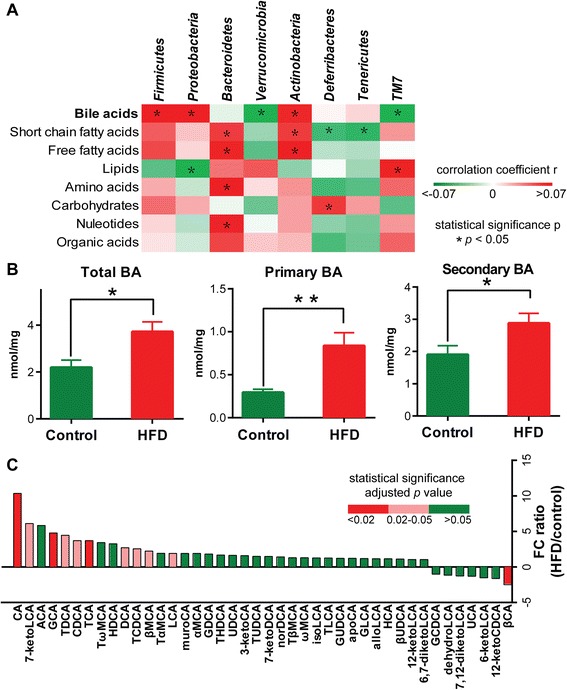
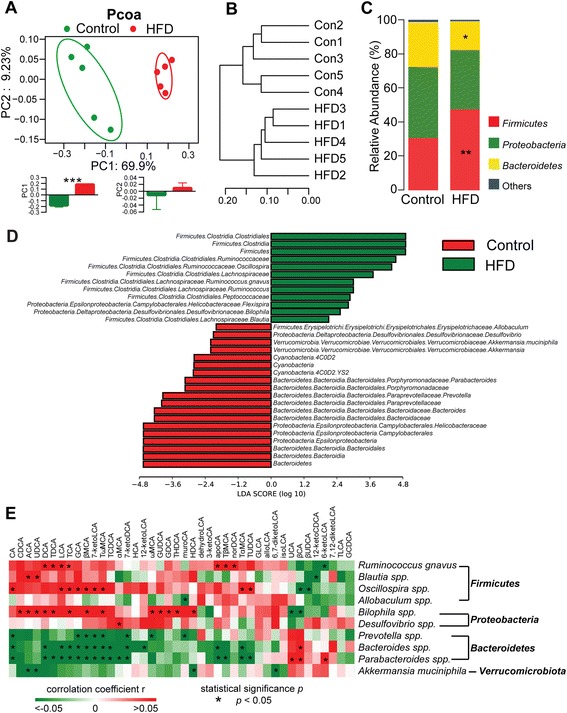
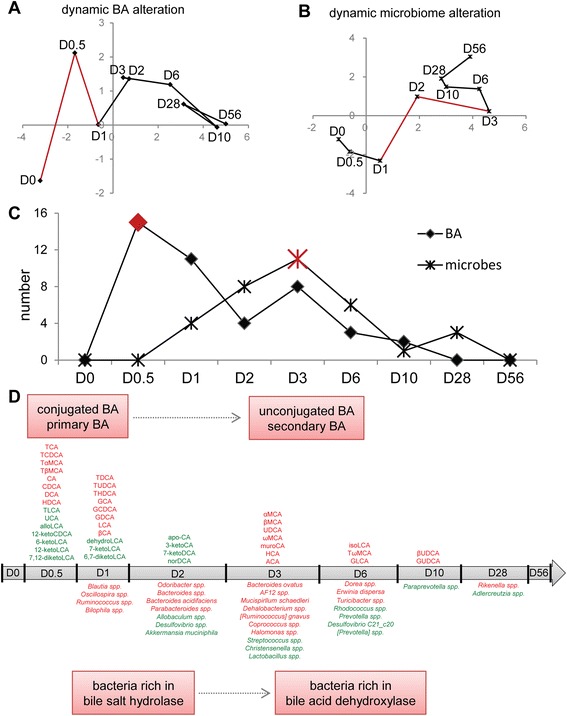
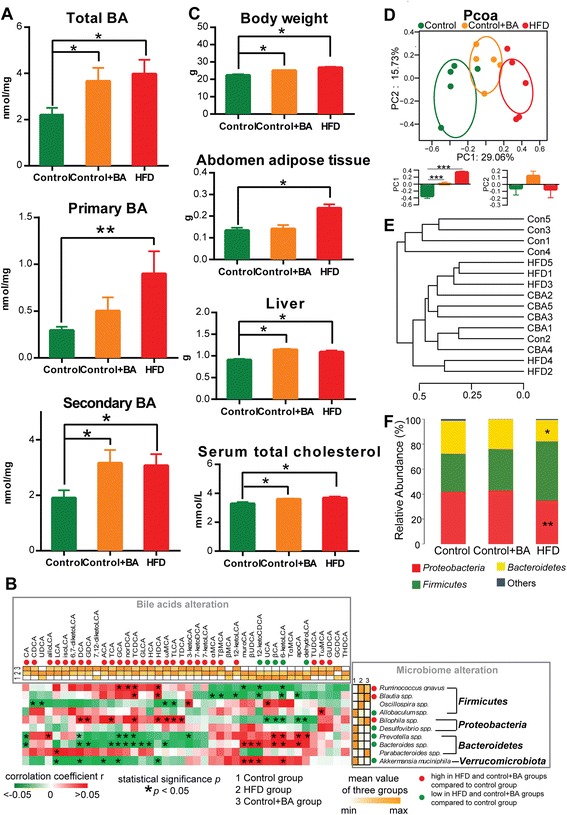
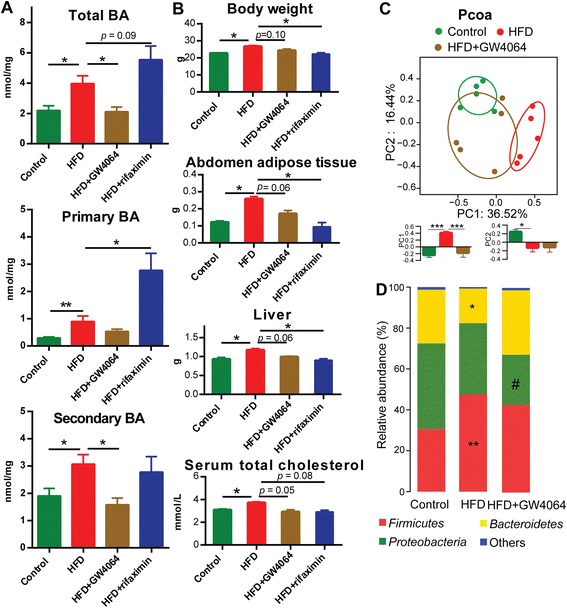
BACKGROUND: Intestinal bacteria are known to regulate bile acid (BA) homeostasis via intestinal biotransformation of BAs and stimulation of the expression of fibroblast growth factor 19 through intestinal nuclear farnesoid X receptor (FXR). On the other hand, BAs directly regulate the gut microbiota with their strong antimicrobial activities. It remains unclear, however, how mammalian BAs cross-talk with gut microbiome and shape microbial composition in a dynamic and interactive way. RESULTS: We quantitatively profiled small molecule metabolites derived from host-microbial co-metabolism in mice, demonstrating that BAs were the most significant factor correlated with microbial alterations among all types of endogenous metabolites. A high-fat diet (HFD) intervention resulted in a rapid and significant increase in the intestinal BA pool within 12 h, followed by an alteration in microbial composition at 24 h, providing supporting evidence that BAs are major dietary factors regulating gut microbiota. Feeding mice with BAs along with a normal diet induced an obese phenotype and obesity-associated gut microbial composition, similar to HFD-fed mice. Inhibition of hepatic BA biosynthesis under HFD conditions attenuated the HFD-induced gut microbiome alterations. Both inhibition of BAs and direct suppression of microbiota improved obese phenotypes. CONCLUSIONS: Our study highlights a liver-BA-gut microbiome metabolic axis that drives significant modifications of BA and microbiota compositions capable of triggering metabolic disorders, suggesting new therapeutic strategies targeting BA metabolism for metabolic diseases.
Overview
The claims and statistics of this paper haven’t been checked yet.
Run the check — free, no account needed. It reads the open-access text and checks the sources it cites.
Integrity signals
Registry
Cites
Statistics
Figures
Verification
Claims the paper makes
The claims and statistics of this paper haven’t been checked yet.
Run the check — free, no account needed. It reads the open-access text and checks the sources it cites.
Claims other papers make about this one
Each is checked against this paper’s own text: does it say what the citing paper says it does?
The cited source says what the claim attributes to it.
In the citing paper
“In mice fed a high‐fat diet, there is a significant change in the profile of intestinal bile acids, while total BAs, primary BAs, and secondary BAs, including CA, GCA, TDCA, DCA, and LCA, are greatly increased (Zheng et al., 2017).”
From Akkermansia muciniphila alleviates high‐fat‐diet ‐related metabolic‐associated fatty liver disease by modulating gut microbiota and bile acids (2023) · cites this paper as Zheng et al., 2017
The cited source says what the claim attributes to it.
In the citing paper
“The abundance of Bilophila and Blautia immediately increase after 1 day of intervention with a high‐fat diet, which may be related to their ability to tolerate bile salts (Zheng et al., 2017).”
From Akkermansia muciniphila alleviates high‐fat‐diet ‐related metabolic‐associated fatty liver disease by modulating gut microbiota and bile acids (2023) · cites this paper as Zheng et al., 2017
Self-check
Percentages, sums and reported differences re-computed from the paper’s own numbers.
The self-check needs the paper’s full text.
Citations
Cites
Schloss, P. D., Westcott, S. L., Ryabin, T., Hall, J. R., Hartmann, M., Hollister, E. B., Lesniewski, R. A., Oakley, B. B., Parks, D. H., Robinson, C. J., et al. (2009) · Applied and Environmental Microbiology · doi:10.1128/aem.01541-09 · Cited by 19,549
Metagenomic biomarker discovery and explanation
Segata, N., Izard, J., Waldron, L., Gevers, D., Miropolsky, L., Garrett, W. S., & Huttenhower, C. (2011) · Genome Biology · doi:10.1186/gb-2011-12-6-r60 · Cited by 16,192
Diet rapidly and reproducibly alters the human gut microbiome
David, L. A., Maurice, C. F., Carmody, R. N., Gootenberg, D. B., Button, J. E., Wolfe, B. E., Ling, A. V., Devlin, A. S., Varma, Y., Fischbach, M. A., et al. (2014) · Nature · doi:10.1038/nature12820 · Cited by 10,100
UniFrac: a New Phylogenetic Method for Comparing Microbial Communities
Lozupone, C., & Knight, R. (2005) · Applied and Environmental Microbiology · doi:10.1128/aem.71.12.8228-8235.2005 · Cited by 8,227
Cross-talk between Akkermansia muciniphila and intestinal epithelium controls diet-induced obesity
Everard, A., Belzer, C., Geurts, L., Ouwerkerk, J. P., Druart, C., Bindels, L. B., Guiot, Y., Derrien, M., Muccioli, G. G., Delzenne, N. M., et al. (2013) · Proceedings of the National Academy of Sciences · doi:10.1073/pnas.1219451110 · Cited by 4,511
Functional interactions between the gut microbiota and host metabolism
Tremaroli, V., & Bäckhed, F. (2012) · Nature · doi:10.1038/nature11552 · Cited by 4,387
The Effect of Diet on the Human Gut Microbiome: A Metagenomic Analysis in Humanized Gnotobiotic Mice
Turnbaugh, P. J., Ridaura, V. K., Faith, J. J., Rey, F. E., Knight, R., & Gordon, J. I. (2009) · Science Translational Medicine · doi:10.1126/scitranslmed.3000322 · Cited by 3,058 · cited 8×
“Bacteroides spp. concentrations were increased at day 2 but were low at 8 weeks.”
InfluentialBile Acids: Natural Ligands for an Orphan Nuclear Receptor
Parks, D. J., Blanchard, S. G., Bledsoe, R. K., Chandra, G., Consler, T. G., Kliewer, S. A., Stimmel, J. B., Willson, T. M., Zavacki, A. M., Moore, D. D., et al. (1999) · Science · doi:10.1126/science.284.5418.1365 · Cited by 2,274
Dao, M. C., Everard, A., Aron-Wisnewsky, J., Sokolovska, N., Prifti, E., Verger, E. O., Kayser, B. D., Levenez, F., Chilloux, J., Hoyles, L., et al. (2016) · Gut · doi:10.1136/gutjnl-2014-308778 · Cited by 1,931
Dietary-fat-induced taurocholic acid promotes pathobiont expansion and colitis in Il10-/- mice
Devkota, S., Wang, Y., Musch, M. W., Leone, V., Fehlner-Peach, H., Nadimpalli, A., Antonopoulos, D. A., Jabri, B., & Chang, E. B. (2012) · Nature · doi:10.1038/nature11225 · Cited by 1,904
Role of Bile Acids and Bile Acid Receptors in Metabolic Regulation
Lefebvre, P., Cariou, B., Lien, F., Kuipers, F., & Staels, B. (2009) · Physiological Reviews · doi:10.1152/physrev.00010.2008 · Cited by 1,678
Diet dominates host genotype in shaping the murine gut microbiota
Carmody, R. N., Gerber, G. K., Luevano, J. M., Gatti, D. M., Somes, L., Svenson, K. L., & Turnbaugh, P. J. (2015) · Cell Host & Microbe · doi:10.1016/j.chom.2014.11.010 · Cited by 1,103
Murphy, E. F., Cotter, P. D., Healy, S., Marques, T. M., O’Sullivan, Ó., Fouhy, F., Clarke, S. F., O’Toole, P. W., Quigley, E. M. M., Stanton, C., et al. (2010) · Gut · doi:10.1136/gut.2010.215665 · Cited by 964
Bile Acid Is a Host Factor That Regulates the Composition of the Cecal Microbiota in Rats
Islam, K. B. M. S., Fukiya, S., Hagio, M., Fujii, N., Ishizuka, S., Ooka, T., Ogura, Y., Hayashi, T., & Yokota, A. (2011) · Gastroenterology · doi:10.1053/j.gastro.2011.07.046 · Cited by 918
Modulation of the fecal bile acid profile by gut microbiota in cirrhosis
Kakiyama, G., Pandak, W. M., Gillevet, P. M., Hylemon, P. B., Heuman, D. M., Daita, K., Takei, H., Muto, A., Nittono, H., Ridlon, J. M., et al. (2013) · Journal of Hepatology · doi:10.1016/j.jhep.2013.01.003 · Cited by 797
The gut microbiota, obesity and insulin resistance
Shen, J., Obin, M. S., & Zhao, L. (2013) · Molecular Aspects of Medicine · doi:10.1016/j.mam.2012.11.001 · Cited by 599
The Microbiota of the Gut in Preschool Children With Normal and Excessive Body Weight
Karlsson, C., Önnerfält, J., Xu, J., Molin, G., Ahrné, S., & Thorngren‐Jerneck, K. (2012) · Obesity · doi:10.1038/oby.2012.110 · Cited by 556
A biosynthetic pathway for a prominent class of microbiota-derived bile acids
Devlin, A. S., & Fischbach, M. A. (2015) · Nature Chemical Biology · doi:10.1038/nchembio.1864 · Cited by 448
Zhao, W., Wang, Y., Liu, S., Huang, J., Zhai, Z., He, C., Ding, J., Wang, J., Wang, H., Fan, W., et al. (2015) · PLoS ONE · doi:10.1371/journal.pone.0117441 · Cited by 430
Mechanism of growth inhibition by free bile acids in lactobacilli and bifidobacteria
Kurdi, P., Kawanishi, K., Mizutani, K., & Yokota, A. (2006) · Journal of Bacteriology · doi:10.1128/jb.188.5.1979-1986.2006 · Cited by 364
The Footprints of Gut Microbial–Mammalian Co-Metabolism
Zheng, X., Xie, G., Zhao, A., Zhao, L., Yao, C., Chiu, N. H. L., Zhou, Z., Bao, Y., Jia, W., Nicholson, J. K., et al. (2011) · Journal of Proteome Research · doi:10.1021/pr2007945 · Cited by 321
Self-citationThe Intestinal Microbiota in Metabolic Disease
Woting, A., & Blaut, M. (2016) · Nutrients · doi:10.3390/nu8040202 · Cited by 284
渡辺, 光., Horai, Y., Houten, S. M., Morimoto, K., Sugizaki, T., Arita, E., Mataki, C., Sato, H., Tanigawara, Y., Schoonjans, K., et al. (2011) · Journal of Biological Chemistry · doi:10.1074/jbc.m111.248203 · Cited by 266
Dysregulated hepatic bile acids collaboratively promote liver carcinogenesis
Xie, G., Wang, X., Huang, F., Zhao, A., Chen, W., Yan, J., Zhang, Y., Lei, S., Ge, K., Zheng, X., et al. (2016) · International Journal of Cancer · doi:10.1002/ijc.30219 · Cited by 252
Self-citationA targeted metabolomic protocol for short-chain fatty acids and branched-chain amino acids
Zheng, X., Qiu, Y., Zhong, W., Baxter, S. A., Su, M., Li, Q., Xie, G., Ore, B. M., Qiao, S., Spencer, M., et al. (2013) · Metabolomics · doi:10.1007/s11306-013-0500-6 · Cited by 241
Self-citationLan, Y., Wang, Q., Cole, J. R., & ROSEN, G. L. (2012) · PLoS ONE · doi:10.1371/journal.pone.0032491 · Cited by 220
Impact of Diet on Human Intestinal Microbiota and Health
Salonen, A., & de Vos, W. M. (2014) · Annual Review of Food Science and Technology · doi:10.1146/annurev-food-030212-182554 · Cited by 220
Distinctly altered gut microbiota in the progression of liver disease
Xie, G., Wang, X., Liu, P., Wei, R., Chen, W., Rajani, C., Hernandez, B. Y., Alegado, R., Dong, B., Li, D., et al. (2016) · Oncotarget · doi:10.18632/oncotarget.8466 · Cited by 219
Self-citationBile acids and colon cancer: Solving the puzzle with nuclear receptors
Degirolamo, C., Modica, S., Palasciano, G., & Moschetta, A. (2011) · Trends in Molecular Medicine · doi:10.1016/j.molmed.2011.05.010 · Cited by 214
Tachon, S., Zhou, J., Keenan, M. J., Martin, R. J., & Marco, M. L. (2012) · FEMS Microbiology Ecology · doi:10.1111/j.1574-6941.2012.01475.x · Cited by 212
Bile acids in the colon, from healthy to cytotoxic molecules
Barrasa, J. I., Olmo, N., Lizarbe, M. A., & Turnay, J. (2012) · Toxicology in Vitro · doi:10.1016/j.tiv.2012.12.020 · Cited by 210
Diet and excretion of bile acids.
Reddy, B. S. (1981) · PubMed · Cited by 208
The effect of bile acids on intestinal microflora
Floch, M. H., Binder, H. J., Filburn, B., & Gershengoren, W. (1972) · American Journal of Clinical Nutrition · doi:10.1093/ajcn/25.12.1418 · Cited by 191
Lee, J., Arai, H., Nakamura, Y., Fukiya, S., Wada, M., & Yokota, A. (2013) · Journal of Lipid Research · doi:10.1194/jlr.m039834 · Cited by 171
Profiling of Serum Bile Acids in a Healthy Chinese Population Using UPLC–MS/MS
Xie, G., Wang, Y., Wang, X., Zhao, A., Chen, T., Ni, Y., Wong, L. L., Zhang, H., Zhang, J., Liu, C., et al. (2015) · Journal of Proteome Research · doi:10.1021/pr500920q · Cited by 160
Self-citationIm, E., & Martinez, J. D. (2004) · Journal of Nutrition · doi:10.1093/jn/134.2.483 · Cited by 154
Circulating Unsaturated Fatty Acids Delineate the Metabolic Status of Obese Individuals
Ni, Y., Zhao, L., Yu, H., Ma, X., Bao, Y., Rajani, C., Loo, L. W. M., Shvetsov, Y. B., Yu, H., Chen, T., et al. (2015) · EBioMedicine · doi:10.1016/j.ebiom.2015.09.004 · Cited by 139
Self-citationBile acids: From digestion to cancers
Baptissart, M., Vega, A., Maqdasy, S., Caira, F., Baron, S., Lobaccaro, J.-M. A., & Volle, D. H. (2013) · Biochimie · doi:10.1016/j.biochi.2012.06.022 · Cited by 97
The Brain Metabolome of Male Rats across the Lifespan
Zheng, X., Chen, T., Zhao, A., Wang, X., Xie, G., Huang, F., Liu, J., Zhao, Q., Wang, S., Wang, C., et al. (2016) · Scientific Reports · doi:10.1038/srep24125 · Cited by 70
Self-citationUrsodeoxycholic acid and chemoprevention of colorectal cancer
Serfaty, L., Bissonnette, M., & Poupon, R. Y. (2010) · Gastroentérologie Clinique et Biologique · doi:10.1016/j.gcb.2010.05.005 · Cited by 31
Cited by
Sorted by citations
Huang, F., Zheng, X., Ma, X., Jiang, R., Zhou, W., Zhou, S., Zhang, Y., Lei, S., Wang, S., Kuang, J., et al. (2019) · Nature Communications · doi:10.1038/s41467-019-12896-x · Cited by 799
Self-citationZheng, X., Chen, T., Jiang, R., Zhao, A., Wu, Q., Kuang, J., Han, X., Li, M., Li, M., 黄凤杰, et al. (2020) · Cell Metabolism · doi:10.1016/j.cmet.2020.11.017 · Cited by 464
Self-citationFoley, M. H., O’Flaherty, S., Barrangou, R., & Theriot, C. M. (2019) · PLOS Pathogens · doi:10.1371/journal.ppat.1007581 · Cited by 271
The gut microbiota drives the impact of bile acids and fat source in diet on mouse metabolism
Just, S., Mondot, S., Ecker, J., Wegner, K., Rath, E., Gau, L., Streidl, T., Hery-Arnaud, G., Schmidt, S., Lesker, T. R., et al. (2018) · Microbiome · doi:10.1186/s40168-018-0510-8 · Cited by 269
Zhao, L., Lou, H., Peng, Y., Chen, S., Zhang, Y., & Li, X. (2019) · Endocrine · doi:10.1007/s12020-019-02103-8 · Cited by 238
Self-citation
Metadata
- Authors
- Zheng, X., Huang, F., Zhao, A., Lei, S., Zhang, Y., Xie, G., Chen, T., Qu, C., Rajani, C., Dong, B., Li, D., & Jia, W.
- Affiliations
- Shanghai Jiao Tong University (CN)
- University of Hawaii Cancer Center (US)
- China Agricultural University (CN)
- Corresponding author
- Jia, Wei
- ORCID
- Venue
- BMC Biology
- Published
- 2017-12
- Volume
- 15
- Issue
- 1
- Pages
- 120-120
- ISSN
- 1741-7007 (ISSN-L)
- PMC
- PMC5731064
- OpenAlex
- W2774287749
- Cited by
- 323
- References
- 40
- Citations by year
- 2026: 18 · 2025: 36 · 2024: 40 · 2023: 61 · 2022: 44 · 2021: 47 · 2020: 36 · 2019: 29 · 2018: 12
- FWCI
- 8.83
- Type
- journal article
- Language
- en
- Open access
- gold
- doi.org
- Licence
- cc-by
- Locations
- BMC Biology (publishedVersion, cc-by)
- PubMed Central (publishedVersion, cc-by)
- PubMed (publishedVersion)
- DOAJ (DOAJ: Directory of Open Access Journals) (submittedVersion, cc-by-sa)
- Funders
- National Natural Science Foundation of China (31500954)
- Science and Technology Committee of Shanghai Municipality Government (15YF1409100)
- Topics
- Life Sciences › Biochemistry, Genetics and Molecular Biology › Molecular Biology › Gut microbiota and health
- Health Sciences › Medicine › Oncology › Drug Transport and Resistance Mechanisms
- Health Sciences › Medicine › Pharmacology (medical) › Berberine and alkaloids research
- Keywords
- bile acids, gut microbiota, diet-induced obesity, high-fat diet, bile acid synthesis, FGF19, farnesoid X receptor, small molecule metabolites, metabolic disorders
- MeSH terms
- Gastrointestinal Microbiome, Receptor, Farnesoid X-Activated, Animals, Bile Acids and Salts, Isoxazoles, Male, Mice, Inbred C57BL, Mice, Obese, Signal Transduction, Receptors, Cytoplasmic and Nuclear, Mice, Diet, High-Fat
About these checks
Registry, retraction, Cites and statistics results are computed, not judged, with one exception: a printed reference that no index lists is read once by a model before it counts as a citation error. Claims are extracted by a model and kept only when their quote appears verbatim in the text; each cited source is then checked, with a model’s help, for whether it says what the claim relies on. Those verdicts can be wrong — read the claim’s quote and the cited source before relying on one.
Statistics and arithmetic are recomputed, not judged.
Confidence bands are shown only for fields calibrated on our annotated test set. None is calibrated yet, so no band is shown.
What counts as a claim ›How we measure confidence ›How we check this ›
Are you an author, or do you see a problem with this page? Request a review
