

Immune related adverse events associated with anti-CTLA-4 antibodies: systematic review and meta-analysis
Open accessThe DOI matches its Crossref record; 142 of the 142 references it cites were found in a registry or an index.
Abstract
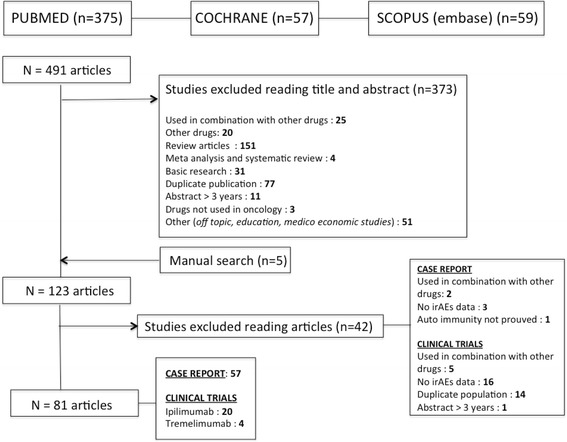
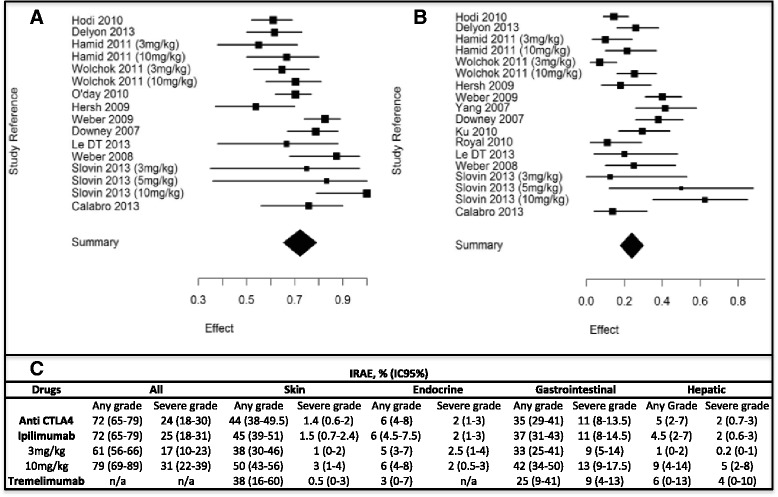
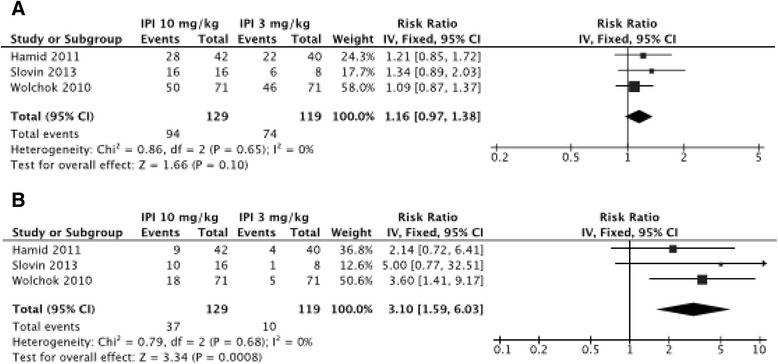
BACKGROUND: Targeting CTLA-4 is a recent strategic approach in cancer control: blocking CTLA-4 enhances an antitumor immunity by promoting T-cell activation and cytotoxic T-lymphocyte proliferation. This induction of a tolerance break against the tumor may be responsible for immune-related adverse events (irAEs). Our objective was to assess the incidence and nature of irAEs in oncologic patients receiving anti-CTLA-4 antibodies (ipilimumab and tremelimumab). METHODS: A systematic search of literature up to February 2014 was performed in MEDLINE, EMBASE, and Cochrane databases to identify relevant articles. Paired reviewers independently selected articles for inclusion and extracted data. Pooled incidence was calculated using R(©), package meta. RESULTS: Overall, 81 articles were included in the study, with a total of 1265 patients from 22 clinical trials included in the meta-analysis. Described irAEs consisted of skin lesions (rash, pruritus, and vitiligo), colitis, and less frequently hepatitis, hypophysitis, thyroiditis, and some rare events such as sarcoidosis, uveitis, Guillain-Barré syndrome, immune-mediated cytopenia and polymyalgia rheumatic/Horton. The overall incidence of all-grade irAEs was 72 % (95 % CI, 65-79 %). The overall incidence of high-grade irAEs was 24 % (95 % CI, 18-30 %). The risk of developing irAEs was dependent of dosage, with incidence of all-grade irAEs being evaluated to 61 % (95 % CI, 56-66 %) for ipilimumab 3 mg/kg and 79 % (95 % CI, 69-89 %) for ipilimumab 10 mg/kg. Death due to irAEs occurred in 0.86 % of patients. The median time of onset of irAEs was about 10 weeks (IQR, 6-12) after the onset of treatment, corresponding with the first three cycles but varied according to the organ system involved. Such immune activation could also be indicative for tumor-specific T-cell activation and irAE occurrence was associated with clinical response to CTLA-4 blocking in 60 % of patients. CONCLUSION: The price of potential long-term survival to metastatic tumors is an atypical immune toxicity, reflecting the mechanism of action of anti-CTLA-4 antibodies. A better knowledge of these irAEs and its management in a multidisciplinary approach will help to reduce morbidity and therapy interruptions.
Overview
The claims and statistics of this paper haven’t been checked yet.
Free: it reads the open-access text and checks the first 5 claims that cite a source we can check. Create a free account to check every claim.
Integrity signals
Registry
Cites
Statistics
Figures
Verification
Claims the paper makes
The claims and statistics of this paper haven’t been checked yet.
Free: it reads the open-access text and checks the first 5 claims that cite a source we can check. Create a free account to check every claim.
Claims other papers make about this one
Each is checked against this paper’s own text: does it say what the citing paper says it does?
The source backs part of the claim, not all of it — or backs it for a different population, condition or comparison.
In the citing paper
“ICI-associated colitis is routinely treated with immunosuppressive therapy, including corticosteroids and/or agents targeting tumor necrosis factor alpha (TNF-alpha), all of which have significant side effects.”
From Fecal microbiota transplantation for refractory immune checkpoint inhibitor-associated colitis (2018) · cites this paper as [5]
Experimental — accuracy not yet measuredThe source backs part of the claim, not all of it — or backs it for a different population, condition or comparison.
In the citing paper
“Neurologic immune-related adverse events from immune checkpoint inhibitors include autonomic neuropathy and can present with severe GI dysmotility (Bertrand et al., 2015).”
From Autonomic nervous system and gastrointestinal manifestations with an emphasis on gastric dysfunction (2026) · cites this paper as Bertrand et al., 2015
Experimental — accuracy not yet measured
Self-check
Percentages, sums and reported differences re-computed from the paper’s own numbers.
The self-check needs the paper’s full text.
Citations
Cites
The Cochrane Collaboration's tool for assessing risk of bias in randomised trials
Higgins, J. P. T., Altman, D. G., Gotzsche, P. C., Juni, P., Moher, D., Oxman, A. D., Savovic, J., Schulz, K. F., Weeks, L., Sterne, J. A. C., et al. (2011) · BMJ · doi:10.1136/bmj.d5928 · Cited by 33,817
PD-1 and PD-L1 Immune Checkpoint Blockade to Treat Breast Cancer
Hartkopf, A. D., Taran, F.-A., Wallwiener, M., Walter, C. B., Krämer, B., Grischke, E.-M., & Brucker, S. Y. (2016) · Breast Care · doi:10.1159/000453569 · Cited by 30,845
Dermyshi, E., Wang, Y., Yan, C., Hong, W., Qiu, G., Gong, X., & Zhang, T. (2017) · Neonatology · doi:10.1159/000454668 · Cited by 24,451
Adverse Renal Effects of Immune Checkpoint Inhibitors: A Narrative Review
Wanchoo, R., Karam, S., Uppal, N. N., Barta, V. S., Deray, G., Devoe, C., Launay-Vacher, V., Jhaveri, K. D., & on behalf of Cancer and Kidney International Network Workgroup on Immune Checkpoint Inhibitors (2017) · American Journal of Nephrology · doi:10.1159/000455014 · Cited by 15,256
Improved Survival with Ipilimumab in Patients with Metastatic Melanoma
Hodi, F. S., O'Day, S. J., McDermott, D. F., Weber, R. W., Sosman, J. A., Haanen, J. B., Gonzalez, R., Robert, C., Schadendorf, D., Hassel, J. C., et al. (2010) · New England Journal of Medicine · doi:10.1056/nejmoa1003466 · Cited by 15,155 · cited 4×
“[7], an irAE was defined as an adverse event that was associated with exposure to the study drug and that was consistent with an immune phenomenon.”
BackgroundInfluentialThe blockade of immune checkpoints in cancer immunotherapy
Pardoll, D. M. (2012) · Nature Reviews Cancer · doi:10.1038/nrc3239 · Cited by 13,838 · cited 1×
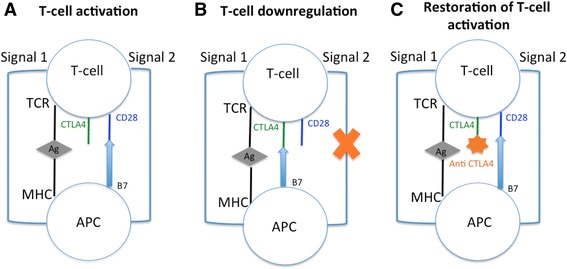
“Thus, blockades of immune checkpoints with antagonists of inhibitory pathways have been developed and anti-CTLA-4 antibodies are precursors in this domain [3] (Mechanism of action: anti CTLA-4 antibodies in Fig.”
BackgroundIpilimumab plus Dacarbazine for Previously Untreated Metastatic Melanoma
Robert, C., Thomas, L., Bondarenko, I., O'Day, S., Weber, J., Garbe, C., Lebbe, C., Baurain, J.-F., Testori, A., Grob, J.-J., et al. (2011) · New England Journal of Medicine · doi:10.1056/nejmoa1104621 · Cited by 4,496 · cited 1×
“Thus, a fully humanized anti-CTLA-4 monoclonal antibody immunoglobulin (Ig) G1 isotype (ipilimumab) was approved by the Food and Drug Administration (FDA) in 2011 at a dosage of 3 mg/kg every 3 weeks for four cycles in advanced melanoma, with evidence of improved survival [7, 8].”
BackgroundGenetic Basis for Clinical Response to CTLA-4 Blockade in Melanoma
Snyder, A., Makarov, V., Merghoub, T., Yuan, J., Zaretsky, J. M., Desrichard, A., Walsh, L. A., Postow, M. A., Wong, P., Ho, T. S., et al. (2014) · New England Journal of Medicine · doi:10.1056/nejmoa1406498 · Cited by 4,286 · cited 1×
“[119] also defined a genetic basis for benefit from CTLA-4 blockade in melanoma by whole-exome sequencing on tumors and matched blood samples.”
BackgroundTivol, E. A., Borriello, F., Schweitzer, A. N., Lynch, W. P., Bluestone, J. A., & Sharpe, A. H. (1995) · Immunity · doi:10.1016/1074-7613(95)90125-6 · Cited by 2,914 · cited 1×
“This role is supported by the lethal lympho-proliferation and autoimmunity in CTLA-4 knockout mice [5].”
BackgroundFitzgerald, M., Hayward, I. P., Thomas, A. C., Campbell, J. H., & CAMPBELL, G. R. (1995) · Cited by 2,552
Research works printed but not linked: 1
- Salenave J Chanson P Young J Hypophysite lymphocytaire. Endocrinologie-Nutrition, 10-023-D-10 2007 Paris Elsevier Masson SAS
Cited by
Items 101–200 of 750
New insight in endocrine-related adverse events associated to immune checkpoint blockade
Elia, G., Ferrari, S. M., Galdiero, M. R., Ragusa, F., Paparo, S. R., Ruffilli, I., Varricchi, G., Fallahi, P., & Antonelli, A. (2019) · Best Practice & Research Clinical Endocrinology & Metabolism · doi:10.1016/j.beem.2019.101370 · Cited by 114
“It was found that the risk of irAEs augmented with increasing of the dose (77).”
BackgroundGastrointestinal and Hepatic Toxicities of Checkpoint Inhibitors: Algorithms for Management
Grover, S., Rahma, O. E., Hashemi, N., & Lim, R. M. (2018) · American Society of Clinical Oncology Educational Book · doi:10.1200/edbk_100013 · Cited by 116
Diet, Microbiome, and Cancer Immunotherapy—A Comprehensive Review
Szczyrek, M., Bitkowska, P., Chunowski, P., Czuchryta, P., Krawczyk, P. A., & Milanowski, J. (2021) · Nutrients · doi:10.3390/nu13072217 · Cited by 113
“It is assumed that this particular effect can be reached by the modulating polyamine transport and synthesis of group B vitamins by these bacterial species [19,21,31,32,56,64,66,69,72,92].”
BackgroundMethodInfluentialHarnessing cancer immunotherapy during the unexploited immediate perioperative period
Matzner, P., Sandbank, E., Neeman, E., Zmora, O., Gottumukkala, V. N. R., & Ben‐Eliyahu, S. (2020) · Nature Reviews Clinical Oncology · doi:10.1038/s41571-019-0319-9 · Cited by 112
Autoimmune endocrine dysfunctions associated with cancer immunotherapies
Ferrari, S. M., Fallahi, P., Elia, G., Ragusa, F., Ruffilli, I., Patrizio, A., Galdiero, M. R., Baldini, E., Ulisse, S., Marone, G., et al. (2019) · International Journal of Molecular Sciences · doi:10.3390/ijms20102560 · Cited by 107
“Other symptoms have been described as confusion, loss of libido, hallucination, polyuria, polydipsia, memory loss, erectile dysfunction, cold intolerance, insomnia, and dizziness [43,66,77,78].”
BackgroundInfluentialSoluble CD73 as biomarker in patients with metastatic melanoma patients treated with nivolumab
Morello, S., Capone, M., Sorrentino, C., Giannarelli, D., Madonna, G., Mallardo, D., Grimaldi, A. M., Pinto, A., & Ascierto, P. A. (2017) · Journal of Translational Medicine · doi:10.1186/s12967-017-1348-8 · Cited by 108
Immunotherapy of cancers comes of age
Yousefi, H., Yuan, J. D., Keshavarz‐Fathi, M., Murphy, J. F., & Rezaei, N. (2017) · Expert Review of Clinical Immunology · doi:10.1080/1744666x.2017.1366315 · Cited by 107
“Moreover, all-grade immunerelated adverse events were associated with the dosage [45].”
BackgroundCardiac Complications in Immune Checkpoint Inhibition Therapy
Tajiri, K., & Ieda, M. (2019) · Frontiers in Cardiovascular Medicine · doi:10.3389/fcvm.2019.00003 · Cited by 103
Immunotherapy of brain metastases: breaking a “dogma”
Giacomo, A. M. D., Valente, M., Cerase, A., Lofiego, M. F., Piazzini, F., Calabrò, L., Gambale, E., Covre, A., & Maio, M. (2019) · Journal of Experimental & Clinical Cancer Research · doi:10.1186/s13046-019-1426-2 · Cited by 105
Imaging of tumour response to immunotherapy
Dromain, C., Beigelman‐Aubry, C., Pozzessere, C., Durán, R., & Digklia, A. (2020) · European Radiology Experimental · doi:10.1186/s41747-019-0134-1 · Cited by 103
“ICI-related hepatitis has been reported in up to 19% of patients receiving anti-CTLA4, whereas it is rarely reported when using anti-PD1 or anti-PDL1 [40, 42].”
BackgroundImmunological Characteristics of Colitis Associated with Anti-CTLA-4 Antibody Therapy
Bamias, G., Delladetsima, I. K., Perdiki, Μ., Siakavellas, S. I., Goukos, D., Papatheodoridis, G., Daikos, G. L., & Gogas, H. J. (2017) · Cancer Investigation · doi:10.1080/07357907.2017.1324032 · Cited by 103
Gu, L., Khadaroo, P. A., Su, H., Kong, L., Chen, L., Wang, X., Li, X., Zhu, H., Zhong, X., Pan, J., et al. (2019) · BMC Cancer · doi:10.1186/s12885-019-5785-z · Cited by 102
“There are a few metaanalyses on the incidences of irAEs to date, and most include articles observed monotherapy or one ICI combined with chemotherapy [11, 12].”
Gastrointestinal toxicity of immune checkpoint inhibitors: From mechanisms to management
Samaan, M. A., Pavlidis, P., Papa, S., Powell, N., & Irving, P. M. (2018) · Nature Reviews Gastroenterology & Hepatology · doi:10.1038/nrgastro.2018.14 · Cited by 100
Using human genetics to improve safety assessment of therapeutics
Carss, K., Deaton, A. M., Río-Espínola, A. D., Diogo, D., Fielden, M. R., Kulkarni, D. A., Moggs, J. G., Newham, P., Nelson, M. R., Sistare, F. D., et al. (2022) · Nature Reviews Drug Discovery · doi:10.1038/s41573-022-00561-w · Cited by 100
Predictive Biomarkers of Immune Checkpoint Inhibitors-Related Toxicities
Xu, Y., Fu, Y., Zhu, B., Wang, J., & Zhang, B. (2020) · Frontiers in Immunology · doi:10.3389/fimmu.2020.02023 · Cited by 101
Narváez, J., Juarez-López, P., Lluch, J., Narváez, J. A., Palmero, R., del Muro, X. G., Solé, J. M. N., & Domingo‐Doménech, E. (2018) · Autoimmunity Reviews · doi:10.1016/j.autrev.2018.05.002 · Cited by 94
Xie, W., Huang, H., Xiao, S., Fan, Y., Deng, X., & Zhang, Z. (2020) · Autoimmunity Reviews · doi:10.1016/j.autrev.2020.102687 · Cited by 92
Anti-PD1-induced collagenous colitis in a melanoma patient
Baroudjian, B., Lourenco, N., Pagès, C., Chami, I., Maillet, M., Bertheau, P., Bagot, M., Gornet, J.-M., Lebbé, C., & Allez, M. (2016) · Melanoma Research · doi:10.1097/cmr.0000000000000252 · Cited by 89
Immunotherapy with ipilimumab plus nivolumab in a stage IV melanoma patient during pregnancy
Menzer, C., Beedgen, B., Rom, J., Duffert, C. M., Volckmar, A., Sedlaczek, O., Richtig, E., Enk, A., Jäger, D., & Hassel, J. C. (2018) · European Journal of Cancer · doi:10.1016/j.ejca.2018.09.008 · Cited by 90
Crosby, E. J., Wei, J., Yang, X. Y., Lei, G., Wang, T., Liu, C.-X., Agarwal, P., Korman, A. J., Morse, M. A., Gouin, K., et al. (2018) · OncoImmunology · doi:10.1080/2162402x.2017.1421891 · Cited by 84
“mab), where Grade III toxicities were observed in up to 25% of treated patients.(49,50) While we did not observe these overt tox-”
BackgroundSarcoid-like reactions in patients receiving modern melanoma treatment
Dimitriou, F., Frauchiger, A. L., Urosevic‐Maiwald, M., Nägeli, M., Goldinger, S. M., Barysch, M. J., Franzen, D., Kamarachev, J., Braun, R. P., Dummer, R., et al. (2018) · Melanoma Research · doi:10.1097/cmr.0000000000000437 · Cited by 88
Chat, V., Ferguson, R., Simpson, D., Kazlow, E., Lax, R., Moran, U., Pavlick, A. C., Frederick, D. T., Boland, G. M., Sullivan, R. J., et al. (2019) · Cancer Immunology Immunotherapy · doi:10.1007/s00262-019-02318-8 · Cited by 87
Pulmonary toxicity of immune checkpoint immunotherapy
Ghanbar, M., & Suresh, K. S. (2024) · Journal of Clinical Investigation · doi:10.1172/jci170503 · Cited by 88
“The use of ICIs has shown improved overall survival in NSCLC (9), but it has also been linked to immune-related adverse events (irAEs), including lung toxicity (10, 11).”
BackgroundThyroid dysfunctions secondary to cancer immunotherapy
Chalan, P., Dalmazi, G. D., Pani, F., Remigis, A. D., Corsello, A., & Caturegli, P. (2017) · Journal of Endocrinological Investigation · doi:10.1007/s40618-017-0778-8 · Cited by 89
Review of immune checkpoint inhibitors in immuno-oncology
Jacob, J. B., Jacob, M. K., & Parajuli, P. (2021) · Advances in pharmacology · doi:10.1016/bs.apha.2021.01.002 · Cited by 86
Immune‑related adverse events during anticancer immunotherapy: Pathogenesis and management (Review)
Stucci, S., Palmirotta, R., Passarelli, A., Silvestris, E., Argentiero, A., Lanotte, L., Acquafredda, S., Todisco, A., & Silvestris, F. (2017) · Oncology Letters · doi:10.3892/ol.2017.6919 · Cited by 66
“…several reported cases of Sweet's syndrome or Stevens-Johnson syndrome, as well as toxic epidermal necrosis, pyoderma gangrenosum and cutaneous sarcoidosis during anti-CTLA4 therapy, as well as exacerbation of pre-existing conditions, such as eczema, vitiligo or rosacea and extensive alopecia (22).”
Walter, J. E., Farmer, J. R., Földvári, Z., Torgerson, T. R., & Cooper, M. A. (2016) · The Journal of Allergy and Clinical Immunology In Practice · doi:10.1016/j.jaip.2016.08.004 · Cited by 85
Can Immune Checkpoint Inhibitors Induce Microscopic Colitis or a Brand New Entity?
Choi, K., Abu‐Sbeih, H., Samdani, R. T., González, G. N., Raju, G. S., Richards, D. M., Gao, J., Subudhi, S. K., Stroehlein, J., & Wang, Y. (2018) · Inflammatory Bowel Diseases · doi:10.1093/ibd/izy240 · Cited by 84
“Mucosal abnormality 5 (13) 7 (47) 3 (27)”
Molecular Pathways: Immune Checkpoint Antibodies and their Toxicities
Cousin, S., & Italiano, A. (2016) · Clinical Cancer Research · doi:10.1158/1078-0432.ccr-15-2569 · Cited by 83
“Colitis, indicated by diarrhea, abdominal pain and rectal bleeding, is the main gastrointestinal AE and the most severe irAE associated with anti–CTLA-4 (15).”
BackgroundInfluentialDiagnosis and Management of Immune Checkpoint Inhibitor Colitis.
Hashash, J. G., Francis, F. F., & Farraye, F. A. (2021) · Europe PMC (PubMed Central) · Cited by 83
Supportive care for patients undergoing immunotherapy
Rapoport, B. L., Eeden, R. I. V., Sibaud, V., Epstein, J. B., Klastersky, J. A., Aapro, M., & Moodley, S. D. (2017) · Supportive Care in Cancer · doi:10.1007/s00520-017-3802-9 · Cited by 83
The PD-1:PD-L1 axis in Inflammatory Arthritis
Canavan, M., Floudas, A., Veale, D. J., & Fearon, U. (2021) · BMC Rheumatology · doi:10.1186/s41927-020-00171-2 · Cited by 83
“Interestingly, reports of rheumatic irAEs in patients receiving anti-CTLA-4 immunotherapy are rare, suggestive of a more potent role for PD-1 in rheumatology related irAEs [86].”
BackgroundHryniewicki, A. T., Wang, C., Shatsky, R. A., & Coyne, C. J. (2018) · Journal of Emergency Medicine · doi:10.1016/j.jemermed.2018.07.005 · Cited by 83
Adverse events induced by immune checkpoint inhibitors
Perdigoto, A. L., Kluger, H. M., & Herold, K. C. (2021) · Current Opinion in Immunology · doi:10.1016/j.coi.2021.02.002 · Cited by 83
Immune-related adverse events of checkpoint inhibitors: Insights into immunological dysregulation
Yang, H., Yao, Z., Zhou, X., Zhang, W., Zhang, X., & Zhang, F. (2020) · Clinical Immunology · doi:10.1016/j.clim.2020.108377 · Cited by 74
Synergistic potential of immune checkpoint inhibitors and therapeutic cancer vaccines
Oladejo, M., Paulishak, W., & Wood, L. M. (2022) · Seminars in Cancer Biology · doi:10.1016/j.semcancer.2022.12.003 · Cited by 80
Rivero, J. D., Cordes, L. M., Kłubo-Gwieździńska, J., Madan, R. A., Nieman, L. K., & Gulley, J. L. (2019) · The Oncologist · doi:10.1634/theoncologist.2018-0470 · Cited by 81
“We also recommend an MRI of the sella with pituitary cuts, primarily in those patients with headaches, visual changes.”
BackgroundInfluentialAberrant B cell repertoire selection associated with HIV neutralizing antibody breadth
Roskin, K. M., Jackson, K., Lee, J.-Y., Hoh, R. A., Joshi, S. A., Hwang, K., Bonsignori, M., Pedroza‐Pacheco, I., Liao, H., Moody, M. A., et al. (2020) · Nature Immunology · doi:10.1038/s41590-019-0581-0 · Cited by 81
Biomarkers in Precision Cancer Immunotherapy: Promise and Challenges
McKean, W. B., Moser, J. C., Rimm, D. L., & Hu‐Lieskovan, S. (2020) · American Society of Clinical Oncology Educational Book · doi:10.1200/edbk_280571 · Cited by 79
Risk factors for immune-related adverse events: what have we learned and what lies ahead?
Liu, X., Shi, Y., Zhang, D., Zhou, Q., Liu, J., Chen, M., Xu, Y., Zhao, J., Zhong, W., & Wang, M. (2021) · Biomarker Research · doi:10.1186/s40364-021-00314-8 · Cited by 79
“with diarrhea and/or colitis being the most common (occurring in approximately 20 % of patients) [2, 3].”
BackgroundCheckpoint inhibitors for malignant melanoma: a systematic review and meta-analysis
Karlsson, A., & Saleh, S. N. (2017) · Clinical Cosmetic and Investigational Dermatology · doi:10.2147/ccid.s120877 · Cited by 79
“47,52 These immunorelated adverse events range from mild and self-limiting to life-threatening organ inflammation, and although they respond well to steroids and in severe cases infliximab, prophylactic budesonide failed to reduce the rate of grade ≥ 2 diarrhea in ipilimumab-treated patients.”
Advancing Cancer Immunotherapies with Nanotechnology
Lou, J. W. H., Zhang, L., & Zheng, G. (2019) · Advanced Therapeutics · doi:10.1002/adtp.201800128 · Cited by 78
Patterns of toxicity burden for FDA-approved immune checkpoint inhibitors in the United States
Yang, F., Shay, C., Abousaud, M. I., Tang, C., Li, Y., Qin, Z. S., Saba, N. F., & Teng, Y. (2023) · Journal of Experimental & Clinical Cancer Research · doi:10.1186/s13046-022-02568-y · Cited by 78
Phase I clinical trial of combination imatinib and ipilimumab in patients with advanced malignancies
Reilley, M. J., Bailey, A. M., Subbiah, V., Jankú, F., Naing, A., Falchook, G. S., Karp, D. D., Piha-Paul, S. A., Tsimberidou, A. M., Fu, S., et al. (2017) · Journal for ImmunoTherapy of Cancer · doi:10.1186/s40425-017-0238-1 · Cited by 77
“These higher-grade toxicities were generally self-limited and not more severe than those seen in ipilimumab monotherapy trials [17, 18].”
BackgroundDrug-induced liver injury: Highlights from a review of the 2015 literature
Sarges, P., Steinberg, J. M., & Lewis, J. H. (2016) · Drug Safety · doi:10.1007/s40264-016-0427-8 · Cited by 74
Pichler, R., Heidegger, I. M., Fritz, J., Danzl, M., Sprung, S., Zelger, B. G., Brunner, A., & Pircher, A. (2017) · Oncotarget · doi:10.18632/oncotarget.19913 · Cited by 75
Translational Research in Vitiligo
Katz, E. L., & Harris, J. E. (2021) · Frontiers in Immunology · doi:10.3389/fimmu.2021.624517 · Cited by 74
Fujisawa, Y., Yoshino, K., Otsuka, A., Funakoshi, T., Uchi, H., Fujimura, T., Matsushita, S., Hata, H., Okuhira, H., Tanaka, R., et al. (2017) · Journal of Dermatological Science · doi:10.1016/j.jdermsci.2017.10.009 · Cited by 73
Nikpoor, A. R., Tavakkol‐Afshari, J., Sadri, K., Jalali, S. A., & Jaafari, M. R. (2017) · Nanomedicine Nanotechnology Biology and Medicine · doi:10.1016/j.nano.2017.08.010 · Cited by 73
Cancer immunotherapy-induced endocrinopathies: Clinical behavior and therapeutic approach
Iglesias, P. (2017) · European Journal of Internal Medicine · doi:10.1016/j.ejim.2017.08.019 · Cited by 72
Regulatory T Cells Restrain Pathogenic T Helper Cells during Skin Inflammation
Hartwig, T., Zwicky, P., Schreiner, B., Yawalkar, N., Cheng, P. F., Navarini, A. A., Dummer, R., Flatz, L., Conrad, C., Schlapbach, C., et al. (2018) · Cell Reports · doi:10.1016/j.celrep.2018.12.012 · Cited by 72
“Treatment of melanoma patients with ipilimumab (IP) can cause severe skin manifestations and pathologies by neutralization of Treg cells (Bertrand et al., 2015; Romano et al., 2015).”
BackgroundClinical Features of Liver Injury Induced by Immune Checkpoint Inhibitors in Japanese Patients
Imoto, K., Kohjima, M., Hioki, T., Kurashige, T., Kurokawa, M., Tashiro, S., Suzuki, H., Kuwano, A., Tanaka, M., Okada, S., et al. (2019) · Canadian Journal of Gastroenterology and Hepatology · doi:10.1155/2019/6391712 · Cited by 68
Multiorgan Immune-Related Adverse Events During Treatment With Atezolizumab
Kichenadasse, G., Miners, J. O., Mangoni, A. A., Rowland, A., Hopkins, A. M., & Sorich, M. J. (2020) · Journal of the National Comprehensive Cancer Network · doi:10.6004/jnccn.2020.7567 · Cited by 74
Pathogenesis, Clinical Manifestations and Management of Immune Checkpoint Inhibitors Toxicity
Inno, A., Metro, G., Bironzo, P., Grimaldi, A. M., Grego, E., Nunno, V. D., Picasso, V., Massari, F., & Gori, S. (2017) · Tumori Journal · doi:10.5301/tj.5000625 · Cited by 72
“For patients treated with CTLA-4 inhibitors, the skin and the gastrointestinal tract are affected in 44% and 35% of cases, respectively, while the endocrine system and liver are rarely involved (6% and 5% of cases, respectively) (80).”
BackgroundAbdel‐Wahab, N., Diab, A. K., Yu, R. K., Futreal, P. A., Criswell, L. A., Tayar, J. H., Dadu, R., Shannon, V. R., Shete, S. S., & Suarez-Almazor, M. E. (2021) · Cancer Immunology Immunotherapy · doi:10.1007/s00262-020-02797-0 · Cited by 70
Adverse Events in Cancer Immunotherapy
Abdel‐Wahab, N., Alshawa, A., & Suarez-Almazor, M. E. (2017) · Advances in experimental medicine and biology · doi:10.1007/978-3-319-53156-4_8 · Cited by 70
Oda, S. K., Daman, A. W., Garcia, N. M., Wagener, F., Schmitt, T. M., Tan, X., Chapuis, A. G., & Greenberg, P. D. (2017) · Blood · doi:10.1182/blood-2017-04-777052 · Cited by 62
Balaji, A., Zhang, J., Wills, B., Marrone, K. A., Elmariah, H., Yarchoan, M. M., Zimmerman, J. W., Hajjir, K., Venkatraman, D., Armstrong, D. K., et al. (2019) · Journal of Oncology Practice · doi:10.1200/jop.18.00703 · Cited by 68
Advanced Nanotechnology for Enhancing Immune Checkpoint Blockade Therapy
Cremolini, C., Vitale, E., Rastaldo, R., & Giachino, C. (2021) · Nanomaterials · doi:10.3390/nano11030661 · Cited by 67
“In some cases, the onset of AIEs, like pulmonary and hepatic toxicity, is delayed up to 1 year after treatment initiation [84].”
BackgroundInfluentialWang, Z., Chen, F., Cao, Y., Zhang, F., Sun, L., Yang, C., Xie, X., Wu, Z., Sun, M., Ma, F., et al. (2024) · Advanced Materials · doi:10.1002/adma.202314197 · Cited by 67
Targeting B7‐1 in immunotherapy
Chen, R., Ganesan, A., Okoye, I., Arutyunova, E. I., Elahi, S., Lemieux, M. J., & Barakat, K. (2019) · Medicinal Research Reviews · doi:10.1002/med.21632 · Cited by 67
Powell, N., Ibraheim, H., Raine, T., Speight, A., Papa, S., Brain, O., Green, M., Samaan, M., Spain, L. A., Yousaf, N., et al. (2020) · The Lancet. Gastroenterology & hepatology · doi:10.1016/s2468-1253(20)30014-5 · Cited by 67
Neuro-ophthalmic Complications of Immune Checkpoint Inhibitors: A Systematic Review
Yu, C. W., Yau, M., Mezey, N., Joarder, I., & Micieli, J. A. (2020) · Eye and Brain · doi:10.2147/eb.s277760 · Cited by 68
A Recombinant Antibody-Expressing Influenza Virus Delays Tumor Growth in a Mouse Model
Hamilton, J. R., Vijayakumar, G., & Palese, P. (2018) · Cell Reports · doi:10.1016/j.celrep.2017.12.025 · Cited by 66
Toxicity profiles of immunotherapy
Cousin, S., Sénéschal, J., & Italiano, A. (2017) · Pharmacology & Therapeutics · doi:10.1016/j.pharmthera.2017.07.005 · Cited by 65
Supakornnumporn, S., & Katirji, B. (2017) · Journal of Clinical Neuromuscular Disease · doi:10.1097/cnd.0000000000000193 · Cited by 63
Yadav, D., Kwak, M., Chauhan, P., Puranik, N., Lee, P. C.-W., & Jin, J. (2022) · Seminars in Cancer Biology · doi:10.1016/j.semcancer.2022.02.016 · Cited by 63
Neoplasia and intraocular inflammation: From masquerade syndromes to immunotherapy-induced uveitis
Touhami, S., Audo, I. S., Terrada, C., Gaudric, A., LeHoang, P., Touitou, V., & Bodaghi, B. (2019) · Progress in Retinal and Eye Research · doi:10.1016/j.preteyeres.2019.05.002 · Cited by 64
Failing, J. J., Finnes, H. D., Kottschade, L. A., Allred, J. B., & Markovic, S. N. (2016) · Melanoma Research · doi:10.1097/cmr.0000000000000299 · Cited by 62
Sise, M. E., Seethapathy, H. S., & Reynolds, K. L. (2019) · The Oncologist · doi:10.1634/theoncologist.2018-0764 · Cited by 64
“Although renal irAEs occur less frequently than irAEs [16, 17] that affect other organ systems such as the skin, gastrointestinal tract, and endocrinopathies, we suspect that”
BackgroundT cell costimulation, checkpoint inhibitors and anti-tumor therapy
Nandi, D., Pathak, S., Verma, T., Singh, M., Chattopadhyay, A., Thakur, S., Raghavan, A., Gokhroo, A., & Vijayamahantesh, V. (2020) · Journal of Biosciences · doi:10.1007/s12038-020-0020-2 · Cited by 61
“In case of anti-CTLA4 treatment, incidents of autoimmune colitis, and organ damage (mainly dermal and gastrointestinal) have been reported (Bertrand et al. 2015).”
BackgroundAn engineered influenza virus to deliver antigens for lung cancer vaccination
Ji, D., Zhang, Y., Sun, J., Zhang, B., Ma, W., Cheng, B., Wang, X., Li, Y., Yu, M., Xu, H., et al. (2023) · Nature Biotechnology · doi:10.1038/s41587-023-01796-7 · Cited by 60
Advances in pathogenesis and precision medicine for nasopharyngeal carcinoma
Zhu, Q., Zhao, G., Li, Y., Talakatta, G., Mai, H., Le, Q., Young, L. S., & Zeng, M. (2021) · MedComm · doi:10.1002/mco2.32 · Cited by 60
Control of foreign Ag‐specific Ab responses by Treg and Tfr
Wing, J. B., Lim, E. L., & Sakaguchi, S. (2020) · Immunological Reviews · doi:10.1111/imr.12888 · Cited by 59
Tremelimumab-Induced Graves Hyperthyroidism
Gan, E. H., Mitchell, A. L., Plummer, R., Pearce, S., & Perros, P. (2017) · European Thyroid Journal · doi:10.1159/000464285 · Cited by 58
Scleroderma‐like skin changes induced by checkpoint inhibitor therapy
Tjarks, B. J., Kerkvliet, A. M., Jassim, A. D., & Bleeker, J. S. (2018) · Journal of Cutaneous Pathology · doi:10.1111/cup.13273 · Cited by 58
The Changing Clinical Spectrum of Hypophysitis
Chiloiro, S., Capoluongo, E., Tartaglione, T., Giampietro, A., Bianchi, A., Giustina, A., Pontecorvi, A., & Marinis, L. D. (2019) · Trends in Endocrinology and Metabolism · doi:10.1016/j.tem.2019.06.004 · Cited by 58
Imaging findings of immune checkpoint inhibitor associated pancreatitis
Das, J. P., Postow, M. A., Friedman, C. F., Do, R. K., & Halpenny, D. F. (2020) · European Journal of Radiology · doi:10.1016/j.ejrad.2020.109250 · Cited by 58
“[27]The most common radiologically encountered irAEs include colitis, pneumonitis, hypophysitis and sarcoid-like reaction with up to 31% of patients noted to have adverse events on body imaging studies over the course of their ICI treatment.”
BackgroundGuo, X., Chen, S., Wang, X., & Liu, X. (2023) · Frontiers in Immunology · doi:10.3389/fimmu.2023.1138483 · Cited by 57
Immunoprofiling as a predictor of patient’s response to cancer therapy—promises and challenges
Bethmann, D., Feng, Z., & Fox, B. A. (2017) · Current Opinion in Immunology · doi:10.1016/j.coi.2017.01.005 · Cited by 57
Lang, N., Dick, J., Slynko, A., Schulz, C., Dimitrakopoulou‐Strauss, A., Sachpekidis, C., Enk, A., & Hassel, J. C. (2019) · Immunotherapy · doi:10.2217/imt-2018-0146 · Cited by 57
Gan, X., Shan, Q., Li, H., Janssens, R., Shen, Y., He, Y., Chen, F., van Haperen, R., Drabek, D., Li, J., et al. (2022) · Proceedings of the National Academy of Sciences · doi:10.1073/pnas.2200879119 · Cited by 57
Nanoparticles for Cancer Immunotherapy: Innovations and Challenges
Fallatah, M., Alradwan, I. A., Fayez, N. A., Aodah, A. H., Alkhrayef, M. N., Majrashi, M. A., & Jamous, Y. F. (2025) · Pharmaceuticals · doi:10.3390/ph18081086 · Cited by 57
“However, adverse reactions due to immunogenicity have facilitated the use of liposomes to package and deliver ipilimumab into the targeted cells [165,166].”
How to Diagnose and Treat IBD Mimics in the Refractory IBD Patient Who Does Not Have IBD
Chachu, K. A., & Osterman, M. T. (2016) · Inflammatory Bowel Diseases · doi:10.1097/mib.0000000000000726 · Cited by 57
“This medication is associated with the development of a wide variety of immune-related adverse events, including dermatitis, hypophysitis, uveitis, enterocolitis, hepatitis, and nephritis.(152) Endoscopically, ipilimumab-induced colitis may resemble CD with deep and/or serpiginous ulceration.”
BackgroundSingh, S., Long, J. P., Tchakarov, A., Dong, Y., Yee, C., & Lin, J. S. (2022) · JCI Insight · doi:10.1172/jci.insight.165108 · Cited by 41
“Over 60% of patients treated with immune checkpoint blockade will develop at least one irAE (4, 5).”
BackgroundNanoparticle-based immunoengineering strategies for enhancing cancer immunotherapy
Dang, B.-T. N., Kwon, T. K., Lee, S., Jeong, J., & Yook, S. (2023) · Journal of Controlled Release · doi:10.1016/j.jconrel.2023.12.007 · Cited by 55
Targeting Immunotherapy to the Tumor Microenvironment
Dougan, M., & Dougan, S. K. (2017) · Journal of Cellular Biochemistry · doi:10.1002/jcb.26005 · Cited by 54
“However, the most common side effects of anti-CTLA-4 therapy are colitis and thyroiditis, which may stem from a loss of Tregs in these tissues [Bertrand et al., 2015].”
BackgroundActivation of thyroid antigen-reactive B cells in recent onset autoimmune thyroid disease patients
Smith, M. J., Rihanek, M., Coleman, B. M., Gottlieb, P. A., Sarapura, V. D., & Cambier, J. C. (2017) · Journal of Autoimmunity · doi:10.1016/j.jaut.2017.12.001 · Cited by 58
Шульгин, Б. В., Kosinsky, Y., Omelchenko, A. V., Chu, L., Mugundu, G. M., Aksenov, S., Pimentel, R., DeYulia, G., Kim, G., Peskov, K. V., et al. (2020) · OncoImmunology · doi:10.1080/2162402x.2020.1748982 · Cited by 55
“showed lower AE rates for tremelimumab but did not take into account line of treatment as a covariate.(7) Differences in AE rates for these two anti-CTLA-4 drugs were likely due to”
BackgroundMethodInfluentialManagement of immune related adverse events induced by immune checkpoint inhibition
Teufel, A., Zhan, T., Härtel, N., Bornschein, J., Ebert, M. P., & Schulte, N. (2019) · Cancer Letters · doi:10.1016/j.canlet.2019.04.018 · Cited by 56
Glinos, D. A., Soskic, B., Williams, C., Kennedy, A., Jostins, L., Sansom, D. M., & Trynka, G. (2020) · Genes and Immunity · doi:10.1038/s41435-020-00118-0 · Cited by 54
Boegeholz, J., Brueggen, C. S., Pauli, C., Dimitriou, F., Haralambieva, E., Dummer, R., Manz, M. G., & Widmer, C. C. (2020) · BMC Cancer · doi:10.1186/s12885-020-06763-y · Cited by 53
“The organs most affected are skin, lungs, intestine, endocrine glands and liver, but irAEs can also occur in several other organ systems [4, 5].”
Kottschade, L. A. (2018) · Current Oncology Reports · doi:10.1007/s11912-018-0671-4 · Cited by 54
Lybaert, L., Vermaelen, K. Y., Geest, B. G. D., & Nuhn, L. (2018) · Journal of Controlled Release · doi:10.1016/j.jconrel.2018.09.009 · Cited by 54
Living with Metastatic Cancer: A Roadmap for Future Research
Tometich, D. B., Hyland, K. A., Soliman, H. H., Jim, H., & Oswald, L. B. (2020) · Cancers · doi:10.3390/cancers12123684 · Cited by 54
“Any grade irAEs occur in about 72% of patients treated with single-agent ipilimumab, with 24% experiencing grade 3 or above [42].”
BackgroundThe dark side of immunotherapy
Okwundu, N., Grossman, D., Hu‐Lieskovan, S., Grossmann, K. F., & Swami, U. (2021) · Annals of Translational Medicine · doi:10.21037/atm-20-4750 · Cited by 52
Adverse Effects of Immune-Checkpoint Inhibitors in Hepatocellular Carcinoma
Cui, T., Liu, Y., Wang, J.-B., & Liu, L. (2020) · OncoTargets and Therapy · doi:10.2147/ott.s279858 · Cited by 52
Bai, R., Chen, N., Chen, X., Li, L., Song, W., Li, W., Zhao, Y., Zhang, Y., Han, F., Lyu, Z., et al. (2021) · Cancer Biology and Medicine · doi:10.20892/j.issn.2095-3941.2021.0052 · Cited by 52
Anti-PD-L1 atezolizumab-Induced Autoimmune Diabetes: a Case Report and Review of the Literature
Hickmott, L., Peña, H. D. L., Turner, H. E., Ahmed, F., Protheroe, A. S., Grossman, A. B., & Gupta, A. (2017) · Targeted Oncology · doi:10.1007/s11523-017-0480-y · Cited by 51
Immunotherapy: a new treatment paradigm in bladder cancer
Davarpanah, N. N., Yuno, A., Trepel, J. B., & Apolo, A. B. (2017) · Current Opinion in Oncology · doi:10.1097/cco.0000000000000366 · Cited by 52
Metadata
- Authors
- Bertrand, A., Kostine, M., Barnetche, T., Truchetet, M.-E., & Schaeverbeke, T.
- Affiliations
- Centre Hospitalier Universitaire de Bordeaux (FR)
- Centre National de la Recherche Scientifique (FR)
- Université de Bordeaux (FR)
- Corresponding author
- Bertrand, Anne
- Venue
- BMC Medicine
- Published
- 2015-09-04
- Volume
- 13
- Issue
- 1
- Pages
- 211-211
- ISSN
- 1741-7015 (ISSN-L)
- PMC
- PMC4559965
- OpenAlex
- W1914776013
- Cited by
- 704
- References
- 142
- Citations by year
- 2026: 25 · 2025: 33 · 2024: 48 · 2023: 65 · 2022: 65 · 2021: 72 · 2020: 95 · 2019: 99 · 2018: 75 · 2017: 76 · 2016: 48 · 2015: 1
- FWCI
- 7.15
- Type
- journal article
- Language
- en
- Open access
- gold
- doi.org
- Licence
- Locations
- BMC Medicine (publishedVersion, cc-by)
- Europe PMC (PubMed Central) (publishedVersion, cc-by)
- PubMed Central (publishedVersion, cc-by)
- PubMed (publishedVersion)
- Topics
- Health Sciences › Medicine › Oncology › Cancer Immunotherapy and Biomarkers
- Life Sciences › Immunology and Microbiology › Immunology › Immunotherapy and Immune Responses
- Life Sciences › Pharmacology, Toxicology and Pharmaceutics › Toxicology › Pharmacovigilance and Adverse Drug Reactions
- Keywords
- CTLA-4 blockade, ipilimumab, tremelimumab, immune checkpoint inhibitors, immunotoxicity, rash, colitis, hepatitis, hypophysitis, thyroiditis, dose-dependent toxicity, adverse event incidence, time to onset of adverse events, treatment response, cancer immunotherapy, metastatic cancer, vitiligo
- MeSH terms
- Ipilimumab, Antibodies, Monoclonal, Antineoplastic Agents, Humans, Immunologic Factors, Immunotherapy, Neoplasms, CTLA-4 Antigen, Antibodies, Monoclonal, Humanized
About these checks
Registry, retraction, Cites and statistics results are computed, not judged, with one exception: a printed reference that no index lists is read once by a model before it counts as a citation error. Claims are extracted by a model and kept only when their quote appears verbatim in the text; each cited source is then checked, with a model’s help, for whether it says what the claim relies on. Those verdicts can be wrong — read the claim’s quote and the cited source before relying on one.
Statistics and arithmetic are recomputed, not judged.
Confidence bands are shown only for fields calibrated on our annotated test set. None is calibrated yet, so no band is shown.
What counts as a claim ›How we measure confidence ›How we check this ›
Are you an author, or do you see a problem with this page? Request a review
Data sources
Bibliographic data: Semantic Scholar, OpenAlex, Crossref.
Contains information from the Semantic Scholar Academic Graph Datasets, made available under the ODC Attribution License (ODC-BY 1.0).
Semantic Scholar’s data is described in: Kinney, R., et al. (2023). The Semantic Scholar Open Data Platform. arXiv:2301.10140.
