

Immune related adverse events associated with anti-CTLA-4 antibodies: systematic review and meta-analysis
Open accessThe DOI matches its Crossref record; 142 of the 142 references it cites were found in a registry or an index.
Abstract
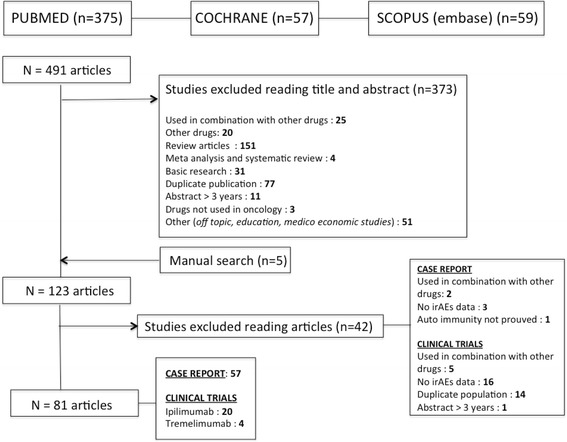
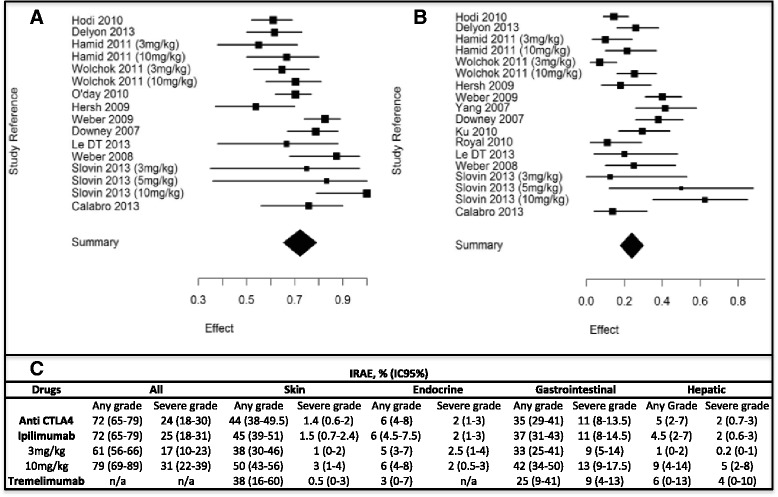
BACKGROUND: Targeting CTLA-4 is a recent strategic approach in cancer control: blocking CTLA-4 enhances an antitumor immunity by promoting T-cell activation and cytotoxic T-lymphocyte proliferation. This induction of a tolerance break against the tumor may be responsible for immune-related adverse events (irAEs). Our objective was to assess the incidence and nature of irAEs in oncologic patients receiving anti-CTLA-4 antibodies (ipilimumab and tremelimumab). METHODS: A systematic search of literature up to February 2014 was performed in MEDLINE, EMBASE, and Cochrane databases to identify relevant articles. Paired reviewers independently selected articles for inclusion and extracted data. Pooled incidence was calculated using R(©), package meta. RESULTS: Overall, 81 articles were included in the study, with a total of 1265 patients from 22 clinical trials included in the meta-analysis. Described irAEs consisted of skin lesions (rash, pruritus, and vitiligo), colitis, and less frequently hepatitis, hypophysitis, thyroiditis, and some rare events such as sarcoidosis, uveitis, Guillain-Barré syndrome, immune-mediated cytopenia and polymyalgia rheumatic/Horton. The overall incidence of all-grade irAEs was 72 % (95 % CI, 65-79 %). The overall incidence of high-grade irAEs was 24 % (95 % CI, 18-30 %). The risk of developing irAEs was dependent of dosage, with incidence of all-grade irAEs being evaluated to 61 % (95 % CI, 56-66 %) for ipilimumab 3 mg/kg and 79 % (95 % CI, 69-89 %) for ipilimumab 10 mg/kg. Death due to irAEs occurred in 0.86 % of patients. The median time of onset of irAEs was about 10 weeks (IQR, 6-12) after the onset of treatment, corresponding with the first three cycles but varied according to the organ system involved. Such immune activation could also be indicative for tumor-specific T-cell activation and irAE occurrence was associated with clinical response to CTLA-4 blocking in 60 % of patients. CONCLUSION: The price of potential long-term survival to metastatic tumors is an atypical immune toxicity, reflecting the mechanism of action of anti-CTLA-4 antibodies. A better knowledge of these irAEs and its management in a multidisciplinary approach will help to reduce morbidity and therapy interruptions.
Overview
The claims and statistics of this paper haven’t been checked yet.
Free: it reads the open-access text and checks the first 5 claims that cite a source we can check. Create a free account to check every claim.
Integrity signals
Registry
Cites
Statistics
Figures
Verification
Claims the paper makes
The claims and statistics of this paper haven’t been checked yet.
Free: it reads the open-access text and checks the first 5 claims that cite a source we can check. Create a free account to check every claim.
Claims other papers make about this one
Each is checked against this paper’s own text: does it say what the citing paper says it does?
The source backs part of the claim, not all of it — or backs it for a different population, condition or comparison.
In the citing paper
“ICI-associated colitis is routinely treated with immunosuppressive therapy, including corticosteroids and/or agents targeting tumor necrosis factor alpha (TNF-alpha), all of which have significant side effects.”
From Fecal microbiota transplantation for refractory immune checkpoint inhibitor-associated colitis (2018) · cites this paper as [5]
Experimental — accuracy not yet measuredThe source backs part of the claim, not all of it — or backs it for a different population, condition or comparison.
In the citing paper
“Neurologic immune-related adverse events from immune checkpoint inhibitors include autonomic neuropathy and can present with severe GI dysmotility (Bertrand et al., 2015).”
From Autonomic nervous system and gastrointestinal manifestations with an emphasis on gastric dysfunction (2026) · cites this paper as Bertrand et al., 2015
Experimental — accuracy not yet measured
Self-check
Percentages, sums and reported differences re-computed from the paper’s own numbers.
The self-check needs the paper’s full text.
Citations
Cites
The Cochrane Collaboration's tool for assessing risk of bias in randomised trials
Higgins, J. P. T., Altman, D. G., Gotzsche, P. C., Juni, P., Moher, D., Oxman, A. D., Savovic, J., Schulz, K. F., Weeks, L., Sterne, J. A. C., et al. (2011) · BMJ · doi:10.1136/bmj.d5928 · Cited by 33,817
PD-1 and PD-L1 Immune Checkpoint Blockade to Treat Breast Cancer
Hartkopf, A. D., Taran, F.-A., Wallwiener, M., Walter, C. B., Krämer, B., Grischke, E.-M., & Brucker, S. Y. (2016) · Breast Care · doi:10.1159/000453569 · Cited by 30,845
Dermyshi, E., Wang, Y., Yan, C., Hong, W., Qiu, G., Gong, X., & Zhang, T. (2017) · Neonatology · doi:10.1159/000454668 · Cited by 24,451
Adverse Renal Effects of Immune Checkpoint Inhibitors: A Narrative Review
Wanchoo, R., Karam, S., Uppal, N. N., Barta, V. S., Deray, G., Devoe, C., Launay-Vacher, V., Jhaveri, K. D., & on behalf of Cancer and Kidney International Network Workgroup on Immune Checkpoint Inhibitors (2017) · American Journal of Nephrology · doi:10.1159/000455014 · Cited by 15,256
Improved Survival with Ipilimumab in Patients with Metastatic Melanoma
Hodi, F. S., O'Day, S. J., McDermott, D. F., Weber, R. W., Sosman, J. A., Haanen, J. B., Gonzalez, R., Robert, C., Schadendorf, D., Hassel, J. C., et al. (2010) · New England Journal of Medicine · doi:10.1056/nejmoa1003466 · Cited by 15,155 · cited 4×
“[7], an irAE was defined as an adverse event that was associated with exposure to the study drug and that was consistent with an immune phenomenon.”
BackgroundInfluentialThe blockade of immune checkpoints in cancer immunotherapy
Pardoll, D. M. (2012) · Nature Reviews Cancer · doi:10.1038/nrc3239 · Cited by 13,838 · cited 1×
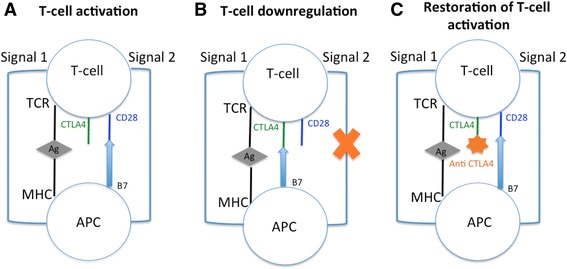
“Thus, blockades of immune checkpoints with antagonists of inhibitory pathways have been developed and anti-CTLA-4 antibodies are precursors in this domain [3] (Mechanism of action: anti CTLA-4 antibodies in Fig.”
BackgroundIpilimumab plus Dacarbazine for Previously Untreated Metastatic Melanoma
Robert, C., Thomas, L., Bondarenko, I., O'Day, S., Weber, J., Garbe, C., Lebbe, C., Baurain, J.-F., Testori, A., Grob, J.-J., et al. (2011) · New England Journal of Medicine · doi:10.1056/nejmoa1104621 · Cited by 4,496 · cited 1×
“Thus, a fully humanized anti-CTLA-4 monoclonal antibody immunoglobulin (Ig) G1 isotype (ipilimumab) was approved by the Food and Drug Administration (FDA) in 2011 at a dosage of 3 mg/kg every 3 weeks for four cycles in advanced melanoma, with evidence of improved survival [7, 8].”
BackgroundGenetic Basis for Clinical Response to CTLA-4 Blockade in Melanoma
Snyder, A., Makarov, V., Merghoub, T., Yuan, J., Zaretsky, J. M., Desrichard, A., Walsh, L. A., Postow, M. A., Wong, P., Ho, T. S., et al. (2014) · New England Journal of Medicine · doi:10.1056/nejmoa1406498 · Cited by 4,286 · cited 1×
“[119] also defined a genetic basis for benefit from CTLA-4 blockade in melanoma by whole-exome sequencing on tumors and matched blood samples.”
BackgroundTivol, E. A., Borriello, F., Schweitzer, A. N., Lynch, W. P., Bluestone, J. A., & Sharpe, A. H. (1995) · Immunity · doi:10.1016/1074-7613(95)90125-6 · Cited by 2,914 · cited 1×
“This role is supported by the lethal lympho-proliferation and autoimmunity in CTLA-4 knockout mice [5].”
BackgroundFitzgerald, M., Hayward, I. P., Thomas, A. C., Campbell, J. H., & CAMPBELL, G. R. (1995) · Cited by 2,552
Research works printed but not linked: 1
- Salenave J Chanson P Young J Hypophysite lymphocytaire. Endocrinologie-Nutrition, 10-023-D-10 2007 Paris Elsevier Masson SAS
Cited by
Adverse effects of immune-checkpoint inhibitors: epidemiology, management and surveillance
Martins, F., Sofiya, L., Sykiotis, G. P., Lamine, F., Maillard, M., Fraga, M., Shabafrouz, K., Ribi, C., Cairoli, A., Guex-Crosier, Y., et al. (2019) · Nature Reviews Clinical Oncology · doi:10.1038/s41571-019-0218-0 · Cited by 2,314
on behalf of the Society for Immunotherapy of Cancer Toxicity Management Working Group, Puzanov, I., Diab, A., Abdallah, K., Bingham, C. O., Brogdon, C., Dadu, R., Hamad, L., Kim, S., Lacouture, M. E., et al. (2017) · Journal for ImmunoTherapy of Cancer · doi:10.1186/s40425-017-0300-z · Cited by 1,992
Breast Cancer, Version 4.2017, NCCN Clinical Practice Guidelines in Oncology
Gradishar, W. J., Anderson, B. O., Balassanian, R., Blair, S. L., Burstein, H. J., Cyr, A., Elias, A. D., Farrar, W. B., Forero, A., Giordano, S. H., et al. (2018) · Journal of the National Comprehensive Cancer Network · doi:10.6004/jnccn.2018.0012 · Cited by 1,609
Chen, Q., Xu, L., Liang, C., Wang, C., Peng, R., & Liu, Z. (2016) · Nature Communications · doi:10.1038/ncomms13193 · Cited by 1,596
Immune checkpoint signaling and cancer immunotherapy
He, X., & Xu, C. (2020) · Cell Research · doi:10.1038/s41422-020-0343-4 · Cited by 1,371
A review of cancer immunotherapy toxicity
Kennedy, L. B., & Salama, A. K. S. (2020) · CA: A Cancer Journal for Clinicians · doi:10.3322/caac.21596 · Cited by 1,364
Treatment of the Immune-Related Adverse Effects of Immune Checkpoint Inhibitors: A Review
Friedman, C. F., Proverbs-Singh, T. A., & Postow, M. A. (2016) · JAMA Oncology · doi:10.1001/jamaoncol.2016.1051 · Cited by 802
Fecal microbiota transplantation for refractory immune checkpoint inhibitor-associated colitis
Wang, Y., Wiesnoski, D. H., Helmink, B. A., Gopalakrishnan, V., Choi, K., DuPont, H. L., Jiang, Z.-D., Abu-Sbeih, H., Sanchez, C. A., Chang, C.-C., et al. (2018) · Nature Medicine · doi:10.1038/s41591-018-0238-9 · Cited by 740
Nanoparticle‐Enhanced Radiotherapy to Trigger Robust Cancer Immunotherapy
Chen, Q., Chen, J., Yang, Z., Xu, J., Xu, L., Liang, C., Han, X., & Liu, Z. (2019) · Advanced Materials · doi:10.1002/adma.201802228 · Cited by 661
Collateral damage: Insulin-dependent diabetes induced with checkpoint inhibitors
Stamatouli, A. M., Quandt, Z., Perdigoto, A. L., Clark, P. L., Kluger, H., Weiss, S. A., Gettinger, S., Sznol, M., Young, A., Rushakoff, R., et al. (2018) · Diabetes · doi:10.2337/dbi18-0002 · Cited by 590
Thompson, J. A., Schneider, B. J., Brahmer, J., Andrews, S., Armand, P., Bhatia, S., Budde, L. E., Costa, L., Davies, M., Dunnington, D., et al. (2019) · Journal of the National Comprehensive Cancer Network · doi:10.6004/jnccn.2019.0013 · Cited by 570
Abdel-Wahab, N., Shah, M., Lopez-Olivo, M. A., & Suarez-Almazor, M. E. (2018) · Annals of Internal Medicine · doi:10.7326/m17-2073 · Cited by 487
Wang, P.-F., Chen, Y., Song, S.-Y., Wang, T.-J., Ji, W.-J., Li, S.-W., Liu, N., & Yan, C.-X. (2017) · Frontiers in Pharmacology · doi:10.3389/fphar.2017.00730 · Cited by 468
“AEs that occur potentially due to immunological effects were defined as irAEs. irAEs could be serious, requiring suspension of immunotherapy and possibly leading to death (Bertrand et al., 2015; Chen et al., 2015; Eigentler et al., 2016).”
BackgroundTGF-β1 – A truly transforming growth factor in fibrosis and immunity
Lodyga, M., & Hinz, B. (2020) · Seminars in Cell & Developmental Biology · doi:10.1016/j.semcdb.2019.12.010 · Cited by 458
Immune-related adverse events of immune checkpoint inhibitors: a review
Yin, Q., Wu, L., Han, L., Zheng, X., Tong, R., Li, L., Bai, L., & Bian, Y. (2023) · Frontiers in Immunology · doi:10.3389/fimmu.2023.1167975 · Cited by 446
“86% of patients dying due to irAEs (37).”
BackgroundAbdel-Wahab, N., Shah, M., & Suarez-Almazor, M. E. (2016) · PLOS ONE · doi:10.1371/journal.pone.0160221 · Cited by 444
“While many genetic determinants have been described in patients with primary autoimmune diseases, it is uncertain whether patients developing irAEs share the same genetic risks [9].”
Cutaneous Melanoma, Version 2.2019, NCCN Clinical Practice Guidelines in Oncology
Coit, D. G., Thompson, J. A., Albertini, M. R., Barker, C., Carson, W. E., Contreras, C., Daniels, G. A., DiMaio, D., Fields, R. C., Fleming, M. D., et al. (2019) · Journal of the National Comprehensive Cancer Network · doi:10.6004/jnccn.2019.0018 · Cited by 436
Tumor Immune Microenvironment and Immunosuppressive Therapy in Hepatocellular Carcinoma: A Review
Oura, K., Morishita, A., Tani, J., & Masaki, T. (2021) · International Journal of Molecular Sciences · doi:10.3390/ijms22115801 · Cited by 426
“According to meta-analysis of anti-CTLA-4 or anti-PD-L1 monotherapy, common target organs with irAEs were the skin, gastrointestinal tract, endocrine glands, and the liver [189,191].”
MethodMaio, M., Scherpereel, A., Calabrò, L., Aerts, J., Perez, S. C., Bearz, A., Nackaerts, K., Fennell, D. A., Kowalski, D., Tsao, A. S., et al. (2017) · The Lancet Oncology · doi:10.1016/s1470-2045(17)30446-1 · Cited by 424
Cappelli, L. C., Gutierrez, A. K., Bingham, C. O., & Shah, A. A. (2017) · Arthritis Care & Research · doi:10.1002/acr.23177 · Cited by 403
de Filette, J., Andreescu, C., Cools, F., Bravenboer, B., & Velkeniers, B. (2019) · Hormone and Metabolic Research · doi:10.1055/a-0843-3366 · Cited by 381
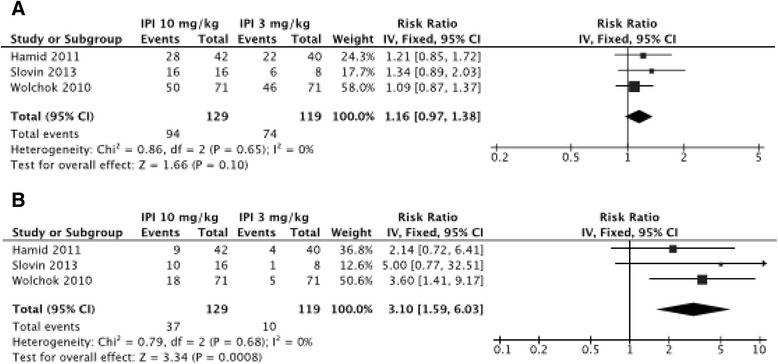
“In one study, ipilimumab 10 mg/kg resulted in significantly longer overall survival against ipilimumab 3 mg/kg but with increased treatment-related adverse events including hypophysitis [111].”
BackgroundHypophysitis Secondary to Cytotoxic T-Lymphocyte–Associated Protein 4 Blockade
Caturegli, P., Di Dalmazi, G., Lombardi, M., Grosso, F., Larman, H. B., Larman, T., Taverna, G., Cosottini, M., & Lupi, I. (2016) · The American Journal of Pathology · doi:10.1016/j.ajpath.2016.08.020 · Cited by 381
Teraoka, S., Fujimoto, D., Morimoto, T., Kawachi, H., Ito, M., Sato, Y., Nagata, K., Nakagawa, A., Otsuka, K., Uehara, K., et al. (2017) · Journal of Thoracic Oncology · doi:10.1016/j.jtho.2017.08.022 · Cited by 375
Combination immunotherapy: a road map
Ott, P. A., Hodi, F. S., Kaufman, H. L., Wigginton, J. M., & Wolchok, J. D. (2017) · Journal for ImmunoTherapy of Cancer · doi:10.1186/s40425-017-0218-5 · Cited by 374
“For example, treatment with checkpoint inhibitors, including monoclonal antibodies that target CTLA-4, PD-1, or PD-L1 have been associated with a variety of autoimmune-like inflammatory phenomena that appear to be driven by disruption of self-tolerance to various normal tissues including thyroid, pituitary, liver, lun…”
BackgroundClinical Pharmacokinetics and Pharmacodynamics of Immune Checkpoint Inhibitors
Centanni, M., Moes, D. J. A. R., Trocóniz, I. F., Ciccolini, J., & van Hasselt, J. G. C. (2019) · Clinical Pharmacokinetics · doi:10.1007/s40262-019-00748-2 · Cited by 355
CHECKPOINT INHIBITOR IMMUNE THERAPY: Systemic Indications and Ophthalmic Side Effects
Dalvin, L. A., Shields, C. L., Orloff, M., Sato, T., & Shields, J. A. (2018) · Retina · doi:10.1097/iae.0000000000002181 · Cited by 336
Biomarkers for immune checkpoint inhibition in non–small cell lung cancer (NSCLC)
Bodor, J. N., Boumber, Y., & Borghaei, H. (2020) · Cancer · doi:10.1002/cncr.32468 · Cited by 329
Ma, W., Gilligan, B. M., Yuan, J., & Li, T. (2016) · Journal of Hematology & Oncology · doi:10.1186/s13045-016-0277-y · Cited by 327
“, irAEs) [22].”
Kostine, M., Rouxel, L., Barnetche, T., Veillon, R., Martin, F., Dutriaux, C., Dousset, L., Pham-Ledard, A., Prey, S., Beylot-Barry, M., et al. (2018) · Annals of the Rheumatic Diseases · doi:10.1136/annrheumdis-2017-212257 · Cited by 306
Self-citationPetrelli, F., Signorelli, D., Ghidini, M., Ghidini, A., Pizzutilo, E. G., Ruggieri, L., Cabiddu, M., Borgonovo, K., Dognini, G., Brighenti, M., et al. (2020) · Cancers · doi:10.3390/cancers12030546 · Cited by 300
“A potential association with better prognosis in patients reporting immune-related adverse events has been described [38,39], thus balancing the negative effect of steroid use.”
BackgroundNF-κB c-Rel Is Crucial for the Regulatory T Cell Immune Checkpoint in Cancer
Grinberg-Bleyer, Y., Oh, H., Desrichard, A., Bhatt, D. M., Caron, R., Chan, T. A., Schmid, R. M., Klein, U., Hayden, M. S., & Ghosh, S. (2017) · Cell · doi:10.1016/j.cell.2017.08.004 · Cited by 297
Abdel-Wahab, N., Safa, H., Abudayyeh, A., Johnson, D. H., Trinh, V. A., Zobniw, C. M., Lin, H., Wong, M. K., Abdelrahim, M., Gaber, A. O., et al. (2019) · Journal for ImmunoTherapy of Cancer · doi:10.1186/s40425-019-0585-1 · Cited by 294
Diagnosis and management of toxicities of immune checkpoint inhibitors in hepatocellular carcinoma
Sangro, B., Chan, S. L., Meyer, T., Reig, M., El-Khoueiry, A., & Galle, P. R. (2020) · Journal of Hepatology · doi:10.1016/j.jhep.2019.10.021 · Cited by 293
“Although direct comparisons are not available, metaanalyses indicate that rash and colitis are significantly more frequent during CTLA-4 blockade, and suggest that there are no major differences between agents within each target checkpoint [7][8][9].”
BackgroundNanomaterials for cancer immunotherapy
Song, W., Musetti, S. N., & Huang, L. (2017) · Biomaterials · doi:10.1016/j.biomaterials.2017.09.017 · Cited by 281
“For example, anti-CTLA4 antibodies mostly affect the skin and the gastrointestinal tract, observed in 44% and 35% of cases, respectively [162], and the main irAE profiles for PD-1/PD-L1 antibodies are asthenia (16-34%) [163].”
BackgroundUltrasound-controllable engineered bacteria for cancer immunotherapy
Abedi, M. H., Yao, M. S., Mittelstein, D. R., Bar-Zion, A., Swift, M. B., Lee-Gosselin, A., Barturen-Larrea, P., Buss, M. T., & Shapiro, M. G. (2022) · Nature Communications · doi:10.1038/s41467-022-29065-2 · Cited by 260
Couey, M. A., Bell, R. B., Patel, A. A., Romba, M. C., Crittenden, M. R., Curti, B. D., Urba, W. J., & Leidner, R. S. (2019) · Journal for ImmunoTherapy of Cancer · doi:10.1186/s40425-019-0645-6 · Cited by 243
Emerging immunotherapy for HCC: A guide for hepatologists
Foerster, F., Gairing, S. J., Ilyas, S. I., & Galle, P. R. (2022) · Hepatology · doi:10.1002/hep.32447 · Cited by 240
Endoscopic and Histologic Features of Immune Checkpoint Inhibitor-Related Colitis
Wang, Y., Abu-Sbeih, H., Mao, E., Ali, N., Qiao, W., Trinh, V. A., Zobniw, C., Johnson, D. H., Samdani, R., Lum, P., et al. (2018) · Inflammatory Bowel Diseases · doi:10.1093/ibd/izy104 · Cited by 240
Rheumatic immune-related adverse events from cancer immunotherapy
Calabrese, L. H., Calabrese, C., & Cappelli, L. C. (2018) · Nature Reviews Rheumatology · doi:10.1038/s41584-018-0074-9 · Cited by 233
Clinical development of targeted and immune based anti-cancer therapies
Seebacher, N. A., Stacy, A. E., Porter, G. M., & Merlot, A. M. (2019) · Journal of Experimental & Clinical Cancer Research · doi:10.1186/s13046-019-1094-2 · Cited by 231
Immune checkpoint inhibitor‐related hypophysitis and endocrine dysfunction: clinical review
Joshi, M. N., Whitelaw, B. C., Palomar, M. T. P., Wu, Y., & Carroll, P. V. (2016) · Clinical Endocrinology · doi:10.1111/cen.13063 · Cited by 220
Kumar, P., Bhattacharya, P., & Prabhakar, B. S. (2018) · Journal of Autoimmunity · doi:10.1016/j.jaut.2018.08.007 · Cited by 216
“On the other hand, targeting TIM-3, LAG3 and TIGIT pathways in combination with PD1 which are predominantly expressed on intra-tumoral Tregs, but not constitutively on Tregs, may have reduced autoimmune adverse events compared to CTLA-4 blockade [371, 383, 384].”
BackgroundGastrointestinal motility disorders in neurologic disease
Camilleri, M. (2021) · Journal of Clinical Investigation · doi:10.1172/jci143771 · Cited by 211
“…or adynamic ileus) in association with diverse infections or toxins including herpes zoster, EBV, Borrelia burgdorferi (Lyme disease), botulism B toxin, Helicobacter pylori (102), treatment with anti-CTL4 antibodies (103), and, more recently, Zika virus (104) and SARS-CoV-2 infection (105).”
El Osta, B., Hu, F., Sadek, R., Chintalapally, R., & Tang, S.-C. (2017) · Critical Reviews in Oncology/Hematology · doi:10.1016/j.critrevonc.2017.09.002 · Cited by 209
Immune Checkpoint Inhibitor Therapy in Oncology
Tan, S., Day, D., Nicholls, S. J., & Segelov, E. (2022) · JACC: CardioOncology · doi:10.1016/j.jaccao.2022.09.004 · Cited by 205
“9% were fatal.(57) In contrast, a metaanalysis of 46 studies and 12,808 patients treated with PD-1/PD-L1 inhibitors reported an overall irAE incidence of 27%, of which 6% were high grade and mortality was 0.”
BackgroundResultLuo, X.-Y., Wu, K.-M., & He, X.-X. (2021) · Journal of Experimental & Clinical Cancer Research · doi:10.1186/s13046-021-01968-w · Cited by 202
“Although CTLA-4, an immune checkpoint, has achieved long-lasting efficacy in tumors, severe immune-related toxicity limits its application [95].”
BackgroundSade-Feldman, M., Kanterman, J., Klieger, Y., Ish-Shalom, E., Olga, M., Saragovi, A., Shtainberg, H., Lotem, M., & Baniyash, M. (2016) · Clinical Cancer Research · doi:10.1158/1078-0432.ccr-15-3104 · Cited by 201
Koelzer, V. H., Rothschild, S. I., Zihler, D., Wicki, A., Willi, B., Willi, N., Voegeli, M., Cathomas, G., Zippelius, A., & Mertz, K. D. (2016) · Journal for ImmunoTherapy of Cancer · doi:10.1186/s40425-016-0117-1 · Cited by 200
“Several case reports have previously illustrated the diverse clinical spectrum of irAEs including diffuse alveolar damage and immune mediated pneumonitis [15], myocarditis [16], arthritis [17], severe skin toxicity [11], hypophysitis and meningoencephalitis [18].”
BackgroundResultInfluentialAnquetil, C., Salem, J.-E., Lebrun-Vignes, B., Johnson, D. B., Mammen, A. L., Stenzel, W., Léonard-Louis, S., Benveniste, O., Moslehi, J. J., & Allenbach, Y. (2018) · Circulation · doi:10.1161/circulationaha.118.035898 · Cited by 199
Brix, N., Tiefenthaller, A., Anders, H., Belka, C., & Lauber, K. (2017) · Immunological Reviews · doi:10.1111/imr.12573 · Cited by 197
Autoantibody Development under Treatment with Immune-Checkpoint Inhibitors
de Moel, E. C., Rozeman, E. A., Kapiteijn, E. H., Verdegaal, E. M. E., Grummels, A., Bakker, J. A., Huizinga, T. W. J., Haanen, J. B., Toes, R. E. M., & van der Woude, D. (2019) · Cancer Immunology Research · doi:10.1158/2326-6066.cir-18-0245 · Cited by 191
“Cancer Immunol Res; 7(1) January 2019 Cancer Immunology Research 8”
BackgroundInfluentialHuman leukocyte antigen variation is associated with adverse events of checkpoint inhibitors
Hasan Ali, O., Berner, F., Bomze, D., Fässler, M., Diem, S., Cozzio, A., Jörger, M., Früh, M., Driessen, C., Lenz, T. L., et al. (2019) · European Journal of Cancer · doi:10.1016/j.ejca.2018.11.009 · Cited by 187
“topical corticosteroids, colitis presents a major clinical challenge and a medical emergency, as it can lead to colon perforation and death [25].”
Daly, L. E., Power, D. G., O'Reilly, Á., Donnellan, P., Cushen, S. J., O'Sullivan, K., Twomey, M., Woodlock, D. P., Redmond, H. P., & Ryan, A. M. (2017) · British Journal of Cancer · doi:10.1038/bjc.2016.431 · Cited by 187
“%) for patients receiving an ipilimumab dose of 3 mg kg (cid:2) 1 (Bertrand et al , 2015).”
InfluentialDirect and Indirect Modulation of T Cells by VEGF-A Counteracted by Anti-Angiogenic Treatment
Bourhis, M., Palle, J., Galy-Fauroux, I., & Terme, M. (2021) · Frontiers in Immunology · doi:10.3389/fimmu.2021.616837 · Cited by 184
Bajwa, R., Cheema, A., Khan, T., Amirpour, A., Paul, A., Chaughtai, S., Patel, S., Patel, T., Bramson, J., Gupta, V., et al. (2019) · Journal of Clinical Medicine Research · doi:10.14740/jocmr3750 · Cited by 179
“Many of the conditions can be life-threatening calling for discontinuation of treatment, long-term corticosteroids and at times anti-tumor necrosis factor therapy [13].”
BackgroundEvolving Roles for Targeting CTLA-4 in Cancer Immunotherapy
Zhao, Y., Yang, W., Huang, Y., Cui, R., Li, X., & Li, B. (2018) · Cellular Physiology and Biochemistry · doi:10.1159/000490025 · Cited by 179
A comprehensive review of immune checkpoint inhibitors for cancer treatment
Arafat Hossain, M. (2024) · International Immunopharmacology · doi:10.1016/j.intimp.2024.113365 · Cited by 178
Liposome-Based Drug Delivery Systems in Cancer Immunotherapy
Gu, Z., Da Silva, C., Van der Maaden, K., Ossendorp, F., & Cruz, L. (2020) · Pharmaceutics · doi:10.3390/pharmaceutics12111054 · Cited by 176
“immune-related adverse events induced by CTLA-4 blockade increased up to 70% [128,129].”
BackgroundAlmutairi, A. R., McBride, A., Slack, M., Erstad, B. L., & Abraham, I. (2020) · Frontiers in Oncology · doi:10.3389/fonc.2020.00091 · Cited by 175
Syngeneic animal models of tobacco-associated oral cancer reveal the activity of in situ anti-CTLA-4
Wang, Z., Wu, V. H., Allevato, M. M., Gilardi, M., He, Y., Luis Callejas-Valera, J., Vitale-Cross, L., Martin, D., Amornphimoltham, P., Mcdermott, J., et al. (2019) · Nature Communications · doi:10.1038/s41467-019-13471-0 · Cited by 174
Risk factors for immune-related adverse events associated with anti-PD-1 pembrolizumab
Eun, Y., Kim, I. Y., Sun, J.-M., Lee, J., Cha, H.-S., Koh, E.-M., Kim, H., & Lee, J. (2019) · Scientific Reports · doi:10.1038/s41598-019-50574-6 · Cited by 171
Meffre, E., & O'Connor, K. C. (2019) · Immunological Reviews · doi:10.1111/imr.12821 · Cited by 170
Gori, S., Inno, A., Belluomini, L., Bocus, P., Bisoffi, Z., Russo, A., & Arcaro, G. (2019) · Critical Reviews in Oncology/Hematology · doi:10.1016/j.critrevonc.2019.09.003 · Cited by 165
Burch, H. B. (2019) · New England Journal of Medicine · doi:10.1056/nejmra1901214 · Cited by 164
Ipilimumab-Associated Colitis: CT Findings
Kim, K. W., Ramaiya, N. H., Krajewski, K. M., Shinagare, A. B., Howard, S. A., Jagannathan, J. P., & Ibrahim, N. (2013) · American Journal of Roentgenology · doi:10.2214/ajr.12.9751 · Cited by 156
Advances in immunotherapy for melanoma
Redman, J. M., Gibney, G. T., & Atkins, M. B. (2016) · BMC Medicine · doi:10.1186/s12916-016-0571-0 · Cited by 160
“A meta-analysis (in subjects with various malignancies including melanoma) calculated an overall incidence of irAEs in 72 % of ipilimumab-treated patients, with a 24 % incidence of high-grade adverse events [22].”
BackgroundSun, X., Roudi, R., Dai, T., Chen, S., Fan, B., Li, H., Zhou, Y., Zhou, M., Zhu, B., Yin, C., et al. (2019) · BMC Cancer · doi:10.1186/s12885-019-5701-6 · Cited by 160
Progress in PD-1/PD-L1 pathway inhibitors: From biomacromolecules to small molecules
Lin, X., Lu, X., Luo, G., & Xiang, H. (2019) · European Journal of Medicinal Chemistry · doi:10.1016/j.ejmech.2019.111876 · Cited by 160
Immunotherapy for Head and Neck Squamous Cell Carcinoma
Moskovitz, J., Moy, J., & Ferris, R. L. (2018) · Current Oncology Reports · doi:10.1007/s11912-018-0654-5 · Cited by 159
Immunotherapy for hepatocellular carcinoma: Current status and future perspectives
Mandlik, D. S., Mandlik, S. K., & Choudhary, H. B. (2023) · World Journal of Gastroenterology · doi:10.3748/wjg.v29.i6.1054 · Cited by 158
Local and Targeted Delivery of Immune Checkpoint Blockade Therapeutics
Han, X., Li, H., Zhou, D. R., Chen, Z., & Gu, Z. (2020) · Accounts of Chemical Research · doi:10.1021/acs.accounts.0c00339 · Cited by 155
Stelmachowska‐Banaś, M., & Czajka-Oraniec, I. (2020) · Endocrine Connections · doi:10.1530/ec-20-0342 · Cited by 151
“Although some studies have shown a positive association between ipilimumab dose and the incidence of IH (29), another wide analysis suggested that no endocrine irAEs seem to be dose dependent (30).”
Fa’ak, F., Buni, M., Falohun, A., Lu, H., Song, J., Johnson, D. H., Zobniw, C. M., Trinh, V. A., Awiwi, M. O., Tahon, N. H., et al. (2023) · Journal for ImmunoTherapy of Cancer · doi:10.1136/jitc-2023-006814 · Cited by 150
Thallinger, C., Füreder, T., Preusser, M., Heller, G., Müllauer, L., Höeller, C., Prosch, H., Frank, N., Świerzewski, R., Berger, W., et al. (2017) · Wiener klinische Wochenschrift · doi:10.1007/s00508-017-1285-9 · Cited by 147
“These irAEs may include the induction of diarrhea or the emergence of ulcerative colitis or Crohn’s disease, Hashimoto’s thyroiditis, autoimmune hepatitis, uveitis and hypophysitis which can be life-threatening complications if not recognized and treated appropriately [41, 43, 44].”
BackgroundPhysical and chemical profiles of nanoparticles for lymphatic targeting
Ke, X., Howard, G. P., Tang, H., Cheng, B., Saung, M. T., Santos, J. L., & Mao, H. (2019) · Advanced Drug Delivery Reviews · doi:10.1016/j.addr.2019.09.005 · Cited by 146
Clinical assessment of immune-related adverse events
Sosa, A., Lopez Cadena, E., Simon Olive, C., Karachaliou, N., & Rosell, R. (2018) · Therapeutic Advances in Medical Oncology · doi:10.1177/1758835918764628 · Cited by 132
Petrelli, F., Grizzi, G., Ghidini, M., Ghidini, A., Ratti, M., Panni, S., Cabiddu, M., Ghilardi, M., Borgonovo, K., Parati, M. C., et al. (2019) · Journal of Immunotherapy · doi:10.1097/cji.0000000000000300 · Cited by 140
Autoimmune complications of immunotherapy: pathophysiology and management
Chan, K. K., & Bass, A. R. (2020) · BMJ · doi:10.1136/bmj.m736 · Cited by 141
Review of the Immune Checkpoint Inhibitors in the Context of Cancer Treatment
Alturki, N. A. (2023) · Journal of Clinical Medicine · doi:10.3390/jcm12134301 · Cited by 135
Hernandez, S., Qing, J., Hong, R., Du, X., Park, S., Lee, H.-M., Xu, M., Oh, S. A., Navarro, A., Roose-Girma, M., et al. (2018) · Cell Reports · doi:10.1016/j.celrep.2018.09.012 · Cited by 136
Immune Checkpoint Inhibitor Toxicity
Palmieri, D. J., & Carlino, M. S. (2018) · Current Oncology Reports · doi:10.1007/s11912-018-0718-6 · Cited by 134
Kähler, K. C., Hassel, J. C., Heinzerling, L., Loquai, C., Mössner, R., Ugurel, S., Zimmer, L., Gutzmer, R., & for the “Cutaneous Side Effects” Committee of the Work Group Dermatological Oncology (ADO) (2016) · JDDG: Journal der Deutschen Dermatologischen Gesellschaft · doi:10.1111/ddg.13047 · Cited by 118
Review: Immune‐Related Adverse Events With Use of Checkpoint Inhibitors for Immunotherapy of Cancer
Suarez-Almazor, M. E., Kim, S. T., Abdel‐Wahab, N., & Diab, A. K. (2017) · Arthritis & Rheumatology · doi:10.1002/art.40043 · Cited by 134
The biomarkers related to immune related adverse events caused by immune checkpoint inhibitors
Jia, X., Geng, L., Jiang, P., Xu, H., Nan, K., Yao, Y., Jiang, L., Sun, H., Qin, T., & Guo, H. (2020) · Journal of Experimental & Clinical Cancer Research · doi:10.1186/s13046-020-01749-x · Cited by 134
“CD177 and CEACAM1 Vafa Shahabi et al. analyzed the gene expression profiles of whole blood samples of melanoma patients treated with IPI and found that the neutrophil activation markers CD177 and CEACAM1 were highly expressed at baseline and postbaseline in patients with GI irAEs [28].”
BackgroundInfluentialCTLA4 blockade elicits paraneoplastic neurological disease in a mouse model
Yshii, L., Gebauer, C., Pignolet, B., Mauré, E., Queriault, C., Pierau, M., Saito, H., 昇, 鈴., Brunner-Weinzierl, M. C., Bauer, J., et al. (2016) · Brain · doi:10.1093/brain/aww225 · Cited by 127
“Partly mirroring these data, anti-CTLA4 therapy has been associated with immune-related adverse events in 60% of treated patients (Bertrand et al., 2015).”
BackgroundInfluentialKvarnhammar, A. M., Veitonmäki, N., Hägerbrand, K., Dahlman, A., Smith, K. E., Fritzell, S., von Schantz, L., Thagesson, M., Werchau, D., Smedenfors, K., et al. (2019) · Journal for ImmunoTherapy of Cancer · doi:10.1186/s40425-019-0570-8 · Cited by 115
“However, CTLA-4 blocking antibodies are associated with severe immune-related adverse events due to a systemic activation of T cells, which limits their use [16, 17].”
BackgroundQueirolo, P., Boutros, A., Tanda, E. T., Spagnolo, F., & Quaglino, P. (2019) · Seminars in Cancer Biology · doi:10.1016/j.semcancer.2019.08.001 · Cited by 126
Du, X., Liu, M., Su, J., Zhang, P., Tang, F., Ye, P., Devenport, M., Wang, X., Zhang, Y., Liu, Y., et al. (2018) · Cell Research · doi:10.1038/s41422-018-0012-z · Cited by 123
Immune-Related Adverse Events Associated with Immune Checkpoint Inhibitors
Day, D., & Hansen, A. R. (2016) · BioDrugs · doi:10.1007/s40259-016-0204-3 · Cited by 124
Thyroid disorders induced by checkpoint inhibitors
Ferrari, S. M., Fallahi, P., Galetta, F., Citi, E., Benvenga, S., & Antonelli, A. (2018) · Reviews in Endocrine and Metabolic Disorders · doi:10.1007/s11154-018-9463-2 · Cited by 123
“86% of patients died owing to irAEs [30].”
BackgroundMethodImmune checkpoint inhibitor associated myocarditis occurs in both high-grade and low-grade forms
Champion, S. N., & Stone, J. R. (2019) · Modern Pathology · doi:10.1038/s41379-019-0363-0 · Cited by 122
Toxicities associated with checkpoint inhibitors—an overview
Spiers, L., Coupe, N. A., & Payne, M. (2019) · Rheumatology · doi:10.1093/rheumatology/kez418 · Cited by 120
Immune-Related Adverse Events of Immune Checkpoint Inhibitors: A Brief Review
Myers, G. (2018) · Current Oncology · doi:10.3747/co.25.4235 · Cited by 116
Arima, H., Iwama, S., Inaba, H., Ariyasu, H., Makita, N., Otsuki, M., Kageyama, K., Imagawa, A., & Akamizu, T. (2019) · Endocrine Journal · doi:10.1507/endocrj.ej19-0163 · Cited by 107
“Hypopituitarism Overview The incidence of hypopituitarism associated with antiCTLA-4 or anti-PD-1 antibody treatment is reported to be around 10% or <1%, respectively [6-11].”
BackgroundIntegrin-Mediated TGFβ Activation Modulates the Tumour Microenvironment
Brown, N. F., & Marshall, J. F. (2019) · Cancers · doi:10.3390/cancers11091221 · Cited by 116
van Holstein, Y., Kapiteijn, E., Bastiaannet, E., van den Bos, F., Portielje, J. E. A., & de Glas, N. A. (2019) · Drugs & Aging · doi:10.1007/s40266-019-00697-2 · Cited by 116
Kostine, M., Mauric, E., Tison, A., Barnetche, T., Barre, A., Nikolski, M., Rouxel, L., Dutriaux, C., Dousset, L., Prey, S., et al. (2021) · European Journal of Cancer · doi:10.1016/j.ejca.2021.08.036 · Cited by 101
Self-citationAntibody-based drug delivery systems for cancer therapy: Mechanisms, challenges, and prospects
Chen, Z., Kankala, R. K., Yang, Z., Li, W., Xie, S., Li, H., Chen, A., & Zou, L. (2022) · Theranostics · doi:10.7150/thno.72594 · Cited by 119
“Obinutuzumab; Gazyva® CLL, Follicular lymphoma IRR, TLS, hypersensitivity reactions, fatigue, neutropenia, cough, upper respiratory tract infections, neutropenia, thrombocytopenia, musculoskeletal pain CD38 Daratumumab; Darzalex® MM Intravenous infusion using an infusion set fitted with a flow regulator IRR, upper res…”
BackgroundInfluentialAutoimmune phenomena and disease in cancer patients treated with immune checkpoint inhibitors
Tocut, M., Brenner, R., & Zandman-Goddard, G. (2018) · Autoimmunity Reviews · doi:10.1016/j.autrev.2018.01.010 · Cited by 109
Myositis as an adverse event of immune checkpoint blockade for cancer therapy
Shah, M., Tayar, J. H., Abdel‐Wahab, N., & Suarez-Almazor, M. E. (2018) · Seminars in Arthritis and Rheumatism · doi:10.1016/j.semarthrit.2018.05.006 · Cited by 114
Metadata
- Authors
- Bertrand, A., Kostine, M., Barnetche, T., Truchetet, M.-E., & Schaeverbeke, T.
- Affiliations
- Centre Hospitalier Universitaire de Bordeaux (FR)
- Centre National de la Recherche Scientifique (FR)
- Université de Bordeaux (FR)
- Corresponding author
- Bertrand, Anne
- Venue
- BMC Medicine
- Published
- 2015-09-04
- Volume
- 13
- Issue
- 1
- Pages
- 211-211
- ISSN
- 1741-7015 (ISSN-L)
- PMC
- PMC4559965
- OpenAlex
- W1914776013
- Cited by
- 704
- References
- 142
- Citations by year
- 2026: 25 · 2025: 33 · 2024: 48 · 2023: 65 · 2022: 65 · 2021: 72 · 2020: 95 · 2019: 99 · 2018: 75 · 2017: 76 · 2016: 48 · 2015: 1
- FWCI
- 7.15
- Type
- journal article
- Language
- en
- Open access
- gold
- doi.org
- Licence
- Locations
- BMC Medicine (publishedVersion, cc-by)
- Europe PMC (PubMed Central) (publishedVersion, cc-by)
- PubMed Central (publishedVersion, cc-by)
- PubMed (publishedVersion)
- Topics
- Health Sciences › Medicine › Oncology › Cancer Immunotherapy and Biomarkers
- Life Sciences › Immunology and Microbiology › Immunology › Immunotherapy and Immune Responses
- Life Sciences › Pharmacology, Toxicology and Pharmaceutics › Toxicology › Pharmacovigilance and Adverse Drug Reactions
- Keywords
- CTLA-4 blockade, ipilimumab, tremelimumab, immune checkpoint inhibitors, immunotoxicity, rash, colitis, hepatitis, hypophysitis, thyroiditis, dose-dependent toxicity, adverse event incidence, time to onset of adverse events, treatment response, cancer immunotherapy, metastatic cancer, vitiligo
- MeSH terms
- Ipilimumab, Antibodies, Monoclonal, Antineoplastic Agents, Humans, Immunologic Factors, Immunotherapy, Neoplasms, CTLA-4 Antigen, Antibodies, Monoclonal, Humanized
About these checks
Registry, retraction, Cites and statistics results are computed, not judged, with one exception: a printed reference that no index lists is read once by a model before it counts as a citation error. Claims are extracted by a model and kept only when their quote appears verbatim in the text; each cited source is then checked, with a model’s help, for whether it says what the claim relies on. Those verdicts can be wrong — read the claim’s quote and the cited source before relying on one.
Statistics and arithmetic are recomputed, not judged.
Confidence bands are shown only for fields calibrated on our annotated test set. None is calibrated yet, so no band is shown.
What counts as a claim ›How we measure confidence ›How we check this ›
Are you an author, or do you see a problem with this page? Request a review
Data sources
Bibliographic data: Semantic Scholar, OpenAlex, Crossref.
Contains information from the Semantic Scholar Academic Graph Datasets, made available under the ODC Attribution License (ODC-BY 1.0).
Semantic Scholar’s data is described in: Kinney, R., et al. (2023). The Semantic Scholar Open Data Platform. arXiv:2301.10140.
