

Predatory’ open access: a longitudinal study of article volumes and market characteristics
Open accessThe DOI matches its Crossref record; 28 of the 28 references it cites were found in a registry or an index.
Abstract
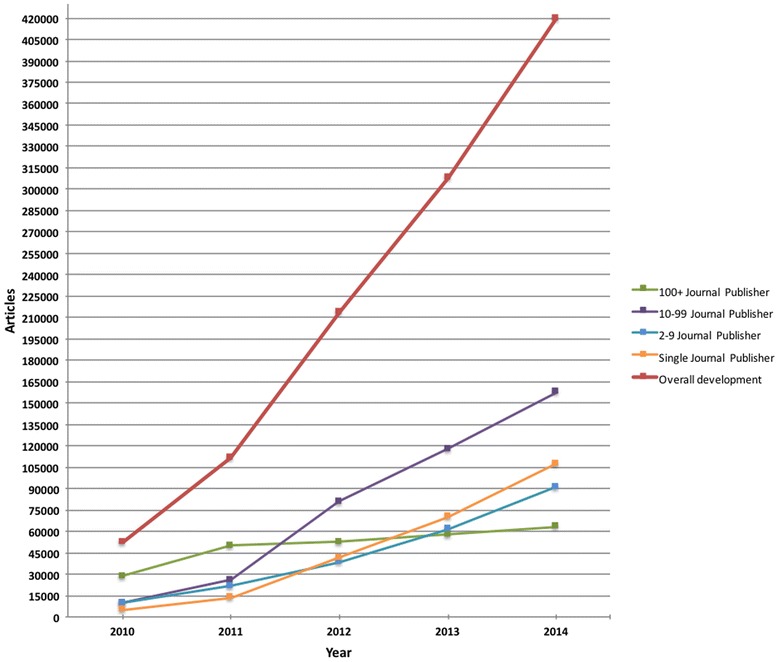
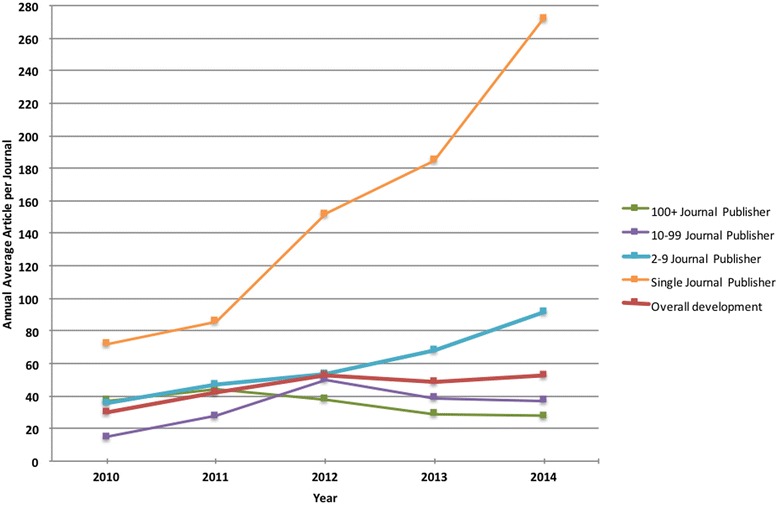
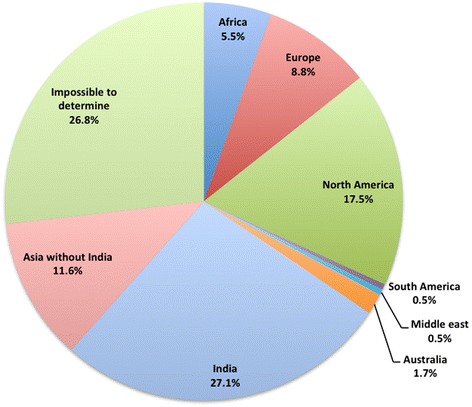
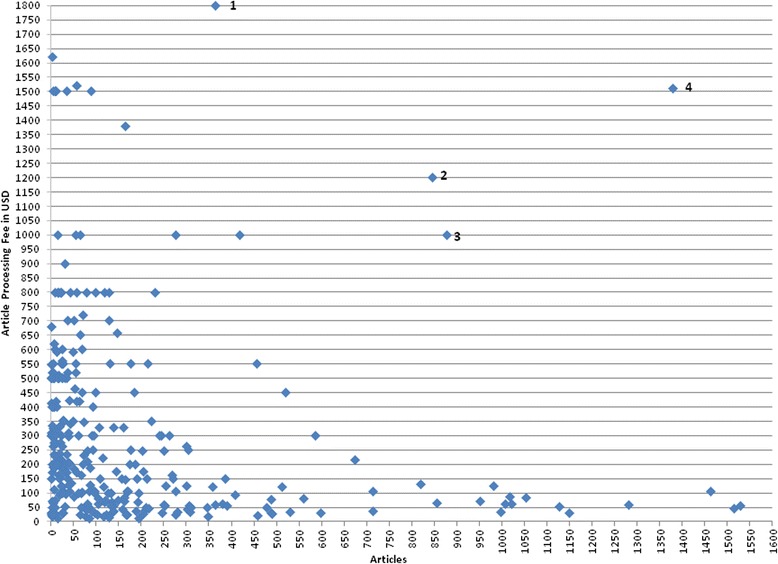
BACKGROUND: A negative consequence of the rapid growth of scholarly open access publishing funded by article processing charges is the emergence of publishers and journals with highly questionable marketing and peer review practices. These so-called predatory publishers are causing unfounded negative publicity for open access publishing in general. Reports about this branch of e-business have so far mainly concentrated on exposing lacking peer review and scandals involving publishers and journals. There is a lack of comprehensive studies about several aspects of this phenomenon, including extent and regional distribution. METHODS: After an initial scan of all predatory publishers and journals included in the so-called Beall's list, a sample of 613 journals was constructed using a stratified sampling method from the total of over 11,000 journals identified. Information about the subject field, country of publisher, article processing charge and article volumes published between 2010 and 2014 were manually collected from the journal websites. For a subset of journals, individual articles were sampled in order to study the country affiliation of authors and the publication delays. RESULTS: Over the studied period, predatory journals have rapidly increased their publication volumes from 53,000 in 2010 to an estimated 420,000 articles in 2014, published by around 8,000 active journals. Early on, publishers with more than 100 journals dominated the market, but since 2012 publishers in the 10-99 journal size category have captured the largest market share. The regional distribution of both the publisher's country and authorship is highly skewed, in particular Asia and Africa contributed three quarters of authors. Authors paid an average article processing charge of 178 USD per article for articles typically published within 2 to 3 months of submission. CONCLUSIONS: Despite a total number of journals and publishing volumes comparable to respectable (indexed by the Directory of Open Access Journals) open access journals, the problem of predatory open access seems highly contained to just a few countries, where the academic evaluation practices strongly favor international publication, but without further quality checks.
Overview
The claims and statistics of this paper haven’t been checked yet.
Free: it reads the open-access text and checks the first 5 claims that cite a source we can check. Create a free account to check every claim.
Integrity signals
Registry
Cites
Statistics
Figures
Verification
Claims the paper makes
The claims and statistics of this paper haven’t been checked yet.
Free: it reads the open-access text and checks the first 5 claims that cite a source we can check. Create a free account to check every claim.
Claims other papers make about this one
Each is checked against this paper’s own text: does it say what the citing paper says it does?
The source backs part of the claim, not all of it — or backs it for a different population, condition or comparison.
In the citing paper
“The growth of online journals that require author publication fees may be driving an increasingly profit-based publishing model (49).”
From Protection of the human gene research literature from contract cheating organizations known as research paper mills (2022) · cites this paper as [49]
Experimental — accuracy not yet measuredThe cited source says what the claim attributes to it.
In the citing paper
“Although these criteria are often considered to be controversial [164], it was shown that predatory journals usually fulfilled several of the criteria outlined by Beall [150,165].”
From Web of Science (WoS) and Scopus: The Titans of Bibliographic Information in Today’s Academic World (2021) · cites this paper as [150]
The cited source says what the claim attributes to it.
In the citing paper
“these artificial journals have evolved and they even manage to pass the selection process of the major bibliographic, as well as OA, DBs [145,150,157,158,166]”
From Web of Science (WoS) and Scopus: The Titans of Bibliographic Information in Today’s Academic World (2021) · cites this paper as [150]
In the citing paper
“Publish or perish research cultures (6,34,43,101) combined with an increasingly commercially-focused publishing environment (49,102) are leading to the dislocation between the scientific and career value of research publications (103)”
From Protection of the human gene research literature from contract cheating organizations known as research paper mills (2022) · cites this paper as [49]
In the citing paper
“When including the entire literature, predatory publishing likely comprises about 5 to 10%.”
From Misinformation in and about science (2021) · cites this paper as [88]
3 more claims about this paper
Create a free account to see every claim other papers make about this one.
Self-check
Percentages, sums and reported differences re-computed from the paper’s own numbers.
The self-check needs the paper’s full text.
Citations
Cites
Bohannon, J. (2013) · Science · doi:10.1126/science.342.6154.60 · Cited by 934
The Development of Open Access Journal Publishing from 1993 to 2009
Laakso, M., Welling, P., Bukvova, H., Nyman, L., Björk, B.-C., & Hedlund, T. (2011) · PLoS ONE · doi:10.1371/journal.pone.0020961 · Cited by 755
Self-citationPredatory publishers are corrupting open access
Beall, J. (2012) · Nature · doi:10.1038/489179a · Cited by 658 · cited 1×
“Jeffrey Beall coined the phrase ‘predatory publishers’ to describe publishers of this sort of journal [6].”
BackgroundSuber, P. (2012) · The MIT Press eBooks · doi:10.7551/mitpress/9286.001.0001 · Cited by 623
The Access/Impact Problem and the Green and Gold Roads to Open Access
Harnad, S. R., Brody, T., Vallières, F., Carr, L. A., Hitchcock, S., Gingras, Y., Oppenheim, C., Stamerjohanns, H., & Hilf, E. R. (2004) · Serials Review · doi:10.1016/j.serrev.2004.09.013 · Cited by 529 · cited 7×
“In addition, there is a ‘green’ route in which authors or third parties can legally make manuscript versions of articles published in traditional journals freely available on the Internet [4].”
BackgroundInfluentialThe publishing delay in scholarly peer-reviewed journals
Björk, B.-C., & Solomon, D. (2013) · Journal of Informetrics · doi:10.1016/j.joi.2013.09.001 · Cited by 432
Self-citation(2000) · Technometrics · doi:10.1080/00401706.2000.10486038 · Cited by 412
Towards Electronic Journals: Realities for Scientists, Librarians, and Publishers,,,,
Tenopir, C., & King, D. W. (2000) · Cited by 400
Anatomy of open access publishing: a study of longitudinal development and internal structure
Laakso, M., & Björk, B.-C. (2012) · BMC Medicine · doi:10.1186/1741-7015-10-124 · Cited by 364 · cited 3×
“Björk and Solomon [32] found delays of 9 – 18 months, depending on the field of science, with social sciences having the longest delays.”
BackgroundMethodSelf-citationWho publishes in “predatory” journals?
Xia, J., Harmon, J. L., Connolly, K. G., Donnelly, R. M., Anderson, M. R., & Howard, H. A. (2015) · Journal of the Association for Information Science and Technology · doi:10.1002/asi.23265 · Cited by 359 · cited 1×
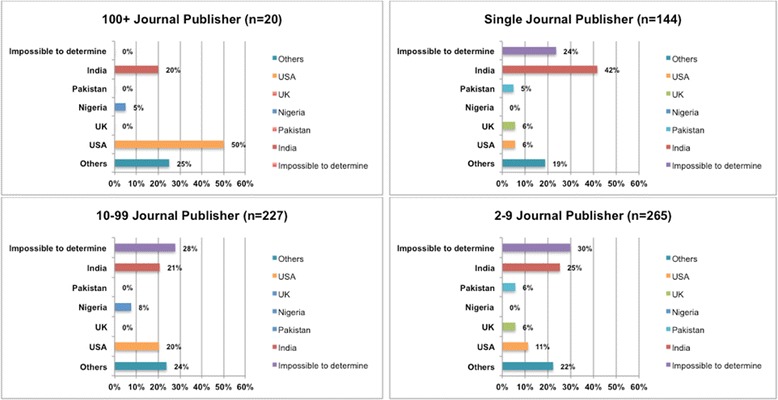
“Xia et al. also studied the origin of authors in seven pharmacological journals included in the above list and found a strong dominance of Indian authors, with Nigerian and Pakistani authors in second and third place [18].”
Result
Research works printed but not linked: 1
- Spears T. Respectable medical journal turns to dark side. Ottawa, ON: Ottawa Citizen; 2014. http://ottawacitizen.com/technology/science/respected-medical-journal-turns-to-dark-side.
Cited by
Items 701–800 of 813
Vilén, T., & Savolainen, E. (2019) · Signum · doi:10.25033/sig.87064
Benefits & Challenges of Open Access
Li, Y. (2020) · American Chemical Society eBooks · doi:10.1021/acsguide.10502
The Reproducibility Crisis and Autism Spectrum Research
Bennett, M., & Goodall, E. (2022) · Emerald Group Publishing Limited eBooks · doi:10.1108/978-1-80382-463-520221011
Journal packing density of Library and Information Science journals published across Asia
Pandita, R., & Singh, S. (2022) · Malaysian Journal of Library & Information Science · doi:10.22452/mjlis.vol27no1.1
Saudi Medical Research Articles Published in Pseudo Journals: An Urgent Call for Action
Alansari, D. (2021) · Applied Medical Research · doi:10.47363/amr/2021(8)204
COPE Council. COPE Discussion document: Predatory publishing. Version 1. November 2019
Editorial, A. (2022) · Science Editor and Publisher · doi:10.24069/sep-22-30
Tanaka, Y., Tanaka, M., Tatsumi, H., Tamura, T., & Yamamoto, M. (2022) · Journal of allied health sciences · doi:10.15563/jalliedhealthsci.13.81
Open Access: an Evaluation of its Impact, Obstacles, and Advancements
Miles, R. (2016) · Библиотекар · doi:10.18485/bibliotekar.2016.58.1_2.1 · Cited by 1
Typos, Misspellings and Other Accidents: Metadata Accuracy as a Measure of Publisher QualityPreprint
Siler, K., & Larivière, V. (2022) · SocArXiv (OSF Preprints) · doi:10.31235/osf.io/yjp3k
B 15 Verfahren der wissenschaftlichen Qualitäts-/Relevanzsicherung/ Evaluierung
Herb, U. (2022) · De Gruyter eBooks · doi:10.1515/9783110769043-027 · Cited by 1
Un caso de publicación en revista médica pirata
Calzolari, A., & Odetto, D. (2022) · Revista del Hospital Italiano de Buenos Aires · doi:10.51987/revhospitalbaires.v42i4.240
Bennett, M. (2023) · Springer eBooks · doi:10.1007/978-981-19-9240-7_1
CÔNG BỐ VỀ CHỦ ĐỀ “PREDATORY JOURNAL” TRONG CƠ SỞ DỮ LIỆU SCOPUS
Trung, N. T., & An, N. L. V. (2023) · Tạp chí Khoa học và Công nghệ Trường Đại học Hùng Vương · doi:10.59775/1859-3968.121
“Beall (2012) [18], Shen & Björk (2015) [28], Xia và cộng sự (2015) [29], Shamseer và cộng sự (2017) [30] và Clark và cộng sự (2015) [31] là năm bài báo được trích dẫn nhiều nhất trong các tài liệu về PSP.”
Open accessPreprint
Brakista, A. (2023) · doi:10.31219/osf.io/dyjg3
Decoding Predatory Publishing practices for Academia
Nayanthara, S., & Sulochana, A. (2023) · Journal of Information and Knowledge · doi:10.17821/srels/2023/v60i3/171026
Revistas depredadoras y secuestradas en cirugía. Qué se debe saber sobre ellas y cómo evitarlas.
Manterola, C., Castillo, C. M. S., & Rivadeneira, J. (2023) · Revista de Cirugía · doi:10.35687/s2452-454920230041787
Vasantha Raju, N., Adakawa, M. I., & Harinarayana, N. S. (2023) · Annals of Library and Information Studies · doi:10.56042/alis.v70i2.264
Publication Ethics and Graduate Students
Poff, D. C. (2023) · Springer eBooks · doi:10.1007/978-981-287-079-7_140-1
On the peer review reports: It's not the size that matters ... really?Preprint
Maddi, A., & Miotti, E. L. (2023) · arXiv (Cornell University) · doi:10.48550/arxiv.2309.02000 · Cited by 1
“The number of predatory journals is currently estimated at 13,000 journals with more than hundred thousand published articles (Boukacem-Zeghmouri et al., 2020; C. Shen & Björk, 2015).”
BackgroundCleeremans, A. (2018) · Cambridge University Press eBooks · doi:10.1017/9781108304443.021
Sharma, S., Verhagen, A. P., Elkins, M. R., Brismée, J., Fulk, G. D., Taradaj, J., Steen, L., Jette, A. M., Moore, A. P., Stewart, A., et al. (2023) · Musculoskeletal Science and Practice · doi:10.1016/j.msksp.2023.102836
Les journaux prédateurs en anesthésie-réanimation : les connaître pour les éviter
Darraz, A., Motiaa, Y., Es-Saad, O., Aabdi, M., Labib, S., & Sbaï, H. (2023) · Anesthésie & Réanimation · doi:10.1016/j.anrea.2023.04.002
Compromising quality parameters lead to fallout: a study of de-indexing of research journals
Pandita, R., & Singh, S. (2023) · Malaysian Journal of Library & Information Science · doi:10.22452/mjlis.vol28no2.2
Navigating the new world of scientific publications
Grgić, I. H., & Romić, K. (2022) · PUBMET · doi:10.15291/pubmet.3947
Quinteros, T. N., Molina, C. G., Henríquez-Fuentes, F., & Fernández, C. F. (2023) · Ibersid revista de sistemas de información y documentación · doi:10.54886/ibersid.v17i2.4928
Panorama dos periódicos predatórios em acesso aberto
Acquolini, N. T., Garcia, M. P. C., de Sousa, R. S. C., Pavão, C. M. G., & da Silva, F. C. C. (2023) · BiblioCanto · doi:10.21680/2447-7842.2023v9n2id33726
Publication Ethics and Graduate Students
Poff, D. C. (2023) · Springer eBooks · doi:10.1007/978-3-031-39989-3_140
Predatorski časopisi: velika dvojba za autore
Romić, K. (2023) · Napredak · doi:10.59549/n.164.3-4.5
Predatory journals and publishing fraud
Gunatilake, S. B. (2023) · Journal of the Ceylon College of Physicians · doi:10.4038/jccp.v54i2.8023
Hollier, C., & McGrath, N. (2024) · Elsevier eBooks · doi:10.1016/b978-0-323-95689-5.00064-x
Moosa, I. A. (2024) · Edward Elgar Publishing eBooks · doi:10.4337/9781035307807.00019
Publication Ethics and Graduate Students
Poff, D. C. (2024) · Springer international handbooks of education · doi:10.1007/978-3-031-54144-5_140
Pangestu, A., Al-Hakim, R. R., Arief, Y. Z., Hidayah, H. A., & Andriand, A. (2023) · JURNAL FISIOTERAPI DAN ILMU KESEHATAN SISTHANA · doi:10.55606/jufdikes.v5i1.178 · Cited by 2
A WOS-Based Investigation of Authors for English Predatory Journals
Tan, Q. H., Yuan, X., & Li, Z. (2024) · Lecture notes in computer science · doi:10.1007/978-3-031-57867-0_30
RIZQULLAH, W. A. (2023) · doi:10.47832/res.book1-3
Kumar, A., Pandey, D., Srivastava, L., & Srivastava, S. (2024) · Springer international handbooks of education · doi:10.1007/978-981-99-3895-7_64-1
Daumann, F., & Follert, F. (2023) · ORDO · doi:10.1515/ordo-2024-2001
“Dabei existiert inzwischen eine Fülle an Kennzahlen, die die Qualität einer Zeitschrift beurteilen sollen; zum einen finden hier subjektive, d. h. befragungsbasierte und zum anderen zitationsbasierte Metriken Anwendung (zu den „ Ranking Games “ siehe z. B. Osterloh und Frey 2015).”
The Shifting Sands of Medical-Scientific Publishing: The Rise of Reviews
Chandra, S., Chandra, S., & Dubey, P. K. (2024) · Springer eBooks · doi:10.1007/978-981-97-4060-4_9 · Cited by 2
Madukoma, E., & Adekunle, A. P. (2024) · Elsevier eBooks · doi:10.1016/b978-0-323-95689-5.00244-3 · Cited by 2
Kumar, A., Pandey, D., Srivastava, L., & Srivastava, S. (2024) · Springer international handbooks of education · doi:10.1007/978-981-97-4318-6_64
Why Do Researchers Falsify Data or Manipulate Study Findings?
Crombie, I. (2021) · Wiley eBooks · doi:10.1002/9781394322183.ch7
Tomlinson, O. W. (2024) · AJP Advances in Physiology Education · doi:10.1152/advan.00162.2024
Confronting the Rise of Predatory Publishing: Implications for Public Health Research and Practice
Fishal, A. T. (2025) · International Journal of Clinical Case Reports and Reviews · doi:10.31579/2690-4861/648
Acceso Abierto vs. Revistas de Pago: Efectos en la Difusión del Conocimiento Científico
Pulido, M. I. M., & Tejeida, A. C. F. (2025) · Estudios y Perspectivas Revista Científica y Académica · doi:10.61384/r.c.a..v5i1.918
Young, J. L., Shepherd, M. H., Dickson, T., & Todd, J. (2025) · Musculoskeletal Science and Practice · doi:10.1016/j.msksp.2025.103316
Saiani, P. P. (2024) · Quaderni di Sociologia · doi:10.4000/13k0k · Cited by 1
Percle, A. P., Hansen, A., Sheppard, A. J., Tujague, L. L., Rutz, R. W., & Massey, P. A. (2025) · JBJS Open Access · doi:10.2106/jbjs.oa.24.00166
“Previous authors have demonstrated similar trends in respect to journals with lower quality publications 35-39 .”
Lansana, P. M. (2025) · Advanced Research Journal · doi:10.71350/3062192531
“Reputable journals can be expensive to access, and researchers must pay hefty processing costs in order to get published (Shen & Björk, 2015).”
InfluentialYılmaz, M. T., Kahvecioğlu, A., Gültekin, M., Atalar, B., Özyiğit, G., & Selek, U. (2025) · JCO Global Oncology · doi:10.1200/go-24-00589
Hus, Y., & Segal, O. (2025) · Exploration of Neuroprotective Therapy · doi:10.37349/ent.2025.1004110 · Cited by 1
Moldovan scientific conferences: Predatory or merely misguided?
Cuciureanu, G. (2025) · European Science Editing · doi:10.3897/ese.2025.e150991
Rizo, L. C., & Matos-Hernández, E. C. (2025) · Portal de la Ciencia · doi:10.51247/pdlc.v6i3.624 · Cited by 3
Ferreira, C. L., Pìlatti, L. A., Cantorani, J. R. H., & Picinin, C. T. (2025) · Education for Information · doi:10.1177/01678329251364340
“Additionally, the rise of predatory publishing practices exploiting the APC model poses risks to academic integrity (La Barrera et al., 2023; Shen & Bj¨ork, 2015).”
Model Open Access Policy in Current Scenario
Bhoi, D., & Maharana, B. (2025) · Transactions on computer systems and networks · doi:10.1007/978-981-99-8957-7_46
Discussion Paper in Search of the Author: The Surreal World of Academic PublishingPreprint
Macdonald, S. (2025) · SSRN Electronic Journal · doi:10.2139/ssrn.5365578 · Cited by 1
Webber, N., Wiegand, S., Cohen, J. A., Reynolds, J. M., Ancelet, L., & Salazar, A. V. (2025) · Learned Publishing · doi:10.1002/leap.2020
“The country is ranked highly in several studies of author and editor affiliation or journal location of presumed predatory outlets (Alrawadieh 2018; Boukacem-Zeghmouri et al. 2023; Demir 2018; Kurt 2018; Shen and Björk 2015; Wallace and Perri 2018).”
Sieß, A. (2025) · Scientometrics · doi:10.1007/s11192-025-05411-1 · Cited by 4
“Another longitudinal study performed by Shen and Björk (2015) investigated the bibliometrics of journals included in the prominent but now discontinued ‘ Beall’s list ’, while Kulczycki et al. (2021) analyzed differences in citation patterns between legitimate and ‘questionable’ journals.”
“I’d Like to Think I’d Be Able to Spot One”: How Journalists Navigate Predatory Journals
Fleerackers, A., Moorhead, L. L., & Alperín, J. P. (2025) · Journalism Practice · doi:10.1080/17512786.2025.2551984 · Cited by 2
Graduate Education and Knowledge Production in Africa in the Context of the Knowledge Economies
Ogachi, O. I. (2025) · Springer eBooks · doi:10.1007/978-3-031-92909-0_9 · Cited by 1
On the Fast Track to Full Gold Open Access
Kudelić, R. (2025) · Lecture notes in networks and systems · doi:10.1007/978-981-96-6938-7_12
Ortega, M. P., Osca-Lluch, J., Osca, J. H., Tortosa, M., & González‐Sala, F. (2025) · Diversitas · doi:10.15332/22563067.11388
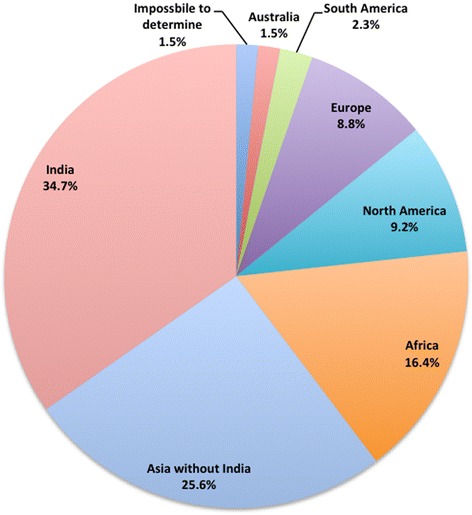
“…vein, a study observed that out of a sample of 262 authors from developing countries who have published in predatory journals, 34.7% of these authors are affiliated with institutions in India, 25.6% from Asia excluding India, followed by African authors with 16.4% of the total (Shen & Bjork, 2015).”
InfluentialIgalens, J. (2025) · Revue Management & Innovation · doi:10.3917/rmi.212.0004
Introduction and Overview: What Is Intellectual Property?
Moore, A. D. (2025) · Cambridge University Press eBooks · doi:10.1017/9781009619875.001
A Sharing of Insights on the Issues Involving Research: A Commentary Review
Espinoza, E. R. (2025) · Psychology and Education A Multidisciplinary Journal · doi:10.70838/pemj.490509 · Cited by 1
Reforming medical career progression: a call for merit-based systems
Bulletti, F. M., Guido, M., Coccia, M. E., Palagiano, A., Giacomucci, E., & Bulletti, C. (2025) · Frontiers in Medicine · doi:10.3389/fmed.2025.1643399 · Cited by 1
“China and India demonstrate exponential growth in publication volume and citation metrics but produce comparatively fewer transformative innovations (112).”
Ethical guidelines in scientific journal policies: analysis and recommendations
Lima, C. P. M., PONTES, L. B., Caldeira, F. I. D., Faria, L. V., de Oliveira, F. A., da Silva, L. R., Martelli, M. G. G., Fernandes, C. M. D. S., & Serra, M. D. C. (2025) · Revista de Odontologia da UNESP · doi:10.1590/1807-2577.20250011 · Cited by 1
Cobey, K. D., Rice, D. B., Lalu, M. M., Abramowitz, D., Ahmadzai, N., Cunningham, H., Ayala, A. P., Raffoul, H., Khan, F., Shamseer, L., et al. (2020) · Figshare · doi:10.6084/m9.figshare.12160014
Cobey, K. D., Rice, D. B., Lalu, M. M., Abramowitz, D., Ahmadzai, N., Cunningham, H., Ayala, A. P., Raffoul, H., Khan, F., Shamseer, L., et al. (2020) · Figshare · doi:10.6084/m9.figshare.12160020
Additional file 1 of Predatory publishing in medical education: a rapid scoping review
Tomlinson, O. W. (2024) · Figshare · doi:10.6084/m9.figshare.26663449
Additional file 2 of Predatory publishing in medical education: a rapid scoping review
Tomlinson, O. W. (2024) · Figshare · doi:10.6084/m9.figshare.26663452
Cobey, K. D., Rice, D. B., Lalu, M. M., Abramowitz, D., Ahmadzai, N., Cunningham, H., Ayala, A. P., Raffoul, H., Khan, F., Shamseer, L., et al. (2020) · Figshare · doi:10.6084/m9.figshare.12160026
Hall, L. M., & Hendricks, A. E. (2020) · Figshare · doi:10.6084/m9.figshare.13357508
Joshi, N., & Bhatia, M. (2025) · Research Square · doi:10.21203/rs.3.rs-8339562/v1
Surugue, L., & Rivière, P. (2025) · Droit Santé et Société · doi:10.54695/dsso.121.0038
Introduction to Scientific Writing in Maxillofacial Surgery
Nazari, A. (2025) · Springer eBooks · doi:10.1007/978-3-031-36962-9_311-1 · Cited by 1
Linhui, W., Hu, N., Sayab, M., & Ni, M. (2026) · Trends in Scholarly Publishing · doi:10.21124/tsp.2026.01.14
Faturamento com Taxas de Processamento de Artigos (APC)
Campos, F. D. F., Maricato, J. D. M., & do Canto, F. L. (2026) · Biblios Journal of Librarianship and Information Science · doi:10.5195/biblios.2025.1230
Marar, S. D., Abu-Shaheen, A. K., Ayyash, M., AlQurashi, A., Hamza, A., & Hamza, M. A. (2026) · BMC Medical Education · doi:10.1186/s12909-026-08944-y
“The questionnaire was developed in the English language based on previously published studies [4, 8, 25].”
Textual content and academic journals selectivity: A case of economic journals
Baranowski, P., & Wójcik, S. (2026) · Journal of Informetrics · doi:10.1016/j.joi.2026.101797 · Cited by 1
Trust, Transparency, and Accountability: The Three Pillars of Ethical Scholarly Publishing
Bharati, K. (2026) · Trends in Scholarly Publishing · doi:10.21124/tsp.2026.49.54
Mannai, A., Khadmi, I., Grira, I., & Khemiss, M. (2026) · BMC Medical Education · doi:10.1186/s12909-026-08895-4
“Geographically, authors who published in predatory journals are based primarily in Asia and Africa [11, 20].”
Scientific autonomy in the structural bubble: from institutional bias to AI-mediated consensus
Rubenstein, E. (2026) · Frontiers in Research Metrics and Analytics · doi:10.3389/frma.2026.1766504 · Cited by 2
“One risk of indiscriminate inclusion is predatory inclusion: low-quality outlets provide legitimacy signals while providing minimal peer review (Shen and Björk, 2015; Grudniewicz et al., 2019).”
Zeinollakizi, M. (2026) · Frontiers in Education · doi:10.3389/feduc.2026.1743473 · Cited by 2
Microbial fuel cell for sustainable approach to wastewater remediation and green energy generation
Rahman, R., Rahman, M. Z., Hakim, M., Hoque, M., Hossain, M. H., Shajahan, M., & Takafuji, M. (2026) · Elsevier eBooks · doi:10.1016/b978-0-443-34272-1.00007-0
Stockholm science II: when the state pays the ransom
de Farías, S. T. (2026) · Science and Public Policy · doi:10.1093/scipol/scag040
Predatory journals and their societal impact: a study based on Beall’s list and altmetric.com
Vysakh, C. (2026) · Quality & Quantity · doi:10.1007/s11135-026-02808-9
“In 2014, 420000 articles were published by 8000 predatory journals (Shen and Björk 2015 ).”
Nuñez, J. P. S. C., Pinedo, L., Arones-Perez, P. P., & Gavilán-Colca, M. J. (2026) · JLIS it · doi:10.36253/jlis.it-725
Lytras, M. D., Alzahrani, B., Almabadi, R., Abukammas, S., Alsaywid, B. S., & Lytra, C.-C. (. (2026) · Elsevier eBooks · doi:10.1016/b978-0-443-27743-6.00008-7
Adewojo, A. A., Ifelayo, E. B., & Jetawo, A. (2026) · Serials Review · doi:10.1080/00987913.2026.2664681
“These patterns support earlier observations that authors in developing contexts often depend on informal cues and networks when navigating open-access publishing (Lain � e & Winker, 2017; Shen & Bj € ork, 2015), but this study adds context-specific evidence from teacher education institutions.”
Influential8. The Politics of Infrastructuring Inclusivity
Vilchis, I. L., Sundsbø, K., Smith, I., & Ball, J. (2026) · Open Book Publishers · doi:10.11647/obp.0528.08
chander, M. (2026) · Trends in Scholarly Publishing · doi:10.21124/tsp.2026.82.89
Reasons journals are not found in DOAJ
Frantsvåg, J. E. (2026) · Nordlyd · doi:10.7557/12.8707
“Shen and Björk (2015) note that 27% of “predatory” publishers were located in India.”
Gobernanza editorial colaborativa en la ciencia abierta latinoamericana a partir del modelo RERCIE
Tapia, J. A. C., & Torres-Toukoumidis, Á. (2026) · We Journal Review · doi:10.38202/journal22.2
“…se nutrió de charlas sobre las expectativas de revisores y autores, las concepciones erróneas en torno a la publicación, las licencias Creative Commons y la iden-tificación de publicaciones depredadoras, fenómeno cuya expansión a escala global ha sido documentada con detalle (Shen & Björk, 2015).”
Turning a blind eye to the reality of academic publishing
Macdonald, S. (2026) · Social Science Information · doi:10.1177/05390184261456132
“(Shen and Björk, 2015) Though some established publishers clung to the fanciful notion that academic endeav-our was sacrosanct and that they were the conduit through which knowledge passed from the cloister to the outside world, APCs made a mockery of the ideal.”
Rafiq, S., Afzal, A., & Mehboob, K. (2026) · Ethics & Behavior · doi:10.1080/10508422.2026.2705498 · Cited by 1
Pamuła-Cieślak, N., Głowacka, E., & Kisilowska, M. (2026) · Przegląd Biblioteczny · doi:10.36702/pb.1306
The seductive predator: navigating predatory publishing and conferences
Williams, N. R. (2026) · Occupational Medicine · doi:10.1093/occmed/kqag075
Kakamad, F. H., Abdalla, B. A., Ahmed, F. J., Saeed, D. H. M., Ahmed, H. K., Mahmood, Y. M., Mohammed, S. H., Abdullah, H. O., Abdulkarim, M. M., Nasralla, H. A., et al. (2026) · Advancements in health research. · doi:10.4081/ahr.2026.209
Metadata
- Authors
- Shen, C., & Björk, B.-C.
- Affiliations
- Hanken School of Economics (FI)
- Corresponding author
- Shen, Cenyu
- Venue
- BMC Medicine
- Published
- 2015-10-01
- Volume
- 13
- Issue
- 1
- Pages
- 230-230
- ISSN
- 1741-7015 (ISSN-L)
- PMC
- PMC4589914
- OpenAlex
- W2156487032
- Cited by
- 819
- References
- 28
- Citations by year
- 2026: 44 · 2025: 56 · 2024: 46 · 2023: 81 · 2022: 70 · 2021: 93 · 2020: 88 · 2019: 76 · 2018: 91 · 2017: 86 · 2016: 79 · 2015: 7
- FWCI
- 564.37
- Type
- journal article
- Language
- en
- Open access
- gold
- doi.org
- Licence
- Locations
- BMC Medicine (publishedVersion, cc-by)
- Europe PMC (PubMed Central) (publishedVersion, cc-by)
- PubMed Central (publishedVersion, cc-by)
- PubMed (publishedVersion)
- Työväentutkimus Vuosikirja (acceptedVersion)
- Työväentutkimus Vuosikirja (submittedVersion)
- Topics
- Social Sciences › Library and Information Sciences › Publishing and Scholarly Communication
- Social Sciences › Library and Information Sciences › Academic Publishing and Open Access
- Social Sciences › Library and Information Sciences › scientometrics and bibliometrics research
- Keywords
- predatory publishing, predatory journals, predatory publishers, open access publishing, article processing charges, regional distribution of authors, time to publication, peer review quality, Beall's list, DOAJ
- MeSH terms
- Authorship, Humans, Longitudinal Studies, Peer Review, Periodicals as Topic, Publishing, Bibliometrics, Access to Information
About these checks
Registry, retraction, Cites and statistics results are computed, not judged, with one exception: a printed reference that no index lists is read once by a model before it counts as a citation error. Claims are extracted by a model and kept only when their quote appears verbatim in the text; each cited source is then checked, with a model’s help, for whether it says what the claim relies on. Those verdicts can be wrong — read the claim’s quote and the cited source before relying on one.
Statistics and arithmetic are recomputed, not judged.
Confidence bands are shown only for fields calibrated on our annotated test set. None is calibrated yet, so no band is shown.
What counts as a claim ›How we measure confidence ›How we check this ›
Are you an author, or do you see a problem with this page? Request a review
Data sources
Bibliographic data: Semantic Scholar, OpenAlex, Crossref.
Contains information from the Semantic Scholar Academic Graph Datasets, made available under the ODC Attribution License (ODC-BY 1.0).
Semantic Scholar’s data is described in: Kinney, R., et al. (2023). The Semantic Scholar Open Data Platform. arXiv:2301.10140.
