

CAFs secreted exosomes promote metastasis and chemotherapy resistance by enhancing cell stemness and epithelial-mesenchymal transition in colorectal cancer
Open accessThe DOI matches its Crossref record; 40 of the 40 references it cites were found in a registry or an index.
Abstract
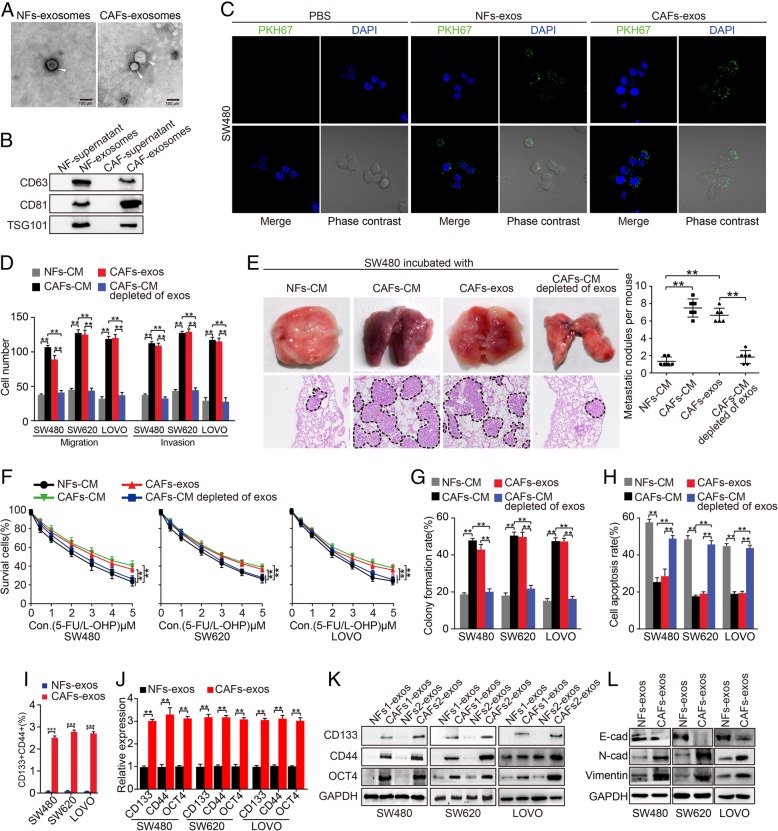
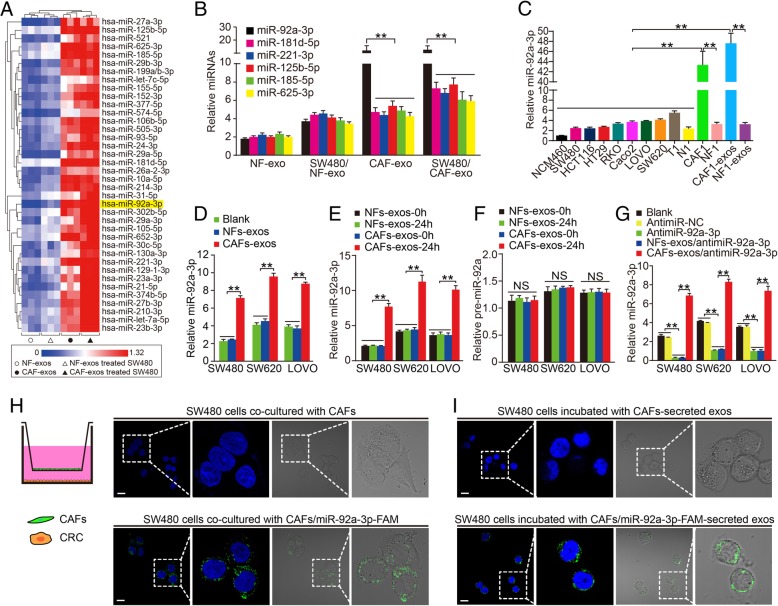
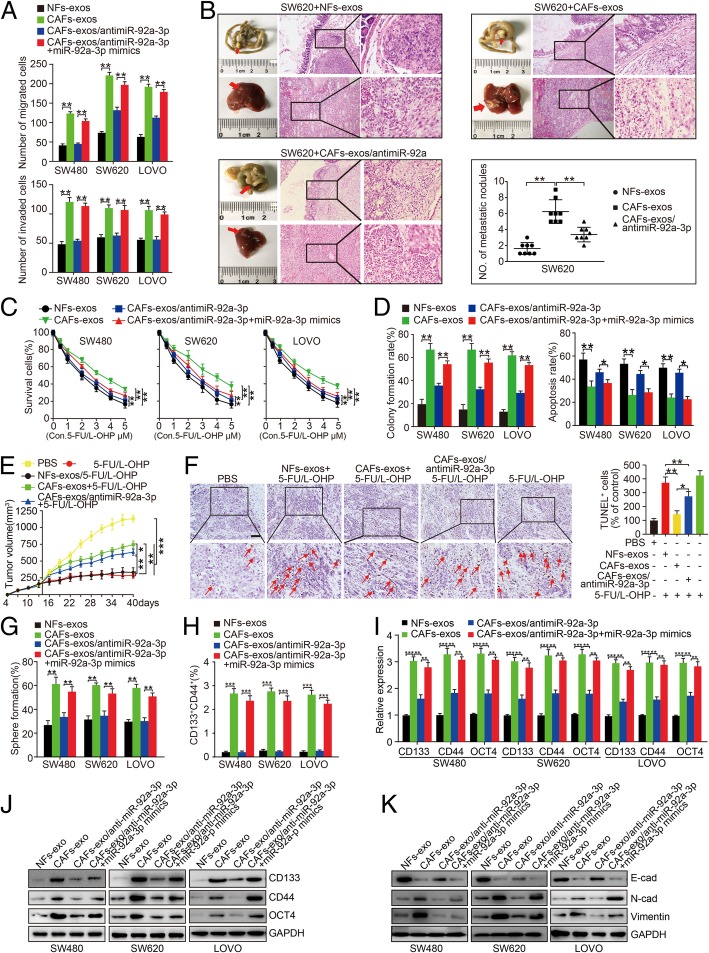
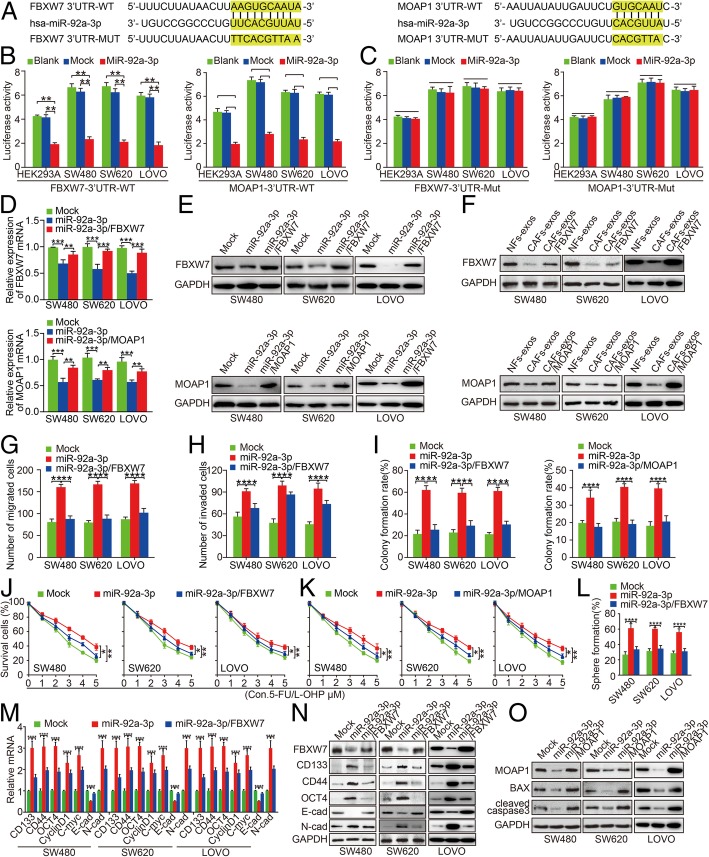
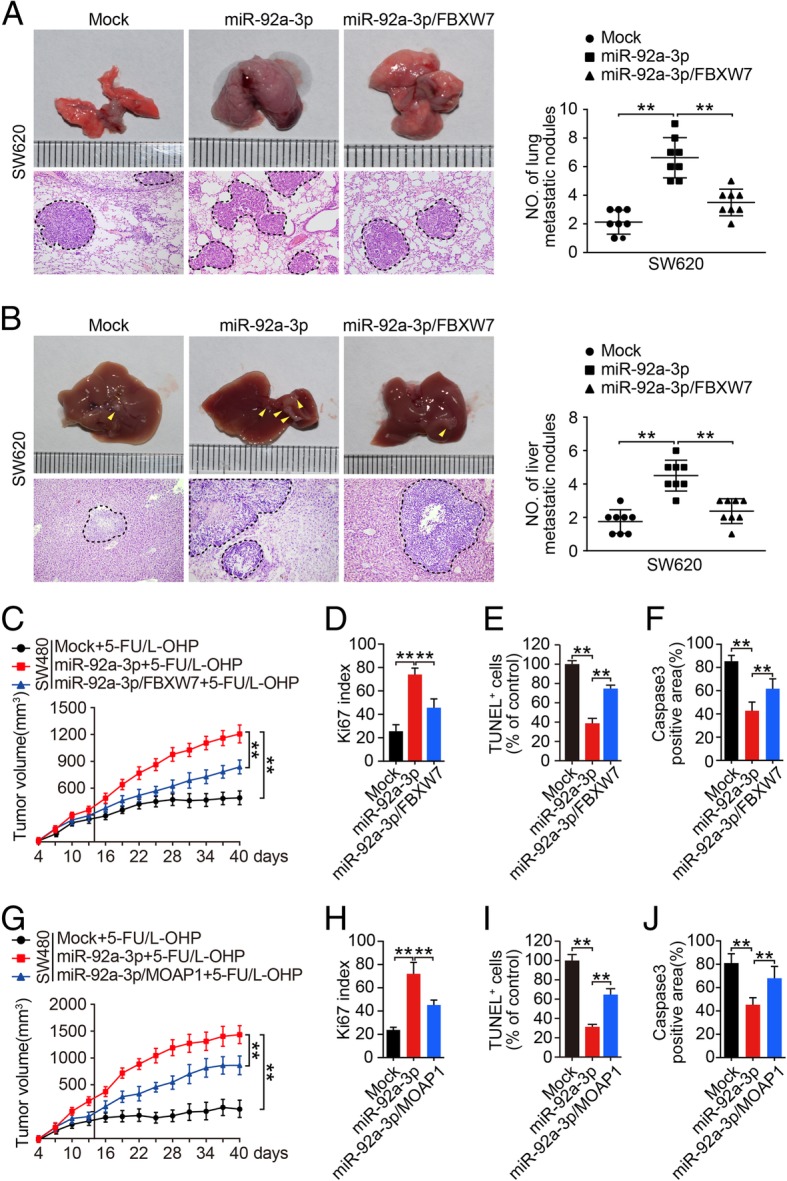
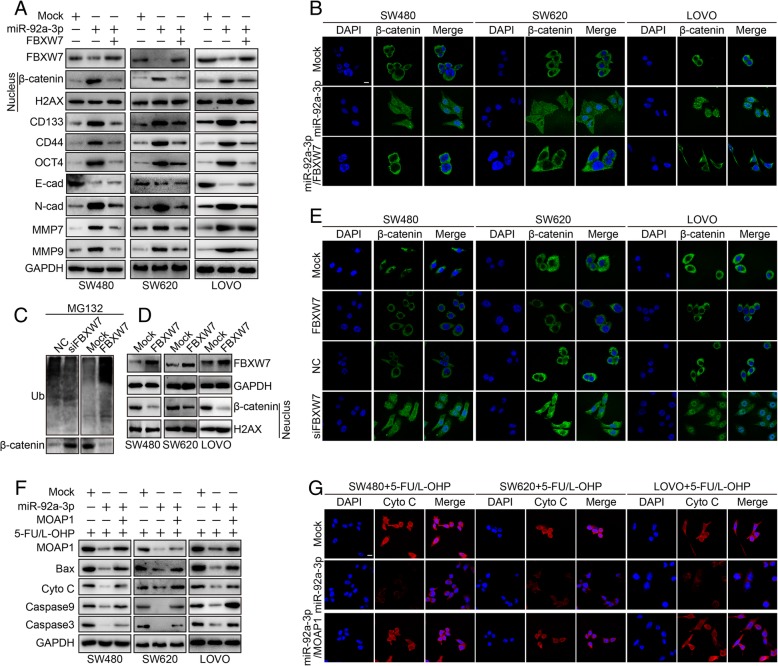
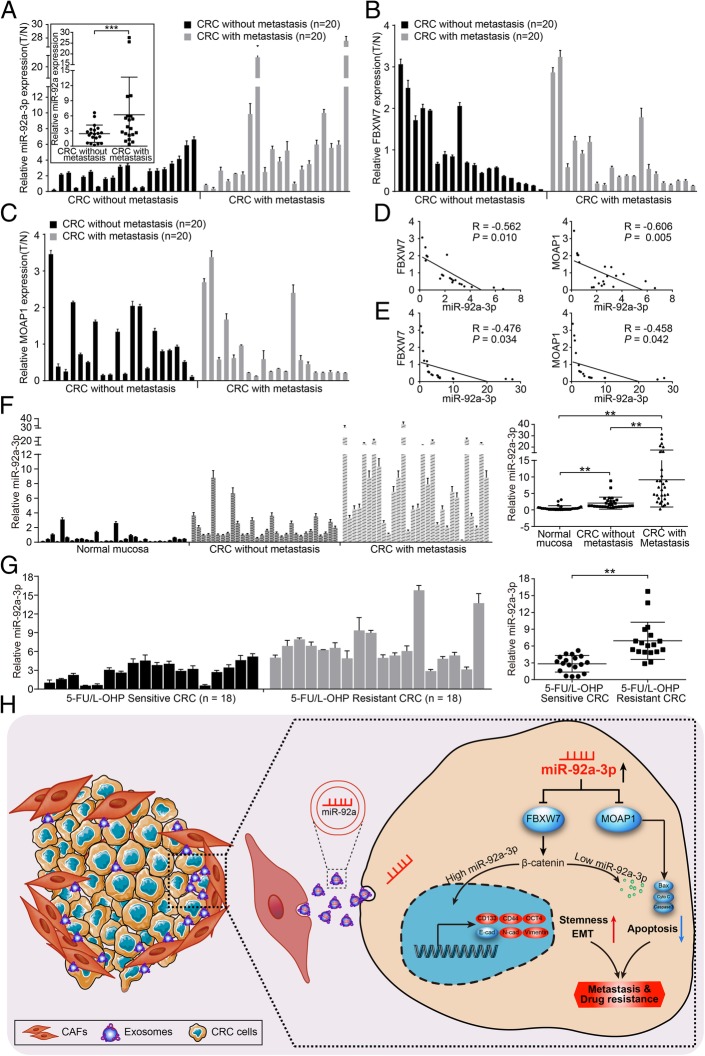
BACKGROUND: Cancer associated fibroblasts (CAFs) are key stroma cells that play dominant roles in tumor progression. However, the CAFs-derived molecular determinants that regulate colorectal cancer (CRC) metastasis and chemoresistance have not been fully characterized. METHODS: CAFs and NFs were obtained from fresh CRC and adjacent normal tissues. Exosomes were isolated from conditioned medium and serum of CRC patients using ultracentrifugation method and ExoQuick Exosome Precipitation Solution kit, and characterized by transmission electronic microscopy, nanosight and western blot. MicroRNA microarray was employed to identify differentially expressed miRNAs in exosomes secreted by CAFs or NFs. The internalization of exosomes, transfer of miR-92a-3p was observed by immunofluorescence. Boyden chamber migration and invasion, cell counting kit-8, flow cytometry, plate colony formation, sphere formation assays, tail vein injection and primary colon cancer liver metastasis assays were employed to explore the effect of NFs, CAFs and exosomes secreted by them on epithelial-mesenchymal transition, stemness, metastasis and chemotherapy resistance of CRC. Luciferase report assay, real-time qPCR, western blot, immunofluorescence, and immunohistochemistry staining were employed to explore the regulation of CRC metastasis and chemotherapy resistance by miR-92a-3p, FBXW7 and MOAP1. RESULTS: CAFs promote the stemness, epithelial-mesenchymal transition (EMT), metastasis and chemotherapy resistance of CRC cells. Importantly, CAFs exert their roles by directly transferring exosomes to CRC cells, leading to a significant increase of miR-92a-3p level in CRC cells. Mechanically, increased expression of miR-92a-3p activates Wnt/β-catenin pathway and inhibits mitochondrial apoptosis by directly inhibiting FBXW7 and MOAP1, contributing to cell stemness, EMT, metastasis and 5-FU/L-OHP resistance in CRC. Clinically, miR-92a-3p expression is significantly increased in CRC tissues and negatively correlated with the levels of FBXW7 and MOAP1 in CRC specimens, and high expression of exosomal miR-92a-3p in serum was highly linked with metastasis and chemotherapy resistance in CRC patients. CONCLUSIONS: CAFs secreted exosomes promote metastasis and chemotherapy resistance of CRC. Inhibiting exosomal miR-92a-3p provides an alternative modality for the prediction and treatment of metastasis and chemotherapy resistance in CRC.
Overview
The claims and statistics of this paper haven’t been checked yet.
Free: it reads the open-access text and checks the first 5 claims that cite a source we can check. Create a free account to check every claim.
Integrity signals
Registry
Cites
Statistics
Figures
Verification
Claims the paper makes
The claims and statistics of this paper haven’t been checked yet.
Free: it reads the open-access text and checks the first 5 claims that cite a source we can check. Create a free account to check every claim.
Claims other papers make about this one
Each is checked against this paper’s own text: does it say what the citing paper says it does?
The source backs part of the claim, not all of it — or backs it for a different population, condition or comparison.
In the citing paper
“Targeting these exosomes can effectively reduce autophagy activity and reverse CRC chemotherapy sensitivity [299,300,301].”
From Drug Resistance in Colorectal Cancer: From Mechanism to Clinic (2022) · cites this paper as [299]
Experimental — accuracy not yet measuredThe source backs part of the claim, not all of it — or backs it for a different population, condition or comparison.
In the citing paper
“A series of studies have shown that CAF-derived exosomes, such as miR-92a-3p, H19 and CCAL, promote CRC EMT and lead to CRC metastasis and chemotherapy resistance by activating the Wnt/β-catenin pathway.”
From Drug Resistance in Colorectal Cancer: From Mechanism to Clinic (2022) · cites this paper as [299]
Experimental — accuracy not yet measured
Self-check
Percentages, sums and reported differences re-computed from the paper’s own numbers.
The self-check needs the paper’s full text.
Citations
Cites
Bartel (2004) · doi:10.1016/s0092-8674(04)00045-5 · Cited by 34,714
MicroRNAs: Target Recognition and Regulatory Functions
Bartel, D. P. (2009) · Cell · doi:10.1016/j.cell.2009.01.002 · Cited by 20,068
Microenvironmental regulation of tumor progression and metastasis
Quail, D. F., & Joyce, J. A. (2013) · Nature Medicine · doi:10.1038/nm.3394 · Cited by 7,994
Global Cancer Incidence and Mortality Rates and Trends—An Update
Torre, L. A., Siegel, R. L., Ward, E. M., & Jemal, A. (2016) · Cancer Epidemiology, Biomarkers & Prevention · doi:10.1158/1055-9965.epi-15-0578 · Cited by 3,692
Tournigand, C., André, T., Achille, E., Lledo, G., Flesh, M., Mery-Mignard, D., Quinaux, E., Couteau, C., Buyse, M., Ganem, G., et al. (2004) · Journal of Clinical Oncology · doi:10.1200/jco.2004.05.113 · Cited by 2,915
Pancreatic cancer exosomes initiate pre-metastatic niche formation in the liver
Costa-Silva, B., Aiello, N. M., Ocean, A. J., Singh, S., Zhang, H., Thakur, B. K., Becker, A., Hoshino, A., Mark, M. T., Molina, H., et al. (2015) · Nature Cell Biology · doi:10.1038/ncb3169 · Cited by 2,692
The cancer stem cell: premises, promises and challenges
Clevers, H. (2011) · Nature Medicine · doi:10.1038/nm.2304 · Cited by 1,923
Cancer-secreted miR-105 destroys vascular endothelial barriers to promote metastasis
Zhou, W., Fong, M. Y., Min, Y., Somlo, G., Liu, L., Palomares, M. R., Yu, Y., Chow, A., O’Connor, S. T. F., Chin, A. R., et al. (2014) · Cancer Cell · doi:10.1016/j.ccr.2014.03.007 · Cited by 1,476
Migrating cancer stem cells — an integrated concept of malignant tumour progression
Brabletz, T., Jung, A., Spaderna, S., Hlubek, F., & Kirchner, T. (2005) · Nature Reviews Cancer · doi:10.1038/nrc1694 · Cited by 1,352 · cited 1×
“Cancer stem cells (CSCs) are self-renewable cell types that contribute to initiation, metastasis, relapse, and chemotherapy resistance of cancer cells [22, 23].”
BackgroundExosomes Mediate Stromal Mobilization of Autocrine Wnt-PCP Signaling in Breast Cancer Cell Migration
Luga, V., Zhang, L., Viloria-Petit, A. M., Ogunjimi, A. A., Inanlou, M. R., Chiu, E., Buchanan, M., Hosein, A. N., Basik, M., & Wrana, J. L. (2012) · Cell · doi:10.1016/j.cell.2012.11.024 · Cited by 1,311
Cited by
Items 701–785 of 785
Arrivi, G., Gentile, G., Roberto, M., & Cave, D. D. (2025) · International Journal of Molecular Sciences · doi:10.3390/ijms262311318 · Cited by 2
A Review of the Impact of Exosomal Non-Coding RNAs on the Development of Malignant Colorectal Tumors
Mansouri, P., & Shanehbandi, D. (2025) · مجله دانشگاه علوم پزشکی اردبیل · doi:10.61882/jarums.25.2.118
Liu, M., Lv, J., Cheng, Y., Wang, J., Liu, D., & Chen, F. (2025) · Scientific Reports · doi:10.1038/s41598-025-29379-3
“Several studies indicated that cancer associated fibroblasts transfer the exosome miR-92a-3p into colorectal cancer cells and activate the Wnt/ β-catenin pathway, promoting the stemness, EMT, and metastasis of colorectal cancer cells 32 .”
Liu, X., Luo, D., Zhang, P., Tian, D., Liu, W., & Jia, L. (2025) · BMC Neurology · doi:10.1186/s12883-025-04372-5
Zhang, Y., Zhao, J., Ding, M., Su, Y., Cui, D., Jiang, C., Zhao, S., Jia, G., Wang, X., Ruan, Y., et al. (2020) · Figshare · doi:10.6084/m9.figshare.13467023
Liu, Y. D., Zhuang, X. P., Cai, D. L., Cao, C., Gu, Q. S., Liu, X. N., Zheng, B. B., Guan, B. J., Yu, L., Li, J. K., et al. (2021) · Figshare · doi:10.6084/m9.figshare.13578928
Zhang, Y., Zhao, J., Ding, M., Su, Y., Cui, D., Jiang, C., Zhao, S., Jia, G., Wang, X., Ruan, Y., et al. (2020) · Figshare · doi:10.6084/m9.figshare.13467021
Jin, A.-L., Ding, L., Yang, W.-J., Liu, T., Chen, W., Li, T., Zhang, C.-Y., Pan, B., Qiu, S.-J., Zhou, J., et al. (2023) · Figshare · doi:10.6084/m9.figshare.22610266
Cioce, M., Fumagalli, M. R., Donzelli, S., Goeman, F., Canu, V., Rutigliano, D., Orlandi, G., Sacconi, A., Pulito, C., Palcau, A. C., et al. (2023) · Figshare · doi:10.6084/m9.figshare.23700767
Zhang, Y., Zhao, J., Ding, M., Su, Y., Cui, D., Jiang, C., Zhao, S., Jia, G., Wang, X., Ruan, Y., et al. (2020) · Figshare · doi:10.6084/m9.figshare.13467017
Shen, R., Li, P., Zhang, B., Feng, L., & Cheng, S. (2022) · Figshare · doi:10.6084/m9.figshare.21301472
Zhang, Y., Zhao, J., Ding, M., Su, Y., Cui, D., Jiang, C., Zhao, S., Jia, G., Wang, X., Ruan, Y., et al. (2020) · Figshare · doi:10.6084/m9.figshare.13467013
Liu, Y. D., Zhuang, X. P., Cai, D. L., Cao, C., Gu, Q. S., Liu, X. N., Zheng, B. B., Guan, B. J., Yu, L., Li, J. K., et al. (2021) · Figshare · doi:10.6084/m9.figshare.13578925
Yang, C., Zhang, Y., Yan, M., Wang, J., Wang, J., Wang, M., Xuan, Y., Cheng, H., Ma, J., Chai, C., et al. (2024) · Figshare · doi:10.6084/m9.figshare.24993788
Han, S., Wang, D., Huang, Y., Zeng, Z., Xu, P., Xiong, H., Ke, Z., Zhang, Y., Hu, Y., Wang, F., et al. (2023) · Figshare · doi:10.6084/m9.figshare.22615255
Self-citationLiu, Y. D., Zhuang, X. P., Cai, D. L., Cao, C., Gu, Q. S., Liu, X. N., Zheng, B. B., Guan, B. J., Yu, L., Li, J. K., et al. (2021) · Figshare · doi:10.6084/m9.figshare.13578919
Shen, R., Li, P., Zhang, B., Feng, L., & Cheng, S. (2022) · Figshare · doi:10.6084/m9.figshare.21301433
Zhang, Y., Zhao, J., Ding, M., Su, Y., Cui, D., Jiang, C., Zhao, S., Jia, G., Wang, X., Ruan, Y., et al. (2020) · Figshare · doi:10.6084/m9.figshare.13467019
Yang, C., Zhang, Y., Yan, M., Wang, J., Wang, J., Wang, M., Xuan, Y., Cheng, H., Ma, J., Chai, C., et al. (2024) · Figshare · doi:10.6084/m9.figshare.26666842
Yang, C., Zhang, Y., Yan, M., Wang, J., Wang, J., Wang, M., Xuan, Y., Cheng, H., Ma, J., Chai, C., et al. (2024) · Figshare · doi:10.6084/m9.figshare.24993693
Liu, Y. D., Zhuang, X. P., Cai, D. L., Cao, C., Gu, Q. S., Liu, X. N., Zheng, B. B., Guan, B. J., Yu, L., Li, J. K., et al. (2021) · Figshare · doi:10.6084/m9.figshare.13578922
Zhou, L., Zhang, Y., Wei, M., Du, K., Lin, J., & Wei, L. (2023) · Figshare · doi:10.6084/m9.figshare.23930242
Jin, A.-L., Ding, L., Yang, W., Liu, T., Chen, W., Li, T., Zhang, C.-Y., Pan, B., Qiu, S.-J., Zhou, J., et al. (2023) · Figshare · doi:10.6084/m9.figshare.22610269
Shen, R., Li, P., Zhang, B., Feng, L., & Cheng, S. (2022) · Figshare · doi:10.6084/m9.figshare.21301469
Li, X., Lan, Q., Lai, W., Wu, H., Xu, H., Fang, K., Chu, Z., & Zeng, Y. (2022) · Figshare · doi:10.6084/m9.figshare.20688599
Lu, L., Huang, J., Mo, J., Da, X., Li, Q., Fan, M., & Lu, H. (2022) · Figshare · doi:10.6084/m9.figshare.19218951
Shen, R., Li, P., Zhang, B., Feng, L., & Cheng, S. (2022) · Figshare · doi:10.6084/m9.figshare.21301436
Zhou, L., Zhang, Y., Wei, M., Du, K., Lin, J., & Wei, L. (2023) · Figshare · doi:10.6084/m9.figshare.23930239
Liu, Y. D., Zhuang, X. P., Cai, D. L., Cao, C., Gu, Q. S., Liu, X. N., Zheng, B. B., Guan, B. J., Yu, L., Li, J. K., et al. (2021) · Figshare · doi:10.6084/m9.figshare.13578931
Xu, Y., Ren, Z., Fang, Z., Yang, H., & Hu, C. (2024) · Figshare · doi:10.6084/m9.figshare.26378140
Li, X., Lan, Q., Lai, W., Wu, H., Xu, H., Fang, K., Chu, Z., & Zeng, Y. (2022) · Figshare · doi:10.6084/m9.figshare.20688596
Shen, R., Li, P., Zhang, B., Feng, L., & Cheng, S. (2022) · Figshare · doi:10.6084/m9.figshare.21301439
Zhang, Y., Zhao, J., Ding, M., Su, Y., Cui, D., Jiang, C., Zhao, S., Jia, G., Wang, X., Ruan, Y., et al. (2020) · Figshare · doi:10.6084/m9.figshare.13467025
李晓军, Lan, Q., Lai, W., Wu, H., Xu, H., Fang, K., Chu, Z., & Zeng, Y. (2022) · Figshare · doi:10.6084/m9.figshare.20688605
李晓军, Lan, Q., Lai, W., Wu, H., Xu, H., Fang, K., Chu, Z., & Zeng, Y. (2022) · Figshare · doi:10.6084/m9.figshare.20688590
李晓军, Lan, Q., Lai, W., Wu, H., Xu, H., Fang, K., Chu, Z., & Zeng, Y. (2022) · Figshare · doi:10.6084/m9.figshare.20688593
Zhou, L., Zhang, Y., Wei, M., Du, K., Lin, J., & Wei, L. (2023) · Figshare · doi:10.6084/m9.figshare.23930236
Xu, Y., Ren, Z., Fang, Z., Yang, H., & Hu, C. (2024) · Figshare · doi:10.6084/m9.figshare.26753749
Zhou, L., Li, J., Tang, Y., & Yang, M. (2021) · Figshare · doi:10.6084/m9.figshare.13535222
Zhang, Y., Zhao, J., Ding, M., Su, Y., Cui, D., Jiang, C., Zhao, S., Jia, G., Wang, X., Ruan, Y., et al. (2020) · Figshare · doi:10.6084/m9.figshare.13467015
Xu, Y., Ren, Z., Fang, Z., Yang, H., & Hu, C. (2024) · Figshare · doi:10.6084/m9.figshare.26753758
Yang, C., Zhang, Y., Yan, M., Wang, J., Wang, J., Wang, M., Xuan, Y., Cheng, H., Ma, J., Chai, C., et al. (2024) · Figshare · doi:10.6084/m9.figshare.26666839
Xu, Y., Ren, Z., Fang, Z., Yang, H., & Hu, C. (2024) · Figshare · doi:10.6084/m9.figshare.26753755
Shen, R., Li, P., Zhang, B., Feng, L., & Cheng, S. (2022) · Figshare · doi:10.6084/m9.figshare.21301427
Shen, R., Li, P., Zhang, B., Feng, L., & Cheng, S. (2022) · Figshare · doi:10.6084/m9.figshare.21301442
Xu, Y., Ren, Z., Fang, Z., Yang, H., & Hu, C. (2024) · Figshare · doi:10.6084/m9.figshare.26753752
Shen, R., Li, P., Zhang, B., Feng, L., & Cheng, S. (2022) · Figshare · doi:10.6084/m9.figshare.21301430
Xu, Y., Ren, Z., Fang, Z., Yang, H., & Hu, C. (2024) · Figshare · doi:10.6084/m9.figshare.26378029
Kang, J., Lim, D. M., Kim, Y., Shim, H., Kim, T., Park, K. J., Kang, S., Yu, C. S., Lee, J. L., Yu, Y., et al. (2026) · MedComm · doi:10.1002/mco2.70584 · Cited by 1
Li, S., Weng, K., Yan, L., Lu, Y., Zhou, R., Fan, Z., Yang, Z., Yue, J., & Li, W. (2026) · Journal of Translational Medicine · doi:10.1186/s12967-026-07677-2 · Cited by 3
“Emerging studies indicate that interactions between CAFs and malignant cells influence chemotherapy resistance and immunotherapy response in several cancers [13–16].”
Swaminathan, V., & John, J. (2026) · Advances in biochemistry in health and disease · doi:10.1007/978-3-032-08824-6_12
Shao, Y., Zhang, Z., Wang, Y., Zhang, C., Liu, E., & Yu, H. (2026) · Targetome · doi:10.48130/targetome-0025-0012
Transforming role of cancer associated fibroblasts: From therapeutic barriers to promising targets
Chang, J., Yu, X., Xiong, N., Zhu, M., Yang, C., Zhao, Wang, C., Wang, S., Ye, Y., & Shen, Z. (2026) · Critical Reviews in Oncology/Hematology · doi:10.1016/j.critrevonc.2026.105143
The possible role of sirtuins and MiRNAs in gastrointestinal cancers: special focus on Sirt1
Meybodi, S. M., Bahreini, F., Kalies, K., Reiter, R. J., & Rezaei, N. (2026) · Cancer Cell International · doi:10.1186/s12935-026-04181-x
“Hence, SIRT3 plays a significant role in PC metastasis, and its activity is influenced by miR-421 [159, 160].”
Molecular features and clinical significance of cancer-associated fibroblasts in colorectal cancer
Yin, Y., Liu, H., Wu, S., Fu, Y., & Peng, S. (2026) · Molecular Biology of the Cell · doi:10.1091/mbc.e25-10-0476 · Cited by 1
Spatial organization of myofibroblastic and complement-secreting CAFs in neuroendocrine tumorsPreprint
Niedra, H., Spriņģe, M. L., Tiltina, K., Pečulis, R., Saksis, R., Nazarovs, J., Ozoliņš, A., Vilisova, S., Senterjakova, N., Geriņa-Bērziņa, A., et al. (2026) · bioRxiv (Cold Spring Harbor Laboratory) · doi:10.64898/2026.02.26.708188
“Across tumor types, CAF programs have been repeatedly associated with disease progression and therapy resistance (Hu et al , 2019; Linares et al , 2020; Yasuda et al , 2021), and multiple CAF states can coexist within the same tumor forming distinguishable tumor-stroma interactomes, contributing to…”
Colorectal Micropapillary Adenocarcinoma: Molecular Mechanisms and Clinical Implications
Chen, B., Zhang, R., Ding, Y., Zhang, K., Song, X., & Chen, J. (2026) · Journal of Gastrointestinal Cancer · doi:10.1007/s12029-025-01372-z
Self-citationChandra, P., Pathak, R., Sharma, H., & Sachan, N. (2026) · Elsevier eBooks · doi:10.1016/b978-0-443-40535-8.00004-1
Exosomes in cancer: Functional mechanisms and therapeutic perspectives
Xiao, W.-Z., & Shi, J.-H. (2026) · World Journal of Clinical Oncology · doi:10.5306/wjco.v17.i3.116823
Li, Y., Zhang, J., Gao, X., Zhou, F., Chen, T., Zhao, W., Li, X., & Zhang, Y. (2026) · Frontiers in Oncology · doi:10.3389/fonc.2026.1795888 · Cited by 3
Identification of therapeutic targets of nucleolin-related pathways in pancreatic cancer therapy
Raineri, F. (2020) · theses.fr (ABES) · doi:10.70675/b0a30a01z777cz4da7z90cbz3e9a95dd1630
Yuan, Y., Zhu, B., Yang, L., Leng, Y., Chen, F., Yang, Z., Gu, W., & Zhang, K. (2026) · Biomedicines · doi:10.3390/biomedicines14050986
“Emerging studies have demonstrated that exosomes play important roles in regulating the initiation, development, metastasis and drug resistance of tumors [8–10].”
Dhungel, N., Latimer, B., Custis, D., & Dragoi, A. (2026) · bioRxiv (Cold Spring Harbor Laboratory) · doi:10.64898/2026.04.27.721078
Research on exosomes in cancer multidrug resistance and clinical translation
Zhang, W., He, M., Cheng, X., Chai, Q., Li, A., Li, F., Gu, Y., Fang, K., Rong, R., & Liu, J. (2026) · Extracellular Vesicles and Circulating Nucleic Acids · doi:10.20517/evcna.2025.191
Nagaraju, G. P., Sarvesh, S., & El‐Rayes, B. F. (2026) · Cancer Letters · doi:10.1016/j.canlet.2026.218617
Letter to the Editor: Icaritin targeting epithelial-mesenchymal transition in colorectal cancer
Sun, N.-Q., Zhang, H.-X., & Mo, S. (2026) · World Journal of Gastrointestinal Oncology · doi:10.4251/wjgo.119926
CAF enhances pancreatic cancer EMT and chemo-resistance
Zhang, S., Ceng, Q., & Liu, M. (2026) · Scientia Sinica Vitae · doi:10.1360/ssv-2026-0104
Extracellular vesicles in solid tumors: from tumor ecology to engineered therapeutics
Cai, W., Chen, Y., Dai, S., Cheng, C., & Chen, L. (2026) · Molecular Cancer · doi:10.1186/s12943-026-02705-7
“CAF-derived EVs have been associated with adaptive resistance through mechanisms involving suppression of mitochondrial apoptosis, modulation of lipid peroxidation, and reduced sensitivity to ferroptotic stress in selected experimental settings [72–75].”
Wang, F., Li, D., Li, Y., Yu, B., Gan, X., Wang, Y., Luo, H., Chen, J., Zhou, H., Lu, Q., et al. (2026) · Biochimica et Biophysica Acta (BBA) - Molecular Basis of Disease · doi:10.1016/j.bbadis.2026.168360
Self-citationColorectal cancer liver metastases: mechanism and therapy
Liu, S., Ban, L.-X., Zhang, W., Sun, Y., Wang, K., Man, Y., & Zhang, Y. (2026) · Frontiers in Immunology · doi:10.3389/fimmu.2026.1861130
Liu, Y.-X., Zhang, J., Li, X., Chen, X., Xu, K., & Cao, Y. (2026) · Genes · doi:10.3390/genes17070817 · Cited by 1
Wang, X., Li, Z., & Zhang, B. (2026) · Frontiers in Oncology · doi:10.3389/fonc.2026.1821922 · Cited by 1
Deciphering the colorectal tumor microenvironment: Interactions and targets for effective therapy
Zhao, J., Shi, C., Du, Y., Li, G., & Yan, C. (2026) · Biochemical Pharmacology · doi:10.1016/j.bcp.2026.118303
Metabolic Dysfunction–Associated Steatotic Liver Disease Reprograms the Hepatic Metastatic Niche
Karabicici, M., & Seki, E. (2026) · Seminars in Liver Disease · doi:10.1055/a-2921-0092
Collado, M., Medina-Chico, V., Castillo, M. E., Herrera, M., Larriba, M. J., Galindo-Pumariño, C., Flores, C. L., Martínez, Í., Morón, B. I., Conde, E., et al. (2026) · Research Square · doi:10.21203/rs.3.rs-10396814/v1
Liu, Y., Yin, D., Wu, L., Wang, H., Song, Y., Huang, J., Zhou, J., Li, H., Liang, P., Feng, J., et al. (2026) · Frontiers in Cell and Developmental Biology · doi:10.3389/fcell.2026.1829843
“…a critical role in the progression of various cancers, including cervical cancer, by modulating essential processes such as tumor cell proliferation, migration, invasion, metastasis, and resistance to therapy (Bueno-Urquiza et al., 2024; Wright et al., 2023; Hu et al., 2019; Richards et al., 2017).”
Effects of high CD93 expression on tumor growth and angiogenesis in gastric adenocarcinoma
Dong, Y., Luo, P., Chai, L., Li, X., Wang, J., Wei, L., & Wang, J. (2026) · PLoS ONE · doi:10.1371/journal.pone.0355284
Bartolini, M., Battaglin, F., Soni, S., Algaze, S. D., Ashouri, K., Torres-González, L., Mittal, P., Shah, U., Zhang, W., Millstein, J., et al. (2026) · Nature Reviews Gastroenterology & Hepatology · doi:10.1038/s41575-026-01243-3 · Cited by 1
“Moreover, by fine-tuning fibroblast behaviour, lncRNAs contribute to either a tumour-promoting or tumour-suppressing microenvironment, high-lighting their dual role in cancer progression 108 .”
Zhao, Y., & Jie, L. (2026) · International Journal of Oncology · doi:10.3892/ijo.2026.5934
“Cancer‑associated fibroblasts (CAFs), as core components of the TME, promote tumor growth and metastasis through the secretion of exosomes (113). miR‑335‑5p plays an oncogenic role in NSCLC (114).”
O'Connor, P., Murphy, G., & Walsh, N. (2025) · Archive of International Journal of Cancer and Allied Science · doi:10.51847/tbdl7qwuah
Mitochondrial dysfunction as a metabolic checkpoint of immunotherapy response in colorectal cancer
Tomassini, L., Colella, M., Monteleone, G., Stolfi, C., & Laudisi, F. (2026) · Frontiers in Immunology · doi:10.3389/fimmu.2026.1908222
Exosomes: The Elixir or the Trojan Horse
Khosravipour, A., Mansoori, M., Aboutalebi, H., Hashemi, F., & Vafaei, S. (2026) · Biomedicine & Pharmacotherapy · doi:10.1016/j.biopha.2026.119957
Sun, J., Yan, T., Zhang, Z., Liu, H., Ren, M., YiDong, F., Guo, L., Yan, K., & Liu, J. (2026) · Pathology - Research and Practice · doi:10.1016/j.prp.2026.156702
Extracellular vesicle–mediated strategies for cancer tissue normalisation
Raudenská, M., Balvan, J., Gumulec, J., & Masařík, M. (2026) · Cancer Letters · doi:10.1016/j.canlet.2026.218909
Metadata
- Authors
- Hu, J. L., Wang, W., Lan, X. L., Zeng, Z. C., Liang, Y. S., Yan, Y. R., Song, F. Y., Wang, F. F., Zhu, X. H., Liao, W. J., Liao, W. T., Ding, Y. Q., & Liang, L.
- Affiliations
- Key Laboratory of Guangdong Province (CN)
- Nanfang Hospital (CN)
- Venue
- Molecular Cancer
- Published
- 2019-05-07
- Volume
- 18
- Issue
- 1
- Pages
- 91-91
- ISSN
- 1476-4598 (ISSN-L)
- PMC
- PMC6503554
- OpenAlex
- W2947891482
- Cited by
- 773
- References
- 40
- Citations by year
- 2026: 63 · 2025: 96 · 2024: 136 · 2023: 127 · 2022: 157 · 2021: 118 · 2020: 64 · 2019: 12
- FWCI
- 29.85
- Type
- journal article
- Language
- en
- Open access
- gold
- doi.org
- Licence
- cc-by
- creativecommons.org/licenses/by/4.0/ (tdm)
- Locations
- Molecular Cancer (publishedVersion, cc-by)
- PubMed Central (publishedVersion, cc-by)
- PubMed (publishedVersion)
- DOAJ (DOAJ: Directory of Open Access Journals) (submittedVersion, cc-by-sa)
- Funders
- National Basic Research Program of China (973 Program, 2015CB554002)
- National Natural Science Foundation of China (81672821, 81272759, 81472313, 81401927)
- Topics
- Life Sciences › Biochemistry, Genetics and Molecular Biology › Molecular Biology › Extracellular vesicles in disease
- Health Sciences › Medicine › Oncology › Cancer Cells and Metastasis
- Life Sciences › Biochemistry, Genetics and Molecular Biology › Cancer Research › MicroRNA in disease regulation
- Keywords
- colorectal cancer, cancer-associated fibroblasts, exosomes, miR-92a-3p, epithelial-mesenchymal transition, cancer stemness, metastasis, chemoresistance, FBXW7, Wnt/β-catenin signaling, mitochondrial apoptosis
- MeSH terms
- Cancer-Associated Fibroblasts, F-Box-WD Repeat-Containing Protein 7, Animals, Humans, Liver Neoplasms, Neoplasm Transplantation, Colorectal Neoplasms, Up-Regulation, Gene Expression Regulation, Neoplastic, Drug Resistance, Neoplasm, MicroRNAs, Cell Line, Tumor, Adaptor Proteins, Signal Transducing, Apoptosis Regulatory Proteins, Mice, Exosomes, Epithelial-Mesenchymal Transition, Wnt Signaling Pathway
About these checks
Registry, retraction, Cites and statistics results are computed, not judged, with one exception: a printed reference that no index lists is read once by a model before it counts as a citation error. Claims are extracted by a model and kept only when their quote appears verbatim in the text; each cited source is then checked, with a model’s help, for whether it says what the claim relies on. Those verdicts can be wrong — read the claim’s quote and the cited source before relying on one.
Statistics and arithmetic are recomputed, not judged.
Confidence bands are shown only for fields calibrated on our annotated test set. None is calibrated yet, so no band is shown.
What counts as a claim ›How we measure confidence ›How we check this ›
Are you an author, or do you see a problem with this page? Request a review
Data sources
Bibliographic data: Semantic Scholar, OpenAlex, Crossref.
Contains information from the Semantic Scholar Academic Graph Datasets, made available under the ODC Attribution License (ODC-BY 1.0).
Semantic Scholar’s data is described in: Kinney, R., et al. (2023). The Semantic Scholar Open Data Platform. arXiv:2301.10140.
