

Pasos Hacia La Salud: a randomized controlled trial of an internet-delivered physical activity intervention for Latinas
Open accessThe DOI matches its Crossref record; 62 of the 63 references it cites were found in a registry or an index; none of the 38 sources its claims cite is checked for support yet.
Abstract
BACKGROUND: Internet access has grown markedly in Latinos during the past decade. However, there have been no Internet-based physical activity interventions designed for Latinos, despite large disparities in lifestyle-related conditions, such as obesity and diabetes, particularly in Latina women. The current study tested the efficacy of a 6-month culturally adapted, individually tailored, Spanish-language Internet-based physical activity intervention. METHODS: Inactive Latinas (N = 205) were randomly assigned to the Tailored Physical Activity Internet Intervention or the Wellness Contact Control Internet Group. Participants in both groups received emails on a tapered schedule over 6 months to alert them to new content on the website. The primary outcome was minutes/week of moderate to vigorous physical activity (MVPA) at 6 months as measured by the 7-Day Physical Activity Recall; activity was also measured by accelerometers. Data were collected between 2011 and 2014 and analyzed in 2015 at the University of California, San Diego. RESULTS: Increases in minutes/week of MVPA were significantly greater in the Intervention Group compared to the Control Group (mean difference = 50.00, SE = 9.5, p < 0.01). Increases in objectively measured MVPA were also significantly larger in the Intervention Group (mean differences = 31.0, SE = 10.7, p < .01). The Intervention Group was also significantly more likely to meet national physical activity guidelines at 6 months (OR = 3.12, 95% CI 1.46-6.66, p < .05). CONCLUSION: Findings from the current study suggest that this Internet-delivered individually tailored intervention successfully increased MVPA in Latinas compared to a Wellness Contact Control Internet Group. TRIAL REGISTRATION: NCT01834287.
Overview
CoChat Summary
## TL;DR
This randomized controlled trial found that a 6-month Spanish-language, culturally adapted, individually tailored Internet physical activity intervention increased moderate-to-vigorous physical activity (MVPA) more than a wellness-contact control among inactive Latinas. The intervention also improved self-efficacy and cognitive/behavioral processes of change, and 31.4% of intervention participants met physical activity guidelines at 6 months versus 12.6% of controls.
## Key findings
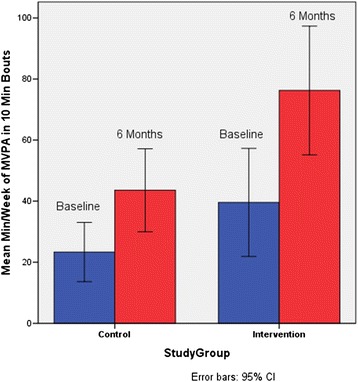
- Self-reported MVPA increased more in the intervention group than the control group at 6 months: mean difference = 50.00 min/week (SE = 9.5, p < 0.01).
- Objectively measured MVPA also favored the intervention: mean difference = 31.0 min/week (SE = 10.7, p < .01).
- Meeting national physical activity guidelines at 6 months was more likely in the intervention group: 31.4% vs 12.6%; OR = 3.12 (95% CI 1.46–6.66, p < .05).
- Intervention participants showed greater increases in psychosocial targets: self-efficacy (.42 vs -0.13, p < .001), cognitive processes (0.64 vs 0.05, p < .001), and behavioral processes (0.92 vs 0.25, p < .001); enjoyment showed only a trend (p = 0.08).
## Methods
- Randomized controlled trial of a 6-month Spanish-language, culturally and linguistically adapted, individually tailored Internet physical activity intervention versus a Spanish-language wellness contact control group.
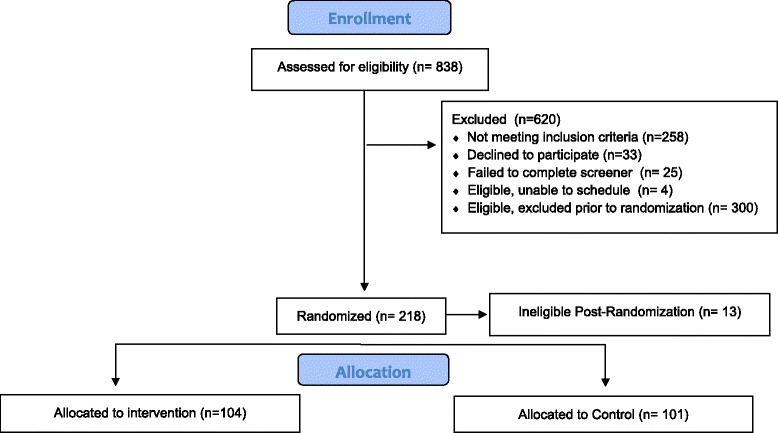
- Sample: 205 inactive Latinas; intervention N = 104, control N = 101; eligibility required ages 18–65, insufficient activity (< 60 min/week MVPA), BMI < 45 kg/m2, Spanish fluency, and Internet access.
- Primary analysis used linear mixed-effects regression for MVPA (self-report and accelerometer), with intent-to-treat analysis; guideline attainment was analyzed with logistic regression/GEE, and correlations between self-report and accelerometer MVPA were also computed.
## Limitations
- The paper states the sample was mostly healthy Mexican American women with some degree of health literacy and advanced education, so results may not generalize to other Latina subgroups, Latino men, or other ethnic groups.
- The paper notes the study was powered using a self-report measure, even though accelerometry was added as an additional primary outcome.
- Evident from the text: follow-up outcomes are reported at 6 months only in this paper, and the authors say a separate analysis of maintenance effects is forthcoming.
Model-written summary. Check it against the paper before relying on it.
Integrity signals
Registry
Cites
Statistics
Figures
Verification
Claims the paper makes
0 Valid · 0 Not valid · 15 Not checked · 32 Own results and interpretations
A result the paper reports from its own data — it cites no other source for it, so there is none to check. The quote shows it is in the paper.
In the paper
“On average, participants in the Intervention Group increased their min/week of MVPA from 8.0 (SD = 15.0), Median = 0 at baseline to 112.8 (SD = 97.1), Median = 100 min/week at 6 months”
§ Pasos Hacia La Salud: a randomized controlled trial of an internet-delivered physical activity intervention for Latinas > Results
plainstates a cause- Asserted: passes — The authors put it forward as true.
- Checkable: passes — It can be checked against evidence.
- Load-bearing: passes — The paper’s conclusions depend on it.
- Based: passes — The paper gives a reason why it holds.
A result the paper reports from its own data — it cites no other source for it, so there is none to check. The quote shows it is in the paper.
In the paper
“There were no significant differences between Intervention and Control with respect to changes in social support (friends), social support (family), social support (rewards and punishments), perceived stress, or depression (p’s > .05).”
§ Pasos Hacia La Salud: a randomized controlled trial of an internet-delivered physical activity intervention for Latinas > Results
plain- Asserted: passes — The authors put it forward as true.
- Checkable: passes — It can be checked against evidence.
- Load-bearing: unclear — It is unclear whether the paper’s conclusions depend on it.
- Based: passes — The paper gives a reason why it holds.
A result the paper reports from its own data — it cites no other source for it, so there is none to check. The quote shows it is in the paper.
In the paper
“and a trend for enjoyment (13.37(23.81) vs. 7.09(21.39),p = 0.08) from baseline to 6 months.”
§ Pasos Hacia La Salud: a randomized controlled trial of an internet-delivered physical activity intervention for Latinas > Results
hedgedstates an association- Asserted: passes — The authors put it forward as true.
- Checkable: passes — It can be checked against evidence.
- Load-bearing: unclear — It is unclear whether the paper’s conclusions depend on it.
- Based: passes — The paper gives a reason why it holds.
A result the paper reports from its own data — it cites no other source for it, so there is none to check. The quote shows it is in the paper.
In the paper
“Intervention participants showed greater increases in self-efficacy (.42 (1.03) vs. -0.13(0.92), p < .001)”
§ Pasos Hacia La Salud: a randomized controlled trial of an internet-delivered physical activity intervention for Latinas > Results
plainstates a cause- Asserted: passes — The authors put it forward as true.
- Checkable: passes — It can be checked against evidence.
- Load-bearing: passes — The paper’s conclusions depend on it.
- Based: passes — The paper gives a reason why it holds.
A result the paper reports from its own data — it cites no other source for it, so there is none to check. The quote shows it is in the paper.
In the paper
“behavioral processes (0.92(1.00) vs 0.25(0.75), p < .001)”
§ Pasos Hacia La Salud: a randomized controlled trial of an internet-delivered physical activity intervention for Latinas > Results
plainstates a cause- Asserted: passes — The authors put it forward as true.
- Checkable: passes — It can be checked against evidence.
- Load-bearing: passes — The paper’s conclusions depend on it.
- Based: passes — The paper gives a reason why it holds.
23 more claims
Create a free account to see all 47 claims and to verify the 38 references still open.
- It may state two separate claims as one. 16
- Probably not a substantial claim. 6
Claims other papers make about this one
Each is checked against this paper’s own text: does it say what the citing paper says it does?
The source backs part of the claim, not all of it — or backs it for a different population, condition or comparison.
In the citing paper
“study participants in the two interventions that did not show a significant difference in the depression symptoms experienced a limited user acceptance of the eHealth interventions (48, 49) compared to study participants in the other studies included in this review.”
From Efficacy of eHealth interventions to reduce depression symptoms in individuals with obesity: a systematic review of randomized controlled trials (2024) · cites this paper as [48]
Experimental — accuracy not yet measuredThe cited source says what the claim attributes to it.
In the citing paper
“Results from two of the six included studies (48, 49) showed no significant group differences in depression symptoms.”
From Efficacy of eHealth interventions to reduce depression symptoms in individuals with obesity: a systematic review of randomized controlled trials (2024) · cites this paper as [48]
Citations
Cites
The CES-D Scale: A Self-Report Depression Scale for Research in the General Population
Radloff, L. S. (1977) · Applied Psychological Measurement · doi:10.1177/014662167700100306 · Cited by 53,267
A Global Measure of Perceived Stress
Cohen, S., Kamarck, T., & Mermelstein, R. (1983) · Journal of Health and Social Behavior · doi:10.2307/2136404 · Cited by 32,807 · cited 2×
“The PSS is validated and has been used in many studies examining the association between stress and health and has an internal consistency of 0.86 in this sample [43].”
Influential(1985) · Medical Entomology and Zoology · Cited by 19,180
The Physical Activity Guidelines for Americans
Piercy, K. L., Troiano, R. P., Ballard, R. M., Carlson, S. A., Fulton, J. E., Galuska, D. A., George, S. M., & Olson, R. D. (2018) · JAMA · doi:10.1001/jama.2018.14854 · Cited by 9,755
Heart Disease and Stroke Statistics—2023 Update: A Report From the American Heart Association
Tsao, C. W., Aday, A. W., Almarzooq, Z. I., Anderson, C. A. M., Arora, P., Avery, C. L., Baker-Smith, C. M., Beaton, A. Z., Boehme, A. K., Buxton, A. E., et al. (2023) · Circulation · doi:10.1161/cir.0000000000001123 · Cited by 8,300
Physical Activity in the United States Measured by Accelerometer
TROIANO, R. P., BERRIGAN, D., DODD, K. W., MÂSSE, L. C., TILERT, T., & MCDOWELL, M. (2008) · Medicine & Science in Sports & Exercise · doi:10.1249/mss.0b013e31815a51b3 · Cited by 7,638 · cited 1×
“national guidelines [2–8] and lower compared to non-Latino whites [5–8].”
Heart Disease and Stroke Statistics—2013 Update: A Report From the American Heart Association
Go, A. S., Mozaffarian, D., Roger, V. L., Benjamin, E. J., Berry, J. D., Borden, W. B., Bravata, D. M., Dai, S., Ford, E. S., Fox, C. S., et al. (2013) · Circulation · doi:10.1161/cir.0b013e31828124ad · Cited by 5,292
(1988) · Cited by 4,111
Calibration of the Computer Science and Applications, Inc. accelerometer
FREEDSON, P. S., MELANSON, E., & SIRARD, J. (1998) · Medicine & Science in Sports & Exercise · doi:10.1097/00005768-199805000-00021 · Cited by 3,825
Prince, S. A., Adamo, K. B., Hamel, M., Hardt, J., Connor Gorber, S., & Tremblay, M. (2008) · International Journal of Behavioral Nutrition and Physical Activity · doi:10.1186/1479-5868-5-56 · Cited by 3,162
Parker, R. M., Baker, D. W., Williams, M. V., & Nurss, J. R. (1995) · Journal of General Internal Medicine · doi:10.1007/bf02640361 · Cited by 2,023
Neighborhood-based differences in physical activity: an environment scale evaluation
Saelens, B. E., Sallis, J. F., Black, J. B., & Chen, D. (2003) · American Journal of Public Health · doi:10.2105/ajph.93.9.1552 · Cited by 1,954 · cited 2×
“94 in this sample) and criterion validity [44].”
Toward a Comprehensive Model of Change
Prochaska, J. O., & Diclemente, C. C. (1986) · Treating Addictive Behaviors · doi:10.1007/978-1-4613-2191-0_1 · Cited by 1,877 · cited 2×
“Accordingly, a recent study showed that a PA intervention using printed, mail-delivered materials that were individually tailored based on theoretical constructs (Social Cognitive Theory and the Transtheoretical Model [14, 15]) was successful at increasing PA in inactive Latinas [16, 17].”
Self-Efficacy and the Stages of Exercise Behavior Change
Marcus, B. H., Selby, V. C., Niaura, R. S., & Rossi, J. S. (1992) · Research Quarterly for Exercise and Sport · doi:10.1080/02701367.1992.10607557 · Cited by 1,860 · cited 1×
“96 [51] in past studies, and .”
Self-citationThe social psychology of health
(1989) · Choice Reviews Online · doi:10.5860/choice.26-5686 · Cited by 1,788
PHYSICAL ACTIVITY ASSESSMENT METHODOLOGY IN THE FIVE-CITY PROJECT1
SALLIS, J. F., HASKELL, W. L., WOOD, P. D., FORTMANN, S. P., ROGERS, T., BLAIR, S. N., & PAFFENBARGER, R. S. (1985) · American Journal of Epidemiology · doi:10.1093/oxfordjournals.aje.a113987 · Cited by 1,716 · cited 1×
“The 7-Day Physical Activity Recall (7-Day PAR) was used to calculate the needed sample size for the study based on 80 % power using effect sizes from previous studies, and so served as the primary outcome measure [26, 27].”
The development of scales to measure social support for diet and exercise behaviors
Sallis, J. F., Grossman, R. M., Pinski, R. B., Patterson, T. L., & Nader, P. R. (1987) · Preventive Medicine · doi:10.1016/0091-7435(87)90022-3 · Cited by 1,534 · cited 1×
“88 in this sample) and good criterion validity [40].”
2008 Physical activity guidelines for Americans: (525412010-001)
(2008) · PsycEXTRA Dataset · doi:10.1037/e525412010-001 · Cited by 1,466
Physical activity enjoyment scale: Two validation studies
Kendzierski, D., & DeCarlo, K. J. (1991) · Journal of Sport and Exercise Psychology · doi:10.1123/jsep.13.1.50 · Cited by 1,329 · cited 1×
“86 in this sample [43].”
BLAIR, S. N., HASKELL, W. L., HO, P., PAFFENBARGER, R. S., VRANIZAN, K. M., FARQUHAR, J. W., & WOOD, P. D. (1985) · American Journal of Epidemiology · doi:10.1093/oxfordjournals.aje.a114163 · Cited by 1,104 · cited 1×
“The 7-Day Physical Activity Recall (7-Day PAR) was used to calculate the needed sample size for the study based on 80 % power using effect sizes from previous studies, and so served as the primary outcome measure [26, 27].”
Dunn, A. L., Marcus, B. H., Kampert, J. B., Garcia, M. E., Kohl III, H. W., & Blair, S. N. (1999) · JAMA · doi:10.1001/jama.281.4.327 · Cited by 1,077 · cited 1×
“The 7-Day PAR has been used across many studies on physical activity and has consistently demonstrated acceptable reliability, internal consistency, and concurrent validity with objective measures of activity [28–32].”
Self-citationPhysical Activity in U.S. Adults
Tucker, J. M., Welk, G. J., & Beyler, N. K. (2011) · American Journal of Preventive Medicine · doi:10.1016/j.amepre.2010.12.016 · Cited by 977 · cited 1×
“national guidelines [2–8] and lower compared to non-Latino whites [5–8].”
Neighborhood Environment Walkability Scale: Validity and Development of a Short Form
CERIN, E., SAELENS, B. E., SALLIS, J. F., & FRANK, L. D. (2006) · Medicine & Science in Sports & Exercise · doi:10.1249/01.mss.0000227639.83607.4d · Cited by 816 · cited 1×
“Neighborhood Environment Walkability Scale, Abbreviated (NEWSA) includes 54 items [45, 46] assessing various aspects of the built environment related to walking, neighborhood aesthetics, and traffic.”
The stages and processes of exercise adoption and maintenance in a worksite sample.
Marcus, B. H., Rossi, J. S., Selby, V. C., Niaura, R. S., & Abrams, D. B. (1992) · Health Psychology · doi:10.1037/0278-6133.11.6.386 · Cited by 796 · cited 2×
“0 median minutes/week at baseline to 100 min/week at 6 months in the current study) [52].”
Self-citationUpdating the evidence that physical activity is good for health: an epidemiological review 2000–2003
Bauman, A. E. (2004) · Journal of Science and Medicine in Sport · doi:10.1016/s1440-2440(04)80273-1 · Cited by 768
Interventions for promoting physical activity
Foster, C., Hillsdon, M., Thorogood, M., Kaur, A., & Wedatilake, T. (2005) · Cochrane Database of Systematic Reviews · doi:10.1002/14651858.cd003180.pub2 · Cited by 692
Canadian Society for Exercise Physiology
(1993) · Canadian Journal of Applied Physiology · doi:10.1139/h93-034 · Cited by 530
Environmental Correlates of Physical Activity in a Sample of Belgian Adults
De Bourdeaudhuij, I., Sallis, J. F., & Saelens, B. E. (2003) · American Journal of Health Promotion · doi:10.4278/0890-1171-18.1.83 · Cited by 441 · cited 2×
“Neighborhood Environment Walkability Scale, Abbreviated (NEWSA) includes 54 items [45, 46] assessing various aspects of the built environment related to walking, neighborhood aesthetics, and traffic.”
Leslie, E., Saelens, B., Frank, L., Owen, N., Bauman, A., Coffee, N., & Hugo, G. (2005) · Health & Place · doi:10.1016/j.healthplace.2004.05.005 · Cited by 436 · cited 2×
“Neighborhood Environment Walkability Scale, Abbreviated (NEWSA) includes 54 items [45, 46] assessing various aspects of the built environment related to walking, neighborhood aesthetics, and traffic.”
Validity of the Computer Science and Applications, Inc. (CCA) activity monitor
MELANSON, E. L., & FREEDSON, P. S. (1995) · Medicine & Science in Sports & Exercise · doi:10.1249/00005768-199506000-00021 · Cited by 416
Trend and Prevalence Estimates Based on the 2008 Physical Activity Guidelines for Americans
Carlson, S. A., Fulton, J. E., Schoenborn, C. A., & Loustalot, F. (2010) · American Journal of Preventive Medicine · doi:10.1016/j.amepre.2010.06.006 · Cited by 415 · cited 1×
“national guidelines [2–8] and lower compared to non-Latino whites [5–8].”
Validation of the CSA accelerometer for assessing children??s physical activity
JANZ, K. F. (1994) · Medicine & Science in Sports & Exercise · doi:10.1249/00005768-199403000-00015 · Cited by 327 · cited 1×
“Accelerometers measure both movement and intensity of activity and have been validated with heart rate telemetry [34] and total energy expenditure [35].”
Maintenance of physical activity following an individualized motivationally tailored intervention
Bock, B. C., Marcus, B. H., Pinto, B. M., & Forsyth, L. H. (2001) · Annals of Behavioral Medicine · doi:10.1207/s15324796abm2302_2 · Cited by 275 · cited 1×
“84) as well as shown acceptable concurrent validity with measures of selfefficacy and current activity levels [50].”
Self-citationEvaluation of methods to assess physical activity in free-living conditions
J. M. LEENDERS, N. Y., MICHAEL SHERMAN, W., NAGARAJA, H. N., & LAWRENCE KIEN, C. (2001) · Medicine & Science in Sports & Exercise · doi:10.1097/00005768-200107000-00024 · Cited by 255 · cited 1×
“Past research indicates that the 7-Day PAR is sensitive to changes in MVPA over time [29, 30] and has good test-retest reliability among Latino participants [33].”
Guarnaccia, P. J., Angel, R., & Worobey, J. L. (1989) · Social Science & Medicine · doi:10.1016/0277-9536(89)90131-7 · Cited by 252 · cited 12×
“Additionally, the largest gains were seen in foreign-born and Spanish-language dominant Latinos, who also tend to report the lowest rates of PA [9, 10, 20].”
InfluentialAmericans’ Internet Access: 2000-2015
Perrin, A. (2015) · Cited by 241
A Comparison of Internet and Print-Based Physical Activity Interventions
Marcus, B. H. (2007) · Archives of Internal Medicine · doi:10.1001/archinte.167.9.944 · Cited by 216 · cited 1×
“5 min/week) [54].”
Self-citationThe use of mobile apps to improve nutrition outcomes: A systematic literature review
DiFilippo, K. N., Huang, W.-H., Andrade, J. E., & Chapman-Novakofski, K. M. (2015) · Journal of Telemedicine and Telecare · doi:10.1177/1357633x15572203 · Cited by 212 · cited 1×
“Other aspects of smart phone technology (applications, text messaging) have been used to promote health behavior change in other groups [59–62] and should also be explored in this at risk target population.”
Norris, A. E., Ford, K., & Bova, C. A. (1996) · Hispanic Journal of Behavioral Sciences · doi:10.1177/07399863960181004 · Cited by 210 · cited 1×
“, marital status, and acculturation [25].”
Remote and web 2.0 interventions for promoting physical activity
Foster, C. E., Richards, J. A., Thorogood, M., & Hillsdon, M. M. (2013) · Cochrane Database of Systematic Reviews · doi:10.1002/14651858.cd010395.pub2 · Cited by 186 · cited 1×
“Despite this, a 2013 Cochrane review reported a paucity of web-based physical activity intervention studies that include participants from varying socioeconomic or ethnic groups [56] and we were unable to locate such other studies in a recent literature review.”
Six-month physical activity and fitness changes in Project Active, a randomized trial
DUNN, A. L., GARCIA, M. E., MARCUS, B. H., KAMPERT, J. B., KOHL, H. W., & BLAIR, S. N. (1998) · Medicine & Science in Sports & Exercise · doi:10.1097/00005768-199807000-00009 · Cited by 183 · cited 1×
“The 7-Day PAR has been used across many studies on physical activity and has consistently demonstrated acceptable reliability, internal consistency, and concurrent validity with objective measures of activity [28–32].”
Self-citationValidation of the Telephone and In-Person Interview Versions of the 7-Day PAR
HAYDEN-WADE, H. A., COLEMAN, K. J., SALLIS, J. F., & ARMSTRONG, C. (2003) · Medicine & Science in Sports & Exercise · doi:10.1249/01.mss.0000064941.43869.4e · Cited by 164 · cited 1×
“Past research indicates that the 7-Day PAR is sensitive to changes in MVPA over time [29, 30] and has good test-retest reliability among Latino participants [33].”
Leisure-Time Physical Activity Disparities Among Hispanic Subgroups in the United States
Neighbors, C. J., Marquez, D. X., & Marcus, B. H. (2008) · American Journal of Public Health · doi:10.2105/ajph.2006.096982 · Cited by 157 · cited 1×
“Both being Latino and being female are associated with not meeting PA recommendations [8, 9], and Latinas report the lowest levels of leisure PA of all major demographic groups.”
Self-citationReliability and Validity of Self-Reported Physical Activity in Latinos
RAUH, M. J. D., HOVELL, M. F., HOFSTETTER, C. R., SALLIS, J. F., & GLEGHORN, A. (1992) · International Journal of Epidemiology · doi:10.1093/ije/21.5.966 · Cited by 145 · cited 1×
“Past research indicates that the 7-Day PAR is sensitive to changes in MVPA over time [29, 30] and has good test-retest reliability among Latino participants [33].”
Reliability of 2 Instruments for Auditing the Environment for Physical Activity
Brownson, R. C., Hoehner, C. M., Brennan, L. K., Cook, R. A., Elliott, M. B., & McMullen, K. M. (2004) · Journal of Physical Activity and Health · doi:10.1123/jpah.1.3.191 · Cited by 134 · cited 2×
“Neighborhood Environment Walkability Scale, Abbreviated (NEWSA) includes 54 items [45, 46] assessing various aspects of the built environment related to walking, neighborhood aesthetics, and traffic.”
Physical Activity Patterns and Obesity in Hispanic and Non-Hispanic White Women
SLATTERY, M. L., SWEENEY, C., EDWARDS, S., HERRICK, J., MURTAUGH, M., BAUMGARTNER, K., GUILIANO, A., & BYERS, T. (2006) · Medicine & Science in Sports & Exercise · doi:10.1249/01.mss.0000183202.09681.2a · Cited by 117 · cited 3×
“Concordantly, they also show marked disparities in obesity, diabetes, and other conditions related to inactivity [9, 10].”
Physical Activity in Latinas: Social and Environmental Influences
Larsen, B. A., Pekmezi, D., Marquez, B., Benitez, T. J., & Marcus, B. H. (2013) · Women s Health · doi:10.2217/whe.13.9 · Cited by 114 · cited 1×
“Social support in particular has been reported to be an important component in physical activity behavior change in past studies with Latinas [11, 57].”
Self-citationA Culturally Adapted Physical Activity Intervention for Latinas
Pekmezi, D. W., Neighbors, C. J., Lee, C. S., Gans, K. M., Bock, B. C., Morrow, K. M., Marquez, B., Dunsiger, S., & Marcus, B. H. (2009) · American Journal of Preventive Medicine · doi:10.1016/j.amepre.2009.08.023 · Cited by 103 · cited 4×
“These psychosocial constructs have been shown to predict increases in PA in our prior studies with Latina women [16, 17].”
InfluentialSelf-citationThe Association of Neighborhood Design and Recreational Environments with Physical Activity
Atkinson, J. L., Sallis, J. F., Saelens, B. E., Cain, K. L., & Black, J. B. (2005) · American Journal of Health Promotion · doi:10.4278/0890-1171-19.4.304 · Cited by 102 · cited 1×
“Several studies have supported the test–retest reliability of the NEWS [47, 48] as well as its construct validity by reporting significant differences on some NEWS sub-scales between neighborhoods selected to differ on walkability [46, 47] and modest correlations between NEWS sub-scales and accelerometer and self-repo…”
Salud Para Su Corazón: A Community-Based Latino Cardiovascular Disease Prevention and Outreach Model
Alcalay, R., Alvarado, M., Balcázar, H., Newman, E. P., & Huerta, E. E. (1999) · Journal of Community Health · doi:10.1023/a:1018734303968 · Cited by 93 · cited 1×
“Topics included: Cut Down On Salt and Sodium, Cut Down on Fat and Not on Taste, Learn Your Cholesterol Number, Stress Management, Kick the Smoking Habit, Protect Your Heart-Lower Your Cholesterol, and Prevent High Blood Pressure [24].”
Martinez, S. M., Arredondo, E. M., Perez, G., & Baquero, B. I. (2009) · Family & Community Health · doi:10.1097/01.fch.0000342814.42025.6d · Cited by 93 · cited 1×
“cite limited transportation and childcare duties as key barriers to physical activity [11–13].”
McCully, S. N., Don, B. P., & Updegraff, J. A. (2013) · Journal of Medical Internet Research · doi:10.2196/jmir.2612 · Cited by 89 · cited 1×
“Those findings were published in 2007, but more recent Health Information Trends Survey (HINTs) data also indicated that Latinos were more likely to use the Internet for help with diet, weight and physical activity than non-Latino whites [55].”
Depressive symptomatology among Mexican-American adults: An examination with the CES-D scale
García, M. A., & Marks, G. N. (1989) · Psychiatry Research · doi:10.1016/0165-1781(89)90129-7 · Cited by 81 · cited 12×
“Additionally, the largest gains were seen in foreign-born and Spanish-language dominant Latinos, who also tend to report the lowest rates of PA [9, 10, 20].”
InfluentialMarcus, B. H., Dunsiger, S. I., Pekmezi, D. W., Larsen, B. A., Bock, B. C., Gans, K. M., Marquez, B., Morrow, K. M., & Tilkemeier, P. (2013) · American Journal of Preventive Medicine · doi:10.1016/j.amepre.2013.07.006 · Cited by 75
Self-citationDunton, G. F., Dzubur, E., Kawabata, K., Yanez, B., Bo, B., & Intille, S. (2014) · Frontiers in Public Health · doi:10.3389/fpubh.2014.00012 · Cited by 74
Physical Activity in Latino Men and Women: Facilitators, Barriers, and Interventions
Larsen, B. A., Noble, M. L., Murray, K. E., & Marcus, B. H. (2014) · American Journal of Lifestyle Medicine · doi:10.1177/1559827614521758 · Cited by 71
Self-citationParra-Medina, D. M., & Messias, D. K. H. (2011) · Quest · doi:10.1080/00336297.2011.10483668 · Cited by 68 · cited 1×
“cite limited transportation and childcare duties as key barriers to physical activity [11–13].”
Marcus, B. H., Lewis, B. A., Williams, D. M., Whiteley, J. A., Albrecht, A. E., Jakicic, J. M., Parisi, A. F., Hogan, J. W., Napolitano, M. A., & Bock, B. C. (2007) · Contemporary Clinical Trials · doi:10.1016/j.cct.2007.04.003 · Cited by 60 · cited 1×
“6 % in the current study with Latinas [53].”
Self-citationMarcus, B. H., Hartman, S. J., Pekmezi, D., DUNSIGER, S. I., Linke, S., Marquez, B., Gans, K. M., Bock, B. C., Larsen, B. A., & Rojas, C. (2015) · Contemporary Clinical Trials · doi:10.1016/j.cct.2015.08.004 · Cited by 38 · cited 1×
“A detailed description of study protocols can be found elsewhere [23].”
Self-citationPan, L., Freedman, D. S., Gillespie, C., Park, S., & Sherry, B. (2011) · Population Health Metrics · doi:10.1186/1478-7954-9-56 · Cited by 36 · cited 2×
“Concordantly, they also show marked disparities in obesity, diabetes, and other conditions related to inactivity [9, 10].”
Mistry, C. D., Sweet, S. N., Rhodes, R. E., & Latimer‐Cheung, A. E. (2015) · Psychology and Health · doi:10.1080/08870446.2014.997731 · Cited by 29 · cited 1×
“Other aspects of smart phone technology (applications, text messaging) have been used to promote health behavior change in other groups [59–62] and should also be explored in this at risk target population.”
Lieber, S. B., Redberg, R. F., Blumenthal, R. S., Gandhi, A., Robb, K. J., & Mora, S. (2012) · The American Journal of Cardiology · doi:10.1016/j.amjcard.2012.02.017 · Cited by 26
Research works printed but not linked: 2
- US Department of Health and Human Services Early release of selected estimates based on data from the national health interview survey, 2013 2014 Washington, DC US Department of Health and Human Services
- Zickuhr K Smith A Digital differences 2012
Cited by
Cheng, C., Beauchamp, A., Elsworth, G. R., & Osborne, R. H. (2020) · Journal of Medical Internet Research · doi:10.2196/18476 · Cited by 220
“• Health literacy assessed by the Short Test of Functional Health Literacy • Focus groups • Social cognitive theory • Transtheoretical model Marcus et al (2016) [71]”
BackgroundMethodInfluentialSocial cognitive theory-based health promotion in primary care practice: A scoping review
Islam, K. F., Awal, A., Mazumder, H., Munni, U. R., Majumder, K., Afroz, K., Tabassum, M. N., & Hossain, M. M. (2023) · Heliyon · doi:10.1016/j.heliyon.2023.e14889 · Cited by 207
Lewis, B. A., Napolitano, M. A., Buman, M. P., Williams, D. M., & Nigg, C. R. (2017) · Journal of Behavioral Medicine · doi:10.1007/s10865-016-9797-8 · Cited by 194
“However, one recent study by Marcus et al. (2016) did find that inactive Latinas randomly assigned to a culturally competent Internet-based intervention increased their physical activity levels relative to a wellness control.”
Promoting Physical Activity among Underserved Populations
Mendoza-Vasconez, A. S., Linke, S., Muñoz, M. A., Pekmezi, D., Ainsworth, M. C., Cano, M., Williams, V., Marcus, B. H., & Larsen, B. A. (2016) · Current Sports Medicine Reports · doi:10.1249/jsr.0000000000000276 · Cited by 131
“Study results revealed significantly greater increases in PA for the intervention group, compared with the control group (55).”
MethodResultSelf-citationPatnode, C. D., Redmond, N., Iacocca, M. O., & Henninger, M. (2022) · JAMA · doi:10.1001/jama.2022.7408 · Cited by 89
“Sample size, median (IQR) [range] 314 (200-710) [32-48 835] Follow-up at 12 mo or closest, median (IQR) [range], % 86 (77-91) [38-100] Population selectionb”
Metadata
- Authors
- Marcus, B. H., Hartman, S. J., Larsen, B. A., Pekmezi, D., Dunsiger, S. I., Linke, S., Marquez, B., Gans, K. M., Bock, B. C., Mendoza-Vasconez, A. S., Noble, M. L., & Rojas, C.
- Affiliations
- University of California San Diego (US)
- University of Alabama at Birmingham (US)
- Brown University (US)
- Corresponding author
- Marcus, Bess H.
- ORCID
- Venue
- International Journal of Behavioral Nutrition and Physical Activity
- Published
- 2016-05-28
- Volume
- 13
- Issue
- 1
- Pages
- 62-62
- ISSN
- 1479-5868 (ISSN-L)
- PMC
- PMC4884436
- OpenAlex
- W2399057681
- Semantic Scholar
- 9ad0473144085c0ca1873c56d2125ffdac215c5a
- Cited by
- 77
- References
- 63
- Citations by year
- 2026: 5 · 2025: 9 · 2024: 8 · 2023: 6 · 2022: 11 · 2021: 9 · 2020: 7 · 2019: 7 · 2018: 10 · 2017: 2 · 2016: 3
- FWCI
- 5.90
- Type
- journal article
- Language
- en
- Open access
- gold
- doi.org
- Licence
- cc-by
- creativecommons.org/licenses/by/4.0/ (tdm)
- creativecommons.org/licenses/by/4.0/ (vor)
- Locations
- International Journal of Behavioral Nutrition and Physical Activity (publishedVersion, cc-by)
- Europe PMC (PubMed Central) (publishedVersion, cc-by)
- PubMed Central (publishedVersion, cc-by)
- PubMed (publishedVersion)
- eScholarship (California Digital Library) (submittedVersion, cc-by)
- eScholarship (California Digital Library) (submittedVersion)
- Funders
- National Institutes of Health (5R01CA159954)
- Topics
- Health Sciences › Medicine › Public Health, Environmental and Occupational Health › Physical Activity and Health
- Health Sciences › Health Professions › General Health Professions › Mobile Health and mHealth Applications
- Social Sciences › Psychology › Applied Psychology › Digital Mental Health Interventions
- Keywords
- online intervention, physical activity, Hispanic women, culturally tailored interventions, Spanish-language intervention, personalized interventions, moderate-to-vigorous physical activity, physical inactivity, physical activity guidelines, obesity, diabetes mellitus
- MeSH terms
- Adult, Female, Health Promotion, Hispanic or Latino, Humans, Language, Middle Aged, Motor Activity, Obesity, Health Behavior, Exercise, Odds Ratio, Treatment Outcome, Telemedicine, Internet, Electronic Mail, Cultural Competency, Health Status Disparities
About these checks
Registry, retraction, Cites and statistics results are computed, not judged, with one exception: a printed reference that no index lists is read once by a model before it counts as a citation error. Claims are extracted by a model and kept only when their quote appears verbatim in the text; each cited source is then checked, with a model’s help, for whether it says what the claim relies on. Those verdicts can be wrong — read the claim’s quote and the cited source before relying on one.
A language model drew the claims from the paper on 2026-10-11, under version 3 of the claim definition (model deepseek-v4.1-flash, prompt extract-v3).
A second model labelled each claim on 2026-10-11 (model jev-1.13-20260917, definition revision gold-guideline-v0.2).
Statistics and arithmetic are recomputed, not judged.
Confidence bands are shown only for fields calibrated on our annotated test set. None is calibrated yet, so no band is shown.
What counts as a claim ›How we measure confidence ›How we check this ›
Are you an author, or do you see a problem with this page? Request a review
Data sources
Bibliographic data: Semantic Scholar, OpenAlex, Crossref.
Contains information from the Semantic Scholar Academic Graph Datasets, made available under the ODC Attribution License (ODC-BY 1.0).
Semantic Scholar’s data is described in: Kinney, R., et al. (2023). The Semantic Scholar Open Data Platform. arXiv:2301.10140.
