

The DOI matches its Crossref record; 261 of the 262 references it cites were found in a registry or an index; 6 of the 255 sources its claims cite were checked for support.
Tau and neuroinflammation in Alzheimer’s disease: interplay mechanisms and clinical translation
Open accessAbstract
Alzheimer’s Disease (AD) contributes to most cases of dementia. Its prominent neuropathological features are the extracellular neuritic plaques and intercellular neurofibrillary tangles composed of aggregated β-amyloid (Aβ) and hyperphosphorylated tau protein, respectively. In the past few decades, disease-modifying therapy targeting Aβ has been the focus of AD drug development. Even though it is encouraging that two of these drugs have recently received accelerated US Food and Drug Administration approval for AD treatment, their efficacy or long-term safety is controversial. Tau has received increasing attention as a potential therapeutic target, since evidence indicates that tau pathology is more associated with cognitive dysfunction. Moreover, inflammation, especially neuroinflammation, accompanies AD pathological processes and is also linked to cognitive deficits. Accumulating evidence indicates that inflammation has a complex and tight interplay with tau pathology. Here, we review recent evidence on the interaction between tau pathology, focusing on tau post-translational modification and dissemination, and neuroinflammatory responses, including glial cell activation and inflammatory signaling pathways. Then, we summarize the latest clinical trials targeting tau and neuroinflammation. Sustained and increased inflammatory responses in glial cells and neurons are pivotal cellular drivers and regulators of the exacerbation of tau pathology, which further contributes to its worsening by aggravating inflammatory responses. Unraveling the precise mechanisms underlying the relationship between tau pathology and neuroinflammation will provide new insights into the discovery and clinical translation of therapeutic targets for AD and other tau-related diseases (tauopathies). Targeting multiple pathologies and precision therapy strategies will be the crucial direction for developing drugs for AD and other tauopathies.
Overview
AI snapshot
Written from the paper’s full text.
TL;DR
This narrative review argues that tau pathology and neuroinflammation are tightly intertwined in Alzheimer’s disease, with sustained glial and neuronal inflammatory responses exacerbating tau post-translational modification and propagation in a vicious cycle. It summarizes tau- and neuroinflammation-targeted drug candidates in clinical trials and concludes that multi-target and precision therapies are likely needed for AD and other tauopathies.
Key findings
- Tau pathology correlates more closely with cognitive dysfunction than Aβ, and soluble oligomeric tau—not only insoluble fibrils/NFTs—is proposed to play a critical role in neurotoxicity and propagation. In AD brain, tau is reported to be twofold to threefold hyperphosphorylated versus 2–3 mol phosphate per mole tau in normal adult brain.
- Neuroinflammation is described as a third core AD pathological feature. Microglia and astrocytes can exacerbate tau hyperphosphorylation and spreading via receptors and pathways including TREM2, CX3CR1/CX3CL1, FPR2, CMKLR1, NLRP3/IL-1β/p38α MAPK, NF-κB, and exosome-mediated tau propagation.
- The review reports that as of January 2022, among 143 drugs in the AD pipeline, 83.2% were disease-modifying; 20 (16.8%) targeted Aβ, 13 (10.9%) tau, 28 (19.3%) inflammation, and 19 (16%) synaptic plasticity or neuroprotection. More than 50 inflammation-related agents have entered AD trials, with 22 currently ongoing, and 12 tau antibodies have entered clinical trials, half terminated for poor efficacy.
- Clinical translation remains mixed: anti-tau vaccines and antibodies have largely failed to show cognitive benefit, while some p38α inhibitors, nilotinib, NE3107, senolytics, and GV-971 show biomarker, safety, or cognitive signals that require further validation.
Methods
- Narrative review of recent evidence on tau pathology and neuroinflammation in AD, focusing on tau post-translational modification, tau dissemination, glial activation, and inflammatory signaling pathways.
- Summarizes clinical trials targeting tau and neuroinflammation, with a representative table of drug candidates compiled from ClinicalTrials.gov and Alzforum, accessed March 2023.
- No systematic review, meta-analysis, or primary experimental data are reported.
Limitations
- The paper does not state explicit limitations.
- Evident from the text: it is a narrative review without a systematic search strategy or formal quality assessment.
- The clinical trial table is current only to March 2023, and many listed trials are ongoing, terminated, suspended, or have unknown/no reported results, so efficacy and safety conclusions are provisional.
Model-written summary. Check it against the paper before relying on it.
Integrity signals
Registry
Cites
Statistics
Figures
Verification
Claims the paper makes
152 Not checked yet · 20 Own interpretation · 3 Partly supported · 3 No basis given · 1 Supported · accuracy not yet measured
In the paper
“AD is considered a secondary tauopathy due to tau pathology may occur as a consequence of extracellular amyloid plaques.”
§ Tau and neuroinflammation in Alzheimer’s disease: interplay mechanisms and clinical translation > Mechanisms of tau-mediated neurodegeneration > Expression and function of tau
What the sources say
- Not checked yetcites [24] Götz J, Halliday G, Nisbet RM. Molecular pathogenesis of the tauopathies. Annu Rev Pathol. 2019;14:239–61. source
hedgedconditional- Asserted: passes — The authors put it forward as true.
- Checkable: passes — It can be checked against evidence.
- Load-bearing: unclear — It is unclear whether the paper’s conclusions depend on it.
- Based: passes — The paper gives a reason why it holds.
None of the sources cited for this claim have been checked yet.
In the paper
“These findings indicate that soluble oligomeric tau may play a more essential role in neurodegeneration than insoluble fibrillar tau (including NFT), the “tau we can see”.”
§ Tau and neuroinflammation in Alzheimer’s disease: interplay mechanisms and clinical translation > Mechanisms of tau-mediated neurodegeneration > Expression and function of tau
What the sources say
- Not checked yetcites [25] Hyman B. All the tau we cannot see. Annu Rev Med. 2023;74:503–14. source
- Not checked yetcites [26] Santacruz K, Lewis J, Spires T, Paulson J, Kotilinek L, Ingelsson M, Guimaraes A, DeTure M, Ramsden M, McGowan E, et al. Tau suppression in a neurodegenerative mouse model improves memory function. Science. 2005;309:476–81. source
- Not checked yetcites [27] Fox LM, William CM, Adamowicz DH, Pitstick R, Carlson GA, Spires-Jones TL, Hyman BT. Soluble tau species, not neurofibrillary aggregates, disrupt neural system integration in a tau transgenic model. J Neuropathol Exp Neurol. 2011;70:588–95. source
- Not checked yetcites [28] Polydoro M, Dzhala VI, Pooler AM, Nicholls SB, McKinney AP, Sanchez L, Pitstick R, Carlson GA, Staley KJ, Spires-Jones TL, Hyman BT. Soluble pathological tau in the entorhinal cortex leads to presynaptic deficits in an early Alzheimer’s disease model. Acta Neuropathol. 2014;127:257–70. source
- Not checked yetcites [29] Rudinskiy N, Hawkes JM, Betensky RA, Eguchi M, Yamaguchi S, Spires-Jones TL, Hyman BT. Orchestrated experience-driven Arc responses are disrupted in a mouse model of Alzheimer’s disease. Nat Neurosci. 2012;15:1422–9. source
- Not checked yetcites [30] Busche MA, Wegmann S, Dujardin S, Commins C, Schiantarelli J, Klickstein N, Kamath TV, Carlson GA, Nelken I, Hyman BT. Tau impairs neural circuits, dominating amyloid-beta effects, in Alzheimer models in vivo. Nat Neurosci. 2019;22:57–64. source
- Not checked yetcites [31] Wegmann S, DeVos SL, Zeitler B, Marlen K, Bennett RE, Perez-Rando M, MacKenzie D, Yu Q, Commins C, Bannon RN, et al. Persistent repression of tau in the brain using engineered zinc finger protein transcription factors. Sci Adv. 2021. https://doi.org/10.1126/sciadv.abe1611. source
hedgedconditional- Asserted: passes — The authors put it forward as true.
- Checkable: passes — It can be checked against evidence.
- Load-bearing: passes — The paper’s conclusions depend on it.
- Based: passes — The paper gives a reason why it holds.
A conclusion the paper draws from its own results — it cites no other source for it, so there is none to check. The quote shows it is in the paper.
In the paper
“Accumulating evidence indicates that inflammation has a complex and tight interplay with tau pathology.”
§ Tau and neuroinflammation in Alzheimer’s disease: interplay mechanisms and clinical translation > Abstract
hedgedcorrelational- Asserted: passes — The authors put it forward as true.
- Checkable: passes — It can be checked against evidence.
- Load-bearing: passes — The paper’s conclusions depend on it.
- Based: passes — The paper gives a reason why it holds.
In the paper
“In AD brains, tau aggregates into NFTs or neuropil threads composed of 3R and 4R Tau [24].”
§ Tau and neuroinflammation in Alzheimer’s disease: interplay mechanisms and clinical translation > Mechanisms of tau-mediated neurodegeneration > Expression and function of tau
What the sources say
- Not checked yetcites [24] Götz J, Halliday G, Nisbet RM. Molecular pathogenesis of the tauopathies. Annu Rev Pathol. 2019;14:239–61. source
plain- Asserted: passes — The authors put it forward as true.
- Checkable: passes — It can be checked against evidence.
- Load-bearing: unclear — It is unclear whether the paper’s conclusions depend on it.
- Based: passes — The paper gives a reason why it holds.
In the paper
“In addition, activation of inflammatory processes and immune responses are commonly observed in AD brain tissues [5].”
§ Tau and neuroinflammation in Alzheimer’s disease: interplay mechanisms and clinical translation > Background
What the sources say
- Not checked yetcites [5] Leng FD, Edison P. Neuroinflammation and microglial activation in Alzheimer disease: where do we go from here? Nat Rev Neurol. 2021;17:157–72. source
plain- Asserted: passes — The authors put it forward as true.
- Checkable: passes — It can be checked against evidence.
- Load-bearing: passes — The paper’s conclusions depend on it.
- Based: passes — The paper gives a reason why it holds.
In the paper
“Recent studies have found that overexpression of either wild-type tau or human P301L-mutant tau inhibits neural network activity independent of fibril formation.”
§ Tau and neuroinflammation in Alzheimer’s disease: interplay mechanisms and clinical translation > Mechanisms of tau-mediated neurodegeneration > Expression and function of tau
What the sources say
- Not checked yetcites [30] Busche MA, Wegmann S, Dujardin S, Commins C, Schiantarelli J, Klickstein N, Kamath TV, Carlson GA, Nelken I, Hyman BT. Tau impairs neural circuits, dominating amyloid-beta effects, in Alzheimer models in vivo. Nat Neurosci. 2019;22:57–64. source
plaindirect- Asserted: passes — The authors put it forward as true.
- Checkable: passes — It can be checked against evidence.
- Load-bearing: passes — The paper’s conclusions depend on it.
- Based: passes — The paper gives a reason why it holds.
In the paper
“Turning off their overexpression attenuates the inhibition of network activity, which is associated with soluble tau but not fibrillar tau [30].”
§ Tau and neuroinflammation in Alzheimer’s disease: interplay mechanisms and clinical translation > Mechanisms of tau-mediated neurodegeneration > Expression and function of tau
What the sources say
- Not checked yetcites [30] Busche MA, Wegmann S, Dujardin S, Commins C, Schiantarelli J, Klickstein N, Kamath TV, Carlson GA, Nelken I, Hyman BT. Tau impairs neural circuits, dominating amyloid-beta effects, in Alzheimer models in vivo. Nat Neurosci. 2019;22:57–64. source
plaindirect- Asserted: passes — The authors put it forward as true.
- Checkable: passes — It can be checked against evidence.
- Load-bearing: passes — The paper’s conclusions depend on it.
- Based: passes — The paper gives a reason why it holds.
None of the sources cited for this claim have been checked yet.
In the paper
“Increasing evidence demonstrates that the cognitive dysfunction and severity of the disease are more related to tau pathology [11–14].”
§ Tau and neuroinflammation in Alzheimer’s disease: interplay mechanisms and clinical translation > Background
What the sources say
- Not checked yetcites [11] Arriagada PV, Growdon JH, Hedley-Whyte ET, Hyman BT. Neurofibrillary tangles but not senile plaques parallel duration and severity of Alzheimer’s disease. Neurology. 1992;42:631–631. source
- Not checked yetcites [12] GomezIsla T, Hollister R, West H, Mui S, Growdon JH, Petersen RC, Parisi JE, Hyman BT. Neuronal loss correlates with but exceeds neurofibrillary tangles in Alzheimer’s disease. Ann Neurol. 1997;41:17–24. source
- Not checked yetcites [13] Gong P, Chen YQ, Lin AH, Zhang HB, Zhang Y, Ye RD, Yu Y. p47(phox) deficiency improves cognitive impairment and attenuates tau hyperphosphorylation in mouse models of AD. Alzheimers Res Ther. 2020;12:18. source
- Not checked yetcites [14] Zhang HB, Lin AH, Gong P, Chen YQ, Ye RD, Qian F, Zhang Y, Yu Y. The chemokine-like receptor 1 deficiency improves cognitive deficits of AD mice and attenuates tau hyperphosphorylation via regulating tau seeding. J Neurosci. 2020;40:6991–7007. source
boostedcorrelational- Asserted: passes — The authors put it forward as true.
- Checkable: passes — It can be checked against evidence.
- Load-bearing: passes — The paper’s conclusions depend on it.
- Based: passes — The paper gives a reason why it holds.
None of the sources cited for this claim have been checked yet.
In the paper
“Correlations between NFT density and clinical symptoms, such as a cognitive decline in AD, have been demonstrated [11, 12].”
§ Tau and neuroinflammation in Alzheimer’s disease: interplay mechanisms and clinical translation > Mechanisms of tau-mediated neurodegeneration
What the sources say
- Not checked yetcites [11] Arriagada PV, Growdon JH, Hedley-Whyte ET, Hyman BT. Neurofibrillary tangles but not senile plaques parallel duration and severity of Alzheimer’s disease. Neurology. 1992;42:631–631. source
- Not checked yetcites [12] GomezIsla T, Hollister R, West H, Mui S, Growdon JH, Petersen RC, Parisi JE, Hyman BT. Neuronal loss correlates with but exceeds neurofibrillary tangles in Alzheimer’s disease. Ann Neurol. 1997;41:17–24. source
boostedcorrelational- Asserted: passes — The authors put it forward as true.
- Checkable: passes — It can be checked against evidence.
- Load-bearing: unclear — It is unclear whether the paper’s conclusions depend on it.
- Based: passes — The paper gives a reason why it holds.
In the paper
“Co-targeting p38α, the most central tau kinase associated with interdependence, and the master sites synergistically eliminated hyperphosphorylation of tau [39].”
§ Tau and neuroinflammation in Alzheimer’s disease: interplay mechanisms and clinical translation > Mechanisms of tau-mediated neurodegeneration > Post-transcriptional modifications of tau
What the sources say
- Not checked yetcites [39] Stefanoska K, Gajwani M, Tan ARP, Ahel HI, Asih PR, Volkerling A, Poljak A, Ittner A. Alzheimer’s disease: ablating single master site abolishes tau hyperphosphorylation. Sci Adv. 2022. https://doi.org/10.1126/sciadv.abl8809. source
plaindirect- Asserted: passes — The authors put it forward as true.
- Checkable: passes — It can be checked against evidence.
- Load-bearing: unclear — It is unclear whether the paper’s conclusions depend on it.
- Based: passes — The paper gives a reason why it holds.
- It may state two separate claims as one. 73
- Probably not a substantial claim. 7
The cited sources support only part of this claim — read each source’s verdict below.
In the paper
“The inflammatory responses (especially neuroinflammation) accompany the entire progress of AD pathogenesis and are also linked to cognitive dysfunction [15].”
§ Tau and neuroinflammation in Alzheimer’s disease: interplay mechanisms and clinical translation > Background
What the sources say
- Partly supportedcites [15] Bettcher BM, Tansey MG, Dorothee G, Heneka MT. Peripheral and central immune system crosstalk in Alzheimer disease—a research prospectus. Nat Rev Neurol. 2021;17:689–701. sourceExperimental — accuracy not yet measured
The ‘Clinical studies of immune dysregulation’ section reports a CNS inflammatory response early in AD and links some inflammatory markers to faster cognitive decline. The ‘Mechanistic insight from animal studies’ section describes chronic neuroinflammation contributing to disease progression and neuronal dysfunction. The source does not establish that inflammatory responses accompany the entire course of AD pathogenesis; it emphasizes stage-dependent patterns and mixed clinical associations. Page numbers were not available in our copy. (LLM, conf=0.85)
plaincorrelational- Asserted: passes — The authors put it forward as true.
- Checkable: passes — It can be checked against evidence.
- Load-bearing: passes — The paper’s conclusions depend on it.
- Based: passes — The paper gives a reason why it holds.
It may state two separate claims as one.
- Partly supported
The cited sources support only part of this claim — read each source’s verdict below.
In the paper
“Even though it is encouraging that two of these drugs have recently received accelerated US Food and Drug Administration approval for AD treatment, their efficacy or long-term safety is controversial.”
§ Tau and neuroinflammation in Alzheimer’s disease: interplay mechanisms and clinical translation > Abstract
What the sources say
- Partly supportedcites [8] Kantarci K. 2021 marks a new era for Alzheimer’s therapeutics. Lancet Neurol. 2022;21:3–4. sourceExperimental — accuracy not yet measured
In the paper’s main text (page unavailable), Kantarci reports accelerated FDA approval and disputed clinical benefit for aducanumab. It describes donanemab as the subject of a phase 2 trial, not as a second approved drug, and does not establish a controversy over long-term safety. (LLM, conf=0.87)
- Not checked yetcites [9] Mullard A. FDA approval for Biogen’s aducanumab sparks Alzheimer disease firestorm. Nat Rev Drug Discov. 2021;20:496–496.
- Partly supportedcites [10] van Dyck CH, Swanson CJ, Aisen P, Bateman RJ, Chen C, Gee M, Kanekiyo M, Li D, Reyderman L, Cohen S, et al. Lecanemab in early Alzheimer’s disease. N Engl J Med. 2023;388:9–21. sourceExperimental — accuracy not yet measured
The introduction (§10) says that one anti-amyloid antibody, aducanumab, had received accelerated FDA approval—not two. The conclusion (Table 3 continued) reports adverse events and calls for longer trials to determine lecanemab’s efficacy and safety, supporting uncertainty about longer-term outcomes, but it does not characterize the efficacy of two approved drugs as controversial. (LLM, conf=0.86)
plain- Asserted: passes — The authors put it forward as true.
- Checkable: passes — It can be checked against evidence.
- Load-bearing: unclear — It is unclear whether the paper’s conclusions depend on it.
- Based: passes — The paper gives a reason why it holds.
It may state two separate claims as one.
- Partly supported
The cited sources support only part of this claim — read each source’s verdict below.
In the paper
“The pathogenic tau can be released from diseased neurons, then uptake by previously unaffected normal neurons, inducing pathogenic tau production in normal neurons.”
§ Tau and neuroinflammation in Alzheimer’s disease: interplay mechanisms and clinical translation > Mechanisms of tau-mediated neurodegeneration > Post-transcriptional modifications of tau
What the sources say
- Supportedcites [41] Mudher A, Colin M, Dujardin S, Medina M, Dewachter I, Naini SMA, Mandelkow EM, Mandelkow E, Buee L, Goedert M, Brion JP. What is the evidence that tau pathology spreads through prion-like propagation? Acta Neuropathol Commun. 2017;5:20. source
The Transcellular tau transfer section (page unavailable) reports that tau seeds released from donor cells are taken up by recipient cells and induce aggregation of previously non-aggregated tau. It also reports neuron-to-neuron transfer of tau capable of seeding aggregation. The paper describes this mechanism chiefly through experimental studies; the claim says it can occur, not that it is established in human disease. (LLM, conf=0.88)
- Partly supportedcites [42] Clavaguera F, Bolmont T, Crowther RA, Abramowski D, Frank S, Probst A, Fraser G, Stalder AK, Beibel M, Staufenbiel M, et al. Transmission and spreading of tauopathy in transgenic mouse brain. Nat Cell Biol. 2009;11:909-U325. sourceExperimental — accuracy not yet measured
The Abstract (passages 5 and 7; no page given) reports that injected brain extract induced tau filament formation and spreading in transgenic mice expressing wild-type human tau. But the Abstract (passages 1 and 6) treats release from affected cells and entry into other cells as possible mechanisms requiring investigation, not as a demonstrated sequence. It also reports assembly of existing wild-type tau into filaments, rather than pathogenic tau production in normal neurons. (LLM, conf=0.88)
plaindirect- Asserted: passes — The authors put it forward as true.
- Checkable: passes — It can be checked against evidence.
- Load-bearing: unclear — It is unclear whether the paper’s conclusions depend on it.
- Based: passes — The paper gives a reason why it holds.
It may state two separate claims as one.
- Supported
Every source the paper cites for this claim was checked and supports it.
In the paper
“HDAC6 knockdown attenuates reactive oxygen species (ROS) generation, NADPH oxidase activation, and neuroinflammation response in HIV-1 transactivator of transcription (Tat)-stimulated astrocytes [184].”
§ Tau and neuroinflammation in Alzheimer’s disease: interplay mechanisms and clinical translation > Neuroinflammation: a link between tau and AD > Role of neuroinflammation in post-transcriptional modifications of tau
What the sources say
- Supportedcites [184] Youn GS, Cho H, Kim D, Choi SY, Park J. Crosstalk between HDAC6 and Nox2-based NADPH oxidase mediates HIV-1 Tat-induced pro-inflammatory responses in astrocytes. Redox Biol. 2017;12:978–86. source
The Results sections report that HDAC6 knockdown reduced Tat-induced ROS generation and NADPH oxidase activity in CRT-MG cells and primary mouse astrocytes. The Discussion also states that knockdown suppressed subsequent expression of pro-inflammatory chemokines, supporting the claimed inflammatory response in astrocytes. No page numbers are provided in our copy. (LLM, conf=0.93)
plaindirect- Asserted: passes — The authors put it forward as true.
- Checkable: passes — It can be checked against evidence.
- Load-bearing: passes — The paper’s conclusions depend on it.
- Based: passes — The paper gives a reason why it holds.
It may state two separate claims as one.
- Supported
In the paper
“Mutations in the MAPT gene lead to FTDP-17 [22], providing evidence that tau dysfunction due to tau mutations induces neurodegeneration.”
§ Tau and neuroinflammation in Alzheimer’s disease: interplay mechanisms and clinical translation > Mechanisms of tau-mediated neurodegeneration > Expression and function of tau
What the sources say
- Not checked yetcites [22] Hutton M, Lendon CL, Rizzu P, Baker M, Froelich S, Houlden H, Pickering-Brown S, Chakraverty S, Isaacs A, Grover A, et al. Association of missense and 5 ’-splice-site mutations in tau with the inherited dementia FTDP-17. Nature. 1998;393:702–5. source
plaindirect- Asserted: passes — The authors put it forward as true.
- Checkable: passes — It can be checked against evidence.
- Load-bearing: unclear — It is unclear whether the paper’s conclusions depend on it.
- Based: passes — The paper gives a reason why it holds.
It may state two separate claims as one.
In the paper
“In January 2023, FDA approved a new monoclonal antibody against Aβ called lecanemab for the treatment of early AD, also by its accelerated approval pathway.”
§ Tau and neuroinflammation in Alzheimer’s disease: interplay mechanisms and clinical translation > Background
What the sources say
- Not checked yetcites [10] van Dyck CH, Swanson CJ, Aisen P, Bateman RJ, Chen C, Gee M, Kanekiyo M, Li D, Reyderman L, Cohen S, et al. Lecanemab in early Alzheimer’s disease. N Engl J Med. 2023;388:9–21. source
plain- Asserted: passes — The authors put it forward as true.
- Checkable: passes — It can be checked against evidence.
- Load-bearing: fails — The paper’s conclusions may not depend on it.
- Based: passes — The paper gives a reason why it holds.
Probably not a substantial claim. The paper’s conclusions may not depend on it.
In the paper
“Furthermore, inhibition of endogenous tau improves behaviors and protects neurons from toxicity in APP/PS1 mice, a mouse model with AD-like Aβ pathology [31].”
§ Tau and neuroinflammation in Alzheimer’s disease: interplay mechanisms and clinical translation > Mechanisms of tau-mediated neurodegeneration > Expression and function of tau
What the sources say
- Not checked yetcites [31] Wegmann S, DeVos SL, Zeitler B, Marlen K, Bennett RE, Perez-Rando M, MacKenzie D, Yu Q, Commins C, Bannon RN, et al. Persistent repression of tau in the brain using engineered zinc finger protein transcription factors. Sci Adv. 2021. https://doi.org/10.1126/sciadv.abe1611. source
plaindirect- Asserted: passes — The authors put it forward as true.
- Checkable: passes — It can be checked against evidence.
- Load-bearing: passes — The paper’s conclusions depend on it.
- Based: passes — The paper gives a reason why it holds.
It may state two separate claims as one.
In the paper
“Moreover, inflammation, especially neuroinflammation, accompanies AD pathological processes and is also linked to cognitive deficits.”
§ Tau and neuroinflammation in Alzheimer’s disease: interplay mechanisms and clinical translation > Abstract
What the sources say
- Not checked yetcites [15] Bettcher BM, Tansey MG, Dorothee G, Heneka MT. Peripheral and central immune system crosstalk in Alzheimer disease—a research prospectus. Nat Rev Neurol. 2021;17:689–701. source
plaincorrelational- Asserted: passes — The authors put it forward as true.
- Checkable: passes — It can be checked against evidence.
- Load-bearing: passes — The paper’s conclusions depend on it.
- Based: passes — The paper gives a reason why it holds.
It may state two separate claims as one.
A conclusion the paper draws from its own results — it cites no other source for it, so there is none to check. The quote shows it is in the paper.
In the paper
“The efficacy or long-term safety of these two drugs needs further validation.”
§ Tau and neuroinflammation in Alzheimer’s disease: interplay mechanisms and clinical translation > Background
plain- Asserted: passes — The authors put it forward as true.
- Checkable: passes — It can be checked against evidence.
- Load-bearing: passes — The paper’s conclusions depend on it.
- Based: passes — The paper gives a reason why it holds.
Probably not a substantial claim. It may state two separate claims as one.
None of the sources cited for this claim have been checked yet.
In the paper
“It is encouraging that in 2021, aducanumab, a humanized recombinant monoclonal antibody targeting Aβ, became the first disease-modifying therapy (DMT) drug for AD approved by an accelerated pathway of the US Food and Drug Administration (FDA).”
§ Tau and neuroinflammation in Alzheimer’s disease: interplay mechanisms and clinical translation > Background
What the sources say
- Not checked yetcites [8] Kantarci K. 2021 marks a new era for Alzheimer’s therapeutics. Lancet Neurol. 2022;21:3–4. source
- Not checked yetcites [9] Mullard A. FDA approval for Biogen’s aducanumab sparks Alzheimer disease firestorm. Nat Rev Drug Discov. 2021;20:496–496.
plain- Asserted: passes — The authors put it forward as true.
- Checkable: passes — It can be checked against evidence.
- Load-bearing: fails — The paper’s conclusions may not depend on it.
- Based: passes — The paper gives a reason why it holds.
Probably not a substantial claim. The paper’s conclusions may not depend on it.
In the paper
“Lecanemab reduced brain amyloid burden markedly in early AD and cognitive decline moderately than placebo at 18 months but was related to adverse events [10].”
§ Tau and neuroinflammation in Alzheimer’s disease: interplay mechanisms and clinical translation > Background
What the sources say
- Not checked yetcites [10] van Dyck CH, Swanson CJ, Aisen P, Bateman RJ, Chen C, Gee M, Kanekiyo M, Li D, Reyderman L, Cohen S, et al. Lecanemab in early Alzheimer’s disease. N Engl J Med. 2023;388:9–21. source
plaindirect- Asserted: passes — The authors put it forward as true.
- Checkable: passes — It can be checked against evidence.
- Load-bearing: unclear — It is unclear whether the paper’s conclusions depend on it.
- Based: passes — The paper gives a reason why it holds.
It may state two separate claims as one.
None of the sources cited for this claim have been checked yet.
In the paper
“Tau has received increasing attention as a potential therapeutic target, since evidence indicates that tau pathology is more associated with cognitive dysfunction.”
§ Tau and neuroinflammation in Alzheimer’s disease: interplay mechanisms and clinical translation > Abstract
What the sources say
- Not checked yetcites [11] Arriagada PV, Growdon JH, Hedley-Whyte ET, Hyman BT. Neurofibrillary tangles but not senile plaques parallel duration and severity of Alzheimer’s disease. Neurology. 1992;42:631–631. source
- Not checked yetcites [12] GomezIsla T, Hollister R, West H, Mui S, Growdon JH, Petersen RC, Parisi JE, Hyman BT. Neuronal loss correlates with but exceeds neurofibrillary tangles in Alzheimer’s disease. Ann Neurol. 1997;41:17–24. source
- Not checked yetcites [13] Gong P, Chen YQ, Lin AH, Zhang HB, Zhang Y, Ye RD, Yu Y. p47(phox) deficiency improves cognitive impairment and attenuates tau hyperphosphorylation in mouse models of AD. Alzheimers Res Ther. 2020;12:18. source
- Not checked yetcites [14] Zhang HB, Lin AH, Gong P, Chen YQ, Ye RD, Qian F, Zhang Y, Yu Y. The chemokine-like receptor 1 deficiency improves cognitive deficits of AD mice and attenuates tau hyperphosphorylation via regulating tau seeding. J Neurosci. 2020;40:6991–7007. source
hedgedcorrelational- Asserted: passes — The authors put it forward as true.
- Checkable: passes — It can be checked against evidence.
- Load-bearing: passes — The paper’s conclusions depend on it.
- Based: passes — The paper gives a reason why it holds.
It may state two separate claims as one.
None of the sources cited for this claim have been checked yet.
In the paper
“Furthermore, tau propagation-induced tau pathology is based on the spread of tau between neurons and the dissemination between neurons and glial cells [81, 82].”
§ Tau and neuroinflammation in Alzheimer’s disease: interplay mechanisms and clinical translation > Mechanisms of tau-mediated neurodegeneration > Propagation of tau pathology
What the sources say
- Not checked yetcites [81] Sanders DW, Kaufman SK, DeVos SL, Sharma AM, Mirbaha H, Li AM, Barker SJ, Foley AC, Thorpe JR, Serpell LC, et al. Distinct tau prion strains propagate in cells and mice and define different tauopathies. Neuron. 2014;82:1271–88. source
- Not checked yetcites [82] Santello M, Toni N, Volterra A. Astrocyte function from information processing to cognition and cognitive impairment. Nat Neurosci. 2019;22:154–66. source
plaindirect- Asserted: passes — The authors put it forward as true.
- Checkable: passes — It can be checked against evidence.
- Load-bearing: passes — The paper’s conclusions depend on it.
- Based: passes — The paper gives a reason why it holds.
It may state two separate claims as one.
In the paper
“Exosomes carrying tau are taken up by local and remote cells and contribute to apoptosis and neuronal loss [79].”
§ Tau and neuroinflammation in Alzheimer’s disease: interplay mechanisms and clinical translation > Mechanisms of tau-mediated neurodegeneration > Propagation of tau pathology
What the sources say
- Not checked yetcites [79] Agosta F, Dalla Libera D, Spinelli EG, Finardi A, Canu E, Bergami A, Chiavetto LB, Baronio M, Comi G, Martino G, et al. Myeloid microvesicles in cerebrospinal fluid are associated with myelin damage and neuronal loss in mild cognitive impairment and alzheimer disease. Ann Neurol. 2014;76:813–25. source
plaindirect- Asserted: passes — The authors put it forward as true.
- Checkable: passes — It can be checked against evidence.
- Load-bearing: unclear — It is unclear whether the paper’s conclusions depend on it.
- Based: passes — The paper gives a reason why it holds.
It may state two separate claims as one.
None of the sources cited for this claim have been checked yet.
In the paper
“In addition, the acetylation of tau is an early pathological feature of neurodegeneration. Acetylated tau inhibits its degradation, promotes pathological aggregation and propagation, and contributes to tauopathy [46–51].”
§ Tau and neuroinflammation in Alzheimer’s disease: interplay mechanisms and clinical translation > Mechanisms of tau-mediated neurodegeneration > Post-transcriptional modifications of tau
What the sources say
- Not checked yetcites [46] Min SW, Cho SH, Zhou YG, Schroeder S, Haroutunian V, Seeley WW, Huang EJ, Shen Y, Masliah E, Mukherjee C, et al. Acetylation of tau inhibits its degradation and contributes to tauopathy. Neuron. 2010;67:953–66. source
- Not checked yetcites [47] Cohen TJ, Guo JL, Hurtado DE, Kwong LK, Mills IP, Trojanowski JQ, Lee VMY. The acetylation of tau inhibits its function and promotes pathological tau aggregation. Nat Commun. 2011;2:9. source
- Not checked yetcites [48] Min SW, Chen X, Tracy TE, Li YQ, Zhou YG, Wang C, Shirakawa K, Minami SS, Defensor E, Mok SA, et al. Critical role of acetylation in tau-mediated neurodegeneration and cognitive deficits. Nat Med. 2015;21:1154. source
- Not checked yetcites [49] Irwin DJ, Cohen TJ, Grossman M, Arnold SE, McCarty-Wood E, Van Deerlin VM, Lee VMY, Trojanowski JQ. Acetylated tau neuropathology in sporadic and hereditary tauopathies. Am J Pathol. 2013;183:344–51. source
- Not checked yetcites [50] Caballero B, Bourdenx M, Luengo E, Diaz A, Sohn PD, Chen X, Wang C, Juste YR, Wegmann S, Patel B, et al. Acetylated tau inhibits chaperone-mediated autophagy and promotes tau pathology propagation in mice. Nat Commun. 2021;12:2238. source
- Not checked yetcites [51] Shin M-K, Vazquez-Rosa E, Koh Y, Dhar M, Chaubey K, Cintron-Perez CJ, Barker S, Miller E, Franke K, Noterman MF, et al. Reducing acetylated tau is neuroprotective in brain injury. Cell. 2021;184:2715–32. source
plaindirect- Asserted: passes — The authors put it forward as true.
- Checkable: passes — It can be checked against evidence.
- Load-bearing: unclear — It is unclear whether the paper’s conclusions depend on it.
- Based: passes — The paper gives a reason why it holds.
It may state two separate claims as one.
In the paper
“Postmortem studies have shown that the spread of tau pathology in AD follows a predictable pattern, allowing neuropathological diagnosis of different AD stages defined by Braak staging (I–VI).”
§ Tau and neuroinflammation in Alzheimer’s disease: interplay mechanisms and clinical translation > Mechanisms of tau-mediated neurodegeneration > Propagation of tau pathology
What the sources say
- Not checked yetcites [57] Braak H, Braak E. Diagnostic criteria for neuropathologic assessment of Alzheimer’s disease. Neurobiol Aging. 1997;18:S85–8. source
plaincorrelational- Asserted: passes — The authors put it forward as true.
- Checkable: passes — It can be checked against evidence.
- Load-bearing: unclear — It is unclear whether the paper’s conclusions depend on it.
- Based: passes — The paper gives a reason why it holds.
It may state two separate claims as one.
In the paper
“Sokolow et al. revealed that C-terminal truncated tau is abundant in the cortical pre-synaptic terminals, and tau cleavage promotes tau aggregation, secretion, and propagation in AD [66].”
§ Tau and neuroinflammation in Alzheimer’s disease: interplay mechanisms and clinical translation > Mechanisms of tau-mediated neurodegeneration > Propagation of tau pathology
What the sources say
- Not checked yetcites [66] Sokolow S, Henkins KM, Bilousova T, Gonzalez B, Vinters HV, Miller CA, Cornwell L, Poon WW, Gylys KH. Pre-synaptic C-terminal truncated tau is released from cortical synapses in Alzheimer’s disease. J Neurochem. 2015;133:368–79. source
plaindirect- Asserted: passes — The authors put it forward as true.
- Checkable: passes — It can be checked against evidence.
- Load-bearing: unclear — It is unclear whether the paper’s conclusions depend on it.
- Based: passes — The paper gives a reason why it holds.
It may state two separate claims as one.
None of the sources cited for this claim have been checked yet.
In the paper
“Increased neuronal activity enhances the release of tau-containing exosomes [75] and exacerbates tau propagation and pathology [78].”
§ Tau and neuroinflammation in Alzheimer’s disease: interplay mechanisms and clinical translation > Mechanisms of tau-mediated neurodegeneration > Propagation of tau pathology
What the sources say
- Not checked yetcites [75] Wang Y, Balaji V, Kaniyappan S, Kruger L, Irsen S, Tepper K, Chandupatla R, Maetzler W, Schneider A, Mandelkow E, Mandelkow EM. The release and trans-synaptic transmission of Tau via exosomes. Mol Neurodegener. 2017;12:25. source
- Not checked yetcites [78] Wu JW, Hussaini SA, Bastille IM, Rodriguez GA, Mrejeru A, Rilett K, Sanders DW, Cook C, Fu H, Boonen RA, et al. Neuronal activity enhances tau propagation and tau pathology in vivo. Nat Neurosci. 2016;19:1085–92. source
plaindirect- Asserted: passes — The authors put it forward as true.
- Checkable: passes — It can be checked against evidence.
- Load-bearing: unclear — It is unclear whether the paper’s conclusions depend on it.
- Based: passes — The paper gives a reason why it holds.
It may state two separate claims as one.
None of the sources cited for this claim have been checked yet.
In the paper
“However, under pathological conditions, various highly increased post-translational modifications, such as hyperphosphorylation, destabilize the interaction of tau with microtubules [33] and enhance the capacity of tau to accumulate in the cytoplasm [34], leading to microtubule instability and transport dysfunction.”
§ Tau and neuroinflammation in Alzheimer’s disease: interplay mechanisms and clinical translation > Mechanisms of tau-mediated neurodegeneration > Post-transcriptional modifications of tau
What the sources say
- Not checked yetcites [33] Merrick SE, Trojanowski JQ, Lee VMY. Selective destruction of stable microtubules and axons by inhibitors of protein serine/threonine phosphatases in cultured human neurons (NT2N cells). J Neurosci. 1997;17:5726–37. source
- Not checked yetcites [34] Li CZ, Gotz J. Tau-based therapies in neurodegeneration: opportunities and challenges. Nat Rev Drug Discovery. 2017;16:863–83. source
plaindirect- Asserted: passes — The authors put it forward as true.
- Checkable: passes — It can be checked against evidence.
- Load-bearing: passes — The paper’s conclusions depend on it.
- Based: passes — The paper gives a reason why it holds.
It may state two separate claims as one.
None of the sources cited for this claim have been checked yet.
In the paper
“there is a large amount of evidence indicating that the abnormally hyperphosphorylated or oligomeric tau can be secreted from neurons into the extracellular space, then be taken up by other normal neurons, and finally causes interneuronal transfer of tau pathology and spreading of tau toxicity across different brain regions [59–61]”
§ Tau and neuroinflammation in Alzheimer’s disease: interplay mechanisms and clinical translation > Mechanisms of tau-mediated neurodegeneration > Propagation of tau pathology
What the sources say
- Not checked yetcites [59] Alonso AD, Beharry C, Corbo CP, Cohen LS. Molecular mechanism of prion-like tau-induced neurodegeneration. Alzheimers Dement. 2016;12:1090–7. source
- Not checked yetcites [60] Takeda S, Wegmann S, Cho HS, Devos SL, Commins C, Roe AD, Nicholls SB, Carlson GA, Pitstick R, Nobuhara CK, et al. Neuronal uptake and propagation of a rare phosphorylated high-molecular-weight tau derived from Alzheimer’s disease brain. Nat Commun. 2015;6:15. source
- Not checked yetcites [61] Dai CL, Hu W, Tung YC, Liu F, Gong CX, Iqbal K. Tau passive immunization blocks seeding and spread of Alzheimer hyperphosphorylated tau-induced pathology in 3 x Tg-AD mice. Alzheimers Res Ther. 2018;10:14. source
hedgeddirect- Asserted: passes — The authors put it forward as true.
- Checkable: passes — It can be checked against evidence.
- Load-bearing: passes — The paper’s conclusions depend on it.
- Based: passes — The paper gives a reason why it holds.
It may state two separate claims as one.
In the paper
“In addition, trans-synaptic tau propagation and aggregation can also be independent of the presence of endogenous soluble tau, but the absence of endogenous tau reduces its neurotoxicity [63].”
§ Tau and neuroinflammation in Alzheimer’s disease: interplay mechanisms and clinical translation > Mechanisms of tau-mediated neurodegeneration > Propagation of tau pathology
What the sources say
- Not checked yetcites [63] Wegmann S, Maury EA, Kirk MJ, Saqran L, Roe A, DeVos SL, Nicholls S, Fan Z, Takeda S, Cagsal-Getkin O, et al. Removing endogenous tau does not prevent tau propagation yet reduces its neurotoxicity. Embo j. 2015;34:3028–41. source
plaindirect- Asserted: passes — The authors put it forward as true.
- Checkable: passes — It can be checked against evidence.
- Load-bearing: unclear — It is unclear whether the paper’s conclusions depend on it.
- Based: passes — The paper gives a reason why it holds.
It may state two separate claims as one.
In the paper
“Hyperphosphorylated tau leads to abnormal aggregation of tau protein, which loses its ability to stabilize microtubules, thereby impairing neuronal function [23].”
§ Tau and neuroinflammation in Alzheimer’s disease: interplay mechanisms and clinical translation > Mechanisms of tau-mediated neurodegeneration > Post-transcriptional modifications of tau
What the sources say
- Not checked yetcites [23] Hoglinger GU, Respondek G, Kovacs GG. New classification of tauopathies. Revue Neurologique. 2018;174:664–8. source
plaindirect- Asserted: passes — The authors put it forward as true.
- Checkable: passes — It can be checked against evidence.
- Load-bearing: unclear — It is unclear whether the paper’s conclusions depend on it.
- Based: passes — The paper gives a reason why it holds.
It may state two separate claims as one.
None of the sources cited for this claim have been checked yet.
In the paper
“For example, reduced tau O-glycosylation could lead to increased phosphorylation, while the enhancement of O-glycosylation reduces the extent of tau phosphorylation [43–45].”
§ Tau and neuroinflammation in Alzheimer’s disease: interplay mechanisms and clinical translation > Mechanisms of tau-mediated neurodegeneration > Post-transcriptional modifications of tau
What the sources say
- Not checked yetcites [43] Liu F, Iqbal K, Grundke-Iqbal I, Hart GW, Gong CX. O-GlcNAcylation regulates phosphorylation of tau: a mechanism involved in Alzheimer’s disease. Proc Natl Acad Sci USA. 2004;101:10804–9. source
- Not checked yetcites [44] Brunden KR, Trojanowski JQ, Lee VMY. Advances in tau-focused drug discovery for Alzheimer’s disease and related tauopathies. Nat Rev Drug Discovery. 2009;8:783–93. source
- Not checked yetcites [45] Wang JZ, Grundke-Iqbal I, Iqbal K. Glycosylation of microtubule-associated protein tau: an abnormal posttranslational modification in Alzheimer’s disease. Nat Med. 1996;2:871–5. source
hedgeddirect- Asserted: passes — The authors put it forward as true.
- Checkable: passes — It can be checked against evidence.
- Load-bearing: unclear — It is unclear whether the paper’s conclusions depend on it.
- Based: passes — The paper gives a reason why it holds.
It may state two separate claims as one.
None of the sources cited for this claim have been checked yet.
In the paper
“Glial cells such as microglia and astrocytes perform normal immune functions in CNS and also play a vital role in the spreading of pathological tau [80, 83].”
§ Tau and neuroinflammation in Alzheimer’s disease: interplay mechanisms and clinical translation > Mechanisms of tau-mediated neurodegeneration > Propagation of tau pathology
What the sources say
- Not checked yetcites [80] Asai H, Ikezu S, Tsunoda S, Medalla M, Luebke J, Haydar T, Wolozin B, Butovsky O, Kugler S, Ikezu T. Depletion of microglia and inhibition of exosome synthesis halt tau propagation. Nat Neurosci. 2015;18:1584–93. source
- Not checked yetcites [83] Pearce MMP, Spartz EJ, Hong W, Luo L, Kopito RR. Prion-like transmission of neuronal huntingtin aggregates to phagocytic glia in the Drosophila brain. Nat Commun. 2015;6:6768. source
plaindirect- Asserted: passes — The authors put it forward as true.
- Checkable: passes — It can be checked against evidence.
- Load-bearing: passes — The paper’s conclusions depend on it.
- Based: passes — The paper gives a reason why it holds.
It may state two separate claims as one.
None of the sources cited for this claim have been checked yet.
In the paper
“Evidence suggests that the pathological activation of glial cells and the release of inflammatory factors involved in neuroinflammation can exacerbate tau pathology via direct or indirect pathways, leading to neuronal damage and cognitive impairment, ultimately aggravating AD pathology [113, 114].”
§ Tau and neuroinflammation in Alzheimer’s disease: interplay mechanisms and clinical translation > Neuroinflammation: a link between tau and AD
What the sources say
- Not checked yetcites [113] Kitazawa M, Cheng D, Tsukamoto MR, Koike MA, Wes PD, Vasilevko V, Cribbs DH, LaFerla FM. Blocking IL-1 signaling rescues cognition, attenuates tau pathology, and restores neuronal β-catenin pathway function in an Alzheimer’s disease model. J Immunol. 2011;187:6539–49. source
- Not checked yetcites [114] Leyns CEG, Holtzman DM. Glial contributions to neurodegeneration in tauopathies. Mol Neurodegener. 2017;12:50. source
hedgeddirect- Asserted: passes — The authors put it forward as true.
- Checkable: passes — It can be checked against evidence.
- Load-bearing: passes — The paper’s conclusions depend on it.
- Based: passes — The paper gives a reason why it holds.
It may state two separate claims as one.
None of the sources cited for this claim have been checked yet.
In the paper
“Furthermore, since the immune response exists throughout the pathological progress of AD [104, 105], suggesting that it may also participate in and aggravate the disease development.”
§ Tau and neuroinflammation in Alzheimer’s disease: interplay mechanisms and clinical translation > Neuroinflammation: a link between tau and AD
What the sources say
- Not checked yetcites [104] Heneka MT, Carson MJ, El Khoury J, Landreth GE, Brosseron F, Feinstein DL, Jacobs AH, Wyss-Coray T, Vitorica J, Ransohoff RM, et al. Neuroinflammation in Alzheimer’s disease. Lancet Neurol. 2015;14:388–405. source
- Not checked yetcites [105] Blasko I, Grubeck-Loebenstein B. Role of the immune system in the pathogenesis, prevention and treatment of Alzheimer’s disease. Drugs Aging. 2003;20:101–13. source
hedgedconditional- Asserted: passes — The authors put it forward as true.
- Checkable: passes — It can be checked against evidence.
- Load-bearing: passes — The paper’s conclusions depend on it.
- Based: passes — The paper gives a reason why it holds.
It may state two separate claims as one.
In the paper
“In contrast, in tau-P301S transgenic mice, TREM2 deletion attenuates neuroinflammation and protects against neurodegeneration at a late stage without altering tau phosphorylation and aggregation [127].”
§ Tau and neuroinflammation in Alzheimer’s disease: interplay mechanisms and clinical translation > Neuroinflammation: a link between tau and AD > Role of neuroinflammation in post-transcriptional modifications of tau
What the sources say
- Not checked yetcites [127] Leyns CEG, Ulrich JD, Finn MB, Stewart FR, Koscal LJ, Remolina Serrano J, Robinson GO, Anderson E, Colonna M, Holtzman DM. TREM2 deficiency attenuates neuroinflammation and protects against neurodegeneration in a mouse model of tauopathy. Proc Natl Acad Sci U S A. 2017;114:11524–9. source
plaindirect- Asserted: passes — The authors put it forward as true.
- Checkable: passes — It can be checked against evidence.
- Load-bearing: passes — The paper’s conclusions depend on it.
- Based: passes — The paper gives a reason why it holds.
It may state two separate claims as one.
In the paper
“Although the link between neuroinflammation and AD was discovered decades ago [102], it remains unclear whether it is a cause or a consequence of the disease.”
§ Tau and neuroinflammation in Alzheimer’s disease: interplay mechanisms and clinical translation > Neuroinflammation: a link between tau and AD
What the sources say
- Not checked yetcites [102] McGeer PL, Rogers J, McGeer EG. Inflammation, antiinflammatory agents, and Alzheimer’s disease: the last 22 years. J Alzheimers Dis. 2016;54:853–7. source
plaincorrelational- Asserted: passes — The authors put it forward as true.
- Checkable: passes — It can be checked against evidence.
- Load-bearing: passes — The paper’s conclusions depend on it.
- Based: passes — The paper gives a reason why it holds.
It may state two separate claims as one.
In the paper
“Interestingly, the upregulation of such proinflammatory cytokine has been observed even before signs of increased Aβ and hyperphosphorylated tau in CSF of mild cognitive impairment (MCI) patients [101], suggesting that the inflammatory processes had occurred in the early stages of AD.”
§ Tau and neuroinflammation in Alzheimer’s disease: interplay mechanisms and clinical translation > Neuroinflammation: a link between tau and AD
What the sources say
- Not checked yetcites [101] Schuitemaker A, Dik MG, Veerhuis R, Scheltens P, Schoonenboom NSM, Hack CE, Blankenstein MA, Jonker C. Inflammatory markers in AD and MCI patients with different biomarker profiles. Neurobiol Aging. 2009;30:1885–9. source
hedgedcorrelational- Asserted: passes — The authors put it forward as true.
- Checkable: passes — It can be checked against evidence.
- Load-bearing: unclear — It is unclear whether the paper’s conclusions depend on it.
- Based: passes — The paper gives a reason why it holds.
It may state two separate claims as one.
In the paper
“This chronic neuroinflammation is caused by persistent activation of glial cells and excessive release of cytotoxic molecules, which adversely affects brain function and is a major cofactor in the pathogenesis of many neurodegenerative disorders, including AD [84].”
§ Tau and neuroinflammation in Alzheimer’s disease: interplay mechanisms and clinical translation > Neuroinflammation: a link between tau and AD
What the sources say
- Not checked yetcites [84] Kinney JW, Bemiller SM, Murtishaw AS, Leisgang AM, Salazar AM, Lamb BT. Inflammation as a central mechanism in Alzheimer’s disease. Alzheimers Dement (NY). 2018;4:575–90. source
plaindirect- Asserted: passes — The authors put it forward as true.
- Checkable: passes — It can be checked against evidence.
- Load-bearing: passes — The paper’s conclusions depend on it.
- Based: passes — The paper gives a reason why it holds.
It may state two separate claims as one.
None of the sources cited for this claim have been checked yet.
In the paper
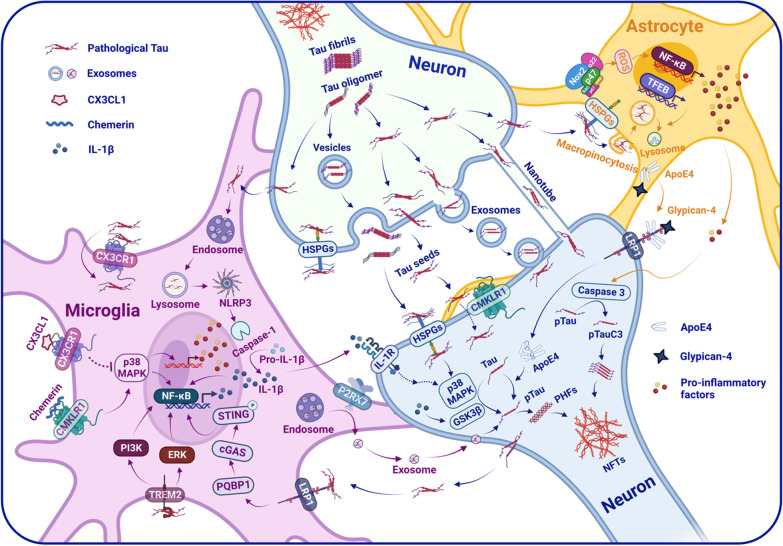
“Deletion of CX3CR1 or depression of the CX3CL1/CX3CR1 axis reduces Aβ deposition [130–132] but exacerbates tau pathology, such as increased phosphorylation and aggregation of tau, and this is associated with worsened behavioral and cognitive impairments [132–137] (Fig. 1).”
§ Tau and neuroinflammation in Alzheimer’s disease: interplay mechanisms and clinical translation > Neuroinflammation: a link between tau and AD > Role of neuroinflammation in post-transcriptional modifications of tau
What the sources say
- Not checked yetcites [130] Liu Z, Condello C, Schain A, Harb R, Grutzendler J. CX3CR1 in microglia regulates brain amyloid deposition through selective protofibrillar amyloid-beta phagocytosis. J Neurosci. 2010;30:17091–101. source
- Not checked yetcites [131] Lee S, Varvel NH, Konerth ME, Xu G, Cardona AE, Ransohoff RM, Lamb BT. CX3CR1 deficiency alters microglial activation and reduces beta-amyloid deposition in two Alzheimer’s disease mouse models. Am J Pathol. 2010;177:2549–62. source
- Not checked yetcites [132] Puntambekar SS, Moutinho M, Lin PBC, Jadhav V, Tumbleson-Brink D, Balaji A, Benito MA, Xu GX, Oblak A, Lasagna-Reeves CA, et al. CX3CR1 deficiency aggravates amyloid driven neuronal pathology and cognitive decline in Alzheimer’s disease. Mol Neurodegener. 2022;17:21. source
- Not checked yetcites [133] Lee S, Xu G, Jay TR, Bhatta S, Kim KW, Jung S, Landreth GE, Ransohoff RM, Lamb BT. Opposing effects of membrane-anchored CX3CL1 on amyloid and tau pathologies via the p38 MAPK pathway. J Neurosci. 2014;34:12538–46. source
- Not checked yetcites [134] Fuhrmann M, Bittner T, Jung CK, Burgold S, Page RM, Mitteregger G, Haass C, LaFerla FM, Kretzschmar H, Herms J. Microglial Cx3cr1 knockout prevents neuron loss in a mouse model of Alzheimer’s disease. Nat Neurosci. 2010;13:411–3. source
- Not checked yetcites [135] Maphis N, Xu G, Kokiko-Cochran ON, Jiang S, Cardona A, Ransohoff RM, Lamb BT, Bhaskar K. Reactive microglia drive tau pathology and contribute to the spreading of pathological tau in the brain. Brain. 2015;138:1738–55. source
- Not checked yetcites [136] Fan Q, He W, Gayen M, Benoit MR, Luo X, Hu X, Yan R. Activated CX3CL1/Smad2 signals prevent neuronal loss and alzheimer’s tau pathology-mediated cognitive dysfunction. J Neurosci. 2020;40:1133–44. source
- Not checked yetcites [137] Bhaskar K, Konerth M, Kokiko-Cochran ON, Cardona A, Ransohoff RM, Lamb BT. Regulation of Tau Pathology by the Microglial Fractalkine Receptor. Neuron. 2010;68:19–31. source
plaindirect- Asserted: passes — The authors put it forward as true.
- Checkable: passes — It can be checked against evidence.
- Load-bearing: passes — The paper’s conclusions depend on it.
- Based: passes — The paper gives a reason why it holds.
It may state two separate claims as one.
A conclusion the paper draws from its own results — it cites no other source for it, so there is none to check. The quote shows it is in the paper.
In the paper
“These findings reveal a pivotal role in the cell-to-cell spreading of abnormal tau in neurotoxicity and provide potential therapeutic strategies for tau-targeted immunotherapies in AD and other tauopathies.”
§ Tau and neuroinflammation in Alzheimer’s disease: interplay mechanisms and clinical translation > Mechanisms of tau-mediated neurodegeneration > Propagation of tau pathology
boosteddirect- Asserted: passes — The authors put it forward as true.
- Checkable: passes — It can be checked against evidence.
- Load-bearing: passes — The paper’s conclusions depend on it.
- Based: passes — The paper gives a reason why it holds.
It may state two separate claims as one.
None of the sources cited for this claim have been checked yet.
In the paper
“In the CSF of AD patients, the R47H (rs75932628) variant of TREM2 or soluble TREM2 has been found to correlate with total or phosphorylated tau (Thr181), respectively, but not with Aβ42 [124, 125].”
§ Tau and neuroinflammation in Alzheimer’s disease: interplay mechanisms and clinical translation > Neuroinflammation: a link between tau and AD > Role of neuroinflammation in post-transcriptional modifications of tau
What the sources say
- Not checked yetcites [124] Lill CM, Rengmark A, Pihlstrom L, Fogh I, Shatunov A, Sleiman PM, Wang LS, Liu T, Lassen CF, Meissner E, et al. The role of TREM2 R47H as a risk factor for Alzheimer’s disease, frontotemporal lobar degeneration, amyotrophic lateral sclerosis, and Parkinson’s disease. Alzheimers Dement. 2015;11:1407–16. source
- Not checked yetcites [125] Piccio L, Deming Y, Del-Aguila JL, Ghezzi L, Holtzman DM, Fagan AM, Fenoglio C, Galimberti D, Borroni B, Cruchaga C. Cerebrospinal fluid soluble TREM2 is higher in Alzheimer disease and associated with mutation status. Acta Neuropathol. 2016;131:925–33. source
plaincorrelational- Asserted: passes — The authors put it forward as true.
- Checkable: passes — It can be checked against evidence.
- Load-bearing: passes — The paper’s conclusions depend on it.
- Based: passes — The paper gives a reason why it holds.
It may state two separate claims as one.
In the paper
“Astrocytes are the most abundant glial cells in the brain and have a variety of complex and essential functions in CNS, including maintenance of brain homeostasis, synaptic transmission, and information processing through neural circuits [94].”
§ Tau and neuroinflammation in Alzheimer’s disease: interplay mechanisms and clinical translation > Neuroinflammation: a link between tau and AD
What the sources say
- Not checked yetcites [94] Sofroniew MV, Vinters HV. Astrocytes: biology and pathology. Acta Neuropathol. 2010;119:7–35. source
plain- Asserted: passes — The authors put it forward as true.
- Checkable: passes — It can be checked against evidence.
- Load-bearing: fails — The paper’s conclusions may not depend on it.
- Based: passes — The paper gives a reason why it holds.
Probably not a substantial claim. The paper’s conclusions may not depend on it. It may state two separate claims as one.
None of the sources cited for this claim have been checked yet.
In the paper
“TREM2, a pivotal risk factor for LOAD [119, 120], is associated with tau pathology.”
§ Tau and neuroinflammation in Alzheimer’s disease: interplay mechanisms and clinical translation > Neuroinflammation: a link between tau and AD > Role of neuroinflammation in post-transcriptional modifications of tau
What the sources say
- Not checked yetcites [119] Jonsson T, Stefansson H, Steinberg S, Jonsdottir I, Jonsson PV, Snaedal J, Bjornsson S, Huttenlocher J, Levey AI, Lah JJ, et al. Variant of TREM2 associated with the risk of Alzheimer’s disease. N Engl J Med. 2013;368:107–16. source
- Not checked yetcites [120] Guerreiro R, Wojtas A, Bras J, Carrasquillo M, Rogaeva E, Majounie E, Cruchaga C, Sassi C, Kauwe JS, Younkin S, et al. TREM2 variants in Alzheimer’s disease. N Engl J Med. 2013;368:117–27. source
plaincorrelational- Asserted: passes — The authors put it forward as true.
- Checkable: passes — It can be checked against evidence.
- Load-bearing: passes — The paper’s conclusions depend on it.
- Based: passes — The paper gives a reason why it holds.
It may state two separate claims as one.
In the paper
“Microglia are the resident immune cells of the brain and play a pivotal role in the immune defense of CNS.”
§ Tau and neuroinflammation in Alzheimer’s disease: interplay mechanisms and clinical translation > Neuroinflammation: a link between tau and AD
What the sources say
- Not checked yetcites [86] Nimmerjahn A, Kirchhoff F, Helmchen F. Resting microglial cells are highly dynamic surveillants of brain parenchyma in vivo. Science. 2005;308:1314–8. source
plain- Asserted: passes — The authors put it forward as true.
- Checkable: passes — It can be checked against evidence.
- Load-bearing: fails — The paper’s conclusions may not depend on it.
- Based: passes — The paper gives a reason why it holds.
Probably not a substantial claim. The paper’s conclusions may not depend on it. It may state two separate claims as one.
None of the sources cited for this claim have been checked yet.
In the paper
“Astrocytes become activated in AD and exhibit certain immune functions.”
§ Tau and neuroinflammation in Alzheimer’s disease: interplay mechanisms and clinical translation > Neuroinflammation: a link between tau and AD
What the sources say
- Not checked yetcites [95] Carrero I, Gonzalo MR, Martin B, Sanz-Anquela JM, Arevalo-Serrano J, Gonzalo-Ruiz A. Oligomers of beta-amyloid protein (A beta 1–42) induce the activation of cyclooxygenase-2 in astrocytes via an interaction with interleukin-1beta, tumour necrosis factor-alpha, and a nuclear factor kappa-B mechanism in the rat brain. Exp Neurol. 2012;236:215–27. source
- Not checked yetcites [96] Garwood CJ, Pooler AM, Atherton J, Hanger DP, Noble W. Astrocytes are important mediators of Abeta-induced neurotoxicity and tau phosphorylation in primary culture. Cell Death Dis. 2011;2: e167. source
plain- Asserted: passes — The authors put it forward as true.
- Checkable: passes — It can be checked against evidence.
- Load-bearing: passes — The paper’s conclusions depend on it.
- Based: passes — The paper gives a reason why it holds.
It may state two separate claims as one.
None of the sources cited for this claim have been checked yet.
In the paper
“Our and other studies found that systemic administration of lipopolysaccharide (LPS, inducer of inflammation) leads to microglial activation in the mouse brain, which results in tau hyperphosphorylation at specific sites [117, 118].”
§ Tau and neuroinflammation in Alzheimer’s disease: interplay mechanisms and clinical translation > Neuroinflammation: a link between tau and AD > Role of neuroinflammation in post-transcriptional modifications of tau
What the sources say
- Not checked yetcites [117] Liu J, Wang D, Li SQ, Yu Y, Ye RD. Suppression of LPS-induced tau hyperphosphorylation by serum amyloid A. J Neuroinflammation. 2016;13:15. source
- Not checked yetcites [118] Kitazawa M, Oddo S, Yamasaki TR, Green KN, LaFerla FM. Lipopolysaccharide-induced inflammation exacerbates tau pathology by a cyclin-dependent kinase 5-mediated pathway in a transgenic model of Alzheimer’s disease. J Neurosci. 2005;25:8843–53. source
plaindirect- Asserted: passes — The authors put it forward as true.
- Checkable: passes — It can be checked against evidence.
- Load-bearing: passes — The paper’s conclusions depend on it.
- Based: passes — The paper gives a reason why it holds.
It may state two separate claims as one.
None of the sources cited for this claim have been checked yet.
In the paper
“Deficiency of FPR2 or administration of its inhibitors/anti-inflammatory ligands could alleviate the pathological symptoms of AD, including reduced activation of glial cells (microglia and/or astrocytes) and tau hyperphosphorylation, and ultimately leading to improvement in cognitive function [151–154].”
§ Tau and neuroinflammation in Alzheimer’s disease: interplay mechanisms and clinical translation > Neuroinflammation: a link between tau and AD > Role of neuroinflammation in post-transcriptional modifications of tau
What the sources say
- Not checked yetcites [151] Medeiros R, Kitazawa M, Passos GF, Baglietto-Vargas D, Cheng D, Cribbs DH, LaFerla FM. Aspirin-triggered lipoxin A4 stimulates alternative activation of microglia and reduces Alzheimer disease-like pathology in mice. Am J Pathol. 2013;182:1780–9. source
- Not checked yetcites [152] Zhang H, Wang D, Gong P, Lin A, Zhang Y, Ye RD, Yu Y. Formyl peptide receptor 2 deficiency improves cognition and attenuates tau hyperphosphorylation and astrogliosis in a mouse model of Alzheimer’s disease. J Alzheimers Dis. 2019;67:169–79. source
- Not checked yetcites [153] Schroder N, Schaffrath A, Welter JA, Putzka T, Griep A, Ziegler P, Brandt E, Samer S, Heneka MT, Kaddatz H, et al. Inhibition of formyl peptide receptors improves the outcome in a mouse model of Alzheimer disease. J Neuroinflammation. 2020;17:131. source
- Not checked yetcites [154] Trojan E, Tylek K, Schroder N, Kahl I, Brandenburg LO, Mastromarino M, Leopoldo M, Basta-Kaim A, Lacivita E. The N-formyl peptide receptor 2 (FPR2) agonist MR-39 improves ex vivo and in vivo amyloid beta (1–42)-induced neuroinflammation in mouse models of Alzheimer’s disease. Mol Neurobiol. 2021;58:6203–21. source
hedgeddirect- Asserted: passes — The authors put it forward as true.
- Checkable: passes — It can be checked against evidence.
- Load-bearing: passes — The paper’s conclusions depend on it.
- Based: passes — The paper gives a reason why it holds.
It may state two separate claims as one.
- Rests on an assumption: Findings from transgenic mouse models of tau pathology and neuroinflammation are representative of human AD and can guide therapeutic development.
None of the sources cited for this claim have been checked yet.
In the paper
“Interestingly, the R47H variant of TREM2, which is expressed by microglia and linked to innate immunity, has been found to present an altered glycosylation pattern and decreased stability compared with wild-type TREM2 [176], indicating a potential link between microglial neuroinflammation and glycosylation [177, 178].”
§ Tau and neuroinflammation in Alzheimer’s disease: interplay mechanisms and clinical translation > Neuroinflammation: a link between tau and AD > Role of neuroinflammation in post-transcriptional modifications of tau
What the sources say
- Not checked yetcites [176] Park JS, Ji IJ, Kim DH, An HJ, Yoon SY. The Alzheimer’s disease-associated R47H variant of TREM2 has an altered glycosylation pattern and protein stability. Front Neurosci. 2016;10:618.
- Not checked yetcites [177] Haukedal H, Freude KK. Implications of glycosylation in Alzheimer’s disease. Front Neurosci. 2021;14:18. source
- Not checked yetcites [178] Rebelo AL, Chevalier MT, Russo L, Pandit A. Role and therapeutic implications of protein glycosylation in neuroinflammation. Trends Mol Med. 2022;28:270–89. source
plaincorrelational- Asserted: passes — The authors put it forward as true.
- Checkable: passes — It can be checked against evidence.
- Load-bearing: unclear — It is unclear whether the paper’s conclusions depend on it.
- Based: passes — The paper gives a reason why it holds.
It may state two separate claims as one.
In the paper
“Increases in tau O-GlcNAcylation inhibit tau aggregates and neuronal cell loss [174], indicating that O-GlcNAcylation modification can protect AD progression.”
§ Tau and neuroinflammation in Alzheimer’s disease: interplay mechanisms and clinical translation > Neuroinflammation: a link between tau and AD > Role of neuroinflammation in post-transcriptional modifications of tau
What the sources say
- Not checked yetcites [174] Yuzwa SA, Shan X, Macauley MS, Clark T, Skorobogatko Y, Vosseller K, Vocadlo DJ. Increasing O-GlcNAc slows neurodegeneration and stabilizes tau against aggregation. Nat Chem Biol. 2012;8:393–9. source
plaindirect- Asserted: passes — The authors put it forward as true.
- Checkable: passes — It can be checked against evidence.
- Load-bearing: unclear — It is unclear whether the paper’s conclusions depend on it.
- Based: passes — The paper gives a reason why it holds.
It may state two separate claims as one.
In the paper
“Overexpression of SAA by intracerebral injection attenuates tau hyperphosphorylation, and the mechanism is related to SAA-induced secretion of IL-10 from microglia [117].”
§ Tau and neuroinflammation in Alzheimer’s disease: interplay mechanisms and clinical translation > Neuroinflammation: a link between tau and AD > Role of neuroinflammation in post-transcriptional modifications of tau
What the sources say
- Not checked yetcites [117] Liu J, Wang D, Li SQ, Yu Y, Ye RD. Suppression of LPS-induced tau hyperphosphorylation by serum amyloid A. J Neuroinflammation. 2016;13:15. source
plaindirect- Asserted: passes — The authors put it forward as true.
- Checkable: passes — It can be checked against evidence.
- Load-bearing: unclear — It is unclear whether the paper’s conclusions depend on it.
- Based: passes — The paper gives a reason why it holds.
It may state two separate claims as one.
None of the sources cited for this claim have been checked yet.
In the paper
“The expression and activity of p300 are increased in the brain of AD patients [179], and the dysregulation of p300/CBP promotes tau acetylation, which could aggravate tau accumulation and pathology [46, 48].”
§ Tau and neuroinflammation in Alzheimer’s disease: interplay mechanisms and clinical translation > Neuroinflammation: a link between tau and AD > Role of neuroinflammation in post-transcriptional modifications of tau
What the sources say
- Not checked yetcites [179] Aubry S, Shin W, Crary JF, Lefort R, Qureshi YH, Lefebvre C, Califano A, Shelanski ML. Assembly and interrogation of Alzheimer’s disease genetic networks reveal novel regulators of progression. PLoS ONE. 2015;10: e0120352. source
- Not checked yetcites [46] Min SW, Cho SH, Zhou YG, Schroeder S, Haroutunian V, Seeley WW, Huang EJ, Shen Y, Masliah E, Mukherjee C, et al. Acetylation of tau inhibits its degradation and contributes to tauopathy. Neuron. 2010;67:953–66. source
- Not checked yetcites [48] Min SW, Chen X, Tracy TE, Li YQ, Zhou YG, Wang C, Shirakawa K, Minami SS, Defensor E, Mok SA, et al. Critical role of acetylation in tau-mediated neurodegeneration and cognitive deficits. Nat Med. 2015;21:1154. source
hedgeddirect- Asserted: passes — The authors put it forward as true.
- Checkable: passes — It can be checked against evidence.
- Load-bearing: passes — The paper’s conclusions depend on it.
- Based: passes — The paper gives a reason why it holds.
It may state two separate claims as one.
In the paper
“NLRP3 inflammasome has been proven to accumulate inside microglia upon activation, promoting cleavage and activity of caspase-1 and release of IL-1β [160].”
§ Tau and neuroinflammation in Alzheimer’s disease: interplay mechanisms and clinical translation > Neuroinflammation: a link between tau and AD > Role of neuroinflammation in post-transcriptional modifications of tau
What the sources say
- Not checked yetcites [160] Heneka MT, McManus RM, Latz E. Inflammasome signalling in brain function and neurodegenerative disease. Nat Rev Neurosci. 2018;19:610–21. source
boosteddirect- Asserted: passes — The authors put it forward as true.
- Checkable: passes — It can be checked against evidence.
- Load-bearing: passes — The paper’s conclusions depend on it.
- Based: passes — The paper gives a reason why it holds.
It may state two separate claims as one.
In the paper
“Abnormal acetylation of tau on lysine residues spans the microtubule-binding repeat region (MTBR), and this modification alone is sufficient to induce tau pathology and neurodegeneration [51].”
§ Tau and neuroinflammation in Alzheimer’s disease: interplay mechanisms and clinical translation > Neuroinflammation: a link between tau and AD > Role of neuroinflammation in post-transcriptional modifications of tau
What the sources say
- Not checked yetcites [51] Shin M-K, Vazquez-Rosa E, Koh Y, Dhar M, Chaubey K, Cintron-Perez CJ, Barker S, Miller E, Franke K, Noterman MF, et al. Reducing acetylated tau is neuroprotective in brain injury. Cell. 2021;184:2715–32. source
plaindirect- Asserted: passes — The authors put it forward as true.
- Checkable: passes — It can be checked against evidence.
- Load-bearing: unclear — It is unclear whether the paper’s conclusions depend on it.
- Based: passes — The paper gives a reason why it holds.
It may state two separate claims as one.
In the paper
“Another study demonstrates that IL-10 deletion activates microglia, increases IL-6 production, and leads to tau hyperphosphorylation in response to acute systemic inflammation [165].”
§ Tau and neuroinflammation in Alzheimer’s disease: interplay mechanisms and clinical translation > Neuroinflammation: a link between tau and AD > Role of neuroinflammation in post-transcriptional modifications of tau
What the sources say
- Not checked yetcites [165] Weston LL, Jiang S, Chisholm D, Jantzie LL, Bhaskar K. Interleukin-10 deficiency exacerbates inflammation-induced tau pathology. J Neuroinflammation. 2021;18:161. source
boosteddirect- Asserted: passes — The authors put it forward as true.
- Checkable: passes — It can be checked against evidence.
- Load-bearing: unclear — It is unclear whether the paper’s conclusions depend on it.
- Based: passes — The paper gives a reason why it holds.
It may state two separate claims as one.
In the paper
“Cohen et al. reported that tau is a substrate of HDAC6, and the inhibition of HDAC6 increases tau acetylation [47].”
§ Tau and neuroinflammation in Alzheimer’s disease: interplay mechanisms and clinical translation > Neuroinflammation: a link between tau and AD > Role of neuroinflammation in post-transcriptional modifications of tau
What the sources say
- Not checked yetcites [47] Cohen TJ, Guo JL, Hurtado DE, Kwong LK, Mills IP, Trojanowski JQ, Lee VMY. The acetylation of tau inhibits its function and promotes pathological tau aggregation. Nat Commun. 2011;2:9. source
plaindirect- Asserted: passes — The authors put it forward as true.
- Checkable: passes — It can be checked against evidence.
- Load-bearing: unclear — It is unclear whether the paper’s conclusions depend on it.
- Based: passes — The paper gives a reason why it holds.
It may state two separate claims as one.
In the paper
“Our recent study identified that CMKLR1 deletion increases Aβ plaques in the AD mouse brain but reduces mortality and cognitive deficits of AD mice and attenuates tau hyperphosphorylation [14].”
§ Tau and neuroinflammation in Alzheimer’s disease: interplay mechanisms and clinical translation > Neuroinflammation: a link between tau and AD > Role of neuroinflammation in post-transcriptional modifications of tau
What the sources say
- Not checked yetcites [14] Zhang HB, Lin AH, Gong P, Chen YQ, Ye RD, Qian F, Zhang Y, Yu Y. The chemokine-like receptor 1 deficiency improves cognitive deficits of AD mice and attenuates tau hyperphosphorylation via regulating tau seeding. J Neurosci. 2020;40:6991–7007. source
plaindirect- Asserted: passes — The authors put it forward as true.
- Checkable: passes — It can be checked against evidence.
- Load-bearing: passes — The paper’s conclusions depend on it.
- Based: passes — The paper gives a reason why it holds.
It may state two separate claims as one.
- Rests on an assumption: Findings from transgenic mouse models of tau pathology and neuroinflammation are representative of human AD and can guide therapeutic development.
In the paper
“The expression of p47phox in neurons contributes to tau hyperphosphorylation directly, while p47phox in astrocytes affects tau hyperphosphorylation by activating astrocytes indirectly [13].”
§ Tau and neuroinflammation in Alzheimer’s disease: interplay mechanisms and clinical translation > Neuroinflammation: a link between tau and AD > Role of neuroinflammation in post-transcriptional modifications of tau
What the sources say
- Not checked yetcites [13] Gong P, Chen YQ, Lin AH, Zhang HB, Zhang Y, Ye RD, Yu Y. p47(phox) deficiency improves cognitive impairment and attenuates tau hyperphosphorylation in mouse models of AD. Alzheimers Res Ther. 2020;12:18. source
plaindirect- Asserted: passes — The authors put it forward as true.
- Checkable: passes — It can be checked against evidence.
- Load-bearing: unclear — It is unclear whether the paper’s conclusions depend on it.
- Based: passes — The paper gives a reason why it holds.
It may state two separate claims as one.
None of the sources cited for this claim have been checked yet.
In the paper
“In addition, tau also undergoes both N-linked glycosylation (N-glycosylation) [171] and O-linked N-acetylglucosaminylation (O-GlcNAcylation) [172], which have been proposed to affect tau phosphorylation and aggregation [173].”
§ Tau and neuroinflammation in Alzheimer’s disease: interplay mechanisms and clinical translation > Neuroinflammation: a link between tau and AD > Role of neuroinflammation in post-transcriptional modifications of tau
What the sources say
- Not checked yetcites [171] Losev Y, Frenkel-Pinter M, Abu-Hussien M, Viswanathan GK, Elyashiv-Revivo D, Geries R, Khalaila I, Gazit E, Segal D. Differential effects of putative N-glycosylation sites in human Tau on Alzheimer’s disease-related neurodegeneration. Cell Mol Life Sci. 2021;78:2231–45. source
- Not checked yetcites [172] Zhu YP, Shan XY, Yuzwa SA, Vocadlo DJ. The emerging link between O-GlcNAc and Alzheimer disease. J Biol Chem. 2014;289:34472–81. source
- Not checked yetcites [173] Losev Y, Paul A, Frenkel-Pinter M, Abu-Hussein M, Khalaila I, Gazit E, Segal D. Novel model of secreted human tau protein reveals the impact of the abnormal N-glycosylation of tau on its aggregation propensity. Sci Rep. 2019;9:10. source
hedgedconditional- Asserted: passes — The authors put it forward as true.
- Checkable: passes — It can be checked against evidence.
- Load-bearing: unclear — It is unclear whether the paper’s conclusions depend on it.
- Based: passes — The paper gives a reason why it holds.
It may state two separate claims as one.
In the paper
“Inhibiting p300 with salsalate, a non-steroidal anti-inflammatory drug, could induce tau deacetylation, preserve tau axonal localization, and protect mice from neurodegeneration [51].”
§ Tau and neuroinflammation in Alzheimer’s disease: interplay mechanisms and clinical translation > Neuroinflammation: a link between tau and AD > Role of neuroinflammation in post-transcriptional modifications of tau
What the sources say
- Not checked yetcites [51] Shin M-K, Vazquez-Rosa E, Koh Y, Dhar M, Chaubey K, Cintron-Perez CJ, Barker S, Miller E, Franke K, Noterman MF, et al. Reducing acetylated tau is neuroprotective in brain injury. Cell. 2021;184:2715–32. source
hedgedconditional- Asserted: passes — The authors put it forward as true.
- Checkable: passes — It can be checked against evidence.
- Load-bearing: passes — The paper’s conclusions depend on it.
- Based: passes — The paper gives a reason why it holds.
It may state two separate claims as one.
In the paper
“Selective suppression of p38α MAPK significantly reduces tau hyperphosphorylation and improves working memory in hTau mice [164].”
§ Tau and neuroinflammation in Alzheimer’s disease: interplay mechanisms and clinical translation > Neuroinflammation: a link between tau and AD > Role of neuroinflammation in post-transcriptional modifications of tau
What the sources say
- Not checked yetcites [164] Maphis N, Jiang SY, Xu GX, Kokiko-Cochran ON, Roy SM, Van Eldik LJ, Watterson DM, Lamb BT, Bhaskar K. Selective suppression of the alpha isoform of p38 MAPK rescues late-stage tau pathology. Alzheimers Res Ther. 2016;8:54. source
plaindirect- Asserted: passes — The authors put it forward as true.
- Checkable: passes — It can be checked against evidence.
- Load-bearing: unclear — It is unclear whether the paper’s conclusions depend on it.
- Based: passes — The paper gives a reason why it holds.
It may state two separate claims as one.
In the paper
“However, another study revealed that TREM2 knockout or its R47H variant decreases microgliosis around Aβ plaques and enhances the propagation of tau aggregates [70].”
§ Tau and neuroinflammation in Alzheimer’s disease: interplay mechanisms and clinical translation > Neuroinflammation: a link between tau and AD > Role of neuroinflammation in the propagation of tau
What the sources say
- Not checked yetcites [70] Leyns CEG, Gratuze M, Narasimhan S, Jain N, Koscal LJ, Jiang H, Manis M, Colonna M, Lee VMY, Ulrich JD, Holtzman DM. TREM2 function impedes tau seeding in neuritic plaques. Nat Neurosci. 2019;22:1217. source
plaindirect- Asserted: passes — The authors put it forward as true.
- Checkable: passes — It can be checked against evidence.
- Load-bearing: unclear — It is unclear whether the paper’s conclusions depend on it.
- Based: passes — The paper gives a reason why it holds.
It may state two separate claims as one.
None of the sources cited for this claim have been checked yet.
In the paper
“However, with the failures or unsatisfactory efficacy of drugs anti-Aβ [9, 208–211], the development of drugs targeting other targets is increasing, such as anti-tau pathology and anti-neuroinflammation [212].”
§ Tau and neuroinflammation in Alzheimer’s disease: interplay mechanisms and clinical translation > Advances in AD drug development focused on tau pathology and neuroinflammation
What the sources say
- Not checked yetcites [9] Mullard A. FDA approval for Biogen’s aducanumab sparks Alzheimer disease firestorm. Nat Rev Drug Discov. 2021;20:496–496.
- Not checked yetcites [208] Doody RS, Raman R, Farlow M, Iwatsubo T, Vellas B, Joffe S, Kieburtz K, He F, Sun XY, Thomas RG, et al. A phase 3 trial of semagacestat for treatment of Alzheimer’s disease. N Engl J Med. 2013;369:341–50. source
- Not checked yetcites [209] Jeremic D, Jimenez-Diaz L, Navarro-Lopez JD. Past, present and future of therapeutic strategies against amyloid-beta peptides in Alzheimer’s disease: a systematic review. Ageing Res Rev. 2021;72:36. source
- Not checked yetcites [210] Salloway S, Chalkias S, Barkhof F, Burkett P, Barakos J, Purcell D, Suhy J, Forrestal F, Tian Y, Umans K, et al. Amyloid-related imaging abnormalities in 2 phase 3 studies evaluating aducanumab in patients with early Alzheimer disease. JAMA Neurol. 2022;79:13–21. source
- Not checked yetcites [211] Mahase E. Aducanumab: European agency rejects Alzheimer’s drug over efficacy and safety concerns. BMJ. 2021;375:1.
- Not checked yetcites [212] Cummings J, Lee G, Nahed P, Kambar M, Zhong K, Fonseca J, Taghva K. Alzheimer’s disease drug development pipeline: 2022. Alzheimers Dement. 2022;8:24.
plaindirect- Asserted: passes — The authors put it forward as true.
- Checkable: passes — It can be checked against evidence.
- Load-bearing: passes — The paper’s conclusions depend on it.
- Based: passes — The paper gives a reason why it holds.
It may state two separate claims as one.
In the paper
“Overexpression of transcription factor EB (TFEB, a regulator of lysosomal biogenesis) in astrocytes promotes tau fibril species uptake and lysosomal activity as well as attenuates tau spreading and pathology in the hippocampus of P301S tauopathy mice [201] (Fig. 1).”
§ Tau and neuroinflammation in Alzheimer’s disease: interplay mechanisms and clinical translation > Neuroinflammation: a link between tau and AD > Role of neuroinflammation in the propagation of tau
What the sources say
- Not checked yetcites [201] Martini-Stoica H, Cole AL, Swartzlander DB, Chen F, Wan YW, Bajaj L, Bader DA, Lee VMY, Trojanowski JQ, Liu ZD, et al. TFEB enhances astroglial uptake of extracellular tau species and reduces tau spreading. J Exp Med. 2018;215:2355–77. source
plaindirect- Asserted: passes — The authors put it forward as true.
- Checkable: passes — It can be checked against evidence.
- Load-bearing: unclear — It is unclear whether the paper’s conclusions depend on it.
- Based: passes — The paper gives a reason why it holds.
It may state two separate claims as one.
In the paper
“Administration of NLRP3 inhibitor or ASC deficiency reduces the exogenously or non-exogenously seeded tau pathology, highlighting the promotion of NLRP3/ASC axis activation on the propagation of tau seeds [186].”
§ Tau and neuroinflammation in Alzheimer’s disease: interplay mechanisms and clinical translation > Neuroinflammation: a link between tau and AD > Role of neuroinflammation in the propagation of tau
What the sources say
- Not checked yetcites [186] Stancu I-C, Cremers N, Vanrusselt H, Couturier J, Vanoosthuyse A, Kessels S, Lodder C, Brone B, Huaux F, Octave J-N, et al. Aggregated Tau activates NLRP3-ASC inflammasome exacerbating exogenously seeded and non-exogenously seeded Tau pathology in vivo. Acta Neuropathol. 2019;137:599–617. source
plaindirect- Asserted: passes — The authors put it forward as true.
- Checkable: passes — It can be checked against evidence.
- Load-bearing: passes — The paper’s conclusions depend on it.
- Based: passes — The paper gives a reason why it holds.
It may state two separate claims as one.
In the paper
“Tau can bind to microglial CX3CR1 and initiate the internalization and degradation of tau [191].”
§ Tau and neuroinflammation in Alzheimer’s disease: interplay mechanisms and clinical translation > Neuroinflammation: a link between tau and AD > Role of neuroinflammation in the propagation of tau
What the sources say
- Not checked yetcites [191] Castro-Sanchez S, Garcia-Yague AJ, Kugler S, Lastres-Becker I. CX3CR1-deficient microglia shows impaired signalling of the transcription factor NRF2: Implications in tauopathies. Redox Biol. 2019;22:12. source
plaindirect- Asserted: passes — The authors put it forward as true.
- Checkable: passes — It can be checked against evidence.
- Load-bearing: passes — The paper’s conclusions depend on it.
- Based: passes — The paper gives a reason why it holds.
It may state two separate claims as one.
None of the sources cited for this claim have been checked yet.
In the paper
“In addition, several studies have shown that tau seeds taken up by microglia can activate microglia, further exacerbating tau propagation and pathology [186, 192, 193].”
§ Tau and neuroinflammation in Alzheimer’s disease: interplay mechanisms and clinical translation > Neuroinflammation: a link between tau and AD > Role of neuroinflammation in the propagation of tau
What the sources say
- Not checked yetcites [186] Stancu I-C, Cremers N, Vanrusselt H, Couturier J, Vanoosthuyse A, Kessels S, Lodder C, Brone B, Huaux F, Octave J-N, et al. Aggregated Tau activates NLRP3-ASC inflammasome exacerbating exogenously seeded and non-exogenously seeded Tau pathology in vivo. Acta Neuropathol. 2019;137:599–617. source
- Not checked yetcites [192] Jin MH, Shiwaku H, Tanaka H, Obita T, Ohuchi S, Yoshioka Y, Jin XC, Kondo K, Fujita K, Homma H, et al. Tau activates microglia via the PQBP1-cGAS-STING pathway to promote brain inflammation. Nat Commun. 2021;12:22. source
- Not checked yetcites [193] Wang C, Fan L, Khawaja RR, Liu BY, Zhan LH, Kodama L, Chin M, Li YQ, Le D, Zhou YG, et al. Microglial NF-kappa B drives tau spreading and toxicity in a mouse model of tauopathy. Nat Commun. 2022;13:19. source
plaindirect- Asserted: passes — The authors put it forward as true.
- Checkable: passes — It can be checked against evidence.
- Load-bearing: passes — The paper’s conclusions depend on it.
- Based: passes — The paper gives a reason why it holds.
It may state two separate claims as one.
In the paper
“Suppression of P2X purinoceptor 7 (P2RX7)-induced exosome secretion from microglia attenuates misfolded tau aggregates in the hippocampus and improves cognitive deficits of P301S mice [195].”
§ Tau and neuroinflammation in Alzheimer’s disease: interplay mechanisms and clinical translation > Neuroinflammation: a link between tau and AD > Role of neuroinflammation in the propagation of tau
What the sources say
- Not checked yetcites [195] Ruan Z, Delpech JC, Venkatesan Kalavai S, Van Enoo AA, Hu J, Ikezu S, Ikezu T. P2RX7 inhibitor suppresses exosome secretion and disease phenotype in P301S tau transgenic mice. Mol Neurodegener. 2020;15:47. source
plaindirect- Asserted: passes — The authors put it forward as true.
- Checkable: passes — It can be checked against evidence.
- Load-bearing: unclear — It is unclear whether the paper’s conclusions depend on it.
- Based: passes — The paper gives a reason why it holds.
It may state two separate claims as one.
In the paper
“The integrin αV/β1 receptor interacts with tau monomers or fibrils and mediates tau uptake in primary astrocytes.”
§ Tau and neuroinflammation in Alzheimer’s disease: interplay mechanisms and clinical translation > Neuroinflammation: a link between tau and AD > Role of neuroinflammation in the propagation of tau
What the sources say
- Not checked yetcites [203] Wang P, Ye YH. Filamentous recombinant human Tau activates primary astrocytes via an integrin receptor complex. Nat Commun. 2021;12:95. source
plaindirect- Asserted: passes — The authors put it forward as true.
- Checkable: passes — It can be checked against evidence.
- Load-bearing: unclear — It is unclear whether the paper’s conclusions depend on it.
- Based: passes — The paper gives a reason why it holds.
It may state two separate claims as one.
None of the sources cited for this claim have been checked yet.
In the paper
“Inhibitors of the O-GlcNAcase enzyme (OGA)-like thiamet G increase tau glycosylation, reduce NFTs and neuronal cell death, improve motor behavior, and prolong survival of tau transgenic mice [174, 220, 221].”
§ Tau and neuroinflammation in Alzheimer’s disease: interplay mechanisms and clinical translation > Advances in AD drug development focused on tau pathology and neuroinflammation > Mediators of tau post-translational modifications
What the sources say
- Not checked yetcites [174] Yuzwa SA, Shan X, Macauley MS, Clark T, Skorobogatko Y, Vosseller K, Vocadlo DJ. Increasing O-GlcNAc slows neurodegeneration and stabilizes tau against aggregation. Nat Chem Biol. 2012;8:393–9. source
- Not checked yetcites [220] Hastings NB, Wang X, Song L, Butts BD, Grotz D, Hargreaves R, Fred Hess J, Hong KK, Huang CR, Hyde L, et al. Inhibition of O-GlcNAcase leads to elevation of O-GlcNAc tau and reduction of tauopathy and cerebrospinal fluid tau in rTg4510 mice. Mol Neurodegener. 2017;12:39. source
- Not checked yetcites [221] Permanne B, Sand A, Ousson S, Neny M, Hantson J, Schubert R, Wiessner C, Quattropani A, Beher D. O-GlcNAcase inhibitor ASN90 is a multimodal drug candidate for tau and alpha-synuclein proteinopathies. ACS Chem Neurosci. 2022;13:1296–314. source
plaindirect- Asserted: passes — The authors put it forward as true.
- Checkable: passes — It can be checked against evidence.
- Load-bearing: passes — The paper’s conclusions depend on it.
- Based: passes — The paper gives a reason why it holds.
It may state two separate claims as one.
None of the sources cited for this claim have been checked yet.
In the paper
“These cholinesterase inhibitors and NMDA receptor antagonist memantine only temporarily relieve the symptoms of AD patients but do not delay the progression of the disease [206, 207].”
§ Tau and neuroinflammation in Alzheimer’s disease: interplay mechanisms and clinical translation > Advances in AD drug development focused on tau pathology and neuroinflammation
What the sources say
- Not checked yetcites [206] Sharma K. Cholinesterase inhibitors as Alzheimer’s therapeutics. Mol Med Rep. 2019;20:1479–87.
- Not checked yetcites [207] Kumar A, Singh A. Ekavali: a review on Alzheimer’s disease pathophysiology and its management: an update. Pharmacol Rep. 2015;67:195–203. source
plain- Asserted: passes — The authors put it forward as true.
- Checkable: passes — It can be checked against evidence.
- Load-bearing: passes — The paper’s conclusions depend on it.
- Based: passes — The paper gives a reason why it holds.
It may state two separate claims as one.
In the paper
“Various kinases are known to induce tau hyperphosphorylation, such as GSK-3β, a major tau kinase. These kinases are hyperactivated during the progression of AD and other tauopathies [19], indicating that the development of their mediators may be an effective treatment for these diseases.”
§ Tau and neuroinflammation in Alzheimer’s disease: interplay mechanisms and clinical translation > Advances in AD drug development focused on tau pathology and neuroinflammation > Mediators of tau post-translational modifications
What the sources say
- Not checked yetcites [19] Guo T, Noble W, Hanger DP. Roles of tau protein in health and disease. Acta Neuropathol. 2017;133:665–704. source
boosteddirect- Asserted: passes — The authors put it forward as true.
- Checkable: passes — It can be checked against evidence.
- Load-bearing: passes — The paper’s conclusions depend on it.
- Based: passes — The paper gives a reason why it holds.
It may state two separate claims as one.
None of the sources cited for this claim have been checked yet.
In the paper
“As mentioned above, p38α MAPK is a key kinase involved in microglia-induced neuroinflammation leading to tau pathology [135, 137], and this kinase can also directly regulate tau phosphorylation [39].”
§ Tau and neuroinflammation in Alzheimer’s disease: interplay mechanisms and clinical translation > Advances in AD drug development focused on tau pathology and neuroinflammation > Therapeutically targeting tau through modulating neuroinflammation
What the sources say
- Not checked yetcites [135] Maphis N, Xu G, Kokiko-Cochran ON, Jiang S, Cardona A, Ransohoff RM, Lamb BT, Bhaskar K. Reactive microglia drive tau pathology and contribute to the spreading of pathological tau in the brain. Brain. 2015;138:1738–55. source
- Not checked yetcites [137] Bhaskar K, Konerth M, Kokiko-Cochran ON, Cardona A, Ransohoff RM, Lamb BT. Regulation of Tau Pathology by the Microglial Fractalkine Receptor. Neuron. 2010;68:19–31. source
- Not checked yetcites [39] Stefanoska K, Gajwani M, Tan ARP, Ahel HI, Asih PR, Volkerling A, Poljak A, Ittner A. Alzheimer’s disease: ablating single master site abolishes tau hyperphosphorylation. Sci Adv. 2022. https://doi.org/10.1126/sciadv.abl8809. source
plaindirect- Asserted: passes — The authors put it forward as true.
- Checkable: passes — It can be checked against evidence.
- Load-bearing: passes — The paper’s conclusions depend on it.
- Based: passes — The paper gives a reason why it holds.
It may state two separate claims as one.
None of the sources cited for this claim have been checked yet.
In the paper
“Tideglusib has been reported to reduce tau phosphorylation and has anti-inflammatory effects in animal models [216, 217].”
§ Tau and neuroinflammation in Alzheimer’s disease: interplay mechanisms and clinical translation > Advances in AD drug development focused on tau pathology and neuroinflammation > Mediators of tau post-translational modifications
What the sources say
- Not checked yetcites [216] Sereno L, Coma M, Rodriguez M, Sanchez-Ferrer P, Sanchez MB, Gich I, Agullo JM, Perez M, Avila J, Guardia-Laguarta C, et al. A novel GSK-3beta inhibitor reduces Alzheimer’s pathology and rescues neuronal loss in vivo. Neurobiol Dis. 2009;35:359–67. source
- Not checked yetcites [217] Wang H, Huang S, Yan K, Fang X, Abussaud A, Martinez A, Sun HS, Feng ZP. Tideglusib, a chemical inhibitor of GSK3beta, attenuates hypoxic-ischemic brain injury in neonatal mice. Biochim Biophys Acta. 2016;1860:2076–85. source
hedgeddirect- Asserted: passes — The authors put it forward as true.
- Checkable: passes — It can be checked against evidence.
- Load-bearing: unclear — It is unclear whether the paper’s conclusions depend on it.
- Based: passes — The paper gives a reason why it holds.
It may state two separate claims as one.
In the paper
“The binding of tau fibrils to astrocyte αV/β1 activates integrin signaling, resulting in NF-κB activation, leading to an increase of pro-inflammatory cytokines and chemokines, and induction of expression of neurotoxic astrocytic markers [203].”
§ Tau and neuroinflammation in Alzheimer’s disease: interplay mechanisms and clinical translation > Neuroinflammation: a link between tau and AD > Role of neuroinflammation in the propagation of tau
What the sources say
- Not checked yetcites [203] Wang P, Ye YH. Filamentous recombinant human Tau activates primary astrocytes via an integrin receptor complex. Nat Commun. 2021;12:95. source
plaindirect- Asserted: passes — The authors put it forward as true.
- Checkable: passes — It can be checked against evidence.
- Load-bearing: passes — The paper’s conclusions depend on it.
- Based: passes — The paper gives a reason why it holds.
It may state two separate claims as one.
In the paper
“However, the treatment of this vaccine did not slow cognitive and functional decline in mild AD patients in the phase 2 clinical trial (ADAMANT, NCT02579252), although it shows the high immunogenicity [227].”
§ Tau and neuroinflammation in Alzheimer’s disease: interplay mechanisms and clinical translation > Advances in AD drug development focused on tau pathology and neuroinflammation > Anti-tau immunotherapy
What the sources say
- Not checked yetcites [227] Novak P, Kovacech B, Katina S, Schmidt R, Scheltens P, Kontsekova E, Ropele S, Fialova L, Kramberger M, Paulenka-Ivanovova N, et al. ADAMANT: a placebo-controlled randomized phase 2 study of AADvac1, an active immunotherapy against pathological tau in Alzheimer’s disease. Nature aging. 2021;1:521–34. source
plain- Asserted: passes — The authors put it forward as true.
- Checkable: passes — It can be checked against evidence.
- Load-bearing: unclear — It is unclear whether the paper’s conclusions depend on it.
- Based: passes — The paper gives a reason why it holds.
It may state two separate claims as one.
A conclusion the paper draws from its own results — it cites no other source for it, so there is none to check. The quote shows it is in the paper.
In the paper
“These findings suggest that phagocytized tau by astrocytes can be degraded and/or induce astrocytic activation.”
§ Tau and neuroinflammation in Alzheimer’s disease: interplay mechanisms and clinical translation > Neuroinflammation: a link between tau and AD > Role of neuroinflammation in the propagation of tau
hedgedconditional- Asserted: passes — The authors put it forward as true.
- Checkable: passes — It can be checked against evidence.
- Load-bearing: passes — The paper’s conclusions depend on it.
- Based: passes — The paper gives a reason why it holds.
It may state two separate claims as one.
In the paper
“Jin et al. reported that microglia uptake exogenous monomeric tau in parallel via two surface receptors, LRP1 and TREM2, and then induce nuclear factor NF-κB activation in microglia through two different pathways, LRP1/polyglutamine binding protein 1 (PQBP1)/cyclic GMP–AMP synthase (cGAS)/Stimulator of interferon genes (STING) and TREM2/extracellular signal-regulated kinase (ERK)/Phosphoinositide”
§ Tau and neuroinflammation in Alzheimer’s disease: interplay mechanisms and clinical translation > Neuroinflammation: a link between tau and AD > Role of neuroinflammation in the propagation of tau
What the sources say
- Not checked yetcites [192] Jin MH, Shiwaku H, Tanaka H, Obita T, Ohuchi S, Yoshioka Y, Jin XC, Kondo K, Fujita K, Homma H, et al. Tau activates microglia via the PQBP1-cGAS-STING pathway to promote brain inflammation. Nat Commun. 2021;12:22. source
plaindirect- Asserted: passes — The authors put it forward as true.
- Checkable: passes — It can be checked against evidence.
- Load-bearing: passes — The paper’s conclusions depend on it.
- Based: passes — The paper gives a reason why it holds.
It may state two separate claims as one.
The paper states this without a source or data behind it here, so there is nothing to check it against. The quote shows it is in the paper.
In the paper
“The most likely reason for the failure of drugs targeting Aβ may be that Aβ pathology in AD does not always correlate with cognitive decline.”
§ Tau and neuroinflammation in Alzheimer’s disease: interplay mechanisms and clinical translation > Conclusions and perspectives
hedgedcorrelational- Asserted: passes — The authors put it forward as true.
- Checkable: passes — It can be checked against evidence.
- Load-bearing: passes — The paper’s conclusions depend on it.
- Based: fails — The paper may give no reason why it holds.
Probably not a substantial claim. The paper may give no reason why it holds.
None of the sources cited for this claim have been checked yet.
In the paper
“This drug combination eliminates the senescent cells (also known as “senolytic therapy”), reduces tau pathology, amyloid load, and neuroinflammation, and ameliorates cognitive impairment in preclinical studies [256, 257].”
§ Tau and neuroinflammation in Alzheimer’s disease: interplay mechanisms and clinical translation > Advances in AD drug development focused on tau pathology and neuroinflammation > Therapeutically targeting tau through modulating neuroinflammation
What the sources say
- Not checked yetcites [256] Zhang P, Kishimoto Y, Grammatikakis I, Gottimukkala K, Cutler RG, Zhang S, Abdelmohsen K, Bohr VA, Misra Sen J, Gorospe M, Mattson MP. Senolytic therapy alleviates Abeta-associated oligodendrocyte progenitor cell senescence and cognitive deficits in an Alzheimer’s disease model. Nat Neurosci. 2019;22:719–28. source
- Not checked yetcites [257] Musi N, Valentine JM, Sickora KR, Baeuerle E, Thompson CS, Shen Q, Orr ME. Tau protein aggregation is associated with cellular senescence in the brain. Aging Cell. 2018;17: e12840. source
plaindirect- Asserted: passes — The authors put it forward as true.
- Checkable: passes — It can be checked against evidence.
- Load-bearing: passes — The paper’s conclusions depend on it.
- Based: passes — The paper gives a reason why it holds.
It may state two separate claims as one.
The paper states this without a source or data behind it here, so there is nothing to check it against. The quote shows it is in the paper.
In the paper
“Accumulating evidence indicates that neuroinflammation may be the third pathological feature of AD and plays an integral role in AD pathogenesis and the promotion of cognitive impairment.”
§ Tau and neuroinflammation in Alzheimer’s disease: interplay mechanisms and clinical translation > Conclusions and perspectives
hedgedconditional- Asserted: passes — The authors put it forward as true.
- Checkable: passes — It can be checked against evidence.
- Load-bearing: passes — The paper’s conclusions depend on it.
- Based: passes — The paper gives a reason why it holds.
It may state two separate claims as one.
A conclusion the paper draws from its own results — it cites no other source for it, so there is none to check. The quote shows it is in the paper.
In the paper
“While in the middle and late stages of AD, sustained and increased inflammatory responses in glial cells and neurons are pivotal cellular drivers and regulators of the exacerbation of tau pathology, further contributing to its worsening by promoting inflammatory responses.”
§ Tau and neuroinflammation in Alzheimer’s disease: interplay mechanisms and clinical translation > Conclusions and perspectives
plaindirect- Asserted: passes — The authors put it forward as true.
- Checkable: passes — It can be checked against evidence.
- Load-bearing: passes — The paper’s conclusions depend on it.
- Based: passes — The paper gives a reason why it holds.
It may state two separate claims as one.
A conclusion the paper draws from its own results — it cites no other source for it, so there is none to check. The quote shows it is in the paper.
In the paper
“However, the efficacy of these drugs is controversial and needs further validation.”
§ Tau and neuroinflammation in Alzheimer’s disease: interplay mechanisms and clinical translation > Conclusions and perspectives
plain- Asserted: passes — The authors put it forward as true.
- Checkable: passes — It can be checked against evidence.
- Load-bearing: passes — The paper’s conclusions depend on it.
- Based: passes — The paper gives a reason why it holds.
It may state two separate claims as one.
- Rests on an assumption: Two DMT drugs targeting Aβ have recently received accelerated FDA approval for AD treatment.
In the paper
“A phase 2 clinical trial in 37 patients with mild to moderate AD (NCT02947893) showed that nilotinib was well-tolerated and reduced CSF pTau181 at 6 months compared to the placebo group [251].”
§ Tau and neuroinflammation in Alzheimer’s disease: interplay mechanisms and clinical translation > Advances in AD drug development focused on tau pathology and neuroinflammation > Therapeutically targeting tau through modulating neuroinflammation
What the sources say
- Not checked yetcites [251] Turner RS, Hebron ML, Lawler A, Mundel EE, Yusuf N, Starr JN, Anjum M, Pagan F, Torres-Yaghi Y, Shi WK, et al. Nilotinib effects on safety, tolerability, and biomarkers in Alzheimer’s disease. Ann Neurol. 2020;88:183–94. source
plaindirectn = 37- Asserted: passes — The authors put it forward as true.
- Checkable: passes — It can be checked against evidence.
- Load-bearing: unclear — It is unclear whether the paper’s conclusions depend on it.
- Based: passes — The paper gives a reason why it holds.
It may state two separate claims as one.
A conclusion the paper draws from its own results — it cites no other source for it, so there is none to check. The quote shows it is in the paper.
In the paper
“The most likely reason for the failure of drugs targeting Aβ may be that Aβ pathology in AD does not always correlate with cognitive decline.”
§ Tau and neuroinflammation in Alzheimer’s disease: interplay mechanisms and clinical translation > Conclusions and perspectives
hedgedconditional- Asserted: passes — The authors put it forward as true.
- Checkable: passes — It can be checked against evidence.
- Load-bearing: passes — The paper’s conclusions depend on it.
- Based: fails — The paper may give no reason why it holds.
Probably not a substantial claim. The paper may give no reason why it holds.
In the paper
“A multi-center phase 2 clinical trial showed that although a 24-week treatment with neflamapimod did not ameliorate episodic memory in individuals with mild AD, neflamapimod treatment significantly reduces CSF total tau and tau phosphorylated at threonine 181 (pTau181) compared to the placebo group (NCT03402659).”
§ Tau and neuroinflammation in Alzheimer’s disease: interplay mechanisms and clinical translation > Advances in AD drug development focused on tau pathology and neuroinflammation > Therapeutically targeting tau through modulating neuroinflammation
What the sources say
- Not checked yetcites NCT03402659
plaindirect- Asserted: passes — The authors put it forward as true.
- Checkable: passes — It can be checked against evidence.
- Load-bearing: passes — The paper’s conclusions depend on it.
- Based: passes — The paper gives a reason why it holds.
It may state two separate claims as one.
The paper relies on this without support.
Findings from transgenic mouse models of tau pathology and neuroinflammation are representative of human AD and can guide therapeutic development.
“TREM2 deficiency in a hTau (expressing human MAPT but not endogenous mouse Mapt) mouse model exacerbates tau phosphorylation and aggregation at the early disease stage [126].”
The paper relies on this without support.
The failure of NSAID clinical trials to improve cognition in AD patients is due to the disease stages of recruited patients rather than to inflammation not being a valid therapeutic target.
“The outcomes of clinical trials may be related to the disease stages of recruited AD patients.”
The paper relies on this without support.
Nearly all anti-Aβ drugs have failed to show satisfactory therapeutic efficacy in the past two decades.
“However, nearly, all anti-Aβ drugs have failed to show satisfactory therapeutic efficacy in the past two decades.”
The paper relies on this without support.
Two DMT drugs targeting Aβ have recently received accelerated FDA approval for AD treatment.
“It is particularly encouraging that two DMT drugs targeting Aβ have recently received accelerated FDA approval for AD treatment.”
The paper relies on this without support.
To date, there are no tau-focused drugs approved by FDA.
“To date, there are no tau-focused drugs approved by FDA.”
The paper relies on this without support.
Several agents targeting tau post-translational modification and dissemination have recently entered clinical trials for treating AD and other tauopathies.
“Still, several agents targeting tau post-translational modification and dissemination have recently entered clinical trials for treating AD and other tauopathies.”
The paper relies on this without support.
These therapeutic strategies have shown good safety and tolerability.
“These therapeutic strategies have shown good safety and tolerability, and clinical trials of their therapeutic effects are underway.”
The paper relies on this without support.
Clinical trials of the therapeutic effects of these strategies are underway.
“These therapeutic strategies have shown good safety and tolerability, and clinical trials of their therapeutic effects are underway.”
Claims other papers make about this one
Each is checked against this paper’s own text: does it say what the citing paper says it does?
The source backs part of the claim, not all of it — or backs it for a different population, condition or comparison.
In the citing paper
“These oligomers form earlier than NFTs and impair synaptic plasticity, disrupt membrane integrity, and propagate toxicity between neurons [44, 45].”
From Toward a Unified Framework in Molecular Neurobiology of Alzheimer’s Disease: Revisiting the Pathophysiological Hypotheses (2026) · cites this paper as [45]
Experimental — accuracy not yet measuredThe source backs part of the claim, not all of it — or backs it for a different population, condition or comparison.
In the citing paper
“while phosphatases such as protein phosphatase (PP1, PP2A, and PP2B) promote tau dephosphorylation [45].”
From Toward a Unified Framework in Molecular Neurobiology of Alzheimer’s Disease: Revisiting the Pathophysiological Hypotheses (2026) · cites this paper as [45]
Experimental — accuracy not yet measuredThe source backs part of the claim, not all of it — or backs it for a different population, condition or comparison.
In the citing paper
“Activation of microglia and astrocytes is a common feature of AD and other tauopathies (Di Benedetto, Burgaletto et al. 2022, Chen and Yu 2023, Deng, Wu et al. 2024)”
From SORLA up-regulation suppresses pathological effects in aged tauopathy mouse brain (2026) · cites this paper as Chen and Yu 2023
Experimental — accuracy not yet measuredThe cited source says what the claim attributes to it.
In the citing paper
“While NFTs have long been viewed as toxic end-stage aggregates, increasing evidence suggests that soluble tau oligomers are the primary neurotoxic species.”
From Toward a Unified Framework in Molecular Neurobiology of Alzheimer’s Disease: Revisiting the Pathophysiological Hypotheses (2026) · cites this paper as [45]
In the citing paper
“A growing body of evidence suggests that inflammation has an intricate relationship with tau pathology that contributes to AD pathology and cognitive decline. 103”
From Senescence, brain inflammation, and oligomeric tau drive cognitive decline in Alzheimer's disease: Evidence from clinical and preclinical studies (2024) · cites this paper as [103]
In the citing paper
“In animal models, case in point, antibodies that bind selectively to phosphorylated tau have shown promise in lowering tau pathology.”
From Recent Advances in Therapeutics for the Treatment of Alzheimer’s Disease (2024) · cites this paper as [98]
In the citing paper
“But a lot of these methods have had difficulties in the clinic, frequently because of problems with toxicity or ineffectiveness [95,98].”
From Recent Advances in Therapeutics for the Treatment of Alzheimer’s Disease (2024) · cites this paper as [98]
Self-check
Percentages, sums and reported differences re-computed from the paper’s own numbers.
Each contradiction between two passages listed here was confirmed by an independent check.
Rated minor: it would not touch a result — a value no result rests on, a p-value that stays on the same side of the significance level, or a conflict that is clerical, resolved elsewhere in the paper, or outside its own findings.
In the paper
§ Tau and neuroinflammation in Alzheimer’s disease: interplay mechanisms and clinical translation > Advances in AD drug development focused on tau pathology and neuroinflammation > Therapeutically targeting tau through modulating neuroinflammation
“One phase 2 trial is ongoing to evaluate the safety, tolerability, pharmacokinetics, and effect of AZP2006 in patients with PSP (NCT04008355).”
§ Tau and neuroinflammation in Alzheimer’s disease: interplay mechanisms and clinical translation > Advances in AD drug development focused on tau pathology and neuroinflammation > Tau pathology as a therapeutic target
“| AZP2006 | Tau, Inflammation | The neurotrophic factor progranulin enhancer | Phase 2a | Completed;(NCT04008355) | AlzProtect SAS | No results reported |”
Citations
Cites
1 retracted
Dementia prevention, intervention, and care: 2020 report of the Lancet Commission
Livingston, G., Huntley, J., Sommerlad, A., Ames, D., Ballard, C., Banerjee, S., Brayne, C., Burns, A., Cohen-Mansfield, J., Cooper, C., et al. (2020) · The Lancet · doi:10.1016/s0140-6736(20)30367-6 · Cited by 10,430 · cited 1×
“Background Dementia is currently one of the leading causes of disability and dependency among the elderly [1].”
BackgroundRetractedAmyloid oligomers exacerbate tau pathology in a mouse model of tauopathy
Selenica, M.-L. B., Brownlow, M., Jimenez, J. P., Lee, D. C., Pena, G., Dickey, C. A., Gordon, M. N., & Morgan, D. (2013) · Neurodegenerative Diseases · doi:10.1159/000337230 · Cited by 10,359
Glutamate neurotoxicity and diseases of the nervous system
Choi, D. W. (1988) · Neuron · doi:10.1016/0896-6273(88)90162-6 · Cited by 8,188
Neuroinflammation in Alzheimer's disease
Heneka, M. T., Carson, M. J., Khoury, J. E., Landreth, G. E., Brosseron, F., Feinstein, D. L., Jacobs, A. H., Wyss-Coray, T., Vitorica, J., Ransohoff, R. M., et al. (2015) · The Lancet Neurology · doi:10.1016/s1474-4422(15)70016-5 · Cited by 6,226 · cited 1×
“Furthermore, since the immune response exists throughout the pathological progress of AD [104, 105], suggesting that it may also participate in and aggravate the disease development.”
BackgroundResting microglial cells are highly dynamic surveillants of brain parenchyma in vivo
Nimmerjahn, A., Kirchhoff, F., & Helmchen, F. (2005) · Science · doi:10.1126/science.1110647 · Cited by 5,827 · cited 1×
“They are in an inactive “resting” state under physiological conditions while actively monitoring the brain environment and brain parenchyma with highly motile processes [86].”
BackgroundLecanemab in early Alzheimer's disease
van Dyck, C. H., Swanson, C. J., Aisen, P., Bateman, R. J., Chen, C., Gee, M., Kanekiyo, M., Li, D., Reyderman, L., Cohen, S., et al. (2023) · New England Journal of Medicine · doi:10.1056/nejmoa2212948 · Cited by 5,678
A Unique Microglia Type Associated with Restricting Development of Alzheimer’s Disease
Keren-Shaul, H., Spinrad, A., Weiner, A., Matcovitch-Natan, O., Dvir-Szternfeld, R., Ulland, T. K., David, E., Baruch, K., Lara-Astaiso, D., Toth, B., et al. (2017) · Cell · doi:10.1016/j.cell.2017.05.018 · Cited by 5,493 · cited 1×
“This may be related to the different types of microglia [194].”
BackgroundAstrocytes: Biology and pathology
Sofroniew, M. V., & Vinters, H. V. (2010) · Acta Neuropathologica · doi:10.1007/s00401-009-0619-8 · Cited by 5,196 · cited 1×
“and essential functions in CNS, including maintenance of brain homeostasis, synaptic transmission, and information processing through neural circuits [94].”
BackgroundAssociation of missense and 5′-splice-site mutations in tau with the inherited dementia FTDP-17
Hutton, M., Lendon, C. L., Rizzu, P., Baker, M., Froelich, S., Houlden, H., Pickering-Brown, S., Chakraverty, S., Isaacs, A., Grover, A., et al. (1998) · Nature · doi:10.1038/31508 · Cited by 3,498
Neuroinflammation and microglial activation in Alzheimer disease: where do we go from here?
Leng, F., & Edison, P. (2021) · Nature Reviews Neurology · doi:10.1038/s41582-020-00435-y · Cited by 3,179
Research works printed but not linked: 2
- Tai H-C, Ma H-T, Huang S-C, Wu M-F, Wu C-L, Lai Y-T, Li Z-L, Margolin R, Intorcia AJ, Serrano GE, et al. The tau oligomer antibody APNmAb005 detects early-stage pathological tau enriched at synapses and rescues neuronal loss in long-term treatments. BioRxiv. 2022. https://doi.org/10.1101/2022.06.24.497452v1. · DOI
- Jordan. K, Mahdavi. K, Haroon. J, Rindner. E, Zielinski. M, Venkatraman. V, Becerra. S, Goodenowe. D, Ahlem. C, Reading. C, et al: Neuroimaging data from a phase 2, open-label study of ne3107 in patients with cognitive decline due to degenerative dementias. In: Clinical Trials on Alzheimer’s Disease (CTAD) Conference; November 29–December 2; San Francisco, California, USA. 2022
Cited by
Sorted by citations
Cyclin-dependent protein kinases and cell cycle regulation in biology and disease
Pellarin, I., Dall’Acqua, A., Favero, A., Segatto, I., Rossi, V., Crestan, N., Karimbayli, J., Belletti, B., & Baldassarre, G. (2025) · Signal Transduction and Targeted Therapy · doi:10.1038/s41392-024-02080-z · Cited by 381
Tong, B., Ba, Y., Li, Z., Yang, C., Su, K., Qi, H., Zhang, D., Liu, X., Wu, Y., Chen, Y., et al. (2024) · Neurobiology of Disease · doi:10.1016/j.nbd.2024.106505 · Cited by 117
Self-citationGaikwad, S., Senapati, S., Haque, M. A., & Kayed, R. (2024) · Alzheimer's & Dementia · doi:10.1002/alz.13490 · Cited by 117
“103 Importantly, treatment with ibuprofen, a nons-teroidalanti-inflammatorydrug,markedlyreducesbraininflammation, senescent cell load and improves cognitive function.”
BackgroundTargeting Cytokine-Mediated Inflammation in Brain Disorders: Developing New Treatment Strategies
Mallick, R., Basak, S., Chowdhury, P., Bhowmik, P., Das, R. K., Banerjee, A., Paul, S., Pathak, S., & Duttaroy, A. K. (2025) · Pharmaceuticals · doi:10.3390/ph18010104 · Cited by 108
Kamila, P., Kar, K., Chowdhury, S., Chakraborty, P., Dutta, R., S, S., Singh S, A., & Prajapati, B. G. (2025) · IBRO Neuroscience Reports · doi:10.1016/j.ibneur.2025.05.005 · Cited by 90
Yang, J., Liang, J., Hu, N., He, N., Liu, B., Liu, G., & Qin, Y. (2024) · CNS Neuroscience & Therapeutics · doi:10.1111/cns.70091 · Cited by 109
“It also catalyzes the aberrant phosphorylation and aggregation of tau [60].”
BackgroundHe, S., Xu, Z., & Han, X. (2025) · Molecular Neurodegeneration · doi:10.1186/s13024-025-00803-6 · Cited by 62
“These inflammatory processes can increase the activity of tau phosphatases and kinases, leading to abnormal tau hyperphosphorylation [296–299].”
Zhao, Z., Zhang, J., Wu, Y., Xie, M., Tao, S., Lv, Q., & Wang, Q. (2024) · Brain Behavior and Immunity · doi:10.1016/j.bbi.2024.06.014 · Cited by 58
Naringenin ameliorates amyloid-β pathology and neuroinflammation in Alzheimer’s disease
Zhu, Y., Guo, X., Li, S., Wu, Y., Zhu, F., Qin, C., Zhang, Q., & Yang, Y. (2024) · Communications Biology · doi:10.1038/s42003-024-06615-6 · Cited by 64
Xu, J., & Lu, Y. (2025) · Frontiers in Microbiology · doi:10.3389/fmicb.2025.1583562 · Cited by 68
Li, H., Cai, R., Zhou, Y., Jiang, Y., & Tan, S. (2025) · Journal of Neuroinflammation · doi:10.1186/s12974-025-03563-8 · Cited by 72
“Particularly in the early stages of AD, patients’ brains exhibit significant chronic neuroinflammatory responses, and this inflammation can exacerbate Aβ deposition and tau protein hyperphosphorylation [21, 22].”
Recent Advances in Therapeutics for the Treatment of Alzheimer’s Disease
Thawabteh, A. M., Ghanem, A. W., AbuMadi, S., Thaher, D., Jaghama, W., Karaman, D., & Karaman, R. (2024) · Molecules · doi:10.3390/molecules29215131 · Cited by 56
“But a lot of these methods have had difficulties in the clinic, frequently because of problems with toxicity or ineffectiveness [95,98].”
BackgroundStereo-seq of the prefrontal cortex in aging and Alzheimer’s disease
Gong, Y., Haeri, M., Zhang, X., Li, Y., Liu, A., Wu, D., Zhang, Q., Jazwinski, S. M., Zhou, X., Wang, X., et al. (2025) · Nature Communications · doi:10.1038/s41467-024-54715-y · Cited by 52
Self-citationThe impact of physical exercise on neuroinflammation mechanism in Alzheimer’s disease
Hu, J., Huang, B., & Chen, K. (2024) · Frontiers in Aging Neuroscience · doi:10.3389/fnagi.2024.1444716 · Cited by 55
Hein, Z. M., Karikalan, B., Gopalakrishna, P. K., Dhevi, K., Alkatiri, A., Hussan, F., Mohd Moklas, M. A., Jagadeesan, S., Che Ramli, M. D., Che Mohd Nassir, C. M. N., et al. (2026) · Molecular Neurobiology · doi:10.1007/s12035-025-05602-0 · Cited by 43
Inflammasomes in neurodegenerative diseases
Wang, Q., Yang, S., Zhang, X., Zhang, S., Chen, L., Wang, W., Chen, N., & Yan, J. (2024) · Translational Neurodegeneration · doi:10.1186/s40035-024-00459-0 · Cited by 47
“This process leads to inflammasome activation and subsequent induction of neuro-inflammation [56].”
Wahl, D., Risen, S. J., Osburn, S. C., Emge, T., Sharma, S., Gilberto, V. S., Chatterjee, A., Nagpal, P., Moreno, J. A., & LaRocca, T. J. (2024) · Journal of Neuroinflammation · doi:10.1186/s12974-024-03182-9 · Cited by 41
“Beyond specific cytokine pathways, neuroinflammation is linked with protein pathology (including tau accumulation) and glial cell dysregulation in aging and AD [4, 80–82].”
Choe, U. (2025) · Journal of Functional Foods · doi:10.1016/j.jff.2025.106870 · Cited by 48
Huang, J., Wu, F., Cao, W., Chen, Y., Yao, Q., Cen, P., Wang, J., Lu, H., Zhang, X. H., Zhou, R., et al. (2024) · Biomaterials · doi:10.1016/j.biomaterials.2024.123042 · Cited by 41
Self-citationDetka, J., Płachtij, N., Strzelec, M., Manik, A., & Sałat, K. (2024) · Molecules · doi:10.3390/molecules29184354 · Cited by 40
“Other p38 α MAPK inhibitors, such as MW150, showed good safety and tolerability in phase 1 clinical trials (NCT04120233, NCT02942771) [140], but these studies suggested some risk for elevated liver enzymes.”
BackgroundThe Molecular Mechanisms of Cognitive Dysfunction in Long COVID: A Narrative Review
Popa, E., Popa, A. E., Poroch, M., Poroch, V., Ungureanu, M. I., Slănină, A. M., Bacușcă, A. I., & Coman, A. E. (2025) · International Journal of Molecular Sciences · doi:10.3390/ijms26115102 · Cited by 45
“In AD, cerebrovascular dysfunction impairs the clearance of amyloid-β and tau, thereby exacerbating neuronal injury [56,107,108,157].”
Singh, N., Nandy, S. K., Jyoti, A., Saxena, J., Sharma, A., Siddiqui, A. J., & Sharma, L. K. (2024) · Brain Sciences · doi:10.3390/brainsci14060554 · Cited by 35
Glial reactivity correlates with synaptic dysfunction across aging and Alzheimer’s disease
Rohden, F., Ferreira, P. C. L., Bellaver, B., Ferrari‐Souza, J. P., Aguzzoli, C. S., Soares, C., Abbas, S., Zalzale, H., Povala, G., Lussier, F. Z., et al. (2025) · Nature Communications · doi:10.1038/s41467-025-60806-1 · Cited by 43
GSK-3β dysregulation in aging: Implications for tau pathology and Alzheimer's disease progression
Rekha, A., Afzal, M., Babu, M. A., Menon, S. V., Nathiya, D., Supriya, S., Mishra, S. B., Gupta, S., Goyal, K., Rana, M., et al. (2025) · Molecular and Cellular Neuroscience · doi:10.1016/j.mcn.2025.104005 · Cited by 34
Loss of TMEM106B exacerbates Tau pathology and neurodegeneration in PS19 mice
Feng, T., Du, H., Yang, C., Wang, Y., & Hu, F. (2024) · Acta Neuropathologica · doi:10.1007/s00401-024-02702-4 · Cited by 22
SERS-Based Optical Nanobiosensors for the Detection of Alzheimer’s Disease
Gao, F., Li, F., Wang, J., Yu, H., Li, X., Chen, H., Wang, J., Qin, D., Li, Y., Liu, S., et al. (2023) · Biosensors · doi:10.3390/bios13090880 · Cited by 31
Junyi, L., Yueyang, W., Liu, B., Xiaohong, D., Wenhui, C., Zhang, N., & Zhang, H. (2024) · Molecular Neurobiology · doi:10.1007/s12035-024-04513-w · Cited by 32
Early-stage Alzheimer’s disease profiling in blood achieved by multiplexing aptamer-SERS biosensors
Muhammad, M., Liu, C., Ge, Y., Shao, C., Xiong, L., Xia, H., Iqbal, J., Zhan, J., Qu, F., & Huang, Q. (2024) · Biosensors and Bioelectronics · doi:10.1016/j.bios.2024.116907 · Cited by 28
Targeting Abnormal Tau Phosphorylation for Alzheimer’s Therapeutics
Singh, A., Ansari, V. A., Mahmood, T., Hasan, S. S., Wasim, R., Maheshwari, S., Akhtar, J., Sheikh, S., & Vishwakarma, V. K. (2024) · Hormone and Metabolic Research · doi:10.1055/a-2238-1384 · Cited by 29
“…served on human AD-derived tau oligomers and PHFs. Interesting - ly, DiY cross-links can facilitate the formation of non-toxic, soluble tau oligomers, inhibit the formation of β-sheets and further exten - sion of prefibrils, and increase the insolubility and stability of tau fibrils in AD [51–54].”
BackgroundZhuang, X., Jie, L., Song, Y., Ban, R., Zhao, X., Xia, Z., Wang, Z., & Zhang, G. (2024) · NeuroMolecular Medicine · doi:10.1007/s12017-024-08815-z · Cited by 33
“Concurrently, inflammation, particularly neuroinflammation, is closely associated with AD pathology and cognitive deficits (Chen & Yu, 2023; Novoa et al., 2022).”
Ghimire, A., Rehman, S. A., Subhani, A., Khan, M. A., Rahman, Z., Iqubal, M. K., & Iqubal, A. (2025) · hLife · doi:10.1016/j.hlife.2024.11.006 · Cited by 32
Zhao, W., Liu, Z., Wu, J., Liu, A., & Yan, J. (2025) · Neural Regeneration Research · doi:10.4103/nrr.nrr-d-24-01343 · Cited by 37
“This process could create a vicious cycle, further exacerbating neurodegeneration (Chen and Yu, 2023).”
Navigating the dementia landscape: Biomarkers and emerging therapies
Maheshwari, S., Singh, A., Ansari, V. A., Mahmood, T., Wasim, R., Akhtar, J., & Verma, A. (2024) · Ageing Research Reviews · doi:10.1016/j.arr.2024.102193 · Cited by 30
Huang, G., Liu, Y., Zhu, X., He, L., & Chen, T. (2025) · Exploration · doi:10.1002/exp.20240415 · Cited by 28
“This would result in the formation of neurofibrillary tangles (NFTs) and the subsequent disruption of normal neuronal and synaptic functions [95].”
Jaye, S., Sandau, U. S., & Saugstad, J. A. (2024) · Frontiers in Aging Neuroscience · doi:10.3389/fnagi.2024.1378576 · Cited by 26
“How microglia contribute to Tau pathology is reviewed in depth elsewhere (Das et al., 2020; Ayyubova, 2023; Chen and Yu, 2023; Ou-Yang et al., 2023”
Jiang, Z., Wang, J., Qin, Y., Liu, S., Luo, B., Bai, F., Wei, H., Zhang, S., Wei, J., Ding, G., et al. (2024) · Alzheimer s Research & Therapy · doi:10.1186/s13195-024-01392-0 · Cited by 32
Self-citationHu, B., Zhang, J., Huang, J., Luo, B., Zeng, X., & Jia, J. (2023) · Neural Regeneration Research · doi:10.4103/1673-5374.391311 · Cited by 27
“Aβ deposits and hyperphosphorylated tau protein can induce neuroinflammation and is associated with cognitive impairment in AD (Leng and Edison, 2021; Chen and Yu, 2023) and contribute to its pathogenesis (Huang et al., 2017; de Brito Toscano et al., 2021).”
BackgroundTREM2 in Neurodegenerative Disorders: Mutation Spectrum, Pathophysiology, and Therapeutic Targeting
Yang, H.-W., Kim, D., Yang, Y., Bagyinszky, E., & An, S. S. A. (2025) · International Journal of Molecular Sciences · doi:10.3390/ijms26157057 · Cited by 26
“These inflammatory mediators can lead to synaptic dysfunctions, excitotoxicity, and oxidative stress-related damage, resulting in decreased neuronal function and loss of nerve cells [90,91].”
Molecular mechanisms and biomarkers in neurodegenerative disorders: a comprehensive review
Ali, N., Sayeed, U., Shahid, S. M. A., Akhtar, S., & Khan, M. K. A. (2025) · Molecular Biology Reports · doi:10.1007/s11033-025-10463-w · Cited by 26
Fatima, G., Ashiquzzaman, A., Kim, S. S., Kim, Y. R., Kwon, H.-S., & Chung, E. (2025) · Neurobiology of Disease · doi:10.1016/j.nbd.2025.106877 · Cited by 26
Boyton, I., Valenzuela, S. M., Collins‐Praino, L. E., & Care, A. (2023) · Brain Behavior and Immunity · doi:10.1016/j.bbi.2023.11.004 · Cited by 23
Ge, T.-Q., Guan, P.-P., & Wang, P. (2024) · Neuroscience & Biobehavioral Reviews · doi:10.1016/j.neubiorev.2024.105868 · Cited by 28
Ren, J., Wang, Q., Hong, H., & Tang, C. (2025) · Microorganisms · doi:10.3390/microorganisms13081956 · Cited by 28
“Transferring the GM from WT mice to AD mice reversed the increases of Firmicutes and Prevotella and the decreases of Bacteroides and Akkermansia [115].”
New Insights into the Role of SGLT-2 Inhibitors in the Prevention of Dementia
Hung, C., & Lu, L. (2024) · Neurology International · doi:10.3390/neurolint16060124 · Cited by 23
Linkage of circadian rhythm disruptions with Alzheimer's disease and therapeutic interventions
Madhamanchi, K., Zhang, J., & Melkani, G. C. (2025) · Acta Pharmaceutica Sinica B · doi:10.1016/j.apsb.2025.04.011 · Cited by 31
Zhang, N., Nao, J., & Dong, X. (2023) · Journal of Agricultural and Food Chemistry · doi:10.1021/acs.jafc.3c06672 · Cited by 23
Protein modification in neurodegenerative diseases
Ramazi, S., Dadzadi, M., Darvazi, M., Seddigh, N., & Allahverdi, A. (2024) · MedComm · doi:10.1002/mco2.674 · Cited by 25
Atabi, F., Moassesfar, M., Nakhaie, T., Bagherian, M., Hosseinpour, N., & Hashemi, M. (2025) · Diabetology & Metabolic Syndrome · doi:10.1186/s13098-025-01930-2 · Cited by 37
Nanotechnology for tau pathology in Alzheimer's disease
Ma, R., Mu, Q., Xi, Y., Liu, G., & Liu, C. (2024) · Materials Today Bio · doi:10.1016/j.mtbio.2024.101145 · Cited by 23
Gut instincts: Unveiling the connection between gut microbiota and Alzheimer's disease
Peddinti, V., Avaghade, M. M., Suthar, S. U., Rout, B., Gomte, S. S., Agnihotri, T. G., & Jain, A. (2024) · Clinical Nutrition ESPEN · doi:10.1016/j.clnesp.2024.02.019 · Cited by 24
Sarkar, S., Bhui, U., Kumar, B., Ashique, S., Kumar, P., Sharma, H., Bhowmick, M., Pal, R., & Kumar, T. (2024) · Current Psychiatry Research and Reviews · doi:10.2174/0126660822329981241007105405 · Cited by 25
Wtpsk, S., Oikari, L. E., Bharadwaj, P., Jayasena, V., Martins, R. N., & Fernando, W. M. A. D. B. (2025) · Nutrients · doi:10.3390/nu17142286 · Cited by 23
“In AD, neuroplasticity is impaired, disrupting neuronal signalling and leading to cognitive and motor deficits [91].”
Targeting Progranulin as an Immuno-Neurology Therapeutic Approach
Boylan, M. A., Pincetic, A., Romano, G. J., Tatton, N. A., Kenkare-Mitra, S., & Rosenthal, A. (2023) · International Journal of Molecular Sciences · doi:10.3390/ijms242115946 · Cited by 19
Kaur, A., & Aran, K. R. (2025) · Neuroscience · doi:10.1016/j.neuroscience.2025.04.001 · Cited by 23
Neuroinflammation and Alzheimer's disease: Unravelling the molecular mechanisms
Kakkar, A., Singh, H., Singh, B. K., Kumar, A., Mishra, A. K., & Chopra, H. (2025) · Journal of Alzheimer s Disease · doi:10.1177/13872877251374353 · Cited by 26
Li, B., Wang, L., Xiao, Y. C., Wang, Y., Wang, Y., Peng, Y., Zhang, A., Tang, Z., & Qi, X. (2025) · Phytotherapy Research · doi:10.1002/ptr.8461 · Cited by 23
New progress on the role and mechanism of tau protein in Alzheimer's disease and depression
Wang, Y., Zhou, J., Zhou, Q., & Wang, H. (2025) · Frontiers in Neurology · doi:10.3389/fneur.2025.1551273 · Cited by 19
Involvement of inflammasomes in the pathogenesis of Alzheimer's disease
Beder, N., Belkhelfa, M., & Leklou, H. (2024) · Journal of Alzheimer s Disease · doi:10.1177/13872877241283677 · Cited by 20
The emerging role of oxygen redox in pathological progression of disorders
Li, S.-Y., Gong, X., Ndikuryayo, F., & Yang, W. (2025) · Ageing Research Reviews · doi:10.1016/j.arr.2025.102660 · Cited by 17
Immune Modulation in Alzheimer’s Disease: From Pathogenesis to Immunotherapy
Balkhi, S., Spirito, A. D., Poggi, A. D., & Mortara, L. (2025) · Cells · doi:10.3390/cells14040264 · Cited by 21
“This association underscores the therapeutic potential of strategies aimed at modulating tau pathology [155].”
Qi, X., Yuan, S., Ding, J., Sun, W., Shi, Y., Xing, Y., Liu, Z., Yao, Y., Fu, S., Sun, B., et al. (2024) · Aging Cell · doi:10.1111/acel.14352 · Cited by 18
Li, T., Lu, Z., Qin, T., Liu, L., & Zhang, J. (2025) · Neuroscience · doi:10.1016/j.neuroscience.2025.06.068 · Cited by 22
Mulumba, J., Duan, R., Luo, B., Wu, J., Sulaiman, M., Wang, F., & Yang, Y. (2025) · Exploration of neuroscience · doi:10.37349/en.2025.100675 · Cited by 23
Tripathi, S., Kaushik, M., Dwivedi, R., Tiwari, P., Tripathi, M., & Dada, R. (2024) · Journal of Alzheimer s Disease Reports · doi:10.1177/25424823241289039 · Cited by 16
Ijezie, E. C., Miller, M. J., Hardy, C., Jarvis, A. R., Czajka, T. F., D’Brant, L., Rugenstein, N., Waickman, A. T., Murphy, E. A., & Butler, D. C. (2025) · Brain Pathology · doi:10.1111/bpa.70006 · Cited by 20
“Tau, a microtubule-associated protein, binds to axonal microtubules through its four microtubule binding domains [55].”
The Role of Tau in Neuronal Function and Neurodegeneration
Aranda-Abreu, G. E., Rojas-Durán, F., Hernández‐Aguilar, M. E., Herrera‐Covarrubias, D., García, L. I., Toledo‐Cárdenas, M. R., & Chi-Castañeda, D. (2025) · Neurology International · doi:10.3390/neurolint17050075 · Cited by 20
Kong, E., Geng, X., Wu, F., Yue, W. W., Sun, Y., & Feng, X. (2023) · Journal of Cellular and Molecular Medicine · doi:10.1111/jcmm.18090 · Cited by 16
“12 Microglia activation is a complex process involving the transformation of microglia into an activated phenotype, characterized by morphological changes and the release of pro-inflammatory cytokines, such as tumour necrosis factor α (TNF-α ) and interleukin-1 β (IL-1 β ).”
BackgroundMicrobial orchestration of neuroimmune crosstalk: from homeostasis to disease
Ouyang, H., Yang, Y., Zhang, X., Cui, Y., & Zhang, Y. (2025) · Frontiers in Immunology · doi:10.3389/fimmu.2025.1679286 · Cited by 21
Zhou, X., Kumar, P., Bhuyan, D. J., Jensen, S. O., Roberts, T. L., & Münch, G. W. (2023) · Biomolecules · doi:10.3390/biom13111568 · Cited by 17
The role of brain–liver–gut Axis in neurological disorders
Li, P., Xie, L., Yang, W., Feng, S., Mao, W., Ye, L., Cheng, H., Wu, X., & Mao, X. (2025) · Burns & Trauma · doi:10.1093/burnst/tkaf011 · Cited by 16
“Neuroinflammation [80], abnormal BBB permeability [81], and immune system dysfunction [82] lead to the accumulation of A β peptides, which induce further tau protein phosphorylation [83], causing neuronal necrosis and disease progression.”
Khan, B., Iqbal, M. K., Khan, M. A., Khan, H. R., Kiyani, M. M., Bashir, S., & Li, S. (2025) · Journal of Molecular Neuroscience · doi:10.1007/s12031-025-02337-4 · Cited by 17
“Neuroinflammation is pivotal in the Etiology of Alzheimer’s disease (AD), principally resulting from the dysregulation of microglia, the brain’s resident immune cells, which are activated in response to amyloid plaques and tau tangles (Chen and Yu 2023).”
Zhu, L., Liu, C., Wang, Y., Zhu, X., Wu, L., Chen, L.-H., Zhou, J., & Wang, F. (2025) · Neurochemistry International · doi:10.1016/j.neuint.2025.105964 · Cited by 18
Puranik, N., & Song, M. (2024) · International Journal of Molecular Sciences · doi:10.3390/ijms25189936 · Cited by 16
“Embedded within neurons, misfolded tau protein is the second most important histopathological feature of AD, and is the major cause of tauopathy [12].”
BackgroundcGAS-STING signaling in Alzheimer's disease: Microglial mechanisms and therapeutic opportunities
Fazal, F., Dar, N. J., Ahamad, S., Khan, S., Bano, N., Saha, S., Nazir, A., & Bhat, S. A. (2026) · Molecular Aspects of Medicine · doi:10.1016/j.mam.2025.101444 · Cited by 21
Kim, Y. J., Mun, B.-R., Choi, K. Y., & Choi, W. (2024) · Brain Sciences · doi:10.3390/brainsci14030208 · Cited by 16
“Specifically, probiotics may suppress lipopolysaccharide (LPS)-generating bacteria and LPS-induced inflammation, which stimulates tau phosphorylation [53].”
BackgroundLi, C., Wang, Y., Wu, Y., Yu, Y. H., Liu, Y., & Liu, Q. (2025) · TrAC Trends in Analytical Chemistry · doi:10.1016/j.trac.2025.118173 · Cited by 16
Self-citationInternalization of extracellular Tau oligomers in Alzheimer’s disease
Chinnathambi, S., Rangappa, N., & Chandrashekar, M. (2025) · Advances in clinical chemistry · doi:10.1016/bs.acc.2025.01.005 · Cited by 14
Palacios, A. G., Zhang, S. X., & Acosta, M. L. (2025) · Alzheimer s & Dementia · doi:10.1002/alz.70497 · Cited by 16
Singh, A. N., Maheshwari, S., Yadav, J. P., Varshney, A. P., Singh, S. K., & Prajapati, B. G. (2024) · Central Nervous System Agents in Medicinal Chemistry · doi:10.2174/0118715249289120240321065936 · Cited by 13
Fang, B., Wang, Z., & Nan, G. (2024) · The journal of nutrition health & aging · doi:10.1016/j.jnha.2024.100428 · Cited by 14
Bibliometric analysis of neuroinflammation and Alzheimer’s disease
Sun, W., Gong, J., Li, S., Pin, W., Han, X., Chang, X., Luan, H., Li, R., Wen, B., & Wei, C. (2024) · Frontiers in Aging Neuroscience · doi:10.3389/fnagi.2024.1423139 · Cited by 14
Zhang, Y.-B., Liu, M., Wang, Y., Hu, D., Wu, S., Zhao, B., Zhou, B., & Yang, L. (2025) · European Journal of Pharmacology · doi:10.1016/j.ejphar.2025.177958 · Cited by 14
UCH-L1 in Alzheimer’s Disease: A Crucial Player in Dementia-Associated Mechanisms
Porchietto, E., Morello, G., Cicilese, G., Rainero, I., Rubino, E., Tamagno, E., Boschi, S., & Guglielmotto, M. (2025) · International Journal of Molecular Sciences · doi:10.3390/ijms26189012 · Cited by 13
Amyloid solutions: lecanemab, gantenerumab, and donanemab in the treatment of Alzheimer's disease
Ameen, T. B., Ali, U., Salma, O., Samee, M. A., Abbas, S. M. I., Kashif, S. N., Arifi, M. A., Ali, M., Khowaja, M., Ali, S. M. S., et al. (2025) · The Egyptian Journal of Neurology Psychiatry and Neurosurgery · doi:10.1186/s41983-025-00968-3 · Cited by 20
“Recent studies have demonstrated that the NLRP3 inflammasome, activated by aggregated tau seeds in microglia, can exacerbate tau pathology and its dissemination [34–37].”
Gautam, A. S., Panda, E. S., Balki, S., Pandey, S. K., Tiwari, A., & Singh, R. K. (2024) · Food & Function · doi:10.1039/d4fo05278a · Cited by 13
Li, B., Wang, L., Yan, X., Tang, Z., Wang, Y., Sun, T., & Qi, X. (2025) · Journal of Neuroinflammation · doi:10.1186/s12974-025-03506-3 · Cited by 15
“Tauopathy is closely linked to neuronal damage through mechanisms including microtubule destabilization, neurotoxic aggregate formation, neuroinflammation, and vascular impairment [42].”
Traumatic Brain Injury and Dementia: Mechanisms, Risk Stratification, and Clinical Management
Al-Rubaie, A. (2025) · Journal of Clinical Neurology · doi:10.3988/jcn.2025.0079 · Cited by 15
“57 Changes to phosphorylation induced by inflammatory mediators can lead to the formation of neurofibrillary tangles, which are a hallmark of several neurodegenerative diseases.”
Mehboodi, M., Namdari, M. P., Abdollahi, Z., Mobarezi, Z., Kiani, M., Chamani, F., Khanbabaie, H., Rabiei, S., Maleki, M. H., Sanati, H., et al. (2025) · Microbial Pathogenesis · doi:10.1016/j.micpath.2025.107905 · Cited by 15
Jia, T.-T., Kang, G., Jiang, L., Li, Z., Zhao, R., Qin, J., Niu, H., & Ma, L. (2025) · TrAC Trends in Analytical Chemistry · doi:10.1016/j.trac.2025.118338 · Cited by 12
Jiang, M., Ge, Z., Yin, S., Liu, Y., Gao, H., Lu, L., Wang, H., Chen, L., Ni, J., Pan, Y., et al. (2024) · Journal Of Clinical Periodontology · doi:10.1111/jcpe.14109 · Cited by 14
Njoku, G. C., & Kanmogne, G. D. (2025) · International Journal of Molecular Sciences · doi:10.3390/ijms26189069 · Cited by 15
“Another hallmark of AD pathology is hyperphosphorylation of tau proteins, resulting in neurofibrillary tangles (NFTs) that are also linked to cognitive impairments [75,76].”
Microglial responses partially mediate the effect of Aβ on cognition in Alzheimer's disease
Madsen, L. S., Ismail, R., Parbo, P., Kjeldsen, P. L., Schaldemose, J. L., Hansen, K. V., Gottrup, H., Aanerud, J., Eskildsen, S. F., & Brooks, D. J. (2024) · Alzheimer s & Dementia · doi:10.1002/alz.14298 · Cited by 13
“43 The results from our present studysupportthenotionthatA β isakeyfactorinearlydiseaseprogres-sion; however, as the disease develops, the extracellular toxicity of A β A limitation of the current study is the relatively low number of participants, which reduced its statistical power.”
Prediction of longitudinal synaptic loss in Alzheimer's disease using tau PET and plasma biomarkers
Wang, J., Huang, Q., Chen, X., You, Z., He, K., Mao, X., Huang, Y. H., Franzmeier, N., Schöll, M., Guo, T., et al. (2025) · Alzheimer s & Dementia · doi:10.1002/alz.70333 · Cited by 12
“48,49 The role of glial cells in synapse degeneration in AD is that synapses are opsonized and removed via phagocytic mechanisms, potentially as a result of RNA and protein changes that occur at the synapse in response to A β and tau pathology.”
Dietary salt promotes cognition impairment through GLP-1R/mTOR/p70S6K signaling pathway
Yang, X., Liu, S., Wang, C., Fan, H., Zou, Q., Pu, Y., & Cai, Z. (2024) · Scientific Reports · doi:10.1038/s41598-024-57998-9 · Cited by 11
Tancreda, G., Ravera, S., & Panfoli, I. (2025) · International Journal of Molecular Sciences · doi:10.3390/ijms26115403 · Cited by 13
“It accumulates in neurons and aggregates into neurofibrillary tangles (NFTs), neuropil threads, and dystrophic neurites, promoting neurotoxicity and the progression of the cognitive decline characteristics of AD [3].”
Salahuddin, M., Abdel‐Wareth, A. A. A., Rashwan, A. K., Hiramatsu, K., Fulzele, S., & Lohakare, J. (2024) · Food Bioscience · doi:10.1016/j.fbio.2024.105096 · Cited by 11
Xia, M., Liu, Q., Zhang, W., Ge, J., & Mei, Z. (2025) · MedComm · doi:10.1002/mco2.70328 · Cited by 15
Li, K., Ling, H., Wang, X., Xie, Q., Gu, C., Luo, W., & Qiu, P. (2023) · Progress in Neuro-Psychopharmacology and Biological Psychiatry · doi:10.1016/j.pnpbp.2023.110909 · Cited by 11
The potential link between the development of Alzheimer’s disease and osteoporosis
Nasme, F., Behera, J., Tyagi, P., Debnath, N., Falcone, J. C., & Tyagi, N. (2025) · Biogerontology · doi:10.1007/s10522-024-10181-z · Cited by 12
“The hall mark of the AD pathophysiology includes, but not limited to, significant accumulation of amyloid-β (Aβ) plaques and neurofibrillary tangles (NFTs) in the brain (Chen and Yu 2023; Hampel et al. 2021).”
Nguyen, D. P. Q., Pham, S., Jallow, A. W., Ho, N.-T., Le, B., Quang, H. T., Lin, Y.-F., & Lin, Y.-F. (2024) · Scientific Reports · doi:10.1038/s41598-024-66693-8 · Cited by 14
“On another hand, the interplay between Aβ and tau proteins in AD is complex and reciprocal, where Aβ accumulation induces tau hyperphosphorylation, exacerbating Aβ pathology and creating a feedback loop 45 .”
Background
Metadata
- Authors
- Chen, Y., & Yu, Y.
- Affiliations
- Shanghai Jiao Tong University (CN)
- Corresponding author
- Yu, Yang
- ORCID
- Yu, Yang
- Venue
- Journal of Neuroinflammation
- Published
- 2023-07-14
- Volume
- 20
- Issue
- 1
- Pages
- 165-165
- ISSN
- 1742-2094 (ISSN-L)
- PMC
- PMC10349496
- OpenAlex
- W4384296800
- Cited by
- 516
- References
- 262
- Citations by year
- 2026: 185 · 2025: 242 · 2024: 79 · 2023: 10
- FWCI
- 18.41
- Type
- journal article
- Language
- en
- Open access
- gold
- doi.org
- Locations
- Journal of Neuroinflammation (publishedVersion, cc-by)
- PubMed Central (publishedVersion, cc-by)
- PubMed (publishedVersion)
- DOAJ (DOAJ: Directory of Open Access Journals) (submittedVersion, cc-by-sa)
- Funders
- Natural Science Foundation of Shanghai (22ZR1434700)
- National Natural Science Foundation of China (81870835)
- Topics
- Life Sciences › Neuroscience › Cellular and Molecular Neuroscience › Alzheimer's disease research and treatments
- Life Sciences › Neuroscience › Neurology › Neuroinflammation and Neurodegeneration Mechanisms
- Health Sciences › Medicine › Psychiatry and Mental health › Dementia and Cognitive Impairment Research
- Keywords
- Alzheimer's disease, tau pathology, neuroinflammation, glial activation, inflammatory signaling, tau-targeted therapy, tauopathy, amyloid-beta, disease-modifying therapy, precision therapy
- MeSH terms
- Neuroinflammatory Diseases, Alzheimer Disease, Humans, Inflammation, Amyloid beta-Peptides, tau Proteins, Tauopathies
About these checks
Registry, retraction, Cites and statistics results are computed, not judged, with one exception: a printed reference that no index lists is read once by a model before it counts as a citation error. Claims are extracted by a model and kept only when their quote appears verbatim in the text; each cited source is then checked, with a model’s help, for whether it says what the claim relies on. Those verdicts can be wrong — read the claim’s quote and the cited source before relying on one.
A language model drew the claims from the paper on 2026-10-06, under version 3 of the claim definition (model deepseek-v4.1-flash, prompt extract-v3).
A second model labelled each claim on 2026-10-06 (model jev-1.13-20260917, definition revision gold-guideline-v0.2).
Cited sources are checked with a language model’s help (gpt-6-sol).
Statistics and arithmetic are recomputed, not judged.
Confidence bands are shown only for fields calibrated on our annotated test set. None is calibrated yet, so no band is shown.
What counts as a claim ›How we measure confidence ›How we check this ›
Are you an author, or do you see a problem with this page? Request a review
