

Stable, simultaneous and proportional 4-DoF prosthetic hand control via synergy-inspired linear interpolation: a case series
Open accessThe DOI matches its Crossref record; 56 of the 59 references it cites were found in a registry or an index.
Abstract
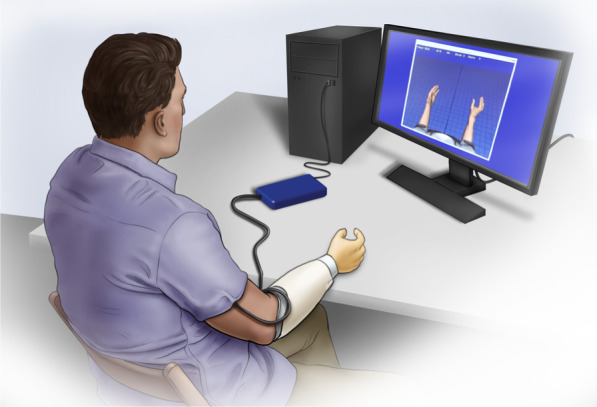
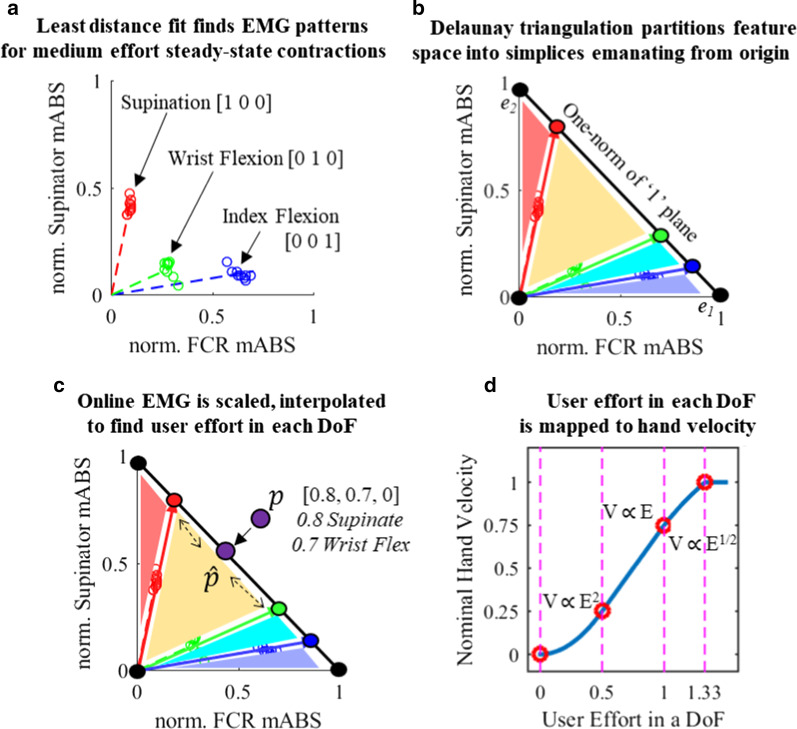
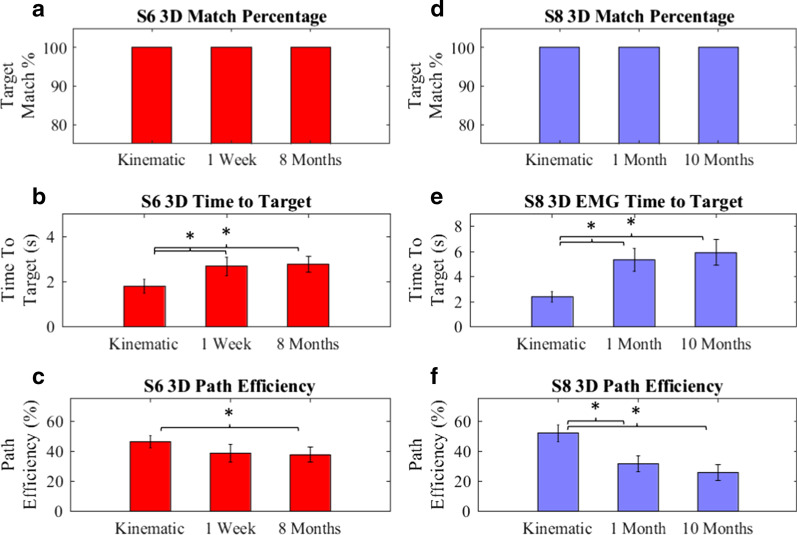
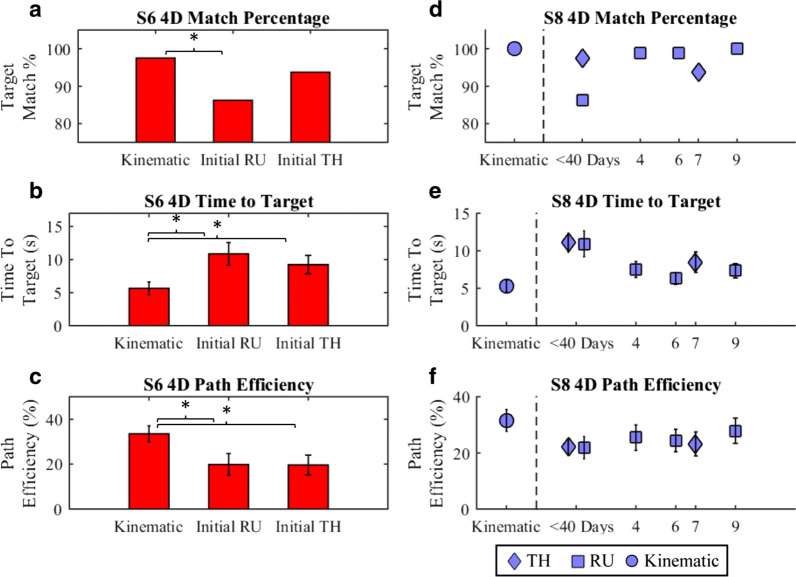
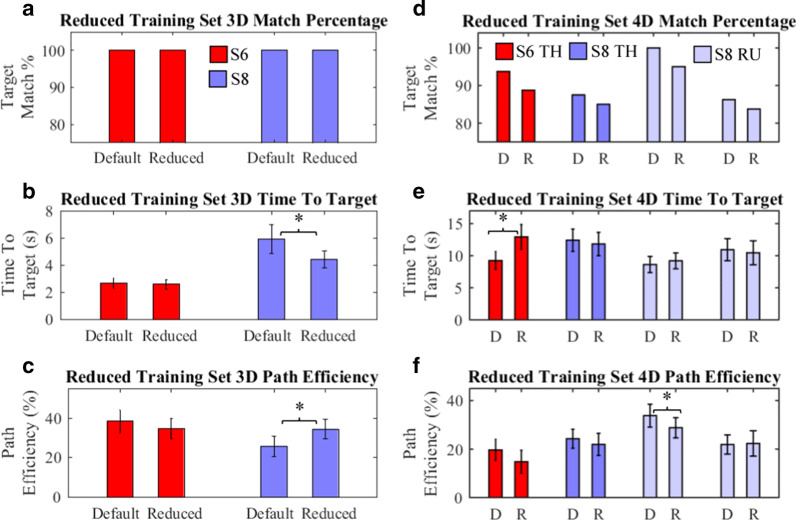
Background: Current commercial prosthetic hand controllers limit patients’ ability to fully engage high Degree-of-Freedom (DoF) prosthetic hands. Available feedforward controllers rely on large training data sets for controller setup and a need for recalibration upon prosthesis donning. Recently, an intuitive, proportional, simultaneous, regression-based 3-DoF controller remained stable for several months without retraining by combining chronically implanted electromyography (ciEMG) electrodes with a K-Nearest-Neighbor (KNN) mapping technique. The training dataset requirements for simultaneous KNN controllers increase exponentially with DoF, limiting the realistic development of KNN controllers in more than three DoF. We hypothesize that a controller combining linear interpolation, the muscle synergy framework, and a sufficient number of ciEMG channels (at least two per DoF), can allow stable, high-DoF control. Methods: Two trans-radial amputee subjects, S6 and S8, were implanted with percutaneously interfaced bipolar intramuscular electrodes. At the time of the study, S6 and S8 had 6 and 8 bipolar EMG electrodes, respectively. A Virtual Reality (VR) system guided users through single and paired training movements in one 3-DoF and four different 4-DoF cases. A linear model of user activity was built by partitioning EMG feature space into regions bounded by vectors of steady state movement EMG patterns. The controller evaluated online EMG signals by linearly interpolating the movement class labels for surrounding trained EMG movements. This yields a simultaneous, continuous, intuitive, and proportional controller. Controllers were evaluated in 3-DoF and 4-DoF through a target-matching task in which subjects controlled a virtual hand to match 80 targets spanning the available movement space. Match Percentage, Time-To-Target, and Path Efficiency were evaluated over a 10-month period based on subject availability. Results and conclusions: In 3-DoF, S6 and S8 matched most targets and demonstrated stable control after 8 and 10 months, respectively. In 4-DoF, both subjects initially found two of four 4-DoF controllers usable, matching most targets. S8 4-DoF controllers were stable, and showed improving trends over 7–9 months without retraining or at-home practice. S6 4-DoF controllers were unstable after 7 months without retraining. These results indicate that the performance of the controller proposed in this study may remain stable, or even improve, provided initial viability and a sufficient number of EMG channels. Overall, this study demonstrates a controller capable of stable, simultaneous, proportional, intuitive, and continuous control in 3-DoF for up to ten months and in 4-DoF for up to nine months without retraining or at-home use with minimal training times.
Overview
The claims and statistics of this paper haven’t been checked yet.
Free: it reads the open-access text and checks the first 5 claims that cite a source we can check. Create a free account to check every claim.
Integrity signals
Registry
Cites
Statistics
Figures
Verification
Claims the paper makes
The claims and statistics of this paper haven’t been checked yet.
Free: it reads the open-access text and checks the first 5 claims that cite a source we can check. Create a free account to check every claim.
Claims other papers make about this one
Each is checked against this paper’s own text: does it say what the citing paper says it does?
The check wasn’t confident either way, so it gives no verdict — never disputed.
In the citing paper
“The human hand can achieve various dexterous gestures with almost 23 degrees of freedoms (DOFs).[454]”
From Flexible Electronics and Devices as Human–Machine Interfaces for Medical Robotics (2022) · cites this paper as [454]
Experimental — accuracy not yet measured
Self-check
Percentages, sums and reported differences re-computed from the paper’s own numbers.
The self-check needs the paper’s full text.
Citations
Cites
A new strategy for multifunction myoelectric control
Hudgins, B., Parker, P., & Scott, R. N. (1993) · IEEE Transactions on Biomedical Engineering · doi:10.1109/10.204774 · Cited by 2,149 · cited 1×
“proportional controllers Intuitive prosthetic hand control has been widely adopted since its introduction by (Hudgins 1993) [20].”
Tie, J., Wang, Y., Tomasetti, C., Li, L., Springer, S., Kinde, I., Silliman, N., Tacey, M., Wong, H.-L., Christie, M., et al. (2016) · Science Translational Medicine · doi:10.1126/scitranslmed.aaf6219 · Cited by 1,492
A neural interface provides long-term stable natural touch perception
Tan, D. W., Schiefer, M. A., Keith, M. W., Anderson, J. R., Tyler, J., & Tyler, D. J. (2014) · Science Translational Medicine · doi:10.1126/scitranslmed.3008669 · Cited by 751
Self-citationAkima, H. (1978) · ACM Transactions on Mathematical Software · doi:10.1145/355780.355786 · Cited by 742
Control of Fast-Reaching Movements by Muscle Synergy Combinations
d'Avella, A., Portone, A., Fernandez, L., & Lacquaniti, F. (2006) · The Journal of Neuroscience · doi:10.1523/jneurosci.0830-06.2006 · Cited by 727 · cited 1×
“Synergy Theory can reduce training data volume Synergy Theory is a framework for describing muscle activity which states that muscles are driven in synergies, sub-movements in which individual muscles are contracted in fixed ratios commanded by a common neural signal [26].”
BackgroundA Comparison of Surface and Intramuscular Myoelectric Signal Classification
Hargrove, L. J., Englehart, K., & Hudgins, B. (2007) · IEEE Transactions on Biomedical Engineering · doi:10.1109/tbme.2006.889192 · Cited by 518 · cited 1×
“As ciEMG is more localized than surface EMG [46] (sEMG), this approach may be less fatiguing than the traditional proportionality implementation of scaling velocity by the average global signal (e.”
BackgroundEpidemiologic Overview of Individuals with Upper-Limb Loss and Their Reported Research Priorities
Atkins, D. J., Heard, D. C. Y., & Donovan, W. H. (1996) · JPO Journal of Prosthetics and Orthotics · doi:10.1097/00008526-199600810-00003 · Cited by 508 · cited 1×
“The man–machine interface, limited in both feed-forward control and closed-loop control, is a major contributor to abandonment [2, 3].”
BackgroundOrtiz-Catalan, M., Håkansson, B., & Brånemark, R. (2014) · Science Translational Medicine · doi:10.1126/scitranslmed.3008933 · Cited by 484 · cited 4×
“Studies have demonstrated that intuitive controllers, generated by machine learning methods, are capable of simultaneity, allowing combined movements, and proportionality, allowing hand speed to change with user effort, as 3-DoF classifiers [9, 18, 21].”
BackgroundMethodResultInfluentialEMG feature evaluation for movement control of upper extremity prostheses
Zardoshti-Kermani, M., Wheeler, B. C., Badie, K., & Hashemi, R. M. (1995) · IEEE Transactions on Rehabilitation Engineering · doi:10.1109/86.481972 · Cited by 477 · cited 1×
“Analysis Target matching metrics are described in prior work [40].”
MethodJiang, N., Englehart, K. B., & Parker, P. A. (2009) · IEEE Transactions on Biomedical Engineering · doi:10.1109/tbme.2008.2007967 · Cited by 450 · cited 1×
“Synergy Theory can be used to allow control over complex movements from small training sets [23], which is typically done by identifying synergies and using them to control individual DoF [23, 27, 28].”
MethodThe optimal controller delay for myoelectric prostheses
Farrell, T. R., & Weir, R. F. (2007) · IEEE Transactions on Neural Systems and Rehabilitation Engineering · doi:10.1109/tnsre.2007.891391 · Cited by 438
Linear and Nonlinear Regression Techniques for Simultaneous and Proportional Myoelectric Control
Hahne, J. M., Biebmann, F., Jiang, N., Rehbaum, H., Farina, D., Meinecke, F. C., Muller, K.-R., & Parra, L. C. (2014) · IEEE Transactions on Neural Systems and Rehabilitation Engineering · doi:10.1109/tnsre.2014.2305520 · Cited by 365 · cited 2×
“The presented controller expands demonstrated continuous control beyond previously reported 2-DoF [12, 44] and 3-DoF [10, 30] cases.”
BackgroundClassification of Simultaneous Movements Using Surface EMG Pattern Recognition
Young, A. J., Smith, L. H., Rouse, E. J., & Hargrove, L. J. (2013) · IEEE Transactions on Biomedical Engineering · doi:10.1109/tbme.2012.2232293 · Cited by 320 · cited 2×
“Low training times are frequently included in literature as a desired characteristic of prosthetic hand controllers [14, 21, 48].”
BackgroundVu, P. P., Vaskov, A. K., Irwin, Z. T., Henning, P. T., Lueders, D. R., Laidlaw, A. T., Davis, A. J., Nu, C. S., Gates, D. H., Gillespie, R. B., et al. (2020) · Science Translational Medicine · doi:10.1126/scitranslmed.aay2857 · Cited by 291
Muceli, S., & Farina, D. (2012) · IEEE Transactions on Neural Systems and Rehabilitation Engineering · doi:10.1109/tnsre.2011.2178039 · Cited by 285 · cited 1×
“Low training times are frequently included in literature as a desired characteristic of prosthetic hand controllers [14, 21, 48].”
BackgroundJiang, N., Rehbaum, H., Vujaklija, I., Graimann, B., & Farina, D. (2014) · IEEE Transactions on Neural Systems and Rehabilitation Engineering · doi:10.1109/tnsre.2013.2278411 · Cited by 269
EMG-Based Control of a Robot Arm Using Low-Dimensional Embeddings
Artemiadis, P. K., & Kyriakopoulos, K. J. (2010) · IEEE Transactions on Robotics · doi:10.1109/tro.2009.2039378 · Cited by 267 · cited 1×
“Synergy Theory can be used to allow control over complex movements from small training sets [23], which is typically done by identifying synergies and using them to control individual DoF [23, 27, 28].”
MethodWeak but Critical Links between Primary Somatosensory Centers and Motor Cortex during Movement
Wei, P., Bao, R., Lv, Z., & Jing, B. (2018) · Frontiers in Human Neuroscience · doi:10.3389/fnhum.2018.00001 · Cited by 264
Prosthetic Myoelectric Control Strategies: A Clinical Perspective
Roche, A. D., Rehbaum, H., Farina, D., & Aszmann, O. C. (2014) · Current Surgery Reports · doi:10.1007/s40137-013-0044-8 · Cited by 261 · cited 1×
“Current commercially available myoelectric hand prostheses are typically limited to one or two Degrees of Freedom (DoF) and experience a 10–35% abandonment rate [1].”
BackgroundThe neural basis of perceived intensity in natural and artificial touch
Graczyk, E. L., Schiefer, M. A., Saal, H. P., Delhaye, B. P., Bensmaia, S. J., & Tyler, D. J. (2016) · Science Translational Medicine · doi:10.1126/scitranslmed.aaf5187 · Cited by 258 · cited 1×
“This number of subjects parallels past studies with implanted control and sensory restoration systems [2, 9, 10, 54, 55].”
ResultSelf-citationOnline Myoelectric Control of a Dexterous Hand Prosthesis by Transradial Amputees
Cipriani, C., Antfolk, C., Controzzi, M., Lundborg, G., Rosen, B., Carrozza, M. C., & Sebelius, F. (2011) · IEEE Transactions on Neural Systems and Rehabilitation Engineering · doi:10.1109/tnsre.2011.2108667 · Cited by 233
Is Accurate Mapping of EMG Signals on Kinematics Needed for Precise Online Myoelectric Control?
Jiang, N., Vujaklija, I., Rehbaum, H., Graimann, B., & Farina, D. (2014) · IEEE Transactions on Neural Systems and Rehabilitation Engineering · doi:10.1109/tnsre.2013.2287383 · Cited by 218
Hahne, J. M., Schweisfurth, M. A., Koppe, M., & Farina, D. (2018) · Science Robotics · doi:10.1126/scirobotics.aat3630 · Cited by 216 · cited 3×
“Linear interpolation follows from linear regression studies Linear regression for prosthesis control has been examined in past work [15, 22, 30].”
BackgroundMethodPasquina, P. F., Evangelista, M., Carvalho, A. J., Lockhart, J., Griffin, S., Nanos, G., McKay, P., Hansen, M., Ipsen, D., Vandersea, J., et al. (2015) · Journal of Neuroscience Methods · doi:10.1016/j.jneumeth.2014.07.016 · Cited by 205 · cited 3×
“Separately, ciEMG has also been shown to improve user performance with standard tests and reduce fatigue [2].”
BackgroundResultIllusory movement perception improves motor control for prosthetic hands
Marasco, P. D., Hebert, J. S., Sensinger, J. W., Shell, C. E., Schofield, J. S., Thumser, Z. C., Nataraj, R., Beckler, D. T., Dawson, M. R., Blustein, D. H., et al. (2018) · Science Translational Medicine · doi:10.1126/scitranslmed.aao6990 · Cited by 198
Sok, D., Doores, K. J., Briney, B., Le, K. M., Saye-Francisco, K. L., Ramos, A., Kulp, D. W., Julien, J.-P., Menis, S., Wickramasinghe, L., et al. (2014) · Science Translational Medicine · doi:10.1126/scitranslmed.3008104 · Cited by 183
Jiang, N., Vest-Nielsen, J. L., Muceli, S., & Farina, D. (2012) · Journal of NeuroEngineering and Rehabilitation · doi:10.1186/1743-0003-9-42 · Cited by 181 · cited 3×
“Studies have demonstrated that intuitive controllers, generated by machine learning methods, are capable of simultaneity, allowing combined movements, and proportionality, allowing hand speed to change with user effort, as 3-DoF classifiers [9, 18, 21].”
BackgroundArtificial Force Field for Haptic Feedback in UAV Teleoperation
Lam, T. M., Boschloo, H. W., Mulder, M., & van Paassen, M. M. (2009) · IEEE Transactions on Systems, Man, and Cybernetics - Part A: Systems and Humans · doi:10.1109/tsmca.2009.2028239 · Cited by 178 · cited 3×
“; TMR: Targeted muscle reinnervation; VR: Virtual reality.”
BackgroundMethodMuceli, S., Boye, A. T., d'Avella, A., & Farina, D. (2010) · Journal of Neurophysiology · doi:10.1152/jn.00559.2009 · Cited by 177 · cited 1×
“Channel sufficiency A previous study, (Muceli 2010 [37]), found that 2-DoF multi-DoF movements can be accurately reconstructed using four, but not three, synergies extracted from singleDoF movements.”
BackgroundPage, D. M., George, J. A., Kluger, D. T., Duncan, C., Wendelken, S., Davis, T., Hutchinson, D. T., & Clark, G. A. (2018) · Frontiers in Human Neuroscience · doi:10.3389/fnhum.2018.00352 · Cited by 175 · cited 1×
“This number of subjects parallels past studies with implanted control and sensory restoration systems [2, 9, 10, 54, 55].”
ResultImplanted Neuroprosthesis for Restoring Arm and Hand Function in People With High Level Tetraplegia
Memberg, W. D., Polasek, K. H., Hart, R. L., Bryden, A. M., Kilgore, K. L., Nemunaitis, G. A., Hoyen, H. A., Keith, M. W., & Kirsch, R. F. (2014) · Archives of Physical Medicine and Rehabilitation · doi:10.1016/j.apmr.2014.01.028 · Cited by 137 · cited 1×
“Both were previously implanted with 8 pairs of intramuscular myoelectric signal (IM-MES [34]) recording electrodes, accessible through percutaneous leads.”
MethodSelf-citationMatrone, G. C., Cipriani, C., Carrozza, M. C., & Magenes, G. (2012) · Journal of NeuroEngineering and Rehabilitation · doi:10.1186/1743-0003-9-40 · Cited by 127 · cited 1×
“Synergy Theory can be used to allow control over complex movements from small training sets [23], which is typically done by identifying synergies and using them to control individual DoF [23, 27, 28].”
MethodEffective force control by muscle synergies
Berger, D. J., & d’Avella, A. (2014) · Frontiers in Computational Neuroscience · doi:10.3389/fncom.2014.00046 · Cited by 125 · cited 3×
“Furthermore, the controller examines a method of proportionality [29, 45] which only makes use of relevant EMG signals, although it does not quantify its effectiveness.”
BackgroundMethodSimon, A. M., Hargrove, L. J., Lock, B. A., & Kuiken, T. A. (2011) · IEEE Transactions on Biomedical Engineering · doi:10.1109/tbme.2011.2155063 · Cited by 120
Structure learning and the Occam's razor principle: a new view of human function acquisition
Narain, D., Smeets, J. B. J., Mamassian, P., Brenner, E., & van Beers, R. J. (2014) · Frontiers in Computational Neuroscience · doi:10.3389/fncom.2014.00121 · Cited by 113
Evaluation of Linear Regression Simultaneous Myoelectric Control Using Intramuscular EMG
Smith, L. H., Kuiken, T. A., & Hargrove, L. J. (2016) · IEEE Transactions on Biomedical Engineering · doi:10.1109/tbme.2015.2469741 · Cited by 112 · cited 3×
“Linear interpolation follows from linear regression studies Linear regression for prosthesis control has been examined in past work [15, 22, 30].”
BackgroundMethodChapman, A., Vicenzino, B., BLANCH, P. D., Knox, J. J., & Hodges, P. W. (2009) · Journal of Electromyography and Kinesiology · doi:10.1016/j.jelekin.2008.11.013 · Cited by 112 · cited 1×
“The mean-absolute-value EMG feature on each channel was normalized to a maximum of ‘1′ per training data set [36].”
MethodMoore, S. P., & Marteniuk, R. G. (1986) · Journal of Motor Behavior · doi:10.1080/00222895.1986.10735388 · Cited by 93 · cited 1×
“While there is little recent research on EMG consistency, there is a demonstrated decrease in the coefficient of variability over a four-hundred repetition task [49] and an observed elimination of unwanted neural activity with practice [50].”
BackgroundOnline mapping of EMG signals into kinematics by autoencoding
Vujaklija, I., Shalchyan, V., Kamavuako, E. N., Jiang, N., Marateb, H. R., & Farina, D. (2018) · Journal of NeuroEngineering and Rehabilitation · doi:10.1186/s12984-018-0363-1 · Cited by 87
CDKL5 and Shootin1 Interact and Concur in Regulating Neuronal Polarization
Nawaz, M., Giarda, E., Bedogni, F., Montanara, P. L., Ricciardi, S., Ciceri, D., Alberio, T., Landsberger, N., Rusconi, L., & Kilstrup‐Nielsen, C. (2016) · PLoS ONE · doi:10.1371/journal.pone.0148634 · Cited by 74
Hwang, H.-J., Hahne, J. M., & Müller, K. (2017) · PLoS ONE · doi:10.1371/journal.pone.0186318 · Cited by 68
Dewald, H. A., Lukyanenko, P., Lambrecht, J. M., Anderson, J. R., Tyler, D. J., Kirsch, R. F., & Williams, M. R. (2019) · Journal of NeuroEngineering and Rehabilitation · doi:10.1186/s12984-019-0607-8 · Cited by 57 · cited 10×
“Dewald H, Lukyanenko P, Lambrecht J, Anderson J, Tyler D, Kirsch R, Williams M. Stable, three degree-of-freedom myoelectric prosthetic control via chronic bipolar intramuscular electrodes: a case study.”
BackgroundMethodResultInfluentialSelf-citationEnhanced EMG signal processing for simultaneous and proportional myoelectric control
Nielsen, J. L. G., Holmgaard, S., Jiang, N., Englehart, K., Farina, D., & Parker, P. (2009) · 2009 Annual International Conference of the IEEE Engineering in Medicine and Biology Society · doi:10.1109/iembs.2009.5332745 · Cited by 52 · cited 1×
“Studies have demonstrated that intuitive controllers, generated by machine learning methods, are capable of simultaneity, allowing combined movements, and proportionality, allowing hand speed to change with user effort, as 3-DoF classifiers [9, 18, 21].”
BackgroundFarina, D., Rehbaum, H., Holobar, A., Vujaklija, I., Jiang, N., Hofer, C., Salminger, S., van Vliet, H.-W., & Aszmann, O. C. (2014) · IEEE Transactions on Neural Systems and Rehabilitation Engineering · doi:10.1109/tnsre.2014.2306000 · Cited by 51
Simultaneous and proportional control of 2D wrist movements with myoelectric signals
Hahne, J. M., Rehbaum, H., Bießmann, F., Meinecke, F. C., Müller, K. R., Jiang, N., Farina, D., & Parra, L. C. (2012) · Machine learning for signal processing ... · doi:10.1109/mlsp.2012.6349712 · Cited by 49 · cited 1×
“Linear interpolation follows from linear regression studies Linear regression for prosthesis control has been examined in past work [15, 22, 30].”
MethodChanges in kinematic and EMG variability while practicing a maximal performance task
Gabriel, D. A. (2002) · Journal of Electromyography and Kinesiology · doi:10.1016/s1050-6411(02)00026-3 · Cited by 44 · cited 1×
“While there is little recent research on EMG consistency, there is a demonstrated decrease in the coefficient of variability over a four-hundred repetition task [49] and an observed elimination of unwanted neural activity with practice [50].”
BackgroundHargrove, L. J., Miller, L. A., Turner, K. L., & Kuiken, T. (2018) · Journal of NeuroEngineering and Rehabilitation · doi:10.1186/s12984-018-0402-y · Cited by 42 · cited 1×
“Past work indicates that strong VR controller performance carries over to functional benefit [43] and that continuous controllers can provide additional functional gain [21] relative to classifiers.”
BackgroundEvaluation of head orientation and neck muscle EMG signals as three-dimensional command sources
Williams, M. R., & Kirsch, R. F. (2015) · Journal of NeuroEngineering and Rehabilitation · doi:10.1186/s12984-015-0016-6 · Cited by 38
Self-citationThe LET Procedure for Prosthetic Myocontrol: Towards Multi-DOF Control Using Single-DOF Activations
Nowak, M., & Castellini, C. (2016) · PLoS ONE · doi:10.1371/journal.pone.0161678 · Cited by 36 · cited 4×
“Notably, Nowak and Castellini [31] found that linear regression performance improves if un-trained multi-DoF movements are approximated by linear combinations of trained singleDoF movements.”
BackgroundInfluentialNovel postural control algorithm for control of multifunctional myoelectric prosthetic hands
Segil, J. L., & Weir (2015) · The Journal of Rehabilitation Research and Development · doi:10.1682/jrrd.2014.05.0134 · Cited by 32 · cited 1×
“Other algorithms can be tuned to weight single-class movements preferentially or to implement features such as stiffness [52] or ‘positional wells’ [53].”
BackgroundInnovative Methods of Reconstruction After Pelvic Tumor Resection
Perry, K. I., Abdel, M. P., Lewallen, D. G., Rose, P. S., & Sim, F. H. (2013) · Current Surgery Reports · doi:10.1007/s40137-013-0041-y · Cited by 21
User ratings of prosthetic usability and satisfaction in VA study to optimize DEKA Arm
Resnik, L. J., & Borgia, M. L. (2014) · The Journal of Rehabilitation Research and Development · doi:10.1682/jrrd.2013.02.0056 · Cited by 16 · cited 1×
“Advanced prosthetic systems, such as the 10-DoF DEKA/ LUKE Arm [4] and the 16-DoF Modular Prosthetic Limb [5], have expanded prosthetic hand capabilities, but place even higher demands on prosthetic hand controllers.”
BackgroundClassification of motor unit activity following targeted muscle reinnervation
Kapelner, T., Jiang, N., Vujaklija, I., Aszmann, O. C., Holobar, A., & Farina, D. (2015) · International IEEE/EMBS Conference on Neural Engineering · doi:10.1109/ner.2015.7146707 · Cited by 15
Control of myoelectric prosthetic hand based on surface EMG
Ishii, C., Harada, A., Nakakuki, T., & Hashimoto, H. (2011) · IEEE International Conference on Mechatronics and Automation (ICMA) · doi:10.1109/icma.2011.5985757 · Cited by 15
Pulliam, C. L., Lambrecht, J. M., & Kirsch, R. F. (2012) · Annual International Conference of the IEEE Engineering in Medicine and Biology Society (EMBC) · doi:10.1109/embc.2012.6346734 · Cited by 9 · cited 1×
“1) previously used in similar studies [35] guided the acquisition of training data.”
MethodSelf-citationPage, D. M. (2018) · J. Willard Marriott Library · doi:10.26053/0h-883s-cmg0 · Cited by 4
Research works printed but not linked: 6
- Johannes MS Bigelow JD Burck JM Harshbarger SD Kozlowski MV Van Doren T An overview of the developmental process for the modular prosthetic limb Johns Hopkins APL Technical Digest 2011 30 3 207 216
- Ajiboye B. Investigation of muscle synergies as a control paradigm for myoelectric devices (dissertation). 2007. Northwestern University, Evanston, Illinois
- Mitas L Mitasova H Longley PA Goodchild MF Maguire DJ Rhind DW Spatial interpolation Geographical Information Systems, volume 1: principles and technical issues 1999 New York Wiley 481 492
- Williams M. Evaluation of 2D and 3D command sources for individuals with high tetraplegia (Dissertation). 2009. Case Western Reserve University, Cleveland, Ohio.
- Gabriel DA Changes in kinematic and EMG variability while practicing a maximal performance task J. Electromyogr Kinesiol. 2002 12 407 412 10.1016/S1050-6411(02)00026-3 12223174 · DOI
- Moore SP Marteniuk RG Kinematic and electromyographic changes that occur as a function of learning a time-constrained aiming task J Mot Behav 1986 18 4 397 426 10.1080/00222895.1986.10735388 15138139 · DOI
Cited by
Flexible Electronics and Devices as Human–Machine Interfaces for Medical Robotics
Heng, W., Solomon, S., & Gao, W. (2022) · Advanced Materials · doi:10.1002/adma.202107902 · Cited by 609
A Review of Myoelectric Control for Prosthetic Hand Manipulation
Chen, Z., Min, H., Wang, D., Xia, Z., Sun, F., & Fang, B. (2023) · Biomimetics · doi:10.3390/biomimetics8030328 · Cited by 152
“Joint torque [35,46–48] Other parameters 3D coordinate value [49,50], Movement of the in-hand object [51], Multidimensional arrays [14], Movement activation level [52] MAV: Mean absolute value, RMS: Root mean square, WL: Waveform length, ZC: Zero crossing, SSC: Slope-sign changes, SOAMC: Sixth…”
BackgroundA highly integrated bionic hand with neural control and feedback for use in daily life
Ortiz-Catalan, M., Zbinden, J., Millenaar, J., D’Accolti, D., Controzzi, M., Clemente, F., Cappello, L., Earley, E. J., Mastinu, E., Kolankowska, J., et al. (2023) · Science Robotics · doi:10.1126/scirobotics.adf7360 · Cited by 105
“Implanted electrodes have been found to provide reliable control signals ( 12 – 16 ) but impose an additional communication requirement, namely, that the signals must travel constantly from inside to outside the body ( 17 ).”
BackgroundToledo-Peral, C. L., Vega-Martínez, G., Mercado-Gutierrez, J. A., Rodríguez‐Reyes, G., Vera, A., Leija, L., & Gutiérrez-Martínez, J. (2022) · Electronics · doi:10.3390/electronics11142271 · Cited by 88
“From the articles that include patients in their studies (40%), these are mainly upper limb amputees (50%) [6,43,56,61,65,67,68,70], post-stroke with hemiparesis patients (43.”
BackgroundMethodVu, P. P., Vaskov, A. K., Lee, C., Jillala, R., Wallace, D. M., Davis, A. J., Kung, T. A., Kemp, S. W. P., Gates, D. H., Chestek, C. A., et al. (2023) · Journal of Neural Engineering · doi:10.1088/1741-2552/accb0c · Cited by 66
“People with transradial amputations demonstrated stable three-DoF prosthetic control in a virtual space up to 10 months without recalibration using percutaneous intramuscular electrodes in residual innervated muscles [54].”
Background
Metadata
- Authors
- Lukyanenko, P., Dewald, H. A., Lambrecht, J., Kirsch, R. F., Tyler, D. J., & Williams, M. R.
- Affiliations
- Louis Stokes Cleveland VA Medical Center (US)
- Cleveland FES Center (US)
- Corresponding author
- Tyler, Dustin J.
- ORCID
- Venue
- Journal of NeuroEngineering and Rehabilitation
- Published
- 2021-03-18
- Volume
- 18
- Issue
- 1
- Pages
- 50-50
- ISSN
- 1743-0003 (ISSN-L)
- PMC
- PMC7977328
- OpenAlex
- W3136285704
- Semantic Scholar
- d293cd9637047bf724f2e6ef5756e9383c569805
- Cited by
- 27
- References
- 59
- Citations by year
- 2026: 2 · 2025: 12 · 2024: 3 · 2023: 4 · 2022: 4 · 2021: 2
- FWCI
- 0.99
- Type
- journal article
- Language
- en
- Open access
- gold
- doi.org
- Licence
- cc-by
- creativecommons.org/licenses/by/4.0/ (tdm)
- creativecommons.org/licenses/by/4.0/ (vor)
- Locations
- Journal of NeuroEngineering and Rehabilitation (publishedVersion, cc-by)
- PubMed Central (publishedVersion, cc-by)
- PubMed (publishedVersion)
- DOAJ (DOAJ: Directory of Open Access Journals) (submittedVersion, cc-by-sa)
- Funders
- Defense Advanced Research Projects Agency (#N66001-15-C-4014. "iSens: Implanted Somatosensory Electrical Neurostimulation and Sensing")
- U.S. Department of Veterans Affairs (1 I01 RX001077-01, I01RX003355)
- National Institutes of Health (5T32-EB004314-20)
- Topics
- Physical Sciences › Engineering › Biomedical Engineering › Muscle activation and electromyography studies
- Physical Sciences › Engineering › Biomedical Engineering › Prosthetics and Rehabilitation Robotics
- Life Sciences › Neuroscience › Cellular and Molecular Neuroscience › Neuroscience and Neural Engineering
- Keywords
- prosthetic hand control, linear interpolation, muscle synergies, intramuscular electrodes, transradial amputation, proportional control, controller stability, virtual reality training, upper limb prosthesis
- MeSH terms
- Simulation Training, Virtual Reality, Amputees, Arm, Artificial Limbs, Electrodes, Implanted, Electromyography, Hand, Humans, Male, Movement, Patient Education as Topic, Software, Linear Models, Muscle, Skeletal, Physical Therapy Modalities, Brain-Computer Interfaces
About these checks
Registry, retraction, Cites and statistics results are computed, not judged, with one exception: a printed reference that no index lists is read once by a model before it counts as a citation error. Claims are extracted by a model and kept only when their quote appears verbatim in the text; each cited source is then checked, with a model’s help, for whether it says what the claim relies on. Those verdicts can be wrong — read the claim’s quote and the cited source before relying on one.
Statistics and arithmetic are recomputed, not judged.
Confidence bands are shown only for fields calibrated on our annotated test set. None is calibrated yet, so no band is shown.
What counts as a claim ›How we measure confidence ›How we check this ›
Are you an author, or do you see a problem with this page? Request a review
Data sources
Bibliographic data: Semantic Scholar, OpenAlex, Crossref.
Contains information from the Semantic Scholar Academic Graph Datasets, made available under the ODC Attribution License (ODC-BY 1.0).
Semantic Scholar’s data is described in: Kinney, R., et al. (2023). The Semantic Scholar Open Data Platform. arXiv:2301.10140.
