

The effects of a home-based resistance training programme on body composition and muscle function during weight loss in people living with overweight or obesity: a randomised controlled pilot trial
Open accessThe DOI matches its Crossref record; 70 of the 70 references it cites were found in a registry or an index; 27 of the 58 sources its claims cite were checked for support.
Abstract
Background: Obesity continues to grow as a public health concern and although dietary interventions can be effective at reducing body mass and improving cardiovascular risk factors, they also result in undesirable losses of lean tissue. The aim of this randomised controlled pilot trial was to investigate the effects of a home-based resistance training exercise programme on body composition and muscle function in people living with overweight or obesity undergoing dietary weight loss. Methods: Participants (n = 48) from Glasgow were randomly assigned to either a diet-induced weight loss group (WL) or a diet plus home-based resistance training exercise group (RT + WL) for 12-weeks. Body composition, muscle strength, and physical function were assessed at baseline and post-intervention. Results: There was no effect of the resistance exercise training programme (all p > 0.05) on body composition including body mass index, total body mass, fat mass, fat free mass or muscle thickness during weight loss. However, the resistance training group showed improvements in muscle and physical function compared to the weight loss only group, resulting in higher grip strength (RT + WL: Δ2.65, 95% CI: 0.44, 4.86; WL: Δ-0.26, 95% CI: -2.04, 1.51:p = 0.046), maximal voluntary contraction force (RT + WL:Δ23.61, 95% CI: 3.39, 43.84 WL: Δ-11.95, 95% CI: -35.37, 11.48;p = 0.019), and sit-to-stand test scores (RT + WL:Δ5.9, 95% CI: 4.27, 7.53 WL: Δ1.47, 95% CI: 0.13, 2.82; p < 0.001). Conclusions: These findings suggest that incorporating home-based resistance training into weight loss programmes can preserve, or even enhance, muscle function without negatively impacting the effectiveness of dietary weight loss interventions, highlighting its potential to mitigate muscle function losses during weight loss in people living with overweight or obese. Trial registration: Name of the registry: ClinicalTrials.gov. The registration number: NCT05702840. Date of Registry: 18/01/2023. The registration title: EXerCise wEight Loss (EXCEL).
Overview
CoChat Summary
TL;DR
In a 12-week pilot RCT in adults with overweight/obesity, adding home-based resistance training to a commercial weight-loss programme did not change body composition but improved muscle strength and physical function compared with weight loss alone. The authors conclude this home-based approach may help preserve or enhance muscle function during dietary weight loss.
Key findings
- No between-group effect of resistance training on body composition: BMI (p = 0.642), body mass (p = 0.822), fat mass (p = 0.729), fat percentage (p = 0.797), fat free mass (p = 0.739), or muscle thickness (p = 0.598).
- Grip strength improved in RT + WL versus WL: RT + WL Δ2.65 kg (95% CI 0.44, 4.86) vs WL Δ−0.26 kg (95% CI −2.04, 1.51); p = 0.046.
- Knee extensor maximal voluntary contraction force improved in RT + WL versus WL: RT + WL Δ23.61 N (95% CI 3.39, 43.84) vs WL Δ−11.95 N (95% CI −35.37, 11.48); p = 0.019.
- Sit-to-stand performance improved in RT + WL versus WL: RT + WL Δ5.9 repetitions (95% CI 4.27, 7.53) vs WL Δ1.47 repetitions (95% CI 0.13, 2.82); p < 0.001.
Methods
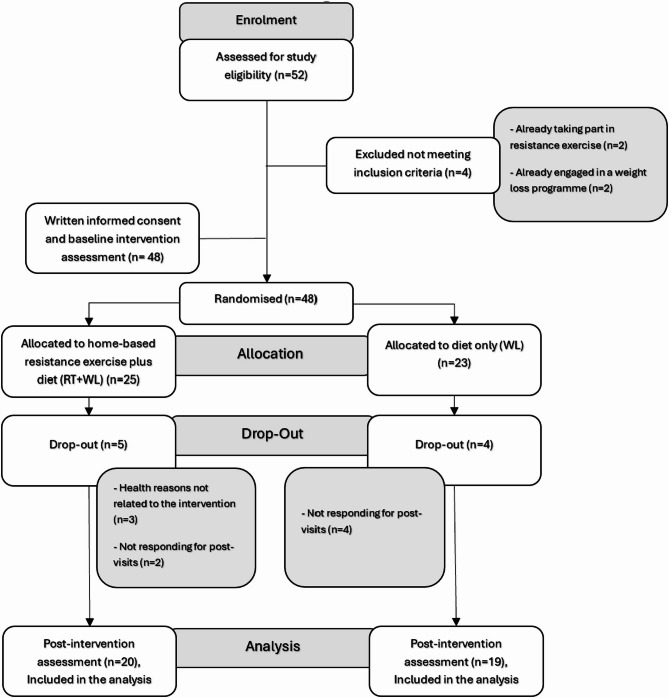
- 12-week, parallel-group pilot randomised controlled trial; participants from Glasgow were randomised 1:1 to diet-induced weight loss (WL) or diet plus home-based resistance training (RT + WL). A total of 48 participants were recruited and randomised; 39 completed (26 males, 13 females).
- All participants received access to the Weight Watchers programme for 12 weeks. The RT + WL group also received a resistance exercise booklet and demonstration videos, and were asked to perform exercises three times weekly, three sets per exercise, targeting RPE 8–10 (week 1: RPE 4–6); exercises included press-ups, band lateral raises, band seated low rows, squats, lunges, and calf raises.
- Outcomes measured at baseline and 12 weeks included BMI and body composition by scales and bioelectrical impedance, vastus lateralis muscle thickness by ultrasound, knee extensor maximal torque and grip strength, and 30-second sit-to-stand performance. Between-group differences were assessed using one-way ANCOVA with baseline outcome as a covariate (SPSS 29.0.1.0; p < 0.05).
Limitations
- The paper states: this was a small pilot trial without a formal sample size calculation and likely insufficient statistical power to detect changes in all outcomes; adherence was not formally assessed; participant experiences were not explored; dietary intake was not strictly controlled or monitored; BIA is less precise than DXA for fat free mass (lab CV 1.3%; minimum detectable change reported as 3.5–4 kg); protein intake was not controlled or assessed; and home-based unsupervised exercise may lack social support and professional supervision.
- Evident from the text: 9 of 48 randomised participants did not complete the study, and non-completers were mostly female; baseline characteristics differed somewhat between groups (WL group slightly younger and with a higher proportion of female participants), although the authors report no clear differences between groups.
Model-written summary. Check it against the paper before relying on it.
Integrity signals
Registry
Cites
Statistics
Figures
Verification
Claims the paper makes
21 Valid · 1 Not valid · 13 Not checked · 47 Own results and interpretations
At least one cited source doesn’t support this claim or points to a different paper, and none confirmed it — see the verdicts below.
In the paper
“Indeed previous studies of supervised resistance exercise during weight loss demonstrated increases in fat free mass [16, 38], decreases in fat mass [39, 40] and improved muscle strength [16, 40].”
§ The effects of a home-based resistance training programme on body composition and muscle function during weight loss in people living with overweight or obesity: a randomised controlled pilot trial > Discussion
What the sources say
- Not checked — no full text of the sourcecites [16] Avila JJ, Gutierres JA, Sheehy ME, Lofgren IE, Delmonico MJ. Effect of moderate intensity resistance training during weight loss on body composition and physical performance in overweight older adults. Eur J Appl Physiol. 2010;109(3):517–25. 20169360 source
- Disputedcites [38] Campbell WW, Haub MD, Wolfe RR, Ferrando AA, Sullivan DH, Apolzan JW, et al. Resistance training preserves fat-free mass without impacting changes in protein metabolism after weight loss in older women. Obesity. 2009;17(7):1332–9. 19247271 PMC4299870 sourceExperimental — accuracy not yet measured
The Results (Body composition; page unavailable) state that fat-free mass was unchanged in the resistance-training group, not increased. It decreased in the sedentary group, so the study supports preservation of fat-free mass during weight loss rather than a gain. (LLM, conf=0.93)
Checked by a reasoning model — may be wrong.
boostedstates a cause- Asserted: passes — The authors put it forward as true.
- Checkable: passes — It can be checked against evidence.
- Load-bearing: passes — The paper’s conclusions depend on it.
- Based: passes — The paper gives a reason why it holds.
The cited sources support only part of this claim — read each source’s verdict below.
In the paper
“Indeed around ∼20–30% of weight lost is lean tissue”
§ The effects of a home-based resistance training programme on body composition and muscle function during weight loss in people living with overweight or obesity: a randomised controlled pilot trial > Introduction
What the sources say
- Partly supportedcites [7] Cava E, Yeat NC, Mittendorfer B. Preserving healthy muscle during weight loss. Advances in nutrition (Bethesda. Md). 2017;8(3):511–9. PMC5421125 28507015 sourceExperimental — accuracy not yet measured
The section “Effect of diet-induced weight loss on muscle mass in persons with obesity” states that fat-free mass accounts for about 20–30% of total weight loss in people who are overweight or obese. The citing sentence omits that population qualifier; the same passage says the proportion often exceeds 35% in people with normal weight. (LLM, conf=0.88)
- Not checked — no full text of the sourcecites [8] Enriquez Guerrero A, San Mauro Martin I, Garicano Vilar E, Camina Martin MA. Effectiveness of an intermittent fasting diet versus continuous energy restriction on anthropometric measurements, body composition and lipid profile in overweight and obese adults: a meta-analysis. Eur J Clin Nutr. 2021;75(7):1024–39. 33293678 source
- Not checked — no full text of the sourcecites [9] Pellegrini M, Cioffi I, Evangelista A, Ponzo V, Goitre I, Ciccone G, et al. Effects of time-restricted feeding on body weight and metabolism. A systematic review and meta-analysis. Reviews Endocr Metabolic Disorders. 2019;21(1):17–33. 31808043 source
plainstates an association- Asserted: passes — The authors put it forward as true.
- Checkable: passes — It can be checked against evidence.
- Load-bearing: passes — The paper’s conclusions depend on it.
- Based: passes — The paper gives a reason why it holds.
- Partly supported
The cited sources support only part of this claim — read each source’s verdict below.
In the paper
“with a recent meta-analysis showing that weight loss is associated with a loss of lean body mass of ~ 1.3 kg on average [7–9].”
§ The effects of a home-based resistance training programme on body composition and muscle function during weight loss in people living with overweight or obesity: a randomised controlled pilot trial > Introduction
What the sources say
- Partly supportedcites [7] Cava E, Yeat NC, Mittendorfer B. Preserving healthy muscle during weight loss. Advances in nutrition (Bethesda. Md). 2017;8(3):511–9. PMC5421125 28507015 sourceExperimental — accuracy not yet measured
The section ‘Effect of diet-induced weight loss on muscle mass in persons with obesity’ states that calorie-reduced weight loss decreases lean body mass. It gives proportions of weight lost as fat-free mass, but does not report an average loss of approximately 1.3 kg. The paper describes itself as a review, not the meta-analysis described in the citing sentence. (LLM, conf=0.88)
- Not checked — no full text of the sourcecites [8] Enriquez Guerrero A, San Mauro Martin I, Garicano Vilar E, Camina Martin MA. Effectiveness of an intermittent fasting diet versus continuous energy restriction on anthropometric measurements, body composition and lipid profile in overweight and obese adults: a meta-analysis. Eur J Clin Nutr. 2021;75(7):1024–39. 33293678 source
- Not checked — no full text of the sourcecites [9] Pellegrini M, Cioffi I, Evangelista A, Ponzo V, Goitre I, Ciccone G, et al. Effects of time-restricted feeding on body weight and metabolism. A systematic review and meta-analysis. Reviews Endocr Metabolic Disorders. 2019;21(1):17–33. 31808043 source
plainstates an association- Asserted: passes — The authors put it forward as true.
- Checkable: passes — It can be checked against evidence.
- Load-bearing: passes — The paper’s conclusions depend on it.
- Based: passes — The paper gives a reason why it holds.
- Partly supported
The cited sources support only part of this claim — read each source’s verdict below.
In the paper
“Furthermore, a recent meta-analysis in older adults with obesity found that supervised resistance exercise training attenuated the loss of lean mass during weight loss (mean difference: 0.8 kg [95% CI: 0.4–1.3 kg]) [41].”
§ The effects of a home-based resistance training programme on body composition and muscle function during weight loss in people living with overweight or obesity: a randomised controlled pilot trial > Discussion
What the sources say
- Partly supportedcites [41] Sardeli AV, Komatsu TR, Mori MA, Gáspari AF, Chacon-Mikahil MPT. Resistance training prevents muscle loss induced by caloric restriction in obese elderly individuals: a systematic review and meta-analysis. Nutrients. 2018;10(4):423. 29596307 PMC5946208 sourceExperimental — accuracy not yet measured
The Abstract reports that resistance training reduced caloric-restriction-induced lean body mass loss in obese older adults by 0.819 kg (0.364–1.273 kg), matching the cited figures after rounding. The Results (section 3.1) describe prescribed exercise three times weekly, but our copy does not establish that the training was supervised. (LLM, conf=0.85)
plainstates a cause- Asserted: passes — The authors put it forward as true.
- Checkable: passes — It can be checked against evidence.
- Load-bearing: passes — The paper’s conclusions depend on it.
- Based: passes — The paper gives a reason why it holds.
- Partly supported
The sources with a verdict support this claim; the rest weren’t checked yet, have no full text we could read, or their verdicts aren’t rated yet.
In the paper
“There is also evidence that during weight loss, resistance exercise can attenuate the decline in fat free mass, augment fat loss and increase muscle strength [16, 17].”
§ The effects of a home-based resistance training programme on body composition and muscle function during weight loss in people living with overweight or obesity: a randomised controlled pilot trial > Introduction
What the sources say
- Not checked — no full text of the sourcecites [16] Avila JJ, Gutierres JA, Sheehy ME, Lofgren IE, Delmonico MJ. Effect of moderate intensity resistance training during weight loss on body composition and physical performance in overweight older adults. Eur J Appl Physiol. 2010;109(3):517–25. 20169360 source
- Supportedcites [17] Hunter GR, Fisher G, Neumeier WH, Carter SJ, Plaisance EP. Exercise training and energy expenditure following weight loss. Med Sci Sports Exerc. 2015;47(9):1950–7. 25606816 PMC4508245 source
The Discussion reports that, following weight loss, the resistance-training group did not lose fat-free mass (+0.3 kg), while the aerobic and no-exercise groups lost 0.5 kg and 1.0 kg, respectively. This supports the attributed claim that resistance exercise can attenuate the decline in fat-free mass during weight loss. (LLM, conf=0.92)
plainstates a cause- Asserted: passes — The authors put it forward as true.
- Checkable: passes — It can be checked against evidence.
- Load-bearing: passes — The paper’s conclusions depend on it.
- Based: passes — The paper gives a reason why it holds.
47 more claims · 8 with their cited sources checked
Create a free account to see all 82 claims and to verify the 2 references still open.
- Probably not a substantial claim. 15
- It may state two separate claims as one. 18
Self-check
Percentages, sums and reported differences re-computed from the paper’s own numbers.
Each contradiction between two passages listed here was confirmed by an independent check.
Rated minor: it would not touch a result — a value no result rests on, a p-value that stays on the same side of the significance level, or a conflict that is clerical, resolved elsewhere in the paper, or outside its own findings.
In the paper
§ The effects of a home-based resistance training programme on body composition and muscle function during weight loss in people living with overweight or obesity: a randomised controlled pilot trial > Results
“| Grip strength (kg) | 37 (8.8) | 37 (8.8) | 37 (8.8) | 36.8 (13.3) | 36.8 (13.3) | 36.8 (13.3) | 36.7 (9.4) | 36.7 (9.4) | 36.7 (9.4) | 38.2 (9) |”
§ The effects of a home-based resistance training programme on body composition and muscle function during weight loss in people living with overweight or obesity: a randomised controlled pilot trial > Results > Post-intervention outcomes
“| Grip strength (kg) | 37 (8.8) | 39.7 (9.5) | 2.7 (0.44, 4.86) | 38.1 (9) | 37.9 (8.8) |”
Citations
Cites
CONSORT 2010 Statement: updated guidelines for reporting parallel group randomised trials
the CONSORT Group, Schulz, K. F., Altman, D. G., & Moher, D. (2010) · BMC Medicine · doi:10.1186/1741-7015-8-18 · Cited by 13,371
Fundamentals of Clinical Trials
Friedman, L. M., Furberg, C. D., DeMets, D. L., Reboussin, D. M., & Granger, C. B. (2015) · doi:10.1007/978-3-319-18539-2 · Cited by 2,237
CONSORT 2010 statement: Updated guidelines for reporting parallel group randomised trials
Schulz, K. F., Altman, D. G., & Moher, D. (2010) · Journal of Pharmacology and Pharmacotherapeutics · doi:10.4103/0976-500x.72352 · Cited by 2,165
Lean, M. E., Leslie, W. S., Barnes, A. C., Brosnahan, N., Thom, G., McCombie, L., Peters, C., Zhyzhneuskaya, S., Al-Mrabeh, A., Hollingsworth, K. G., et al. (2018) · The Lancet · doi:10.1016/s0140-6736(17)33102-1 · Cited by 2,095 · cited 1×
“Furthermore, larger levels of weight loss (~ 10 kg) via more intense dietary intervention, have been shown to result in remission of diabetes in almost half of participants [6].”
Whitehead, A. L., Julious, S. A., Cooper, C. L., & Campbell, M. J. (2016) · Statistical Methods in Medical Research · doi:10.1177/0962280215588241 · Cited by 1,936 · cited 1×
“We aimed to recruit 50 participants, which is within the recommended range of sample size for pilot studies [30] and would allow us to detect a 0.8 SD difference in outcomes (power 80%, alpha = 0.05).”
InfluentialThe underappreciated role of muscle in health and disease
Wolfe, R. R. (2006) · The American Journal of Clinical Nutrition · doi:10.1093/ajcn/84.3.475 · Cited by 1,537 · cited 1×
“This is important as skeletal muscle has both functional and metabolic roles [10], with low muscle mass/strength recognised as a contributing factor to cardiometabolic and other obesity-related diseases [11] and as being associated with higher mortality and morbidity [7].”
Neural adaptation to resistance training
SALE, D. G. (1988) · Medicine & Science in Sports & Exercise · doi:10.1249/00005768-198810001-00009 · Cited by 1,421 · cited 1×
“However, these factors may have a lesser impact on the neural adaptations related to strength improvements [56, 57].”
Folland, J. P., & Williams, A. G. (2007) · Sports Medicine · doi:10.2165/00007256-200737020-00004 · Cited by 1,347 · cited 1×
“…that resistance training exercise induces neural adaptations, such as increased recruitment of motor units, firing frequency, and coordinated movements between muscles, which can enhance force production and increase strength independent of hypertrophic or body composition changes [52, 53].”
The worldwide obesity epidemic
James, P. T., Leach, R., Kalamara, E., & Shayeghi, M. (2001) · Obesity Research · doi:10.1038/oby.2001.123 · Cited by 1,201 · cited 1×
“The prevalence of obesity continues to rise across the world, especially in the Middle East, Central and Eastern Europe and North America, with the global burden highest in adults (between 45 and 59 years of age) and women [3, 4].”
Resistance Training is Medicine: Effects of Strength Training on Health
Westcott, W. L. (2012) · Current Sports Medicine Reports · doi:10.1249/jsr.0b013e31825dabb8 · Cited by 778 · cited 1×
“The most effective method to increase or maintain muscle mass is resistance exercise [13] which has been shown to not only increase muscle mass and strength but also to improve blood lipids and glycaemic control, reduce blood pressure and increase cardiorespiratory fitness in a variety of…”
Cornelissen, V. A., Fagard, R. H., Coeckelberghs, E., & Vanhees, L. (2011) · Hypertension · doi:10.1161/hypertensionaha.111.177071 · Cited by 549 · cited 1×
“…method to increase or maintain muscle mass is resistance exercise [13] which has been shown to not only increase muscle mass and strength but also to improve blood lipids and glycaemic control, reduce blood pressure and increase cardiorespiratory fitness in a variety of populations [14, 15].”
The impact of obesity on skeletal muscle strength and structure through adolescence to old age
Tomlinson, D. J., Erskine, R. M., Morse, C. I., Winwood, K., & Onambélé-Pearson, G. (2016) · Biogerontology · doi:10.1007/s10522-015-9626-4 · Cited by 496 · cited 1×
“Therefore, although muscle mass and strength are generally higher in people with overweight/obesity [12], to maximise the benefits of weight loss it is optimal to retain muscle mass and strength as much as possible, and strategies to maintain lean tissue/muscle mass during weight loss are needed.”
Huitema, B. E. (2011) · Wiley Series in Probability and Statistics · doi:10.1002/9781118067475 · Cited by 464 · cited 1×
“Prior to data analysis, tests of normality by Kolmogorov-Smirnov and assumptions for conducting one-way ANCOVA were assessed, with data meeting all necessary assumptions [36].”
Preserving Healthy Muscle during Weight Loss
Cava, E., Yeat, N. C., & Mittendorfer, B. (2017) · Advances in Nutrition · doi:10.3945/an.116.014506 · Cited by 452 · cited 4×
“Indeed around ∼ 20–30% of weight lost is lean tissue, with a recent meta-analysis showing that weight loss is associated with a loss of lean body mass of ~ 1.3 kg on average [7–9].”
InfluentialGe, L., Sadeghirad, B., Ball, G. D. C., da Costa, B. R., Hitchcock, C. L., Svendrovski, A., Kiflen, R., Quadri, K., Kwon, H. Y., Karamouzian, M., et al. (2020) · BMJ · doi:10.1136/bmj.m696 · Cited by 426 · cited 2×
“This level of weight loss results in improvements in cardiovascular risk factors such as blood pressure, low density lipoprotein (LDL) and high-density lipoprotein (HDL) cholesterol and glycaemic con-trol [5].”
Upadhyay, J., Farr, O., Perakakis, N., Ghaly, W., & Mantzoros, C. (2018) · Medical Clinics of North America · doi:10.1016/j.mcna.2017.08.004 · Cited by 375 · cited 1×
“Obesity continues to grow as a public health concern and is associated with an increased risk of morbidity and mortality, and greater health and social care costs [1].”
Efficacy of Commercial Weight-Loss Programs: An Updated Systematic Review
Gudzune, K. A., Doshi, R. S., Mehta, A. K., Chaudhry, Z. W., Jacobs, D. K., Vakil, R. M., Lee, C. J., Bleich, S. N., & Clark, J. M. (2015) · Annals of Internal Medicine · doi:10.7326/m14-2238 · Cited by 325 · cited 1×
“Weight Watchers is a commercially available programme [32], and participants set an initial goal to lose 5 kg of body mass over the 12 weeks.”
Resistance exercise as a treatment for sarcopenia: prescription and delivery
Hurst, C., Robinson, S. M., Witham, M. D., Dodds, R. M., Granic, A., Buckland, C., De Biase, S., Finnegan, S., Rochester, L., Skelton, D. A., et al. (2022) · Age and Ageing · doi:10.1093/ageing/afac003 · Cited by 319 · cited 1×
“As mentioned, these studies involved supervised, facility-based exercise interventions, and this may have provided a higher training stimulus compared to our home-based programme for the retention of fat free mass [43–46].”
CONSTRUCT VALIDITY OF THE OMNI RESISTANCE EXERCISE SCALE
LAGALLY, K. M., & ROBERTSON, R. J. (2006) · Journal of Strength and Conditioning Research · doi:10.1519/00124278-200605000-00003 · Cited by 282
Physical Fitness and Exercise During the COVID-19 Pandemic: A Qualitative Enquiry
Kaur, H., Singh, T., Arya, Y. K., & Mittal, S. (2020) · Frontiers in Psychology · doi:10.3389/fpsyg.2020.590172 · Cited by 253 · cited 1×
“It has also been recently demonstrated that the COVID-19 pandemic has further emphasised the need for accessible, home-based exercise options [24, 25].”
Billot, M., Calvani, R., Urtamo, A., Sánchez-Sánchez, J. L., Ciccolari-Micaldi, C., Chang, M., Roller-Wirnsberger, R., Wirnsberger, G., Sinclair, A., Vaquero-Pinto, M. N., et al. (2020) · Clinical Interventions in Aging · doi:10.2147/cia.s253535 · Cited by 242 · cited 1×
“Preserving or increasing muscle strength and functional capacity can improve quality of life [63] and independence in everyday tasks, and lower the risk of falls and disabilities linked with ageing and obesity [64, 65].”
Ashton, R. E., Tew, G. A., Aning, J. J., Gilbert, S. E., Lewis, L., & Saxton, J. M. (2020) · British Journal of Sports Medicine · doi:10.1136/bjsports-2017-098970 · Cited by 238
Verreijen, A. M., Verlaan, S., Engberink, M. F., Swinkels, S., de Vogel-van den Bosch, J., & Weijs, P. J. (2015) · The American Journal of Clinical Nutrition · doi:10.3945/ajcn.114.090290 · Cited by 237 · cited 1×
“BIA has lower precision compared to dual-energy X-ray absorp-tiometry (DXA), the gold standard for body composition assessment used in similar studies [58].”
Evidence for Resistance Training as a Treatment Therapy in Obesity
Strasser, B., & Schobersberger, W. (2011) · Journal of Obesity · doi:10.1155/2011/482564 · Cited by 220
Exercise and Fitness in the Age of Social Distancing During the COVID-19 Pandemic
Nyenhuis, S. M., Greiwe, J., Zeiger, J. S., Nanda, A., & Cooke, A. (2020) · The Journal of Allergy and Clinical Immunology: In Practice · doi:10.1016/j.jaip.2020.04.039 · Cited by 213 · cited 1×
“It has also been recently demonstrated that the COVID-19 pandemic has further emphasised the need for accessible, home-based exercise options [24, 25].”
Lopez, P., Taaffe, D. R., Galvão, D. A., Newton, R. U., Nonemacher, E. R., Wendt, V. M., Bassanesi, R. N., Turella, D. J. P., & Rech, A. (2022) · Obesity Reviews · doi:10.1111/obr.13428 · Cited by 210 · cited 1×
“%) in people living with over-weight or obesity during weight loss [42].”
Dunstan, D. W., Daly, R. M., Owen, N., Jolley, D., Vulikh, E., Shaw, J., & Zimmet, P. (2005) · Diabetes Care · doi:10.2337/diacare.28.1.3 · Cited by 194 · cited 1×
“There is, to our knowledge, only one relevant previous study of home-based resistance exercise, although this was in the weight maintenance phase which, similar to the current study, found that such exercise had no effect on fat free mass [47].”
Is Weight Loss–Induced Muscle Mass Loss Clinically Relevant?
Conte, C., Hall, K. D., & Klein, S. (2024) · JAMA · doi:10.1001/jama.2024.6586 · Cited by 191 · cited 1×
“…resistance exercise on fat free mass or muscle thickness and further work applying this intervention during more extreme loss of fat free mass, for example with the use of total diet replacement or weight loss medications such as the glucagon-like peptide 1 (GLP-1) agonists, are warranted [37].”
The knowns and unknowns of neural adaptations to resistance training
Škarabot, J., Brownstein, C. G., Casolo, A., Del Vecchio, A., & Ansdell, P. (2021) · European Journal of Applied Physiology · doi:10.1007/s00421-020-04567-3 · Cited by 183 · cited 1×
“…that resistance training exercise induces neural adaptations, such as increased recruitment of motor units, firing frequency, and coordinated movements between muscles, which can enhance force production and increase strength independent of hypertrophic or body composition changes [52, 53].”
Resistance Training Conserves Fat-Free Mass and Resting Energy Expenditure Following Weight Loss
Hunter, G. R., Byrne, N. M., Sirikul, B., Fernández, J. R., Zuckerman, P. A., Darnell, B. E., & Gower, B. A. (2008) · Obesity · doi:10.1038/oby.2008.38 · Cited by 173
Pellegrini, M., Cioffi, I., Evangelista, A., Ponzo, V., Goitre, I., Ciccone, G., Ghigo, E., & Bo, S. (2020) · Reviews in Endocrine and Metabolic Disorders · doi:10.1007/s11154-019-09524-w · Cited by 168 · cited 1×
“Indeed around ∼ 20–30% of weight lost is lean tissue, with a recent meta-analysis showing that weight loss is associated with a loss of lean body mass of ~ 1.3 kg on average [7–9].”
InfluentialMotivators and Barriers for Older People Participating in Resistance Training: A Systematic Review
Burton, E., Farrier, K., Lewin, G., Pettigrew, S., Hill, A.-M., Airey, P., Bainbridge, L., & Hill, K. D. (2017) · Journal of Aging and Physical Activity · doi:10.1123/japa.2015-0289 · Cited by 159 · cited 1×
“A systematic review reported that barriers to participation in resistance exercise for older adults include safety, fear, fatigue, health concerns, pain, and lack of social support [21, 22].”
Sugar consumption and global prevalence of obesity and hypertension: an ecological analysis
Siervo, M., Montagnese, C., Mathers, J. C., Soroka, K. R., Stephan, B. C., & Wells, J. C. (2014) · Public Health Nutrition · doi:10.1017/s1368980013000141 · Cited by 157 · cited 1×
“The prevalence of obesity continues to rise across the world, especially in the Middle East, Central and Eastern Europe and North America, with the global burden highest in adults (between 45 and 59 years of age) and women [3, 4].”
Efficacy of a home-based training program for older adults using elastic tubing
Mikesky, A. E., Topp, R., Wigglesworth, J. K., Harsha, D. M., & Edwards, J. E. (1994) · European Journal of Applied Physiology and Occupational Physiology · doi:10.1007/bf00392037 · Cited by 139 · cited 1×
“It has been shown, in a variety of populations, that home-based resistance exercises can have positive effects on body weight/composition outcomes and markers of cardiometabolic health [26] alongside increases in muscle strength, physical functioning [27] and functional mobility [28].”
Sardeli, A. V., Komatsu, T. R., Mori, M. A., Gáspari, A. F., & Chacon-Mikahil, M. P. T. (2018) · Nutrients · doi:10.3390/nu10040423 · Cited by 138 · cited 1×
“Furthermore, a recent meta-analysis in older adults with obesity found that supervised resistance exercise training attenuated the loss of lean mass during weight loss (mean difference: 0.8 kg [95% CI: 0.4–1.3 kg]) [41].”
InfluentialGlobal warming and obesity: a systematic review
An, R., Ji, M., & Zhang, S. (2018) · Obesity Reviews · doi:10.1111/obr.12624 · Cited by 133 · cited 1×
“For example, obesity increases the risk of a range of chronic diseases, such as hypertension, type 2 diabetes, coronary heart disease, dyslipidaemia and certain cancers [2].”
Santanasto, A. J., Glynn, N. W., Newman, M. A., Taylor, C. A., Brooks, M. M., Goodpaster, B. H., & Newman, A. B. (2011) · Journal of Obesity · doi:10.1155/2011/516576 · Cited by 132 · cited 1×
“Although weight loss can sometimes decrease muscle strength due to the reduction in body mass [7], it often improves physical function by reducing the mechanical load on the body [69].”
Strain, T., Fitzsimons, C., Kelly, P., & Mutrie, N. (2016) · BMC Public Health · doi:10.1186/s12889-016-3774-6 · Cited by 131 · cited 1×
“The number of people regularly taking part in resistance exercise is, perhaps unsurprisingly, low [18] and several studies have reported barriers.”
Avila, J. J., Gutierres, J. A., Sheehy, M. E., Lofgren, I. E., & Delmonico, M. J. (2010) · European Journal of Applied Physiology · doi:10.1007/s00421-010-1387-9 · Cited by 128 · cited 3×
“Other studies reported that including resistance exercise during dietary weight loss can help maintain muscle function [49] as assessed by a 4-minute walk test, a 6-minute walk test and sit-to-stand (STS) performance, and strength [16] measured by symptom-limited one-repetition maximum (1-RM).”
Resistance training to improve type 2 diabetes: working toward a prescription for the future
Pesta, D. H., Goncalves, R. L. S., Madiraju, A. K., Strasser, B., & Sparks, L. M. (2017) · Nutrition & Metabolism · doi:10.1186/s12986-017-0173-7 · Cited by 120 · cited 1×
“Resistance exercise training has also been found to have major metabolic health benefits, such as enhanced insulin sensitivity and better glucose management, which are vital for controlling and avoiding type 2 diabetes and other metabolic disorders [66–68].”
Hector, A. J., Marcotte, G. R., Churchward-Venne, T. A., Murphy, C. H., Breen, L., von Allmen, M., Baker, S. K., & Phillips, S. M. (2015) · The Journal of Nutrition · doi:10.3945/jn.114.200832 · Cited by 119 · cited 1×
“There is also, during weight loss, research showing that a caloric restriction diet and the associated energy deficit may impair the muscle protein synthesis response to resistance exercise, limiting hypertrophic adaptations and the resources required to build new muscle tissue [7, 54, 55].”
Khodadad Kashi, S., Mirzazadeh, Z. S., & Saatchian, V. (2023) · Biological Research For Nursing · doi:10.1177/10998004221120945 · Cited by 119 · cited 1×
“The improvements in muscular strength and physical function observed with resistance exercise training during weight loss have important clinical and functional implications [49, 62].”
Exercise Training and Energy Expenditure following Weight Loss
HUNTER, G. R., FISHER, G., NEUMEIER, W. H., CARTER, S. J., & PLAISANCE, E. P. (2015) · Medicine & Science in Sports & Exercise · doi:10.1249/mss.0000000000000622 · Cited by 105 · cited 1×
“There is also evidence that during weight loss, resistance exercise can attenuate the decline in fat free mass, augment fat loss and increase muscle strength [16, 17].”
Figueroa, A., Vicil, F., Sanchez-Gonzalez, M. A., Wong, A., Ormsbee, M. J., Hooshmand, S., & Daggy, B. (2013) · American Journal of Hypertension · doi:10.1093/ajh/hps050 · Cited by 97 · cited 1×
“Furthermore, despite using different methods for assessing muscle strength such as eight-repetition maximum (8RM) [50] or one-repetition maximum (1RM) [51], studies in postmenopausal women living with over-weight and obesity research have shown that supervised resistance exercise training has a…”
Cavill, N., & Foster, C. E. (2018) · Journal of Frailty Sarcopenia and Falls · doi:10.22540/jfsf-03-105 · Cited by 96 · cited 1×
“A systematic review reported that barriers to participation in resistance exercise for older adults include safety, fear, fatigue, health concerns, pain, and lack of social support [21, 22].”
Plotnikoff, R. C., Eves, N., Jung, M., Sigal, R. J., Padwal, R., & Karunamuni, N. (2010) · International Journal of Obesity · doi:10.1038/ijo.2010.109 · Cited by 95
Shaughnessy, K. A., Hackney, K. J., Clark, B. C., Kraemer, W. J., Terbizan, D. J., Bailey, R. R., & McGrath, R. (2020) · Journal of Alzheimer’s Disease · doi:10.3233/jad-190856 · Cited by 90 · cited 1×
“Preserving or increasing muscle strength and functional capacity can improve quality of life [63] and independence in everyday tasks, and lower the risk of falls and disabilities linked with ageing and obesity [64, 65].”
The experience of weight stigma among gym members with overweight and obesity.
Schvey, N. A., Sbrocco, T., Bakalar, J. L., Ress, R., Barmine, M., Gorlick, J., Pine, A., Stephens, M., & Tanofsky-Kraff, M. (2017) · Stigma and Health · doi:10.1037/sah0000062 · Cited by 81 · cited 1×
“Another recent study found that 68% of adults with obesity reported difficulty accessing gym facilities and discomfort in public exercise settings [23].”
The Health Benefits of Resistance Exercise: Beyond Hypertrophy and Big Weights
Abou Sawan, S., Nunes, E. A., Lim, C., McKendry, J., & Phillips, S. M. (2023) · Exercise, Sport and Movement · doi:10.1249/esm.0000000000000001 · Cited by 76 · cited 1×
“Resistance exercise training has also been found to have major metabolic health benefits, such as enhanced insulin sensitivity and better glucose management, which are vital for controlling and avoiding type 2 diabetes and other metabolic disorders [66–68].”
Enríquez Guerrero, A., San Mauro Martín, I., Garicano Vilar, E., & Camina Martín, M. A. (2021) · European Journal of Clinical Nutrition · doi:10.1038/s41430-020-00821-1 · Cited by 75
Campbell, W. W., Haub, M. D., Wolfe, R. R., Ferrando, A. A., Sullivan, D. H., Apolzan, J. W., & Iglay, H. B. (2009) · Obesity · doi:10.1038/oby.2009.2 · Cited by 74 · cited 1×
“Indeed previous studies of supervised resistance exercise during weight loss demonstrated increases in fat free mass [16, 38], decreases in fat mass [39, 40] and improved muscle strength [16, 40].”
Zion, A. S., De Meersman, R., Diamond, B. E., & Bloomfield, D. M. (2003) · Clinical Autonomic Research · doi:10.1007/s10286-003-0117-3 · Cited by 73 · cited 1×
“It has been shown, in a variety of populations, that home-based resistance exercises can have positive effects on body weight/composition outcomes and markers of cardiometabolic health [26] alongside increases in muscle strength, physical functioning [27] and functional mobility [28].”
Sajoux, I., Lorenzo, P. M., Gomez-Arbelaez, D., Zulet, M. A., Abete, I., Castro, A. I., Baltar, J., Portillo, M. P., Tinahones, F. J., Martinez, J. A., et al. (2019) · Nutrients · doi:10.3390/nu11102368 · Cited by 63 · cited 1×
“This is important as skeletal muscle has both functional and metabolic roles [10], with low muscle mass/strength recognised as a contributing factor to cardiometabolic and other obesity-related diseases [11] and as being associated with higher mortality and morbidity [7].”
Miller, T., Mull, S., Aragon, A. A., Krieger, J., & Schoenfeld, B. J. (2018) · International Journal of Sport Nutrition and Exercise Metabolism · doi:10.1123/ijsnem.2017-0221 · Cited by 59 · cited 1×
“Indeed previous studies of supervised resistance exercise during weight loss demonstrated increases in fat free mass [16, 38], decreases in fat mass [39, 40] and improved muscle strength [16, 40].”
Exploration of the protein requirement during weight loss in obese older adults
Weijs, P. J. M., & Wolfe, R. R. (2016) · Clinical Nutrition · doi:10.1016/j.clnu.2015.02.016 · Cited by 48 · cited 1×
“It has been demonstrated that protein intake ≥ 1.2 g/kg body weight is critical for muscle mass preservation during weight loss in obese older adults [61], and it may be that protein intake was not sufficient to, alongside exercise, support maintenance of fat free mass during the intervention.”
InfluentialLiu, X., Gao, Y., Lu, J., Ma, Q., Shi, Y., Liu, J., Xin, S., & Su, H. (2022) · Frontiers in Physiology · doi:10.3389/fphys.2021.791999 · Cited by 47 · cited 1×
“For example, a recent systematic review and meta-analysis found that supervised resistance exercise can improve muscle strength (standardised mean difference: 1.79, 95% CI: 0.91–2.67) during weight loss in people living with obesity or overweight [48].”
InfluentialPractices, Perceived Benefits, and Barriers to Strength Training Among Women Enrolled in College
Kimberly S., H., Flippin, K. J., Blom, L. C., Bolin, J. E., Hoover, D. L., & Judge, L. W. (2018) · International Journal of Exercise Science · doi:10.70252/zrmt3507 · Cited by 46 · cited 1×
“For example, research with college women found that barriers included perceived lack of time, not feeling comfortable in the gym, as well as lack of knowledge regarding the use of free weights and other forms of resistance exercise [19, 20].”
The Role of Supervision in Resistance Training; an Exploratory Systematic Review and Meta-Analysis
Fisher, J. P., Steele, J., Wolf, M., Androulakis‐Korakakis, P., Smith, D., & Gießing, J. (2022) · International Journal of Strength and Conditioning · doi:10.47206/ijsc.v2i1.101 · Cited by 41
Straight, C. R., Dorfman, L. R., Cottell, K. E., Krol, J. M., Lofgren, I. E., & Delmonico, M. J. (2012) · Journal of Physical Activity and Health · doi:10.1123/jpah.9.6.875 · Cited by 40 · cited 2×
“Indeed previous studies of supervised resistance exercise during weight loss demonstrated increases in fat free mass [16, 38], decreases in fat mass [39, 40] and improved muscle strength [16, 40].”
InfluentialIsmail, A. D., Alkhayl, F. F. A., Wilson, J., Johnston, L., Gill, J. M. R., & Gray, S. R. (2019) · Experimental Physiology · doi:10.1113/ep087435 · Cited by 39 · cited 1×
“We also measured vastus lateralis muscle thickness, as a measure of muscle size, using ultrasound [35].”
Self-citationCaloric restriction induces anabolic resistance to resistance exercise
Murphy, C., & Koehler, K. (2020) · European Journal of Applied Physiology · doi:10.1007/s00421-020-04354-0 · Cited by 38 · cited 1×
“There is also, during weight loss, research showing that a caloric restriction diet and the associated energy deficit may impair the muscle protein synthesis response to resistance exercise, limiting hypertrophic adaptations and the resources required to build new muscle tissue [7, 54, 55].”
Hintze, L. J., Messier, V., Lavoie, M.-È., Brochu, M., Lavoie, J.-M., Prud'homme, D., Rabasa-Lhoret, R., & Doucet, É. (2018) · Physiology & Behavior · doi:10.1016/j.physbeh.2018.03.014 · Cited by 31 · cited 1×
“…despite using different methods for assessing muscle strength such as eight-repetition maximum (8RM) [50] or one-repetition maximum (1RM) [51], studies in postmenopausal women living with over-weight and obesity research have shown that supervised resistance exercise training has a…”
Hillsdon, M., & Foster, C. (2018) · Journal of Frailty, Sarcopenia and Falls · doi:10.22540/jfsf-03-066 · Cited by 30 · cited 1×
“Preserving or increasing muscle strength and functional capacity can improve quality of life [63] and independence in everyday tasks, and lower the risk of falls and disabilities linked with ageing and obesity [64, 65].”
Barriers to resistance training among college-aged women
Peters, N. A., Schlaff, R. A., Knous, J. L., & Baruth, M. (2018) · Journal of American College Health · doi:10.1080/07448481.2018.1462815 · Cited by 26 · cited 1×
“For example, research with college women found that barriers included perceived lack of time, not feeling comfortable in the gym, as well as lack of knowledge regarding the use of free weights and other forms of resistance exercise [19, 20].”
Orange, S. T., Madden, L. A., & Vince, R. V. (2020) · Journal of physiotherapy · doi:10.1016/j.jphys.2020.09.009 · Cited by 23 · cited 2×
“The improvements in muscular strength and physical function observed with resistance exercise training during weight loss have important clinical and functional implications [49, 62].”
Coleman, M., Burke, R., Benavente, C., Piñero, A., Augustin, F., Maldonado, J., Fisher, J. P., Oberlin, D. J., Vigotsky, A. D., & Schoenfeld, B. J. (2023) · Journal of Sports Sciences · doi:10.1080/02640414.2023.2261090 · Cited by 20 · cited 1×
“As mentioned, these studies involved supervised, facility-based exercise interventions, and this may have provided a higher training stimulus compared to our home-based programme for the retention of fat free mass [43–46].”
Muscular adaptations to periodized resistance-training in older adults
Murlasits, Z., & Reed, J. (2020) · Science & Sports · doi:10.1016/j.scispo.2019.10.007 · Cited by 10 · cited 1×
“However, these factors may have a lesser impact on the neural adaptations related to strength improvements [56, 57].”
(2022) · PubMed Central · Cited by 9
Effectiveness of a digital weight management program on diet quality: a randomized controlled trial
Palacios, A. M., Lee, A. M., Parker, C., Watts, C. Q., Dickinson, S. L., Henschel, B., Anderson, G., Kersey, J. X., Allison, D. B., Foster, G. D., et al. (2025) · The American Journal of Clinical Nutrition · doi:10.1016/j.ajcnut.2025.06.024 · Cited by 8
role of supervision in resistance training: An exploratory systematic review and meta-analysis
Fisher, J., Steele, J., Wolf, M., Androulakis-Korakakis, P., Smith, D., & Giessing, J. (2021) · doi:10.51224/srxiv.18
Research works printed but not linked: 1
- National Institutes of Health. Office of Medical Applications of Research. Bioelectrical impedance analysis in body composition measurement: National Institutes of health technology assessment conference statement, December 12–14, 1994: US Department of Health and Human Services, Public Health Service, National ….
Cited by
Al-Awadi, A. A., Alroudhan, D., Alsaeed, D., Almarshad, B. W., Alshehabi, D. H., Al‐Lahou, B., Mashankar, A., Al‐Ozairi, E., & Gray, S. (2026) · BMJ Open · doi:10.1136/bmjopen-2026-116911 · Cited by 16
“29 Thus, this scalable intervention is ready to be tested during semaglutide/ tirzepatide treatment.”
Self-citationSancho-Haro, E. S., Muñoz-López, M., Baz-Valle, E., Villanueva-Tobaldo, C. V., Tornero-Aguilera, J. F., López-Gil, J. F., López‐Moreno, M., Martín-Rodríguez, A., & Clemente‐Suárez, V. J. (2026) · Pharmaceuticals · doi:10.3390/ph19060897 · Cited by 2
Xu, W., Xie, X., & Liu, H. (2026) · BMC Sports Science Medicine and Rehabilitation · doi:10.1186/s13102-026-01793-8 · Cited by 2
Song, S., Wei, Y., Zhang, H., & Soundy, A. (2026) · BMJ Open · doi:10.1136/bmjopen-2025-113206 · Cited by 2
Xiang, Q., Li, W., Li, Y., Chai, X., Ma, Y., & Yan, Z. (2026) · Clinical Nutrition ESPEN · doi:10.1016/j.clnesp.2026.103102 · Cited by 1
Metadata
- Authors
- Binmahfoz, A., Johnston, L., Dunning, E., Gray, C. M., & Gray, S. R.
- Affiliations
- Umm al-Qura University (SA)
- University of Glasgow (GB)
- Lithuanian Sports University (LT)
- Corresponding author
- Gray, Stuart R.
- Venue
- Nutrition & Metabolism
- Published
- 2025-08-04
- Volume
- 22
- Issue
- 1
- Pages
- 90-90
- ISSN
- 1743-7075 (ISSN-L)
- PMC
- PMC12323239
- OpenAlex
- W4413005740
- Cited by
- 8
- References
- 70
- Citations by year
- 2026: 8
- FWCI
- 5.15
- Type
- journal article
- Language
- en
- Open access
- gold
- doi.org
- Licence
- cc-by
- creativecommons.org/licenses/by/4.0 (tdm)
- creativecommons.org/licenses/by/4.0 (vor)
- Locations
- Nutrition & Metabolism (publishedVersion, cc-by)
- PubMed Central (publishedVersion, cc-by)
- PubMed (publishedVersion)
- ENLIGHTEN (Jurnal Bimbingan dan Konseling Islam) (acceptedVersion, cc-by-sa)
- DOAJ (DOAJ: Directory of Open Access Journals) (submittedVersion, cc-by-sa)
- Funders
- University of Glasgow
- Topics
- Health Sciences › Medicine › Physiology (medical) › Nutrition and Health in Aging
- Health Sciences › Medicine › Physiology (medical) › Cardiovascular and exercise physiology
- Health Sciences › Medicine › Public Health, Environmental and Occupational Health › Physical Activity and Health
- Keywords
- home-based resistance training, obesity, overweight, weight loss, dietary weight loss, body composition, muscle function, muscle strength, grip strength, physical function, sit-to-stand test, fat-free mass, physical activity interventions
About these checks
Registry, retraction, Cites and statistics results are computed, not judged, with one exception: a printed reference that no index lists is read once by a model before it counts as a citation error. Claims are extracted by a model and kept only when their quote appears verbatim in the text; each cited source is then checked, with a model’s help, for whether it says what the claim relies on. Those verdicts can be wrong — read the claim’s quote and the cited source before relying on one.
The claim verdicts this report counts are experimental: their accuracy is not yet measured.
A language model drew the claims from the paper on 2026-10-10, under version 3 of the claim definition (model deepseek-v4.1-flash, prompt extract-v3).
A second model labelled each claim on 2026-10-10 (model jev-1.13-20260917, definition revision gold-guideline-v0.2).
Cited sources are checked with a language model’s help (gpt-6-sol).
Statistics and arithmetic are recomputed, not judged.
Confidence bands are shown only for fields calibrated on our annotated test set. None is calibrated yet, so no band is shown.
What counts as a claim ›How we measure confidence ›How we check this ›
Are you an author, or do you see a problem with this page? Request a review
Data sources
Bibliographic data: Semantic Scholar, OpenAlex, Crossref.
Contains information from the Semantic Scholar Academic Graph Datasets, made available under the ODC Attribution License (ODC-BY 1.0).
Semantic Scholar’s data is described in: Kinney, R., et al. (2023). The Semantic Scholar Open Data Platform. arXiv:2301.10140.
