

Developing a comprehensive definition of sustainability
Open accessThe DOI matches its Crossref record; 38 of the 38 references it cites were found in a registry or an index.
Abstract
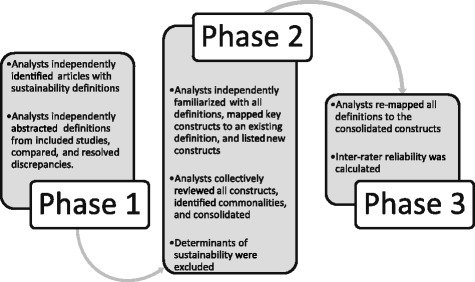
BACKGROUND: Understanding sustainability is one of the significant implementation science challenges. One of the big challenges in researching sustainability is the lack of consistent definitions in the literature. Most implementation studies do not present a definition of sustainability, even when assessing sustainability. The aim of the current study was to systematically develop a comprehensive definition of sustainability based on definitions already used in the literature. METHODS: We searched for knowledge syntheses of sustainability and abstracted sustainability definitions from the articles identified through any relevant systematic and scoping reviews. The constructs in the abstracted sustainability definitions were mapped to an existing definition. The comprehensive definition of sustainability was revised to include emerging constructs. RESULTS: We identified four knowledge syntheses of sustainability, which identified 209 original articles. Of the 209 articles, 24 (11.5%) included a definition of sustainability. These definitions were mapped to three constructs from an existing definition, and nine new constructs emerged. We reviewed all constructs and created a revised definition: (1) after a defined period of time, (2) a program, clinical intervention, and/or implementation strategies continue to be delivered and/or (3) individual behavior change (i.e., clinician, patient) is maintained; (4) the program and individual behavior change may evolve or adapt while (5) continuing to produce benefits for individuals/systems. All 24 definitions were remapped to the comprehensive definition (percent agreement among three coders was 94%). Of the 24 definitions, 17 described the continued delivery of a program (70.8%), 17 mentioned continued outcomes (70.8%), 13 mentioned time (54.2%), 8 addressed the individual maintenance of a behavior change (33.3%), and 6 described the evolution or adaptation (25.0%). CONCLUSIONS: We drew from over 200 studies to identify 24 existing definitions of sustainability. Based on these definitions, we identified five key sustainability constructs, which can be used as the basis for future research on sustainability. Our next step is to identify sustainability frameworks and develop a meta-framework using a concept mapping approach to consolidate the factors and considerations across sustainability frameworks.
Overview
The claims and statistics of this paper haven’t been checked yet.
Free: it reads the open-access text and checks the first 5 claims that cite a source we can check. Create a free account to check every claim.
Integrity signals
Registry
Cites
Statistics
Figures
Verification
Claims the paper makes
The claims and statistics of this paper haven’t been checked yet.
Free: it reads the open-access text and checks the first 5 claims that cite a source we can check. Create a free account to check every claim.
Claims other papers make about this one
Each is checked against this paper’s own text: does it say what the citing paper says it does?
The check wasn’t confident either way, so it gives no verdict — never disputed.
In the citing paper
“Management and reporting of SP present close connections, as one can serve as an input for the other.”
From Sustainability Reporting and Performance Measurement Systems: How do Small- and Medium-Sized Benefit Corporations Manage Integration? (2018) · cites this paper as [69]
Experimental — accuracy not yet measuredIn the citing paper
“More recently, the ability to adapt and continuously improve has also been recognised as a potential definition of sustainability [14].”
From Navigating the sustainability landscape: a systematic review of sustainability approaches in healthcare (2018) · cites this paper as [14]
Self-check
Percentages, sums and reported differences re-computed from the paper’s own numbers.
The self-check needs the paper’s full text.
Citations
Cites
The Measurement of Observer Agreement for Categorical Data
Landis, J. R., & Koch, G. G. (1977) · Biometrics · doi:10.2307/2529310 · Cited by 81,148 · cited 1×
“Inter-rater reliability for the mapped constructs was 94%, indicating substantial agreement among the three reviewers [28].”
BackgroundQualitative research in health care: Analysing qualitative data
Pope, C. (2000) · BMJ · doi:10.1136/bmj.320.7227.114 · Cited by 8,131
Diffusion of Innovations in Service Organizations: Systematic Review and Recommendations
GREENHALGH, T., ROBERT, G., MACFARLANE, F., BATE, P., & KYRIAKIDOU, O. (2004) · The Milbank Quarterly · doi:10.1111/j.0887-378x.2004.00325.x · Cited by 7,448 · cited 2×
““Sustainability of organizational innovations can be thought of as the point at which new ways of working become the norm and the underlying systems and ways of working become transformed in support” [2].”
BackgroundEvaluating the public health impact of health promotion interventions: the RE-AIM framework.
Glasgow, R. E., Vogt, T. M., & Boles, S. M. (1999) · American Journal of Public Health · doi:10.2105/ajph.89.9.1322 · Cited by 7,217 · cited 4×
“Definitions referring to evidence-based programs primarily focused on continuing program delivery at the organizational level, using descriptions such as “the continued use of an intervention” [22], “program or policy becomes institutionalized or part of the routine organizational practices and policies” [23], “progra…”
BackgroundInfluentialQualitative data analysis for applied policy research
(2002) · Analyzing Qualitative Data · doi:10.4324/9780203413081-14 · Cited by 4,964
Powell, B. J., Waltz, T. J., Chinman, M. J., Damschroder, L. J., Smith, J. L., Matthieu, M. M., Proctor, E. K., & Kirchner, J. E. (2015) · Implementation Science · doi:10.1186/s13012-015-0209-1 · Cited by 4,963
Qualitative data analysis for applied policy research
Ritchie, J., & Spencer, L. (2010) · Analyzing qualitative data · doi:10.4324/9780203413081_chapter_9 · Cited by 4,800
Advancing a Conceptual Model of Evidence-Based Practice Implementation in Public Service Sectors
Aarons, G. A., Hurlburt, M., & Horwitz, S. M. (2011) · Administration and Policy in Mental Health and Mental Health Services Research · doi:10.1007/s10488-010-0327-7 · Cited by 3,240
The dynamic sustainability framework: addressing the paradox of sustainment amid ongoing change
Chambers, D. A., Glasgow, R. E., & Stange, K. C. (2013) · Implementation Science · doi:10.1186/1748-5908-8-117 · Cited by 1,724 · cited 4×
“Definitions referring to evidence-based programs primarily focused on continuing program delivery at the organizational level, using descriptions such as “the continued use of an intervention” [22], “program or policy becomes institutionalized or part of the routine organizational practices and policies” [23], “progra…”
BackgroundInfluentialDissemination and Implementation Research in HealthTranslating Science to Practice
Brownson, R. C., Colditz, G. A., & Proctor, E. K. (2012) · doi:10.1093/acprof:oso/9780199751877.001.0001 · Cited by 1,355
Wiltsey Stirman, S., Kimberly, J., Cook, N., Calloway, A., Castro, F., & Charns, M. (2012) · Implementation Science · doi:10.1186/1748-5908-7-17 · Cited by 1,355 · cited 10×
“Most implementation studies do not include an explicit definition of sustainability [11].”
BackgroundInfluentialShediac-Rizkallah, M. C., & Bone, L. R. (1998) · Health Education Research · doi:10.1093/her/13.1.87 · Cited by 1,129
Is Sustainability Possible? A Review and Commentary on Empirical Studies of Program Sustainability
Scheirer, M. A. (2005) · American Journal of Evaluation · doi:10.1177/1098214005278752 · Cited by 710
Public health program capacity for sustainability: a new framework
Schell, S. F., Luke, D. A., Schooley, M. W., Elliott, M. B., Herbers, S. H., Mueller, N. B., & Bunger, A. C. (2013) · Implementation Science · doi:10.1186/1748-5908-8-15 · Cited by 563
No going back: A review of the literature on sustaining organizational change
Buchanan, D., Fitzgerald, L., Ketley, D., Gollop, R., Jones, J. L., Lamont, S. S., Neath, A., & Whitby, E. (2005) · International Journal of Management Reviews · doi:10.1111/j.1468-2370.2005.00111.x · Cited by 475 · cited 1×
“are maintained” [25], or “enduring part of the behavioral repertoire of an individual” [23].”
BackgroundProctor, E., Luke, D., Calhoun, A., McMillen, C., Brownson, R., McCrary, S., & Padek, M. (2015) · Implementation Science · doi:10.1186/s13012-015-0274-5 · Cited by 429 · cited 4×
“Building on existing sustainability research and the recommendations from Proctor and colleagues, our goal for the current study was to systematically develop a comprehensive definition of sustainability based on definitions already used in the literature [1].”
BackgroundMethodInfluentialBuilding capacity and sustainable prevention innovations: a sustainability planning model
Johnson, K., Hays, C., Center, H., & Daley, C. (2004) · Evaluation and Program Planning · doi:10.1016/j.evalprogplan.2004.01.002 · Cited by 411 · cited 1×
“Examples included “a suggested ‘adaptation phase’ that integrates and institutionalizes interventions within local organizational and cultural contexts” [22], “the dynamism of continuing change” [26], and “creating an environment for innovations to adapt to the system, if necessary” [27].”
BackgroundSustainability science: an integrated approach for health-programme planning
Gruen, R. L., Elliott, J. H., Nolan, M. L., Lawton, P. D., Parkhill, A., McLaren, C. J., & Lavis, J. N. (2008) · The Lancet · doi:10.1016/s0140-6736(08)61659-1 · Cited by 395 · cited 4×
“Gruen and colleagues included both conceptual frameworks and empirical studies about program sustainability within healthcare organizations or in community settings [20].”
BackgroundInfluentialDissemination and Implementation Research in Health: Translating Science to Practice
Chambers, D. (2023) · doi:10.1093/oso/9780197660690.001.0001 · Cited by 243
Iwelunmor, J., Blackstone, S., Veira, D., Nwaozuru, U., Airhihenbuwa, C., Munodawafa, D., Kalipeni, E., Jutal, A., Shelley, D., & Ogedegbe, G. (2015) · Implementation Science · doi:10.1186/s13012-016-0392-8 · Cited by 219 · cited 4×
“Iwelunmor J, Blackstone S, Veira D, Nwaozuru U, Airhihenbuwa C, Munodawafa D, et al. Toward the sustainability of health interventions implemented in sub-Saharan Africa: a systematic review and conceptual framework.”
BackgroundInfluentialThe sustainability of health promotion interventions for different levels of social organization
Swerissen, H. (2004) · Health Promotion International · doi:10.1093/heapro/dah113 · Cited by 205 · cited 1×
“Swerissen and Crisp (2004) [44] X X Moore et al.”
BackgroundSustaining Community‐Based Programs for Families: Conceptualization and Measurement*
Mancini, J. A., & Marek, L. I. (2004) · Family Relations · doi:10.1111/j.0197-6664.2004.00040.x · Cited by 199
Bossert, T. J. (1990) · Social Science & Medicine · doi:10.1016/0277-9536(90)90148-l · Cited by 195
A Framework for Understanding “Evidence” in Prevention Research and Programs
Kellam, S. G., & Langevin, D. J. (2003) · Prevention Science · doi:10.1023/a:1024693321963 · Cited by 195 · cited 1×
“The advantage of implementing evidence-based programs, rather than newly developed and untested programs, is that if such programs are delivered with high implementation quality, they can be expected to produce anticipated outcomes [29].”
BackgroundDevelopment of Level of Institutionalization Scales for Health Promotion Programs
Goodman, R. M., McLeroy, K. R., Steckler, A. B., & Hoyle, R. H. (1993) · Health Education Quarterly · doi:10.1177/109019819302000208 · Cited by 181
Ament, S. M. C., de Groot, J. J. A., Maessen, J. M. C., Dirksen, C. D., van der Weijden, T., & Kleijnen, J. (2015) · BMJ Open · doi:10.1136/bmjopen-2015-008073 · Cited by 177 · cited 4×
“Ament and colleagues included studies of sustainability that had at least two measurements (other than selfreporting), obtained before and immediately after implementation, of professionals’ adherence to a clinical practice guideline [15].”
BackgroundInfluentialDoyle, C., Howe, C., Woodcock, T., Myron, R., Phekoo, K., McNicholas, C., Saffer, J., & Bell, D. (2013) · Implementation Science · doi:10.1186/1748-5908-8-127 · Cited by 166
The sustainability of healthcare innovations: a concept analysis
Fleiszer, A. R., Semenic, S. E., Ritchie, J. A., Richer, M., & Denis, J. (2015) · Journal of Advanced Nursing · doi:10.1111/jan.12633 · Cited by 166 · cited 2×
“Fleiszer and colleagues completed a concept analysis on the sustainability of healthcare innovations where they described three characteristics of sustainability: continued benefits, routinization/institutionalization, and development [26].”
BackgroundProgram sustainability: focus on organizational routines
Pluye, P. (2004) · Health Promotion International · doi:10.1093/heapro/dah411 · Cited by 144
Tricco, A. C., Ashoor, H. M., Cardoso, R., MacDonald, H., Cogo, E., Kastner, M., Perrier, L., McKibbon, A., Grimshaw, J. M., & Straus, S. E. (2015) · Implementation Science · doi:10.1186/s13012-016-0421-7 · Cited by 139 · cited 6×
“The four reviews encompassed a total of 240 original research publications (39 from Gruen and colleagues [20], 125 from Stirman and colleagues [11], 14 from Ament and colleagues [15], and 62 from Tricco and colleagues [12]); because of overlap among the reviews, there were 209 unique citations.”
BackgroundInfluentialSelf-citationProject IMPACT: A Report on Barriers and Facilitators to Sustainability
Blasinsky, M., Goldman, H. H., & Unützer, J. (2006) · Administration and Policy in Mental Health and Mental Health Services Research · doi:10.1007/s10488-006-0086-7 · Cited by 121
Sustainability of health care: a framework for analysis
Olsen, I. (1998) · Health Policy and Planning · doi:10.1093/heapol/13.3.287 · Cited by 117
Stetler, C. B., Ritchie, J., Rycroft-Malone, J., Schultz, A., & Charns, M. (2007) · Implementation Science · doi:10.1186/1748-5908-2-3 · Cited by 84
Organizational Characteristics of Successful Innovative Health Care Programs Sustained Over Time
Evashwick, C., & Ory, M. (2003) · Family & Community Health · doi:10.1097/00003727-200307000-00003 · Cited by 76
Promoting Sustainability of Community Health Initiatives: An Empirical Case Study
Paine-Andrews, A., Fisher, J. L., Campuzano, M. K., Fawcett, S. B., & Berkley-Patton, J. (2000) · Health Promotion Practice · doi:10.1177/152483990000100311 · Cited by 46 · cited 1×
“Only 2 (8%) of the definitions incorporated both maintenance of a behavior by individuals and continued delivery of the program [21, 30].”
BackgroundIwelunmor, J., Blackstone, S. R., Veira, D., Nwaozuru, U., Airhihenbuwa, C. O., Munodawafa, D., Kalipeni, E., Jutal, A., Shelley, D., & Ogedegbe, G. G. (2015) · Implementation Science · doi:10.1186/s13012-016-0415-5 · Cited by 27
Francis, L., Dunt, D., & Cadilhac, D. A. (2016) · BMJ Open · doi:10.1136/bmjopen-2015-010944 · Cited by 24 · cited 2×
“8% (n = 10) of studies measuring individual-level sustainability outcomes [32].”
BackgroundResultPowell, N. R., & Lochman, J. E. (2004) · Contemporary Psychology · doi:10.1037/004883 · Cited by 2
Research works printed but not linked: 1
- Brownson R Colditz G Proctor E Dissemination and implementation research in health 2012 1 Oxford Oxford University Press
Cited by
The Sustainability of Evidence-Based Interventions and Practices in Public Health and Health Care
Shelton, R. C., Cooper, B. R., & Stirman, S. W. (2018) · Annual Review of Public Health · doi:10.1146/annurev-publhealth-040617-014731 · Cited by 806
Klaic, M., Kapp, S., Hudson, P., Chapman, W., Denehy, L., Story, D., & Francis, J. J. (2022) · Implementation Science · doi:10.1186/s13012-021-01171-7 · Cited by 394
“The two most frequently used frameworks included ongoing maintenance of benefits from the intervention, capacity building and integration of the intervention or program within the organisation [95, 96].”
BackgroundMethodShelton, R. C., Chambers, D. A., & Glasgow, R. E. (2020) · Frontiers in Public Health · doi:10.3389/fpubh.2020.00134 · Cited by 448
“(15) described sustainability as “after a defined period of time, the program, clinical intervention, and/or implementation strategies continue to be delivered and/or individual behavior change (i.”
BackgroundLennox, L., Maher, L., & Reed, J. (2018) · Implementation Science · doi:10.1186/s13012-017-0707-4 · Cited by 421
“More recently, the ability to adapt and continuously improve has also been recognised as a potential definition of sustainability [14].”
BackgroundMeans, A. R., Kemp, C. G., Gwayi-Chore, M.-C., Gimbel, S., Soi, C., Sherr, K., Wagenaar, B. H., Wasserheit, J. N., & Weiner, B. J. (2020) · Implementation Science · doi:10.1186/s13012-020-0977-0 · Cited by 418
“Sustainability is a key implementation outcome, and definitions of sustainability vary in the implementation literature [51, 52].”
Background
Metadata
- Authors
- Moore, J. E., Mascarenhas, A., Bain, J., & Straus, S. E.
- Affiliations
- St. Michael's Hospital (CA)
- Corresponding author
- Moore, Julia E.
- Venue
- Implementation Science
- Published
- 2017-09-02
- Volume
- 12
- Issue
- 1
- Pages
- 110-110
- ISSN
- 1748-5908 (ISSN-L)
- PMC
- PMC5581411
- OpenAlex
- W2751732558
- Cited by
- 630
- References
- 38
- Citations by year
- 2026: 56 · 2025: 82 · 2024: 99 · 2023: 111 · 2022: 87 · 2021: 86 · 2020: 48 · 2019: 27 · 2018: 28 · 2017: 5
- FWCI
- 47.67
- Type
- journal article
- Language
- en
- Open access
- gold
- doi.org
- Licence
- cc-by
- creativecommons.org/licenses/by/4.0/ (tdm)
- Locations
- Implementation Science (publishedVersion, cc-by)
- PubMed Central (publishedVersion, cc-by)
- PubMed (publishedVersion)
- TSpace (University of Toronto) (submittedVersion, cc-by)
- DOAJ (DOAJ: Directory of Open Access Journals) (submittedVersion, cc-by-sa)
- Topics
- Health Sciences › Health Professions › General Health Professions › Health Policy Implementation Science
- Health Sciences › Health Professions › General Health Professions › Health Sciences Research and Education
- Health Sciences › Medicine › Public Health, Environmental and Occupational Health › Clinical practice guidelines implementation
- Keywords
- sustainability, definition of sustainability, behavior maintenance, sustainability framework, concept mapping, meta-framework
- MeSH terms
- Delivery of Health Care, Health Plan Implementation, Health Services Research, Humans, Program Evaluation
About these checks
Registry, retraction, Cites and statistics results are computed, not judged, with one exception: a printed reference that no index lists is read once by a model before it counts as a citation error. Claims are extracted by a model and kept only when their quote appears verbatim in the text; each cited source is then checked, with a model’s help, for whether it says what the claim relies on. Those verdicts can be wrong — read the claim’s quote and the cited source before relying on one.
Statistics and arithmetic are recomputed, not judged.
Confidence bands are shown only for fields calibrated on our annotated test set. None is calibrated yet, so no band is shown.
What counts as a claim ›How we measure confidence ›How we check this ›
Are you an author, or do you see a problem with this page? Request a review
Data sources
Bibliographic data: Semantic Scholar, OpenAlex, Crossref.
Contains information from the Semantic Scholar Academic Graph Datasets, made available under the ODC Attribution License (ODC-BY 1.0).
Semantic Scholar’s data is described in: Kinney, R., et al. (2023). The Semantic Scholar Open Data Platform. arXiv:2301.10140.
