

Choosing implementation strategies to address contextual barriers: diversity in recommendations and future directions
Open accessThe DOI matches its Crossref record; 50 of the 50 references it cites were found in a registry or an index.
Abstract
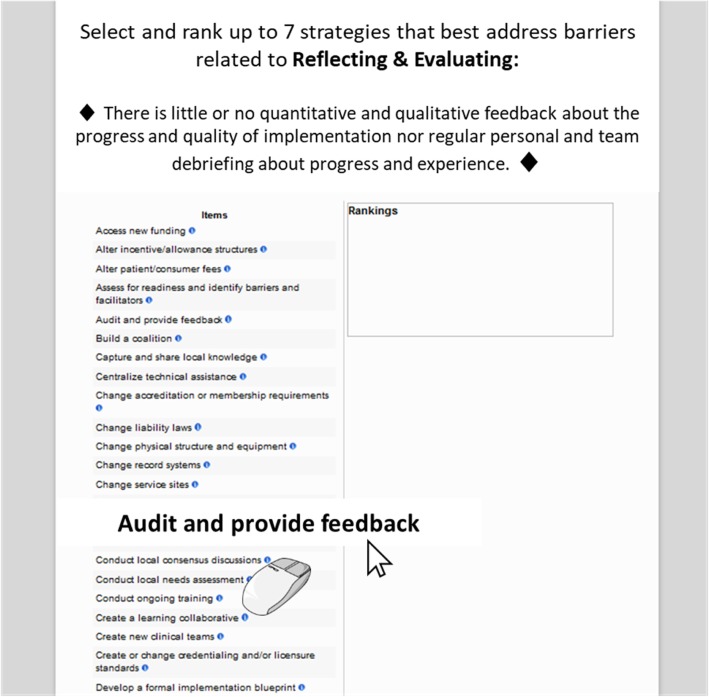
BACKGROUND: A fundamental challenge of implementation is identifying contextual determinants (i.e., barriers and facilitators) and determining which implementation strategies will address them. Numerous conceptual frameworks (e.g., the Consolidated Framework for Implementation Research; CFIR) have been developed to guide the identification of contextual determinants, and compilations of implementation strategies (e.g., the Expert Recommendations for Implementing Change compilation; ERIC) have been developed which can support selection and reporting of implementation strategies. The aim of this study was to identify which ERIC implementation strategies would best address specific CFIR-based contextual barriers. METHODS: Implementation researchers and practitioners were recruited to participate in an online series of tasks involving matching specific ERIC implementation strategies to specific implementation barriers. Participants were presented with brief descriptions of barriers based on CFIR construct definitions. They were asked to rank up to seven implementation strategies that would best address each barrier. Barriers were presented in a random order, and participants had the option to respond to the barrier or skip to another barrier. Participants were also asked about considerations that most influenced their choices. RESULTS: Four hundred thirty-five invitations were emailed and 169 (39%) individuals participated. Respondents had considerable heterogeneity in opinions regarding which ERIC strategies best addressed each CFIR barrier. Across the 39 CFIR barriers, an average of 47 different ERIC strategies (SD = 4.8, range 35 to 55) was endorsed at least once for each, as being one of seven strategies that would best address the barrier. A tool was developed that allows users to specify high-priority CFIR-based barriers and receive a prioritized list of strategies based on endorsements provided by participants. CONCLUSIONS: The wide heterogeneity of endorsements obtained in this study's task suggests that there are relatively few consistent relationships between CFIR-based barriers and ERIC implementation strategies. Despite this heterogeneity, a tool aggregating endorsements across multiple barriers can support taking a structured approach to consider a broad range of strategies given those barriers. This study's results point to the need for a more detailed evaluation of the underlying determinants of barriers and how these determinants are addressed by strategies as part of the implementation planning process.
Overview
The claims and statistics of this paper haven’t been checked yet.
Free: it reads the open-access text and checks the first 5 claims that cite a source we can check. Create a free account to check every claim.
Integrity signals
Registry
Cites
Statistics
Figures
Verification
Claims the paper makes
The claims and statistics of this paper haven’t been checked yet.
Free: it reads the open-access text and checks the first 5 claims that cite a source we can check. Create a free account to check every claim.
Claims other papers make about this one
Each is checked against this paper’s own text: does it say what the citing paper says it does?
The source backs part of the claim, not all of it — or backs it for a different population, condition or comparison.
In the citing paper
“a few best practices have been added: Teaming [42, 46, 73], Assessing Needs [46, 47], Assessing Context, Tailoring Strategies [14], and Adapting [45, 74, 75].”
From The updated consolidated framework for implementation research based on user feedback (2022) · cites this paper as [14]
Experimental — accuracy not yet measuredThe source backs part of the claim, not all of it — or backs it for a different population, condition or comparison.
In the citing paper
“Current literature also reflects an increasing number of studies testing the effectiveness of implementation strategies and the mechanisms that explain how these strategies may influence implementation outcomes [25–31].”
From Ten years of implementation outcomes research: a scoping review (2023) · cites this paper as [26]
Experimental — accuracy not yet measuredThe cited source says what the claim attributes to it.
In the citing paper
“Determinant frameworks can thus be used to inform choice of implementation strategies that may best address contextual determinants [14], generate hypotheses to prospectively guide predictions of implementation outcomes, or retrospectively explain implementation outcomes by assessing differences in determinants across implementation settings [11, 13, 15].”
From The updated consolidated framework for implementation research based on user feedback (2022) · cites this paper as [14]
Self-check
Percentages, sums and reported differences re-computed from the paper’s own numbers.
The self-check needs the paper’s full text.
Citations
Cites
Damschroder, L. J., Aron, D. C., Keith, R. E., Kirsh, S. R., Alexander, J. A., & Lowery, J. C. (2009) · Implementation Science · doi:10.1186/1748-5908-4-50 · Cited by 14,496
Self-citationHoffmann, T. C., Glasziou, P. P., Boutron, I., Milne, R., Perera, R., Moher, D., Altman, D. G., Barbour, V., Macdonald, H., Johnston, M., et al. (2014) · BMJ · doi:10.1136/bmj.g1687 · Cited by 10,548
Proctor, E., Silmere, H., Raghavan, R., Hovmand, P., Aarons, G., Bunger, A., Griffey, R., & Hensley, M. (2011) · Administration and Policy in Mental Health and Mental Health Services Research · doi:10.1007/s10488-010-0319-7 · Cited by 8,721
Michie, S., Richardson, M., Johnston, M., Abraham, C., Francis, J., Hardeman, W., Eccles, M. P., Cane, J., & Wood, C. E. (2013) · Annals of Behavioral Medicine · doi:10.1007/s12160-013-9486-6 · Cited by 7,629
What's in a name? Qualitative description revisited
Sandelowski, M. (2010) · Research in Nursing & Health · doi:10.1002/nur.20362 · Cited by 4,975
Powell, B. J., Waltz, T. J., Chinman, M. J., Damschroder, L. J., Smith, J. L., Matthieu, M. M., Proctor, E. K., & Kirchner, J. E. (2015) · Implementation Science · doi:10.1186/s13012-015-0209-1 · Cited by 4,963
Self-citationMaking sense of implementation theories, models and frameworks
Nilsen, P. (2015) · Implementation Science · doi:10.1186/s13012-015-0242-0 · Cited by 4,447
Implementation strategies: recommendations for specifying and reporting
Proctor, E. K., Powell, B. J., & McMillen, J. C. (2013) · Implementation Science · doi:10.1186/1748-5908-8-139 · Cited by 2,585
Self-citationKnowledge translation of research findings
Grimshaw, J. M., Eccles, M. P., Lavis, J. N., Hill, S. J., & Squires, J. E. (2012) · Implementation Science · doi:10.1186/1748-5908-7-50 · Cited by 2,407
Planning health promotion programs an intervention mapping approach
Bartholomew, L. K., Parcel, G. S., Kok, G., & Gottlieb, N. (2006) · Research Publications (Maastricht University) · Cited by 2,321
Research works printed but not linked: 2
- Waltz TJ Powell BJ Chinman MJ Damschroder LJ Smith JL Matthieu MM Proctor EK Kirchner JE Structuring complex recommendations: methods and general findings Implement Sci 2016 11 Suppl 1 A23
- Powell BJ Aarons GA Amaya-Jackson L Haley A Weiner BJ The collaborative approach to selecting and tailoring implementation strategies (COAST-IS) Implement Sci 2018 13 (Suppl 3): A79 39 40
Cited by
Items 701–800 of 1,000
Evaluating Implementation Strategies
Knocke, K., & Powell, B. J. (2023) · Oxford University Press eBooks · doi:10.1093/oxfordhb/9780190059668.013.17 · Cited by 1
Self-citationWands, B., Hu, J., George-Gay, B., Alley, A. H., & Damico, N. K. (2023) · Journal of Nursing Education · doi:10.3928/01484834-20230815-10 · Cited by 2
Ndlovu, P., & Potokri, O. C. (2023) · Humanities and Social Sciences Communications · doi:10.1057/s41599-023-02188-7 · Cited by 1
Bravo, G. P., Andrade, R. M. R., Zurita, S. A., Zúñiga, C. C., Navarro, E. S., & Romo-Medina, I. (2024) · International Research in Geographical and Environmental Education · doi:10.1080/10382046.2024.2348279 · Cited by 2
“To address barriers in EE, it is crucial to study and apply strategies that can help overcome them (Fixsen et al., 2019; Nadeem et al., 2013; Slaughter et al., 2015; Waltz et al., 2019).”
Sivertsen, D. M., Becker, U., Andersen, O., & Kirk, J. W. (2024) · Nordic Studies on Alcohol and Drugs · doi:10.1177/14550725241252256 · Cited by 1
“This could be due to contextual factors and the fact that interventions need to be adapted or tailored to the local context (Kirk et al., 2021; Waltz et al., 2019; Wensing et al., 2011).”
BackgroundTonkikh, O., Young, H. M., Bell, J. F., Famula, J., Whitney, R. L., Mongoven, J. M., & Kelly, K. (2024) · JMIR Aging · doi:10.2196/63355 · Cited by 1
Lowry, S., Low, J., Goff, L. M., Irwin, S., Sevdalis, N., Okeke, P., Brady, O., Curran, N., & Walker, A. (2024) · Journal of Human Nutrition and Dietetics · doi:10.1111/jhn.13396 · Cited by 1
“40 This approach, the study of the implementation context and the subsequent mapping of the identi fi ed contextual factors to speci fi c implementation strategies hypothesised to address them are key aspects of a theory ‐ supported implementation optimisation effort.”
Stout, N. L., Harrington, S., Perry, A. M., Alappattu, M. J., & Manes, M. R. (2025) · PM&R · doi:10.1002/pmrj.13301 · Cited by 1
“Our findings provide consensus on a prioritized approach to implementation which may optimize efficiency and help structure the implementation team work-plan 35 to reduce barriers more effectively.”
Eisman, A. B., Koffkey, C., Partridge, R. T., Brown, S., & Kim, B. (2025) · Pilot and Feasibility Studies · doi:10.1186/s40814-024-01581-6 · Cited by 3
“Training can improve behavioral capability by building knowledge, skills, and self-efficacy; this will build mastery for new content delivery, improving fidelity [71, 79].”
Smale, E. M., van den Berg, J., Heijman, J. K. –., Bekker, C. L., & van den Bemt, B. J. F. (2025) · International Journal for Quality in Health Care · doi:10.1093/intqhc/mzaf038 · Cited by 3
“Strategies were categorized into Level-1 (top strategies endorsed by ≥ 50% of experts) and Level-2 (endorsed by 20–50% of experts) [24].”
Implementation drivers scale: a new implementation measure to reduce mental health gaps
Agudelo‐Hernández, F., Guapacha-Montoya, M., & Reyes, A. C. D. (2025) · Primary Health Care Research & Development · doi:10.1017/s146342362510025x · Cited by 1
“Other instruments have been proposed to determine the implementation of mental health programmes (Grandes et al ., 2017; Rojas-Andrade et al. , 2023; Waltz et al .”
“I worry we'll blow right by it:” Barriers to Uptake of the STRATIFY-CDS for Acute Heart Failure
Christensen, M. A., Reale, C., Anders, S. H., Coffman, T., Alaw, H., Mathe, J. L., Albert, D., Sachs, A. L., McCoy, A. B., Liu, D., et al. (2025) · Applied Clinical Informatics · doi:10.1055/a-2594-3770 · Cited by 1
Kinney, A. R., Graham, J. E., Bukhari, R. A., Hoffman, A. L., & Malcolm, M. P. (2022) · American Journal of Occupational Therapy · doi:10.5014/ajot.121.049060 · Cited by 1
Ryan, G. W., Charlton, M. E., Scherer, A. M., Ashida, S., Gilbert, P. A., Daly, E., & Askelson, N. M. (2023) · Clinical Pediatrics · doi:10.1177/00099228231154661 · Cited by 2
Guscott, A., Deslandes, A., Parange, N., & Childs, J. T. (2023) · Australasian Journal of Ultrasound in Medicine · doi:10.1002/ajum.12331 · Cited by 1
Anjelina, C. P., & Safrida, S. (2022) · Musamus Journal of Public Administration · doi:10.35724/mjpa.v5i1.4507 · Cited by 1
Craig, A.-M. (2020) · St Andrews Research Repository (St Andrews Research Repository) · doi:10.17630/sta/16 · Cited by 2
Walker, E. (2000) · doi:10.15760/etd.7493 · Cited by 1
Olstad, D. L., Beall, R. F., Spackman, E., Dunn, S., Lipscombe, L. L., Williams, K., Oster, R. T., Scott, S., Zimmermann, G. L., McBrien, K., et al. (2021) · Research Square · doi:10.21203/rs.3.rs-180761/v1 · Cited by 1
McLoughlin, G. M., Sweeney, R., Liechty, L., Lee, J. A., Rosenkranz, R. R., & Welk, G. J. (2021) · Research Square · doi:10.21203/rs.3.rs-647714/v1 · Cited by 1
Marco, E. S. (2021) · Tesis Doctorals en Xarxa (Consorci de Serveis Universitaris de Catalunya) · doi:10.6035/14103.2021.588890 · Cited by 1
Westgard, C. M., & Orrego-Ferreyros, L. A. (2021) · Research Square · doi:10.21203/rs.3.rs-995871/v1 · Cited by 1
Beuf, T. L. F. D. (2022) · Research Publications (Maastricht University) · doi:10.26481/dis.20220404td · Cited by 2
Simmons, R. G., Baayd, J., Elliott, S., Cohen, S. R., & Turok, D. K. (2022) · Research Square · doi:10.21203/rs.3.rs-1662376/v1 · Cited by 1
Sichel, C. E., & Connors, E. H. (2022) · Research Square · doi:10.21203/rs.3.rs-1573722/v1 · Cited by 1
Potter, C., Leggat, F. J., Lowe, R., Pallmann, P., Riaz, M. A., Barlow, C., Edwards, A., Siriwardena, A. N., Sevdalis, N., Sewell, B., et al. (2023) · Research Square · doi:10.21203/rs.3.rs-2288918/v1 · Cited by 1
Dubbeldeman, E. M., van der Kleij, R., Brakema, E. A., & Crone, M. R. (2023) · doi:10.31219/osf.io/3vq7p · Cited by 1
Daele, T. V., Vis, C., Assche, E. V., & Riper, H. M. (2024) · Frontiers in Digital Health · doi:10.3389/fdgth.2023.1349545 · Cited by 2
Chen, J., Yang, J., Liu, S. J., Luo, L., He, W., Zhou, H., Ren, N., Zhou, Y., Cai, Y., Luo, H., et al. (2024) · Research Square · doi:10.21203/rs.3.rs-4627685/v1 · Cited by 1
Implementation of Robotic Walking in a School Environment: A Pilot StudyPreprint
Diot, C. M., Newton, E., Byrne, E., Mitchell, A., Norman, B., Youngblood, J. L., Jha, A., Hilderley, A., & Condliffe, E. G. (2026) · Research Square · doi:10.21203/rs.3.rs-10744666/v1 · Cited by 1
Avaliação das estratégias de implementação de guias de prática clínica de alta qualidade
de Vasconcelos, L. P. (2020) · Digital Library of Theses and Dissertations (Universidade de São Paulo) · doi:10.11606/d.5.2020.tde-05072020-131628
Iwelunmor, J., Ezechi, O., Obiezu‐Umeh, C., Oladele, D. A., Nwaozuru, U., Aifah, A. A., Gyamfi, J., Gbaja-Biamila, T. A., Musa, A. Z., Onakomaiya, D. O., et al. (2021) · Research Square · doi:10.21203/rs.3.rs-339833/v1
“Page 13/22 facilitators in other studies that can mitigate organization barriers by maintaining strategic direction and ensure that organizational resources are directed to support intervention adoption [21-23].”
BackgroundWestgard, C. M. (2021) · Research Square · doi:10.21203/rs.3.rs-491310/v1
Girling, C., Packham, A., Robinson, L., Arden, M. A., Hind, D., & Wildman, M. J. (2021) · Research Square · doi:10.21203/rs.3.rs-847358/v1
Delaforce, A., Duff, J. S., Munday, J., & Hardy, J. (2020) · Research Square · doi:10.21203/rs.3.rs-54589/v1
“During the barrier and strategy mapping, we included only the strongest suggested ERIC strategies (over 50% expert agreement for effectiveness) for each actor barrier in our recommendations to avoid losing context [14].”
BackgroundMethodInfluentialDamschroder, L. J., Sussman, J. B., Pfeiffer, P. N., Kurlander, J. E., Freitag, M. B., Robinson, C., Spoutz, P. M., Christopher, M. L. D., Battar, S., Dickerson, K., et al. (2022) · Research Square · doi:10.21203/rs.3.rs-1412713/v1
Self-citationCriteria for Prioritizing Best Practices to Implement in Cognitive Rehabilitation
Poulin, V., Pellerin, M., Lamontagne, M., Viau‐Guay, A., Ouellet, M., Jean, A., & Nicole, M. (2022) · Global Implementation Research and Applications · doi:10.1007/s43477-022-00041-8
“As suggested by various authors (King et al., 2020; Kirk et al., 2016; Waltz et al., 2019), theories or frameworks, such as the CFIR, could be used to inform pre-implementation assessment and help plan and select suitable implementation strategies, which would possibly increase the likelihood of best practices use.”
BackgroundMethodRegauer, V., Seckler, E., Campbell, C., Phillips, A., Rotter, T., Bauer, P., & Müller, M. (2021) · Research Square · doi:10.21203/rs.3.rs-216445/v1
McLoughlin, G. M., Sweeney, R., Liechty, L., Lee, J. A., Rosenkranz, R. R., & Welk, G. J. (2021) · Research Square · doi:10.21203/rs.3.rs-647714/v2
McLoughlin, G. M., Allen, P. M., Walsh‐Bailey, C., & Brownson, R. C. (2021) · Research Square · doi:10.21203/rs.3.rs-206237/v1
Richardson, E., Hogan, T. P., Shimada, S. L., Sliwinski, S. K., & Kim, B. (2022) · BMJ Open · doi:10.1136/bmjopen-2022-064450
Deng, B., Yang, K., Wang, Y., Li, Y., Hu, Y., & Liu, N. (2022) · Research Square · doi:10.21203/rs.3.rs-2141757/v1
Tan, E. S., McLeod, B. D., Mildon, R. L., Shlonsky, A., Seah, C. K. F., McCrickerd, K., Goh, E., & Kembhavi, G. (2022) · Research Square · doi:10.21203/rs.3.rs-2274099/v1
Afshar, M., Adelaine, S., Resnik, F., Mundt, M. P., Long, J., Leaf, M. A., Ampian, T., Wills, G. J., Schnapp, B. H., Chao, M., et al. (2022) · medRxiv · doi:10.1101/2022.12.04.22282990
Ontwikkeling en selectie van implementatiestrategieën
Grol, R. P. T. M., & Wensing, M. (2023) · Bohn Stafleu van Loghum eBooks · doi:10.1007/978-90-368-2909-0_10
Zelfmanagementinterventies: ontwikkeling, evaluatie en implementatie
Been-Dahmen, J., Ista, E., & van Staa, A. L. (2023) · Bohn Stafleu van Loghum eBooks · doi:10.1007/978-90-368-2919-9_13
Tarfa, A., Fadul, N. A., Stohs, E. J., Wetherhold, J., Kebede, M., Mirghani, N., & Ashraf, M. S. (2023) · Research Square · doi:10.21203/rs.3.rs-2742627/v1
Kanno, N. D. P. (2023) · Digital Library of Theses and Dissertations (Universidade de São Paulo) · doi:10.11606/d.5.2023.tde-31052023-165648 · Cited by 5
Zhai, S., Yuwen, W., Sonney, J., Hash, J. B., & Ward, T. M. (2023) · doi:10.2196/preprints.51128
A primer to implementation science and potential applications to precision medicine
Hearld, L. R. (2023) · Elsevier eBooks · doi:10.1016/b978-0-12-824010-6.00064-2
Selecting De‐Implementation Strategies and Designing Interventions
Presseau, J., McCleary, N., Patey, A. M., McHugh, S., & Lorencatto, F. (2023) · Wiley eBooks · doi:10.1002/9781119862758.ch9
Kemp, C. G. (2023) · Cambridge Prisms Global Mental Health · doi:10.1017/gmh.2023.63.pr7
(2023) · Cambridge Prisms Global Mental Health · doi:10.1017/gmh.2023.63.pr11
(2023) · Cambridge Prisms Global Mental Health · doi:10.1017/gmh.2023.63.pr4
(2023) · Cambridge Prisms Global Mental Health · doi:10.1017/gmh.2023.63.pr5
(2023) · Cambridge Prisms Global Mental Health · doi:10.1017/gmh.2023.63.pr10
(2023) · Cambridge Prisms Global Mental Health · doi:10.1017/gmh.2023.63.pr6
(2023) · Cambridge Prisms Global Mental Health · doi:10.1017/gmh.2023.63.pr9
(2023) · Cambridge Prisms Global Mental Health · doi:10.1017/gmh.2023.63.pr8
(2023) · Cambridge Prisms Global Mental Health · doi:10.1017/gmh.2023.63.pr3
(2023) · Cambridge Prisms Global Mental Health · doi:10.1017/gmh.2023.63.pr2
Kemp, C. G. (2023) · Cambridge Prisms Global Mental Health · doi:10.1017/gmh.2023.63.pr1
Leiva, L., Barría, D., & Zavala‐Villalón, G. (2024) · Psykhe (Santiago) · doi:10.7764/psykhe.2021.36777 · Cited by 2
Bouma, S. E. (2024) · University of Groningen research database (University of Groningen / Centre for Information Technology) · doi:10.33612/diss.910418216
Implementation of Biological Learning Management to Produce Productive Teachers
Akhmad, A. (2024) · EduLine Journal of Education and Learning Innovation · doi:10.35877/454ri.eduline2401
“Based on the description above, it can be understood that the organization of learning to complete the learning plan that has been made with the organizational structure or stages of its implementation (Hull et al., 2019; Waltz et al., 2019).”
BackgroundHilderley, A. J., Cassidy, C. E., Reist-Asencio, S., Tao, C., Tao, S., McCoy, S., Vurrabindi, D., O’Grady, K., Herrero, M., Cambridge, L., et al. (2024) · Implementation Science Communications · doi:10.1186/s43058-024-00602-y · Cited by 2
“The modifiable barriers and facilitators will be input-ted to the RISOME Query Tool [14], which outputs a list of possible strategies and the percent of experts who endorsed the match.”
BackgroundImplementation Science to Promote Equity in Women’s Behavioral Health
Vroom, E. B., & Sharp, A. (2024) · Springer eBooks · doi:10.1007/978-3-031-58293-6_11
Beckley, A. A., & Wong, C. K. (2024) · Research Square · doi:10.21203/rs.3.rs-4456817/v1
Implementierungsstrategien für Hygienemaßnahmen
Zingg, W. (2024) · Krankenhaushygiene up2date · doi:10.1055/a-2062-3476
Mohsen, M., Abbaticchio, A., Zhang, T., Jassal, S. V., & Battistella, M. (2024) · BMC Family Practice · doi:10.1186/s12875-024-02564-5
“Improving the uptake of CDS tools involves the application of strategies to address the barriers and facilitators to tool uptake in a given context [20].”
BackgroundManaging everyday life: exploring the essential components of reablement and user experiences
Mouchaers, I. (2024) · Research Publications (Maastricht University) · doi:10.26481/dis.20240913im · Cited by 3
(2024) · Revue scientifiques des travaux de fin d'étude en rééducation et réadaptation. · doi:10.25965/rse2r.259
TASKS-R Framework: A Refactorization and Refinement of TASKS FrameworkPreprint
Dong, H. (2024) · PsyArXiv (OSF Preprints) · doi:10.31234/osf.io/rftm9
Connell, L., Ackerley, S. J., & Rycroft‐Malone, J. (2024) · Research Square · doi:10.21203/rs.3.rs-4730004/v1
Implementation of interventions to enhance quality use of medicines
van Dijk, L., & Vervloet, M. (2024) · Wiley eBooks · doi:10.1002/9781119911685.ch51
Mootz, J. J., dos Santos, P. F., Moridi, L., dos Santos, K., Weissman, M. M., Oliffe, J. L., Stith, S. M., Khan, S., Feliciano, P., Suleman, A., et al. (2024) · Cambridge Prisms Global Mental Health · doi:10.1017/gmh.2024.92 · Cited by 1
“A query using the CFIR-Expert Recommendations for Implementing Change (CFIR-ERIC) (Waltz et al., 2019) tool confirmed that participatory inclusion of patients, families and community boards would be fruitful.”
MethodMeyer, S., Söling, S., Dymek, N. G., Britz, H., May, S., Dumröse, A., & Köberlein–Neu, J. (2024) · Prävention und Gesundheitsförderung · doi:10.1007/s11553-024-01172-6
Wolk, C. B., & Snyder, S. E. (2024) · Oxford University Press eBooks · doi:10.1093/oso/9780197579848.003.0008
Charmant, W. M., Snoeker, B. A. M., van Hout, H. P. J., Nauta, I. H., Boonstra, F., Geleijn, E., Veenhof, C., & Nanayakkara, P. W. B. (2024) · PLoS ONE · doi:10.1371/journal.pone.0314855 · Cited by 3
Murphy, C., French, H., McCarthy, G., Albers, B., & Cunningham, C. (2025) · Musculoskeletal Care · doi:10.1002/msc.70030
Katzmarzyk, P. T., Price‐Haywood, E. G., Apolzan, J. W., Denstel, K. D., Drews, K. L., Farris, E., Harden-Barrios, J., Hearld, L. R., Mire, E. F., Martin, C. K., et al. (2025) · Contemporary Clinical Trials · doi:10.1016/j.cct.2024.107806 · Cited by 1
Fredens, M., Terkildsen, M. D., Grønkjær, M., Toft, U., Hawkins, J. L., & Nielsen, C. P. (2025) · Research Square · doi:10.21203/rs.3.rs-5677797/v1
Facteurs impactant l’implantation de la réalité virtuelle en réadaptation pédiatrique
Hervo, J., Bailly, R., Levac, D. E., Brochard, S., & Pons, C. (2025) · Kinésithérapie la Revue · doi:10.1016/j.kine.2025.01.072
Allen, C. G., Marable, J., Foss, K., Whitcomb, C., Cragun, C., Buchanan, A. H., Hallquist, M. L. G., Baker, N. L., Bosch, R., Craig, D. W., et al. (2025) · doi:10.2196/preprints.73718
Self-citationKing, A. C., Zahrai, A., Bisson, E. J., Shergill, Y., Rice, D. B., Wai, E. K., Nedden, N. Z., Cooper, L., James, D. J., Rash, J. A., et al. (2025) · Digital Health · doi:10.1177/20552076251326229
“We used the Expert Recommendations for Implementing Change (ERIC)-CFIR matching tool 64 to identify two fi t-for-purpose interventions targeting the aforementioned implementation determinants.”
Society for Maternal‐Fetal Medicine (SMFM), Hamm, R. F., Chavan, N. R., Smith, N., & Ehrig, J. (2025) · Pregnancy · doi:10.1002/pmf2.70013 · Cited by 1
Iwelunmor, J., Wapmuk, A., Kokelu, E., Ojo, T., Olusanya, O. A., Gbaja-Biamila, T. A., Akinsolu, F. T., Musa, A. Z., Xian, H., Abodunrin, O. R., et al. (2025) · Implementation Science · doi:10.1186/s13012-025-01428-5 · Cited by 2
“Preliminary findings demonstrate that an implementation strategy [38] bundle that combines a mother-daughter campaign, tailored and adapted to local contexts, with education on cervical cancer and access to onsite services (i.e. access to HPV vaccination and HPV screening in private spaces) that…”
Sasaki, N., Shimazu, T., Ogawa, S., Sawada, U., Powell, B. J., Saito, J., Odawara, M., Takeno, H., Tsutsumi, A., & Imamura, K. (2025) · Journal of Occupational and Environmental Medicine · doi:10.1097/jom.0000000000003430
Self-citationIntegration of Evidence Into Practice
Messerall, T., Frantz, S., & McNett, M. (2025) · Clinical Journal for Nurse Practitioners in Women s Health · doi:10.1891/cjnpwh-2508
Ngongi, L. I., Akiba, C. F., Kilonzo, M. N., Minja, A., Komba, C., Mbaga, M., Msafiri, A., Kajula, L. J., Kaaya, S., Pence, B. W., et al. (2025) · PLoS ONE · doi:10.1371/journal.pone.0323502
“Going forward, a research agenda that utilizes a structured approach to developing implementation strategies like the CFIR-ERIC matching tool could help identify the most pragmatic next steps for KSADS-PL implementation at MNH [26].”
Klockar, E., Kylén, M., Gustavsson, C., Finch, T. L., Jones, F., & Elf, M. (2025) · Research Square · doi:10.21203/rs.3.rs-6047723/v1
Kamo, S., Yoshikawa, T., Ito, Y., Imamura, K., Kandabashi, K., Eguchi, H., Kawakami, N., Nishi, D., & Sasaki, N. (2025) · SANGYO EISEIGAKU ZASSHI · doi:10.1539/sangyoeisei.2024-036-b
Protocol for implementation of intraoperative adverse event recording during WHO checklist sign-out
Burri‐Winkler, K., Auderset, A. C., Hahnloser, D., Burkhart, C. S., Neuhaus, V., Gass, J., Vogt, A. P., Prouse, G., Winkens, J., Haller, G., et al. (2025) · BMJ Open Quality · doi:10.1136/bmjoq-2024-003286 · Cited by 1
Epstein, A. S., Knežević, A., Hoque, A., Rosa, W. E., Harding, J. J., Raj, N. P., Reidy‐Lagunes, D. L., Iyer, G., Applebaum, A. J., & Nelson, J. E. (2025) · JCO Oncology Practice · doi:10.1200/op-25-00059 · Cited by 1
A Problem-Solving Court for Crimes Against Older Adults
Pesta, G. B., Brancale, J. N., & Blomberg, T. G. (2025) · Laws · doi:10.3390/laws14030040
Morroni, D., Charalambous, E., & Karekla, M. (2025) · Journal of Contextual Behavioral Science · doi:10.1016/j.jcbs.2025.100919 · Cited by 1
Ditta, J., Longley, V., Woodward‐Nutt, K., Chouliara, N., Thomas, S., Cotterill, S., Bamford, A., Conroy, P., Bowen, A., & Patchwood, E. (2026) · BMC Health Services Research · doi:10.1186/s12913-026-14816-4 · Cited by 1
“Early consideration of barriers and facilitators can inform design optimisations and prevent resource wastage on unsuccessful implementation [28, 29], enhancing the likelihood of equitable and successful implementation.”
Society for Maternal‐Fetal Medicine (SMFM), Binstock, A., Bianco, A., Whitsel, A. I., Vijayvergiya, D. H., & Hamm, R. F. (2025) · Pregnancy · doi:10.1002/pmf2.70024 · Cited by 1
“Finally, sites should select implementation strategies to enhance success that might work best in their individual context [11, 12].”
Metadata
- Authors
- Waltz, T. J., Powell, B. J., Fernández, M. E., Abadie, B., & Damschroder, L. J.
- Affiliations
- Eastern Michigan University (US)
- University of North Carolina at Chapel Hill (US)
- The University of Texas Health Science Center at Houston (US)
- VA Center for Clinical Management Research (US)
- Corresponding author
- Damschroder, Laura J.
- Venue
- Implementation Science
- Published
- 2019-04-29
- Volume
- 14
- Issue
- 1
- Pages
- 42-42
- ISSN
- 1748-5908 (ISSN-L)
- PMC
- PMC6489173
- OpenAlex
- W2947410237
- Cited by
- 1,136
- References
- 50
- Citations by year
- 2026: 176 · 2025: 194 · 2024: 220 · 2023: 171 · 2022: 166 · 2021: 121 · 2020: 79 · 2019: 8
- FWCI
- 127.40
- Type
- journal article
- Language
- en
- Open access
- gold
- doi.org
- Licence
- cc-by
- creativecommons.org/licenses/by/4.0/ (tdm)
- creativecommons.org/licenses/by/4.0/ (vor)
- Locations
- Implementation Science (publishedVersion, cc-by)
- Europe PMC (PubMed Central) (publishedVersion, cc-by)
- PubMed Central (publishedVersion, cc-by)
- PubMed (publishedVersion)
- DOAJ (DOAJ: Directory of Open Access Journals) (submittedVersion, cc-by-sa)
- Funders
- U.S. Department of Veterans Affairs (QLP 92-025; QUERI DM, DIB 98-001)
- Topics
- Health Sciences › Health Professions › General Health Professions › Health Policy Implementation Science
- Health Sciences › Health Professions › General Health Professions › Health Sciences Research and Education
- Health Sciences › Medicine › Public Health, Environmental and Occupational Health › Clinical practice guidelines implementation
- Keywords
- implementation strategies, contextual barriers, Consolidated Framework for Implementation Research, Expert Recommendations for Implementing Change, ERIC, implementation planning, strategy selection, implementation barriers and facilitators
- MeSH terms
- Implementation Science, Health Plan Implementation, Health Services Research, Humans, Models, Theoretical, Quality of Health Care, Evidence-Based Practice
About these checks
Registry, retraction, Cites and statistics results are computed, not judged, with one exception: a printed reference that no index lists is read once by a model before it counts as a citation error. Claims are extracted by a model and kept only when their quote appears verbatim in the text; each cited source is then checked, with a model’s help, for whether it says what the claim relies on. Those verdicts can be wrong — read the claim’s quote and the cited source before relying on one.
Statistics and arithmetic are recomputed, not judged.
Confidence bands are shown only for fields calibrated on our annotated test set. None is calibrated yet, so no band is shown.
What counts as a claim ›How we measure confidence ›How we check this ›
Are you an author, or do you see a problem with this page? Request a review
Data sources
Bibliographic data: Semantic Scholar, OpenAlex, Crossref.
Contains information from the Semantic Scholar Academic Graph Datasets, made available under the ODC Attribution License (ODC-BY 1.0).
Semantic Scholar’s data is described in: Kinney, R., et al. (2023). The Semantic Scholar Open Data Platform. arXiv:2301.10140.
