

Choosing implementation strategies to address contextual barriers: diversity in recommendations and future directions
Open accessThe DOI matches its Crossref record; 50 of the 50 references it cites were found in a registry or an index.
Abstract
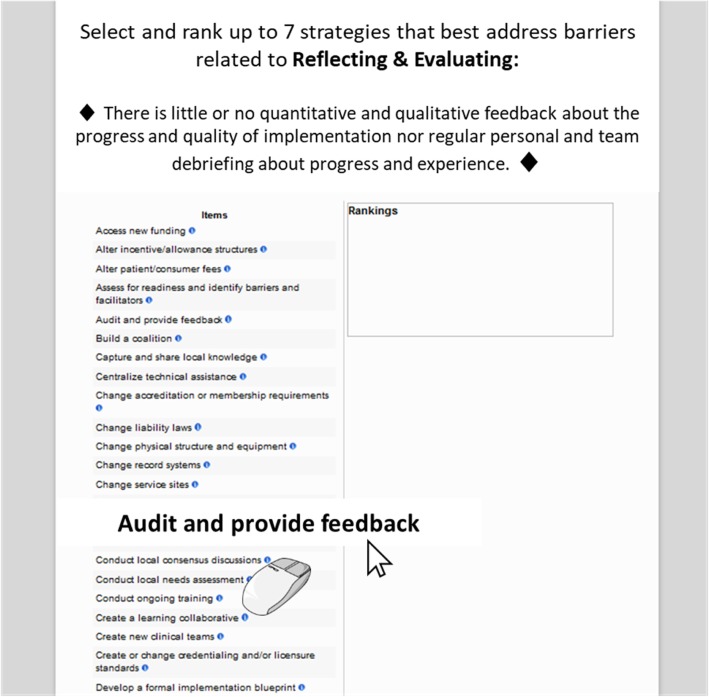
BACKGROUND: A fundamental challenge of implementation is identifying contextual determinants (i.e., barriers and facilitators) and determining which implementation strategies will address them. Numerous conceptual frameworks (e.g., the Consolidated Framework for Implementation Research; CFIR) have been developed to guide the identification of contextual determinants, and compilations of implementation strategies (e.g., the Expert Recommendations for Implementing Change compilation; ERIC) have been developed which can support selection and reporting of implementation strategies. The aim of this study was to identify which ERIC implementation strategies would best address specific CFIR-based contextual barriers. METHODS: Implementation researchers and practitioners were recruited to participate in an online series of tasks involving matching specific ERIC implementation strategies to specific implementation barriers. Participants were presented with brief descriptions of barriers based on CFIR construct definitions. They were asked to rank up to seven implementation strategies that would best address each barrier. Barriers were presented in a random order, and participants had the option to respond to the barrier or skip to another barrier. Participants were also asked about considerations that most influenced their choices. RESULTS: Four hundred thirty-five invitations were emailed and 169 (39%) individuals participated. Respondents had considerable heterogeneity in opinions regarding which ERIC strategies best addressed each CFIR barrier. Across the 39 CFIR barriers, an average of 47 different ERIC strategies (SD = 4.8, range 35 to 55) was endorsed at least once for each, as being one of seven strategies that would best address the barrier. A tool was developed that allows users to specify high-priority CFIR-based barriers and receive a prioritized list of strategies based on endorsements provided by participants. CONCLUSIONS: The wide heterogeneity of endorsements obtained in this study's task suggests that there are relatively few consistent relationships between CFIR-based barriers and ERIC implementation strategies. Despite this heterogeneity, a tool aggregating endorsements across multiple barriers can support taking a structured approach to consider a broad range of strategies given those barriers. This study's results point to the need for a more detailed evaluation of the underlying determinants of barriers and how these determinants are addressed by strategies as part of the implementation planning process.
Overview
The claims and statistics of this paper haven’t been checked yet.
Free: it reads the open-access text and checks the first 5 claims that cite a source we can check. Create a free account to check every claim.
Integrity signals
Registry
Cites
Statistics
Figures
Verification
Claims the paper makes
The claims and statistics of this paper haven’t been checked yet.
Free: it reads the open-access text and checks the first 5 claims that cite a source we can check. Create a free account to check every claim.
Claims other papers make about this one
Each is checked against this paper’s own text: does it say what the citing paper says it does?
The source backs part of the claim, not all of it — or backs it for a different population, condition or comparison.
In the citing paper
“a few best practices have been added: Teaming [42, 46, 73], Assessing Needs [46, 47], Assessing Context, Tailoring Strategies [14], and Adapting [45, 74, 75].”
From The updated consolidated framework for implementation research based on user feedback (2022) · cites this paper as [14]
Experimental — accuracy not yet measuredThe source backs part of the claim, not all of it — or backs it for a different population, condition or comparison.
In the citing paper
“Current literature also reflects an increasing number of studies testing the effectiveness of implementation strategies and the mechanisms that explain how these strategies may influence implementation outcomes [25–31].”
From Ten years of implementation outcomes research: a scoping review (2023) · cites this paper as [26]
Experimental — accuracy not yet measuredThe cited source says what the claim attributes to it.
In the citing paper
“Determinant frameworks can thus be used to inform choice of implementation strategies that may best address contextual determinants [14], generate hypotheses to prospectively guide predictions of implementation outcomes, or retrospectively explain implementation outcomes by assessing differences in determinants across implementation settings [11, 13, 15].”
From The updated consolidated framework for implementation research based on user feedback (2022) · cites this paper as [14]
Self-check
Percentages, sums and reported differences re-computed from the paper’s own numbers.
The self-check needs the paper’s full text.
Citations
Cites
Damschroder, L. J., Aron, D. C., Keith, R. E., Kirsh, S. R., Alexander, J. A., & Lowery, J. C. (2009) · Implementation Science · doi:10.1186/1748-5908-4-50 · Cited by 14,496
Self-citationHoffmann, T. C., Glasziou, P. P., Boutron, I., Milne, R., Perera, R., Moher, D., Altman, D. G., Barbour, V., Macdonald, H., Johnston, M., et al. (2014) · BMJ · doi:10.1136/bmj.g1687 · Cited by 10,548
Proctor, E., Silmere, H., Raghavan, R., Hovmand, P., Aarons, G., Bunger, A., Griffey, R., & Hensley, M. (2011) · Administration and Policy in Mental Health and Mental Health Services Research · doi:10.1007/s10488-010-0319-7 · Cited by 8,721
Michie, S., Richardson, M., Johnston, M., Abraham, C., Francis, J., Hardeman, W., Eccles, M. P., Cane, J., & Wood, C. E. (2013) · Annals of Behavioral Medicine · doi:10.1007/s12160-013-9486-6 · Cited by 7,629
What's in a name? Qualitative description revisited
Sandelowski, M. (2010) · Research in Nursing & Health · doi:10.1002/nur.20362 · Cited by 4,975
Powell, B. J., Waltz, T. J., Chinman, M. J., Damschroder, L. J., Smith, J. L., Matthieu, M. M., Proctor, E. K., & Kirchner, J. E. (2015) · Implementation Science · doi:10.1186/s13012-015-0209-1 · Cited by 4,963
Self-citationMaking sense of implementation theories, models and frameworks
Nilsen, P. (2015) · Implementation Science · doi:10.1186/s13012-015-0242-0 · Cited by 4,447
Implementation strategies: recommendations for specifying and reporting
Proctor, E. K., Powell, B. J., & McMillen, J. C. (2013) · Implementation Science · doi:10.1186/1748-5908-8-139 · Cited by 2,585
Self-citationKnowledge translation of research findings
Grimshaw, J. M., Eccles, M. P., Lavis, J. N., Hill, S. J., & Squires, J. E. (2012) · Implementation Science · doi:10.1186/1748-5908-7-50 · Cited by 2,407
Planning health promotion programs an intervention mapping approach
Bartholomew, L. K., Parcel, G. S., Kok, G., & Gottlieb, N. (2006) · Research Publications (Maastricht University) · Cited by 2,321
Research works printed but not linked: 2
- Waltz TJ Powell BJ Chinman MJ Damschroder LJ Smith JL Matthieu MM Proctor EK Kirchner JE Structuring complex recommendations: methods and general findings Implement Sci 2016 11 Suppl 1 A23
- Powell BJ Aarons GA Amaya-Jackson L Haley A Weiner BJ The collaborative approach to selecting and tailoring implementation strategies (COAST-IS) Implement Sci 2018 13 (Suppl 3): A79 39 40
Cited by
Items 101–200 of 1,000
Romney, W. M., Bellows, D. M., Tavernite, J. P., Salbach, N. M., & Deutsch, J. E. (2021) · Archives of Physical Medicine and Rehabilitation · doi:10.1016/j.apmr.2021.01.076 · Cited by 34
Investigating the Adoption of Clinical Genomics in Australia. An Implementation Science Case Study
Best, S., Long, J. C., Gaff, C., Braithwaite, J., & Taylor, N. J. (2021) · Genes · doi:10.3390/genes12020317 · Cited by 32
“, behaviours change techniques [25], or ERIC strategies [26]) and frameworks (e.”
BackgroundImplementation strategies in the context of medication reconciliation: a qualitative study
Stolldorf, D. P., Ridner, S. H., Vogus, T. J., Roumie, C. L., Schnipper, J. L., Dietrich, M. S., Schlundt, D. G., & Kripalani, S. B. (2021) · Implementation Science Communications · doi:10.1186/s43058-021-00162-5 · Cited by 37
Using Implementation Mapping to Build Organizational Readiness
Watson, A., Hernandez, B., Kolodny-Goetz, J., Walker, T. J., Lamont, A. E., Imm, P. S., Wandersman, A. H., & Fernández, M. E. (2022) · Frontiers in Public Health · doi:10.3389/fpubh.2022.904652 · Cited by 41
Self-citationSmith, J. D., Merle, J. L., Webster, K., Cahue, S., Penedo, F. J., & Garcia, S. F. (2022) · Frontiers in Health Services · doi:10.3389/frhs.2022.983217 · Cited by 33
Rocque, G. B., Dionne-Odom, J. N., Stover, A. M., Daniel, C. L., Azuero, A., Huang, C.-H. S., Ingram, S. A., Franks, J. A., Caston, N. E., Dent, D. A. N., et al. (2022) · BMC Health Services Research · doi:10.1186/s12913-022-07914-6 · Cited by 27
“0 and Intervention Mapping [44] to identify appropriate implementation strategies to overcome additional barriers encountered [45].”
BackgroundYakovchenko, V., Morgan, T. R., Chinman, M. J., Powell, B. J., Gonzalez, R., Park, A., Malone, P. S., Chartier, M., Ross, D., & Rogal, S. S. (2021) · BMC Health Services Research · doi:10.1186/s12913-021-07312-4 · Cited by 27
“Despite advances in naming and specifying implementation strategies, there is a lack of consensus on how to optimally choose strategies throughout the course of a multi-stage implementation [16].”
BackgroundSelf-citationA scoping review of implementation of health-focused interventions in vulnerable populations
Daniels, S. I., Cheng, H. L., Gray, C. P., Kim, B., Stave, C. D., & Midboe, A. M. (2022) · Translational Behavioral Medicine · doi:10.1093/tbm/ibac025 · Cited by 32
Azad, G. F., Minton, K. E., Mandell, D. S., & Landa, R. J. (2020) · Administration and Policy in Mental Health and Mental Health Services Research · doi:10.1007/s10488-020-01064-9 · Cited by 35
Implementation of School-Based COVID-19 Testing Programs in Underserved Populations
Haroz, E. E., Kalb, L. G., Newland, J. G., Goldman, J. L., Mast, D. K., Ko, L. K., Grass, R., Shah, P., Walsh, T., & Schuster, J. E. (2022) · PEDIATRICS · doi:10.1542/peds.2021-054268g · Cited by 30
Nelson, L. E., Ogunbajo, A., Abu-Ba’are, G. R., Conserve, D. F., Wilton, L., Ndenkeh, J. J. N., Braitstein, P. K. A., Dow, D. E., Arrington‐Sanders, R., Appiah, P., et al. (2022) · AIDS and Behavior · doi:10.1007/s10461-022-03776-5 · Cited by 29
Damush, T. M., Miech, E. J., Rattray, N. A., Homoya, B. J., Penney, L., Cheatham, A. J., Baird, S. A., Myers, J. L., Austin, C., Myers, L. J., et al. (2020) · Journal of General Internal Medicine · doi:10.1007/s11606-020-06100-w · Cited by 26
Scott, K., Murphy, C. M., Yap, K. R., Tosto, S. A., Hurley, L., & Becker, S. J. (2021) · Translational Issues in Psychological Science · doi:10.1037/tps0000245 · Cited by 29
von Meyenfeldt, E. M., van Nassau, F., de Betue, C. T. I., Barberio, L., Schreurs, W. H., Marres, G. M. H., Bonjer, H. J., & Anema, J. R. (2022) · BMJ Open · doi:10.1136/bmjopen-2021-051513 · Cited by 28
McLoughlin, G. M., Sweeney, R., Liechty, L., Lee, J. A., Rosenkranz, R. R., & Welk, G. J. (2022) · Frontiers in Health Services · doi:10.3389/frhs.2022.881639 · Cited by 31
Abraham, J., Holzer, K. J., Lenard, E. M., Meng, A., Pennington, B. R. T., Wolfe, R. C., Haroutounian, S., Calfee, R. P., Hammil, C. W., Kozower, B. D., et al. (2023) · American Journal of Geriatric Psychiatry · doi:10.1016/j.jagp.2023.09.003 · Cited by 31
Chinman, M., Gellad, W. F., McCarthy, S., Gordon, A. J., Rogal, S. S., Mor, M. K., & Hausmann, L. R. M. (2019) · Implementation Science · doi:10.1186/s13012-019-0852-z · Cited by 27
Implementing PrEP Services in Diverse Health Care Settings
Faro, E. Z., Mantell, J. E., Gonzalez-Argoti, T., Hoffman, S., Edelstein, Z. R., Tsoi, B. W., & Bauman, L. J. (2022) · JAIDS Journal of Acquired Immune Deficiency Syndromes · doi:10.1097/qai.0000000000002971 · Cited by 27
Piper, K. N., Haardörfer, R., Escoffery, C., Sheth, A. N., & Sales, J. M. (2021) · Implementation Science Communications · doi:10.1186/s43058-021-00148-3 · Cited by 25
“Although there is limited guidance on strategies to combat issues related to complexity, expert recommendations suggest that “promoting adaptability” may work for these settings [47].”
BackgroundMcLoughlin, G. M., Allen, P. M., Walsh‐Bailey, C., & Brownson, R. C. (2021) · Implementation Science Communications · doi:10.1186/s43058-021-00169-y · Cited by 46
Guyatt, S., Ferguson, M., Beckmann, M. M., & Wilkinson, S. A. (2021) · BMC Health Services Research · doi:10.1186/s12913-021-07024-9 · Cited by 34
“setting so we have followed the lead of other implementation researchers [44, 50] and separated expected and new parents for independent consideration alongside the”
BackgroundMethodAment, S. M. C., van den Broek, L. M., Everdingen, M. H. J. V. D. B.-V., Boyne, J. J., Maessen, J. M. C., Bekkers, S. C. A. M., Bellersen, L., Rocca, H. B., Engels, Y., & Janssen, D. J. A. (2022) · BMC Palliative Care · doi:10.1186/s12904-021-00896-y · Cited by 32
“Recruitment and training of clinical leadership among this topic may help to change the culture in cardiology [36].”
BackgroundPreferences of healthcare workers using tongue swabs for tuberculosis diagnosis during COVID-19
Codsi, R., Errett, N. A., Luabeya, A. K. K., van As, D., Hatherill, M., Shapiro, A. E., Lochner, K. A., Vingino, A. R., Kohn, M., & Cangelosi, G. A. (2023) · PLOS Global Public Health · doi:10.1371/journal.pgph.0001430 · Cited by 26
“, barriers and facilitators) and determining which implementation strategies will address them [20].”
BackgroundCzosnek, L., Zopf, E. M., Cormie, P., Rosenbaum, S., Richards, J. A., & Rankin, N. M. (2022) · Implementation Science Communications · doi:10.1186/s43058-022-00337-8 · Cited by 44
Implementation Science Methodologies for Complementary and Integrative Health Research
Clark, D. M., Edwards, E., Murray, P., & Langevin, H. M. (2021) · The Journal of Alternative and Complementary Medicine · doi:10.1089/acm.2020.0446 · Cited by 26
“This group, the Expert Recommendations for Implementing Change (ERIC), defined a list of 73 implementation strategies and created a crosswalk between ERIC and CFIR.31,32”
MethodOptimizing Implementation in Cancer Control (OPTICC): protocol for an implementation science center
Lewis, C. C., Hannon, P. A., Klasnja, P., Baldwin, L., Hawkes, R. J., Blackmer, J., & Johnson, A. N. (2021) · Implementation Science Communications · doi:10.1186/s43058-021-00117-w · Cited by 27
“Typically, determinants of cancer control EBI implementation are identified by participant interviews, focus groups, or surveys with providers and/or healthcare administrators using general determinants frameworks such as the Consolidated Framework for Implementation Research (CFIR) or the Theoretical Domains Framewor…”
BackgroundAmano, T., Hooley, C., Strong, J., & Inoue, M. (2021) · International Journal of Geriatric Psychiatry · doi:10.1002/gps.5641 · Cited by 30
Hudon, C., Chouinard, M., Bisson, M., Brousselle, A., Lambert, M., Danish, A., Rodríguez, C., & Sabourin, V. (2022) · International Journal of Integrated Care · doi:10.5334/ijic.5652 · Cited by 37
Context in Implementation Science
Kaplan, H. C., & Walsh, K. E. (2022) · PEDIATRICS · doi:10.1542/peds.2020-045948c · Cited by 31
Cohen, A. J., Russell, L. E., Elwy, A. R., Mitchell, K. M., Cornell, P. Y., Silva, J. W., Moy, E. M., & Kennedy, M. A. (2023) · Frontiers in Health Services · doi:10.3389/frhs.2022.958969 · Cited by 25
Delaforce, A., Duff, J. S., Munday, J., & Hardy, J. (2020) · Journal of Multidisciplinary Healthcare · doi:10.2147/jmdh.s282308 · Cited by 26
Connell, L., Chesworth, B. M., Ackerley, S., Smith, M., & Stinear, C. M. (2021) · Physical Therapy · doi:10.1093/ptj/pzab040 · Cited by 28
Li, J., Smyth, S. S., Clouser, J. M., McMullen, C. A., Gupta, V. A., & Williams, M. V. (2021) · Medicina · doi:10.3390/medicina57060570 · Cited by 24
“ing guideline-based evaluation and management of syncope within the local context, (2) how likely will the recommendations be delivered as prescribed (fidelity), and (3) what strategies might maximize the facilitators and overcome barriers to implementation? After completing context assessments, identifying barriers a…”
MethodInfluentialFakha, A., de Boer, B., van Achterberg, T., Hamers, J. P. H., & Verbeek, H. (2022) · BMC Geriatrics · doi:10.1186/s12877-021-02672-2 · Cited by 26
“Based on the existing literature, we hereby provide hands-on suggestions for addressing the priority factors when implementing a TCI [53, 54, 56].”
BackgroundMethodVerweij, L., Smit, Y., Blijlevens, N. M. A., & Hermens, R. (2022) · BMC Health Services Research · doi:10.1186/s12913-022-08020-3 · Cited by 29
“This process was guided by the CFIR-ERIC (Consolidated Framework for Implementation ResearchExpert Recommendations for Implementing Change) Implementation Strategy Matching tool, evaluating current barriers and facilitators for implementation and matching potential actions (strategies) using facilitators to reduce bar…”
MethodSchroeck, F. R., Ismail, A. A. O., Haggstrom, D. A., Sanchez, S. L., Walker, D. R., & Zubkoff, L. (2022) · Implementation Science · doi:10.1186/s13012-022-01231-6 · Cited by 24
“Appropriate strategies are guided by an implementation science theory or framework and consider contextual factors and known implementation barriers, which may differ across key stakeholders such as leaders, nurses, or providers [2].”
BackgroundReuter, K., Genao, K., Callanan, E. M., Cannone, D. E., Giardina, E. V., Rollman, B. L., Singer, J. R., Slutzky, A. R., Ye, S., Duran, A. T., et al. (2022) · Circulation Cardiovascular Quality and Outcomes · doi:10.1161/circoutcomes.122.009338 · Cited by 26
Wagner, A. D., Beima‐Sofie, K., Awuor, M., Owade, W. A., Neary, J., Dettinger, J. C., Pintye, J. C., Abuna, F., Lagat, H., Weiner, B. J., et al. (2023) · Frontiers in Reproductive Health · doi:10.3389/frph.2023.1205925 · Cited by 23
Kamran, R., Jackman, L., Laws, A., Stepney, M., Harrison, C. J., Jain, A., & Rodrigues, J. N. (2024) · PLoS ONE · doi:10.1371/journal.pone.0301922 · Cited by 24
Shrubsole, K., Copland, D. A., Hill, A. J., Khan, A., Lawrie, M., O’Connor, D. A., Pattie, M., Rodriguez, A. D., Ward, E. C., Worrall, L. E., et al. (2022) · Aphasiology · doi:10.1080/02687038.2022.2095608 · Cited by 23
“This tool supports selection of implementation strategies compiled by the Expert Recommendations for Implementing Change (ERIC) group according to specific Consolidated Framework for Implementation Research (CFIR) barriers, as endorsed by implementation experts (Waltz et al, 2019).”
MethodInfluentialBrimblecombe, J. K., Miles, B., Chappell, E., Silva, K. D., Ferguson, M., Mah, C. L., Miles, E., Gunther, A., Wycherley, T. P., Peeters, A., et al. (2023) · International Journal of Behavioral Nutrition and Physical Activity · doi:10.1186/s12966-022-01377-y · Cited by 26
“Further research is warranted to map these factors derived from the CFIR [44] to the longlist of implementation strategies (n = 73) for the adoption of evidence-based practice in clinical health care developed by Powel et al.”
BackgroundNommsen‐Rivers, L. A., Black, M. M., Christian, P. S., Groh‐Wargo, S. L., Heinig, M. J., Israel-Ballard, K. A., Obbagy, J., Palmquist, A. E. L., Stuebe, A. M., Barr, S. M., et al. (2023) · American Journal of Clinical Nutrition · doi:10.1016/j.ajcnut.2023.01.020 · Cited by 25
“In order to benefit both infants and lactating parents, discoveries in human milk require implementation research to determine how to improve the dissemination and uptake of scientific advancements across diverse populations and contexts [14, 15].”
BackgroundExamining barriers to implementing a surgical-site infection bundle
Dukes, K., Reisinger, H. S., Schweizer, M. L., Ward, M., Chapin, L., Ryken, T. C., Perl, T. M., & Herwaldt, L. A. (2023) · Infection Control and Hospital Epidemiology · doi:10.1017/ice.2023.114 · Cited by 26
“Additionally, using CFIR tools, 19,20 we identified implementation barriers (Table 2) and evidence-based strategies that may assist implementation (Table 3).”
MethodBigelow, K. M., Walker, D., Jia, F., Irvin, D., & Turcotte, A. (2020) · Early Childhood Research Quarterly · doi:10.1016/j.ecresq.2019.12.010 · Cited by 25
Kirk, J. W., Nilsén, P., Andersen, O., Powell, B. J., Tjørnhøj‐Thomsen, T., Bandholm, T., & Pedersen, M. M. (2022) · BMC Health Services Research · doi:10.1186/s12913-021-07395-z · Cited by 25
Self-citationManta, S. W., Sandreschi, P. F., dos Santos, M. C., Konrad, L. M., Tassitano, R. M., & Benedetti, T. R. B. (2022) · Preventive Medicine Reports · doi:10.1016/j.pmedr.2022.101875 · Cited by 30
“Assessing the intervention implementation processes, based on barriers and facilitation, allows for enhancing the desirable results and improving the assistance to users (Waltz et al., 2019).”
BackgroundAn Overview of Dissemination and Implementation Science in Physical Activity and Health Promotion
Estabrooks, P. A. (2023) · Kinesiology Review · doi:10.1123/kr.2022-0044 · Cited by 25
How Can Implementation Science Improve the Care of Familial Hypercholesterolaemia?
Sarkies, M., Jones, L. K., Pang, J., SULLIVAN, D. R., & Watts, G. F. (2023) · Current Atherosclerosis Reports · doi:10.1007/s11883-023-01090-6 · Cited by 26
Schol, C. M. A., van Mol, M. M. C., Berger, E., Leerentveld, C., Gommers, D. A. M. P. J., & Ista, E. (2024) · Australian Critical Care · doi:10.1016/j.aucc.2024.04.002 · Cited by 23
Fehily, C. M. C., Hodder, R. K., Bartlem, K. M., Wiggers, J., Wolfenden, L., Dray, J., Bailey, J. M., Wilczynska, M., Stockings, E., Clinton‐McHarg, T., et al. (2020) · Preventive Medicine Reports · doi:10.1016/j.pmedr.2020.101108 · Cited by 22
“However, this variability reflects the complexity of implementation research (Waltz et al., 2019).”
BackgroundImplementing immediate postpartum contraception: a comparative case study at 11 hospitals
Moniz, M. H., Bonawitz, K., Wetmore, M. K., Dalton, V. K., Damschroder, L. J., Forman, J. H., Peahl, A. F., & Heisler, M. (2021) · Implementation Science Communications · doi:10.1186/s43058-021-00136-7 · Cited by 23
“Strategies paired to determinants largely align with recommendations from the CFIR-ERIC Matching Tool [52].”
MethodSelf-citationGodbee, K., Gunn, J., Lautenschlager, N. T., & Palmer, V. J. (2020) · Australian Journal of Primary Health · doi:10.1071/py19249 · Cited by 20
Yi, T. W., O’Hara, D. V., Smyth, B. J., Jardine, M., Levin, A., & Morton, R. L. (2023) · Canadian Journal of Kidney Health and Disease · doi:10.1177/20543581231217857 · Cited by 23
“39 Adapting these strategies to the local setting, available resources, and infrastructure, may offer an improved likelihood to resolve these barriers.”
BackgroundSchultes, M.-T., Albers, B., Caci, L., Nyantakyi, E., & Clack, L. (2022) · Frontiers in Public Health · doi:10.3389/fpubh.2022.836552 · Cited by 27
Fridberg, H., Wallin, L., & Tistad, M. (2022) · BMC Health Services Research · doi:10.1186/s12913-022-08846-x · Cited by 24
“To match strategies with identified determinants has shown inconsistent results and has proven to be a complex task for researchers in implementation science [12].”
BackgroundDunbar, P., Keyes, L. M., & Browne, J. P. (2023) · PLoS ONE · doi:10.1371/journal.pone.0278007 · Cited by 57
Smith, A. W., DiMartino, L., Garcia, S. F., Mitchell, S. A., Ruddy, K. J., Smith, J. D., Wong, S. L., Cahue, S., Cella, D. F., Jensen, R. E., et al. (2023) · JNCI Cancer Spectrum · doi:10.1093/jncics/pkad073 · Cited by 21
McCrimmon, T., Collins, L. F., Perez‐Brumer, A., Bazzi, A. R., Shaffer, V. A., Kerrigan, D. L., Alcaide, M. L., & Philbin, M. M. (2024) · AIDS Patient Care and STDs · doi:10.1089/apc.2023.0248 · Cited by 21
“15 Prior research 16–18 has identified clinic-based factors that shape implementation of new health care technologies, practices, or guidelines: these include regulatory and legislative standards, access to financial and other resources, infrastructure and workflow structure, leadership,…”
Workflow Barriers and Strategies to Reduce Antibiotic Overuse in Nursing Homes
Ramly, E., Tong, M., Bondar, S., Ford, J. D., Nace, D. A., & Crnich, C. J. (2020) · Journal of the American Geriatrics Society · doi:10.1111/jgs.16632 · Cited by 20
Walker, T. J., Craig, D. W., Robertson, M. C., Szeszulski, J., & Fernández, M. E. (2021) · Translational Behavioral Medicine · doi:10.1093/tbm/ibaa133 · Cited by 22
Self-citationCombining Improvement and Implementation Sciences and Practices for the Post COVID-19 Era
Øvretveit, J., Mittman, B. S., Rubenstein, L. V., & Ganz, D. A. (2021) · Journal of General Internal Medicine · doi:10.1007/s11606-020-06373-1 · Cited by 22
Using decision analysis to support implementation planning in research and practice
Smith, N., Knocke, K., & Lich, K. H. (2022) · Implementation Science Communications · doi:10.1186/s43058-022-00330-1 · Cited by 29
“Tools such as the CFIR-ERIC matching tool can help narrow the possible universe of implementation strategies based on context- or intervention-specific barriers [5].”
BackgroundMethodYe, P., Jin, Y., Er, Y., Yin, X., Yao, Y., Li, B., Zhang, J., Ivers, R., Keay, L. J., Duan, L., et al. (2022) · JAMA Network Open · doi:10.1001/jamanetworkopen.2022.28960 · Cited by 23
van Tuijl, A. A. C., Wollersheim, H. C. H., Fluit, C. R. M. G., van Gurp, P. J. M., & Calsbeek, H. (2020) · Implementation Science Communications · doi:10.1186/s43058-020-00082-w · Cited by 21
Evaluating blinatumomab implementation in low- and middle-income countries: a study protocol
Duffy, C., Santana, V. M., Inaba, H., Jeha, S., Pauley, J. L., Sniderman, E., Ghara, N., Mushtaq, N., Narula, G., Bhakta, N. H., et al. (2022) · Implementation Science Communications · doi:10.1186/s43058-022-00310-5 · Cited by 23
Stan, J. H. V., Holmes, J. A., Wengerd, L. R., Juckett, L., Whyte, J., Pinto, S. M., Katz, L. W., & Wolfberg, J. (2022) · Archives of Physical Medicine and Rehabilitation · doi:10.1016/j.apmr.2022.09.021 · Cited by 19
Valenta, S., Ribaut, J., Leppla, L., Mielke, J., Teynor, A., Koehly, K., Gerull, S., Grossmann, F. F., Witzig-Brändli, V., Geest, S. D., et al. (2023) · Frontiers in Health Services · doi:10.3389/frhs.2022.977564 · Cited by 29
van der Laag, P. J., Dorhout, B. G., Heeren, A. A., Veenhof, C., Barten, D., & Schoonhoven, L. (2023) · Frontiers in Public Health · doi:10.3389/fpubh.2023.1253267 · Cited by 25
Verweij, L., Oesch, S., & Naef, R. (2023) · BMC Health Services Research · doi:10.1186/s12913-023-10285-1 · Cited by 25
“The thereby developed and refined multifaceted FSI implementation strategy falls into six of the nine ERIC implementation strategy domains [75].”
BackgroundMethodMartínez, O., Brady, K. A., Levine, E. C., Page, K. R., Zea, M. C., Yamanis, T. J., Grieb, S. M. D., Shinefeld, J., Ortiz, K. S., Davis, W., et al. (2020) · Ehquidad Revista Internacional de Políticas de Bienestar y Trabajo Social · doi:10.15257/ehquidad.2020.0009 · Cited by 25
Waid, J., & Choy-Brown, M. (2021) · Children and Youth Services Review · doi:10.1016/j.childyouth.2021.106098 · Cited by 24
Walker, T. J., Szeszulski, J., Robertson, M. C., Cuccaro, P. M., & Fernández, M. E. (2022) · Evaluation and Program Planning · doi:10.1016/j.evalprogplan.2022.102051 · Cited by 32
Self-citationXiong, B., Bailey, D. X., Stirling, C., Prudon, P., & Martin‐Khan, M. (2024) · BMC Health Services Research · doi:10.1186/s12913-024-11367-4 · Cited by 22
“The CFIR-ERIC Matching Tool [22] was developed based on expert consensus and was utilised to help guide choice of theoretically informed matching strategies to address CFIR barriers.”
Johnson, V. E., Jallawide, B. W., Anaman, R., Tarpeh, T. T., Jarnda, K. V., Sunday, B., Wingbah, M. W., Tarley, J. P. A., Zhang, K., & Shi, Y. (2025) · Journal of environmental chemical engineering · doi:10.1016/j.jece.2025.119611 · Cited by 21
Brakema, E. A., van der Kleij, R., Poot, C. C., Chavannes, N. H., Tsiligianni, I., Walusimbi, S., An, P. L., Sooronbaev, T., Numans, M. E., Crone, M. R., et al. (2021) · BMJ Global Health · doi:10.1136/bmjgh-2020-003221 · Cited by 27
Walker, T. J., Foster, M., Szeszulski, J., Craig, D. W., Mullen, P. D., & Fernández, M. E. (2022) · BMC Public Health · doi:10.1186/s12889-022-13692-x · Cited by 19
“Further understanding implementation strategy mechanisms is important for EBI success and an area of future work [38, 39].”
BackgroundSelf-citationBecker‐Haimes, E. M., Ramesh, B., Buck, J. E., Nuske, H. J., Zentgraf, K. A., Stewart, R. E., Buttenheim, A. M., & Mandell, D. S. (2022) · Implementation Science · doi:10.1186/s13012-022-01220-9 · Cited by 20
“Outputs from contextual inquiry ideally identify implementation determinants, which then drive which implementation strategies strategy selection (4,5).”
BackgroundIntegrating CFIR-ERIC and e-Delphi Methods to Increase Telegeriatrics Uptake
Kernan, L. M., Dryden, E. M., Nearing, K. A. J., Kennedy, M. A., Hung, W. W., Moo, L. R., & Pimentel, C. B. (2022) · The Gerontologist · doi:10.1093/geront/gnac107 · Cited by 23
Strategies to Bridge Equitable Implementation of Telehealth
Gustavson, A. M., Lewinski, A. A., Fitzsimmons‐Craft, E. E., Coronado, G. D., Linke, S., O’Malley, D. M., Adams, A. S., Glasgow, R. E., & Klesges, L. M. (2023) · Interactive Journal of Medical Research · doi:10.2196/40358 · Cited by 21
“Understanding mental models can help to select potential implementation strategies needed to promote the equitable implementation of telehealth across a variety of disciplines [35,58,59].”
BackgroundSideris, K., Weir, C. R., Schmalfuss, C. M., Hanson, H., Pipke, M., Tseng, P.-H., Lewis, N. P., Sallam, K., Bozkurt, B., Hanff, T. C., et al. (2024) · Journal of the American Medical Informatics Association · doi:10.1093/jamia/ocae017 · Cited by 23
Feasibility of Implementation Mapping for Integrative Medical Group Visits
Roth, I., Tiedt, M., Barnhill, J. L., Karvelas, K. R., Faurot, K. R., Gaylord, S. A., Gardiner, P. M., Miller, V. E., & Leeman, J. (2021) · The Journal of Alternative and Complementary Medicine · doi:10.1089/acm.2020.0393 · Cited by 22
“Both replication and identifying mechanisms are key to enhancing the rigor of implementation science.(22) Implementation mapping is based upon and closely mirrors intervention mapping, a process for designing health behavior interventions.”
BackgroundMethodInfluentialDeterminants of Evidence-based Practice Uptake in Rural Intensive Care Units. A Mixed Methods Study
Sterba, K. R., Johnson, E. E., Nadig, N. R., Simpson, A. N., Simpson, K. N., Goodwin, A. J., IV, Beeks, R., Warr, E. H., Zapka, J., & Ford, D. W. (2020) · Annals of the American Thoracic Society · doi:10.1513/annalsats.202002-170oc · Cited by 18
Murta, S. G., Nobre-Sandoval, L. D. A., Rocha, V. P. S., Miranda, A. A. V., Duailibe, K. D., Farias, D. A., de Menezes, J. C. L., Abdala, I. G., Gomes, M. D. S. M., & Vinha, L. G. D. A. (2020) · Prevention Science · doi:10.1007/s11121-020-01173-9 · Cited by 21
“Finally, one can speculate about the role of contextual factors (Waltz et al. 2019): the inadequacy of the support system (such as gaps in supervision and training) and the program offering infrastructure (for example, a lack of organizational capacity in the services responsible for…”
BackgroundRegauer, V., Seckler, E., Campbell, C., Phillips, A., Rotter, T., Bauer, P., & Müller, M. (2021) · Implementation Science Communications · doi:10.1186/s43058-021-00222-w · Cited by 23
Dong, O. M., Roberts, M. C., Wu, R. R., Voils, C. I., Sperber, N. R., Gavin, K. L., Bates, J. S., Coffinier, C., Naglich, M., Kelley, M. J., et al. (2021) · Pharmacogenomics · doi:10.2217/pgs-2021-0089 · Cited by 20
Implementation and evaluation of a syringe vending machine trial in Tbilisi, Georgia
Otiashvili, D., Kirtadze, I., Mgebrishvili, T., Beselia, A., Tabatadze, M., Vardanashvili, I., & Ober, A. J. (2022) · International Journal of Drug Policy · doi:10.1016/j.drugpo.2022.103649 · Cited by 18
Implementation of infection prevention and control for hospitalized neonates: A narrative review
Nyantakyi, E., Caci, L., Castro, M., Schlaeppi, C., Cook, A., Albers, B., Walder, J., Metsvaht, T., Bielicki, J. A., Dramowski, A., et al. (2022) · Clinical Microbiology and Infection · doi:10.1016/j.cmi.2022.11.007 · Cited by 23
Kassianos, A. P., Plackett, R., Kambouri, M. A., & Sheringham, J. (2023) · BMC Medical Education · doi:10.1186/s12909-023-04422-x · Cited by 18
Crellin, E., Martyn, M. M., McClaren, B., & Gaff, C. (2023) · European Journal of Human Genetics · doi:10.1038/s41431-023-01376-y · Cited by 23
“Nonetheless, the comprehensiveness of the Picker framework was a key strength, with aspects such as timeliness not captured in the measure of processes of care domains, for example.”
BackgroundEpstein, A. S., Knežević, A., Romano, D. R., Hoque, A., Raj, N. P., Reidy‐Lagunes, D. L., Rosa, W. E., Cruz, E. R., Calderon, C., O'Shaughnessy, S., et al. (2023) · JCO Clinical Cancer Informatics · doi:10.1200/cci.23.00125 · Cited by 19
Factors influencing older adult community fall prevention exercise implementation: a scoping review
Sibley, K. M., Tittlemier, B. J., Olarinde, F., Leadbetter, B., & B̀ouchard, D. R. (2024) · Age and Ageing · doi:10.1093/ageing/afae186 · Cited by 21
“The CFIR constructs have been systematically mapped to specific implementation strategies recommended to target each construct [11], making it a useful tool for facilitating implementation planning and decision-making.”
MethodHPV Vaccination Champions: Evaluating a Technology-Mediated Intervention for Parents
Sundstrom, B. L., Cartmell, K. B., White, A. A., Russo, N., Well, H., Pierce, J. Y., Brandt, H. M., Roberts, J. R., & Ford, M. E. (2021) · Frontiers in Digital Health · doi:10.3389/fdgth.2021.636161 · Cited by 19
Koester, M. N., Bejarano, C. M., Davis, A. M., Brownson, R. C., Kerner, J. F., Sallis, J. F., Steel, C., & Carlson, J. (2021) · Implementation Science Communications · doi:10.1186/s43058-021-00198-7 · Cited by 17
“Conversely, the CFIR-based findings are beneficial because they can be used to identify promising implementation strategies based on existing CFIR construct—implementation strategy mappings [30].”
BackgroundPeiffer‐Smadja, N., Descousse, S., Courrèges, E., Nganbou, A., Jeanmougin, P., Birgand, G., Lenaud, S., Beaumont, A., Durand, C., Delory, T., et al. (2024) · Journal of Medical Internet Research · doi:10.2196/45122 · Cited by 25
“These implementation strategies are tailored to address barriers identified with the CFIR framework [31].”
Nazari, A., Hajihashemi, M., Safavi, S. R., Ataei, R., & Hosseinnia, M. (2025) · BMC Oral Health · doi:10.1186/s12903-025-06549-3 · Cited by 39
“While variation is understandable in behavior change interventions, our analysis suggests that there could have been other contextual determinants [48].”
May, C. R., Hillis, A., Albers, B., Desveaux, L., Gilbert, A. W., Girling, M., Kislov, R., MacFarlane, A. E., Mair, F. S., Potthoff, S., et al. (2025) · Implementation Science · doi:10.1186/s13012-025-01444-5 · Cited by 28
“…tailored, and operationalized through a detailed action plan that is founded on a structured method—for example, implementation mapping [106, 107]—that specifies not just methods to select strategies to be executed, but also those responsible for executing them, the resources required to…”
Nooraie, R. Y., Lyons, P. G., Baumann, A. A., & Saboury, B. (2021) · PET Clinics · doi:10.1016/j.cpet.2021.07.002 · Cited by 19
Kolko, D. J., McGuier, E. A., Turchi, R. M., Thompson, E., Iyengar, S., Smith, S. N., Hoagwood, K., Liebrecht, C., Bennett, I. M., Powell, B. J., et al. (2022) · Implementation Science · doi:10.1186/s13012-022-01195-7 · Cited by 17
“We incorporate implementation science guidelines [55, 136, 145] and prior trial methods (e.”
MethodSelf-citationDevelopment of an interdisciplinary early rheumatoid arthritis care pathway
Gukova, X., Hazlewood, G. S., ARBILLAGA, H. O., MacMullan, P., Zimmermann, G. L., Barnabe, C. C. M., Choi, M. Y., Barber, M. R. W., Charlton, A., Job, B., et al. (2022) · BMC Rheumatology · doi:10.1186/s41927-022-00267-x · Cited by 21
“solutions were identified through linkage to ERIC recommendations [24].”
MethodToomey, C., Kennedy, N., MacFarlane, A. E., Glynn, L. G., Forbes, J., Skou, S. T., & Roos, E. M. (2022) · BMC Musculoskeletal Disorders · doi:10.1186/s12891-022-05599-w · Cited by 16
Metadata
- Authors
- Waltz, T. J., Powell, B. J., Fernández, M. E., Abadie, B., & Damschroder, L. J.
- Affiliations
- Eastern Michigan University (US)
- University of North Carolina at Chapel Hill (US)
- The University of Texas Health Science Center at Houston (US)
- VA Center for Clinical Management Research (US)
- Corresponding author
- Damschroder, Laura J.
- Venue
- Implementation Science
- Published
- 2019-04-29
- Volume
- 14
- Issue
- 1
- Pages
- 42-42
- ISSN
- 1748-5908 (ISSN-L)
- PMC
- PMC6489173
- OpenAlex
- W2947410237
- Cited by
- 1,136
- References
- 50
- Citations by year
- 2026: 176 · 2025: 194 · 2024: 220 · 2023: 171 · 2022: 166 · 2021: 121 · 2020: 79 · 2019: 8
- FWCI
- 127.40
- Type
- journal article
- Language
- en
- Open access
- gold
- doi.org
- Licence
- cc-by
- creativecommons.org/licenses/by/4.0/ (tdm)
- creativecommons.org/licenses/by/4.0/ (vor)
- Locations
- Implementation Science (publishedVersion, cc-by)
- Europe PMC (PubMed Central) (publishedVersion, cc-by)
- PubMed Central (publishedVersion, cc-by)
- PubMed (publishedVersion)
- DOAJ (DOAJ: Directory of Open Access Journals) (submittedVersion, cc-by-sa)
- Funders
- U.S. Department of Veterans Affairs (QLP 92-025; QUERI DM, DIB 98-001)
- Topics
- Health Sciences › Health Professions › General Health Professions › Health Policy Implementation Science
- Health Sciences › Health Professions › General Health Professions › Health Sciences Research and Education
- Health Sciences › Medicine › Public Health, Environmental and Occupational Health › Clinical practice guidelines implementation
- Keywords
- implementation strategies, contextual barriers, Consolidated Framework for Implementation Research, Expert Recommendations for Implementing Change, ERIC, implementation planning, strategy selection, implementation barriers and facilitators
- MeSH terms
- Implementation Science, Health Plan Implementation, Health Services Research, Humans, Models, Theoretical, Quality of Health Care, Evidence-Based Practice
About these checks
Registry, retraction, Cites and statistics results are computed, not judged, with one exception: a printed reference that no index lists is read once by a model before it counts as a citation error. Claims are extracted by a model and kept only when their quote appears verbatim in the text; each cited source is then checked, with a model’s help, for whether it says what the claim relies on. Those verdicts can be wrong — read the claim’s quote and the cited source before relying on one.
Statistics and arithmetic are recomputed, not judged.
Confidence bands are shown only for fields calibrated on our annotated test set. None is calibrated yet, so no band is shown.
What counts as a claim ›How we measure confidence ›How we check this ›
Are you an author, or do you see a problem with this page? Request a review
Data sources
Bibliographic data: Semantic Scholar, OpenAlex, Crossref.
Contains information from the Semantic Scholar Academic Graph Datasets, made available under the ODC Attribution License (ODC-BY 1.0).
Semantic Scholar’s data is described in: Kinney, R., et al. (2023). The Semantic Scholar Open Data Platform. arXiv:2301.10140.
