

DeepCpG: accurate prediction of single-cell DNA methylation states using deep learning
Open accessPublished version of a preprint
The DOI matches its Crossref record; 77 of the 80 references it cites were found in a registry or an index.
Abstract
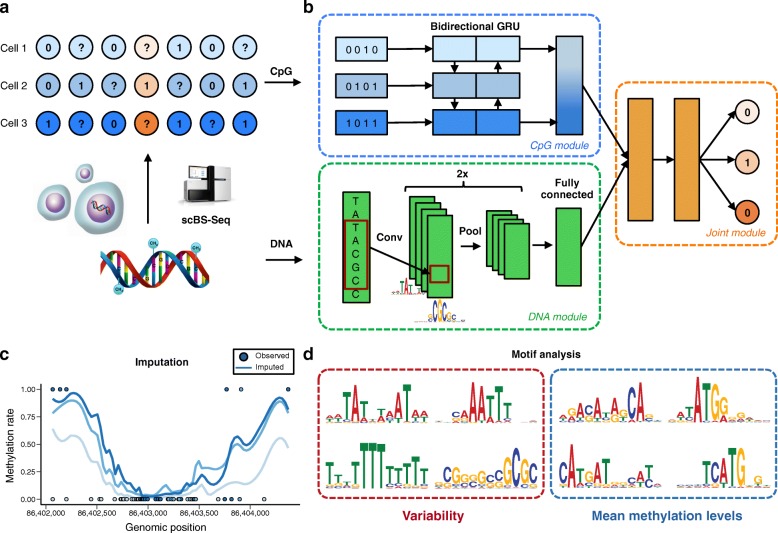
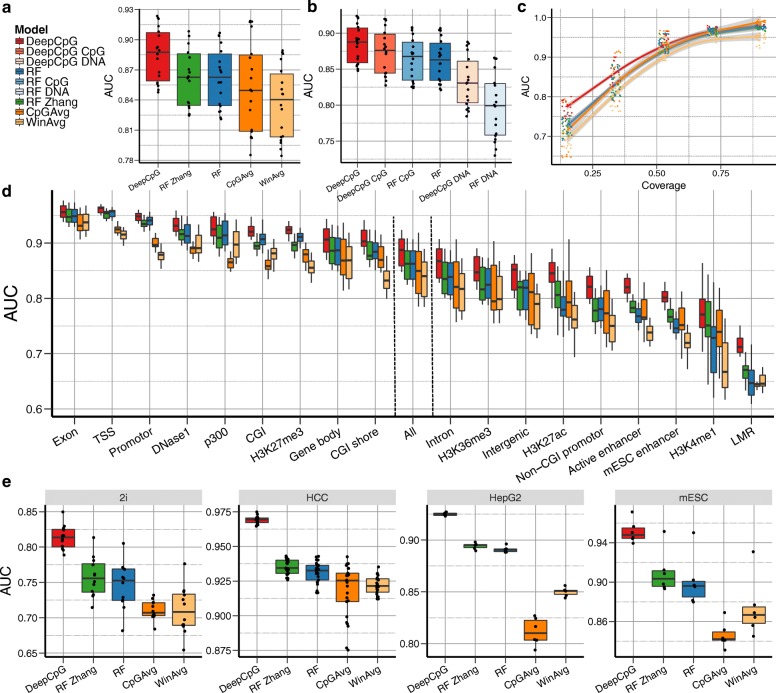
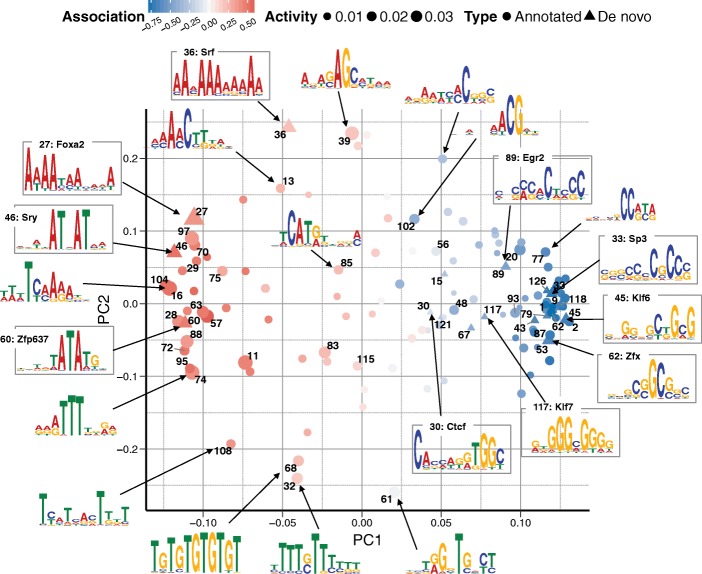
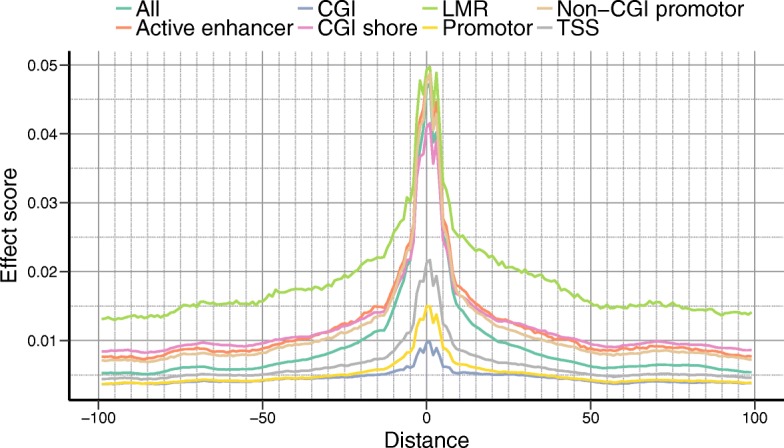
Recent technological advances have enabled DNA methylation to be assayed at single-cell resolution. However, current protocols are limited by incomplete CpG coverage and hence methods to predict missing methylation states are critical to enable genome-wide analyses. We report DeepCpG, a computational approach based on deep neural networks to predict methylation states in single cells. We evaluate DeepCpG on single-cell methylation data from five cell types generated using alternative sequencing protocols. DeepCpG yields substantially more accurate predictions than previous methods. Additionally, we show that the model parameters can be interpreted, thereby providing insights into how sequence composition affects methylation variability.
Overview
The claims and statistics of this paper haven’t been checked yet.
Free: it reads the open-access text and checks the first 5 claims that cite a source we can check. Create a free account to check every claim.
Integrity signals
Registry
Cites
Statistics
Figures
Verification
Claims the paper makes
The claims and statistics of this paper haven’t been checked yet.
Free: it reads the open-access text and checks the first 5 claims that cite a source we can check. Create a free account to check every claim.
Claims other papers make about this one
Each is checked against this paper’s own text: does it say what the citing paper says it does?
The cited source says what the claim attributes to it.
In the citing paper
“They showed that regions with increased methylation variability associate significantly more strongly to gene expression, indicating functional relevance.”
From Mapping gene regulatory networks from single-cell omics data (2018) · cites this paper as [75]
In the citing paper
“One possible way to deal with technical dropouts is proposed by Angermueller et al. [75] by developing DeepCpG, a computational approach based on deep neural networks, to predict missing methylation states and link methylation states to motifs.”
From Mapping gene regulatory networks from single-cell omics data (2018) · cites this paper as [75]
Self-check
Percentages, sums and reported differences re-computed from the paper’s own numbers.
The self-check needs the paper’s full text.
Citations
Cites
Deep Residual Learning for Image Recognition
He, K., Zhang, X., Ren, S., & Sun, J. (2016) · 2016 IEEE Conference on Computer Vision and Pattern Recognition (CVPR) · doi:10.1109/cvpr.2016.90 · Cited by 235,474
Breiman, L. (2001) · Machine Learning · doi:10.1023/a:1010933404324 · Cited by 133,538 · cited 1×
“Additionally, we compared DeepCpG to random forest classifiers [37] trained on individual cells using the DNA sequence information and neighbouring CpG states as input ( RF ).”
MethodAdam: A Method for Stochastic Optimization
Kingma, D. P., & Ba, J. (2014) · arXiv · doi:10.48550/arxiv.1412.6980 · Cited by 98,946 · cited 2×
“The learning rate was adapted by Adam [65] and decayed by a factor of 0.”
MethodInfluentialLeCun, Y., Bengio, Y., & Hinton, G. (2015) · Nature · doi:10.1038/nature14539 · Cited by 84,126
(2014) · Cited by 33,419
Neural Machine Translation by Jointly Learning to Align and Translate
Bahdanau, D., Cho, K., & Bengio, Y. (2014) · arXiv · doi:10.48550/arxiv.1409.0473 · Cited by 16,213 · cited 1×
“RNNs have been successfully used for modelling long-range dependencies in natural language [58, 59], acoustic signals [60] and, more recently, genomic sequences [61, 62].”
Method(2010) · Cited by 14,134
WebLogo: A Sequence Logo Generator: Figure 1
Crooks, G. E., Hon, G., Chandonia, J.-M., & Brenner, S. E. (2004) · Genome Research · doi:10.1101/gr.849004 · Cited by 12,386 · cited 2×
“Selected sequence windows were aligned and visualised as sequence motifs using WebLogo [69] version 3.”
MethodInfluentialBackpropagation Applied to Handwritten Zip Code Recognition
LeCun, Y., Boser, B., Denker, J. S., Henderson, D., Howard, R. E., Hubbard, W., & Jackel, L. D. (1989) · Neural Computation · doi:10.1162/neco.1989.1.4.541 · Cited by 11,891 · cited 1×
“Here, we report DeepCpG, a computational method based on deep neural networks [17 – 19] for predicting single-cell methylation states and for modelling the sources of DNA methylation variability.”
MethodRobust Locally Weighted Regression and Smoothing Scatterplots
Cleveland, W. S. (1979) · Journal of the American Statistical Association · doi:10.1080/01621459.1979.10481038 · Cited by 11,594 · cited 1×
“Trend lines were fit using local polynomial regression (LOESS [72]); shaded areas denote 95%”
Method
Research works printed but not linked: 1
- Denas O, Taylor J. Deep modeling of gene expression regulation in an erythropoiesis model. Represent. Learn. ICML Workshop. 2013
Cited by
Items 501–553 of 553
Potential of Interactive VR and Digital Twin for Drug Development and Clinical Trials
Malviya, R., & Rajput, S. (2025) · Wiley eBooks · doi:10.1002/9781394315680.ch8
Global Virology V: 21st Century Vaccines and Viruses
Shapshak, P., Balaji, S., Kangueane, P., Kuhn, J. H., Somboonwit, C., & Sinnott, J. T. (2025) · Springer eBooks · doi:10.1007/978-3-031-77911-4
A Review of AI Tools in Molecular Biology and Virology
Bhat, P. N., Balaji, S., & Shapshak, P. (2025) · Springer eBooks · doi:10.1007/978-3-031-77911-4_30 · Cited by 2
Emerging Trends in Genomics: Big Data and Deep Learning Technique
Chaturvedi, S., Agrawal, A., & Gupta, R. (2025) · Lecture notes in networks and systems · doi:10.1007/978-981-96-4151-2_4
Application of bioinformatics and data science in studies of cancer epigenetics
Chu, D.-T., Dao, T.-D., To, M.-H., Trinh, T. D., & Bui, N.-L. (2025) · International review of cytology · doi:10.1016/bs.ircmb.2025.10.003
Prediction of DNA Methylation Sites
Suresh, A., Bhandare, S., Talukdar, S., & Kalai, S. (2025) · International Conference on New Frontiers in Communication, Automation, Management and Security (ICCAMS) · doi:10.1109/iccams65118.2025.11234033
Deep learning of regulatory sequence variation in Pulmonary Arterial Hypertension
Tilly, T. (2023) · Apollo (University of Cambridge) · doi:10.17863/cam.100199
Levy, J. J., Titus, A. J., Petersen, C. L., Chen, Y., Salas, L. A., & Christensen, B. C. (2020) · Figshare · doi:10.6084/m9.figshare.11999295
Scott, C. A., Duryea, J., Mackay, H. A., Baker, M. S., Laritsky, E., Gunasekara, C., Coarfa, C., & Waterland, R. A. (2020) · Figshare · doi:10.6084/m9.figshare.12593127
Williams, J., Xu, B., Putnam, D. K., Thrasher, A., Li, C., Yang, J., & Chen, X. (2021) · Figshare · doi:10.6084/m9.figshare.13605199
Kapourani, C.-A., Argelaguet, R., Sanguinetti, G., & Vallejos, C. A. (2021) · Figshare · doi:10.6084/m9.figshare.14457368
Williams, J., Xu, B., Putnam, D. K., Thrasher, A., Li, C., Yang, J., & Chen, X. (2021) · Figshare · doi:10.6084/m9.figshare.13605193
Linker, S. M., Urban, L., Clark, S. J., Chhatriwala, M., Amatya, S., McCarthy, D. J., Ebersberger, I., Vallier, L., Reik, W., Stegle, O., et al. (2020) · Figshare · doi:10.6084/m9.figshare.11981907
Self-citationKapourani, C.-A., Argelaguet, R., Sanguinetti, G., & Vallejos, C. A. (2021) · Figshare · doi:10.6084/m9.figshare.14457353
Scott, C. A., Duryea, J., Mackay, H. A., Baker, M. S., Laritsky, E., Gunasekara, C., Coarfa, C., & Waterland, R. A. (2020) · Figshare · doi:10.6084/m9.figshare.12593130
Nguyen-Vo, T.-H., Trinh, Q. H., Nguyen, L., Nguyen-Hoang, P.-U., Rahardja, S., & Nguyen, B. P. (2022) · Figshare · doi:10.6084/m9.figshare.21269434
Krämer, S. J. (2023) · heiDOK (Heidelberg University) · doi:10.11588/heidok.00033968
Au Yeung, W. K., Maruyama, O., & Sasaki, H. (2021) · Figshare · doi:10.6084/m9.figshare.14833260
Kasvaimen genomin evoluution ennustaminen neuroverkoilla peräsuolen syövässä
Järvinen, T. (2024) · Aaltodoc (Aalto University)
Varatharajah, Y. (2020) · Illinois Digital Environment for Access to Learning and Scholarship (University of Illinois at Urbana-Champaign) · Cited by 1
Giwa, A. (2021) · University of the Western Cape Electronic Theses and Dissertations Repository (University of the Western Cape)
Applications of large‐scale artificial intelligence models in bioinformatics
Li, M., Shang, Q., Dong, Z., You, Z. S., Zhang, L., & Xiao, M. (2025) · Quantitative Biology · doi:10.1002/qub2.70026
“For instance, self ‐ supervised learning techniques can enhance the accuracy of protein structure prediction [6]; DL enables effective prediction of single ‐ cell deoxyribonucleic acid (DNA) methylation states [7, 8]; and variational autoen-coders [9] have been applied to biomolecular design.”
Machine Learning Approaches in Dna Analysis: Techniques, Applications, and Framework
Singh, P., Singh, K., Kaur, P., Kumar, R., Reshma, & Rajput, P. (2025) · IEEE International Conference for Women in Innovation, Technology & Entrepreneurship (ICWITE) · doi:10.1109/icwite64848.2025.11307160
Manoj, M., Bhagavathi, K., Fathima, S. A. N., Pillai, S. S., Malarvizhi, M., Shenbagam, M., Velayuthaprabhu, S., & Anand, A. V. (2026) · CABI biotechnology series. · doi:10.1079/9781800628649.0001 · Cited by 1
Choudhary, S. (2025) · International Conference on Communication, Computer, and Information Technology (IC3IT) · doi:10.1109/ic3it66137.2025.11341384
Liu, Y., Liu, Z., Jiang, T., Wang, Y., & Liu, Y. (2025) · IEEE International Conference on Bioinformatics and Biomedicine (BIBM) · doi:10.1109/bibm66473.2025.11356405
Optimizing Deep Learning Models for DNA Methylation Prediction
Fakhreddin, B. A., Dodlapati, S., & Sun, J. (2025) · IEEE International Conference on Bioinformatics and Biomedicine (BIBM) · doi:10.1109/bibm66473.2025.11356037
“By focusing on CNNs, we were able to systematically explore multiple configurations of depth, optimization, and input context length while maintaining feasible training times (Alipanahi et al., 2015; Angermueller et al., 2017).”
InfluentialThe Intersection of AI and genomics in health and disease: Advancements and applications
Kaushik, L., Vivek, A., Arora, S., Hamid, F., Mukherjee, K., Bisht, N., Chaudhary, S., Shukla, J., Nawani, S., & Kumar, S. (2026) · Progress in molecular biology and translational science · doi:10.1016/bs.pmbts.2026.01.013
Artificial Intelligence in the prediction of 3D chromatin structure and gene regulation
Pietryga, A., & Plewczyński, D. (2026) · Progress in molecular biology and translational science · doi:10.1016/bs.pmbts.2026.01.018
Probing sequence-level instructions for gene expression
Taha, M. (2018) · theses.fr (ABES) · doi:10.70675/4af494d2z4e2ez49ccz9821ze38a2c283ad4
Etude des éléments régulateurs de l'expression des gènes chez l'humain
Bessière, C. (2018) · theses.fr (ABES) · doi:10.70675/0b26676ez90bfz4f47zba59z90853f19d510
“développent DeepCpG pour comprendre l’influence de la composition de la séquence ADN, et notamment de petits motifs et leurs mutations, sur la variabilité de la méthylation chez l’homme et la souris [4], à partir de données de séquençage de cellules uniques (single-cell).”
BackgroundConception de séquences génomiques artificielles chez la levure par apprentissage profond
Routhier, E. (2021) · theses.fr (ABES) · doi:10.70675/9b8f6b3czd015z48afzb458z22d7510f2953
Modelling the geometry of high-dimensional omics data : dimensionality, subspaces, trajectories
Bac, J. (2022) · theses.fr (ABES) · doi:10.70675/3c682a3dz1b61z4109z9dbdz18ac2365aed0
Unsupervised representation learning for single-cell transcriptomic and epigenomic data
Raimundo, F. (2022) · theses.fr (ABES) · doi:10.70675/760cd5d0z17c6z4f4ezb476z68bd387daf22
Heurteau, A. (2019) · theses.fr (ABES) · doi:10.70675/95ea64bcz8d1cz44cez859azcdb19dafacec
Immortal AI, Mortal Life: Long-Term Perspectives on AI and Human Knowledge
Shim, H. (2026) · Journal of Medical Internet Research · doi:10.2196/98707
Bridging Sequence and Graph Structure for Epigenetic Age PredictionPreprint
Li, Y., Zhang, X., Shen, X., Tyagi, S., Zheng, X., Huang, J., & Xia, F. (2026) · arXiv (Cornell University) · doi:10.48550/arxiv.2605.10541
“[20] proposed DeepCpG, a convolutional neural network-based model designed to predict single-cell methylation states from local sequence windows, demonstrating that sequence motifs carry substantial predictive power for methylation variability [21, 22, 23, 24].”
Das, P., Choudhury, N. A., & Chhetry, B. (2026) · Archives of Computational Methods in Engineering · doi:10.1007/s11831-026-10634-3 · Cited by 1
“Further, Angermueller et al. [ 71] introduced DeepCpG models which outperformed otheer models, achieving - more than 90% AUC score in predicting methylation states across five cell types, while also providing insights into how sequence composition influences methylation variability.”
A Region-Aware Structured Framework Improves Prediction of Gene Expression from DNA Methylation
Zhong, Z., & Hu, J. (2026) · Computational and Structural Biotechnology Journal · doi:10.34133/csbj.0138
“However, existing approaches often treat methylation features from different genomic regions as a unified input to the model [ 25 – 27 ], lacking explicit modeling of region-specific regulatory differences.”
Varol, B., & Türkiş, F. C. (2026) · Wiley Interdisciplinary Reviews Data Mining and Knowledge Discovery · doi:10.1002/widm.70100
DNA methylation in glioblastoma: insights from single-cell epigenomics
Zohreh, R., Rezaei, N., & Amirifar, P. (2026) · Epigenomics · doi:10.1080/17501911.2026.2682246
Salman, M. (2026) · Innovative Medicines & Omics · doi:10.36922/imo025420055
Monajjemi, M., Mollaamin, F., Shahriari, A. H., & Khandestan, M. (2026) · Biointerface Research in Applied Chemistry · doi:10.33263/briac163.090
Bakhtiyari, N., Masoudi‐Sobhanzadeh, Y., Farajnia, S., & Kumar, S. (2026) · Bioinformatics · doi:10.1093/bioinformatics/btag483
“…Cas9 genome-editing efficiency prediction model using deep residual blocks, the final subset of features was selected by analyzing the weights of the first fully connected layer in the residual blocks, following an approach similar to that described in a previous study (Angermueller et al. 2017).”
The use of artificial intelligence in advancing molecular biology in Africa: a narrative review
Awuah, D., Hounkpe, A., Anane-Asamoah, J., Dakubo, W. K., Adu, I. K., Barnie, P. A., Ansah, E. O., Fosu, K., Aidoo, C. O., Essien, V., et al. (2026) · Molecular Genetics and Genomics · doi:10.1007/s00438-026-02492-2
“…- tion and chromatin-accessibility data can support feature selection, regulatory inference, and the prioritization of candidate loci for follow-up studies, including work on haemo - globinopathies, developmental regulation, and parasite gene control (Angermueller et al. 2017 ; Avsec et al. 2021).”
Deep learning as a bridge between sequencing-derived biological data and functional interpretation
Hong, H., Liu, L., Liao, W., Zhao, J., Liu, Y., He, X., Li, J., He, R., Jin, Y., Sha, L., et al. (2026) · Discover Artificial Intelligence · doi:10.1007/s44163-026-01739-6
“Similarly, Recurrent Neural Networks (RNNs) [12] and their derivatives, such as Long Short-Term Memory (LSTM) networks, have been effectively adapted to model sequential dependencies in tasks like DNA methylation prediction and RNA splicing analysis [13].”
Liang, H., Hua, H., Li, S., & Chen, S. (2026) · Briefings in Bioinformatics · doi:10.1093/bib/bbag434
“DeepCpG [ 20]: This method employs a multimodal deep learning architecture that fuses CNNs for extracting DNA sequence motifs with bidirectional GRUs for capturing spatial dependencies across neighboring CpG sites.”
InfluentialKhaldy, M. A. A., & Gheraibia, Y. (2026) · Advances in computational intelligence and robotics book series · doi:10.4018/979-8-2600-0161-5.ch004
SMORE: joint dimension reduction and cell population discovery on single-cell methylome dataPreprint
Deng, J., Wang, Z., Tang, W., Hu, G., & Feng, H. (2026) · bioRxiv (Cold Spring Harbor Laboratory) · doi:10.64898/2026.09.14.751514
“…to borrow information from local CpG neighborhoods and genomic sequence, whereas Melissa and Epiclomal employ probabilistic models that jointly infer missing methylation states and cellular population structure (Angermueller et al., 2017; Kapourani & San-guinetti, 2019; de Souza et al., 2020).”
The impact of deep learning and omics data in transforming precision therapy for brain cancer
Munquad, S., Upadhyay, A., & Das, A. B. (2026) · Frontiers in Bioinformatics · doi:10.3389/fbinf.2026.1811813
“DeepCpG, another DL-based method, focuses on predicting methylation states and detecting changes in methylation levels (Angermueller et al., 2017).”
Cheng, D. W. (2026) · Research Square · doi:10.21203/rs.3.rs-11183912/v1
An adversarial deep neural network for identifying non-alcoholic fatty liver disease
Wang, Y., Wang, Y., Zhang, R., Di, Q., Li, G., Wang, S., Liu, C., & Na, L. (2026) · Technology and Health Care · doi:10.1177/09287329261501859
Chen, S., Zhang, W., Dai, L., Xiong, Z., Lai, S., Xu, H., Gu, J., Peng, K., Jiang, N., Hong, L., et al. (2026) · iMetaOmics. · doi:10.1002/imo2.70156
Metadata
- Authors
- Angermueller, C., Lee, H. J., Reik, W., & Stegle, O.
- Affiliations
- European Bioinformatics Institute (GB)
- Babraham Institute (GB)
- Corresponding author
- Angermueller, Christof
- Stegle, Oliver
- Venue
- Genome Biology
- Published
- 2017-04-11
- Volume
- 18
- Issue
- 1
- Pages
- 67-67
- ISSN
- 1465-6906 (ISSN-L)
- 1474-760X
- PMC
- PMC5387360
- OpenAlex
- W2952935243
- Semantic Scholar
- 837566abb925a33b33544965bbe8d9bb710af7d6
- Cited by
- 536
- References
- 80
- Citations by year
- 2026: 28 · 2025: 51 · 2024: 50 · 2023: 54 · 2022: 52 · 2021: 88 · 2020: 69 · 2019: 66 · 2018: 53 · 2017: 23
- FWCI
- 24.45
- Type
- journal article
- Language
- en
- Update notices
- correction (2017-05-12)
- Open access
- gold
- doi.org
- Licence
- cc-by
- Locations
- Genome biology (publishedVersion, cc-by)
- bioRxiv (Cold Spring Harbor Laboratory) (acceptedVersion, cc-by-nc-nd)
- PubMed Central (publishedVersion, cc-by)
- PubMed (publishedVersion)
- DOAJ (DOAJ: Directory of Open Access Journals) (submittedVersion, cc-by-sa)
- Apollo (University of Cambridge) (submittedVersion, cc-by)
- Zenodo (CERN European Organization for Nuclear Research) (submittedVersion, other-oa)
- Apollo (cc-by)
- Funders
- Wellcome Trust
- European Molecular Biology Laboratory
- European Commission
- Biotechnology and Biological Sciences Research Council (BBS/E/B/0000S266, BBS/E/B/0000H334, BBS/E/B/000C0403)
- Topics
- Life Sciences › Biochemistry, Genetics and Molecular Biology › Molecular Biology › Epigenetics and DNA Methylation
- Life Sciences › Biochemistry, Genetics and Molecular Biology › Molecular Biology › Single-cell and spatial transcriptomics
- Life Sciences › Biochemistry, Genetics and Molecular Biology › Molecular Biology › Genomics and Chromatin Dynamics
- Keywords
- single-cell DNA methylation, deep neural network, model interpretability, sequence composition
About these checks
Registry, retraction, Cites and statistics results are computed, not judged, with one exception: a printed reference that no index lists is read once by a model before it counts as a citation error. Claims are extracted by a model and kept only when their quote appears verbatim in the text; each cited source is then checked, with a model’s help, for whether it says what the claim relies on. Those verdicts can be wrong — read the claim’s quote and the cited source before relying on one.
Statistics and arithmetic are recomputed, not judged.
Confidence bands are shown only for fields calibrated on our annotated test set. None is calibrated yet, so no band is shown.
What counts as a claim ›How we measure confidence ›How we check this ›
Are you an author, or do you see a problem with this page? Request a review
Data sources
Bibliographic data: Semantic Scholar, OpenAlex, Crossref.
Contains information from the Semantic Scholar Academic Graph Datasets, made available under the ODC Attribution License (ODC-BY 1.0).
Semantic Scholar’s data is described in: Kinney, R., et al. (2023). The Semantic Scholar Open Data Platform. arXiv:2301.10140.
