

Assessment of computational methods for the analysis of single-cell ATAC-seq data
Open accessPublished version of a preprint
The DOI matches its Crossref record; 47 of the 47 references it cites were found in a registry or an index.
Abstract
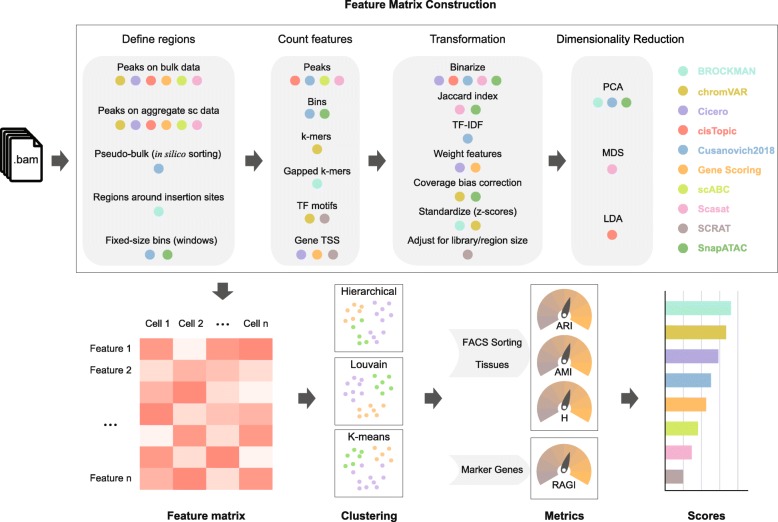
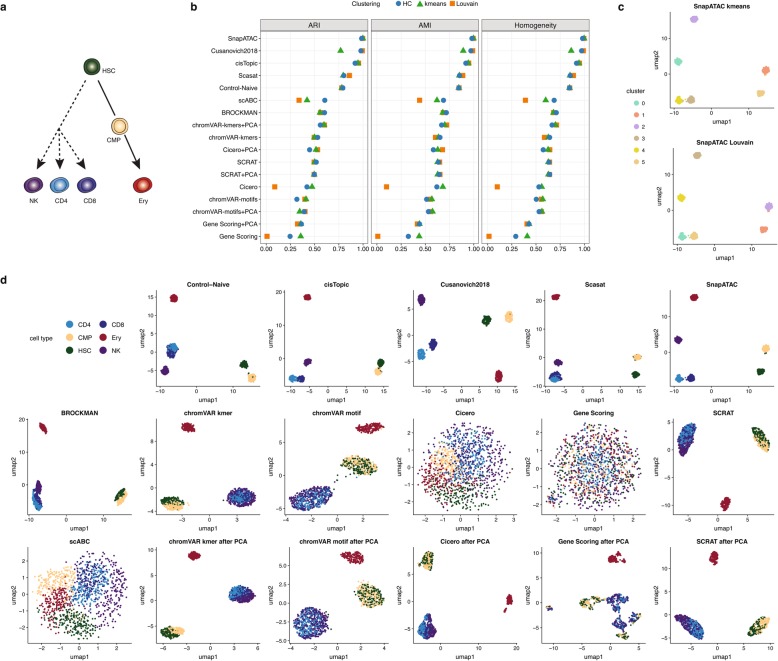
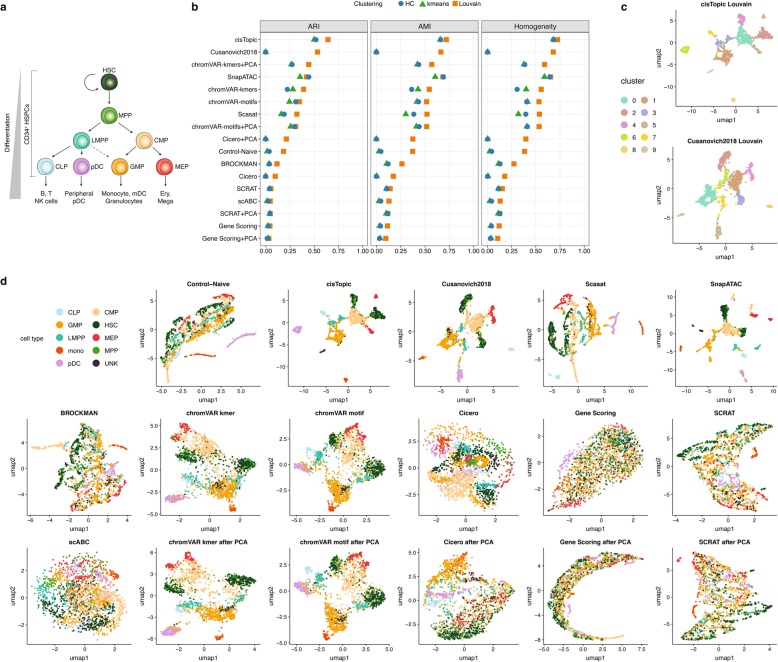
Background: Recent innovations in single-cell Assay for Transposase Accessible Chromatin using sequencing (scATAC-seq) enable profiling of the epigenetic landscape of thousands of individual cells. scATAC-seq data analysis presents unique methodological challenges. scATAC-seq experiments sample DNA, which, due to low copy numbers (diploid in humans), lead to inherent data sparsity (1–10% of peaks detected per cell) compared to transcriptomic (scRNA-seq) data (10–45% of expressed genes detected per cell). Such challenges in data generation emphasize the need for informative features to assess cell heterogeneity at the chromatin level. Results: We present a benchmarking framework that is applied to 10 computational methods for scATAC-seq on 13 synthetic and real datasets from different assays, profiling cell types from diverse tissues and organisms. Methods for processing and featurizing scATAC-seq data were compared by their ability to discriminate cell types when combined with common unsupervised clustering approaches. We rank evaluated methods and discuss computational challenges associated with scATAC-seq analysis including inherently sparse data, determination of features, peak calling, the effects of sequencing coverage and noise, and clustering performance. Running times and memory requirements are also discussed. Conclusions: This reference summary of scATAC-seq methods offers recommendations for best practices with consideration for both the non-expert user and the methods developer. Despite variation across methods and datasets, SnapATAC, Cusanovich2018 , and cisTopic outperform other methods in separating cell populations of different coverages and noise levels in both synthetic and real datasets. Notably, SnapATAC is the only method able to analyze a large dataset (> 80,000 cells).
Overview
The claims and statistics of this paper haven’t been checked yet.
Free: it reads the open-access text and checks the first 5 claims that cite a source we can check. Create a free account to check every claim.
Integrity signals
Registry
Cites
Statistics
Figures
Verification
Claims the paper makes
The claims and statistics of this paper haven’t been checked yet.
Free: it reads the open-access text and checks the first 5 claims that cite a source we can check. Create a free account to check every claim.
Claims other papers make about this one
Each is checked against this paper’s own text: does it say what the citing paper says it does?
In the citing paper
“In particular, for scATAC feature assignments specific to CRISPR perturbations, known loci of action could be used to improve feature calls40.”
From scPerturb: harmonized single-cell perturbation data (2024) · cites this paper as [40]
In the citing paper
“Most workflows use a cell-by-peak or cell-by-bin matrix as a basis for analysis, which performs better than matrices of gene or TF motif features135”
From Best practices for single-cell analysis across modalities (2023) · cites this paper as [135]
In the citing paper
“Dimensionality reduction methods based on latent semantic indexing (ArchR140 and Signac143), latent Dirichlet allocation (cisTopic141) and spectral embedding (snapATAC136) were shown to perform best for downstream clustering and cell annotation135.”
From Best practices for single-cell analysis across modalities (2023) · cites this paper as [135]
In the citing paper
“Notably, the cell-by-peak matrix is even more sparse than scRNA-seq data, with only 1–10% of peaks called in each cell owing to the presence of only two copies of assayable chromatin in cells of a diploid organism135.”
From Best practices for single-cell analysis across modalities (2023) · cites this paper as [135]
In the citing paper
“Initial approaches that map multimodal data into a common feature space based on prior knowledge — such as assay for transposase-accessible chromatin (ATAC) regions to nearby transcripts — with subsequent application of single-cell data integration methods have been shown to result in information loss135.”
From Best practices for single-cell analysis across modalities (2023) · cites this paper as [135]
Self-check
Percentages, sums and reported differences re-computed from the paper’s own numbers.
The self-check needs the paper’s full text.
Citations
Cites
Scikit-learn: Machine Learning in Python
Pedregosa, F., Varoquaux, G., Gramfort, A., Michel, V., Thirion, B., Grisel, O., Blondel, M., Müller, A., Nothman, J., Louppe, G., et al. (2012) · arXiv · doi:10.48550/arxiv.1201.0490 · Cited by 71,016 · cited 1×
“For this study, we used three commonly used clustering methods: k-means, hierarchical clustering (with default ward linkage) as implemented in the scikit-learn library [32], and Louvain clustering (a community detection-based method) [33, 34] as implemented in Scanpy [35].”
MethodBEDTools: a flexible suite of utilities for comparing genomic features
Quinlan, A. R., & Hall, I. M. (2010) · Bioinformatics · doi:10.1093/bioinformatics/btq033 · Cited by 27,437
Fast unfolding of communities in large networks
Blondel, V. D., Guillaume, J.-L., Lambiotte, R., & Lefebvre, E. (2008) · Journal of Statistical Mechanics: Theory and Experiment · doi:10.1088/1742-5468/2008/10/p10008 · Cited by 21,424
An integrated encyclopedia of DNA elements in the human genome
The ENCODE Project Consortium (2012) · Nature · doi:10.1038/nature11247 · Cited by 18,072 · cited 9×
“Feature sets of informative peaks for scATAC analyses may be computed from bulk 790 samples available through large scale consortia such as ENCODE[20] and 791 ROADMAP[21] or more precise tissue-specific cell types as in the 792 murine ImmGen Project[22].”
MethodInfluentialUMAP: Uniform Manifold Approximation and Projection
McInnes, L., Healy, J., Saul, N., & Großberger, L. (2018) · Journal of Open Source Software · doi:10.21105/joss.00861 · Cited by 9,826
SCANPY: large-scale single-cell gene expression data analysis
Wolf, F. A., Angerer, P., & Theis, F. J. (2018) · Genome Biology · doi:10.1186/s13059-017-1382-0 · Cited by 8,881
UMAP: Uniform Manifold Approximation and Projection for Dimension Reduction
McInnes, L., Healy, J., & Melville, J. (2018) · arXiv · doi:10.48550/arxiv.1802.03426 · Cited by 7,101
Reversed graph embedding resolves complex single-cell trajectories
Qiu, X., Mao, Q., Tang, Y., Wang, L., Chawla, R., Pliner, H. A., & Trapnell, C. (2017) · Nature Methods · doi:10.1038/nmeth.4402 · Cited by 5,070 · cited 1×
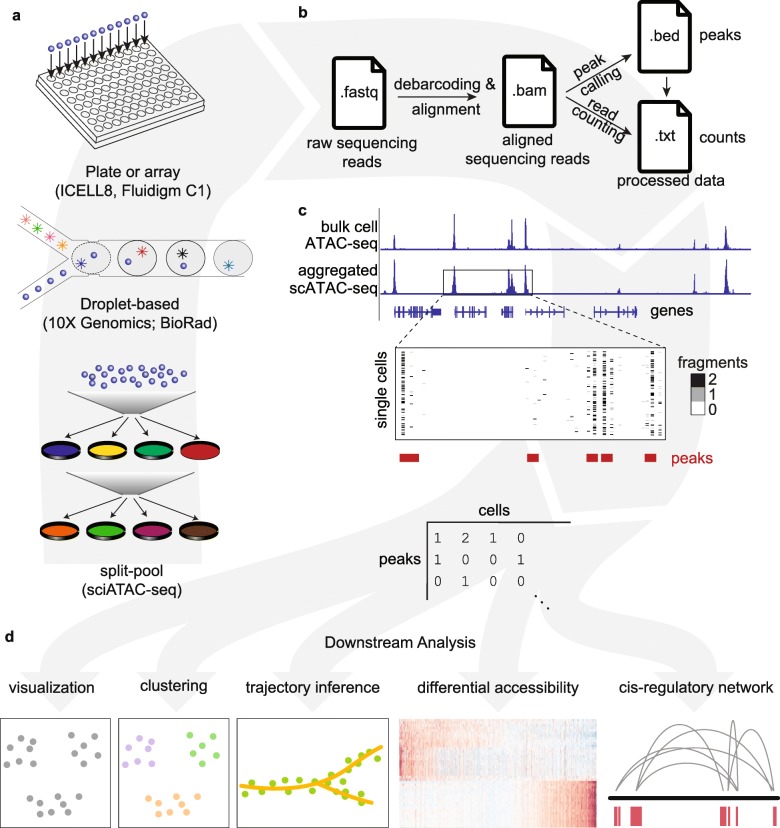
“However, the sparsity of scATAC-seq datasets provides unique challenges that must be addressed in order to perform essential analyses such as cluster identification, visualization, and trajectory inference [29, 30].”
MethodClustering by fast search and find of density peaks
Rodriguez, A., & Laio, A. (2014) · Science · doi:10.1126/science.1242072 · Cited by 4,942
Software for Computing and Annotating Genomic Ranges
Lawrence, M., Huber, W., Pagès, H., Aboyoun, P., Carlson, M., Gentleman, R., Morgan, M. T., & Carey, V. J. (2013) · PLoS Computational Biology · doi:10.1371/journal.pcbi.1003118 · Cited by 4,398
Research works printed but not linked: 2
- Fang R, et al. Fast and accurate clustering of single cell epigenomes reveals cis-regulatory elements in rare cell types. BioRxiv:615179v2. 2019.
- Stark R Brown G DiffBind: differential binding analysis of ChIP-Seq peak data R Package Version 2011 100 4 3
Cited by
Items 101–200 of 358
singlecellVR: Interactive Visualization of Single-Cell Data in Virtual Reality
Stein, D. F., Chen, H., Vinyard, M. E., Qin, Q., Combs, R. D., Zhang, Q., & Pinello, L. (2021) · Frontiers in Genetics · doi:10.3389/fgene.2021.764170 · Cited by 24
“The PAGA-analyzed dataset shown here is from Paul, et al., 2015 (Paul et al., 2015).”
MethodInfluentialSelf-citationFundamental and practical approaches for single-cell ATAC-seq analysis
Shi, P., Nie, Y., Yang, J., Zhang, W., Tang, Z., & Xu, J. (2022) · aBIOTECH · doi:10.1007/s42994-022-00082-5 · Cited by 22
“Recently, ten computational methods for scATAC-seq data analysis were compared, with the result that SnapATAC (Fang et al. 2021), Cusanovich2018 (Cusanovich et al. 2015, 2018a, b), and cisTopic (Bravo Gonza´lez-Blas et al. 2019) were found to outperform other methods (Chen et al. 2019).”
MethodInfluentialMendieta, J. P., Sangra, A., Yan, H., Minow, M. A. A., & Schmitz, R. J. (2023) · The Plant Journal · doi:10.1111/tpj.16351 · Cited by 22
Building and analyzing metacells in single-cell genomics data
Bilous, M., Hérault, L., Gabriel, A. A., Teleman, M., & Gfeller, D. (2024) · Molecular Systems Biology · doi:10.1038/s44320-024-00045-6 · Cited by 24
“…(e.g., modularity (Newman and Girvan, 2004), silhouette coef fi cient (Rousseeuw, 1987) or other approaches developed speci fi cally for scRNA-seq data (Liu et al, 2021c; Chen et al, 2019b; Kiselev et al, 2017; Grabski et al, 2023)) due to the differing objectives of clustering and metacells.”
scATAnno: Automated Cell Type Annotation for Single-cell ATAC-seq Data
Jiang, Y., Hu, Z., Lu, F., Lynch, A. W., Jiang, J., Zhu, A., Zeng, Z., Zhang, Y., Wu, G., Xie, Y., et al. (2025) · Genomics Proteomics & Bioinformatics · doi:10.1093/gpbjnl/qzaf108 · Cited by 24
“Despite these challenges, cell type annotation at the scATAC-seq level remains important”
New horizons in the stormy sea of multimodal single-cell data integration
Jackson, C. A., & Vogel, C. (2022) · Molecular Cell · doi:10.1016/j.molcel.2021.12.012 · Cited by 26
Dual alignment feature embedding network for multi-omics data clustering
Xiao, Y., Yang, D., Li, J., Zou, X., Zhou, H., & Tang, C. (2024) · Knowledge-Based Systems · doi:10.1016/j.knosys.2024.112774 · Cited by 28
Ng, C. X., Lee, S. Y., Yap, X. Y., Wong, Y. H., Loh, J. S., Ang, K. P., Lee, W. H., Xu, W., Yong, P. V. C., & Lee, S. H. (2025) · Discover Oncology · doi:10.1007/s12672-025-04085-8 · Cited by 25
“…provides unprecedented chromatin accessibility resolution in cancer stem-like cells, the current techniques are limited in their practical scalability by high computational demands, inconsistent coverage, and extreme data sparsity, which detects only ~ 1–10% of accessible peaks per cell [247].”
Eun, M., Kim, D., Shin, S.-I., Yang, H. O., Kim, K.-D., Choi, S. Y., Park, S., Kim, D. K., Jeong, C. W., Moon, K. C., et al. (2023) · Kidney International · doi:10.1016/j.kint.2023.09.030 · Cited by 20
Raja, K. K. B., Yeung, K., Shim, Y.-K., Li, Y., Chen, R., & Mardon, G. (2023) · Nature Communications · doi:10.1038/s41467-023-43037-0 · Cited by 27
Best practices for differential accessibility analysis in single-cell epigenomics
Teo, A. Y. Y., Squair, J. W., Courtine, G., & Skinnider, M. A. (2024) · Nature Communications · doi:10.1038/s41467-024-53089-5 · Cited by 22
“In particular, scATAC-seq measures a larger number of features compared to scRNA-seq, and each of these features are quanti fi ed by fewer reads and in fewer cells 47 .”
Zeng, P., & Lin, Z. (2021) · PLoS Computational Biology · doi:10.1371/journal.pcbi.1009064 · Cited by 21
“We compared coupleCoC+ with coupleCoC [42], CoC [45], kmeans and other commonly used clustering methods for single-cell genomic data, including SC3 [20], SIMLR [19], SAME-clustering [24] and SHARP [25] for scRNA-seq data, Cusanovich2018 [30] and cisTopic [29] for scATAC-seq data (we implemented louvain clustering afte…”
MethodParmentier, R., Racine, L., Moussy, A., Chantalat, S., Ravi, S., Gao, N. P., Stockholm, D., Corre, G., Fourel, G., Deleuze, J., et al. (2022) · PLoS Biology · doi:10.1371/journal.pbio.3001849 · Cited by 22
“First, bulk ATAC-seq was used to establish the temporal dynamics of the chromatin and identify the global systemic changes in chromatin structure [38].”
MethodIntegration of single-cell multi-omics data by regression analysis on unpaired observations
Yuan, Q., & Duren, Z. (2022) · Genome biology · doi:10.1186/s13059-022-02726-7 · Cited by 22
“We simulate the scATAC-seq data according to the method proposed in ref [34] taking bulk ATAC-seq count matrix [35] as input.”
MethodASTER: accurately estimating the number of cell types in single-cell chromatin accessibility data
Chen, S., Wang, R., Long, W., & Jiang, R. (2022) · Bioinformatics · doi:10.1093/bioinformatics/btac842 · Cited by 19
Yan, X., Zheng, R., Chen, J., & Li, M. (2023) · Bioinformatics · doi:10.1093/bioinformatics/btad505 · Cited by 19
“However, inherent sparsity, high dimension, and increasing size of scATAC-seq data have posed significant challenges in cell-type identification (Chen et al. 2019).”
BackgroundCao, Y., Fu, L., Wu, J., Peng, Q., Nie, Q. H., Zhang, J., & Xie, X. S. (2021) · Bioinformatics · doi:10.1093/bioinformatics/btab303 · Cited by 21
ClustAssess: tools for assessing the robustness of single-cell clusteringPreprint
Shahsavari, A., Munteanu, A., & Mohorianu, I. I. (2022) · bioRxiv (Cold Spring Harbor Laboratory) · doi:10.1101/2022.01.31.478592 · Cited by 21
Understanding the Adult Mammalian Heart at Single-Cell RNA-Seq Resolution
Marín‐Sedeño, E., de Morentin, X. M., Pérez-Pomares, J. M., Gómez-Cabrero, D., & Ruiz‐Villalba, A. (2021) · Frontiers in Cell and Developmental Biology · doi:10.3389/fcell.2021.645276 · Cited by 19
Holman, A. R., Tran, S., Destici, E., Farah, E. N., Li, T., Nelson, A. C., Engler, A. J., & Neil, C. (2024) · Cell Genomics · doi:10.1016/j.xgen.2024.100680 · Cited by 19
A benchmark of computational pipelines for single-cell histone modification data
Raimundo, F., Prompsy, P., Vert, J., & Vallot, C. (2023) · Genome biology · doi:10.1186/s13059-023-02981-2 · Cited by 16
“For computing the representations using the different methods, we used the implementation from the original packages, except for SnapATAC for which we used the reimplementation of [12] as it allowed a nicer API for running a large number of jobs; their implementation can be found on their github https:// github.”
InfluentialSingle-Cell Sequencing Technology in Ruminant Livestock: Challenges and Opportunities
Lyons, A., Brown, J., & Davenport, K. M. (2024) · Current Issues in Molecular Biology · doi:10.3390/cimb46060316 · Cited by 19
Hao, G., Yi, F., Yu, Z., Su, Y., Zhu, H., Wang, F., Chen, X., Yang, Y., Wang, G., Wong, K., et al. (2025) · Nature Communications · doi:10.1038/s41467-025-57027-x · Cited by 16
FactVAE: a factorized variational autoencoder for single-cell multi-omics data integration analysis
Wang, L., Zhang, H., Yi, B., Xie, W., Yu, K., Li, W., Li, K., & Zhao, D. (2025) · Briefings in Bioinformatics · doi:10.1093/bib/bbaf157 · Cited by 16
“Furthermore, FactVAE leverages known gene-peak to guide model training, ensuring the reliability of the derived information, and employs a knowledge transfer strategy to mitigate the inherent sparsity of ATAC data [24].”
Computational Analyses and Challenges of Single-cell ATAC-seq
Wang, C., Zhou, J., Zhang, H., Zhuang, Z., Bai, G., Tang, M., Liu, S., & Liu, T. (2025) · Genomics Proteomics & Bioinformatics · doi:10.1093/gpbjnl/qzaf115 · Cited by 16
scATAC-seq generates more accurate and complete regulatory maps than bulk ATAC-seq
Gur, E., & Hughes, J. R. (2025) · Scientific Reports · doi:10.1038/s41598-025-87351-7 · Cited by 16
APEC: an accesson-based method for single-cell chromatin accessibility analysis
Li, B., Li, Y., Li, K., Zhu, L., Yu, Q., Cai, P., Fang, J., Zhang, W., Du, P., Jiang, C., et al. (2020) · Genome biology · doi:10.1186/s13059-020-02034-y · Cited by 15
Advances in Single-Cell Multi-Omics and Application in Cardiovascular Research
Zhang, X., Qiu, H., Zhang, F., & Ding, S. (2022) · Frontiers in Cell and Developmental Biology · doi:10.3389/fcell.2022.883861 · Cited by 15
Which single-cell analysis tool is best? Scientists offer advice
Dance, A. (2022) · Nature · doi:10.1038/d41586-022-04426-5 · Cited by 14
Probabilistic tensor decomposition extracts better latent embeddings from single-cell multiomic data
Wang, R. H., Wang, J., & Li, S. C. (2023) · Nucleic Acids Research · doi:10.1093/nar/gkad570 · Cited by 17
Carraro, C., Bonaguro, L., Srinivasa, R., van Uelft, M., Isakzai, V., Schulte-Schrepping, J., Gambhir, P., Elmzzahi, T., Montgomery, J. V., Hayer, H., et al. (2023) · Cell Reports Methods · doi:10.1016/j.crmeth.2023.100598 · Cited by 15
Chen, Z., Zhang, J., Liu, J. J., Zhang, Z., Zhu, J., Lee, D., Xu, M., & Gerstein, M. (2021) · Bioinformatics · doi:10.1093/bioinformatics/btaa1039 · Cited by 15
Cell population‐based framework of genetic epidemiology in the single‐cell omics era
Okada, D., Zheng, C., Cheng, J. H., & Yamada, R. (2021) · BioEssays · doi:10.1002/bies.202100118 · Cited by 16
A Synthesis Concerning Conservation and Divergence of Cell Types across Epithelia
Montoro, D. T., Haber, A. L., Rood, J., Regev, A., & Rajagopal, J. (2020) · Cold Spring Harbor Perspectives in Biology · doi:10.1101/cshperspect.a035733 · Cited by 16
scMoC: single-cell multi-omics clustering
Eltager, M., Abdelaal, T., Mahfouz, A. E., & Reinders, M. J. T. (2022) · Bioinformatics Advances · doi:10.1093/bioadv/vbac011 · Cited by 14
GAGAM v1.2: An Improvement on Peak Labeling and Genomic Annotated Gene Activity Matrix Construction
Martini, L., Bardini, R., Savino, A., & Carlo, S. D. (2022) · Genes · doi:10.3390/genes14010115 · Cited by 13
“In particular, ref [31] uses them for benchmarking, and they are the metrics employed to evaluate GAGAM v1.”
BackgroundMethodInfluentialExperimental and computational technologies to dissect the kidney at the single-cell level.
Kuppe, C., Perales-Patón, J., Saez-Rodriguez, J., & Kramann, R. (2020) · Nephrology, Dialysis and Transplantation · doi:10.1093/ndt/gfaa233 · Cited by 10
Zaim, S. R., Pebworth, M.-P., McGrath, I., Okada, L. Y., Weiss, M. D. A., Reading, J., Czartoski, J., Torgerson, T. R., McElrath, M. J., Bumol, T. F., et al. (2024) · Nature Communications · doi:10.1038/s41467-024-50612-6 · Cited by 13
“…models 27 . scATAC-seq data is even sparser than scRNA-seq data with a near binary (0 or 1) measurement of accessibility 1 , and a detection rate of 1 – 10% on expected accessible peaks at the single-cell level (compared to 10 – 45% of expressed genes being detected per cell in scRNA-seq) 8 .”
Unveiling causal regulatory mechanisms through cell-state parallax
Wu, A. P., Singh, R., Walsh, C. A., & Berger, B. (2025) · Nature Communications · doi:10.1038/s41467-025-61337-5 · Cited by 14
Erbe, R., Kessler, M. D., Favorov, A. V., Easwaran, H., Gaykalova, D. A., & Fertig, E. J. (2020) · Nucleic Acids Research · doi:10.1093/nar/gkaa349 · Cited by 15
“To further compare our results to a state of the art (42) Bayesian topic modeling method for scATAC-seq analysis, we apply cisTopic (6) to the Schep et al.”
MethodLiu, C., Wang, L., & Liu, Z. (2023) · BMC Bioinformatics · doi:10.1186/s12859-022-05126-7 · Cited by 15
Secchia, S., Forneris, M., Heinen, T., Stegle, O., & Furlong, E. E. M. (2022) · Developmental Cell · doi:10.1016/j.devcel.2022.01.016 · Cited by 12
“, 2019), which outperforms other methods on continuous populations (Chen et al., 2019).”
BackgroundSmith, E. L., Mok, G. F., & Münsterberg, A. (2022) · Biochemical Society Transactions · doi:10.1042/bst20210834 · Cited by 11
Zeng, P., & Lin, Z. (2023) · IEEE Transactions on Computational Biology and Bioinformatics · doi:10.1109/tcbb.2023.3305989 · Cited by 12
“WeimplementLouvainclustering[36]afterdimensionreductionbythe baselinesscAIandMOFA+. Whencomputingtheclustermemberships ofcellsinfourrealdatasetsbyallbaselinesexceptSeuratV4,weset thenumbersofcellclustersthesameasthatgivenbythedataanalysis atthe10XGenomicswebsite.”
Zandavi, S. M., Koch, F. C., Vijayan, A., Zanini, F., Valdés‐Mora, F., Gallego‐Ortega, D., & Vafaee, F. (2022) · Nucleic Acids Research · doi:10.1093/nar/gkac436 · Cited by 12
“Single-cell sequencing data also suffer from the ‘curse of missingness’ due to, for instance, dropout events in scRNA-sequencing (2) or the low copy number in DNA leading to an inherent per-cell sparsity in scATAC-sequencing data (3).”
BackgroundTilahun, Z. A., Bizuneh, Y. K., & Mekonnen, A. G. (2025) · Cogent Social Sciences · doi:10.1080/23311886.2025.2473644 · Cited by 10
“…al., 2016), is available at https://swat.tamu. edu/software/, was used to adjust the precipitation and temperature bias in hydrological modelling. chen et al. (2019) assessed different bias adjustment methods and found that they all enhanced the precipitation and temperature simulation. however,…”
Dong, Y., Zhang, J., Shi, J., Hu, Y., Cao, X., Xing, L., Dong, Y., & Zhang, X. (2025) · Briefings in Bioinformatics · doi:10.1093/bib/bbaf244 · Cited by 10
“We evaluate the performance of the clustering result using accuracy (ACC), normalized mutual information (NMI), F1-score, precision, recall [40], adjusted rand index (ARI), and Silhouette Coefficient(S-score) [41].”
Enhancing sensitivity and versatility of Tn5-based single cell omics
Seufert, I., Sant, P., Bauer, K., Syed, A. P., Rippe, K., & Mallm, J. (2023) · Frontiers in Epigenetics and Epigenomics · doi:10.3389/freae.2023.1245879 · Cited by 10
“One strategy to counteract the sparsity for scATAC-seq data is to aggregate multiple similar cells (Pliner et al., 2018;Chen et al., 2019).”
MethodKhandibharad, S., Kharat, K., & Singh, S. (2024) · Microbiology Spectrum · doi:10.1128/spectrum.03478-23 · Cited by 10
scMLC: an accurate and robust multiplex community detection method for single-cell multi-omics data
Chen, Y., Zheng, R., Liu, J., & Li, M. (2024) · Briefings in Bioinformatics · doi:10.1093/bib/bbae101 · Cited by 10
“Here, we introduced a novel canonical feature selection method called SGCCA, which incorporates a sparsity-promoting L1 penalty [28– 31]incanonicalcorrelationanalysis.”
MethodHubness reduction improves clustering and trajectory inference in single-cell transcriptomic data
Amblard, E., Bac, J., Chervov, A., Soumelis, V., & Zinovyev, A. Y. (2021) · Bioinformatics · doi:10.1093/bioinformatics/btab795 · Cited by 13
Chromatin-accessibility estimation from single-cell ATAC data with scOpenPreprint
Li, Z., Kuppe, C., Ziegler, S., Cheng, M., Kabgani, N., Menzel, S., Zenke, M., Kramann, R., & Costa, I. G. (2019) · bioRxiv (Cold Spring Harbor Laboratory) · doi:10.1101/865931 · Cited by 10
simCAS: an embedding-based method for simulating single-cell chromatin accessibility sequencing data
Li, C., Chen, X., Chen, S., Jiang, R., & Zhang, X. (2023) · Bioinformatics · doi:10.1093/bioinformatics/btad453 · Cited by 9
Geens, B., Goossens, S., Li, J., de Peer, Y. V., & Broeck, J. V. (2024) · Molecular and Cellular Endocrinology · doi:10.1016/j.mce.2024.112178 · Cited by 10
Network diffusion for scalable embedding of massive single-cell ATAC-seq data
Dong, K., & Zhang, S. (2021) · Science Bulletin · doi:10.1016/j.scib.2021.05.014 · Cited by 10
Zenere, A., Rundquist, O., Gustafsson, M., & Altafini, C. (2021) · Bioinformatics · doi:10.1093/bioinformatics/btab577 · Cited by 9
“However, the limited depth of the currently available methods, especially for scATAC-seq [5], poses serious technical limitations.”
Integration of Genomic Profiling and Organoid Development in Precision Oncology
Yoon, H., & Lee, S. (2021) · International Journal of Molecular Sciences · doi:10.3390/ijms23010216 · Cited by 11
Single-Cell Sequencing on Marine Life: Application and Future Development
Li, J., Wang, H., & Li, C. (2022) · Frontiers in Marine Science · doi:10.3389/fmars.2022.906267 · Cited by 11
Hu, K., Liu, H., Lawson, N. D., & Zhu, L. J. (2022) · Frontiers in Cell and Developmental Biology · doi:10.3389/fcell.2022.981859 · Cited by 9
Single-cell RNA sequencing to study vascular diversity and function
Ma, F., Hernandez, G. E., Romay, M. C., & Iruela‐Arispe, M. L. (2021) · Current Opinion in Hematology · doi:10.1097/moh.0000000000000651 · Cited by 10
“In addition to single cell or spatial transcriptomics, other technologies that profile chromatin accessibility [34], DNA methylation [35] and protein [36] were developed at the individual cell level, allowing the analyses of single-cell multiomics.”
BackgroundSceptic: pseudotime analysis for time-series single-cell sequencing and imaging data
Li, G., Kim, H., Pendyala, S., Zhang, R., Distèche, C. M., Vert, J.-P., Deng, X., Fowler, D. M., & Noble, W. S. (2025) · Genome biology · doi:10.1186/s13059-025-03679-3 · Cited by 10
Liu, J., Ma, J., Wen, J., & Zhou, X. (2024) · Advanced Science · doi:10.1002/advs.202401815 · Cited by 9
Akhtyamov, P., Shaheen, L., Raevskiy, M., Stupnikov, A., & Medvedeva, Y. A. (2023) · Briefings in Bioinformatics · doi:10.1093/bib/bbad447 · Cited by 8
“Independent benchmark studies [14, 17] and method presenting papers [8, 13] have provided effective benchmarking protocols for comparing scATAC-seq imputation methods; however,these works do not explicitly investigate the contribution of preprocessing and postprocessing steps, which can have a…”
BackgroundMethodBenchmarking Algorithms for Gene Set Scoring of Single-cell ATAC-seq Data
Wang, X., Lian, Q., Dong, H., Xu, S., Su, Y., & Wu, X. (2024) · Genomics Proteomics & Bioinformatics · doi:10.1093/gpbjnl/qzae014 · Cited by 9
“732 [37] Chen H, Lareau C, Andreani T, Vinyard ME, Garcia SP, Clement K, et al.”
BackgroundLi, S., Li, Y., Sun, Y., Li, Y., Chen, X., Tang, S., & Chen, S. (2024) · Bioinformatics · doi:10.1093/bioinformatics/btae191 · Cited by 8
“Initially, we apply binarization to X i as suggested in a recent study (Chen et al. 2019), select regions that are accessible in more than 0 : 01 × c cells (Chen et al. 2021, 2022), and perform the term frequency-inverse document frequency (TF-IDF) transformation (Li et al. 2021, Chen et al. 2023,…”
Zhao, F., Ma, X., Yao, B., Lu, Q., & Chen, L. (2024) · PLoS Computational Biology · doi:10.1371/journal.pcbi.1011854 · Cited by 9
On metrics for subpopulation detection in single-cell and spatial omics data
Luo, S., Germain, P., von Meyenn, F., & Robinson, M. D. (2025) · Nucleic Acids Research · doi:10.1093/nar/gkaf921 · Cited by 7
“…to address this problem, including evaluating the metric at the “best-performing k ” [ 4 ], the “true k ” (based on the available ground truth labels) [ 1 , 2 , 26 ], the “detected k ”(typically using default parameters) [ 2 ], or across a range of parameters that yield different k values [ 4 ].”
The histone-modified landscape: Core mechanisms of osimertinib resistance in EGFR-mutant lung cancer
Yang, J., Zhang, M., Gao, C., Yao, X., Sun, C., & Zhuang, J. (2026) · Cancer Letters · doi:10.1016/j.canlet.2026.218321 · Cited by 7
Schwartz, G. W., Zhou, Y., Petrovic, J., Pear, W. S., & Faryabi, R. B. (2021) · Cell Reports · doi:10.1016/j.celrep.2021.109575 · Cited by 7
Liu, Y., Li, Z., Chen, X., Cui, X., Gao, Z., & Jiang, R. (2025) · Nature Communications · doi:10.1038/s41467-025-56535-0 · Cited by 9
“Secondly, spATAC-seq data generally exhibits high dimensionality, great sparsity, and suffers from a notable incidence of data missing due to a low capturing rate 3,36,37 .”
Chen, M. (2025) · Cell Genomics · doi:10.1016/j.xgen.2025.100806 · Cited by 7
Swain, A. K., Shekhawat, R. S., & Yadav, P. (2025) · Briefings in Bioinformatics · doi:10.1093/bib/bbaf253 · Cited by 7
“…us to analyse the expression pattern of genes at individual cell level [5], scATAC-seq provides insights into chromatin accessibility of the genome at a single-cell resolution [3], and spatial transcriptomics retains spatial context while analysing the molecular features of tissue samples [4].”
Pierce, S. E., Kim, S. H., & Greenleaf, W. J. (2021) · Current Opinion in Genetics & Development · doi:10.1016/j.gde.2020.11.008 · Cited by 7
Methods for constructing and evaluating consensus genomic interval sets
Rymuza, J., Sun, Y., Zheng, G., LeRoy, N. J., Murach, M., Phan, N., Zhang, A., & Sheffield, N. C. (2024) · Nucleic Acids Research · doi:10.1093/nar/gkae685 · Cited by 7
“…they define genomic intervals for differential peak analysis ( 11 ); they form the regions of interest in a count matrix in single-cell epigenome analysis ( 11 ,12 ); they are used as a background for statistical region enrichment analysis ( 13–16 ); and they are a region vocabulary in…”
Biophysical model for joint analysis of chromatin and RNA sequencing data
Felce, C., Gorin, G., & Pachter, L. S. (2024) · Physical review. E · doi:10.1103/physreve.110.064405 · Cited by 7
Zibetti, C. (2022) · Cells · doi:10.3390/cells11050806 · Cited by 8
Przytycki, P. F., & Pollard, K. S. (2022) · Bioinformatics · doi:10.1093/bioinformatics/btac150 · Cited by 8
Computational modelling in single-cell cancer genomics: methods and future directions
Zhang, A. W., & Campbell, K. R. (2020) · Physical Biology · doi:10.1088/1478-3975/abacfe · Cited by 7
Assessing the multimodal tradeoffPreprint
Booeshaghi, A. S., Gao, F., & Pachter, L. S. (2021) · bioRxiv (Cold Spring Harbor Laboratory) · doi:10.1101/2021.12.08.471788 · Cited by 9
“…to standardize processing for single-cell RNA-seq (Melsted et al. 2021; Battenberg et al. 2022) and single-nucleus ATAC-seq (Yu et al. 2020; Chen et al. 2019), many multimodal assays are currently published with standalone custom workflows (Wu et al. 2022; Ma et al. 2020; Cheow et al.…”
MethodThe Epigenetic Battleground: Host Chromatin at the Core of Infection
Machado, F. C., & Moretti, N. S. (2026) · Epigenomes · doi:10.3390/epigenomes10010013 · Cited by 6
“…relied on transcriptomic profiling (single-cell RNA sequencing), single-cell epigenomic approaches, such as single-cell ATAC-seq, offer a promising tool for investigating the epigenomic landscape to discover key components of the regulatory logic that precedes and constrains gene expression [195].”
Cai, G., Chen, F., Wen, K., Li, Y., & Ou-Yang, L. (2025) · Information Fusion · doi:10.1016/j.inffus.2025.103428 · Cited by 8
Applications of single‐cell multi‐omics sequencing in deep understanding of brain diseases
Zhang, X., Lü, P., & Shen, X. (2022) · Clinical and Translational Discovery · doi:10.1002/ctd2.95 · Cited by 6
Joint analysis of scATAC-seq datasets using epiConv
Lin, L., & Zhang, L. (2022) · BMC Bioinformatics · doi:10.1186/s12859-022-04858-w · Cited by 6
“We did not directly apply Harmony, MNN or Seurat on the raw matrix or gene activity matrix that summed the reads near each gene’s TSS as these simple methods generally did not perform well [10].”
BackgroundMethodRoth, C., Venu, V., Job, V., Lubbers, N., Sanbonmatsu, K. Y., Steadman, C. R., & Starkenburg, S. R. (2023) · BMC Bioinformatics · doi:10.1186/s12859-023-05553-0 · Cited by 6
“deep-learning of single-cell ATAC-seq profiles [58, 59].”
Integrating single-cell multimodal epigenomic data using 1D convolutional neural networks
Gao, C., & Welch, J. D. (2024) · Bioinformatics · doi:10.1093/bioinformatics/btae705 · Cited by 6
“To apply 1D convolutional filters (Conv1D), the input multimodal data are transformed into 3D arrays (cell × modality × bin), following window-based genome binning at 10 kb resolution (Chen et al. 2019) (Fig.”
Deaminase-mediated chromatin accessibility profiling with single-allele resolutionPreprint
Yu, T., Li, Z., Gibbs, E., Iwase, R., Francoeur, M., Phan, Q. V., Zhao, J., Rosin, J., Cole, P. A., Pinello, L., et al. (2024) · bioRxiv (Cold Spring Harbor Laboratory) · doi:10.1101/2024.12.17.628768 · Cited by 7
Self-citationEnhanced integration of single-cell multi-omics data using graph attention networks
Liao, X., Li, Y., Li, S., Wen, L., Li, X., & Yu, B. (2025) · ACS Synthetic Biology · doi:10.1021/acssynbio.4c00864 · Cited by 5
Li, S., Huang, Y., & Chen, S. (2025) · Genome biology · doi:10.1186/s13059-025-03603-9 · Cited by 5
Xu, S., Škarica, M., Hwang, A., Dai, Y. Q., Lee, C.-Y., Girgenti, M. J., & Zhang, J. (2022) · Journal of Computational Biology · doi:10.1089/cmb.2021.0596 · Cited by 5
“…especially assay for transposase-accessible chromatin using sequencing (ATAC-seq), have allowed scientists to probe accessible genome-wide chromatin in individual cells (Buenrostro et al., 2015; Cusanovich et al., 2015; Chen et al., 2018; Chen et al., 2019; Satpathy et al., 2019; Yan et al., 2020).”
A generic reference defined by consensus peaks for single-cell ATAC-seq data analysis
Meng, Q., Wu, X., Chen, W., Zhao, Y., Li, C., Wei, Z., Zeng, X., Li, J., Xi, X., Chen, S., et al. (2026) · Nature Communications · doi:10.1038/s41467-026-69461-6 · Cited by 6
“United peaks were derived from the peak set provided by the benchmark study 63 from https://github.com/ pinellolab/scATAC-benchmarking/blob/master/Real_Data/ Buenrostro_2018/input/combined.sorted.merged.bed.”
iPoLNG—An unsupervised model for the integrative analysis of single-cell multiomics data
Zhang, W., & Lin, Z. (2023) · Frontiers in Genetics · doi:10.3389/fgene.2023.998504 · Cited by 5
Fast clustering and cell-type annotation of scATAC data using pre-trained embeddings
LeRoy, N. J., Smith, J. P., Zheng, G., Rymuza, J., Gharavi, E., Brown, D. E., Zhang, A., & Sheffield, N. C. (2024) · NAR Genomics and Bioinformatics · doi:10.1093/nargab/lqae073 · Cited by 6
“This is comparable with other scA T AC clustering methods which are robust to data loss ( 13 ).”
BackgroundMethodResultInfluentialChoi, H. K., Kim, H., Chung, H., Lee, D.-S., & Kim, J. (2024) · Briefings in Functional Genomics · doi:10.1093/bfgp/elae044 · Cited by 7
A single-cell atlas of mouse olfactory bulb chromatin accessibility
Chen, Y., Ding, X., Wang, S., Ding, P., Xu, Z., Li, J., Wang, M., Xiang, R., Wang, X., Wang, H., et al. (2021) · Journal of genetics and genomics/Journal of Genetics and Genomics · doi:10.1016/j.jgg.2021.02.007 · Cited by 5
STENCIL: A web templating engine for visualizing and sharing life science datasets
Sun, Q., Nematbakhsh, A., Kuntala, P. K., Kellogg, G. D., Pugh, B. F., & Lai, W. (2022) · PLoS Computational Biology · doi:10.1371/journal.pcbi.1009859 · Cited by 5
Tuning parameters of dimensionality reduction methods for single-cell RNA-seq analysisPreprint
Raimundo, F., Vallot, C., & Vert, J. (2020) · bioRxiv (Cold Spring Harbor Laboratory) · doi:10.1101/2020.04.27.064816 · Cited by 5
da Silva, J. E. H., Bernardino, H. S., de Oliveira, I. L., & Camata, J. J. (2025) · Biosystems · doi:10.1016/j.biosystems.2025.105464 · Cited by 6
Accurate chromatin marks peak calling with Omnipeak
Shpynov, O., & Artyomov, M. N. (2026) · Nucleic Acids Research · doi:10.1093/nar/gkaf1454 · Cited by 4
“…A T AC-seq [ 39 ], which reveals the unique chromatin states of different individual cells or subpopulations, further highlights the importance of selecting an appropriate analysis tool because major computational single-cell A T AC-seq pipelines still contain bulk signal peak calling steps [ 40 ].”
Advances in scCUT&Tag and computational analysis for single-cell gene regulatory element mapping
Wu, J., Wahiduzzaman, M., Yin, P., Sun, P., Chen, H., Ding, Y., & Wang, J. (2026) · Briefings in Bioinformatics · doi:10.1093/bib/bbag015 · Cited by 4
Self-citationLi, S., Tang, S., Wang, Y., Li, S., Jia, Y., & Chen, S. (2024) · Quantitative Biology · doi:10.1002/qub2.33 · Cited by 4
Metadata
- Authors
- Chen, H., Lareau, C., Andreani, T., Vinyard, M. E., Garcia, S. P., Clement, K., Andrade-Navarro, M. A., Buenrostro, J. D., & Pinello, L.
- Affiliations
- Broad Institute (US)
- Harvard University (US)
- Massachusetts General Hospital (US)
- Johannes Gutenberg University Mainz (DE)
- Corresponding author
- Pinello, Luca
- ORCID
- Venue
- Genome Biology
- Published
- 2019-11-18
- Volume
- 20
- Issue
- 1
- Pages
- 241-241
- ISSN
- 1465-6906 (ISSN-L)
- 1474-760X
- PMC
- PMC6859644
- OpenAlex
- W2989061519
- Semantic Scholar
- dc9f0e12340139dbc18638c43fafd9441c2ad40e
- Cited by
- 332
- References
- 47
- Citations by year
- 2026: 24 · 2025: 40 · 2024: 72 · 2023: 45 · 2022: 49 · 2021: 67 · 2020: 33 · 2019: 2
- FWCI
- 12.98
- Type
- journal article
- Language
- en
- Open access
- gold
- doi.org
- Licence
- cc-by
- creativecommons.org/licenses/by/4.0/ (tdm)
- creativecommons.org/licenses/by/4.0/ (vor)
- Locations
- Genome biology (publishedVersion, cc-by)
- bioRxiv (Cold Spring Harbor Laboratory) (acceptedVersion, cc-by)
- PubMed Central (publishedVersion, cc-by)
- PubMed (publishedVersion)
- DOAJ (DOAJ: Directory of Open Access Journals) (submittedVersion, cc-by-sa)
- Funders
- Chan Zuckerberg Initiative DAF (2018- 182734)
- National Human Genome Research Institute (R00HG008399, R35HG010717)
- Topics
- Life Sciences › Biochemistry, Genetics and Molecular Biology › Molecular Biology › Single-cell and spatial transcriptomics
- Life Sciences › Biochemistry, Genetics and Molecular Biology › Molecular Biology › Genomics and Chromatin Dynamics
- Life Sciences › Biochemistry, Genetics and Molecular Biology › Molecular Biology › Epigenetics and DNA Methylation
- Keywords
- single-cell ATAC-seq, chromatin accessibility, cell type discrimination, unsupervised clustering, peak calling, data sparsity, sequencing depth, noise, computational performance, epigenetic heterogeneity
- MeSH terms
- Animals, Humans, Sequence Analysis, DNA, Computational Biology, Benchmarking, Mice, Epigenomics, Single-Cell Analysis
About these checks
Registry, retraction, Cites and statistics results are computed, not judged, with one exception: a printed reference that no index lists is read once by a model before it counts as a citation error. Claims are extracted by a model and kept only when their quote appears verbatim in the text; each cited source is then checked, with a model’s help, for whether it says what the claim relies on. Those verdicts can be wrong — read the claim’s quote and the cited source before relying on one.
Statistics and arithmetic are recomputed, not judged.
Confidence bands are shown only for fields calibrated on our annotated test set. None is calibrated yet, so no band is shown.
What counts as a claim ›How we measure confidence ›How we check this ›
Are you an author, or do you see a problem with this page? Request a review
Data sources
Bibliographic data: Semantic Scholar, OpenAlex, Crossref.
Contains information from the Semantic Scholar Academic Graph Datasets, made available under the ODC Attribution License (ODC-BY 1.0).
Semantic Scholar’s data is described in: Kinney, R., et al. (2023). The Semantic Scholar Open Data Platform. arXiv:2301.10140.
