

Assessment of computational methods for the analysis of single-cell ATAC-seq data
Open accessPublished version of a preprint
The DOI matches its Crossref record; 47 of the 47 references it cites were found in a registry or an index.
Abstract
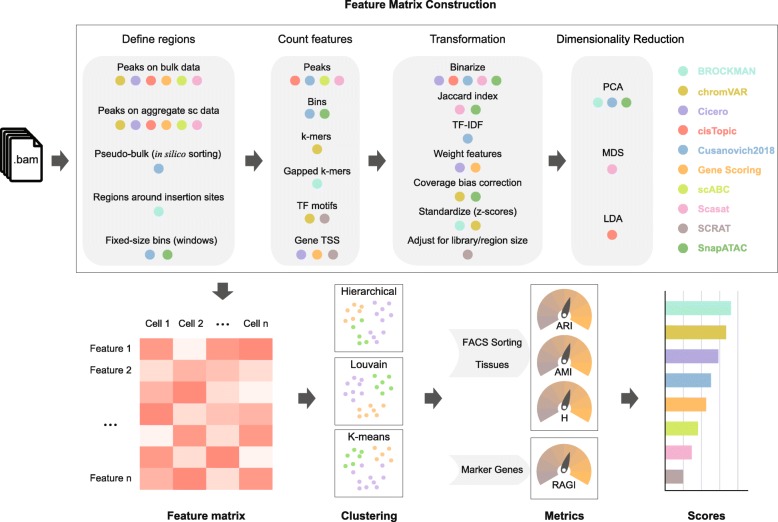
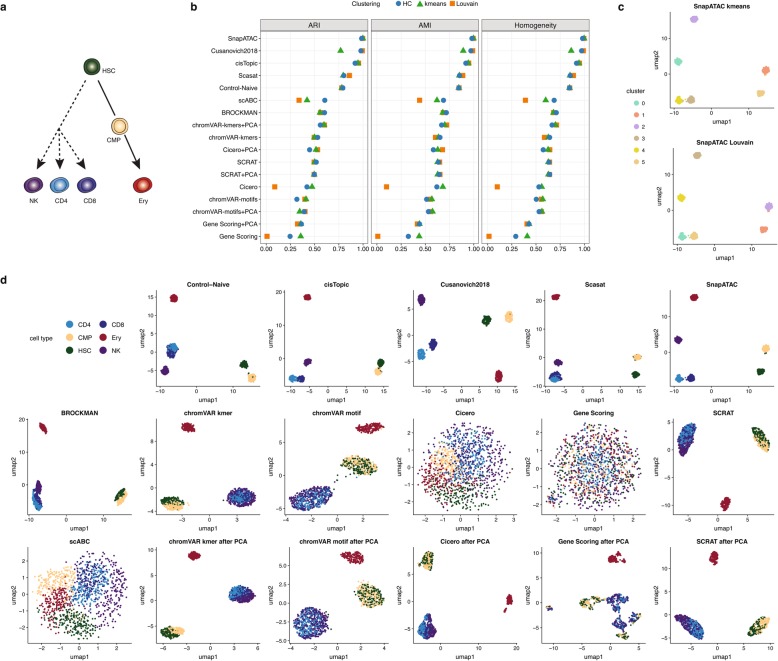
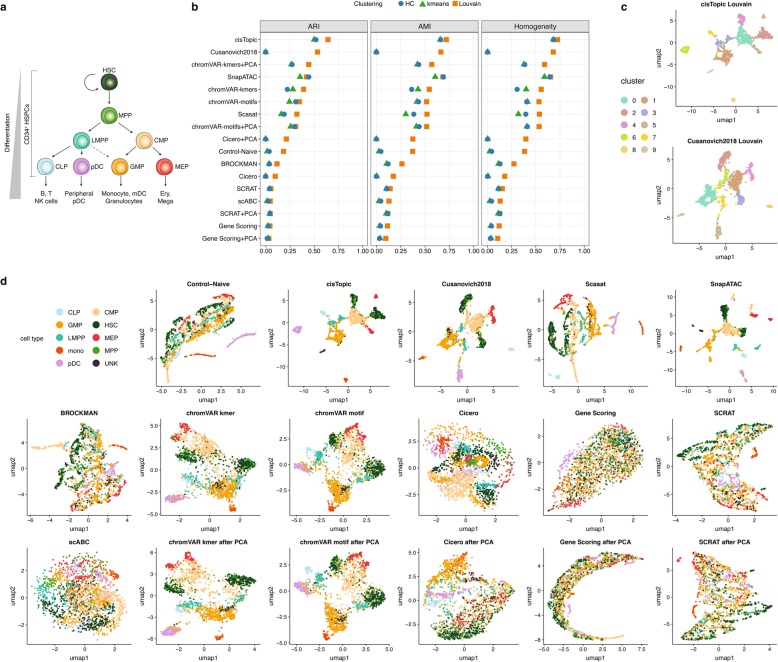
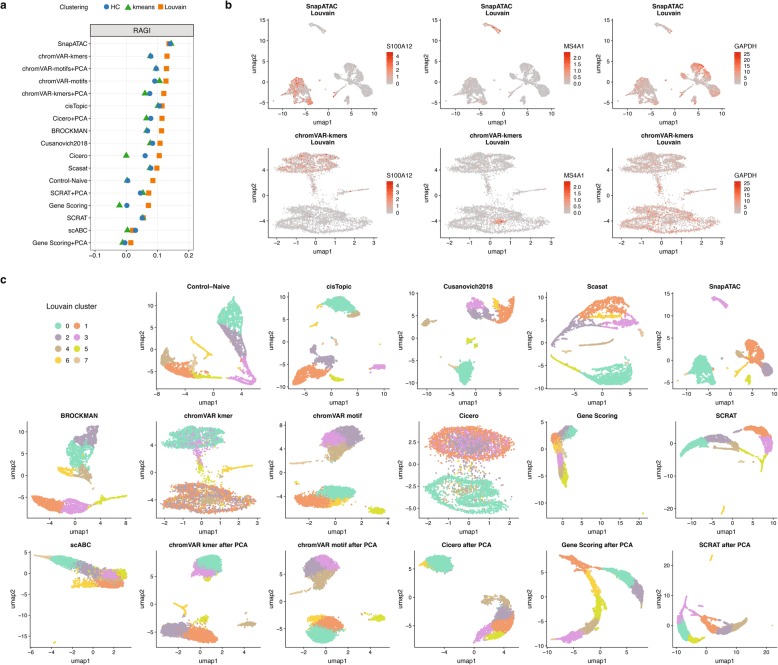
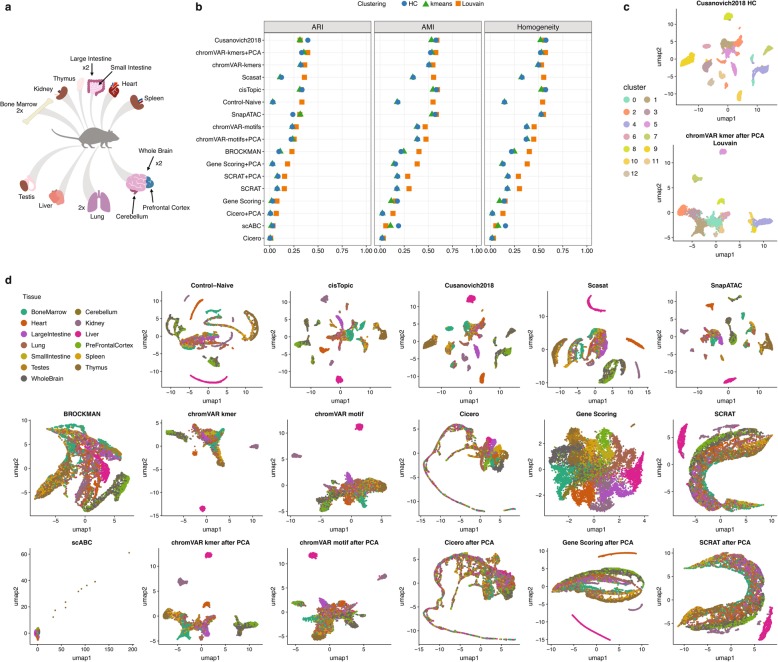
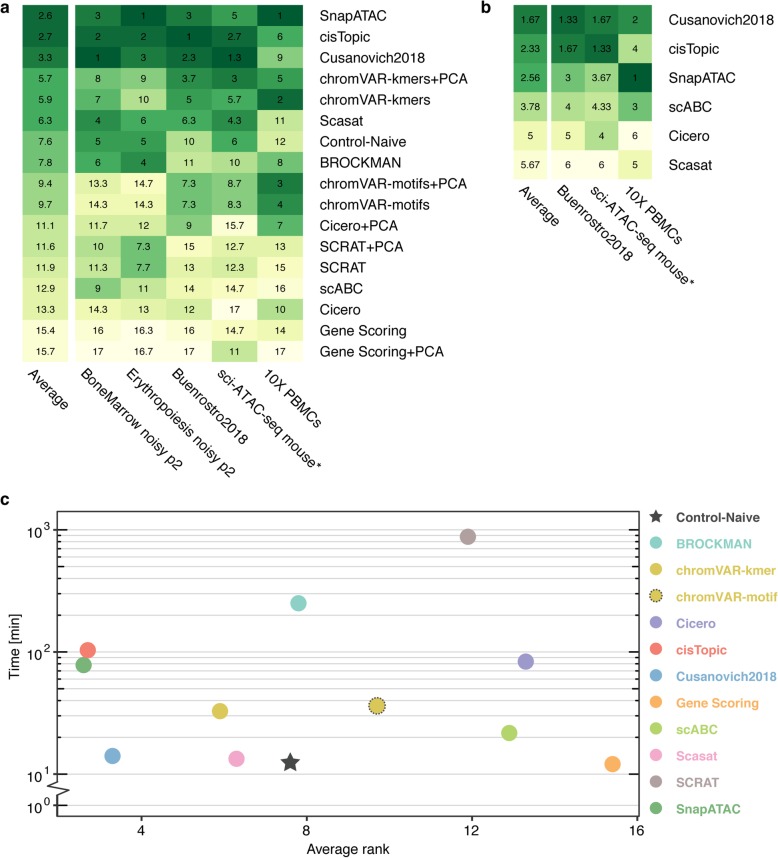
Background: Recent innovations in single-cell Assay for Transposase Accessible Chromatin using sequencing (scATAC-seq) enable profiling of the epigenetic landscape of thousands of individual cells. scATAC-seq data analysis presents unique methodological challenges. scATAC-seq experiments sample DNA, which, due to low copy numbers (diploid in humans), lead to inherent data sparsity (1–10% of peaks detected per cell) compared to transcriptomic (scRNA-seq) data (10–45% of expressed genes detected per cell). Such challenges in data generation emphasize the need for informative features to assess cell heterogeneity at the chromatin level. Results: We present a benchmarking framework that is applied to 10 computational methods for scATAC-seq on 13 synthetic and real datasets from different assays, profiling cell types from diverse tissues and organisms. Methods for processing and featurizing scATAC-seq data were compared by their ability to discriminate cell types when combined with common unsupervised clustering approaches. We rank evaluated methods and discuss computational challenges associated with scATAC-seq analysis including inherently sparse data, determination of features, peak calling, the effects of sequencing coverage and noise, and clustering performance. Running times and memory requirements are also discussed. Conclusions: This reference summary of scATAC-seq methods offers recommendations for best practices with consideration for both the non-expert user and the methods developer. Despite variation across methods and datasets, SnapATAC, Cusanovich2018 , and cisTopic outperform other methods in separating cell populations of different coverages and noise levels in both synthetic and real datasets. Notably, SnapATAC is the only method able to analyze a large dataset (> 80,000 cells).
Overview
The claims and statistics of this paper haven’t been checked yet.
Free: it reads the open-access text and checks the first 5 claims that cite a source we can check. Create a free account to check every claim.
Integrity signals
Registry
Cites
Statistics
Figures
Verification
Claims the paper makes
The claims and statistics of this paper haven’t been checked yet.
Free: it reads the open-access text and checks the first 5 claims that cite a source we can check. Create a free account to check every claim.
Claims other papers make about this one
Each is checked against this paper’s own text: does it say what the citing paper says it does?
In the citing paper
“In particular, for scATAC feature assignments specific to CRISPR perturbations, known loci of action could be used to improve feature calls40.”
From scPerturb: harmonized single-cell perturbation data (2024) · cites this paper as [40]
In the citing paper
“Most workflows use a cell-by-peak or cell-by-bin matrix as a basis for analysis, which performs better than matrices of gene or TF motif features135”
From Best practices for single-cell analysis across modalities (2023) · cites this paper as [135]
In the citing paper
“Dimensionality reduction methods based on latent semantic indexing (ArchR140 and Signac143), latent Dirichlet allocation (cisTopic141) and spectral embedding (snapATAC136) were shown to perform best for downstream clustering and cell annotation135.”
From Best practices for single-cell analysis across modalities (2023) · cites this paper as [135]
In the citing paper
“Notably, the cell-by-peak matrix is even more sparse than scRNA-seq data, with only 1–10% of peaks called in each cell owing to the presence of only two copies of assayable chromatin in cells of a diploid organism135.”
From Best practices for single-cell analysis across modalities (2023) · cites this paper as [135]
In the citing paper
“Initial approaches that map multimodal data into a common feature space based on prior knowledge — such as assay for transposase-accessible chromatin (ATAC) regions to nearby transcripts — with subsequent application of single-cell data integration methods have been shown to result in information loss135.”
From Best practices for single-cell analysis across modalities (2023) · cites this paper as [135]
Self-check
Percentages, sums and reported differences re-computed from the paper’s own numbers.
The self-check needs the paper’s full text.
Citations
Cites
Scikit-learn: Machine Learning in Python
Pedregosa, F., Varoquaux, G., Gramfort, A., Michel, V., Thirion, B., Grisel, O., Blondel, M., Müller, A., Nothman, J., Louppe, G., et al. (2012) · arXiv · doi:10.48550/arxiv.1201.0490 · Cited by 71,016 · cited 1×
“For this study, we used three commonly used clustering methods: k-means, hierarchical clustering (with default ward linkage) as implemented in the scikit-learn library [32], and Louvain clustering (a community detection-based method) [33, 34] as implemented in Scanpy [35].”
MethodBEDTools: a flexible suite of utilities for comparing genomic features
Quinlan, A. R., & Hall, I. M. (2010) · Bioinformatics · doi:10.1093/bioinformatics/btq033 · Cited by 27,437
Fast unfolding of communities in large networks
Blondel, V. D., Guillaume, J.-L., Lambiotte, R., & Lefebvre, E. (2008) · Journal of Statistical Mechanics: Theory and Experiment · doi:10.1088/1742-5468/2008/10/p10008 · Cited by 21,424
An integrated encyclopedia of DNA elements in the human genome
The ENCODE Project Consortium (2012) · Nature · doi:10.1038/nature11247 · Cited by 18,072 · cited 9×
“Feature sets of informative peaks for scATAC analyses may be computed from bulk 790 samples available through large scale consortia such as ENCODE[20] and 791 ROADMAP[21] or more precise tissue-specific cell types as in the 792 murine ImmGen Project[22].”
MethodInfluentialUMAP: Uniform Manifold Approximation and Projection
McInnes, L., Healy, J., Saul, N., & Großberger, L. (2018) · Journal of Open Source Software · doi:10.21105/joss.00861 · Cited by 9,826
SCANPY: large-scale single-cell gene expression data analysis
Wolf, F. A., Angerer, P., & Theis, F. J. (2018) · Genome Biology · doi:10.1186/s13059-017-1382-0 · Cited by 8,881
UMAP: Uniform Manifold Approximation and Projection for Dimension Reduction
McInnes, L., Healy, J., & Melville, J. (2018) · arXiv · doi:10.48550/arxiv.1802.03426 · Cited by 7,101
Reversed graph embedding resolves complex single-cell trajectories
Qiu, X., Mao, Q., Tang, Y., Wang, L., Chawla, R., Pliner, H. A., & Trapnell, C. (2017) · Nature Methods · doi:10.1038/nmeth.4402 · Cited by 5,070 · cited 1×
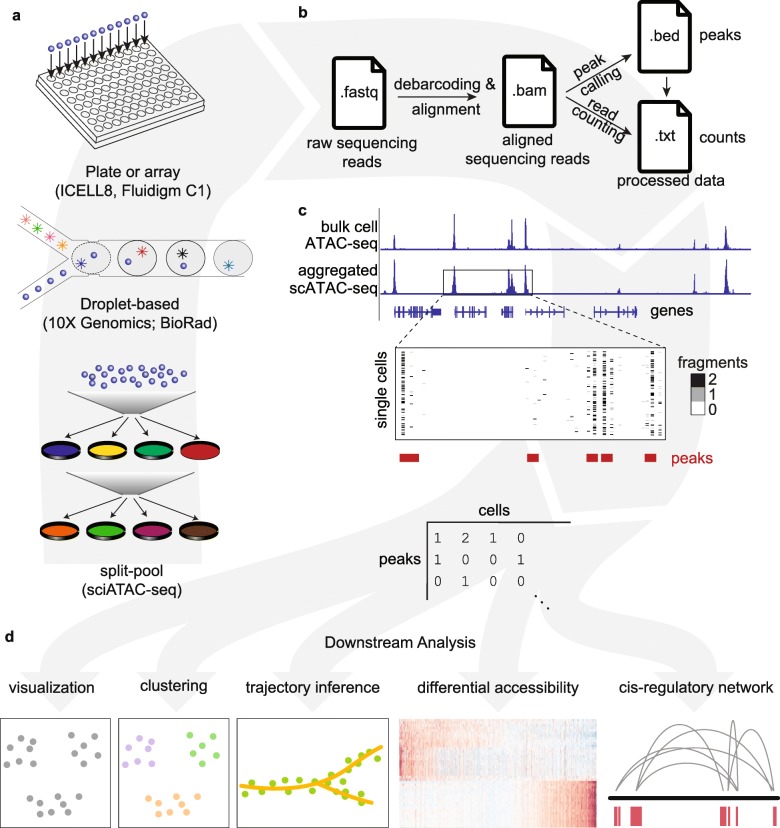
“However, the sparsity of scATAC-seq datasets provides unique challenges that must be addressed in order to perform essential analyses such as cluster identification, visualization, and trajectory inference [29, 30].”
MethodClustering by fast search and find of density peaks
Rodriguez, A., & Laio, A. (2014) · Science · doi:10.1126/science.1242072 · Cited by 4,942
Software for Computing and Annotating Genomic Ranges
Lawrence, M., Huber, W., Pagès, H., Aboyoun, P., Carlson, M., Gentleman, R., Morgan, M. T., & Carey, V. J. (2013) · PLoS Computational Biology · doi:10.1371/journal.pcbi.1003118 · Cited by 4,398
Research works printed but not linked: 2
- Fang R, et al. Fast and accurate clustering of single cell epigenomes reveals cis-regulatory elements in rare cell types. BioRxiv:615179v2. 2019.
- Stark R Brown G DiffBind: differential binding analysis of ChIP-Seq peak data R Package Version 2011 100 4 3
Cited by
Items 301–358 of 358
CHROMATIN ACCESSIBILITY CHANGES DURING ADIPOSE BEIGING AND MELANOCYTE STEM CELL ACTIVATION
Lee, S. (2022) · eCommons (Cornell University) · doi:10.7298/w7e7-kv88
Additional file 1 of Joint analysis of scATAC-seq datasets using epiConv
Lin, L., & Zhang, L. (2022) · Figshare · doi:10.6084/m9.figshare.20407420
Missarova, A., Dann, E., Rosen, L. U., Satija, R., & Marioni, J. C. (2024) · Figshare · doi:10.6084/m9.figshare.26750681
Yu, W., Uzun, Y., Zhu, Q., Chen, C., & Tan, K. (2020) · Figshare · doi:10.6084/m9.figshare.12160050
Przytycki, P. F., & Pollard, K. S. (2021) · Figshare · doi:10.6084/m9.figshare.14033650
Additional file 3 of Benchmarking computational methods for single-cell chromatin data analysis
Luo, S., Germain, P., Robinson, M. D., & von Meyenn, F. (2024) · Figshare · doi:10.6084/m9.figshare.26777830
Missarova, A., Dann, E., Rosen, L. U., Satija, R., & Marioni, J. C. (2024) · Figshare · doi:10.6084/m9.figshare.26750675
Roth, C., Venu, V., Job, V., Lubbers, N., Sanbonmatsu, K. Y., Steadman, C. R., & Starkenburg, S. R. (2024) · Figshare · doi:10.6084/m9.figshare.26643577
Roth, C., Venu, V., Job, V., Lubbers, N., Sanbonmatsu, K. Y., Steadman, C. R., & Starkenburg, S. R. (2024) · Figshare · doi:10.6084/m9.figshare.26643562
Missarova, A., Dann, E., Rosen, L. U., Satija, R., & Marioni, J. C. (2024) · Figshare · doi:10.6084/m9.figshare.26750678
Roth, C., Venu, V., Job, V., Lubbers, N., Sanbonmatsu, K. Y., Steadman, C. R., & Starkenburg, S. R. (2024) · Figshare · doi:10.6084/m9.figshare.26643574
Zhang, L., & Nie, Q. (2021) · Figshare · doi:10.6084/m9.figshare.13520752
Additional file 1 of Benchmarking computational methods for single-cell chromatin data analysis
Luo, S., Germain, P., Robinson, M. D., & von Meyenn, F. (2024) · Figshare · doi:10.6084/m9.figshare.26768356
Przytycki, P. F., & Pollard, K. S. (2021) · Figshare · doi:10.6084/m9.figshare.14033656
Yu, W., Uzun, Y., Zhu, Q., Chen, C., & Tan, K. (2020) · Figshare · doi:10.6084/m9.figshare.12160044
Additional file 1 of APEC: an accesson-based method for single-cell chromatin accessibility analysis
Li, B., Li, Y., Li, K., Zhu, L., Yu, Q., Cai, P., Fang, J., Zhang, W., Du, P., Jiang, C., et al. (2020) · Figshare · doi:10.6084/m9.figshare.12291608
Additional file 4 of simATAC: a single-cell ATAC-seq simulation framework
Navidi, Z., Zhang, L., & Wang, B. (2021) · Figshare · doi:10.6084/m9.figshare.14168524
Additional file 2 of Benchmarking computational methods for single-cell chromatin data analysis
Luo, S., Germain, P., Robinson, M. D., & von Meyenn, F. (2024) · Figshare · doi:10.6084/m9.figshare.26768416
Roth, C., Venu, V., Job, V., Lubbers, N., Sanbonmatsu, K. Y., Steadman, C. R., & Starkenburg, S. R. (2024) · Figshare · doi:10.6084/m9.figshare.26643565
Missarova, A., Dann, E., Rosen, L. U., Satija, R., & Marioni, J. C. (2024) · Figshare · doi:10.6084/m9.figshare.26750687
Raimundo, F., Prompsy, P., Vert, J., & Vallot, C. (2024) · Figshare · doi:10.6084/m9.figshare.26598464
Roth, C., Venu, V., Job, V., Lubbers, N., Sanbonmatsu, K. Y., Steadman, C. R., & Starkenburg, S. R. (2024) · Figshare · doi:10.6084/m9.figshare.26643580
Liu, C., Wang, L., & Liu, Z. (2024) · Figshare · doi:10.6084/m9.figshare.26559104
Missarova, A., Dann, E., Rosen, L. U., Satija, R., & Marioni, J. C. (2024) · Figshare · doi:10.6084/m9.figshare.26750690
Missarova, A., Dann, E., Rosen, L. U., Satija, R., & Marioni, J. C. (2024) · Figshare · doi:10.6084/m9.figshare.26750684
Roth, C., Venu, V., Job, V., Lubbers, N., Sanbonmatsu, K. Y., Steadman, C. R., & Starkenburg, S. R. (2024) · Figshare · doi:10.6084/m9.figshare.26643559
Roth, C., Venu, V., Job, V., Lubbers, N., Sanbonmatsu, K. Y., Steadman, C. R., & Starkenburg, S. R. (2024) · Figshare · doi:10.6084/m9.figshare.26643556
Zhang, W., Jiang, R., Chen, S., & Wang, Y. (2024) · Figshare · doi:10.6084/m9.figshare.24277238
Liu, C., Wang, L., & Liu, Z. (2024) · Figshare · doi:10.6084/m9.figshare.26559107
Yu, W., Uzun, Y., Zhu, Q., Chen, C., & Tan, K. (2020) · Figshare · doi:10.6084/m9.figshare.12160035
Missarova, A., Dann, E., Rosen, L. U., Satija, R., & Marioni, J. C. (2024) · Figshare · doi:10.6084/m9.figshare.26750672
Roth, C., Venu, V., Job, V., Lubbers, N., Sanbonmatsu, K. Y., Steadman, C. R., & Starkenburg, S. R. (2024) · Figshare · doi:10.6084/m9.figshare.26643568
Zhang, L., & Nie, Q. (2021) · Figshare · doi:10.6084/m9.figshare.13520749
DE LANGE, N. M. (2023) · Open Repository and Bibliography (University of Luxembourg)
Castillo Bonilla, A. (2021) · The Oberta in Open Access (Universitat Oberta de Catalunya)
Lineage, cell state and cell identity in the developing human brain
Mannens, C. C. A. (2024) · Open Archive (Karolinska Institutet)
Rathi, R., & Rathi, R. (2025) · UA Campus Repository (The University of Arizona)
Ip, K. (2025) · cIRcle (University of British Columbia) · doi:10.14288/1.0450337
Genome- and peak-informed two-stage framework for scATAC-seq cell type identification
Liu, Y., Guan, S., Yan, H., Shen, L.-C., Zhu, Y., Qiang, J.-P., & Wei, G. (2025) · Bioinformatics · doi:10.1093/bioinformatics/btaf682 · Cited by 1
“Among the key analytical challenges in scATAC-seq data interpretation, accurate cell type annotation stands out as a foundational step (Chen et al. 2019).”
iAODE for benchmarking and continuum modeling of single-cell chromatin accessibility
Fu, Z., Chen, C., Wang, S., Wang, J., & Chen, S. (2026) · Communications Biology · doi:10.1038/s42003-026-09768-8
“For scATAC-seq, extreme sparsity makes peak-gene link inference sensitive to noise 19 , requiring coherence examination at peak, gene, and multi-modal integration levels simultaneously 27,28 .”
Wall, B. P. G., Ogata, J. D., Nguyen, M. T., Olex, A. L., Floros, K. V., Faber, A. C., McClay, J. L., Harrell, J. C., & Dozmorov, M. G. (2026) · Bioinformatics · doi:10.1093/bioinformatics/btag110
“…et al. 2020, Yang et al. 2020), chromatin conformation capture technologies (Huang et al. 2022), and their single-cell variants (Vitak et al. 2017, Chen et al. 2019, Heumos et al. 2023), as well as in pipelines and tools for genomic data analysis (Ramirez et al. 2014, Stansfield and Dozmorov…”
Modelling the geometry of high-dimensional omics data : dimensionality, subspaces, trajectories
Bac, J. (2022) · theses.fr (ABES) · doi:10.70675/3c682a3dz1b61z4109z9dbdz18ac2365aed0
Unsupervised representation learning for single-cell transcriptomic and epigenomic data
Raimundo, F. (2022) · theses.fr (ABES) · doi:10.70675/760cd5d0z17c6z4f4ezb476z68bd387daf22
Genome-wide link between DNA replication and genome instability at the single cell level
Josephides, J. M. (2023) · theses.fr (ABES) · doi:10.70675/8afe969ez4e89z4209za2bdz41919a3f7e56 · Cited by 1
Yu, L., Deary, L. T., Liu, Q., Zhang, Q., & Zhao, S. (2026) · bioRxiv (Cold Spring Harbor Laboratory) · doi:10.64898/2026.04.27.721080
“%) of the regions that are detectable in bulk 23,25 , leaving the majority of regulatory elements unobserved and limiting the power of enrichment tests.”
Cell type annotation for scATAC-seq via DNA large language model and graph domain adaptation
Liu, Y., Guan, S., Yan, H., Shen, L.-C., Qiang, J.-P., & Wei, G. (2026) · PLoS Computational Biology · doi:10.1371/journal.pcbi.1014226
“These discrepancies can lead to distributional shifts in the feature space between the source and target domains, which pose challenges to direct label transfer and necessitate effective domain adaptation strategies [26].”
Ajay, V., Laughner, N., Cahan, P., & Andrew, D. J. (2026) · Genetics · doi:10.1093/genetics/iyag117
“…of scATAC-seq (eg the small number of fragments per cell, high sparsity of signal and locus-level dropout), which, although widely used to assay open chromatin, can fail to capture regions where the promoter accessibility is weak, hindered, or transient (Chen et al. 2019; Li et al. 2021).”
ATACompass enables cross-species cell identity mapping for scATAC-seq without gene annotations
Jiang, J., Ding, Y., Jin, B., Liu, G., Wang, S., Zhang, Y., Wang, Y., Li, X., Liu, J., Li, W., et al. (2026) · Cell Reports Methods · doi:10.1016/j.crmeth.2026.101460
Wang, D., Zhu, X., Hu, N., Wu, B., Dong, Y., Song, Y., Li, X., Wang, Z., Huang, Z., Li, Y., et al. (2026) · Genes & Diseases · doi:10.1016/j.gendis.2026.102272
Mao, S., Yang, C., Zhen, C., He, Z., Luo, Y., & Zhang, L. (2026) · Communications Biology · doi:10.1038/s42003-026-10462-y
Graph designs for deep learning–based multi-omics integration
Alif, M. N., Ahmed, K. T., Baul, S., & Zhang, W. (2026) · Briefings in Bioinformatics · doi:10.1093/bib/bbag410
“For instance, scRNA-seq [ 40] quantifies mRNA transcripts to map gene activity, while scATAC-seq [ 41] identifies open chromatin regions that mark regulatory elements.”
Liang, H., Hua, H., Li, S., & Chen, S. (2026) · Briefings in Bioinformatics · doi:10.1093/bib/bbag434
“However, benchmarking studies of these omics modalities [ 68– 70] have provided critical methodological references for our evaluation framework, and established standardized evaluation paradigms while sorting out the similarities and differences in data characteristics”
Cao, L., Zhang, W., Zhou, F., He, Y., Long, Y., Chen, S., & Wang, Y. (2026) · Genome Research · doi:10.1101/gr.281981.126
Du, X., & Qiao, H. (2026) · Frontiers in Cell and Developmental Biology · doi:10.3389/fcell.2026.1935200
“(ii) Single-cell ATAC sequencing (scATAC-seq) (Wang C. et al., 2025). scATAC-seq evaluates accessible chromatin, thereby allowing the identification of regulatory elements involved in the transcription of inflammatory genes (Shi et al., 2022; Chen et al., 2019).”
Lu, Z., Yu, P., & Wang, Y. (2026) · Lecture notes in computer science · doi:10.1007/978-3-032-38224-5_53
EpiZoo: a DNA sequence-aware foundation model for cross-species single-cell epigenomicsPreprint
Li, K., Chen, X., Jiang, Q., Wang, Z., Lv, H., & Jiang, R. (2026) · bioRxiv (Cold Spring Harbor Laboratory) · doi:10.64898/2026.09.24.754017
Wang, Y., Guo, S., Qian, J., Liang, H., Su, Y., Yu, Z., & Li, X. (2026) · Journal of Chemical Information and Modeling · doi:10.1021/acs.jcim.6c02880
Gokhale, A., & Przytycki, P. F. (2026) · Bioinformatics Advances · doi:10.1093/bioadv/vbag313
“Given that scATAC-seq data is typically less readily available than scRNA-seq data (Chen et al .”
Influential
Metadata
- Authors
- Chen, H., Lareau, C., Andreani, T., Vinyard, M. E., Garcia, S. P., Clement, K., Andrade-Navarro, M. A., Buenrostro, J. D., & Pinello, L.
- Affiliations
- Broad Institute (US)
- Harvard University (US)
- Massachusetts General Hospital (US)
- Johannes Gutenberg University Mainz (DE)
- Corresponding author
- Pinello, Luca
- ORCID
- Venue
- Genome Biology
- Published
- 2019-11-18
- Volume
- 20
- Issue
- 1
- Pages
- 241-241
- ISSN
- 1465-6906 (ISSN-L)
- 1474-760X
- PMC
- PMC6859644
- OpenAlex
- W2989061519
- Semantic Scholar
- dc9f0e12340139dbc18638c43fafd9441c2ad40e
- Cited by
- 332
- References
- 47
- Citations by year
- 2026: 24 · 2025: 40 · 2024: 72 · 2023: 45 · 2022: 49 · 2021: 67 · 2020: 33 · 2019: 2
- FWCI
- 12.98
- Type
- journal article
- Language
- en
- Open access
- gold
- doi.org
- Licence
- cc-by
- creativecommons.org/licenses/by/4.0/ (tdm)
- creativecommons.org/licenses/by/4.0/ (vor)
- Locations
- Genome biology (publishedVersion, cc-by)
- bioRxiv (Cold Spring Harbor Laboratory) (acceptedVersion, cc-by)
- PubMed Central (publishedVersion, cc-by)
- PubMed (publishedVersion)
- DOAJ (DOAJ: Directory of Open Access Journals) (submittedVersion, cc-by-sa)
- Funders
- Chan Zuckerberg Initiative DAF (2018- 182734)
- National Human Genome Research Institute (R00HG008399, R35HG010717)
- Topics
- Life Sciences › Biochemistry, Genetics and Molecular Biology › Molecular Biology › Single-cell and spatial transcriptomics
- Life Sciences › Biochemistry, Genetics and Molecular Biology › Molecular Biology › Genomics and Chromatin Dynamics
- Life Sciences › Biochemistry, Genetics and Molecular Biology › Molecular Biology › Epigenetics and DNA Methylation
- Keywords
- single-cell ATAC-seq, chromatin accessibility, cell type discrimination, unsupervised clustering, peak calling, data sparsity, sequencing depth, noise, computational performance, epigenetic heterogeneity
- MeSH terms
- Animals, Humans, Sequence Analysis, DNA, Computational Biology, Benchmarking, Mice, Epigenomics, Single-Cell Analysis
About these checks
Registry, retraction, Cites and statistics results are computed, not judged, with one exception: a printed reference that no index lists is read once by a model before it counts as a citation error. Claims are extracted by a model and kept only when their quote appears verbatim in the text; each cited source is then checked, with a model’s help, for whether it says what the claim relies on. Those verdicts can be wrong — read the claim’s quote and the cited source before relying on one.
Statistics and arithmetic are recomputed, not judged.
Confidence bands are shown only for fields calibrated on our annotated test set. None is calibrated yet, so no band is shown.
What counts as a claim ›How we measure confidence ›How we check this ›
Are you an author, or do you see a problem with this page? Request a review
Data sources
Bibliographic data: Semantic Scholar, OpenAlex, Crossref.
Contains information from the Semantic Scholar Academic Graph Datasets, made available under the ODC Attribution License (ODC-BY 1.0).
Semantic Scholar’s data is described in: Kinney, R., et al. (2023). The Semantic Scholar Open Data Platform. arXiv:2301.10140.
