

Assessment of computational methods for the analysis of single-cell ATAC-seq data
Open accessPublished version of a preprint
The DOI matches its Crossref record; 47 of the 47 references it cites were found in a registry or an index.
Abstract
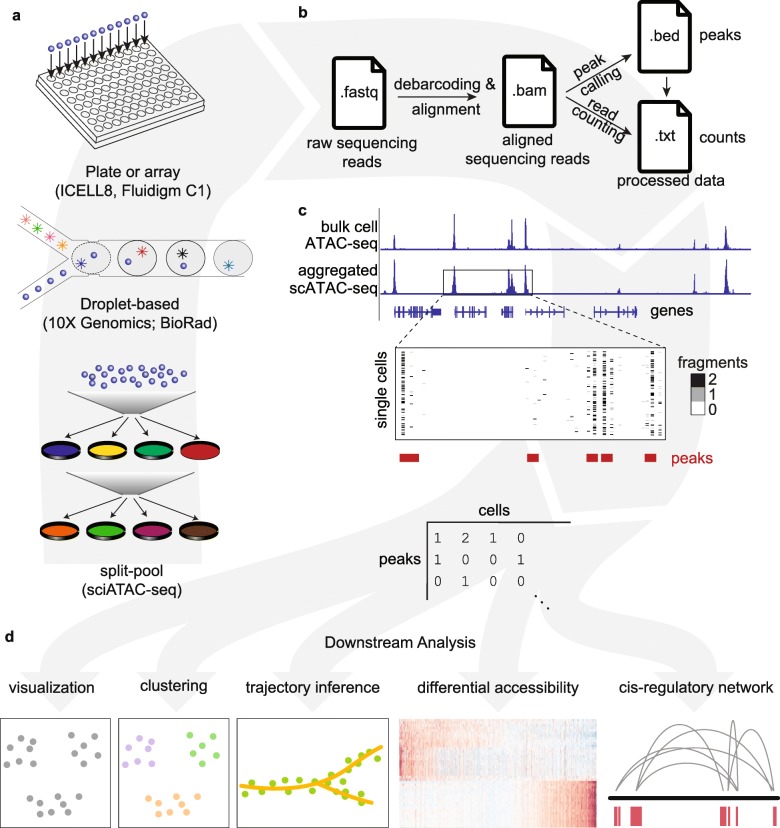
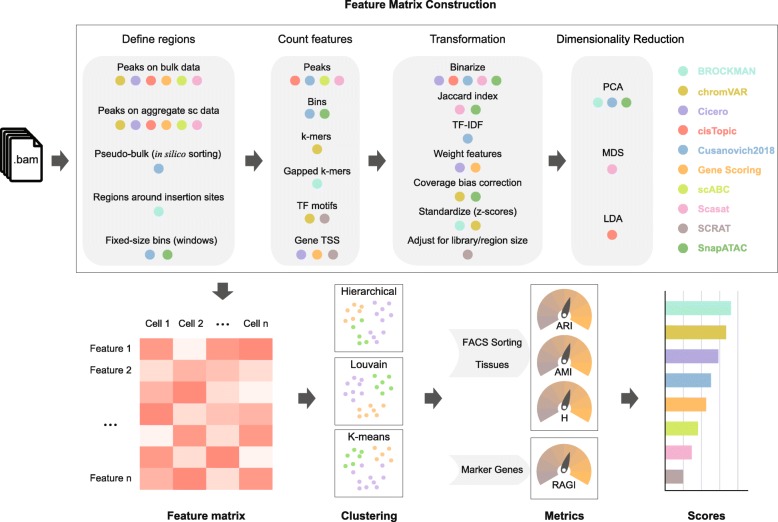
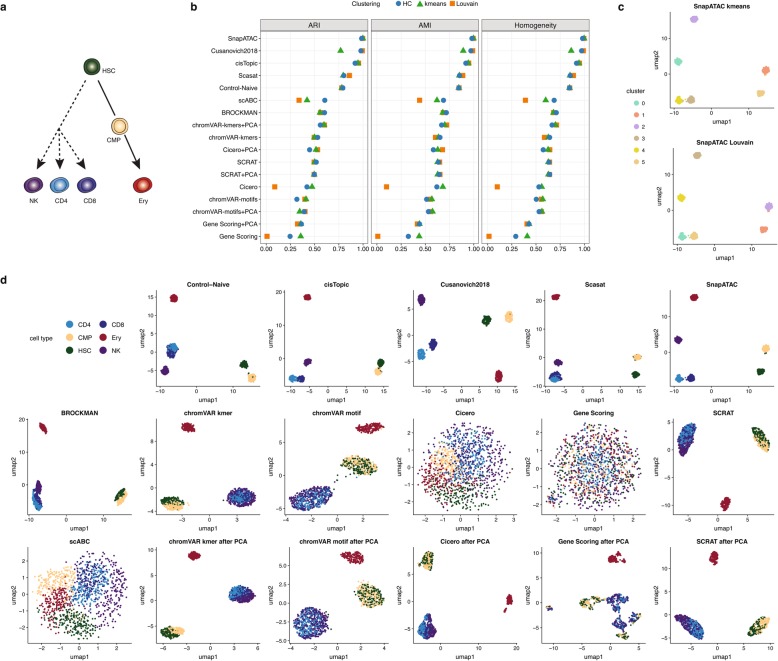
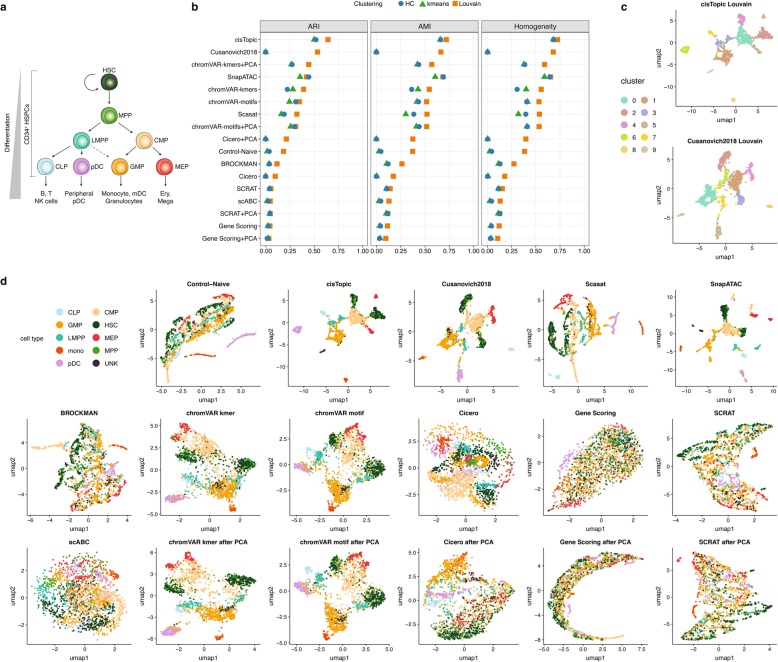
Background: Recent innovations in single-cell Assay for Transposase Accessible Chromatin using sequencing (scATAC-seq) enable profiling of the epigenetic landscape of thousands of individual cells. scATAC-seq data analysis presents unique methodological challenges. scATAC-seq experiments sample DNA, which, due to low copy numbers (diploid in humans), lead to inherent data sparsity (1–10% of peaks detected per cell) compared to transcriptomic (scRNA-seq) data (10–45% of expressed genes detected per cell). Such challenges in data generation emphasize the need for informative features to assess cell heterogeneity at the chromatin level. Results: We present a benchmarking framework that is applied to 10 computational methods for scATAC-seq on 13 synthetic and real datasets from different assays, profiling cell types from diverse tissues and organisms. Methods for processing and featurizing scATAC-seq data were compared by their ability to discriminate cell types when combined with common unsupervised clustering approaches. We rank evaluated methods and discuss computational challenges associated with scATAC-seq analysis including inherently sparse data, determination of features, peak calling, the effects of sequencing coverage and noise, and clustering performance. Running times and memory requirements are also discussed. Conclusions: This reference summary of scATAC-seq methods offers recommendations for best practices with consideration for both the non-expert user and the methods developer. Despite variation across methods and datasets, SnapATAC, Cusanovich2018 , and cisTopic outperform other methods in separating cell populations of different coverages and noise levels in both synthetic and real datasets. Notably, SnapATAC is the only method able to analyze a large dataset (> 80,000 cells).
Overview
The claims and statistics of this paper haven’t been checked yet.
Free: it reads the open-access text and checks the first 5 claims that cite a source we can check. Create a free account to check every claim.
Integrity signals
Registry
Cites
Statistics
Figures
Verification
Claims the paper makes
The claims and statistics of this paper haven’t been checked yet.
Free: it reads the open-access text and checks the first 5 claims that cite a source we can check. Create a free account to check every claim.
Claims other papers make about this one
Each is checked against this paper’s own text: does it say what the citing paper says it does?
In the citing paper
“In particular, for scATAC feature assignments specific to CRISPR perturbations, known loci of action could be used to improve feature calls40.”
From scPerturb: harmonized single-cell perturbation data (2024) · cites this paper as [40]
In the citing paper
“Most workflows use a cell-by-peak or cell-by-bin matrix as a basis for analysis, which performs better than matrices of gene or TF motif features135”
From Best practices for single-cell analysis across modalities (2023) · cites this paper as [135]
In the citing paper
“Dimensionality reduction methods based on latent semantic indexing (ArchR140 and Signac143), latent Dirichlet allocation (cisTopic141) and spectral embedding (snapATAC136) were shown to perform best for downstream clustering and cell annotation135.”
From Best practices for single-cell analysis across modalities (2023) · cites this paper as [135]
In the citing paper
“Notably, the cell-by-peak matrix is even more sparse than scRNA-seq data, with only 1–10% of peaks called in each cell owing to the presence of only two copies of assayable chromatin in cells of a diploid organism135.”
From Best practices for single-cell analysis across modalities (2023) · cites this paper as [135]
In the citing paper
“Initial approaches that map multimodal data into a common feature space based on prior knowledge — such as assay for transposase-accessible chromatin (ATAC) regions to nearby transcripts — with subsequent application of single-cell data integration methods have been shown to result in information loss135.”
From Best practices for single-cell analysis across modalities (2023) · cites this paper as [135]
Self-check
Percentages, sums and reported differences re-computed from the paper’s own numbers.
The self-check needs the paper’s full text.
Citations
Cites
Scikit-learn: Machine Learning in Python
Pedregosa, F., Varoquaux, G., Gramfort, A., Michel, V., Thirion, B., Grisel, O., Blondel, M., Müller, A., Nothman, J., Louppe, G., et al. (2012) · arXiv · doi:10.48550/arxiv.1201.0490 · Cited by 71,016 · cited 1×
“For this study, we used three commonly used clustering methods: k-means, hierarchical clustering (with default ward linkage) as implemented in the scikit-learn library [32], and Louvain clustering (a community detection-based method) [33, 34] as implemented in Scanpy [35].”
MethodBEDTools: a flexible suite of utilities for comparing genomic features
Quinlan, A. R., & Hall, I. M. (2010) · Bioinformatics · doi:10.1093/bioinformatics/btq033 · Cited by 27,437
Fast unfolding of communities in large networks
Blondel, V. D., Guillaume, J.-L., Lambiotte, R., & Lefebvre, E. (2008) · Journal of Statistical Mechanics: Theory and Experiment · doi:10.1088/1742-5468/2008/10/p10008 · Cited by 21,424
An integrated encyclopedia of DNA elements in the human genome
The ENCODE Project Consortium (2012) · Nature · doi:10.1038/nature11247 · Cited by 18,072 · cited 9×
“Feature sets of informative peaks for scATAC analyses may be computed from bulk 790 samples available through large scale consortia such as ENCODE[20] and 791 ROADMAP[21] or more precise tissue-specific cell types as in the 792 murine ImmGen Project[22].”
MethodInfluentialUMAP: Uniform Manifold Approximation and Projection
McInnes, L., Healy, J., Saul, N., & Großberger, L. (2018) · Journal of Open Source Software · doi:10.21105/joss.00861 · Cited by 9,826
SCANPY: large-scale single-cell gene expression data analysis
Wolf, F. A., Angerer, P., & Theis, F. J. (2018) · Genome Biology · doi:10.1186/s13059-017-1382-0 · Cited by 8,881
UMAP: Uniform Manifold Approximation and Projection for Dimension Reduction
McInnes, L., Healy, J., & Melville, J. (2018) · arXiv · doi:10.48550/arxiv.1802.03426 · Cited by 7,101
Reversed graph embedding resolves complex single-cell trajectories
Qiu, X., Mao, Q., Tang, Y., Wang, L., Chawla, R., Pliner, H. A., & Trapnell, C. (2017) · Nature Methods · doi:10.1038/nmeth.4402 · Cited by 5,070 · cited 1×
“However, the sparsity of scATAC-seq datasets provides unique challenges that must be addressed in order to perform essential analyses such as cluster identification, visualization, and trajectory inference [29, 30].”
MethodClustering by fast search and find of density peaks
Rodriguez, A., & Laio, A. (2014) · Science · doi:10.1126/science.1242072 · Cited by 4,942
Software for Computing and Annotating Genomic Ranges
Lawrence, M., Huber, W., Pagès, H., Aboyoun, P., Carlson, M., Gentleman, R., Morgan, M. T., & Carey, V. J. (2013) · PLoS Computational Biology · doi:10.1371/journal.pcbi.1003118 · Cited by 4,398
Research works printed but not linked: 2
- Fang R, et al. Fast and accurate clustering of single cell epigenomes reveals cis-regulatory elements in rare cell types. BioRxiv:615179v2. 2019.
- Stark R Brown G DiffBind: differential binding analysis of ChIP-Seq peak data R Package Version 2011 100 4 3
Cited by
Items 201–300 of 358
Jia, Y., Li, S., Jiang, R., & Chen, S. (2024) · IEEE Transactions on Computational Biology and Bioinformatics · doi:10.1109/tcbb.2024.3372970 · Cited by 4
“Wenotethatthecell-typelabelswereconsideredreasonable andhavebeenusedtoassessunsupervisedcellclusteringper-formanceandsupervisedcelltypeannotationperformance[4], [5], [18], [19], [24], [25].”
BackgroundHyGAnno: hybrid graph neural network–based cell type annotation for single-cell ATAC sequencing data
Zhang, W., Cui, Y., Liu, B., Loza, M., Park, S., & Nakai, K. (2024) · Briefings in Bioinformatics · doi:10.1093/bib/bbae152 · Cited by 6
“Meanwhile,due to low copy num-bersofDNA,onlyamaximumof10%peakscanbefinallydetected in each cell; the data sparsity of scATAC-seq is thereby inherent and unavoidable [13].”
BackgroundGong, Y., Srinivasan, S. S., Zhang, R., Kessenbrock, K., & Zhang, J. (2022) · Biomolecules · doi:10.3390/biom12070874 · Cited by 4
“It can be used for downstream analyses including cell clustering, identifying differential accessible peaks, construction of cis -regulatory network, and inferring trajectories [5].”
MethodGAGAM: A Genomic Annotation-Based Enrichment of scATAC-seq Data for Gene Activity Matrix
Martini, L., Bardini, R., Savino, A., & Carlo, S. D. (2022) · Lecture notes in computer science · doi:10.1007/978-3-031-07802-6_2 · Cited by 5
Luo, S., Zhu, M., Lin, L., Xie, J., Lin, S., Chen, Y., Zhu, J., & Huang, J. (2024) · Briefings in Bioinformatics · doi:10.1093/bib/bbaf069 · Cited by 4
Single-cell technologies to dissect heterogenous immune cell therapy products
Mueller, K. P., & Saha, K. (2021) · Current Opinion in Biomedical Engineering · doi:10.1016/j.cobme.2021.100343 · Cited by 4
Suen, H. C., Luk, A. C. S., & Liao, J. (2022) · Scientific Reports · doi:10.1038/s41598-022-25729-7 · Cited by 4
Zhang, W., Jiang, R., Chen, S., & Wang, Y. (2023) · Genome biology · doi:10.1186/s13059-023-03072-y · Cited by 4
“However, doublet-detection in scCAS data is more challenging than in scRNA-seq data since the assay-specific challenges of scCAS data, including their low capture rate, close-to-binary nature, extreme sparsity, and tens of times higher dimensions than scRNA-seq data [12–14].”
MethodLiao, J., Suen, H. C., Luk, A. C. S., Lee, A. W.-T., Ng, J. K. W., Chan, T. H. T., Cheung, M. Y., Chan, D. Y. L., Qi, H., Chan, W., et al. (2020) · bioRxiv (Cold Spring Harbor Laboratory) · doi:10.1101/2020.10.12.336834 · Cited by 4
“…substructure within cell populations associated with a continuous EMT-like process, which is one of the best methods for dynamic populations 37 cisTopic identifies co accessible regulatory regions (cis-regulatory topics) for each cell by clustering all 364,232 scATAC-Seq peaks (Chen et al. 2019).”
MethodUser-friendly exploration of epigenomic data in single cells using sinceiPreprint
Bhardwaj, V., & Mourragui, S. M. C. (2024) · bioRxiv (Cold Spring Harbor Laboratory) · doi:10.1101/2024.07.27.605424 · Cited by 4
Single-cell technologies meet Hi-C
Hughes, J. R., & Davies, J. O. J. (2024) · Nature Genetics · doi:10.1038/s41588-024-01855-y · Cited by 4
A Single-Cell Omics Technical Guide for Advancing Neuropsychiatric Research
Casmey, K., Zimmermann, M., Xie, Y., Codeluppi-Arrowsmith, S. A., & Turecki, G. (2025) · Genes · doi:10.3390/genes16121394 · Cited by 3
RefTM: reference-guided topic modeling of single-cell chromatin accessibility data
Zhang, Z., Chen, S., & Lin, Z. (2022) · Briefings in Bioinformatics · doi:10.1093/bib/bbac540 · Cited by 3
GRAIGH: Gene Regulation accessibility integrating GeneHancer database
Martini, L., Savino, A., Bardini, R., & Carlo, S. D. (2023) · IEEE International Conference on Bioinformatics and Biomedicine (BIBM) · doi:10.1109/bibm58861.2023.10385417 · Cited by 3
“Cells are grouped into two significant populations, and some smaller groups, aligning with expectations for this sample type [17].”
BackgroundMethodInfluentialRutkowski, P., & Tabaka, M. (2025) · NAR Genomics and Bioinformatics · doi:10.1093/nargab/lqaf040 · Cited by 4
Analytics methods and tools for integration of biomedical data in medicine
Zhang, L., Karimzadeh, M., Welch, M. L., McIntosh, C., & Wang, B. (2020) · Elsevier eBooks · doi:10.1016/b978-0-12-821259-2.00007-7 · Cited by 3
Single-cell sequencing: promises and challenges for human genetics
Sreenivasan, V. K. A., Henck, J., & Spielmann, M. (2022) · Medizinische Genetik · doi:10.1515/medgen-2022-2156 · Cited by 6
“Some of these include Cellranger, Seurat, Scanpy, etc., for sc-transcriptome-seq analysis [25], chromVar, Signac, scABC,etc.,for sc-epigenome-seqanalysis[26],and Mono-var, SCIΦ, etc., for sc-genome-seq analysis [27].”
Tensor decomposition discriminates tissues using scATAC-seq
Taguchi, Y., & Turki, T. (2023) · Biochimica et Biophysica Acta (BBA) - General Subjects · doi:10.1016/j.bbagen.2023.130360 · Cited by 4
Braband, K. L., Nedwed, A. S., Helbich, S. S., Simon, M., Beumer, N., Brors, B., Marini, F., & Delacher, M. (2023) · Frontiers in Immunology · doi:10.3389/fimmu.2023.1232511 · Cited by 3
Zhang, B., Nan, M., Wang, L., HanWen, W., Chen, X. '., Shi, Y., Ma, Y., & Gao, J. (2025) · BMC Genomics · doi:10.1186/s12864-025-11462-8 · Cited by 5
“The adjusted rand index [24] (ARI), normalized mutual information (NMI), and residual average Gini index [25] (RAGI) are calculated to evaluate algorithm performance.”
Learning single-cell chromatin accessibility profiles using meta-analytic marker genes
Kawaguchi, R. K., Tang, Z., Fischer, S., Rajesh, C., Tripathy, R. K., Koo, P. K., & Gillis, J. (2022) · Briefings in Bioinformatics · doi:10.1093/bib/bbac541 · Cited by 3
“, 2 for diploid organisms) results in observed signals that are nearly binary (0, 1, or 2) and are sparsely located across genomic loci, making it difficult to obtain robust results from single datasets [13].”
BackgroundProfiling of transcribed cis -regulatory elements in single cellsPreprint
Moody, J., Kouno, T., Suzuki, A., Shibayama, Y., Terao, C., Chang, J.-C., López-Redondo, F., Yip, C. W., Severin, J., Suetsugu, H., et al. (2021) · bioRxiv (Cold Spring Harbor Laboratory) · doi:10.1101/2021.04.04.438388 · Cited by 5
Weinand, K., Langan, E. M., Curtis, M. L., & Raychaudhuri, S. (2025) · bioRxiv (Cold Spring Harbor Laboratory) · doi:10.1101/2025.04.02.646871 · Cited by 3
Destin2: Integrative and cross-modality analysis of single-cell chromatin accessibility data
Guan, P. Y., Lee, J. S., Wang, L., Lin, K., Mei, W., Chen, L., & Jiang, Y. (2023) · Frontiers in Genetics · doi:10.3389/fgene.2023.1089936 · Cited by 2
“Multiple statistical 28 and computational methods have been developed and evaluated by independent benchmark studies [7].”
MethodMartini, L., Bardini, R., Savino, A., & Carlo, S. D. (2024) · Genes · doi:10.3390/genes15030268 · Cited by 2
“These methods retain minimal biological information from raw scATAC-seq data, primarily related to gene-coding regions, despite only representing a small percentage of the entire signal [19].”
BackgroundMethodUnveiling Long Non-coding RNA Networks from Single-Cell Omics Data Through Artificial Intelligence
Cao, G., & Chen, D. (2024) · Methods in molecular biology · doi:10.1007/978-1-0716-4290-0_11 · Cited by 2
GFETM: Genome foundation-based embedded topic model for scATAC-seq modeling
Fan, Y., Osakwe, A., Han, S., Li, Y., Ding, J., & Li, Y. (2026) · Cell Systems · doi:10.1016/j.cels.2026.101563 · Cited by 3
Amarasinghe, S. L., Yang, P., Voogd, O., Yang, H., Du, M. R. M., Su, S., Brown, D. V., Jabbari, J. S., Bowden, R. J., & Ritchie, M. E. (2023) · NAR Genomics and Bioinformatics · doi:10.1093/nargab/lqad105 · Cited by 2
scGEMOC, A Graph Embedded Contrastive Learning Single-cell Multiomics Clustering Model
Li, B., & Nabavi, S. (2023) · IEEE International Conference on Bioinformatics and Biomedicine (BIBM) · doi:10.1109/bibm58861.2023.10385267 · Cited by 3
A scalable approach to topic modelling in single-cell data by approximate pseudobulk projection
Subedi, S., Sumida, T. S., & Park, Y. (2024) · Life Science Alliance · doi:10.26508/lsa.202402713 · Cited by 2
“…genomics, especially for sparse DNA accessibility data, embedding methods based on topic modelling (or latent semantic indexing), such as ArchR (Granja et al, 2021) and cisTopic (Bravo Gonz´alez-Blas et al, 2019), were ranked in the top lists of a recent benchmark study (Chen et al, 2019).”
Zajanckauskaite, A., Lingelbach, M., Juozapaitė, D., Utkus, A., Rukšnaitytė, G., Jonuškienė, G., & Gulla, A. (2024) · Genes · doi:10.3390/genes15101242 · Cited by 2
“However, tightly packed DNA is less prone to transposase binding [48,49].”
BackgroundMethodFITs: forest of imputation trees for recovering true signals in single-cell open chromatin profiles
Sharma, R., Pandey, N., Mongia, A., Mishra, S. V., Majumdar, A., & Kumar, V. (2020) · NAR Genomics and Bioinformatics · doi:10.1093/nargab/lqaa091 · Cited by 2
“Recently, a few methods have been proposed for visualization and clustering of scATAC-seq profiles (18).”
Enhancement and Imputation of Peak Signal Enables Accurate Cell-Type Classification in scATAC-seq
Cui, Z., Cui, Y., Gao, Y. P., Jiang, T., Zang, T., & Wang, Y. (2021) · Frontiers in Genetics · doi:10.3389/fgene.2021.658352 · Cited by 2
“Several region definitions for cell-peak matrix have been broadly used (Chen et al., 2019), including peaks on bulk data or aggregate single-cell data, pseudo-bulk data, regions around insertion sites, and fixed-size bins.”
BackgroundMethodLeveraging Novel Integrated Single-Cell Analyses to Define HIV-1 Latency Reversal
Zhao, S., & Tsibris, A. M. N. (2021) · Viruses · doi:10.3390/v13071197 · Cited by 2
A heterogeneous graph cross-omics attention model for single-cell representation learning
Liu, Y., Zhang, J., Wang, S., Zhang, W., Zeng, X., & Kwoh, C. K. (2022) · IEEE International Conference on Bioinformatics and Biomedicine (BIBM) · doi:10.1109/bibm55620.2022.9995680 · Cited by 2
“SNARE-seq is another method that employs the droplet platform and barcoded beads to analyze open chromatin accessibility and mRNA level in the same individual nucleus [13].”
MethodMartini, L., Bardini, R., Savino, A., & Carlo, S. D. (2023) · Lecture notes in computer science · doi:10.1007/978-3-031-34960-7_14 · Cited by 2
Subtle cell states resolved in single-cell data
Lareau, C. A. (2023) · Nature Biotechnology · doi:10.1038/s41587-023-01797-6 · Cited by 2
Self-citationLearning sequence-based regulatory dynamics in single-cell genomicsPreprint
Ibarra, I. L., Schneeberger, J., Erdogan, E., Redl, L., Martens, L. D., Klein, D., Aliee, H., & Theis, F. J. (2024) · bioRxiv (Cold Spring Harbor Laboratory) · doi:10.1101/2024.08.07.605876 · Cited by 2
“…convolutional filters and iterative, greedy optimization for faster convergence, allowing direct interpretation of main signal contributors 12 , yet potentially affecting generalization performance in scalable applications due to constraining the learning task to a limited set of motifs 13 .”
Detecting novel cell type in single-cell chromatin accessibility data via open-set domain adaptation
Lin, Y., Pan, Z., Zeng, Y., Yang, Y., & Dai, Z. (2024) · Briefings in Bioinformatics · doi:10.1093/bib/bbae370 · Cited by 1
“(iii) Compared with scRNA-seq data, scATAC-seq data have higher sparsity and dimensionality, with nearly binarized values [18].”
MethodSingle-cell technology for plant systems biology
Amini, S., Thibivilliers, S., Farmer, A. A., Martin, O., & Libault, M. (2025) · Elsevier eBooks · doi:10.1016/b978-0-443-23736-2.00008-3 · Cited by 1
Advancing Cardiovascular Medicine: Innovative Therapeutic Pathways with Single-Cell Technologies
Ji, J., Lindberg, E. L., & Reichart, D. (2025) · Current Treatment Options in Cardiovascular Medicine · doi:10.1007/s11936-025-01100-7 · Cited by 1
“These processes are interconnected, as chromatin accessibility governs transcription factor and chromatin remodeler access to DNA, driving cis-regulatory activities and cell-type-specific gene expression [ 92–94].”
Multiscale modeling primer: Focus on chromatin and epigenetics
Mahajan, A., Navarro, E. J., Poole, W., El-Samad, H., Bianco, S., & Lopez, C. F. (2026) · Journal of Biological Chemistry · doi:10.1016/j.jbc.2026.113517 · Cited by 1
“This is especially important for single-cell techniques, which have begun to address cellular variability but remain limited by resolution and noise (156–158).”
Wang, H., Dong, H., & Du, P.-F. (2025) · Briefings in Bioinformatics · doi:10.1093/bib/bbaf597 · Cited by 1
“…captures < 10% of accessible chromatin peaks per cell [16]; (ii) accessible regions in scATAC-seq data vary significantly across different datasets [17]; (iii) an scATAC-seq dataset is a very sparse, very large, nearly binary matrix, which makes it very difficult to be handled by general-purpose…”
scII: Dual-Threshold Adaptive Integration of Single-Cell Multiomics Data Driven by Imputation
Zhang, Y., Li, Y., Jin, Z., Tian, Y., & Su, C. (2026) · Journal of Chemical Information and Modeling · doi:10.1021/acs.jcim.5c02396 · Cited by 1
PAIR: Reconstructing Single‐Cell Open‐Chromatin Landscapes for Transcription Factor Regulome Mapping
Su, Y., Qi, Q., Fan, Y., Wang, Y., Hao, G., Wong, K., Wang, Y., & Wang, L. (2026) · Advanced Science · doi:10.1002/advs.202524392 · Cited by 1
“[ 45 ].”
Boolean logic links chromatin accessibility states to gene expression variability across cell types
Malekpour, S. A., Jafari, M., & Sadeghi, M. (2026) · Nucleic Acids Research · doi:10.1093/nar/gkag230 · Cited by 1
“Similar limitations in the predictive performance of Cicero have been noted in prior studies [ 77 ].”
Kumar, S., Botey-Bataller, J., Nguyen, N., Li, W., Liu, Z., Xu, C.-J., & Li, Y. (2026) · Advances in experimental medicine and biology · doi:10.1007/978-3-032-18966-0_15 · Cited by 1
Schlegel, L., Gómez-Cano, F., Marand, A. P., & Johannes, F. M. (2026) · NAR Genomics and Bioinformatics · doi:10.1093/nargab/lqag063 · Cited by 1
Baruri, S., Batra, L., Adhikari, S., & El-Baz, A. S. (2026) · Epigenomes · doi:10.3390/epigenomes10030053 · Cited by 2
“These highly sparse matrices often hinder essential downstream tasks such as cell-type identification and clustering [87].”
scI2CL: Effectively fusing single-cell multi-omics by intra- and inter-omics contrastive learning
Liu, W., Peng, H., Li, W., Zhang, Y., Guan, J., & Zhou, S. (2026) · Information Fusion · doi:10.1016/j.inffus.2026.104794 · Cited by 1
ATAC-seq and psychiatric disorders
Fullard, J. F., Bendl, J. M., & Roussos, P. (2021) · Elsevier eBooks · doi:10.1016/b978-0-12-823577-5.00036-2 · Cited by 1
Jafari, E., Johnson, T. S., Wang, Y., Liu, Y., Huang, K., & Wang, Y. (2022) · Bioinformatics · doi:10.1093/bioinformatics/btac683 · Cited by 1
Contrastive Learning in Single-cell Multiomics Clustering
Li, B., & Nabavi, S. (2023) · ACM International Conference on Bioinformatics, Computational Biology, and Health Informatics (ACM-BCB) · doi:10.1145/3584371.3613010 · Cited by 1
Cofea: correlation-based feature selection for single-cell chromatin accessibility data
Li, K., Chen, X., Song, S., Hou, L., Chen, S., & Jiang, R. (2023) · Briefings in Bioinformatics · doi:10.1093/bib/bbad458 · Cited by 1
“The typical method is dimensionality reduction and cell clustering, followed by assigning the putative cell type label to each cluster [24].”
InfluentialSingle-cell multiomics to advance cell therapy
Goss, K. L., & Horwitz, E. M. (2024) · Cytotherapy · doi:10.1016/j.jcyt.2024.10.009 · Cited by 1
SCBC: A Supervised Single-Cell Classification Method Based on Batch Correction for ATAC-Seq Data
Hai, J., Xie, Z., Liu, N., & Yuan, Y. (2024) · Lecture notes in computer science · doi:10.1007/978-981-96-0119-6_6 · Cited by 1
Cell-Type Annotation for scATAC-Seq Data by Integrating Chromatin Accessibility and Genome Sequence
Guo, W., Wang, L., Liu, Y., & Zhang, X. (2025) · Biomolecules · doi:10.3390/biom15070938 · Cited by 1
“These methods employ machine learning models to capture the relationships between chromatin accessibility patterns and cell types from a reference dataset, subsequently applying this knowledge to annotate the query dataset [5,6].”
Xiong, K., Wang, W., Ding, R., Luo, D., Qin, Y., Zou, X., Wang, J., Yu, C., & Li, L. (2026) · Genome Medicine · doi:10.1186/s13073-026-01599-w · Cited by 3
“Additionally, scATAC-seq data often exhibit inherent high sparsity and technical noise, posing significant challenges in determining informative features for dissecting tumor cell subpopulations [17].”
Latent Association Mining in Binary DataPreprint
Mosso, C., Bodwin, K., Chakraborty, S., Zhang, K., & Nobel, A. B. (2017) · arXiv (Cornell University) · doi:10.48550/arxiv.1711.10427 · Cited by 2
Ding, T., Schweickart, G., Kaiser, K., Rivaldi, A., Marchal, N., Harrington, C. A., Varghese, A., Qin, K., Kelly, B., Sunkel, B. D., et al. (2025) · bioRxiv (Cold Spring Harbor Laboratory) · doi:10.1101/2025.09.21.677597 · Cited by 1
Yan, C., He, Z., Ye, L., Zheng, S., Lin, N., Li, G., & Li, W. (2025) · bioRxiv (Cold Spring Harbor Laboratory) · doi:10.1101/2025.09.27.678942 · Cited by 1
DUBStepR: correlation-based feature selection for clustering single-cell RNA sequencing dataPreprint
Ranjan, B., Sun, W., Park, J., Mishra, K., Xie, R., Alipour, F., Schmidt, F., Singhal, V., Joanito, I., Honardoost, M. A., et al. (2020) · Zenodo (CERN European Organization for Nuclear Research) · doi:10.5281/zenodo.4072260 · Cited by 1
scSHEFT enables multiomics label transfer from scRNA-seq to scATAC-seq through dual alignment
Huang, Z., Zheng, R., Jia, P., Yan, X., Chen, J., & Li, M. (2026) · Genome Research · doi:10.1101/gr.280410.125 · Cited by 1
Single-Cell Technologies in Parkinson׳s Disease
Kee, N., & Papathanou, M. (2020) · Elsevier eBooks · doi:10.1016/b978-0-12-801238-3.11613-7
Deciphering cell-type specific signal transduction in the brain: Challenges and promises
Roussarie, J.-P., & Rodriguez‐Rodriguez, P. (2020) · Advances in pharmacology · doi:10.1016/bs.apha.2020.09.009
Miyashiro, K., & Eberwine, J. H. (2021) · Elsevier eBooks · doi:10.1016/b978-0-12-823577-5.00034-9
Banf, M., & Hartwig, T. (2021) · Computation · doi:10.3390/computation9120146
Zaugg, J. B. (2020) · Faculty Opinions – Post-Publication Peer Review of the Biomedical Literature · doi:10.3410/f.736924657.793574281
Faculty Opinions recommendation of A human cell atlas of fetal chromatin accessibility.
Tiwari, V. K., & Lavin, D. P. (2021) · Faculty Opinions – Post-Publication Peer Review of the Biomedical Literature · doi:10.3410/f.739024475.793583149
Challenges for single-cell epigenetic analysis
Metzl-Raz, E., Kim, S. H., Zhang, C. R., & Greenleaf, W. J. (2023) · Elsevier eBooks · doi:10.1016/b978-0-323-91367-6.00021-0
Research Progress of Single-Cell Sequencing Technology in Giant Cell Tumor of Bone
Liu, Y., & Ye, D. (2024) · Cancer Research Journal · doi:10.11648/j.crj.20241201.12
A starting guide on multi-omic single-cell data joint analysis: basic practices and resultsPreprint
Martini, L., Bardini, R., & Carlo, S. D. (2024) · bioRxiv (Cold Spring Harbor Laboratory) · doi:10.1101/2024.03.30.587427
“On the contrary, the analysis of epigenomic data, particularly scATAC-seq data, requires further investigation [6].”
BackgroundMethodAdditional file 1 of Feature selection revisited in the single-cell era
Yang, P., Huang, H., & Liu, C. (2021) · Figshare · doi:10.6084/m9.figshare.17104024
Additional file 4 of APEC: an accesson-based method for single-cell chromatin accessibility analysis
Li, B., Li, Y., Li, K., Zhu, L., Yu, Q., Cai, P., Fang, J., Zhang, W., Du, P., Chen, J., et al. (2020) · Figshare · doi:10.6084/m9.figshare.12291623
Additional file 3 of simATAC: a single-cell ATAC-seq simulation framework
Navidi, Z., Zhang, L., & Wang, B. (2021) · Figshare · doi:10.6084/m9.figshare.14168518
Additional file 2 of APEC: an accesson-based method for single-cell chromatin accessibility analysis
Li, B., Li, Y., Li, K., Zhu, L., Yu, Q., Cai, P., Fang, J., Zhang, W., Du, P., Chen, J., et al. (2020) · Figshare · doi:10.6084/m9.figshare.12291611
Additional file 2 of simATAC: a single-cell ATAC-seq simulation framework
Navidi, Z., Zhang, L., & Wang, B. (2021) · Figshare · doi:10.6084/m9.figshare.14168512
Additional file 3 of APEC: an accesson-based method for single-cell chromatin accessibility analysis
Li, B., Li, Y., Li, K., Zhu, L., Yu, Q., Cai, P., Fang, J., Zhang, W., Du, P., Jiang, C., et al. (2020) · Figshare · doi:10.6084/m9.figshare.12291614
Annotating cell types in single-cell ATAC data via the guidance of the underlying DNA sequences
(2024) · Nature Computational Science · doi:10.1038/s43588-024-00626-3
Discrete latent embeddings illuminate cellular diversity in single-cell epigenomics
Wei, Z. (2024) · Nature Computational Science · doi:10.1038/s43588-024-00634-3
Zhang, J., Chakravarthy, M., & Singh, R. (2024) · bioRxiv (Cold Spring Harbor Laboratory) · doi:10.1101/2024.10.27.620531
“On the other hand, chro-61 matin accessibility measurement offers a view of the regulatory landscape and potential for future gene activity, but it is often sparse, less cell-type-specific, and difficult to interpret on its own [16].”
Automated Cell Type Annotation with Reference Cluster MappingPreprint
Galanti, V., Shi, L., Azizi, E., Liu, Y., & Blumberg, A. J. (2024) · bioRxiv (Cold Spring Harbor Laboratory) · doi:10.1101/2024.11.30.626130 · Cited by 1
“This motivates a different strategy based on two key biological principles: cell types represent stable transcriptional states [34–37], and relative gene expression patterns are largely preserved across technologies [38–40].”
Molecular phenotyping of Parkinson's disease
Lee, K. W. (2025) · doi:10.69622/28760255
Single-Cell Genomics to Resolve Tumor Heterogeneity and Predict Therapeutic Resistance in Lymphomas
(2025) · International Journal of Computer Applications Technology and Research · doi:10.7753/ijcatr1406.1002
Single-cell epigenomics: Methods and translation
Yadav, R. P., Pan, G., & Chen, X. (2025) · Elsevier eBooks · doi:10.1016/b978-0-443-26759-8.00029-1 · Cited by 1
reDA: differential abundance testing on scATAC-seq data using random walk with restart
Chen, Z., Hua, J., Ba, L., He, T., Yang, B., Qi, J., & Jin, S. (2025) · Bioinformatics · doi:10.1093/bioinformatics/btaf459
“…suffers from inherent data extremely sparsity and binarization due to low copy numbers, typically detecting only 1%–10% of accessible regions per cell, which significantly complicates biologically relevant feature extraction, impairs accurate intercellular variation assessment (Chen et al. 2019).”
IMATAC imputes single-cell ATAC-seq data by deep hierarchical network with denoising autoencoder
Li, Y., Lv, H., Li, K., Liu, Y., Zhang, X., Liu, Z., Jing, P., & Han, P. (2025) · Briefings in Bioinformatics · doi:10.1093/bib/bbaf515
“…produces only 3%–7% of non-zero counts in peak by cell matrix, which is distinct from 10%–30% of non-zero values for scRNA-seq data, since scATAC-seq profiles DNA not RNA, the much lower copy number (one or two ) per diploid cell results in an inherent sparsity and near-binarization [14, 18, 19].”
Predicting gene-specific regulation with transcriptomic and epigenetic single-cell data
Rumpf, L., Ardakani, F. B., Hecker, D., & Schulz, M. H. (2026) · Bioinformatics · doi:10.1093/bioinformatics/btag299
“While a standard scRNA-seq matrix contains 55 − 95 % zeros, scATAC-seq data is even more sparse with 90 − 99 % zeros (Chen et al. 2019).”
Chae, J., McMichael, B. D., & Furey, T. S. (2025) · bioRxiv (Cold Spring Harbor Laboratory) · doi:10.1101/2025.11.26.690776
“Growing numbers of single-cell ATAC-sequencing (scATAC-seq) datasets can be utilized to determine cell-specific annotations for deconvolution, but these datasets are generally sparse, noisy, and costly to generate at su " cient sequencing depth (Lähnemann et al. 2020, Chen et al. 2019).”
Additional file 5 of APEC: an accesson-based method for single-cell chromatin accessibility analysis
Li, B., Li, Y., Li, K., Zhu, L., Yu, Q., Cai, P., Fang, J., Zhang, W., Du, P., Jiang, C., et al. (2020) · Figshare · doi:10.6084/m9.figshare.12291632
Additional file 1 of simATAC: a single-cell ATAC-seq simulation framework
Navidi, Z., Zhang, L., & Wang, B. (2021) · Figshare · doi:10.6084/m9.figshare.14168506
Additional file 2 of Feature selection revisited in the single-cell era
Yang, P., Huang, H., & Liu, C. (2021) · Figshare · doi:10.6084/m9.figshare.17104027
Roth, C., Venu, V., Job, V., Lubbers, N., Sanbonmatsu, K. Y., Steadman, C. R., & Starkenburg, S. R. (2024) · Figshare · doi:10.6084/m9.figshare.26643586
Ranjan, B., Schmidt, F., Sun, W., Park, J., Honardoost, M. A., Tan, J. H. J., Rayan, N. A., & Prabhakar, S. (2021) · Figshare · doi:10.6084/m9.figshare.14404378
Roth, C., Venu, V., Job, V., Lubbers, N., Sanbonmatsu, K. Y., Steadman, C. R., & Starkenburg, S. R. (2024) · Figshare · doi:10.6084/m9.figshare.26643571
Raimundo, F., Prompsy, P., Vert, J., & Vallot, C. (2024) · Figshare · doi:10.6084/m9.figshare.26598461
Zhang, L., & Nie, Q. (2021) · Figshare · doi:10.6084/m9.figshare.13520746
Roth, C., Venu, V., Job, V., Lubbers, N., Sanbonmatsu, K. Y., Steadman, C. R., & Starkenburg, S. R. (2024) · Figshare · doi:10.6084/m9.figshare.26643583
Zhang, W., Jiang, R., Chen, S., & Wang, Y. (2023) · Figshare · doi:10.6084/m9.figshare.24277169
Metadata
- Authors
- Chen, H., Lareau, C., Andreani, T., Vinyard, M. E., Garcia, S. P., Clement, K., Andrade-Navarro, M. A., Buenrostro, J. D., & Pinello, L.
- Affiliations
- Broad Institute (US)
- Harvard University (US)
- Massachusetts General Hospital (US)
- Johannes Gutenberg University Mainz (DE)
- Corresponding author
- Pinello, Luca
- ORCID
- Venue
- Genome Biology
- Published
- 2019-11-18
- Volume
- 20
- Issue
- 1
- Pages
- 241-241
- ISSN
- 1465-6906 (ISSN-L)
- 1474-760X
- PMC
- PMC6859644
- OpenAlex
- W2989061519
- Semantic Scholar
- dc9f0e12340139dbc18638c43fafd9441c2ad40e
- Cited by
- 332
- References
- 47
- Citations by year
- 2026: 24 · 2025: 40 · 2024: 72 · 2023: 45 · 2022: 49 · 2021: 67 · 2020: 33 · 2019: 2
- FWCI
- 12.98
- Type
- journal article
- Language
- en
- Open access
- gold
- doi.org
- Licence
- cc-by
- creativecommons.org/licenses/by/4.0/ (tdm)
- creativecommons.org/licenses/by/4.0/ (vor)
- Locations
- Genome biology (publishedVersion, cc-by)
- bioRxiv (Cold Spring Harbor Laboratory) (acceptedVersion, cc-by)
- PubMed Central (publishedVersion, cc-by)
- PubMed (publishedVersion)
- DOAJ (DOAJ: Directory of Open Access Journals) (submittedVersion, cc-by-sa)
- Funders
- Chan Zuckerberg Initiative DAF (2018- 182734)
- National Human Genome Research Institute (R00HG008399, R35HG010717)
- Topics
- Life Sciences › Biochemistry, Genetics and Molecular Biology › Molecular Biology › Single-cell and spatial transcriptomics
- Life Sciences › Biochemistry, Genetics and Molecular Biology › Molecular Biology › Genomics and Chromatin Dynamics
- Life Sciences › Biochemistry, Genetics and Molecular Biology › Molecular Biology › Epigenetics and DNA Methylation
- Keywords
- single-cell ATAC-seq, chromatin accessibility, cell type discrimination, unsupervised clustering, peak calling, data sparsity, sequencing depth, noise, computational performance, epigenetic heterogeneity
- MeSH terms
- Animals, Humans, Sequence Analysis, DNA, Computational Biology, Benchmarking, Mice, Epigenomics, Single-Cell Analysis
About these checks
Registry, retraction, Cites and statistics results are computed, not judged, with one exception: a printed reference that no index lists is read once by a model before it counts as a citation error. Claims are extracted by a model and kept only when their quote appears verbatim in the text; each cited source is then checked, with a model’s help, for whether it says what the claim relies on. Those verdicts can be wrong — read the claim’s quote and the cited source before relying on one.
Statistics and arithmetic are recomputed, not judged.
Confidence bands are shown only for fields calibrated on our annotated test set. None is calibrated yet, so no band is shown.
What counts as a claim ›How we measure confidence ›How we check this ›
Are you an author, or do you see a problem with this page? Request a review
Data sources
Bibliographic data: Semantic Scholar, OpenAlex, Crossref.
Contains information from the Semantic Scholar Academic Graph Datasets, made available under the ODC Attribution License (ODC-BY 1.0).
Semantic Scholar’s data is described in: Kinney, R., et al. (2023). The Semantic Scholar Open Data Platform. arXiv:2301.10140.
