

Effectiveness and cost-effectiveness of guided Internet- and mobile-based CBT for adolescents and young adults with chronic somatic conditions and comorbid depression and anxiety symptoms (youthCOACHCD): study protocol for a multicentre randomized controlled trial
Open accessThe DOI matches its Crossref record; 108 of the 108 references it cites were found in a registry or an index; 7 of the 62 sources its claims cite were checked for support.
Abstract
Background: Adolescents and young adults (AYA) with chronic somatic conditions have an increased risk of comorbid depression and anxiety symptoms. Internet- and mobile-based cognitive behavioural therapy (iCBT) might be one possibility to extend the access to evidence-based treatments. Studies suggest that guided iCBT can reduce anxiety and depression symptoms in AYA. However, little is known about the effectiveness of iCBT for AYA with chronic somatic conditions and comorbid symptoms of anxiety and/or depression in routine care. Evidence on the (cost-)effectiveness of iCBT is essential for its implementation in health care. Objectives and methods: This multicentre two-armed randomized controlled trial (RCT) aims to evaluate the (cost-) effectiveness of guided iCBT (youthCOACH CD) in addition to treatment as usual (TAU) compared to enhanced treatment as usual (TAU+) in AYA aged 12–21 years with one of three chronic somatic conditions (type 1 diabetes, cystic fibrosis, or juvenile idiopathic arthritis). AYA with one of the chronic somatic conditions and elevated symptoms of anxiety or depression (Patient Health Questionnaire [PHQ-9] and/or Generalized Anxiety Disorder [GAD-7] Screener score ≥ 7) will be eligible for inclusion. We will recruit 212 patients (2 ×n = 106) in routine care through three German patient registries. Assessments will take place at baseline and at 6 weeks, 3 months, 6 months, and 12 months post-randomization. The primary outcome will be combined depression and anxiety symptom severity as measured with the PHQ Anxiety and Depression Scale. Secondary outcomes will include health-related quality of life, coping strategies, self-efficacy, stress-related personal growth, social support, behavioural activation, adjustment and trauma-related symptoms, automatic thoughts, intervention satisfaction, working alliance, and Internet usage. The cost-effectiveness will be determined, and potential moderators and mediators of intervention effects will be explored. Discussion: iCBT might implicate novel ways to increase the access to evidence-based interventions in this specific population. The distinct focus on effectiveness and cost-effectiveness of youthCOACH CD in patients with chronic somatic conditions, as well as intervention safety, will most likely provide important new insights in the field of paediatric e-mental health. A particular strength of the present study is its implementation directly into routine collaborative health care. As such, this study will provide important insights for health care policy and stakeholders and indicate how iCBT can be integrated into existing health care systems. Trial registration: German Clinical Trials Register (DRKS),DRKS00017161. Registered on 17 September 2019.
Overview
CoChat Summary
## TL;DR
This paper is a study protocol for a multicentre randomized controlled trial testing guided Internet- and mobile-based CBT (youthCOACHCD) for adolescents and young adults with chronic somatic conditions and elevated depression/anxiety symptoms. It aims to compare youthCOACHCD plus treatment as usual against enhanced treatment as usual, focusing on effectiveness, cost-effectiveness, and safety.
## Key findings
- Not stated in the paper.
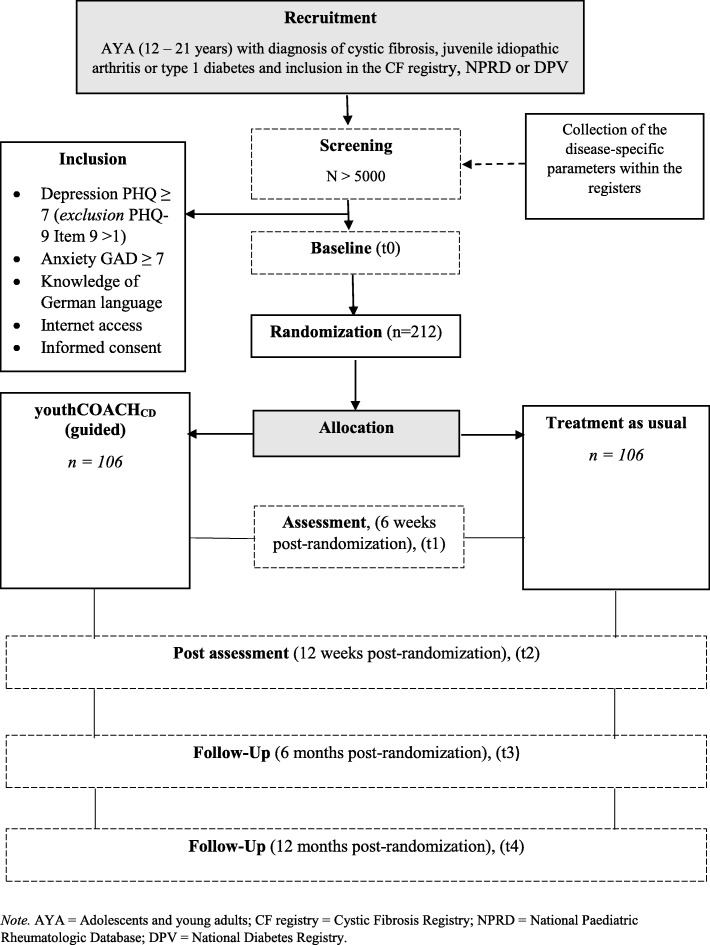
- The trial plans to recruit 212 patients (2 × n = 106) aged 12–21 years with type 1 diabetes, cystic fibrosis, or juvenile idiopathic arthritis and PHQ-9 and/or GAD-7 score ≥ 7.
- The primary outcome is combined depression and anxiety symptom severity on the PHQ-ADS at 12 weeks post-randomization (t2); secondary follow-ups are at 6 months (t3) and 12 months (t4).
- Sample size planning assumes a clinically significant effect of at least d = .50; the calculation used power = .90, α < .05, and ICC = .02, yielding 166 participants, then increased by 28% for expected dropout to N = 212.
## Methods
- Design: A two-armed, multicentre, parallel randomized controlled trial comparing guided iCBT + TAU with TAU+; randomization is 1:1, block randomized, and stratified by chronic somatic condition.
- Sample/data: Adolescents and young adults 12–21 years in routine care across German registries/clinical centres; data come from patient-reported questionnaires, caregiver reports, and medical record data linked pseudonymously.
- Analysis: Primary outcome will be analyzed with a hierarchical linear model under the intention-to-treat principle, adjusting for baseline value, sex, age, and chronic somatic condition; missing data will be handled with multiple imputation with predictive mean matching and economic evaluation will use the societal perspective with ICER and bootstrapping.
## Limitations
- The paper states that requiring custodial consent for adolescents aged 12–16 “might lead to a left-skewed age distribution” of participants.
- The authors note that intervention and study adherence might be limited in AYA, and they therefore assume a 28% dropout rate.
- Evident from the protocol: because this is a study protocol, it reports planned methods and outcomes rather than trial results, so effectiveness and cost-effectiveness are not yet known.
Model-written summary. Check it against the paper before relying on it.
Integrity signals
Registry
Cites
Statistics
Figures
Verification
Claims the paper makes
5 Valid · 0 Not valid · 40 Not checked · 31 Own results and interpretations
Every source the paper cites for this claim was checked and supports it.
In the paper
“A recent meta-analysis of individual participant data showed that guided iCBT for adults with depression is associated with a mean reduced risk for symptom deterioration compared to other control conditions [33].”
§ Effectiveness and cost-effectiveness of guided Internet- and mobile-based CBT for adolescents and young adults with chronic somatic conditions and comorbid depression and anxiety symptoms (youthCOACHCD): study protocol for a multicentre randomized controlled trial > Background
What the sources say
- Supportedcites [33] Ebert DD Donkin L Andersson G Andrews G Berger T Carlbring P Does Internet-based guided-self-help for depression cause harm? An individual participant data meta-analysis on deterioration rates and its moderators in randomized controlled trials Psychol Med 2016 46 13 2679 2693 10.1017/S0033291716001562 27649340 PMC5560500 source
The Abstract Conclusions (p.1) state almost verbatim that 'Internet-based guided self-help is associated with a mean reduced risk for a symptom deterioration compared to controls', and the Abstract Results / Results–Deterioration rates sections give the supporting pooled estimate (3.36 v. 7.60%; RR 0.47, 95% CI 0.29–0.75, NNT 43.21) from 18 RCTs / 2079 participants. The Method–Identification and selection of studies section bounds this to adults (aged ≥18 years) with depression receiving guided (non-self-guided) Internet interventions versus waiting-list, care-as-usual or other controls, matching the claim's population and comparator. Only caveat: the source labels the interventions 'Internet-based guided self-help' (predominantly CBT, with a non-CBT subgroup), so 'guided iCBT' is the citing authors' slightly narrower wording for the same pooled effect. (LLM, conf=0.85)
plainstates an association- Asserted: passes — The authors put it forward as true.
- Checkable: passes — It can be checked against evidence.
- Load-bearing: passes — The paper’s conclusions depend on it.
- Based: passes — The paper gives a reason why it holds.
- Supported
The sources with a verdict support this claim; the rest weren’t checked yet, have no full text we could read, or their verdicts aren’t rated yet.
In the paper
“CBT has also been found to reduce symptoms of depressive disorders in adults with chronic somatic conditions [18–20]”
§ Effectiveness and cost-effectiveness of guided Internet- and mobile-based CBT for adolescents and young adults with chronic somatic conditions and comorbid depression and anxiety symptoms (youthCOACHCD): study protocol for a multicentre randomized controlled trial > Background
What the sources say
- Supportedcites [18] Dobkin RD Menza M Allen LA Gara MA Mark MH Cognitive-behavioral therapy for depression in Parkinson’s disease: a randomized, controlled trial Am J Psychiatry 2011 168 1066 1074 10.1176/appi.ajp.2011.10111669 21676990 PMC3186855 source
The Results section reports significantly greater reductions in depression with CBT than with clinical monitoring in patients with Parkinson’s disease, a chronic somatic condition. This supports the cited paper’s contribution to the broader statement about adults with such conditions. (LLM, conf=0.91)
- Not checked yetcites [19] Baumeister H Huttel N Bengel J Psychological and pharmacological interventions for depression in patients with coronary artery disease Cochrane Database Syst Rev 2011 9 CD008012 PMC7389312 21901717
- Not checked yetcites [20] Baumeister H Hutter N Collaborative care for depression in medically ill patients Curr Opin Psychiatry 2012 25 5 405 414 10.1097/YCO.0b013e3283556c63 22801356 source
plainstates a cause- Asserted: passes — The authors put it forward as true.
- Checkable: passes — It can be checked against evidence.
- Load-bearing: passes — The paper’s conclusions depend on it.
- Based: passes — The paper gives a reason why it holds.
- Supported
None of the sources cited for this claim have been checked yet.
In the paper
“again probably with higher effect sizes for guided iCBT compared to completely unguided self-help iCBT [31, 39]”
§ Effectiveness and cost-effectiveness of guided Internet- and mobile-based CBT for adolescents and young adults with chronic somatic conditions and comorbid depression and anxiety symptoms (youthCOACHCD): study protocol for a multicentre randomized controlled trial > Background
What the sources say
- Not checked yetcites [31] Domhardt M Steubl L Baumeister H Internet- and mobile-based interventions for mental and somatic disorders in children and adolescents: a systematic review of meta-analyses Z Kinder Jugendpsychiatr Psychother 2020 48 33 46 10.1024/1422-4917/a000625 30422059 source
- Could not verifycites [39] Ebert DD Zarski AC Christensen H Stikkelbroek Y Cuijpers P Berking M Internet and computer-based cognitive behavioral therapy for anxiety and depression in youth: a meta-analysis of randomized controlled outcome trials PLoS One 2015 10 3 1 15 10.1371/journal.pone.0119895 PMC4364968 25786025 sourceExperimental — accuracy not yet measured
The Discussion (page not available in our copy) says the reviewed interventions ranged from therapist-guided to unguided formats, but that the authors could not examine their differential effectiveness. The overall effect size reported in the Results does not establish whether guided iCBT has higher effect sizes than unguided iCBT. (LLM, conf=0.76)
hedgedstates a possible cause- Asserted: passes — The authors put it forward as true.
- Checkable: passes — It can be checked against evidence.
- Load-bearing: passes — The paper’s conclusions depend on it.
- Based: passes — The paper gives a reason why it holds.
The cited sources support only part of this claim — read each source’s verdict below.
In the paper
“As such, Internet- and mobile-based, therapeutically guided CBT can be as efficacious as face-to-face CBT for the treatment of mental disorders [32].”
§ Effectiveness and cost-effectiveness of guided Internet- and mobile-based CBT for adolescents and young adults with chronic somatic conditions and comorbid depression and anxiety symptoms (youthCOACHCD): study protocol for a multicentre randomized controlled trial > Background
What the sources say
- Partly supportedcites [32] Carlbring P Andersson G Cuijpers P Riper H Hedman-Lagerlöf E Internet-based vs. face-to-face cognitive behavior therapy for psychiatric and somatic disorders: an updated systematic review and meta-analysis Cogn Behav Ther 2018 47 1 1 18 10.1080/16506073.2017.1401115 29215315 sourceExperimental — accuracy not yet measured
The Discussion (p. 16) says guided internet-delivered CBT and face-to-face CBT were equally effective overall for the conditions studied. The paper does not establish the same result for mobile-based CBT, and the Discussion (p. 15) cautions that equivalence cannot yet be concluded for all conditions. (LLM, conf=0.88)
plain- Asserted: passes — The authors put it forward as true.
- Checkable: passes — It can be checked against evidence.
- Load-bearing: passes — The paper’s conclusions depend on it.
- Based: passes — The paper gives a reason why it holds.
- Partly supported
None of the sources cited for this claim have been checked yet.
In the paper
“Adolescents and young adults (AYA) with chronic somatic conditions have an increased risk of comorbid depression and anxiety symptoms.”
- Also stated in: § Background · plain
“Mental disturbances and disorders are common in this population, particularly depression- and anxiety- related symptoms [8, 9]”
§ Effectiveness and cost-effectiveness of guided Internet- and mobile-based CBT for adolescents and young adults with chronic somatic conditions and comorbid depression and anxiety symptoms (youthCOACHCD): study protocol for a multicentre randomized controlled trial > Abstract > Background
plainstates an association- Asserted: passes — The authors put it forward as true.
- Checkable: passes — It can be checked against evidence.
- Load-bearing: passes — The paper’s conclusions depend on it.
- Based: passes — The paper gives a reason why it holds.
- Also stated in: § Background · plain
21 more claims
Create a free account to see all 76 claims and to verify the 55 references still open.
- Probably not a substantial claim. 44
- It may state two separate claims as one. 16
Citations
Cites
A Brief Measure for Assessing Generalized Anxiety Disorder: The GAD-7
Spitzer, R. L., Kroenke, K., Williams, J. B. W., & Löwe, B. (2006) · Archives of Internal Medicine · doi:10.1001/archinte.166.10.1092 · Cited by 31,765 · cited 7×
“AYA between 12 and 21 years of age with type 1 diabetes, cystic fibrosis, or juvenile idiopathic arthritis and elevated anxiety and/or depression symptoms (Generalized Anxiety Disorder Screener, GAD-7 [45] and/or PHQ-9 [46] score ≥ 7) with Internet access and a basic knowledge of the German language are eligible for i…”
BackgroundMethodInfluentialCONSORT 2010 Statement: updated guidelines for reporting parallel group randomised trials
the CONSORT Group, Schulz, K. F., Altman, D. G., & Moher, D. (2010) · BMC Medicine · doi:10.1186/1741-7015-8-18 · Cited by 13,371
CONSORT 2010 Statement: updated guidelines for reporting parallel group randomised trials
Schulz, K. F., Altman, D. G., Moher, D., & for the CONSORT Group (2010) · BMJ · doi:10.1136/bmj.c332 · Cited by 9,329
Moher, D., Hopewell, S., Schulz, K. F., Montori, V., Gotzsche, P. C., Devereaux, P. J., Elbourne, D., Egger, M., & Altman, D. G. (2010) · BMJ · doi:10.1136/bmj.c869 · Cited by 8,883
SPIRIT 2013 Statement: Defining Standard Protocol Items for Clinical Trials
Chan, A.-W., Tetzlaff, J. M., Altman, D. G., Laupacis, A., Gøtzsche, P. C., Krleža-Jerić, K., Hróbjartsson, A., Mann, H., Dickersin, K., Berlin, J. A., et al. (2013) · Annals of Internal Medicine · doi:10.7326/0003-4819-158-3-201302050-00583 · Cited by 7,363 · cited 1×
“This study protocol is in accordance with the Standard Protocol Items: Recommendations for Interventional Trials (SPIRIT) guideline [44].”
MethodBIRMAHER, B., KHETARPAL, S., BRENT, D., CULLY, M., BALACH, L., KAUFMAN, J., & NEER, S. M. (1997) · Journal of the American Academy of Child & Adolescent Psychiatry · doi:10.1097/00004583-199704000-00018 · Cited by 2,846
BIRMAHER, B., BRENT, D. A., CHIAPPETTA, L., BRIDGE, J., MONGA, S., & BAUGHER, M. (1999) · Journal of the American Academy of Child & Adolescent Psychiatry · doi:10.1097/00004583-199910000-00011 · Cited by 2,252
Plummer, F., Manea, L., Trepel, D., & McMillan, D. (2016) · General Hospital Psychiatry · doi:10.1016/j.genhosppsych.2015.11.005 · Cited by 1,882 · cited 1×
“The screening questionnaires are the GAD-7 [45] and the PHQ-9 [46] with a defined cut-off score of ≥ 7 in either of the questionnaires [53].”
MethodAssessment and Prediction of Stress‐Related Growth
Park, C. L., Cohen, L. H., & Murch, R. L. (1996) · Journal of Personality · doi:10.1111/j.1467-6494.1996.tb00815.x · Cited by 1,561
Computer-based psychological treatments for depression: A systematic review and meta-analysis
Richards, D., & Richardson, T. (2012) · Clinical Psychology Review · doi:10.1016/j.cpr.2012.02.004 · Cited by 1,442
Carlbring, P., Andersson, G., Cuijpers, P., Riper, H., & Hedman-Lagerlöf, E. (2018) · Cognitive Behaviour Therapy · doi:10.1080/16506073.2017.1401115 · Cited by 1,232
Advantages and limitations of Internet-based interventions for common mental disorders
Andersson, G., & Titov, N. (2014) · World Psychiatry · doi:10.1002/wps.20083 · Cited by 1,160
The impact of guidance on Internet-based mental health interventions — A systematic review
Baumeister, H., Reichler, L., Munzinger, M., & Lin, J. (2014) · Internet Interventions · doi:10.1016/j.invent.2014.08.003 · Cited by 1,037
Self-citationAn ERP study on L2 syntax processing: When do learners fail?
Meulman, N., Stowe, L. A., Sprenger, S. A., Bresser, M., & Schmid, M. S. (2014) · Frontiers in Psychology · doi:10.3389/fpsyg.2014.01072 · Cited by 1,001
Kühner, C., Bürger, C., Keller, F., & Hautzinger, M. (2007) · Der Nervenarzt · doi:10.1007/s00115-006-2098-7 · Cited by 935 · cited 1×
“”, BDI-II item = 1: “I have thoughts of killing myself, but I would not carry them out”, BDI-II item = 2: “I would like to kill myself”, BDI-II item = 3: “I would kill myself if I had the chance”) [89].”
BackgroundEconomic Evaluation in Clinical Trials
Glick, H. A., Doshi, J. A., Sonnad, S. S., & Polsky, D. (2014) · Oxford University Press eBooks · doi:10.1093/med/9780199685028.001.0001 · Cited by 910
Development of the EQ-5D-Y: a child-friendly version of the EQ-5D
Wille, N., Badia, X., Bonsel, G., Burström, K., Cavrini, G., Devlin, N., Egmar, A.-C., Greiner, W., Gusi, N., Herdman, M., et al. (2010) · Quality of Life Research · doi:10.1007/s11136-010-9648-y · Cited by 872
Measurement of health status in children with juvenile rheumatoid arthritis
Singh, G., Athreya, B. H., Fries, J. F., & Goldsmith, D. P. (1994) · Arthritis & Rheumatism · doi:10.1002/art.1780371209 · Cited by 838
Richardson, L. P., McCauley, E., Grossman, D. C., McCarty, C. A., Richards, J., Russo, J. E., Rockhill, C., & Katon, W. (2010) · Pediatrics · doi:10.1542/peds.2010-0852 · Cited by 806 · cited 3×
“AYA between 12 and 21 years of age with type 1 diabetes, cystic fibrosis, or juvenile idiopathic arthritis and elevated anxiety and/or depression symptoms (Generalized Anxiety Disorder Screener, GAD-7 [45] and/or PHQ-9 [46] score ≥ 7) with Internet access and a basic knowledge of the German language are eligible for i…”
BackgroundMethodSelf-Reported Population Health: An International Perspective based on EQ-5D
(2014) · Springer eBooks · doi:10.1007/978-94-007-7596-1 · Cited by 794
Psychological adjustment to chronic disease
de Ridder, D., Geenen, R., Kuijer, R., & van Middendorp, H. (2008) · The Lancet · doi:10.1016/s0140-6736(08)61078-8 · Cited by 759
Scales to Assess Child and Adolescent Depression: Checklists, Screens, and Nets
COSTELLO, E. J., & ANGOLD, A. (1988) · Journal of the American Academy of Child & Adolescent Psychiatry · doi:10.1097/00004583-198811000-00011 · Cited by 730
Cognitive therapy versus medication for depression: treatment outcomes and neural mechanisms
DeRubeis, R. J., Siegle, G. J., & Hollon, S. D. (2008) · Nature Reviews Neuroscience · doi:10.1038/nrn2345 · Cited by 690
Hedman, E., Ljótsson, B., & Lindefors, N. (2012) · Expert Review of Pharmacoeconomics & Outcomes Research · doi:10.1586/erp.12.67 · Cited by 672
COMPTON, S. N., MARCH, J. S., BRENT, D., ALBANO, A. M., WEERSING, V. R., & CURRY, J. (2004) · Journal of the American Academy of Child & Adolescent Psychiatry · doi:10.1097/01.chi.0000127589.57468.bf · Cited by 616
Internet-Delivered Psychological Treatments
Andersson, G. (2016) · Annual Review of Clinical Psychology · doi:10.1146/annurev-clinpsy-021815-093006 · Cited by 595
Munder, T., Wilmers, F., Leonhart, R., Linster, H. W., & Barth, J. (2010) · Clinical Psychology & Psychotherapy · doi:10.1002/cpp.658 · Cited by 538
Ebert, D. D., Zarski, A.-C., Christensen, H., Stikkelbroek, Y., Cuijpers, P., Berking, M., & Riper, H. (2015) · PLOS ONE · doi:10.1371/journal.pone.0119895 · Cited by 533
Pinquart, M., & Shen, Y. (2011) · Journal of Pediatric Psychology · doi:10.1093/jpepsy/jsq104 · Cited by 506
Kroenke, K., Wu, J., Yu, Z., Bair, M. J., Kean, J., Stump, T., & Monahan, P. O. (2016) · Psychosomatic Medicine · doi:10.1097/psy.0000000000000322 · Cited by 504
Kanter, J. W., Mulick, P. S., Busch, A. M., Berlin, K. S., & Martell, C. R. (2007) · Journal of Psychopathology and Behavioral Assessment · doi:10.1007/s10862-006-9038-5 · Cited by 493
Definitions and Measurement of Chronic Health Conditions in Childhood: A Systematic Review
van der Lee, J. H., Mokkink, L. B., Grootenhuis, M. A., Heymans, H. S., & Offringa, M. (2007) · JAMA · doi:10.1001/jama.297.24.2741 · Cited by 480
Chisholm, D., Knapp, M. R. J., Knudsen, H. C., Amaddeo, F., Gaite, L., van Wijngaarden, B., & EPSILON Study Group (2000) · British Journal of Psychiatry · doi:10.1192/bjp.177.39.s28 · Cited by 480 · cited 1×
“The CAMHSRI-DE is based on the Client Sociodemographic and Service Receipt Inventory (CSSRI) [91, 92], adjusted for children and adolescents with mental health problems in the German health care system [90].”
MethodSoziale Unterstützung bei der Krankheitsbewältigung: Die Berliner Social Support Skalen (BSSS)
Schulz, U., & Schwarzer, R. (2003) · Diagnostica · doi:10.1026//0012-1924.49.2.73 · Cited by 467
Feasibility, reliability, and validity of the EQ-5D-Y: results from a multinational study
Ravens-Sieberer, U., Wille, N., Badia, X., Bonsel, G., Burström, K., Cavrini, G., Devlin, N., Egmar, A.-C., Gusi, N., Herdman, M., et al. (2010) · Quality of Life Research · doi:10.1007/s11136-010-9649-x · Cited by 464
Costello, E. J., He, J.-P., Sampson, N. A., Kessler, R. C., & Merikangas, K. R. (2014) · Psychiatric Services · doi:10.1176/appi.ps.201100518 · Cited by 441
Bandelow, B., Sher, L., Bunevicius, R., Hollander, E., Kasper, S., Zohar, J., Möller, H.-J., WFSBP Task Force on Mental Disorders in Primary Care, & WFSBP Task Force on Anxiety Disorders, O. A. P. (2012) · International Journal of Psychiatry in Clinical Practice · doi:10.3109/13651501.2012.667114 · Cited by 428
Child anxiety in primary care: Prevalent but untreated
Chavira, D. A., Stein, M. B., Bailey, K., & Stein, M. T. (2004) · Depression and Anxiety · doi:10.1002/da.20039 · Cited by 416
The prevalence of cystic fibrosis in the European Union
Farrell, P. M. (2008) · Journal of Cystic Fibrosis · doi:10.1016/j.jcf.2008.03.007 · Cited by 399
Personal Coping. Theory, Research, and Application
Lipper, S. (1993) · American Journal of Psychotherapy · doi:10.1176/appi.psychotherapy.1993.47.4.631 · Cited by 388
Behavior Problems in Children and Adolescents With Chronic Physical Illness: A Meta-Analysis
Pinquart, M., & Shen, Y. (2011) · Journal of Pediatric Psychology · doi:10.1093/jpepsy/jsr042 · Cited by 371
Burleson Daviss, W., Birmaher, B., Melhem, N. A., Axelson, D. A., Michaels, S. M., & Brent, D. A. (2006) · Journal of Child Psychology and Psychiatry · doi:10.1111/j.1469-7610.2006.01646.x · Cited by 370
Sachser, C., Berliner, L., Holt, T., Jensen, T. K., Jungbluth, N., Risch, E., Rosner, R., & Goldbeck, L. (2017) · Journal of Affective Disorders · doi:10.1016/j.jad.2016.12.040 · Cited by 361
Self-citationJosephine, K., Josefine, L., Philipp, D., David, E., & Harald, B. (2017) · Journal of Affective Disorders · doi:10.1016/j.jad.2017.07.021 · Cited by 341
Self-citationCognitive-Behavioral Therapy for Depression in Parkinson's Disease: A Randomized, Controlled Trial
Dobkin, R. D., Menza, M., Allen, L. A., Gara, M. A., Mark, M. H., Tiu, J., Bienfait, K. L., & Friedman, J. (2011) · American Journal of Psychiatry · doi:10.1176/appi.ajp.2011.10111669 · Cited by 310
Internet addiction: coping styles, expectancies, and treatment implications
Brand, M., Laier, C., & Young, K. S. (2014) · Frontiers in Psychology · doi:10.3389/fpsyg.2014.01256 · Cited by 297 · cited 3×
“The present study uses the 15- Table 3 SPIRIT schedule of enrolment, intervention, and assessments Notes: t0 = baseline, t1 = 6 weeks, t2 = 3 months, t3 = 6 months, t4 = 12 months, PHQ-9 Patient Health Questionnaire, GAD-7 Generalized Anxiety Disorder Questionnaire, PHQ-ADS Patient Health Questionnaire Anxiety and Dep…”
MethodSelf-referent speech and psychopathology: The balance of positive and negative thinking
Kendall, P. C., Howard, B. L., & Hays, R. C. (1989) · Cognitive Therapy and Research · doi:10.1007/bf01176069 · Cited by 283
Dear, B. F., Titov, N., Sunderland, M., McMillan, D., Anderson, T., Lorian, C., & Robinson, E. (2011) · Cognitive Behaviour Therapy · doi:10.1080/16506073.2011.582138 · Cited by 282
Life crises and personal growth.
Schaefer, J. A., & Moos, R. H. (1992) · Cited by 279
Reliability and Validity of Assessing User Satisfaction With Web-Based Health Interventions
Boß, L., Lehr, D., Reis, D., Vis, C., Riper, H., Berking, M., & Ebert, D. D. (2016) · Journal of Medical Internet Research · doi:10.2196/jmir.5952 · Cited by 251
Clinical outcome measures in juvenile idiopathic arthritis
Consolaro, A., Giancane, G., Schiappapietra, B., Davì, S., Calandra, S., Lanni, S., & Ravelli, A. (2016) · Pediatric Rheumatology · doi:10.1186/s12969-016-0085-5 · Cited by 245
Statistical Analysis of Cost-Effectiveness Data.
Frame, S. J., Willan, A. R., & Chichester, A. H. B. (2013) · Cited by 234
Thabrew, H., Stasiak, K., Bavin, L., Frampton, C., & Merry, S. (2018) · International Journal of Methods in Psychiatric Research · doi:10.1002/mpr.1610 · Cited by 234
Ladwig, I., Rief, W., & Nestoriuc, Y. (2014) · Verhaltenstherapie · doi:10.1159/000367928 · Cited by 227 · cited 1×
“This is an adapted version of the Inventory for recording negative effects of psychotherapy that is specifically adjusted for online interventions [87].”
BackgroundDomhardt, M., Geßlein, H., von Rezori, R. E., & Baumeister, H. (2019) · Depression and Anxiety · doi:10.1002/da.22860 · Cited by 218
Self-citationEssau, C. A., Muris, P., & Ederer, E. M. (2002) · Journal of Behavior Therapy and Experimental Psychiatry · doi:10.1016/s0005-7916(02)00005-8 · Cited by 216
Titov, N., Dear, B. F., Ali, S., Zou, J. B., Lorian, C. N., Johnston, L., Terides, M. D., Kayrouz, R., Klein, B., Gandy, M., et al. (2015) · Behavior Therapy · doi:10.1016/j.beth.2014.09.008 · Cited by 210
Cost-Effectiveness Thresholds: the Past, the Present and the Future
Thokala, P., Ochalek, J., Leech, A. A., & Tong, T. (2018) · PharmacoEconomics · doi:10.1007/s40273-017-0606-1 · Cited by 206
Baumeister, H., Hutter, N., & Bengel, J. (2011) · Cochrane Database of Systematic Reviews · doi:10.1002/14651858.cd008012.pub3 · Cited by 205
Self-citationEstablishing Guidelines for Executing and Reporting Internet Intervention Research
Proudfoot, J., Klein, B., Barak, A., Carlbring, P., Cuijpers, P., Lange, A., Ritterband, L., & Andersson, G. (2011) · Cognitive Behaviour Therapy · doi:10.1080/16506073.2011.573807 · Cited by 202
Persönliche Reifung (Personal Growth) durch Belastungen und Traumata:
Maercker, A., & Langner, R. (2001) · Diagnostica · doi:10.1026//0012-1924.47.3.153 · Cited by 178 · cited 1×
“at all”, 1 = “something”, and 2 = “a lot” [67].”
Bevölkerungsrepräsentative Normierung der Skala zur Allgemeinen Selbstwirksamkeitserwartung
Hinz, A., Schumacher, J., Albani, C., Schmid, G., & Brähler, E. (2006) · Diagnostica · doi:10.1026/0012-1924.52.1.26 · Cited by 175
Anxiety in children and adolescents with chronic physical illnesses: a meta‐analysis
Pinquart, M., & Shen, Y. (2011) · Acta Paediatrica · doi:10.1111/j.1651-2227.2011.02223.x · Cited by 170
Roick, C., Kilian, R., Matschinger, H., Bernert, S., Mory, C., & Angermeyer, M. C. (2001) · Psychiatrische Praxis · doi:10.1055/s-2001-17790 · Cited by 163
Self-citationFILOCAMO, G., DAVÌ, S., PISTORIO, A., BERTAMINO, M., RUPERTO, N., LATTANZI, B., CONSOLARO, A., MAGNI-MANZONI, S., GALASSO, R., VARNIER, G. C., et al. (2010) · The Journal of Rheumatology · doi:10.3899/jrheum.091474 · Cited by 161 · cited 1×
“Physician’s global assessment of disease activity (numeric rating scale [NRS] 0–10) [57], active joint count, patient/parent global assessment of overall well-being (NRS), the clinical 10-joint Juvenile Arthritis Disease Activity Score [58], functional status (assessed by the Childhood Health Assessment Questionnaire)…”
MethodStatistical Analysis of Cost‐effectiveness Data
Willan, A. R., & Briggs, A. H. (2006) · doi:10.1002/0470856289 · Cited by 155
Kreimeier, S., & Greiner, W. (2019) · Value in Health · doi:10.1016/j.jval.2018.11.001 · Cited by 155
Ebert, D. D., Donkin, L., Andersson, G., Andrews, G., Berger, T., Carlbring, P., Rozenthal, A., Choi, I., Laferton, J. A. C., Johansson, R., et al. (2016) · Psychological Medicine · doi:10.1017/s0033291716001562 · Cited by 154
Paganini, S., Teigelkötter, W., Buntrock, C., & Baumeister, H. (2018) · Journal of Affective Disorders · doi:10.1016/j.jad.2017.07.018 · Cited by 144
Self-citationThabrew, H., Stasiak, K., Hetrick, S. E., Wong, S., Huss, J. H., & Merry, S. N. (2018) · Cochrane Database of Systematic Reviews · doi:10.1002/14651858.cd012489.pub2 · Cited by 141 · cited 1×
“high risk of bias due to inadequate blinding, lack of published protocols, incomplete outcome data) [40].”
BackgroundOptimistische Kompetenzerwartung: Zur Erfassung einer personellen Bewältigungsressource
Schwarzer, R. (1994) · Diagnostica · Cited by 130
Digital Phenotyping and Mobile Sensing: New Developments in Psychoinformatics
Baumeister, H., & Montag, C. (2019) · Studies in neuroscience, psychology and behavioral economics · doi:10.1007/978-3-030-31620-4 · Cited by 116
Self-citationDie Drogenaffinität Jugendlicher in der Bundesrepublik Deutschland 2011
Aufklärung, K. B. F. G. (2016) · GESIS Data Archive · doi:10.4232/1.5159 · Cited by 111 · cited 1×
“6%) have used the Internet daily in the last 12 months [98].”
MethodDeutscher Gesundheitsbericht Diabetes 2010
(2009) · Info Diabetologie · doi:10.1007/bf03371089 · Cited by 111
An Internet-Based Intervention for Chronic Pain
Lin, J., Paganini, S., Sander, L., Lüking, M., Ebert, D. D., Buhrman, M., Andersson, G., & Baumeister, H. (2017) · Deutsches Ärzteblatt international · doi:10.3238/arztebl.2017.0681 · Cited by 110
Self-citationDear, B. F., Zou, J. B., Ali, S., Lorian, C. N., Johnston, L., Sheehan, J., Staples, L. G., Gandy, M., Fogliati, V. J., Klein, B., et al. (2015) · Behavior Therapy · doi:10.1016/j.beth.2014.09.007 · Cited by 108
Determinants of arterial stiffness in COPD
Bhatt, S. P., Cole, A. G., Wells, J. M., Nath, H., Watts, J. R., Cockcroft, J. R., & Dransfield, M. T. (2014) · BMC Pulmonary Medicine · doi:10.1186/1471-2466-14-1 · Cited by 107
Domhardt, M., Steubl, L., & Baumeister, H. (2020) · Zeitschrift für Kinder- und Jugendpsychiatrie und Psychotherapie · doi:10.1024/1422-4917/a000625 · Cited by 101
Self-citationErbe, D., Eichert, H.-C., Rietz, C., & Ebert, D. (2016) · Internet Interventions · doi:10.1016/j.invent.2016.06.006 · Cited by 97
Wilmers, F., Munder, T., Leonhart, R., Herzog, T., Plassmann, R., Barth, J., & Linster, H. W. (2008) · University of Bern · doi:10.7892/boris.27962 · Cited by 94 · cited 1×
“Therapeutic alliance In the present study, therapeutic alliance between client and e-Coach/the Internet-based intervention will be assessed with an adapted version of the Working Alliance Inventory-Short Revised (WAISR) questionnaire [70].”
MethodStandardized Documentation in Pediatric Diabetology: Experience From Austria and Germany
Hofer, S. E., Schwandt, A., Holl, R. W., & Initiative, A. D. (2016) · Journal of Diabetes Science and Technology · doi:10.1177/1932296816658057 · Cited by 89
Self-citationWeb-Based Interventions for Youth Internalizing Problems: A Systematic Review
Reyes-Portillo, J. A., Mufson, L., Greenhill, L. L., Gould, M. S., Fisher, P. W., Tarlow, N., & Rynn, M. A. (2014) · Journal of the American Academy of Child & Adolescent Psychiatry · doi:10.1016/j.jaac.2014.09.005 · Cited by 88
Hedman, E., El Alaoui, S., Lindefors, N., Andersson, E., Rück, C., Ghaderi, A., Kaldo, V., Lekander, M., Andersson, G., & Ljótsson, B. (2014) · Behaviour Research and Therapy · doi:10.1016/j.brat.2014.05.010 · Cited by 79
The BELLA study group, Hintzpeter, B., Klasen, F., Schön, G., Voss, C., Hölling, H., & Ravens-Sieberer, U. (2015) · European Child & Adolescent Psychiatry · doi:10.1007/s00787-015-0676-6 · Cited by 77
Kuhlmann, A., Schmidt, T., Treskova, M., López‐Bastida, J., Linertová, R., Oliva, J., Serrano-Aguilar, P. G., de la Paz, M. P., Kanavos, P. G., Taruscio, D., et al. (2016) · The European Journal of Health Economics · doi:10.1007/s10198-016-0786-1 · Cited by 74
Smith, N., Rapley, T., Jandial, S., English, C., Davies, B., Wyllie, R., & Foster, H. (2016) · Pediatric Rheumatology · doi:10.1186/s12969-015-0062-4 · Cited by 72
Kühner, C., Bürger, C., Keller, F., & Hautzinger, M. (2007) · Der Nervenarzt · Cited by 72
Petersen, C., Schmidt, S., & Bullinger, M. (2004) · Journal of Pediatric Psychology · doi:10.1093/jpepsy/jsh066 · Cited by 67
Ramos, A. L., Hoffmann, F., Albrecht, K., Klotsche, J., Zink, A., & Minden, K. (2017) · Seminars in Arthritis and Rheumatism · doi:10.1016/j.semarthrit.2017.05.003 · Cited by 65
Self-citationPuka, K., Widjaja, E., & Smith, M. L. (2017) · Epilepsy & Behavior · doi:10.1016/j.yebeh.2016.12.011 · Cited by 61
Statistical analysis of cost–effectiveness data from randomized clinical trials
Willan, A. R. (2006) · Expert Review of Pharmacoeconomics & Outcomes Research · doi:10.1586/14737167.6.3.337 · Cited by 60
Social/economic costs and health-related quality of life in patients with cystic fibrosis in Europe
Chevreul, K., Michel, M., Brigham, K. B., López‐Bastida, J., Linertová, R., Oliva, J., Serrano-Aguilar, P. G., de la Paz, M. P., Taruscio, D., Schieppati, A., et al. (2016) · The European Journal of Health Economics · doi:10.1007/s10198-016-0781-6 · Cited by 60
Internet-Based Interventions in Chronic Somatic Disease
Bendig, E., Bauereiß, N., Ebert, D. D., Snoek, F., Andersson, G., & Baumeister, H. (2018) · Deutsches Ärzteblatt international · doi:10.3238/arztebl.2018.0659 · Cited by 54 · cited 1×
“improve pain-related disability in patients with chronic pain [37, 38].”
BackgroundSelf-citationPersuasive E-Health Design for Behavior Change
Baumeister, H., Kraft, R., Baumel, A., Pryss, R., & Messner, E.-M. (2019) · Studies in Neuroscience, Psychology and Behavioral Economics · doi:10.1007/978-3-030-31620-4_17 · Cited by 53 · cited 1×
“audios as well as prompts and reminders [52].”
BackgroundSelf-citationHealth care provision in pediatric rheumatology in Germany--national rheumatologic database.
Minden, K., Niewerth, M., Listing, J., & Zink, A. (2002) · PubMed · Cited by 50
Self-citationFidika, A., Herle, M., & Goldbeck, L. (2014) · BMC Pulmonary Medicine · doi:10.1186/1471-2466-14-205 · Cited by 46
Farrand, P., & Woodford, J. (2015) · Annals of Behavioral Medicine · doi:10.1007/s12160-015-9689-0 · Cited by 45
Valuation of Child Health‐Related Quality of Life in the United States
Craig, B. M., Greiner, W., Brown, D. S., & Reeve, B. B. (2015) · Health Economics · doi:10.1002/hec.3184 · Cited by 44
McCombie, A., Gearry, R., Andrews, J., Mikocka-Walus, A., & Mulder, R. (2015) · Journal of Clinical Psychology in Medical Settings · doi:10.1007/s10880-015-9420-0 · Cited by 42
Direct Diabetes-Related Costs in Young Patients with Early-Onset, Long-Lasting Type 1 Diabetes
Bächle, C., Icks, A., Straßburger, K., Flechtner‐Mors, M., Hungele, A., Beyer, P., Placzek, K., Hermann, U., Schumacher, A., Freff, M., et al. (2013) · PLoS ONE · doi:10.1371/journal.pone.0070567 · Cited by 40
Self-citationGesundheitsökonomie in der Psychiatrie: Konzepte, Methoden, Analysen
Salize, H. J., & Kilian, R. (2010) · doi:10.17433/978-3-17-026606-3 · Cited by 40 · cited 1×
“The stochastic uncertainty of the ICER will be estimated by non-parametric bootstrapping [95, 96].”
MethodSelf-citationTeismann, T., Ertle, A., Furka, N., Willutzki, U., & Hoyer, J. (2016) · Clinical Psychology & Psychotherapy · doi:10.1002/cpp.1948 · Cited by 38
Collaborative care for depression in medically ill patients
Baumeister, H., & Hutter, N. (2012) · Current Opinion in Psychiatry · doi:10.1097/yco.0b013e3283556c63 · Cited by 36
Self-citationJanicke, D. M., Harman, J. S., Kelleher, K. J., & Zhang, J. (2007) · Journal of Pediatric Psychology · doi:10.1093/jpepsy/jsn051 · Cited by 25 · cited 1×
“Mental disturbances and disorders are common in this population, particularly depression- and anxiety- related symptoms [8, 9], which in turn are associated with reduced quality of life, reduced treatment adherence, poorer long-term prognosis [10], and increased health service use (outpatient and inpatient, medical/me…”
BackgroundStern, M. (2011) · Current Opinion in Pulmonary Medicine · doi:10.1097/mcp.0b013e32834b6b72 · Cited by 17
Huffziger, S., Meyer, T. D., Seemann, S., Horn, A. B., Groen, G., & Pössel, P. (2008) · Zeitschrift für Klinische Psychologie und Psychotherapie · doi:10.1026/1616-3443.37.4.255 · Cited by 8
Weschenfelder, A.-K., Reißner, V., Knollmann, M., Hebebrand, J., Wasem, J., & Neumann, A. (2017) · Zeitschrift für Kinder- und Jugendpsychiatrie und Psychotherapie · doi:10.1024/1422-4917/a000501 · Cited by 6
Friedli, L. (2002) · PsycEXTRA Dataset · doi:10.1037/e427032008-004 · Cited by 2
Research works printed but not linked: 2
- Lin J Paganini S Sander L Lüking M Daniel Ebert D Buhrman M Internetbasierte Intervention bei chronischen Schmerzen Dtsch Arztebl Int 2017 114 41 681 688 29082858 PMC5672594
- Jerusalem M Persönliche Ressourcen, Vulnerabilität und Stresserleben 1990 Göttingen Hogrefe
Cited by
Efficacy of digital health interventions in youth with chronic medical conditions: A meta-analysis
Domhardt, M., Schröder, A., Geirhos, A., Steubl, L., & Baumeister, H. (2021) · Internet Interventions · doi:10.1016/j.invent.2021.100373 · Cited by 45
Self-citationDomhardt, M., Messner, E.-M., Eder, A.-S., Engler, S., Sander, L. B., Baumeister, H., & Terhorst, Y. (2021) · Child and Adolescent Psychiatry and Mental Health · doi:10.1186/s13034-021-00401-6 · Cited by 43
Self-citationShah, A., Hussain‐Shamsy, N., Strudwick, G., Sockalingam, S., Nolan, R. P., & Seto, E. (2022) · Journal of Medical Internet Research · doi:10.2196/38030 · Cited by 42
Geirhos, A., Domhardt, M., Lunkenheimer, F., Temming, S., Holl, R. W., Minden, K., Warschburger, P., Meissner, T., Mueller-Stierlin, A. S., & Baumeister, H. (2022) · BMC Pediatrics · doi:10.1186/s12887-022-03134-3 · Cited by 37
Self-citationBaumeister, H., Bauereiss, N., Zarski, A.-C., Braun, L., Buntrock, C., Hoherz, C., Idrees, A. R., Kraft, R., Meyer, P., Nguyen, T. B. D., et al. (2021) · Frontiers in Psychiatry · doi:10.3389/fpsyt.2021.660534 · Cited by 30
Self-citation
Metadata
- Authors
- COACH consortium, Lunkenheimer, F., Domhardt, M., Geirhos, A., Kilian, R., Mueller-Stierlin, A. S., Holl, R. W., Meissner, T., Minden, K., Moshagen, M., Ranz, R., Sachser, C., Staab, D., Warschburger, P., & Baumeister, H.
- Affiliations
- Universität Ulm (DE)
- Heinrich Heine University Düsseldorf (DE)
- German Rheumatism Research Centre (DE)
- University Hospital Ulm (DE)
- Charité – Universitätsmedizin Berlin (DE)
- University of Potsdam (DE)
- Corresponding author
- Baumeister, Harald
- ORCID
- Venue
- Trials
- Published
- 2020-03-12
- Volume
- 21
- Issue
- 1
- Pages
- 253-253
- ISSN
- 1745-6215 (ISSN-L)
- PMC
- PMC7069009
- OpenAlex
- W3011612172
- Cited by
- 37
- References
- 108
- Citations by year
- 2026: 3 · 2025: 3 · 2024: 4 · 2023: 8 · 2022: 8 · 2021: 9 · 2020: 2
- FWCI
- 6.10
- Type
- journal article
- Language
- en
- Open access
- gold
- doi.org
- Licence
- cc-by
- creativecommons.org/licenses/by/4.0/ (tdm)
- creativecommons.org/licenses/by/4.0/ (vor)
- Locations
- Trials (publishedVersion, cc-by)
- PubMed Central (publishedVersion, cc-by)
- PubMed (publishedVersion)
- DOAJ (DOAJ: Directory of Open Access Journals) (submittedVersion, cc-by-sa)
- publish.UP (University of Potsdam) (submittedVersion, cc-by)
- OPen Access Repositorium der Universität Ulm (OPARU) (Ulm University) (submittedVersion, cc-by)
- OPen Access Repositorium der Universität Ulm (OPARU) (Ulm University) (submittedVersion, other-oa)
- Universität Ulm, Kommunikations- und Informationszentrum (kiz) (cc-by)
- Universität Ulm, Kommunikations- und Informationszentrum (kiz) (public-domain)
- Funders
- German Ministriy of Education and Research (01GL1740A; 01GL1740E)
- Topics
- Social Sciences › Psychology › Applied Psychology › Digital Mental Health Interventions
- Social Sciences › Psychology › Experimental and Cognitive Psychology › Anxiety, Depression, Psychometrics, Treatment, Cognitive Processes
- Health Sciences › Medicine › Public Health, Environmental and Occupational Health › Telemedicine and Telehealth Implementation
- Keywords
- internet-based cognitive behavioral therapy, adolescents and young adults, depression, anxiety, comorbidities, type 1 diabetes, cystic fibrosis, juvenile idiopathic arthritis, cost-effectiveness, e-mental health, usual care, health-related quality of life, coping strategies, self-efficacy, social support
- MeSH terms
- Patient Health Questionnaire, Internet-Based Intervention, Adolescent, Anxiety, Chronic Disease, Cost-Benefit Analysis, Depression, Humans, Quality of Life, Multicenter Studies as Topic, Cognitive Behavioral Therapy, Randomized Controlled Trials as Topic, Treatment Outcome, Young Adult
About these checks
Registry, retraction, Cites and statistics results are computed, not judged, with one exception: a printed reference that no index lists is read once by a model before it counts as a citation error. Claims are extracted by a model and kept only when their quote appears verbatim in the text; each cited source is then checked, with a model’s help, for whether it says what the claim relies on. Those verdicts can be wrong — read the claim’s quote and the cited source before relying on one.
The claim verdicts this report counts are experimental: their accuracy is not yet measured.
A language model drew the claims from the paper on 2026-10-11, under version 3 of the claim definition (model deepseek-v4.1-flash, prompt extract-v3).
A second model labelled each claim on 2026-10-11 (model jev-1.13-20260917, definition revision gold-guideline-v0.2).
Cited sources are checked with a language model’s help (qwen3.8-omni-flash and gpt-6-sol).
Statistics and arithmetic are recomputed, not judged.
Confidence bands are shown only for fields calibrated on our annotated test set. None is calibrated yet, so no band is shown.
What counts as a claim ›How we measure confidence ›How we check this ›
Are you an author, or do you see a problem with this page? Request a review
Data sources
Bibliographic data: Semantic Scholar, OpenAlex, Crossref.
Contains information from the Semantic Scholar Academic Graph Datasets, made available under the ODC Attribution License (ODC-BY 1.0).
Semantic Scholar’s data is described in: Kinney, R., et al. (2023). The Semantic Scholar Open Data Platform. arXiv:2301.10140.
