

Mechanism of increased risk of insulin resistance in aging skeletal muscle
Open accessThe DOI matches its Crossref record; 108 of the 108 references it cites were found in a registry or an index.
Abstract
As age increases, the risk of developing type 2 diabetes increases, which is associated with senile skeletal muscle dysfunction. During skeletal muscle aging, mitochondrial dysfunction, intramyocellular lipid accumulation, increased inflammation, oxidative stress, modified activity of insulin sensitivity regulatory enzymes, endoplasmic reticulum stress, decreased autophagy, sarcopenia and over-activated renin-angiotensin system may occur. These changes can impair skeletal muscle insulin sensitivity and increase the risk of insulin resistance and type 2 diabetes during skeletal muscle aging. This review of the mechanism of the increased risk of insulin resistance during skeletal muscle aging will provide a more comprehensive explanation for the increased incidence of type 2 diabetes in elderly individuals, and will also provide a more comprehensive perspective for the prevention and treatment of type 2 diabetes in elderly populations.
Overview
The claims and statistics of this paper haven’t been checked yet.
Free: it reads the open-access text and checks the first 5 claims that cite a source we can check. Create a free account to check every claim.
Integrity signals
Registry
Cites
Statistics
Figures
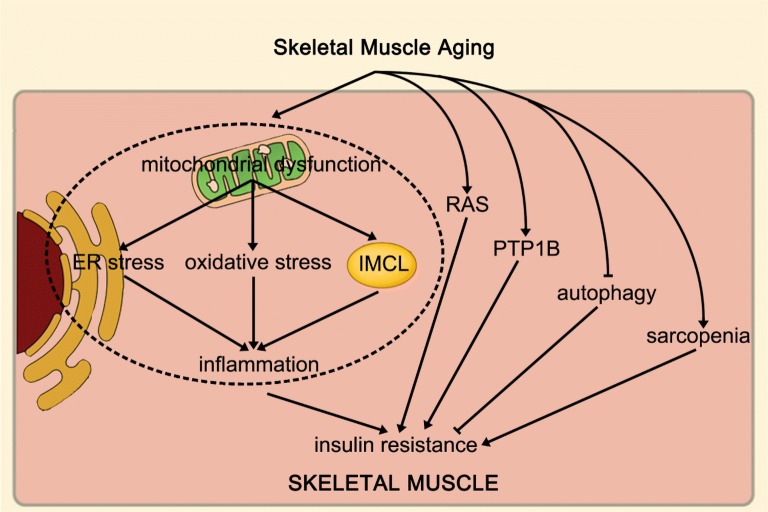
Verification
Claims the paper makes
The claims and statistics of this paper haven’t been checked yet.
Free: it reads the open-access text and checks the first 5 claims that cite a source we can check. Create a free account to check every claim.
Claims other papers make about this one
Each is checked against this paper’s own text: does it say what the citing paper says it does?
The cited source doesn’t support the claim as written.
In the citing paper
“Reduced insulin signalling or insulin resistance can impair muscle protein metabolism, leading to muscle wasting and sarcopenia58.”
From Sarcopenic obesity in older adults: a clinical overview (2024) · cites this paper as [58]
Checked by a reasoning model — may be wrong.
Experimental — accuracy not yet measuredThe source backs part of the claim, not all of it — or backs it for a different population, condition or comparison.
In the citing paper
“Also, with aging and obesity (especially abdominal obesity), insulin sensitivity gradually decreases in skeletal muscle and adipocytes, increasing serum glucose levels and promoting ER overload and Os [83, 91–95].”
From The critical role of oxidative stress in sarcopenic obesity (2021) · cites this paper as [94]
Experimental — accuracy not yet measuredIn the citing paper
“Excess nutrients (ingesting high fat and/or high glucose), chronic inflammatory state, high adiposity, IR, metabolic syndrome, and aging harm the ER function in the liver, skeletal muscle, and adipose tissue, inducing Os [83, 91–95].”
From The critical role of oxidative stress in sarcopenic obesity (2021) · cites this paper as [94]
In the citing paper
“In the early stages of metabolic dysregulation, insulin secretion is elevated to compensate for increased glycemia (hyperinsulinemia). The high amount of insulin produced by the pancreas requires that the ER guarantee the correct folding of the hormone, which generates an ER overload and dysfunction, an unfolded protein response (UPR) overactivation, Os, and inflammation [83, 91–95].”
From The critical role of oxidative stress in sarcopenic obesity (2021) · cites this paper as [94]
Self-check
Percentages, sums and reported differences re-computed from the paper’s own numbers.
The self-check needs the paper’s full text.
Citations
Cites
Xu, H., Barnes, G. T., Yang, Q., Tan, G., Yang, D., Chou, C. J., Sole, J., Nichols, A., Ross, J. S., Tartaglia, L. A., et al. (2003) · Journal of Clinical Investigation · doi:10.1172/jci200319451 · Cited by 6,760 · cited 1×
“in aging skeletal muscle Inflammation is closely related to skeletal muscle insulin resistance, and increased inflammation promotes skeletal muscle insulin resistance [38].”
BackgroundIncreased oxidative stress in obesity and its impact on metabolic syndrome
Furukawa, S., Fujita, T., Shimabukuro, M., Iwaki, M., Yamada, Y., Nakajima, Y., Nakayama, O., Makishima, M., Matsuda, M., & Shimomura, I. (2004) · Journal of Clinical Investigation · doi:10.1172/jci21625 · Cited by 5,508
Fielding, R. A., Vellas, B., Evans, W. J., Bhasin, S., Morley, J. E., Newman, A. B., Abellan van Kan, G., Andrieu, S., Bauer, J., Breuille, D., et al. (2011) · Journal of the American Medical Directors Association · doi:10.1016/j.jamda.2011.01.003 · Cited by 3,256 · cited 1×
“The proportion of type II muscle fibers is reduced [32], resulting in the muscle mass of type II muscle fibers becoming lower than that of type I muscle fibers.”
BackgroundReactive oxygen species have a causal role in multiple forms of insulin resistance
Houstis, N., Rosen, E. D., & Lander, E. S. (2006) · Nature · doi:10.1038/nature04634 · Cited by 2,525
Elchebly, M., Payette, P., Michaliszyn, E., Cromlish, W., Collins, S., Loy, A. L., Normandin, D., Cheng, A., Himms-Hagen, J., Chan, C.-C., et al. (1999) · Science · doi:10.1126/science.283.5407.1544 · Cited by 2,210
Inflammation: the link between insulin resistance, obesity and diabetes
Dandona, P. (2004) · Trends in Immunology · doi:10.1016/j.it.2003.10.013 · Cited by 2,170 · cited 1×
“Studies have shown that TNF-α, monocyte chemoattractant protein-1 (MCP-1), C-reactive protein (CRP), ILs and other inflammatory factors can promote skeletal muscle insulin resistance [78].”
BackgroundMuscaritoli, M., Anker, S. D., Argilés, J., Aversa, Z., Bauer, J. M., Biolo, G., Boirie, Y., Bosaeus, I., Cederholm, T., Costelli, P., et al. (2010) · Clinical Nutrition · doi:10.1016/j.clnu.2009.12.004 · Cited by 1,732
Autophagosomes form at ER–mitochondria contact sites
Hamasaki, M., Furuta, N., Matsuda, A., Nezu, A., Yamamoto, A., Fujita, N., Oomori, H., Noda, T., Haraguchi, T., Hiraoka, Y., et al. (2013) · Nature · doi:10.1038/nature11910 · Cited by 1,683
The underappreciated role of muscle in health and disease
Wolfe, R. R. (2006) · The American Journal of Clinical Nutrition · doi:10.1093/ajcn/84.3.475 · Cited by 1,537
The compelling link between physical activity and the body's defense system
Nieman, D. C., & Wentz, L. M. (2019) · Journal of Sport and Health Science · doi:10.1016/j.jshs.2018.09.009 · Cited by 1,340
Research works printed but not linked: 1
- Jeannette A Chris P Esther J Anoop M Teresa T Elizabeth BS IDF DIABETES ATLAS eighth edition 2017 2017 Brussels IDF
Cited by
Type 2 diabetes mellitus in older adults: clinical considerations and management
Bellary, S., Kyrou, I., Brown, J. E., & Bailey, C. J. (2021) · Nature Reviews Endocrinology · doi:10.1038/s41574-021-00512-2 · Cited by 639
Chronic inflammation and the hallmarks of aging
Baechle, J. J., Chen, N., Makhijani, P., Winer, S., Furman, D., & Winer, D. A. (2023) · Molecular Metabolism · doi:10.1016/j.molmet.2023.101755 · Cited by 471
“the IIS pathway by promoting a pro-inflammatory environment in metabolic tissues, such as adipose tissues [253,254], muscles [255], and digestive tracts [256,257].”
BackgroundEl Assar, M., Álvarez-Bustos, A., Sosa, P., Angulo, J., & Rodríguez-Mañas, L. (2022) · International Journal of Molecular Sciences · doi:10.3390/ijms23158713 · Cited by 371
“Specific aging-related changes in the muscles involve a decreased cross-sectional area (CSA) of skeletal muscle due to a switch in the fiber type [38], intramyocellular lipid accumulation and, at later stages, fibrotic tissue [36,39], a decrease in the number of satellite cells [40] and neuromuscular degeneration [41].”
BackgroundSarcopenic obesity in older adults: a clinical overview
Prado, C. M., Batsis, J. A., Donini, L. M., Gonzalez, M. C., & Siervo, M. (2024) · Nature Reviews Endocrinology · doi:10.1038/s41574-023-00943-z · Cited by 355
“Reduced insulin signalling or insulin resistance can impair muscle protein metabolism, leading to muscle wasting and sarcopenia 58 .”
Bilski, J., Pierzchalski, P., Szczepanik, M., Bonior, J., & Zoladz, J. (2022) · Cells · doi:10.3390/cells11010160 · Cited by 251
“At least in part, mitochondrial dysfunction is linked to the ageing and obesity processes [143,144].”
BackgroundMultisystem physiological perspective of human frailty and its modulation by physical activity
Taylor, J. A., Greenhaff, P. L., Bartlett, D. B., Jackson, T. A., Duggal, N. A., & Lord, J. M. (2023) · Physiological Reviews · doi:10.1152/physrev.00037.2021 · Cited by 197
Rheumatoid sarcopenia: loss of skeletal muscle strength and mass in rheumatoid arthritis
Bennett, J. L., Pratt, A. G., Dodds, R., Sayer, A. A., & Isaacs, J. D. (2023) · Nature Reviews Rheumatology · doi:10.1038/s41584-023-00921-9 · Cited by 161
Role of NF-κB in Ageing and Age-Related Diseases: Lessons from Genetically Modified Mouse Models
García-García, V. A., Alameda, J. P., Page, A., & Casanova, M. L. (2021) · Cells · doi:10.3390/cells10081906 · Cited by 161
“skeletal muscle insulin sensitivity and it has been reported that skeletal muscle dysfunction is involved in the development of type 2 diabetes [113].”
BackgroundJorgenson, K. W., Phillips, S. M., & Hornberger, T. A. (2020) · Cells · doi:10.3390/cells9071658 · Cited by 150
β-hydroxybutyrate as an Anti-Aging Metabolite
Wang, L. Y., Chen, P., & Xiao, W. (2021) · Nutrients · doi:10.3390/nu13103420 · Cited by 144
“Age-related muscle dysfunction is characterized by progressive sarcopenia and atrophy of skeletal muscles, which is related to frailty, muscle weakness, and disability in the elderly [95].”
BackgroundSelf-citationAstaxanthin as a Novel Mitochondrial Regulator: A New Aspect of Carotenoids, beyond Antioxidants
Nishida, Y., Nawaz, A., Hecht, K. A., & Tobe, K. (2021) · Nutrients · doi:10.3390/nu14010107 · Cited by 143
Musculoskeletal exercise: Its role in promoting health and longevity
D’Onofrio, G., Kirschner, J. S., Prather, H., Goldman, D., & Rozanski, A. (2023) · Progress in Cardiovascular Diseases · doi:10.1016/j.pcad.2023.02.006 · Cited by 148
Massimino, E., Izzo, A., Riccardi, G., & Della Pepa, G. (2021) · Cells · doi:10.3390/cells10081958 · Cited by 102
“The mechanisms underlying the age-related changes involved in sarcopenia are not completely understood and are related to several and interacting processes: decline in the synthesis of muscle proteins [21], post-prandial resistance to synthesize protein in response to various nutritional factors [22], alteration in ho…”
BackgroundProkopidis, K., Chambers, E., Ni Lochlainn, M., & Witard, O. C. (2021) · Frontiers in Physiology · doi:10.3389/fphys.2021.770455 · Cited by 102
“, 2020), both of which are physiological factors linked with increased risk of sarcopenia (Nelke et al., 2019; Shou et al., 2020).”
BackgroundRole of hormones in sarcopenia
(2021) · Vitamins and Hormones · doi:10.1016/bs.vh.2020.12.021 · Cited by 92
Micheli, L., Bertini, L., Bonato, A., Villanova, N., Caruso, C., Caruso, M., Bernini, R., & Tirone, F. (2023) · Nutrients · doi:10.3390/nu15071767 · Cited by 97
Sarcopenic obesity: Myokines as potential diagnostic biomarkers and therapeutic targets?
Guo, A., Li, K., & Xiao, Q. (2020) · Experimental Gerontology · doi:10.1016/j.exger.2020.111022 · Cited by 83
The critical role of oxidative stress in sarcopenic obesity
Gonzalez, A., Simon, F., Achiardi, O., Vilos, C., Cabrera, D., & Cabello-Verrugio, C. (2021) · Oxidative Medicine and Cellular Longevity · doi:10.1155/2021/4493817 · Cited by 79
Silva, F. M., Duarte‐Mendes, P., Teixeira, A. M., Soares, C., & Ferreira, J. P. (2024) · Scientific Reports · doi:10.1038/s41598-024-51832-y · Cited by 300
“Specifically, with increasing age, insulin sensitivity, and the body’s glucose regulation ability gradually decreased 84 .”
BackgroundResultHossain, M. B., Khan, M. N., Oldroyd, J. C., Rana, J., Magliano, D. J., Chowdhury, E., Karim, M. N., & Islam, R. M. (2022) · PLOS Global Public Health · doi:10.1371/journal.pgph.0000461 · Cited by 98
Changes in Cells Associated with Insulin Resistance
Szablewski, L. (2024) · International Journal of Molecular Sciences · doi:10.3390/ijms25042397 · Cited by 88
“An increased risk of insulin resistance may be due to aging skeletal muscle [127].”
BackgroundImpact of Dietary Fiber on Inflammation and Insulin Resistance in Older Patients: A Narrative Review
Niero, M., Bartoli, G., Colle, P. D., Scarcella, M., & Zanetti, M. (2023) · Nutrients · doi:10.3390/nu15102365 · Cited by 70
“Probably, the pathogenesis of this phenomenon is linked to the production of ROS by the impaired mitochondria and by the accumulation of intracellular lipids that induce insulin resistance in skeletal muscle [23].”
BackgroundLee, J. H., Jeon, J. H., & Lee, M. J. (2020) · Nutrients · doi:10.3390/nu12092597 · Cited by 64
Livshits, G., & Kalinkovich, A. (2023) · Ageing Research Reviews · doi:10.1016/j.arr.2023.101852 · Cited by 58
Assar, M. E., Rodríguez-Sánchez, I., Álvarez‐Bustos, A., & Rodríguez‐Mañas, L. (2024) · Molecular Aspects of Medicine · doi:10.1016/j.mam.2024.101271 · Cited by 60
Shrestha, N., Karki, K. B., Poudyal, A., Aryal, K. K., Mahato, N. K., Gautam, N., Dirghayu, K. C., Gyanwali, P., Dhimal, M., & Jha, A. K. (2022) · BMJ Open · doi:10.1136/bmjopen-2022-060750 · Cited by 80
“33 The findings of the study and these factors underscore the need of tailored interventions for management and control of DM among population with higher age.”
BackgroundChen, L., Ming, J., Chen, T., Hébert, J. R., Sun, P., Zhang, L., Wang, H., Wu, Q., Zhang, C., Shivappa, N., et al. (2022) · European Journal of Nutrition · doi:10.1007/s00394-022-02941-9 · Cited by 58
“Inflammation primarily impairs insulin signaling through the activation of the IKKβ/NF-κB and JNK pathways, thereby promoting skeletal muscle insulin resistance [48, 49].”
BackgroundNatural products: Potential therapeutic agents to prevent skeletal muscle atrophy
Yadav, A., Yadav, S. S., Singh, S., & Dabur, R. (2022) · European Journal of Pharmacology · doi:10.1016/j.ejphar.2022.174995 · Cited by 58
Omura, T., & Araki, A. (2022) · Geriatrics & Gerontology International · doi:10.1111/ggi.14339 · Cited by 47
Chen, S., Yan, S., Aiheti, N., Kuribanjiang, K., Yao, X., Wang, Q., Zhou, T., & Yang, L. (2023) · Frontiers in Endocrinology · doi:10.3389/fendo.2023.1109800 · Cited by 49
“Sarcopenia and TDM are both age-related diseases with the same underlying pathophysiological mechanism (4, 5, 35).”
BackgroundLees, M. J., & Carson, B. P. (2020) · Nutrients · doi:10.3390/nu12082434 · Cited by 49
“The findings from these trials may be of particular importance for older persons, given that glycaemic control may be impaired in this population due to losses in skeletal muscle mass and function that predispose individuals to reduced skeletal muscle insulin sensitivity [34,90].”
BackgroundArmand, T. P. T., Kim, H., & Kim, J.-I. (2024) · Journal of Personalized Medicine · doi:10.3390/jpm14030254 · Cited by 57
“For instance, with increasing age, there is a corresponding increase in the risk of developing type 2 diabetes, which is associated with senile skeletal muscle dysfunction and unregulated blood sugar levels due to a decreased sensitivity to insulin [25].”
BackgroundThe contributory role of vascular health in age‐related anabolic resistance
Banks, N. F., Rogers, E. M., Church, D. D., Ferrando, A. A., & Jenkins, N. D. M. (2021) · Journal of Cachexia Sarcopenia and Muscle · doi:10.1002/jcsm.12898 · Cited by 44
Zarezadeh, M., Musazadeh, V., Faghfouri, A. H., Sarmadi, B., Jamilian, P., Jamilian, P., Tutunchi, H., & Dehghan, P. (2022) · Pharmacological Research · doi:10.1016/j.phrs.2022.106397 · Cited by 49
Kurauti, M. A., Soares, G. M., Marmentini, C., Bronczek, G. A., Branco, R. C. S., & Boschero, A. C. (2021) · Vitamins and hormones · doi:10.1016/bs.vh.2020.12.010 · Cited by 54
Wang, Y., Guo, Y., Xu, Y., Wang, W., Zhuang, S., Wang, R., & Xiao, W. (2022) · Metabolites · doi:10.3390/metabo13010014 · Cited by 58
Self-citationPaquin, J., Lagacé, J.-C., Brochu, M., & Dionne, I. J. (2021) · Frontiers in Physiology · doi:10.3389/fphys.2021.656909 · Cited by 41
“In older individuals, sarcopenia as defined by musculoskeletal decline (Cooper et al., 2012) has shown itself to be associated with altered glucose homeostasis (Yang et al., 2017; Shou et al., 2020) as well as autonomy and overall quality of life (Tsekoura et al., 2017).”
BackgroundHedge, E. T., Patterson, C. A., Mastrandrea, C. J., Sonjak, V., Hajj‐Boutros, G., Faust, A., Morais, J. A., & Hughson, R. L. (2022) · Frontiers in Physiology · doi:10.3389/fphys.2022.928313 · Cited by 49
“, 2018), and intrinsic changes related to skeletal muscle aging (Shou et al., 2020).”
BackgroundThe role of mitochondrial-related nuclear genes in age-related common disease
Li, H., Slone, J. D., & Huang, T. (2020) · Mitochondrion · doi:10.1016/j.mito.2020.04.012 · Cited by 46
Rajabian, N., Ikhapoh, I. A., Shahini, S., Choudhury, D., Thiyagarajan, R., Shahini, A., Kulczyk, J., Breed, K., Saha, S., Mohamed, M. A., et al. (2023) · Nature Communications · doi:10.1038/s41467-023-36483-3 · Cited by 45
Huang, S., Xiang, C., & Song, Y. (2022) · PLoS ONE · doi:10.1371/journal.pone.0265221 · Cited by 42
“Sarcopenia is characterized by the age-related progressive loss of skeletal muscle mass and strength which results in muscle weakness, restricted mobility, and increased susceptibility to injury [1].”
BackgroundSarcopenia and type 2 diabetes: Pathophysiology and potential therapeutic lifestyle interventions
Marcotte‐Chénard, A., Oliveira, B., Little, J. P., & Candow, D. G. (2023) · Diabetes & Metabolic Syndrome Clinical Research & Reviews · doi:10.1016/j.dsx.2023.102835 · Cited by 47
Habib, S. S., Alkahtani, S. A., Alhussain, M. H., & Aljuhani, O. E. (2020) · Diabetes Metabolic Syndrome and Obesity · doi:10.2147/dmso.s260382 · Cited by 41
Xia, X., Meng, X., Liu, C., Guo, Y. Z., Li, X., Niu, Y., Lam, H. K. B., Wright, N., Kartsonaki, C., Chen, Y., et al. (2024) · The Lancet Public Health · doi:10.1016/s2468-2667(24)00264-0 · Cited by 41
Falcetta, P., Benelli, E., Molinaro, A., Cosmo, C. D., Bagattini, B., Ghianda, S. D., Salvetti, G., Fiore, E., Pucci, E., Fruzzetti, F., et al. (2021) · Journal of Endocrinological Investigation · doi:10.1007/s40618-021-01594-5 · Cited by 40
Osteopontin - The stirring multifunctional regulatory factor in multisystem aging
Du, Y., Mao, L., Wang, Z., Yan, K., Zhang, L., & Zou, J. T. (2022) · Frontiers in Endocrinology · doi:10.3389/fendo.2022.1014853 · Cited by 38
Nutritional Strategies in Prediabetes: A Scoping Review of Recent Evidence
Yau, J. W., Thor, S. M., & Ramadas, A. (2020) · Nutrients · doi:10.3390/nu12102990 · Cited by 39
González‐Hedström, D., Priego, T., Amor, S., de la Fuente‐Fernández, M., Martín, A. I., López‐Calderón, A., Inarejos-García, A. M., García-Villalón, Á. L., & Granado, M. (2021) · Antioxidants · doi:10.3390/antiox10050737 · Cited by 36
“Indeed, an increase in muscle mass in aged rats rises skeletal muscle glucose uptake and improves insulin sensitivity [29].”
BackgroundDietary flaxseed: Cardiometabolic benefits and its role in promoting healthy aging
Kunutsor, S. K., Jassal, D. S., Ravandi, A., & Lehoczki, A. (2025) · GeroScience · doi:10.1007/s11357-025-01512-0 · Cited by 43
“Insulin resistance and impaired glucose metabolism are hallmarks of aging and key drivers of T2D [134,135].”
Oh, H., Cho, W., El‐Aty, A. M. A., Bayram, C., Jeong, J. H., & Jung, T. W. (2022) · Biochemical Pharmacology · doi:10.1016/j.bcp.2022.115203 · Cited by 28
Prokopidis, K., Irlik, K., Hendel, M., Piaśnik, J., Lip, G. Y. H., & Nabrdalik, K. (2024) · Journal of Cachexia Sarcopenia and Muscle · doi:10.1002/jcsm.13596 · Cited by 34
“Impaired metabolic homeostasis via incremental skeletal muscle mass losses may hamper glucose and insulin sensitivity (and vice versa) [9], leading to reduced exercise capacity, loss of physical strength and function, and overall independence [7].”
Cardio-sarcopenia: A syndrome of concern in aging
Loh, D. R., Tan, R., Lim, W. S., & Koh, A. S.-M. (2022) · Frontiers in Medicine · doi:10.3389/fmed.2022.1027466 · Cited by 32
Lonardo, A., & Weiskirchen, R. (2025) · Biomolecules · doi:10.3390/biom15121745 · Cited by 39
Huang, N., Ge, M., Liu, X., Tian, X., Yin, P., Bao, Z., Cao, F., Shyh‐Chang, N., Dong, B., Dai, L., et al. (2024) · Life Medicine · doi:10.1093/lifemedi/lnaf001 · Cited by 31
“…a variety of factors contribute to the reduction of glucose metabolism, such as impaired insulin signaling, alterations in muscle fiber types, mitochondrial dysfunction, reduced muscle mass and function, increased inflammation and oxidative stress, endocrine imbalances, and lifestyle factors [29].”
Fat‐Free Mass: Friend or Foe to Metabolic Health?
Oliver, C. J., Climstein, M., Rosic, N. N., Bosy‐Westphal, A., Tinsley, G. M., & Myers, S. P. (2025) · Journal of Cachexia Sarcopenia and Muscle · doi:10.1002/jcsm.13714 · Cited by 34
Prokopidis, K., & Dionyssiotis, Y. (2021) · Journal of Frailty Sarcopenia and Falls · doi:10.22540/jfsf-06-050 · Cited by 27
Buchanan, A., & Villani, A. M. (2021) · Healthcare · doi:10.3390/healthcare9101255 · Cited by 28
Shin, J., Jeon, S.-H., Lee, S. J., & Choung, S. (2022) · Nutrients · doi:10.3390/nu14091747 · Cited by 23
“Further, the accumulation of intramyocellular lipids induces the secretion of inflammatory cytokines, such as tumor necrosis factor-α (TNF-α), interleukin-6 (IL-6), and IL-1β [14,15].”
BackgroundAging and “Age-Related” Diseases - What Is the Relation?
Kopp, W. (2024) · Aging and Disease · doi:10.14336/ad.2024.0570 · Cited by 55
“…of IR during aging, including mitochondrial dysfunction, increased visceral obesity, decreased physical activity, medication use, intramyocellular lipid accumulation, subclinical inflammation, endoplasmic reticulum stress, decreased autophagy, an overactivated RAAS and genetic factors [123, 124].”
Prevalence of Clinical Obesity in US Adults, 2017–2020
Shen, Y., & Hu, G. (2025) · Obesity · doi:10.1002/oby.24352 · Cited by 28
Barbu, E. M., Popescu, M. R., Popescu, A.-C., & Balanescu, S. M. (2021) · International Journal of Molecular Sciences · doi:10.3390/ijms22136864 · Cited by 27
“Which age group is the most affected? Is there an age group where the prevalence is higher? Increased adiposity, low-grade inflammation, and mitochondrial dysfunction in elderly patients might make them ideal candidates [124,125].”
BackgroundThe Potential Roles of Ghrelin in Metabolic Syndrome and Secondary Symptoms of Alzheimer’s Disease
Kim, S., Nam, Y., Shin, S. J., Park, Y., Jeon, S. G., Kim, J.-I., Kim, M., & Moon, M. (2020) · Frontiers in Neuroscience · doi:10.3389/fnins.2020.583097 · Cited by 21
Ji, H., Lu, Y., liu, G., Zhao, X., Xu, M., & Chen, M. (2024) · Diabetes Metabolic Syndrome and Obesity · doi:10.2147/dmso.s467409 · Cited by 20
Alzarea, E. A., Al-Kuraishy, H. M., Al-Gareeb, A. I., Alexiou, A. T., Papadakis, M., Beshay, O. N., & Batiha, G. E. (2025) · NeuroMolecular Medicine · doi:10.1007/s12017-025-08832-6 · Cited by 23
“Furthermore, aging enhances obesity and the progression of metabolic syndrome due to the development of skeletal muscle IR (Shou et al., 2020).”
Rajabian, N., Choudhury, D., Ikhapoh, I. A., Saha, S., Kalyankar, A. S., Mehrotra, P., Shahini, A., Breed, K., & Andreadis, S. T. (2023) · Aging Cell · doi:10.1111/acel.13764 · Cited by 18
“…age- impaired glucose homeostasis is associated with insulin resistance and defects in insulin signaling in skeletal muscle (Refaie et al., 2006; Shou et al., 2020), we investigated the effect of reversine treatment on insulin sensitivity, by measuring ECAR after treating the cells with insulin.”
BackgroundPapadopoulos, E., Wong, A. K. O., Law, S. H. C., Zhang, L. Z. J., Breunis, H., Emmenegger, U., & Alibhai, S. M. H. (2023) · PLoS ONE · doi:10.1371/journal.pone.0286381 · Cited by 22
“Sarcopenia is associated with numerous adverse effects in older adults, including falls and fractures [34], hospitalizations [35], and may contribute to insulin resistance [36] and frailty [28], thereby increasing the risk of additional health-related adversities that may require immediate medical attention.”
BackgroundNAD+: An old but promising therapeutic agent for skeletal muscle ageing
Xu, Y., & Xiao, W. (2023) · Ageing Research Reviews · doi:10.1016/j.arr.2023.102106 · Cited by 23
“Irreversible endoplasmic reticulum (ER) stress promotes SMA through the terminal UPR, which is triggered by PERK, ATF6, and IRE1 overactivation (Afroze and Kumar, 2019; Lee et al., 2020b; Shou et al., 2020).”
Self-citationMoon, S., Choi, J. W., Park, J. H., Kim, D. S., Ahn, Y.-H., Kim, Y., Kong, S. H., & Oh, C. (2025) · Journal of Cachexia Sarcopenia and Muscle · doi:10.1002/jcsm.13811 · Cited by 21
“Additional details regarding sample collection and examination methods can be found in the KNHANES guidelines [25, 26].”
Angiotensin-(1-7) Improves Integrated Cardiometabolic Function in Aged Mice
Miller, A. J., Bingaman, S. S., Mehay, D., Medina, D., & Arnold, A. C. (2020) · International Journal of Molecular Sciences · doi:10.3390/ijms21145131 · Cited by 51
“Insulin resistance in aging is partially attributed to skeletal muscle aging leading to decreased expression of skeletal muscle glucose transporter type 4 (Glut4) and mitochondrial dysfunction [41].”
BackgroundGonzález‐Hedström, D., de la Fuente‐Fernández, M., Priego, T., Martín, A. I., Amor, S., López‐Calderón, A., Inarejos-García, A. M., García-Villalón, Á. L., & Granado, M. (2021) · Antioxidants · doi:10.3390/antiox10071066 · Cited by 19
“A positive correlation between insulin sensitivity and muscle mass has been found in aged rats [38] and the blockade of sarcopenic markers in old mice is reported not only to prevent sarcopenia but also to increase insulin sensitivity [91].”
BackgroundOpazo, R., Bárbara Angel, B., Márquez, C., Lydia Lera, M., dos Santos, G. R. C., Monnerat, G., & Albala, C. (2021) · Metabolomics · doi:10.1007/s11306-021-01832-0 · Cited by 19
Zhuang, S., Chen, P., Han, J., & Xiao, W. (2021) · Chinese Journal of Integrative Medicine · doi:10.1007/s11655-021-3529-9 · Cited by 27
“, IL-6, TNF-α) are higher in OA sera than in health sera.((61-63)) This unresolved inflammatory state exists both locally and systemically, resulting in symptoms such as chronic pain, morning stiffness and joint swelling.”
BackgroundSelf-citationThe acute and chronic influence of exercise on mitochondrial dynamics in skeletal muscle
Ritenis, E. J., Padilha, C. S., Cooke, M. B., Stathis, C. G., Philp, A., & CAMERA, D. M. (2024) · American Journal of Physiology-Endocrinology and Metabolism · doi:10.1152/ajpendo.00311.2024 · Cited by 20
Wang, Y., Zou, X., Cai, X., Liu, W., Chen, L., Zhang, R., Zhou, L., Gong, S., Gao, Y., Li, S., et al. (2021) · Journal of Diabetes · doi:10.1111/1753-0407.13203 · Cited by 17
Mahatme, S., Vaishali, K., Kumar, N., Rao, V., Kovela, R. K., & Sinha, M. K. (2022) · Medicine and Pharmacy Reports · doi:10.15386/mpr-2201 · Cited by 24
“[38,68,95,96] The caudate nucleus, parietal and temporal lobes were subject to glucose uptake after HIIT [68].”
BackgroundMezghanni, N., Ammar, A., Boukhris, O. F., Abid, R., Hadadi, A., Alzahrani, T. M., Trabelsi, O., Boujelbane, M. A., Masmoudi, L., Ouergui, I., et al. (2022) · Healthcare · doi:10.3390/healthcare10122533 · Cited by 23
“We suggest this enhancement is attributed to various physiological and training adaptations, such as the enhancement of muscle energy reserves, carbohydrate and lipid intakes, vascular bed growth at the muscle level (ensuring better oxygenation), and better use of energy substrates [97,98].”
BackgroundManagement of Type 2 Diabetes in Frail Older Adults
Bahat, G., Özkök, S., & Petrović, M. (2023) · Drugs & Aging · doi:10.1007/s40266-023-01049-x · Cited by 27
“With increasing age, pancreatic islet function, insulin sensitivity, and the body’s ability to regulate glucose gradually decrease, and older adults may end up with impaired glucose metabolism, and eventually, diabetes [2].”
BackgroundZhang, Q., Hu, S., Jin, Z., Wang, S., Zhang, B., & Zhao, L. (2024) · Frontiers in Pharmacology · doi:10.3389/fphar.2024.1339148 · Cited by 22
“…dysfunction, increased low-grade in fl ammation, lipid accumulation, and oxidative stress in intramuscular cells, as well as accumulation and decreased autophagy and enzyme activity in aging cells (Jiao and Demontis, 2017; Kalinkovich and Livshits, 2017; Crescioli, 2020; Shou et al., 2020).”
BackgroundAli, N. H., Al-Kuraishy, H. M., Al-Gareeb, A. I., Alexiou, A. T., Papadakis, M., Bahaa, M. M., Al-Ibrahim, F., & Batiha, G. E. (2024) · Journal of Cellular and Molecular Medicine · doi:10.1111/jcmm.70118 · Cited by 19
Obesity and type 2 diabetes mellitus: insights from skeletal muscle extracellular matrix remodeling
Wu, L., & Coletta, D. K. (2025) · American Journal of Physiology-Cell Physiology · doi:10.1152/ajpcell.00154.2024 · Cited by 18
AMPK/mTOR balance during exercise: implications for insulin resistance in aging muscle
Mingzheng, X., & You, W. (2025) · Molecular and Cellular Biochemistry · doi:10.1007/s11010-025-05362-4 · Cited by 197
“Mitochondrial dysfunction and a reduction in oxidative capacity appear to play a central role in this process [79].”
Grilo, L. F., Diniz, M. S., Tocantins, C., Areia, A. L., & Pereira, S. P. (2022) · Obesities · doi:10.3390/obesities2030019 · Cited by 17
Papadopoulos, K. I., Papadopoulou, A., & Aw, T. C. (2023) · World Journal of Diabetes · doi:10.4239/wjd.v14.i9.1334 · Cited by 17
Renin angiotensin system-induced muscle wasting: putative mechanisms and implications for clinicians
Afsar, B., Afsar, R. E., Caliskan, Y., Lentine, K. L., & Edwards, J. C. (2025) · Molecular and Cellular Biochemistry · doi:10.1007/s11010-024-05043-8 · Cited by 15
“Reciprocally, aging, obesity, sarcopenia and chronic RAS activation, predate the development of T2DM [98, 99].”
The role of oxidant-antioxidant markers and resistin in metabolic syndrome elderly individuals
Dzięgielewska-Gęsiak, S., Karolina, W., Fatyga, E., Wysocka, E., & Muc‐Wierzgoń, M. (2021) · Science Progress · doi:10.1177/00368504211006510 · Cited by 16
Hashemipour, S., Zohal, M., Modarresnia, L., Kolaji, S., Panahi, H., Badri, M., Chopani, S. M., Kelishomi, S. E., Ghasemi, A., & Ghafelehbashi, H. (2023) · BMC Pregnancy and Childbirth · doi:10.1186/s12884-023-06113-3 · Cited by 22
“Aging is related to higher insulin resistance due to increased visceral fat, reduced lean muscle bulk, and chronic inflammation [17].”
BackgroundPassaro, A., Sanz, J. M., Naumovski, N., & Sergi, D. (2024) · Advances in Redox Research · doi:10.1016/j.arres.2024.100100 · Cited by 19
Basil, B., Mba, I. N., Myke-Mbata, B. K., Adebisi, S., & Oghagbon, E. K. (2024) · BMC Pregnancy and Childbirth · doi:10.1186/s12884-024-06519-7 · Cited by 20
“…dysfunction leading to increased production of reactive oxygen species (ROS) which impair the insulin receptor complex in skeletal muscles amongst many other mechanisms [22], as well as the obesity-induced adipose tissue dysfunction and subclinical Each predictor is assigned a score on each axis.”
BackgroundPrehabilitation: metabolic considerations
Chabot, K., Gillis, C., & Carli, F. (2020) · Current Opinion in Clinical Nutrition & Metabolic Care · doi:10.1097/mco.0000000000000663 · Cited by 19
“explained by a reduction in mitochondrial function [23].”
BackgroundShi, J., He, Q., Pan, Y., Zhang, X., Li, M., & Chen, S. (2022) · Journal of the American Medical Directors Association · doi:10.1016/j.jamda.2022.09.002 · Cited by 14
Skeletal Muscle Evaluation in Patients With Acromegaly
Milioto, A., Corica, G., Nista, F., Wildemberg, L. E., Rossi, F., Bignotti, B., Gadelha, M. R., Ferone, D., Tagliafico, A. S., & Gatto, F. (2024) · Journal of the Endocrine Society · doi:10.1210/jendso/bvae032 · Cited by 15
Polo-Ferrero, L., Navarro-López, V., Fuentes, M., Lacal, J., Cancelas-Felgueras, M. D., Santos-Blázquez, N., Méndez-Sánchez, R., & Sánchez-González, J. L. (2025) · Nursing Reports · doi:10.3390/nursrep15030089 · Cited by 13
The Impact of Ultra‐Processed Food Consumption on Frailty and Sarcopenia: A Systematic Review
Kanbay, M., Abdel‐Rahman, S. M., Güldan, M., Özbek, L., Covic, A., Mallamaci, F., & Zoccali, C. (2025) · Journal of Human Nutrition and Dietetics · doi:10.1111/jhn.70096 · Cited by 16
Xiang, S., Li, Y., Li, Y., Zhang, J., Pan, W., Lu, Y., & Liu, S. (2023) · The journal of nutrition health & aging · doi:10.1007/s12603-023-1967-0 · Cited by 17
“With increasing age, the decrease of skeletal muscle mass and strength can aggravate the risk of insulin resistance through many mechanisms, including mitochondrial dysfunction, intramuscular lipid accumulation, and increased oxidative stress (6).”
Guo, J., Wei, Y., Heiland, E. G., & Marseglia, A. (2024) · Journal of Cachexia Sarcopenia and Muscle · doi:10.1002/jcsm.13542 · Cited by 15
“…and diabetes — in which low muscle mass leads to abnormal glucose metabolism, and reduced insulin signalling induces decreased muscle mass through reduced protein synthesis, 22,28 few studies have explored the associations be-tween muscle mass and all-cause mortality in older adults with diabetes.”
BackgroundJoo, K.-C., Son, D., & Park, J. M. (2022) · Korean Journal of Family Medicine · doi:10.4082/kjfm.21.0138 · Cited by 19
Hwang, J., & Park, S. (2023) · Healthcare · doi:10.3390/healthcare11212860 · Cited by 16
“To further strengthen the reliability”
Preventing obesity, insulin resistance and type 2 diabetes by targeting MT1-MMP
Asthana, P., & Wong, H. L. X. (2024) · Biochimica et Biophysica Acta (BBA) - Molecular Basis of Disease · doi:10.1016/j.bbadis.2024.167081 · Cited by 13
Organotypic cultures as aging associated disease models
Sanchez, M. M., Bagdasarian, I. A., Darch, W., & Morgan, J. T. (2022) · Aging · doi:10.18632/aging.204361 · Cited by 12
Chen, Q., Huang, W., Çapanoğlu, E., Amrouche, A. T., & Lu, B. (2023) · Food Frontiers · doi:10.1002/fft2.261 · Cited by 12
Metadata
- Authors
- Shou, J., Chen, P.-J., & Xiao, W.-H.
- Affiliations
- Shanghai University of Sport (CN)
- Corresponding author
- Xiao, Wei-Hua
- ORCID
- Xiao, Wei-Hua
- Venue
- Diabetology & Metabolic Syndrome
- Published
- 2020-02-11
- Volume
- 12
- Issue
- 1
- Pages
- 14-14
- ISSN
- 1758-5996 (ISSN-L)
- PMC
- PMC7014712
- OpenAlex
- W3012554094
- Semantic Scholar
- 43335a17dc79bc3a93b51bee4de60e6c40636068
- Cited by
- 283
- References
- 108
- Citations by year
- 2026: 44 · 2025: 56 · 2024: 55 · 2023: 45 · 2022: 36 · 2021: 33 · 2020: 14
- FWCI
- 3.06
- Type
- journal article
- Language
- en
- Open access
- gold
- doi.org
- Licence
- cc-by
- creativecommons.org/licenses/by/4.0/ (tdm)
- creativecommons.org/licenses/by/4.0/ (vor)
- Locations
- Diabetology & Metabolic Syndrome (publishedVersion, cc-by)
- PubMed Central (publishedVersion, cc-by)
- PubMed (publishedVersion)
- DOAJ (DOAJ: Directory of Open Access Journals) (submittedVersion, cc-by-sa)
- Funders
- National Natural Science Foundation of China (31300975)
- Natural Science Foundation of Shanghai (18ZR1437100)
- Topics
- Life Sciences › Biochemistry, Genetics and Molecular Biology › Molecular Biology › Muscle Physiology and Disorders
- Health Sciences › Medicine › Physiology (medical) › Nutrition and Health in Aging
- Life Sciences › Biochemistry, Genetics and Molecular Biology › Molecular Biology › Metabolism, Diabetes, and Cancer
- Keywords
- insulin resistance, skeletal muscle aging, type 2 diabetes, mitochondrial dysfunction, intramyocellular lipid, inflammation, oxidative stress, endoplasmic reticulum stress, autophagy, sarcopenia, renin-angiotensin system, insulin sensitivity
About these checks
Registry, retraction, Cites and statistics results are computed, not judged, with one exception: a printed reference that no index lists is read once by a model before it counts as a citation error. Claims are extracted by a model and kept only when their quote appears verbatim in the text; each cited source is then checked, with a model’s help, for whether it says what the claim relies on. Those verdicts can be wrong — read the claim’s quote and the cited source before relying on one.
Statistics and arithmetic are recomputed, not judged.
Confidence bands are shown only for fields calibrated on our annotated test set. None is calibrated yet, so no band is shown.
What counts as a claim ›How we measure confidence ›How we check this ›
Are you an author, or do you see a problem with this page? Request a review
Data sources
Bibliographic data: Semantic Scholar, OpenAlex, Crossref.
Contains information from the Semantic Scholar Academic Graph Datasets, made available under the ODC Attribution License (ODC-BY 1.0).
Semantic Scholar’s data is described in: Kinney, R., et al. (2023). The Semantic Scholar Open Data Platform. arXiv:2301.10140.
