

Atypical sympathetic arousal in children with autism spectrum disorder and its association with anxiety symptomatology
Open accessThe DOI matches its Crossref record; 56 of the 58 references it cites were found in a registry or an index.
Abstract
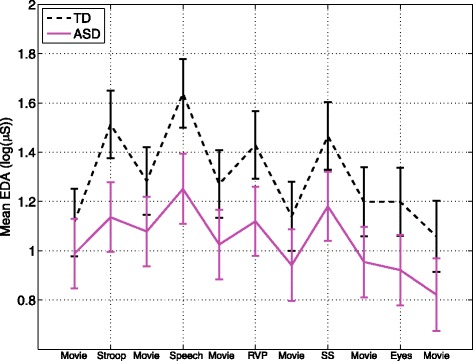
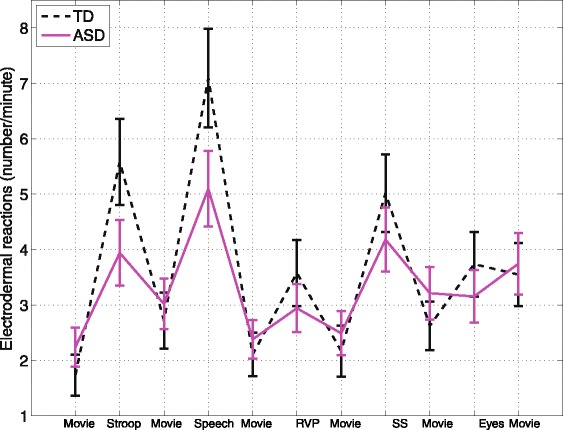
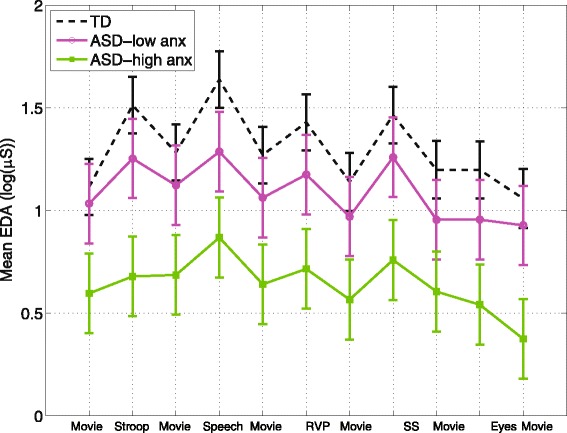
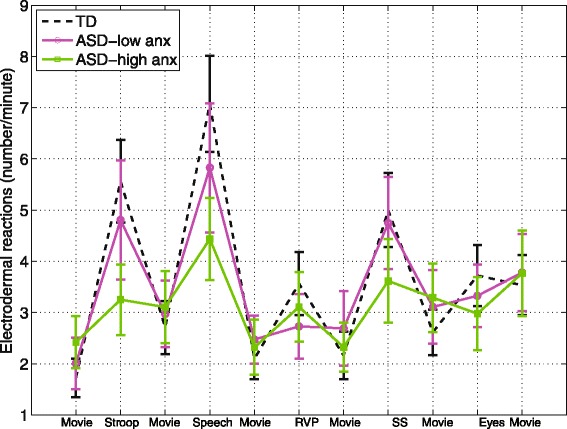
BACKGROUND: Autism spectrum disorder (ASD) has been associated with autonomic atypicalities, although the nature of these differences remains largely unknown. Moreover, existing literature suggests large variability in autonomic function in ASD, motivating the need to examine the existence of subgroups that exhibit more homogeneous autonomic features. METHODS: Electrodermal activity (EDA), a non-invasive physiological indicator of autonomic activity, was measured in typically developing children (n = 33) and those with ASD (n = 38) as participants performed tasks that elicit anxiety, attention, response inhibition, and social cognition processes. The ASD group was divided into low- (n = 18) and high-anxiety (n = 20) participants, and the groups were compared to mean EDA level and electrodermal reactions frequency (EDR). RESULTS: The ASD group had a significantly blunted mean EDA response to the anxiety tasks (p < 0.004). The EDR response to all tasks, except response inhibition, was also blunted in the ASD group (p < 0.04). For this group, EDR frequency during the anxiety and social cognition tasks was negatively correlated with behavioral scores in the domains that were probed by each task (p < 0.002). The high-anxiety ASD group showed significantly decreased mean EDA compared to both the low-anxiety ASD group (p = 0.02) and the typically developing control group (p = 0.04). The high-anxiety ASD group also had significantly more severe symptoms than the low-anxiety ASD group on domains related to anxiety, attention, rule breaking, aggression, obsessions and compulsions, and depression. CONCLUSIONS: Our results suggest atypical autonomic function in children with ASD, specifically with respect to sympathetic activity. Moreover, anxiety symptomatology defined subgroups with distinct physiological and behavioral profiles. Overall, the results add to the body of literature supporting autonomic dysfunction in ASD and highlight the role of anxiety and autonomic features in explaining the variability in the autism spectrum.
Overview
The claims and statistics of this paper haven’t been checked yet.
Free: it reads the open-access text and checks the first 5 claims that cite a source we can check. Create a free account to check every claim.
Integrity signals
Registry
Cites
Statistics
Figures
Verification
Claims the paper makes
The claims and statistics of this paper haven’t been checked yet.
Free: it reads the open-access text and checks the first 5 claims that cite a source we can check. Create a free account to check every claim.
Claims other papers make about this one
Each is checked against this paper’s own text: does it say what the citing paper says it does?
The cited source doesn’t support the claim as written.
In the citing paper
“In summary, the overall conclusion must be that assessments of sympathetic activity in children with ASD using HRV measures or electrodermal activity do not support sympathetic autonomic dysfunction associated with autism.”
From Autism Spectrum Disorder in Children Is Not Associated With Abnormal Autonomic Nervous System Function: Hypothesis and Theory (2022) · cites this paper as [53]
Checked by a reasoning model — may be wrong.
Experimental — accuracy not yet measuredThe source backs part of the claim, not all of it — or backs it for a different population, condition or comparison.
In the citing paper
“Contrary to their expectations, the baseline electrodermal activity in children with high anxiety levels was lower than controls.”
From Autism Spectrum Disorder in Children Is Not Associated With Abnormal Autonomic Nervous System Function: Hypothesis and Theory (2022) · cites this paper as [53]
Experimental — accuracy not yet measuredThe source backs part of the claim, not all of it — or backs it for a different population, condition or comparison.
In the citing paper
“compared to a control group, ASD children with low levels of anxiety were not different from controls in baseline electrodermal activity nor in sympathetic responses to any stimulus (53).”
From Autism Spectrum Disorder in Children Is Not Associated With Abnormal Autonomic Nervous System Function: Hypothesis and Theory (2022) · cites this paper as [53]
Experimental — accuracy not yet measuredThe source backs part of the claim, not all of it — or backs it for a different population, condition or comparison.
In the citing paper
“In response to tasks, the sympathetic activity goes up, similar to typically developing children, but there is no hyper-arousal.”
From Autism Spectrum Disorder in Children Is Not Associated With Abnormal Autonomic Nervous System Function: Hypothesis and Theory (2022) · cites this paper as [53]
Experimental — accuracy not yet measuredThe source backs part of the claim, not all of it — or backs it for a different population, condition or comparison.
In the citing paper
“These tasks increase sympathetic activity, as shown by electrodermal activity.”
From Autism Spectrum Disorder in Children Is Not Associated With Abnormal Autonomic Nervous System Function: Hypothesis and Theory (2022) · cites this paper as [53]
Experimental — accuracy not yet measured
2 more claims about this paper
Create a free account to see every claim other papers make about this one.
Self-check
Percentages, sums and reported differences re-computed from the paper’s own numbers.
The self-check needs the paper’s full text.
Citations
Cites
Studies of interference in serial verbal reactions
Stroop, J. R. (1935) · Journal of Experimental Psychology · doi:10.1037/h0054651 · Cited by 18,622
Lord, C., Rutter, M., & Le Couteur, A. (1994) · Journal of Autism and Developmental Disorders · doi:10.1007/bf02172145 · Cited by 9,065 · cited 1×
“Participants in the ASD group had a primary clinical diagnosis of ASD supported by the Autism Diagnostic Observation Schedule (ADOS) [28] and the Autism Diagnostic Interview-Revised (ADI-R) [29].”
MethodLord, C., Risi, S., Lambrecht, L., Cook, E. H., Leventhal, B. L., DiLavore, P. C., Pickles, A., & Rutter, M. (2000) · Journal of Autism and Developmental Disorders · doi:10.1023/a:1005592401947 · Cited by 7,520 · cited 1×
“Participants in the ASD group had a primary clinical diagnosis of ASD supported by the Autism Diagnostic Observation Schedule (ADOS) [28] and the Autism Diagnostic Interview-Revised (ADI-R) [29].”
MethodBaron‐Cohen, S., Wheelwright, S., Hill, J., Raste, Y., & Plumb, I. (2001) · Journal of Child Psychology and Psychiatry · doi:10.1111/1469-7610.00715 · Cited by 4,555 · cited 1×
“task [33]), and social cognition (Reading the Mind in the Eyes task [34, 35]).”
Background(2001) · doi:10.1017/cbo9780511546396 · Cited by 4,482
Baron‐Cohen, S., Wheelwright, S. J., Hill, J., Raste, Y., & Plumb, I. (2001) · PubMed · Cited by 4,313
Dawson, M. E., Schell, A. M., Filion, D. L., & Berntson, G. G. (2009) · Handbook of Psychophysiology · doi:10.1017/cbo9780511546396.007 · Cited by 1,720
A continuous measure of phasic electrodermal activity
Benedek, M., & Kaernbach, C. (2010) · Journal of Neuroscience Methods · doi:10.1016/j.jneumeth.2010.04.028 · Cited by 1,671 · cited 1×
“task [33]), and social cognition (Reading the Mind in the Eyes task [34, 35]).”
BackgroundAnxiety Disorders in Children and Adolescents with Autistic Spectrum Disorders: A Meta-Analysis
van Steensel, F. J. A., Bögels, S. M., & Perrin, S. (2011) · Clinical Child and Family Psychology Review · doi:10.1007/s10567-011-0097-0 · Cited by 1,463 · cited 1×
“These regions have also been implicated in studies of social deficits in ASD [47] as well as in neuro-circuitry of anxiety [50].”
BackgroundBeissner, F., Meissner, K., Bar, K.-J., & Napadow, V. (2013) · Journal of Neuroscience · doi:10.1523/jneurosci.1103-13.2013 · Cited by 920 · cited 1×
“Interestingly, markers of a well-regulated ANS have been associated with improved social function in children with ASD [45].”
BackgroundBal, E., Harden, E., Lamb, D., Van Hecke, A. V., Denver, J. W., & Porges, S. W. (2010) · Journal of Autism and Developmental Disorders · doi:10.1007/s10803-009-0884-3 · Cited by 575 · cited 2×
“Evidence supporting this notion includes increased cardiac activity (elevated heart rate [4–8], decreased parasympathetic tone [5–7, 9], and larger tonic pupil size [10, 11]).”
BackgroundResultCoull, J. T., Frith, C. D., Frackowiak, R. S. J., & Grasby, P. M. (1996) · Neuropsychologia · doi:10.1016/0028-3932(96)00029-2 · Cited by 566
A systematic review and meta-analysis of the fMRI investigation of autism spectrum disorders
Philip, R. C. M., Dauvermann, M. R., Whalley, H. C., Baynham, K., Lawrie, S. M., & Stanfield, A. C. (2012) · Neuroscience & Biobehavioral Reviews · doi:10.1016/j.neubiorev.2011.10.008 · Cited by 392 · cited 1×
“ASD has been associated with differences in neuroanatomy, function, and connectivity in these regions [47–49], which may affect sympathetic function.”
BackgroundReview of neuroimaging in autism spectrum disorders: what have we learned and where we go from here
Anagnostou, E., & Taylor, M. J. (2011) · Molecular Autism · doi:10.1186/2040-2392-2-4 · Cited by 321 · cited 1×
“These regions have also been implicated in studies of social deficits in ASD [47] as well as in neuro-circuitry of anxiety [50].”
BackgroundSelf-citationAutonomic responses of autistic children to people and objects
Hirstein, W., Iversen, P., & Ramachandran, V. S. (2001) · Proceedings of the Royal Society of London. Series B: Biological Sciences · doi:10.1098/rspb.2001.1724 · Cited by 297 · cited 1×
“These include both increased [18] and unaltered [19–22] basal skin conductance levels and decreased number of EDA reactions to affective images [23] and at rest [19], as well as atypical EDA reactivity to faces [20, 24], emotional judgment tasks [25], eye contact [26], and auditory stimuli [18].”
BackgroundReduced cardiac parasympathetic activity in children with autism
Ming, X., Julu, P. O. O., Brimacombe, M., Connor, S., & Daniels, M. L. (2005) · Brain and Development · doi:10.1016/j.braindev.2005.01.003 · Cited by 245 · cited 2×
“Evidence supporting this notion includes increased cardiac activity (elevated heart rate [4–8], decreased parasympathetic tone [5–7, 9], and larger tonic pupil size [10, 11]).”
BackgroundResultSkin Conductance Responses to Another Person’s Gaze in Children with Autism
Kylliäinen, A., & Hietanen, J. K. (2006) · Journal of Autism and Developmental Disorders · doi:10.1007/s10803-006-0091-4 · Cited by 235 · cited 1×
“These include both increased [18] and unaltered [19–22] basal skin conductance levels and decreased number of EDA reactions to affective images [23] and at rest [19], as well as atypical EDA reactivity to faces [20, 24], emotional judgment tasks [25], eye contact [26], and auditory stimuli [18].”
BackgroundModelling event-related skin conductance responses
Bach, D. R., Flandin, G., Friston, K. J., & Dolan, R. J. (2010) · International Journal of Psychophysiology · doi:10.1016/j.ijpsycho.2010.01.005 · Cited by 215 · cited 1×
“62Hz [36] as well as existing literature [37, 38].”
BackgroundKushki, A., Drumm, E., Pla Mobarak, M., Tanel, N., Dupuis, A., Chau, T., & Anagnostou, E. (2013) · PLoS ONE · doi:10.1371/journal.pone.0059730 · Cited by 209 · cited 10×
“The Stroop task requires participants to name the color of words that spell out names of colors.”
BackgroundMethodInfluentialSelf-citationJansen, L. M. C., Gispen-de Wied, C. C., Wiegant, V. M., Westenberg, H. G. M., Lahuis, B. E., & van Engeland, H. (2006) · Journal of Autism and Developmental Disorders · doi:10.1007/s10803-006-0124-z · Cited by 177 · cited 1×
“Most notably, these findings include atypically blunted ANS activity in response to anxiety and psychosocial challenges [4, 12–15].”
BackgroundJezova, D., Makatsori, A., Duncko, R., Moncek, F., & Jakubek, M. (2004) · Progress in Neuro-Psychopharmacology and Biological Psychiatry · doi:10.1016/j.pnpbp.2004.08.005 · Cited by 175 · cited 2×
“Such dampened reactivity has also been reported across a number of psychiatric and affective conditions including attention deficit/ hyperactivity and conduct disorder [39], alexithymia [40], depression [41], and high trait anxiety [42, 43].”
BackgroundHollocks, M. J., Howlin, P., Papadopoulos, A. S., Khondoker, M. R., & Simonoff, E. A. (2014) · Psychoneuroendocrinology · doi:10.1016/j.psyneuen.2014.04.004 · Cited by 161
Stress responsivity in children with externalizing behavior disorders
SNOEK, H., VAN GOOZEN, S. H. M., MATTHYS, W., BUITELAAR, J. K., & VAN ENGELAND, H. (2004) · Development and Psychopathology · doi:10.1017/s0954579404044578 · Cited by 155 · cited 1×
“Decreased levels of EDA have previously been reported in other populations with psychiatric difficulties including depression [17], anti-social behavior [53], and externalizing behavior disorders [54].”
BackgroundPatriquin, M. A., Scarpa, A., Friedman, B. H., & Porges, S. W. (2013) · Developmental Psychobiology · doi:10.1002/dev.21002 · Cited by 149 · cited 1×
“These difficulties, together with impaired attentional control, may play a role in the early emergence of ASD symptoms [44] (e.”
BackgroundFunctional autonomic nervous system profile in children with autism spectrum disorder
Kushki, A., Brian, J., Dupuis, A., & Anagnostou, E. (2014) · Molecular Autism · doi:10.1186/2040-2392-5-39 · Cited by 145 · cited 3×
“This experimental protocol is described in detail in [4] and summarized in Table 1.”
BackgroundMethodSelf-citationLarger tonic pupil size in young children with autism spectrum disorder
Anderson, C. J., & Colombo, J. (2009) · Developmental Psychobiology · doi:10.1002/dev.20352 · Cited by 140 · cited 1×
“Evidence supporting this notion includes increased cardiac activity (elevated heart rate [4–8], decreased parasympathetic tone [5–7, 9], and larger tonic pupil size [10, 11]).”
BackgroundBenevides, T. W., & Lane, S. J. (2015) · Journal of Autism and Developmental Disorders · doi:10.1007/s10803-013-1971-z · Cited by 137 · cited 4×
“Given that the ANS output depends on the complex interplay of both its branches, it is critical to better understand sympathetic function in this population [3].”
BackgroundInfluentialFlemming, K. D. (2006) · Mayo Clinic Proceedings · doi:10.4065/81.10.1405-c · Cited by 136
Atypical pupillary light reflex and heart rate variability in children with autism spectrum disorder
Daluwatte, C., Miles, J. H., Christ, S. E., Beversdorf, D. Q., Takahashi, T. N., & Yao, G. (2013) · Journal of Autism and Developmental Disorders · doi:10.1007/s10803-012-1741-3 · Cited by 128 · cited 1×
“In addition to these findings, altered ANS response to environmental challenges has also been reported in ASD [2, 3, 8].”
BackgroundHERPERTZ, S. C., WENNING, B., MUELLER, B., QUNAIBI, M., SASS, H., & HERPERTZ-DAHLMANN, B. (2001) · Journal of the American Academy of Child & Adolescent Psychiatry · doi:10.1097/00004583-200110000-00017 · Cited by 126 · cited 1×
“62Hz [36] as well as existing literature [37, 38].”
BackgroundPhysiologic arousal to social stress in children with autism spectrum disorders: a pilot study
Levine, T. P., Sheinkopf, S. J., Pescosolido, M., Rodino, A., Elia, G., & Lester, B. (2012) · Research in Autism Spectrum Disorders · doi:10.1016/j.rasd.2011.04.003 · Cited by 121 · cited 3×
“Participants completed five tasks eliciting performance anxiety (Stroop Word-Color Interference task [30]), social anxiety (public speaking task [12, 22]), attention (Rapid Visual Information Processing task [31, 32]), response inhibition (Stop Signal”
BackgroundMethodA systematic review of physiological reactivity to stimuli in autism
Lydon, S., Healy, O., Reed, P., Mulhern, T., Hughes, B. M., & Goodwin, M. S. (2016) · Developmental Neurorehabilitation · doi:10.3109/17518423.2014.971975 · Cited by 120 · cited 4×
“The findings in this area are inconsistent and include both decreased and unaltered parasympathetic tone [2, 3].”
BackgroundInfluentialPorges, S. W., Macellaio, M., Stanfill, S. D., McCue, K., Lewis, G. F., Harden, E. R., Handelman, M., Denver, J., Bazhenova, O. V., & Heilman, K. J. (2013) · International Journal of Psychophysiology · doi:10.1016/j.ijpsycho.2012.11.009 · Cited by 120 · cited 2×
“Evidence supporting this notion includes increased cardiac activity (elevated heart rate [4–8], decreased parasympathetic tone [5–7, 9], and larger tonic pupil size [10, 11]).”
BackgroundResultNeuhaus, E., Bernier, R., & Beauchaine, T. P. (2014) · Journal of Autism and Developmental Disorders · doi:10.1007/s10803-013-1923-7 · Cited by 119 · cited 1×
“Decreased parasympathetic tone, measured by respiratory sinus arrhythmia, has also been associated with social and emotional difficulties in ASD [9].”
BackgroundJansen, L. M., Gispen-de Wied, C. C., van der Gaag, R.-J., & van Engeland, H. (2003) · Neuropsychopharmacology · doi:10.1038/sj.npp.1300046 · Cited by 118 · cited 3×
“Participants completed five tasks eliciting performance anxiety (Stroop Word-Color Interference task [30]), social anxiety (public speaking task [12, 22]), attention (Rapid Visual Information Processing task [31, 32]), response inhibition (Stop Signal”
BackgroundMethodDepressive symptoms and attenuated physiological reactivity to laboratory stressors
Schwerdtfeger, A. R., & Rosenkaimer, A.-K. (2011) · Biological Psychology · doi:10.1016/j.biopsycho.2011.05.009 · Cited by 105 · cited 2×
“These include deficits in allocation of attentional resources [39] or other executive functions as well as lower levels of motivation to performance, engagement, or interest in study tasks [40].”
BackgroundElectrodermal Activity and Antisocial Behavior: Empirical Findings and Theoretical Issues
Fowles, D. C. (1993) · Springer eBooks · doi:10.1007/978-1-4615-2864-7_15 · Cited by 100 · cited 2×
“In particular, arousal increases physiological output to a certain point, beyond which the physiological response decreases (a concept similar to Pavlov’s notion of transmarginal inhibition) [52].”
BackgroundA systematic review of nonsurgical single-visit versus multiple-visit endodontic treatment
Chu, C.-H., Wong, A., & Zhang, C. (2014) · Clinical, Cosmetic and Investigational Dentistry · doi:10.2147/ccide.s61487 · Cited by 98
Electrodermal reactivity to emotion processing in adults with autistic spectrum disorders
Hubert, B. E., Wicker, B., Monfardini, E., & Deruelle, C. (2009) · Autism · doi:10.1177/1362361308091649 · Cited by 95 · cited 1×
“These include both increased [18] and unaltered [19–22] basal skin conductance levels and decreased number of EDA reactions to affective images [23] and at rest [19], as well as atypical EDA reactivity to faces [20, 24], emotional judgment tasks [25], eye contact [26], and auditory stimuli [18].”
BackgroundWilken, J. A., Smith, B. D., Tola, K., & Mann, M. (2000) · International Journal of Psychophysiology · doi:10.1016/s0167-8760(00)00082-9 · Cited by 93 · cited 1×
“This would be consistent with the high prevalence of comorbid anxiety in ASD [51] and previous reports of hyper-arousal in this population [5–8, 27].”
ResultMcAuley, T., Crosbie, J., Charach, A., & Schachar, R. (2014) · Journal of Child Psychology and Psychiatry · doi:10.1111/jcpp.12160 · Cited by 91 · cited 1×
“task [33]), and social cognition (Reading the Mind in the Eyes task [34, 35]).”
BackgroundAutonomic and Behavioral Responses of Children With Autism to Auditory Stimuli
Chang, M. C., Parham, L. D., Blanche, E. I., Schell, A., Chou, C.-P., Dawson, M., & Clark, F. (2012) · The American Journal of Occupational Therapy · doi:10.5014/ajot.2012.004242 · Cited by 86 · cited 3×
“0 μs [18]) were identified as outliers and removed.”
BackgroundPupil and salivary indicators of autonomic dysfunction in autism spectrum disorder
Anderson, C. J., Colombo, J., & Unruh, K. E. (2013) · Developmental Psychobiology · doi:10.1002/dev.21051 · Cited by 85 · cited 1×
“Evidence supporting this notion includes increased cardiac activity (elevated heart rate [4–8], decreased parasympathetic tone [5–7, 9], and larger tonic pupil size [10, 11]).”
BackgroundAbnormal autonomic and associated brain activities during rest in autism spectrum disorder
Eilam-Stock, T., Xu, P., Cao, M., Gu, X., Van Dam, N. T., Anagnostou, E., Kolevzon, A., Soorya, L., Park, Y., Siller, M., et al. (2014) · Brain · doi:10.1093/brain/awt294 · Cited by 84 · cited 2×
“Further supporting atypical central autonomic processing, a study of resting state activity in ASD [19] found that the EDR signal was positively correlated with activity in several regions involved in autonomic processing (e.”
BackgroundSelf-citationA novel EDA glove based on textile-integrated electrodes for affective computing
Lanatà, A., Valenza, G., & Scilingo, E. P. (2012) · Medical & Biological Engineering & Computing · doi:10.1007/s11517-012-0921-9 · Cited by 72 · cited 1×
“62Hz [36] as well as existing literature [37, 38].”
BackgroundPina‐Camacho, L., Villero, S., Fraguas, D., Boada, L., Janssen, J., Navas-Sánchez, F. J., Mayoral, M., Llorente, C., Arango, C., & Parellada, M. (2011) · Journal of Autism and Developmental Disorders · doi:10.1007/s10803-011-1360-4 · Cited by 69 · cited 1×
“In particular, a widespread network of regions, including the amygdalae, and the prefrontal, anterior cingulate, and insular cortices, has been associated with sympathetic modulation [46].”
BackgroundDelayed Reversal Learning and Association With Repetitive Behavior in Autism Spectrum Disorders
South, M., Newton, T., & Chamberlain, P. D. (2012) · Autism Research · doi:10.1002/aur.1255 · Cited by 62 · cited 1×
“These include both increased [18] and unaltered [19–22] basal skin conductance levels and decreased number of EDA reactions to affective images [23] and at rest [19], as well as atypical EDA reactivity to faces [20, 24], emotional judgment tasks [25], eye contact [26], and auditory stimuli [18].”
BackgroundMathersul, D. C., McDonald, S., & Rushby, J. A. (2012) · Physiology & Behavior · doi:10.1016/j.physbeh.2012.10.008 · Cited by 60 · cited 1×
“These include both increased [18] and unaltered [19–22] basal skin conductance levels and decreased number of EDA reactions to affective images [23] and at rest [19], as well as atypical EDA reactivity to faces [20, 24], emotional judgment tasks [25], eye contact [26], and auditory stimuli [18].”
BackgroundMathersul, D. C., McDonald, S., & Rushby, J. A. (2013) · International Journal of Psychophysiology · doi:10.1016/j.ijpsycho.2013.04.014 · Cited by 60 · cited 2×
“Decreased levels of EDA have previously been reported in other populations with psychiatric difficulties including depression [17], anti-social behavior [53], and externalizing behavior disorders [54].”
BackgroundResultSmeekens, I., Didden, R., & Verhoeven, E. W. M. (2015) · Journal of Autism and Developmental Disorders · doi:10.1007/s10803-013-1947-z · Cited by 55 · cited 1×
“Most notably, these findings include atypically blunted ANS activity in response to anxiety and psychosocial challenges [4, 12–15].”
BackgroundRiby, D. M., Whittle, L., & Doherty-Sneddon, G. (2012) · Journal of Clinical and Experimental Neuropsychology · doi:10.1080/13803395.2011.645019 · Cited by 52
Autism spectrum disorder in infancy: developmental considerations in treatment targets
Brian, J. A., Bryson, S. E., & Zwaigenbaum, L. (2015) · Current Opinion in Neurology · doi:10.1097/wco.0000000000000182 · Cited by 48 · cited 1×
“Such dampened reactivity has also been reported across a number of psychiatric and affective conditions including attention deficit/ hyperactivity and conduct disorder [39], alexithymia [40], depression [41], and high trait anxiety [42, 43].”
BackgroundSelf-citationThe influence of anxiety on electrodermal responses to distractors
Naveteur, J., Buisine, S., & Gruzelier, J. H. (2005) · International Journal of Psychophysiology · doi:10.1016/j.ijpsycho.2004.12.006 · Cited by 41 · cited 1×
“Such dampened reactivity has also been reported across a number of psychiatric and affective conditions including attention deficit/ hyperactivity and conduct disorder [39], alexithymia [40], depression [41], and high trait anxiety [42, 43].”
BackgroundFranz, M., Schaefer, R., & Schneider, C. (2003) · Journal of Psychophysiology · doi:10.1027/0269-8803.17.4.203 · Cited by 40 · cited 2×
“These include deficits in allocation of attentional resources [39] or other executive functions as well as lower levels of motivation to performance, engagement, or interest in study tasks [40].”
BackgroundNeural correlates of fear: insights from neuroimaging
Critchley, H., & Garfinkel, S. N. (2014) · Neuroscience and Neuroeconomics · doi:10.2147/nan.s35915 · Cited by 27 · cited 1×
“ASD has been associated with differences in neuroanatomy, function, and connectivity in these regions [47–49], which may affect sympathetic function.”
BackgroundMing, X., Julu, P. O. O., Brimacombe, M. B., Connor, S., & Daniels, M. L. (2012) · Brain and Development · doi:10.1016/j.braindev.2012.07.011 · Cited by 13
Research works printed but not linked: 1
- Porges SW. The Polyvagal Theory: Neurophysiological Foundations Of Emotions, Attachment, Communication, and Self-Regulation (Norton Series On Interpersonal Neurobiology). New York: WW Norton & Company; 2011.
Cited by
Sleep in Children with Autism Spectrum Disorder
Souders, M. C., Zavodny, S., Eriksen, W., Sinko, R., Connell, J., Kerns, C., Schaaf, R., & Pinto-Martin, J. (2017) · Current Psychiatry Reports · doi:10.1007/s11920-017-0782-x · Cited by 307
Keith, J. M., Jamieson, J. P., & Bennetto, L. (2019) · Journal of Abnormal Child Psychology · doi:10.1007/s10802-018-0455-1 · Cited by 93
Autism spectrum disorder is associated with autonomic underarousal
BUJNAKOVA, I., ONDREJKA, I., MESTANIK, M., VISNOVCOVA, Z., MESTANIKOVA, A., HRTANEK, I., FLESKOVA, D., CALKOVSKA, A., & TONHAJZEROVA, I. (2016) · Physiological Research · doi:10.33549/physiolres.933528 · Cited by 75
“Interestingly, Panju et al. (2015) studied two groups of ASD (low-anxiety and highanxiety) and they found significantly decreased mean EDA in high-anxiety ASD group.”
BackgroundPathological Demand Avoidance: symptoms but not a syndrome
Green, J., Absoud, M., Grahame, V., Malik, O., Simonoff, E. A., Couteur, A. S. L., & Baird, G. (2018) · The Lancet Child & Adolescent Health · doi:10.1016/s2352-4642(18)30044-0 · Cited by 89
Fluegge, K. (2016) · Environmental Toxicology and Pharmacology · doi:10.1016/j.etap.2016.08.013 · Cited by 72
Metadata
- Authors
- Panju, S., Brian, J., Dupuis, A., Anagnostou, E., & Kushki, A.
- Affiliations
- University of Toronto (CA)
- Bloorview Research Institute (CA)
- Hospital for Sick Children (CA)
- Corresponding author
- Kushki, Azadeh
- Venue
- Molecular Autism
- Published
- 2015-12
- Volume
- 6
- Issue
- 1
- Pages
- 64-64
- ISSN
- 2040-2392 (ISSN-L)
- PMC
- PMC4676885
- OpenAlex
- W2191720120
- Cited by
- 79
- References
- 58
- Citations by year
- 2026: 6 · 2025: 9 · 2024: 7 · 2023: 8 · 2022: 8 · 2021: 10 · 2020: 13 · 2019: 4 · 2018: 7 · 2017: 4 · 2016: 3
- FWCI
- 2.81
- Type
- journal article
- Language
- en
- Open access
- gold
- doi.org
- Licence
- cc-by
- Locations
- Molecular Autism (publishedVersion, cc-by)
- Europe PMC (PubMed Central) (publishedVersion, cc-by)
- PubMed Central (publishedVersion, cc-by)
- PubMed (publishedVersion)
- TSpace (University of Toronto) (submittedVersion)
- Funders
- Ontario Brain Institute
- Government of Ontario
- Topics
- Life Sciences › Neuroscience › Cognitive Neuroscience › Autism Spectrum Disorder Research
- Health Sciences › Medicine › Cardiology and Cardiovascular Medicine › Heart Rate Variability and Autonomic Control
- Health Sciences › Medicine › Psychiatry and Mental health › Child Nutrition and Feeding Issues
- Keywords
- autism spectrum disorder, autonomic dysfunction, sympathetic activation, electrodermal activity, children, response inhibition, social cognition, attention
About these checks
Registry, retraction, Cites and statistics results are computed, not judged, with one exception: a printed reference that no index lists is read once by a model before it counts as a citation error. Claims are extracted by a model and kept only when their quote appears verbatim in the text; each cited source is then checked, with a model’s help, for whether it says what the claim relies on. Those verdicts can be wrong — read the claim’s quote and the cited source before relying on one.
Statistics and arithmetic are recomputed, not judged.
Confidence bands are shown only for fields calibrated on our annotated test set. None is calibrated yet, so no band is shown.
What counts as a claim ›How we measure confidence ›How we check this ›
Are you an author, or do you see a problem with this page? Request a review
Data sources
Bibliographic data: Semantic Scholar, OpenAlex, Crossref.
Contains information from the Semantic Scholar Academic Graph Datasets, made available under the ODC Attribution License (ODC-BY 1.0).
Semantic Scholar’s data is described in: Kinney, R., et al. (2023). The Semantic Scholar Open Data Platform. arXiv:2301.10140.
