

Selection bias on intellectual ability in autism research: a cross-sectional review and meta-analysis
Open accessThe DOI matches its Crossref record; 51 of the 51 references it cites were found in a registry or an index.
Abstract
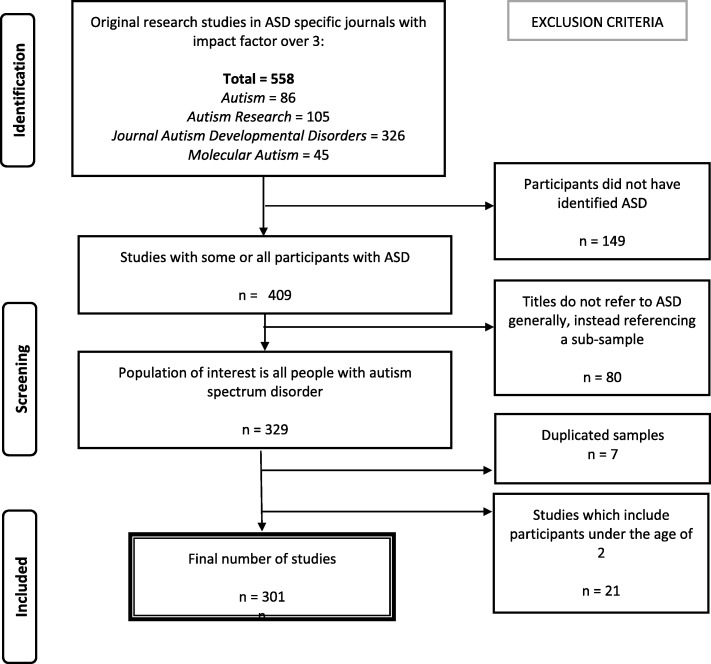
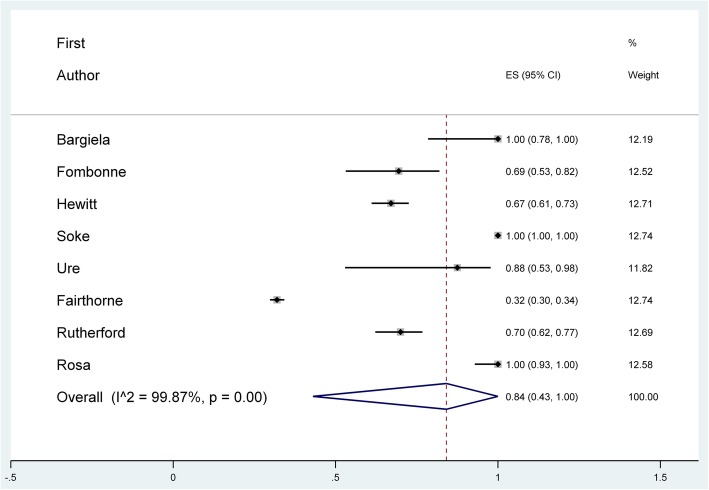
Current global estimates suggest the proportion of the population with autism spectrum disorder (ASD) who have intellectual disability (ID) is approximately 50%. Our objective was to ascertain the existence of selection bias due to under-inclusion of populations with ID across all fields of autism research. A sub-goal was to evaluate inconsistencies in reporting of findings. This review covers all original research published in 2016 in autism-specific journals with an impact factor greater than 3. Across 301 included studies, 100,245 participants had ASD. A random effects meta-analysis was used to estimate the proportion of participants without ID. Selection bias was defined as where more than 75% of participants did not have ID. Meta-analysis estimated 94% of all participants identified as being on the autism spectrum in the studies reviewed did not have ID (95% CI 0.91–0.97). Eight out of ten studies demonstrated selection bias against participants with ID. The reporting of participant characteristics was generally poor: information about participants’ intellectual ability was absent in 38% of studies ( n = 114). Where there was selection bias on ID, only 31% of studies mentioned lack of generalisability as a limitation. We found selection bias against ID throughout all fields of autism research. We recommend transparent reporting about ID and strategies for inclusion for this much marginalised group.
Overview
The claims and statistics of this paper haven’t been checked yet.
Free: it reads the open-access text and checks the first 5 claims that cite a source we can check. Create a free account to check every claim.
Integrity signals
Registry
Cites
Statistics
Figures
Verification
Claims the paper makes
The claims and statistics of this paper haven’t been checked yet.
Free: it reads the open-access text and checks the first 5 claims that cite a source we can check. Create a free account to check every claim.
Claims other papers make about this one
Each is checked against this paper’s own text: does it say what the citing paper says it does?
The source backs part of the claim, not all of it — or backs it for a different population, condition or comparison.
In the citing paper
“Russell et al. (2019), examining autism research papers published in 2016, covering 301 studies and more than 100,000 participants, estimated that 94% of all ASD participants had IQ in the average range, and 80% of studies showed selection bias against participants with intellectual disability.”
From Annual Research Review: Looking back to look forward – changes in the concept of autism and implications for future research (2020) · cites this paper as Russell et al. (2019)
Experimental — accuracy not yet measuredThe cited source says what the claim attributes to it.
In the citing paper
“Beyond specific genetic syndromes (for example, FXS), there is little research on sex/gender effects in intellectual disabilities, which is also reflected in the autism literature insofar as autistic people with intellectual disabilities are disproportionately under-represented304,305.”
From Sex and gender in neurodevelopmental conditions (2023) · cites this paper as [304]
The cited source says what the claim attributes to it.
In the citing paper
“The authors contrast this with an estimated 50 -55% of the autistic population that have intellectual disability.”
From Annual Research Review: Looking back to look forward – changes in the concept of autism and implications for future research (2020) · cites this paper as Russell et al. (2019)
Self-check
Percentages, sums and reported differences re-computed from the paper’s own numbers.
The self-check needs the paper’s full text.
Citations
Cites
Baio, J., Wiggins, L., Christensen, D. L., Maenner, M. J., Daniels, J., Warren, Z., Kurzius-Spencer, M., Zahorodny, W., Robinson, C., Rosenberg, et al. (2018) · MMWR. Surveillance Summaries · doi:10.15585/mmwr.ss6706a1 · Cited by 6,078
What Is the Male-to-Female Ratio in Autism Spectrum Disorder? A Systematic Review and Meta-Analysis
Loomes, R., Hull, L., & Mandy, W. P. L. (2017) · Journal of the American Academy of Child & Adolescent Psychiatry · doi:10.1016/j.jaac.2017.03.013 · Cited by 2,804
Self-citationGlobal Prevalence of Autism and Other Pervasive Developmental Disorders
Elsabbagh, M., Divan, G., Koh, Y., Kim, Y. S., Kauchali, S., Marcín, C., Montiel‐Nava, C., Patel, V., Paula, C. S., Wang, C., et al. (2012) · Autism Research · doi:10.1002/aur.239 · Cited by 2,636
Autism spectrum disorders: developmental disconnection syndromes
Geschwind, D. H., & Levitt, P. (2007) · Current Opinion in Neurobiology · doi:10.1016/j.conb.2007.01.009 · Cited by 1,411
Naarden Braun, K. V., Lopez, M., White, T., et al. (2023) · Carolina Digital Repository (University of North Carolina at Chapel Hill) · doi:10.17615/y3kk-5x30 · Cited by 1,381
The Epidemiology of Autism Spectrum Disorders
Newschaffer, C. J., Croen, L. A., Daniels, J., Giarelli, E., Grether, J. K., Levy, S. E., Mandell, D. S., Miller, L. A., Pinto-Martin, J., Reaven, J., et al. (2007) · Annual Review of Public Health · doi:10.1146/annurev.publhealth.28.021406.144007 · Cited by 1,228
A Systematic Review of Early Intensive Intervention for Autism Spectrum Disorders
Warren, Z., McPheeters, M. L., Sathe, N., Foss-Feig, J. H., Glasser, A., & Veenstra-VanderWeele, J. (2011) · Pediatrics · doi:10.1542/peds.2011-0426 · Cited by 790
IQ in children with autism spectrum disorders: Data from the special needs and autism project (SNAP)
Charman, T., Pickles, A., Simonoff, E., Chandler, S., Loucas, T., & Baird, G. (2011) · Psychological Medicine · doi:10.1017/s0033291710000991 · Cited by 599
“We’re tired, not sad”: Benefits and burdens of mothering a child with a disability
Green, S. E. (2007) · Social Science & Medicine · doi:10.1016/j.socscimed.2006.08.025 · Cited by 542
Cited by
Items 301–400 of 438
Gaigg, S., Krug, M. K., Solomon, M., Roestorf, A., Derwent, C. L. T., Anns, S., Bowler, D., Rivera, S. M., Nordahl, C. W., & Jones, E. J. H. (2020) · Autism Research · doi:10.1002/aur.2368 · Cited by 2
“This group is generally underrepresented in the literature [Russell et al., 2019], partly because of considerable methodological challenges in probing cognitive processes of interest.”
BackgroundTemporal Synchrony in Autism: A Systematic ReviewPreprint
Baldwin, M. M., Xiao, Z., & Murray, A. L. (2020) · PsyArXiv (OSF Preprints) · doi:10.31234/osf.io/67gv8 · Cited by 2
White, L. M., Adams, D., Simpson, K., & Malone, S. A. (2025) · SSRN Electronic Journal · doi:10.2139/ssrn.5212434 · Cited by 2
Fanous, M. (2024) · UCL Discovery (University College London) · Cited by 2
Stress, Affect Regulation and Attachment of People With Sensory and Intellectual Disabilities
de Vaan, G., Vervloed, M. P. J., Knoors, H. E. T., & Verhoeven, L. T. W. (2020) · Frontiers in Education · doi:10.3389/feduc.2020.539792 · Cited by 1
Autism and Learning Disabilities: A relational-intersectional perspective
Cano, F. U. (2022) · Murmurations Journal of Transformative Systemic Practice · doi:10.28963/4.2.7 · Cited by 1
“• Autism research focuses only on the more able end of the spectrum (Russell et al., 2019).”
Background(2024) · Frontiers research topics · doi:10.3389/978-2-8325-4411-2 · Cited by 1
Carrier, C., Magnacca, C., Rinaldo, E., Esteves, J., & Perry, A. (2024) · Journal of Mental Health Research in Intellectual Disabilities · doi:10.1080/19315864.2024.2397368 · Cited by 1
“Despite the existence of mental health treatments designed for youth with ASD, there is an underrepresentation of youth with ID and ASD in ASD research (Russell et al., 2019).”
Parrella, N.-F., Hill, A. T., Enticott, P. G., Botha, T., & Ford, T. C. (2026) · Research in Neurodiversity · doi:10.1016/j.rin.2026.100017 · Cited by 1
Self-citationKey, A. P. F., Jones, D., & Corbett, B. A. (2025) · Journal of Autism and Developmental Disorders · doi:10.1007/s10803-025-06755-6 · Cited by 1
“the role of intellectual capability in social functioning is not yet clearly understood because research studies and clinical trials commonly exclude autistic participants with a below-average intellectual quotient (IQ) (Thurm et al., 2019; Jack & Pelphrey, 2017; Russell et al., 2019).”
Kaedbey, M., Servant, A., Philibert-Lignières, G., & Quintin, E. (2025) · Review Journal of Autism and Developmental Disorders · doi:10.1007/s40489-025-00516-y · Cited by 1
Hasche, N. G., Kunter, M., Krause, A.-K., & Dignath, C. (2025) · Edition ZfE · doi:10.1007/978-3-658-48674-7_6 · Cited by 1
Bauer, V., Caslini, G., Mores, M., Gianotti, M., & Garzotto, F. (2025) · International Journal of Human-Computer Studies · doi:10.1016/j.ijhcs.2025.103675 · Cited by 1
Andriienko, H. (2025) · Psychology and Personality · doi:10.33989/2226-4078.2024.2.39 · Cited by 1
Herbert, G., Smith, A., & MacLennan, K. (2025) · Autism in Adulthood · doi:10.1177/25739581251375879 · Cited by 1
Moura, H. F. S., Moreira, M. F. A., Mangabeira, D. S., Santos, K. O., & da Cruz, S. D. S. (2026) · Psicologia e Saúde em Debate · doi:10.22289/2446-922x.v12a1a37 · Cited by 1
Active Learning for Autistic Learners: Enabling or Disabling?
Eadon, L., Peruzzo, F., & Crane, L. (2026) · Active Learning in Higher Education · doi:10.1177/14697874261429882 · Cited by 1
“In our analysis, we use the term autistic learners to refer to those who can access higher education, which typically excludes those with intellectual disabilities; an often-overlooked subsection of the autistic population (Russell et al., 2019).”
East, C., Parsons, S., & Kovshoff, H. (2026) · International Journal of Research & Method in Education · doi:10.1080/1743727x.2026.2651336 · Cited by 2
“This bias is indicative of a wider problem within the autism research field, where the voices of people with co-occurring intellectual disabilities, or those who may be ‘unvoiced or differently voiced’ (Ashby 2011, n.p.n.), are systematically and routinely excluded (Russell et al .”
Livingston, L. A., Leekam, S., Davies, G., Shah, P., Layinka, O., Carrington, S. J., & Jones, C. R. G. (2026) · Molecular Autism · doi:10.1186/s13229-026-00714-3 · Cited by 1
“As such, our findings may be less relevant to autistic people with an additional intellectual disability, who made up only 5% of the Autistic group in the current study, and are poorly represented in autism research more generally [71].”
A multi-method phenotypic study of sex differences in pragmatic language in autism
Landau, E. B., Brooks, S. E., Guilfoyle, J. L., Nayar, K., Crawford, S., Xing, J., Lau, J. C. Y., Martin, G. E., Voigt, R., Soorya, L. V., et al. (2026) · Frontiers in Psychiatry · doi:10.3389/fpsyt.2026.1759436 · Cited by 1
“Whereas the current study necessarily focused on verbally fl uent autistic individuals, extending this research to include those with lower verbal abilities is critical, as pragmatic language challenges may manifest differently (199).”
Stephenson, K. G., Norris, M. N., Kim, S. Y., Russell, N., Levine, A., Murphy, C., Youngstrom, E. A., & Butter, E. M. (2026) · Journal of Autism and Developmental Disorders · doi:10.1007/s10803-026-07352-x · Cited by 1
Layton, C., & Bennetto, L. (2026) · Research in Autism · doi:10.1016/j.reia.2026.202941 · Cited by 1
Caregiver‐reported quality of life among individuals with neurodevelopmental genetic conditions
Schuck, R. K., Baker, E. K., Baiden, K. M. P., Foley, K., Hardan, A. Y., Frazier, T. W., & Uljarević, M. (2026) · Developmental Medicine & Child Neurology · doi:10.1111/dmcn.70434 · Cited by 1
Mind–Body Interventions for Autistic Youth
Cosgrove, K. T., Ratcliff, C. G., & Storch, E. A. (2026) · Psychiatric Clinics of North America · doi:10.1016/j.psc.2026.07.009 · Cited by 1
Woodcock, K. A., & Waite, J. (2019) · Journal of Intellectual Disability Research · doi:10.1111/jir.12678 · Cited by 1
“There is growing awareness that individuals with intellectual disabilities are often excluded from research into mental health outcomes (Russell et al. 2019).”
BackgroundHandheld cueing systems: promoting career task independence for learners with disabilities
Thull, C. S., & Glaser, N. J. (2025) · Disability and Rehabilitation Assistive Technology · doi:10.1080/17483107.2025.2489108 · Cited by 1
“About 38% of persons with autism have co-existing iD, as well as possibly having other co-existing conditions such as epilepsy, attention deficit hyperactivity disorder, and/or sensory processing differences [9,10].”
Passarini, S., Quarin, F., Lazzaro, G., Costanzo, F., Battisti, A., Valeri, G., Guerrera, S., Casula, L., Menghini, D., Pirchio, S., et al. (2026) · Frontiers in Psychiatry · doi:10.3389/fpsyt.2026.1764016 · Cited by 1
“As a result, individuals with neurodevelopmental dif fi culties may be excluded from studies, introducing biases that perpetuate social inequities (32, 33).”
Dantec, M., Cazalis, F., Peyrical, A., Luisier, A.-C., Benabou, C., Coeur-Bizot, S., Mandairon, N., Mantel, M., & Bensafi, M. (2023) · bioRxiv (Cold Spring Harbor Laboratory) · doi:10.1101/2023.12.15.571849 · Cited by 1
Khan, A., & Caldwell‐Harris, C. L. (2024) · Preprints.org · doi:10.20944/preprints202403.0338.v1 · Cited by 1
The Use of Socially Assistive Robots with Autistic Children
Kouroupa, A. (2024) · University of Hertfordshire Research Archive (University of Hertfordshire) · doi:10.18745/th.28076 · Cited by 1
Experience-based specialisation: underpinnings of communication in typical and atypical development
Kolesnik, A. (2020) · BIROn (Birkbeck, University of London) · doi:10.18743/pub.00045818 · Cited by 1
Carter, C. K. (2024) · Lancaster EPrints (Lancaster University) · doi:10.17635/lancaster/thesis/2553 · Cited by 1
The lived experiences of autistic children in mainstream primary schools in England
Billington, J. (2023) · CentAUR (University of Reading) · doi:10.48683/1926.00115830 · Cited by 1
Strategies to Reduce Business Costs Associated with Employee Financial Stress
Ward, G. (2024) · ScholarWorks (Walden University) · Cited by 2
Bhogal, K. (2023) · University of Birmingham Institutional Research Archive (University of Birmingham) · Cited by 1
Smith, J. R., Bonnée, M., Marler, S., Atwood, R., Lewis, B. J., Lim, S., Baldwin, I., Wu, H., Liu, J., Cascio, C. J., et al. (2026) · medRxiv · doi:10.64898/2026.09.10.26362749 · Cited by 1
“These limitations are especially important as the field of autism research broadly has recognized that autistic individuals with intellectual disability and high support needs are systematically excluded from clinical research [10,11].”
Developmental Regression in Children with Autism Spectrum Disorder: Associated Factors and Outcomes
Estabillo, J. A. (2019) · Louisiana State University · doi:10.31390/gradschool_dissertations.5000
“Additionally, the prevalence of ID among individuals with ASD is approximately 50% (Charman et al., 2011; Newschaffer et al., 2007; Russell et al., 2019), which indicates that the study sample is likely underestimating the presence of ID.”
BackgroundDeMayo, M. M. (2020) · The Sydney eScholarship Repository (The University of Sydney)
Howard, K. (2020) · Apollo (University of Cambridge) · doi:10.17863/cam.52528
Phenotypic and Genotypic Heterogeneity in Autism Spectrum Disorder
Clements, C. C. (2020) · Scholarly Commons (University of Pennsylvania)
A Comprehensive Meta-analysis of the Prevalence of Autism Spectrum Disorders
Guo, H., Ma, Y., Aizhu, W., & Xiang, Z. (2021) · Psychology and Behavioral Sciences · doi:10.11648/j.pbs.20211003.11
“Different autism may have different symptoms or causes, even in the same person [17], different origins may cause different core symptoms.”
BackgroundBamford, C. (2019) · University of Birmingham Institutional Research Archive (University of Birmingham)
Autism and Technology for Collaboration
Yuill, N. (2021) · Springer eBooks · doi:10.1007/978-3-030-75047-3_6
Understanding Falls in People with Intellectual Disability in Western Australia
Ho, P. (2020) · ResearchOnline@ND (The University of Notre Dame)
Holzinger, D., Weber, C., Bölte, S., Fellinger, J., & Hofer, J. (2021) · Journal of Autism and Developmental Disorders · doi:10.1007/s10803-021-05245-9
Examining the Needs of Autistics With Intellectual Disabilities
Bennett, M., & Goodall, E. (2022) · Emerald Group Publishing Limited eBooks · doi:10.1108/978-1-80382-463-520221007
Muellerleile, J. (2022) · Publication Server of Goethe University Frankfurt am Main (Goethe University Frankfurt) · doi:10.21248/gups.68693
New program offers $35K grants to study ‘profound autism’
Hess, P. (2022) · The Transmitter · doi:10.53053/kums3352
Levy, Y. (2022) · Frontiers in Psychiatry · doi:10.3389/fpsyt.2022.956351
Bundgaard‐Nielsen, C. (2021) · VBN Forskningsportal (Aalborg Universitet) · doi:10.54337/aau466210133
Wolfer, P., & Durrleman, S. (2023) · First Language · doi:10.1177/01427237231207521
“…the growing number of autistic individuals exposed to more than one language, for whom evidence-based recommendations are needed (Beauchamp & MacLeod, 2017), particularly for (bilingual) autistic children with intellectual impairment who are often absent from studies (Russell et al., 2019).”
BackgroundResultPsycho-Educational Assessments: Theory and Practice
Bulut, O. (2024) · MDPI eBooks · doi:10.3390/books978-3-7258-0551-8
NEUROBIOLOGICAL FACTORS OF EXECUTIVE DYSFUNCTION IN AUTISM SPECTRUM DISORDERS
Kozunova, G. L., Zakirov, F., Rytikova, A. M., Stroganova, T. A., & Chernyshev, B. (2023) · Журнал высшей нервной деятельности им И П Павлова · doi:10.31857/s0044467723020077
Aeberhard, R., Sy, M., & Kramer-Roy, D. (2024) · Cadernos Brasileiros de Terapia Ocupacional · doi:10.1590/2526-8910.ctoao278136222
Emergence and Persistence of Loneliness Among Autistic Adults: A Theoretical Framework
Schiltz, H. K., & Lord, C. (2025) · Autism in Adulthood · doi:10.1089/aut.2024.0149
“75 We are hopeful that later versions of our proposed model will be AUTISM LONELINESS THEORETICAL FRAMEWORK able to empirically integrate the experiences and needs of less verbal people who often have quite different options for social environments.”
« L’autisme profond » : une casuistique pour le clinicien
Pry, R., & Achhab, A. E. (2025) · Neuropsychiatrie de l Enfance et de l Adolescence · doi:10.1016/j.neurenf.2025.03.007
Wilkinson, E. (2024) · Scholars Archive - University at Albany (University at Albany, State University of New York) · doi:10.54014/7sew-4fp4
Gruner, M., Roessner, V., & Ring, M. (2025) · Autism Research · doi:10.1002/aur.70107
“…can help parents and professionals better understand and support anxious autistic youth. individuals with intellectual disabilities are often neglected in clinical studies (Russell et al. 2019) and very little is known especially about minimally verbal older youth (Tager-Flusberg and Kasari 2013).”
Kinder mit erhöhtem Risiko für Bildungsmisserfolg
Ziehm, J., Hasselhorn, M., & Roßbach, H. (2025) · Edition ZfE · doi:10.1007/978-3-658-48674-7
Language impairment in autistic adolescents and young adults: Variability by definitionPreprint
Girolamo, T. M., Butler, L. K., & Parish‐Morris, J. (2025) · medRxiv · doi:10.1101/2025.09.05.25335184
“Last, given current autism diagnostic criteria (WHO, 2022) and systematic exclusion in autism research (Russell et al., 2019), this study had no NVIQ cutoffs.”
InfluentialLaverty, C., & Richards, C. (2025) · Journal of Intellectual Disability Research · doi:10.1111/jir.70055
Rideout, B. (2025) · Open Access Victoria University of Wellington | Te Herenga Waka (Figshare) · doi:10.26686/d36j-ppwr
St. John, B. M., Hickey, E., Kastern, E., Russell, C., Russell, T., Mathy, A., Peterson, B., Wigington, D., Pellien, C., Caudill, A., et al. (2022) · Figshare · doi:10.6084/m9.figshare.21077598
St. John, B. M., Hickey, E., Kastern, E., Russell, C., Russell, T., Mathy, A., Peterson, B., Wigington, D., Pellien, C., Caudill, A., et al. (2022) · Figshare · doi:10.6084/m9.figshare.21077604
Hong, J., DaWalt, L. S., Taylor, J. L., Haider, A. H., & Mailick, M. R. (2024) · Figshare · doi:10.6084/m9.figshare.26635221
St. John, B. M., Hickey, E., Kastern, E., Russell, C., Russell, T., Mathy, A., Peterson, B., Wigington, D., Pellien, C., Caudill, A., et al. (2022) · Figshare · doi:10.6084/m9.figshare.21077589
Manyukhina, V. O., Prokofyev, A. O., Galuta, I. A., Goiaeva, D. E., Obukhova, T. S., Schneiderman, J. F., Altukhov, D., Stroganova, T. A., & Orekhova, E. V. (2022) · Figshare · doi:10.6084/m9.figshare.19759967
St. John, B. M., Hickey, E., Kastern, E., Russell, C., Russell, T., Mathy, A., Peterson, B., Wigington, D., Pellien, C., Caudill, A., et al. (2022) · Figshare · doi:10.6084/m9.figshare.21077592
St. John, B. M., Hickey, E., Kastern, E., Russell, C., Russell, T., Mathy, A., Peterson, B., Wigington, D., Pellien, C., Caudill, A., et al. (2022) · Figshare · doi:10.6084/m9.figshare.21077601
Carrier, C. (2021) · York University Digital Library (York University)
Baxter, N. (2023) · White Rose eTheses Online (University of Leeds, The University of Sheffield, University of York)
Qualité de vie d'adultes ayant un trouble du spectre de l'autisme
Lampron, A. (2024) · Archipel (Université du Québec à Montréal)
Caregiver Perspectives on Service Needs for Individuals with Profound Autism
Ferguson, E. F. (2023) · eScholarship (California Digital Library)
Croydon, A. (2023) · ePrints Soton (University of Southampton)
Developing and Testing a Low Language Demand Test of Episodic Memory in Autistic Children.
Alkan, M. (2023) · Durham e-Theses (Durham University)
Dahary, H. (2023) · eScholarship@McGill (McGill) · doi:10.82308/9632
Developing a new self-harm assessment tool with and for autistic adults
Newell, V. (2025) · Nottingham ePrints (University of Nottingham)
JONES, E. (2021) · Durham e-Theses (Durham University)
PROUD, R. (2024) · Durham e-Theses (Durham University)
Levick, J. (2024) · Nottingham Trent University's Institutional Repository (Nottingham Trent Repository)
Persico, A. M., Rubichi, S., & Asta, L. (2023) · IRIS UNIMORE (University of Modena and Reggio Emilia)
Validation d'un test de reconnaissance des expressions faciales des émotions chez l'enfant TSA
Sissou, E., & Van-Elsuwe Lalanne, M. (2023) · HAL
Brede, J. (2024) · UCL Discovery (University College London)
Evaluating the Severity of an Unconditioned Stimulus in PTSD
Shahout, N. (2023) · Digital Access to Scholarship at Harvard (DASH) (Harvard University)
Bottini, S. B., McMahon, M., Slocum, S. K., Cook, T., & Scheithauer, M. (2025) · Research in Autism · doi:10.1016/j.reia.2025.202775
Roberts, R. J. (2022) · Oxford University Research Archive (ORA) (University of Oxford) · doi:10.5287/ora-exmmpkgk0
Three papers examining mental health service provision with autistic adults in Canada
Morris, R. (2025) · cIRcle (University of British Columbia) · doi:10.14288/1.0451046
Russo, N. N., Osborne, J., Soto, E. F., Zemla, J. C., & Burack, J. A. (2025) · Developmental Psychobiology · doi:10.1002/dev.70114
“These constraints already impact who completes studies, which generally include participants with lower support needs (Russell et al. 2019 ) and often require funding.”
Halsall, J., Robinson, E., Cook, A., Halsall, A., & Crane, L. (2026) · Autism · doi:10.1177/13623613251414302
“Alongside the valuable contribution this research provides in examining friendship for an underrepresented group in the literature (Russell et al., 2019), this work also presents a crucially important contribution to developing inclusive and accessible methodologies.”
Treviño, M. S., & Gerstein, E. D. (2026) · Journal of Autism and Developmental Disorders · doi:10.1007/s10803-026-07238-y
Autism in Viet Nam: A systematic scoping review
Boyle, L., Perepa, P., Thalia, K., & Crane, L. (2026) · Autism · doi:10.1177/13623613261425838
“…research in Vietnamese cultural contexts, it is important to evaluate the quality of research, particularly as the broader, global field of autism research has often found issues with research quality (Bottema-Beutel et al., 2023; Roche et al., 2021; Russell et al., 2019; Warren et al., 2011).”
Batiz-Flores, P. (2024) · ITESO Institutional Repository (ReI) (Western Institute of Technology and Higher Education)
Torenvliet, C. (2023) · UvA-DARE (University of Amsterdam)
Stanford, L., Welham, A., Banks, S. A., & Surtees, A. D. R. (2026) · Journal of Autism and Developmental Disorders · doi:10.1007/s10803-026-07228-0
Brouche, S. (2024) · theses.fr (ABES) · doi:10.70675/bf70d134z3677z4719zb982zf6ca37f69ed7
Mylapalli, S. N. R. (2024) · theses.fr (ABES) · doi:10.70675/dc56372bzbbc9z4e73za4cfz0d6171cf40c8
Metadata
- Authors
- Russell, G., Mandy, W., Elliott, D., White, R., Pittwood, T., & Ford, T.
- Affiliations
- University of Exeter (GB)
- University College London (GB)
- Corresponding author
- Russell, Ginny
- Venue
- Molecular Autism
- Published
- 2019-03-01
- Volume
- 10
- Issue
- 1
- Pages
- 9-9
- ISSN
- 2040-2392 (ISSN-L)
- PMC
- PMC6397505
- OpenAlex
- W2927010782
- Semantic Scholar
- 8e09807ae6e9ca212c20c28b4b8b4ee1ae9485da
- Cited by
- 366
- References
- 50
- Citations by year
- 2026: 47 · 2025: 60 · 2024: 56 · 2023: 52 · 2022: 57 · 2021: 44 · 2020: 38 · 2019: 11
- FWCI
- 4.75
- Type
- journal article
- Language
- en
- Open access
- gold
- doi.org
- Licence
- cc-by
- creativecommons.org/licenses/by/4.0/ (tdm)
- Locations
- Molecular Autism (publishedVersion, cc-by)
- Europe PMC (PubMed Central) (publishedVersion, cc-by)
- PubMed Central (publishedVersion, cc-by)
- PubMed (publishedVersion)
- DOAJ (DOAJ: Directory of Open Access Journals) (submittedVersion)
- UCL Discovery (University College London) (submittedVersion)
- Figshare (submittedVersion, cc-by)
- Open Research Exeter (University of Exeter) (submittedVersion, cc-by)
- Funders
- Wellcome Trust (108676/Z/1 SfZ)
- Topics
- Life Sciences › Neuroscience › Cognitive Neuroscience › Autism Spectrum Disorder Research
- Social Sciences › Decision Sciences › Statistics, Probability and Uncertainty › Meta-analysis and systematic reviews
- Health Sciences › Medicine › Public Health, Environmental and Occupational Health › Down syndrome and intellectual disability research
- Keywords
- autism spectrum disorder, intellectual disability, selection bias, underrepresentation in research, research generalisability, marginalised populations
- MeSH terms
- Autism Spectrum Disorder, Humans, Intellectual Disability, Selection Bias, Patient Selection, Biomedical Research
About these checks
Registry, retraction, Cites and statistics results are computed, not judged, with one exception: a printed reference that no index lists is read once by a model before it counts as a citation error. Claims are extracted by a model and kept only when their quote appears verbatim in the text; each cited source is then checked, with a model’s help, for whether it says what the claim relies on. Those verdicts can be wrong — read the claim’s quote and the cited source before relying on one.
Statistics and arithmetic are recomputed, not judged.
Confidence bands are shown only for fields calibrated on our annotated test set. None is calibrated yet, so no band is shown.
What counts as a claim ›How we measure confidence ›How we check this ›
Are you an author, or do you see a problem with this page? Request a review
Data sources
Bibliographic data: Semantic Scholar, OpenAlex, Crossref.
Contains information from the Semantic Scholar Academic Graph Datasets, made available under the ODC Attribution License (ODC-BY 1.0).
Semantic Scholar’s data is described in: Kinney, R., et al. (2023). The Semantic Scholar Open Data Platform. arXiv:2301.10140.
