

Selection bias on intellectual ability in autism research: a cross-sectional review and meta-analysis
Open accessThe DOI matches its Crossref record; 51 of the 51 references it cites were found in a registry or an index.
Abstract
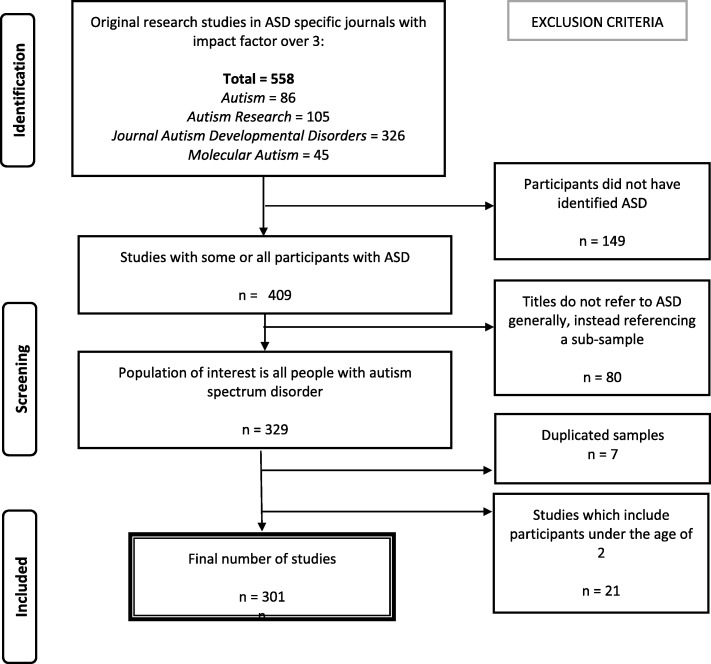
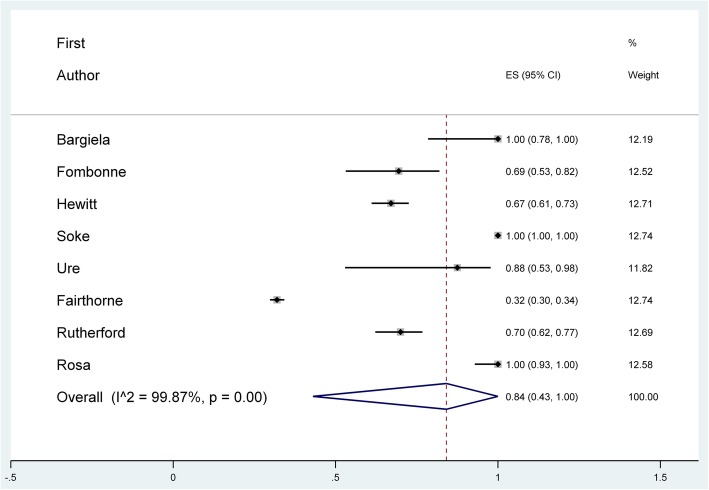
Current global estimates suggest the proportion of the population with autism spectrum disorder (ASD) who have intellectual disability (ID) is approximately 50%. Our objective was to ascertain the existence of selection bias due to under-inclusion of populations with ID across all fields of autism research. A sub-goal was to evaluate inconsistencies in reporting of findings. This review covers all original research published in 2016 in autism-specific journals with an impact factor greater than 3. Across 301 included studies, 100,245 participants had ASD. A random effects meta-analysis was used to estimate the proportion of participants without ID. Selection bias was defined as where more than 75% of participants did not have ID. Meta-analysis estimated 94% of all participants identified as being on the autism spectrum in the studies reviewed did not have ID (95% CI 0.91–0.97). Eight out of ten studies demonstrated selection bias against participants with ID. The reporting of participant characteristics was generally poor: information about participants’ intellectual ability was absent in 38% of studies ( n = 114). Where there was selection bias on ID, only 31% of studies mentioned lack of generalisability as a limitation. We found selection bias against ID throughout all fields of autism research. We recommend transparent reporting about ID and strategies for inclusion for this much marginalised group.
Overview
The claims and statistics of this paper haven’t been checked yet.
Free: it reads the open-access text and checks the first 5 claims that cite a source we can check. Create a free account to check every claim.
Integrity signals
Registry
Cites
Statistics
Figures
Verification
Claims the paper makes
The claims and statistics of this paper haven’t been checked yet.
Free: it reads the open-access text and checks the first 5 claims that cite a source we can check. Create a free account to check every claim.
Claims other papers make about this one
Each is checked against this paper’s own text: does it say what the citing paper says it does?
The source backs part of the claim, not all of it — or backs it for a different population, condition or comparison.
In the citing paper
“Russell et al. (2019), examining autism research papers published in 2016, covering 301 studies and more than 100,000 participants, estimated that 94% of all ASD participants had IQ in the average range, and 80% of studies showed selection bias against participants with intellectual disability.”
From Annual Research Review: Looking back to look forward – changes in the concept of autism and implications for future research (2020) · cites this paper as Russell et al. (2019)
Experimental — accuracy not yet measuredThe cited source says what the claim attributes to it.
In the citing paper
“Beyond specific genetic syndromes (for example, FXS), there is little research on sex/gender effects in intellectual disabilities, which is also reflected in the autism literature insofar as autistic people with intellectual disabilities are disproportionately under-represented304,305.”
From Sex and gender in neurodevelopmental conditions (2023) · cites this paper as [304]
The cited source says what the claim attributes to it.
In the citing paper
“The authors contrast this with an estimated 50 -55% of the autistic population that have intellectual disability.”
From Annual Research Review: Looking back to look forward – changes in the concept of autism and implications for future research (2020) · cites this paper as Russell et al. (2019)
Self-check
Percentages, sums and reported differences re-computed from the paper’s own numbers.
The self-check needs the paper’s full text.
Citations
Cites
Baio, J., Wiggins, L., Christensen, D. L., Maenner, M. J., Daniels, J., Warren, Z., Kurzius-Spencer, M., Zahorodny, W., Robinson, C., Rosenberg, et al. (2018) · MMWR. Surveillance Summaries · doi:10.15585/mmwr.ss6706a1 · Cited by 6,078
What Is the Male-to-Female Ratio in Autism Spectrum Disorder? A Systematic Review and Meta-Analysis
Loomes, R., Hull, L., & Mandy, W. P. L. (2017) · Journal of the American Academy of Child & Adolescent Psychiatry · doi:10.1016/j.jaac.2017.03.013 · Cited by 2,804
Self-citationGlobal Prevalence of Autism and Other Pervasive Developmental Disorders
Elsabbagh, M., Divan, G., Koh, Y., Kim, Y. S., Kauchali, S., Marcín, C., Montiel‐Nava, C., Patel, V., Paula, C. S., Wang, C., et al. (2012) · Autism Research · doi:10.1002/aur.239 · Cited by 2,636
Autism spectrum disorders: developmental disconnection syndromes
Geschwind, D. H., & Levitt, P. (2007) · Current Opinion in Neurobiology · doi:10.1016/j.conb.2007.01.009 · Cited by 1,411
Naarden Braun, K. V., Lopez, M., White, T., et al. (2023) · Carolina Digital Repository (University of North Carolina at Chapel Hill) · doi:10.17615/y3kk-5x30 · Cited by 1,381
The Epidemiology of Autism Spectrum Disorders
Newschaffer, C. J., Croen, L. A., Daniels, J., Giarelli, E., Grether, J. K., Levy, S. E., Mandell, D. S., Miller, L. A., Pinto-Martin, J., Reaven, J., et al. (2007) · Annual Review of Public Health · doi:10.1146/annurev.publhealth.28.021406.144007 · Cited by 1,228
A Systematic Review of Early Intensive Intervention for Autism Spectrum Disorders
Warren, Z., McPheeters, M. L., Sathe, N., Foss-Feig, J. H., Glasser, A., & Veenstra-VanderWeele, J. (2011) · Pediatrics · doi:10.1542/peds.2011-0426 · Cited by 790
IQ in children with autism spectrum disorders: Data from the special needs and autism project (SNAP)
Charman, T., Pickles, A., Simonoff, E., Chandler, S., Loucas, T., & Baird, G. (2011) · Psychological Medicine · doi:10.1017/s0033291710000991 · Cited by 599
“We’re tired, not sad”: Benefits and burdens of mothering a child with a disability
Green, S. E. (2007) · Social Science & Medicine · doi:10.1016/j.socscimed.2006.08.025 · Cited by 542
Cited by
Items 401–438 of 438
Deakin, M., Hamilton, L., Heasman, B., & Petty, S. (2026) · Autism & Developmental Language Impairments · doi:10.1177/23969415261436238
“…et al., 2019; Ordaz et al., 2018; Quist et al., 2015; Sizoo & Kuiper, 2017; Spain et al., 2017; Walhout et al., 2022 CBT-based guided self-help Russell et al., 2019 MBSR based Beck et al.,2020; Braden et al.,2022; Conner & White 2018; Kiep et al.,2015; Sizoo & Kuiper 2017; Spek et al.,2013…”
As the definition of autism expands, are we losing sight of those with the greatest needs?
Whitehouse, A., Trembath, D., & Uljarević, M. (2026) · The Conversation · doi:10.64628/aa.jh5749dug
Brooker, J., & Jenks, E. (2026) · Journal of Research in Special Educational Needs · doi:10.1111/1471-3802.70108
Reynolds, H., Benders, T., & Verhagen, J. (2026) · Autism & Developmental Language Impairments · doi:10.1177/23969415261441522
“Speci fi cally, Russell et al. (2019) found that across 301 research papers published in top autism journals in 2016, only 6% of autistic participants sampled had ID, and only 2% were NMS, suggesting a distinct underrepresentation of these groups.”
InfluentialHess, E. (2025) · Scholarship - Claremont (Claremont Colleges)
Palmieri, A., & Weigle, K. L. (2026) · Journal of Mental Health Research in Intellectual Disabilities · doi:10.1080/19315864.2026.2681456
Action prediction in autistic and non-autistic observers with perceptual and cognitive load
Sun, K. (2026) · Canadian Journal of Undergraduate Research · doi:10.14288/cjur.v10i2.200923
Musical short-term memory of autistic children and its cognitive correlates
Philibert-Lignières, G. (2026) · doi:10.82308/55646
Beyond Words: Creativity, Communication, and Empowerment in VR
Savickaite, S. (2026) · Springer eBooks · doi:10.1007/978-3-032-19636-1_5
Educational technology and cognitive diversity: exploring attitudinal responses of autistic students
Cerdán-Chacón, A., Lorenzo, G., Meliá, S., & Cabrera, E. A. (2026) · Disability and Rehabilitation Assistive Technology · doi:10.1080/17483107.2026.2689538
Pose estimation analysis of free-play reveals atypical interpersonal motor synchrony in autism
Akhavan, S., Kojovic, N., Chataing, T., Segers, J., Maillart, T., & Schaer, M. (2026) · Scientific Reports · doi:10.1038/s41598-026-61530-6
“Concerns surrounding selection biases have been increasingly highlighted within the field of autism research 35,107 , but have been addressed by only two prior IMS studies 49,57 .”
FIRMAN, K., Bigham, K. D., Saville, C. W. N., & Burnside, E. (2026) · Journal of Applied Research in Intellectual Disabilities · doi:10.1111/jar.70267
“research participants—individuals who contribute data (Brooker et al. 2015; Feldman et al. 2014; Russell et al. 2019; Shankar et al. 2018).”
Greenstein, E., Lee, N., McQuaid, G. A., & Wallace, G. L. (2026) · Autism · doi:10.1177/13623613261466302
“…adults classified as having “likely cognitive impairment” as determined by SPARK (thus removing this variable as a covariate in the first step of these models), to demonstrate the robustness of findings within this subgroup of individuals underrepresented in autism research (Russell et al., 2019).”
Exploring the impact of autism diagnosis for adults with a learning disability and their families
Wells, H. (2026) · Open Access at Essex (University of Essex) · doi:10.5526/err-00043674
Navigating Mixed-Neurotype Dialogue: Environmental and Affective Influences on Autistic Speakers
Miller, Z. A., Conner, C. M., Chang, J. C., & Mazefsky, C. A. (2026) · Autism · doi:10.1177/13623613261469909
“However, such adaptations do not always improve understanding and can add stress, emotional, and mental health burdens for autistic individuals (Crompton et al., 2020a; Field et al., 2024; Mandy, 2019; McQuaid et al., 2024).”
Longhurst, P., Modica, C. A., & Swami, V. (2026) · Body Image · doi:10.1016/j.bodyim.2026.102160
Parsons, S., Kovshoff, H., Collis, A., Eddy, C. G., Ellington, E. S., Giddins, B., Hind, A., Moyse, R., Tansley, R., Ward, V. C. S., et al. (2026) · International Journal of Research & Method in Education · doi:10.1080/1743727x.2026.2709366
Bourhis, A., Lea, G., Chams-Ddine, B., Marie, P., & Geoffray, M. (2026) · Research in Autism · doi:10.1016/j.reia.2026.203017
van Balkom, I. D. C., Cooke, J., de Cuba, A. G., Burkitt‐Wright, E., Gaasterland, C. M. W., & Burdeus-Olavarrieta, M. (2026) · Journal of Intellectual Disability Research · doi:10.1111/jir.70178
Kennedy, R. A., Alford, K., & Shields, N. (2026) · Journal of Intellectual Disability Research · doi:10.1111/jir.70177
Stevens, C. J., Eberle, S., Carrow, C., Tsheringla, S., Cukar-Capizzi, C., Wolf, J. M., Naples, A. J., & McPartland, J. C. (2026) · medRxiv · doi:10.64898/2026.10.01.26364439
Diversity and Equity in Autism Research
(2026) · Frontiers research topics · doi:10.3389/978-2-8325-8820-8
Comparing mental health treatment outcomes for autistic and non-autistic people: a systematic reviewPreprint
Griffiths, J., Elise, F., Thompson, J., Li, S., Olive, R. R., Bhutta, A., Liu, W., Holden, M., Mandiangu, M., Baptiste, D., et al. (2026) · medRxiv · doi:10.64898/2026.10.08.26364831
Self-citationAn, R., Yan, M., & 程艳 (2026) · Perspectives of the ASHA Special Interest Groups · doi:10.1044/2026_persp-26-00110
Thomas, N. K. (2026) · Routledge eBooks · doi:10.4324/9781003688488
Private providers are profiting from the expansion of ADHD and autism diagnosis
Fisher, N., & Frith, U. (2026) · BMJ · doi:10.1136/bmj-2026-101196
Obesity Management in Autistic Adults: Toward a Neurodiversity-Informed Approach
Rao, N. P., & Wadford, A. M. (2026) · Autism in Adulthood · doi:10.1177/25739581261497850
Potential for Life Skills Growth in Adults With Profound Autism
Clarke, E. M., Wellmann, M., Kubis-Badilla, J., Lord, C., & Bal, V. H. (2026) · Journal of Autism and Developmental Disorders · doi:10.1007/s10803-026-07488-w
“Am I now masking, even with a bot?”: Pseudo-Social Bonding between Autistic Adults and LLMs
Cogley, E., Matthews, T., & Finnegan, D. J. (2026) · Electronic workshops in computing · doi:10.14236/ewic/britchi26.46
Yuill, N., Holt, S., Daley, S., & Smith, A. P. (2026) · Research Square · doi:10.21203/rs.3.rs-11537546/v1
Caregivers' perspectives on career guidance for autistic young people in special schools
Dexter, S., Remington, A., & Crane, L. (2026) · British Journal of Special Education · doi:10.1111/1467-8578.70132
Resendes, E. E. (2026) · YorkSpace (York University)
Klein, J. S. G. (2026) · YorkSpace (York University)
Gao, X., Du, S., Zhang, X., & Wang, J. (2026) · Frontiers in Toxicology · doi:10.3389/ftox.2026.1968860
Maggio, R., Turriziani, L., Campestre, C., Cara, M. D., Tripodi, E., Impallomeni, C., Quartarone, A., Passantino, C., & Cucinotta, F. (2023) · doi:10.3389/fpsyt.2023.1225236.s001
Kouroupa, A., Laws, K. R., Irvine, K., Mengoni, S. E., Baird, A., & Sharma, S. (2022) · doi:10.1371/journal.pone.0269800.r001
Maggio, R., Turriziani, L., Campestre, C., Cara, M. D., Tripodi, E., Impallomeni, C., Quartarone, A., Passantino, C., & Cucinotta, F. (2023) · doi:10.3389/fpsyt.2023.1225236.s005
Metadata
- Authors
- Russell, G., Mandy, W., Elliott, D., White, R., Pittwood, T., & Ford, T.
- Affiliations
- University of Exeter (GB)
- University College London (GB)
- Corresponding author
- Russell, Ginny
- Venue
- Molecular Autism
- Published
- 2019-03-01
- Volume
- 10
- Issue
- 1
- Pages
- 9-9
- ISSN
- 2040-2392 (ISSN-L)
- PMC
- PMC6397505
- OpenAlex
- W2927010782
- Semantic Scholar
- 8e09807ae6e9ca212c20c28b4b8b4ee1ae9485da
- Cited by
- 366
- References
- 50
- Citations by year
- 2026: 47 · 2025: 60 · 2024: 56 · 2023: 52 · 2022: 57 · 2021: 44 · 2020: 38 · 2019: 11
- FWCI
- 4.75
- Type
- journal article
- Language
- en
- Open access
- gold
- doi.org
- Licence
- cc-by
- creativecommons.org/licenses/by/4.0/ (tdm)
- Locations
- Molecular Autism (publishedVersion, cc-by)
- Europe PMC (PubMed Central) (publishedVersion, cc-by)
- PubMed Central (publishedVersion, cc-by)
- PubMed (publishedVersion)
- DOAJ (DOAJ: Directory of Open Access Journals) (submittedVersion)
- UCL Discovery (University College London) (submittedVersion)
- Figshare (submittedVersion, cc-by)
- Open Research Exeter (University of Exeter) (submittedVersion, cc-by)
- Funders
- Wellcome Trust (108676/Z/1 SfZ)
- Topics
- Life Sciences › Neuroscience › Cognitive Neuroscience › Autism Spectrum Disorder Research
- Social Sciences › Decision Sciences › Statistics, Probability and Uncertainty › Meta-analysis and systematic reviews
- Health Sciences › Medicine › Public Health, Environmental and Occupational Health › Down syndrome and intellectual disability research
- Keywords
- autism spectrum disorder, intellectual disability, selection bias, underrepresentation in research, research generalisability, marginalised populations
- MeSH terms
- Autism Spectrum Disorder, Humans, Intellectual Disability, Selection Bias, Patient Selection, Biomedical Research
About these checks
Registry, retraction, Cites and statistics results are computed, not judged, with one exception: a printed reference that no index lists is read once by a model before it counts as a citation error. Claims are extracted by a model and kept only when their quote appears verbatim in the text; each cited source is then checked, with a model’s help, for whether it says what the claim relies on. Those verdicts can be wrong — read the claim’s quote and the cited source before relying on one.
Statistics and arithmetic are recomputed, not judged.
Confidence bands are shown only for fields calibrated on our annotated test set. None is calibrated yet, so no band is shown.
What counts as a claim ›How we measure confidence ›How we check this ›
Are you an author, or do you see a problem with this page? Request a review
Data sources
Bibliographic data: Semantic Scholar, OpenAlex, Crossref.
Contains information from the Semantic Scholar Academic Graph Datasets, made available under the ODC Attribution License (ODC-BY 1.0).
Semantic Scholar’s data is described in: Kinney, R., et al. (2023). The Semantic Scholar Open Data Platform. arXiv:2301.10140.
