

Alexithymia may explain the relationship between autistic traits and eating disorder psychopathology
Open accessThe DOI matches its Crossref record; 176 of the 178 references it cites were found in a registry or an index.
Abstract
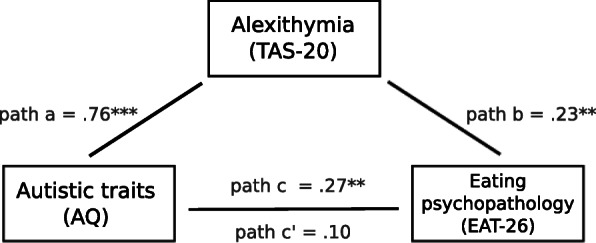
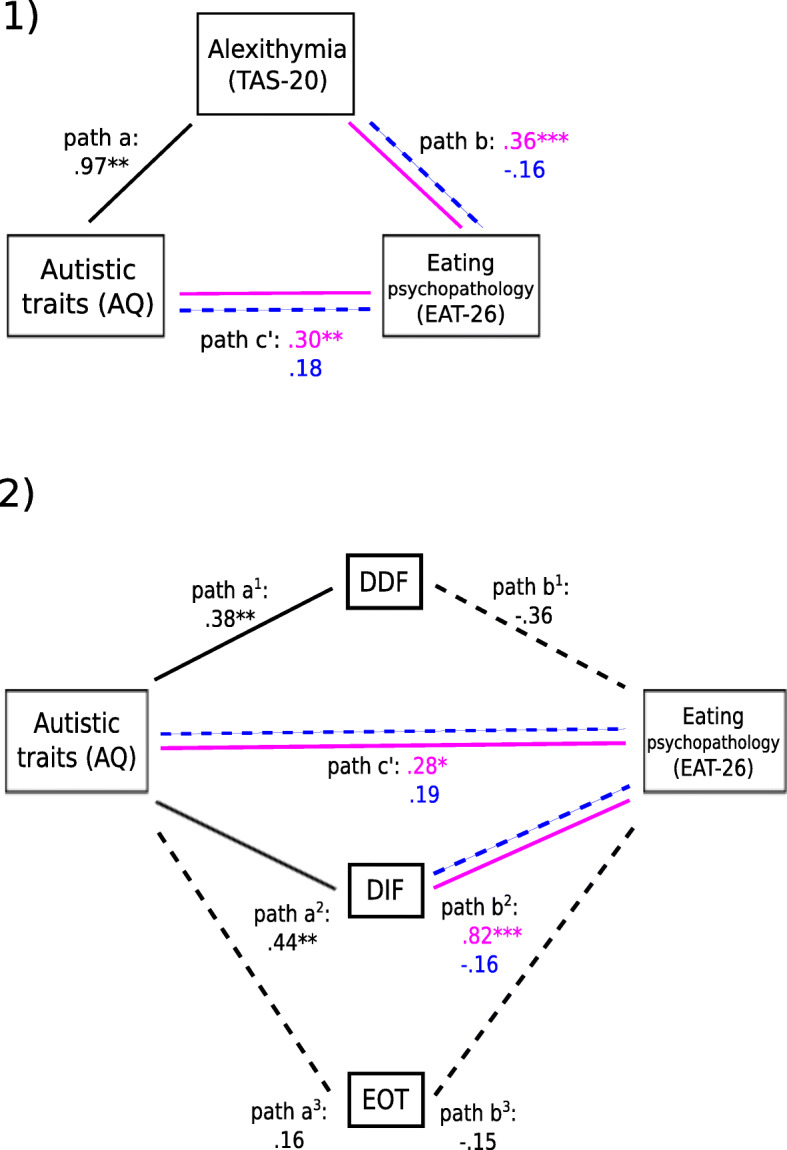
Background: Autistic people are disproportionately vulnerable to anorexia nervosa and other eating disorders (ED), and within the general population, autistic traits correlate with ED psychopathology. A putative mechanism which may underpin this heightened risk is alexithymia, a difficulty identifying and describing emotional states which is observed in both autism and ED. In two experiments with independent non-clinical samples, we explored whether alexithymia might mediate the heightened risk of eating psychopathology in individuals high in autistic traits. Methods: Our first experiment used the PROCESS macro for SPSS to examine relationships between alexithymia (measured by the Toronto Alexithymia Scale (TAS-20)), autistic traits (autism quotient (AQ)), and eating psychopathology (Eating Attitudes Test (EAT-26)) in 121 participants. Our second experiment (n= 300) replicated and furthered this analysis by examining moderating effects of sex and controlling for anxiety and depression as covariates. We also included an additional performance-based measure of alexithymia, the Levels of Emotional Awareness Scale (LEAS). Results: Study 1 suggested that TAS-20 scores mediated the relationship between heightened autistic traits and eating psychopathology. Replication and further scrutiny of this finding, in study 2, revealed that this mediation effect was partial and specific to the female participants in this sample. The mediation effect appeared to be carried by the difficulty identifying feelings subscale of the TAS-20, even when depression and anxiety were controlled for. LEAS scores, however, were not significantly related to autistic traits or eating psychopathology. Limitations: Cross-sectional data prevents any conclusions around the direction and causality of relationships between alexithymia, autistic traits, and eating psychopathology (alongside depression and anxiety), necessitating longitudinal research. Our non-clinical sample was predominantly Caucasian undergraduate students, so it remains to be seen if these results would extrapolate to clinical and/or autistic samples. Divergence between the TAS-20 and LEAS raises crucial questions regarding the construct validity of these measures. Conclusions: Our findings with respect to autistic traits suggest that alexithymia could partially explain the prevalence of ED in autistic people and may as such be an important consideration in the pathogenesis and treatment of ED in autistic and non-autistic people alike. Further research with clinical samples is critical to explore these ideas. Differences between men and women, furthermore, emphasize the importance of looking for sex-specific as well as generic risk factors in autistic and non-autistic men and women.
Overview
The claims and statistics of this paper haven’t been checked yet.
Free: it reads the open-access text and checks the first 5 claims that cite a source we can check. Create a free account to check every claim.
Integrity signals
Registry
Cites
Statistics
Figures
Verification
Claims the paper makes
The claims and statistics of this paper haven’t been checked yet.
Free: it reads the open-access text and checks the first 5 claims that cite a source we can check. Create a free account to check every claim.
Claims other papers make about this one
Each is checked against this paper’s own text: does it say what the citing paper says it does?
The source backs part of the claim, not all of it — or backs it for a different population, condition or comparison.
In the citing paper
“Other psychiatric features that are common in both autism and EDS/HSD include: anxiety, depression, bipolar disorder, eating disorders, and suicidal behaviors [24,56,57,58,59,60,61,62].”
From The Relationship between Autism and Ehlers-Danlos Syndromes/Hypermobility Spectrum Disorders (2020) · cites this paper as [60]
Experimental — accuracy not yet measured
Self-check
Percentages, sums and reported differences re-computed from the paper’s own numbers.
The self-check needs the paper’s full text.
Citations
Cites
Beyond Baron and Kenny: Statistical Mediation Analysis in the New Millennium
Hayes, A. F. (2009) · Communication Monographs · doi:10.1080/03637750903310360 · Cited by 9,757 · cited 1×
“The bootstrapping method is generally robust to violations of normality and suited to small sample sizes [107, 147], so the possibility that relationships between autistic traits, eating psychopathology, and alexithymia do differ in males is still plausible until replicated in a larger sample.”
MethodBaron-Cohen, S., Wheelwright, S., Skinner, R., Martin, J., & Clubley, E. (2001) · Journal of Autism and Developmental Disorders · doi:10.1023/a:1005653411471 · Cited by 6,450 · cited 1×
“tools, including screening questionnaires (such as the Autism-Spectrum Quotient (AQ) [37]) [7, 38–45], clin-”
MethodThe PHQ-9: A New Depression Diagnostic and Severity Measure
Kroenke, K., & Spitzer, R. L. (2002) · Psychiatric Annals · doi:10.3928/0048-5713-20020901-06 · Cited by 5,898 · cited 1×
“The Patient Health Questionnaire (PHQ-9 [128])”
Bagby, R. M., Parker, J. D. A., & Taylor, G. J. (1994) · Journal of Psychosomatic Research · doi:10.1016/0022-3999(94)90005-1 · Cited by 5,293 · cited 1×
“The Toronto Alexithymia Scale (TAS-20) [99]”
The Eating Attitudes Test: psychometric features and clinical correlates
Garner, D. M., Olmsted, M. P., Bohr, Y., & Garfinkel, P. E. (1982) · Psychological Medicine · doi:10.1017/s0033291700049163 · Cited by 4,962 · cited 24×
“Previous research has aimed for greater clarity by examining relationships between autistic traits and subscales of the EAT-26 [36], but this approach is contraindicated by one recent psychometric and factor analysis [104], which corroborates previous findings of unstable factorial structure, “weaving” of items betwee…”
InfluentialWhat Is the Male-to-Female Ratio in Autism Spectrum Disorder? A Systematic Review and Meta-Analysis
Loomes, R., Hull, L., & Mandy, W. P. L. (2017) · Journal of the American Academy of Child & Adolescent Psychiatry · doi:10.1016/j.jaac.2017.03.013 · Cited by 2,804 · cited 1×
“Where anorexia is more commonly diagnosed in females with a typical onset in adolescence [15], autism, in contrast, is more commonly diagnosed in males [16] and is manifest in brain differences even in the first year of life.”
BackgroundRedefine statistical significance
Benjamin, D. J., Berger, J. O., Johannesson, M., Nosek, B. A., Wagenmakers, E.-J., Berk, R., Bollen, K. A., Brembs, B., Brown, L., Camerer, C., et al. (2017) · Nature Human Behaviour · doi:10.1038/s41562-017-0189-z · Cited by 2,772
Risks of all-cause and suicide mortality in mental disorders: a meta-review
Chesney, E., Goodwin, G. M., & Fazel, S. (2014) · World Psychiatry · doi:10.1002/wps.20128 · Cited by 2,115 · cited 1×
“In contrast, DSM-5 conceptualizes AN as the most lethal [14] of several feeding and eating disorders (ED), an acute psychiatric illness (as opposed to a lifelong difference in functioning) characterized by restricted caloric intake, intense fear and avoidance of weight gain, and disturbed body and shape perception.”
BackgroundValidity of the brief patient health questionnaire mood scale (PHQ-9) in the general population
Martin, A., Rief, W., Klaiberg, A., & Braehler, E. (2006) · General Hospital Psychiatry · doi:10.1016/j.genhosppsych.2005.07.003 · Cited by 1,379 · cited 1×
“the last 2-week period) has received extensive clinical usage and possesses strong psychometric properties [129].”
BackgroundThe 20-Item Toronto Alexithymia Scale
Parker, J. D. A., Taylor, G. J., & Bagby, R. M. (2003) · Journal of Psychosomatic Research · doi:10.1016/s0022-3999(02)00578-0 · Cited by 1,036
Premature mortality in autism spectrum disorder
Hirvikoski, T., Mittendorfer-Rutz, E., Boman, M., Larsson, H., Lichtenstein, P., & Bölte, S. (2016) · British Journal of Psychiatry · doi:10.1192/bjp.bp.114.160192 · Cited by 1,011
Emotion generation and emotion regulation: One or two depends on your point of view
Gross, J. J., & Feldman Barrett, L. (2011) · Emotion Review · doi:10.1177/1754073910380974 · Cited by 863 · cited 1×
“For instance, some authors suggest that emotion generation and regulation are one concept all together [94], which can be observed in the way emotion regulation is sometimes measured (e.”
BackgroundAdvancing the understanding of autism disease mechanisms through genetics
de la Torre-Ubieta, L., Won, H., Stein, J. L., & Geschwind, D. H. (2016) · Nature Medicine · doi:10.1038/nm.4071 · Cited by 827 · cited 1×
“With some theorists preferring to talk about ‘the autisms’, it is likely that ASC encapsulates a family of genetically heterogenous conditions with these common presenting features [13] (2)It is relevant to note that the prevalence of eating disorders is also heightened in people with other neurodevelopmental conditio…”
Background(1987) · American Journal of Psychiatry · doi:10.1176/ajp.144.2.133 · Cited by 813 · cited 1×
“Another motivation for our inclusion of the LEAS is that it bypasses the fundamental confound that profoundly alexithymic individuals should, by nature of the construct, have difficulty with self-report [109, 110, 118, 156].”
BackgroundThe Levels of Emotional Awareness Scale: A Cognitive-Developmental Measure of Emotion
Lane, R. D., Quinlan, D. M., Schwartz, G. E., Walker, P. A., & Zeitlin, S. B. (1990) · Journal of Personality Assessment · doi:10.1080/00223891.1990.9674052 · Cited by 798 · cited 2×
“Importantly, two studies investigating patients with anorexia [116, 117] found a disparity where high self-reported levels of alexithymia (TAS-20) were belied by scores comparative to controls in one such measure, the Levels of Emotional Awareness Scale (LEAS: [118]).”
BackgroundMethodMediation analysis in epidemiology: methods, interpretation and bias
Richiardi, L., Bellocco, R., & Zugna, D. (2013) · International Journal of Epidemiology · doi:10.1093/ije/dyt127 · Cited by 781 · cited 2×
“The same is true for depression and anxiety, potential “mediator-outcome confounders” [134].”
BackgroundThe fickle P value generates irreproducible results
Halsey, L. G., Curran-Everett, D., Vowler, S. L., & Drummond, G. B. (2015) · Nature Methods · doi:10.1038/nmeth.3288 · Cited by 765
The 20-Item Toronto Alexithymia Scale
Taylor, G. J., Bagby, R. M., & Parker, J. D. A. (2003) · Journal of Psychosomatic Research · doi:10.1016/s0022-3999(02)00601-3 · Cited by 673 · cited 1×
“The TAS-20 boasts good internal consistency and testretest reliability [100, 101], being the most popular and most highly translated self-report tool for alexithymia, and has been the most extensively used in ED research [87].”
MethodEmpathic brain responses in insula are modulated by levels of alexithymia but not autism
Bird, G., Silani, G., Brindley, R., White, S., Frith, U., & Singer, T. (2010) · Brain · doi:10.1093/brain/awq060 · Cited by 655 · cited 1×
“have argued are distinct from the TAS-20 [142, 144, 158].”
BackgroundTreasure, J., & Schmidt, U. (2013) · Journal of Eating Disorders · doi:10.1186/2050-2974-1-13 · Cited by 646 · cited 1×
“premorbid) patterns of interpersonal discomfort” [23], which when studied in acutely ill individuals manifest as social impairments and difficulties making friends [26].”
BackgroundRisk markers for suicidality in autistic adults
Cassidy, S., Bradley, L., Shaw, R., & Baron-Cohen, S. (2018) · Molecular Autism · doi:10.1186/s13229-018-0226-4 · Cited by 621 · cited 1×
“In a similar vein, though alexithymia is associated with depression and suicidality in people with ED [172–174] as well as in psychiatric populations in general [82, 83], the contribution of alexithymia to the heightened suicide rates seen in autism [175] is unknown, as are the effects of autistic traits or autism wit…”
BackgroundRuzich, E., Allison, C., Smith, P., Watson, P., Auyeung, B., Ring, H., & Baron-Cohen, S. (2015) · Molecular Autism · doi:10.1186/2040-2392-6-2 · Cited by 610
Mixed emotions: the contribution of alexithymia to the emotional symptoms of autism
Bird, G., & Cook, R. (2013) · Translational Psychiatry · doi:10.1038/tp.2013.61 · Cited by 592 · cited 1×
“have argued are distinct from the TAS-20 [142, 144, 158].”
BackgroundShared heritability of attention-deficit/hyperactivity disorder and autism spectrum disorder
Rommelse, N. N. J., Franke, B., Geurts, H. M., Hartman, C. A., & Buitelaar, J. K. (2010) · European Child & Adolescent Psychiatry · doi:10.1007/s00787-010-0092-x · Cited by 564 · cited 1×
“As autism and ADHD are strongly comorbid and share genetic heritability [51], individuals with both autism and ADHD might possibly be found at higher rates in the eating disorder population than individuals with either ADHD or autism alone—this is yet to be explored.”
BackgroundInvestigating alexithymia in autism: A systematic review and meta-analysis
Kinnaird, E., Stewart, C., & Tchanturia, K. (2019) · European Psychiatry · doi:10.1016/j.eurpsy.2018.09.004 · Cited by 545 · cited 2×
“These qualitative comments and our own quantitative findings, if validated by future research, would corroborate the marked clinical import of identifying comorbid alexithymia in autistic people [85].”
BackgroundResultLavender, J. M., Wonderlich, S. A., Engel, S. G., Gordon, K. H., Kaye, W. H., & Mitchell, J. E. (2015) · Clinical Psychology Review · doi:10.1016/j.cpr.2015.05.010 · Cited by 512 · cited 2×
“been suggested to increase risk of psychopathology as part of greater difficulties with emotion regulation, including having limited strategies; poorer emotional awareness and differentiation (the alexithymia aspect); poorer inhibition of impulses, especially when distressed; and lower likelihood of being accepting an…”
BackgroundMortality in eating disorders ‐ results of a large prospective clinical longitudinal study
Fichter, M. M., & Quadflieg, N. (2016) · International Journal of Eating Disorders · doi:10.1002/eat.22501 · Cited by 475 · cited 1×
“Seventeen participants had formally been diagnosed with an eating disorder (anorexia nervosa [9], bulimia nervosa [5], binge-eating disorder [2], or eating disorder not otherwise specified [1]).”
BackgroundBird, G., & Viding, E. (2014) · Neuroscience & Biobehavioral Reviews · doi:10.1016/j.neubiorev.2014.09.021 · Cited by 472
Kashdan, T. B., Barrett, L. F., & McKnight, P. E. (2015) · Current Directions in Psychological Science · doi:10.1177/0963721414550708 · Cited by 463 · cited 2×
“differentiate between the ability to describe an emotion and the ability to mentally represent an emotion, the former is associated with the TAS20 and the latter with the LEAS (and with theory of mind); this view is not accepted by other theorists; in their review, Kashdan and colleagues [95], for instance, describe t…”
BackgroundLakens, D., Adolfi, F. G., Albers, C. J., Anvari, F., Apps, M. A. J., Argamon, S. E., Baguley, T., Becker, R. B., Benning, S. D., Bradford, D. E., et al. (2018) · Nature Human Behaviour · doi:10.1038/s41562-018-0311-x · Cited by 458
Oakley, B. F. M., Brewer, R., Bird, G., & Catmur, C. (2016) · Journal of Abnormal Psychology · doi:10.1037/abn0000182 · Cited by 431
The Eating Attitudes Test: Validation With DSM-IV Eating Disorder Criteria
Mintz, L. B., & O'Halloran, M. S. (2000) · Journal of Personality Assessment · doi:10.1207/s15327752jpa7403_11 · Cited by 396 · cited 1×
“However, concerns have been raised that the EAT-26 may be prone to false positives in non-clinical samples such as ours: it was originally developed on a clinical sample, at a time prior to the inclusion of ED in the DSM, and is based on an outdated conceptualization that conflated AN and BN [165].”
BackgroundAlexithymia, Not Autism, Predicts Poor Recognition of Emotional Facial Expressions
Cook, R., Brewer, R., Shah, P., & Bird, G. (2013) · Psychological Science · doi:10.1177/0956797612463582 · Cited by 378 · cited 1×
“have argued are distinct from the TAS-20 [142, 144, 158].”
BackgroundWestwood, H., Kerr-Gaffney, J., Stahl, D., & Tchanturia, K. (2017) · Journal of Psychosomatic Research · doi:10.1016/j.jpsychores.2017.06.007 · Cited by 354
Emotion-processing deficits in eating disorders
Bydlowski, S., Corcos, M., Jeammet, P., Paterniti, S., Berthoz, S., Laurier, C., Chambry, J., & Consoli, S. M. (2005) · International Journal of Eating Disorders · doi:10.1002/eat.20132 · Cited by 348 · cited 2×
“As anxiety and depression contribute substantial variance to TAS-20, and likewise to LEAS scores to a lesser extent [119, 121, 122], our second experiment followed recommendations [123] to include these as covariates in order to disentangle their contribution from that of alexithymia.”
BackgroundAlexithymia, not autism, is associated with impaired interoception
Shah, P., Hall, R., Catmur, C., & Bird, G. (2016) · Cortex · doi:10.1016/j.cortex.2016.03.021 · Cited by 326
Twenty-five years with the 20-item Toronto Alexithymia Scale
Bagby, R. M., Parker, J. D. A., & Taylor, G. J. (2020) · Journal of Psychosomatic Research · doi:10.1016/j.jpsychores.2020.109940 · Cited by 321 · cited 3×
“The lower reliability of EOT and its lack of relationship with eating disorders are consistent with previous research [101, 123, 138], explaining further why EOT did not emerge as a mediator in this analysis.”
ResultAlexithymia and eating disorders: a critical review of the literature
Nowakowski, M. E., McFarlane, T., & Cassin, S. (2013) · Journal of Eating Disorders · doi:10.1186/2050-2974-1-21 · Cited by 300 · cited 2×
“The lower reliability of EOT and its lack of relationship with eating disorders are consistent with previous research [101, 123, 138], explaining further why EOT did not emerge as a mediator in this analysis.”
ResultThe Beck Anxiety Inventory: Reexamination of factor structure and psychometric properties
Osman, A., Kopper, B. A., Barrios, F. X., Osman, J. R., & Wade, T. (1997) · Journal of Clinical Psychology · doi:10.1002/(sici)1097-4679(199701)53:1<7::aid-jclp2>3.0.co;2-s · Cited by 294 · cited 1×
“week) has likewise received popular clinical use and extensive validation of its properties [132].”
BackgroundCastellini, G., Lo Sauro, C., Mannucci, E., Ravaldi, C., Rotella, C. M., Faravelli, C., & Ricca, V. (2011) · Psychosomatic Medicine · doi:10.1097/psy.0b013e31820a1838 · Cited by 293 · cited 1×
“9): that in the course of a lifetime, many patients move between presentations and may at times show mixed symptoms that defy categorization, especially if other psychiatric comorbidities are involved [167, 168].”
BackgroundSociodemographic correlates of alexithymia
Lane, R. D., Sechrest, L., & Riedel, R. (1998) · Comprehensive Psychiatry · doi:10.1016/s0010-440x(98)90051-7 · Cited by 292 · cited 2×
“Another motivation for our inclusion of the LEAS is that it bypasses the fundamental confound that profoundly alexithymic individuals should, by nature of the construct, have difficulty with self-report [109, 110, 118, 156].”
BackgroundPreece, D., Becerra, R., Allan, A., Robinson, K., & Dandy, J. (2017) · Personality and Individual Differences · doi:10.1016/j.paid.2017.08.003 · Cited by 288 · cited 3×
“thinking that is functional and stimulus-bound such that emotional states are not attended to, and DIF and DDF with poor appraisal of emotions [74].”
BackgroundMethodInfluentialNaviaux, J. C., Wang, L., Li, K., Bright, A., Alaynick, W. A., Williams, K. R., Powell, S. B., & Naviaux, R. K. (2015) · Molecular Autism · doi:10.1186/2040-2392-6-1 · Cited by 285
Zucker, N. L., Losh, M., Bulik, C. M., LaBar, K. S., Piven, J., & Pelphrey, K. A. (2007) · Psychological Bulletin · doi:10.1037/0033-2909.133.6.976 · Cited by 284 · cited 2×
“premorbid) patterns of interpersonal discomfort” [23], which when studied in acutely ill individuals manifest as social impairments and difficulties making friends [26].”
BackgroundAutism Spectrum Disorder in Anorexia Nervosa: An Updated Literature Review
Westwood, H., & Tchanturia, K. (2017) · Current Psychiatry Reports · doi:10.1007/s11920-017-0791-9 · Cited by 278 · cited 3×
“However, the apparent fading away of autistic symptoms with age and/or recovery may reflect not only the influence of malnutrition but also the potentially poorer prognosis and slower or poorer treatment response of individuals with high autistic traits or diagnosed autism [7–11]—with these individuals thus more likel…”
BackgroundAlexithymia and Somatization in General Population
Mattila, A. K., Kronholm, E., Jula, A., Salminen, J. K., Koivisto, A.-M., Mielonen, R.-L., & Joukamaa, M. (2008) · Psychosomatic Medicine · doi:10.1097/psy.0b013e31816ffc39 · Cited by 262
Pereira, M., Argelaguet, F., Millán, J. D. R., & Lécuyer, A. (2018) · Frontiers in Psychology · doi:10.3389/fpsyg.2018.00527 · Cited by 251
Effect of Alexithymia on the Process and Outcome of Psychotherapy: A Programmatic Review
Ogrodniczuk, J. S., Piper, W. E., & Joyce, A. S. (2011) · Psychiatry Research · doi:10.1016/j.psychres.2010.04.026 · Cited by 249 · cited 1×
“Regardless of conceptual differences, theorists from different approaches unanimously recognize the connections between alexithymia and pathological states or disadvantageous outcomes: it is associated with mental and physical ill-health [75, 76], psychosocial difficulties [77], self-injury [78], substance abuse [79],…”
BackgroundGillis, M. M., Haaga, D. A. F., & Ford, G. T. (1995) · Psychological Assessment · doi:10.1037/1040-3590.7.4.450 · Cited by 236
Gender Dysphoria and Autism Spectrum Disorder: A Systematic Review of the Literature
Glidden, D., Bouman, W. P., Jones, B. A., & Arcelus, J. (2016) · Sexual Medicine Reviews · doi:10.1016/j.sxmr.2015.10.003 · Cited by 231
Alexithymia in Women with Anorexia Nervosa: A Preliminary Investigation
Bourke, M. P., Taylor, G. J., Parker, J. D. A., & Bagby, R. M. (1992) · British Journal of Psychiatry · doi:10.1192/bjp.161.2.240 · Cited by 225 · cited 1×
“Alexithymia is a common co-occurrence in not only anorexia but bulimia and binge-eating disorder [87]; in anorexia, it has been estimated in as many as 77% of female patients [88].”
BackgroundOldershaw, A., Lavender, T., Sallis, H., Stahl, D., & Schmidt, U. (2015) · Clinical Psychology Review · doi:10.1016/j.cpr.2015.04.005 · Cited by 222 · cited 2×
“been suggested to increase risk of psychopathology as part of greater difficulties with emotion regulation, including having limited strategies; poorer emotional awareness and differentiation (the alexithymia aspect); poorer inhibition of impulses, especially when distressed; and lower likelihood of being accepting an…”
BackgroundAttentional Bias, Emotion Recognition, and Emotion Regulation in Anorexia: State or Trait?
Harrison, A., Tchanturia, K., & Treasure, J. (2010) · Biological Psychiatry · doi:10.1016/j.biopsych.2010.04.037 · Cited by 216 · cited 1×
“Studies using developmental interviews or prospective approaches have, however, confirmed the presence of autistic features before the onset of disordered eating and diagnosed ED [5, 48, 56], and others have noted the persistence of social difficulties [49], problems with the theory of mind, empathy and emotion recogn…”
MethodMurphy, J., Catmur, C., & Bird, G. (2018) · Journal of Experimental Psychology: General · doi:10.1037/xge0000366 · Cited by 210 · cited 1×
“and regulation [69–72], and some suggest it reflects a more general deficit in interoception, where alexithymic people may struggle to identify and link bodily sensations and internal states with emotions [73].”
BackgroundA review of eating disorders in males
Raevuori, A., Keski-Rahkonen, A., & Hoek, H. W. (2014) · Current Opinion in Psychiatry · doi:10.1097/yco.0000000000000113 · Cited by 201
Bardone-Cone, A. M., Hunt, R. A., & Watson, H. J. (2018) · Current Psychiatry Reports · doi:10.1007/s11920-018-0932-9 · Cited by 199 · cited 4×
“High scores in the EAT-26 could reflect any of a diverse group of “subclinical anorexics, partial syndrome anorexics, suspected anorexics, suspected bulimics, purgers, weight preoccupied and normal dieters” (Mintz and O’Halloran [163], p.”
BackgroundInfluentialEmotional Theory of Mind and Emotional Awareness in Recovered Anorexia Nervosa Patients
Oldershaw, A., Hambrook, D., Tchanturia, K., Treasure, J., & Schmidt, U. (2010) · Psychosomatic Medicine · doi:10.1097/psy.0b013e3181c6c7ca · Cited by 198 · cited 1×
“Studies using developmental interviews or prospective approaches have, however, confirmed the presence of autistic features before the onset of disordered eating and diagnosed ED [5, 48, 56], and others have noted the persistence of social difficulties [49], problems with the theory of mind, empathy and emotion recogn…”
MethodAlexithymia and Autism Spectrum Disorder: A Complex Relationship
Poquérusse, J., Pastore, L., Dellantonio, S., & Esposito, G. (2018) · Frontiers in Psychology · doi:10.3389/fpsyg.2018.01196 · Cited by 197 · cited 3×
“Recent work has suggested that, given the understanding that alexithymia encapsulates emotional and more physiological interoceptive difficulties, interventions which increase awareness of physiological arousal associated with emotional experiences may be helpful [176], as might therapeutic work supporting cognitive r…”
BackgroundResultInteroception in autism Spectrum disorder: a review
DuBois, D., Ameis, S. H., Lai, M., Casanova, M. F., & Desarkar, P. (2016) · International Journal of Developmental Neuroscience · doi:10.1016/j.ijdevneu.2016.05.001 · Cited by 192 · cited 1×
“and satiety [30], and autistic people may also experience distortions in body image [31].”
BackgroundAlexithymia and its relationships with anxiety and depression in eating disorders
Eizaguirre, A. E., Ortego, A., de Apellániz, I. O. D. A. M., Olariaga, L. J., & Juaniz, M. (2003) · Personality and Individual Differences · doi:10.1016/s0191-8869(03)00099-0 · Cited by 187
Eating disorders, DSM–5 and clinical reality
Fairburn, C. G., & Cooper, Z. (2011) · British Journal of Psychiatry · doi:10.1192/bjp.bp.110.083881 · Cited by 186 · cited 3×
“Fairburn CG, Cooper Z. Eating disorders, DSM-5 and clinical reality.”
BackgroundInfluentialThe Eating Attitudes Test: Twenty-five years later
Garfinkel, P. E., & Newman, A. (2001) · Eating and Weight Disorders - Studies on Anorexia, Bulimia and Obesity · doi:10.1007/bf03339747 · Cited by 186 · cited 1×
“The test boasts strong psychometric properties, including construct validity, test-retest reliability, and discriminant ability between individuals with current ED, subthreshold symptoms, and recovered ED [105, 106].”
BackgroundBrede, J., Babb, C., Jones, C., Elliott, M., Zanker, C., Tchanturia, K., Serpell, L., Fox, J., & Mandy, W. (2020) · Journal of Autism and Developmental Disorders · doi:10.1007/s10803-020-04479-3 · Cited by 184 · cited 2×
“In qualitative research, alexithymia has indeed been identified by autistic people themselves as one risk factor for their ED, alongside other elements of being autistic [146].”
BackgroundPini, S., Abelli, M., Carpita, B., Dell'Osso, L., Castellini, G., Carmassi, C., & Ricca, V. (2016) · Neuropsychiatric Disease and Treatment · doi:10.2147/ndt.s108912 · Cited by 183
Remove, rather than redefine, statistical significance
Amrhein, V., & Greenland, S. (2017) · Nature Human Behaviour · doi:10.1038/s41562-017-0224-0 · Cited by 183
Lindvall Dahlgren, C., Wisting, L., & Rø, Ø. (2017) · Journal of Eating Disorders · doi:10.1186/s40337-017-0186-7 · Cited by 176 · cited 2×
“Where anorexia is more commonly diagnosed in females with a typical onset in adolescence [15], autism, in contrast, is more commonly diagnosed in males [16] and is manifest in brain differences even in the first year of life.”
BackgroundBody weight preoccupation in middle-age and ageing women: A general population survey
Allaz, A.-F., Bernstein, M., Rouget, P., Archinard, M., & Morabia, A. (1998) · International Journal of Eating Disorders · doi:10.1002/(sici)1098-108x(199804)23:3<287::aid-eat6>3.0.co;2-f · Cited by 175
The Toronto Alexithymia Scale (TAS-20): A measure of general psychological distress
Leising, D., Grande, T., & Faber, R. (2009) · Journal of Research in Personality · doi:10.1016/j.jrp.2009.03.009 · Cited by 172
Is anorexia nervosa a version of autism spectrum disorders?
Oldershaw, A., Treasure, J., Hambrook, D., Tchanturia, K., & Schmidt, U. (2011) · European Eating Disorders Review · doi:10.1002/erv.1069 · Cited by 170
Milosavljevic, B., Carter Leno, V., Simonoff, E., Baird, G., Pickles, A., Jones, C. R. G., Erskine, C., Charman, T., & Happé, F. (2016) · Journal of Autism and Developmental Disorders · doi:10.1007/s10803-015-2670-8 · Cited by 170
The Multifaceted Nature of Alexithymia – A Neuroscientific Perspective
Goerlich, K. S. (2018) · Frontiers in Psychology · doi:10.3389/fpsyg.2018.01614 · Cited by 170 · cited 4×
“ences rather than being purely dispositional [68], might result from an emotionally repressive upbringing and lead”
BackgroundInfluentialHemming, L., Haddock, G., Shaw, J., & Pratt, D. (2019) · Frontiers in Psychiatry · doi:10.3389/fpsyt.2019.00203 · Cited by 170 · cited 2×
“Regardless of conceptual differences, theorists from different approaches unanimously recognize the connections between alexithymia and pathological states or disadvantageous outcomes: it is associated with mental and physical ill-health [75, 76], psychosocial difficulties [77], self-injury [78], substance abuse [79],…”
BackgroundLopez, C., Tchanturia, K., Stahl, D., & Treasure, J. (2009) · Journal of Clinical and Experimental Neuropsychology · doi:10.1080/13803390802036092 · Cited by 167
Theory of Mind and Emotional Awareness Deficits in Patients With Somatoform Disorders
Subic-Wrana, C., Beutel, M. E., Knebel, A., & Lane, R. D. (2010) · Psychosomatic Medicine · doi:10.1097/psy.0b013e3181d35e83 · Cited by 165
Danner, U. N., Sanders, N., Smeets, P. A. M., van Meer, F., Adan, R. A. H., Hoek, H. W., & van Elburg, A. A. (2012) · International Journal of Eating Disorders · doi:10.1002/eat.22007 · Cited by 164
Davies, H. A., Wolz, I., Leppänen, J., Fernández‐Aranda, F., Schmidt, U. H., & Tchanturia, K. (2016) · Neuroscience & Biobehavioral Reviews · doi:10.1016/j.neubiorev.2016.02.015 · Cited by 163 · cited 1×
“Furthermore, they share in common heightened negative affectivity [21], blunted facial affect [22, 23], problems with the theory of mind and cognitive/emotional perspective-taking [21, 24, 25], and tend to have “long-standing (i.”
BackgroundWestwood, H., Eisler, I., Mandy, W., Leppanen, J., Treasure, J., & Tchanturia, K. (2016) · Journal of Autism and Developmental Disorders · doi:10.1007/s10803-015-2641-0 · Cited by 160 · cited 1×
“AQ [43], are maintained when alexithymia is controlled for.”
BackgroundObesity: a new paradigm in endocrinology.
Vettor, R. (2001) · PubMed · Cited by 160
Alexithymia and Suicide Risk in Psychiatric Disorders: A Mini-Review
De Berardis, D., Fornaro, M., Orsolini, L., Valchera, A., Carano, A., Vellante, F., Perna, G., Serafini, G., Gonda, X., Pompili, M., et al. (2017) · Frontiers in Psychiatry · doi:10.3389/fpsyt.2017.00148 · Cited by 149
Depressive personality dimensions and alexithymia in eating disorders
Speranza, M., Corcos, M., Loas, G., Stéphan, P., Guilbaud, O., Pérez-Díaz, F., Vénisse, J.-L., Bizouard, P., Halfon, O., Flament, M. F., et al. (2005) · Psychiatry Research · doi:10.1016/j.psychres.2005.04.001 · Cited by 148 · cited 1×
“ders to perform comparably to controls on the LEAS even whilst reporting higher alexithymia on the TAS-20 [114, 115]—though see [117, 153].”
BackgroundA scoping review of what is known of the physical health of adults with autism spectrum disorder
Cashin, A., Buckley, T., Trollor, J. N., & Lennox, N. (2018) · Journal of Intellectual Disabilities · doi:10.1177/1744629516665242 · Cited by 146 · cited 1×
“Seventeen participants had formally been diagnosed with an eating disorder (anorexia nervosa [9], bulimia nervosa [5], binge-eating disorder [2], or eating disorder not otherwise specified [1]).”
BackgroundBora, E., & Köse, S. (2016) · International Journal of Eating Disorders · doi:10.1002/eat.22572 · Cited by 145 · cited 1×
“Furthermore, they share in common heightened negative affectivity [21], blunted facial affect [22, 23], problems with the theory of mind and cognitive/emotional perspective-taking [21, 24, 25], and tend to have “long-standing (i.”
BackgroundLong-term consequences of anorexia nervosa
Męczekalski, B., Podfigurna-Stopa, A., & Katulski, K. (2013) · Maturitas · doi:10.1016/j.maturitas.2013.04.014 · Cited by 144
The psychophysiological mechanisms of alexithymia in autism spectrum disorder
Gaigg, S. B., Cornell, A. S., & Bird, G. (2018) · Autism · doi:10.1177/1362361316667062 · Cited by 142 · cited 1×
“Recent work has suggested that, given the understanding that alexithymia encapsulates emotional and more physiological interoceptive difficulties, interventions which increase awareness of physiological arousal associated with emotional experiences may be helpful [176], as might therapeutic work supporting cognitive r…”
BackgroundAlexithymia and problematic alcohol use: A critical update
Cruise, K., & Becerra, R. (2017) · Addictive Behaviors · doi:10.1016/j.addbeh.2017.09.025 · Cited by 140 · cited 1×
“Regardless of conceptual differences, theorists from different approaches unanimously recognize the connections between alexithymia and pathological states or disadvantageous outcomes: it is associated with mental and physical ill-health [75, 76], psychosocial difficulties [77], self-injury [78], substance abuse [79],…”
BackgroundExploring autistic traits in anorexia: a clinical study
Tchanturia, K., Smith, E., Weineck, F., Fidanboylu, E., Kern, N., Treasure, J., & Baron Cohen, S. (2013) · Molecular Autism · doi:10.1186/2040-2392-4-44 · Cited by 137 · cited 2×
“Like alexithymia and malnutrition, anxiety and depression artificially inflate autistic symptomatology [39, 48, 55].”
BackgroundMethodMandy, W., & Tchanturia, K. (2015) · Molecular Autism · doi:10.1186/2040-2392-6-6 · Cited by 136 · cited 3×
“Studies using developmental interviews or prospective approaches have, however, confirmed the presence of autistic features before the onset of disordered eating and diagnosed ED [5, 48, 56], and others have noted the persistence of social difficulties [49], problems with the theory of mind, empathy and emotion recogn…”
BackgroundMethodBandini, E., Fisher, A. D., Castellini, G., Lo Sauro, C., Lelli, L., Meriggiola, M. C., Casale, H., Benni, L., Ferruccio, N., Faravelli, C., et al. (2013) · The Journal of Sexual Medicine · doi:10.1111/jsm.12062 · Cited by 130 · cited 1×
“If overlaps might be seen between the two populations, pathogenic factors relevant for people with gender dysphoria [171] may be relevant for autistic people, too.”
BackgroundStevenson, J. L., & Hart, K. R. (2017) · Journal of Autism and Developmental Disorders · doi:10.1007/s10803-017-3109-1 · Cited by 130
Do girls with anorexia nervosa have elevated autistic traits?
Baron-Cohen, S., Jaffa, T., Davies, S., Auyeung, B., Allison, C., & Wheelwright, S. (2013) · Molecular Autism · doi:10.1186/2040-2392-4-24 · Cited by 128 · cited 2×
“Several mechanisms have been posited as to how autistic traits or diagnoseable autism could heighten the risk of eating psychopathology: a strong “systemizing” drive that would lend itself to meticulous monitoring of caloric intake [45]; increased likelihood of digestive problems and food sensitivities, and cognitive…”
BackgroundMethodAre Autism and Anorexia Nervosa Related?
Gillberg, C. (1983) · The British Journal of Psychiatry · doi:10.1192/bjp.142.4.428b · Cited by 126
Alexithymia, memory of emotion, emotional awareness, and perfectionism.
Lundh, L.-G., Johnsson, A., Sundqvist, K., & Olsson, H. (2002) · Emotion · doi:10.1037//1528-3542.2.4.361 · Cited by 123 · cited 2×
“Another motivation for our inclusion of the LEAS is that it bypasses the fundamental confound that profoundly alexithymic individuals should, by nature of the construct, have difficulty with self-report [109, 110, 118, 156].”
BackgroundSubthreshold autism spectrum disorder in patients with eating disorders
Dell'Osso, L., Carpita, B., Gesi, C., Cremone, I. M., Corsi, M., Massimetti, E., Muti, D., Calderani, E., Castellini, G., Luciano, M., et al. (2018) · Comprehensive Psychiatry · doi:10.1016/j.comppsych.2017.11.007 · Cited by 123 · cited 1×
“ical interviews [46], and autism diagnostic tests [6, 47], and this consistent elevation in autistic symptomatology suggests disproportionate representation of ASC in this population [5, 6, 48, 49](2).”
BackgroundPreece, D. A., Becerra, R., Robinson, K., & Dandy, J. (2017) · Journal of Psychopathology and Behavioral Assessment · doi:10.1007/s10862-017-9634-6 · Cited by 122 · cited 4×
“Reliability scores were again checked for this sample (see Supplementary materials) and proved satisfactory in all measures with the exception of the EOT (externally orientated thinking) subscale of the TAS-20, which has indeed been shown to be the least reliable subscale in previous research [101].”
BackgroundMethodResultInfluentialStorch, E. A., Larson, M. J., Ehrenreich, J. T., Arnold, E. B., Jones, A. M., Renno, P., Fujii, C., Lewin, A. B., Mutch, P. J., Murphy, T. K., et al. (2012) · Journal of Developmental and Physical Disabilities · doi:10.1007/s10882-012-9290-4 · Cited by 121 · cited 1×
“based discrimination alongside the generally heightened risk of bullying [137]; and a failure to pick up the typical”
BackgroundAnderluh, M., Tchanturia, K., Rabe-Hesketh, S., Collier, D., & Treasure, J. (2009) · Psychological Medicine · doi:10.1017/s0033291708003292 · Cited by 119 · cited 1×
“9): that in the course of a lifetime, many patients move between presentations and may at times show mixed symptoms that defy categorization, especially if other psychiatric comorbidities are involved [167, 168].”
BackgroundMarchesi, C., Ossola, P., Tonna, M., & De Panfilis, C. (2014) · Comprehensive Psychiatry · doi:10.1016/j.comppsych.2013.12.008 · Cited by 117 · cited 1×
“ders to perform comparably to controls on the LEAS even whilst reporting higher alexithymia on the TAS-20 [114, 115]—though see [117, 153].”
BackgroundParling, T., Mortazavi, M., & Ghaderi, A. (2010) · Eating Behaviors · doi:10.1016/j.eatbeh.2010.04.001 · Cited by 114 · cited 1×
“Importantly, two studies investigating patients with anorexia [116, 117] found a disparity where high self-reported levels of alexithymia (TAS-20) were belied by scores comparative to controls in one such measure, the Levels of Emotional Awareness Scale (LEAS: [118]).”
MethodAlexithymia in children with and without autism spectrum disorders
Griffin, C., Lombardo, M. V., & Auyeung, B. (2016) · Autism Research · doi:10.1002/aur.1569 · Cited by 114 · cited 2×
“The connection between autistic traits and alexithymia corroborates the general prevalence of alexithymia in both male and female autistic people [84, 86], but the lack of relationship between eating psychopathology and alexithymia was surprising, given the links demonstrated between these phenomena in women [87], and…”
BackgroundResultAssessment of Eating Disorders: Review and Recommendations for Clinical Use
Anderson, D. A., Lundgren, J. D., Shapiro, J. R., & Paulosky, C. A. (2004) · Behavior Modification · doi:10.1177/0145445503259851 · Cited by 108 · cited 2×
“This measure was chosen as one of the most widely used measures of eating psychopathology [103] and comprises subscales measuring restrictive eating (dieting), bulimic behaviours, and food preoccupation (bulimia and food preoccupation), and behaviours around controlling amount and ways of eating (oral control).”
BackgroundMethodNielsen, S., Anckarsäter, H., Gillberg, C., Gillberg, C., Råstam, M., & Wentz, E. (2015) · Molecular Autism · doi:10.1186/s13229-015-0013-4 · Cited by 107
Frewen, P., Lane, R. D., Neufeld, R. W. J., Densmore, M., Stevens, T., & Lanius, R. (2008) · Psychosomatic Medicine · doi:10.1097/psy.0b013e31815f66d4 · Cited by 105
Eating and feeding problems and gastrointestinal dysfunction in Autism Spectrum Disorders
Vissoker, R. E., Latzer, Y., & Gal, E. (2015) · Research in Autism Spectrum Disorders · doi:10.1016/j.rasd.2014.12.010 · Cited by 105
Clinical evaluation of autistic symptoms in women with anorexia nervosa
Westwood, H., Mandy, W., & Tchanturia, K. (2017) · Molecular Autism · doi:10.1186/s13229-017-0128-x · Cited by 104 · cited 2×
“ical interviews [46], and autism diagnostic tests [6, 47], and this consistent elevation in autistic symptomatology suggests disproportionate representation of ASC in this population [5, 6, 48, 49](2).”
BackgroundResultTchanturia, K., Adamson, J., Leppanen, J., & Westwood, H. (2019) · Autism · doi:10.1177/1362361317722431 · Cited by 102
Liew, S. M., Thevaraja, N., Hong, R. Y. S., & Magiati, I. (2014) · Journal of Autism and Developmental Disorders · doi:10.1007/s10803-014-2238-z · Cited by 101 · cited 1×
“Autistic traits are also highly associated with anxiety and depression [164], and it has been commonly assumed that as stable traits, autistic traits confer vulnerability to anxiety and depression.”
BackgroundPreece, D. A., Becerra, R., Boyes, M. E., Northcott, C., McGillivray, L., & Hasking, P. A. (2019) · Personality and Individual Differences · doi:10.1016/j.paid.2019.109721 · Cited by 101 · cited 2×
“ders to perform comparably to controls on the LEAS even whilst reporting higher alexithymia on the TAS-20 [114, 115]—though see [117, 153].”
BackgroundEmotion recognition deficits in eating disorders are explained by co-occurring alexithymia
Brewer, R., Cook, R., Cardi, V., Treasure, J., & Bird, G. (2015) · Royal Society Open Science · doi:10.1098/rsos.140382 · Cited by 97 · cited 1×
“Likewise, emotional deficits in anorexia have been proposed to reflect comorbid alexithymia rather than the ED itself [70].”
BackgroundLeppanen, J., Sedgewick, F., Treasure, J., & Tchanturia, K. (2018) · Neuroscience & Biobehavioral Reviews · doi:10.1016/j.neubiorev.2018.04.009 · Cited by 93 · cited 1×
“Furthermore, they share in common heightened negative affectivity [21], blunted facial affect [22, 23], problems with the theory of mind and cognitive/emotional perspective-taking [21, 24, 25], and tend to have “long-standing (i.”
BackgroundAlexithymia and Suicide Ideation in a Sample of Patients with Binge Eating Disorder
Carano, A., De Berardis, D., Campanella, D., Serroni, N., Ferri, F., Di Iorio, G., Acciavatti, T., Mancini, L., Mariani, G., Martinotti, G., et al. (2012) · Journal of Psychiatric Practice · doi:10.1097/01.pra.0000410982.08229.99 · Cited by 91
Empathy, systemizing, and autistic traits in anorexia nervosa: A pilot study
Hambrook, D., Tchanturia, K., Schmidt, U., Russell, T., & Treasure, J. (2008) · British Journal of Clinical Psychology · doi:10.1348/014466507x272475 · Cited by 91
Analysis of the EAT-26 in a Non-Clinical Sample
Rogoza, R., Brytek-Matera, A., & Garner, D. (2016) · Archives of Psychiatry and Psychotherapy · doi:10.12740/app/63647 · Cited by 91 · cited 2×
“and factor analysis [104], which corroborates previous”
BackgroundImpact of ASD Traits on Treatment Outcomes of Eating Disorders in Girls
Stewart, C. S., McEwen, F. S., Konstantellou, A., Eisler, I., & Simic, M. (2017) · European Eating Disorders Review · doi:10.1002/erv.2497 · Cited by 90
Emotion regulation difficulties in alexithymia and mental health
Pandey, R., Saxena, P., & Dubey, A. (2011) · Europe’s Journal of Psychology · doi:10.5964/ejop.v7i4.155 · Cited by 89
Reduced awareness of others’ emotions in unipolar depressed patients
Donges, U.-S., Kersting, A., Dannlowski, U., Lalee-Mentzel, J., Arolt, V., & Suslow, T. (2005) · Journal of Nervous & Mental Disease · doi:10.1097/01.nmd.0000161683.02482.19 · Cited by 89
Investigating autism spectrum disorder and autistic traits in early onset eating disorder
Pooni, J., Ninteman, A., Bryant‐Waugh, R., Nicholls, D., & Mandy, W. (2012) · International Journal of Eating Disorders · doi:10.1002/eat.20980 · Cited by 85
Aaron, R. V., Benson, T. L., & Park, S. (2015) · Personality and Individual Differences · doi:10.1016/j.paid.2014.12.032 · Cited by 83
The relationship between self‐harm and alexithymia
Norman, H., & Borrill, J. (2015) · Scandinavian Journal of Psychology · doi:10.1111/sjop.12217 · Cited by 82 · cited 1×
“Regardless of conceptual differences, theorists from different approaches unanimously recognize the connections between alexithymia and pathological states or disadvantageous outcomes: it is associated with mental and physical ill-health [75, 76], psychosocial difficulties [77], self-injury [78], substance abuse [79],…”
BackgroundAn examination of autism spectrum traits in adolescents with anorexia nervosa and their parents
Rhind, C., Bonfioli, E., Hibbs, R., Goddard, E., Macdonald, P., Gowers, S., Schmidt, U., Tchanturia, K., Micali, N., & Treasure, J. (2014) · Molecular Autism · doi:10.1186/2040-2392-5-56 · Cited by 82
Exploring alexithymia, depression, and binge eating in self-reported eating disorders in women.
Wheeler, K., Greiner, P., & Boulton, M. (2005) · Perspectives in psychiatric care · doi:10.1111/j.1744-6163.2005.00022.x · Cited by 81
Lane, R. D., Hsu, C.-H., Locke, D. E. C., Ritenbaugh, C., & Stonnington, C. M. (2015) · Consciousness and Cognition · doi:10.1016/j.concog.2015.02.004 · Cited by 79 · cited 1×
“affective theory of mind [157], which Bird and colleagues”
BackgroundOverweight and obese status in children with autism spectrum disorder and disruptive behavior
Criado, K. K., Sharp, W. G., McCracken, C. E., De Vinck-Baroody, O., Dong, L., Aman, M. G., McDougle, C. J., McCracken, J. T., Eugene Arnold, L., Weitzman, C., et al. (2018) · Autism · doi:10.1177/1362361316683888 · Cited by 78 · cited 1×
“[31], higher weights [136], and thus potential weight-”
BackgroundTchanturia, K., Larsson, E., & Adamson, J. (2016) · BMC Psychiatry · doi:10.1186/s12888-016-1044-x · Cited by 77 · cited 1×
“Seventeen participants had formally been diagnosed with an eating disorder (anorexia nervosa [9], bulimia nervosa [5], binge-eating disorder [2], or eating disorder not otherwise specified [1]).”
BackgroundBentz, M., Jepsen, J. R. M., Pedersen, T., Bulik, C. M., Pedersen, L., Pagsberg, A. K., & Plessen, K. J. (2016) · Journal of Adolescent Health · doi:10.1016/j.jadohealth.2016.08.011 · Cited by 77 · cited 2×
“Studies using developmental interviews or prospective approaches have, however, confirmed the presence of autistic features before the onset of disordered eating and diagnosed ED [5, 48, 56], and others have noted the persistence of social difficulties [49], problems with the theory of mind, empathy and emotion recogn…”
BackgroundMethodNazar, B. P., Peynenburg, V., Rhind, C., Hibbs, R., Schmidt, U., Gowers, S., Macdonald, P., Goddard, E., Todd, G., Micali, N., et al. (2018) · International Journal of Eating Disorders · doi:10.1002/eat.22823 · Cited by 74
Solmi, F., Bentivegna, F., Bould, H., Mandy, W., Kothari, R., Rai, D., Skuse, D., & Lewis, G. (2021) · Journal of Child Psychology and Psychiatry · doi:10.1111/jcpp.13255 · Cited by 73 · cited 1×
“Studies using developmental interviews or prospective approaches have, however, confirmed the presence of autistic features before the onset of disordered eating and diagnosed ED [5, 48, 56], and others have noted the persistence of social difficulties [49], problems with the theory of mind, empathy and emotion recogn…”
MethodDo Children and Adolescents with Anorexia Nervosa Display an Inefficient Cognitive Processing Style?
Lang, K., Lloyd, S., Khondoker, M., Simic, M., Treasure, J., & Tchanturia, K. (2015) · PLOS ONE · doi:10.1371/journal.pone.0131724 · Cited by 72
Alexithymia, a compounding factor for eating and social avoidance symptoms in anorexia nervosa
Courty, A., Godart, N. T., Lalanne, C., & Berthoz, S. (2014) · Comprehensive Psychiatry · doi:10.1016/j.comppsych.2014.09.011 · Cited by 72 · cited 2×
“social difficulties [91] which some theorists place central to anorexia and other ED [141].”
BackgroundAlexithymia in anorexia nervosa: The mediating role of depression
Torres, S., Guerra, M. P., Lencastre, L., Miller, K. M., Vieira, F. M., Roma‐Torres, A., Brandão, I., & Costa, P. (2014) · Psychiatry Research · doi:10.1016/j.psychres.2014.10.023 · Cited by 68
Meier, S. M., Bulik, C. M., Thornton, L. M., Mattheisen, M., Mortensen, P. B., & Petersen, L. (2015) · European Eating Disorders Review · doi:10.1002/erv.2402 · Cited by 68 · cited 1×
“The importance of anxiety as “one developmental pathway” to AN [150] has been recognized in nonautistic people—but just as with alexithymia, malnutrition in individuals with disordered eating makes it difficult to decipher any pathogenic role of anxiety or depression.”
BackgroundSubgrouping siblings of people with autism: Identifying the broader autism phenotype
Ruzich, E., Allison, C., Smith, P., Watson, P., Auyeung, B., Ring, H., & Baron‐Cohen, S. (2016) · Autism Research · doi:10.1002/aur.1544 · Cited by 67
Levels of autistic traits in anorexia nervosa: a comparative psychometric study
Courty, A., Maria, A. S., Lalanne, C., Ringuenet, D., Vindreau, C., Chevallier, C., Pouga, L., Pinabel, F., Philippe, A., Adrien, J.-L., et al. (2013) · BMC Psychiatry · doi:10.1186/1471-244x-13-222 · Cited by 66
Westwood, H., Mandy, W., Simic, M., & Tchanturia, K. (2018) · Journal of Abnormal Child Psychology · doi:10.1007/s10802-017-0301-x · Cited by 66 · cited 3×
“Studies using developmental interviews or prospective approaches have, however, confirmed the presence of autistic features before the onset of disordered eating and diagnosed ED [5, 48, 56], and others have noted the persistence of social difficulties [49], problems with the theory of mind, empathy and emotion recogn…”
BackgroundMethodEating Problems in Men and Women with an Autism Spectrum Disorder
Spek, A. A., van Rijnsoever, W., van Laarhoven, L., & Kiep, M. (2020) · Journal of Autism and Developmental Disorders · doi:10.1007/s10803-019-03931-3 · Cited by 66
Measuring eating disorder attitudes and behaviors: a reliability generalization study
Gleaves, D. H., Pearson, C. A., Ambwani, S., & Morey, L. C. (2014) · Journal of Eating Disorders · doi:10.1186/2050-2974-2-6 · Cited by 64 · cited 1×
“The test boasts strong psychometric properties, including construct validity, test-retest reliability, and discriminant ability between individuals with current ED, subthreshold symptoms, and recovered ED [105, 106].”
BackgroundLevin, R. L., & Rawana, J. S. (2016) · Clinical Psychology Review · doi:10.1016/j.cpr.2016.09.010 · Cited by 64 · cited 5×
“As autism and ADHD are strongly comorbid and share genetic heritability [51], individuals with both autism and ADHD might possibly be found at higher rates in the eating disorder population than individuals with either ADHD or autism alone—this is yet to be explored. treatment response.”
BackgroundInfluentialKajanoja, J., Scheinin, N. M., Karlsson, L., Karlsson, H., & Karukivi, M. (2017) · Journal of Psychosomatic Research · doi:10.1016/j.jpsychores.2017.04.010 · Cited by 64 · cited 1×
“Regardless of conceptual differences, theorists from different approaches unanimously recognize the connections between alexithymia and pathological states or disadvantageous outcomes: it is associated with mental and physical ill-health [75, 76], psychosocial difficulties [77], self-injury [78], substance abuse [79],…”
BackgroundTrait Autism is a Better Predictor of Empathy than Alexithymia
Shah, P., Livingston, L. A., Callan, M. J., & Player, L. (2019) · Journal of Autism and Developmental Disorders · doi:10.1007/s10803-019-04080-3 · Cited by 62
Eating disorders and eating pathology in young adult and adult patients with ESSENCE
Karjalainen, L., Gillberg, C., Råstam, M., & Wentz, E. (2016) · Comprehensive Psychiatry · doi:10.1016/j.comppsych.2015.12.009 · Cited by 60 · cited 1×
“the general population [149], it is also crucial to investi-”
BackgroundEmotional facial expression in women recovered from anorexia nervosa
Davies, H. A., Schmidt, U. H., & Tchanturia, K. (2013) · BMC Psychiatry · doi:10.1186/1471-244x-13-291 · Cited by 59
Alexithymia in eating disorders: therapeutic implications
Carpiniello, B., Pinna, F., & Sanna, L. (2014) · Psychology Research and Behavior Management · doi:10.2147/prbm.s52656 · Cited by 55
Keefer, K. V., Taylor, G. J., Parker, J. D. A., & Bagby, R. M. (2019) · Assessment · doi:10.1177/1073191117698220 · Cited by 52 · cited 1×
“The “gold standard” of alexithymia measurement, the TAS-20, rests on the perspective that alexithymia is a dimensional construct with subclinical levels [155], encapsulating four factors: difficulty identifying feelings (DIF), difficulty describing feelings (DDF), externally orientated thinking style (EOT), and constr…”
BackgroundMaroti, D., Lilliengren, P., & Bileviciute-Ljungar, I. (2018) · Frontiers in Psychology · doi:10.3389/fpsyg.2018.00453 · Cited by 52 · cited 5×
“Consistent with the lack of association between them in our data, one recent meta-analysis suggests relationships between scores in the two tests are negligible at best [111], suggesting it may not afterall capture related concepts.”
BackgroundMethodResultInfluentialComputerised analysis of facial emotion expression in eating disorders
Leppanen, J., Dapelo, M. M., Davies, H., Lang, K., Treasure, J., & Tchanturia, K. (2017) · PLOS ONE · doi:10.1371/journal.pone.0178972 · Cited by 50
Tomitaka, S., Kawasaki, Y., Ide, K., Akutagawa, M., Ono, Y., & Furukawa, T. A. (2018) · Frontiers in Psychiatry · doi:10.3389/fpsyt.2018.00390 · Cited by 50 · cited 1×
“2 is seen for people in the 18–29 age bracket [130].”
BackgroundEmpathy and social functioning in anorexia nervosa before and after recovery
Morris, R., Bramham, J., Smith, E., & Tchanturia, K. (2014) · Cognitive Neuropsychiatry · doi:10.1080/13546805.2013.794723 · Cited by 48
Vagni, D., Moscone, D., Travaglione, S., & Cotugno, A. (2016) · Research in Autism · doi:10.1016/j.rasd.2016.10.002 · Cited by 48
Postorino, V., Scahill, L. D., Peppo, L. D., Fatta, L. M., Zanna, V., Castiglioni, M. C., Gillespie, S. E., Vicari, S., & Mazzone, L. (2017) · Journal of Autism and Developmental Disorders · doi:10.1007/s10803-016-3023-y · Cited by 47 · cited 1×
“ical interviews [46], and autism diagnostic tests [6, 47], and this consistent elevation in autistic symptomatology suggests disproportionate representation of ASC in this population [5, 6, 48, 49](2).”
BackgroundBentz, M., Jepsen, J. R. M., Telléus, G. K., Moslet, U., Pedersen, T., Bulik, C. M., & Plessen, K. J. (2017) · Journal of Eating Disorders · doi:10.1186/s40337-017-0137-3 · Cited by 47
Disordered eating attitudes, alexithymia and suicide probability among Turkish high school girls
Alpaslan, A. H., Soylu, N., AVCI, K., Coşkun, K. Ş., Kocak, U., & Taş, H. U. (2015) · Psychiatry Research · doi:10.1016/j.psychres.2014.12.052 · Cited by 45
Do autism spectrum disorder and anorexia nervosa have some eating disturbances in common?
Karjalainen, L., Råstam, M., Paulson-Karlsson, G., & Wentz, E. (2019) · European Child & Adolescent Psychiatry · doi:10.1007/s00787-018-1188-y · Cited by 45
Emotional awareness in substance‐dependent patients
Carton, S., Bayard, S., Paget, V., Jouanne, C., Varescon, I., Edel, Y., & Detilleux, M. (2010) · Journal of Clinical Psychology · doi:10.1002/jclp.20662 · Cited by 44
Does alexithymia expose to mental disorder symptoms in late adolescence? A 4-year follow-up study
Karukivi, M., Vahlberg, T. J., Pölönen, T., Filppu, T., & Saarijãrvi, S. (2014) · General Hospital Psychiatry · doi:10.1016/j.genhosppsych.2014.09.012 · Cited by 43 · cited 1×
“Regardless of conceptual differences, theorists from different approaches unanimously recognize the connections between alexithymia and pathological states or disadvantageous outcomes: it is associated with mental and physical ill-health [75, 76], psychosocial difficulties [77], self-injury [78], substance abuse [79],…”
BackgroundAutism and anorexia nervosa: Two facets of the same disease?
Odent, M. R. (2010) · Medical Hypotheses · doi:10.1016/j.mehy.2010.01.039 · Cited by 42
Christensen, S. S., Bentz, M., Clemmensen, L., Strandberg‐Larsen, K., & Olsen, E. M. (2018) · European Eating Disorders Review · doi:10.1002/erv.2627 · Cited by 42 · cited 23×
“Previous research has aimed for greater clarity by examining relationships between autistic traits and subscales of the EAT-26 [36], but this approach is contraindicated by one recent psychometric and factor analysis [104], which corroborates previous findings of unstable factorial structure, “weaving” of items betwee…”
MethodResultInfluentialAlexithymia, Emotional Awareness and Perceived Dysfunctional Parental Behaviors in Heroin Dependents
Torrado, M. V., Ouakinin, S., & Bacelar–Nicolau, L. (2013) · International Journal of Mental Health and Addiction · doi:10.1007/s11469-013-9448-z · Cited by 41
Coombs, E., Brosnan, M., Bryant‐Waugh, R., & Skevington, S. M. (2011) · British Journal of Clinical Psychology · doi:10.1348/014466510x524408 · Cited by 40 · cited 1×
“Even studies exploring the autism-anorexia link in the typically developing, healthy population have tended to adjust or control for effects of sex in correlation analyses [32, 33, 36], rather than actively examining them.”
BackgroundInterpersonal problems in anorexia nervosa: Social inhibition as defining and detrimental
Carter, J. C., Kelly, A. C., & Norwood, S. J. (2012) · Personality and Individual Differences · doi:10.1016/j.paid.2012.02.020 · Cited by 40 · cited 1×
“social difficulties [91] which some theorists place central to anorexia and other ED [141].”
BackgroundHuke, V., Turk, J., Saeidi, S., Kent, A., & Morgan, J. F. (2014) · European Eating Disorders Review · doi:10.1002/erv.2269 · Cited by 39
Emotional clarity development and psychosocial outcomes during adolescence.
Haas, L. M., McArthur, B. A., Burke, T. A., Olino, T. M., Abramson, L. Y., & Alloy, L. B. (2018) · Emotion · doi:10.1037/emo0000452 · Cited by 38 · cited 1×
“Regardless of conceptual differences, theorists from different approaches unanimously recognize the connections between alexithymia and pathological states or disadvantageous outcomes: it is associated with mental and physical ill-health [75, 76], psychosocial difficulties [77], self-injury [78], substance abuse [79],…”
BackgroundCentral Coherence in Full Recovery of Anorexia Nervosa
Lindner, S. E., Fichter, M. M., & Quadflieg, N. (2012) · European Eating Disorders Review · doi:10.1002/erv.2213 · Cited by 35
Emotional differentiation and parental bonding in inpatients suffering from eating disorders
Rommel, D., Nandrino, J., Antoine, P., & Dodin, V. (2012) · British Journal of Clinical Psychology · doi:10.1111/bjc.12010 · Cited by 34 · cited 2×
“ders to perform comparably to controls on the LEAS even whilst reporting higher alexithymia on the TAS-20 [114, 115]—though see [117, 153].”
BackgroundMethodEndophenotypes: A conceptual link between anorexia nervosa and autism spectrum disorder
Zhou, Z., McAdam, D. B., & Donnelly, D. (2017) · Research in Developmental Disabilities · doi:10.1016/j.ridd.2017.11.008 · Cited by 34 · cited 4×
“Several mechanisms have been posited as to how autistic traits or diagnoseable autism could heighten the risk of eating psychopathology: a strong “systemizing” drive that would lend itself to meticulous monitoring of caloric intake [45]; increased likelihood of digestive problems and food sensitivities, and cognitive…”
BackgroundInfluentialMansour, S., Rozenblat, V., Fuller‐Tyszkiewicz, M., Paganini, C., Treasure, J. L., & Krug, I. (2016) · Psychiatry Research · doi:10.1016/j.psychres.2016.08.021 · Cited by 33 · cited 4×
“[36], who examined the mediating contribution of emotion dysregulation, negative attitudes to emotions, empathy and body dissatisfaction to relationships between the subscales of the EAT-26 (dieting, bulimia, and oral control), and autistic traits (as measured by the AQ).”
BackgroundInfluentialAlexithymia and emotional awareness in females with Painful Rheumatic Conditions
Baeza‐Velasco, C., Carton, S., Almohsen, C., Blotman, F., & Gély-Nargeot, M. C. (2012) · Journal of Psychosomatic Research · doi:10.1016/j.jpsychores.2012.08.008 · Cited by 32 · cited 1×
“As anxiety and depression contribute substantial variance to TAS-20, and likewise to LEAS scores to a lesser extent [119, 121, 122], our second experiment followed recommendations [123] to include these as covariates in order to disentangle their contribution from that of alexithymia.”
Meltzer, H. Y., & Zureick, J. L. (1987) · Psychiatry Research · doi:10.1016/0165-1781(87)90097-7 · Cited by 30
Calderoni, S., Fantozzi, P., Balboni, G., Pagni, V., Franzonı, E., Apicella, F., Maestro, S., Muratori, F., & Narzisi, A. (2015) · Neuropsychiatric Disease and Treatment · doi:10.2147/ndt.s73235 · Cited by 27 · cited 1×
“The authors related their findings to previous studies where comorbid emotion pathology was also seen to give rise to the apparently elevated autistic traits in an anorexic sample [93], and thus lend credence to the idea that the autismanorexia relationship might be artificially inflated by comorbidities.”
ResultCarton, A. M., & Smith, A. D. (2013) · Eating and Weight Disorders - Studies on Anorexia Bulimia and Obesity · doi:10.1007/s40519-013-0086-z · Cited by 26 · cited 1×
“Even studies exploring the autism-anorexia link in the typically developing, healthy population have tended to adjust or control for effects of sex in correlation analyses [32, 33, 36], rather than actively examining them.”
BackgroundGesi, C., Carmassi, C., Luciano, M., Bossini, L., Ricca, V., Fagiolini, A. M., Maj, M., & Dell’Osso, L. (2017) · European Psychiatry · doi:10.1016/j.eurpsy.2017.01.310 · Cited by 26
Harrison, A., Watterson, S. V., & Bennett, S. D. (2018) · International Journal of Eating Disorders · doi:10.1002/eat.22993 · Cited by 26 · cited 1×
“Studies using developmental interviews or prospective approaches have, however, confirmed the presence of autistic features before the onset of disordered eating and diagnosed ED [5, 48, 56], and others have noted the persistence of social difficulties [49], problems with the theory of mind, empathy and emotion recogn…”
MethodBrief Report: Body Image in Autism: Evidence from Body Size Estimation
Asada, K., Tojo, Y., Hakarino, K., Saito, A., Hasegawa, T., & Kumagaya, S. (2017) · Journal of Autism and Developmental Disorders · doi:10.1007/s10803-017-3323-x · Cited by 25 · cited 2×
“[31], higher weights [136], and thus potential weight-”
BackgroundExpression of positive emotions differs in illness and recovery in anorexia nervosa
Dapelo, M. M., Hart, S., Hale, C., Morris, R. G., & Tchanturia, K. (2016) · Psychiatry Research · doi:10.1016/j.psychres.2016.09.014 · Cited by 23
Exploring Self-Reported Eating Disorder Symptoms in Autistic Men
Kinnaird, E., Sedgewick, F., Stewart, C. S., & Tchanturia, K. (2019) · Autism in Adulthood · doi:10.1089/aut.2019.0017 · Cited by 23
Bernátová, T., & Světlák, M. (2017) · Activitas Nervosa Superior · doi:10.1007/s41470-017-0006-z · Cited by 18 · cited 1×
“(3)Some studies do, however, find differences between ED patient groups and control comparison groups on the LEAS [119, 120], so there is some discrepancy in the field.”
BackgroundPersonality profiles in young adults with disordered eating behavior
Raynal, P., Melioli, T., & Chabrol, H. (2016) · Eating Behaviors · doi:10.1016/j.eatbeh.2016.06.020 · Cited by 14
The impact of alexithymia on autism diagnostic assessmentsPreprint
Hobson, H., Westwood, H., Conway, J. R., McEwen, F. S., Colvert, E., Catmur, C., Bird, G., & Happe, F. G. E. (2018) · PsyArXiv (OSF Preprints) · doi:10.31234/osf.io/8na9q · Cited by 8 · cited 3×
“supported by Hobson and colleagues [92]) and that autistic traits themselves predispose for eating difficulties.”
BackgroundInfluential
Research works printed but not linked: 4
- Hayes AF An introduction to mediation, moderation, and conditional process analysis: a regression-based approach (second edition) 2017 New York, NY Guilford Press
- Beck AT Steer RA Manual for the Beck Anxiety Inventory 1990 San Antonio, TX Psychological Corporation
- Lord C, Rutter M, DiLavorne P, Risi S, Gotham K, Bishop S. Autism Diagnostic Observation Schedule, Second Edition (ADOS-2) Manual (Part I): modules 1-4. Torrance, CA: Western Psychological Services; 2012.
- Castellini G Fisher A Bandini E Casale H Fanny E Meriggiola M Gender dysphoria is associated with eating disorder psychopathology in gender dysphoria subjects J Sex Med 2014 11 9
Cited by
Vuillier, L., May, L., Greville-Harris, M., Surman, R., & Moseley, R. L. (2021) · Journal of Eating Disorders · doi:10.1186/s40337-020-00362-9 · Cited by 130
Self-citationThe Relationship between Autism and Ehlers-Danlos Syndromes/Hypermobility Spectrum Disorders
Casanova, E. L., Baeza-Velasco, C., Buchanan, C. B., & Casanova, M. F. (2020) · Journal of Personalized Medicine · doi:10.3390/jpm10040260 · Cited by 109
Sensory Processing and Eating Behaviours in Autism: A Systematic Review
Nimbley, E., Golds, L., Sharpe, H., Gillespie‐Smith, K., & Duffy, F. (2022) · European Eating Disorders Review · doi:10.1002/erv.2920 · Cited by 93
Halkiopoulos, C., Gkintoni, E., Aroutzidis, A., & Antonopoulou, H. (2025) · Diagnostics · doi:10.3390/diagnostics15040456 · Cited by 122
Neurodivergence, intersectionality, and eating disorders: a lived experience-led narrative review
Cobbaert, L., Millichamp, A., Elwyn, R., Silverstein, S., Schweizer, K., Thomas, E., & Miskovic‐Wheatley, J. (2024) · Journal of Eating Disorders · doi:10.1186/s40337-024-01126-5 · Cited by 95
Metadata
- Authors
- Vuillier, L., Carter, Z., Teixeira, A. R., & Moseley, R. L.
- Affiliations
- Bournemouth University (GB)
- Corresponding author
- Vuillier, L.
- Venue
- Molecular Autism
- Published
- 2020-08-05
- Volume
- 11
- Issue
- 1
- Pages
- 63-63
- ISSN
- 2040-2392 (ISSN-L)
- PMC
- PMC7406391
- OpenAlex
- W3047236934
- Cited by
- 48
- References
- 178
- Citations by year
- 2026: 3 · 2025: 10 · 2024: 12 · 2023: 8 · 2022: 6 · 2021: 7 · 2020: 2
- FWCI
- 2.30
- Type
- journal article
- Language
- en
- Open access
- gold
- doi.org
- Licence
- cc-by
- creativecommons.org/licenses/by/4.0 (tdm)
- creativecommons.org/licenses/by/4.0 (vor)
- Locations
- Molecular Autism (publishedVersion, cc-by)
- PubMed Central (publishedVersion, cc-by)
- PubMed (publishedVersion)
- Bournemouth University Research Online (Bournemouth University) (acceptedVersion)
- DOAJ (DOAJ: Directory of Open Access Journals) (submittedVersion, cc-by-sa)
- Funders
- Bournemouth University
- Topics
- Social Sciences › Psychology › Clinical Psychology › Eating Disorders and Behaviors
- Health Sciences › Medicine › Psychiatry and Mental health › Psychosomatic Disorders and Their Treatments
- Health Sciences › Medicine › Psychiatry and Mental health › Child Nutrition and Feeding Issues
- Keywords
- alexithymia, autistic traits, eating disorders, anorexia nervosa, eating disorder psychopathology, mediation, sex differences, emotional awareness, Toronto Alexithymia Scale, Levels of Emotional Awareness Scale, autism spectrum disorder, depression, anxiety, eating attitudes, eating disorder risk, construct validity
- MeSH terms
- Adolescent, Adult, Affective Symptoms, Feeding and Eating Disorders, Autistic Disorder, Female, Humans, Male, Middle Aged, Psychopathology, Regression Analysis, Young Adult
About these checks
Registry, retraction, Cites and statistics results are computed, not judged, with one exception: a printed reference that no index lists is read once by a model before it counts as a citation error. Claims are extracted by a model and kept only when their quote appears verbatim in the text; each cited source is then checked, with a model’s help, for whether it says what the claim relies on. Those verdicts can be wrong — read the claim’s quote and the cited source before relying on one.
Statistics and arithmetic are recomputed, not judged.
Confidence bands are shown only for fields calibrated on our annotated test set. None is calibrated yet, so no band is shown.
What counts as a claim ›How we measure confidence ›How we check this ›
Are you an author, or do you see a problem with this page? Request a review
Data sources
Bibliographic data: Semantic Scholar, OpenAlex, Crossref.
Contains information from the Semantic Scholar Academic Graph Datasets, made available under the ODC Attribution License (ODC-BY 1.0).
Semantic Scholar’s data is described in: Kinney, R., et al. (2023). The Semantic Scholar Open Data Platform. arXiv:2301.10140.
