

The link of adverse childhood experiences and attachment to maladaptive personality traits in adults diagnosed with substance use disorder
Open accessThe DOI matches its Crossref record; 44 of the 45 references it cites were found in a registry or an index; 23 of the 48 sources its claims cite were checked for support.
Abstract
BACKGROUND: Maladaptive personality traits are often associated with adverse childhood experiences and substance use disorders. At the same time, there is a multidirectional relationship between experiencing life stressors and maladaptive personality traits. A variable that also enters these relationships is relational attachment, which has an impact on an individual's overall functioning. We aimed to examine these interconnections in a clinical sample. METHODS: = 38.87 ± 10.34 years, 71.43% men) was assembled. The data on adverse childhood experience (Adverse Childhood Experience International Questionnaire; ACE-IQ), attachment anxiety and avoidance (Experiences in Close Relationships - Revised; ECR-R), maladaptive personality traits (Personality Inventory for DSM-5 Short Form; PID-5-SF) were collected, and associations between variables were assessed by correlations and exploratory network analysis. RESULTS: Adverse childhood experiences were reported by 92% of patients in the clinical sample. Spearman correlation analysis revealed significant associations between attachment anxiety and the PID-5 domains of Negative Affectivity, Antagonism, and Disinhibition. Attachment avoidance correlated with Detachment and Disinhibition. Specific ACEs, such as emotional neglect, emotional abuse, and parental loss, were significantly associated with Psychoticism and other maladaptive personality traits. Exploratory network analysis visualized robust links between attachment dimensions and personality traits, with Negative Affectivity, Detachment, and Disinhibition emerging as central nodes. These findings suggest that maladaptive personality traits serve as a key connecting point between early adversity and relational patterns in individuals with substance use disorders. CONCLUSIONS: The findings underscore the clinical relevance of maladaptive personality domains in understanding how adverse childhood experiences shape adult relational patterns in individuals with substance use disorders. Targeting these personality domains in assessment and intervention may enhance the effectiveness of therapeutic approaches addressing both addiction and attachment-related difficulties. Integrating this perspective into treatment planning could support more individualized interventions, particularly for patients with histories of early adversity. Furthermore, findings point to the potential benefit of trauma-informed and personality-focused therapeutic approaches to address underlying relational and emotional regulation difficulties. Sufficient preventive programs for maltreated children and youth should be a topic in question.
Overview
CoChat Summary
TL;DR
In a Slovak clinical sample of 63 adults with substance use disorder, adverse childhood experiences, insecure attachment, and maladaptive personality traits were highly co-occurring. Exploratory network analysis highlighted Negative Affectivity, Detachment, and Disinhibition as central nodes linking early adversity and attachment patterns.
Key findings
- 92% of patients reported at least one reoccurring adverse childhood experience; mean ACE occurrence was M = 3.37 (SD = 2.28), and 43% reported more than 4 ACEs.
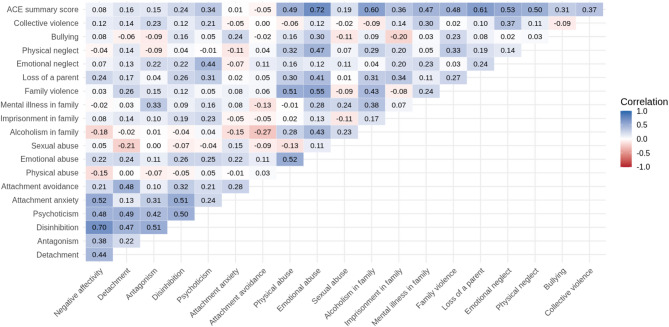
- Attachment anxiety correlated with Negative Affectivity (ρ = 0.52, p < 0.001), Antagonism (ρ = 0.31, p = 0.013), and Disinhibition (ρ = 0.51, p < 0.001); attachment avoidance correlated with Detachment (ρ = 0.48, p < 0.001) and Disinhibition (ρ = 0.32, p = 0.012).
- Psychoticism was significantly associated with emotional neglect (ρ = 0.44, p < 0.001), emotional abuse (ρ = 0.25, p = 0.044), loss of a parent (ρ = 0.31, p = 0.014), and the ACE summary score (ρ = 0.34, p = 0.006).
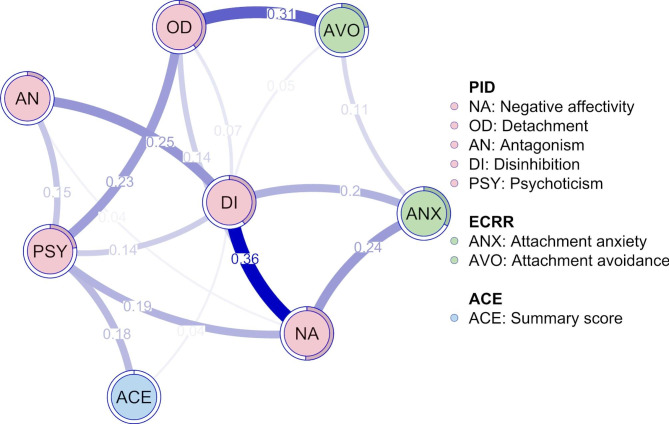
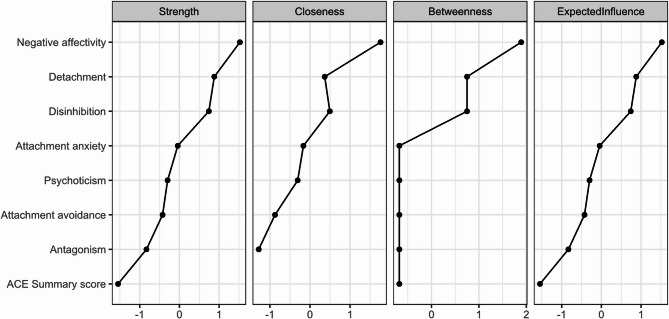
- In the exploratory network, Negative Affectivity, Detachment, and Disinhibition showed the highest centrality values.
Methods
- Clinical sample of adult inpatients with substance use disorder in Slovak mental health facilities (n = 63; mean age = 38.87 ± 10.34 years; 71.43% men); 27 had alcohol use disorder and 36 had another psychoactive substance use disorder.
- Measures included the Adverse Childhood Experience International Questionnaire (ACE-IQ), Experiences in Close Relationships – Revised (ECR-R), and Personality Inventory for DSM-5 Short Form (PID-5-SF).
- Associations were assessed with Spearman correlations and exploratory network analysis using qgraph with the EBICglasso estimator and node centrality metrics.
Limitations
- Stated: small AUD (n = 27) and OSUD (n = 36) subgroups prevented subgroup-specific networks and limit generalizability; the predominantly male sample may limit generalizability to female patients; the inpatient residential rehabilitation sample may not represent the general SUD population; self-report questionnaires may be affected by socially desirable answers.
- Evident: the cross-sectional design cannot establish causality or temporal ordering, and the small overall sample size limits precision and generalizability of the network findings.
Model-written summary. Check it against the paper before relying on it.
Integrity signals
Registry
Cites
Statistics
Figures
Verification
Claims the paper makes
20 Valid · 0 Not valid · 12 Not checked · 66 Own results and interpretations
Every source the paper cites for this claim was checked and supports it.
In the paper
“Only 31% of participants reported four or more ACEs based on binary scoring, and just 7% based on frequency scoring.”
§ The link of adverse childhood experiences and attachment to maladaptive personality traits in adults diagnosed with substance use disorder > Discussion
What the sources say
- Supportedcites [41] Kascakova N, Furstova J, Hasto J, Tavel P. Associations of multiple adverse childhood experiences, attachment insecurity and loneliness with physical and mental health difficulties in a representative Slovak sample. Prev Med Rep. 2025;50:102982. 39901935 PMC11788736 source
The Results section (Occurrence of adverse childhood experiences; page not available) reports that 31.4% of the representative Slovak adult sample had four or more ACEs. The Methods section (Measures; page not available) says the study used binary scoring, so 31% is an appropriate rounding. (LLM, conf=0.92)
plain- Asserted: passes — The authors put it forward as true.
- Checkable: passes — It can be checked against evidence.
- Load-bearing: passes — The paper’s conclusions depend on it.
- Based: passes — The paper gives a reason why it holds.
- Supported
The cited sources support only part of this claim — read each source’s verdict below.
In the paper
“Clinically, persons with a history of emotional abuse and neglect often develop an anxious (preoccupied) attachment style [42–45], characterized by heightened sensitivity to rejection, difficulties with affect regulation, and persistent fears about the availability of close others [21].”
§ The link of adverse childhood experiences and attachment to maladaptive personality traits in adults diagnosed with substance use disorder > Discussion
What the sources say
- Not checked — no full text of the sourcecites [42] Limke A, Showers CJ, Zeigler-Hill V. Emotional and sexual maltreatment: anxious attachment mediates psychological adjustment. J Soc Clin Psychol. 2010;29:347–67. source
- Partly supportedcites [43] Riggs SA. Childhood emotional abuse and the attachment system across the life cycle: what theory and research tell Us. J Aggress Maltreat Trauma. 2010;19:5–51. sourceExperimental — accuracy not yet measured
In ‘Adult Attachment, Coping, and Mental Health’ (page unavailable), Riggs describes preoccupied adults who experienced inconsistent, controlling, or role-reversing parenting, supporting a possible link with adverse caregiving. But ‘Emotionally Abusive Caregiving’ says emotional abuse can lead to several insecure attachment patterns, and the Conclusion emphasizes fearful attachment; the paper does not establish that people with histories of emotional abuse and neglect often develop the specifically preoccupied style. (LLM, conf=0.86)
- Not checked — no full text of the sourcecites [44] Schimmenti A, Bifulco A. Linking lack of care in childhood to anxiety disorders in emerging adulthood: the role of attachment styles. Child Adolesc Ment Health. 2015;20:41–8. 32680332 source
- Partly supportedcites [45] Falgares G, Costanzo G, Manna G, Lamis DA. Childhood emotional maltreatment and internalizing problems in a non-clinical sample of adolescents: a moderated-mediation model of insecure anxious attachment style and gender. Res Psychother Psychopathol Process Outcome. 2024;27. PMC11420744 38912928 sourceExperimental — accuracy not yet measured
The Introduction says emotional abuse and neglect tend to be related to insecure attachment, with a stronger association for anxious attachment. The Discussion reports a positive association in adolescents and suggests maltreatment may contribute to the style’s development. The claim’s wording, “often develop,” implies a frequency and developmental outcome that these passages do not establish. (LLM, conf=0.82)
plainstates a cause- Asserted: passes — The authors put it forward as true.
- Checkable: passes — It can be checked against evidence.
- Load-bearing: passes — The paper’s conclusions depend on it.
- Based: passes — The paper gives a reason why it holds.
Every source the paper cites for this claim was checked and supports it.
In the paper
“Only 31% of participants reported four or more ACEs based on binary scoring, and just 7% based on frequency scoring.”
§ The link of adverse childhood experiences and attachment to maladaptive personality traits in adults diagnosed with substance use disorder > Discussion
What the sources say
- Supportedcites [41] Kascakova N, Furstova J, Hasto J, Tavel P. Associations of multiple adverse childhood experiences, attachment insecurity and loneliness with physical and mental health difficulties in a representative Slovak sample. Prev Med Rep. 2025;50:102982. 39901935 PMC11788736 source
Table 2 in Results (Occurrence of adverse childhood experiences; page unavailable) reports that 75 of 1,018 adults in the representative Slovak sample had four or more ACEs under frequency scoring: 7.4%, rounded to 7%. The same row reports 31.4% under binary scoring, consistent with the citing sentence’s 31%. (LLM, conf=0.94)
plain- Asserted: passes — The authors put it forward as true.
- Checkable: passes — It can be checked against evidence.
- Load-bearing: passes — The paper’s conclusions depend on it.
- Based: passes — The paper gives a reason why it holds.
- Supported
Every source the paper cites for this claim was checked and supports it.
In the paper
“Failure to resolve these early experiences may significantly shape maladaptive trajectories into adulthood [48].”
§ The link of adverse childhood experiences and attachment to maladaptive personality traits in adults diagnosed with substance use disorder > Discussion > Implications
What the sources say
- Supportedcites [48] Cirasola A, Hillman S, Fonagy P. Mapping the road from childhood adversity to personality disorder: the role of unresolved States of Mind: childhood adversity, unresolved States of Mind and personality disorder. Personality Mental Health. 2017;11:77–90. 28101905 source
The Discussion (page not provided) says that unresolved/disorganized attachment was significantly associated with childhood adversity and adult personality-disorder outcomes. It explicitly suggests that a lack of resolution may shape a developmental pathway toward long-term negative effects in adulthood. (LLM, conf=0.94)
hedgedstates a possible cause- Asserted: passes — The authors put it forward as true.
- Checkable: unclear — It is unclear whether it could be checked against evidence.
- Load-bearing: passes — The paper’s conclusions depend on it.
- Based: passes — The paper gives a reason why it holds.
- Supported
Every source the paper cites for this claim was checked and supports it.
In the paper
“In line with international data, another research [9] also supported the observation that ACEs are more prevalent among individuals with substance use disorders (SUD) than in the general population.”
§ The link of adverse childhood experiences and attachment to maladaptive personality traits in adults diagnosed with substance use disorder > Introduction
What the sources say
- Supportedcites [9] Leza L, Siria S, López-Goñi JJ, et al. Adverse childhood experiences (ACEs) and substance use disorder (SUD): A scoping review. Drug Alcohol Depend. 2021;221:108563. 33561668 source
The Introduction states that people in treatment for addiction have a higher prevalence of ACEs than the general population. Section 3.5 also reports a higher prevalence among people in treatment for SUD and a higher proportion reporting ACEs among participants with SUD than among those without it. (LLM, conf=0.94)
plainstates an association- Asserted: passes — The authors put it forward as true.
- Checkable: passes — It can be checked against evidence.
- Load-bearing: unclear — It is unclear whether the paper’s conclusions depend on it.
- Based: passes — The paper gives a reason why it holds.
- Supported
65 more claims · 5 with their cited sources checked
Create a free account to see all 98 claims and to verify the 2 references still open.
- It may state two separate claims as one. 14
- Probably not a substantial claim. 19
Self-check
Percentages, sums and reported differences re-computed from the paper’s own numbers.
Each contradiction between two passages listed here was confirmed by an independent check.
Rated minor: it would not touch a result — a value no result rests on, a p-value that stays on the same side of the significance level, or a conflict that is clerical, resolved elsewhere in the paper, or outside its own findings.
In the paper
§ The link of adverse childhood experiences and attachment to maladaptive personality traits in adults diagnosed with substance use disorder > Abstract > Methods
“A clinical sample of adult patients with substance use disorder (n = 63, mage = 38.87 ± 10.34 years, 71.43% men) was assembled.”
§ The link of adverse childhood experiences and attachment to maladaptive personality traits in adults diagnosed with substance use disorder > Results > Background characteristics
“There were 27 AUD patients, 63% males, with a mean age of 42.2 years (SD = 11.06). The OSUD group comprised 36 patients, 77,78% males, with a mean age of 35.6 years (SD = 8.55).”
Rated minor: it would not touch a result — a value no result rests on, a p-value that stays on the same side of the significance level, or a conflict that is clerical, resolved elsewhere in the paper, or outside its own findings.
In the paper
§ The link of adverse childhood experiences and attachment to maladaptive personality traits in adults diagnosed with substance use disorder > Results > Occurrence of adverse childhood experiences
“The average occurrence of ACEs in the sample was M = 3.37 (SD = 2.28).”
§ The link of adverse childhood experiences and attachment to maladaptive personality traits in adults diagnosed with substance use disorder > Results > Occurrence of adverse childhood experiences
“| Alcoholism in family | 36 (57.14) | | | Emotional neglect | 34 (53.97) | | | Loss of parent | 30 (47.62) | | | Bullying | 29 (46.03) | | | Family violence | 27 (42.86) | | | Emotional abuse | 19 (30.16) | | | Collective violence | 18 (28.57) | | | Physical abuse | 13 (20.64) | | | Mental illness in family | 10 (15.87) | | | Physical neglect | 10 (15.87) | | | Imprisonment in family | 9 (14.29) | | | Sexual abuse | 4 (6.35) | |”
Citations
Cites
Regularization Paths for Generalized Linear Models via Coordinate Descent
Friedman, J., Hastie, T., & Tibshirani, R. (2010) · Journal of Statistical Software · doi:10.18637/jss.v033.i01 · Cited by 19,927 · cited 1×
“To estimate the network, we used the qgraph package in R [39] along with the EBICglasso estimator [40], which applies regularization techniques to reduce the inclusion of potentially spurious connections.”
Felitti, V. J., Anda, R. F., Nordenberg, D., Williamson, D. F., Spitz, A. M., Edwards, V., Koss, M. P., & Marks, J. S. (1998) · American Journal of Preventive Medicine · doi:10.1016/s0749-3797(98)00017-8 · Cited by 18,943 · cited 3×
“Similarly, the original ACE study [3] demonstrated that individuals exposed to multiple adverse experiences had a four-to twelve-fold increased risk for alcoholism, drug abuse, depression, and suicide attempts.”
Child abuse: Adolescent records vs. adult recall
Femina, D. D., Yeager, C. A., & Lewis, D. O. (1990) · Child Abuse & Neglect · doi:10.1016/0145-2134(90)90033-p · Cited by 8,820
Hughes, K., Bellis, M. A., Hardcastle, K. A., Sethi, D., Butchart, A., Mikton, C., Jones, L., & Dunne, M. P. (2017) · The Lancet Public Health · doi:10.1016/s2468-2667(17)30118-4 · Cited by 5,255 · cited 2×
“A comprehensive meta-analysis [4] involving over 250,000 participants showed that individuals who had experienced four or more ACEs had markedly increased odds of adverse health outcomes compared to those without such experiences.”
qgraph: Network Visualizations of Relationships in Psychometric Data
Epskamp, S., Cramer, A. O. J., Waldorp, L. J., Schmittmann, V. D., & Borsboom, D. (2012) · Journal of Statistical Software · doi:10.18637/jss.v048.i04 · Cited by 4,856 · cited 1×
“To estimate the network, we used the qgraph package in R [39] along with the EBICglasso estimator [40], which applies regularization techniques to reduce the inclusion of potentially spurious connections.”
Bowlby (1977) · doi:10.1192/bjp.130.3.201 · Cited by 2,844
Initial construction of a maladaptive personality trait model and inventory for DSM-5
Krueger, R. F., Derringer, J., Markon, K. E., Watson, D., & Skodol, A. E. (2012) · Psychological Medicine · doi:10.1017/s0033291711002674 · Cited by 1,908 · cited 1×
“The degree of maladaptive personality traits was measured using the PID-5 [28] in its shortened 100-item form [29].”
Network analysis of multivariate data in psychological science
Borsboom, D., Deserno, M. K., Rhemtulla, M., Epskamp, S., Fried, E. I., McNally, R. J., Robinaugh, D. J., Perugini, M., Dalege, J., Costantini, G., et al. (2021) · Nature Reviews Methods Primers · doi:10.1038/s43586-021-00055-w · Cited by 1,371 · cited 1×
“Network Analysis [38] was applied as an exploratory tool to examine the underlying structure of the data.”
Personality and substance use disorders: A prospective study.
Sher, K. J., Bartholow, B. D., & Wood, M. D. (2000) · Journal of Consulting and Clinical Psychology · doi:10.1037/0022-006x.68.5.818 · Cited by 483 · cited 1×
“For example, disinhibition has been linked to impulsive substance use [15], while negative affectivity may contribute to emotion-driven consumption [16].”
Boullier, M., & Blair, M. (2018) · Paediatrics and Child Health · doi:10.1016/j.paed.2017.12.008 · Cited by 450 · cited 1×
“Given their pervasive and enduring impact, ACEs represent a serious threat to long-term health and psychosocial functioning [1–3].”
Risk factors and correlates of deliberate self-harm behavior: A systematic review
Fliege, H., Lee, J.-R., Grimm, A., & Klapp, B. F. (2009) · Journal of Psychosomatic Research · doi:10.1016/j.jpsychores.2008.10.013 · Cited by 428 · cited 1×
“Even stronger associations were observed for problematic drug use [6, 7] and both interpersonal and self-directed aggression [8].”
Afifi, T. O., Mather, A., Boman, J., Fleisher, W., Enns, M. W., MacMillan, H., & Sareen, J. (2011) · Journal of Psychiatric Research · doi:10.1016/j.jpsychires.2010.11.008 · Cited by 410 · cited 2×
“These findings are in line with previous work indicating that cumulative maltreatment increases the risk of Cluster A and B personality disorders [11, 12], and that specific forms of neglect and abuse contribute to the development of maladaptive personality traits [10].”
Riggs, S. A. (2010) · Journal of Aggression, Maltreatment & Trauma · doi:10.1080/10926770903475968 · Cited by 336
Maples, J. L., Carter, N. T., Few, L. R., Crego, C., Gore, W. L., Samuel, D. B., Williamson, R. L., Lynam, D. R., Widiger, T. A., Markon, K. E., et al. (2015) · Psychological Assessment · doi:10.1037/pas0000120 · Cited by 333 · cited 1×
“The degree of maladaptive personality traits was measured using the PID-5 [28] in its shortened 100-item form [29].”
Meta-analytic evidence for stability in attachments from infancy to early adulthood
Pinquart, M., Feußner, C., & Ahnert, L. (2013) · Attachment & Human Development · doi:10.1080/14616734.2013.746257 · Cited by 317 · cited 1×
“Keywords Substance use disorder, Personality, Attachment, Adverse childhood experiences indicates that it retains moderate stability across the lifespan [24, 25].”
Adverse childhood experiences (ACEs) and substance use disorder (SUD): A scoping review
Leza, L., Siria, S., López-Goñi, J. J., & Fernández-Montalvo, J. (2021) · Drug and alcohol dependence · doi:10.1016/j.drugalcdep.2021.108563 · Cited by 305
Schimmenti, A., & Bifulco, A. (2015) · Child and Adolescent Mental Health · doi:10.1111/camh.12051 · Cited by 198
Attachment Styles and Aggression in Physically Abused and Neglected Children
Finzi, R., Ram, A., Har-Even, D., Shnit, D., & Weizman, A. (2001) · Journal of Youth and Adolescence · doi:10.1023/a:1012237813771 · Cited by 168 · cited 1×
“Conceptu-ally, this pattern may indicate that the impact of family violence on Detachment is not best captured as a direct pathway, but rather as one that operates through the development of avoidant relational strategies [46, 47].”
The relation of attachment security status to effortful self-regulation: A meta-analysis.
Pallini, S., Chirumbolo, A., Morelli, M., Baiocco, R., Laghi, F., & Eisenberg, N. (2018) · Psychological Bulletin · doi:10.1037/bul0000134 · Cited by 162 · cited 2×
“They also reflect the broader literature identifying attachment insecurity as a key factor in the developmental pathways from ACEs to adult psychopathology [17, 22, 24].”
An Overview of the DSM-5 Alternative Model of Personality Disorders
Krueger, R. F., & Hobbs, K. A. (2020) · Psychopathology · doi:10.1159/000508538 · Cited by 144 · cited 1×
“In recent years, there has been a growing emphasis on understanding personality pathology using dimensional models, particularly the Alternative Model for Personality Disorders (AMPD) introduced in DSM-5 Section III [13].”
Huang, S., Trapido, E., Fleming, L., Arheart, K., Crandall, L., French, M., Malcolm, S., & Prado, G. (2011) · Addictive Behaviors · doi:10.1016/j.addbeh.2010.09.001 · Cited by 125 · cited 1×
“Even stronger associations were observed for problematic drug use [6, 7] and both interpersonal and self-directed aggression [8].”
Waxman, R., Fenton, M. C., Skodol, A. E., Grant, B. F., & Hasin, D. (2014) · Personality and Mental Health · doi:10.1002/pmh.1239 · Cited by 98
The Relationship Between Childhood Physical Abuse and Adult Attachment Styles
Unger, J. A. M., & De Luca, R. V. (2014) · Journal of Family Violence · doi:10.1007/s10896-014-9588-3 · Cited by 95 · cited 1×
“Conceptu-ally, this pattern may indicate that the impact of family violence on Detachment is not best captured as a direct pathway, but rather as one that operates through the development of avoidant relational strategies [46, 47].”
Early childhood attachment stability and change: a meta-analysis
Opie, J. E., McIntosh, J. E., Esler, T. B., Duschinsky, R., George, C., Schore, A., Kothe, E. J., Tan, E. S., Greenwood, C. J., & Olsson, C. A. (2021) · Attachment & Human Development · doi:10.1080/14616734.2020.1800769 · Cited by 80 · cited 2×
“They also reflect the broader literature identifying attachment insecurity as a key factor in the developmental pathways from ACEs to adult psychopathology [17, 22, 24].”
Childhood adversity and psychiatric disorder in young adulthood: An analysis of 107,704 Swedes
Björkenstam, E., Burström, B., Vinnerljung, B., & Kosidou, K. (2016) · Journal of Psychiatric Research · doi:10.1016/j.jpsychires.2016.02.018 · Cited by 77
New Technology in Survey Research: Computer-Assisted Personal Interviewing (CAPI)
Baker, R. P. (1992) · Social Science Computer Review · doi:10.1177/089443939201000202 · Cited by 69 · cited 1×
“Computer-assisted personal interviewing [27] was used for data collection, and data were obtained by trained psychologists and psychiatrists employed at the departments.”
Fuchshuber, J., Hiebler-Ragger, M., Kresse, A., Kapfhammer, H.-P., & Unterrainer, H. F. (2019) · Frontiers in Psychiatry · doi:10.3389/fpsyt.2019.00643 · Cited by 62 · cited 1×
“Building on prior research [26] that has examined the links between ACEs, attachment insecurity, and personality pathology, the present study explores how these domains interact within a shared dimensional framework.”
Predicting problematic alcohol use with the DSM–5 alternative model of personality pathology.
Creswell, K. G., Bachrach, R. L., Wright, A. G. C., Pinto, A., & Ansell, E. (2016) · Personality Disorders: Theory, Research, and Treatment · doi:10.1037/per0000131 · Cited by 56 · cited 1×
“Existing literature suggests that mal-adaptive personality traits are significantly associated with the development and maintenance of SUD [14].”
Emotional and Sexual Maltreatment: Anxious Attachment Mediates Psychological Adjustment
Limke, A., Showers, C. J., & Zeigler-Hill, V. (2010) · Journal of Social and Clinical Psychology · doi:10.1521/jscp.2010.29.3.347 · Cited by 50 · cited 1×
“Clinically, persons with a history of emotional abuse and neglect often develop an anxious (preoccupied) attachment style [42–45], characterized by heightened sensitivity to rejection, difficulties with affect regulation, and persistent fears about the availability of close others [21].”
Kisely, S., Mills, R., Strathearn, L., & Najman, J. M. (2020) · Addiction · doi:10.1111/add.14794 · Cited by 50
Díaz-Batanero, C., Ramírez-López, J., Domínguez-Salas, S., Fernández-Calderón, F., & Lozano, Ó. M. (2019) · Assessment · doi:10.1177/1073191117739980 · Cited by 46 · cited 1×
“The inventory retains good psychometric properties even in its short form [31, 32] and in test-retest [33].”
Erkoreka, L., Zamalloa, I., Rodriguez, S., Muñoz, P., Mendizabal, I., Zamalloa, M. I., Arrue, A., Zumarraga, M., & Gonzalez‐Torres, M. A. (2022) · Clinical Psychology & Psychotherapy · doi:10.1002/cpp.2640 · Cited by 43 · cited 2×
“Beyond its origins, insecure attachment has been robustly associated with impairments in affect regulation, heightened interpersonal reactivity, and poor stress tolerance [21] — all of which are central vulnerabilities in both mal-adaptive personality functioning and SUD.”
Chatziioannidis, S., Andreou, C., Agorastos, A., Kaprinis, S., Malliaris, Y., Garyfallos, G., & Bozikas, V. P. (2019) · Psychiatry Research · doi:10.1016/j.psychres.2019.05.021 · Cited by 41 · cited 1×
“Insecure attachment, which often emerges as a developmental consequence of adverse caregiving environments, represents a key mechanism linking early adversity to later psychopathology [19, 20].”
Cohen, L. J., Ardalan, F., Tanis, T., Halmi, W., Galynker, I., Von Wyl, A., & Hengartner, M. P. (2017) · Attachment & Human Development · doi:10.1080/14616734.2016.1253639 · Cited by 36 · cited 1×
“These patterns can persist into adulthood and shape how individuals cope with distress, form relationships, and regulate internal states [23].”
Cirasola, A., Hillman, S., Fonagy, P., & Chiesa, M. (2017) · Personality and Mental Health · doi:10.1002/pmh.1365 · Cited by 24
Torres-Soto, J.-F., Moya-Faz, F.-J., Giner-Alegría, C.-A., & Oliveras-Valenzuela, M.-A. (2018) · Anales de Psicología · doi:10.6018/analesps.35.1.333191 · Cited by 19 · cited 1×
“The inventory retains good psychometric properties even in its short form [31, 32] and in test-retest [33].”
Voestermans, D., Eikelenboom, M., Rullmann, J., Wolters-Geerdink, M., Draijer, N., Smit, J. H., Thomaes, K., & van Marle, H. J. F. (2021) · Journal of Personality Disorders · doi:10.1521/pedi_2020_34_474 · Cited by 19 · cited 1×
“Insecure attachment, which often emerges as a developmental consequence of adverse caregiving environments, represents a key mechanism linking early adversity to later psychopathology [19, 20].”
Kascakova, N., Petrikova, M., Furstova, J., Hasto, J., Geckova, A. M., & Tavel, P. (2022) · BMC Public Health · doi:10.1186/s12889-022-14160-2 · Cited by 14 · cited 2×
“A representative study in Slovakia [5] confirmed that childhood maltreatment—specifically emotional, physical, and sexual abuse—strongly predicted alcohol use disorder in adulthood.”
Self-citationCavicchioli, M., Ramella, P., Movalli, M., Prudenziati, F., Vassena, G., Simone, G., & Maffei, C. (2020) · Substance Use & Misuse · doi:10.1080/10826084.2020.1762650 · Cited by 13 · cited 1×
“For example, disinhibition has been linked to impulsive substance use [15], while negative affectivity may contribute to emotion-driven consumption [16].”
Maladaptive personality traits in depressive and substance use disorders: A study with the PID‐5
Gonçalves, B., Pires, R., Sousa Ferreira, A., Gama Marques, J., Paulino, M., & Henriques‐Calado, J. (2022) · Scandinavian Journal of Psychology · doi:10.1111/sjop.12783 · Cited by 12 · cited 1×
“The inventory retains good psychometric properties even in its short form [31, 32] and in test-retest [33].”
Childhood Maltreatment, Personality Pathology, and Intimate Partner Aggression
South, S. C., Boudreaux, M. J., & Oltmanns, T. F. (2022) · Journal of Interpersonal Violence · doi:10.1177/08862605221076164 · Cited by 11
Olomouci, U. P. V., Švecová, J., Kaščáková, N., Fürstová, J., Hašto, J., & Tavel, P. (2021) · Ceskoslovenska psychologie · doi:10.51561/cspsych.65.2.146 · Cited by 10 · cited 1×
“The statements in this 14-item Slovak version of the Experiences in Close Relationships Revised Questionnaire ECR-R [36] describe how the individual feels about close relationships.”
Self-citationKascakova, N., Furstova, J., Hasto, J., & Tavel, P. (2025) · Preventive Medicine Reports · doi:10.1016/j.pmedr.2025.102982 · Cited by 8 · cited 1×
“Importantly, recent data from a nationally representative Slovak population study [41] showed substantially lower rates of cumulative ACE exposure in the general population.”
Self-citationFalgares, G., Costanzo, G., Manna, G., & Lamis, D. A. (2024) · Research in Psychotherapy: Psychopathology, Process and Outcome · doi:10.4081/ripppo.2024.745 · Cited by 7 · cited 1×
“Clinically, persons with a history of emotional abuse and neglect often develop an anxious (preoccupied) attachment style [42–45], characterized by heightened sensitivity to rejection, difficulties with affect regulation, and persistent fears about the availability of close others [21].”
Research works printed but not linked: 1
- Mikulincer M, Shaver PR. Attachment in adulthood: structure, dynamics, and change. Guilford Press. 2018.
Cited by
Silva, C., Moreira, P., Fávero, M., Sousa‐Gomes, V., Dias, P. C., Azeredo, A., & Moreira, D. S. (2026) · Journal of Substance Use · doi:10.1080/14659891.2026.2627200
The Interplay of Early Attachment Difficulties and Long-Term Substance Use: A Clinical Case Study
Tehreem, L., Hashmi, F., & Bukhari, S. H. T. (2026) · The regional tribune. · doi:10.55737/trt/v-i.202
Ünver, H., Gündoğmuş, P. D., Oruc, E. B., Tatlı, S. Z., Varlı, M. R., Özdemir, M. A., Kocaman, B., Gündoğmuş, İ., & Şafak, Y. (2026) · Frontiers in Psychology · doi:10.3389/fpsyg.2026.1803371
Emotional Neglect in Childhood and Benzodiazepine Misuse in Rhode Island Young Adults
Bradford, C., & Rosenthal, S. R. (2026) · Addiction & Prevention · doi:10.3390/addictprev1010006
Metadata
- Authors
- Migalova, E., Furstova, J., Hasto, J., Tavel, P., & Kascakova, N.
- Affiliations
- Palacký University Olomouc (CZ)
- Corresponding author
- Migalova, Eva
- ORCID
- Tavel, Peter
- Venue
- BMC Psychology
- Published
- 2025-08-27
- Volume
- 13
- Issue
- 1
- Pages
- 974-974
- ISSN
- 2050-7283 (ISSN-L)
- PMC
- PMC12392568
- OpenAlex
- W4413755090
- Cited by
- 6
- References
- 45
- Citations by year
- 2026: 6
- FWCI
- 7.06
- Type
- journal article
- Language
- en
- Open access
- gold
- doi.org
- Licence
- cc-by
- creativecommons.org/licenses/by/4.0 (tdm)
- creativecommons.org/licenses/by/4.0 (vor)
- Locations
- BMC Psychology (publishedVersion, cc-by)
- PubMed Central (publishedVersion, cc-by)
- PubMed (publishedVersion)
- DOAJ (DOAJ: Directory of Open Access Journals) (submittedVersion, cc-by-sa)
- Funders
- European Regional Development Fund (CZ.02.01.01/00/22_008/0004583)
- Topics
- Social Sciences › Psychology › Clinical Psychology › Child Abuse and Trauma
- Social Sciences › Psychology › Clinical Psychology › Personality Disorders and Psychopathology
- Social Sciences › Psychology › Clinical Psychology › Personality Traits and Psychology
- Keywords
- adverse childhood experiences, attachment, maladaptive personality traits, substance use disorders, attachment anxiety, attachment avoidance, negative affectivity, disinhibition, detachment, emotional neglect, emotional abuse, parental loss, childhood adversity, trauma-informed care
- MeSH terms
- Adverse Childhood Experiences, Adult, Female, Humans, Male, Middle Aged, Object Attachment, Personality, Personality Disorders, Substance-Related Disorders
About these checks
Registry, retraction, Cites and statistics results are computed, not judged, with one exception: a printed reference that no index lists is read once by a model before it counts as a citation error. Claims are extracted by a model and kept only when their quote appears verbatim in the text; each cited source is then checked, with a model’s help, for whether it says what the claim relies on. Those verdicts can be wrong — read the claim’s quote and the cited source before relying on one.
The claim verdicts this report counts are experimental: their accuracy is not yet measured.
A language model drew the claims from the paper on 2026-10-10, under version 3 of the claim definition (model deepseek-v4.1-flash, prompt extract-v3).
A second model labelled each claim on 2026-10-10 (model jev-1.13-20260917, definition revision gold-guideline-v0.2).
Cited sources are checked with a language model’s help (gpt-6-sol).
Statistics and arithmetic are recomputed, not judged.
Confidence bands are shown only for fields calibrated on our annotated test set. None is calibrated yet, so no band is shown.
What counts as a claim ›How we measure confidence ›How we check this ›
Are you an author, or do you see a problem with this page? Request a review
Data sources
Bibliographic data: Semantic Scholar, OpenAlex, Crossref.
Contains information from the Semantic Scholar Academic Graph Datasets, made available under the ODC Attribution License (ODC-BY 1.0).
Semantic Scholar’s data is described in: Kinney, R., et al. (2023). The Semantic Scholar Open Data Platform. arXiv:2301.10140.
