

CONSORT 2010 statement: extension to randomised pilot and feasibility trials
Open accessThe DOI matches its Crossref record; 100 of the 100 references it cites were found in a registry or an index; 7 of the 22 sources its claims cite were checked for support.
Abstract
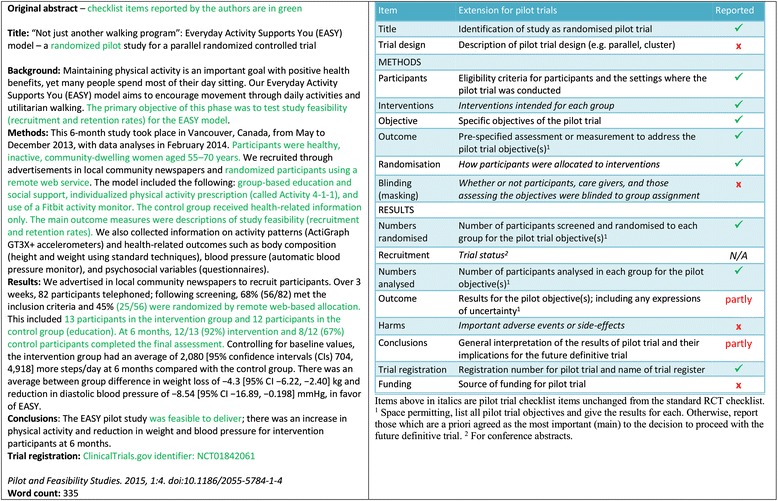
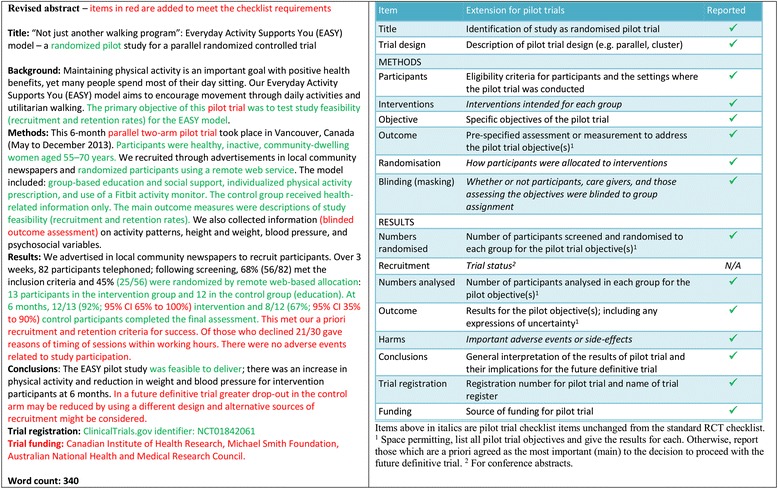
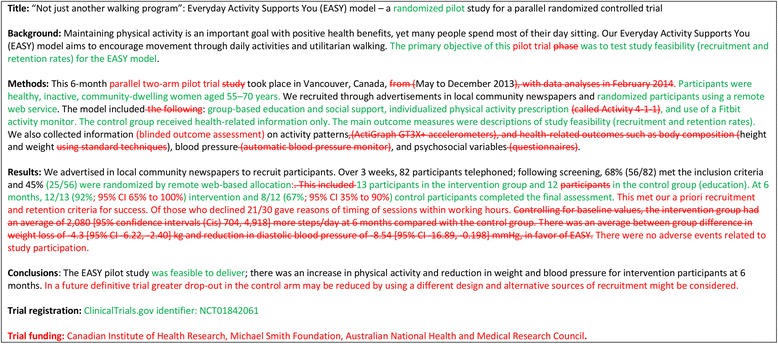
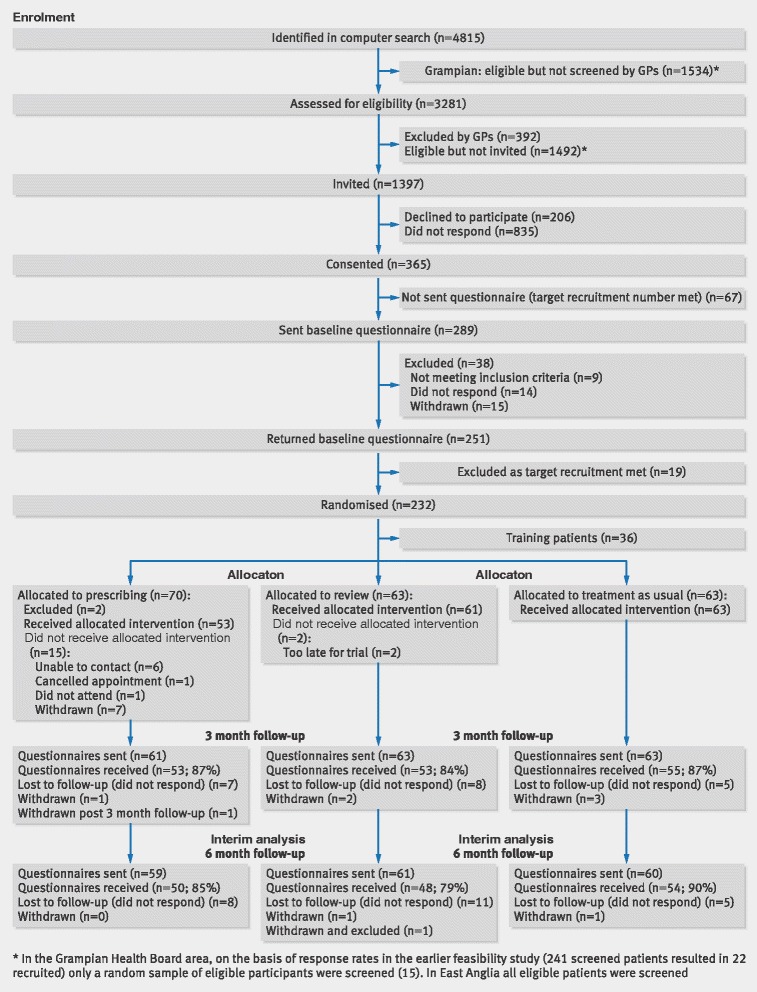
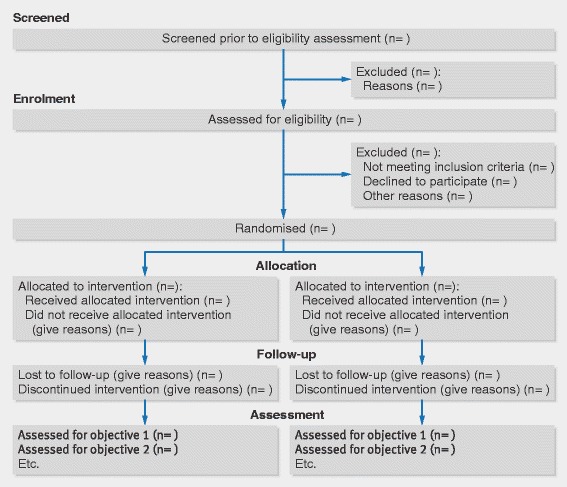
The Consolidated Standards of Reporting Trials (CONSORT) statement is a guideline designed to improve the transparency and quality of the reporting of randomised controlled trials (RCTs). In this article we present an extension to that statement for randomised pilot and feasibility trials conducted in advance of a future definitive RCT. The checklist applies to any randomised study in which a future definitive RCT, or part of it, is conducted on a smaller scale, regardless of its design (eg, cluster, factorial, crossover) or the terms used by authors to describe the study (eg, pilot, feasibility, trial, study). The extension does not directly apply to internal pilot studies built into the design of a main trial, non-randomised pilot and feasibility studies, or phase II studies, but these studies all have some similarities to randomised pilot and feasibility studies and so many of the principles might also apply. The development of the extension was motivated by the growing number of studies described as feasibility or pilot studies and by research that has identified weaknesses in their reporting and conduct. We followed recommended good practice to develop the extension, including carrying out a Delphi survey, holding a consensus meeting and research team meetings, and piloting the checklist. The aims and objectives of pilot and feasibility randomised studies differ from those of other randomised trials. Consequently, although much of the information to be reported in these trials is similar to those in randomised controlled trials (RCTs) assessing effectiveness and efficacy, there are some key differences in the type of information and in the appropriate interpretation of standard CONSORT reporting items. We have retained some of the original CONSORT statement items, but most have been adapted, some removed, and new items added. The new items cover how participants were identified and consent obtained; if applicable, the prespecified criteria used to judge whether or how to proceed with a future definitive RCT; if relevant, other important unintended consequences; implications for progression from pilot to future definitive RCT, including any proposed amendments; and ethical approval or approval by a research review committee confirmed with a reference number. This article includes the 26 item checklist, a separate checklist for the abstract, a template for a CONSORT flowchart for these studies, and an explanation of the changes made and supporting examples. We believe that routine use of this proposed extension to the CONSORT statement will result in improvements in the reporting of pilot trials. Editor’s note: In order to encourage its wide dissemination this article is freely accessible on the BMJ and Pilot and Feasibility Studies journal websites.
Overview
CoChat Summary
## TL;DR
This paper extends the CONSORT reporting guideline to randomised pilot and feasibility trials, arguing that these studies need reporting standards tailored to their primary goal of assessing feasibility rather than intervention effectiveness. It provides a 26-item checklist, plus abstract and flowchart guidance, developed through Delphi consensus, meetings, and piloting.
## Key findings
- The extension applies to any randomised study conducted on a smaller scale in advance of a future definitive RCT, regardless of design (for example, cluster, factorial, crossover) or the labels used by authors (“pilot,” “feasibility,” “study,” or “trial”).
- The authors report using a multi-stage development process: a research team review, a modified Delphi survey with 93 participants, a second Delphi round with 79/93 (84.9%) responses, a two-day expert consensus meeting, further team meetings, and piloting of the checklist.
- The final product includes a 26-item checklist, a separate abstract checklist, and a template CONSORT flowchart for pilot trials.
- The paper argues that routine use of the extension should improve reporting quality; it also states that CONSORT has been cited more than 8000 times and that adoption of CONSORT has been associated with improved reporting quality in previous studies.
## Methods
- Guideline-development paper rather than an empirical trial; the authors developed reporting recommendations for randomised pilot and feasibility trials.
- Development process included a Delphi survey, consensus meeting, research team meetings, and piloting the checklist; the paper also reports a staged process in which the team first reviewed existing CONSORT items and applied revised checklists to 30 articles.
- The analysis was consensus-based: items were retained, removed, or reworded based on relevance to pilot/feasibility trials and agreement among participants and experts.
## Limitations
- The paper does not report empirical evaluation of whether the extension itself improves reporting in pilot trials; this is stated only as an expectation.
- The checklist is explicitly said not to apply directly to internal pilot studies, non-randomised pilot and feasibility studies, or phase II studies; this is a scope limitation stated in the paper.
- Evident from the text: this is a consensus guideline, so its recommendations are not based on a single systematic empirical comparison within this paper.
Model-written summary of a shortened version of the paper’s full text (it is longer than we read). Check it against the paper before relying on it.
Integrity signals
Registry
Cites
Statistics
Figures
Verification
Claims the paper makes
4 Valid · 5 Not valid · 10 Not checked · 47 Own results and interpretations
The sources with a verdict support this claim; the rest weren’t checked yet, have no full text we could read, or their verdicts aren’t rated yet.
In the paper
“by research that has identified weaknesses in the reporting and conduct of these studies [12–15].”
§ CONSORT 2010 statement: extension to randomised pilot and feasibility trials > Scope of this paper
What the sources say
- Supportedcites [12] Shanyinde M Pickering RM Weatherall M Questions asked and answered in pilot and feasibility randomized controlled trials BMC Med Res Methodol 2011 11 117 10.1186/1471-2288-11-117 21846349 PMC3170294 source
The Discussion reports that most reviewed pilot and feasibility trials did not primarily address methodological issues and that lessons for planning later trials were often discussed only minimally. It also says the published reports sometimes made the trials’ original objectives impossible to determine, supporting the claim about weaknesses in both conduct and reporting. (LLM, conf=0.88)
- Not checked yetcites [13] Lancaster GA Dodd S Williamson PR Design and analysis of pilot studies: recommendations for good practice J Eval Clin Pract 2004 10 307 312 10.1111/j..2002.384.doc.x 15189396 source
- Supportedcites [14] Thabane L Ma J Chu R A tutorial on pilot studies: the what, why and how BMC Med Res Methodol 2010 10 1 10.1186/1471-2288-10-1 20053272 PMC2824145 source
Section 5, “Challenges of and Common Misconceptions about Pilot Studies” (page not provided), says that many pilot projects are not well designed and that a vast number of studies are poorly designed and reported. This supports the attributed claim about weaknesses in their conduct and reporting. (LLM, conf=0.91)
- Supportedcites [15] Arain M Campbell MJ Cooper CL Lancaster GA What is a pilot or feasibility study? A review of current practice and editorial policy BMC Med Res Methodol 2010 10 67 10.1186/1471-2288-10-67 20637084 PMC2912920 source
The Conclusions state that pilot studies are poorly reported and place inappropriate emphasis on hypothesis testing. The Discussion identifies a conduct-related weakness: studies performed hypothesis tests despite sample-size limitations, a practice the authors caution against. The cited paper therefore supports the broad claim. (LLM, conf=0.90)
plain- Asserted: passes — The authors put it forward as true.
- Checkable: passes — It can be checked against evidence.
- Load-bearing: passes — The paper’s conclusions depend on it.
- Based: passes — The paper gives a reason why it holds.
- Supported
The cited sources support only part of this claim — read each source’s verdict below.
In the paper
“The development of this extension was motivated by the growing number of studies described as feasibility or pilot studies [12]”
§ CONSORT 2010 statement: extension to randomised pilot and feasibility trials > Scope of this paper
What the sources say
- Partly supportedcites [12] Shanyinde M Pickering RM Weatherall M Questions asked and answered in pilot and feasibility randomized controlled trials BMC Med Res Methodol 2011 11 117 10.1186/1471-2288-11-117 21846349 PMC3170294 sourceExperimental — accuracy not yet measured
Our copy of Shanyinde et al. (2011) documents the growth in pilot/feasibility literature — the Results (p. 1, 'Results') report 3,581 then 3,652 MEDLINE/EMBASE papers for 2000-2009 with 'the frequency of papers rose steeply with time' — which supports the 'growing number of studies described as feasibility or pilot studies' element of the sentence. However, the paper never discusses the CONSORT extension for pilot trials or the motivation for developing it; the only CONSORT item in our copy is the CONSORT 2010 Statement listed as reference 60 (References). So the part of the claim about why the extension was developed is not supported by this source. (LLM, conf=0.70)
plainstates a cause- Asserted: passes — The authors put it forward as true.
- Checkable: passes — It can be checked against evidence.
- Load-bearing: passes — The paper’s conclusions depend on it.
- Based: passes — The paper gives a reason why it holds.
- Partly supported
The cited sources support only part of this claim — read each source’s verdict below.
In the paper
“This is not recommended, however, because evidence suggests that results of doing this largely reflects the effectiveness of the intervention rather than anything else [66].”
§ CONSORT 2010 statement: extension to randomised pilot and feasibility trials > Extension of CONSORT 2010 to pilot trials > Methods
What the sources say
- Partly supportedcites [66] Sackett DL Commentary: Measuring the success of blinding in RCTs: don’t, must, can’t or needn’t? Int J Epidemiol 2007 36 664 665 10.1093/ije/dym088 17675306 sourceExperimental — accuracy not yet measured
In the Commentary (pp. 664–665), Sackett says end-of-trial blinding tests cannot distinguish loss of blinding from participants’ or clinicians’ hunches about efficacy. That supports the warning against treating their answers as a valid test of blinding, but not the claim that the answers largely reflect the intervention’s actual effectiveness: in his example, the clinicians’ hunches were wrong. (LLM, conf=0.86)
hedgedstates an association- Asserted: passes — The authors put it forward as true.
- Checkable: passes — It can be checked against evidence.
- Load-bearing: passes — The paper’s conclusions depend on it.
- Based: passes — The paper gives a reason why it holds.
- Partly supported
A conclusion the paper draws from its own results — it cites no other source for it, so there is none to check. The quote shows it is in the paper.
In the paper
“In a pilot trial, the number of participants is likely to be smaller than in the future definitive RCT and baseline imbalances might therefore be more likely.”
§ CONSORT 2010 statement: extension to randomised pilot and feasibility trials > Extension of CONSORT 2010 to pilot trials > Results
hedgedstates a possible cause- Asserted: passes — The authors put it forward as true.
- Checkable: passes — It can be checked against evidence.
- Load-bearing: unclear — It is unclear whether the paper’s conclusions depend on it.
- Based: passes — The paper gives a reason why it holds.
- Rests on an assumption not shown here.
In the paper
“estimates of rates in pilot trials may be subject to considerable uncertainty, so that it is best to be cautious about setting definitive thresholds that could be missed simply due to chance variation [41].”
§ CONSORT 2010 statement: extension to randomised pilot and feasibility trials > Extension of CONSORT 2010 to pilot trials > Methods
What the sources say
- Not checked yetcites [41] Eldridge SM Costelloe CE Kahan BC Lancaster GA Kerry SM How big should the pilot study for my cluster randomised trial be? Stat Methods Med Res 2016 25 1039 1056 10.1177/0962280215588242 26071431 source
hedged- Asserted: passes — The authors put it forward as true.
- Checkable: passes — It can be checked against evidence.
- Load-bearing: passes — The paper’s conclusions depend on it.
- Based: passes — The paper gives a reason why it holds.
5 more claims
Create a free account to see all 66 claims and to verify the 15 references still open.
- Probably not a substantial claim. 53
- It may state two separate claims as one. 20
- The quote only partly states this claim. 1
Claims other papers make about this one
Each is checked against this paper’s own text: does it say what the citing paper says it does?
The source backs part of the claim, not all of it — or backs it for a different population, condition or comparison.
In the citing paper
“Within the research literature, there is considerable divergence over what exploratory studies should be called, what they should achieve, what they should entail, whether and how they should determine progression to future studies and how they should be reported [7, 8, 19–21].”
From Exploratory studies to decide whether and how to proceed with full-scale evaluations of public health interventions: a systematic review of guidance (2018) · cites this paper as [7]
Experimental — accuracy not yet measuredThe source backs part of the claim, not all of it — or backs it for a different population, condition or comparison.
In the citing paper
“Detailed recommendations for reporting exploratory studies were recently provided in new Consolidated Standards of Reporting Trials (CONSORT) guidance by Eldridge et al. [7].”
From Exploratory studies to decide whether and how to proceed with full-scale evaluations of public health interventions: a systematic review of guidance (2018) · cites this paper as [7]
Experimental — accuracy not yet measuredThe source backs part of the claim, not all of it — or backs it for a different population, condition or comparison.
In the citing paper
“Several sources of guidance also highlight that exploratory studies should be appropriately labelled in the title/abstract to enable easy identification”
From Exploratory studies to decide whether and how to proceed with full-scale evaluations of public health interventions: a systematic review of guidance (2018) · cites this paper as [7]
Experimental — accuracy not yet measuredThe source backs part of the claim, not all of it — or backs it for a different population, condition or comparison.
In the citing paper
“An exploratory study may also result in multiple publications, but should provide reference to other work carried out in the same exploratory study [7, 15].”
From Exploratory studies to decide whether and how to proceed with full-scale evaluations of public health interventions: a systematic review of guidance (2018) · cites this paper as [7]
Experimental — accuracy not yet measuredThe source backs part of the claim, not all of it — or backs it for a different population, condition or comparison.
In the citing paper
“Nonetheless, a justification for the anticipated sample size for all implementation feasibility or pilot studies (hybrid or stand-alone) is recommended [18], to ensure that implementation measures and outcomes achieve sufficient estimates of precision to be useful.”
From Guidance for conducting feasibility and pilot studies for implementation trials (2020) · cites this paper as [18]
Experimental — accuracy not yet measured
35 more claims about this paper
Create a free account to see every claim other papers make about this one.
Citations
Cites
Tong, A., Sainsbury, P., & Craig, J. (2007) · International Journal for Quality in Health Care · doi:10.1093/intqhc/mzm042 · Cited by 42,509
CONSORT 2010 Statement: updated guidelines for reporting parallel group randomised trials
the CONSORT Group, Schulz, K. F., Altman, D. G., & Moher, D. (2010) · BMC Medicine · doi:10.1186/1741-7015-8-18 · Cited by 13,371
Standards for Reporting Qualitative Research: A Synthesis of Recommendations
O’Brien, B. C., Harris, I. B., Beckman, T. J., Reed, D. A., & Cook, D. A. (2014) · Academic Medicine · doi:10.1097/acm.0000000000000388 · Cited by 12,211
Hoffmann, T. C., Glasziou, P. P., Boutron, I., Milne, R., Perera, R., Moher, D., Altman, D. G., Barbour, V., Macdonald, H., Johnston, M., et al. (2014) · BMJ · doi:10.1136/bmj.g1687 · Cited by 10,548
Moher, D., Hopewell, S., Schulz, K. F., Montori, V., Gotzsche, P. C., Devereaux, P. J., Elbourne, D., Egger, M., & Altman, D. G. (2010) · BMJ · doi:10.1136/bmj.c869 · Cited by 8,883
Self-citationCONSORT 2010 statement: updated guidelines for reporting parallel group randomized trials
Schulz, K. F., Altman, D. G., Moher, D., & for the CONSORT Group* (2010) · Annals of Internal Medicine · doi:10.7326/0003-4819-152-11-201006010-00232 · Cited by 3,824
Consort 2010 statement: extension to cluster randomised trials
Campbell, M. K., Piaggio, G., Elbourne, D. R., Altman, D. G., & for the CONSORT Group (2012) · BMJ · doi:10.1136/bmj.e5661 · Cited by 3,510
Self-citationA tutorial on pilot studies: the what, why and how
Thabane, L., Ma, J., Chu, R., Cheng, J., Ismaila, A., Rios, L. P., Robson, R., Thabane, M., Giangregorio, L., & Goldsmith, C. H. (2010) · BMC Medical Research Methodology · doi:10.1186/1471-2288-10-1 · Cited by 3,384
Self-citationSample size of 12 per group rule of thumb for a pilot study
Julious, S. A. (2005) · Pharmaceutical Statistics · doi:10.1002/pst.185 · Cited by 3,068
Design and analysis of pilot studies: recommendations for good practice
Lancaster, G. A., Dodd, S., & Williamson, P. R. (2004) · Journal of Evaluation in Clinical Practice · doi:10.1111/j..2002.384.doc.x · Cited by 2,572
Self-citationPiaggio, G., Elbourne, D. R., Pocock, S. J., Evans, S. J. W., Altman, D. G., & CONSORT Group, F. T. (2012) · JAMA · doi:10.1001/jama.2012.87802 · Cited by 2,428
Boutron, I., Moher, D., Altman, D. G., Schulz, K. F., Ravaud, P., & for the CONSORT Group* (2008) · Annals of Internal Medicine · doi:10.7326/0003-4819-148-4-200802190-00008 · Cited by 2,292
The International Committee of Medical Journal Editors
van der Weyden, M. (2006) · Proceedings of the Workshop on Publishing for Biomedical Journal Editors and Reviewers · doi:10.2349/biij.2.4.e54-13 · Cited by 1,998
Whitehead, A. L., Julious, S. A., Cooper, C. L., & Campbell, M. J. (2016) · Statistical Methods in Medical Research · doi:10.1177/0962280215588241 · Cited by 1,936
Self-citationMoher, D., Hopewell, S., Schulz, K. F., Montori, V., Gøtzsche, P. C., Devereaux, P. J., Elbourne, D., Egger, M., & Altman, D. G. (2010) · Journal of Clinical Epidemiology · doi:10.1016/j.jclinepi.2010.03.004 · Cited by 1,858
Self-citationImproving the reporting of pragmatic trials: An extension of the CONSORT statement
Zwarenstein, M., Treweek, S., Gagnier, J. J., Altman, D. G., Tunis, S., Haynes, B., Oxman, A. D., Moher, D., & groups, F. T. C. A. P. T. I. H. (. (2008) · BMJ · doi:10.1136/bmj.a2390 · Cited by 1,813
Better Reporting of Harms in Randomized Trials: An Extension of the CONSORT Statement
Ioannidis, J. P. A., Evans, S. J. W., Gøtzsche, P. C., O'Neill, R. T., Altman, D. G., Schulz, K., Moher, D., & for the CONSORT Group* (2004) · Annals of Internal Medicine · doi:10.7326/0003-4819-141-10-200411160-00009 · Cited by 1,593
Eldridge, S. M., Lancaster, G. A., Campbell, M. J., Thabane, L., Hopewell, S., Coleman, C. L., & Bond, C. M. (2016) · PLOS ONE · doi:10.1371/journal.pone.0150205 · Cited by 1,581
Self-citationWhat is a pilot or feasibility study? A review of current practice and editorial policy
Arain, M., Campbell, M. J., Cooper, C. L., & Lancaster, G. A. (2010) · BMC Medical Research Methodology · doi:10.1186/1471-2288-10-67 · Cited by 1,483
Self-citationReporting of Patient-Reported Outcomes in Randomized Trials: The CONSORT PRO Extension
Calvert, M., Blazeby, J., Altman, D. G., Revicki, D. A., Moher, D., Brundage, M. D., & CONSORT PRO Group, F. T. (2013) · JAMA · doi:10.1001/jama.2013.879 · Cited by 1,386
National Institute for Health Research
Evans, R. (2014) · Nursing Standard · doi:10.7748/ns.28.49.32.s37 · Cited by 1,350
Reporting of Noninferiority and Equivalence Randomized Trials: An Extension of the CONSORT Statement
Piaggio, G., Elbourne, D. R., Altman, D. G., Pocock, S. J., Evans, S. J. W., & CONSORT Group, F. T. (2006) · JAMA · doi:10.1001/jama.295.10.1152 · Cited by 1,153
Mechanical ventilation guided by esophageal pressure in acute lung injury.
Talmor, D., Sarge, T., Malhotra, A., O'Donnell, C. R., Ritz, R., Lisbon, A., Novack, V., & Loring, S. H. (2008) · New England Journal of Medicine · doi:10.1056/nejmoa0708638 · Cited by 1,149
Van Spall, H. G. C., Toren, A., Kiss, A., & Fowler, R. A. (2007) · JAMA · doi:10.1001/jama.297.11.1233 · Cited by 1,055
On the use of a pilot sample for sample size determination
Browne, R. H. (1995) · Statistics in Medicine · doi:10.1002/sim.4780141709 · Cited by 1,007
Teare, M. D., Dimairo, M., Shephard, N., Hayman, A., Whitehead, A., & Walters, S. J. (2014) · Trials · doi:10.1186/1745-6215-15-264 · Cited by 773
Ormiston, J. A., Serruys, P. W., Regar, E., Dudek, D., Thuesen, L., Webster, M. W., Onuma, Y., Garcia-Garcia, H. M., McGreevy, R., & Veldhof, S. (2008) · The Lancet · doi:10.1016/s0140-6736(08)60415-8 · Cited by 712
Hopewell, S., Clarke, M., Moher, D., Wager, E., Middleton, P., Altman, D. G., Schulz, K. F., & and the CONSORT Group (2008) · PLoS Medicine · doi:10.1371/journal.pmed.0050020 · Cited by 674
Self-citation(1997) · JAMA · doi:10.1001/jama.277.11.925 · Cited by 668
Turner, L., Shamseer, L., Altman, D. G., Schulz, K. F., & Moher, D. (2012) · Systematic Reviews · doi:10.1186/2046-4053-1-60 · Cited by 628
Reporting Randomized, Controlled Trials of Herbal Interventions: An Elaborated CONSORT Statement
Gagnier, J. J., Boon, H., Rochon, P., Moher, D., Barnes, J., Bombardier, C., & for the CONSORT Group* (2006) · Annals of Internal Medicine · doi:10.7326/0003-4819-144-5-200603070-00013 · Cited by 608
CONSORT for reporting randomised trials in journal and conference abstracts
Hopewell, S., Clarke, M., Moher, D., Wager, E., Middleton, P., Altman, D. G., & Schulz, K. F. (2008) · The Lancet · doi:10.1016/s0140-6736(07)61835-2 · Cited by 458
Self-citationO’Cathain, A., Hoddinott, P., Lewin, S., Thomas, K. J., Young, B., Adamson, J., Jansen, Y. J., Mills, N., Moore, G., & Donovan, J. L. (2015) · Pilot and Feasibility Studies · doi:10.1186/s40814-015-0026-y · Cited by 458
What can qualitative research do for randomised controlled trials? A systematic mapping review
O'Cathain, A., Thomas, K. J., Drabble, S. J., Rudolph, A., & Hewison, J. (2013) · BMJ Open · doi:10.1136/bmjopen-2013-002889 · Cited by 438
Sample size calculations for pilot randomized trials: a confidence interval approach
Cocks, K., & Torgerson, D. J. (2013) · Journal of Clinical Epidemiology · doi:10.1016/j.jclinepi.2012.09.002 · Cited by 431
International Committee of Medical Journal Editors.
Riis, P. J. (1990) · PubMed · Cited by 415
Pai, M., Lloyd, N. S., Cheng, J., Thabane, L., Spencer, F. A., Cook, D. J., Haynes, R. B., Schünemann, H. J., & Douketis, J. D. (2013) · Implementation Science · doi:10.1186/1748-5908-8-1 · Cited by 376 · cited 1×
“Thus, they effectively functioned as if they were in the intervention group [83].”
Self-citationValue of Flow Diagrams in Reports of Randomized Controlled Trials
Egger, M. (2001) · JAMA · doi:10.1001/jama.285.15.1996 · Cited by 317
Pilot and feasibility studies come of age!
Lancaster, G. A. (2015) · Pilot and Feasibility Studies · doi:10.1186/2055-5784-1-1 · Cited by 260
Self-citationQuestions asked and answered in pilot and feasibility randomized controlled trials
Shanyinde, M., Pickering, R. M., & Weatherall, M. (2011) · BMC Medical Research Methodology · doi:10.1186/1471-2288-11-117 · Cited by 229
Thabane, L., Hopewell, S., Lancaster, G. A., Bond, C. M., Coleman, C. L., Campbell, M. J., & Eldridge, S. M. (2016) · Pilot and Feasibility Studies · doi:10.1186/s40814-016-0065-z · Cited by 216
Self-citationFrech, S. A., DuPont, H. L., Bourgeois, A. L., McKenzie, R., Belkind-Gerson, J., Figueroa, J. F., Okhuysen, P. C., Guerrero, N. H., Martinez-Sandoval, F. G., Meléndez-Romero, J. H., et al. (2008) · The Lancet · doi:10.1016/s0140-6736(08)60839-9 · Cited by 205
What can qualitative research do for randomised controlled trials? A systematic mapping review
O'Cathain, A., Thomas, K., Drabble, S., Rudolph, A., & Hewison, J. (2013) · Trials · doi:10.1186/1745-6215-14-s1-o52 · Cited by 198
Development of The Cochrane Collaboration's Central Register of Controlled Clinical Trials
Dickersin, K., Manheimer, E., Wieland, S., Robinson, K. A., Lefebvre, C., & McDonald, S. (2002) · Evaluation & the Health Professions · doi:10.1177/0163278702025001004 · Cited by 198
Bugge, C., Williams, B., Hagen, S., Logan, J., Glazener, C., Pringle, S., & Sinclair, L. (2013) · Trials · doi:10.1186/1745-6215-14-353 · Cited by 175
Commentary: Measuring the success of blinding in RCTs: don't, must, can't or needn't?
Sackett, D. L. (2007) · International Journal of Epidemiology · doi:10.1093/ije/dym088 · Cited by 150
How big should the pilot study for my cluster randomised trial be?
Eldridge, S. M., Costelloe, C. E., Kahan, B. C., Lancaster, G. A., & Kerry, S. M. (2016) · Statistical Methods in Medical Research · doi:10.1177/0962280215588242 · Cited by 135
Self-citationHughes, C. W., Barnes, S., Barnes, C., DeFina, L. F., Nakonezny, P., & Emslie, G. J. (2013) · Mental Health and Physical Activity · doi:10.1016/j.mhpa.2013.06.006 · Cited by 132
Boysen, G., Krarup, L.-H., Zeng, X., Oskedra, A., Korv, J., Andersen, G., Gluud, C., Pedersen, A., Lindahl, M., Hansen, L., et al. (2009) · BMJ · doi:10.1136/bmj.b2810 · Cited by 129
Accelerated care versus standard care among patients with hip fracture: the HIP ATTACK pilot trial
The Hip Fracture Accelerated Surgical Treatment and Care Track (HIP ATTACK) Investigators (2014) · Canadian Medical Association Journal · doi:10.1503/cmaj.130901 · Cited by 125
Optimal sample sizes for phase II clinical trials and pilot studies
Stallard, N. (2012) · Statistics in Medicine · doi:10.1002/sim.4357 · Cited by 116
Arnold, D. M., Heddle, N. M., Carruthers, J., Cook, D. J., Crowther, M. A., Meyer, R. M., Liu, Y., Cook, R. J., McLeod, A., MacEachern, J. A., et al. (2012) · Blood · doi:10.1182/blood-2011-08-374777 · Cited by 108
Systematic review to determine whether participation in a trial influences outcome
Vist, G. E., Hagen, K. B., Devereaux, P. J., Bryant, D., Kristoffersen, D. T., & Oxman, A. D. (2005) · BMJ · doi:10.1136/bmj.330.7501.1175 · Cited by 104
Ashe, M. C., Winters, M., Hoppmann, C. A., Dawes, M. G., Gardiner, P. A., Giangregorio, L. M., Madden, K. M., McAllister, M. M., Wong, G., Puyat, J. H., et al. (2015) · Pilot and Feasibility Studies · doi:10.1186/2055-5784-1-4 · Cited by 103
Bruhn, H., Bond, C. M., Elliott, A. M., Hannaford, P. C., Lee, A. J., McNamee, P., Smith, B. H., Watson, M. C., Holland, R., & Wright, D. (2013) · BMJ Open · doi:10.1136/bmjopen-2012-002361 · Cited by 99
Self-citationBusse, M., Quinn, L., Debono, K., Jones, K., Collett, J., Playle, R., Kelly, M., Simpson, S., Backx, K., Wasley, D., et al. (2013) · Journal of Neurologic Physical Therapy · doi:10.1097/npt.0000000000000016 · Cited by 97
Goldstein, T. R., Fersch-Podrat, R., Axelson, D. A., Gilbert, A., Hlastala, S. A., Birmaher, B., & Frank, E. (2014) · Psychotherapy · doi:10.1037/a0034396 · Cited by 94
Gilbody, S. M., Peckham, E. J., Man, M., Mitchell, N., Li, J., Becque, T., Hewitt, C. E., Knowles, S. E., Bradshaw, T., Planner, C., et al. (2015) · The Lancet Psychiatry · doi:10.1016/s2215-0366(15)00091-7 · Cited by 88
Schoultz, M., Atherton, I., & Watson, A. (2015) · Trials · doi:10.1186/s13063-015-0909-5 · Cited by 86
Reporting of participant flow diagrams in published reports of randomized trials
Hopewell, S., Hirst, A., Collins, G. S., Mallett, S., Yu, L.-M., & Altman, D. G. (2011) · Trials · doi:10.1186/1745-6215-12-253 · Cited by 84
Self-citationFarrin, A., Russell, I., Torgerson, D., & Underwood, M. (2005) · Clinical Trials · doi:10.1191/1740774505cn073oa · Cited by 79
Prophylaxis of Thromboembolism in Critical Care (PROTECT) Trial: a pilot study.
Cook, D., Rocker, G., Meade, M., Guyatt, G., Geerts, W., Anderson, D., Skrobik, Y., Hébert, P., Albert, M., Cooper, J., et al. (2005) · Journal of critical care · doi:10.1016/j.jcrc.2005.09.010 · Cited by 77
Randomized pilot trial of a synbiotic dietary supplement in chronic HIV-1 infection
Schunter, M., Chu, H., Hayes, T. L., McConnell, D., Crawford, S. S., Luciw, P. A., Bengmark, S., Asmuth, D. M., Brown, J., Bevins, C. L., et al. (2012) · BMC Complementary and Alternative Medicine · doi:10.1186/1472-6882-12-84 · Cited by 70
Alers, N. O., Jenkin, G., Miller, S. L., & Wallace, E. M. (2013) · BMJ Open · doi:10.1136/bmjopen-2013-004141 · Cited by 66
Hoddinott, P., Craig, L., Maclennan, G., Boyers, D., & Vale, L. (2012) · BMJ Open · doi:10.1136/bmjopen-2011-000652 · Cited by 66
Proof of Concept: A PhRMA Position Paper With Recommendations for Best Practice
Cartwright, M. E., Cohen, S., Fleishaker, J. C., Madani, S., McLeod, J. F., Musser, B., & Williams, S. A. (2010) · Clinical Pharmacology & Therapeutics · doi:10.1038/clpt.2009.286 · Cited by 63
Bayesian Design of Proof-of-Concept Trials
Fisch, R. D., Jones, I., Jones, J. P., Kerman, J., Rosenkranz, G., & Schmidli, H. (2015) · Therapeutic Innovation & Regulatory Science · doi:10.1177/2168479014533970 · Cited by 60
Taylor, S. J., Sohanpal, R., Bremner, S. A., Devine, A., McDaid, D., Fernández, J.-L., Griffiths, C. J., & Eldridge, S. (2012) · British Journal of General Practice · doi:10.3399/bjgp12x656829 · Cited by 57
Self-citationStansfeld, S. A., Kerry, S., Chandola, T., Russell, J., Berney, L., Hounsome, N., Lanz, D., Costelloe, C., Smuk, M., & Bhui, K. (2015) · BMJ Open · doi:10.1136/bmjopen-2015-007981 · Cited by 53
Burton, C., Weller, D., Marsden, W., Worth, A., & Sharpe, M. (2012) · BMJ Open · doi:10.1136/bmjopen-2011-000513 · Cited by 53
Messages from Manchester: pilot randomised controlled trial following self-harm
Kapur, N., Gunnell, D., Hawton, K., Nadeem, S., Khalil, S., Longson, D., Jordan, R., Donaldson, I., Emsley, R., & Cooper, J. (2013) · British Journal of Psychiatry · doi:10.1192/bjp.bp.113.126425 · Cited by 51
Porserud, A., Sherif, A., & Tollbäck, A. (2014) · Clinical Rehabilitation · doi:10.1177/0269215513506230 · Cited by 49
Stow, R., Ives, N., Smith, C., Rick, C., & Rushton, A. (2015) · Trials · doi:10.1186/s13063-015-0952-2 · Cited by 44
Teaming up: feasibility of an online treatment environment for adolescents with type 1 diabetes
Boogerd, E. A., Noordam, C., Kremer, J. A., Prins, J. B., & Verhaak, C. M. (2014) · Pediatric Diabetes · doi:10.1111/pedi.12103 · Cited by 39
Clark, W. F., Sontrop, J. M., Huang, S.-H., Gallo, K., Moist, L., House, A. A., Weir, M. A., & Garg, A. X. (2013) · BMJ Open · doi:10.1136/bmjopen-2013-003666 · Cited by 38
LeBlanc, A., Légaré, F., Labrecque, M., Godin, G., Thivierge, R., Laurier, C., Côté, L., O'Connor, A. M., & Rousseau, M. (2011) · Implementation Science · doi:10.1186/1748-5908-6-5 · Cited by 37 · cited 15×
“The denominators of 21 (FMGs) and 52 (family physicians) indicate numbers approached and therefore the effort involved in recruiting.”
InfluentialYu, N. X., Stewart, S. M., Chui, J. P. L., Ho, J. L. Y., Li, A. C. H., & Lam, T. H. (2013) · Behavior Therapy · doi:10.1016/j.beth.2013.10.003 · Cited by 36
Turner, L., Moher, D., Shamseer, L., Weeks, L., Peters, J., Plint, A., Altman, D. G., & Schulz, K. F. (2011) · Trials · doi:10.1186/1745-6215-12-s1-a47 · Cited by 36
Schoultz, M., Macaden, L., & Hubbard, G. (2016) · Pilot and Feasibility Studies · doi:10.1186/s40814-015-0041-z · Cited by 34
Hoddinott, P., Craig, L., MacLennan, G., Boyers, D., & Vale, L. (2012) · BMJ Open · doi:10.1136/bmjopen-2012-001039 · Cited by 32
Transfusing neonates based on platelet count vs. platelet mass: A randomized feasibility-pilot study
Zisk, J. L., Mackley, A. B., Clearly, G., Chang, E., Christensen, R. D., & Paul, D. A. (2013) · Platelets · doi:10.3109/09537104.2013.843072 · Cited by 31
Begh, R. A., Aveyard, P., Upton, P., Bhopal, R. S., White, M., Amos, A., Prescott, R. J., Bedi, R., Barton, P., Fletcher, M., et al. (2011) · Trials · doi:10.1186/1745-6215-12-197 · Cited by 31
Heazell, A. E. P., Bernatavicius, G., Roberts, S. A., Garrod, A., Whitworth, M. K., Johnstone, E., Gillham, J. C., & Lavender, T. (2013) · BMC Pregnancy and Childbirth · doi:10.1186/1471-2393-13-95 · Cited by 29
The ICONS Project Team and the ICONS Patient, P. A. C. I. G., Thomas, L. H., Watkins, C. L., Sutton, C., Forshaw, D., Leathley, M. J., French, B., Burton, C. R., Cheater, F., Roe, B. H., et al. (2014) · Trials · doi:10.1186/1745-6215-15-509 · Cited by 26
Seebacher, B., Kuisma, R., Glynn, A., & Berger, T. (2015) · Pilot and Feasibility Studies · doi:10.1186/s40814-015-0021-3 · Cited by 26
Warren, F. C., Stych, K., Thorogood, M., Sharp, D. J., Murphy, M., Turner, K. M., Holt, T. A., Searle, A., Bryant, S., Huxley, C., et al. (2014) · Trials · doi:10.1186/1745-6215-15-134 · Cited by 25
Crawley, E. M., Mills, N., Beasant, L., Johnson, D., Collin, S. M., Deans, Z., White, K., & Montgomery, A. A. (2013) · Trials · doi:10.1186/1745-6215-14-415 · Cited by 24
Hecksteden, A., Grütters, T., & Meyer, T. (2013) · PLoS ONE · doi:10.1371/journal.pone.0081181 · Cited by 19
Meta-analysis of randomized phase II trials to inform subsequent phase III decisions
Burke, D. L., Billingham, L. J., Girling, A. J., & Riley, R. D. (2014) · Trials · doi:10.1186/1745-6215-15-346 · Cited by 19
Wilson, D. T., Walwyn, R. E., Brown, J., Farrin, A. J., & Brown, S. R. (2016) · Statistical Methods in Medical Research · doi:10.1177/0962280215589507 · Cited by 18
Forero, M., Heikkila, A., Paul, J., Cheng, J., & Thabane, L. (2015) · Pilot and Feasibility Studies · doi:10.1186/s40814-015-0002-6 · Cited by 17
Self-citationKennedy, C. C., Thabane, L., Ioannidis, G., Adachi, J. D., & Παπαϊωάννου, Α. (2014) · Journal of the American Medical Directors Association · doi:10.1016/j.jamda.2014.05.007 · Cited by 16
Self-citationUK clinical trials must be registered to win ethics committee approval
Dyer, C. (2013) · BMJ · doi:10.1136/bmj.f5614 · Cited by 10 · cited 1×
“Registration ensures transparency and accountability and in the United Kingdom is now a requirement for all clinical trials before approval from UK ethics committees [87, 88] It ensures all ongoing work is in the public domain, and subsequent publication (and therefore access to findings for the greater good) confirme…”
Jackson, L., Cohen, J., Sully, B., & Julious, S. A. (2015) · Pilot and Feasibility Studies · doi:10.1186/s40814-015-0007-1 · Cited by 10
Hill, K. M., Walwyn, R. E. A., Camidge, D., Meads, D. M., Murray, J., Reynolds, G., Farrin, A. J., & House, A. O. (2013) · Trials · doi:10.1186/1745-6215-14-212 · Cited by 7
NHS research authority links approval of trials to registration and publication of results
Kmietowicz, Z. (2013) · BMJ · doi:10.1136/bmj.f3119 · Cited by 7
Hamilton, F. L., Hornby, J., Sheringham, J., Kerry, S., Linke, S., Solmi, F., Ashton, C., Moore, K. P., & Murray, E. (2015) · Pilot and Feasibility Studies · doi:10.1186/s40814-015-0023-1 · Cited by 6
Olsen, K., Howel, D., Barber, R., Ford, G. A., Gallagher, P., McAllister-Williams, H., Nilsson, J., O'Brien, J. T., Parker, J., & Thomas, A. J. (2015) · Pilot and Feasibility Studies · doi:10.1186/s40814-015-0042-y · Cited by 6
Hill, K., Walwyn, R., Camidge, D., Murray, J., Meads, D., Reynolds, G., Farrin, A., & House, A. (2016) · Journal of Cardiovascular Nursing · doi:10.1097/jcn.0000000000000294 · Cited by 5
Research works printed but not linked: 1
- Hip Fracture Accelerated Surgical Treatment and Care Track (HIP ATTACK) Investigators Accelerated care versus standard care among patients with hip fracture: the HIP ATTACK pilot trial CMAJ 2014 186 E52 E60 10.1503/cmaj.130901 24246589 PMC3883849 · DOI · Paper page
Cited by
Skivington, K., Matthews, L., Simpson, S. A., Craig, P., Baird, J., Blazeby, J. M., Boyd, K. A., Craig, N., French, D. P., McIntosh, E., et al. (2021) · BMJ · doi:10.1136/bmj.n2061 · Cited by 5,808
CONSORT 2025 statement: updated guideline for reporting randomised trials
Hopewell, S., Chan, A.-W., Collins, G. S., Hróbjartsson, A., Moher, D., Schulz, K. F., Tunn, R., Aggarwal, R., Berkwits, M., Berlin, J. A., et al. (2025) · BMJ · doi:10.1136/bmj-2024-081123 · Cited by 1,195
Self-citationGuidelines for designing and evaluating feasibility pilot studies
Teresi, J. A., Yu, X., Stewart, A. L., & Hays, R. D. (2022) · Medical Care · doi:10.1097/mlr.0000000000001664 · Cited by 734
“Feasibility indicators can include completion rates and times for speci fi c components, perceived burden, incon-venience, and reasons for noncompletion, 9 all of which may inform assessment protocol modi fi cation.”
BackgroundAvery, K. N. L., Williamson, P. R., Gamble, C., O'Connell Francischetto, E., Metcalfe, C., Davidson, P., Williams, H., & Blazeby, J. M. (2017) · BMJ Open · doi:10.1136/bmjopen-2016-013537 · Cited by 575
Guidelines for reporting non-randomised pilot and feasibility studies
Lancaster, G. A., & Thabane, L. (2019) · Pilot and Feasibility Studies · doi:10.1186/s40814-019-0499-1 · Cited by 527
Self-citation
Metadata
- Authors
- on behalf of the PAFS consensus group, Eldridge, S. M., Chan, C. L., Campbell, M. J., Bond, C. M., Hopewell, S., Thabane, L., & Lancaster, G. A.
- Affiliations
- Queen Mary University of London (GB)
- University of Aberdeen (GB)
- University of Oxford (GB)
- Lancaster University (GB)
- Corresponding author
- Eldridge, Sandra M.
- ORCID
- Venue
- Pilot and Feasibility Studies
- Published
- 2016-10-21
- Volume
- 2
- Issue
- 1
- Pages
- 64-64
- ISSN
- 2055-5784 (ISSN-L)
- PMC
- PMC5154046
- OpenAlex
- W2534656414
- Cited by
- 2,843
- References
- 100
- Citations by year
- 2026: 153 · 2025: 291 · 2024: 465 · 2023: 460 · 2022: 417 · 2021: 371 · 2020: 283 · 2019: 200 · 2018: 125 · 2017: 71 · 2016: 3
- FWCI
- 124.55
- Type
- journal article
- Language
- en
- Open access
- gold
- doi.org
- Licence
- Locations
- Pilot and Feasibility Studies (publishedVersion, cc-by)
- PubMed Central (publishedVersion, cc-by)
- PubMed (publishedVersion)
- CLOK (University of Central Lancashire) (acceptedVersion)
- White Rose Research Online (University of Leeds, The University of Sheffield, University of York) (acceptedVersion)
- LA Referencia (Red Federada de Repositorios Institucionales de Publicaciones Científicas) (acceptedVersion, other-oa)
- RECERCAT (Consorci de Serveis Universitaris de Catalunya) (acceptedVersion, other-oa)
- UPCommons institutional repository (Universitat Politècnica de Catalunya) (acceptedVersion, other-oa)
- Keele Research Repository (Keele University) (submittedVersion, cc-by)
- Aberdeen University Research Archive (Aberdeen University) (submittedVersion)
- Stirling Online Research Repository (University of Stirling) (submittedVersion, cc-by)
- Research Explorer (The University of Manchester) (submittedVersion, other-oa)
- Queen Mary Research Online (Queen Mary University of London) (submittedVersion, cc-by)
- RECERCAT (Consorci de Serveis Universitaris de Catalunya) (submittedVersion, public-domain)
- Newcastle University ePrints (Newcastle Univesity) (cc-by)
- Funders
- Queen Mary University of London
- University of Sheffield
- NIHR RDS London
- NIHR RDS South East
- NIHR Statisticians Group
- Chief Scientist Office
- Topics
- Social Sciences › Decision Sciences › Statistics, Probability and Uncertainty › Meta-analysis and systematic reviews
- Physical Sciences › Mathematics › Statistics and Probability › Statistical Methods in Clinical Trials
- Social Sciences › Sociology and Political Science › Delphi Technique in Research
- Keywords
- CONSORT statement, pilot trial, feasibility trial, reporting guidelines, randomised trials, trial reporting checklist, participant consent, research ethics approval
About these checks
Registry, retraction, Cites and statistics results are computed, not judged, with one exception: a printed reference that no index lists is read once by a model before it counts as a citation error. Claims are extracted by a model and kept only when their quote appears verbatim in the text; each cited source is then checked, with a model’s help, for whether it says what the claim relies on. Those verdicts can be wrong — read the claim’s quote and the cited source before relying on one.
The claim verdicts this report counts are experimental: their accuracy is not yet measured.
A language model drew the claims from the paper on 2026-10-11, under version 3 of the claim definition (model deepseek-v4.1-flash, prompt extract-v3).
A second model labelled each claim on 2026-10-11 (model jev-1.13-20260917, definition revision gold-guideline-v0.2).
Cited sources are checked with a language model’s help (gpt-6-sol and qwen3.8-omni-flash).
Statistics and arithmetic are recomputed, not judged.
Confidence bands are shown only for fields calibrated on our annotated test set. None is calibrated yet, so no band is shown.
What counts as a claim ›How we measure confidence ›How we check this ›
Are you an author, or do you see a problem with this page? Request a review
Data sources
Bibliographic data: Semantic Scholar, OpenAlex, Crossref.
Contains information from the Semantic Scholar Academic Graph Datasets, made available under the ODC Attribution License (ODC-BY 1.0).
Semantic Scholar’s data is described in: Kinney, R., et al. (2023). The Semantic Scholar Open Data Platform. arXiv:2301.10140.
