

SANRA—a scale for the quality assessment of narrative review articles
Open accessThe DOI matches its Crossref record; 12 of the 13 references it cites were found in a registry or an index; 4 of the 12 sources its claims cite were checked for support.
Abstract
BACKGROUND: Narrative reviews are the commonest type of articles in the medical literature. However, unlike systematic reviews and randomized controlled trials (RCT) articles, for which formal instruments exist to evaluate quality, there is currently no instrument available to assess the quality of narrative reviews. In response to this gap, we developed SANRA, the Scale for the Assessment of Narrative Review Articles. METHODS: A team of three experienced journal editors modified or deleted items in an earlier SANRA version based on face validity, item-total correlations, and reliability scores from previous tests. We deleted an item which addressed a manuscript's writing and accessibility due to poor inter-rater reliability. The six items which form the revised scale are rated from 0 (low standard) to 2 (high standard) and cover the following topics: explanation of (1) the importance and (2) the aims of the review, (3) literature search and (4) referencing and presentation of (5) evidence level and (6) relevant endpoint data. For all items, we developed anchor definitions and examples to guide users in filling out the form. The revised scale was tested by the same editors (blinded to each other's ratings) in a group of 30 consecutive non-systematic review manuscripts submitted to a general medical journal. RESULTS: Raters confirmed that completing the scale is feasible in everyday editorial work. The mean sum score across all 30 manuscripts was 6.0 out of 12 possible points (SD 2.6, range 1-12). Corrected item-total correlations ranged from 0.33 (item 3) to 0.58 (item 6), and Cronbach's alpha was 0.68 (internal consistency). The intra-class correlation coefficient (average measure) was 0.77 [95% CI 0.57, 0.88] (inter-rater reliability). Raters often disagreed on items 1 and 4. CONCLUSIONS: SANRA's feasibility, inter-rater reliability, homogeneity of items, and internal consistency are sufficient for a scale of six items. Further field testing, particularly of validity, is desirable. We recommend rater training based on the "explanations and instructions" document provided with SANRA. In editorial decision-making, SANRA may complement journal-specific evaluation of manuscripts-pertaining to, e.g., audience, originality or difficulty-and may contribute to improving the standard of non-systematic reviews.
Overview
CoChat Summary
TL;DR
SANRA is a six-item, 0–2 scale (maximum 12) for assessing the quality of narrative review articles, developed and field-tested by three journal editors. In 30 consecutive non-systematic review manuscripts, it showed feasible use, sufficient internal consistency and inter-rater reliability, and a modest association with editorial acceptance.
Key findings
- Across 30 manuscripts (90 ratings), the mean SANRA sum score was 6.0 out of 12 (SD 2.6, range 1–12, median 6).
- Internal consistency was Cronbach’s alpha 0.68; corrected item-total correlations ranged from 0.33 (item 3) to 0.58 (item 6).
- Inter-rater reliability was an intra-class correlation coefficient (average measure) of 0.77 [95% CI 0.57, 0.88]; raters often disagreed on items 1 and 4.
- Average SANRA scores were modestly associated with editorial acceptance (mean 6.6, SD 1.9, n = 17) versus rejection (mean 5.1, SD 2.1, n = 13), point biserial correlation 0.37 (t = 2.09, df 28; two-sided p = 0.046).
Methods
- SANRA was developed between 2010 and 2017 by three experienced editors at Deutsches Ärzteblatt; the revised six-item version deleted an item on writing and accessibility due to poor inter-rater reliability.
- The revised scale was tested on 30 consecutive non-systematic review manuscripts submitted to Deutsches Ärzteblatt in 2015; three editor-raters scored them independently and blinded to each other’s ratings.
- Analyses included descriptive statistics, Cronbach’s alpha, corrected item-total correlations, average-measure intra-class correlation using a two-way random effects model (consistency definition), and a post hoc point biserial correlation between SANRA sum scores and acceptance/rejection.
Limitations
- The paper states the main limitation is sample size: 30 manuscripts was a compromise between representativeness, power, and feasibility, and took about 6 months to sample.
- The authors state that the scale’s authors were also the test-raters, so inter-rater reliability may be lower in groups less familiar with SANRA; the study also did not assess test-retest reliability, and results are study-specific.
- The paper acknowledges restricted content validity because SANRA is limited to six items and is a critical appraisal tool rather than a reporting guideline; criterion validity evidence is post hoc and weak, and no established cut-offs exist for comparing manuscripts across settings.
Model-written summary. Check it against the paper before relying on it.
Integrity signals
Registry
Cites
Statistics
Figures
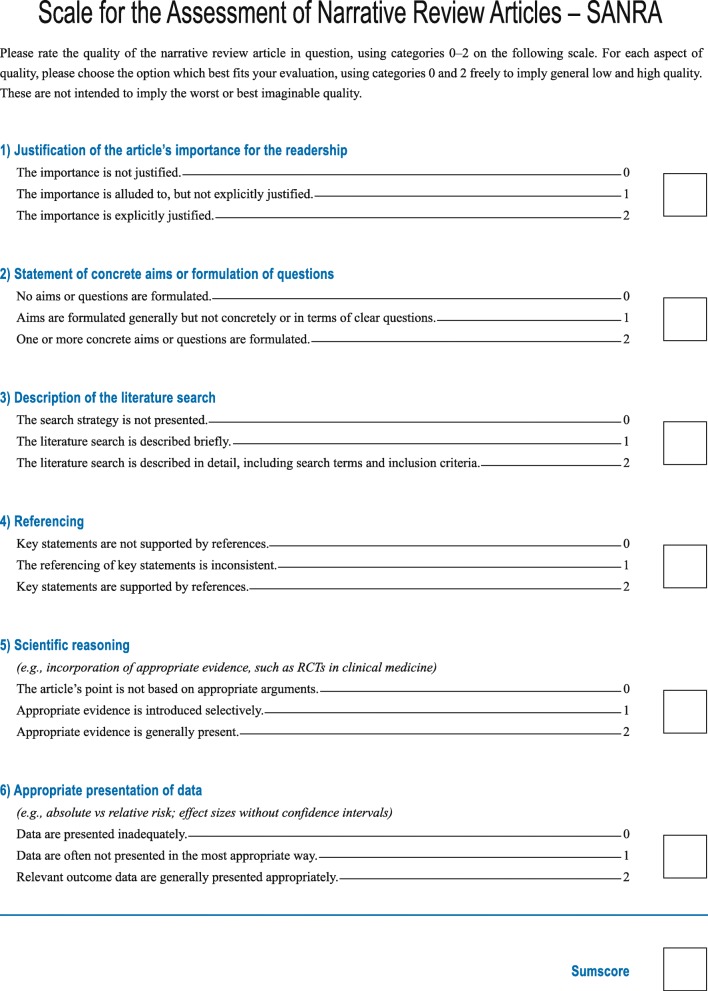
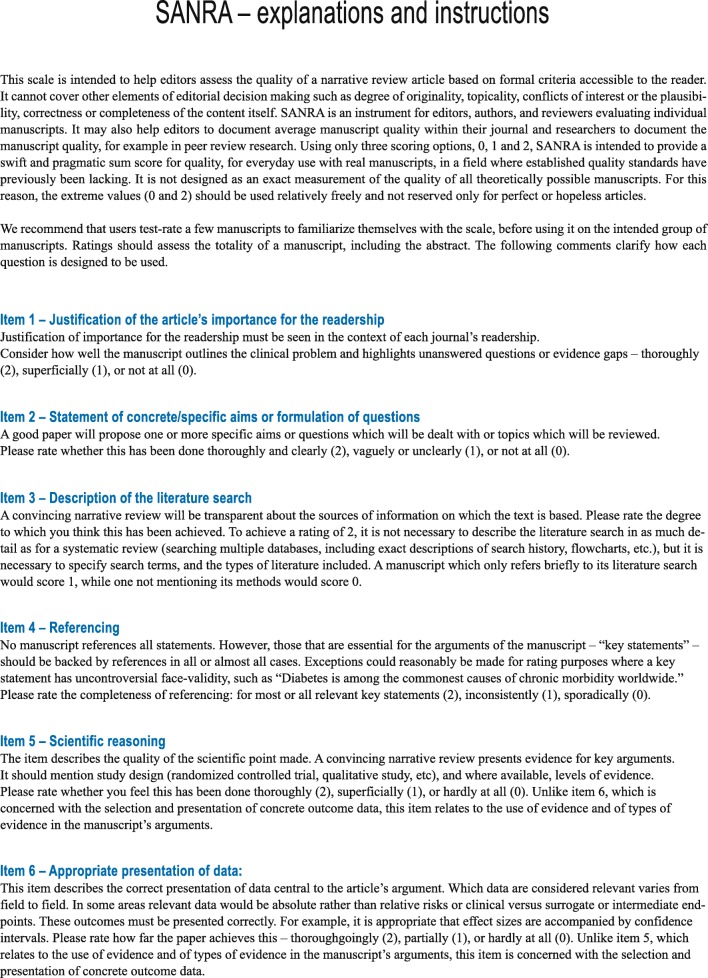
Verification
Claims the paper makes
3 Valid · 0 Not valid · 5 Not checked · 27 Own results and interpretations
The cited sources support only part of this claim — read each source’s verdict below.
In the paper
“Bastian et al. found that they constitute the largest share of all text types in medicine and they concluded that they “remain the staple of medical literature” [1].”
- Also stated in: § Background · plain
“Narrative reviews are the commonest type of articles in the medical literature.”
§ SANRA—a scale for the quality assessment of narrative review articles > Background
What the sources say
- Partly supportedcites [1] Bastian H Glasziou P Chalmers I Seventy-five trials and eleven systematic reviews a day: how will we ever keep up? PLoS Med 2010 7 9 e1000326 10.1371/journal.pmed.1000326 20877712 PMC2943439 sourceExperimental — accuracy not yet measured
In “How Close Are We to Archie Cochrane’s Goal?” and the Summary Points (pages unavailable), the paper calls non-systematic narrative reviews the staple of medical literature synthesis. It does not say they constitute the largest share of all medical text types; that extends a claim about literature synthesis to medical literature as a whole. (LLM, conf=0.88)
plain- Asserted: passes — The authors put it forward as true.
- Checkable: passes — It can be checked against evidence.
- Load-bearing: unclear — It is unclear whether the paper’s conclusions depend on it.
- Based: passes — The paper gives a reason why it holds.
- Also stated in: § Background · plain
The sources with a verdict support this claim; the rest weren’t checked yet, have no full text we could read, or their verdicts aren’t rated yet.
In the paper
“non-systematic reviews or narrative reviews have been widely criticized as unreliable [1, 4].”
§ SANRA—a scale for the quality assessment of narrative review articles > Background
What the sources say
- Supportedcites [1] Bastian H Glasziou P Chalmers I Seventy-five trials and eleven systematic reviews a day: how will we ever keep up? PLoS Med 2010 7 9 e1000326 10.1371/journal.pmed.1000326 20877712 PMC2943439 source
In “How Close Are We to Archie Cochrane’s Goal?”, the paper describes reviews not conducted systematically as having great potential for error and calls them less reliable forms of information. Box 1 also says that articles and textbooks had highlighted the risk of bias and chance in reviews. Together, these passages support the broad characterization that narrative reviews have been criticized as unreliable; page numbers are not provided in our copy. (LLM, conf=0.89)
- Not checked — no full text of the sourcecites [4] Mulrow CD The medical review article: state of the science Ann Intern Med 1987 106 485 488 10.7326/0003-4819-106-3-485 3813259 source
plain- Asserted: passes — The authors put it forward as true.
- Checkable: passes — It can be checked against evidence.
- Load-bearing: passes — The paper’s conclusions depend on it.
- Based: passes — The paper gives a reason why it holds.
- Supported
A result the paper reports from its own data — it cites no other source for it, so there is none to check. The quote shows it is in the paper.
In the paper
“Cronbach’s alpha was 0.68 (internal consistency).”
- Also stated in: § Results · plain
“The scale’s internal consistency, measured as Cronbach’s alpha, was 0.68.”
§ SANRA—a scale for the quality assessment of narrative review articles > Abstract > Results
plainn = 90- Asserted: passes — The authors put it forward as true.
- Checkable: passes — It can be checked against evidence.
- Load-bearing: passes — The paper’s conclusions depend on it.
- Based: passes — The paper gives a reason why it holds.
- Also stated in: § Results · plain
A result the paper reports from its own data — it cites no other source for it, so there is none to check. The quote shows it is in the paper.
In the paper
“Raters often disagreed on items 1 and 4.”
- Also stated in: § Results · plain
“Disagreements most often occurred with regard to items 1 and 4.”
§ SANRA—a scale for the quality assessment of narrative review articles > Abstract > Results
plain- Asserted: passes — The authors put it forward as true.
- Checkable: passes — It can be checked against evidence.
- Load-bearing: unclear — It is unclear whether the paper’s conclusions depend on it.
- Based: passes — The paper gives a reason why it holds.
- Also stated in: § Results · plain
A result the paper reports from its own data — it cites no other source for it, so there is none to check. The quote shows it is in the paper.
In the paper
“The intra-class correlation coefficient (average measure) was 0.77 [95% CI 0.57, 0.88] (inter-rater reliability).”
- Also stated in: § Results · plain
“The intra-class correlation coefficient (average measure) amounted to 0.77 [95% CI 0.57, 0.88; F 4.3; df 29, 58].”
§ SANRA—a scale for the quality assessment of narrative review articles > Abstract > Results
plain- Asserted: passes — The authors put it forward as true.
- Checkable: passes — It can be checked against evidence.
- Load-bearing: passes — The paper’s conclusions depend on it.
- Based: passes — The paper gives a reason why it holds.
- Also stated in: § Results · plain
14 more claims
Create a free account to see all 35 claims and to verify the 3 references still open.
- Probably not a substantial claim. 11
- It may state two separate claims as one. 11
Claims other papers make about this one
Each is checked against this paper’s own text: does it say what the citing paper says it does?
The source backs part of the claim, not all of it — or backs it for a different population, condition or comparison.
In the citing paper
“The review was conducted and reported in accordance with the principles of the Scale for the Assessment of Narrative Review Articles (SANRA), which provides a validated framework for ensuring methodological transparency, scientific rigor, and balanced interpretation in narrative reviews [ 19 ].”
From Paracetamol: A History of Assumptions, Errors, and Evidence Reversals in Pain Management (2026) · cites this paper as [19]
Experimental — accuracy not yet measuredThe source backs part of the claim, not all of it — or backs it for a different population, condition or comparison.
In the citing paper
“As a narrative review, the present work does not include an aggregated quantitative assessment and is more exposed to selection subjectivity than a registered systematic review [124,125].”
From Berberine-Drug Interactions: Mechanisms, Clinical Relevance and Risk Stratification-A Narrative Review (2026) · cites this paper as [124]
Experimental — accuracy not yet measuredThe cited source says what the claim attributes to it.
In the citing paper
“This work is designed as a structured narrative review, with transparent reporting of the documentation strategy, guided by the quality criteria of the Scale for the Assessment of Narrative Review Articles (SANRA) [124].”
From Berberine-Drug Interactions: Mechanisms, Clinical Relevance and Risk Stratification-A Narrative Review (2026) · cites this paper as [124]
The cited source says what the claim attributes to it.
In the citing paper
“we used the following:-Cochrane Risk of Bias 2 (RoB 2) [29] and PEDRO scale tools for RCTs.-AMSTAR 2 [30] checklist for systematic review.-SANRA (Scale for the Assessment of Narrative Review Articles) [31] for narrative reviews.-JBI Checklist for Text and Opinion [32] for expert opinion papers.”
From Pelvic Floor Muscle Training Following Surgery for Pelvic Organ Prolapse: Recommendation from Scientific Literature (2026) · cites this paper as [31]
The cited source says what the claim attributes to it.
In the citing paper
“Data analysis employed a narrative and thematic synthesis methodology,adhering to the SANRA guidelines for narrative reviews (32).”
From Ethical issues in multi-agent AI systems for healthcare: a narrative review (2026) · cites this paper as [32]
12 more claims about this paper
Create a free account to see every claim other papers make about this one.
Citations
Cites
Shea, B. J., Reeves, B. C., Wells, G., Thuku, M., Hamel, C., Moran, J., Moher, D., Tugwell, P., Welch, V., Kristjansson, E., et al. (2017) · BMJ · doi:10.1136/bmj.j4008 · Cited by 10,636 · cited 2×
“Critical appraisal tools have been developed for systematic reviews (e.g., AMSTAR 2 [A MeaSurement Tool to Assess Systematic Reviews] [7]) and papers on RCTs (e.g., the CASP [Critical Appraisal Skills Program] checklist for randomized trials [8]) and other types of medical studies.”
BackgroundStreiner, D. L., & Norman, G. R. (2008) · doi:10.1093/acprof:oso/9780199231881.001.0001 · Cited by 2,631
Critical appraisal skills programme
Singh, J. (2013) · Journal of Pharmacology and Pharmacotherapeutics · doi:10.4103/0976-500x.107697 · Cited by 2,556
Guidelines for Reporting Reliability and Agreement Studies (GRRAS) were proposed
Kottner, J., Audigé, L., Brorson, S., Donner, A., Gajewski, B. J., Hróbjartsson, A., Roberts, C., Shoukri, M., & Streiner, D. L. (2011) · Journal of Clinical Epidemiology · doi:10.1016/j.jclinepi.2010.03.002 · Cited by 2,174
The Mass Production of Redundant, Misleading, and Conflicted Systematic Reviews and Meta‐analyses
IOANNIDIS, J. P. A. (2016) · The Milbank Quarterly · doi:10.1111/1468-0009.12210 · Cited by 1,483 · cited 1×
“While systematic reviews are not per se superior articles and while certain systematic reviews have been criticized lately [3], non-systematic reviews or narrative reviews have”
BackgroundSeventy-five trials and eleven systematic reviews a day: how will we ever keep up?
Bastian, H., Glasziou, P., & Chalmers, I. (2010) · PLoS Medicine · doi:10.1371/journal.pmed.1000326 · Cited by 1,188 · cited 2×
“found that they constitute the largest share of all text types in medicine and they concluded that they “remain the staple of medical literature” [1].”
BackgroundThe Medical Review Article: State of the Science
MULROW, C. D. (1987) · Annals of Internal Medicine · doi:10.7326/0003-4819-106-3-485 · Cited by 856 · cited 1×
“been widely criticized as unreliable [1, 4].”
Writing a narrative biomedical review: considerations for authors, peer reviewers, and editors
Gasparyan, A. Y., Ayvazyan, L., Blackmore, H., & Kitas, G. D. (2011) · Rheumatology International · doi:10.1007/s00296-011-1999-3 · Cited by 694 · cited 1×
“[13], for example, have provided guidance for writing narrative reviews, and Byrne [14] as well as Pautasso [15] has written, from different angles, thoughtful editorials on improving narrative reviews and presented lists of key features of writing a good review—lists that naturally overlap with SANRA items (e.”
BackgroundTen Simple Rules for Writing a Literature Review
Pautasso, M. (2013) · PLoS Computational Biology · doi:10.1371/journal.pcbi.1003149 · Cited by 272 · cited 3×
“[13], for example, have provided guidance for writing narrative reviews, and Byrne [14] as well as Pautasso [15] has written, from different angles, thoughtful editorials on improving narrative reviews and presented lists of key features of writing a good review—lists that naturally overlap with SANRA items (e.”
BackgroundImproving the peer review of narrative literature reviews
Byrne, J. A. (2016) · Research Integrity and Peer Review · doi:10.1186/s41073-016-0019-2 · Cited by 159 · cited 3×
“[13], for example, have provided guidance for writing narrative reviews, and Byrne [14] as well as Pautasso [15] has written, from different angles, thoughtful editorials on improving narrative reviews and presented lists of key features of writing a good review—lists that naturally overlap with SANRA items (e.”
Background
Research works printed but not linked: 3
- Higgins JPT, Green S. (eds.). Cochrane Handbook for Systematic Reviews and Interventions. Version 5.1.0. The Cochrane Collaboration 2011, section 1.2.2., www.handbook.cochrane.org, retrieved on Oct 31, 2018.
- Baethge C Mertens S Goldbeck-Wood S Development of a quality score for the assessment of non-systematic review articles (SANRA) Poster, Seventh International Congress on Peer Review and Biomedical Publication 2013 USA Chicago, Illinois
- Baethge C Goldbeck-Wood S Mertens S A scale for the assessment of non-systematic review articles (SANRA) Poster, Eighth International Congress on Peer and Biomedical Publication 2017 USA Chicago, Illinois
Cited by
Items 1,601–1,700 of 4,334
Economic effects of Mpox: A short analysis
Shang, Z. (2025) · Social Sciences & Humanities Open · doi:10.1016/j.ssaho.2025.102207 · Cited by 1
Qi, J., Hossain, M. Z., Ando, H., Roy, R. R., & Kitagawa, J. (2025) · Cells · doi:10.3390/cells14221795 · Cited by 2
“The review was prepared in accordance with the SANRA (Scale for the Assessment of Narrative Review Articles) guidelines [49] to ensure clarity, methodological transparency, and scientific rigor.”
Radiological Differentiation of Pituitary Adenomas From Other Sellar Masses: A Systematic Review
Goyal, R. K., Khaing, I., Madhusuthanan, A. K., ., D., Garg, G., & Anwar, S. (2025) · Cureus · doi:10.7759/cureus.96793 · Cited by 1
“…studies, case series, and case reports; Quality Assessment of Diagnostic Accuracy Studies-2 (QUADAS-2) [18] for diagnostic-accuracy studies (including AI classifiers used for differential diagnosis); and Scale for the Assessment of Narrative Review Articles (SANRA) [19] for narrative reviews.”
Tuono, R. D. M., Louokdom, J. S., Njopwouo, M. S., & Tagny, C. T. (2025) · Thrombosis Journal · doi:10.1186/s12959-025-00804-x · Cited by 3
“…of Preferred Reporting Items for Systematic Reviews and Meta-Analyses (PRISMA) [34] and the Cochrane Hand-book for Systematic Reviews of Interventions [35] made it possible to carry out the systematic review of databases and search engines. assessed by a SMD that ranged from moderate to large.”
Lombardo, M. (2025) · Frontiers in Nutrition · doi:10.3389/fnut.2025.1665566 · Cited by 1
“This narrative review was conducted following the SANRA (Scale for the Assessment of Narrative Review Articles) guidelines (13), to ensure transparency, methodological rigor, and comprehensive reporting.”
Methodological guidance for individual participant data meta-analyses: a systematic review
Otalike, E. G., Clarke, M. J., Akhter, F., Veroniki, A. A., Kandala, N., & Gagnier, J. J. (2025) · Journal of Clinical Epidemiology · doi:10.1016/j.jclinepi.2025.112089 · Cited by 1
Niemczyk, S., Niemczyk, W., Bąk-Drabik, K. K., Latusek, K., Zawilska, A., Wiench, R., Hadzik, J., & Dominiak, M. (2025) · Journal of Clinical Medicine · doi:10.3390/jcm14238392 · Cited by 1
“Due to the nature of the issue, the authors chose to do a narrative review, but in ensuring its reliability, they followed the Scale for the Assessment of Narrative Review Articles (SANRA) guidelines [17].”
Röttgering, J. G., Choi, E., Douw, L., de Vries, R., Brie, M. S., Taylor, J. W., Klein, M., & Jamora, C. W. (2025) · Heliyon · doi:10.1016/j.heliyon.2025.e44183 · Cited by 1
Lombardo, M., Aiello, G., Gonzalez, A., Muthanna, F. M. S., Scoditti, E., Tripodi, G., & Baldelli, S. (2025) · Nutrition Reviews · doi:10.1093/nutrit/nuaf237 · Cited by 1
Interplay Between Sestrin Proteins and Ferroptosis: A Comprehensive Review of Regulatory Mechanisms
Wu, Y., Sun, Y., Fede, C., & Stecco, C. (2025) · Molecular Biotechnology · doi:10.1007/s12033-025-01539-w · Cited by 1
“We conducted a literature review according to the guidelines of narrative review, which was published in 2019 by Baethge C, etc. al [37].”
CBRNE education and training for Polish health professionals: Where do we stand?
Długosz, K., Łyziński, K., & Seweryn, B. (2025) · Folia Medica Cracoviensia · doi:10.24425/fmc.2025.156129 · Cited by 1
“The narrative review was prepared in accordance with SANRA ( Scale for the Assessment of Narrative Review Articles ) [14].”
Tapaswi, J. J., Urkude, A. S., Bhosale, S., Seth, A., Sharma, V., Mahajon, B., & Deogade, M. S. (2025) · International Journal of Ayurveda Research · doi:10.4103/ijar.ijar_283_25 · Cited by 1
Rectal Stimulation in Premature and Full-Term Newborns: A Narrative Review
Rossi, S., Calza, S., Rosa, C. D., Ottonello, G., Dasso, N., Mora, R. D. R. D., Artuso, I., Caracciolo, G. M., Serveli, S., & Scelsi, S. (2025) · Children · doi:10.3390/children12121656 · Cited by 2
“No acknowledged guidelines are available for writing narrative reviews; therefore, we applied the SANRA scale (Scale for the Assessment of Narrative Review Articles) to ensure quality and transparency in reporting [13] (see Supplementary File S1).”
Artificial intelligence for atrial fibrillation prediction while in sinus rhythm: a narrative review
Saiz-Vivó, J., Chakravarthy, N., Ho, W. H. H., Ching, C. K., Yeung, W. L. K., Lim, T. W., Wang, X., & Yang, F. (2025) · European Heart Journal - Digital Health · doi:10.1093/ehjdh/ztaf144 · Cited by 1
“8 To identify the most relevant articles involving the application of AI for prediction of AF from SR, a structured search of academic databases, including PubMed, ScienceDirect, Embase, Engineering Village, and IEEE Xplore, was performed, focusing on publications from January 1st 2015 through…”
Prasetyo, S., Permatasari, R. E., & Prabowo, R. (2025) · BIO Web of Conferences · doi:10.1051/bioconf/202519605005 · Cited by 1
Acevedo, A. M., & Zeigler, Z. (2025) · Military Medicine · doi:10.1093/milmed/usaf597 · Cited by 1
Wiedermann, C. J., Zaboli, A., & Turcato, G. (2025) · International Journal of Translational Medicine · doi:10.3390/ijtm6010002 · Cited by 1
“The methodological approach adhered to the Scale for the Assessment of Narrative Review Articles (SANRA) checklist for transparency in aims, the literature search, referencing, evidence synthesis, and logical presentation [34].”
From Repair to Prevention: The Emerging Role of Preventive Orthopedics
Martinez, H. E. L., Lugo, J. P. B., Vélez-Ramos, L., Saigal, A. N., & Señeriz-Ortiz, R. (2025) · Cureus · doi:10.7759/cureus.100008 · Cited by 2
Sharma, Y., Obidigbo, B., Oguama, U., Ogbodo, K., Prasad, S., Paul, I., & Maria, E. (2025) · Cureus · doi:10.7759/cureus.100203 · Cited by 2
“We followed good practice guidance for narrative syntheses - prioritizing transparency in scope, sources, and thematic organization - rather than applying a systematic review framework [25-27].”
Healthy aging psychological interventions for the elderly population: A narrative review
Levskaya, L., & Pipere, A. (2025) · doi:10.59893/szv.2025.2(11 · Cited by 2
Indications for Dialysis in Lithium Toxicity: A Narrative Review
Aydın, İ. H., Ibrahim, K., Abuelazm, H., Stephenson, T. L., Brikker, E., & El‐Mallakh, R. S. (2026) · Kidney and Dialysis · doi:10.3390/kidneydial6010005 · Cited by 1
“We addressed the six quality points of the Scale for the Assessment of Narrative Review Articles (SANRA) [37].”
Carter, E., Sagaribay, R., Singh, A. K., Evangelista, L. S., Kuhls, D. A., Pharr, J. R., & Batra, K. (2026) · Healthcare · doi:10.3390/healthcare14010114 · Cited by 1
“This comprehensive review was conducted from 28 August through 16 September 2025 in accordance with the SANRA (Scale for the Assessment of Narrative Review Articles) guidelines [40].”
Celi, S., Citriniti, E., Romano, R. L., Bortoli, N., & Gheri, F. (2026) · Journal of Emergency Nursing · doi:10.1016/j.jen.2025.12.001 · Cited by 1
Lafeber, A. H., de Kraker, L. C. D., van Goudoever, J. B., & de Groof, F. (2026) · Current Opinion in Clinical Nutrition & Metabolic Care · doi:10.1097/mco.0000000000001206 · Cited by 1
Research progress in the application of stent in TIPS procedures
Qi, L., Wang, Y., Li, W., Li, S., & Zhou, J. (2026) · Science Progress · doi:10.1177/00368504251412571 · Cited by 1
“6”
Occhigrossi, F., Mosca, J., Leoni, M. L. G., Pasqualucci, A., Gazzeri, R., Cascella, M., & Varrassi, G. (2026) · Exploration of Immunology · doi:10.37349/ei.2026.1003235 · Cited by 1
Kusi‐Appiah, E., Rewa, O. G., Allana, S., Montgomery, C., & Papathanassoglou, E. (2026) · Nursing in Critical Care · doi:10.1111/nicc.70336 · Cited by 1
“The Scale for the Assessment of Narrative Review Articles (SANRA) guided reporting [44].”
Management of Surgical Complications in Pediatric Kidney Transplantation
Corzo, M. P., Rasmussen, S. K., & Nathan, J. D. (2026) · Journal of Clinical Medicine · doi:10.3390/jcm15020779 · Cited by 1
“This narrative review was performed following the SANRA guidelines [19].”
Zuccotti, G., Calcaterra, V., Rossi, V., Vincenti, A., Loperfido, F., Baldassarre, P., Maccarini, B., Fasano, A., & Cena, H. (2026) · Frontiers in Nutrition · doi:10.3389/fnut.2026.1751559 · Cited by 1
Okocha, J., Adigwe, I., & Adebiyi, A. A. (2025) · NIPES Journal of Science and Technology Research · doi:10.37933/nipes/7.4.2025.si42 · Cited by 1
Medical and psychosocial influences on quality of life in endometriosis: A holistic narrative review
Helgerth, K. A. C., & Schütz, A. (2026) · Journal of Endometriosis and Pelvic Pain Disorders · doi:10.1177/22840265251411717 · Cited by 1
“To ensure scientific rigor, the Scale for the Assessment of Narrative Review Articles 21 was used to select high-quality studies, following Baumeister and Leary’s 22 criteria for a structured and comprehensive synthesis.”
Sacchini, F., Biondini, F., Cangelosi, G., Palomares, S. M., Mancin, S., Parozzi, M., Caggianelli, G., Russotto, S., Masini, A., Lopane, D., et al. (2026) · Psychiatry International · doi:10.3390/psychiatryint7010024 · Cited by 1
Telerehabilitation in the management of urinary incontinence in women: a narrative review
Roshdi, G., & Motealleh, A. (2026) · BMC Women s Health · doi:10.1186/s12905-025-04215-y · Cited by 2
“Full-text review assessed 45 articles for eligibility, of which 20 were excluded due to inadequate focus on telerehabilitation interventions for UI or insufficient methodological rigor based on SANRA quality criteria [19].”
Τάσιου, Α., Tzerefos, C., Janssen, I. K., Karagianni, M. D., Peramatzis, K., Tsianaka, E., Gazioğlu, N., Keser, N., Karampouga, M., Mihaylova, S., et al. (2026) · Cureus · doi:10.7759/cureus.102770 · Cited by 1
“The review was prepared in accordance with the SANRA (Scale for the Assessment of Narrative Review Articles) guidelines to ensure methodological rigor in literature search, synthesis, and reporting [6].”
Wang, C., Colonnello, E., Sansone, A., Wang, J., Zhang, Y., & Jannini, E. A. (2025) · Sexual Medicine Reviews · doi:10.1093/sxmrev/qeaf075 · Cited by 1
Anaesthesia in Microsurgical Flap Reconstruction: A Review
Arturi, F., Letizia, S., Melegari, G., Francesco, M., Fabio, G., Bertellini, E., Giacomo, C., & Alberto, B. (2026) · Surgeries · doi:10.3390/surgeries7010021 · Cited by 1
“Our goal in applying these criteria is to achieve greater clarity and completeness for the readers of the article itself [8].”
Shao, W., Lu, Z., Wei, X., 孔蕴源, Long, Y., Zhang, Y., & Shao, R. (2026) · Science Progress · doi:10.1177/00368504251409841 · Cited by 1
“15 To ensure a comprehensive and transparent evidence base, this review was informed by a structured scoping search conducted in accordance with the methodological guidance for scoping reviews.”
Mirabella, G., Privitera, G., Montana, A., Ultimo, L. E., Santonocito, E. F., David, E., Foti, P. V., Palmucci, S., Romeo, P., & Basile, A. (2026) · La radiologia medica · doi:10.1007/s11547-026-02171-7 · Cited by 1
“This approach follows SANRA criteria for quality assessment of narrative reviews [7].”
Wiedermann, C. J., Piccoliori, G., Murali, P., Pizzini, C., & Prainsack, D. H. V. S. (2026) · Healthcare · doi:10.3390/healthcare14040503 · Cited by 1
“To enhance transparency and rigor, this review followed the principles of the Scale for the Assessment of Narrative Review Articles (SANRA) [23], addressing clarity of aims, literature search description, referencing, evidence synthesis, and logical narrative structure.”
Advances in antidepressant pharmacotherapy: phase 3 evidence and clinical perspectives
Cuomo, A., Pinzi, M., & Fagiolini, A. M. (2026) · Expert Opinion on Pharmacotherapy · doi:10.1080/14656566.2026.2634195 · Cited by 1
“This narrative review was conducted using a structured and transparent approach to identify and synthesize evidence on newer antidepressant pharmacotherapies with late-stage clinical development [21,22].”
Ultrasound features of thyroid follicular adenoma and follicular carcinoma: A narrative review
Hou, T., & Nie, F. (2026) · Journal of International Medical Research · doi:10.1177/03000605261418838 · Cited by 1
“This narrative review was conducted according to the Scale for the Assessment of Narrative Review Articles (SANRA) guidelines 13 to ensure a structured and comprehensive synthesis of the literature.”
Artificial intelligence-assisted medical research design for novice researchers: a narrative review
Lee, J. S. (2026) · Journal of Korean Medical Association · doi:10.5124/jkma.25.0156 · Cited by 1
Meniscus extrusion after a medial meniscus root repair: Where we are and how can we solve it?
Ehrke, T. R., Keel, T. J., Guerin, G. E., Wilebski, B. J., Tollefson, L. V., & LaPrade, R. F. (2026) · Science Progress · doi:10.1177/00368504261426669 · Cited by 1
Kunz, E. M., Ciesla, C. D., Foster, D. T., Kioutchoukova, I. P., Manhard, C. E., Gilham, W., & Lucke-Wold, B. P. (2026) · Cerebrovascular Diseases · doi:10.1159/000551033 · Cited by 1
Okeke, J. I. (2025) · Millah Journal of Religious Studies · doi:10.20885/millah.vol24.iss2.ar14 · Cited by 2
“The quality of the review was further guided by principles outlined in the Scale for the Assessment of Narrative Review Articles (SANRA), which emphasizes clarity, justification, and analytical coherence (Baethge et al., 2019; Feldman et al., 2023).”
Machida, M. (2026) · Human Vaccines & Immunotherapeutics · doi:10.1080/21645515.2026.2632446 · Cited by 1
“16”
Sharma, A., Vadhithala, V., Kumar, A., Verma, S., & Katkuri, S. N. (2026) · South African Journal of Clinical Nutrition · doi:10.1080/16070658.2026.2624904 · Cited by 1
Di, J., Xuan, G., Shanshan, X., & Jianzhong, Y. (2026) · Journal of International Medical Research · doi:10.1177/03000605261417865 · Cited by 1
“15 Through systematic screening and analysis of the existing evidence, this review identified modifiable factors for VAP prevention and excluded interventions with no clear benefit.”
Anti-VEGF Agents and the Inner Retina in nAMD: A Narrative Review of RNFL and Ganglion Cell Changes
Tsiropoulos, G. N., Topouzis, F., Amoaku, W. M. K., & Panos, G. D. (2026) · Drug Design Development and Therapy · doi:10.2147/dddt.s591127 · Cited by 1
“20”
Miranda, A. R., Barral, P. E., Serra, S. V., & Soria, E. A. (2026) · The Journal of Nutritional Biochemistry · doi:10.1016/j.jnutbio.2026.110334 · Cited by 1
Zhou, Z., Zhong, M., & Li, S. (2026) · Frontiers in Medicine · doi:10.3389/fmed.2026.1731301 · Cited by 1
“This narrative review was conducted in accordance with the SANRA (Scale for the Assessment of Narrative Review Articles) guidelines (10).”
Shanahan, R. M., Don, N., Hudson, J. S., McCarthy, D. J., Bhatia, S., Sankar, A., Kann, M. R., Andrews, E. G., Biehl, J. T., Agarwal, N., et al. (2026) · Asian Journal of Neurosurgery · doi:10.1055/s-0046-1817813 · Cited by 1
Managing Fever and Vaccination Risks in Dravet Syndrome: From Pathophysiology to Clinical Practice
Ferretti, A., Bianchi, M., COSTA, M., Nardo, G. D., Mennini, M., Perilli, L., Perulli, M., Riva, A., Striano, P., & Parisi, P. (2026) · Journal of Child Neurology · doi:10.1177/08830738261420285 · Cited by 1
Rinaldi, S. S. D., Sudres, J., & Rousseau, A. (2026) · L Évolution Psychiatrique · doi:10.1016/j.evopsy.2026.01.009 · Cited by 1
Garg, S., Young, P. G., Franquemont, C., Conley, R., & Gill, S. S. (2026) · Journal of Functional Biomaterials · doi:10.3390/jfb17030143 · Cited by 2
“A narrative literature review was conducted in accordance with the Scale for the Assessment of Narrative Review Articles (SANRA) guidelines [16].”
Cantoni, C., Vellone, V. G., Cafferata, B., Gaggero, G., Serra, M., Spreafico, F., Bottino, C., & Spaggiari, G. M. (2026) · Cancers · doi:10.3390/cancers18060908 · Cited by 1
Celocentesis: Current Evidence and Future Directions
Cecchini, F., Visentin, S., Giambona, A., Vinciguerra, M., Picciotto, F. P., Andrisani, A., Cassina, M., Londero, A. P., Nicolaides, K. H., & Cosmi, E. (2026) · Journal of Clinical Medicine · doi:10.3390/jcm15062196 · Cited by 1
“A non-systematic review was conducted in accordance with the Scale for the Assessment of Narrative Review Articles (SANRA) for the quality assessment of narrative review articles [14].”
Varrassi, G., Myrcik, D., & Leoni, M. L. G. (2026) · Exploration of Immunology · doi:10.37349/ei.2026.1003240 · Cited by 1
Exercise Training and Biomarkers of Neuroaxonal Injury in Multiple Sclerosis: Narrative Review
Martin, T. B., DuBose, N. G., & Motl, R. W. (2026) · International Journal of Environmental Research and Public Health · doi:10.3390/ijerph23030380 · Cited by 1
“This narrative review was conducted based on the Scale for the Assessment of Narrative Review Articles (SANRA) guidelines [20] and provides an overview and description of common body fluid biomarkers of neuroaxonal injury (e.g., sNfL and sGFAP) in MS, and then focuses on four topical areas…”
Occupational Therapy in the Treatment of Breast Cancer-Related Lymphedema: A Narrative Review
Jiménez-Jiménez, A. B., Elvira-Pastor, I., Mayordomo-Riera, F. J., & Muñoz-Alcaraz, M. N. (2026) · Medical Sciences · doi:10.3390/medsci14010139 · Cited by 1
“As this is a narrative review, no formal assessment of risk of bias or structured grading of certainty (e.g., GRADE) was performed [33].”
Matamala-Molina, E., Morales-Parra, M., & Troncoso-Pantoja, C. (2026) · South Florida Journal of Development · doi:10.46932/sfjdv7n3-010 · Cited by 1
Nonchoice Surgical Decision Making among Patients with Cancer: A Narrative Review
Bechthold, A. C., Kennedy, A., Monton, O., & Kopecky, K. E. (2026) · Medical Decision Making · doi:10.1177/0272989x261427003 · Cited by 2
“33 Initially, we intended to conduct a scoping review and consulted with 2 academic librarians to develop a comprehensive search strategy.”
Ganie, A. U. R., Paul, F. A., & Lone, A. A. (2026) · Psychology Health & Medicine · doi:10.1080/13548506.2026.2645953 · Cited by 1
Helgerth, K. A. C., & Schütz, A. (2026) · Journal of Community Safety and Well-Being · doi:10.35502/jcswb.465 · Cited by 1
Streparola, A., Provasoli, C., Cosmai, S., Modena, G. M., Cattani, D., Dacomi, A., Chiari, C., Scollo, S., Mancin, S., Parozzi, M., et al. (2026) · International Journal of Palliative Nursing · doi:10.12968/ijpn.2025.0036 · Cited by 1
Miscia, M., Raffone, A., Mollica, V., Piazza, P., Cipriani, L., Maletta, M., Ferla, S., Perucci, M., Cortese, F., Pesaresi, I., et al. (2026) · Journal of Clinical Medicine · doi:10.3390/jcm15062452 · Cited by 1
“This narrative review was structured according to the SANRA framework to improve transparency [25].”
Managing Osteoarthritis Pain in Underrepresented Populations: Insights from Mexico and Latin America
Mercado, M. V.-D., Romero-García, P. A., Bhattaram, P., Mendoza-Díaz, C. E., & Ramírez-Pérez, S. (2026) · Journal of Clinical Medicine · doi:10.3390/jcm15062396 · Cited by 1
“This review was conducted according to the Scale for the Assessment of Narrative Review Articles (SANRA) [21].”
Gastrointestinal Toxicities of Targeted Cancer Therapies: A Narrative Review
Omeludike, E., Oguama, U., Ubah, N., Nwabueze, C. O., Okeke, N., Aregbesola, E. T., Igbokwe, M. A., Gujral, M., Lawal, R. A., & Akande, Y. F. (2026) · Cureus · doi:10.7759/cureus.105842 · Cited by 1
Maisoon, B. (2026) · Frontiers in Public Health · doi:10.3389/fpubh.2026.1769017 · Cited by 1
Cruz, S. M. G., Cortés, J. A. G., Betancourt, J. T. S., Cortés, V. A. L., & Basulto, S. F. C. (2025) · DIVULGARE Boletín Científico de la Escuela Superior de Actopan · doi:10.29057/esa.v13iespecial2.15705 · Cited by 1
Collaborative Care for Depression in Chronic Illness: A Narrative Review
Wong, C., & Corso, G. (2026) · Journal of Primary Care & Community Health · doi:10.1177/21501319261434616 · Cited by 2
“26 As a narrative review, the approach prioritizes conceptual integration and clinical relevance over systematic enumeration or exhaustive study tabulation.”
Chen, S., Mao, J., Zhuang, X., Jiang, Y., Zou, Y., Xiang, M., & Shu, Y. (2026) · Science Progress · doi:10.1177/00368504261436956 · Cited by 1
Pérez, M. C., Pérez, A. C., & Aldana, A. C. (2026) · Cureus · doi:10.7759/cureus.106385 · Cited by 1
“To ensure the scientific rigor of this synthesis, the quality of the review was self-assessed using the SANRA scale (Scale for the Assessment of Narrative Review Articles) [26].”
Sidonio, R. F., Corrales‐Medina, F. F., Johnsen, J. M., Sholzberg, M., Malcolmson, C., & Connell, N. T. (2026) · Therapeutic Advances in Hematology · doi:10.1177/20406207261431617 · Cited by 1
“32”
The persistent proatlantal artery: types and subtypes
Rusu, M. C., Tudose, R. C., & Vrapciu, A. D. (2026) · Surgical and Radiologic Anatomy · doi:10.1007/s00276-026-03880-4 · Cited by 1
“This narrative review was conducted in accordance with the Scale for the Assessment of Narrative Review Articles (SANRA) guidelines [5 ].”
From comorbidity to continuum: Alzheimer’s disease and epilepsy are connected-now what?
Alves, S. S., Manzine, P. R., dos Santos, F. M., Migliaccio, M. M., Alves, L. D. C., da Silva-Júnior, R. M. P., Becerra-Hernández, L. V., González-Acosta, C. A., Buriticá, E., Cominetti, M. R., et al. (2026) · Neuroscience & Biobehavioral Reviews · doi:10.1016/j.neubiorev.2026.106682 · Cited by 1
Saloum, A., Zaher, I., Stipho, C. T., Demir, E., Naravetla, V., Pahlevani, M., Yaghi, N. K., & Karsy, M. J. (2026) · BioMedInformatics · doi:10.3390/biomedinformatics6020020 · Cited by 1
“As this is a narrative rather than systematic review, the search and selection process was guided by the Scale for the Assessment of Narrative Review Articles (SANRA) to ensure methodological transparency and balanced coverage [11].”
dos Santos, J. C. C., Arruda, M. A., & Masruha, M. R. (2026) · Frontiers in Human Neuroscience · doi:10.3389/fnhum.2026.1715787 · Cited by 1
“The process was guided by the SANRA (Scale for the Assessment of Narrative Review Articles) framework (Baethge et al., 2019).”
Khan, A., & Madihie, A. (2026) · Counselling and Psychotherapy Research · doi:10.1002/capr.70120 · Cited by 1
Wellens Syndrome in the Modern Era: A Contemporary Review
Bui, A. C. M., Nguyen, N. P., Tran, V.-P., Tran, Q. V., Ha, M. T., Hoang, N., Ngo, H. M., & Tran, P. (2026) · SN Comprehensive Clinical Medicine · doi:10.1007/s42399-026-02351-6 · Cited by 1
Qu, H.-L., Sun, X., Xu, X.-M., & Zhang, X.-B. (2026) · Neurocritical Care · doi:10.1007/s12028-026-02518-y · Cited by 1
“We undertook a focused narrative review of studies pertinent to LCIS, MCE, and neurocritical care management [15, 16].”
Gómez, E. Z., Monge, P. R. D., & Rivero, L. C. C. (2026) · Cureus · doi:10.7759/cureus.107095 · Cited by 1
“…the time-sensitive nature of therapeutic interventions, a narrative interpretative synthesis was selected over quantitative pooling in order to integrate epidemiologic trends, evolving diagnostic criteria, and stepwise management strategies into a coherent and clinically applicable framework [8].”
Weeraratne, H. R., Alwis, S. M., Singh, M.-P., Majumdar, A., & Perini, M. V. (2026) · Digestive and Liver Disease · doi:10.1016/j.dld.2026.03.016 · Cited by 1
The Effects of Bariatric Surgery on Female Fertility: A Narrative Review
Iliopoulou, M., Papageorgiou, T., Eleftheriadis, M., Mastorakos, G., & Valsamakis, G. (2026) · International Journal of Molecular Sciences · doi:10.3390/ijms27083665 · Cited by 1
Innovations in Refractory Melasma: Mechanism-Based Management and Emerging Therapeutic Strategies
Rocafort, S. L., Rivera-Díaz, J., Bonilla, I. M., & Rabelo-Cartagena, J. (2026) · Cureus · doi:10.7759/cureus.107411 · Cited by 2
“Lighter phototypes (I-III) can tolerate deeper peels and higher energy lasers, but photoprotection is essential for all to prevent recurrent and minimize adverse effects [1,4,5,8,20,29,30].”
Correia, J. C., Richard-Lepouriel, H., Chalut-Carpentier, A., & Pataky, Z. (2026) · Frontiers in Psychiatry · doi:10.3389/fpsyt.2026.1699908 · Cited by 2
“…sought to enhance transparency and methodological rigor by adhering to the SANRA (Scale for the Assessment of Narrative Review Articles) guidelines (22), which assess narrative reviews across six domains including justi fi cation of the review ’ s importance, literature search transparency,…”
Gates, P., Zocco, A., & Farnbach, S. (2026) · American Journal of Community Psychology · doi:10.1002/ajcp.70071 · Cited by 1
“As review quality was relevant to the second aim of this umbrella review, this was assessed as per PRIOR guidelines using highly cited and recommended tools — the 16 ‐ item AMSTAR ‐ 2 (Shea et al., 2017) for systematic reviews, and the 6 ‐ item SANRA for narrative reviews (Baethge et al., 2019).”
Gyokova, E. H., Hristova-Atanasova, E., & Dimitrova, K. K. (2026) · International Journal of Molecular Sciences · doi:10.3390/ijms27093748 · Cited by 1
“To enhance transparency, methodological rigour, and critical appraisal, the review process was guided by the SANRA (Scale for the Assessment of Narrative Review Articles) standard [31].”
An equation-based conceptual framework of personal and professional development in pharmacy practice
Odeh, M. M., Murry, L. T., & Desselle, S. P. (2026) · Research in Social and Administrative Pharmacy · doi:10.1016/j.sapharm.2026.04.007 · Cited by 1
Endocrine roles of vitamin D in female reproduction: Mechanisms and clinical implications
Alsuwaidi, A., Anouti, F. A., & Papandreou, D. (2026) · Women s Health · doi:10.1177/17455057261446942 · Cited by 1
“This narrative review was conducted in alignment with principles recommended by SANRA (Scale for the Assessment of Narrative Review Articles) 15 to ensure a comprehensive and high-quality integration.”
Advances in ceRNA regulatory networks in adipogenesis: Mechanistic insights and future perspectives
Wang, Z. W., Zhang, Q., Fu, H., Xue, H., Mu, M., Zhai, Y., Zhai, M., Zhao, N., Wang, H., & 于砚丽 (2026) · Biochemical and Biophysical Research Communications · doi:10.1016/j.bbrc.2026.153838 · Cited by 2
CHEN, C. X. R., Xie, S., Luo, Z., Hu, Z., Du, X., Huang, D., Hu, H., & Peng, S. (2026) · Frontiers in Medicine · doi:10.3389/fmed.2026.1817855 · Cited by 2
Inflammaging and the role of micronutrients as immunomodulators: a pathway to healthy aging
Tan, S. S. L., Garg, V., Dhiman, A., Bansal, N., & Conway, P. L. (2026) · Immunity & Ageing · doi:10.1186/s12979-026-00569-5 · Cited by 2
“Furthermore, this review was further planned, executed, and reported in accordance with the Scale for the Assessment of Narrative Review Articles (SANRA) criteria [28].”
Egan, A. M., Johdi, N. A., Azizan, E. A., Mohd, R., Sakthiswary, R., Shaharir, S. S., & Zailani, M. A. H. (2026) · International Journal of Molecular Sciences · doi:10.3390/ijms27093968 · Cited by 1
“This narrative review was conducted following the standards of the Scale for the Assessment of Narrative Review Articles (SANRAs) criteria [19].”
InfluentialShimizu, E., Yokoiwa, R., & Nakayama, S. (2026) · Applied Sciences · doi:10.3390/app16094448 · Cited by 2
Regional Anaesthesia Approaches in Head and Neck Surgery: Current Evidence and Clinical Applications
Maniaci, A., Lentini, M., Modica, M. S. D., Parisi, F. M., Chiesa-Estomba, C. M., Lechien, J. R., Lombardo, G. A. G., White, M., & Via, L. L. (2026) · Journal of Clinical Medicine · doi:10.3390/jcm15103569 · Cited by 1
Sekito, T., Hirakawa, H., & Sadahira, T. (2026) · Therapeutic Advances in Urology · doi:10.1177/17562872261448600 · Cited by 1
How do ankle-foot orthoses affect slope and stair walking? A narrative review
Waterval, N. F. J., Nollet, F., & Brehm, M. (2026) · Prosthetics and Orthotics International · doi:10.1097/pxr.0000000000000532 · Cited by 1
Systematic review: diagnostic-related failure demand in different health conditions
Nykänen, N., Seppänen, M. R. J., Vartiainen, V. A., Ramste, M. O., & Sanmark, E. (2026) · Journal of Public Health · doi:10.1007/s10389-026-02790-4 · Cited by 1
Paul, J. R., Gandiga, P. C., & Aggarwal, R. (2026) · Best Practice & Research Clinical Rheumatology · doi:10.1016/j.berh.2026.102140 · Cited by 1
Metadata
- Authors
- Baethge, C., Goldbeck-Wood, S., & Mertens, S.
- Affiliations
- University of Cologne (DE)
- BMJ Group (United Kingdom) (GB)
- Corresponding author
- Baethge, Christopher
- ORCID
- Baethge, Christopher
- Venue
- Research Integrity and Peer Review
- Published
- 2019-03-26
- Volume
- 4
- Issue
- 1
- Pages
- 5-5
- ISSN
- 2058-8615 (ISSN-L)
- PMC
- PMC6434870
- OpenAlex
- W2922577842
- Semantic Scholar
- ea7f35b3069b53791c3b746c5c4b3c72a83a526b
- Cited by
- 3,469
- References
- 13
- Citations by year
- 2026: 1823 · 2025: 551 · 2024: 379 · 2023: 309 · 2022: 218 · 2021: 152 · 2020: 32 · 2019: 4
- FWCI
- 20.57
- Type
- journal article
- Language
- en
- Open access
- gold
- doi.org
- Licence
- cc-by
- creativecommons.org/licenses/by/4.0/ (tdm)
- Locations
- Research Integrity and Peer Review (publishedVersion, cc-by)
- Europe PMC (PubMed Central) (publishedVersion, other-oa)
- PubMed Central (publishedVersion, cc-by)
- PubMed (publishedVersion)
- Kölner Universitäts PublikationsServer (Universität zu Köln) (publishedVersion)
- DOAJ (DOAJ: Directory of Open Access Journals) (submittedVersion, cc-by-sa)
- Topics
- Social Sciences › Decision Sciences › Statistics, Probability and Uncertainty › Meta-analysis and systematic reviews
- Social Sciences › Library and Information Sciences › Academic Writing and Publishing
- Social Sciences › Library and Information Sciences › scientometrics and bibliometrics research
- Keywords
- quality assessment scale, manuscript review, inter-rater reliability, level of evidence, scale development
About these checks
Registry, retraction, Cites and statistics results are computed, not judged, with one exception: a printed reference that no index lists is read once by a model before it counts as a citation error. Claims are extracted by a model and kept only when their quote appears verbatim in the text; each cited source is then checked, with a model’s help, for whether it says what the claim relies on. Those verdicts can be wrong — read the claim’s quote and the cited source before relying on one.
The claim verdicts this report counts are experimental: their accuracy is not yet measured.
A language model drew the claims from the paper on 2026-11-10, under version 3 of the claim definition (model deepseek-v4.1-flash, prompt extract-v3).
A second model labelled each claim on 2026-11-10 (model jev-1.13-20260917, definition revision gold-guideline-v0.2).
Cited sources are checked with a language model’s help (gpt-6-sol).
Statistics and arithmetic are recomputed, not judged.
Confidence bands are shown only for fields calibrated on our annotated test set. None is calibrated yet, so no band is shown.
What counts as a claim ›How we measure confidence ›How we check this ›
Are you an author, or do you see a problem with this page? Request a review
Data sources
Bibliographic data: Semantic Scholar, OpenAlex, Crossref.
Contains information from the Semantic Scholar Academic Graph Datasets, made available under the ODC Attribution License (ODC-BY 1.0).
Semantic Scholar’s data is described in: Kinney, R., et al. (2023). The Semantic Scholar Open Data Platform. arXiv:2301.10140.
