

SANRA—a scale for the quality assessment of narrative review articles
Open accessThe DOI matches its Crossref record; 12 of the 13 references it cites were found in a registry or an index; 4 of the 12 sources its claims cite were checked for support.
Abstract
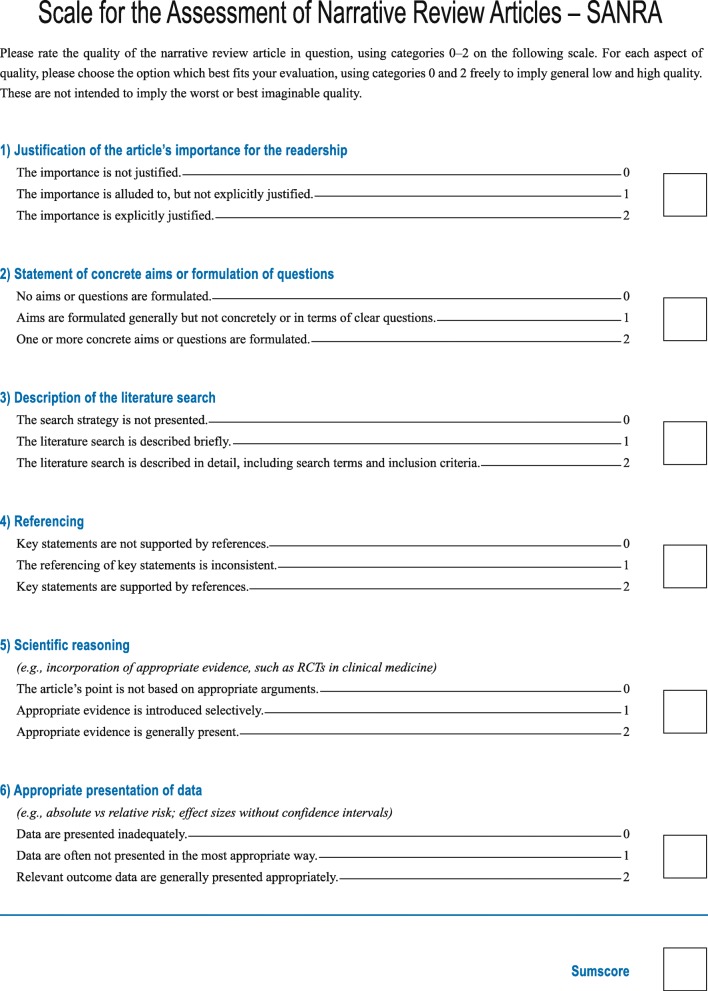
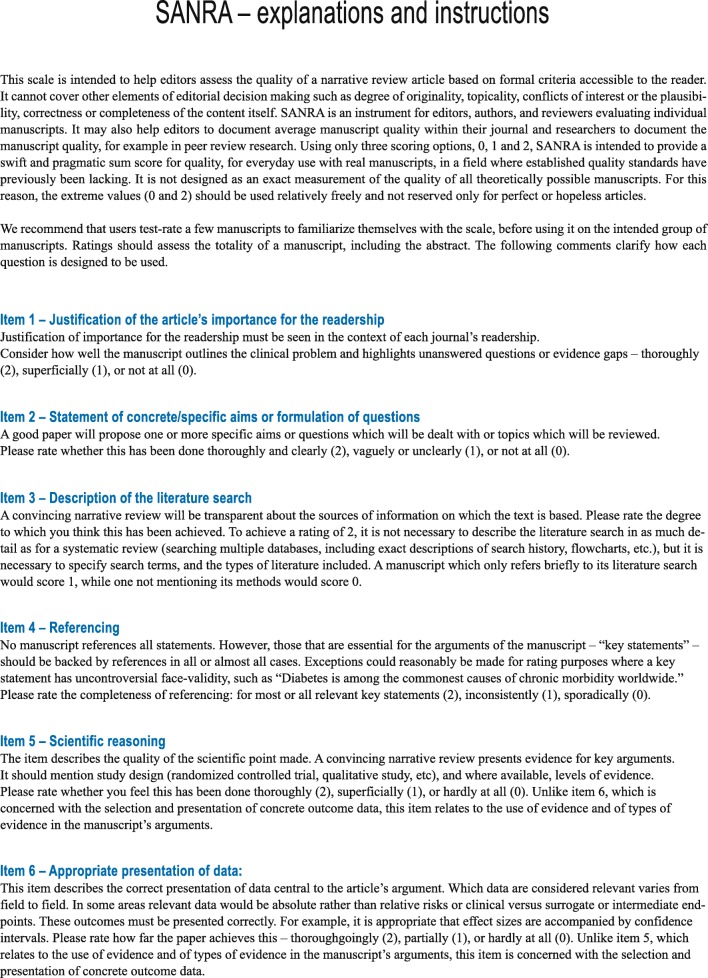
BACKGROUND: Narrative reviews are the commonest type of articles in the medical literature. However, unlike systematic reviews and randomized controlled trials (RCT) articles, for which formal instruments exist to evaluate quality, there is currently no instrument available to assess the quality of narrative reviews. In response to this gap, we developed SANRA, the Scale for the Assessment of Narrative Review Articles. METHODS: A team of three experienced journal editors modified or deleted items in an earlier SANRA version based on face validity, item-total correlations, and reliability scores from previous tests. We deleted an item which addressed a manuscript's writing and accessibility due to poor inter-rater reliability. The six items which form the revised scale are rated from 0 (low standard) to 2 (high standard) and cover the following topics: explanation of (1) the importance and (2) the aims of the review, (3) literature search and (4) referencing and presentation of (5) evidence level and (6) relevant endpoint data. For all items, we developed anchor definitions and examples to guide users in filling out the form. The revised scale was tested by the same editors (blinded to each other's ratings) in a group of 30 consecutive non-systematic review manuscripts submitted to a general medical journal. RESULTS: Raters confirmed that completing the scale is feasible in everyday editorial work. The mean sum score across all 30 manuscripts was 6.0 out of 12 possible points (SD 2.6, range 1-12). Corrected item-total correlations ranged from 0.33 (item 3) to 0.58 (item 6), and Cronbach's alpha was 0.68 (internal consistency). The intra-class correlation coefficient (average measure) was 0.77 [95% CI 0.57, 0.88] (inter-rater reliability). Raters often disagreed on items 1 and 4. CONCLUSIONS: SANRA's feasibility, inter-rater reliability, homogeneity of items, and internal consistency are sufficient for a scale of six items. Further field testing, particularly of validity, is desirable. We recommend rater training based on the "explanations and instructions" document provided with SANRA. In editorial decision-making, SANRA may complement journal-specific evaluation of manuscripts-pertaining to, e.g., audience, originality or difficulty-and may contribute to improving the standard of non-systematic reviews.
Overview
CoChat Summary
TL;DR
SANRA is a six-item, 0–2 scale (maximum 12) for assessing the quality of narrative review articles, developed and field-tested by three journal editors. In 30 consecutive non-systematic review manuscripts, it showed feasible use, sufficient internal consistency and inter-rater reliability, and a modest association with editorial acceptance.
Key findings
- Across 30 manuscripts (90 ratings), the mean SANRA sum score was 6.0 out of 12 (SD 2.6, range 1–12, median 6).
- Internal consistency was Cronbach’s alpha 0.68; corrected item-total correlations ranged from 0.33 (item 3) to 0.58 (item 6).
- Inter-rater reliability was an intra-class correlation coefficient (average measure) of 0.77 [95% CI 0.57, 0.88]; raters often disagreed on items 1 and 4.
- Average SANRA scores were modestly associated with editorial acceptance (mean 6.6, SD 1.9, n = 17) versus rejection (mean 5.1, SD 2.1, n = 13), point biserial correlation 0.37 (t = 2.09, df 28; two-sided p = 0.046).
Methods
- SANRA was developed between 2010 and 2017 by three experienced editors at Deutsches Ärzteblatt; the revised six-item version deleted an item on writing and accessibility due to poor inter-rater reliability.
- The revised scale was tested on 30 consecutive non-systematic review manuscripts submitted to Deutsches Ärzteblatt in 2015; three editor-raters scored them independently and blinded to each other’s ratings.
- Analyses included descriptive statistics, Cronbach’s alpha, corrected item-total correlations, average-measure intra-class correlation using a two-way random effects model (consistency definition), and a post hoc point biserial correlation between SANRA sum scores and acceptance/rejection.
Limitations
- The paper states the main limitation is sample size: 30 manuscripts was a compromise between representativeness, power, and feasibility, and took about 6 months to sample.
- The authors state that the scale’s authors were also the test-raters, so inter-rater reliability may be lower in groups less familiar with SANRA; the study also did not assess test-retest reliability, and results are study-specific.
- The paper acknowledges restricted content validity because SANRA is limited to six items and is a critical appraisal tool rather than a reporting guideline; criterion validity evidence is post hoc and weak, and no established cut-offs exist for comparing manuscripts across settings.
Model-written summary. Check it against the paper before relying on it.
Integrity signals
Registry
Cites
Statistics
Figures
Verification
Claims the paper makes
3 Valid · 0 Not valid · 5 Not checked · 27 Own results and interpretations
The cited sources support only part of this claim — read each source’s verdict below.
In the paper
“Bastian et al. found that they constitute the largest share of all text types in medicine and they concluded that they “remain the staple of medical literature” [1].”
- Also stated in: § Background · plain
“Narrative reviews are the commonest type of articles in the medical literature.”
§ SANRA—a scale for the quality assessment of narrative review articles > Background
What the sources say
- Partly supportedcites [1] Bastian H Glasziou P Chalmers I Seventy-five trials and eleven systematic reviews a day: how will we ever keep up? PLoS Med 2010 7 9 e1000326 10.1371/journal.pmed.1000326 20877712 PMC2943439 sourceExperimental — accuracy not yet measured
In “How Close Are We to Archie Cochrane’s Goal?” and the Summary Points (pages unavailable), the paper calls non-systematic narrative reviews the staple of medical literature synthesis. It does not say they constitute the largest share of all medical text types; that extends a claim about literature synthesis to medical literature as a whole. (LLM, conf=0.88)
plain- Asserted: passes — The authors put it forward as true.
- Checkable: passes — It can be checked against evidence.
- Load-bearing: unclear — It is unclear whether the paper’s conclusions depend on it.
- Based: passes — The paper gives a reason why it holds.
- Also stated in: § Background · plain
The sources with a verdict support this claim; the rest weren’t checked yet, have no full text we could read, or their verdicts aren’t rated yet.
In the paper
“non-systematic reviews or narrative reviews have been widely criticized as unreliable [1, 4].”
§ SANRA—a scale for the quality assessment of narrative review articles > Background
What the sources say
- Supportedcites [1] Bastian H Glasziou P Chalmers I Seventy-five trials and eleven systematic reviews a day: how will we ever keep up? PLoS Med 2010 7 9 e1000326 10.1371/journal.pmed.1000326 20877712 PMC2943439 source
In “How Close Are We to Archie Cochrane’s Goal?”, the paper describes reviews not conducted systematically as having great potential for error and calls them less reliable forms of information. Box 1 also says that articles and textbooks had highlighted the risk of bias and chance in reviews. Together, these passages support the broad characterization that narrative reviews have been criticized as unreliable; page numbers are not provided in our copy. (LLM, conf=0.89)
- Not checked — no full text of the sourcecites [4] Mulrow CD The medical review article: state of the science Ann Intern Med 1987 106 485 488 10.7326/0003-4819-106-3-485 3813259 source
plain- Asserted: passes — The authors put it forward as true.
- Checkable: passes — It can be checked against evidence.
- Load-bearing: passes — The paper’s conclusions depend on it.
- Based: passes — The paper gives a reason why it holds.
- Supported
A result the paper reports from its own data — it cites no other source for it, so there is none to check. The quote shows it is in the paper.
In the paper
“Cronbach’s alpha was 0.68 (internal consistency).”
- Also stated in: § Results · plain
“The scale’s internal consistency, measured as Cronbach’s alpha, was 0.68.”
§ SANRA—a scale for the quality assessment of narrative review articles > Abstract > Results
plainn = 90- Asserted: passes — The authors put it forward as true.
- Checkable: passes — It can be checked against evidence.
- Load-bearing: passes — The paper’s conclusions depend on it.
- Based: passes — The paper gives a reason why it holds.
- Also stated in: § Results · plain
A result the paper reports from its own data — it cites no other source for it, so there is none to check. The quote shows it is in the paper.
In the paper
“Raters often disagreed on items 1 and 4.”
- Also stated in: § Results · plain
“Disagreements most often occurred with regard to items 1 and 4.”
§ SANRA—a scale for the quality assessment of narrative review articles > Abstract > Results
plain- Asserted: passes — The authors put it forward as true.
- Checkable: passes — It can be checked against evidence.
- Load-bearing: unclear — It is unclear whether the paper’s conclusions depend on it.
- Based: passes — The paper gives a reason why it holds.
- Also stated in: § Results · plain
A result the paper reports from its own data — it cites no other source for it, so there is none to check. The quote shows it is in the paper.
In the paper
“The intra-class correlation coefficient (average measure) was 0.77 [95% CI 0.57, 0.88] (inter-rater reliability).”
- Also stated in: § Results · plain
“The intra-class correlation coefficient (average measure) amounted to 0.77 [95% CI 0.57, 0.88; F 4.3; df 29, 58].”
§ SANRA—a scale for the quality assessment of narrative review articles > Abstract > Results
plain- Asserted: passes — The authors put it forward as true.
- Checkable: passes — It can be checked against evidence.
- Load-bearing: passes — The paper’s conclusions depend on it.
- Based: passes — The paper gives a reason why it holds.
- Also stated in: § Results · plain
14 more claims
Create a free account to see all 35 claims and to verify the 3 references still open.
- Probably not a substantial claim. 11
- It may state two separate claims as one. 11
Claims other papers make about this one
Each is checked against this paper’s own text: does it say what the citing paper says it does?
The source backs part of the claim, not all of it — or backs it for a different population, condition or comparison.
In the citing paper
“The review was conducted and reported in accordance with the principles of the Scale for the Assessment of Narrative Review Articles (SANRA), which provides a validated framework for ensuring methodological transparency, scientific rigor, and balanced interpretation in narrative reviews [ 19 ].”
From Paracetamol: A History of Assumptions, Errors, and Evidence Reversals in Pain Management (2026) · cites this paper as [19]
Experimental — accuracy not yet measuredThe source backs part of the claim, not all of it — or backs it for a different population, condition or comparison.
In the citing paper
“As a narrative review, the present work does not include an aggregated quantitative assessment and is more exposed to selection subjectivity than a registered systematic review [124,125].”
From Berberine-Drug Interactions: Mechanisms, Clinical Relevance and Risk Stratification-A Narrative Review (2026) · cites this paper as [124]
Experimental — accuracy not yet measuredThe cited source says what the claim attributes to it.
In the citing paper
“This work is designed as a structured narrative review, with transparent reporting of the documentation strategy, guided by the quality criteria of the Scale for the Assessment of Narrative Review Articles (SANRA) [124].”
From Berberine-Drug Interactions: Mechanisms, Clinical Relevance and Risk Stratification-A Narrative Review (2026) · cites this paper as [124]
The cited source says what the claim attributes to it.
In the citing paper
“we used the following:-Cochrane Risk of Bias 2 (RoB 2) [29] and PEDRO scale tools for RCTs.-AMSTAR 2 [30] checklist for systematic review.-SANRA (Scale for the Assessment of Narrative Review Articles) [31] for narrative reviews.-JBI Checklist for Text and Opinion [32] for expert opinion papers.”
From Pelvic Floor Muscle Training Following Surgery for Pelvic Organ Prolapse: Recommendation from Scientific Literature (2026) · cites this paper as [31]
The cited source says what the claim attributes to it.
In the citing paper
“Data analysis employed a narrative and thematic synthesis methodology,adhering to the SANRA guidelines for narrative reviews (32).”
From Ethical issues in multi-agent AI systems for healthcare: a narrative review (2026) · cites this paper as [32]
12 more claims about this paper
Create a free account to see every claim other papers make about this one.
Citations
Cites
Shea, B. J., Reeves, B. C., Wells, G., Thuku, M., Hamel, C., Moran, J., Moher, D., Tugwell, P., Welch, V., Kristjansson, E., et al. (2017) · BMJ · doi:10.1136/bmj.j4008 · Cited by 10,636 · cited 2×
“Critical appraisal tools have been developed for systematic reviews (e.g., AMSTAR 2 [A MeaSurement Tool to Assess Systematic Reviews] [7]) and papers on RCTs (e.g., the CASP [Critical Appraisal Skills Program] checklist for randomized trials [8]) and other types of medical studies.”
BackgroundStreiner, D. L., & Norman, G. R. (2008) · doi:10.1093/acprof:oso/9780199231881.001.0001 · Cited by 2,631
Critical appraisal skills programme
Singh, J. (2013) · Journal of Pharmacology and Pharmacotherapeutics · doi:10.4103/0976-500x.107697 · Cited by 2,556
Guidelines for Reporting Reliability and Agreement Studies (GRRAS) were proposed
Kottner, J., Audigé, L., Brorson, S., Donner, A., Gajewski, B. J., Hróbjartsson, A., Roberts, C., Shoukri, M., & Streiner, D. L. (2011) · Journal of Clinical Epidemiology · doi:10.1016/j.jclinepi.2010.03.002 · Cited by 2,174
The Mass Production of Redundant, Misleading, and Conflicted Systematic Reviews and Meta‐analyses
IOANNIDIS, J. P. A. (2016) · The Milbank Quarterly · doi:10.1111/1468-0009.12210 · Cited by 1,483 · cited 1×
“While systematic reviews are not per se superior articles and while certain systematic reviews have been criticized lately [3], non-systematic reviews or narrative reviews have”
BackgroundSeventy-five trials and eleven systematic reviews a day: how will we ever keep up?
Bastian, H., Glasziou, P., & Chalmers, I. (2010) · PLoS Medicine · doi:10.1371/journal.pmed.1000326 · Cited by 1,188 · cited 2×
“found that they constitute the largest share of all text types in medicine and they concluded that they “remain the staple of medical literature” [1].”
BackgroundThe Medical Review Article: State of the Science
MULROW, C. D. (1987) · Annals of Internal Medicine · doi:10.7326/0003-4819-106-3-485 · Cited by 856 · cited 1×
“been widely criticized as unreliable [1, 4].”
Writing a narrative biomedical review: considerations for authors, peer reviewers, and editors
Gasparyan, A. Y., Ayvazyan, L., Blackmore, H., & Kitas, G. D. (2011) · Rheumatology International · doi:10.1007/s00296-011-1999-3 · Cited by 694 · cited 1×
“[13], for example, have provided guidance for writing narrative reviews, and Byrne [14] as well as Pautasso [15] has written, from different angles, thoughtful editorials on improving narrative reviews and presented lists of key features of writing a good review—lists that naturally overlap with SANRA items (e.”
BackgroundTen Simple Rules for Writing a Literature Review
Pautasso, M. (2013) · PLoS Computational Biology · doi:10.1371/journal.pcbi.1003149 · Cited by 272 · cited 3×
“[13], for example, have provided guidance for writing narrative reviews, and Byrne [14] as well as Pautasso [15] has written, from different angles, thoughtful editorials on improving narrative reviews and presented lists of key features of writing a good review—lists that naturally overlap with SANRA items (e.”
BackgroundImproving the peer review of narrative literature reviews
Byrne, J. A. (2016) · Research Integrity and Peer Review · doi:10.1186/s41073-016-0019-2 · Cited by 159 · cited 3×
“[13], for example, have provided guidance for writing narrative reviews, and Byrne [14] as well as Pautasso [15] has written, from different angles, thoughtful editorials on improving narrative reviews and presented lists of key features of writing a good review—lists that naturally overlap with SANRA items (e.”
Background
Research works printed but not linked: 3
- Higgins JPT, Green S. (eds.). Cochrane Handbook for Systematic Reviews and Interventions. Version 5.1.0. The Cochrane Collaboration 2011, section 1.2.2., www.handbook.cochrane.org, retrieved on Oct 31, 2018.
- Baethge C Mertens S Goldbeck-Wood S Development of a quality score for the assessment of non-systematic review articles (SANRA) Poster, Seventh International Congress on Peer Review and Biomedical Publication 2013 USA Chicago, Illinois
- Baethge C Goldbeck-Wood S Mertens S A scale for the assessment of non-systematic review articles (SANRA) Poster, Eighth International Congress on Peer and Biomedical Publication 2017 USA Chicago, Illinois
Cited by
Items 1,201–1,300 of 4,334
Prifti, E., & El-Osta, A. A. R. (2025) · BMJ Public Health · doi:10.1136/bmjph-2025-003564 · Cited by 3
“26 Further methodological details are provided as online supplemental material (Section S1-S6, S10,Figure S1) and a summary of included evidence by domain and population focus is presented in the online supplemental material (SectionS7, Table S1).”
Meaning and Psychedelics in Palliative Care: A Narrative Review
Alexander, W. B., Hansen, E., Anderson, B. T., Zarrabi, A. J., Rogers, A. H., Loewen, G., Ficcaro, Z. R., Alexander, M. H., Schaefer, D., & Case, A. A. (2025) · Journal of Pain and Symptom Management · doi:10.1016/j.jpainsymman.2025.10.015 · Cited by 4
den Akker, K. K. V., Christie, H. L., Boots, L. M. M., de Vugt, M. E., & Duits, A. (2025) · Aging & Mental Health · doi:10.1080/13607863.2025.2579159 · Cited by 4
“Finally, the items of the SANRA-scale (Baethge et al., 2019) were taken into account throughout the writing of this narrative review.”
Surgeon leadership in trauma resuscitation requires a competency-based multimodal training framework
Bass, G. A., Duffy, C. C., Cannon, J. W., Yelon, J. A., Ferrada, P. A., Evans, S. L., Leonard, J. M., & Kaplan, L. J. (2025) · Trauma Surgery & Acute Care Open · doi:10.1136/tsaco-2025-001975 · Cited by 3
McGown, P. J., Forshaw, J., & Gould, L. (2025) · Medical Education Online · doi:10.1080/10872981.2025.2579079 · Cited by 3
Immediate kangaroo mother care: a narrative review of the benefits and barriers
Aryadevi, N. N. B., Putri, R. S. I., Satari, H. I., & Marsubrin, P. M. T. (2025) · World Journal of Pediatrics · doi:10.1007/s12519-025-00993-5 · Cited by 5
“Additionally, the Scale for the Assessment of Narrative Review Articles (SANRA) was utilized to increase review quality [18].”
Akbulut, S., & Çolak, C. (2025) · World Journal of Hepatology · doi:10.4254/wjh.v17.i11.109494 · Cited by 5
“In this review, we incorporated the Scale for the Assessment of Narrative Review Articles (SANRA) checklist and the Preferred Reporting Items for Systematic Reviews and Meta-Analyses framework into the methods section to strengthen methodological rigor and reproducibility [28,29].”
Narrative Review: Gut Microbiota and Its Impact on α‐syn Function in Parkinson's Disease
Salinas-Velarde, I. D., Donaciano-Domínguez, J., Oros‐Pantoja, R., Garrido, J. F. A., González‐Cervantes, R. M., Munguía‐Cervantes, J. E., Gómez‐López, M., Bustos‐Martínez, J., & Piña, A. E. S. (2025) · MicrobiologyOpen · doi:10.1002/mbo3.70173 · Cited by 3
Stein, E., Duarte, G. B. S., Bersch-Ferreira, Â. C., Weschenfelder, C., Figueiró, M. F., Rogero, M. M., de Abreu-Silva, E. O., & Marcadenti, A. (2025) · Nutrition Reviews · doi:10.1093/nutrit/nuaf243 · Cited by 4
Evidence Synthesis in Recreational Fisheries Science and Management
Cooke, S. J., Rytwinski, T., Harper, M., Howarth, A. T., Nakagawa, S., & Hunt, L. M. (2025) · Fish & fisheries series/Fish and fisheries series (Print) · doi:10.1007/978-3-031-99739-6_19 · Cited by 3
Passion, Motivation, and Well-Being in Young Footballers: A Systematic Review
Braz, D. S., Maia, C., Gouveia, É. R., Monteiro, D., Couto, N., & Sarmento, H. (2025) · Healthcare · doi:10.3390/healthcare13243273 · Cited by 6
“For Vallerand’s [49] narrative study, the SANRA scale [50] will be used, which consists of six items rated from 0 (low quality) to 2 (high quality), with a maximum score of 12.”
Kahraman, T., & Ayaz, A. (2025) · Medicina · doi:10.3390/medicina61122211 · Cited by 4
“This narrative review was conducted in accordance with the SANRA (Scale for the Assessment of Narrative Review Articles) guidelines [21].”
Possner, M., Schwitz, F., Zach, N., Karrer, T., Tam, J., Oechslin, E., Muhll, I. V., Wolofsky, K. T., Birnie, D., Beauchesne, L., et al. (2025) · CJC Pediatric and Congenital Heart Disease · doi:10.1016/j.cjcpc.2025.09.002 · Cited by 3
“Narrative reviews and book chapters were appraised using the Scale for the Assessment of Narrative Review Articles (SANRA), 21 which assesses quality based on criteria such as clarity, referencing, and scientific reasoning.”
O’Hara, R. B., Loftis, S. C., & Rando, C. M. (2025) · Journal of Biomedical Research & Environmental Sciences · doi:10.37871/jbres2228 · Cited by 3
Walaszek, M., Cubała, W. J., & Kachlik, Z. (2025) · Journal of Clinical Medicine · doi:10.3390/jcm15010150 · Cited by 3
“The conduct and reporting of the review were informed by the SANRA (Scale for the Assessment of Narrative Review Articles) framework to support clarity, coherence, and methodological transparency [9].”
Treatment Gap in Mental Health Care among Low- and Middle-income Countries: A Narrative Review
Rajan, V., Patra, S., Behera, P., Singh, A. K., & Patro, B. K. (2025) · Indian Journal of Social Psychiatry · doi:10.4103/ijsp.ijsp_225_24 · Cited by 4
Giguère, R., Marois, A., Fortin‐Guichard, D., Charest, J., Rocheleau, J., Thompson, K., Stolberg, M., St‐Martin, P., Bergouignan, A., Niaussat, V., et al. (2026) · Frontiers in Physiology · doi:10.3389/fphys.2025.1729596 · Cited by 3
“The review was self-assessed using the Scale for Assessment of Narrative Review (SANRA) quality guidelines (Multimedia Appendix 1) (Baethge et al., 2019).”
Angelopoulou, E., Papageorgiou, S. G., & Papatriantafyllou, J. D. (2026) · Neurology International · doi:10.3390/neurolint18010018 · Cited by 3
“The methodological principles of a structured narrative review, guided by the Scale for the Assessment of Narrative Review Articles (SANRA) recommendations [6].”
Sleep, Stress, and Recovery as Predictors of Injury Risk in Soccer Players: A Systematic Review
Cantón, E., Raga, J., & Peris-Delcampo, D. (2026) · Healthcare · doi:10.3390/healthcare14020236 · Cited by 3
“For narrative reviews, the SANRA scale [14] was used.”
SANRA: a guide for the evaluation and development of narrative reviews
Fuentes-Barria, H., Aguilera-Eguía, R. A., Soto, O. P. L., & Aristizábal-Hoyos, J. A. (2026) · Nutrición Hospitalaria · doi:10.20960/nh.06153 · Cited by 3
Reezigt, R. R., Beetsma, A. J., Catley, M. J., Palermo, T. M., Pate, J. W., Leake, H. B., Reneman, M. F., Watson, J. A., Ryan, C. G., & Moseley, G. L. (2026) · Journal of Pain · doi:10.1016/j.jpain.2026.106195 · Cited by 3
Schleimer, T., Innocenti, T., Foster, N. E., Ferreira, M. L., & Chiarotto, A. (2026) · Osteoarthritis and Cartilage · doi:10.1016/j.joca.2026.01.013 · Cited by 4
Dahò, M., & Monzani, D. (2026) · Current Psychology · doi:10.1007/s12144-025-08959-6 · Cited by 5
“To assess the methodological quality of this narrative review, we completed the Scale for the Assessment of Nar - rative Review Articles (SANRA; Baethge et al., 2019 ).”
Akbulut, S., & Çolak, C. (2026) · World Journal of Gastrointestinal Oncology · doi:10.4251/wjgo.v18.i2.113870 · Cited by 4
“…quality of the included studies was assessed using: Elements adapted from the Scale for the Assessment of Narrative Review Articles (SANRA) criteria[70], specifically focusing on: (1) Comprehensiveness of literature search: Evaluation of the reported search strategy and its ability to identify…”
Jiang, J., Zhong, Q., Yin, Z., Zhou, Q., Wang, Y., & Yan, Z. (2026) · International Journal of Behavioral Nutrition and Physical Activity · doi:10.1186/s12966-026-01874-4 · Cited by 4
Digital twins in urology: a vision for the future of urological practice
Nedbal, C., Madaan, S., Ghulam, N., & Somani, B. K. (2026) · Therapeutic Advances in Urology · doi:10.1177/17562872261419592 · Cited by 4
Gelardi, M. (2026) · Cells · doi:10.3390/cells15040323 · Cited by 3
“…proportion of patients exhibits The review was conducted in accordance with the SANRA (Scale for the Assessment of Narrative Review Articles) recommendations [10] A literature search was performed using PubMed and Scopus databases, including articles published in English up to January 2026.”
Guo, X., Tang, M., Jiang, X., Lin, J., Chen, W., & Song, Y. (2026) · Journal of International Medical Research · doi:10.1177/03000605261417916 · Cited by 4
Mohamed, S. (2026) · Health Sciences Review · doi:10.1016/j.hsr.2026.100267 · Cited by 5
Fernandes, Y. R., Funari, M. P., Sakai, C., & Maluf‐Filho, F. (2026) · Clinics · doi:10.1016/j.clinsp.2026.100897 · Cited by 3
“17 to evaluate technical modifications, outcomes, and complications associated with Zenker ’ s Per-Oral Endoscopic Myotomy (Z-POEM), covering studies published between January 2016 and September 2025.”
Li, J., Zhao, Q., Gao, H., Wang, H., Guo, C., & Feng, X. (2026) · Frontiers in Pharmacology · doi:10.3389/fphar.2026.1751781 · Cited by 3
“Evidence was synthesized into a structured narrative consistent with the Scale for the Assessment of Narrative Review Articles (SANRA) principles (Baethge et al., 2019) and mapped to actionable decision nodes (0–3 h, 3–6 h, 6–24 h).”
Huh, H., & Park, J. J. (2026) · Diagnostics · doi:10.3390/diagnostics16060858 · Cited by 3
“Reporting was guided by the Scale for the Assessment of Narrative Review Articles (SANRA) [27], and the completed SANRA checklist is provided as Supplementary File S2.”
Gut Microbiota Resilience and Environmental Stressors: A Hidden Key to Lifespan Optimization?
Alum, E. U., Nwachoko, N., Tufail, T., Govindarajan, R. K., Alum, B. N., Nwuruku, O. A., & Aja, P. M. (2026) · Probiotics and Antimicrobial Proteins · doi:10.1007/s12602-026-10976-1 · Cited by 3
“However, to enhance transparency and minimize selection bias, we used an organized and clearly defined literature search, screening and synthesis approach in line with the guidelines of the Scale of Assessing Narrative Review Articles (SANRA) [8].”
Eliezer, M., Christodorescu, R., Belova, A., Rusu, D., Milicescu, Ș., Cohen, M., & Stratul, Ş. (2026) · Journal of Functional Biomaterials · doi:10.3390/jfb17030154 · Cited by 3
“Despite the increasing prevalence of medically complex patients in dental practice, evidence on the adjunctive use of HA-based biomaterials under systemic compromise remains limited, heterogeneous, and occasionally inconsistent [20–22].”
Empathy as an Essential Skill of Interprofessional Collaboration in Healthcare: A Narrative Review
Papachristou, A., Koukouli, S., Rovithis, M., Kelesi, Μ., Μουδάτσου, Μ., & Stavropoulou, A. (2026) · Healthcare · doi:10.3390/healthcare14060805 · Cited by 4
“The Scale for the Assessment of Narrative Review Articles (SANRA) [18] was employed to ensure transparency and quality in the review process.”
Suter, P., Buetler, V. A., Graf, N., & Pavlov, N. (2026) · Journal of Asthma and Allergy · doi:10.2147/jaa.s588165 · Cited by 3
Christodoulou, R. C., Papageorgiou, P. S., Pereira, A. C. L., Solomou, E. E., Papageorgiou, S. G., Vassiliou, E. K., & Georgiou, M. F. (2026) · Frontiers in Oncology · doi:10.3389/fonc.2026.1795441 · Cited by 3
Renewable Feedstock Nanocarriers for Drug Delivery: Evidence Mapping and Translational Readiness
Gonçalves, R. S. (2026) · Pharmaceutics · doi:10.3390/pharmaceutics18040407 · Cited by 3
“These systems significantly reduce reagent consumption, processing times, and energy inputs while enabling the real-time monitoring of reaction parameters [17].”
InfluentialPerilli, L., Ferretti, A., Riva, A., Grosso, S., Verrotti, A., & Striano, P. (2026) · Expert Review of Clinical Pharmacology · doi:10.1080/17512433.2026.2652967 · Cited by 4
“The methodological quality and transparency of this narrative review were assessed according to the SANRA (Scale for the Assessment of Narrative Review Articles) criteria [24].”
Todorović, P., Pavlović, N., Kopilaš, A., Vukojević, K., & Carić, A. (2026) · Journal of Clinical Medicine · doi:10.3390/jcm15072694 · Cited by 3
“Telemedicine-based shoulder examinations typically employ synchronous video consultations, where clinicians guide patients through self-performed or proxy-assisted examination maneuvers in real time [20].”
Conspiracy of silence in palliative care settings: multidisciplinary insights from a scoping review
Ferreira-Nunes, M.-F., & Reis-Pina, P. (2026) · Palliative Medicine in Practice · doi:10.5603/pmp.109733 · Cited by 3
Palumbo, M., Giampaolino, P., Pellicano, M., Graziano, V., Bifulco, G., & Corte, L. D. (2026) · Expert Opinion on Pharmacotherapy · doi:10.1080/14656566.2026.2657998 · Cited by 4
“The review was conducted in accordance with the quality standards defined by the SANRA (Scale for the Assessment of Narrative Review Articles) guidelines, ensuring methodological rigor and transparency [13].”
Almohammadi, A. A. (2026) · International journal of abdominal wall and hernia surgery · doi:10.4103/ijawhs.ijawhs_1_26 · Cited by 3
Saberian, M. (2026) · Wound Repair and Regeneration · doi:10.1111/wrr.70154 · Cited by 3
“This narrative review follows SANRA guidelines [31].”
Effectiveness of Nature-Based Mindfulness Interventions to Improve Mental Health: A Narrative Review
Vecchio, C., Copat, C., Rapisarda, P., Conti, G. O., & Ferrante, M. (2026) · International Journal of Environmental Research and Public Health · doi:10.3390/ijerph23050551 · Cited by 3
“It was conducted in accordance with recommendations aimed at improving transparency and methodological quality of narrative reviews, particularly those outlined in the Scale for the Assessment of Narrative Review Articles (SANRA) [25].”
Sriram, S., Jayakanth, M., Buch, S. A., Alam, T., & Hasan, S. (2026) · Annals of Medicine and Surgery · doi:10.1097/ms9.0000000000005034 · Cited by 3
“To maintain scientific rigor and quality, the SANRA (Scale for the Assessment of Narrative Review Articles) guidelines were applied throughout the manuscript preparation [ 15 ] .”
The Role and Mechanisms of Tumor-Derived Exosomes in the Formation of the Premetastatic Niche
王继超, & Ye, J. (2026) · Cancer Control · doi:10.1177/10732748261448980 · Cited by 3
“9”
Hung, M., Jensen, A., Strickler, I., Vu, S., Hon, E. S., Arapovic, A. E., & El‐Othmani, M. M. (2026) · Journal of Clinical Medicine · doi:10.3390/jcm15103578 · Cited by 3
“This narrative review was conducted in accordance with the Scale for the Assessment of Narrative Review Articles (SANRA) recommendations [9].”
Brain-First vs. Body-First Models in Neurodegenerative Disease: A Perspective Review
Forte, G., & Casagrande, M. (2026) · NeuroSci · doi:10.3390/neurosci7030057 · Cited by 3
Wang, R., Sun, X., Sun, Y., & Wang, J. (2026) · Frontiers in Psychology · doi:10.3389/fpsyg.2026.1794568 · Cited by 4
“The reporting of this narrative review was also informed by principles emphasized in SANRA, particularly transparency of scope, search description, and scientific reasoning (Baethge et al., 2019).”
Karakuła, K. H., Sitarz, R., Forma, A., Przygodzka, D., Teresiński, G., Juchnowicz, D., Buszewicz, G., & Baj, J. (2026) · Nutrients · doi:10.3390/nu18101573 · Cited by 3
“This structured narrative review followed SANRA recommendations [37] and incorporated a structured literature search across major biomedical databases.”
From urge to action: an integrative neuropsychological model of tic generation in Tourette syndrome
Zamboni, L., Federico, A., Casari, R., Campagnari, S., Bertoldi, A., Righetti, F., Masin, S., Pavan, R., Resina, M., & Lugoboni, F. (2026) · Frontiers in Psychiatry · doi:10.3389/fpsyt.2026.1841663 · Cited by 3
Ogungbite, O. C., Ogungbite, A. B., Ogunlade, B., & Akinluyi, E. T. (2026) · Pesticide Biochemistry and Physiology · doi:10.1016/j.pestbp.2026.107190 · Cited by 3
Bittsánszky, A., Bilicki, V., Sudár, G., Süth, M., Kusza, S., & Tóth, A. J. (2026) · Veterinary Sciences · doi:10.3390/vetsci13060574 · Cited by 4
Zhao, Q., Jiang, W., Zhang, C., Ouyang, M., Wu, N., & Guo, Y. (2026) · Frontiers in Public Health · doi:10.3389/fpubh.2026.1863050 · Cited by 3
“The review process was guided by the Scale for the Assessment of Narrative Review Articles (SANRA) criteria to enhance methodological transparency (20).”
The importance of symptoms in bronchiectasis
Angelis, A. D., Marrades, P., Perea, L., Faner, R., Iorfida, A., Aliberti, S., Chalmers, J. D., & Sibila, O. (2026) · European Respiratory Review · doi:10.1183/16000617.0085-2026 · Cited by 3
“The preparation and reporting of this narrative review were guided by the SANRA (Scale for the Assessment of Narrative Review Articles) recommendations to ensure transparency and methodological rigor [17].”
Terrinoni, M., Caputo, V., Palisciano, M., Mascellino, G., Gerli, S., & Favilli, A. (2026) · Genes · doi:10.3390/genes17060714 · Cited by 6
“This narrative review assessed following the SANRA, the Scale for the Assessment of Narrative Review Articles [10], was based on a structured literature search performed in PubMed and Scopus.”
The role of intermittent fasting in modulating oxidative stress: a narrative review
Raja, P. A. L., Gunadi, J. W., & Sanjaya, A. (2026) · Molecular Biology Reports · doi:10.1007/s11033-026-12142-w · Cited by 3
“Reporting was guided by the Scale for the Assessment of Narrative Review Articles (SANRA), which provides a semi-structured framework for ensuring quality and trans-parency in narrative reviews [16].”
Latella, D., Scorza, C., Bonanno, M., Calderone, A., Quartarone, A., Quattrini, F., & Calabrò, R. S. (2026) · Journal of Clinical Medicine · doi:10.3390/jcm15135140 · Cited by 4
Almalki, D. F., Alkabkabi, R. A., Wayyani, R. A., Alharthi, A. S., Aljuhani, H. A., Mahyub, R. M., Bakhsh, H. S., Alomani, A. M., Almhmadi, N. N., Aljohani, A. A., et al. (2026) · Frontiers in Aging Neuroscience · doi:10.3389/fnagi.2026.1883880 · Cited by 4
“The reporting of this narrative review was guided by the SANRA framework (Baethge et al., 2019).”
Bereda, G. (2026) · Phytomedicine Plus · doi:10.1016/j.phyplu.2026.101022 · Cited by 3
Integrating Artificial Intelligence into Medical Education in LMICs: A Narrative Review
Adefolalu, A. O. (2026) · Advances in Medical Education and Practice · doi:10.2147/amep.s613617 · Cited by 5
Wójcik, S., Rulkiewicz, A., & Domienik‐Karłowicz, J. (2026) · Healthcare · doi:10.3390/healthcare14162519 · Cited by 3
“…this was not a systematic review, the manuscript was structured to address key quality expectations for narrative reviews, including justification of importance, clarity of aims, transparent literature search, appropriate referencing, scientific reasoning and relevant presentation of data [27].”
Bereda, G. (2026) · Journal of Genetic Engineering and Biotechnology · doi:10.1016/j.jgeb.2026.100795 · Cited by 3
Ebrahimi, M. (2025) · ASEAN Entrepreneurship Journal · doi:10.24191/aej.v11i1.14098 · Cited by 4
“First, in alignment with the criteria proposed by Baethge et al. (2019) for evaluating the quality of nonsystematic or narrative reviews, I have clearly elaborated on the importance of this study in contributing to an area that is progressing at a much slower pace compared to similar fields in…”
Firth, J., Linardon, J., Sawyer, C. S., French, C., Stubbs, B., Firth, J. A., Solmi, M., Torous, J. B., Berhe, K., Hallal, P. C., et al. (2026) · Journal of Physical Activity and Health · doi:10.1123/jpah.2026-0550 · Cited by 3
Nikolaenko, D. (2026) · Pollution and Diseases · doi:10.66659/gssn7d85 · Cited by 3
Intentional weight loss and mortality in middle-aged and older adults: A narrative review
Yannakoulia, M., Mamalaki, E., & Poulimeneas, D. (2022) · Maturitas · doi:10.1016/j.maturitas.2022.07.016 · Cited by 3
Goit, R., Saddik, S. E., Dawood, S. N., Rabih, A. M., Niaj, A., Raman, A., Uprety, M., Calero, M. J., Villanueva, M. R. B., Joshaghani, N., et al. (2022) · Cureus · doi:10.7759/cureus.29891 · Cited by 4
ENTRENCHING SUPPLY CHAIN RESILIENCE BEYOND BOUNDARIES: A DYNAMIC FRAMEWORK IN POST-COVID LANDSCAPE
Seow, R. Y. C. (2023) · Journal of Technology and Operations Management/Journal of technology and operations management · doi:10.32890/jtom2023.18.2.3 · Cited by 5
“The narrative literature review approach facilitates a qualitative exploration of the subject matter, accentuating the richness of understanding and contextual insights derived from the extensive scholarly discourse on SCR (Baethge et al., 2019).”
BackgroundCurrent state and practical recommendations on reproductive mental health: a narrative review
Martínez‐Borba, V., Suso‐Ribera, C., & Osma, J. (2024) · Women & Health · doi:10.1080/03630242.2024.2360419 · Cited by 3
“A Scale for the Assessment of Narrative Review Articles (SANRA; Baethge, Goldbeck-Wood, and Mertens 2019), which indicates the standards of high-quality narrative reviews, was followed to report the results of the present work (Appendix A).”
BackgroundIdentifying competencies in advanced healthcare practice: an umbrella review
Kenyon, E. A., DeBoer, S., El-Khoury, R., La, D., Saville, B., Gillis, H., Alcock, G., Miller, E., & Sadi, J. (2024) · Advances in Health Sciences Education · doi:10.1007/s10459-024-10349-9 · Cited by 4
“Quality appraisal suggests that, although the quality of the data was rated more favorably when using the SANRA compared to the JBI checklist, the quality of the data is moderate to high.”
InfluentialLakha, S. F., & Mailis, A. (2024) · Pain and Therapy · doi:10.1007/s40122-024-00621-6 · Cited by 3
“Our comprehensive review met the SANRA (Scale for Assessment of Narrative Review Articles) guideline criteria for narrative literature review [15] and was conducted as follows: We searched the literature for English-language studies on SA, SP, and pain management in a comprehensive search for the…”
MethodThe Role of Inositols in Endocrine and Neuroendocrine Tumors
Mormando, M., Puliani, G., Bianchini, M., Lauretta, R., & Appetecchia, M. (2024) · Biomolecules · doi:10.3390/biom14081004 · Cited by 3
“This review was This review was conducted according to the SANRA scale for the quality assessment of narrative review articles [11]. conducted according to the SANRA scale for the quality assessment of narrative review articles [11].”
MethodRaduica, F., Simion, I., Enache, I., Valter, N., & Naddeo, A. (2024) · Machines · doi:10.3390/machines12120889 · Cited by 3
Posterior Urethral Valves and Fertility: Insight on Paternity Rates and Seminal Parameters
Corte, M. D., Nappo, S. G., Aversa, A., Vignera, S. L., Porpiglia, F., Fiori, C., & Mondaini, N. (2025) · Diseases · doi:10.3390/diseases13010021 · Cited by 4
“The quality of the review, assessed according to the SANRA Scale [14], scored 12 out of 12, with 2 points assigned for each item.”
Yeung, E. Y. H. (2025) · Acta Microbiologica Hellenica · doi:10.3390/amh70010002 · Cited by 3
Ética en enfermería: administración segura de medicamentos y su delegación en Colombia
Uribe, J. C. G., Ovalle, J. L. V., & de Vélez, M. E. C. (2025) · RHS-Revista Humanismo y Sociedad · doi:10.22209/rhs.v13n1a06 · Cited by 3
Xue, J., Zhou, N., Li, Q., Wang, R., Li, Y., Zhu, H., & Lv, C. (2025) · Science Progress · doi:10.1177/00368504251329190 · Cited by 7
A Narrative Review of Culturally Informed Breastfeeding Interventions for African American Women
ADERIBIGBE, T. B., Adeleye, K. K., Simonsen, S. E., & Latendresse, G. (2025) · The Journal of Perinatal & Neonatal Nursing · doi:10.1097/jpn.0000000000000912 · Cited by 3
Guerra‐Londono, C. E., Schreck, A., Muthukumar, A., & Guerra-Londoño, J. J. (2025) · Best practice & research. Clinical anaesthesiology · doi:10.1016/j.bpa.2025.03.009 · Cited by 3
Intra-apheresis Cycling to Improve the Clinical Efficacy of Peripheral Blood Stem Cell Donations
Wadley, A. J., Pradana, F., Nijjar, T., Drayson, M. T., Lucas, S. J. E., Kinsella, F. A. M., & Cox, P. A. (2025) · Sports Medicine · doi:10.1007/s40279-025-02183-9 · Cited by 3
“To guide the primary topic of how single bouts of exercise affect peripheral blood concentrations of HSCs, we used the Scale for the Assessment of Narrative Review Articles [35]”
Iqbal, K., Intemann, T., Börnhorst, C., Zhang, J., & Aleksandrova, K. (2025) · AJE Advances Research in Epidemiology · doi:10.1093/ajeadv/uuaf005 · Cited by 4
Prácticas psicológicas sin base científica: riesgos e implicancias sociales
Quispe, E. P. T., Chuquimamani, M. V. M., Mamani, S. P., Condori, J. A., & Palacios, E. C. (2025) · Revistalexenlace · doi:10.63644/tfwdr772 · Cited by 4
Canário, C., Cruz, O., & Almeida, A. (2025) · Journal of Evidence-Based Social Work · doi:10.1080/26408066.2025.2528917 · Cited by 4
Effects of steroids on vasogenic edema due to brain tumors, a narrative review
Shahrabi, M., Abdollahi, A., Lahiji, M. N., Sorbi, T., & Solduzian, M. (2025) · Interdisciplinary Neurosurgery · doi:10.1016/j.inat.2025.102106 · Cited by 3
Sohaili, A., Mogaka, F. O., Vanrompay, D. C. G., Omollo, V. O., Morré, S. A., & Thomas, P. P. M. (2025) · One Health Outlook · doi:10.1186/s42522-025-00165-5 · Cited by 3
“The study followed a SANRA checklist for narrative reviews [34].”
Depression and Peripheral Artery Disease: A Narrative Review
Giosdekos, A., Bakoyiannis, C., Rizos, E., & Kakisis, I. (2025) · Cureus · doi:10.7759/cureus.93652 · Cited by 3
“The review was conducted in accordance with the SANRA (Scale for the Assessment of Narrative Review Articles) guidelines, ensuring methodological quality through a focused research question, transparent eligibility criteria, systematic database searches, and appropriate referencing [17].”
Kéri, S. (2025) · Life · doi:10.3390/life15101599 · Cited by 5
“…of the present narrative review: “(1) justification of the article’s importance for the readership, (2) statement of concrete aims and formulations of questions, (3) description of the literature search, (4) referencing, (5) scientific reasoning, and (6) appropriate presentation of data” [26].”
Cultural competence teaching in public health: a rapid review to support implementation
Parić, M., Feria, P. R., Calle, M. D. C., Lagos, G., Commers, M., & Czabanowska, K. (2025) · Health Policy · doi:10.1016/j.healthpol.2025.105512 · Cited by 3
Optimization of community-based mental health services: a systematic review
bin Almi, A. A., & Khaiyom, J. H. A. (2020) · Mental Health Review Journal · doi:10.1108/mhrj-01-2020-0006 · Cited by 3
Flood, T., & Shepherd, P. (2021) · Journal of Interprofessional Education & Practice · doi:10.1016/j.xjep.2021.100453 · Cited by 4
A Narrative Review of Function-Focused Measures for Children With Neurodevelopmental Disorders
Shanmugarajah, K., Rosenbaum, P., Zubairi, M. S., & Rezze, B. D. (2021) · Frontiers in Rehabilitation Sciences · doi:10.3389/fresc.2021.709978 · Cited by 3
“A narrative review summarizes and describes previously published information with an interpretation of the contents of different studies using a comprehensive, critical and objective analysis (32, 33).”
MethodDiabetes Surrounding Stigma: Conceptual Issues, Mechanisms Involved and Challenges
Pedrero, V., Palacio, L. M. A., & Manzi, J. M. (2022) · Salud Uninorte · doi:10.14482/sun.37.1.610.7 · Cited by 4
Suplementos deportivos: ¿Cómo definimos a estos productos?
Muñoz-Maldonado, G. E., Ahmed, F. A. O., Díaz-Ochoa, A., Ramírez-Orozco, R. E., & Renaud, V. M. G. (2021) · Lux Médica · doi:10.33064/48lm20213235 · Cited by 4
Matsuda, S., & Yoshimura, H. (2022) · Journal of International Medical Research · doi:10.1177/03000605221097370 · Cited by 3
“The authors worked to improve the quality of this review in accordance with a scale for the quality assessment of narrative review articles.(37)”
MethodKaratela, S., Caruana, S., & Paul, G. E. (2022) · International Journal of Community Medicine and Public Health · doi:10.18203/2394-6040.ijcmph20221776 · Cited by 3
Elledge, R. O. C., & Speculand, B. (2022) · Frontiers of Oral and Maxillofacial Medicine · doi:10.21037/fomm-22-6 · Cited by 3
Gualberto, I. J. N., Medeiros, G. A., Santos, M. V., Lopes, L. D. S., Machado, H. R., & Sbragia, L. (2022) · Child s Nervous System · doi:10.1007/s00381-022-05615-3 · Cited by 3
“A literature review was conducted by Scale for the Assessment of Narrative Review Articles (SANRA) on narrative reviews [25].”
MethodA Systematic Review of Fibonacci Sequence in the Human Abdominal Wall: Facts and Reality
Ravindra, C., Rengan, V. S., & Ramana, B. (2022) · Cureus · doi:10.7759/cureus.33072 · Cited by 3
Metadata
- Authors
- Baethge, C., Goldbeck-Wood, S., & Mertens, S.
- Affiliations
- University of Cologne (DE)
- BMJ Group (United Kingdom) (GB)
- Corresponding author
- Baethge, Christopher
- ORCID
- Baethge, Christopher
- Venue
- Research Integrity and Peer Review
- Published
- 2019-03-26
- Volume
- 4
- Issue
- 1
- Pages
- 5-5
- ISSN
- 2058-8615 (ISSN-L)
- PMC
- PMC6434870
- OpenAlex
- W2922577842
- Semantic Scholar
- ea7f35b3069b53791c3b746c5c4b3c72a83a526b
- Cited by
- 3,469
- References
- 13
- Citations by year
- 2026: 1823 · 2025: 551 · 2024: 379 · 2023: 309 · 2022: 218 · 2021: 152 · 2020: 32 · 2019: 4
- FWCI
- 20.57
- Type
- journal article
- Language
- en
- Open access
- gold
- doi.org
- Licence
- cc-by
- creativecommons.org/licenses/by/4.0/ (tdm)
- Locations
- Research Integrity and Peer Review (publishedVersion, cc-by)
- Europe PMC (PubMed Central) (publishedVersion, other-oa)
- PubMed Central (publishedVersion, cc-by)
- PubMed (publishedVersion)
- Kölner Universitäts PublikationsServer (Universität zu Köln) (publishedVersion)
- DOAJ (DOAJ: Directory of Open Access Journals) (submittedVersion, cc-by-sa)
- Topics
- Social Sciences › Decision Sciences › Statistics, Probability and Uncertainty › Meta-analysis and systematic reviews
- Social Sciences › Library and Information Sciences › Academic Writing and Publishing
- Social Sciences › Library and Information Sciences › scientometrics and bibliometrics research
- Keywords
- quality assessment scale, manuscript review, inter-rater reliability, level of evidence, scale development
About these checks
Registry, retraction, Cites and statistics results are computed, not judged, with one exception: a printed reference that no index lists is read once by a model before it counts as a citation error. Claims are extracted by a model and kept only when their quote appears verbatim in the text; each cited source is then checked, with a model’s help, for whether it says what the claim relies on. Those verdicts can be wrong — read the claim’s quote and the cited source before relying on one.
The claim verdicts this report counts are experimental: their accuracy is not yet measured.
A language model drew the claims from the paper on 2026-11-10, under version 3 of the claim definition (model deepseek-v4.1-flash, prompt extract-v3).
A second model labelled each claim on 2026-11-10 (model jev-1.13-20260917, definition revision gold-guideline-v0.2).
Cited sources are checked with a language model’s help (gpt-6-sol).
Statistics and arithmetic are recomputed, not judged.
Confidence bands are shown only for fields calibrated on our annotated test set. None is calibrated yet, so no band is shown.
What counts as a claim ›How we measure confidence ›How we check this ›
Are you an author, or do you see a problem with this page? Request a review
Data sources
Bibliographic data: Semantic Scholar, OpenAlex, Crossref.
Contains information from the Semantic Scholar Academic Graph Datasets, made available under the ODC Attribution License (ODC-BY 1.0).
Semantic Scholar’s data is described in: Kinney, R., et al. (2023). The Semantic Scholar Open Data Platform. arXiv:2301.10140.
