

SANRA—a scale for the quality assessment of narrative review articles
Open accessThe DOI matches its Crossref record; 12 of the 13 references it cites were found in a registry or an index; 4 of the 12 sources its claims cite were checked for support.
Abstract
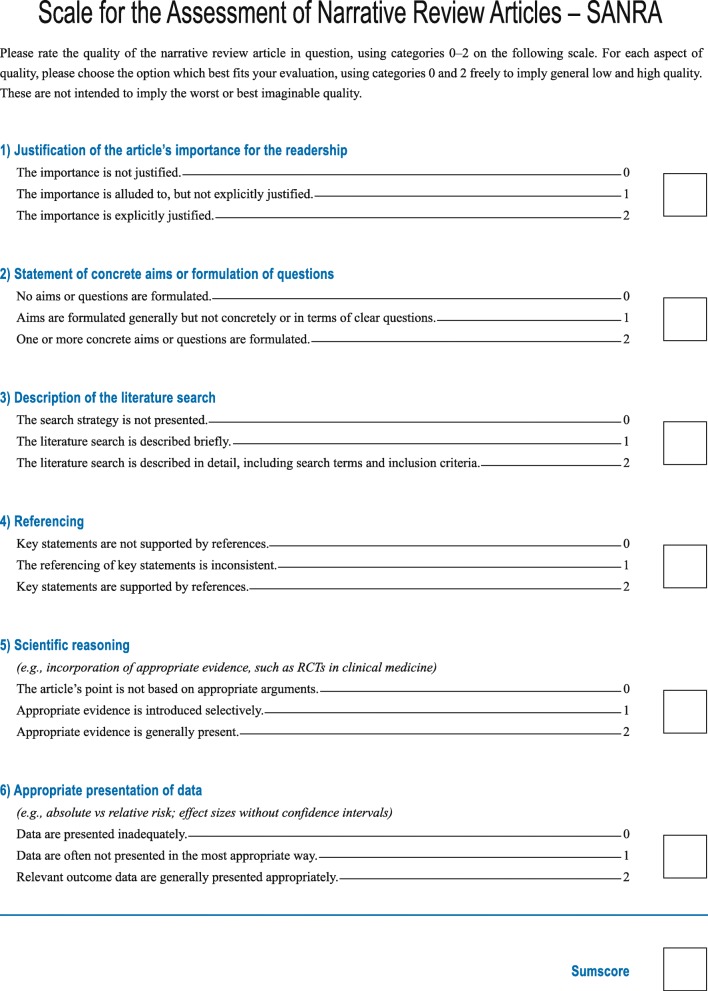
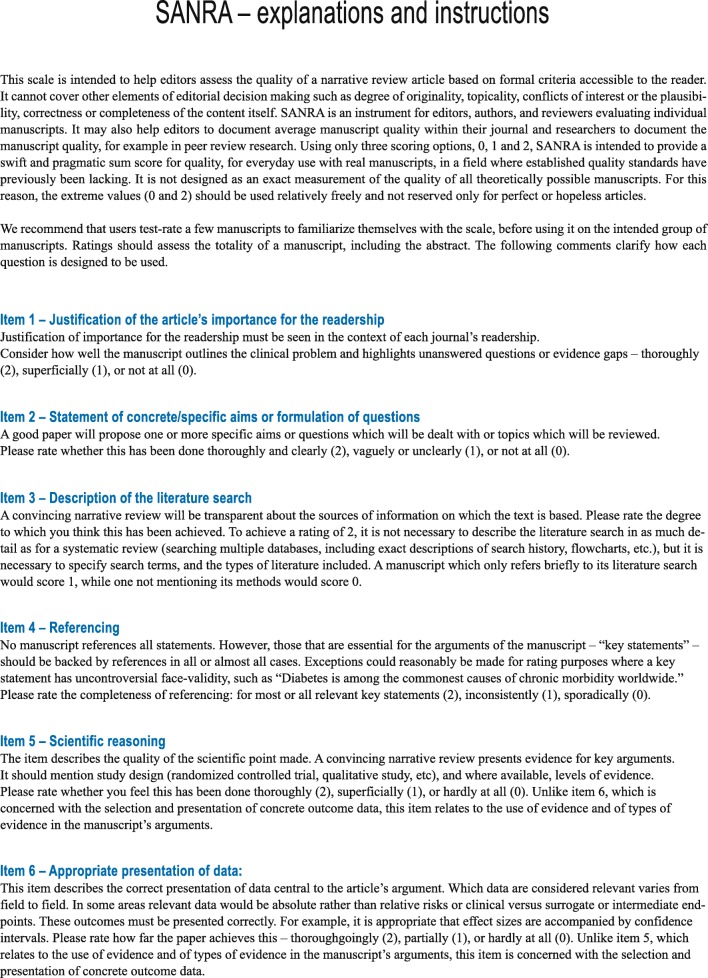
BACKGROUND: Narrative reviews are the commonest type of articles in the medical literature. However, unlike systematic reviews and randomized controlled trials (RCT) articles, for which formal instruments exist to evaluate quality, there is currently no instrument available to assess the quality of narrative reviews. In response to this gap, we developed SANRA, the Scale for the Assessment of Narrative Review Articles. METHODS: A team of three experienced journal editors modified or deleted items in an earlier SANRA version based on face validity, item-total correlations, and reliability scores from previous tests. We deleted an item which addressed a manuscript's writing and accessibility due to poor inter-rater reliability. The six items which form the revised scale are rated from 0 (low standard) to 2 (high standard) and cover the following topics: explanation of (1) the importance and (2) the aims of the review, (3) literature search and (4) referencing and presentation of (5) evidence level and (6) relevant endpoint data. For all items, we developed anchor definitions and examples to guide users in filling out the form. The revised scale was tested by the same editors (blinded to each other's ratings) in a group of 30 consecutive non-systematic review manuscripts submitted to a general medical journal. RESULTS: Raters confirmed that completing the scale is feasible in everyday editorial work. The mean sum score across all 30 manuscripts was 6.0 out of 12 possible points (SD 2.6, range 1-12). Corrected item-total correlations ranged from 0.33 (item 3) to 0.58 (item 6), and Cronbach's alpha was 0.68 (internal consistency). The intra-class correlation coefficient (average measure) was 0.77 [95% CI 0.57, 0.88] (inter-rater reliability). Raters often disagreed on items 1 and 4. CONCLUSIONS: SANRA's feasibility, inter-rater reliability, homogeneity of items, and internal consistency are sufficient for a scale of six items. Further field testing, particularly of validity, is desirable. We recommend rater training based on the "explanations and instructions" document provided with SANRA. In editorial decision-making, SANRA may complement journal-specific evaluation of manuscripts-pertaining to, e.g., audience, originality or difficulty-and may contribute to improving the standard of non-systematic reviews.
Overview
CoChat Summary
TL;DR
SANRA is a six-item, 0–2 scale (maximum 12) for assessing the quality of narrative review articles, developed and field-tested by three journal editors. In 30 consecutive non-systematic review manuscripts, it showed feasible use, sufficient internal consistency and inter-rater reliability, and a modest association with editorial acceptance.
Key findings
- Across 30 manuscripts (90 ratings), the mean SANRA sum score was 6.0 out of 12 (SD 2.6, range 1–12, median 6).
- Internal consistency was Cronbach’s alpha 0.68; corrected item-total correlations ranged from 0.33 (item 3) to 0.58 (item 6).
- Inter-rater reliability was an intra-class correlation coefficient (average measure) of 0.77 [95% CI 0.57, 0.88]; raters often disagreed on items 1 and 4.
- Average SANRA scores were modestly associated with editorial acceptance (mean 6.6, SD 1.9, n = 17) versus rejection (mean 5.1, SD 2.1, n = 13), point biserial correlation 0.37 (t = 2.09, df 28; two-sided p = 0.046).
Methods
- SANRA was developed between 2010 and 2017 by three experienced editors at Deutsches Ärzteblatt; the revised six-item version deleted an item on writing and accessibility due to poor inter-rater reliability.
- The revised scale was tested on 30 consecutive non-systematic review manuscripts submitted to Deutsches Ärzteblatt in 2015; three editor-raters scored them independently and blinded to each other’s ratings.
- Analyses included descriptive statistics, Cronbach’s alpha, corrected item-total correlations, average-measure intra-class correlation using a two-way random effects model (consistency definition), and a post hoc point biserial correlation between SANRA sum scores and acceptance/rejection.
Limitations
- The paper states the main limitation is sample size: 30 manuscripts was a compromise between representativeness, power, and feasibility, and took about 6 months to sample.
- The authors state that the scale’s authors were also the test-raters, so inter-rater reliability may be lower in groups less familiar with SANRA; the study also did not assess test-retest reliability, and results are study-specific.
- The paper acknowledges restricted content validity because SANRA is limited to six items and is a critical appraisal tool rather than a reporting guideline; criterion validity evidence is post hoc and weak, and no established cut-offs exist for comparing manuscripts across settings.
Model-written summary. Check it against the paper before relying on it.
Integrity signals
Registry
Cites
Statistics
Figures
Verification
Claims the paper makes
3 Valid · 0 Not valid · 5 Not checked · 27 Own results and interpretations
The cited sources support only part of this claim — read each source’s verdict below.
In the paper
“Bastian et al. found that they constitute the largest share of all text types in medicine and they concluded that they “remain the staple of medical literature” [1].”
- Also stated in: § Background · plain
“Narrative reviews are the commonest type of articles in the medical literature.”
§ SANRA—a scale for the quality assessment of narrative review articles > Background
What the sources say
- Partly supportedcites [1] Bastian H Glasziou P Chalmers I Seventy-five trials and eleven systematic reviews a day: how will we ever keep up? PLoS Med 2010 7 9 e1000326 10.1371/journal.pmed.1000326 20877712 PMC2943439 sourceExperimental — accuracy not yet measured
In “How Close Are We to Archie Cochrane’s Goal?” and the Summary Points (pages unavailable), the paper calls non-systematic narrative reviews the staple of medical literature synthesis. It does not say they constitute the largest share of all medical text types; that extends a claim about literature synthesis to medical literature as a whole. (LLM, conf=0.88)
plain- Asserted: passes — The authors put it forward as true.
- Checkable: passes — It can be checked against evidence.
- Load-bearing: unclear — It is unclear whether the paper’s conclusions depend on it.
- Based: passes — The paper gives a reason why it holds.
- Also stated in: § Background · plain
The sources with a verdict support this claim; the rest weren’t checked yet, have no full text we could read, or their verdicts aren’t rated yet.
In the paper
“non-systematic reviews or narrative reviews have been widely criticized as unreliable [1, 4].”
§ SANRA—a scale for the quality assessment of narrative review articles > Background
What the sources say
- Supportedcites [1] Bastian H Glasziou P Chalmers I Seventy-five trials and eleven systematic reviews a day: how will we ever keep up? PLoS Med 2010 7 9 e1000326 10.1371/journal.pmed.1000326 20877712 PMC2943439 source
In “How Close Are We to Archie Cochrane’s Goal?”, the paper describes reviews not conducted systematically as having great potential for error and calls them less reliable forms of information. Box 1 also says that articles and textbooks had highlighted the risk of bias and chance in reviews. Together, these passages support the broad characterization that narrative reviews have been criticized as unreliable; page numbers are not provided in our copy. (LLM, conf=0.89)
- Not checked — no full text of the sourcecites [4] Mulrow CD The medical review article: state of the science Ann Intern Med 1987 106 485 488 10.7326/0003-4819-106-3-485 3813259 source
plain- Asserted: passes — The authors put it forward as true.
- Checkable: passes — It can be checked against evidence.
- Load-bearing: passes — The paper’s conclusions depend on it.
- Based: passes — The paper gives a reason why it holds.
- Supported
A result the paper reports from its own data — it cites no other source for it, so there is none to check. The quote shows it is in the paper.
In the paper
“Cronbach’s alpha was 0.68 (internal consistency).”
- Also stated in: § Results · plain
“The scale’s internal consistency, measured as Cronbach’s alpha, was 0.68.”
§ SANRA—a scale for the quality assessment of narrative review articles > Abstract > Results
plainn = 90- Asserted: passes — The authors put it forward as true.
- Checkable: passes — It can be checked against evidence.
- Load-bearing: passes — The paper’s conclusions depend on it.
- Based: passes — The paper gives a reason why it holds.
- Also stated in: § Results · plain
A result the paper reports from its own data — it cites no other source for it, so there is none to check. The quote shows it is in the paper.
In the paper
“Raters often disagreed on items 1 and 4.”
- Also stated in: § Results · plain
“Disagreements most often occurred with regard to items 1 and 4.”
§ SANRA—a scale for the quality assessment of narrative review articles > Abstract > Results
plain- Asserted: passes — The authors put it forward as true.
- Checkable: passes — It can be checked against evidence.
- Load-bearing: unclear — It is unclear whether the paper’s conclusions depend on it.
- Based: passes — The paper gives a reason why it holds.
- Also stated in: § Results · plain
A result the paper reports from its own data — it cites no other source for it, so there is none to check. The quote shows it is in the paper.
In the paper
“The intra-class correlation coefficient (average measure) was 0.77 [95% CI 0.57, 0.88] (inter-rater reliability).”
- Also stated in: § Results · plain
“The intra-class correlation coefficient (average measure) amounted to 0.77 [95% CI 0.57, 0.88; F 4.3; df 29, 58].”
§ SANRA—a scale for the quality assessment of narrative review articles > Abstract > Results
plain- Asserted: passes — The authors put it forward as true.
- Checkable: passes — It can be checked against evidence.
- Load-bearing: passes — The paper’s conclusions depend on it.
- Based: passes — The paper gives a reason why it holds.
- Also stated in: § Results · plain
14 more claims
Create a free account to see all 35 claims and to verify the 3 references still open.
- Probably not a substantial claim. 11
- It may state two separate claims as one. 11
Claims other papers make about this one
Each is checked against this paper’s own text: does it say what the citing paper says it does?
The source backs part of the claim, not all of it — or backs it for a different population, condition or comparison.
In the citing paper
“The review was conducted and reported in accordance with the principles of the Scale for the Assessment of Narrative Review Articles (SANRA), which provides a validated framework for ensuring methodological transparency, scientific rigor, and balanced interpretation in narrative reviews [ 19 ].”
From Paracetamol: A History of Assumptions, Errors, and Evidence Reversals in Pain Management (2026) · cites this paper as [19]
Experimental — accuracy not yet measuredThe source backs part of the claim, not all of it — or backs it for a different population, condition or comparison.
In the citing paper
“As a narrative review, the present work does not include an aggregated quantitative assessment and is more exposed to selection subjectivity than a registered systematic review [124,125].”
From Berberine-Drug Interactions: Mechanisms, Clinical Relevance and Risk Stratification-A Narrative Review (2026) · cites this paper as [124]
Experimental — accuracy not yet measuredThe cited source says what the claim attributes to it.
In the citing paper
“This work is designed as a structured narrative review, with transparent reporting of the documentation strategy, guided by the quality criteria of the Scale for the Assessment of Narrative Review Articles (SANRA) [124].”
From Berberine-Drug Interactions: Mechanisms, Clinical Relevance and Risk Stratification-A Narrative Review (2026) · cites this paper as [124]
The cited source says what the claim attributes to it.
In the citing paper
“we used the following:-Cochrane Risk of Bias 2 (RoB 2) [29] and PEDRO scale tools for RCTs.-AMSTAR 2 [30] checklist for systematic review.-SANRA (Scale for the Assessment of Narrative Review Articles) [31] for narrative reviews.-JBI Checklist for Text and Opinion [32] for expert opinion papers.”
From Pelvic Floor Muscle Training Following Surgery for Pelvic Organ Prolapse: Recommendation from Scientific Literature (2026) · cites this paper as [31]
The cited source says what the claim attributes to it.
In the citing paper
“Data analysis employed a narrative and thematic synthesis methodology,adhering to the SANRA guidelines for narrative reviews (32).”
From Ethical issues in multi-agent AI systems for healthcare: a narrative review (2026) · cites this paper as [32]
12 more claims about this paper
Create a free account to see every claim other papers make about this one.
Citations
Cites
Shea, B. J., Reeves, B. C., Wells, G., Thuku, M., Hamel, C., Moran, J., Moher, D., Tugwell, P., Welch, V., Kristjansson, E., et al. (2017) · BMJ · doi:10.1136/bmj.j4008 · Cited by 10,636 · cited 2×
“Critical appraisal tools have been developed for systematic reviews (e.g., AMSTAR 2 [A MeaSurement Tool to Assess Systematic Reviews] [7]) and papers on RCTs (e.g., the CASP [Critical Appraisal Skills Program] checklist for randomized trials [8]) and other types of medical studies.”
BackgroundStreiner, D. L., & Norman, G. R. (2008) · doi:10.1093/acprof:oso/9780199231881.001.0001 · Cited by 2,631
Critical appraisal skills programme
Singh, J. (2013) · Journal of Pharmacology and Pharmacotherapeutics · doi:10.4103/0976-500x.107697 · Cited by 2,556
Guidelines for Reporting Reliability and Agreement Studies (GRRAS) were proposed
Kottner, J., Audigé, L., Brorson, S., Donner, A., Gajewski, B. J., Hróbjartsson, A., Roberts, C., Shoukri, M., & Streiner, D. L. (2011) · Journal of Clinical Epidemiology · doi:10.1016/j.jclinepi.2010.03.002 · Cited by 2,174
The Mass Production of Redundant, Misleading, and Conflicted Systematic Reviews and Meta‐analyses
IOANNIDIS, J. P. A. (2016) · The Milbank Quarterly · doi:10.1111/1468-0009.12210 · Cited by 1,483 · cited 1×
“While systematic reviews are not per se superior articles and while certain systematic reviews have been criticized lately [3], non-systematic reviews or narrative reviews have”
BackgroundSeventy-five trials and eleven systematic reviews a day: how will we ever keep up?
Bastian, H., Glasziou, P., & Chalmers, I. (2010) · PLoS Medicine · doi:10.1371/journal.pmed.1000326 · Cited by 1,188 · cited 2×
“found that they constitute the largest share of all text types in medicine and they concluded that they “remain the staple of medical literature” [1].”
BackgroundThe Medical Review Article: State of the Science
MULROW, C. D. (1987) · Annals of Internal Medicine · doi:10.7326/0003-4819-106-3-485 · Cited by 856 · cited 1×
“been widely criticized as unreliable [1, 4].”
Writing a narrative biomedical review: considerations for authors, peer reviewers, and editors
Gasparyan, A. Y., Ayvazyan, L., Blackmore, H., & Kitas, G. D. (2011) · Rheumatology International · doi:10.1007/s00296-011-1999-3 · Cited by 694 · cited 1×
“[13], for example, have provided guidance for writing narrative reviews, and Byrne [14] as well as Pautasso [15] has written, from different angles, thoughtful editorials on improving narrative reviews and presented lists of key features of writing a good review—lists that naturally overlap with SANRA items (e.”
BackgroundTen Simple Rules for Writing a Literature Review
Pautasso, M. (2013) · PLoS Computational Biology · doi:10.1371/journal.pcbi.1003149 · Cited by 272 · cited 3×
“[13], for example, have provided guidance for writing narrative reviews, and Byrne [14] as well as Pautasso [15] has written, from different angles, thoughtful editorials on improving narrative reviews and presented lists of key features of writing a good review—lists that naturally overlap with SANRA items (e.”
BackgroundImproving the peer review of narrative literature reviews
Byrne, J. A. (2016) · Research Integrity and Peer Review · doi:10.1186/s41073-016-0019-2 · Cited by 159 · cited 3×
“[13], for example, have provided guidance for writing narrative reviews, and Byrne [14] as well as Pautasso [15] has written, from different angles, thoughtful editorials on improving narrative reviews and presented lists of key features of writing a good review—lists that naturally overlap with SANRA items (e.”
Background
Research works printed but not linked: 3
- Higgins JPT, Green S. (eds.). Cochrane Handbook for Systematic Reviews and Interventions. Version 5.1.0. The Cochrane Collaboration 2011, section 1.2.2., www.handbook.cochrane.org, retrieved on Oct 31, 2018.
- Baethge C Mertens S Goldbeck-Wood S Development of a quality score for the assessment of non-systematic review articles (SANRA) Poster, Seventh International Congress on Peer Review and Biomedical Publication 2013 USA Chicago, Illinois
- Baethge C Goldbeck-Wood S Mertens S A scale for the assessment of non-systematic review articles (SANRA) Poster, Eighth International Congress on Peer and Biomedical Publication 2017 USA Chicago, Illinois
Cited by
Items 1,301–1,400 of 4,334
Pfeiffer, K. A., McKee, K. L., Camp, C. A. V., & Clevenger, K. A. (2023) · Kinesiology Review · doi:10.1123/kr.2022-0040 · Cited by 3
Log Data Indicators for Identifying Learner Engagement in MOOCs
Sharif, M. S. A. M., & Ramakrisnan, P. (2023) · International Journal of Advanced Research in Education and Society · doi:10.55057/ijares.2023.5.1.5 · Cited by 4
A Systematic Review Exploring the Range of Renal Complications of Human Immunodeficiency Virus
Yussuf, F. M., Barbarawi, A., Nor, M. A., Ali, A. I., Sheikh, I. M., Ogedegbe, O. J., Tabowei, G., Jimoh, A., Ozokolie, G. E., & Igbinomwanhia, O. R. (2023) · Cureus · doi:10.7759/cureus.36755 · Cited by 3
“DOI 10.7759/cureus.36755 4 of 14 SANRA [17] Narrative Review Six items: 1) Justification of the article’s importance to the readership, 2) Statement of concrete aims or formulation of questions, 3) Description of the literature search, 4) Referencing, 5) Scientific reason, and 6) Appropriate presentation of data.”
BackgroundMethodInfluentialThe NSCH patient-centered medical home scale: A measurement history, critique, and commentary
Hughes, P. M., Graaf, G., & Thomas, K. C. (2023) · Children s Health Care · doi:10.1080/02739615.2023.2233431 · Cited by 3
“To guide this review and ensure rigorous methodology, we used the Scale for the Quality Assessment of Narrative Review Articles (SANRA) as a guide (Baethge et al., 2019).”
Is simulation useful in preparing doctors-to-be for patient death: A narrative review
Wong, G., Kenny, R., Hannam, M., & Colucci, G. (2023) · Journal of Education and Health Promotion · doi:10.4103/jehp.jehp_1559_22 · Cited by 3
It's in the game: A review of neurological lesions associated with sports
Pedrosa, M., Martins, B., & Araújo, R. (2023) · Journal of the Neurological Sciences · doi:10.1016/j.jns.2023.122803 · Cited by 3
Ogihara, H., Yamamoto, N., Kurasawa, Y., Kamo, T., Hagiyama, A., Hayashi, S., & Momosaki, R. (2024) · American Journal of Physical Medicine & Rehabilitation · doi:10.1097/phm.0000000000002412 · Cited by 3
“20 The revised SANRA scale consists of the following six items: (1) explanation of the importance of the review, (2) statement of the aims of the review, (3) description of the literature search, (4) referencing, (5) scientific reasoning, and (6) presentation of the relevant and appropriate…”
BackgroundAspects of nutriment in maintaining gum wellbeing:A literature review
Dattani, V., Patel, H., Ahmad, R., Sinha, S., Girdhar, G. A., Shetty, A., Haque, M., Kumar, S., & Chowdhury, K. (2024) · Journal of Applied Pharmaceutical Science · doi:10.7324/japs.2024.1704606786 · Cited by 5
Lupia, T., Corcione, S., Staffilano, E., Bosio, R., Curtoni, A., Busca, A., & Rosa, F. G. D. (2024) · Medicina · doi:10.3390/medicina60030495 · Cited by 3
“The current narrative review followed the Scale for the Assessment of Narrative Review Articles (SANRA) flow-chart (Figure 1) [7].”
MethodRoe, E. A., & Smith, B. (2024) · International Emergency Nursing · doi:10.1016/j.ienj.2024.101444 · Cited by 3
Breast reconstruction and breast cancer-related lymphedema: insights and perspectives
Laustsen-Kiel, C. M., Hansen, L., Lauritzen, E., & Damsgaard, T. E. (2024) · Plastic and Aesthetic Research · doi:10.20517/2347-9264.2024.32 · Cited by 3
Uludağ, K. (2024) · Scientific Studios on Social and Political Psychology · doi:10.61727/sssppj/1.2024.90 · Cited by 3
Conceptualising the quality experience for independent medical examinations: A narrative review
Currey, J., & Sprogis, S. K. (2024) · Injury · doi:10.1016/j.injury.2024.111965 · Cited by 3
D’Onofrio, R., Pompa, D., Savoia, C., Masucci, M., Laterza, F., & Manzi, V. (2024) · The Journal of Sports Medicine and Physical Fitness · doi:10.23736/s0022-4707.24.16402-x · Cited by 3
Neuropsychiatric symptoms in Parkinson’s disease: review of data from the Arab world
Chabbouh, A., Khalil, H., Abboud, C., Sader, A., & Khoury, R. (2024) · Journal of International Medical Research · doi:10.1177/03000605241304646 · Cited by 13
Otalike, E. G., Clarke, M. J., Veroniki, A. A., Tricco, A. C., Moher, D., Shea, B., Doherty-Kirby, A. L., Kandala, N., & Gagnier, J. J. (2025) · BMJ Open · doi:10.1136/bmjopen-2024-097297 · Cited by 4
Opioid Stewardship and Gastrointestinal (GI)-Sparing Alternatives in Primary Care Pain Management
Khan, A., Ahmad, A. M., Ibrar, S. S., Awan, S. K., Hashmat, A., Berkhamova, A., & Varrassi, G. (2025) · Cureus · doi:10.7759/cureus.86789 · Cited by 4
Can Nigeria’s fragile Health System tackle the recent Anthrax emergence? A narrative review
Daniel, F. M., Emeruwa, V. E., Essien, E. A., Ukoaka, B. M., Gbuchie, M. A., Essiet, R. N., Josiah-Orisa, P.-C. T., & Nwilegbara, S. (2024) · The Nigerian Health Journal · doi:10.60787/tnhj.v24i1.777 · Cited by 3
The potential of general practice to support young people who self-harm: a narrative review
Mughal, F., Dikomitis, L., Babatunde, O. O., & Chew-Graham, C. A. (2022) · BJGP Open · doi:10.3399/bjgpo.2021.0159 · Cited by 3
“11 All authors were involved in review conception and design, and interpretation of review findings.”
CASTRONOVO, E. L., Bissacco, D., Trimarchi, S., & MEZZETTI, R. (2022) · The Journal of Cardiovascular Surgery · doi:10.23736/s0021-9509.22.12063-x · Cited by 3
Antunes, E. D., Santos, M., Incerti, T. G. V., & Fischer, F. M. (2022) · Studies in systems, decision and control · doi:10.1007/978-3-031-12547-8_32 · Cited by 3
The role of methylene blue in the management of vasoplegic syndrome: a narrative review
Cottyn, J., Roussel, E., Rex, S., & Tmimi, L. A. (2022) · Acta Anaesthesiologica Belgica · doi:10.56126/73.2.11 · Cited by 3
Biochemical Platelet Markers of Cognitive Impairments in Alzheimer’s Disease
Кодинцев, А. Н., Izmozherova, N. V., Aa, P., Volkova, L. I., Петровна, А. И., & Ryabinina, A. V. (2023) · Neurochemical Journal · doi:10.1134/s1819712423010105 · Cited by 4
The Concept of Moving School and Its Practical Implementation in Bavarian Higher Secondary Schools
Englert, P., Andrä, C., & Demetriou, Y. (2023) · Children · doi:10.3390/children10081395 · Cited by 5
Writing, reading, and critiquing reviews
Archibald, D., & Martimianakis, M. A. (2021) · Canadian Medical Education Journal · doi:10.36834/cmej.72945 · Cited by 3
Dumitru, C. N., Marcu, T., Dumitru, A. O., Tudor, S. S., Ferțu, I. D., Elisei, A.-M., & Goroftei, L. (2026) · Pharmaceuticals · doi:10.3390/ph19081313 · Cited by 2
“This work is designed as a structured narrative review, with transparent reporting of the documentation strategy, guided by the quality criteria of the Scale for the Assessment of Narrative Review Articles (SANRA) [124].”
From Obstacle to Catalyst: A Narrative Review of Learning from Errors in Science Education
Fabre-Mitjans, N., Jiménez-Valverde, G., Viciana, S., & Crespo i Torres, F. (2026) · Encyclopedia · doi:10.3390/encyclopedia6090192 · Cited by 2
“The revised reporting was checked against the six SANRA domains—importance, aims, search description, referencing, presentation of evidence levels, and reporting of relevant outcome data—while recognizing that SANRA is an appraisal aid rather than a substitute for a systematic-review protocol [17].”
Lamberti, G., Giraudo, D., Ciardi, G., & Levis, J. K. (2026) · Journal of Clinical Medicine · doi:10.3390/jcm15031116 · Cited by 2
“- SANRA (Scale for the Assessment of Narrative Review Articles) [31] for narrative reviews.”
Völker, J. S. D., Micluția, I., & Hanga, A.-M. (2022) · Current Psychiatry Research and Reviews · doi:10.2174/2666082218666220802112458 · Cited by 2
Wise, E., Morgan, M. A., Biggs, E. D., Ellis, B. H., Joseph, M. C., Say, M. L., Yanitsas, L. T., Bullen, J., Conley, B., Lin, I. B., et al. (2024) · Australian Journal of Primary Health · doi:10.1071/py23167 · Cited by 3
“A systematic search with a narrative review was deemed appropriate to address the research aims, and performed with consideration of the Scale for the Assessment of Narrative Review Articles (Baethge et al .”
MethodThe role of endoscopy in bovine internal medicine – A review of current indication fields
Franz, S., Hofer, L., & Dadak, A. M. (2024) · The Veterinary Journal · doi:10.1016/j.tvjl.2024.106093 · Cited by 4
Pancheva, R., Toneva, A., Braykova, R., & Ahmed, F. (2023) · Biomedical Reviews · doi:10.14748/bmr.v34.9610 · Cited by 2
Tomczak, T., & Rogalski, J. K. (2024) · Current Problems of Psychiatry · doi:10.12923/2353-8627/2024-0009 · Cited by 2
Stemer, G., Mittermayr, T., Schnell‐Inderst, P., & Wild, C. (2024) · European Journal of Hospital Pharmacy · doi:10.1136/ejhpharm-2024-004130 · Cited by 3
Plagiocefalia posicional y neurodesarrollo: una revisión narrativa
Molinari, J. M., Molina, G. L., & Muñoz-Serrano, N. (2024) · Andes pediatrica · doi:10.32641/andespediatr.v95i4.5150 · Cited by 2
A deeper look into the history of refeeding syndrome
Mohajir, W., & Seres, D. S. (2025) · Nutrition in Clinical Practice · doi:10.1002/ncp.11259 · Cited by 2
Nair, N. P. V., Abou-Farhat, M., Kaur, N., Jones, N., Mohan, G., Boruff, J. T., & Iyer, S. N. (2025) · Schizophrenia Bulletin Open · doi:10.1093/schizbullopen/sgae032 · Cited by 2
Daley, A., Daley, K., Bell, K. P., & Jain, S. (2025) · Journal of Water and Health · doi:10.2166/wh.2025.298 · Cited by 2
Retinocytoma: understanding pathogenesis, diagnosis, and treatment approaches
Al-Hussaini, M. A., Sharie, S. A., Sultan, H., Mohammad, M. T., & Yousef, Y. A. (2025) · International Journal of Retina and Vitreous · doi:10.1186/s40942-025-00642-z · Cited by 2
“This narrative review was conducted using the SANRA (Scale for Assessing Narrative Review Articles) criteria to ensure a structured approach in collecting, evaluating, and synthesizing the existing literature on retinocytoma [8].”
Battaglia, E., Poletti, V., Compalati, E., Azzollini, M., & Volpato, E. (2025) · Behavioral Sciences · doi:10.3390/bs15030285 · Cited by 3
“This narrative review has been structured considering the Scale for the Assessment of Narrative Review Articles (SANRA), a brief critical appraisal tool for the assessment of non-systematic articles (Baethge et al., 2019).”
Hiding in Plain Sight : A Narrative Review of Non-Parental Relatives’ Perinatal Grief
Bimman, R., & Graham, N. (2025) · Journal of Social Work in End-of-Life & Palliative Care · doi:10.1080/15524256.2024.2443152 · Cited by 3
Secondary Cardiorenal Syndromes in Children: Focus on Type 3 to 5 Cardiorenal Syndrome
Leventoğlu, E., Kavgacı, A., Örün, U. A., & Büyükkaragöz, B. (2025) · Cardiorenal Medicine · doi:10.1159/000545791 · Cited by 2
“The inclusion of SANRA ’ s criteria for quality assessment could help strengthen the review and ensure a more standardized approach to evaluating complex topics like CRS in pediatric patients [129].”
Kaas-Mason, S., Whitehead, C. R., Ng, S., & Rowland, P. (2025) · Journal of Continuing Education in the Health Professions · doi:10.1097/ceh.0000000000000609 · Cited by 2
Donati, C. M., Cammelli, S., Masetti, R., Strolin, S., Zamfir, A. A., Cilla, S., Strigari, L., & MORGANTI, A. G. (2025) · Journal of Radiation Research and Applied Sciences · doi:10.1016/j.jrras.2025.101596 · Cited by 2
Gene therapy advances using canine and feline animal models of inherited retinal degeneration
Petersen‐Jones, S. M., & Beckwith‐Cohen, B. (2025) · Eye · doi:10.1038/s41433-025-03825-y · Cited by 2
“The SANRA, Scale for the Assessment of Narrative Review Articles, was used as a guide in writing this manuscript [3].”
Singh, A., Ali, A., & Paul, F. A. (2025) · Journal of Addictive Diseases · doi:10.1080/10550887.2025.2513142 · Cited by 4
Coenzyme Q10 as an adjunctive treatment for substance use disorders: a preclinical review
Adabi, R., Masoudi, A., Rafaiee, R., & Mohseni, F. (2025) · Journal of Addictive Diseases · doi:10.1080/10550887.2025.2521561 · Cited by 2
Donos, M. A., Țarcă, E., Cojocaru, E., Ţarcă, V., Butnariu, L. I., Bernic, V., Popovici, P., Roşu, S. T., Tîrnovanu, M. C., Ionescu, N. S., et al. (2025) · Diagnostics · doi:10.3390/diagnostics15151940 · Cited by 2
“Although not systematic, a methodological search was performed throughout the review process to ensure quality, and the manuscript was prepared following the SANRA checklist (Scale for the Assessment of Narrative Review Articles) [5].”
Cordeaux, E., Amsdr, I., Bartsch, A. A., Easton, J., Andiappan, M., Conn, L. G., & Kuluski, K. (2025) · SSM - Health Systems · doi:10.1016/j.ssmhs.2025.100116 · Cited by 3
Dutta, D., Raut, A., Mohanty, A. K., Samantaray, S., & Roy, I. (2025) · Cureus · doi:10.7759/cureus.90461 · Cited by 2
“For narrative reviews, the Scale for the Assessment of Narrative Review Articles (SANRA) was applied [9].”
Restless legs syndrome and growing pains in childhood: understanding the link
Rosen, A. E. V., Ursitti, F., Stella, N., Papetti, L., Checchi, M. P., Voci, A., Mazzone, L., Valeriani, M., & Moavero, R. (2025) · Frontiers in Neurology · doi:10.3389/fneur.2025.1603694 · Cited by 2
“This narrative review was conducted in accordance with the SANRA (Scale for the Assessment of Narrative Review Articles) guidelines to ensure methodological quality and transparency (13).”
Osman, M., Almatar, K. A., Almatar, F., Awad, S. A., Mohamed, H. K., Abouelsadat, M. K., Alamodi, O. T., Gorashi, G. H. A., Mercy, A., Taha, M., et al. (2025) · Cureus · doi:10.7759/cureus.90136 · Cited by 2
“The single narrative review was critically examined with the Scale for the Assessment of Narrative Review Articles (SANRA) criteria [10] to ensure methodological rigor and relevance.”
Knechtle, B., Nikolaidis, P. Τ., Chlíbková, D., Leite, L. B., Forte, P. M., Andrade, M. S., Weiss, K., Rosemann, T. J., & Đurić, S. (2025) · Sports Medicine and Health Science · doi:10.1016/j.smhs.2025.08.004 · Cited by 3
Verde, P., Piccardi, L., Gentile, S., Roberts, G. A., Mambro, A., Pepe, S., & Strollo, F. (2025) · Biomedicines · doi:10.3390/biomedicines13092125 · Cited by 2
“The review followed SANRA criteria, a validated scale for assessing narrative review quality [18].”
Structural Barriers and the Future of AI in Global Health: Lessons From Eradicable Diseases
Hailu, K. T., & Haddad, R. R. (2025) · Cureus · doi:10.7759/cureus.92061 · Cited by 2
Risk Factors Associated With Post-stroke Epilepsy: A Narrative Review
Somannagari, N., Kasagga, A., Sapkota, A., Changaramkumarath, G., Abucha, J. M., Wollel, M. M., & Cavalie, P. S. C. (2025) · Cureus · doi:10.7759/cureus.92134 · Cited by 2
Rajput, J., Narahari, S., Arif, T., Iftikhar, R., Arpan, T., Tariq, A., Duleh, H. M. A., & Cherukuri, S. (2025) · Cureus · doi:10.7759/cureus.92793 · Cited by 4
“…11 criteria on AMSTAR [35]; (2) RCTs: classified as “Low Risk of Bias” in a minimum of four out of five Cochrane domains; (3) Observational studies: a score of≥6 out of nine stars on the Newcastle-Ottawa Scale (NOS) and Narrative reviews [36], and a score of ≥10 out of 14 on the SANRA [37] scale.”
Prehospital spinal and cervical motor restriction in adult trauma patients: a narrative review
Gheri, F., Toppi, N., Bortoli, N., Forni, M., Celi, S., Romano, R., Bocchi, I., Coraci, G., Petta, D., & Floccare, D. J. (2025) · Emergency Care Journal · doi:10.4081/ecj.2025.14088 · Cited by 2
Dexter, F., Sondekoppam, R. V., & Bayman, E. O. (2025) · Cureus · doi:10.7759/cureus.93214 · Cited by 3
Vascular Graft Infections Due to Listeria spp.: A Comprehensive Review of the Literature
Lupia, T., Casarotto, M., Fonte, G., Marena, S., Giunta, F. P., Buffolo, F., Corcione, S., & Rosa, F. G. D. (2025) · Microorganisms · doi:10.3390/microorganisms13102262 · Cited by 2
“The current narrative review followed the Scale for the Assessment of Narrative Review Articles (SANRA) flow-chart (Figure 1) [16].”
Khan, M. K. (2025) · Journal of Datta Meghe Institute of Medical Sciences University · doi:10.4103/jdmimsu.jdmimsu_219_25 · Cited by 2
Ferorelli, D., Calò, F., Sirago, G., Comparcini, D., Gibelli, F., Sessa, F., Carotenuto, M., Solarino, B., & Salerno, M. (2025) · Healthcare · doi:10.3390/healthcare13192546 · Cited by 2
“The completed checklist is provided as Table A1 in the Appendix A section of the present article [21].”
Advances and future perspectives in the treatment and prognosis of type 1 diabetes mellitus
Fu, Y., Zeng, J., & He, Q. (2025) · Frontiers in Clinical Diabetes and Healthcare · doi:10.3389/fcdhc.2025.1651061 · Cited by 2
Duval, C., Corre, P., Esnault, A., Loin, J., & Bertin, H. (2025) · Journal of Stomatology Oral and Maxillofacial Surgery · doi:10.1016/j.jormas.2025.102613 · Cited by 2
Sepsis Biomarkers: What Surgeons Need to Know
Melegari, G., Arturi, F., Gazzotti, F., Villani, M., Bertellini, E., & Barbieri, A. (2025) · Anesthesia Research · doi:10.3390/anesthres2040023 · Cited by 3
“The purpose of this article is to provide a narrative review, conducted in accordance with the SANRA (Scale for the Assessment of Narrative Review Articles) guidelines [10].”
Dathi, P., Gopathoti, S., Nandyala, A., Burra, S., Gopathoti, J., & Paidimarri, S. P. (2025) · Cureus · doi:10.7759/cureus.94637 · Cited by 3
“Systematic reviews were evaluated with AMSTAR [15], and narrative reviews were assessed using SANRA [16].”
Is Training With Animals Needed?
Hollyoak, R. E., Foteff, C. L., Cameron, A., Scott, A., & Maddern, G. J. (2025) · ANZ Journal of Surgery · doi:10.1111/ans.70350 · Cited by 2
“Data were extracted to standardised tables by one reviewer, and the results were synthesised narratively according to the Scale for the Assessment of Narrative Review Articles (SANRA) guidelines [21].”
Liu, C., Wang, Y., & Liang, Y. (2025) · Science Progress · doi:10.1177/00368504251389718 · Cited by 2
Singh, A., & Shute, K. (2025) · Journal of Clinical Neuroscience · doi:10.1016/j.jocn.2025.111715 · Cited by 2
Gantana, E. J., Musekwa, E., Cassim, S., Nell, E., & Chapanduka, Z. C. (2025) · Next research. · doi:10.1016/j.nexres.2025.101002 · Cited by 2
The association between periodontitis and hypothyroidism: A comprehensive review
Wang, Z., & Lin, X. (2025) · Journal of International Medical Research · doi:10.1177/03000605251388870 · Cited by 2
Evaluating the clinical safety of ibuprofen arginine: a narrative review
Fornasari, D., Radaelli, F., Perrot, S., Cajaraville, J. P., Sarzi‐Puttini, P., & Varrassi, G. (2025) · Drugs & Therapy Perspectives · doi:10.1007/s40267-025-01202-z · Cited by 2
“This narrative review adheres to the Scale for the Quality Assessment of Narrative Review Articles (SANRA) guidelines to ensure the highest standards of transparency, reproducibility, and academic rigor [11].”
Research progress on post-laparoscopic shoulder pain after gynecologic surgery
Shao, Y., Zhang, Y., & Lin, X. (2025) · Journal of International Medical Research · doi:10.1177/03000605251399453 · Cited by 2
Žafran, M., Žiberna, L., Martelanc, M., & Albreht, A. (2025) · The Science of The Total Environment · doi:10.1016/j.scitotenv.2025.181044 · Cited by 2
Roles of minimally invasive techniques in the management of epithelial ovarian cancer (Review)
Yang, R., Gao, J., Cheng, Y., Lu, C., & Li, J. (2025) · Oncology Letters · doi:10.3892/ol.2025.15418 · Cited by 3
“The Scale for the Assessment of Narrative Review Articles guidelines were followed to enhance the methodological rigor and transparency of the present narrative synthesis (17).”
Patient Participation During Nursing Bedside Handover: A State-of-the-Art Review
Cruchinho, P. J. M., Teixeira, G. M., Lucas, P. R. M. B., Gaspar, F., & López-Franco, M. D. (2025) · Nursing Reports · doi:10.3390/nursrep15120438 · Cited by 3
Historical Review of the Role of Indirect Cell Death in High-Dose Per Fraction Radiation Therapy
Song, C. W., Sloan, L., Terezakis, S. A., Yang, K., & Griffin, R. J. (2025) · Advances in Radiation Oncology · doi:10.1016/j.adro.2025.101971 · Cited by 3
“As recommended by the narrative review guidelines known as SANRA (Scale for the assessment of narrative review articles), 20 we have attempted to identify the importance, strengths and weaknesses, evidence level and relevant endpoint (clinical effects) reported across a greater than 100 years span…”
Paediatric neurological care in Sub-Saharan Africa: Current status and future directions
Frimpong, M., Mohamed, S., Ibukun, M. O., Asieduwaa, O. Y., & Wireko, A. A. (2025) · Brain and Development · doi:10.1016/j.braindev.2025.104490 · Cited by 2
Giurazza, R., Corcione, A., Rosa, R. C. D., Tortoriello, G., Coppolino, F., Pota, V., Piccialli, F., Sansone, P., Passavanti, M. B., & Pace, M. C. (2025) · Medicina · doi:10.3390/medicina61122208 · Cited by 3
“To ensure the quality and rigor of this narrative review, the methodological process was formally assessed using the Scale for the Assessment of Narrative Review Articles (SANRA), achieving a final score of 12 out of a possible 14 points [5].”
Can TP53, TMB and TME Expand the Immunotherapy Benefit in Metastatic Colorectal Cancer?
Specchia, M., Drittone, D., Mazzotti, E., & Mazzuca, F. (2025) · Cancers · doi:10.3390/cancers17243984 · Cited by 2
“…non-systematic review, was conducted in accordance with the SANRA criteria (Scale for the Assessment of Narrative Review Articles), with attention to justification of the topic, a focused aim, comprehensive literature coverage, transparent presentation, and appropriate interpretation [26].”
Bongiovanni, A., Conte, P., Conteduca, V., Landriscina, M., Lorenzo, G. D., & Cognetti, F. (2025) · Current Oncology · doi:10.3390/curroncol32120690 · Cited by 2
“The identification and selection process adhered to SANRA principles, ensuring transparency and reproducibility [19].”
Marchesi, S., Sciortino, C., Etessami, J. D., Damonte, C., Villa, C., Bottelli, A., Alessandrini, S., Chiaramonte, A., Sabella, G., Pietrantonio, F., et al. (2025) · Therapeutic Advances in Medical Oncology · doi:10.1177/17588359251389741 · Cited by 2
Cardiotoxicity of Chemoradiotherapy in Patients With Esophageal Cancer: A Systematic Review
Kocherry, C., Shamim, H., Jhakri, K., Al-Shudifat, M., Sumra, B., & Yu, A. K. (2026) · Cureus · doi:10.7759/cureus.100822 · Cited by 2
Tejena, S. G. A., Mestanza, B. A. A., Intriago, L. P. C., Cantos, D. L. G., & Alencastro, J. A. P. (2026) · Atlas Research Journal · doi:10.65305/arj.v4n1.2026.47 · Cited by 3
Metroplasty before IVF in women with a T‐shaped uterus: A clinical challenge
Barra, F., Gazzo, I., Favilli, A., Russo, C., Monaco, G., Alessandri, F., Gerli, S., Pacheco, L. A., Exacoustós, C., & Ferrero, S. (2026) · International Journal of Gynecology & Obstetrics · doi:10.1002/ijgo.70827 · Cited by 2
Physical activity and the aging brain: A narrative review
Klil‐Drori, S., Juneau, M., & Serlin, Y. (2026) · Journal of Health Psychology · doi:10.1177/13591053251408208 · Cited by 3
“This process was guided by the principles of the Scale for the Assessment of Narrative Review Articles (SANRA; Baethge et al., 2019), to ensure trans-parency, methodological rigor, and reproducibility in narrative synthesis.”
Come sintetizzare i risultati degli studi biomedici: una rassegna metodologica
PECORARO, V. (2026) · Biochimica Clinica · doi:10.23736/s0393-0564.26.00111-1 · Cited by 2
Surapaneni, K. M. (2026) · Current Opinion in Physiology · doi:10.1016/j.cophys.2026.100907 · Cited by 3
Tao, Y., Zhang, Y., Xu, W., Liu, G., & Liu, H. (2026) · Drug Design Development and Therapy · doi:10.2147/dddt.s583837 · Cited by 3
Laulan, P., Rimmele, U., & Cuadrado, J. (2026) · Mindfulness · doi:10.1007/s12671-026-02767-0 · Cited by 4
“…transparency and scholarly rigor, the review followed the principles of the Scale for the Assessment of Narrative Review Articles (SANRA; Baethge et al., 2019), a 6-item instrument assessing (1) importance of the topic, (2) statement of concrete aims, (3) description of the literature…”
Sepadi, M. M. (2026) · Safety · doi:10.3390/safety12010029 · Cited by 2
“A pattern similarly documented among other local government enforcement and animal control personnel exposed to routine violence and intimidation during regulatory duties [33,41].”
Aragón-Espinosa, P., Pérez, C., Bompart, C., Gueugneau, M., Capel, F., Arbonés-Mainar, J. M., Gómez-Zorita, S., Mas‐Capdevila, A., Escoté, X., Pinent, M., et al. (2026) · Journal of Physiology and Biochemistry · doi:10.1007/s13105-026-01154-6 · Cited by 4
Wang, Z. H., Liu, X., Xie, J., & Lin, Y. (2026) · Frontiers in Neuroscience · doi:10.3389/fnins.2026.1758767 · Cited by 2
“To enhance transparency and reproducibility, we report the core elements of our evidence identification and synthesis process, guided by established recommendations for narrative reviews (Baethge et al., 2019).”
Kang, J. H. (2026) · Cancers · doi:10.3390/cancers18040709 · Cited by 3
“The current narrative review was developed through the clinical perspective of a medical oncologist with over four decades of experience in thoracic oncology, and is reported in accordance with the scale for the quality assessment of narrative review articles (SANRA) guidelines [13].”
Dyslipidemia in Diabetes: Navigating a Complex Landscape for Improved Cardiovascular Outcomes
Wahab, R. A., & Mahmood, W. A. W. (2026) · Clinical Medicine Insights Endocrinology and Diabetes · doi:10.1177/11795514261422310 · Cited by 2
Early Life Nutrition: The First 1000 Days and Healthy Aging in Cystic Fibrosis
Miles, C. N., Nixon, G. M., & Davidson, Z. E. (2026) · Nutrients · doi:10.3390/nu18050739 · Cited by 2
Ziemichód, W., Kajka, N., Rząd, Z., Metelska, A., Janas-Kozik, M. H., Biała, G., Wilczyński, K. M., Grabowska, K., & Karakuła‐Juchnowicz, H. (2026) · Neuroscience & Biobehavioral Reviews · doi:10.1016/j.neubiorev.2026.106615 · Cited by 2
Hasemaki, N., Stana, J., Kontastinou, N., Khangholi, D., Maroulis, E., Peterß, S., Pichlmaier, M. A., & Tsilimparis, N. (2026) · Asian Cardiovascular and Thoracic Annals · doi:10.1177/02184923261424595 · Cited by 2
“12”
Aziz, N., Kamran, N., Almas, A., Bloomfield, G. S., Ahmed, A., Samad, Z. Z., & Mahmood, T. (2026) · Cardiovascular Diabetology – Endocrinology Reports · doi:10.1186/s40842-026-00273-9 · Cited by 2
Metadata
- Authors
- Baethge, C., Goldbeck-Wood, S., & Mertens, S.
- Affiliations
- University of Cologne (DE)
- BMJ Group (United Kingdom) (GB)
- Corresponding author
- Baethge, Christopher
- ORCID
- Baethge, Christopher
- Venue
- Research Integrity and Peer Review
- Published
- 2019-03-26
- Volume
- 4
- Issue
- 1
- Pages
- 5-5
- ISSN
- 2058-8615 (ISSN-L)
- PMC
- PMC6434870
- OpenAlex
- W2922577842
- Semantic Scholar
- ea7f35b3069b53791c3b746c5c4b3c72a83a526b
- Cited by
- 3,469
- References
- 13
- Citations by year
- 2026: 1823 · 2025: 551 · 2024: 379 · 2023: 309 · 2022: 218 · 2021: 152 · 2020: 32 · 2019: 4
- FWCI
- 20.57
- Type
- journal article
- Language
- en
- Open access
- gold
- doi.org
- Licence
- cc-by
- creativecommons.org/licenses/by/4.0/ (tdm)
- Locations
- Research Integrity and Peer Review (publishedVersion, cc-by)
- Europe PMC (PubMed Central) (publishedVersion, other-oa)
- PubMed Central (publishedVersion, cc-by)
- PubMed (publishedVersion)
- Kölner Universitäts PublikationsServer (Universität zu Köln) (publishedVersion)
- DOAJ (DOAJ: Directory of Open Access Journals) (submittedVersion, cc-by-sa)
- Topics
- Social Sciences › Decision Sciences › Statistics, Probability and Uncertainty › Meta-analysis and systematic reviews
- Social Sciences › Library and Information Sciences › Academic Writing and Publishing
- Social Sciences › Library and Information Sciences › scientometrics and bibliometrics research
- Keywords
- quality assessment scale, manuscript review, inter-rater reliability, level of evidence, scale development
About these checks
Registry, retraction, Cites and statistics results are computed, not judged, with one exception: a printed reference that no index lists is read once by a model before it counts as a citation error. Claims are extracted by a model and kept only when their quote appears verbatim in the text; each cited source is then checked, with a model’s help, for whether it says what the claim relies on. Those verdicts can be wrong — read the claim’s quote and the cited source before relying on one.
The claim verdicts this report counts are experimental: their accuracy is not yet measured.
A language model drew the claims from the paper on 2026-11-10, under version 3 of the claim definition (model deepseek-v4.1-flash, prompt extract-v3).
A second model labelled each claim on 2026-11-10 (model jev-1.13-20260917, definition revision gold-guideline-v0.2).
Cited sources are checked with a language model’s help (gpt-6-sol).
Statistics and arithmetic are recomputed, not judged.
Confidence bands are shown only for fields calibrated on our annotated test set. None is calibrated yet, so no band is shown.
What counts as a claim ›How we measure confidence ›How we check this ›
Are you an author, or do you see a problem with this page? Request a review
Data sources
Bibliographic data: Semantic Scholar, OpenAlex, Crossref.
Contains information from the Semantic Scholar Academic Graph Datasets, made available under the ODC Attribution License (ODC-BY 1.0).
Semantic Scholar’s data is described in: Kinney, R., et al. (2023). The Semantic Scholar Open Data Platform. arXiv:2301.10140.
