

SANRA—a scale for the quality assessment of narrative review articles
Open accessThe DOI matches its Crossref record; 12 of the 13 references it cites were found in a registry or an index; 4 of the 12 sources its claims cite were checked for support.
Abstract
BACKGROUND: Narrative reviews are the commonest type of articles in the medical literature. However, unlike systematic reviews and randomized controlled trials (RCT) articles, for which formal instruments exist to evaluate quality, there is currently no instrument available to assess the quality of narrative reviews. In response to this gap, we developed SANRA, the Scale for the Assessment of Narrative Review Articles. METHODS: A team of three experienced journal editors modified or deleted items in an earlier SANRA version based on face validity, item-total correlations, and reliability scores from previous tests. We deleted an item which addressed a manuscript's writing and accessibility due to poor inter-rater reliability. The six items which form the revised scale are rated from 0 (low standard) to 2 (high standard) and cover the following topics: explanation of (1) the importance and (2) the aims of the review, (3) literature search and (4) referencing and presentation of (5) evidence level and (6) relevant endpoint data. For all items, we developed anchor definitions and examples to guide users in filling out the form. The revised scale was tested by the same editors (blinded to each other's ratings) in a group of 30 consecutive non-systematic review manuscripts submitted to a general medical journal. RESULTS: Raters confirmed that completing the scale is feasible in everyday editorial work. The mean sum score across all 30 manuscripts was 6.0 out of 12 possible points (SD 2.6, range 1-12). Corrected item-total correlations ranged from 0.33 (item 3) to 0.58 (item 6), and Cronbach's alpha was 0.68 (internal consistency). The intra-class correlation coefficient (average measure) was 0.77 [95% CI 0.57, 0.88] (inter-rater reliability). Raters often disagreed on items 1 and 4. CONCLUSIONS: SANRA's feasibility, inter-rater reliability, homogeneity of items, and internal consistency are sufficient for a scale of six items. Further field testing, particularly of validity, is desirable. We recommend rater training based on the "explanations and instructions" document provided with SANRA. In editorial decision-making, SANRA may complement journal-specific evaluation of manuscripts-pertaining to, e.g., audience, originality or difficulty-and may contribute to improving the standard of non-systematic reviews.
Overview
CoChat Summary
TL;DR
SANRA is a six-item, 0–2 scale (maximum 12) for assessing the quality of narrative review articles, developed and field-tested by three journal editors. In 30 consecutive non-systematic review manuscripts, it showed feasible use, sufficient internal consistency and inter-rater reliability, and a modest association with editorial acceptance.
Key findings
- Across 30 manuscripts (90 ratings), the mean SANRA sum score was 6.0 out of 12 (SD 2.6, range 1–12, median 6).
- Internal consistency was Cronbach’s alpha 0.68; corrected item-total correlations ranged from 0.33 (item 3) to 0.58 (item 6).
- Inter-rater reliability was an intra-class correlation coefficient (average measure) of 0.77 [95% CI 0.57, 0.88]; raters often disagreed on items 1 and 4.
- Average SANRA scores were modestly associated with editorial acceptance (mean 6.6, SD 1.9, n = 17) versus rejection (mean 5.1, SD 2.1, n = 13), point biserial correlation 0.37 (t = 2.09, df 28; two-sided p = 0.046).
Methods
- SANRA was developed between 2010 and 2017 by three experienced editors at Deutsches Ärzteblatt; the revised six-item version deleted an item on writing and accessibility due to poor inter-rater reliability.
- The revised scale was tested on 30 consecutive non-systematic review manuscripts submitted to Deutsches Ärzteblatt in 2015; three editor-raters scored them independently and blinded to each other’s ratings.
- Analyses included descriptive statistics, Cronbach’s alpha, corrected item-total correlations, average-measure intra-class correlation using a two-way random effects model (consistency definition), and a post hoc point biserial correlation between SANRA sum scores and acceptance/rejection.
Limitations
- The paper states the main limitation is sample size: 30 manuscripts was a compromise between representativeness, power, and feasibility, and took about 6 months to sample.
- The authors state that the scale’s authors were also the test-raters, so inter-rater reliability may be lower in groups less familiar with SANRA; the study also did not assess test-retest reliability, and results are study-specific.
- The paper acknowledges restricted content validity because SANRA is limited to six items and is a critical appraisal tool rather than a reporting guideline; criterion validity evidence is post hoc and weak, and no established cut-offs exist for comparing manuscripts across settings.
Model-written summary. Check it against the paper before relying on it.
Integrity signals
Registry
Cites
Statistics
Figures
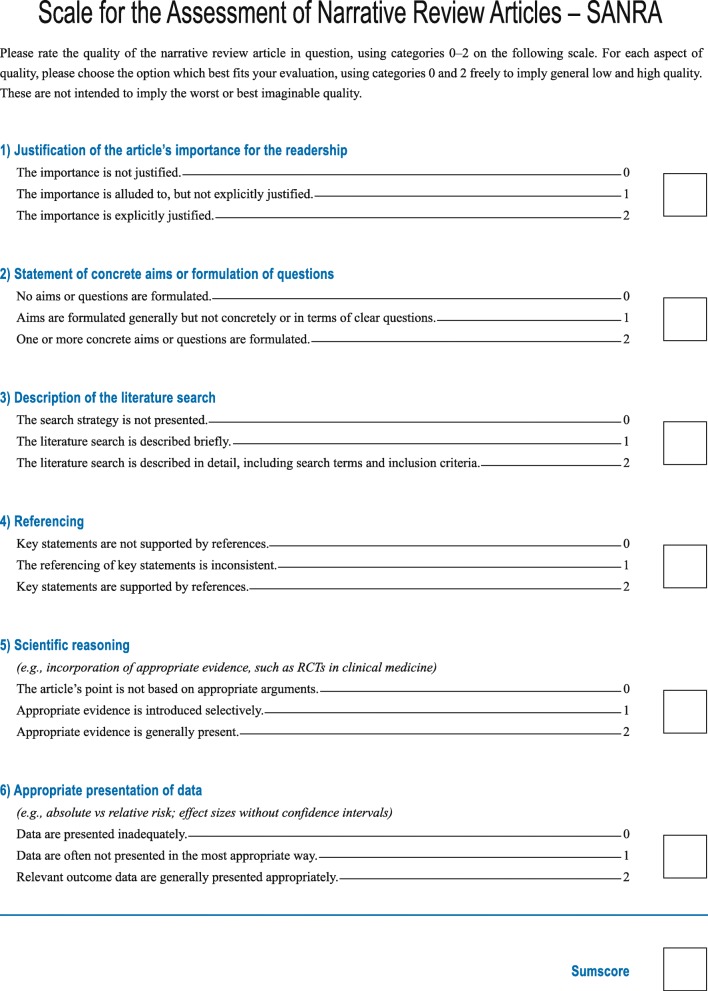
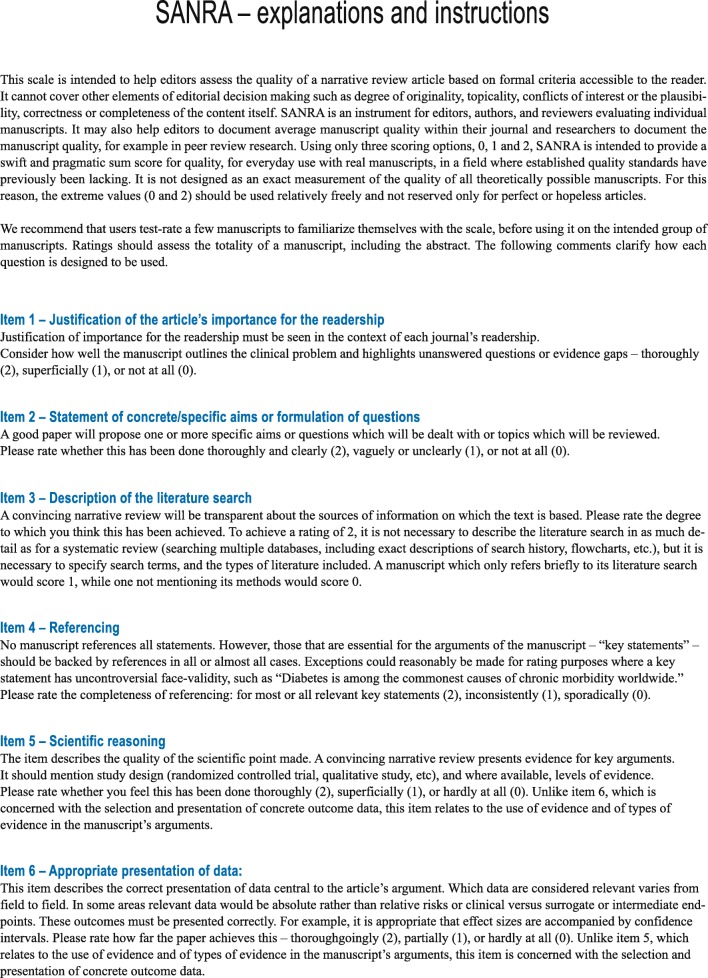
Verification
Claims the paper makes
3 Valid · 0 Not valid · 5 Not checked · 27 Own results and interpretations
The cited sources support only part of this claim — read each source’s verdict below.
In the paper
“Bastian et al. found that they constitute the largest share of all text types in medicine and they concluded that they “remain the staple of medical literature” [1].”
- Also stated in: § Background · plain
“Narrative reviews are the commonest type of articles in the medical literature.”
§ SANRA—a scale for the quality assessment of narrative review articles > Background
What the sources say
- Partly supportedcites [1] Bastian H Glasziou P Chalmers I Seventy-five trials and eleven systematic reviews a day: how will we ever keep up? PLoS Med 2010 7 9 e1000326 10.1371/journal.pmed.1000326 20877712 PMC2943439 sourceExperimental — accuracy not yet measured
In “How Close Are We to Archie Cochrane’s Goal?” and the Summary Points (pages unavailable), the paper calls non-systematic narrative reviews the staple of medical literature synthesis. It does not say they constitute the largest share of all medical text types; that extends a claim about literature synthesis to medical literature as a whole. (LLM, conf=0.88)
plain- Asserted: passes — The authors put it forward as true.
- Checkable: passes — It can be checked against evidence.
- Load-bearing: unclear — It is unclear whether the paper’s conclusions depend on it.
- Based: passes — The paper gives a reason why it holds.
- Also stated in: § Background · plain
The sources with a verdict support this claim; the rest weren’t checked yet, have no full text we could read, or their verdicts aren’t rated yet.
In the paper
“non-systematic reviews or narrative reviews have been widely criticized as unreliable [1, 4].”
§ SANRA—a scale for the quality assessment of narrative review articles > Background
What the sources say
- Supportedcites [1] Bastian H Glasziou P Chalmers I Seventy-five trials and eleven systematic reviews a day: how will we ever keep up? PLoS Med 2010 7 9 e1000326 10.1371/journal.pmed.1000326 20877712 PMC2943439 source
In “How Close Are We to Archie Cochrane’s Goal?”, the paper describes reviews not conducted systematically as having great potential for error and calls them less reliable forms of information. Box 1 also says that articles and textbooks had highlighted the risk of bias and chance in reviews. Together, these passages support the broad characterization that narrative reviews have been criticized as unreliable; page numbers are not provided in our copy. (LLM, conf=0.89)
- Not checked — no full text of the sourcecites [4] Mulrow CD The medical review article: state of the science Ann Intern Med 1987 106 485 488 10.7326/0003-4819-106-3-485 3813259 source
plain- Asserted: passes — The authors put it forward as true.
- Checkable: passes — It can be checked against evidence.
- Load-bearing: passes — The paper’s conclusions depend on it.
- Based: passes — The paper gives a reason why it holds.
- Supported
A result the paper reports from its own data — it cites no other source for it, so there is none to check. The quote shows it is in the paper.
In the paper
“Cronbach’s alpha was 0.68 (internal consistency).”
- Also stated in: § Results · plain
“The scale’s internal consistency, measured as Cronbach’s alpha, was 0.68.”
§ SANRA—a scale for the quality assessment of narrative review articles > Abstract > Results
plainn = 90- Asserted: passes — The authors put it forward as true.
- Checkable: passes — It can be checked against evidence.
- Load-bearing: passes — The paper’s conclusions depend on it.
- Based: passes — The paper gives a reason why it holds.
- Also stated in: § Results · plain
A result the paper reports from its own data — it cites no other source for it, so there is none to check. The quote shows it is in the paper.
In the paper
“Raters often disagreed on items 1 and 4.”
- Also stated in: § Results · plain
“Disagreements most often occurred with regard to items 1 and 4.”
§ SANRA—a scale for the quality assessment of narrative review articles > Abstract > Results
plain- Asserted: passes — The authors put it forward as true.
- Checkable: passes — It can be checked against evidence.
- Load-bearing: unclear — It is unclear whether the paper’s conclusions depend on it.
- Based: passes — The paper gives a reason why it holds.
- Also stated in: § Results · plain
A result the paper reports from its own data — it cites no other source for it, so there is none to check. The quote shows it is in the paper.
In the paper
“The intra-class correlation coefficient (average measure) was 0.77 [95% CI 0.57, 0.88] (inter-rater reliability).”
- Also stated in: § Results · plain
“The intra-class correlation coefficient (average measure) amounted to 0.77 [95% CI 0.57, 0.88; F 4.3; df 29, 58].”
§ SANRA—a scale for the quality assessment of narrative review articles > Abstract > Results
plain- Asserted: passes — The authors put it forward as true.
- Checkable: passes — It can be checked against evidence.
- Load-bearing: passes — The paper’s conclusions depend on it.
- Based: passes — The paper gives a reason why it holds.
- Also stated in: § Results · plain
14 more claims
Create a free account to see all 35 claims and to verify the 3 references still open.
- Probably not a substantial claim. 11
- It may state two separate claims as one. 11
Claims other papers make about this one
Each is checked against this paper’s own text: does it say what the citing paper says it does?
The source backs part of the claim, not all of it — or backs it for a different population, condition or comparison.
In the citing paper
“The review was conducted and reported in accordance with the principles of the Scale for the Assessment of Narrative Review Articles (SANRA), which provides a validated framework for ensuring methodological transparency, scientific rigor, and balanced interpretation in narrative reviews [ 19 ].”
From Paracetamol: A History of Assumptions, Errors, and Evidence Reversals in Pain Management (2026) · cites this paper as [19]
Experimental — accuracy not yet measuredThe source backs part of the claim, not all of it — or backs it for a different population, condition or comparison.
In the citing paper
“As a narrative review, the present work does not include an aggregated quantitative assessment and is more exposed to selection subjectivity than a registered systematic review [124,125].”
From Berberine-Drug Interactions: Mechanisms, Clinical Relevance and Risk Stratification-A Narrative Review (2026) · cites this paper as [124]
Experimental — accuracy not yet measuredThe cited source says what the claim attributes to it.
In the citing paper
“This work is designed as a structured narrative review, with transparent reporting of the documentation strategy, guided by the quality criteria of the Scale for the Assessment of Narrative Review Articles (SANRA) [124].”
From Berberine-Drug Interactions: Mechanisms, Clinical Relevance and Risk Stratification-A Narrative Review (2026) · cites this paper as [124]
The cited source says what the claim attributes to it.
In the citing paper
“we used the following:-Cochrane Risk of Bias 2 (RoB 2) [29] and PEDRO scale tools for RCTs.-AMSTAR 2 [30] checklist for systematic review.-SANRA (Scale for the Assessment of Narrative Review Articles) [31] for narrative reviews.-JBI Checklist for Text and Opinion [32] for expert opinion papers.”
From Pelvic Floor Muscle Training Following Surgery for Pelvic Organ Prolapse: Recommendation from Scientific Literature (2026) · cites this paper as [31]
The cited source says what the claim attributes to it.
In the citing paper
“Data analysis employed a narrative and thematic synthesis methodology,adhering to the SANRA guidelines for narrative reviews (32).”
From Ethical issues in multi-agent AI systems for healthcare: a narrative review (2026) · cites this paper as [32]
12 more claims about this paper
Create a free account to see every claim other papers make about this one.
Citations
Cites
Shea, B. J., Reeves, B. C., Wells, G., Thuku, M., Hamel, C., Moran, J., Moher, D., Tugwell, P., Welch, V., Kristjansson, E., et al. (2017) · BMJ · doi:10.1136/bmj.j4008 · Cited by 10,636 · cited 2×
“Critical appraisal tools have been developed for systematic reviews (e.g., AMSTAR 2 [A MeaSurement Tool to Assess Systematic Reviews] [7]) and papers on RCTs (e.g., the CASP [Critical Appraisal Skills Program] checklist for randomized trials [8]) and other types of medical studies.”
BackgroundStreiner, D. L., & Norman, G. R. (2008) · doi:10.1093/acprof:oso/9780199231881.001.0001 · Cited by 2,631
Critical appraisal skills programme
Singh, J. (2013) · Journal of Pharmacology and Pharmacotherapeutics · doi:10.4103/0976-500x.107697 · Cited by 2,556
Guidelines for Reporting Reliability and Agreement Studies (GRRAS) were proposed
Kottner, J., Audigé, L., Brorson, S., Donner, A., Gajewski, B. J., Hróbjartsson, A., Roberts, C., Shoukri, M., & Streiner, D. L. (2011) · Journal of Clinical Epidemiology · doi:10.1016/j.jclinepi.2010.03.002 · Cited by 2,174
The Mass Production of Redundant, Misleading, and Conflicted Systematic Reviews and Meta‐analyses
IOANNIDIS, J. P. A. (2016) · The Milbank Quarterly · doi:10.1111/1468-0009.12210 · Cited by 1,483 · cited 1×
“While systematic reviews are not per se superior articles and while certain systematic reviews have been criticized lately [3], non-systematic reviews or narrative reviews have”
BackgroundSeventy-five trials and eleven systematic reviews a day: how will we ever keep up?
Bastian, H., Glasziou, P., & Chalmers, I. (2010) · PLoS Medicine · doi:10.1371/journal.pmed.1000326 · Cited by 1,188 · cited 2×
“found that they constitute the largest share of all text types in medicine and they concluded that they “remain the staple of medical literature” [1].”
BackgroundThe Medical Review Article: State of the Science
MULROW, C. D. (1987) · Annals of Internal Medicine · doi:10.7326/0003-4819-106-3-485 · Cited by 856 · cited 1×
“been widely criticized as unreliable [1, 4].”
Writing a narrative biomedical review: considerations for authors, peer reviewers, and editors
Gasparyan, A. Y., Ayvazyan, L., Blackmore, H., & Kitas, G. D. (2011) · Rheumatology International · doi:10.1007/s00296-011-1999-3 · Cited by 694 · cited 1×
“[13], for example, have provided guidance for writing narrative reviews, and Byrne [14] as well as Pautasso [15] has written, from different angles, thoughtful editorials on improving narrative reviews and presented lists of key features of writing a good review—lists that naturally overlap with SANRA items (e.”
BackgroundTen Simple Rules for Writing a Literature Review
Pautasso, M. (2013) · PLoS Computational Biology · doi:10.1371/journal.pcbi.1003149 · Cited by 272 · cited 3×
“[13], for example, have provided guidance for writing narrative reviews, and Byrne [14] as well as Pautasso [15] has written, from different angles, thoughtful editorials on improving narrative reviews and presented lists of key features of writing a good review—lists that naturally overlap with SANRA items (e.”
BackgroundImproving the peer review of narrative literature reviews
Byrne, J. A. (2016) · Research Integrity and Peer Review · doi:10.1186/s41073-016-0019-2 · Cited by 159 · cited 3×
“[13], for example, have provided guidance for writing narrative reviews, and Byrne [14] as well as Pautasso [15] has written, from different angles, thoughtful editorials on improving narrative reviews and presented lists of key features of writing a good review—lists that naturally overlap with SANRA items (e.”
Background
Research works printed but not linked: 3
- Higgins JPT, Green S. (eds.). Cochrane Handbook for Systematic Reviews and Interventions. Version 5.1.0. The Cochrane Collaboration 2011, section 1.2.2., www.handbook.cochrane.org, retrieved on Oct 31, 2018.
- Baethge C Mertens S Goldbeck-Wood S Development of a quality score for the assessment of non-systematic review articles (SANRA) Poster, Seventh International Congress on Peer Review and Biomedical Publication 2013 USA Chicago, Illinois
- Baethge C Goldbeck-Wood S Mertens S A scale for the assessment of non-systematic review articles (SANRA) Poster, Eighth International Congress on Peer and Biomedical Publication 2017 USA Chicago, Illinois
Cited by
Items 1,401–1,500 of 4,334
Meslamani, A. Z. A., Jarab, A. S., & Mohammed, E. M. A. (2026) · Expert Review of Clinical Pharmacology · doi:10.1080/17512433.2026.2638352 · Cited by 2
“We appraised each study for clarity of objectives, appropriateness of design, adequacy of sample size and follow-up, transparency of PK/PD or modeling meth-ods, reporting of uncertainty, and plausibility and consistency of conclusions in line with recommended criteria for narrative reviews [30].”
Alsulayyim, A. S. (2026) · Respiratory Medicine · doi:10.1016/j.rmed.2026.108757 · Cited by 3
Mindfulness-Based Interventions for Bereavement: A Systematized Narrative Review
D’Antoni, F., Mattiussi, F., & Crescentini, C. (2026) · Healthcare · doi:10.3390/healthcare14050673 · Cited by 3
“This review followed the methodological framework of systematized narrative reviews [33,34], which combine elements of systematic reviews (explicit search strategy, eligibility criteria, PRISMA flow diagram) with the flexibility of narrative synthesis.”
Schutte, B., Dada, O. M., Obeng, R., & Byrd, T. (2026) · Journal of Occupational Health · doi:10.1093/joccuh/uiag013 · Cited by 2
24-Hour Ultra-Marathon Running: A Narrative Review of Performance Factors and Physiological Impacts
Knechtle, B., Braschler, L., Weiss, K., Scheer, V., Đurić, S., Leite, L. B., Forte, P. M., Nikolaidis, P. Τ., Chlíbková, D., & Rosemann, T. J. (2026) · Sports Medicine - Open · doi:10.1186/s40798-026-00997-z · Cited by 2
“The relevant literature was searched using a predefined search algorithm [12].”
Social determinants of oral health among adults in Saudi Arabia: a narrative review
Alsaif, M. I. (2026) · The Saudi Dental Journal · doi:10.1007/s44445-026-00147-x · Cited by 2
“This study was conducted as a narrative review, guided by principles outlined in the Scale for the Assessment of Narrative Review Articles (SANRA) (Baethge et al. 2019), with the aim of synthesizing and critically appraising existing literature on the social determinants of oral health among adults in Saudi Arabia.”
Yu, E., Lum, N., Hassan, S., Liu, Z. A., Fazelzad, R., & Kwan, J. Y. Y. (2026) · EClinicalMedicine · doi:10.1016/j.eclinm.2026.103832 · Cited by 2
“17 Conflicts were resolved through discussion.”
Ruiz, E. A. S., Cremades, L. V., & Benites, S. V. (2026) · Sustainability · doi:10.3390/su18063153 · Cited by 3
Current research trends towards the control of protozoans in foods
Ayed, M., Cadavez, V., & Gonzales‐Barron, U. A. (2026) · Italian Journal of Food Safety · doi:10.4081/ijfs.2026.15114 · Cited by 2
“…narrative review (not a systematic review), we adopted proportionate transparency to reduce selection bias and improve auditability, consistent with narrative review quality guidance and literature-search reporting expectations where applicable (Baethge et al ., 2019; Rethlefsen et al ., 2021).”
Michael, G. C. (2026) · Toxicon · doi:10.1016/j.toxicon.2026.109088 · Cited by 2
Sadovski, K., Марковская, В. А., & Seliverstov, P. V. (2026) · Vrach · doi:10.29296/25877305-2026-03-08 · Cited by 2
Ribeiro, J. A. D. S., & Giacomini, L. A. (2026) · Exploration of Musculoskeletal Diseases · doi:10.37349/emd.2026.1007122 · Cited by 2
Han, Y., & Yin, K. (2026) · Journal of International Medical Research · doi:10.1177/03000605261436583 · Cited by 4
Göç, G., & Birge, Ö. (2026) · Medicina · doi:10.3390/medicina62040692 · Cited by 2
“This narrative review followed the Scale for the Assessment of Narrative Review Articles (SANRA) guidelines [20].”
Shamabadi, A., Bahri, R. A., Bafrani, M. A., Karimi, H., Asadigandomani, H., Vahidi, H., & Akhondzadeh, S. (2026) · Dialogues in Clinical Neuroscience · doi:10.1080/19585969.2026.2636468 · Cited by 3
“…mental disorders leading to suicide together for the first time considering a scale for the quality assessment of narrative review articles (SANRA) (Baethge et al. 2019). to achieve the first aim, the string “(gut OR microbio*) AND (suicid* OR “self harm” OR “self injury”)” was searched in PubMed,…”
Dawa, H., Aroso, C. M., Vinhas, A. S., Mendes, J. M., & Cortes, A. R. G. (2026) · Applied Sciences · doi:10.3390/app16083739 · Cited by 2
“We followed SANRA guidance [15] for narrative review quality (Table 1).”
Urfy, M., & Mir, M. T. (2026) · Journal of Personalized Medicine · doi:10.3390/jpm16040218 · Cited by 2
“This article presents a narrative review with a structured, pre-specified search strategy, conducted in accordance with the Scale for the Assessment of Narrative Review Articles (SANRA) framework [5].”
Yaseen, A., Abusalim, E., Harb, M., Sarhan, Z., Talab, Y., Kamal, N., Barakat, F. H., al-Masri, N., Saad, A., & Rahman, Z. A. (2026) · Cancers · doi:10.3390/cancers18091331 · Cited by 2
The roles of STMN3 in various cancers
Yang, J., Shi, L.-Z., Cheng, J., Lu, W.-J., Wang, Q.-H., & Han, W. (2026) · Science Progress · doi:10.1177/00368504261448029 · Cited by 2
Ashraf, D., Sanker, V., Liverani, L., Park, C.-G., Medikonda, R. T., Cavagnaro, M. J., Jeon, I., Ratliff, J. K., & Desai, A. M. (2026) · Neurospine · doi:10.14245/ns.2551862.931 · Cited by 2
“9 The detailed search string enabled a comprehensive and targeted literature review to be conducted.”
Reil, I., Špičić, S., Duvnjak, S., Zdelar‐Tuk, M., Naletilić, Š., Kompes, G., & Dopuđ, M. (2026) · Antibiotics · doi:10.3390/antibiotics15050467 · Cited by 2
“…as an interpretative synthesis rather than a formal systematic review, PRISMA-based flow diagrams and quantitative study selection procedures were not applied, although the review process was guided by principles of transparency and methodological clarity appropriate for narrative reviews [14,15].”
Nitric oxide pathway: Emerging therapeutic strategies for MASLD
Zhang, Y., 张颖, Chen, H., & Qi, F. (2026) · Pathology - Research and Practice · doi:10.1016/j.prp.2026.156516 · Cited by 2
Ghaty, N., Vijayan, S., Selvan, R., Srinivasan, S., Manoj, S., & Sonnegowda, M. (2026) · Frontiers in Psychology · doi:10.3389/fpsyg.2026.1762426 · Cited by 2
Organ donation after ECPR: ethical challenges and clinical implications
Rajšić, S., Argudo, E., Hofheinz, S. B., Martínez-Martínez, M., Delgado, A., Wulczyňská, S., Breitkopf, R., Putzer, G., Rubin, J., Mendonca, M., et al. (2026) · Critical Care · doi:10.1186/s13054-026-06072-z · Cited by 3
“The review was conducted in accordance with the SANRA (Scale for the Assessment of Narrative Review Articles) recommendations for quality assessment of narrative reviews [85].”
Zheng, M., Sun, S., & Lv, B. (2026) · Journal of International Medical Research · doi:10.1177/03000605261447130 · Cited by 2
Multimodal artificial intelligence in retinopathy of prematurity: A comprehensive narrative review
Zhao, X., Wu, Z., Wu, S., Cui, K., Lam, W., Wu, W.-C., Yang, W., Lei, B., Huang, S., Wei, W. B., et al. (2026) · Survey of Ophthalmology · doi:10.1016/j.survophthal.2026.05.006 · Cited by 6
Shinde, R. V., Mohite, S. T., Durgawale, P. P., Patil, S. R., Shinde, A. R., & Shinde, S. (2026) · Cureus · doi:10.7759/cureus.109151 · Cited by 2
“Methodological quality and risk of bias assessment were performed using the SANRA (Scale for the Assessment of Narrative Review Articles) tool, a validated six-item scale specifically designed for evaluating narrative reviews [24].”
Zou, H., Xiao, S., Zheng, T., Zhang, Y., Song, X., Gu, W., Zhan, B., & Huang, Q. (2026) · Frontiers in Cardiovascular Medicine · doi:10.3389/fcvm.2026.1666063 · Cited by 2
Gherghe, M. E., Grigore, A.-G., Timofticiuc, I.-A., Moise, A.-E., Andrei, C. A., Dragosloveanu, Ş., Nedelea, D.-G., Pulik, Ł., Anghel, C., Scheau, C., et al. (2026) · Bioengineering · doi:10.3390/bioengineering13060610 · Cited by 2
“It was prepared as a structured narrative review and reported in line with the principles outlined in the Scale for the Assessment of Narrative Review Articles (SANRA) [109]; therefore, no meta-analysis or formal GRADE evaluation of evidence has been conducted.”
The interplay of dance and creativity as a pathway to health and well-being: a narrative review
Calvo-Estelrich, C., Almarcha, M., & Torrents, C. (2026) · Arts & Health · doi:10.1080/17533015.2026.2678609 · Cited by 2
Zierkiewicz, D., Manulik, S. K., Chudiak, A., Krówczyńska, D., Homola, W., Pobrotyn, P., Benirowska, S., Głowacka, M., Paprocka‐Borowicz, M., & Chabowski, M. (2026) · Journal of Clinical Medicine · doi:10.3390/jcm15114128 · Cited by 2
Organoids as next-generation models for investigating intracranial tumours
Roy, S., Zahin, F., Nkrumah-Boateng, P. A., Chaudhry, S., Nassor, M., Kwarteng, M. F. A., Owusu-Boampong, A. B., & Wireko, A. A. (2026) · Molecular Brain · doi:10.1186/s13041-026-01317-y · Cited by 2
“This narrative review was conducted using the Scale for the Assessment of Narrative Reviews (SANRA) [16] to critically evaluate current and emerging applications of organoid-based technologies in intracranial tumour research.”
Leveraging single-cell and spatial omics for brain tumour insights to improve therapeutic strategies
Roy, S., Nassor, M., Zahin, F., Chaudhry, S., Odei, K. P. K., Nkrumah-Boateng, P. A., & Wireko, A. A. (2026) · Molecular Brain · doi:10.1186/s13041-026-01319-w · Cited by 2
“This narrative review was conducted following the Scale for the Assessment of Narrative Reviews (SANRA) [14] to examine the emerging role of single-cell and spatial multi-omics technologies in brain tumours, with particular emphasis on how these approaches enhance cellular resolution, tumour…”
Aging in a highly polluted world: challenges and solutions to prevent Alzheimer’s disease
Domingo, J. L. (2026) · Archives of Toxicology · doi:10.1007/s00204-026-04469-x · Cited by 2
“The narrative methodology follows the SANRA (Scale for the Assessment of Narrative Review Articles) framework, which does not require a formal search flow diagram but expects transparent reporting of search strategy, inclusion rationale, and critical appraisal (Baethge et al. 2019 ).”
Exercise modulates food reward: neurobiological mechanisms and implications for weight management
Qiu, J., Ji, P., Dai, X., Qiu, D., Fang, Q., Li, Y., Che, T., Qiu, F., & Zhang, S. (2026) · Frontiers in Nutrition · doi:10.3389/fnut.2026.1845848 · Cited by 2
“The review process was informed by the principles of SANRA (Scale for the Assessment of Narrative Review Articles), with an explicit description of the search sources, search scope, screening process, and framework for synthesis (18).”
Insomnia in Breast Cancer: A Neglected Symptom Cluster
Marano, G., Paris, I., Traversi, G., Mazza, O., Migliore, A., Ricozzi, V., Rotondaro, S., Pavese, F., D’Angelo, T., Fuso, P., et al. (2026) · Journal of Clinical Medicine · doi:10.3390/jcm15124603 · Cited by 2
“The review was conducted following principles of transparency, methodological clarity, and focused literature appraisal recommended for high-quality narrative reviews [15,16].”
Petri, A. C., Martins, T. B., Martins, T. B., de Souza, J., Migliorini, F., Maffulli, N., & Okubo, R. (2026) · Sports Medicine - Open · doi:10.1186/s40798-026-01051-8 · Cited by 2
“For narrative or applied reviews, the SANRA scale (Scale for the Assessment of Narrative Review Articles) [18] was used to evaluate justification, coherence, methodology, critical discussion, and reference adequacy.”
Broul, M., Kelbich, P., Jizerová, A., Partlova, D., Hujová, A., & Liegertová, M. (2026) · Clinical Biochemistry · doi:10.1016/j.clinbiochem.2026.111148 · Cited by 2
Tirzepatide and the Cardiovascular Continuum: Metabolic, Cardiorenal and Heart Failure Evidence
Parlati, A. L. M., Martini, L., Nardi, E., Carluccio, R., Parlati, L. E., Madaudo, C., & Filardi, P. P. (2026) · Clinical Medicine Insights Cardiology · doi:10.1177/11795468261460202 · Cited by 3
Ram, T. R., Mu, C., MacEachern, S. J., & Shearer, J. (2026) · Antioxidants · doi:10.3390/antiox15060764 · Cited by 4
Sustainable Athletes’ Career Pathways and Mental Health Support: An Integrative Umbrella Review
Rocco, F. D., Romagnoli, C., Ciaccioni, S., Demarie, S., Doupona, M., Capranica, L., Padua, E., & Guidotti, F. (2026) · Sports · doi:10.3390/sports14060251 · Cited by 2
“The Scale for the Assessment of Narrative Review Articles (SANRA) [41] was applied to evaluate NR manuscripts.”
Artificial Intelligence in Orthodontics: From Laboratory Benchmarks to Clinical Care
Alkadhi, O. H. (2026) · Cureus · doi:10.7759/cureus.111151 · Cited by 2
“The review followed the Scale for the Assessment of Narrative Review Articles (SANRA) reporting items [9].”
Lathiya, D. P. N., Goti, H. S., Dusane, M. B., Kapare, M., Kulkarni, A., & Gavhane, G. (2026) · International Journal of Psychiatry Research · doi:10.33545/26648962.2026.v8.i6a.155 · Cited by 2
From swipe to swindle: a narrative review of research on older adult victims of romance fraud
Pope, T., & Seto, C. H.-F. (2026) · Journal of Elder Abuse & Neglect · doi:10.1080/08946566.2026.2690996 · Cited by 3
“We conducted a narrative literature review to synthesize empirical literature on older adult victims of romance fraud following best practices described by Baethge et al. (2019).”
Romano, D. G., Liguori, L., Pacella, G., Natella, R., Bruno, F., Arrigoni, F., Bruno, M., Piemonte, S., Fischetti, M., Brunese, M., et al. (2026) · Diagnostics · doi:10.3390/diagnostics16121943 · Cited by 2
“We prepared this narrative review in accordance with the Scale for the Assessment of Narrative Review Articles (SANRA), covering the justification of the topic, the aims of the review, the literature search, the referencing and the presentation of evidence levels and relevant endpoint data [15].”
Lucki, M., Lucka, E., Żak, J., Mitkowski, P. P., & Lesiak, M. (2026) · Journal of Clinical Medicine · doi:10.3390/jcm15134885 · Cited by 2
“…regulatory frameworks, and the responsible implementation of AI technologies in clinical practice. https://doi.org/10.3390/jcm15134885 Reference [25] represents the SANRA methodological guidance used for the preparation and reporting of this narrative review and was included solely for…”
InfluentialRodrigues, G. D., Lee, E., Dugué, B., Hanshans, C., Maccarone, M. C., Triantafyllias, K., Hartl, A. J., Kaniušas, E., Mörkl, S., Schmid, T. E., et al. (2026) · Clinical Rheumatology · doi:10.1007/s10067-026-08202-y · Cited by 3
“In accordance with the Scale for the Assessment of Narrative Review Articles (SANRA) [20], the following sections transparently report the literature search strategy, selection process, and synthesis approach.”
Valaei, A., Zahmatkesh, N., Aghaei, R., Maleki, M., Meskini, M., & Siadat, S. D. (2026) · New Microbes and New Infections · doi:10.1016/j.nmni.2026.101805 · Cited by 2
“Consistent with the guidelines of the International Committee of Medical Journal Editors (ICMJE) and the SANRA checklist for narrative reviews [18], this review was planned with explicit literature search parameters, defined scope boundaries, and a structured approach to evidence appraisal.”
Alruwaili, M. F., Paul-Chima, U. O., & Nneoma, U. C. (2026) · Frontiers in Digital Health · doi:10.3389/fdgth.2026.1831150 · Cited by 3
Dettori, M., Deiana, G., Palmieri, A., Arghittu, A., Castiglia, P., Piana, A. F., & Campus, G. (2026) · Medicina · doi:10.3390/medicina62071333 · Cited by 3
“The strategy was informed by established approaches to structured narrative reviews and adapted to the interdisciplinary scope of the present study [18,19].”
Kikuchi, E., Kobayashi, T., Shono, M., Hoffman, J., & Kitamura, H. (2026) · International Journal of Urology · doi:10.1111/iju.70558 · Cited by 2
“This approach was intended to enhance transparency in the conduct of the narrative review [29].”
Rzeszowska, A., Błażej, R., & Jurdziak, L. (2026) · Sensors · doi:10.3390/s26144453 · Cited by 3
“This methodology corresponds to the principles of a qualitative critical narrative review, in which the objective is not only to collect the available literature but also to organize, compare, and critically evaluate existing approaches while identifying the main research gaps [37].”
Oliveira, L. A. S., Valladão, V. D. C. S., Filho, N. N. C., Mendes, L. H., & Zanella, F. A. (2026) · Cureus · doi:10.7759/cureus.112785 · Cited by 2
“This multi-domain scope, rather than a single answerable question, is what a narrative synthesis is best suited to address [15].”
InfluentialThe Pharmacology of Bacterial Persistence: From Antibiotic Tolerance to Antimicrobial Resistance
Caroleo, M. C., Pisano, M., Cione, E., Scumaci, D., Cai, T., Gallelli, L., & Leo, A. (2026) · Antibiotics · doi:10.3390/antibiotics15070691 · Cited by 1
“…bibliography includes 135 core sources: consensus definitions, mechanistic reviews, experimental studies, translational therapeutic papers, public health reports, clinical trial registrations, and narrative review methodology guidance, all assessed according to the SANRA framework [23] (Table 1).”
Beyond Screen Time: A Measurement Framework for Behavioral Exposures in Childhood Myopia
Park, J. J., Yeo, G. E., Kim, Y. W., & Kim, J. H. (2026) · Life · doi:10.3390/life16071178 · Cited by 2
Touati, A., Boufahja, F., Hamadi, N. B., Touaitia, R., & Idres, T. (2026) · Microbial Drug Resistance · doi:10.1177/10766294261467803 · Cited by 2
“49 These methodological boundaries are stated explicitly to distinguish this narrative synthesis from systematic review methodology and to avoid con fl ating interpretive review methods with evidence-synthesis designs intended for exhaustive and reproducible study capture.”
Alum, E. U., Obasi, D. C., Uzor, S., Eji, M. O., Amadi, E. B., Emeruwa, A. P., Akwari, A. A., Okoroh, P. N., Aniokete, U. C., & Alum, B. N. (2026) · Nanomedicine · doi:10.1080/17435889.2026.2705388 · Cited by 6
Pozzi, J., D’Argenzio, J., Carriero, S., Cè, M., D’Arrigo, D., Lanza, C., Biondetti, P., Angileri, S. A., Pavan, M., Catona, R., et al. (2026) · Diagnostics · doi:10.3390/diagnostics16142266 · Cited by 2
“It is a critical narrative synthesis, reported in line with SANRA [27]; it interprets evidentiary mechanisms and their empirical signatures rather than pooling a pre-specified question, and its source selection is purposive rather than exhaustive.”
Kršák, M., Sparrow, D., ROSNER, B. A., DeMolles, D. A., & Shannon, S. (2026) · Therapeutic Advances in Psychopharmacology · doi:10.1177/20451253261470523 · Cited by 2
“13 We formulated three basic questions to explore (sections “Is functional unblinding necessarily detrimental?””
Elsahoryi, N. A., Alhaj, O. A., & Jahrami, H. (2026) · Foods · doi:10.3390/foods15152614 · Cited by 2
“This narrative review was conducted in accordance with the Scale for the Assessment of Narrative Review Articles (SANRA) [12].”
Liang, S., & Zhu, Y. (2026) · Frontiers in Neurology · doi:10.3389/fneur.2026.1907653 · Cited by 2
“The SANRA (Scale for the Quality Assessment of Narrative Review Articles) criteria were used as a guiding framework to ensure methodological rigor (20).”
Šantić, R., Kumrić, M., Pavlović, N., & Božić, J. (2026) · Nutrients · doi:10.3390/nu18152521 · Cited by 2
“The interpretation follows SANRA principles of transparent searching, balanced synthesis, scientific reasoning, and explicit acknowledgement of limitations [15].”
Francis, D. L., & Reddy, S. S. P. (2026) · Frontiers in Public Health · doi:10.3389/fpubh.2026.1843782 · Cited by 2
“Barriers and success factors are identified from recent studies and reports, guided by the SANRA recommendations for structured narrative reviews (10).”
Jiang, X., Peng, J., Fan, Y., Cui, L., & Liu, G. (2026) · Frontiers in Immunology · doi:10.3389/fimmu.2026.1881531 · Cited by 2
“The narrative structure was informed by principles of transparent review reporting (18).”
Waśkiewicz, Z. (2026) · Healthcare · doi:10.3390/healthcare14162473 · Cited by 2
“Reporting was guided by the quality criteria for narrative reviews summarized in the SANRA scale (justification of importance, explicit aims, description of the search, referencing, scientific reasoning, and appropriate presentation of data) [22].”
Habibzadehomran, V. (2026) · Discover Artificial Intelligence · doi:10.1007/s44163-026-02035-z · Cited by 2
Yoon, Y., Park, R., Shim, J., Kim, S. I., Lee, J., Smigel, L., Lam, K. H. S., Suryadi, T., & Suhaimi, A. (2026) · Life · doi:10.3390/life16091438 · Cited by 2
“The manuscript was structured using the principles underlying the SANRA framework, including a clear statement of purpose, transparent description of the literature identification, appropriate referencing, scientific reasoning, and presentation of clinically relevant data [32].”
Suleiman, A. I., Idris, M. O., Nwaogaraku, N. M., Obaka, S., Ogba, P. O., Lawal, D. U., Abdulazeez, I., Guerrero–Barajas, C., Emmanuel, S. S., & Shehu, D. (2026) · Renewable and Sustainable Energy Reviews · doi:10.1016/j.rser.2026.117446 · Cited by 2
Chronic Pain in Older Adults: Risk Factors and Prevention
Carneiro, B. D., Belo, I., Torres, S., Almeida, S. T., & Tavares, I. (2026) · Life · doi:10.3390/life16091515 · Cited by 2
“In the review, we used the Scale for the Assessment of Narrative Review Articles (SANRA) [53] when applicable, which can be consulted in the Supplementary Material (Table S1).”
Pergantis, P., Bardis, N. G., Skianis, C., & Drigas, A. S. (2026) · International Medical Education · doi:10.3390/ime5030093 · Cited by 2
Verma, N., & Arora, S. (2026) · BioTech · doi:10.3390/biotech15040079 · Cited by 3
Ahmed, A., Maina, C., & Akhtar, A. (2026) · Frontiers in Public Health · doi:10.3389/fpubh.2026.1935826 · Cited by 2
“The review followed the SANRA criteria for narrative review quality (15) and adopts the PRISMA 2020 reporting elements that apply to non-pooled syntheses: a specified search strategy, pre-defined eligibility criteria, documented screening, a flow diagram and formal critical appraisal (16).”
Religious coping among muslim parents of children with disabilities: a narrative review
Pratama, G. F., & Boediman, L. M. (2025) · Insight Jurnal Ilmiah Psikologi · doi:10.26486/psikologi.v27i2.4711 · Cited by 4
Parker, R. A., Hodgson, D., Wood, L. J., & Martin, K. (2022) · International Journal of School Social Work · doi:10.4148/2161-4148.1073 · Cited by 4
“Unlike systematic reviews, narrative reviews have no acknowledged guidelines, only what would be regarded as best practice recommendations (Baethge et al., 2019; Ferrari, 2015).”
Croyances périnatales : mécanismes neurocognitifs et spécificités culturelles
Bottemanne, H., Charron, M., & Joly, L. (2022) · Gynécologie Obstétrique Fertilité & Sénologie · doi:10.1016/j.gofs.2022.03.001 · Cited by 5
Factors Affecting Performance and Recovery in Team Sports: A Multidimensional Perspective
Bian, C. (2022) · Frontiers research topics · doi:10.3389/978-2-88974-922-5 · Cited by 2
Should nasogastric tube be used routinely in patients undergoing cardiac surgery? A narrative review
Paleczny, S., Fatima, R., Amador, Y., & El-Diasty, M. M. (2022) · Journal of Cardiac Surgery · doi:10.1111/jocs.17040 · Cited by 2
Substance use among older adults: a review of the literature
Arcadepani, F. B., & Fidalgo, T. M. (2022) · Journal of Addictive Diseases · doi:10.1080/10550887.2022.2109923 · Cited by 2
The Underlying Mechanism of Acupuncture on Enhancing Muscle Strength: A Review of Literature
Bailey Steve, D. (2022) · International Journal of Sports and Exercise Medicine · doi:10.23937/2469-5718/1510236 · Cited by 2
“This review is reported according to the SANRA (Scale for the Assessment of Narrative Review Articles) guidelines [2].”
MethodRobinson, W. P. (2023) · Seminars in Vascular Surgery · doi:10.1053/j.semvascsurg.2023.01.008 · Cited by 3
Hurt, G. M., & Dexter, F. (2023) · Journal of Clinical Anesthesia · doi:10.1016/j.jclinane.2023.111142 · Cited by 2
Strategic, Performance, and Competency Management Models in Higher Education
Pires, C. M. B. F. (2023) · Advances in human resources management and organizational development book series · doi:10.4018/979-8-3693-0235-4.ch013 · Cited by 2
Dailey, A. H., Landers, J., Anderson, S., & Dillon, M. P. (2023) · Prosthetics and Orthotics International · doi:10.1097/pxr.0000000000000282 · Cited by 4
“Numerous authors have identified issues with inadequately reporting the details of orthotic intervention 13,17,74 and have advocated for the routine use of reporting guidelines for describing orthotic interventions.”
BackgroundRizwan, M., Momina, M., Afzal, R., Noor, A., Shahzadi, I., Shireen, S., Aleem, R., & Khan, M. (2023) · International Research Journal of Pure and Applied Chemistry · doi:10.9734/irjpac/2023/v24i6837 · Cited by 2
Present and Future of Research on Continuous Glucose Monitoring: A Narrative Review
Ahn, J., Kang, J. H., Pahn, J., & Yang, Y. (2023) · Korean Journal of Adult Nursing · doi:10.7475/kjan.2023.35.4.311 · Cited by 2
Dexter, F., & Epstein, R. H. (2024) · Anesthesia & Analgesia · doi:10.1213/ane.0000000000006931 · Cited by 2
“42”
Snow, N. J., Murphy, H. M., Chaves, A. R. D. A., Moore, C. S., & Ploughman, M. (2024) · PeerJ · doi:10.7717/peerj.17155 · Cited by 2
Novelties in slipped capital femoral epiphysis imaging: A narrative review
Angelis, R. D., Gómez, M. P. A., Negro, G., Ikhlef, S., Fichera, G., Bazzocchi, A., & Simoni, P. (2024) · Heliyon · doi:10.1016/j.heliyon.2024.e28734 · Cited by 2
“SANRA is an assessment tool specifically implemented to evaluate systematic narrative reviews [14].”
MethodUludağ, K., Jadhav, A., & Kara, F. (2024) · Advances in bioinformatics and biomedical engineering book series · doi:10.4018/979-8-3693-4439-2.ch007 · Cited by 2
Options in Targeted Therapy for Advanced Cholangiocarcinoma: A 2024 Update
Oprescu, A. M., Venter, D. P., Makkai, G. G., Vâlcea, S., Venter, M. D., Tulin, A., Stefan, M., & Constantin, O. (2024) · Cureus · doi:10.7759/cureus.59793 · Cited by 3
“A study that enrolled 5393 patients with cholangiocarcinoma reported a frequency of 13.1% in this location, as opposed to 0.8% in patients who had extrahepatic tumors [8].”
ResultInfluentialAplanalp, C. J., Hansen, R., Otto, A. L., Sukpraprut‐Braaten, S., Baker, H., Aldridge, T., Davis, J., & Hansen, B. (2024) · Cureus · doi:10.7759/cureus.60274 · Cited by 2
“The cale for the Quality Assessment of Narrative Review Articles (SANRA) was used to assess the risk of bias in the papers included in this review [10].”
MethodPalvia, A. R., Kaur, A., Azeez, G. A., Thirunagari, M., Fatima, N., Anand, A., & Nassar, S. T. (2024) · Cureus · doi:10.7759/cureus.66515 · Cited by 2
“Finally, we used the Newcastle-Ottawa Scale (NOS) to assess the cohort studies [9-11].”
MethodPerala, A., Wishart, A. V., Hamouda, R. K., Elsaady, E., Aslam, M. R., & Khan, S. (2024) · Cureus · doi:10.7759/cureus.66888 · Cited by 2
“Narrative reviews were assessed with the Scale for the Assessment of Narrative Review (SANRA) [11], and for randomized controlled trials (RCT), the Cochrane risk-of-bias tool for randomized trials (RoB 2) [12] was used.”
MethodKhorram‐Manesh, A. (2024) · Annali Italiani di Chirurgia · doi:10.62713/aic.3468 · Cited by 2
Zergaw, M., Elgendy, M., Billey, A., Saleem, A., Zeeshan, B., Dissanayake, G., & Nassar, S. T. (2024) · Cureus · doi:10.7759/cureus.67913 · Cited by 2
The unrevealed links: periodontal health, human milk composition, and infant gut microbiome dynamics
Badewy, R., Glogauer, M., Connor, K. L., Sgro, M., Lai, J. Y., Bazinet, R. P., Tenenbaum, H. C., & Azarpazhooh, A. (2024) · Primary Health Care Research & Development · doi:10.1017/s1463423624000215 · Cited by 4
“This review was prepared considering SANRA, the Scale for the Assessment of Narrative Review Articles, checklist as a guideline (Baethge et al ., 2019).”
Shanthanam, R. R., Selvam, J., Vajravelu, A., & Pradeep, T. (2024) · SN Computer Science · doi:10.1007/s42979-024-03358-3 · Cited by 2
“Utilizing stem cells’ capacity for regeneration, Stem Cell Therapy treats a range of illnesses and wounds [15].”
Testa, D. J., Vale, J. P., Ioannou, L. G., Dinas, P. C., Mayor, T. S., Onarheim, K. H., Babar, Z. R., Hargreaves, S., & Flouris, A. D. (2024) · International Journal of Environmental Research and Public Health · doi:10.3390/ijerph22010004 · Cited by 2
Bottussi, A., Ursoleo, J. D., Agosta, V. T., Luca, M. D., & Monaco, F. (2025) · Future Cardiology · doi:10.1080/14796678.2025.2463271 · Cited by 2
Telomere Dynamics in Post-Traumatic Stress Disorder: A Critical Synthesis
Rajkumar, R. P. (2025) · Biomedicines · doi:10.3390/biomedicines13020507 · Cited by 3
“Standard guidelines for this type of review were followed [98,99].”
Metadata
- Authors
- Baethge, C., Goldbeck-Wood, S., & Mertens, S.
- Affiliations
- University of Cologne (DE)
- BMJ Group (United Kingdom) (GB)
- Corresponding author
- Baethge, Christopher
- ORCID
- Baethge, Christopher
- Venue
- Research Integrity and Peer Review
- Published
- 2019-03-26
- Volume
- 4
- Issue
- 1
- Pages
- 5-5
- ISSN
- 2058-8615 (ISSN-L)
- PMC
- PMC6434870
- OpenAlex
- W2922577842
- Semantic Scholar
- ea7f35b3069b53791c3b746c5c4b3c72a83a526b
- Cited by
- 3,469
- References
- 13
- Citations by year
- 2026: 1823 · 2025: 551 · 2024: 379 · 2023: 309 · 2022: 218 · 2021: 152 · 2020: 32 · 2019: 4
- FWCI
- 20.57
- Type
- journal article
- Language
- en
- Open access
- gold
- doi.org
- Licence
- cc-by
- creativecommons.org/licenses/by/4.0/ (tdm)
- Locations
- Research Integrity and Peer Review (publishedVersion, cc-by)
- Europe PMC (PubMed Central) (publishedVersion, other-oa)
- PubMed Central (publishedVersion, cc-by)
- PubMed (publishedVersion)
- Kölner Universitäts PublikationsServer (Universität zu Köln) (publishedVersion)
- DOAJ (DOAJ: Directory of Open Access Journals) (submittedVersion, cc-by-sa)
- Topics
- Social Sciences › Decision Sciences › Statistics, Probability and Uncertainty › Meta-analysis and systematic reviews
- Social Sciences › Library and Information Sciences › Academic Writing and Publishing
- Social Sciences › Library and Information Sciences › scientometrics and bibliometrics research
- Keywords
- quality assessment scale, manuscript review, inter-rater reliability, level of evidence, scale development
About these checks
Registry, retraction, Cites and statistics results are computed, not judged, with one exception: a printed reference that no index lists is read once by a model before it counts as a citation error. Claims are extracted by a model and kept only when their quote appears verbatim in the text; each cited source is then checked, with a model’s help, for whether it says what the claim relies on. Those verdicts can be wrong — read the claim’s quote and the cited source before relying on one.
The claim verdicts this report counts are experimental: their accuracy is not yet measured.
A language model drew the claims from the paper on 2026-11-10, under version 3 of the claim definition (model deepseek-v4.1-flash, prompt extract-v3).
A second model labelled each claim on 2026-11-10 (model jev-1.13-20260917, definition revision gold-guideline-v0.2).
Cited sources are checked with a language model’s help (gpt-6-sol).
Statistics and arithmetic are recomputed, not judged.
Confidence bands are shown only for fields calibrated on our annotated test set. None is calibrated yet, so no band is shown.
What counts as a claim ›How we measure confidence ›How we check this ›
Are you an author, or do you see a problem with this page? Request a review
Data sources
Bibliographic data: Semantic Scholar, OpenAlex, Crossref.
Contains information from the Semantic Scholar Academic Graph Datasets, made available under the ODC Attribution License (ODC-BY 1.0).
Semantic Scholar’s data is described in: Kinney, R., et al. (2023). The Semantic Scholar Open Data Platform. arXiv:2301.10140.
