

SANRA—a scale for the quality assessment of narrative review articles
Open accessThe DOI matches its Crossref record; 12 of the 13 references it cites were found in a registry or an index; 4 of the 12 sources its claims cite were checked for support.
Abstract
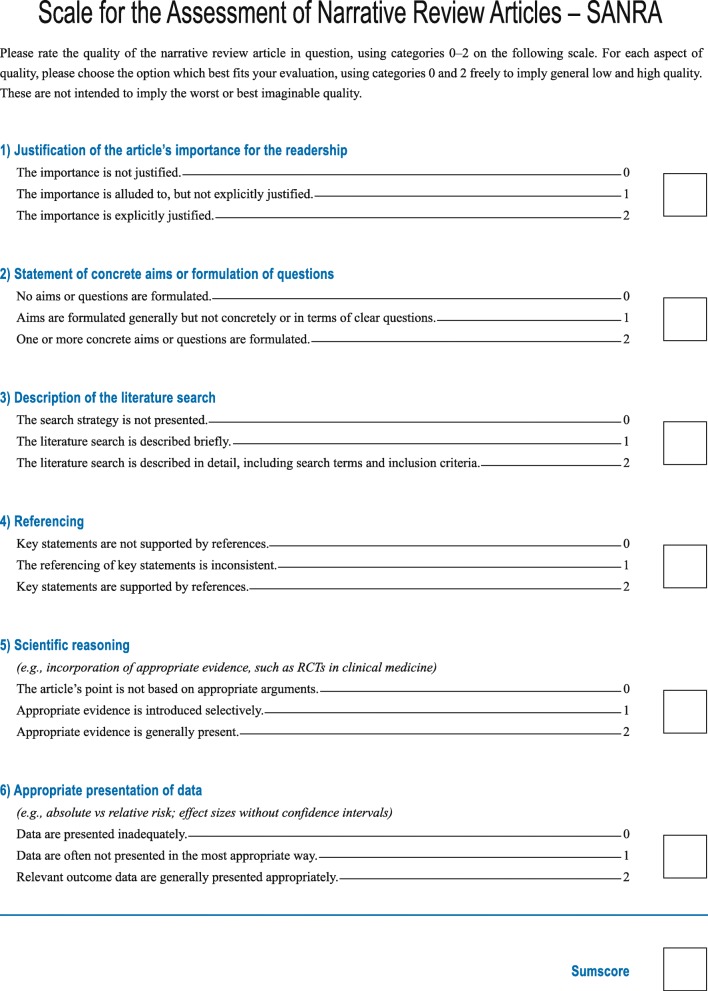
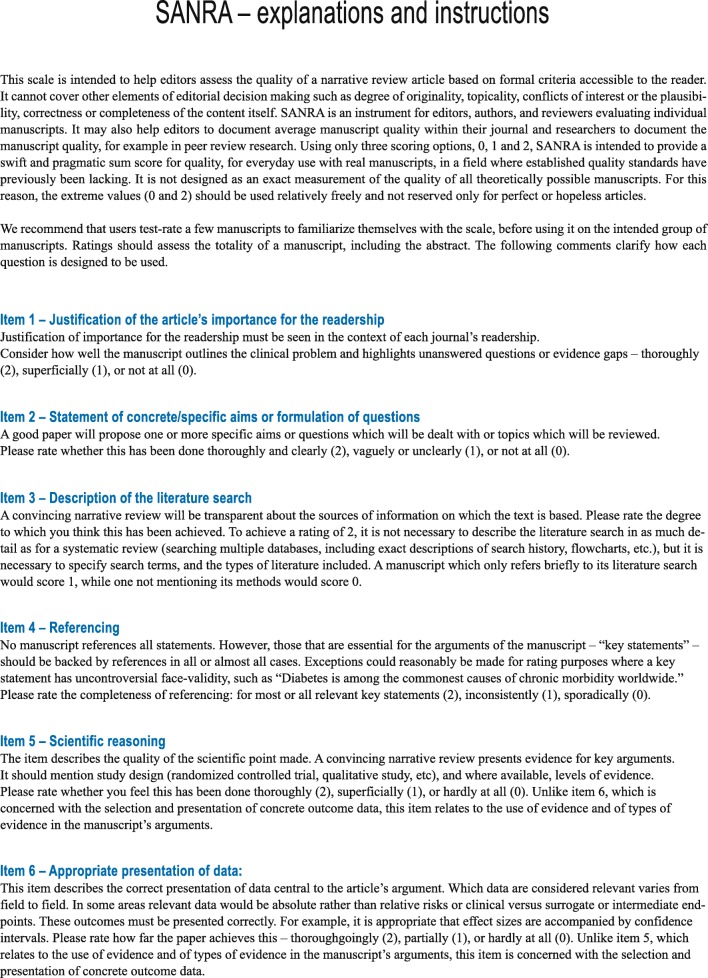
BACKGROUND: Narrative reviews are the commonest type of articles in the medical literature. However, unlike systematic reviews and randomized controlled trials (RCT) articles, for which formal instruments exist to evaluate quality, there is currently no instrument available to assess the quality of narrative reviews. In response to this gap, we developed SANRA, the Scale for the Assessment of Narrative Review Articles. METHODS: A team of three experienced journal editors modified or deleted items in an earlier SANRA version based on face validity, item-total correlations, and reliability scores from previous tests. We deleted an item which addressed a manuscript's writing and accessibility due to poor inter-rater reliability. The six items which form the revised scale are rated from 0 (low standard) to 2 (high standard) and cover the following topics: explanation of (1) the importance and (2) the aims of the review, (3) literature search and (4) referencing and presentation of (5) evidence level and (6) relevant endpoint data. For all items, we developed anchor definitions and examples to guide users in filling out the form. The revised scale was tested by the same editors (blinded to each other's ratings) in a group of 30 consecutive non-systematic review manuscripts submitted to a general medical journal. RESULTS: Raters confirmed that completing the scale is feasible in everyday editorial work. The mean sum score across all 30 manuscripts was 6.0 out of 12 possible points (SD 2.6, range 1-12). Corrected item-total correlations ranged from 0.33 (item 3) to 0.58 (item 6), and Cronbach's alpha was 0.68 (internal consistency). The intra-class correlation coefficient (average measure) was 0.77 [95% CI 0.57, 0.88] (inter-rater reliability). Raters often disagreed on items 1 and 4. CONCLUSIONS: SANRA's feasibility, inter-rater reliability, homogeneity of items, and internal consistency are sufficient for a scale of six items. Further field testing, particularly of validity, is desirable. We recommend rater training based on the "explanations and instructions" document provided with SANRA. In editorial decision-making, SANRA may complement journal-specific evaluation of manuscripts-pertaining to, e.g., audience, originality or difficulty-and may contribute to improving the standard of non-systematic reviews.
Overview
CoChat Summary
TL;DR
SANRA is a six-item, 0–2 scale (maximum 12) for assessing the quality of narrative review articles, developed and field-tested by three journal editors. In 30 consecutive non-systematic review manuscripts, it showed feasible use, sufficient internal consistency and inter-rater reliability, and a modest association with editorial acceptance.
Key findings
- Across 30 manuscripts (90 ratings), the mean SANRA sum score was 6.0 out of 12 (SD 2.6, range 1–12, median 6).
- Internal consistency was Cronbach’s alpha 0.68; corrected item-total correlations ranged from 0.33 (item 3) to 0.58 (item 6).
- Inter-rater reliability was an intra-class correlation coefficient (average measure) of 0.77 [95% CI 0.57, 0.88]; raters often disagreed on items 1 and 4.
- Average SANRA scores were modestly associated with editorial acceptance (mean 6.6, SD 1.9, n = 17) versus rejection (mean 5.1, SD 2.1, n = 13), point biserial correlation 0.37 (t = 2.09, df 28; two-sided p = 0.046).
Methods
- SANRA was developed between 2010 and 2017 by three experienced editors at Deutsches Ärzteblatt; the revised six-item version deleted an item on writing and accessibility due to poor inter-rater reliability.
- The revised scale was tested on 30 consecutive non-systematic review manuscripts submitted to Deutsches Ärzteblatt in 2015; three editor-raters scored them independently and blinded to each other’s ratings.
- Analyses included descriptive statistics, Cronbach’s alpha, corrected item-total correlations, average-measure intra-class correlation using a two-way random effects model (consistency definition), and a post hoc point biserial correlation between SANRA sum scores and acceptance/rejection.
Limitations
- The paper states the main limitation is sample size: 30 manuscripts was a compromise between representativeness, power, and feasibility, and took about 6 months to sample.
- The authors state that the scale’s authors were also the test-raters, so inter-rater reliability may be lower in groups less familiar with SANRA; the study also did not assess test-retest reliability, and results are study-specific.
- The paper acknowledges restricted content validity because SANRA is limited to six items and is a critical appraisal tool rather than a reporting guideline; criterion validity evidence is post hoc and weak, and no established cut-offs exist for comparing manuscripts across settings.
Model-written summary. Check it against the paper before relying on it.
Integrity signals
Registry
Cites
Statistics
Figures
Verification
Claims the paper makes
3 Valid · 0 Not valid · 5 Not checked · 27 Own results and interpretations
The cited sources support only part of this claim — read each source’s verdict below.
In the paper
“Bastian et al. found that they constitute the largest share of all text types in medicine and they concluded that they “remain the staple of medical literature” [1].”
- Also stated in: § Background · plain
“Narrative reviews are the commonest type of articles in the medical literature.”
§ SANRA—a scale for the quality assessment of narrative review articles > Background
What the sources say
- Partly supportedcites [1] Bastian H Glasziou P Chalmers I Seventy-five trials and eleven systematic reviews a day: how will we ever keep up? PLoS Med 2010 7 9 e1000326 10.1371/journal.pmed.1000326 20877712 PMC2943439 sourceExperimental — accuracy not yet measured
In “How Close Are We to Archie Cochrane’s Goal?” and the Summary Points (pages unavailable), the paper calls non-systematic narrative reviews the staple of medical literature synthesis. It does not say they constitute the largest share of all medical text types; that extends a claim about literature synthesis to medical literature as a whole. (LLM, conf=0.88)
plain- Asserted: passes — The authors put it forward as true.
- Checkable: passes — It can be checked against evidence.
- Load-bearing: unclear — It is unclear whether the paper’s conclusions depend on it.
- Based: passes — The paper gives a reason why it holds.
- Also stated in: § Background · plain
The sources with a verdict support this claim; the rest weren’t checked yet, have no full text we could read, or their verdicts aren’t rated yet.
In the paper
“non-systematic reviews or narrative reviews have been widely criticized as unreliable [1, 4].”
§ SANRA—a scale for the quality assessment of narrative review articles > Background
What the sources say
- Supportedcites [1] Bastian H Glasziou P Chalmers I Seventy-five trials and eleven systematic reviews a day: how will we ever keep up? PLoS Med 2010 7 9 e1000326 10.1371/journal.pmed.1000326 20877712 PMC2943439 source
In “How Close Are We to Archie Cochrane’s Goal?”, the paper describes reviews not conducted systematically as having great potential for error and calls them less reliable forms of information. Box 1 also says that articles and textbooks had highlighted the risk of bias and chance in reviews. Together, these passages support the broad characterization that narrative reviews have been criticized as unreliable; page numbers are not provided in our copy. (LLM, conf=0.89)
- Not checked — no full text of the sourcecites [4] Mulrow CD The medical review article: state of the science Ann Intern Med 1987 106 485 488 10.7326/0003-4819-106-3-485 3813259 source
plain- Asserted: passes — The authors put it forward as true.
- Checkable: passes — It can be checked against evidence.
- Load-bearing: passes — The paper’s conclusions depend on it.
- Based: passes — The paper gives a reason why it holds.
- Supported
A result the paper reports from its own data — it cites no other source for it, so there is none to check. The quote shows it is in the paper.
In the paper
“Cronbach’s alpha was 0.68 (internal consistency).”
- Also stated in: § Results · plain
“The scale’s internal consistency, measured as Cronbach’s alpha, was 0.68.”
§ SANRA—a scale for the quality assessment of narrative review articles > Abstract > Results
plainn = 90- Asserted: passes — The authors put it forward as true.
- Checkable: passes — It can be checked against evidence.
- Load-bearing: passes — The paper’s conclusions depend on it.
- Based: passes — The paper gives a reason why it holds.
- Also stated in: § Results · plain
A result the paper reports from its own data — it cites no other source for it, so there is none to check. The quote shows it is in the paper.
In the paper
“Raters often disagreed on items 1 and 4.”
- Also stated in: § Results · plain
“Disagreements most often occurred with regard to items 1 and 4.”
§ SANRA—a scale for the quality assessment of narrative review articles > Abstract > Results
plain- Asserted: passes — The authors put it forward as true.
- Checkable: passes — It can be checked against evidence.
- Load-bearing: unclear — It is unclear whether the paper’s conclusions depend on it.
- Based: passes — The paper gives a reason why it holds.
- Also stated in: § Results · plain
A result the paper reports from its own data — it cites no other source for it, so there is none to check. The quote shows it is in the paper.
In the paper
“The intra-class correlation coefficient (average measure) was 0.77 [95% CI 0.57, 0.88] (inter-rater reliability).”
- Also stated in: § Results · plain
“The intra-class correlation coefficient (average measure) amounted to 0.77 [95% CI 0.57, 0.88; F 4.3; df 29, 58].”
§ SANRA—a scale for the quality assessment of narrative review articles > Abstract > Results
plain- Asserted: passes — The authors put it forward as true.
- Checkable: passes — It can be checked against evidence.
- Load-bearing: passes — The paper’s conclusions depend on it.
- Based: passes — The paper gives a reason why it holds.
- Also stated in: § Results · plain
14 more claims
Create a free account to see all 35 claims and to verify the 3 references still open.
- Probably not a substantial claim. 11
- It may state two separate claims as one. 11
Claims other papers make about this one
Each is checked against this paper’s own text: does it say what the citing paper says it does?
The source backs part of the claim, not all of it — or backs it for a different population, condition or comparison.
In the citing paper
“The review was conducted and reported in accordance with the principles of the Scale for the Assessment of Narrative Review Articles (SANRA), which provides a validated framework for ensuring methodological transparency, scientific rigor, and balanced interpretation in narrative reviews [ 19 ].”
From Paracetamol: A History of Assumptions, Errors, and Evidence Reversals in Pain Management (2026) · cites this paper as [19]
Experimental — accuracy not yet measuredThe source backs part of the claim, not all of it — or backs it for a different population, condition or comparison.
In the citing paper
“As a narrative review, the present work does not include an aggregated quantitative assessment and is more exposed to selection subjectivity than a registered systematic review [124,125].”
From Berberine-Drug Interactions: Mechanisms, Clinical Relevance and Risk Stratification-A Narrative Review (2026) · cites this paper as [124]
Experimental — accuracy not yet measuredThe cited source says what the claim attributes to it.
In the citing paper
“This work is designed as a structured narrative review, with transparent reporting of the documentation strategy, guided by the quality criteria of the Scale for the Assessment of Narrative Review Articles (SANRA) [124].”
From Berberine-Drug Interactions: Mechanisms, Clinical Relevance and Risk Stratification-A Narrative Review (2026) · cites this paper as [124]
The cited source says what the claim attributes to it.
In the citing paper
“we used the following:-Cochrane Risk of Bias 2 (RoB 2) [29] and PEDRO scale tools for RCTs.-AMSTAR 2 [30] checklist for systematic review.-SANRA (Scale for the Assessment of Narrative Review Articles) [31] for narrative reviews.-JBI Checklist for Text and Opinion [32] for expert opinion papers.”
From Pelvic Floor Muscle Training Following Surgery for Pelvic Organ Prolapse: Recommendation from Scientific Literature (2026) · cites this paper as [31]
The cited source says what the claim attributes to it.
In the citing paper
“Data analysis employed a narrative and thematic synthesis methodology,adhering to the SANRA guidelines for narrative reviews (32).”
From Ethical issues in multi-agent AI systems for healthcare: a narrative review (2026) · cites this paper as [32]
12 more claims about this paper
Create a free account to see every claim other papers make about this one.
Citations
Cites
Shea, B. J., Reeves, B. C., Wells, G., Thuku, M., Hamel, C., Moran, J., Moher, D., Tugwell, P., Welch, V., Kristjansson, E., et al. (2017) · BMJ · doi:10.1136/bmj.j4008 · Cited by 10,636 · cited 2×
“Critical appraisal tools have been developed for systematic reviews (e.g., AMSTAR 2 [A MeaSurement Tool to Assess Systematic Reviews] [7]) and papers on RCTs (e.g., the CASP [Critical Appraisal Skills Program] checklist for randomized trials [8]) and other types of medical studies.”
BackgroundStreiner, D. L., & Norman, G. R. (2008) · doi:10.1093/acprof:oso/9780199231881.001.0001 · Cited by 2,631
Critical appraisal skills programme
Singh, J. (2013) · Journal of Pharmacology and Pharmacotherapeutics · doi:10.4103/0976-500x.107697 · Cited by 2,556
Guidelines for Reporting Reliability and Agreement Studies (GRRAS) were proposed
Kottner, J., Audigé, L., Brorson, S., Donner, A., Gajewski, B. J., Hróbjartsson, A., Roberts, C., Shoukri, M., & Streiner, D. L. (2011) · Journal of Clinical Epidemiology · doi:10.1016/j.jclinepi.2010.03.002 · Cited by 2,174
The Mass Production of Redundant, Misleading, and Conflicted Systematic Reviews and Meta‐analyses
IOANNIDIS, J. P. A. (2016) · The Milbank Quarterly · doi:10.1111/1468-0009.12210 · Cited by 1,483 · cited 1×
“While systematic reviews are not per se superior articles and while certain systematic reviews have been criticized lately [3], non-systematic reviews or narrative reviews have”
BackgroundSeventy-five trials and eleven systematic reviews a day: how will we ever keep up?
Bastian, H., Glasziou, P., & Chalmers, I. (2010) · PLoS Medicine · doi:10.1371/journal.pmed.1000326 · Cited by 1,188 · cited 2×
“found that they constitute the largest share of all text types in medicine and they concluded that they “remain the staple of medical literature” [1].”
BackgroundThe Medical Review Article: State of the Science
MULROW, C. D. (1987) · Annals of Internal Medicine · doi:10.7326/0003-4819-106-3-485 · Cited by 856 · cited 1×
“been widely criticized as unreliable [1, 4].”
Writing a narrative biomedical review: considerations for authors, peer reviewers, and editors
Gasparyan, A. Y., Ayvazyan, L., Blackmore, H., & Kitas, G. D. (2011) · Rheumatology International · doi:10.1007/s00296-011-1999-3 · Cited by 694 · cited 1×
“[13], for example, have provided guidance for writing narrative reviews, and Byrne [14] as well as Pautasso [15] has written, from different angles, thoughtful editorials on improving narrative reviews and presented lists of key features of writing a good review—lists that naturally overlap with SANRA items (e.”
BackgroundTen Simple Rules for Writing a Literature Review
Pautasso, M. (2013) · PLoS Computational Biology · doi:10.1371/journal.pcbi.1003149 · Cited by 272 · cited 3×
“[13], for example, have provided guidance for writing narrative reviews, and Byrne [14] as well as Pautasso [15] has written, from different angles, thoughtful editorials on improving narrative reviews and presented lists of key features of writing a good review—lists that naturally overlap with SANRA items (e.”
BackgroundImproving the peer review of narrative literature reviews
Byrne, J. A. (2016) · Research Integrity and Peer Review · doi:10.1186/s41073-016-0019-2 · Cited by 159 · cited 3×
“[13], for example, have provided guidance for writing narrative reviews, and Byrne [14] as well as Pautasso [15] has written, from different angles, thoughtful editorials on improving narrative reviews and presented lists of key features of writing a good review—lists that naturally overlap with SANRA items (e.”
Background
Research works printed but not linked: 3
- Higgins JPT, Green S. (eds.). Cochrane Handbook for Systematic Reviews and Interventions. Version 5.1.0. The Cochrane Collaboration 2011, section 1.2.2., www.handbook.cochrane.org, retrieved on Oct 31, 2018.
- Baethge C Mertens S Goldbeck-Wood S Development of a quality score for the assessment of non-systematic review articles (SANRA) Poster, Seventh International Congress on Peer Review and Biomedical Publication 2013 USA Chicago, Illinois
- Baethge C Goldbeck-Wood S Mertens S A scale for the assessment of non-systematic review articles (SANRA) Poster, Eighth International Congress on Peer and Biomedical Publication 2017 USA Chicago, Illinois
Cited by
Items 1,501–1,600 of 4,334
Advances in Coccygectomy: A Comprehensive Review Evaluating Surgical Techniques for Coccygodynia
Obeng-Gyasi, B., Brown, E. D. L., Chinthala, A. S., & Mao, G. (2025) · Brain Sciences · doi:10.3390/brainsci15020213 · Cited by 2
“A comprehensive literature search was conducted through Ovid MEDLINE, Cochrane Library and Embase databases from inception to present with assistance from a medical librarian following the SANRA guidelines for narrative reviews [9].”
Effect of Omega-3 in Patients Undergoing Bone Marrow Transplantation: A Narrative Review
Mancin, S., Sguanci, M. E., Ferrara, G., Caccialanza, R., Cereda, E., Cascio, A. L., Parozzi, M., Petrelli, F., Cangelosi, G., & Palomares, S. M. (2025) · Hemato · doi:10.3390/hemato6010005 · Cited by 3
“CRP, which are often elevated in HSCT patients reduces the levels of pro-inflammatory cytokines Table 1.”
InfluentialSuppressive antibiotic treatment (SAT) in the era of MDRO infections: a narrative review
Fornari, V., Accardo, G., Lupia, T., Rosa, F. G. D., & Corcione, S. (2025) · Expert Review of Anti-infective Therapy · doi:10.1080/14787210.2025.2473077 · Cited by 3
“The current narrative review followed the Scale for the Assessment of Narrative Review Articles (SANRA) flow-chart (Figure 1) [4] A search was run on PubMed and MEDLINE using the terms (‘suppressive’ [Mesh]) AND (‘antibiotic treatment’ [Mesh]) and (‘life-long’ [Mesh]) AND (‘antibiotic treatment’…”
Dioguardi, M., Muzio, E. L., Illuzzi, G., Sanesi, L., Sovereto, D., Ballini, A., Cazzolla, A. P., Martella, A., & Muzio, L. L. (2025) · European journal of medical research · doi:10.1186/s40001-025-02486-7 · Cited by 2
“…of the literature on the topics of packing density of HSBs in different regions of the tooth crown and, secondarily, in relation to NCCLs. Initially, a narrative review was carried out based on the guidelines provided by the SANRA (Scale for the Assessment of Narrative Review Articles) [11].”
Morris, L. L., Brenner, M. J., Williams, R. L., & Pandian, V. (2025) · Journal of Radiology Nursing · doi:10.1016/j.jradnu.2025.03.004 · Cited by 3
How to Peer Review a Systematic Review: A Peer‐Reviewer's Guide to Reviewing Reviews
Baxter, L. (2025) · The Journal of Clinical Pharmacology · doi:10.1002/jcph.70036 · Cited by 2
Attributes of HPV associated cancers
Thobias, A. R., Patel, M., Vaghela, C., & Patel, P. S. (2025) · Clinical & Translational Oncology · doi:10.1007/s12094-025-03959-1 · Cited by 2
“1 Mode of HPV infection induced neoplastic transformation defined and quantified by “SANRA”—a scale for the quality assessment of narrative review articles [29].”
Kirkove, D., Durieux, N., Allory, E., Louis, G., Gagnayre, R., & Pétré, B. (2025) · Patient Preference and Adherence · doi:10.2147/ppa.s518658 · Cited by 2
Bajwa, M., LeMoine, J. E., Morris, M., & Bajwa, N. (2025) · Cureus Journal of Computer Science. · doi:10.7759/s44389-025-04125-y · Cited by 2
Clinical use of biologics in juvenile idiopathic arthritis: lessons learned from real-world studies
Uçar, S. A., & Sözeri, B. (2025) · Expert Opinion on Biological Therapy · doi:10.1080/14712598.2025.2536351 · Cited by 2
“As this was a narrative review, the methodological framework followed by SANRA (Scale for the Assessment of Narrative Review Articles) guideline to ensure transparency, critical synthesis, and coverage of clinically relevant data [14,15].”
Communication Tools for End-of-Life Conversations in Palliative Nursing: A Narrative Review
Giachello, M., Provasoli, C., Cosmai, S., Modena, G. M., Cattani, D., Dacomi, A., Chiari, C., Scollo, S., Mancin, S., Lopane, D., et al. (2025) · American Journal of Hospice and Palliative Medicine® · doi:10.1177/10499091251351571 · Cited by 3
Stockdale, R. A., Dos’Santos, T., McDaid, K., Nagy, P., Gaffney, C. J., & Barry, T. J. (2025) · Strength and conditioning journal · doi:10.1519/ssc.0000000000000926 · Cited by 2
Dhonde, S., & Jawdekar, A. M. (2025) · Dentistry · doi:10.5772/intechopen.1011683 · Cited by 2
Before you start: the safety of SGLT2 inhibitors for anti-obesity treatment
Meslamani, A. Z. A. (2025) · Expert Opinion on Drug Safety · doi:10.1080/14740338.2025.2573368 · Cited by 2
“…synthesis of a small, metho-dologically heterogeneous evidence base, the author did not apply a formal risk-of-bias tool; instead, an overall methodological strengths and limitations of the studies included are qualitatively summarized in the Results section, in line with SANRA guidance [27].”
The Extracellular Matrix of the Renal Medulla as a Dynamic Reservoir of Osmolytes
Гоженко, А. І., Żukow, W., Gozhenko, O., & Ivanov, D. D. (2025) · Pedagogy and Psychology of Sport · doi:10.12775/pps.2025.27.67029 · Cited by 2
Bakitian, F. A. (2026) · Clinical Cosmetic and Investigational Dentistry · doi:10.2147/ccide.s583379 · Cited by 2
“9 It aimed to address the following general research question: “What does current evidence reveal about the material properties, clinical applications, performance, advantages/disadvantages, limitations, and future directions of bulk-fill RBCs in restorative dentistry?””
Brown, M. J., & Roman, N. V. (2020) · Nutrition and Health · doi:10.1177/0260106020977053 · Cited by 2
“(2005) note they can have the advantage over systematic reviews with respect to tackling comprehensive topics in a much wider way, while systematic reviews are more favorable for specific questions being answered (Baethge et al., 2019).”
BackgroundThe Politics of (Non)endemicity: Chagas Disease in the United States
Peniche, B. M. (2021) · Medical Anthropology · doi:10.1080/01459740.2021.1933483 · Cited by 2
“This article is based on a narrative review (Baethge et al. 2019) of the research on autochthonous vector-borne human cases of CD and T.cruzi infected triatomines and nonhuman animal hosts in the US.”
BackgroundReorganização da qualificação profissional em saúde com a pandemia da COVID-19
Gasque, K. C. D. S., da Conceição, J. R. B., Caldeira, F. I. D., de Oliveira, J. M., & Farias, W. (2021) · Editora COLAB eBooks · doi:10.51781/9786586920178148161 · Cited by 2
de Melo, S. C. S., & Vieira, F. S. (2022) · Revista CEFAC · doi:10.1590/1982-0216/20222437321 · Cited by 2
“…it is recommended that they i) justify their importance; ii) establish their objectives or concrete questions they aim to answer; iii) describe the literature search strategy; iv) support statements with references; v) present appropriate evidence; and vi) adequately present relevant results 13 .”
BackgroundSuharto, A. W. B. (2023) · Academic Journal of Interdisciplinary Studies · doi:10.36941/ajis-2023-0040 · Cited by 2
Medicamentos bioterapéuticos: uso de toxinas botulínicas en la era de biosimilares
Gaviria, J. D. M., Cavanzo, P., Sobrino, F., Ramírez, S., Arango, G. J., Zuluaga, A. F., Morales, M. V., & Rendón, L. (2023) · Acta neurológica colombiana · doi:10.22379/anc.v39i2.867 · Cited by 2
Defining e-research in social work: a review of strategies and challenges
Pai, A. A., Dsouza, M. P., Jothikaran, T. A. J., Sebastin, K. V., & Ashok, L. (2023) · China Journal of Social Work · doi:10.1080/17525098.2023.2232821 · Cited by 2
“We incorporated a scale for the assessment of narrative review articles (SANRA) to maintain the quality of the review (Baethge, Goldbeck-Wood, and Mertens 2019).”
MethodTop 25 Most Cited Articles on Intraoperative Computer Tomography-Guided Navigation in Spine Surgery
Palmer, R. C., Ton, A. T., Robertson, D. M., Liu, K. G., Liu, J. C., Wang, J. C., Hah, R. J., & Alluri, R. K. (2024) · World Neurosurgery · doi:10.1016/j.wneu.2024.02.024 · Cited by 2
Use of Virtual Academic Environments During the Coronavirus Pandemic
Uludağ, K. (2024) · Advances in social networking and online communities book series · doi:10.4018/979-8-3693-5868-9.ch015 · Cited by 5
Kim, Y. E., Serpedin, A., Periyakoil, P. K., German, D. E., & Rameau, A. (2024) · European Archives of Oto-Rhino-Laryngology · doi:10.1007/s00405-024-08659-0 · Cited by 4
Løvoll, H. S., & Botellero, V. L. (2024) · Universitetsforlaget eBooks · doi:10.18261/9788215071800-24-02 · Cited by 4
Genkel, V. V., Domozhirova, E., & Малинина, Е. В. (2024) · Brain Sciences · doi:10.3390/brainsci14070725 · Cited by 4
“Although this review does not include the methodological requirements of a systematic review, we followed available recommendations on methodology for writing narrative reviews, including the Scale for the Assessment of Narrative Review Articles (SANRA) methodology [30,31].”
MethodComputational Models in Neurosciences Between Mechanistic and Phenomenological CharacterizationsPreprint
Gauld, C., Brun, C., Boraud, T., Carlu, M., & Depannemaecker, D. (2022) · Preprints.org · doi:10.20944/preprints202201.0206.v1 · Cited by 2
“For this purpose, 55 we use a set of inclusion criteria according to the SANRA guidelines (Scale for the Assessment of 56 Narrative Review Articles) (Baethge et al. 2019): 57 • identify articles discussing the translational aspect and the use of computational models, and 58 more particularly models…”
MethodFarfán-Díaz, Á., Fuentes-Hinojosa, C., Andrade-Oyarzun, M., Garcia-Carrillo, E., Molina-Márquez, I., Yáñez-Sepúlveda, R., Castillo-Paredes, A., Barrera-González, D., & Montalva-Valenzuela, F. (2026) · Adolescents · doi:10.3390/adolescents6040059 · Cited by 1
“…was informed by the SANRA (Scale for the Assessment of Narrative Review Articles) domains for narrative reviews, including justification of importance, an explicit objective, description of the search, appropriate referencing, scientific reasoning, and presentation of relevant data [27].”
García‐Sanz, P., Aguilera-Cobos, L., Rosario-Lozano, M. P., & Blasco‐Amaro, J. A. (2023) · doi:10.52766/myun6474 · Cited by 2
Srividya, A., & Chaudhry, A. (2023) · Indian Journal of Palliative Care · doi:10.25259/ijpc_47_2023 · Cited by 2
“provided in the SANRA (quality assessment scale for narrative reviews).[7]”
BackgroundQuality of systematic reviews in African emergency medicine: a cross-sectional methodological study
van Niekerk, J., Fapohunda, T., Rohwer, A. C., & McCaul, M. (2023) · African Journal of Emergency Medicine · doi:10.1016/j.afjem.2023.10.001 · Cited by 1
“However, a good start to the solution lies in the use of systematic review reporting checklists and authors appraising their own work before submission [11,13,35].”
BackgroundBertolucci, I. (2023) · Journal of Psychology and Psychotherapy Research · doi:10.12974/2313-1047.2023.10.07 · Cited by 1
“The present narrative review is conducted following the SANRA criteria (Baethge et al ., 2019) and has been realized through a revision of the scientific literature using the following electronic databases: “PubMed”, “Science Direct”, and “Google Scholar”.”
Srichiangrai, W., Kongtanajaruanun, R., Weena, N., Koblap, A., & Muakyod, P. (2024) · British Journal of Management and Marketing Studies · doi:10.52589/bjmms-7bp91qgb · Cited by 1
Anderson, C. B., Fatone, S., & Christiansen, C. L. (2024) · Current Physical Medicine and Rehabilitation Reports · doi:10.1007/s40141-024-00432-y · Cited by 1
“This narrative review was guided by the Scale for the Assessment of Narrative Review Articles [24].”
Pregnancy-associated Cancers: A Narrative Review
Esposito, G., Vecchia, C. L., Fedele, F., & Parazzini, F. (2024) · Epidemiology Biostatistics and Public Health · doi:10.54103/2282-0930/22286 · Cited by 1
“The Scale for the Assessment of Narrative Review Articles (SANRA) was used to report and qualitatively assess the review [1].”
MethodPharmacy Safety and Occupational Health: Quality Perspective
Alomi, Y. A., Sabah, M. A. A., Alamri, N. S., Jasser, A. A. A., Shammari, M. K. A., Otaibi, A. K. A., & Hakami, M. (2024) · International Journal of Pharmacology and Clinical Sciences · doi:10.5530/ijpcs.2023.12.30 · Cited by 1
Rogalski, J. K., & Tomczak, T. (2024) · Health Problems of Civilization · doi:10.5114/hpc.2024.136000 · Cited by 1
Neuromodulation in the treatment of anorexia nervosa - a literature review
Metelska, A., Permoda-Pachuta, A., & Karakuła‐Juchnowicz, H. (2024) · Archives of Psychiatry and Psychotherapy · doi:10.12740/app/176265 · Cited by 1
“The use of a 7-item check-list made it possible to identify key questions about the work, the literature search process and its quality and also allowed the article to be assessed as a narrative review and its implications for further research and clinical practice [18].”
BackgroundCHOWDHURY, S. (2024) · Morecambe Bay medical journal · doi:10.48037/mbmj.v9i6.1432 · Cited by 1
Augmented Reality Smart Glasses for Industry: How to Choose the Right Glasses
Danielsson, O., Ettehad, M., & Syberfeldt, A. (2024) · Advances in transdisciplinary engineering · doi:10.3233/atde240173 · Cited by 1
Aging with and into disability: An introductory review with clarification of basic terms
Venkatesan, S. (2024) · World Journal of Advanced Research and Reviews · doi:10.30574/wjarr.2024.22.1.1170 · Cited by 1
Supporting the management of long-term health risk from night work
Ryan, B., Dadashi, N., & GIBBS, K. (2024) · Industrial Health · doi:10.2486/indhealth.2023-0196 · Cited by 1
“Criteria adapted from Baril-Gingras et al. 34) and supplemented with additional criteria from Baethge et al. 35) enabled quality appraisals of these review and meta-analysis articles.”
Muñoz, C. T. R., Lavín-Maggi, D., Moraga, L., & Illanes, K. P. (2023) · Revista médica de Chile · doi:10.4067/s0034-98872023001101513 · Cited by 1
“Consta de 6 ítems que se califican con 0 (baja calidad), 1 (calidad intermedia) y 2 (alta calidad), con un puntaje máximo de 12 que busca medir la calidad de una investigación 17 .”
Narrative review of value frameworks in urothelial carcinoma and positioning of enfortumab vedotin
Nuñez, A. O., Portela, J. G., Zozaya, N., & Fernández, I. (2024) · Journal of Medical Economics · doi:10.1080/13696998.2024.2403351 · Cited by 1
“This narrative review was conducted using a methodology that meets Scale for the Assessment of Narrative Review Articles (SANRA) criteria, aiming to achieve the maximum quality score of 12 29 .”
Advani, S. D., Smith, A., Kalu, I. C., Perez, R., Hendren, S., Dantes, R., Edwards, J. R., Soe, M. M., Yi, S. H., Young, J., et al. (2024) · Antimicrobial Stewardship & Healthcare Epidemiology · doi:10.1017/ash.2024.397 · Cited by 1
Peri-operative strategy in resuscitation of unstable injured surgical patients: a primer
Mamalchi, S. A., Matar, M. M., & Bass, G. A. (2024) · Postgraduate Medical Journal · doi:10.1093/postmj/qgae141 · Cited by 1
Spirituality as an International Coping Method during Covid-19
Sabuncu, B. C., Kosić, A., & Ai, A. L. (2024) · OBM Integrative and Complementary Medicine · doi:10.21926/obm.icm.2404059 · Cited by 1
Hansen, T., Staal, S. M., Harreby, N. D. R., Andersen, U. O., Holm, M. T., von Bülow, C., & Wæhrens, E. E. (2024) · Geriatrics · doi:10.3390/geriatrics9060138 · Cited by 1
“The review was guided by the criteria of the Scale for the Assessment of Narrative Review articles (SANRA) [37] and the Preferred Reporting Items for Systematic Reviews and Meta-Analyses (PRISMA) statement [38].”
MethodA Literature Review on the Uncommon Use of Extraoral Periapical Radiography
Yeung, A. W. K. (2024) · Applied Sciences · doi:10.3390/app14219850 · Cited by 1
Sharma, A., Sharma, N., & Chahal, A. (2024) · Journal of Diabetology · doi:10.4103/jod.jod_74_24 · Cited by 1
Association Between Hashimoto’s Thyroiditis and Periodontal Disease: A Narrative Review
Ahsan, A., Rafiq, Z., Fatima, M., Naeem, M., Niamat, J., Bukhari, S. J. A., & Shaikh, M. S. (2024) · Oral · doi:10.3390/oral4040042 · Cited by 1
Singh, V., & Goel, D. (2024) · Physiotherapy - The Journal of Indian Association of Physiotherapists · doi:10.4103/pjiap.pjiap_121_24 · Cited by 1
Klotz, S., Begerow, A., & Girdauskas, E. (2024) · Interdisciplinary CardioVascular and Thoracic Surgery · doi:10.1093/icvts/ivae218 · Cited by 3
“Two reviewers (SGRK and AB) selected articles and evaluated their quality independently using the SANRA [21] and STROBE [22] tools.”
Psychological Capital of Generation Z in Facing The Workforce: A Narrative Literature Review
Nu'ma, F. A., & Siahaan, F. M. M. (2024) · Konselor · doi:10.24036/0202413271-0-86 · Cited by 1
Abordaje inicial del paciente con dengue en el servicio de urgencias
de Colombia, U. C., Duque-Barrera, S., Espinal-Cárdenas, Y. A., de Antioquia, U., Herrera-Arango, Y. A., Universidad, C. E. S., Pérez-García, P., & de Colombia, U. C. (2025) · IATREIA · doi:10.17533/udea.iatreia.325 · Cited by 1
Galietta, E., Donati, C. M., Cavallini, L., Candoli, F., Cellini, F., Macchia, G., Deodato, F., Uddin, A., Sumon, M. A., Wondemagegnehu, T., et al. (2025) · Technology in Cancer Research & Treatment · doi:10.1177/15330338241293174 · Cited by 1
Meredith, I., Davies, J. L., Stubbings, D. R., & Payne, L. (2025) · International Journal of Offender Therapy and Comparative Criminology · doi:10.1177/0306624x251329944 · Cited by 1
“Consequently, the Scale for Assessment of Narrative Review Articles (SANRA; Baethge et al., 2019) was adopted for papers with literature review designs.”
Artificial Intelligence, Online Algorithms, and the Influence of Propaganda
Uludağ, K. (2025) · IGI Global eBooks · doi:10.4018/979-8-3693-7468-9.ch008 · Cited by 1
Larki, M., Moghri, J., Bahri, N., & Roudsari, R. L. (2025) · HIV & AIDS Review · doi:10.5114/hivar/150510 · Cited by 1
The paramount role of palliative care in low-prevalence diseases
Correa‐Morales, J. E., Umbacia, M. A., Martinez, C., Zarante, I., Liñeiro, A. M. G., Giraldo‐Moreno, S., & León, M. (2025) · International Journal of Palliative Nursing · doi:10.12968/ijpn.2023.0039 · Cited by 1
Surgical Care in the Era of Mpox Clade I: A Review and Call for Preparedness
Chryssofos, S., Jeong, D., Yaeger, L., & Badran, S. M. (2025) · The American Surgeon · doi:10.1177/00031348251351001 · Cited by 1
Dumet, L. M., Gelmon, S. B., Goodman, J. M., & O'Neal, S. (2025) · Hatfield Graduate Journal of Public Affairs · doi:10.15760/hgjpa.2025.9.1.7 · Cited by 2
O uso de tecnologias digitais na promoção da saúde sexual nos jovens adultos: revisão narrativa
da Cunha-Oliveira, A. C. G. D. P., Gómez‐Cantarino, S., Santos, D., Oliveira, B. F. P., Marinho, B., Ribeiro, C. D., Rodrigues, F., Gomes, J., Menino, E., & Reis, R. K. (2025) · Revista Brasileira de Enfermagem · doi:10.1590/0034-7167-2023-0434pt · Cited by 1
Hendarto, D. T. (2025) · Journal of Economics and Business UBS · doi:10.52644/joeb.v14i3.2675 · Cited by 1
Rare Etiologies of Upper Gastrointestinal Bleeding: A Narrative Review
Dina, I., Nedelcu, M., Iacobescu, C. G., Baboi, I. D., & Bălăceanu, A. L. (2025) · Journal of Clinical Medicine · doi:10.3390/jcm14144972 · Cited by 2
Mahanta, P., Paul, F. A., & Singh, A. (2025) · Vulnerable Children and Youth Studies · doi:10.1080/17450128.2025.2535359 · Cited by 1
“…employed a comprehensive narrative review methodology using SANRA guideline to synthesize existing literature on the mental health of school-going adolescents in India, with a particular emphasis on the landscape and implementation of School Mental Health (SMH) programs (Baethge et al., 2019).”
Alotaibi, M. M., Alrashdi, N. Z., Alzubaidi, B. Y., ALMUTAIRI, M. K., Alanazi, S. A., Almutairi, A. B., & Alqahtani, M. Μ. (2025) · Frontiers in Psychiatry · doi:10.3389/fpsyt.2025.1624590 · Cited by 1
Ramaswamy, S. N., Harikrishnan, S., Bhatt, N., Agarwal, Y., Chand, S., Matam, M. B., & Mohammed, L. (2025) · Cureus · doi:10.7759/cureus.89871 · Cited by 1
“We used the Newcastle-Ottawa scale [13] to assess observational studies and the Scale for the Assessment of Narrative Review Articles (SANRA) tool for narrative reviews [14].”
Guesser, T. A. I., Pinheiro, V. H. G., Alberton, C. L., & Pinto, S. S. (2025) · Psicologia e Saúde em Debate · doi:10.22289/2446-922x.v11a2a4 · Cited by 1
The Role of Whole-Body MRI in Patients with Lymphoma: A Narrative Review
Renzetti, B., Cattabriga, A., Brocchi, S., Gaudiano, C., Assenza, M., Nanni, C., Broccoli, A., Basile, A., Zinzani, P. L., Fanti, S., et al. (2025) · Technology in Cancer Research & Treatment · doi:10.1177/15330338251359724 · Cited by 1
Abasi, A., Ayatollahi, H., Rad, S., & Rafsanjani, M. H. (2025) · Cancers · doi:10.3390/cancers17172777 · Cited by 2
Hydrogels in Peri-Implant Regeneration: Strategies for Modulating Tissue Healing
Frigério, P. B., Duarte, N. D., Koury, M. M., Duarte, F. D. S., Okamoto, R., Buchaim, D. V., Reis, C. H. B., da Silva, W. S., Bueno, L. M. M., Raphael, M. C., et al. (2025) · Pharmaceutics · doi:10.3390/pharmaceutics17091105 · Cited by 1
Medication reconciliation and its essentiality in the geriatric population: A comprehensive review
Hussain, A. S. M., Sulaiman, S. A. S., Khan, S. F., Alrohily, W., Ghadzi, S. M. S., Alsahali, S. M., & Al‐Worafi, Y. M. (2025) · Journal of Applied Pharmaceutical Science · doi:10.7324/japs.2025.235827 · Cited by 1
“The narrative review is reported in accordance with the Scale for the Assessment of Narrative Review Articles (SANRA) [13].”
Empowering Pharmacists in Heartburn Management: Practical Insights for OTC Treatment and Self-Care
Bridgeman, M. B., Hospattankar, A. V., Siddiqui, K., & Nakhla, N. R. (2025) · Pharmacy · doi:10.3390/pharmacy13050124 · Cited by 1
Pavinati, G., de Lima, L. V., Sesnik, H. H., Stolarz, M. F., & Magnabosco, G. T. (2025) · Enfermagem em Foco · doi:10.21675/2357-707x.2025.v16.e-202514supl1 · Cited by 1
Cardiovascular benefits of liraglutide in patients with type 2 diabetes: an in-depth exploration
Alluri, A. A., MITRA, A., Marepalli, A., Kshitij, R. A. J., Gandhi, N., Prystupa, Y., & Seetharaman, R. (2025) · Minerva Cardiology and Angiology · doi:10.23736/s2724-5683.25.06846-2 · Cited by 1
Implementation science in the field of emergency nursing practice: A scoping review
Hou, H., Jiang, Y., Luo, M., Dong, T., & Xiao, S. (2025) · International Emergency Nursing · doi:10.1016/j.ienj.2025.101679 · Cited by 1
Universal Subconstructs of a Healthy Diet for Children and Adolescents: A Critical Review
Schwendler, T., Frongillo, E. A., Craig, H. C., Hanley‐Cook, G., Sattamini, I. F., Hayashi, C., Mehra, V., Pries, A. M., Saha, K. K., Coates, J. C., et al. (2025) · Advances in Nutrition · doi:10.1016/j.advnut.2025.100511 · Cited by 1
Patient Education and Communication in Palliative Radiotherapy: A Narrative Review
Galietta, E., Donati, C. M., Mammini, F., Zamfir, A. A., Bazzocchi, A., Sassi, R., Hovenier, R., Bos, C., Buwenge, M., Cammelli, S., et al. (2025) · Cancers · doi:10.3390/cancers17193109 · Cited by 2
“…(Scale for the Assessment of Narrative Review Articles) quality domains: (i) justification of the article’s importance for readers; (ii) statement of the aims; (iii) description of the literature search; (iv) referencing; (v) scientific reasoning; and (vi) appropriate presentation of data [14].”
Viés de atribuição na cognição social: teorias, aplicações na psiquiatria e pesquisas no Brasil
Marinho, A. C., Mello, C. B., & de Figueiredo, T. C. (2025) · Debates em Psiquiatria · doi:10.25118/2763-9037.2025.v15.1453 · Cited by 1
Estrada-Palavecino, L., Avello, D., Sepúlveda, J., & Püschel, K. (2025) · Education for Health · doi:10.62694/efh.2025.331 · Cited by 2
Vitamin D in Peri-Implant and Periodontal Tissue
Duarte, F. D. S., Duarte, N. D., Mulinari‐Santos, G., Frigério, P. B., Okamoto, R., Buchaim, R. L., Buchaim, D. V., & Issa, J. P. M. (2025) · Dentistry Journal · doi:10.3390/dj13100448 · Cited by 1
“This narrative review was conducted following the guidelines of the Scale for the Assessment of Narrative Review Articles (SANRA) [23].”
InfluentialNon-Contact Laser Therapy for Glaucoma: A Review of Direct Selective Laser Trabeculoplasty
Koziorowska, A. M., Opala, A., & Grabska‐Liberek, I. (2025) · Journal of Clinical Medicine · doi:10.3390/jcm14196884 · Cited by 1
“This article is a narrative review prepared in accordance with the SANRA guidelines [14].”
The Role of Lactoferrin in Modulating Inflammation and Preventing Preterm Birth: A Narrative Review
Messina, A., Motarajji, S. E., Masturzo, B., & Manzoni, P. (2025) · Nutrients · doi:10.3390/nu17193164 · Cited by 2
“To enhance methodological transparency and quality, the review was developed in accordance with the Scale for the Assessment of Narrative Review Articles (SANRA) framework [15], which provides established criteria for narrative reviews.”
Transgender Experiences of Homelessness: A Narrative Review of Psychosocial Support Approaches
Timothy, S. J., Raman, K. J., & Raj, E. A. (2025) · Journal of Psychosocial Rehabilitation and Mental Health · doi:10.1007/s40737-025-00500-z · Cited by 1
Harding, S., Cleves, A., & Guirguis, A. (2025) · Currents in Pharmacy Teaching and Learning · doi:10.1016/j.cptl.2025.102481 · Cited by 1
Allen, B. H., & Tibi, S. (2025) · Language Speech and Hearing Services in Schools · doi:10.1044/2025_lshss-25-00013 · Cited by 1
Special care services delivery at disaster scenes: a systematic review
Masbi, M. H., Tavkoli, N., Payrovi, H., & Dowlati, M. (2025) · International Journal of Emergency Medicine · doi:10.1186/s12245-025-01041-9 · Cited by 2
“…(14 studies) for observational studies [18], SANRA (Scale for the Assessment of Narrative Review Articles) for narrative reviews (9 studies) [19], CARE for case series and reports (3 studies) [20], MMAT (Mixed Methods Appraisal Tool) for mixed methods studies (1 study) [21], CROSS (Critical…”
Sleep Bruxism and Hypobaric Hypoxia Exposure: Exploring the Physiological Association
Pena, E., Yanez, M. P., & Montini, F. (2025) · Journal of Clinical Medicine · doi:10.3390/jcm14207176 · Cited by 1
“This narrative review was conducted following the SANRA guidelines [17] to evaluate the effects of hypobaric and normobaric hypoxia on the physiological and molecular alterations associated with SB.”
Teledentistry: Building a Bridge Between Patient Care and Technology – A Narrative Review
Nawaz, K. B., Zia, M., Irfan, M., Hanif, A., Shahid, R., & Alvi, S. (2025) · The Journal of Basic and Clinical Dentistry · doi:10.64471/28gd7c53 · Cited by 1
Use of cannabis in psychological symptom management among patients with cancer: A narrative review
Reddy, A. C., Wilson, P., Shah, J., Schmitz, N. S., & Chewning, B. A. (2025) · Journal of the American Pharmacists Association · doi:10.1016/j.japh.2025.102954 · Cited by 2
Effects of Virtual Reality With Intradialytic Exercise in Adult Hemodialysis Patients
Warren, R., Radler, D. R., & Zelig, R. S. (2025) · Journal of Renal Nutrition · doi:10.1053/j.jrn.2025.10.011 · Cited by 1
Impact of Physical Therapy on Empowering Neurological Aging: A Narrative Review
Baladaniya, M., Baldania, S., Gandhi, N. V., & Hait, A. (2025) · Cureus · doi:10.7759/cureus.95640 · Cited by 1
Adenovirus Protease: An Overlooked but Druggable Antiviral Target
Belova, P., & Papaneophytou, C. P. (2025) · Macromol—A Journal of Macromolecular Research · doi:10.3390/macromol5040052 · Cited by 1
Narrative Review of Electromyography Applied to Screening or Diagnosis of Sarcopenia
He, H., Jiang, Y., He, J., & Jiang, N. (2025) · IEEE Transactions on Neural Systems and Rehabilitation Engineering · doi:10.1109/tnsre.2025.3628111 · Cited by 1
Outcomes of Different Surgical Approaches in Tracheal Schwannoma: A Narrative Review
Alkhars, H. F., Almayouf, M., Albarrak, M., Alzahrani, F., Fnais, N., Alessa, M., Al-Qahtani, K. H., & Aldhahri, S. (2025) · Ear Nose & Throat Journal · doi:10.1177/01455613251389452 · Cited by 1
Maqsood, A. (2025) · Journal of Medical Education and Curricular Development · doi:10.1177/23821205251389360 · Cited by 1
“26,27 Studies were not omitted only based on quality assessment; rather, the robustness of each study ’ s contribution was evaluated during the synthesis of data and the rating of con fi dence in results.”
Arslan, K., & Şahin, A. S. (2025) · Bagcilar Medical Bulletin · doi:10.4274/bmb.galenos.2025.65982 · Cited by 1
Metadata
- Authors
- Baethge, C., Goldbeck-Wood, S., & Mertens, S.
- Affiliations
- University of Cologne (DE)
- BMJ Group (United Kingdom) (GB)
- Corresponding author
- Baethge, Christopher
- ORCID
- Baethge, Christopher
- Venue
- Research Integrity and Peer Review
- Published
- 2019-03-26
- Volume
- 4
- Issue
- 1
- Pages
- 5-5
- ISSN
- 2058-8615 (ISSN-L)
- PMC
- PMC6434870
- OpenAlex
- W2922577842
- Semantic Scholar
- ea7f35b3069b53791c3b746c5c4b3c72a83a526b
- Cited by
- 3,469
- References
- 13
- Citations by year
- 2026: 1823 · 2025: 551 · 2024: 379 · 2023: 309 · 2022: 218 · 2021: 152 · 2020: 32 · 2019: 4
- FWCI
- 20.57
- Type
- journal article
- Language
- en
- Open access
- gold
- doi.org
- Licence
- cc-by
- creativecommons.org/licenses/by/4.0/ (tdm)
- Locations
- Research Integrity and Peer Review (publishedVersion, cc-by)
- Europe PMC (PubMed Central) (publishedVersion, other-oa)
- PubMed Central (publishedVersion, cc-by)
- PubMed (publishedVersion)
- Kölner Universitäts PublikationsServer (Universität zu Köln) (publishedVersion)
- DOAJ (DOAJ: Directory of Open Access Journals) (submittedVersion, cc-by-sa)
- Topics
- Social Sciences › Decision Sciences › Statistics, Probability and Uncertainty › Meta-analysis and systematic reviews
- Social Sciences › Library and Information Sciences › Academic Writing and Publishing
- Social Sciences › Library and Information Sciences › scientometrics and bibliometrics research
- Keywords
- quality assessment scale, manuscript review, inter-rater reliability, level of evidence, scale development
About these checks
Registry, retraction, Cites and statistics results are computed, not judged, with one exception: a printed reference that no index lists is read once by a model before it counts as a citation error. Claims are extracted by a model and kept only when their quote appears verbatim in the text; each cited source is then checked, with a model’s help, for whether it says what the claim relies on. Those verdicts can be wrong — read the claim’s quote and the cited source before relying on one.
The claim verdicts this report counts are experimental: their accuracy is not yet measured.
A language model drew the claims from the paper on 2026-11-10, under version 3 of the claim definition (model deepseek-v4.1-flash, prompt extract-v3).
A second model labelled each claim on 2026-11-10 (model jev-1.13-20260917, definition revision gold-guideline-v0.2).
Cited sources are checked with a language model’s help (gpt-6-sol).
Statistics and arithmetic are recomputed, not judged.
Confidence bands are shown only for fields calibrated on our annotated test set. None is calibrated yet, so no band is shown.
What counts as a claim ›How we measure confidence ›How we check this ›
Are you an author, or do you see a problem with this page? Request a review
Data sources
Bibliographic data: Semantic Scholar, OpenAlex, Crossref.
Contains information from the Semantic Scholar Academic Graph Datasets, made available under the ODC Attribution License (ODC-BY 1.0).
Semantic Scholar’s data is described in: Kinney, R., et al. (2023). The Semantic Scholar Open Data Platform. arXiv:2301.10140.
