

The synergistic relationship of perceived autonomy support and structure in the prediction of self-regulated learning.
Open accessThe DOI matches its Crossref record; 38 of the 40 references it cites were found in a registry or an index, and 1 are not checked yet; none of the 7 sources its claims cite is checked for support yet.
Abstract
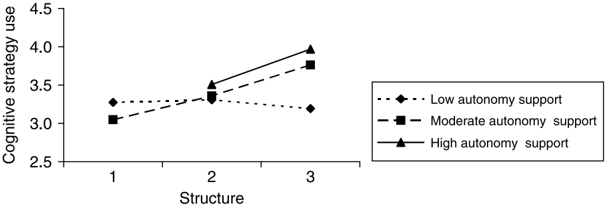
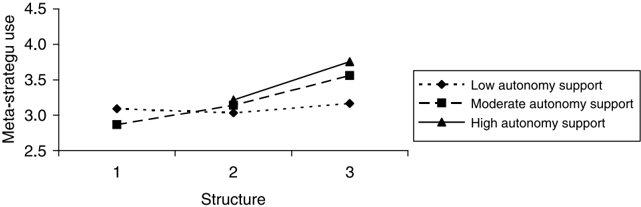
BACKGROUND: Self-determination theory defines two important dimensions of teaching style: autonomy support and structure. AIMS: The purpose of the present study was to investigate the synergistic relationship of perceived teacher autonomy support and the provision of structure in the prediction of self-regulated learning. SAMPLE AND METHOD: Students (N=526) completed questionnaires assessing perceived autonomy support, structure, and self-regulated learning. RESULTS: First, autonomy support and structure were found to be positively correlated, suggesting that the support of student autonomy generally goes hand in hand with the provision of structure and order in the classroom. Second, moderated regression analyses indicated that structure but not autonomy support yielded a main effect on self-regulated learning, although this main effect was qualified by a structure by autonomy support interaction. CONCLUSION: The interaction suggests that structure was associated with more self-regulated learning under conditions of moderate and high autonomy support only. Therefore, when teachers want their students to evaluate themselves, to plan their study activities, and to think about themselves as learners, the teachers are encouraged to provide help, instructions, and expectations in an autonomy-supportive way.
Checked 2026-11-25 · 1 reference not checked yet
Overview
CoChat Summary
TL;DR
This correlational study found that perceived teacher autonomy support and structure are positively correlated, and that structure predicts self-regulated learning mainly when accompanied by moderate or high autonomy support. The authors interpret the interaction as evidence that structure supplies the “know-how” for self-regulated learning while autonomy support supplies the willingness to use it.
Key findings
- Perceived autonomy support and structure were positively correlated (\(r = .67, p < .01\)) and were empirically distinguishable in CFA, with a two-factor solution fitting better than a one-factor solution, \(\Delta\chi^2(1) = 29.39, p < .001\).
- Structure, but not autonomy support, had a main effect on both cognitive strategy use and self-regulation; however, this was qualified by a significant autonomy support × structure interaction, \(\Delta R^2 = .03, p < .001\) for each SRL outcome.
- Simple slopes showed structure predicted cognitive strategy use and self-regulation at average autonomy support (\(\beta = .33\) and \(\beta = .29\), respectively, \(p < .001\)) and high autonomy support (\(\beta = .46\) and \(\beta = .51\), respectively, \(p < .001\)), but not at low autonomy support (\(\beta = .06\), ns for both).
- Type of education did not interact with the teaching style dimensions in predicting SRL, and the three-way interaction with type of education was not significant.
Methods
- Correlational design with \(N = 526\) Belgian students: 264 male and 262 female, Grade 11 and 12 academic-track secondary students plus first-year teacher education students; age ranged from 15 to 27 years (\(M = 17.9\), \(SD = 1.22\)).
- Students completed questionnaires assessing perceived teacher autonomy support and structure (eight items each from the shortened Teacher as Social Context Questionnaire) and self-regulated learning (shortened Motivated Strategies for Learning Questionnaire: 13 cognitive strategy use items and nine self-regulation items).
- Analyses included confirmatory factor analysis, MANOVA for domain effects, and hierarchical moderated regression predicting SRL from type of education, autonomy support, structure, and their interactions.
Limitations
- The paper states that the cross-sectional design prevents conclusions about direction of effects, that student self-reports may create shared method variance and make true teacher effects difficult to determine, and that findings may not generalize to younger populations or other aspects of SRL such as affect regulation.
- The paper also notes that autonomy support and structure were each assessed with brief eight-item scales, limiting insight into subcomponents.
- Evident from the text: the sample did not include the high-autonomy-support/low-structure combination, and the study relies on perceived rather than observed teaching.
Model-written summary. Check it against the paper before relying on it.
Integrity signals
Registry
Cites
Statistics
Figures
Verification
Claims the paper makes
0 Valid · 0 Not valid · 8 Not checked · 62 Own results and interpretations
A result the paper reports from its own data — it cites no other source for it, so there is none to check. The quote shows it is in the paper.
In the paper
“First, autonomy support and structure were found to be positively correlated, suggesting that the support of student autonomy generally goes hand in hand with the provision of structure and order in the classroom.”
- Also stated in: § Preliminary analyses · p. 6 · plain
“As predicted, autonomy support and structure were positively correlated.”
plainstates an association- Asserted: passes — The authors put it forward as true.
- Checkable: passes — It can be checked against evidence.
- Load-bearing: passes — The paper’s conclusions depend on it.
- Based: passes — The paper gives a reason why it holds.
- Also stated in: § Preliminary analyses · p. 6 · plain
A result the paper reports from its own data — it cites no other source for it, so there is none to check. The quote shows it is in the paper.
In the paper
“The educational sciences subsample scored highest on all outcomes compared to both the Dutch and mathematics subsamples, while both did not differ from one another except for autonomy support, with the Dutch subsample scoring significantly lower than the mathematics subsample.”
plain- Asserted: passes — The authors put it forward as true.
- Checkable: passes — It can be checked against evidence.
- Load-bearing: unclear — It is unclear whether the paper’s conclusions depend on it.
- Based: passes — The paper gives a reason why it holds.
A result the paper reports from its own data — it cites no other source for it, so there is none to check. The quote shows it is in the paper.
In the paper
“No evidence was found for curvilinear structure effects on SRL.”
plain- Asserted: passes — The authors put it forward as true.
- Checkable: passes — It can be checked against evidence.
- Load-bearing: passes — The paper’s conclusions depend on it.
- Based: passes — The paper gives a reason why it holds.
A result the paper reports from its own data — it cites no other source for it, so there is none to check. The quote shows it is in the paper.
In the paper
“As the three-way interaction between autonomy support, structure, and type of education also was not significant”
plain- Asserted: passes — The authors put it forward as true.
- Checkable: passes — It can be checked against evidence.
- Load-bearing: passes — The paper’s conclusions depend on it.
- Based: passes — The paper gives a reason why it holds.
A result the paper reports from its own data — it cites no other source for it, so there is none to check. The quote shows it is in the paper.
In the paper
“Domain had an overall multivariate effect (Wilks' l ¼ : 77; F ð 8 ; 1 ; 034 Þ ¼ 17 : 86; p , : 001; h 2 ¼ : 12).”
plainstates an association- Asserted: passes — The authors put it forward as true.
- Checkable: passes — It can be checked against evidence.
- Load-bearing: unclear — It is unclear whether the paper’s conclusions depend on it.
- Based: passes — The paper gives a reason why it holds.
31 more claims
Create a free account to see all 70 claims and every source verdict.
- Probably not a substantial claim. 25
- It may state two separate claims as one. 15
Claims other papers make about this one
Each is checked against this paper’s own text: does it say what the citing paper says it does?
The cited source says what the claim attributes to it.
In the citing paper
“It is now very clear that autonomy support and structure are not antithetical.”
From Basic psychological need theory: Advancements, critical themes, and future directions (2020) · cites this paper as Sierens et al. 2009
The check wasn’t confident either way, so it gives no verdict — never disputed.
In the citing paper
“By contrast, a performance climate promotes the perception that superior performances or winning are the most highly valued outcomes [67, 70–72].”
From Framework for the design and delivery of organized physical activity sessions for children and adolescents: rationale and description of the ‘SAAFE’ teaching principles (2017) · cites this paper as [72]
Experimental — accuracy not yet measured
Citations
Cites
Hu, L., & Bentler, P. M. (1999) · Structural Equation Modeling A Multidisciplinary Journal · doi:10.1080/10705519909540118 · Cited by 108,788
Multiple regression: testing and interpreting interactions
(1992) · Choice Reviews Online · doi:10.5860/choice.29-3352 · Cited by 36,654
(1998) · Cited by 36,049
The "what" and "why" of goal pursuits: Human needs and the self-determination of behavior
Deci, E. L., & Ryan, R. M. (2000) · Psychological Inquiry · doi:10.1207/s15327965pli1104_01 · Cited by 34,210
Motivational and self-regulated learning components of classroom academic performance.
Pintrich, P. R., & De Groot, E. V. (1990) · Journal of Educational Psychology · doi:10.1037/0022-0663.82.1.33 · Cited by 8,332
Regression Diagnostics: Identifying Influential Data and Sources of Collinearity
Belsley, D. A., Kuh, E., & Welsch, R. E. (1980) · Wiley Series in Probability and Statistics · doi:10.1002/0471725153 · Cited by 7,297
Regression Diagnostics -- Identifying Influential Data and Sources of Collinearity
Beaumont, C. D., Belsley, D. A., Kuh, E., & Welsch, R. E. (1981) · The Journal of the Operational Research Society · doi:10.2307/2581267 · Cited by 6,359
Skinner, E. A., & Belmont, M. J. (1993) · Journal of Educational Psychology · doi:10.1037/0022-0663.85.4.571 · Cited by 3,428 · cited 2×
“It may be useful to collect longitudinal data and to use cross-lagged analyses in future studies to look for reciprocal effects of the dimensions of teaching style and the use of self-regulatory skills (see e.g. Skinner & Belmont, 1993).”
Background(1991) · Cited by 3,259
Handbook of Research on Teaching
Richardson, V. (2001) · Cited by 2,437
Research works printed but not linked: 4
- Belmont, M., Skinner, E., Wellborn, J., & Connell, J. (1988). Teacher as social context: A measure of student perceptions of teacher provision of involvement, structure, and autonomy support (Tech. Rep. No. 102). Rochester, NY: University of Rochester.
- Jo ¨reskog, K. G., & So ¨rbom, D. (1993). Lisrel VIII users' reference guide . Mooresville, IN: Scientific Software.
- Miles, J., & Shevlin, M. (2001). Applying regression and correlation . Thousand Oaks, CA: Sage. Miller, R. B., & Brickman, S. J. (2004). A model of future-oriented motivation and self-regulation. Educational Psychology Review , 16 , 9-33.
- Reeve, J., Deci, E. L., & Ryan, R. M. (2004). Self-determination theory: A dialectical framework for understanding socio-cultural influences on student motivation. In D. M. McInerney & S. Van Etten (Eds.), Big theories revisited (pp. 31-60). Greenwich, CT: Information Age Press.
Cited by
Items 201–300 of 613
Is Relatedness Enough? On the Importance of Need Support in Different Types of Social Experiences
Niemiec, C. P., Soenens, B., & Vansteenkiste, M. (2014) · Springer eBooks · doi:10.1007/978-94-017-8542-6_4 · Cited by 44
Self-citationMotivation Science: Controversies and Insights
Bong, M., Reeve, J., & Kim, S.-I. (2023) · doi:10.1093/oso/9780197662359.001.0001 · Cited by 40
Grolnick, W. S., & Lerner, R. E. (2023) · Oxford University Press eBooks · doi:10.1093/oxfordhb/9780197600047.013.26 · Cited by 38
Developing an interactive PBL environment via persuasive gamify elements: a scoping review
Ghani, A. S. A., Rahim, A. F. A., Yusoff, M. S. B., & Hadie, S. N. H. (2022) · Research and Practice in Technology Enhanced Learning · doi:10.1186/s41039-022-00193-z · Cited by 44
“…for facilitating students’ learning in PBL. Providing continuous constructive feedback on students’ performance during a PBL session does not only improve students’ task performance, but it could positively affect students’ competence and motivation (García et al., 2019; Sierens et al., 2009).”
BackgroundPuyenbroeck, S. V., Stouten, J., & Broek, G. V. (2017) · Scandinavian Journal of Medicine and Science in Sports · doi:10.1111/sms.12895 · Cited by 47
How autonomy support mediates the relationship between self-efficacy and approaches to learning
Kulakow, S. (2020) · The Journal of Educational Research · doi:10.1080/00220671.2019.1709402 · Cited by 35
“More specifically, Sierens et al. (2009) have suggested that at least moderate autonomy conditions have to be fulfilled to allow other perceived classroom variables such as perceived structure to have significant associations with approaches to learning.”
BackgroundInfluentialDoes teacher homework feedback matter to 6th graders’ school engagement?: a mixed methods study
da Cunha, J. S., Rosário, P. J. S. L. F., Núñez, J. C., Vallejo, G., Martins, J. A. O., & Högemann, J. (2019) · Metacognition and Learning · doi:10.1007/s11409-019-09200-z · Cited by 36
Do students’ topic interest and tutors’ instructional style matter in problem-based learning?
Wijnia, L., Loyens, S. M. M., Derous, E., & Schmidt, H. G. (2014) · Journal of Educational Psychology · doi:10.1037/a0037119 · Cited by 36
Arvanitis, A., Kalliris, K., & Kaminiotis, K. (2020) · The Social Science Journal · doi:10.1016/j.soscij.2019.08.003 · Cited by 41
Nouwen, W., Clycq, N., Struyf, A., & Donche, V. (2021) · European Journal of Psychology of Education · doi:10.1007/s10212-021-00561-1 · Cited by 45
Cho, H. J., Levesque‐Bristol, C., & Yough, M. S. (2022) · Learning Environments Research · doi:10.1007/s10984-021-09401-x · Cited by 43
“…environments are associated with a wide range of positive learning experiences, such as more engagement in schoolwork (Jang et al., 2010; Reeve, 2006; Wang, & Holcombe, 2010), deep-level learning (Vansteenkiste et al., 2004, 2012), and self-regulated learning (Sierens et al., 2009).”
BackgroundTarbetsky, A. L., Martin, A. J., & Collie, R. J. (2017) · Springer eBooks · doi:10.1007/978-981-10-3394-0_2 · Cited by 49
“Indeed, Sierens et al. (2009) found a significant association between autonomy support and self-regulated learning.”
BackgroundMaladaptive behavior in relation to the basic psychological needs of students in secondary education
Oostdam, R., Koerhuis, M.-J., & Fukkink, R. G. (2018) · European Journal of Psychology of Education · doi:10.1007/s10212-018-0397-6 · Cited by 41
Haw, J. Y., & King, R. B. (2023) · Social Psychology of Education · doi:10.1007/s11218-023-09790-2 · Cited by 33
Valdés‐Cuervo, A. A., Grijalva-Quiñonez, C. S., & Parra-Pérez, L. G. (2022) · Anales de Psicología · doi:10.6018/analesps.424221 · Cited by 39
“Nonetheless, as other scholars (Jang et al., 2010; Joussemet et al., 2008; Ryan & Deci, 2017; Sierens et al., 2009), we believe the provision of autonomy support remains essential for individual development, as it promotes the improvement of children ́s psychological resources that facilitate academic success, positiv…”
BackgroundAlivernini, F., Manganelli, S., Cavicchiolo, E., Chirico, A., & Lucidi, F. (2018) · Journal of Psychoeducational Assessment · doi:10.1177/0734282918785072 · Cited by 30
Teaching in Ways that Support Students' Autonomy
Reeve, J. (2011) · Wiley eBooks · doi:10.1002/9781444395341.ch5 · Cited by 37
Opdenakker, M. (2022) · Frontiers in Psychology · doi:10.3389/fpsyg.2022.1021904 · Cited by 52
“A few studies addressed autonomy support as well as structure in relation to self-regulated learning and found evidence for the importance to combine structure with autonomy support (Sierens et al., 2009; Vansteenkiste et al., 2012).”
BackgroundCreating an Autonomy-Supportive Physical Education (PE) Learning Environment
How, Y. M., & Wang, J. (2015) · Springer eBooks · doi:10.1007/978-981-287-630-0_11 · Cited by 26
Haakma, I., Janssen, M. J., & Minnaert, A. E. M. G. (2017) · Journal of Visual Impairment & Blindness · doi:10.1177/0145482x1711100305 · Cited by 37
Fryer, L. K., & Leenknecht, M. J. M. (2023) · Educational Psychology Review · doi:10.1007/s10648-023-09787-5 · Cited by 45
“…proximal development (e.g. a structure item: ‘My teacher makes sure I understand before he/ she goes on’ vs a chaos item: ‘My teacher begins new things before he/she makes sure I have learned the old ones’; Leenknecht et al., 2017; Vansteenkiste et al., 2009), enhance students’ mastery experiences.”
BackgroundDeveloping academic literacy through self-regulated online learning
Lear, E., LI, L. C., & Prentice, S. (2016) · Student Success · doi:10.5204/ssj.v7i1.297 · Cited by 38
McDavid, L., McDonough, M. H., Blankenship, B. T., & LeBreton, J. M. (2016) · Journal of Sport and Exercise Psychology · doi:10.1123/jsep.2016-0038 · Cited by 31
How Clinical Instructor Behavior Affects Student Clinical Engagement from a Motivational Perspective
Knight, A. W. (2018) · Journal of Nuclear Medicine Technology · doi:10.2967/jnmt.118.209320 · Cited by 30
“Relative to students with chaotic teachers, students whose teachers effectively provide structure tend to have more positive outcomes including enhanced engagement (38) and higher levels of self-regulation (42).”
BackgroundMarsh, H. W., Dicke, T., & Pfeiffer, M. (2019) · Contemporary Educational Psychology · doi:10.1016/j.cedpsych.2019.01.011 · Cited by 26
Deng, K., & Chen, X. (2025) · Learning and Motivation · doi:10.1016/j.lmot.2025.102167 · Cited by 38
Designing and implementing an inquiry-based undergraduate curriculum in pharmaceutical sciences
Meijerman, I., Nab, J., & Koster, A. S. (2016) · Currents in Pharmacy Teaching and Learning · doi:10.1016/j.cptl.2016.08.001 · Cited by 24
“56 The students should know what is expected from them and teacher should set demands to students ' behavior.”
Raes, A., & Schellens, T. (2015) · Educational Technology Research and Development · doi:10.1007/s11423-015-9381-x · Cited by 29
“Consistent with previous research studies (Jang et al. 2010; Sierens et al. 2009), they found that it is the combination of autonomy and structure that produces positive effects on both intrinsic motivation and learning outcomes.”
BackgroundMethodResultInfluentialBennett, M., Ng‐Knight, T., & Hayes, B. (2016) · European Journal of Psychology of Education · doi:10.1007/s10212-016-0321-x · Cited by 32
“For example, Sierens et al. (2009) found a positive effect on students’ self-regulation of perceived teacher structure only when students also perceived sufficient levels of teacher autonomy support.”
BackgroundWeeldenburg, G., Borghouts, L. B., Slingerland, M., & Vos, S. B. (2020) · PLoS ONE · doi:10.1371/journal.pone.0228859 · Cited by 33
Determinants of High School Learners' Continuous Use of Mobile Learning during the Covid-19 Pandemic
Chibisa, A., & Mutambara, D. (2022) · International Journal of Learning Teaching and Educational Research · doi:10.26803/ijlter.21.3.1 · Cited by 27
“4 Perceived autonomy (PA) Supporting students' perceived autonomy entails assisting and encouraging them to pursue their personal objectives (Sierens et al., 2009).”
BackgroundClassroom climate and creativity: The indirect effect of autonomous motivation
Wang, Z., Wang, L., Miao, H., Yan, R., Shi, Y., Yuan, X., Wang, N., & Wang, F. (2023) · Journal of Applied Developmental Psychology · doi:10.1016/j.appdev.2023.101556 · Cited by 27
Alt, D. (2014) · Frontline Learning Research · doi:10.14786/flr.v2i1.84 · Cited by 20
Conesa, P. J., Duñabeitia, J. A., Onandia‐Hinchado, I., & González‐Cutre, D. (2023) · Teaching and Teacher Education · doi:10.1016/j.tate.2023.104281 · Cited by 31
van de Pol, J., de Vries, N., Poorthuis, A. M. G., & Mainhard, T. (2022) · The Journal of Experimental Education · doi:10.1080/00220973.2022.2100732 · Cited by 30
“The autonomy scale of the shortened Teacher as Social Context questionnaire (TASC; Belmont et al., 1988; Sierens et al., 2009) addresses the degree to which teachers give their students choice, give a rationale when choice is constrained, emphasize with students’ perspective, and avoid using…”
BackgroundMethodInfluentialSilva, T., & Galembeck, E. (2016) · Journal of Chemical Education · doi:10.1021/acs.jchemed.6b00326 · Cited by 21
González, J. J. P., Sánchez‐Oliva, D., Marcos, F. M. L., Matos, S., & García‐Calvo, T. (2017) · Journal of Human Kinetics · doi:10.1515/hukin-2017-0151 · Cited by 26
“…strategies, coaches should consider individualised learning rhythms (Jang et al., 2010), structuring tasks with clear guidelines and expectations (Sierens et al., 2009), setting challenges in tasks to the level and experience of the players, optimal time for efficacy and use of feedback, giving…”
BackgroundCoudevylle, G. R., Boulley, G. E., Finez, L., Eugène, K., & Robin, N. (2020) · Educational Psychology · doi:10.1080/01443410.2020.1746237 · Cited by 25
“The need for competence is fulfilled by clearly communicating guidelines and expectations to initiate a learning activity (Jang et al., 2010; Sierens et al., 2009) or by giving positive and constructive feedback (Koka & Hein, 2005; Mouratidis et al., 2008).”
BackgroundMcDavid, L., Parker, L. C., Li, W., Bessenbacher, A., Randolph, A., Harriger, A. R., & Harriger, B. (2020) · International Journal of STEM Education · doi:10.1186/s40594-020-00226-3 · Cited by 31
What Is Motivation, Where Does It Come from, and How Does It Work?
Dweck, C. S., Dixon, M. L., & Gross, J. J. (2023) · Oxford University Press eBooks · doi:10.1093/oso/9780197662359.003.0001 · Cited by 31
Huang, Y., Nalipay, M. J. N., & Wang, H. (2023) · Teaching and Teacher Education · doi:10.1016/j.tate.2023.104461 · Cited by 26
‘The best app is the teacher’ Introducing classroom scripts in technology‐enhanced education
Montrieux, H., Raes, A., & Schellens, T. (2017) · Journal of Computer Assisted Learning · doi:10.1111/jcal.12177 · Cited by 21
“Second, it is clear that the teacher cannot be ignored and should be moved away from the ‘replaced by technology’ –mindset which makes students get overwhelmed by the complexity or the frustration that can arise in doing inquiry (Sierens et al., 2009; Tabak & Reiser, 2015).”
BackgroundParenting and teaching styles in relation to student characteristics and self-regulated learning
Žerak, U., Juriševič, M., & Pečjak, S. (2023) · European Journal of Psychology of Education · doi:10.1007/s10212-023-00742-0 · Cited by 46
Hölscher, S. I. E., Gharaei, N., Schachner, M. K., Ott, P. K., & Umlauft, S. (2023) · Teaching and Teacher Education · doi:10.1016/j.tate.2023.104425 · Cited by 33
Ng, B., Liu, W. C., & Wang, J. (2015) · Qualitative Research in Education · doi:10.17583/qre.2015.1463 · Cited by 27
“, 2012) and nurture self-regulated learning (Sierens et al., 2009).”
BackgroundSevil‐Serrano, J., Abós, Á., Clemente, J. A. J., Murillo, B., & García‐González, L. (2015) · RICYDE Revista Internacional de Ciencias del Deporte · doi:10.5232/ricyde2015.04106 · Cited by 39
Chevalier, S., Huart, I., Coillot, H., Odry, D., Mokounkolo, R., Gillet, N., & Fouquereau, E. (2019) · Police Practice and Research · doi:10.1080/15614263.2019.1658582 · Cited by 24
Teacher as Social Context (TASC) Questionnaire in the Spanish Setting: Teacher Version
García, M. T. I., Maulana, R., García, C. M. F., & García‐Pérez, O. (2019) · Psicología Educativa · doi:10.5093/psed2019a15 · Cited by 30
“The review study by Stroet et al. (2013) indicated that the current literature on teacher behaviour is dominated by the use of students’ perceptions, while the use of teachers’ perceptions or observations is limited. Using student reports, Sierens, Vansteenkiste, Goossens, Soenens, and Dochy (2009) found that autonomy…”
BackgroundThe relationship between coach behavior and athlete self-regulated learning
Goffena, J. D., & Horn, T. S. (2020) · International Journal of Sports Science & Coaching · doi:10.1177/1747954120951903 · Cited by 38
“However, a finding we did not expect to see was the positive relationship between intimidation and SRL.”
BackgroundMethodResultInfluentialNett, U. E., & Goetz, T. (2019) · Springer eBooks · doi:10.1007/978-3-662-55754-9_4 · Cited by 26
Expert teacher perceptions of two-way feedback interaction
Tan, F., Whipp, P. R., Gagné, M., & Quaquebeke, N. V. (2019) · Teaching and Teacher Education · doi:10.1016/j.tate.2019.102930 · Cited by 28
The Promise and Peril of Choosing for Motivation and Learning
Patall, E. A., & Hooper, S. Y. (2019) · Cambridge University Press eBooks · doi:10.1017/9781316823279.012 · Cited by 27
den Bergh, L. K.-V. (2013) · TU/e Research Portal · doi:10.6100/ir754854 · Cited by 32
“Clearly explaining how to regulate learning activities is also critical to stimulate students’ self-regulated learning (Sierens et al., 2009).”
BackgroundLongitudinal associations between autonomy support, help seeking, and achievement
Xu, J. (2024) · Learning and Individual Differences · doi:10.1016/j.lindif.2024.102583 · Cited by 18
Lavrijsen, J., Sypré, S., Soenens, B., Vansteenkiste, M., Camerman, E., Ramos, A., & Verschueren, K. (2024) · Journal of School Psychology · doi:10.1016/j.jsp.2024.101322 · Cited by 23
Self-citationA Study of Problem Based Learning Approach for Undergraduate Students
Jolly, J., & Cherian, J. P. (2012) · Asian Social Science · doi:10.5539/ass.v8n15p157 · Cited by 21
Zhang, W. (2017) · Frontiers of Education in China · doi:10.1007/s11516-017-0019-0 · Cited by 25
Burel, N., Tessier, D. P., & Langdon, J. L. (2020) · European Journal of Psychology of Education · doi:10.1007/s10212-020-00517-x · Cited by 24
Health-based Physical Education: A Model for Educators
Fernández‐Río, J. (2016) · Journal of Physical Education Recreation & Dance · doi:10.1080/07303084.2016.1217123 · Cited by 26
Yılmaz, K., Oğuz, A., & Altınkurt, Y. (2016) · Hacettepe University Journal of Education · doi:10.16986/huje.2016016394 · Cited by 35
Chen, C., Gong, X., Wang, J., & Gao, S. (2021) · Learning and Individual Differences · doi:10.1016/j.lindif.2021.102083 · Cited by 19
Evans, P., & Martin, A. J. (2023) · Educational Psychology · doi:10.1080/01443410.2023.2290442 · Cited by 33
“Recently, researchers have found that autonomy support and structure appear to work together to enhance learners’ educational experience and learning (Jang et al., 2010; Sierens et al., 2009; Vansteenkiste et al., 2012).”
BackgroundHaakma, I., Janssen, M. J., & Minnaert, A. E. M. G. (2016) · American annals of the deaf · doi:10.1353/aad.2016.0024 · Cited by 19
“Autonomy Autonomy refers to the experience of choice and psychological freedom with regard to study activities (Deci & Ryan, 2000; Sierens et al., 2009).”
BackgroundBacker, M. D., Boen, F., Puyenbroeck, S. V., Reynders, B., Meervelt, K. V., & Broek, G. V. (2020) · International Journal of Sports Science & Coaching · doi:10.1177/1747954120952571 · Cited by 18
“The Dutch version has already been used in previous research in the physical education context.(36) The items were slightly adapted to fit the specific team sport context (e.”
MethodDiagnostics of Motivating and Demotivating Styles of Teachers: “Situations-in-School” Questionnaire
Гордеева, Т. О., & Sychev, O. A. (2021) · Psychological Science and Education · doi:10.17759/pse.2021260103 · Cited by 23
Jingle-Jangle Fallacies in Motivation Science: Toward a Definition of Core Motivation
Pekrun, R. H. (2023) · Oxford University Press eBooks · doi:10.1093/oso/9780197662359.003.0009 · Cited by 31
Kiefer, S. M., & Pennington, S. E. (2017) · Middle Grades Research Journal · doi:10.1108/mgrj-06-2017-0003 · Cited by 31
Problem gambling during Covid-19
Frisone, F., Alibrandi, A., & Settineri, S. (2020) · Mediterranean Journal of Clinical Psychology · doi:10.6092/2282-1619/mjcp-2457 · Cited by 32
Patiwael, J. A., Douma, A. H., Bezakova, N., Kusurkar, R. A., & Daelmans, H. E. M. (2021) · BMC Medical Education · doi:10.1186/s12909-021-02618-7 · Cited by 19
“described that autonomy with structure is important for the self-regulation of learning [31].”
BackgroundCooperative Approaches and Academic Motivation towards Enhancing Pre-Service Teachers’ Achievement
Ortíz, D. C., Pérez, M. E. G., Serra, T., & Colomer, J. (2021) · Education Sciences · doi:10.3390/educsci11110705 · Cited by 25
van der Kaap‐Deeder, J., Audenaert, E., Petegem, S. V., Vandevelde, S., van Mastrigt, S. B., Aelterman, N., & Vansteenkiste, M. (2019) · Motivation and Emotion · doi:10.1007/s11031-019-09766-w · Cited by 20
Self-citationVansteenkiste, M., & den Broeck, A. V. (2014) · Oxford University Press eBooks · doi:10.1093/oxfordhb/9780199764921.013.005 · Cited by 30
Self-citationShan-liang, X. U., & Li, D. (2025) · Acta Psychologica · doi:10.1016/j.actpsy.2025.104827 · Cited by 31
Liu, J., & Chung, P. (2017) · Perceptual and Motor Skills · doi:10.1177/0031512517712803 · Cited by 13
“For instance, previous studies found that autonomy support was positively associated with structure in the education context (r1⁄4 .60 to .67; Jang et al., 2010; Sierens et al., 2009) and structure positively correlated with involvement in the PE context (r1⁄4 .”
ResultEFL TEACHERS’ PERCEPTIONS AND STRATEGIES IN IMPLEMENTING LEARNER AUTONOMY
Yuzulia, I. (2020) · Linguists Journal of Linguistics and Language Teaching · doi:10.29300/ling.v6i1.2744 · Cited by 20
No aspect of structure should be left behind in relation to student autonomous motivation
Mouratidis, A. A., Michou, A., Telli, S., Maulana, R., & Helms‐Lorenz, M. (2022) · British Journal of Educational Psychology · doi:10.1111/bjep.12489 · Cited by 14
Perceptions of physical education students and teachers on physical education learning
Nugraha, B. S., Suharjana, S., & Lumintuarso, R. (2022) · Jurnal Cakrawala Pendidikan · doi:10.21831/cp.v41i2.39887 · Cited by 26
“…strictly control students (Reeve & Halusic, 2009), offering relevant structure, support and feedback, socializing clear guidelines and expectations (Sierens et al., 2009) and encouraging, listening, and seeing the perspective of students (Haerens, Aelterman, Vansteenkiste, Soenens, & Van Petegem,…”
BackgroundEnhancing student engagement in pre-vocational and vocational education: a learning history
van Uden, J. M., Ritzen, H., & Pieters, J. M. (2016) · Teachers and Teaching · doi:10.1080/13540602.2016.1200545 · Cited by 19
Girardet, C., & Berger, J. (2018) · The Australian journal of teacher education · doi:10.14221/ajte.2018v43n4.8 · Cited by 16
Facilitating student autonomy in large-scale lectures with audience response systems
Grund, C. K., & Tulis, M. (2019) · Educational Technology Research and Development · doi:10.1007/s11423-019-09713-z · Cited by 17
The Development of Attitudes and Emotions Related to Mathematics
Dowker, A., Ashcraft, M. H., & Krinzinger, H. (2012) · Child Development Research · doi:10.1155/2012/238435 · Cited by 23
“As it is well known that single characteristics of instructional quality, such as perceived structuredness and autonomy support, are independent learning factors that can be complementary [51], we expected to find mixed subtypes of students’ perceived characteristics of instructional quality structuredness of teachers…”
Background(2012) · Springer eBooks · doi:10.1007/springerreference_226183 · Cited by 18
Lejeune, C., Beausaert, S. A. J., & Raemdonck, I. (2022) · Human Resource Development Quarterly · doi:10.1002/hrdq.21492 · Cited by 25
Schiller, E., Dorner, H., & Szabó, Z. (2023) · System · doi:10.1016/j.system.2023.103030 · Cited by 17
Rodríguez, J. L. T., Walle, J. M. L., Tomás-Marco, I., Berrueto, A. C., García, J. A. P., & Castillo, I. (2016) · Psychology of sport and exercise · doi:10.1016/j.psychsport.2016.04.002 · Cited by 28
“Previous studies have not found relationship between structure and controlling style (Jang et al., 2010; Sierens et al., 2009; Tessier et al., 2013), and have suggested that”
BackgroundBerger, J., & Girardet, C. (2016) · Revue française de pédagogie · doi:10.4000/rfp.5099 · Cited by 43
Relationship between negative teacher behaviors and student engagement: Evidence from India
Kuril, S., Gupta, V., & Chand, V. S. (2021) · International Journal of Educational Research · doi:10.1016/j.ijer.2021.101858 · Cited by 16
Vanthournout, G., Kyndt, E., Gijbels, D., & den Bossche, P. V. (2015) · Zeitschrift für Erziehungswissenschaft · doi:10.1007/s11618-014-0601-7 · Cited by 16
Langdon, J. L., & Wittenberg, M. (2018) · Physical Education and Sport Pedagogy · doi:10.1080/17408989.2018.1530748 · Cited by 15
“When considered together with results from Sierens et al. (2009), the theoretical basis of the application of autonomy support and structure is upheld.”
BackgroundInfluentialPredicting high school students’ argumentation skill using information literacy and trace data
Belland, B. R., & Kim, N. J. (2021) · The Journal of Educational Research · doi:10.1080/00220671.2021.1897967 · Cited by 16
“…such understanding due to such reasons as (a) context-specificity of information literacy skills (Artman et al., 2010), (b) desire to avoid failure (Sierens et al., 2009), (c) low intellectual curiosity (Belland, Kim, & Hannafin, 2013; Sierens et al., 2009), and (d) perceived lack of time (Chinn…”
BackgroundLepper, C., Stang‐Rabrig, J., & McElvany, N. (2021) · Unterrichtswissenschaft · doi:10.1007/s42010-021-00121-y · Cited by 16
Wu, J. (2013) · CBE—Life Sciences Education · doi:10.1187/cbe.12-09-0168 · Cited by 20
“It is widely accepted that giving learners autonomy increases motivation (Sierens et al., 2009).”
The relationship between the teacher autonomy and learner autonomy support behaviors
YAZICI, A. Ş. (2016) · Journal of Educational Sciences Research · doi:10.12973/jesr.2016.62.1 · Cited by 25
Assessment of multiple subjects' synergetic governance in vocational education
Wu, M., & Sarker, M. N. I. (2022) · Frontiers in Psychology · doi:10.3389/fpsyg.2022.947665 · Cited by 22
“, 2002), teachinglearning process (Peña-López, 2016), and synergetic approach in public services (Zeng et al., 2007; Sierens et al., 2009; Aldaihani, 2017; Panina et al., 2017); but still lack synergetic governance on vocational education system.”
BackgroundXu, J., Zhang, S., & Chen, H. (2024) · Heliyon · doi:10.1016/j.heliyon.2024.e34616 · Cited by 28
Vo, H. (2022) · Educational Technology Research and Development · doi:10.1007/s11423-022-10155-3 · Cited by 15
Martinek, D., & Kipman, U. (2016) · Sociology Study · doi:10.17265/2159-5526/2016.02.005 · Cited by 22
“2004) and to developing autonomous forms of academic self-regulation (Sierens et al. 2009; Vansteenkiste et al. 2009; Jang, Reeve, and Deci 2010; Soenens et al. 2012).”
BackgroundResultPerceived teaching practice and its prediction of student engagement in Singapore
Luo, W. (2017) · Asia Pacific Education Review · doi:10.1007/s12564-017-9502-9 · Cited by 14
“This finding is consistent with previous research on both classroom goal emphasis (Friedel et al., 2007; Greene et al., 2004; Luo, Hogan, et al., 2011; Schiefele & Schaffner, 2015; Shim et al., 2013; Wolters, 2004) and teacher support versus control based on SDT (Cheon & Reeve, 2015; Jang et al., 2016; Jang et al., 20…”
BackgroundInfluentialHodis, F. A. (2019) · Social Psychology of Education · doi:10.1007/s11218-019-09537-y · Cited by 12
Schweder, S., Hagenauer, G., Grahl, L., & Raufelder, D. (2025) · Teaching and Teacher Education · doi:10.1016/j.tate.2025.105001 · Cited by 18
Metadata
- Authors
- Sierens, E., Vansteenkiste, M., Goossens, L., Soenens, B., & Dochy, F.
- Affiliations
- KU Leuven (BE)
- Ghent University (BE)
- Corresponding author
- Sierens, Eline
- Venue
- British Journal of Educational Psychology
- Publisher
- Wiley
- Published
- 2009-03
- Volume
- 79
- Issue
- 1
- Pages
- 57-68
- ISSN
- 0007-0998 (ISSN-L)
- 2044-8279
- OpenAlex
- W2085917674
- Cited by
- 618
- References
- 38
- Citations by year
- 2026: 22 · 2025: 26 · 2024: 36 · 2023: 127 · 2022: 39 · 2021: 33 · 2020: 53 · 2019: 35 · 2018: 33 · 2017: 39 · 2016: 43 · 2015: 37 · 2014: 28 · 2013: 23 · 2012: 17
- FWCI
- 11.56
- Type
- journal article
- Language
- en
- Open access
- green
- lirias.kuleuven.be
- Licence
- Locations
- British Journal of Educational Psychology (publishedVersion)
- PubMed (publishedVersion)
- Lirias (submittedVersion, other-oa)
- Ghent University Academic Bibliography (Ghent University) (submittedVersion)
- Topics
- Social Sciences › Psychology › Social Psychology › Motivation and Self-Concept in Sports
- Social Sciences › Psychology › Developmental and Educational Psychology › Innovative Teaching and Learning Methods
- Social Sciences › Psychology › Developmental and Educational Psychology › Education, Achievement, and Giftedness
- Keywords
- perceived autonomy support, structure, student self-regulation, self-determination theory, teaching styles, classroom structure, student self-assessment, interaction effects
- MeSH terms
- Adolescent, Adult, Curriculum, Female, Goals, Humans, Individuation, Internal-External Control, Male, Motivation, Problem Solving, Surveys and Questionnaires, Social Perception, Social Support, Teaching, Personal Autonomy, Young Adult
About these checks
Registry, retraction, Cites and statistics results are computed, not judged, with one exception: a printed reference that no index lists is read once by a model before it counts as a citation error. Claims are extracted by a model and kept only when their quote appears verbatim in the text; each cited source is then checked, with a model’s help, for whether it says what the claim relies on. Those verdicts can be wrong — read the claim’s quote and the cited source before relying on one.
A language model drew the claims from the paper on 2026-10-10, under version 3 of the claim definition (model deepseek-v4.1-flash, prompt extract-v3).
A second model labelled each claim on 2026-10-10 (model jev-1.13-20260917, definition revision gold-guideline-v0.2).
Statistics and arithmetic are recomputed, not judged.
Confidence bands are shown only for fields calibrated on our annotated test set. None is calibrated yet, so no band is shown.
What counts as a claim ›How we measure confidence ›How we check this ›
Are you an author, or do you see a problem with this page? Request a review
Data sources
Bibliographic data: Semantic Scholar, OpenAlex, Crossref.
Contains information from the Semantic Scholar Academic Graph Datasets, made available under the ODC Attribution License (ODC-BY 1.0).
Semantic Scholar’s data is described in: Kinney, R., et al. (2023). The Semantic Scholar Open Data Platform. arXiv:2301.10140.
