

The synergistic relationship of perceived autonomy support and structure in the prediction of self-regulated learning.
Open accessThe DOI matches its Crossref record; 38 of the 40 references it cites were found in a registry or an index, and 1 are not checked yet; none of the 7 sources its claims cite is checked for support yet.
Abstract
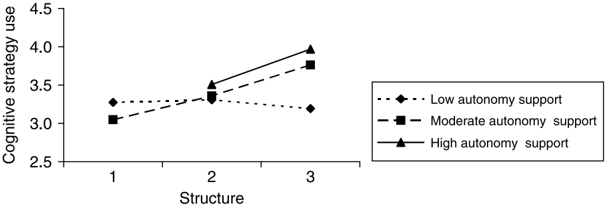
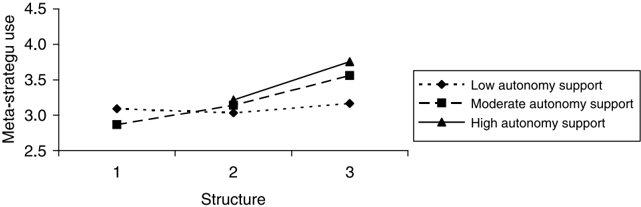
BACKGROUND: Self-determination theory defines two important dimensions of teaching style: autonomy support and structure. AIMS: The purpose of the present study was to investigate the synergistic relationship of perceived teacher autonomy support and the provision of structure in the prediction of self-regulated learning. SAMPLE AND METHOD: Students (N=526) completed questionnaires assessing perceived autonomy support, structure, and self-regulated learning. RESULTS: First, autonomy support and structure were found to be positively correlated, suggesting that the support of student autonomy generally goes hand in hand with the provision of structure and order in the classroom. Second, moderated regression analyses indicated that structure but not autonomy support yielded a main effect on self-regulated learning, although this main effect was qualified by a structure by autonomy support interaction. CONCLUSION: The interaction suggests that structure was associated with more self-regulated learning under conditions of moderate and high autonomy support only. Therefore, when teachers want their students to evaluate themselves, to plan their study activities, and to think about themselves as learners, the teachers are encouraged to provide help, instructions, and expectations in an autonomy-supportive way.
Checked 2026-11-25 · 1 reference not checked yet
Overview
CoChat Summary
TL;DR
This correlational study found that perceived teacher autonomy support and structure are positively correlated, and that structure predicts self-regulated learning mainly when accompanied by moderate or high autonomy support. The authors interpret the interaction as evidence that structure supplies the “know-how” for self-regulated learning while autonomy support supplies the willingness to use it.
Key findings
- Perceived autonomy support and structure were positively correlated (\(r = .67, p < .01\)) and were empirically distinguishable in CFA, with a two-factor solution fitting better than a one-factor solution, \(\Delta\chi^2(1) = 29.39, p < .001\).
- Structure, but not autonomy support, had a main effect on both cognitive strategy use and self-regulation; however, this was qualified by a significant autonomy support × structure interaction, \(\Delta R^2 = .03, p < .001\) for each SRL outcome.
- Simple slopes showed structure predicted cognitive strategy use and self-regulation at average autonomy support (\(\beta = .33\) and \(\beta = .29\), respectively, \(p < .001\)) and high autonomy support (\(\beta = .46\) and \(\beta = .51\), respectively, \(p < .001\)), but not at low autonomy support (\(\beta = .06\), ns for both).
- Type of education did not interact with the teaching style dimensions in predicting SRL, and the three-way interaction with type of education was not significant.
Methods
- Correlational design with \(N = 526\) Belgian students: 264 male and 262 female, Grade 11 and 12 academic-track secondary students plus first-year teacher education students; age ranged from 15 to 27 years (\(M = 17.9\), \(SD = 1.22\)).
- Students completed questionnaires assessing perceived teacher autonomy support and structure (eight items each from the shortened Teacher as Social Context Questionnaire) and self-regulated learning (shortened Motivated Strategies for Learning Questionnaire: 13 cognitive strategy use items and nine self-regulation items).
- Analyses included confirmatory factor analysis, MANOVA for domain effects, and hierarchical moderated regression predicting SRL from type of education, autonomy support, structure, and their interactions.
Limitations
- The paper states that the cross-sectional design prevents conclusions about direction of effects, that student self-reports may create shared method variance and make true teacher effects difficult to determine, and that findings may not generalize to younger populations or other aspects of SRL such as affect regulation.
- The paper also notes that autonomy support and structure were each assessed with brief eight-item scales, limiting insight into subcomponents.
- Evident from the text: the sample did not include the high-autonomy-support/low-structure combination, and the study relies on perceived rather than observed teaching.
Model-written summary. Check it against the paper before relying on it.
Integrity signals
Registry
Cites
Statistics
Figures
Verification
Claims the paper makes
0 Valid · 0 Not valid · 8 Not checked · 62 Own results and interpretations
A result the paper reports from its own data — it cites no other source for it, so there is none to check. The quote shows it is in the paper.
In the paper
“First, autonomy support and structure were found to be positively correlated, suggesting that the support of student autonomy generally goes hand in hand with the provision of structure and order in the classroom.”
- Also stated in: § Preliminary analyses · p. 6 · plain
“As predicted, autonomy support and structure were positively correlated.”
plainstates an association- Asserted: passes — The authors put it forward as true.
- Checkable: passes — It can be checked against evidence.
- Load-bearing: passes — The paper’s conclusions depend on it.
- Based: passes — The paper gives a reason why it holds.
- Also stated in: § Preliminary analyses · p. 6 · plain
A result the paper reports from its own data — it cites no other source for it, so there is none to check. The quote shows it is in the paper.
In the paper
“The educational sciences subsample scored highest on all outcomes compared to both the Dutch and mathematics subsamples, while both did not differ from one another except for autonomy support, with the Dutch subsample scoring significantly lower than the mathematics subsample.”
plain- Asserted: passes — The authors put it forward as true.
- Checkable: passes — It can be checked against evidence.
- Load-bearing: unclear — It is unclear whether the paper’s conclusions depend on it.
- Based: passes — The paper gives a reason why it holds.
A result the paper reports from its own data — it cites no other source for it, so there is none to check. The quote shows it is in the paper.
In the paper
“No evidence was found for curvilinear structure effects on SRL.”
plain- Asserted: passes — The authors put it forward as true.
- Checkable: passes — It can be checked against evidence.
- Load-bearing: passes — The paper’s conclusions depend on it.
- Based: passes — The paper gives a reason why it holds.
A result the paper reports from its own data — it cites no other source for it, so there is none to check. The quote shows it is in the paper.
In the paper
“As the three-way interaction between autonomy support, structure, and type of education also was not significant”
plain- Asserted: passes — The authors put it forward as true.
- Checkable: passes — It can be checked against evidence.
- Load-bearing: passes — The paper’s conclusions depend on it.
- Based: passes — The paper gives a reason why it holds.
A result the paper reports from its own data — it cites no other source for it, so there is none to check. The quote shows it is in the paper.
In the paper
“Domain had an overall multivariate effect (Wilks' l ¼ : 77; F ð 8 ; 1 ; 034 Þ ¼ 17 : 86; p , : 001; h 2 ¼ : 12).”
plainstates an association- Asserted: passes — The authors put it forward as true.
- Checkable: passes — It can be checked against evidence.
- Load-bearing: unclear — It is unclear whether the paper’s conclusions depend on it.
- Based: passes — The paper gives a reason why it holds.
31 more claims
Create a free account to see all 70 claims and every source verdict.
- Probably not a substantial claim. 25
- It may state two separate claims as one. 15
Claims other papers make about this one
Each is checked against this paper’s own text: does it say what the citing paper says it does?
The cited source says what the claim attributes to it.
In the citing paper
“It is now very clear that autonomy support and structure are not antithetical.”
From Basic psychological need theory: Advancements, critical themes, and future directions (2020) · cites this paper as Sierens et al. 2009
The check wasn’t confident either way, so it gives no verdict — never disputed.
In the citing paper
“By contrast, a performance climate promotes the perception that superior performances or winning are the most highly valued outcomes [67, 70–72].”
From Framework for the design and delivery of organized physical activity sessions for children and adolescents: rationale and description of the ‘SAAFE’ teaching principles (2017) · cites this paper as [72]
Experimental — accuracy not yet measured
Citations
Cites
Hu, L., & Bentler, P. M. (1999) · Structural Equation Modeling A Multidisciplinary Journal · doi:10.1080/10705519909540118 · Cited by 108,788
Multiple regression: testing and interpreting interactions
(1992) · Choice Reviews Online · doi:10.5860/choice.29-3352 · Cited by 36,654
(1998) · Cited by 36,049
The "what" and "why" of goal pursuits: Human needs and the self-determination of behavior
Deci, E. L., & Ryan, R. M. (2000) · Psychological Inquiry · doi:10.1207/s15327965pli1104_01 · Cited by 34,210
Motivational and self-regulated learning components of classroom academic performance.
Pintrich, P. R., & De Groot, E. V. (1990) · Journal of Educational Psychology · doi:10.1037/0022-0663.82.1.33 · Cited by 8,332
Regression Diagnostics: Identifying Influential Data and Sources of Collinearity
Belsley, D. A., Kuh, E., & Welsch, R. E. (1980) · Wiley Series in Probability and Statistics · doi:10.1002/0471725153 · Cited by 7,297
Regression Diagnostics -- Identifying Influential Data and Sources of Collinearity
Beaumont, C. D., Belsley, D. A., Kuh, E., & Welsch, R. E. (1981) · The Journal of the Operational Research Society · doi:10.2307/2581267 · Cited by 6,359
Skinner, E. A., & Belmont, M. J. (1993) · Journal of Educational Psychology · doi:10.1037/0022-0663.85.4.571 · Cited by 3,428 · cited 2×
“It may be useful to collect longitudinal data and to use cross-lagged analyses in future studies to look for reciprocal effects of the dimensions of teaching style and the use of self-regulatory skills (see e.g. Skinner & Belmont, 1993).”
Background(1991) · Cited by 3,259
Handbook of Research on Teaching
Richardson, V. (2001) · Cited by 2,437
Research works printed but not linked: 4
- Belmont, M., Skinner, E., Wellborn, J., & Connell, J. (1988). Teacher as social context: A measure of student perceptions of teacher provision of involvement, structure, and autonomy support (Tech. Rep. No. 102). Rochester, NY: University of Rochester.
- Jo ¨reskog, K. G., & So ¨rbom, D. (1993). Lisrel VIII users' reference guide . Mooresville, IN: Scientific Software.
- Miles, J., & Shevlin, M. (2001). Applying regression and correlation . Thousand Oaks, CA: Sage. Miller, R. B., & Brickman, S. J. (2004). A model of future-oriented motivation and self-regulation. Educational Psychology Review , 16 , 9-33.
- Reeve, J., Deci, E. L., & Ryan, R. M. (2004). Self-determination theory: A dialectical framework for understanding socio-cultural influences on student motivation. In D. M. McInerney & S. Van Etten (Eds.), Big theories revisited (pp. 31-60). Greenwich, CT: Information Age Press.
Cited by
Basic psychological need theory: Advancements, critical themes, and future directions
Vansteenkiste, M., Ryan, R. M., & Soenens, B. (2020) · Motivation and Emotion · doi:10.1007/s11031-019-09818-1 · Cited by 1,891
“Also, as acting in an autonomy-supportive way is sometimes perceived to be at odds with setting limits, the question was addressed whether and how an autonomy-supportive style can be combined with structure (Jang et al. 2010; Sierens et al. 2009).”
Self-citationJang, H., Reeve, J., & Deci, E. L. (2010) · Journal of Educational Psychology · doi:10.1037/a0019682 · Cited by 1,650
“…can be presented in either an autonomy-supportive or controlling way and, also, that student outcomes are enhanced when the element of structure is presented in an autonomy-supportive way, yet diminished when the element of structure is presented in a controlling way (Sierens et al., 2009).”
BackgroundMotivational profiles from a self-determination perspective: The quality of motivation matters.
Vansteenkiste, M., Sierens, E., Soenens, B., Luyckx, K., & Lens, W. (2009) · Journal of Educational Psychology · doi:10.1037/a0015083 · Cited by 1,226
Self-citationSoenens, B., & Vansteenkiste, M. (2010) · Developmental Review · doi:10.1016/j.dr.2009.11.001 · Cited by 1,161
Self-citationVansteenkiste, M., Niemiec, C. P., & Soenens, B. (2010) · Advances in Motivation and Achievement · doi:10.1108/s0749-7423(2010)000016a007 · Cited by 864
Self-citationChiu, T. K. F. (2022) · Journal of Research on Technology in Education · doi:10.1080/15391523.2021.1891998 · Cited by 834
“Structure involves communicating clear expectations with respect to student behavior (Sierens et al., 2009).”
BackgroundResultInfluentialBrick by Brick: The Origins, Development, and Future of Self-Determination Theory
Ryan, R. M., & Deci, E. L. (2019) · Advances in Motivation Science · doi:10.1016/bs.adms.2019.01.001 · Cited by 697
Aelterman, N., Vansteenkiste, M., Haerens, L., Soenens, B., Fontaine, J. R. J., & Reeve, J. (2019) · Journal of Educational Psychology · doi:10.1037/edu0000293 · Cited by 614
“, 2012), and interaction effects in which the benefits of structure to students’ self-regulated learning are more pronounced when structure is provided in an autonomysupportive way (Curran, Hill, & Niemiec, 2013; Sierens et al., 2009).”
BackgroundInfluentialSelf-citationVansteenkiste, M., Sierens, E., Goossens, L., Soenens, B., Dochy, F., Mouratidis, A., Aelterman, N., Haerens, L., & Beyers, W. (2012) · Learning and Instruction · doi:10.1016/j.learninstruc.2012.04.002 · Cited by 542
“…1a that autonomy support and structure form two different teaching dimensions and replicating results from previous research in the teaching (e.g., Sierens et al., 2009) and parenting domain (e.g., Farkas & Grolnick, 2010), confirmatory factor analysis indicated that the hypothesized two-factor…”
BackgroundMethodResultSelf-citationTeixeira, P. J., Marques, M. M., Silva, M. N., Brunet, J., Duda, J. L., Haerens, L., La Guardia, J., Lindwall, M., Lonsdale, C., Markland, D., et al. (2020) · Motivation Science · doi:10.1037/mot0000172 · Cited by 528
Self-citationJang, H., Kim, E. J., & Reeve, J. (2012) · Journal of Educational Psychology · doi:10.1037/a0028089 · Cited by 519
Xia, Q., Chiu, T. K. F., Lee, M., Sanusi, I. T., Dai, Y., & Chai, C. S. (2022) · Computers & Education · doi:10.1016/j.compedu.2022.104582 · Cited by 469
Ryan, R. M., Lynch, M. F., Vansteenkiste, M., & Deci, E. L. (2011) · The Counseling Psychologist · doi:10.1177/0011000009359313 · Cited by 429
“An important distinction within SDT concerns the difference between autonomy and independence (Ryan & Lynch, 1989; Soenens, Vansteenkiste, & Sierens, 2009).”
BackgroundSelf-citationCheon, S. H., Reeve, J., & Vansteenkiste, M. (2020) · Teaching and Teacher Education · doi:10.1016/j.tate.2019.103004 · Cited by 406
Self-citationMouratidis, A., Vansteenkiste, M., Lens, W., & Sideridis, G. (2008) · Journal of Sport and Exercise Psychology · doi:10.1123/jsep.30.2.240 · Cited by 382
Self-citationLee, E., & Hannafin, M. J. (2016) · Educational Technology Research and Development · doi:10.1007/s11423-015-9422-5 · Cited by 370
“Autonomy support and structure should be provided together When combined with structured guidance, autonomy support is effective in fostering students’ selfregulation (Reeve et al. 2004; Sierens et al. 2009) Providing both autonomy support and structure yielded positive effects on intrinsic motivation and learning out…”
BackgroundGillet, N., Vallerand, R. J., & Lafrenière, M.-A. K. (2012) · Social Psychology of Education · doi:10.1007/s11218-011-9170-2 · Cited by 321
“While a number of recent studies using the self-determination framework has underscored the role of autonomy support (Sierens et al. 2009; Reeve and Jang 2006), future research should consider other potential mediators of the age-motivation relationship.”
ResultRyan, R. M., Deci, E. L., & Vansteenkiste, M. (2016) · Developmental Psychopathology · doi:10.1002/9781119125556.devpsy109 · Cited by 299
Self-citationLietaert, S., Roorda, D., Laevers, F., Verschueren, K., & De Fraine, B. (2015) · British Journal of Educational Psychology · doi:10.1111/bjep.12095 · Cited by 297
“For example, it was found that for antecedents of behavioural engagement such asmotivation, interest, and self-regulation (Skinner&Pitzer, 2012), girls also score higher than boys (e.g., Sierens et al., 2009; Watt, 2000).”
BackgroundMethodResearch on self-determination in physical education: key findings and proposals for future research
Van den Berghe, L., Vansteenkiste, M., Cardon, G., Kirk, D., & Haerens, L. (2014) · Physical Education and Sport Pedagogy · doi:10.1080/17408989.2012.732563 · Cited by 293
“Researchers working with SDT propose that teachers structure the learning environment through the provision of optimal challenging tasks, positive feedback, and adequate help as well as the communication of clear guidelines and expectations (Sierens et al. 2009).”
BackgroundSelf-citationToward the Development of a Pedagogical Model for Health-Based Physical Education
Haerens, L., Kirk, D., Cardon, G., & De Bourdeaudhuij, I. (2011) · Quest · doi:10.1080/00336297.2011.10483684 · Cited by 276
Hospel, V., & Galand, B. (2016) · Learning and Instruction · doi:10.1016/j.learninstruc.2015.09.001 · Cited by 275
“Sierens et al. (2009) found a positive main effect of structure on self-regulated learning and a signi fi cant interaction: Self-regulated learning was higher when structure was combined with a moderate or high level of autonomy support.”
InfluentialHaerens, L., Kirk, D., Cardon, G., De Bourdeaudhuij, I., & Vansteenkiste, M. (2010) · European Physical Education Review · doi:10.1177/1356336x10381304 · Cited by 272
“Researchers working with SDT propose that teachers structure the learning environment through the provision of optimal challenging tasks, positive feedback, encouragement after failure, and adequate help, as well as the communication of clear guidelines and expectations with respect to the task that needs to be accomp…”
BackgroundSelf-citationKiemer, K., Gröschner, A., Pehmer, A.-K., & Seidel, T. (2015) · Learning and Instruction · doi:10.1016/j.learninstruc.2014.10.003 · Cited by 256
Teacher and Peer Support for Young Adolescents’ Motivation, Engagement, and School Belonging
Kiefer, S. M., Alley, K. M., & Ellerbrock, C. R. (2015) · RMLE Online · doi:10.1080/19404476.2015.11641184 · Cited by 256
“A multidimensional approach was warranted, as most research has examined global associations among teacher support (Reeve, 2006; Sierens et al., 2009); relations among specific aspects of teacher support and their implications for student adjustment are relatively unknown.”
MethodVermote, B., Aelterman, N., Beyers, W., Aper, L., Buysschaert, F., & Vansteenkiste, M. (2020) · Motivation and Emotion · doi:10.1007/s11031-020-09827-5 · Cited by 250
“…studies were performed in secondary education, showing that student perceived autonomy support (Patall et al. 2018) and structure (Jang et al. 2010; Sierens et al. 2009) relate to various favorable outcomes, including behavioral engagement, self-regulated learning, and well-being (see Reeve 2016…”
Self-citationOga-Baldwin, W. L. Q., Nakata, Y., Parker, P., & Ryan, R. M. (2017) · Contemporary Educational Psychology · doi:10.1016/j.cedpsych.2017.01.010 · Cited by 246
Observing Physical Education Teachers’ Need-Supportive Interactions in Classroom Settings
Haerens, L., Aelterman, N., Van den Berghe, L., De Meyer, J., Soenens, B., & Vansteenkiste, M. (2013) · Journal of Sport and Exercise Psychology · doi:10.1123/jsep.35.1.3 · Cited by 243
“In line with previous studies (Koka & Hein, 2005; Mouratidis et al., 2008; Sierens et al., 2009), structure during the activity involved practices such as helping the pupils, giving advice and guidelines, providing positive feedback, and monitoring whether pupils live up to the instructions.”
BackgroundResultSelf-citationExploring Machine Learning Methods to Automatically Identify Students in Need of Assistance
Ahadi, A., Lister, R., Haapala, H., & Vihavainen, A. (2015) · Proceedings of the eleventh annual International Conference on International Computing Education Research · doi:10.1145/2787622.2787717 · Cited by 232
“For example, if a student is already at a stage where she could work on more challenging projects on her own, mandatory excessively structured learning activities that everyone needs to follow may even be counterproductive for her [16, 31].”
BackgroundInfluentialVennix, J., den Brok, P., & Taconis, R. (2018) · International Journal of Science Education · doi:10.1080/09500693.2018.1473659 · Cited by 223
“Indirectly, these findings might be indicators that both relatedness and autonomy needs were fulfilled (Sierens et al., 2009; Sjaastad, 2012).”
BackgroundAelterman, N., Vansteenkiste, M., Van den Berghe, L., De Meyer, J., & Haerens, L. (2014) · Journal of Sport and Exercise Psychology · doi:10.1123/jsep.2013-0229 · Cited by 222
Self-citationCents-Boonstra, M., Lichtwarck-Aschoff, A., Denessen, E., Aelterman, N., & Haerens, L. (2021) · Research Papers in Education · doi:10.1080/02671522.2020.1767184 · Cited by 216
“When providing structure before the activity, teachers communicate clear guidelines, give an overview and objectives for the lesson and share their expectations (Jang, Reeve, and Deci 2010; Sierens et al. 2009; Vansteenkiste et al. 2012).”
BackgroundSupporting students' motivation for e-learning: Teachers matter on and off line
Fryer, L. K., & Bovee, H. N. (2016) · The Internet and Higher Education · doi:10.1016/j.iheduc.2016.03.003 · Cited by 208
Xia, Q., Chiu, T. K. F., Chai, C. S., & Xie, K. (2023) · British Journal of Educational Technology · doi:10.1111/bjet.13305 · Cited by 203
Baeten, M., Dochy, F., & Struyven, K. (2013) · British Journal of Educational Psychology · doi:10.1111/j.2044-8279.2012.02076.x · Cited by 200
Self-citationCognitive load theory and its relationships with motivation: A self-determination theory perspective
Evans, P., Vansteenkiste, M., Parker, P., Kingsford-Smith, A., & Zhou, S. (2024) · Educational Psychology Review · doi:10.1007/s10648-023-09841-2 · Cited by 200
“Conversely, a teaching style that is high in chaos (and low in structure) might impose additional cognitive load, as students have to navigate the uncertainty and unpredictability of a lesson and work out for themselves what kind of behaviors is necessary to attain the learning goals.”
Self-citationChinese Education Examined via the Lens of Self-Determination
Yu, S., Chen, B., Levesque-Bristol, C., & Vansteenkiste, M. (2018) · Educational Psychology Review · doi:10.1007/s10648-016-9395-x · Cited by 199
Self-citationKerner, C., & Goodyear, V. A. (2017) · American Journal of Health Education · doi:10.1080/19325037.2017.1343161 · Cited by 192
“facilitating environments provide positive feedback on performance(46) and clear guidelines and expectations.(47) Relatedness-supportive environments allow individuals to feel socially connected with and accepted by others.”
BackgroundWijnia, L., Loyens, S. M. M., & Derous, E. (2011) · Contemporary Educational Psychology · doi:10.1016/j.cedpsych.2010.11.003 · Cited by 189
Lubans, D. R., Lonsdale, C., Cohen, K., Eather, N., Beauchamp, M. R., Morgan, P. J., Sylvester, B. D., & Smith, J. J. (2017) · International Journal of Behavioral Nutrition and Physical Activity · doi:10.1186/s12966-017-0479-x · Cited by 180
Reeve, J., Cheon, S. H., & Jang, H. (2020) · Contemporary Educational Psychology · doi:10.1016/j.cedpsych.2020.101899 · Cited by 175
Vansteenkiste, M., Williams, G. C., & Resnicow, K. (2012) · International Journal of Behavioral Nutrition and Physical Activity · doi:10.1186/1479-5868-9-23 · Cited by 174
“When directive means providing structure with an active involvement of client and practitoner, SDT maintains that clients might benefit from this structure if it is provided in an autonomy-supportive rather than a coercive way [83].”
BackgroundSelf-citationExamining the components and concomitants of parental structure in the academic domain
Farkas, M. S., & Grolnick, W. S. (2010) · Motivation and Emotion · doi:10.1007/s11031-010-9176-7 · Cited by 171
“For example, Sierens et al. (2009) found that teacher-provided structure was associated with more self-regulated learning in students when students reported moderate or high levels of autonomy support, but not low levels.”
BackgroundVansteenkiste, M., Aelterman, N., Haerens, L., & Soenens, B. (2019) · Advances in Motivation and Achievement · doi:10.1108/s0749-742320190000020004 · Cited by 169
“…is, the clarifying approach can best be coupled with a more attuning (e.g., providing a rationale) or participative (i.e., asking for input regarding introduced guidelines) approach to optimize its bene fi ts (Sierens, Vansteenkiste, Goossens, Soenens, & Dochy, 2009; Vansteenkiste et al., 2012).”
Self-citationVan den Berghe, L., Soenens, B., Vansteenkiste, M., Aelterman, N., Cardon, G., Tallir, I. B., & Haerens, L. (2013) · Psychology of Sport and Exercise · doi:10.1016/j.psychsport.2013.04.006 · Cited by 161
Self-citationOriol-Granado, X., Mendoza-Lira, M., Covarrubias-Apablaza, C.-G., & Molina-López, V.-M. (2017) · Revista de Psicodidáctica (English ed.) · doi:10.1387/revpsicodidact.14280 · Cited by 160
“Prior studies confirm the implication of teacher-provided autonomy support in students’ motivation and interest in participating in academic tasks (Reeve, 2006; Sierens et al., 2009).”
ResultAutonomy Support in the Classroom: A Review From Self-Determination Theory
Núñez, J. L., & León, J. (2015) · European Psychologist · doi:10.1027/1016-9040/a000234 · Cited by 159
Creativity and Control: A Paradox. Evidence from the Levers of Control Framework
Spekle, R. F., van Elten, H. J., & Widener, S. K. (2014) · SSRN Electronic Journal · doi:10.2139/ssrn.2480471 · Cited by 164
“In contrast, structure communicates expectations of behavior, sets limits on what is acceptable behavior, and provides feedback and goals (Sierens et al. 2009).”
InfluentialParental Provision of Academic Structure and the Transition to Middle School
Grolnick, W. S., Raftery‐Helmer, J. N., Flamm, E. S., Marbell, K. N., & Cardemil, E. V. (2014) · Journal of Research on Adolescence · doi:10.1111/jora.12161 · Cited by 176
Aelterman, N., Vansteenkiste, M., Keer, H. V., Meyer, J. D., Berghe, L. V. D., & Haerens, L. L. (2012) · Teaching and Teacher Education · doi:10.1016/j.tate.2012.09.001 · Cited by 219
Self-citationImproving Teacher Feedback During Active Learning: Effects of a Professional Development Program
Van den Bergh, L., Ros, A., & Beijaard, D. (2014) · American Educational Research Journal · doi:10.3102/0002831214531322 · Cited by 150
“Clearly explaining how to regulate learning activities is critical in order to stimulate students’ self-regulated learning (Sierens et al., 2009).”
BackgroundMouratidis, A., Lens, W., & Vansteenkiste, M. (2010) · Journal of Sport and Exercise Psychology · doi:10.1123/jsep.32.5.619 · Cited by 143
Self-citationLiu, W. C., Wang, C. K. J., Kee, Y. H., Koh, C., Lim, B. S. C., & Chua, L. (2014) · Educational Psychology · doi:10.1080/01443410.2013.785067 · Cited by 141
“A recent study by Sierens et al. (2009) suggest that teachers should provide help, instructions and expectations in an autonomy-supportive way if they want their students to adopt self-regulated learning behaviour.”
BackgroundTeachers’ involvement and students’ self-efficacy: Keys to achievement in higher education
Ayllón, S., Alsina, ́., & Colomer, J. (2019) · PLoS ONE · doi:10.1371/journal.pone.0216865 · Cited by 216
“In line with other studies [41], our results show that the three dimensions of NST are distinguishable by knowledge area; but our results do not support the hypothesis that there is an interplay among the NST dimensions to consistently predict students’ achievement (1).”
ResultPatterns of boredom and its relationship with perceived autonomy support and engagement
Tze, V. M. C., Klassen, R. M., & Daniels, L. M. (2014) · Contemporary Educational Psychology · doi:10.1016/j.cedpsych.2014.05.001 · Cited by 168
Cheon, S. H., Reeve, J., & Song, Y.-G. (2019) · Psychology of Sport and Exercise · doi:10.1016/j.psychsport.2018.12.008 · Cited by 131
Curran, T., Hill, A. P., & Niemiec, C. P. (2013) · Journal of Sport and Exercise Psychology · doi:10.1123/jsep.35.1.30 · Cited by 129
“Psychometric support for the reliability and concurrent validity of this measure has been found in a physical education setting (Taylor & Ntoumanis, 2007), and evidence of its two-factor structure has been found among secondary school children (Sierens et al., 2009).”
BackgroundDevelopment and Validation of the Multidimensional Motivational Climate Observation System
Smith, N., Tessier, D. P., Tzioumakis, Y. S., Quested, E., Appleton, P. R., Sarrazin, P. G., Papaioannou, A. G., & Duda, J. L. (2015) · Journal of Sport and Exercise Psychology · doi:10.1123/jsep.2014-0059 · Cited by 167
“Indeed the interaction between structure and other dimensions of the environment have recently gained attention in sport and physical domains (Curran et al., 2013; Sierens et al., 2009).”
BackgroundMouratidis, A. A., Vansteenkiste, M., Michou, A., & Lens, W. (2012) · Learning and Individual Differences · doi:10.1016/j.lindif.2012.09.001 · Cited by 154
“Similar to Sierens et al. (2009), our research indicates that the more teachers are perceived to communicate clear expectations and rules, monitor and adjust their teaching practices accordingly, behave in a contingent way, and provide the necessary help and support to their students, the more…”
BackgroundResultInfluentialSelf-citationAutonomy support for autonomous motivation in medical education
Kusurkar, R. A., & Croiset, G. (2015) · Medical Education Online · doi:10.3402/meo.v20.27951 · Cited by 134
“Autonomy with structure is important for self-regulated learning (11).”
BackgroundBerger, J., Girardet, C., Vaudroz, C., & Crahay, M. (2018) · SAGE Open · doi:10.1177/2158244017754119 · Cited by 192
Motivational teacher strategies: the role of beliefs and contextual factors
Hornstra, L., Mansfield, C., van der Veen, I., Peetsma, T., & Volman, M. (2015) · Learning Environments Research · doi:10.1007/s10984-015-9189-y · Cited by 117
Duchatelet, D., & Donche, V. (2019) · Higher Education Research & Development · doi:10.1080/07294360.2019.1581143 · Cited by 174
“We also expect perceived autonomy support to relate positively to learning outcomes in terms of both self-efficacy (hypothesis 2b) (Alivernini & Lucidi, 2011; Wang et al., 2016) and self-regulation (hypothesis 2c) (Sierens et al., 2009; Stefanou et al., 2013; Wang et al., 2016).”
BackgroundResultInfluentialAutonomy Support for Online Students
Lee, E., Pate, J. A., & Cozart, D. (2015) · TechTrends · doi:10.1007/s11528-015-0871-9 · Cited by 172
“When combined with structured guidance, autonomy support is effective in fostering students’ self-regulation (Jang, Reeve, & Deci, 2010; Sierens et al., 2009; Van Loon et al., 2012), ultimately leading to greater learning outcomes (Baeten, Dochy, & Struyven, 2013; Su & Reeve, 2011).”
BackgroundStudent Motivation and Learning in Mathematics and Science: A Cluster Analysis
Ng, B., Liu, W. C., & Wang, J. (2015) · International Journal of Science and Mathematics Education · doi:10.1007/s10763-015-9654-1 · Cited by 145
Vervoort, T., Logan, D. E., Goubert, L., De Clercq, B., & Hublet, A. (2014) · Pain · doi:10.1016/j.pain.2014.02.021 · Cited by 116
“Entering perceived teacher support of autonomy and competence simultaneously as separate covariates was based upon previous findings indicating that both support dimensions are related but distinct dimensions and hence may differentially impact outcomes [52,57].”
MethodMoè, A., & Katz, I. (2020) · Teaching and Teacher Education · doi:10.1016/j.tate.2020.103173 · Cited by 144
Xia, Q., Chiu, T. K. F., & Chai, C. S. (2022) · Education and Information Technologies · doi:10.1007/s10639-022-11547-x · Cited by 156
“Following Cohen (1988), the effect sizes for the gender differences were medium for autonomy ( d = 0.58), small for competence ( d = 0.40),”
BackgroundMethodInfluentialManganelli, S., Cavicchiolo, E., Mallia, L., Biasi, V., Lucidi, F., & Alivernini, F. (2019) · Educational Psychology · doi:10.1080/01443410.2019.1572104 · Cited by 141
“…academic success (Deci & Ryan, 2000; Pintrich, 2000; Ryan & Deci, 2000; Zimmerman & Schunk, 2011) and several studies have shown that they can be promoted by means of specific training programs and approaches to teaching (e.g. Niemiec & Ryan, 2009; Ning & Downing, 2014; Sierens et al., 2009).”
BackgroundChiu, T. K. F., Sun, J. C.-Y., & Ismailov, M. (2022) · Educational Psychology · doi:10.1080/01443410.2022.2074966 · Cited by 106
“Learning structure is related to how well teachers’ expectations are communicated to students (Sierens et al., 2009).”
BackgroundInfluentialKyndt, E., Dochy, F. J. R. C., Struyven, K., & Cascallar, E. C. (2010) · European Journal of Psychology of Education · doi:10.1007/s10212-010-0053-2 · Cited by 148
Self-citationSchuitema, J. A., Peetsma, T. T. D., & van der Veen, I. (2016) · Learning and Individual Differences · doi:10.1016/j.lindif.2016.05.006 · Cited by 143
“Previous research has demonstrated a relation between perceived teacher support and students' learning behaviour (e.g., Sierens et al., 2009; Ryan & Patrick, 2001; Vansteenkiste et al., 2012; Yin et al., 2009).”
BackgroundFransen, K., Boen, F., Vansteenkiste, M., Mertens, N., & Vande Broek, G. (2018) · Scandinavian Journal of Medicine & Science in Sports · doi:10.1111/sms.12950 · Cited by 80
Self-citationMaulana, R., Opdenakker, M., Stroet, K., & Bosker, R. (2013) · Journal of Youth and Adolescence · doi:10.1007/s10964-013-9921-9 · Cited by 153
Boulley, G. E., Tessier, D. P., Ntoumanis, N., & Sarrazin, P. G. (2018) · Sport Exercise and Performance Psychology · doi:10.1037/spy0000119 · Cited by 133
Duda, J. L., & Appleton, P. R. (2016) · Elsevier eBooks · doi:10.1016/b978-0-12-803634-1.00017-0 · Cited by 161
Should parental prohibition of adolescents' peer relationships be prohibited?
SOENENS, B., VANSTEENKISTE, M., & NIEMIEC, C. P. (2009) · Personal Relationships · doi:10.1111/j.1475-6811.2009.01237.x · Cited by 98
Self-citationOriol, X., Lira, M. M., Apablaza, C. G. C., & Molina-López, V.-M. (2017) · Revista de Psicodidáctica · doi:10.1016/s1136-1034(17)30043-6 · Cited by 153
“Estudios anteriores corroboran la implicación que el apoyo a la autonomía ejercida por los y las docentes tiene sobre la motivación e interés del estudiantado en la participación en tareas académicas (Reeve, 2006; Sierens et al., 2009).”
BackgroundMendoza, N. B., Yan, Z., & King, R. B. (2022) · Computers & Education · doi:10.1016/j.compedu.2022.104663 · Cited by 143
Pogere, E. F., López-Sangil, M. C., García-Señorán, M., & Fernández, A. G. (2019) · Teaching and Teacher Education · doi:10.1016/j.tate.2019.07.001 · Cited by 121
Patall, E. A., Hooper, S., Vasquez, A. C., Pituch, K. A., & Steingut, R. R. (2018) · Learning and Instruction · doi:10.1016/j.learninstruc.2018.07.004 · Cited by 93
Self-Determination as a Psychological and Positive Youth Development Construct
Hui, E. K. P., & Tsang, S. (2012) · The Scientific World JOURNAL · doi:10.1100/2012/759358 · Cited by 161
“…human persons are active and growthoriented agents, inclined to organize and initiate their actions with reference to their values and interests, with the tendency to integrate social norms and practices, intrinsically motivated to pursue personal goals, and striving to master the environments.”
BackgroundEnergization and Direction Are Both Essential Parts of Motivation
Elliot, A. J. (2023) · Oxford University Press eBooks · doi:10.1093/oso/9780197662359.003.0002 · Cited by 94
Mouratidis, A., Michou, A., Aelterman, N., Haerens, L., & Vansteenkiste, M. (2018) · Educational Psychology · doi:10.1080/01443410.2017.1402863 · Cited by 89
“Although perceived structure and autonomy support are on average positively correlated (e.g. Sierens et al., 2009), some teacher may provide autonomy support but no structure and vice versa.”
BackgroundResultInfluentialSelf-citationMabbe, E., Soenens, B., De Muynck, G.-J., & Vansteenkiste, M. (2018) · Journal of Experimental Child Psychology · doi:10.1016/j.jecp.2018.01.008 · Cited by 86
Self-citationAhn, I., Patrick, H., Chiu, M. M., & Levesque‐Bristol, C. (2018) · Journal of Psychoeducational Assessment · doi:10.1177/0734282918791655 · Cited by 105
The Importance of Autonomous, Self-Regulated Learning in Primary Initial Teacher Training
Oates, S. (2019) · Frontiers in Education · doi:10.3389/feduc.2019.00102 · Cited by 132
Hornstra, L., Stroet, K., & Weijers, D. (2021) · Teaching and Teacher Education · doi:10.1016/j.tate.2020.103257 · Cited by 84
A meta-analytic review of the relationships between autonomy support and positive learning outcomes
Mammadov, S., & Schroeder, K. (2023) · Contemporary Educational Psychology · doi:10.1016/j.cedpsych.2023.102235 · Cited by 157
High school identity climate and student identity development
Rich, Y., & Schachter, E. P. (2011) · Contemporary Educational Psychology · doi:10.1016/j.cedpsych.2011.06.002 · Cited by 114
Rutten, C., Boen, F., & Seghers, J. (2012) · Journal of Teaching in Physical Education · doi:10.1123/jtpe.31.3.216 · Cited by 103
Naeghel, J. D., Keer, H. V., Vansteenkiste, M., Haerens, L. L., & Aelterman, N. (2016) · The Journal of Educational Research · doi:10.1080/00220671.2014.942032 · Cited by 133
“In line with previous SDT-related research (e.g., Aelterman et al., 2013; Jang et al., 2010; Sierens et al., 2009), the professional development workshop applied in the present study emphasized the enhancement of two aspects of teachers’ motivating style in particular: the provision of autonomy…”
BackgroundResultInfluentialSelf-citationWang, K., Cui, W., & Yuan, X. (2025) · Behavioral Sciences · doi:10.3390/bs15020165 · Cited by 79
“When individuals’ fundamental psychological requirements are fulfilled, they tend to develop greater autonomy and exhibit increased participation in SRL activities (Liu et al., 2014; Sierens et al., 2009).”
Guay, F., Roy, A., & Valois, P. (2017) · British Journal of Educational Psychology · doi:10.1111/bjep.12146 · Cited by 114
Robinson, K. A. (2023) · Educational Psychologist · doi:10.1080/00461520.2023.2198011 · Cited by 115
“…this assumption of additive and interactive effects is at least partially supported by extant literature (Jang et al., 2010; Linnenbrink, 2005; Sierens et al., 2009), as is the assumption that the meanings of motivational supports can differ based on the presence of other motivational…”
ResultDomen, J., Hornstra, L., Weijers, D., van der Veen, I., & Peetsma, T. (2020) · British Journal of Educational Psychology · doi:10.1111/bjep.12302 · Cited by 73
“These studies mostly found substantial positive relations between need support and student motivation (Sierens et al., 2009; Stroet et al., 2013; Vansteenkiste et al., 2012), whereas studies that assessed need support from the perspective of the teacher typically show significantly weaker…”
BackgroundMethodInfluentialThe benefits of autonomy support for adolescents with severe emotional and behavioral problems
Savard, A., Joussemet, M., Pelletier, J. E., & Mageau, G. A. (2013) · Motivation and Emotion · doi:10.1007/s11031-013-9351-8 · Cited by 184
“…negative developmental and psychological outcomes (e.g., Grolnick and Apostoleris 2002; Soenens 2006), structure is associated with positive motivational outcomes and has a complementary role with autonomy support (Connell and Wellborn 1991; Grolnick 2003; Jang et al. 2010; Sierens et al. 2009).”
An Intervention-Based Program of Research on Teachers’ Motivating Styles
Reeve, J., & Cheon, S. H. (2014) · Motivational Interventions · doi:10.1108/s0749-742320140000018008 · Cited by 72
“Empirical research shows that it is actually an autonomy-supportive style not a controlling style that is closely associated with the provision of a structured learning environment (Jang et al., 2010; Sierens et al., 2009).”
BackgroundTrigueros, R., Mínguez-Mínguez, L. A., Gonzalez-Bernal, J. J., Jahouh, M., Cámara, R. S., & Aguilar-Parra, J. M. (2019) · Nutrients · doi:10.3390/nu11112594 · Cited by 95
“Results of studies similar to the present study conducted during the secondary school phase also showed that autonomy support is positively related to PE class structure [43,44].”
ResultEckes, A., Großmann, N., & Wilde, M. (2018) · Learning and Individual Differences · doi:10.1016/j.lindif.2018.01.011 · Cited by 92
Metadata
- Authors
- Sierens, E., Vansteenkiste, M., Goossens, L., Soenens, B., & Dochy, F.
- Affiliations
- KU Leuven (BE)
- Ghent University (BE)
- Corresponding author
- Sierens, Eline
- Venue
- British Journal of Educational Psychology
- Publisher
- Wiley
- Published
- 2009-03
- Volume
- 79
- Issue
- 1
- Pages
- 57-68
- ISSN
- 0007-0998 (ISSN-L)
- 2044-8279
- OpenAlex
- W2085917674
- Cited by
- 618
- References
- 38
- Citations by year
- 2026: 22 · 2025: 26 · 2024: 36 · 2023: 127 · 2022: 39 · 2021: 33 · 2020: 53 · 2019: 35 · 2018: 33 · 2017: 39 · 2016: 43 · 2015: 37 · 2014: 28 · 2013: 23 · 2012: 17
- FWCI
- 11.56
- Type
- journal article
- Language
- en
- Open access
- green
- lirias.kuleuven.be
- Licence
- Locations
- British Journal of Educational Psychology (publishedVersion)
- PubMed (publishedVersion)
- Lirias (submittedVersion, other-oa)
- Ghent University Academic Bibliography (Ghent University) (submittedVersion)
- Topics
- Social Sciences › Psychology › Social Psychology › Motivation and Self-Concept in Sports
- Social Sciences › Psychology › Developmental and Educational Psychology › Innovative Teaching and Learning Methods
- Social Sciences › Psychology › Developmental and Educational Psychology › Education, Achievement, and Giftedness
- Keywords
- perceived autonomy support, structure, student self-regulation, self-determination theory, teaching styles, classroom structure, student self-assessment, interaction effects
- MeSH terms
- Adolescent, Adult, Curriculum, Female, Goals, Humans, Individuation, Internal-External Control, Male, Motivation, Problem Solving, Surveys and Questionnaires, Social Perception, Social Support, Teaching, Personal Autonomy, Young Adult
About these checks
Registry, retraction, Cites and statistics results are computed, not judged, with one exception: a printed reference that no index lists is read once by a model before it counts as a citation error. Claims are extracted by a model and kept only when their quote appears verbatim in the text; each cited source is then checked, with a model’s help, for whether it says what the claim relies on. Those verdicts can be wrong — read the claim’s quote and the cited source before relying on one.
A language model drew the claims from the paper on 2026-10-10, under version 3 of the claim definition (model deepseek-v4.1-flash, prompt extract-v3).
A second model labelled each claim on 2026-10-10 (model jev-1.13-20260917, definition revision gold-guideline-v0.2).
Statistics and arithmetic are recomputed, not judged.
Confidence bands are shown only for fields calibrated on our annotated test set. None is calibrated yet, so no band is shown.
What counts as a claim ›How we measure confidence ›How we check this ›
Are you an author, or do you see a problem with this page? Request a review
Data sources
Bibliographic data: Semantic Scholar, OpenAlex, Crossref.
Contains information from the Semantic Scholar Academic Graph Datasets, made available under the ODC Attribution License (ODC-BY 1.0).
Semantic Scholar’s data is described in: Kinney, R., et al. (2023). The Semantic Scholar Open Data Platform. arXiv:2301.10140.
