

The synergistic relationship of perceived autonomy support and structure in the prediction of self-regulated learning.
Open accessThe DOI matches its Crossref record; 38 of the 40 references it cites were found in a registry or an index, and 1 are not checked yet; none of the 7 sources its claims cite is checked for support yet.
Abstract
BACKGROUND: Self-determination theory defines two important dimensions of teaching style: autonomy support and structure. AIMS: The purpose of the present study was to investigate the synergistic relationship of perceived teacher autonomy support and the provision of structure in the prediction of self-regulated learning. SAMPLE AND METHOD: Students (N=526) completed questionnaires assessing perceived autonomy support, structure, and self-regulated learning. RESULTS: First, autonomy support and structure were found to be positively correlated, suggesting that the support of student autonomy generally goes hand in hand with the provision of structure and order in the classroom. Second, moderated regression analyses indicated that structure but not autonomy support yielded a main effect on self-regulated learning, although this main effect was qualified by a structure by autonomy support interaction. CONCLUSION: The interaction suggests that structure was associated with more self-regulated learning under conditions of moderate and high autonomy support only. Therefore, when teachers want their students to evaluate themselves, to plan their study activities, and to think about themselves as learners, the teachers are encouraged to provide help, instructions, and expectations in an autonomy-supportive way.
Checked 2026-11-25 · 1 reference not checked yet
Overview
CoChat Summary
TL;DR
This correlational study found that perceived teacher autonomy support and structure are positively correlated, and that structure predicts self-regulated learning mainly when accompanied by moderate or high autonomy support. The authors interpret the interaction as evidence that structure supplies the “know-how” for self-regulated learning while autonomy support supplies the willingness to use it.
Key findings
- Perceived autonomy support and structure were positively correlated (\(r = .67, p < .01\)) and were empirically distinguishable in CFA, with a two-factor solution fitting better than a one-factor solution, \(\Delta\chi^2(1) = 29.39, p < .001\).
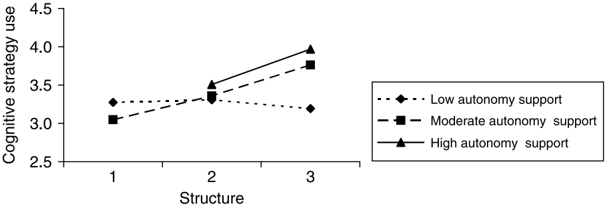
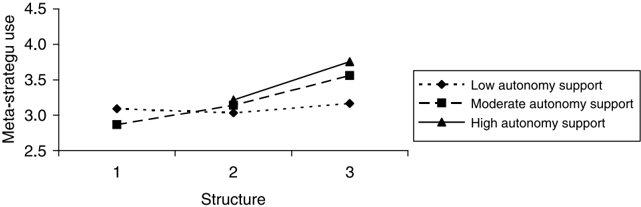
- Structure, but not autonomy support, had a main effect on both cognitive strategy use and self-regulation; however, this was qualified by a significant autonomy support × structure interaction, \(\Delta R^2 = .03, p < .001\) for each SRL outcome.
- Simple slopes showed structure predicted cognitive strategy use and self-regulation at average autonomy support (\(\beta = .33\) and \(\beta = .29\), respectively, \(p < .001\)) and high autonomy support (\(\beta = .46\) and \(\beta = .51\), respectively, \(p < .001\)), but not at low autonomy support (\(\beta = .06\), ns for both).
- Type of education did not interact with the teaching style dimensions in predicting SRL, and the three-way interaction with type of education was not significant.
Methods
- Correlational design with \(N = 526\) Belgian students: 264 male and 262 female, Grade 11 and 12 academic-track secondary students plus first-year teacher education students; age ranged from 15 to 27 years (\(M = 17.9\), \(SD = 1.22\)).
- Students completed questionnaires assessing perceived teacher autonomy support and structure (eight items each from the shortened Teacher as Social Context Questionnaire) and self-regulated learning (shortened Motivated Strategies for Learning Questionnaire: 13 cognitive strategy use items and nine self-regulation items).
- Analyses included confirmatory factor analysis, MANOVA for domain effects, and hierarchical moderated regression predicting SRL from type of education, autonomy support, structure, and their interactions.
Limitations
- The paper states that the cross-sectional design prevents conclusions about direction of effects, that student self-reports may create shared method variance and make true teacher effects difficult to determine, and that findings may not generalize to younger populations or other aspects of SRL such as affect regulation.
- The paper also notes that autonomy support and structure were each assessed with brief eight-item scales, limiting insight into subcomponents.
- Evident from the text: the sample did not include the high-autonomy-support/low-structure combination, and the study relies on perceived rather than observed teaching.
Model-written summary. Check it against the paper before relying on it.
Integrity signals
Registry
Cites
Statistics
Figures
Verification
Claims the paper makes
0 Valid · 0 Not valid · 8 Not checked · 62 Own results and interpretations
A result the paper reports from its own data — it cites no other source for it, so there is none to check. The quote shows it is in the paper.
In the paper
“First, autonomy support and structure were found to be positively correlated, suggesting that the support of student autonomy generally goes hand in hand with the provision of structure and order in the classroom.”
- Also stated in: § Preliminary analyses · p. 6 · plain
“As predicted, autonomy support and structure were positively correlated.”
plainstates an association- Asserted: passes — The authors put it forward as true.
- Checkable: passes — It can be checked against evidence.
- Load-bearing: passes — The paper’s conclusions depend on it.
- Based: passes — The paper gives a reason why it holds.
- Also stated in: § Preliminary analyses · p. 6 · plain
A result the paper reports from its own data — it cites no other source for it, so there is none to check. The quote shows it is in the paper.
In the paper
“The educational sciences subsample scored highest on all outcomes compared to both the Dutch and mathematics subsamples, while both did not differ from one another except for autonomy support, with the Dutch subsample scoring significantly lower than the mathematics subsample.”
plain- Asserted: passes — The authors put it forward as true.
- Checkable: passes — It can be checked against evidence.
- Load-bearing: unclear — It is unclear whether the paper’s conclusions depend on it.
- Based: passes — The paper gives a reason why it holds.
A result the paper reports from its own data — it cites no other source for it, so there is none to check. The quote shows it is in the paper.
In the paper
“No evidence was found for curvilinear structure effects on SRL.”
plain- Asserted: passes — The authors put it forward as true.
- Checkable: passes — It can be checked against evidence.
- Load-bearing: passes — The paper’s conclusions depend on it.
- Based: passes — The paper gives a reason why it holds.
A result the paper reports from its own data — it cites no other source for it, so there is none to check. The quote shows it is in the paper.
In the paper
“As the three-way interaction between autonomy support, structure, and type of education also was not significant”
plain- Asserted: passes — The authors put it forward as true.
- Checkable: passes — It can be checked against evidence.
- Load-bearing: passes — The paper’s conclusions depend on it.
- Based: passes — The paper gives a reason why it holds.
A result the paper reports from its own data — it cites no other source for it, so there is none to check. The quote shows it is in the paper.
In the paper
“Domain had an overall multivariate effect (Wilks' l ¼ : 77; F ð 8 ; 1 ; 034 Þ ¼ 17 : 86; p , : 001; h 2 ¼ : 12).”
plainstates an association- Asserted: passes — The authors put it forward as true.
- Checkable: passes — It can be checked against evidence.
- Load-bearing: unclear — It is unclear whether the paper’s conclusions depend on it.
- Based: passes — The paper gives a reason why it holds.
31 more claims
Create a free account to see all 70 claims and every source verdict.
- Probably not a substantial claim. 25
- It may state two separate claims as one. 15
Claims other papers make about this one
Each is checked against this paper’s own text: does it say what the citing paper says it does?
The cited source says what the claim attributes to it.
In the citing paper
“It is now very clear that autonomy support and structure are not antithetical.”
From Basic psychological need theory: Advancements, critical themes, and future directions (2020) · cites this paper as Sierens et al. 2009
The check wasn’t confident either way, so it gives no verdict — never disputed.
In the citing paper
“By contrast, a performance climate promotes the perception that superior performances or winning are the most highly valued outcomes [67, 70–72].”
From Framework for the design and delivery of organized physical activity sessions for children and adolescents: rationale and description of the ‘SAAFE’ teaching principles (2017) · cites this paper as [72]
Experimental — accuracy not yet measured
Citations
Cites
Hu, L., & Bentler, P. M. (1999) · Structural Equation Modeling A Multidisciplinary Journal · doi:10.1080/10705519909540118 · Cited by 108,788
Multiple regression: testing and interpreting interactions
(1992) · Choice Reviews Online · doi:10.5860/choice.29-3352 · Cited by 36,654
(1998) · Cited by 36,049
The "what" and "why" of goal pursuits: Human needs and the self-determination of behavior
Deci, E. L., & Ryan, R. M. (2000) · Psychological Inquiry · doi:10.1207/s15327965pli1104_01 · Cited by 34,210
Motivational and self-regulated learning components of classroom academic performance.
Pintrich, P. R., & De Groot, E. V. (1990) · Journal of Educational Psychology · doi:10.1037/0022-0663.82.1.33 · Cited by 8,332
Regression Diagnostics: Identifying Influential Data and Sources of Collinearity
Belsley, D. A., Kuh, E., & Welsch, R. E. (1980) · Wiley Series in Probability and Statistics · doi:10.1002/0471725153 · Cited by 7,297
Regression Diagnostics -- Identifying Influential Data and Sources of Collinearity
Beaumont, C. D., Belsley, D. A., Kuh, E., & Welsch, R. E. (1981) · The Journal of the Operational Research Society · doi:10.2307/2581267 · Cited by 6,359
Skinner, E. A., & Belmont, M. J. (1993) · Journal of Educational Psychology · doi:10.1037/0022-0663.85.4.571 · Cited by 3,428 · cited 2×
“It may be useful to collect longitudinal data and to use cross-lagged analyses in future studies to look for reciprocal effects of the dimensions of teaching style and the use of self-regulatory skills (see e.g. Skinner & Belmont, 1993).”
Background(1991) · Cited by 3,259
Handbook of Research on Teaching
Richardson, V. (2001) · Cited by 2,437
Research works printed but not linked: 4
- Belmont, M., Skinner, E., Wellborn, J., & Connell, J. (1988). Teacher as social context: A measure of student perceptions of teacher provision of involvement, structure, and autonomy support (Tech. Rep. No. 102). Rochester, NY: University of Rochester.
- Jo ¨reskog, K. G., & So ¨rbom, D. (1993). Lisrel VIII users' reference guide . Mooresville, IN: Scientific Software.
- Miles, J., & Shevlin, M. (2001). Applying regression and correlation . Thousand Oaks, CA: Sage. Miller, R. B., & Brickman, S. J. (2004). A model of future-oriented motivation and self-regulation. Educational Psychology Review , 16 , 9-33.
- Reeve, J., Deci, E. L., & Ryan, R. M. (2004). Self-determination theory: A dialectical framework for understanding socio-cultural influences on student motivation. In D. M. McInerney & S. Van Etten (Eds.), Big theories revisited (pp. 31-60). Greenwich, CT: Information Age Press.
Cited by
Items 301–400 of 613
Time Management and Achievement Motivation: A Review of What We Know and Directions for Where to Go
Wolters, C. A., Brady, A. C., & Lee, H. J. (2025) · Educational Psychology Review · doi:10.1007/s10648-025-10032-4 · Cited by 42
“…that support students’ satisfaction of their basic needs for autonomy, relatedness, and competence tend to promote greater motivation, well-being, self-regulation, and achievement (Bradshaw et al., 2024; León et al., 2015; Sierens et al., 2009; Slemp et al., 2024; Vansteenkiste et al., 2004, 2012).”
Lauterbach, G. (2023) · Education Sciences · doi:10.3390/educsci13111107 · Cited by 15
Rui, Y., & Liu, T. (2023) · Porta Linguarum Revista Interuniversitaria de Didáctica de las Lenguas Extranjeras · doi:10.30827/portalin.vi40.26930 · Cited by 15
Bürgermeister, A., Ringeisen, T., & Raufelder, D. (2016) · Teaching in Higher Education · doi:10.1080/13562517.2016.1209183 · Cited by 14
Towards Lifelong Learning: Identifying Learner Profiles on Procrastination and Self-Regulation
Ng, B. (2016) · Cited by 17
Hodis, G. M., & Hodis, F. A. (2021) · Personality and Individual Differences · doi:10.1016/j.paid.2021.110985 · Cited by 13
He, J., Yu, H., Jiang, M., & Szumilewicz, A. (2023) · Sustainability · doi:10.3390/su15108080 · Cited by 16
Hoecke, A.-S. V., Delecluse, C., Opdenacker, J., & Boen, F. (2013) · Applied Research in Quality of Life · doi:10.1007/s11482-013-9251-9 · Cited by 16
“This questionnaire has been applied in previous research among Western populations (e.g. Sierens et al. 2009; Vansteenkiste et al. 2009) and assesses the three dimensions of coaches’ behavior as proposed by SDT, i.e. autonomy support (eight items; e.g., ‘My coach listens to my opinion and ideas’),…”
MethodHealthy Outcomes for Teens Project: Diabetes Prevention Through Distributed Interactive Learning
Castelli, D. M., Goss, D., Scherer, J. A., & Chapman‐Novakofski, K. (2011) · Diabetes Technology & Therapeutics · doi:10.1089/dia.2010.0125 · Cited by 12
“41 We know from previous research that those students who spend out of class time on the content are more likely to have better comprehension and application at the end of the course.”
Wijnia, L. (2014) · EUR Research Repository (Erasmus University Rotterdam) · doi:10.13140/rg.2.2.32805.55521 · Cited by 24
Community-Based Project Learning: Empowering Students' Self-Regulated Learning and Creativity
Mashfufah, A., Dasna, I. W., & Utama, C. (2024) · European Journal of Educational Research · doi:10.12973/eu-jer.13.2.427 · Cited by 20
Duchi, L., Wijnia, L., Loyens, S. M. M., & PAAS, F. G. W. C. (2024) · Learning and Individual Differences · doi:10.1016/j.lindif.2024.102608 · Cited by 16
Manninen, M., & Yli-Piipari, S. R. (2021) · Strategies · doi:10.1080/08924562.2020.1867270 · Cited by 15
Snook, A. G., Schram, Á. B., & Jones, B. D. (2021) · BMC Medical Education · doi:10.1186/s12909-021-02599-7 · Cited by 14
“[51] demonstrated that structure (in the form of help, instructions, and clear expectations) was required if the goal was to predict self-regulated learning.”
BackgroundCocchiarella, F., & Booth, P. (2015) · International Journal of Art & Design Education · doi:10.1111/jade.12082 · Cited by 9
Hospital School Students' Academic Motivation and Support Needs: A Self-Determination Perspective
Mombaers, T., & Donche, V. (2020) · Frontiers in Education · doi:10.3389/feduc.2020.00106 · Cited by 13
Areepattamannil, S. (2011) · QSpace (Queen's University Library) · Cited by 33
Effects of feedback on individual creativity in social learning: an experimental study
Wu, M. (2022) · Kybernetes · doi:10.1108/k-07-2021-0602 · Cited by 11
Lepinoy, A., Vanderlinde, R., & Bue, S. L. (2023) · Frontiers in Education · doi:10.3389/feduc.2023.1187251 · Cited by 19
Quality of the Physical Education Teacher’s Instruction in the Perspective of Self-Determination
Vergara-Torres, A. P., Rodríguez, J. L. T., Walle, J. M. L., González-Gallegos, A., Pappous, A. S., & Tomás-Marco, I. (2021) · Frontiers in Psychology · doi:10.3389/fpsyg.2021.708441 · Cited by 15
Reymond, N. C., Großmann, N., & Fries, S. (2023) · Teaching and Teacher Education · doi:10.1016/j.tate.2023.104334 · Cited by 9
Shi, Y., Yu-peng, L., & Yu, Z. (2024) · Current Psychology · doi:10.1007/s12144-024-05916-7 · Cited by 14
“A need-supportive environment provided by teachers was positively related to the deployment of metacognitive strategies (Sierens et al., 2009).”
Koçak, A. A., & Christ, A. A. (2024) · Psychology in the Schools · doi:10.1002/pits.23212 · Cited by 8
Settings, exchanges, and events: The SEE framework of self‐regulated learning supportive practices
Callan, G. L., Longhurst, D. N., Ariotti, A., & Bundock, K. (2020) · Psychology in the Schools · doi:10.1002/pits.22468 · Cited by 12
Instructional Practices That Support Adaptive Motivation, Engagement, and Learning
Patall, E. A., Linnenbrink‐Garcia, L., Liu, P. P., Zambrano, J., & Yates, N. (2022) · Oxford University Press eBooks · doi:10.1093/oxfordhb/9780199841332.013.36 · Cited by 14
Opdenakker, M. (2023) · Springer eBooks · doi:10.1007/978-3-031-31678-4_3 · Cited by 21
Supporting the Needs of Twenty-First Century Learners: A Self-Determination Theory Perspective
Oga-Baldwin, W. L. Q. (2015) · Springer eBooks · doi:10.1007/978-981-287-230-2_3 · Cited by 14
Jukema, J., Veerman, M., van Alphen, J., Visser, G., Smits, C. H. M., & Kingma, T. (2017) · Gerontology & Geriatrics Education · doi:10.1080/02701960.2017.1377702 · Cited by 10
Areepattamannil, S., Freeman, J. G., & Klinger, D. A. (2017) · Social Psychology of Education · doi:10.1007/s11218-017-9420-z · Cited by 13
Troum, J. F. (2010) · Digital Commons - University of South Florida (University of South Florida) · Cited by 15
Montenegro, A., & Schmidt, M. (2023) · Education Sciences · doi:10.3390/educsci13090912 · Cited by 14
Kingma, T., Smits, A., Jaarsma, D. A. D. C., & Voogt, J. M. (2024) · International Journal of Educational Research Open · doi:10.1016/j.ijedro.2024.100331 · Cited by 12
“For example, they do so by being clear about what they expect from their students (Sierens et l., 2009; Vansteenkiste et al., 2012).”
BackgroundXu, J. (2025) · Studies In Educational Evaluation · doi:10.1016/j.stueduc.2025.101454 · Cited by 12
Sinif Öğretmenlerinin Özerklik Destekleri ve Mesleki Özyeterlik Algilari
Güvenç, H. (2011) · Educational Administration Theory and Practice journal · doi:10.14527/910 · Cited by 55
Waddimba, A. C., Mohr, D. C., Beckman, H., & Meterko, M. M. (2020) · PLoS ONE · doi:10.1371/journal.pone.0230907 · Cited by 10
“From this perspective, autonomy is not seen as synonymous with independence (as in the classic job characteristics/redesign model,[70] for instance) but rather is conceptualized as volitional behavior exercised while staying accountable [71] and within structural boundaries.[72] Items capturing ‘autonomy support’ were…”
Methodvan der Zanden, P. J. A. C., Denessen, E. J. P. G., Cillessen, A. H. N., & Meijer, P. C. (2021) · Frontline Learning Research · doi:10.14786/flr.v9i2.665 · Cited by 8
“The ‘relatedness’ scale from the Teacher as Social Context Questionnaire (TASC; Belmont, Skinner, Wellborn, & Connell, 1988; Sierens et al., 2009) was used to measure whether students perceived their teachers as emotionally supportive.”
MethodDissecting the Elephant: Cognition, Emotion, and Motivation as Distinct but Intertwined Entities
Pekrun, R. H. (2023) · Oxford University Press eBooks · doi:10.1093/oso/9780197662359.003.0038 · Cited by 16
Examining different motivational patterns in individualized learning
Kulakow, S., & Raufelder, D. (2023) · Journal of School Psychology · doi:10.1016/j.jsp.2023.101256 · Cited by 7
Lopera, C. U., Oria, H. M., Minguet, J. L. C., & Castillo-Rodríguez, A. (2020) · International Journal of Environmental Research and Public Health · doi:10.3390/ijerph17103374 · Cited by 13
“A coach should consider (with the intention of preparing his players for competition) the different learning rhythms, using individualized teaching styles [24], designing tasks with clear guidelines and goals [25], which pose challenges commensurate with the level and experience of their footballers, with adequate wor…”
BackgroundDoes Scientific Evaluation Matter? Improving Digital Simulation Games by Design-Based Research
Ivens, S., & Oberle, M. (2020) · Social Sciences · doi:10.3390/socsci9090155 · Cited by 10
“In educational science, there are clear indicators that combining and structure in educational interventions help the learner to better understand and receive knowledge (Jang et al. 2010; Sierens et al. 2009).”
BackgroundAwado, T. M., Abalos, T. J., Pelago, H. R., Morales, V., Torres, J. G., Milano, M. L., Hallarte, D. K., Gonzales, R. R., & Gonzales, G. G. (2024) · Discover Education · doi:10.1007/s44217-024-00388-0 · Cited by 18
“Strategically combining these styles can be challenging due to their synergistic relationship, which seeks to balance freedom and guidance in learning [11].”
García-Cazorla, J., Abós, Á., Haerens, L. L., Cocker, K. A. D., Burgueño, R., & García‐González, L. (2025) · Physical Education and Sport Pedagogy · doi:10.1080/17408989.2025.2475175 · Cited by 11
Avcı, S., Özgenel, M., & Avcu, A. (2025) · Metacognition and Learning · doi:10.1007/s11409-025-09431-3 · Cited by 15
Lee, E., & Baird, T. D. (2021) · VTechWorks (Virginia Tech) · Cited by 5
Psychological Need-Based Experiences as Energizing Processes for Mothers’ Identity Formation
Arden, A., Katz, I., & Slobodin, O. (2022) · Journal of Child and Family Studies · doi:10.1007/s10826-022-02258-5 · Cited by 8
“children feel incompetent, neglected, and unimportant (Sierens et al., 2009).”
Need Satisfaction, Motivation, and Learning Strategies in Undergraduate Kinesiology Students
Langdon, J. L., Brady, A. C., & Botnaru, D. (2024) · International Journal of Kinesiology in Higher Education · doi:10.1080/24711616.2024.2335885 · Cited by 11
“The relationships observed in the current study between basic need satisfaction and motivation match what has already been established in the literature (Fedesco et al., 2019; Liu et al., 2013; Sierens et al., 2009; Yu & Levesque-Bristol, 2020).”
BackgroundCharting the Murky Waters of Motivational Climate Measurement: Past Approaches and Future Directions
Johnson, C. D., Lee, S. Y., Diamant, R., & Robinson, K. A. (2024) · Educational Psychology Review · doi:10.1007/s10648-024-09959-x · Cited by 7
“…belongingness-supportive, and relevant classroom climates (e.g., Ryan & Deci, 2020; Schenke et al., 2015; Schmidt et al., 2019; Sierens et al., 2009), our findings indicate that the continued validation and refinement of measurement instruments targeting these constructs…”
Quitério, A. (2018) · Ágora/Ágora para la educación física y el deporte · doi:10.24197/aefd.2-3.2018.213-234 · Cited by 12
“Additionaly, appropriate feedback also contributes to a favourable learning environment (Koka & Hagger, 2010; Sierens et al., 2009), and a child who receives positive feedback about performance will be intrinsically motivated to take up more challenges (Rose et al.”
BackgroundLECTURERS’ PERCEPTIONS OF STUDENT ENGAGEMENT AND THEIR ROLE IN SUPPORTING IT
Montenegro, A. (2022) · European Journal of Education Studies · doi:10.46827/ejes.v9i4.4243 · Cited by 8
“Structure demonstrated by instructors also allows students “to know how they can regulate their learning” (Sierens et al., 2009).”
BackgroundUsop, D. S., & Astuti, A. D. (2022) · Jurnal Ilmiah Profesi Pendidikan · doi:10.29303/jipp.v7i3c.839 · Cited by 42
Promoting fourth-grade students’ autonomy, competence, and relatedness through service-learning
Lapan, C., Rimm‐Kaufman, S. E., & Merritt, E. G. (2022) · Applied Developmental Science · doi:10.1080/10888691.2022.2149522 · Cited by 8
“Effective instructional practices that foster students ’ sense of competence include providing optimal challenges and constructive feedback, and scaffolding students ’ progress (Jang et al., 2010; Sierens et al., 2009).”
BackgroundAcademic Self-Concept: A Central Motivational Construct
Basarkod, G., & Marsh, H. W. (2023) · Oxford University Press eBooks · doi:10.1093/oso/9780197662359.003.0010 · Cited by 12
Joussemet, M., & Mageau, G. A. (2023) · Oxford University Press eBooks · doi:10.1093/oxfordhb/9780197600047.013.28 · Cited by 16
Marcos, F. M. L., López-Gajardo, M. Á., & González, J. J. P. (2023) · Springer eBooks · doi:10.1007/978-981-99-7897-7_6 · Cited by 9
Öğretmen Güdüsel Desteği Ölçeği Geliştirme Ve Uyarlama Çalışması
Güvenç, H. (2015) · Abant İzzet Baysal Üniversitesi Eğitim Fakültesi Dergisi · doi:10.17240/aibuefd.2015.15.1-5000128598 · Cited by 11
Dix, B. P. (2013) · Voces y Silencios Revista Latinoamericana de Educación · doi:10.18175/vys4.1.2013.04 · Cited by 10
“Offering freedom” as a teaching strategy for honors students
Kingma, T., Heijne-Penninga, M., & Wolfensberger, M. (2018) · Journal of the European Honors Council · doi:10.31378/jehc.7 · Cited by 8
“Teachers who offer structure are associated with a higher level of self-regulation in students (Sierens et al., 2009).”
BackgroundRelação da utilidade do orçamento no empoderamento e na criatividade
Silva, T. B. D. J., & Lavarda, C. E. F. (2020) · Contextus - Revista Contemporânea de Economia e Gestão · doi:10.19094/contextus.2020.43566 · Cited by 12
Martin, A. J. (2022) · Springer eBooks · doi:10.1007/978-3-031-07853-8_23 · Cited by 17
Identifying the Role of Social Relationships in Motivating Students to Learn
Wentzel, K. R. (2023) · Oxford University Press eBooks · doi:10.1093/oso/9780197662359.003.0063 · Cited by 9
Vlachos, O., & Papaioannou, A. G. (2023) · International Journal of Environmental Research and Public Health · doi:10.3390/ijerph20054202 · Cited by 11
“Teachers who provide a well-structured environment and clear rules create an efficient communicative context; their expectations are responsive to student needs, helpful, and supportive, deploying a learning environment [56,57].”
BackgroundBai, B., Zang, X., Song, H., & Nie, Y. (2025) · Innovation in Language Learning and Teaching · doi:10.1080/17501229.2025.2533973 · Cited by 11
Nakabayashi, K. (2018) · Interactive Technology and Smart Education · doi:10.1108/itse-10-2017-0050 · Cited by 11
Kakoulidou, M., Knight, F. L. C., Filippi, R., & Hurry, J. (2021) · Research on Child and Adolescent Psychopathology · doi:10.1007/s10802-021-00835-8 · Cited by 7
Understanding Human Motivation and Action as a Complex Dynamic System
Kaplan, A. (2023) · Oxford University Press eBooks · doi:10.1093/oso/9780197662359.003.0073 · Cited by 8
Teacher Support and Student Engagement in Digital Learning
Xia, Q., Zhou, X., Weng, X., & Chiu, T. K. F. (2023) · Educational communications and technology yearbook · doi:10.1007/978-981-19-9217-9_9 · Cited by 9
Frielink, N., Schuengel, C., van der Ven, S. H. G., & Embregts, P. J. C. M. (2024) · Journal of Intellectual Disability Research · doi:10.1111/jir.13163 · Cited by 10
Infatuation with Constructs and Losing Sight of the Motivational Phenomenon
Kaplan, A. (2023) · Oxford University Press eBooks · doi:10.1093/oso/9780197662359.003.0067 · Cited by 6
Al-Naabi, I., Cifuentes‐Faura, J., To, L., & Obor, D. O. (2024) · Journal of University Teaching and Learning Practice · doi:10.53761/1.20.7.06 · Cited by 11
Socially situated learning in individual music lessons
Kupers, W. (2014) · University of Groningen research database (University of Groningen / Centre for Information Technology) · Cited by 9
Sánchez‐Oliva, D., Kinnafick, F., Smith, N., & Stenling, A. (2018) · Measurement in Physical Education and Exercise Science · doi:10.1080/1091367x.2018.1461627 · Cited by 9
“For example, a teacher could give clear guidelines to clarify expectations, offer guidance when a student is engaging in a task, and provide relevant and positive feedback once the task has been completed with success (Sierens et al., 2009).”
BackgroundNoordzij, G., & Wijnia, L. (2020) · Interdisciplinary Journal of Problem-based Learning · doi:10.14434/ijpbl.v14i1.28593 · Cited by 12
Beyond the Basics: Adapting an Open Textbook to Accommodate a Flipped Class
Eichelberger, A., & Ngo, H. (2020) · IAFOR Journal of Education · doi:10.22492/ije.8.2.04 · Cited by 7
“The ability to monitor progress is an important part of self-regulated learning (Zimmerman, 2002) and students have been shown to be more self-regulated when they feel more autonomous in their learning (Sierens et al., 2009).”
BackgroundWhat Shapes Academic Self-efficacy?
Macakova, V., & Wood, C. P. (2022) · Springer eBooks · doi:10.1007/978-981-16-8240-7_6 · Cited by 11
Grützmacher, L. S., & Schermuly, C. C. (2021) · Consulting psychology journal · doi:10.1037/cpb0000199 · Cited by 6
Weinstein, N., Legate, N., Graham, L., Zheng, Y., Plater, M., Al‐Khouja, M., & Moller, A. C. (2022) · Journal of Applied Social Psychology · doi:10.1111/jasp.12953 · Cited by 7
“This increases employees' confidence because they can successfully make the desired change once they decide to do so (Matosic et al., 2016; Sierens et al., 2009; Urdan & Schoenfelder, 2006).”
Poom‐Valickis, K., Jõgi, A., Timoštšuk, I., & Oja, A. (2016) · Eesti Haridusteaduste Ajakiri = Estonian Journal of Education · doi:10.12697/eha.2016.4.1.09 · Cited by 16
Wood, D. R. (2016) · University of Birmingham Institutional Research Archive (University of Birmingham) · Cited by 27
Starr, M. L. (2011) · Bucknell Digital Commons (Bucknell University) · Cited by 13
Experiencing a Flipped Mathematics Class
Larsen, A. J. (2013) · Summit (Simon Fraser University) · Cited by 17
Liu, H., Fan, J., & Zhang, Q. (2026) · European Journal of Education · doi:10.1111/ejed.70869 · Cited by 13
Zhou, W., & Liu, Q. (2025) · BMC Psychology · doi:10.1186/s40359-025-03069-1 · Cited by 22
“In implementing the pre-activity structure, teachers adopt a clarifying strategy [15], which means teachers effectively communicate explicit instructions, provide a lesson overview, establish learning objectives, and share their expectations [11, 78, 79].”
Wu, H. L., Ng, B., & Liu, W. C. (2023) · Springer eBooks · doi:10.1007/978-981-99-7897-7_4 · Cited by 7
David, L., & Weinstein, N. (2024) · European Journal of Education · doi:10.1111/ejed.12674 · Cited by 19
“Indeed, past studies have suggested that autonomy support and structure are closely related and can result in the most positive learning outcomes (Jang et al., 2010; Sierens et al., 2009 ; Vansteenkiste et al., 2012 ).”
Good practices in honors education with examples to follow
van Eijl, P., & Pilot, A. (2019) · Journal of the European Honors Council · doi:10.31378/jehc.87 · Cited by 5
Reflecting on the Education Position Statement of AAIDD and The Arc
Rodriguez, A. M., Taub, D., Scott, L. A., Copeland, S. R., Williams-Diehm, K. L., Landmark, L. J., Sinclair, T. E., Black, R. S., Palmer, S. B., & Thoma, C. A. (2020) · Inclusion · doi:10.1352/2326-6988-8.1.6 · Cited by 5
Mehmet Taha, E. S. E. R., & Cobanoglu, D. (2021) · International Journal of Educational Methodology · doi:10.12973/ijem.7.3.487 · Cited by 11
“There are studies suggesting that the autonomy support provided by the teacher to the students may not involve students in learning activities alone, and that this support should be turned into a structure (Hospel & Galand, 2016; Mouratidis et al., 2018; Sierens et al., 2009).”
BackgroundVitamins for Psychological Growth: A Universal Foundation for Motivating Others
Soenens, B., & Vansteenkiste, M. (2023) · Oxford University Press eBooks · doi:10.1093/oso/9780197662359.003.0016 · Cited by 4
Self-citationMotivation Resides Only in Our Language, Not in Our Mental Processes
Murayama, K. (2023) · Oxford University Press eBooks · doi:10.1093/oso/9780197662359.003.0011 · Cited by 11
How to Foster Motivation? The Need-Based Motivating Compass as a Source of Inspiration
Vansteenkiste, M., & Soenens, B. (2023) · Oxford University Press eBooks · doi:10.1093/oso/9780197662359.003.0056 · Cited by 4
Self-citationThe Unconscious Sources of Motivation and Goals
Bargh, J. A., & Gollwitzer, P. M. (2023) · Oxford University Press eBooks · doi:10.1093/oso/9780197662359.003.0030 · Cited by 6
Zhang, W., & Li, Y. (2023) · Oxford Review of Education · doi:10.1080/03054985.2023.2174092 · Cited by 8
Different ways of using the budget affect the empowerment and creativity of managers
Magro, C. B. D., Silva, T. B. D. J., Lavarda, C. E. F., & Ferla, R. (2022) · Contaduría y Administración · doi:10.22201/fca.24488410e.2023.3161 · Cited by 7
Güvenç, E., & Güvenç, H. (2014) · NWSA Academic Journals · doi:10.12739/nwsa.2014.9.3.1c0620 · Cited by 8
Exploring the Developmental Dynamics of Motivational Resilience Over the Transition to Middle School
Pitzer, J. R. (2000) · doi:10.15760/etd.2302 · Cited by 6
“It is important to note that the positive effects of structure are enhanced by, and sometimes even dependent upon, the structure being offered in an autonomy supportive manner (Guay et al., 2008; Jang, Reeve, & Deci, 2010; Sierens et al., 2009).”
BackgroundStuhlman, M. W., Mikami, A. Y., Hofkens, T. L., Allen, J. P., Pianta, R. C., & Smit, S. (2022) · Frontiers in Education · doi:10.3389/feduc.2022.883226 · Cited by 7
“In terms of autonomy and competence, adolescents are engaged by challenges that promote their sense of self-efficacy, blending self-direction with appropriate structure and support (Vansteenkiste et al., 2004; Sierens et al., 2009).”
Teacher expectations: associations with need supportive teaching and students’ need satisfaction
Boer, I., Hornstra, L., van de Pol, J., & Bakx, A. W. E. A. (2025) · European Journal of Psychology of Education · doi:10.1007/s10212-025-00974-2 · Cited by 8
“The items were derived from the Teacher as Social Context questionnaire (Belmont et al., 1988; Dutch version by Sierens et al., 2009), and chosen based on their conceptual indicativity and expected variation.”
Tong, Q. (2025) · Language Teaching Research · doi:10.1177/13621688251368655 · Cited by 3
Motivating Assessment: How to Leverage Summative Assessments for the Good of Intrinsic Motivation
Daniels, L. M., Pelletier, G. N., Radil, A. I., & Goegan, L. D. (2021) · Emerald Group Publishing Limited eBooks · doi:10.1108/978-1-64802-429-020251009 · Cited by 8
Xing, W., & Teng, M. F. (2026) · European Journal of Education · doi:10.1111/ejed.70439 · Cited by 7
Metadata
- Authors
- Sierens, E., Vansteenkiste, M., Goossens, L., Soenens, B., & Dochy, F.
- Affiliations
- KU Leuven (BE)
- Ghent University (BE)
- Corresponding author
- Sierens, Eline
- Venue
- British Journal of Educational Psychology
- Publisher
- Wiley
- Published
- 2009-03
- Volume
- 79
- Issue
- 1
- Pages
- 57-68
- ISSN
- 0007-0998 (ISSN-L)
- 2044-8279
- OpenAlex
- W2085917674
- Cited by
- 618
- References
- 38
- Citations by year
- 2026: 22 · 2025: 26 · 2024: 36 · 2023: 127 · 2022: 39 · 2021: 33 · 2020: 53 · 2019: 35 · 2018: 33 · 2017: 39 · 2016: 43 · 2015: 37 · 2014: 28 · 2013: 23 · 2012: 17
- FWCI
- 11.56
- Type
- journal article
- Language
- en
- Open access
- green
- lirias.kuleuven.be
- Licence
- Locations
- British Journal of Educational Psychology (publishedVersion)
- PubMed (publishedVersion)
- Lirias (submittedVersion, other-oa)
- Ghent University Academic Bibliography (Ghent University) (submittedVersion)
- Topics
- Social Sciences › Psychology › Social Psychology › Motivation and Self-Concept in Sports
- Social Sciences › Psychology › Developmental and Educational Psychology › Innovative Teaching and Learning Methods
- Social Sciences › Psychology › Developmental and Educational Psychology › Education, Achievement, and Giftedness
- Keywords
- perceived autonomy support, structure, student self-regulation, self-determination theory, teaching styles, classroom structure, student self-assessment, interaction effects
- MeSH terms
- Adolescent, Adult, Curriculum, Female, Goals, Humans, Individuation, Internal-External Control, Male, Motivation, Problem Solving, Surveys and Questionnaires, Social Perception, Social Support, Teaching, Personal Autonomy, Young Adult
About these checks
Registry, retraction, Cites and statistics results are computed, not judged, with one exception: a printed reference that no index lists is read once by a model before it counts as a citation error. Claims are extracted by a model and kept only when their quote appears verbatim in the text; each cited source is then checked, with a model’s help, for whether it says what the claim relies on. Those verdicts can be wrong — read the claim’s quote and the cited source before relying on one.
A language model drew the claims from the paper on 2026-10-10, under version 3 of the claim definition (model deepseek-v4.1-flash, prompt extract-v3).
A second model labelled each claim on 2026-10-10 (model jev-1.13-20260917, definition revision gold-guideline-v0.2).
Statistics and arithmetic are recomputed, not judged.
Confidence bands are shown only for fields calibrated on our annotated test set. None is calibrated yet, so no band is shown.
What counts as a claim ›How we measure confidence ›How we check this ›
Are you an author, or do you see a problem with this page? Request a review
Data sources
Bibliographic data: Semantic Scholar, OpenAlex, Crossref.
Contains information from the Semantic Scholar Academic Graph Datasets, made available under the ODC Attribution License (ODC-BY 1.0).
Semantic Scholar’s data is described in: Kinney, R., et al. (2023). The Semantic Scholar Open Data Platform. arXiv:2301.10140.
