

The synergistic relationship of perceived autonomy support and structure in the prediction of self-regulated learning.
Open accessThe DOI matches its Crossref record; 38 of the 40 references it cites were found in a registry or an index, and 1 are not checked yet; none of the 7 sources its claims cite is checked for support yet.
Abstract
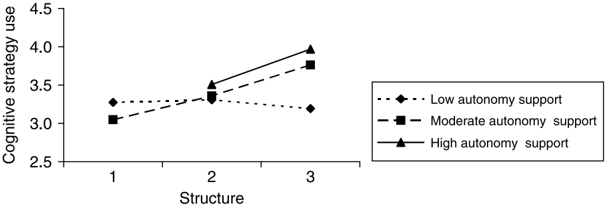
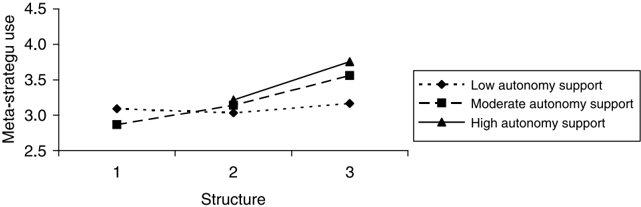
BACKGROUND: Self-determination theory defines two important dimensions of teaching style: autonomy support and structure. AIMS: The purpose of the present study was to investigate the synergistic relationship of perceived teacher autonomy support and the provision of structure in the prediction of self-regulated learning. SAMPLE AND METHOD: Students (N=526) completed questionnaires assessing perceived autonomy support, structure, and self-regulated learning. RESULTS: First, autonomy support and structure were found to be positively correlated, suggesting that the support of student autonomy generally goes hand in hand with the provision of structure and order in the classroom. Second, moderated regression analyses indicated that structure but not autonomy support yielded a main effect on self-regulated learning, although this main effect was qualified by a structure by autonomy support interaction. CONCLUSION: The interaction suggests that structure was associated with more self-regulated learning under conditions of moderate and high autonomy support only. Therefore, when teachers want their students to evaluate themselves, to plan their study activities, and to think about themselves as learners, the teachers are encouraged to provide help, instructions, and expectations in an autonomy-supportive way.
Checked 2026-11-25 · 1 reference not checked yet
Overview
CoChat Summary
TL;DR
This correlational study found that perceived teacher autonomy support and structure are positively correlated, and that structure predicts self-regulated learning mainly when accompanied by moderate or high autonomy support. The authors interpret the interaction as evidence that structure supplies the “know-how” for self-regulated learning while autonomy support supplies the willingness to use it.
Key findings
- Perceived autonomy support and structure were positively correlated (\(r = .67, p < .01\)) and were empirically distinguishable in CFA, with a two-factor solution fitting better than a one-factor solution, \(\Delta\chi^2(1) = 29.39, p < .001\).
- Structure, but not autonomy support, had a main effect on both cognitive strategy use and self-regulation; however, this was qualified by a significant autonomy support × structure interaction, \(\Delta R^2 = .03, p < .001\) for each SRL outcome.
- Simple slopes showed structure predicted cognitive strategy use and self-regulation at average autonomy support (\(\beta = .33\) and \(\beta = .29\), respectively, \(p < .001\)) and high autonomy support (\(\beta = .46\) and \(\beta = .51\), respectively, \(p < .001\)), but not at low autonomy support (\(\beta = .06\), ns for both).
- Type of education did not interact with the teaching style dimensions in predicting SRL, and the three-way interaction with type of education was not significant.
Methods
- Correlational design with \(N = 526\) Belgian students: 264 male and 262 female, Grade 11 and 12 academic-track secondary students plus first-year teacher education students; age ranged from 15 to 27 years (\(M = 17.9\), \(SD = 1.22\)).
- Students completed questionnaires assessing perceived teacher autonomy support and structure (eight items each from the shortened Teacher as Social Context Questionnaire) and self-regulated learning (shortened Motivated Strategies for Learning Questionnaire: 13 cognitive strategy use items and nine self-regulation items).
- Analyses included confirmatory factor analysis, MANOVA for domain effects, and hierarchical moderated regression predicting SRL from type of education, autonomy support, structure, and their interactions.
Limitations
- The paper states that the cross-sectional design prevents conclusions about direction of effects, that student self-reports may create shared method variance and make true teacher effects difficult to determine, and that findings may not generalize to younger populations or other aspects of SRL such as affect regulation.
- The paper also notes that autonomy support and structure were each assessed with brief eight-item scales, limiting insight into subcomponents.
- Evident from the text: the sample did not include the high-autonomy-support/low-structure combination, and the study relies on perceived rather than observed teaching.
Model-written summary. Check it against the paper before relying on it.
Integrity signals
Registry
Cites
Statistics
Figures
Verification
Claims the paper makes
0 Valid · 0 Not valid · 8 Not checked · 62 Own results and interpretations
A result the paper reports from its own data — it cites no other source for it, so there is none to check. The quote shows it is in the paper.
In the paper
“First, autonomy support and structure were found to be positively correlated, suggesting that the support of student autonomy generally goes hand in hand with the provision of structure and order in the classroom.”
- Also stated in: § Preliminary analyses · p. 6 · plain
“As predicted, autonomy support and structure were positively correlated.”
plainstates an association- Asserted: passes — The authors put it forward as true.
- Checkable: passes — It can be checked against evidence.
- Load-bearing: passes — The paper’s conclusions depend on it.
- Based: passes — The paper gives a reason why it holds.
- Also stated in: § Preliminary analyses · p. 6 · plain
A result the paper reports from its own data — it cites no other source for it, so there is none to check. The quote shows it is in the paper.
In the paper
“The educational sciences subsample scored highest on all outcomes compared to both the Dutch and mathematics subsamples, while both did not differ from one another except for autonomy support, with the Dutch subsample scoring significantly lower than the mathematics subsample.”
plain- Asserted: passes — The authors put it forward as true.
- Checkable: passes — It can be checked against evidence.
- Load-bearing: unclear — It is unclear whether the paper’s conclusions depend on it.
- Based: passes — The paper gives a reason why it holds.
A result the paper reports from its own data — it cites no other source for it, so there is none to check. The quote shows it is in the paper.
In the paper
“No evidence was found for curvilinear structure effects on SRL.”
plain- Asserted: passes — The authors put it forward as true.
- Checkable: passes — It can be checked against evidence.
- Load-bearing: passes — The paper’s conclusions depend on it.
- Based: passes — The paper gives a reason why it holds.
A result the paper reports from its own data — it cites no other source for it, so there is none to check. The quote shows it is in the paper.
In the paper
“As the three-way interaction between autonomy support, structure, and type of education also was not significant”
plain- Asserted: passes — The authors put it forward as true.
- Checkable: passes — It can be checked against evidence.
- Load-bearing: passes — The paper’s conclusions depend on it.
- Based: passes — The paper gives a reason why it holds.
A result the paper reports from its own data — it cites no other source for it, so there is none to check. The quote shows it is in the paper.
In the paper
“Domain had an overall multivariate effect (Wilks' l ¼ : 77; F ð 8 ; 1 ; 034 Þ ¼ 17 : 86; p , : 001; h 2 ¼ : 12).”
plainstates an association- Asserted: passes — The authors put it forward as true.
- Checkable: passes — It can be checked against evidence.
- Load-bearing: unclear — It is unclear whether the paper’s conclusions depend on it.
- Based: passes — The paper gives a reason why it holds.
31 more claims
Create a free account to see all 70 claims and every source verdict.
- Probably not a substantial claim. 25
- It may state two separate claims as one. 15
Claims other papers make about this one
Each is checked against this paper’s own text: does it say what the citing paper says it does?
The cited source says what the claim attributes to it.
In the citing paper
“It is now very clear that autonomy support and structure are not antithetical.”
From Basic psychological need theory: Advancements, critical themes, and future directions (2020) · cites this paper as Sierens et al. 2009
The check wasn’t confident either way, so it gives no verdict — never disputed.
In the citing paper
“By contrast, a performance climate promotes the perception that superior performances or winning are the most highly valued outcomes [67, 70–72].”
From Framework for the design and delivery of organized physical activity sessions for children and adolescents: rationale and description of the ‘SAAFE’ teaching principles (2017) · cites this paper as [72]
Experimental — accuracy not yet measured
Citations
Cites
Hu, L., & Bentler, P. M. (1999) · Structural Equation Modeling A Multidisciplinary Journal · doi:10.1080/10705519909540118 · Cited by 108,788
Multiple regression: testing and interpreting interactions
(1992) · Choice Reviews Online · doi:10.5860/choice.29-3352 · Cited by 36,654
(1998) · Cited by 36,049
The "what" and "why" of goal pursuits: Human needs and the self-determination of behavior
Deci, E. L., & Ryan, R. M. (2000) · Psychological Inquiry · doi:10.1207/s15327965pli1104_01 · Cited by 34,210
Motivational and self-regulated learning components of classroom academic performance.
Pintrich, P. R., & De Groot, E. V. (1990) · Journal of Educational Psychology · doi:10.1037/0022-0663.82.1.33 · Cited by 8,332
Regression Diagnostics: Identifying Influential Data and Sources of Collinearity
Belsley, D. A., Kuh, E., & Welsch, R. E. (1980) · Wiley Series in Probability and Statistics · doi:10.1002/0471725153 · Cited by 7,297
Regression Diagnostics -- Identifying Influential Data and Sources of Collinearity
Beaumont, C. D., Belsley, D. A., Kuh, E., & Welsch, R. E. (1981) · The Journal of the Operational Research Society · doi:10.2307/2581267 · Cited by 6,359
Skinner, E. A., & Belmont, M. J. (1993) · Journal of Educational Psychology · doi:10.1037/0022-0663.85.4.571 · Cited by 3,428 · cited 2×
“It may be useful to collect longitudinal data and to use cross-lagged analyses in future studies to look for reciprocal effects of the dimensions of teaching style and the use of self-regulatory skills (see e.g. Skinner & Belmont, 1993).”
Background(1991) · Cited by 3,259
Handbook of Research on Teaching
Richardson, V. (2001) · Cited by 2,437
Research works printed but not linked: 4
- Belmont, M., Skinner, E., Wellborn, J., & Connell, J. (1988). Teacher as social context: A measure of student perceptions of teacher provision of involvement, structure, and autonomy support (Tech. Rep. No. 102). Rochester, NY: University of Rochester.
- Jo ¨reskog, K. G., & So ¨rbom, D. (1993). Lisrel VIII users' reference guide . Mooresville, IN: Scientific Software.
- Miles, J., & Shevlin, M. (2001). Applying regression and correlation . Thousand Oaks, CA: Sage. Miller, R. B., & Brickman, S. J. (2004). A model of future-oriented motivation and self-regulation. Educational Psychology Review , 16 , 9-33.
- Reeve, J., Deci, E. L., & Ryan, R. M. (2004). Self-determination theory: A dialectical framework for understanding socio-cultural influences on student motivation. In D. M. McInerney & S. Van Etten (Eds.), Big theories revisited (pp. 31-60). Greenwich, CT: Information Age Press.
Cited by
Items 101–200 of 613
Curran, T., Hill, A. P., Ntoumanis, N., Hall, H., & Jowett, G. E. (2016) · Journal of Sport and Exercise Psychology · doi:10.1123/jsep.2015-0016 · Cited by 93
Fernández, A. G., Rodríguez, Á. C., Díaz, P., García-Señorán, M., & Ricoy, C. (2017) · Higher Education · doi:10.1007/s10734-017-0160-y · Cited by 98
Leenknecht, M. J. M., Wijnia, L., Loyens, S. M. M., & Rikers, R. M. J. P. (2017) · Teaching and Teacher Education · doi:10.1016/j.tate.2017.08.020 · Cited by 92
Fernández, A. G., & Paoloni, P. (2015) · Chemistry Education Research and Practice · doi:10.1039/c5rp00058k · Cited by 84
Observing the coach-created motivational environment across training and competition in youth sport
Smith, N., Quested, E., Appleton, P. R., & Duda, J. L. (2016) · Journal of Sports Sciences · doi:10.1080/02640414.2016.1159714 · Cited by 104
“Although previous findings indicate structure to be an empowering dimension of the motivational environment, Sierens et al. (2009) demonstrated that structure only had a positive impact upon self-regulated learning when delivered in an autonomy-supportive way.”
BackgroundResultSocial support moderates the effects of stress on sleep in adolescents
van Schalkwijk, F. J., Blessinga, A. N., Willemen, A. M., van der Werf, Y. D., & Schuengel, C. (2015) · Journal of Sleep Research · doi:10.1111/jsr.12298 · Cited by 84
“For the class supervisor the shortened version of the Teacher As Social Context questionnaire was applied (Belmont et al., 1988; Sierens et al., 2009), of which only the commitment questionnaire was implemented.”
MethodTsang, A. (2017) · Active Learning in Higher Education · doi:10.1177/1469787417731214 · Cited by 111
“It also supports how teachers play an imperative role in facilitating learners’ development (e.g. Sierens et al., 2009) especially in searching for specific directions of learning, that is, the specific items in this study (Pokorny and Pickford, 2010).”
BackgroundPapamitsiou, Z. K., & Economides, A. A. (2019) · British Journal of Educational Technology · doi:10.1111/bjet.12747 · Cited by 105
A Teacher-Focused Intervention to Enhance Students’ Classroom Engagement
Reeve, J., Cheon, S. H., & Jang, H.-R. (2019) · Elsevier eBooks · doi:10.1016/b978-0-12-813413-9.00007-3 · Cited by 111
Olivier, E., Galand, B., Morin, A. J. S., & Hospel, V. (2021) · Learning and Instruction · doi:10.1016/j.learninstruc.2020.101389 · Cited by 67
Hornstra, L., Bakx, A. W. E. A., Mathijssen, A. C. S., & Denissen, J. J. A. (2020) · Learning and Individual Differences · doi:10.1016/j.lindif.2020.101871 · Cited by 103
Motivated learning with digital learning tasks: what about autonomy and structure?
van Loon, A., Ros, A., & Martens, R. L. (2012) · Educational Technology Research and Development · doi:10.1007/s11423-012-9267-0 · Cited by 101
“Research studies on learning in the classroom show that offering choices and providing structure together produce positive effects on student motivation and the extent of self-regulated learning (Jang et al. 2010; Sierens et al. 2009).”
BackgroundResultFlunger, B., Mayer, A., & Umbach, N. (2019) · Journal of Educational Psychology · doi:10.1037/edu0000284 · Cited by 65
Böheim, R., Schnitzler, K., Gröschner, A., Weil, M., Knogler, M., Schindler, A.-K., Alles, M., & Seidel, T. (2020) · Learning Culture and Social Interaction · doi:10.1016/j.lcsi.2020.100450 · Cited by 91
Flourishing in the forest: looking at Forest School through a self-determination theory lens
Barrable, A., & Arvanitis, A. (2018) · Journal of Outdoor and Environmental Education · doi:10.1007/s42322-018-0018-5 · Cited by 106
“Scaffolding learning and giving appropriate feedback is an element of a competence supportive teaching practice (Aelterman et al. 2014; Jang et al. 2010; Sierens et al. 2009), but especially so within an early years context (Côté-Lecaldare et al.”
BackgroundReducing Violence in Non-controlling Ways: A Change Program Based on Self Determination Theory
Assor, A., Feinberg, O., Kanat-Maymon, Y., & Kaplan, H. (2018) · The Journal of Experimental Education · doi:10.1080/00220973.2016.1277336 · Cited by 61
“…can support students’ autonomy while simultaneously setting limits and structure, as well as refusing to ignore breaches of adults’ expectations (e.g., Farkas & Grolnick, 2010; Grolnic & Pomerantz, 2009; Jang et al., 2010; Sierens et al., 2009; Soenens et al., 2009; Vansteenkiste et al., 2012).”
BackgroundAreepattamannil, S., Cairns, D., & Dickson, M. (2020) · Journal of Science Teacher Education · doi:10.1080/1046560x.2020.1753309 · Cited by 59
Gillet, N., Berjot, S., Vallerand, R. J., & Amoura, S. (2012) · Basic and Applied Social Psychology · doi:10.1080/01973533.2012.674754 · Cited by 92
“These findings are in line with SDT and past research in sport (eg, Smith et al, 2007 ) and educational (eg, Sierens et al, 2009 ) settings which have shown that autonomy-supportive behaviors positively influence autonomous motivation.”
ResultSpearman, J., & Watt, H. M. G. (2013) · Learning Environments Research · doi:10.1007/s10984-013-9129-7 · Cited by 76
“Previous research has also shown that teacher-provided structure enhances students’ perceived competence, self-regulated learning, internal locus of control and behavioural engagement (Sierens et al. 2009; Skinner and Belmont 1993; Skinner et al. 2008).”
Teachers’ epistemological beliefs as an antecedent of autonomy-supportive teaching
Roth, G., & Weinstock, M. P. (2013) · Motivation and Emotion · doi:10.1007/s11031-012-9338-x · Cited by 93
“relation to students’ autonomous motivation, quality of school engagement, and well-being (Assor et al. 2002; Grolnick et al. 1991; Reeve et al. 2004; Roth et al. 2009a, b; Sierens et al. 2009; Soenens and Vansteenkiste 2005; Williams and Deci 1996).”
BackgroundHolt, A.-D., Smedegaard, S., Pawlowski, C. S., Skovgaard, T., & Christiansen, L. B. (2018) · European Physical Education Review · doi:10.1177/1356336x18758353 · Cited by 80
“…pupils’ increased influence was evident in ‘how’ they worked with the learning activities during PE, and not ‘what’ specific activity they engaged in. Sierens et al. (2009) state that the delivery by teachers of instructions and expectations in ways that support pupils’ autonomy is positively…”
BackgroundChildren’s perceptions of factors that influence PE enjoyment: a qualitative investigation
Domville, M. S., Watson, P. M., Richardson, D., & Graves, L. (2019) · Physical Education and Sport Pedagogy · doi:10.1080/17408989.2018.1561836 · Cited by 100
“…language [Reeve 2009]) competence (e.g. offering structure, tailored support and feedback, communicating clear guidelines and expectations [Sierens et al. 2009]) and relatedness (e.g. energetic and eager delivery, listening to children, coming from the child’s perspective [Haerens et al.…”
BackgroundCan Being Autonomy-Supportive in Teaching Improve Students’ Self-Regulation and Performance?
Wang, J., Ng, B., Liu, W. C., & Ryan, R. M. (2015) · Springer eBooks · doi:10.1007/978-981-287-630-0_12 · Cited by 92
“Research studies (Sierens et al., 2009 ; Vansteenkiste et al., 2009 ) have shown that autonomy-supportive teaching style was associated with students’ management of their classroom learning and self-regulated learning strategies.”
Cui, G., Yao, M., & Zhang, X. (2017) · Frontiers in Psychology · doi:10.3389/fpsyg.2017.00400 · Cited by 76
“Previous research showed that perceived autonomy support positively affected students’ learning outcomes (e.g., Reeve et al., 2004; Tsai et al., 2008; Sierens et al., 2009; Jang et al., 2010; Sakiz, 2012).”
BackgroundMethodInfluentialStudents’ perception of teachers’ two-way feedback interactions that impact learning
Tan, F., Whipp, P. R., Gagné, M., & Quaquebeke, N. V. (2018) · Social Psychology of Education · doi:10.1007/s11218-018-9473-7 · Cited by 92
Rogers, M., & Tannock, R. (2013) · Journal of Attention Disorders · doi:10.1177/1087054713508926 · Cited by 85
Olivier, É., Galand, B., Hospel, V., & Dellisse, S. (2020) · British Journal of Educational Psychology · doi:10.1111/bjep.12342 · Cited by 79
“The two studies that found that autonomy support and structure work best in tandem conducted analyses at the student level (which precludes any conclusions regarding classroom learning environment; Sierens et al., 2009; Vansteenkiste et al., 2012).”
BackgroundDoes changing learning environments affect student motivation?
Schweder, S., & Raufelder, D. (2023) · Learning and Instruction · doi:10.1016/j.learninstruc.2023.101829 · Cited by 89
Dupont, S., Galand, B., & Nils, F. (2015) · European Review of Applied Psychology · doi:10.1016/j.erap.2015.08.003 · Cited by 73
“As a consequence we invest ourselves more in the ask and also the ultimate performance can be much better (Skinner t al., 2008; Sierens et al., 2009).”
BackgroundThe relationship between teacher’s autonomy support and students’ autonomy and vitality
Núñez, J. L., Fernández, C., León, J., & Grijalvo, F. (2015) · Teachers and Teaching · doi:10.1080/13540602.2014.928127 · Cited by 52
Patzak, A., & Zhang, X. (2025) · Educational Psychology Review · doi:10.1007/s10648-025-09994-2 · Cited by 52
“A forward reference search was conducted in Google Scholar for the three most cited articles: Jang et al., 2010; Sierens et al., 2009; Vansteenkiste et al., 2012.”
Patall, E. A., Yates, N., Lee, J., Chen, M., Bhat, B. H., Lee, K., Beretvas, S. N., Lin, S., Hooper, S. Y., Jacobson, N. G., et al. (2023) · Educational Psychologist · doi:10.1080/00461520.2023.2274104 · Cited by 102
“…competence rather than merely control of their behavior, and therefore, will be more effective, when they are delivered in an autonomy-supportive manner or with positive teacher emotions and caring (e.g., Emmer & Stough, 2001; Ryan & Deci, 2017; Sierens et al., 2009; Vansteenkiste et al., 2012).”
BackgroundInfluentialGilbert, W., Bureau, J. S., Poëllhuber, B., & Guay, F. (2021) · Motivation and Emotion · doi:10.1007/s11031-021-09892-4 · Cited by 68
Lee, J., Zhang, T., Chu, T. L., & Gu, X. (2020) · Children · doi:10.3390/children7030021 · Cited by 67
“, providing specific instruction and encouragement to learn each FMS) [41,42].”
BackgroundReeve, J., & Assor, A. (2011) · Cross-cultural advancements in positive psychology · doi:10.1007/978-90-481-9667-8_6 · Cited by 59
“Classroom research shows that teacher-provided structure and teacher-provided autonomy support both contribute constructively to positive student outcomes, such as students’ greater classroom engagement (Jang, Reeve, & Deci, 2010) and students’ greater capacity for self-regulated learning ( Sierens, Vansteenkiste, Goo…”
BackgroundFeri, R., Soemantri, D., & Jusuf, A. (2016) · International Journal of Medical Education · doi:10.5116/ijme.5843.1097 · Cited by 64
Integrating Motivation and Instruction: Towards a Unified Approach in Educational Psychology
Martin, A. J. (2023) · Educational Psychology Review · doi:10.1007/s10648-023-09774-w · Cited by 48
“In that review, it was explained how motivation and engagement are optimized when there is pedagogical structure in place (i.e., when teachers provide explicit plans for the lesson, clear directions, feedback, and guidance, e.g., Jang et al., 2010; Sierens et al., 2009).”
BackgroundLi, Y., & Chiu, T. K. F. (2025) · Education and Information Technologies · doi:10.1007/s10639-025-13574-w · Cited by 97
“Support for structure (competence) involves communication of clear expecta - tions with respect to students’ behaviors (Sierens et al., 2009), distribution of desired materials (Chiu, 2021), and provision of competence-related feedback (Al-Obaydi et al., 2023).”
The Influence of the Social Context on Students In-Class Physical Activity
Perlman, D. (2013) · Journal of Teaching in Physical Education · doi:10.1123/jtpe.32.1.46 · Cited by 47
Oga‐Baldwin, W. L. Q., & Nakata, Y. (2015) · Japanese Psychological Research · doi:10.1111/jpr.12077 · Cited by 47
“…previous studies have found structure and autonomy-support to be different constructs in general education settings with secondary students (e.g., Sierens et al., 2009), this study indicates that, in foreign language classes, Japanese elementary students find clarity and direction engaging and…”
ResultKiemer, K., Gröschner, A., Kunter, M., & Seidel, T. (2016) · European Journal of Psychology of Education · doi:10.1007/s10212-016-0324-7 · Cited by 81
A (Visual) Novel Route to Learning: A Taxonomy of Teaching Strategies in Visual Novels
Camingue, J., Melcer, E. F., & Carstensdottir, E. (2020) · International Conference on the Foundations of Digital Games · doi:10.1145/3402942.3403004 · Cited by 46
“This dimension draws from notions of choice-based learning [45, 63] and self-determination theory [37] in learning science and serious games literature, which have shown the substantial impact such approaches can have on autonomy, engagement, and learning [44, 114].”
BackgroundTessier, D. P., Smith, N., Tzioumakis, Y. S., Quested, E., Sarrazin, P. G., Papaioannou, A. G., Digelidis, N. M., & Duda, J. L. (2013) · International Journal of Sport and Exercise Psychology · doi:10.1080/1612197x.2013.831259 · Cited by 67
“Empirically, studies (Jang et al., 2010; Sierens et al., 2009) have shown that when teachers’ naturally occurring interpersonal styles are scored by raters, providing structure is positively correlated with the provision of autonomy support and negatively correlated with the provision of control.”
BackgroundBaten, E., Vansteenkiste, M., De Muynck, G.-J., De Poortere, E., & Desoete, A. (2020) · Journal of Educational Psychology · doi:10.1037/edu0000444 · Cited by 46
Self-citationLiu, H., Yao, M., Li, J., & Li, R. (2020) · Educational Psychology · doi:10.1080/01443410.2020.1837346 · Cited by 55
Education as Flourishing: Self-Determination Theory in Schools as They Are and as They Might Be
Ryan, R. M., Reeve, J., Kaplan, H., Matos, L., & Cheon, S. H. (2023) · The Oxford Handbook of Self-Determination Theory · doi:10.1093/oxfordhb/9780197600047.013.60 · Cited by 45
Bru, E., Virtanen, T. E., Kjetilstad, V., & Niemiec, C. P. (2019) · Scandinavian Journal of Educational Research · doi:10.1080/00313831.2019.1659404 · Cited by 66
Using Self-Determination Theory in Social Robots to Increase Motivation in L2 Word Learning
van Minkelen, P., Gruson, C., van Hees, P., Willems, M., de Wit, J., Aarts, R., Denissen, J. J. A., & Vogt, P. (2020) · ACM/IEEE International Conference on Human-Robot Interaction (HRI) · doi:10.1145/3319502.3374828 · Cited by 65
“Finally, the need for relatedness can be satisfied by appreciating the child, ensuring that the child feels connected to others, in order for the child to internalize the learning material [8, 21, 24, 28].”
BackgroundBerger, J., & Girardet, C. (2020) · European Journal of Teacher Education · doi:10.1080/02619768.2020.1764930 · Cited by 66
Van Hoecke, A.-S., Delecluse, C., Bogaerts, A., & Boen, F. (2014) · Journal of Aging and Physical Activity · doi:10.1123/japa.2012-0261 · Cited by 43
Vandevelde, S., Keer, H. V., & Merchie, E. (2016) · The Journal of Educational Research · doi:10.1080/00220671.2014.999363 · Cited by 60
Archambault, I., Pascal, S., Tardif-Grenier, K., Dupéré, V., Janosz, M., Parent, S., & Pagani, L. S. (2020) · Teachers and Teaching · doi:10.1080/13540602.2020.1863208 · Cited by 43
“Yet, other studies further showed that student engagement is strengthened when teachers combine these different practices (Hospel & Galand, 2016; Nie & Lau, 2009; Sierens et al., 2009).”
BackgroundDoren, N. V., Cocker, K. A. D., Clerck, T. D., Vangilbergen, A., Vanderlinde, R., & Haerens, L. L. (2021) · International Journal of Environmental Research and Public Health · doi:10.3390/ijerph18147457 · Cited by 81
“Structuring strategies include communicating transparent expectations [44,45], giving step-by-step guidelines [44,46], and using positive and constructive feedback [47,48].”
BackgroundShih, S. (2015) · Social Psychology of Education · doi:10.1007/s11218-013-9214-x · Cited by 58
INFLUENCE OF TEACHING STYLE ON STUDENTS’ ENGAGEMENT, CURIOSITY AND EXPLORATION IN THE CLASSROOM
Inayat, A., & Ali, A. Z. (2020) · Journal of Education and Educational Development · doi:10.22555/joeed.v7i1.2736 · Cited by 87
Week-to-week interplay between teachers’ motivating style and students’ engagement
Michou, A., Altan, S., Mouratidis, A. A., Reeve, J., & Malmberg, L. (2021) · The Journal of Experimental Education · doi:10.1080/00220973.2021.1897774 · Cited by 57
“Similarly, high correlations have been observed in previous studies which have focused on the between-person differences where students provided aggregate accounts of their teachers’ behaviors (e.g., Aelterman et al., 2019; Mouratidis et al., 2018; Sierens et al., 2009).”
BackgroundResultSchuitema, J. A., Peetsma, T. T. D., & van der Veen, I. (2011) · Educational Studies · doi:10.1080/03055698.2011.643105 · Cited by 56
“Studies investigating self-regulated learning and the learning environment are usually cross-sectional and self-regulated learning is generally measured on a single occasion (e.g. Sierens et al. 2009; Van Grinsven and Tillema 2006).”
BackgroundHow to Support Toddlers’ Autonomy: A Qualitative Study With Child Care Educators
Côté-Lecaldare, M., Joussemet, M., & Dufour, S. (2016) · Early Education and Development · doi:10.1080/10409289.2016.1148482 · Cited by 63
“Moreover, recent studies looking at teachers’ provision of AS and structure found those constructs to be both distinct and positively correlated (Jang, Reeve, & Deci, 2010; Sierens et al., 2009).”
BackgroundPelletier, J. E., & Joussemet, M. (2016) · Journal of Applied Research in Intellectual Disabilities · doi:10.1111/jar.12274 · Cited by 57
“However, it is possible to provide both structure and AS (Sierens et al. 2009; Jang et al. 2010).”
BackgroundA dynamic model that links skill acquisition with self-determination in instrumental music lessons
Küpers, E., van Dijk, M., McPherson, G. E., & van Geert, P. L. C. (2013) · Musicae Scientiae · doi:10.1177/1029864913499181 · Cited by 62
Perceived autonomy support, intrinsic motivation, and student ratings of instruction
Griffin, B. W. (2016) · Studies In Educational Evaluation · doi:10.1016/j.stueduc.2016.10.007 · Cited by 61
Lazarides, R., & Rubach, C. (2017) · Mathematics Education Research Journal · doi:10.1007/s13394-017-0196-4 · Cited by 51
“Students taught by autonomy-supportive mathematics teachers report increased intrinsic motivation (Tsai et al. 2008); although, another study found that student-perceived autonomy support was unrelated to their engagement (Sierens et al. 2009).”
BackgroundFlunger, B., Hollmann, L., Hornstra, L., & Murayama, K. (2021) · Learning and Instruction · doi:10.1016/j.learninstruc.2021.101500 · Cited by 60
Dupont, S., Galand, B., Nils, F., & Hospel, V. H. (2017) · Electronic Journal of Research in Education Psychology · doi:10.14204/ejrep.32.13081 · Cited by 39
“13081 strategies, the effect of autonomy support on self-regulation disappeared (Sierens et al., 2009).”
BackgroundMethodInfluentialDettweiler, U., Lauterbach, G., Mall, C., & Simon, P. D. (2017) · Frontiers in Psychology · doi:10.3389/fpsyg.2017.02235 · Cited by 66
Perceived social support and self-regulated learning: A systematic review and meta-analysis
Martínez-López, Z., Nouws, S., Villar, E., Pais, M. E. M., & Tinajero, C. (2023) · International Journal of Educational Research Open · doi:10.1016/j.ijedro.2023.100291 · Cited by 85
Enhancing Students’ Motivation with Autonomy-Supportive Classrooms
Chang, R., Fukuda, E., Durham, J., & Little, T. D. (2017) · Springer eBooks · doi:10.1007/978-94-024-1042-6_8 · Cited by 47
Sava, S., Vîrgă, D., & Paloș, R. (2020) · Studia Psychologica · doi:10.31577/sp.2020.01.790 · Cited by 58
“When the students become confident, they can develop the willingness (autonomy) to initiate self-regulated learning (Sierens et al., 2009).”
BackgroundInfluentialCui, Y., Zhao, G., & Zhang, D. (2022) · British Journal of Educational Technology · doi:10.1111/bjet.13184 · Cited by 52
Uslu, N. A., & Durak, H. Y. (2022) · Learning and Motivation · doi:10.1016/j.lmot.2022.101804 · Cited by 70
Orakçı, Ş., & Durnalı, M. (2022) · Psychology in the Schools · doi:10.1002/pits.22770 · Cited by 53
Smith, N., Quested, E., Appleton, P. R., & Duda, J. L. (2016) · International Review of Sport and Exercise Psychology · doi:10.1080/1750984x.2015.1132334 · Cited by 50
Effects of teacher framing on student engagement during collaborative reasoning discussions
Baker, A. R., Lin, T., Chen, J., Paul, N., Anderson, R. C., & Nguyen‐Jahiel, K. (2017) · Contemporary Educational Psychology · doi:10.1016/j.cedpsych.2017.08.007 · Cited by 48
Liu, P. P., Savitz‐Romer, M., Perella, J., Hill, N. E., & Liang, B. (2018) · Contemporary Educational Psychology · doi:10.1016/j.cedpsych.2018.07.005 · Cited by 45
Students’ interest and self-efficacy and the impact of changing learning environments
Schweder, S., & Raufelder, D. (2022) · Contemporary Educational Psychology · doi:10.1016/j.cedpsych.2022.102082 · Cited by 57
The Relationship between Teachers’ Motivational Support and Engagement versus Disaffection
Güvenç, H. (2015) · Educational Sciences Theory & Practice · doi:10.12738/estp.2015.3.2662 · Cited by 57
“In classes where the teacher arranges the class structure in a manner that supports the students’ perception of competence, engagement is high (Tucker et al., 2002) and self-regulated learning strategies are more widely employed (Sierens et al., 2009).”
BackgroundBasten, M., Meyer-Ahrens, I., Fries, S., & Wilde, M. (2014) · Science Education · doi:10.1002/sce.21125 · Cited by 51
Curran, T., Hill, A. P., Hall, H., & Jowett, G. E. (2014) · Pure (University of Bath) · doi:10.7352/ijsp2014.45.559 · Cited by 55
Fryer, L. K., & Oga-Baldwin, W. L. Q. (2019) · Contemporary Educational Psychology · doi:10.1016/j.cedpsych.2019.101778 · Cited by 36
Filippello, P., Larcan, R., Sorrenti, L., Buzzai, C., Orecchio, S., & Costa, S. (2017) · Improving Schools · doi:10.1177/1365480216688554 · Cited by 42
Pelletier, L. G., & Rocchi, M. (2023) · Oxford University Press eBooks · doi:10.1093/oxfordhb/9780197600047.013.4 · Cited by 71
The Role of Social Support and Coping Skills in Promoting Self-Regulated Learning Among Urban Youth
Perry, J. C., Fisher, A. L., Caemmerer, J. M., Keith, T. Z., & Poklar, A. E. (2015) · Youth & Society · doi:10.1177/0044118x15618313 · Cited by 56
Baker, J. P., & Goodboy, A. K. (2018) · Communication Education · doi:10.1080/03634523.2018.1536793 · Cited by 35
Authenticity made visible in medical students’ experiences of feeling like a doctor
Fredholm, A., Manninen, K., Hjelmqvist, H., & Silén, C. (2019) · International Journal of Medical Education · doi:10.5116/ijme.5cf7.d60c · Cited by 34
Factors influencing behavioural intention to use MOOCs
Khalid, B., Lis, M., Chaiyasoonthorn, W., & Chaveesuk, S. (2021) · Engineering Management in Production and Services · doi:10.2478/emj-2021-0014 · Cited by 47
“These findings were supported by literature, such as studies by Lakhal, Khechine and Pascot (2013) and Sierens, Vansteenkiste, Goossens, Soenens and Dochy (2009), who found a positive relationship between perceived autonomy and behavioural intention to undertake self-regulated learning.”
ResultMendoza, N. B., Yan, Z., & King, R. B. (2022) · European Journal of Psychology of Education · doi:10.1007/s10212-022-00620-1 · Cited by 41
“Hence, although previous studies tend to lean heavily on structured teaching and autonomysupportive teaching as significant predictors of positive student outcomes (e.g. Baker & Goodboy, 2019; Haerens et al., 2015; Sierens et al., 2009; Wang et al., 2016), our study highlights evidence suggesting the relevance of invo…”
ResultShih, S. (2016) · The Journal of Educational Research · doi:10.1080/00220671.2015.1108278 · Cited by 49
Muzaffar, H., Chapman‐Novakofski, K., Castelli, D. M., & Scherer, J. A. (2013) · Appetite · doi:10.1016/j.appet.2013.09.024 · Cited by 44
“The results of this study indicated that both teacher support and provision of structure were positively correlated with learning, but structure yielded a main effect on self-regulated learning (Sierens et al., 2009).”
The Relationship between Workplace Climate, Motivation and Learning Approaches for Knowledge Workers
Vanthournout, G., Noyens, D., Gijbels, D., & den Bossche, P. V. (2014) · Vocations and Learning · doi:10.1007/s12186-014-9112-1 · Cited by 61
Apoyo docente, compromiso académico y satisfacción del alumnado universitario
Gutiérrez, M., Tomás, J. M., & Alberola-Engix, S. (2018) · Estudios sobre Educación · doi:10.15581/004.35.535-555 · Cited by 59
Longitudinal Effects of Student-Perceived Classroom Support on Motivation – A Latent Change Model
Lazarides, R., & Raufelder, D. (2017) · Frontiers in Psychology · doi:10.3389/fpsyg.2017.00417 · Cited by 45
“class, whereby structure reflects the teacher’s guidance during the process of problem solving (Sierens et al., 2009).”
BackgroundInfluentialLazarides, R., & Ittel, A. (2012) · Child Development Research · doi:10.1155/2012/813920 · Cited by 48
“As it is well known that single characteristics of instructional quality, such as perceived structuredness and autonomy support, are independent learning factors that can be complementary [51], we expected to find mixed subtypes of students’ perceived characteristics of instructional quality structuredness of teachers…”
BackgroundArribas, T. L., & Ríos, M. (2015) · Qualitative Research in Education · doi:10.17583/qre.2015.1138 · Cited by 49
The role of classroom characteristics for students’ motivation and career exploration
Lazarides, R., Rohowski, S., Ohlemann, S., & Ittel, A. (2015) · Educational Psychology · doi:10.1080/01443410.2015.1093608 · Cited by 43
Lüftenegger, M., Finsterwald, M., Klug, J., Bergsmann, E., van de Schoot, R., Schober, B., & Wagner, P. (2015) · European Journal of Developmental Psychology · doi:10.1080/17405629.2015.1077113 · Cited by 33
“Formulating clear expectations is another important issue (Sierens et al., 2009).”
Mobile health (mHealth) application loyalty in young consumers
Soni, M., Jain, K., & Jajodia, I. (2021) · Young Consumers Insight and Ideas for Responsible Marketers · doi:10.1108/yc-10-2020-1236 · Cited by 37
Students’ Preferred Characteristics of Learning Environments in Vocational Secondary Education
Placklé, I., Könings, K. D., Jacquet, W., Struyven, K., Libotton, A., van Merriënboer, J. J. G., & Engels, N. (2014) · International Journal for Research in Vocational Education and Training · doi:10.13152/ijrvet.1.2.2 · Cited by 60
“Teachers must be able to provide the kind of coaching that offers appropriate structure and trust, that stimulates students to self-regulate their own learning by providing differentiated help, communicating clear expectations and offering appropriate guidance (Jang et al., 2010; Kirschner et al., 2006; Mouratidisa et…”
Raes, A., & Schellens, T. (2015) · Computers & Education · doi:10.1016/j.compedu.2015.10.014 · Cited by 34
Motivation and psychological need fulfillment on the pathway to identity resolution
Skhirtladze, N., Petegem, S. V., Javakhishvili, N., Schwartz, S. J., & Luyckx, K. (2019) · Motivation and Emotion · doi:10.1007/s11031-019-09795-5 · Cited by 34
Student Vitality, Teacher Engagement, and Rapport in Studio Music Instruction
Blackwell, J., Miksza, P., Evans, P., & McPherson, G. E. (2020) · Frontiers in Psychology · doi:10.3389/fpsyg.2020.01007 · Cited by 45
Metadata
- Authors
- Sierens, E., Vansteenkiste, M., Goossens, L., Soenens, B., & Dochy, F.
- Affiliations
- KU Leuven (BE)
- Ghent University (BE)
- Corresponding author
- Sierens, Eline
- Venue
- British Journal of Educational Psychology
- Publisher
- Wiley
- Published
- 2009-03
- Volume
- 79
- Issue
- 1
- Pages
- 57-68
- ISSN
- 0007-0998 (ISSN-L)
- 2044-8279
- OpenAlex
- W2085917674
- Cited by
- 618
- References
- 38
- Citations by year
- 2026: 22 · 2025: 26 · 2024: 36 · 2023: 127 · 2022: 39 · 2021: 33 · 2020: 53 · 2019: 35 · 2018: 33 · 2017: 39 · 2016: 43 · 2015: 37 · 2014: 28 · 2013: 23 · 2012: 17
- FWCI
- 11.56
- Type
- journal article
- Language
- en
- Open access
- green
- lirias.kuleuven.be
- Licence
- Locations
- British Journal of Educational Psychology (publishedVersion)
- PubMed (publishedVersion)
- Lirias (submittedVersion, other-oa)
- Ghent University Academic Bibliography (Ghent University) (submittedVersion)
- Topics
- Social Sciences › Psychology › Social Psychology › Motivation and Self-Concept in Sports
- Social Sciences › Psychology › Developmental and Educational Psychology › Innovative Teaching and Learning Methods
- Social Sciences › Psychology › Developmental and Educational Psychology › Education, Achievement, and Giftedness
- Keywords
- perceived autonomy support, structure, student self-regulation, self-determination theory, teaching styles, classroom structure, student self-assessment, interaction effects
- MeSH terms
- Adolescent, Adult, Curriculum, Female, Goals, Humans, Individuation, Internal-External Control, Male, Motivation, Problem Solving, Surveys and Questionnaires, Social Perception, Social Support, Teaching, Personal Autonomy, Young Adult
About these checks
Registry, retraction, Cites and statistics results are computed, not judged, with one exception: a printed reference that no index lists is read once by a model before it counts as a citation error. Claims are extracted by a model and kept only when their quote appears verbatim in the text; each cited source is then checked, with a model’s help, for whether it says what the claim relies on. Those verdicts can be wrong — read the claim’s quote and the cited source before relying on one.
A language model drew the claims from the paper on 2026-10-10, under version 3 of the claim definition (model deepseek-v4.1-flash, prompt extract-v3).
A second model labelled each claim on 2026-10-10 (model jev-1.13-20260917, definition revision gold-guideline-v0.2).
Statistics and arithmetic are recomputed, not judged.
Confidence bands are shown only for fields calibrated on our annotated test set. None is calibrated yet, so no band is shown.
What counts as a claim ›How we measure confidence ›How we check this ›
Are you an author, or do you see a problem with this page? Request a review
Data sources
Bibliographic data: Semantic Scholar, OpenAlex, Crossref.
Contains information from the Semantic Scholar Academic Graph Datasets, made available under the ODC Attribution License (ODC-BY 1.0).
Semantic Scholar’s data is described in: Kinney, R., et al. (2023). The Semantic Scholar Open Data Platform. arXiv:2301.10140.
