

The synergistic relationship of perceived autonomy support and structure in the prediction of self-regulated learning.
Open accessThe DOI matches its Crossref record; 38 of the 40 references it cites were found in a registry or an index, and 1 are not checked yet; none of the 7 sources its claims cite is checked for support yet.
Abstract
BACKGROUND: Self-determination theory defines two important dimensions of teaching style: autonomy support and structure. AIMS: The purpose of the present study was to investigate the synergistic relationship of perceived teacher autonomy support and the provision of structure in the prediction of self-regulated learning. SAMPLE AND METHOD: Students (N=526) completed questionnaires assessing perceived autonomy support, structure, and self-regulated learning. RESULTS: First, autonomy support and structure were found to be positively correlated, suggesting that the support of student autonomy generally goes hand in hand with the provision of structure and order in the classroom. Second, moderated regression analyses indicated that structure but not autonomy support yielded a main effect on self-regulated learning, although this main effect was qualified by a structure by autonomy support interaction. CONCLUSION: The interaction suggests that structure was associated with more self-regulated learning under conditions of moderate and high autonomy support only. Therefore, when teachers want their students to evaluate themselves, to plan their study activities, and to think about themselves as learners, the teachers are encouraged to provide help, instructions, and expectations in an autonomy-supportive way.
Checked 2026-11-25 · 1 reference not checked yet
Overview
CoChat Summary
TL;DR
This correlational study found that perceived teacher autonomy support and structure are positively correlated, and that structure predicts self-regulated learning mainly when accompanied by moderate or high autonomy support. The authors interpret the interaction as evidence that structure supplies the “know-how” for self-regulated learning while autonomy support supplies the willingness to use it.
Key findings
- Perceived autonomy support and structure were positively correlated (\(r = .67, p < .01\)) and were empirically distinguishable in CFA, with a two-factor solution fitting better than a one-factor solution, \(\Delta\chi^2(1) = 29.39, p < .001\).
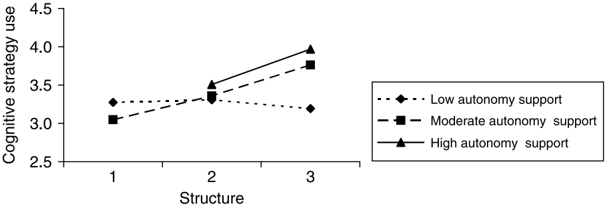
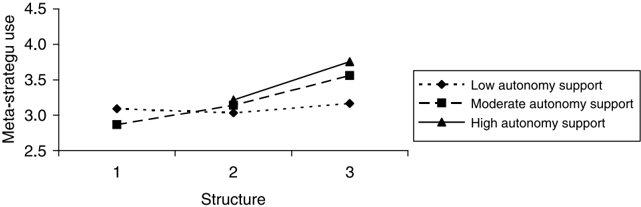
- Structure, but not autonomy support, had a main effect on both cognitive strategy use and self-regulation; however, this was qualified by a significant autonomy support × structure interaction, \(\Delta R^2 = .03, p < .001\) for each SRL outcome.
- Simple slopes showed structure predicted cognitive strategy use and self-regulation at average autonomy support (\(\beta = .33\) and \(\beta = .29\), respectively, \(p < .001\)) and high autonomy support (\(\beta = .46\) and \(\beta = .51\), respectively, \(p < .001\)), but not at low autonomy support (\(\beta = .06\), ns for both).
- Type of education did not interact with the teaching style dimensions in predicting SRL, and the three-way interaction with type of education was not significant.
Methods
- Correlational design with \(N = 526\) Belgian students: 264 male and 262 female, Grade 11 and 12 academic-track secondary students plus first-year teacher education students; age ranged from 15 to 27 years (\(M = 17.9\), \(SD = 1.22\)).
- Students completed questionnaires assessing perceived teacher autonomy support and structure (eight items each from the shortened Teacher as Social Context Questionnaire) and self-regulated learning (shortened Motivated Strategies for Learning Questionnaire: 13 cognitive strategy use items and nine self-regulation items).
- Analyses included confirmatory factor analysis, MANOVA for domain effects, and hierarchical moderated regression predicting SRL from type of education, autonomy support, structure, and their interactions.
Limitations
- The paper states that the cross-sectional design prevents conclusions about direction of effects, that student self-reports may create shared method variance and make true teacher effects difficult to determine, and that findings may not generalize to younger populations or other aspects of SRL such as affect regulation.
- The paper also notes that autonomy support and structure were each assessed with brief eight-item scales, limiting insight into subcomponents.
- Evident from the text: the sample did not include the high-autonomy-support/low-structure combination, and the study relies on perceived rather than observed teaching.
Model-written summary. Check it against the paper before relying on it.
Integrity signals
Registry
Cites
Statistics
Figures
Verification
Claims the paper makes
0 Valid · 0 Not valid · 8 Not checked · 62 Own results and interpretations
A result the paper reports from its own data — it cites no other source for it, so there is none to check. The quote shows it is in the paper.
In the paper
“First, autonomy support and structure were found to be positively correlated, suggesting that the support of student autonomy generally goes hand in hand with the provision of structure and order in the classroom.”
- Also stated in: § Preliminary analyses · p. 6 · plain
“As predicted, autonomy support and structure were positively correlated.”
plainstates an association- Asserted: passes — The authors put it forward as true.
- Checkable: passes — It can be checked against evidence.
- Load-bearing: passes — The paper’s conclusions depend on it.
- Based: passes — The paper gives a reason why it holds.
- Also stated in: § Preliminary analyses · p. 6 · plain
A result the paper reports from its own data — it cites no other source for it, so there is none to check. The quote shows it is in the paper.
In the paper
“The educational sciences subsample scored highest on all outcomes compared to both the Dutch and mathematics subsamples, while both did not differ from one another except for autonomy support, with the Dutch subsample scoring significantly lower than the mathematics subsample.”
plain- Asserted: passes — The authors put it forward as true.
- Checkable: passes — It can be checked against evidence.
- Load-bearing: unclear — It is unclear whether the paper’s conclusions depend on it.
- Based: passes — The paper gives a reason why it holds.
A result the paper reports from its own data — it cites no other source for it, so there is none to check. The quote shows it is in the paper.
In the paper
“No evidence was found for curvilinear structure effects on SRL.”
plain- Asserted: passes — The authors put it forward as true.
- Checkable: passes — It can be checked against evidence.
- Load-bearing: passes — The paper’s conclusions depend on it.
- Based: passes — The paper gives a reason why it holds.
A result the paper reports from its own data — it cites no other source for it, so there is none to check. The quote shows it is in the paper.
In the paper
“As the three-way interaction between autonomy support, structure, and type of education also was not significant”
plain- Asserted: passes — The authors put it forward as true.
- Checkable: passes — It can be checked against evidence.
- Load-bearing: passes — The paper’s conclusions depend on it.
- Based: passes — The paper gives a reason why it holds.
A result the paper reports from its own data — it cites no other source for it, so there is none to check. The quote shows it is in the paper.
In the paper
“Domain had an overall multivariate effect (Wilks' l ¼ : 77; F ð 8 ; 1 ; 034 Þ ¼ 17 : 86; p , : 001; h 2 ¼ : 12).”
plainstates an association- Asserted: passes — The authors put it forward as true.
- Checkable: passes — It can be checked against evidence.
- Load-bearing: unclear — It is unclear whether the paper’s conclusions depend on it.
- Based: passes — The paper gives a reason why it holds.
31 more claims
Create a free account to see all 70 claims and every source verdict.
- Probably not a substantial claim. 25
- It may state two separate claims as one. 15
Claims other papers make about this one
Each is checked against this paper’s own text: does it say what the citing paper says it does?
The cited source says what the claim attributes to it.
In the citing paper
“It is now very clear that autonomy support and structure are not antithetical.”
From Basic psychological need theory: Advancements, critical themes, and future directions (2020) · cites this paper as Sierens et al. 2009
The check wasn’t confident either way, so it gives no verdict — never disputed.
In the citing paper
“By contrast, a performance climate promotes the perception that superior performances or winning are the most highly valued outcomes [67, 70–72].”
From Framework for the design and delivery of organized physical activity sessions for children and adolescents: rationale and description of the ‘SAAFE’ teaching principles (2017) · cites this paper as [72]
Experimental — accuracy not yet measured
Citations
Cites
Hu, L., & Bentler, P. M. (1999) · Structural Equation Modeling A Multidisciplinary Journal · doi:10.1080/10705519909540118 · Cited by 108,788
Multiple regression: testing and interpreting interactions
(1992) · Choice Reviews Online · doi:10.5860/choice.29-3352 · Cited by 36,654
(1998) · Cited by 36,049
The "what" and "why" of goal pursuits: Human needs and the self-determination of behavior
Deci, E. L., & Ryan, R. M. (2000) · Psychological Inquiry · doi:10.1207/s15327965pli1104_01 · Cited by 34,210
Motivational and self-regulated learning components of classroom academic performance.
Pintrich, P. R., & De Groot, E. V. (1990) · Journal of Educational Psychology · doi:10.1037/0022-0663.82.1.33 · Cited by 8,332
Regression Diagnostics: Identifying Influential Data and Sources of Collinearity
Belsley, D. A., Kuh, E., & Welsch, R. E. (1980) · Wiley Series in Probability and Statistics · doi:10.1002/0471725153 · Cited by 7,297
Regression Diagnostics -- Identifying Influential Data and Sources of Collinearity
Beaumont, C. D., Belsley, D. A., Kuh, E., & Welsch, R. E. (1981) · The Journal of the Operational Research Society · doi:10.2307/2581267 · Cited by 6,359
Skinner, E. A., & Belmont, M. J. (1993) · Journal of Educational Psychology · doi:10.1037/0022-0663.85.4.571 · Cited by 3,428 · cited 2×
“It may be useful to collect longitudinal data and to use cross-lagged analyses in future studies to look for reciprocal effects of the dimensions of teaching style and the use of self-regulatory skills (see e.g. Skinner & Belmont, 1993).”
Background(1991) · Cited by 3,259
Handbook of Research on Teaching
Richardson, V. (2001) · Cited by 2,437
Research works printed but not linked: 4
- Belmont, M., Skinner, E., Wellborn, J., & Connell, J. (1988). Teacher as social context: A measure of student perceptions of teacher provision of involvement, structure, and autonomy support (Tech. Rep. No. 102). Rochester, NY: University of Rochester.
- Jo ¨reskog, K. G., & So ¨rbom, D. (1993). Lisrel VIII users' reference guide . Mooresville, IN: Scientific Software.
- Miles, J., & Shevlin, M. (2001). Applying regression and correlation . Thousand Oaks, CA: Sage. Miller, R. B., & Brickman, S. J. (2004). A model of future-oriented motivation and self-regulation. Educational Psychology Review , 16 , 9-33.
- Reeve, J., Deci, E. L., & Ryan, R. M. (2004). Self-determination theory: A dialectical framework for understanding socio-cultural influences on student motivation. In D. M. McInerney & S. Van Etten (Eds.), Big theories revisited (pp. 31-60). Greenwich, CT: Information Age Press.
Cited by
Items 401–500 of 613
A Control-Value Approach to Affective Growth
Pekrun, R. H. (2023) · Oxford University Press eBooks · doi:10.1093/oso/9780197662359.003.0055 · Cited by 6
Rahmawati, A. N., & Asmawan, M. C. (2023) · SCAFFOLDING Jurnal Pendidikan Islam dan Multikulturalisme · doi:10.37680/scaffolding.v5i3.3953 · Cited by 3
“First of all, an inspiration diary allows students to monitor their own progress (Sierens et al., 2009).”
BackgroundBalcı, İ., & Arabaci, İ. B. (2024) · Shanlax International Journal of Education · doi:10.34293/education.v12is1-june.7816 · Cited by 3
“…in organizations, proactive group management ( Aksakal & Doğan, 2022 ), raising motivation (Gürler, 2020), creating joint synergy ( Černe et al., 2017 ; Sierens et al., 2009), creating innovative opportunities (Tu & Wu, 2021), and ensuring a safe and collaborative environment (Weiner et al., 2021).”
BackgroundChaotic (laissez-faire) teaching: The most harmful style for students’ psychological needs?
Bouten, A., Diloy-Peña, S., Abós, Á., García‐González, L., Haerens, L. L., & Cocker, K. A. D. (2025) · International Journal of Educational Research · doi:10.1016/j.ijer.2025.102717 · Cited by 8
The honours learning environment of Windesheim University of Applied Sciences
Kingma, T., Dommerholt, K., & Rijsdijk, L. E. (2017) · Journal of the European Honors Council · doi:10.31378/jehc.19 · Cited by 3
Nakayama, M., Mutsuura, K., & Yamamoto, H. (2021) · Behaviormetrics · doi:10.1007/978-981-16-6104-4_8 · Cited by 3
“In addition to this topic, the relationships between student's emotional factors and their learning activity or performance are often studied and discussed (Sierens et al, 2009, Papaioannou et al, 2012).”
BackgroundSocial Robots for Reducing Mathematics Hiatuses in Primary Education, an Exploratory Field Study
Smakman, M., Smit, K., Lan, E., Fermin, T., van Lagen, J., Maas, J., van Vliet, D., & Leewis, S. (2021) · Bled eConference · doi:10.18690/978-961-286-485-9.46 · Cited by 4
Locke, E. A. (2023) · Oxford University Press eBooks · doi:10.1093/oso/9780197662359.003.0003 · Cited by 9
Nagengast, B., & Trautwein, U. (2023) · Oxford University Press eBooks · doi:10.1093/oso/9780197662359.003.0068 · Cited by 5
Kellerer, J. D., Staudt, A.-L., & Deufert, D. (2023) · Teaching and learning in nursing · doi:10.1016/j.teln.2023.12.001 · Cited by 4
Mouratidis, A. A., Michou, A., Koçak, A. A., Christ, A. A., & Selçuk, Ş. (2024) · Educational Psychology · doi:10.1080/01443410.2024.2402322 · Cited by 4
“…including autonomous motivation (Patall et al., 2018), better time management (Xu, 2024), and elaboration and use of meta-cognitive strategies, which involve thinking about one’s own thinking and learning to improve understanding, retention, and problem-solving skills (Vansteenkiste et al., 2009).”
InfluentialÖğretmenlerin Eğitim İnançları İle Öğrenen Özerkliğini Destekleme Davranışları Arasındaki İlişki
Oğuz, A., Altınkurt, Y., Yılmaz, K., & Hatipoğlu, S. (2014) · DergiPark (Istanbul University) · Cited by 4
Five Critical Success Factors for Coaching: A Perspective on Educating Reflective Practitioners
van Doorn, G. (2019) · NL ARMS · doi:10.1007/978-94-6265-315-3_9 · Cited by 5
Cognitions and Emotions Energize and Sustain Motivation
Schunk, D. H. (2023) · Oxford University Press eBooks · doi:10.1093/oso/9780197662359.003.0037 · Cited by 6
Maulana, R., & Opdenakker, M. (2014) · SensePublishers eBooks · doi:10.1007/978-94-6209-701-8_9 · Cited by 7
Supported teaching autonomy support. [Enseñanza apoyada en el soporte de autonomía].
Murcia, J. A. M. (2016) · RICYDE Revista Internacional de Ciencias del Deporte · doi:10.5232/ricyde2016.043ed · Cited by 5
Collaborative Autonomy: Exploring the Professional Freedom of Three Science Teachers
Ralph, M. C., Robbins, D., Young, S., & Woodruff, L. (2020) · Educational Considerations · doi:10.4148/0146-9282.2197 · Cited by 4
Brenner, C. A. (2022) · British Journal of Teacher Education and Pedagogy · doi:10.32996/bjtep.2022.1.3.5 · Cited by 3
Assessing Motivation Dynamically
Schunk, D. H. (2023) · Oxford University Press eBooks · doi:10.1093/oso/9780197662359.003.0074 · Cited by 5
Skinner, E. A. (2023) · Oxford University Press eBooks · doi:10.1093/oso/9780197662359.003.0061 · Cited by 4
Evans, P., & Martin, A. J. (2023) · Oxford University Press eBooks · doi:10.1093/oxfordhb/9780199841332.013.53 · Cited by 10
Events that Promote Engineering Students' Intrinsic Motivation to Learn
Trenshaw, K., Revelo, R., Earl, K. A., & Herman, G. L. (2020) · ASEE Annual Conference & Exposition · doi:10.18260/1-2--20442 · Cited by 3
“This finding contradicts the generally accepted hierarchy of needs in SDT where autonomy and competence are thought to be more vital to motivation than relatedness.(4,5,12,13,14) This contradictory observation highlights a gap in our understanding of the interdependence of the three needs.”
ResultRigo, D. Y. (2020) · CPU-e Revista de Investigación Educativa · doi:10.25009/cpue.v0i31.2699 · Cited by 13
Hancox, J. E. (2014) · University of Birmingham Institutional Research Archive (University of Birmingham) · Cited by 6
Mínguez-Mínguez, L. A. (2020) · Repositorio Institucional de la Universidad de Burgos (University of Burgos) · doi:10.36443/10259/5451 · Cited by 8
Linnenbrink‐Garcia, L. (2023) · Oxford University Press eBooks · doi:10.1093/oso/9780197662359.003.0065 · Cited by 4
Ma, J., Zhang, Y., & Huang, H. (2024) · European Journal of Education · doi:10.1111/ejed.12783 · Cited by 4
Controlling Your Own Motivation Is an Acquired Skill
Wolters, C. A. (2023) · Oxford University Press eBooks · doi:10.1093/oso/9780197662359.003.0033 · Cited by 2
How Does Context Shape Motivation?
Bong, M. (2023) · Oxford University Press eBooks · doi:10.1093/oso/9780197662359.003.0044 · Cited by 3
How Do We Motivate People? By Working with Their Self-Beliefs
Usher, E. L. (2023) · Oxford University Press eBooks · doi:10.1093/oso/9780197662359.003.0054 · Cited by 8
Pleasure, Utility, and Goals: Motivation as a Value-Based Decision-Making Process
Kim, S. (2023) · Oxford University Press eBooks · doi:10.1093/oso/9780197662359.003.0008 · Cited by 2
Less Is Sometimes More: Differentiating “Mustivation” from “Wantivation”
Vansteenkiste, M., & Soenens, B. (2023) · Oxford University Press eBooks · doi:10.1093/oso/9780197662359.003.0021 · Cited by 5
Self-citationExtrinsic Incentives/Rewards: Short-Term Fix That Can Undermine Long-Term Motivation
Grolnick, W. S. (2023) · Oxford University Press eBooks · doi:10.1093/oso/9780197662359.003.0026 · Cited by 7
Subaşı, M., Koçak, G., Taş, Y., & Yerdelen, S. (2023) · International Journal of Contemporary Educational Research · doi:10.33200/ijcer.1099080 · Cited by 3
Reich, C., Markus, S., & Lohrmann, K. (2023) · Zeitschrift für Grundschulforschung · doi:10.1007/s42278-023-00173-2 · Cited by 8
Afzal, Z., & Jami, H. (2023) · Bahria Journal of Professional Psychology · doi:10.58800/xrvh4316 · Cited by 6
Motivating students using autonomy-supportive instructions: a pilot study
Kong, L. C., & Liu, W. C. (2024) · Asia Pacific Journal of Education · doi:10.1080/02188791.2024.2390073 · Cited by 2
“From a motivational point of view, structure supports students’ perceived competence, perceived control over valued outcomes and self-regulated learning strategies (Sierens et al., 2009).”
Autonomy-supportive teaching - applications of self-determination theory in the classroom.
Wojtowicz, E., & Jędryszek-Geisler, A. (2024) · Studia z Teorii Wychowania · doi:10.5604/01.3001.0054.8965 · Cited by 3
Yun, S., Park, J., & Yli-Piipari, S. R. (2024) · Journal of Teaching in Physical Education · doi:10.1123/jtpe.2024-0223 · Cited by 4
Cummins, W., & Lennon, C. M. (2025) · Journal of Chemical Education · doi:10.1021/acs.jchemed.4c00910 · Cited by 2
Clabaugh, D. J. (2013) · USF Scholarship Repository (University of San Francisco) · Cited by 5
Ortega, F. Z., González, J. I. S., Molina, F. Z., et al. (2017) · Electronic Journal of Research in Educational Psychology · doi:10.25115/ejrep.v9i25.1498 · Cited by 2
“Sierens et al. (2009) encontraron correlaciones positivas entre aquellas metodologías docentes que propician el trabajo autónomo de los estudiantes que tienen apoyo necesario del - 1146 - Electronic Journal of Research in Educational Psychology, 9(3), 1129-1154.”
BackgroundStančić, M., & Булатовић, М. (2017) · Zbornik Instituta za pedagoska istrazivanja · doi:10.2298/zipi1702170s · Cited by 3
Evaluating the Use of Automated Feedback on Student Motivation
Simpson, L., Jones, M. D., & Taylor, S. A. (2018) · INNOVATIONS in pharmacy · doi:10.24926/iip.v9i2.984 · Cited by 4
Teaching Gifted and Talented Children in A New Educational Era
Seničar, M. Ž. (2018) · doi:10.26493/978-961-7055-22-1 · Cited by 2
Two Routes to the Self-Regulation of Motivation and Goals
Gollwitzer, P. M., & Bargh, J. A. (2023) · Oxford University Press eBooks · doi:10.1093/oso/9780197662359.003.0031 · Cited by 2
Motivation Is the Interaction Between Dispositions and Context
Stipek, D. J. (2023) · Oxford University Press eBooks · doi:10.1093/oso/9780197662359.003.0005 · Cited by 7
Alexander, P. A. (2023) · Oxford University Press eBooks · doi:10.1093/oso/9780197662359.003.0050 · Cited by 2
The Good, the Bad, and the Ugly of Motivation
Ntoumanis, N. (2023) · Oxford University Press eBooks · doi:10.1093/oso/9780197662359.003.0020 · Cited by 4
The Most Fundamental Limitation in Motivation Theory and Research Is Our Theories
Anderman, E. M. (2023) · Oxford University Press eBooks · doi:10.1093/oso/9780197662359.003.0066 · Cited by 3
Most Motivation Research in Education Is Not Yet Useful for Teachers
Patrick, H. (2023) · Oxford University Press eBooks · doi:10.1093/oso/9780197662359.003.0064 · Cited by 6
Community-Engaged Research: The Next Frontier in Motivation Science
Gray, D. L., & Harris-Thomas, B. (2023) · Oxford University Press eBooks · doi:10.1093/oso/9780197662359.003.0076 · Cited by 3
Competition Can Enhance Motivation—But Typically Undermines It
Reeve, J. (2023) · Oxford University Press eBooks · doi:10.1093/oso/9780197662359.003.0028 · Cited by 7
Identifying the Profile of a Potential Lifelong Learner.
Ng, B. (2019) · Cited by 14
Entwicklung und Validierung eines Kurzfragebogens zur Erfassung eines motivierenden Unterrichtsstils
Thomas, A. E., & Andreitz, I. (2021) · Zeitschrift für Pädagogische Psychologie · doi:10.1024/1010-0652/a000304 · Cited by 3
Rigo, D. Y. (2021) · Revista Ensayos Pedagógicos · doi:10.15359/rep.16-1.10 · Cited by 6
Relationship of budget utility in empowerment and creativity
Silva, T. B. D. J., & Lavarda, C. E. F. (2020) · Redalyc (Universidad Autónoma del Estado de México) · Cited by 2
Creativity and Control: A Paradox - Evidence from the Levers of Control FrameworkPreprint
van Elten, H. J., & Widener, S. K. (2013) · SSRN Electronic Journal · doi:10.2139/ssrn.2311779 · Cited by 5
Is There a Need for Psychological Needs in Theories of Achievement Motivation?
Wigfield, A., & Koenka, A. C. (2023) · Oxford University Press eBooks · doi:10.1093/oso/9780197662359.003.0046 · Cited by 1
Big-Fish-Little-Pond Effect: Universality of Psychological Comparison Processes
Marsh, H. W., & Basarkod, G. (2023) · Oxford University Press eBooks · doi:10.1093/oso/9780197662359.003.0017 · Cited by 4
Amponsah, M. A., Asamani, L., Addae-Kyeremeh, E., & Assie, R. A. A. (2024) · Canadian Journal of Educational and Social Studies · doi:10.53103/cjess.v4i2.218 · Cited by 3
“…for instance, the influence of instructional scaffolding (Dignath, 2016; Zhu & Mok, 2018), students’ need satisfaction (Liu et al., 2014; Sierens et al., 2009), psychological capital (You et al., 2014) on students’ self-regulated learning, without looking at any intervening nomological…”
BackgroundThe Effect of Self-Regulated Learning on Student Academic Procrastination
Astuti, A. D. (2024) · Tunas Jurnal Pendidikan Guru Sekolah Dasar · doi:10.33084/tunas.v9i2.6149 · Cited by 1
Schäfer, N., Kopiez, R., & Sander, K. (2024) · Jahrbuch der Deutschen Gesellschaft für Musikpsychologie/Jahrbuch Musikpsychologie · doi:10.5964/jbdgm.197 · Cited by 1
“Zur Steigerung des Autonomie-Erlebens ist ein strukturierter Unterricht förderlich (Jang et al., 2010; Sierens et al., 2009).”
BackgroundMolitor, A., Hsu, H., Eulau, K., & Brewster, R. A. (2024) · Infant Mental Health Journal · doi:10.1002/imhj.22140 · Cited by 1
Supporting novice kindergarten teachers’ motivation: the role of a professional development program
Desmeules, A., Hamel, C., & Ratelle, C. F. (2025) · Journal of Early Childhood Teacher Education · doi:10.1080/10901027.2025.2508964 · Cited by 2
“…how support measures offered to novice teachers need to include meaningful PD programs that meet PD effectiveness criteria while helping satisfy their basic psychological needs (Aelterman et al., 2019; Assor et al., 2009; Cheon et al., 2018; Sierens et al., 2009; Vansteenkiste et al., 2020).”
Uthus, M., & Løhre, A. (2025) · Frontiers in Psychology · doi:10.3389/fpsyg.2025.1624279 · Cited by 8
Dong, S., & Wu, J. (2025) · Frontiers in Psychology · doi:10.3389/fpsyg.2025.1678864 · Cited by 3
YILMAZ, N., & Birişçi, S. (2026) · Education and Information Technologies · doi:10.1007/s10639-025-13825-w · Cited by 1
Wie man Prokrastination mit Motivationsregulation überwinden kann
Bäulke, L., & Flunger, B. (2026) · Springer eBooks · doi:10.1007/978-3-662-72900-7_4 · Cited by 1
Teacher trainees and social educators’choices of methodological strategies in their training process
Romero-Cerezo, C., Villoria, J., & Hidalgo, E. (2011) · Procedia - Social and Behavioral Sciences · doi:10.1016/j.sbspro.2011.04.226 · Cited by 1
Autonomy and Structure Can Enhance Motivation of Volunteers in Sport Organizations
Hsu, W. T., Wang, Y. C., Wu, K. H., Hsiao, C.-H., & Wu, H. C. (2013) · Perceptual and Motor Skills · doi:10.2466/30.pms.117x30z5 · Cited by 9
Promoting Learner Autonomy through ELT Classroom Interaction
Hasan, A. S. (2011) · Cited by 1
The student's work and use of a teaching support platform as methodological options at university
Ortega, F. Z., González, J., Molina, F. Z., et al. (2011) · Cited by 1
Behavioral Engagement of Elementary School Students in Turkey: A Mixed Method Study
Akyol, T., & Erdem, H. (2020) · Advances in educational technologies and instructional design book series · doi:10.4018/978-1-7998-4658-1.ch006 · Cited by 4
Ashley, M. S. (2020) · Digital Commons - ACU (Abilene Christian University) · Cited by 1
Silva, T. B. D. J., Magro, C. B. D., SOUZA, L. G. D., & Monteiro, J. J. (2020) · Revista de Educação e Pesquisa em Contabilidade (REPeC) · doi:10.17524/repec.v14i4.2687 · Cited by 5
“Nesse aspecto, requer a estrutura de controle gerencial para apoiar a autonomia (Deci & Ryan, 1987) e fornecer uma estrutura adequada para os problemas de decisão que os indivíduos enfrentam (Sierens et al., 2009).”
BackgroundFatima, K., Ilyas, F., Kadri, W. B., Urooj, K., & Saeed, A. (2017) · Journal of Bahria University Medical and Dental College · Cited by 1
Zheng, J. (2019) · American Educational Research Association Annual Meeting (AERA) · doi:10.3102/1444746 · Cited by 2
Interest and Its Relation to Rewards, Reward Expectations, and Incentives
Hidi, S. E., & Renninger, K. A. (2023) · Oxford University Press eBooks · doi:10.1093/oso/9780197662359.003.0027 · Cited by 2
Motivation Is the State of Wanting Something . . . But Do We Want the Right Things?
Sheldon, K. M. (2023) · Oxford University Press eBooks · doi:10.1093/oso/9780197662359.003.0006 · Cited by 1
Motivation Processes and Outcomes
Schunk, D. H. (2023) · Oxford University Press eBooks · doi:10.1093/oso/9780197662359.003.0004 · Cited by 5
Koenka, A. C., & Wigfield, A. (2023) · Oxford University Press eBooks · doi:10.1093/oso/9780197662359.003.0047 · Cited by 7
Does One Size Fit All? Cultural Perspectives on School Motivation
McInerney, D. M. (2023) · Oxford University Press eBooks · doi:10.1093/oso/9780197662359.003.0013 · Cited by 1
Insights Gained from Controversy 6: “Can You Distinguish Motivation from Cognition and Emotion?”
Bong, M., Reeve, J., & Kim, S. (2023) · Oxford University Press eBooks · doi:10.1093/oso/9780197662359.003.0042 · Cited by 4
The Next Decade: Making Motivation the Foundation of Psychology Again
Dweck, C. S. (2023) · Oxford University Press eBooks · doi:10.1093/oso/9780197662359.003.0070 · Cited by 1
Are Cognition, Motivation, and Emotion the Same or Different? Let’s Abandon That Thinking
Murayama, K. (2023) · Oxford University Press eBooks · doi:10.1093/oso/9780197662359.003.0041 · Cited by 1
How Teacher Support Affects Students Engagement in Learning Math?
Deri, P. S., Cahyadi, S., & Susiati, E. (2023) · Jurnal Neo Konseling · doi:10.24036/00713kons2023 · Cited by 2
Interactive Tablets: Catalyzing Engaged Science Learning in English Instruction
Ong, D. J., Aslam, S., & Amjad, A. I. (2024) · World Journal of English Language · doi:10.5430/wjel.v14n5p413 · Cited by 13
Beyond words: the relevance of autonomy-supportive language in university syllabi
Herrera, D., Delcore, A. L., & Lira, B. (2025) · Frontiers in Psychology · doi:10.3389/fpsyg.2025.1536821 · Cited by 2
“To measure students’ motivation to attend classes, the revised version of the Academic Self-Regulation Scale (Sierens et al., 2009; Mixan, 2016; Ferreyra, 2017) was used.”
InfluentialResearch Informed Sustainable Development Through Art and Design Pedagogic Practices
Cocchiarella, F., Vargas, V. R., Titterington, S., & Haley, D. (2017) · World sustainability series · doi:10.1007/978-3-319-70281-0_13 · Cited by 1
“Through an enquiry-based pedagogic framework that supported the students autonomy as independent and collaborative researchers (Sierens et al. 2009), the unit also allowed students to become core members of regular research group meetings to help direct and discuss agendas being developed.”
BackgroundVanthournout, G., Kyndt, E., Gijbels, D., & den Bossche, P. V. (2015) · Springer eBooks · doi:10.1007/978-3-658-06616-1_6 · Cited by 2
Liu, L., Donbavand, S., Hoskins, B., Janmaat, J. G., & Kavadias, D. (2021) · MDPI eBooks · doi:10.3390/books978-3-0365-2634-8 · Cited by 1
Ala, M., Shahid, S., Mahmud, S., Kaur, K., & Mohyuddin, S. M. (2023) · Advances in higher education and professional development book series · doi:10.4018/978-1-6684-5226-4.ch009 · Cited by 1
What Teachers Need to Know About Promoting Student Motivation to Learn
Patrick, H. (2023) · Oxford University Press eBooks · doi:10.1093/oso/9780197662359.003.0059 · Cited by 3
Understanding Motivation: So Much Is Known, So Much Left to Learn
Urdan, T. (2023) · Oxford University Press eBooks · doi:10.1093/oso/9780197662359.003.0043 · Cited by 2
Good Versus Bad Motivation? Avoiding the Lure of False Dichotomies
Alexander, P. A. (2023) · Oxford University Press eBooks · doi:10.1093/oso/9780197662359.003.0023 · Cited by 2
Gaps in Contemporary Motivation Research: A Biopsychological Perspective
Martin, A. J., & Burns, E. C. (2023) · Oxford University Press eBooks · doi:10.1093/oso/9780197662359.003.0062 · Cited by 9
Harnessing Biopsychology and Mobile Technology to Develop Motivation Science in the Next Decade
Martin, A. J., Burns, E. C., Kennett, R., & Pearson, J. (2023) · Oxford University Press eBooks · doi:10.1093/oso/9780197662359.003.0071 · Cited by 5
The Uneasy Relationship Between Conscious and Non-Conscious Motivation
Urdan, T. (2023) · Oxford University Press eBooks · doi:10.1093/oso/9780197662359.003.0032 · Cited by 2
Bong, M., Reeve, J., & Kim, S. (2023) · Oxford University Press eBooks · doi:10.1093/oso/9780197662359.003.0024 · Cited by 1
Metadata
- Authors
- Sierens, E., Vansteenkiste, M., Goossens, L., Soenens, B., & Dochy, F.
- Affiliations
- KU Leuven (BE)
- Ghent University (BE)
- Corresponding author
- Sierens, Eline
- Venue
- British Journal of Educational Psychology
- Publisher
- Wiley
- Published
- 2009-03
- Volume
- 79
- Issue
- 1
- Pages
- 57-68
- ISSN
- 0007-0998 (ISSN-L)
- 2044-8279
- OpenAlex
- W2085917674
- Cited by
- 618
- References
- 38
- Citations by year
- 2026: 22 · 2025: 26 · 2024: 36 · 2023: 127 · 2022: 39 · 2021: 33 · 2020: 53 · 2019: 35 · 2018: 33 · 2017: 39 · 2016: 43 · 2015: 37 · 2014: 28 · 2013: 23 · 2012: 17
- FWCI
- 11.56
- Type
- journal article
- Language
- en
- Open access
- green
- lirias.kuleuven.be
- Licence
- Locations
- British Journal of Educational Psychology (publishedVersion)
- PubMed (publishedVersion)
- Lirias (submittedVersion, other-oa)
- Ghent University Academic Bibliography (Ghent University) (submittedVersion)
- Topics
- Social Sciences › Psychology › Social Psychology › Motivation and Self-Concept in Sports
- Social Sciences › Psychology › Developmental and Educational Psychology › Innovative Teaching and Learning Methods
- Social Sciences › Psychology › Developmental and Educational Psychology › Education, Achievement, and Giftedness
- Keywords
- perceived autonomy support, structure, student self-regulation, self-determination theory, teaching styles, classroom structure, student self-assessment, interaction effects
- MeSH terms
- Adolescent, Adult, Curriculum, Female, Goals, Humans, Individuation, Internal-External Control, Male, Motivation, Problem Solving, Surveys and Questionnaires, Social Perception, Social Support, Teaching, Personal Autonomy, Young Adult
About these checks
Registry, retraction, Cites and statistics results are computed, not judged, with one exception: a printed reference that no index lists is read once by a model before it counts as a citation error. Claims are extracted by a model and kept only when their quote appears verbatim in the text; each cited source is then checked, with a model’s help, for whether it says what the claim relies on. Those verdicts can be wrong — read the claim’s quote and the cited source before relying on one.
A language model drew the claims from the paper on 2026-10-10, under version 3 of the claim definition (model deepseek-v4.1-flash, prompt extract-v3).
A second model labelled each claim on 2026-10-10 (model jev-1.13-20260917, definition revision gold-guideline-v0.2).
Statistics and arithmetic are recomputed, not judged.
Confidence bands are shown only for fields calibrated on our annotated test set. None is calibrated yet, so no band is shown.
What counts as a claim ›How we measure confidence ›How we check this ›
Are you an author, or do you see a problem with this page? Request a review
Data sources
Bibliographic data: Semantic Scholar, OpenAlex, Crossref.
Contains information from the Semantic Scholar Academic Graph Datasets, made available under the ODC Attribution License (ODC-BY 1.0).
Semantic Scholar’s data is described in: Kinney, R., et al. (2023). The Semantic Scholar Open Data Platform. arXiv:2301.10140.
