

The synergistic relationship of perceived autonomy support and structure in the prediction of self-regulated learning.
Open accessThe DOI matches its Crossref record; 38 of the 40 references it cites were found in a registry or an index, and 1 are not checked yet; none of the 7 sources its claims cite is checked for support yet.
Abstract
BACKGROUND: Self-determination theory defines two important dimensions of teaching style: autonomy support and structure. AIMS: The purpose of the present study was to investigate the synergistic relationship of perceived teacher autonomy support and the provision of structure in the prediction of self-regulated learning. SAMPLE AND METHOD: Students (N=526) completed questionnaires assessing perceived autonomy support, structure, and self-regulated learning. RESULTS: First, autonomy support and structure were found to be positively correlated, suggesting that the support of student autonomy generally goes hand in hand with the provision of structure and order in the classroom. Second, moderated regression analyses indicated that structure but not autonomy support yielded a main effect on self-regulated learning, although this main effect was qualified by a structure by autonomy support interaction. CONCLUSION: The interaction suggests that structure was associated with more self-regulated learning under conditions of moderate and high autonomy support only. Therefore, when teachers want their students to evaluate themselves, to plan their study activities, and to think about themselves as learners, the teachers are encouraged to provide help, instructions, and expectations in an autonomy-supportive way.
Checked 2026-11-25 · 1 reference not checked yet
Overview
CoChat Summary
TL;DR
This correlational study found that perceived teacher autonomy support and structure are positively correlated, and that structure predicts self-regulated learning mainly when accompanied by moderate or high autonomy support. The authors interpret the interaction as evidence that structure supplies the “know-how” for self-regulated learning while autonomy support supplies the willingness to use it.
Key findings
- Perceived autonomy support and structure were positively correlated (\(r = .67, p < .01\)) and were empirically distinguishable in CFA, with a two-factor solution fitting better than a one-factor solution, \(\Delta\chi^2(1) = 29.39, p < .001\).
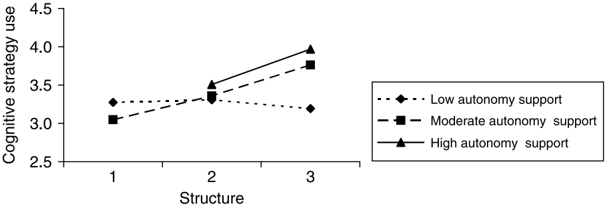
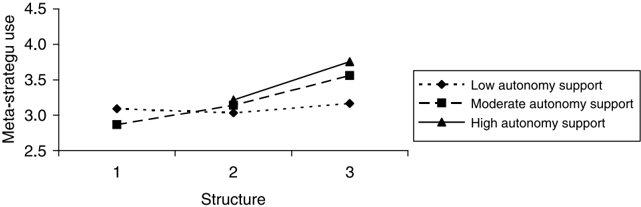
- Structure, but not autonomy support, had a main effect on both cognitive strategy use and self-regulation; however, this was qualified by a significant autonomy support × structure interaction, \(\Delta R^2 = .03, p < .001\) for each SRL outcome.
- Simple slopes showed structure predicted cognitive strategy use and self-regulation at average autonomy support (\(\beta = .33\) and \(\beta = .29\), respectively, \(p < .001\)) and high autonomy support (\(\beta = .46\) and \(\beta = .51\), respectively, \(p < .001\)), but not at low autonomy support (\(\beta = .06\), ns for both).
- Type of education did not interact with the teaching style dimensions in predicting SRL, and the three-way interaction with type of education was not significant.
Methods
- Correlational design with \(N = 526\) Belgian students: 264 male and 262 female, Grade 11 and 12 academic-track secondary students plus first-year teacher education students; age ranged from 15 to 27 years (\(M = 17.9\), \(SD = 1.22\)).
- Students completed questionnaires assessing perceived teacher autonomy support and structure (eight items each from the shortened Teacher as Social Context Questionnaire) and self-regulated learning (shortened Motivated Strategies for Learning Questionnaire: 13 cognitive strategy use items and nine self-regulation items).
- Analyses included confirmatory factor analysis, MANOVA for domain effects, and hierarchical moderated regression predicting SRL from type of education, autonomy support, structure, and their interactions.
Limitations
- The paper states that the cross-sectional design prevents conclusions about direction of effects, that student self-reports may create shared method variance and make true teacher effects difficult to determine, and that findings may not generalize to younger populations or other aspects of SRL such as affect regulation.
- The paper also notes that autonomy support and structure were each assessed with brief eight-item scales, limiting insight into subcomponents.
- Evident from the text: the sample did not include the high-autonomy-support/low-structure combination, and the study relies on perceived rather than observed teaching.
Model-written summary. Check it against the paper before relying on it.
Integrity signals
Registry
Cites
Statistics
Figures
Verification
Claims the paper makes
0 Valid · 0 Not valid · 8 Not checked · 62 Own results and interpretations
A result the paper reports from its own data — it cites no other source for it, so there is none to check. The quote shows it is in the paper.
In the paper
“First, autonomy support and structure were found to be positively correlated, suggesting that the support of student autonomy generally goes hand in hand with the provision of structure and order in the classroom.”
- Also stated in: § Preliminary analyses · p. 6 · plain
“As predicted, autonomy support and structure were positively correlated.”
plainstates an association- Asserted: passes — The authors put it forward as true.
- Checkable: passes — It can be checked against evidence.
- Load-bearing: passes — The paper’s conclusions depend on it.
- Based: passes — The paper gives a reason why it holds.
- Also stated in: § Preliminary analyses · p. 6 · plain
A result the paper reports from its own data — it cites no other source for it, so there is none to check. The quote shows it is in the paper.
In the paper
“The educational sciences subsample scored highest on all outcomes compared to both the Dutch and mathematics subsamples, while both did not differ from one another except for autonomy support, with the Dutch subsample scoring significantly lower than the mathematics subsample.”
plain- Asserted: passes — The authors put it forward as true.
- Checkable: passes — It can be checked against evidence.
- Load-bearing: unclear — It is unclear whether the paper’s conclusions depend on it.
- Based: passes — The paper gives a reason why it holds.
A result the paper reports from its own data — it cites no other source for it, so there is none to check. The quote shows it is in the paper.
In the paper
“No evidence was found for curvilinear structure effects on SRL.”
plain- Asserted: passes — The authors put it forward as true.
- Checkable: passes — It can be checked against evidence.
- Load-bearing: passes — The paper’s conclusions depend on it.
- Based: passes — The paper gives a reason why it holds.
A result the paper reports from its own data — it cites no other source for it, so there is none to check. The quote shows it is in the paper.
In the paper
“As the three-way interaction between autonomy support, structure, and type of education also was not significant”
plain- Asserted: passes — The authors put it forward as true.
- Checkable: passes — It can be checked against evidence.
- Load-bearing: passes — The paper’s conclusions depend on it.
- Based: passes — The paper gives a reason why it holds.
A result the paper reports from its own data — it cites no other source for it, so there is none to check. The quote shows it is in the paper.
In the paper
“Domain had an overall multivariate effect (Wilks' l ¼ : 77; F ð 8 ; 1 ; 034 Þ ¼ 17 : 86; p , : 001; h 2 ¼ : 12).”
plainstates an association- Asserted: passes — The authors put it forward as true.
- Checkable: passes — It can be checked against evidence.
- Load-bearing: unclear — It is unclear whether the paper’s conclusions depend on it.
- Based: passes — The paper gives a reason why it holds.
31 more claims
Create a free account to see all 70 claims and every source verdict.
- Probably not a substantial claim. 25
- It may state two separate claims as one. 15
Claims other papers make about this one
Each is checked against this paper’s own text: does it say what the citing paper says it does?
The cited source says what the claim attributes to it.
In the citing paper
“It is now very clear that autonomy support and structure are not antithetical.”
From Basic psychological need theory: Advancements, critical themes, and future directions (2020) · cites this paper as Sierens et al. 2009
The check wasn’t confident either way, so it gives no verdict — never disputed.
In the citing paper
“By contrast, a performance climate promotes the perception that superior performances or winning are the most highly valued outcomes [67, 70–72].”
From Framework for the design and delivery of organized physical activity sessions for children and adolescents: rationale and description of the ‘SAAFE’ teaching principles (2017) · cites this paper as [72]
Experimental — accuracy not yet measured
Citations
Cites
Hu, L., & Bentler, P. M. (1999) · Structural Equation Modeling A Multidisciplinary Journal · doi:10.1080/10705519909540118 · Cited by 108,788
Multiple regression: testing and interpreting interactions
(1992) · Choice Reviews Online · doi:10.5860/choice.29-3352 · Cited by 36,654
(1998) · Cited by 36,049
The "what" and "why" of goal pursuits: Human needs and the self-determination of behavior
Deci, E. L., & Ryan, R. M. (2000) · Psychological Inquiry · doi:10.1207/s15327965pli1104_01 · Cited by 34,210
Motivational and self-regulated learning components of classroom academic performance.
Pintrich, P. R., & De Groot, E. V. (1990) · Journal of Educational Psychology · doi:10.1037/0022-0663.82.1.33 · Cited by 8,332
Regression Diagnostics: Identifying Influential Data and Sources of Collinearity
Belsley, D. A., Kuh, E., & Welsch, R. E. (1980) · Wiley Series in Probability and Statistics · doi:10.1002/0471725153 · Cited by 7,297
Regression Diagnostics -- Identifying Influential Data and Sources of Collinearity
Beaumont, C. D., Belsley, D. A., Kuh, E., & Welsch, R. E. (1981) · The Journal of the Operational Research Society · doi:10.2307/2581267 · Cited by 6,359
Skinner, E. A., & Belmont, M. J. (1993) · Journal of Educational Psychology · doi:10.1037/0022-0663.85.4.571 · Cited by 3,428 · cited 2×
“It may be useful to collect longitudinal data and to use cross-lagged analyses in future studies to look for reciprocal effects of the dimensions of teaching style and the use of self-regulatory skills (see e.g. Skinner & Belmont, 1993).”
Background(1991) · Cited by 3,259
Handbook of Research on Teaching
Richardson, V. (2001) · Cited by 2,437
Research works printed but not linked: 4
- Belmont, M., Skinner, E., Wellborn, J., & Connell, J. (1988). Teacher as social context: A measure of student perceptions of teacher provision of involvement, structure, and autonomy support (Tech. Rep. No. 102). Rochester, NY: University of Rochester.
- Jo ¨reskog, K. G., & So ¨rbom, D. (1993). Lisrel VIII users' reference guide . Mooresville, IN: Scientific Software.
- Miles, J., & Shevlin, M. (2001). Applying regression and correlation . Thousand Oaks, CA: Sage. Miller, R. B., & Brickman, S. J. (2004). A model of future-oriented motivation and self-regulation. Educational Psychology Review , 16 , 9-33.
- Reeve, J., Deci, E. L., & Ryan, R. M. (2004). Self-determination theory: A dialectical framework for understanding socio-cultural influences on student motivation. In D. M. McInerney & S. Van Etten (Eds.), Big theories revisited (pp. 31-60). Greenwich, CT: Information Age Press.
Cited by
Items 501–600 of 613
Management controls and behavioral factors as drivers of earnings management
Batistella, A. J., Magro, C. B. D., Krüger, S. D., & Mazzioni, S. (2022) · Revista Contemporânea de Contabilidade · doi:10.5007/2175-8069.2022.e83462
Gómez, C. M. D. C. (2016) · Universidad de Lima · doi:10.26439/ulima.tesis/3233 · Cited by 3
Liu, P. P. (2016) · Digital Access to Scholarship at Harvard (DASH) (Harvard University) · Cited by 1
The impact of student facilitation on student engagement in asynchronous online discussion
Bowen, R. T. (2019) · The Research Repository @ WVU (West Virginia University) · doi:10.33915/etd.3779 · Cited by 4
Feng, W. (2018) · TSpace (University of Toronto) · Cited by 6
Psychosocial mechanisms underpinning motivation in youth sports participants
Curran, T. (2013) · White Rose eTheses Online (University of Leeds, The University of Sheffield, University of York)
Rahmanian, Z., VaezMousavi, M., & Sohrabi, M. (2014)
Vikre, M. T. (2015) · NVA (Nasjonalt vitenarkiv)
Flipped Classroom: un'analisi delle componenti motivazionali e autoregolative
Magistrale, L. (2015)
Chang, H. (2016) · International Journal of Learning and Teaching · doi:10.18178/ijlt.2.2.133-139
“Moreover, Zimmerman & Martinez-Pons [13] proposed that how teacher can promote self-regulated learning [14] will be a critical criterion to school success in teaching and learning.”
The Self-Regulated Learning in Cognitive, Interactive, and Transparent Teaching Interface
Chang, H. (2015) · International Journal of Learning and Teaching · doi:10.18178/ijlt.1.2.122-128
“Zimmerman & Martinez-Pons [1] proposed that a critical to school success is how teacher can promote self-regulated learning [2].”
BackgroundCarraça, E. V. (2017) · Retos · doi:10.47197/retos.v0i31.53504 · Cited by 29
Dibacco, K. R. (2016) · Scholarship@Western (Western University) · Cited by 2
KEEPING TRACK OF LEARNERS’ ACTIVITY DURING INQUIRY-BASED LEARNING: THE ROLE OF THE TEACHER
Montrieux, H., Vanderhoven, E., Hove, S. V., Raes, A., & Schellens, T. (2017) · INTED proceedings · doi:10.21125/inted.2017.0964
Akbar, A. (2016) · Scholarship & Creative Works - Digital UNC a service of University Libraries (University of Northern Colorado)
Kwon, J. A. (2012) · Cited by 1
Ardito, G. P. (2016) · E-Learn: World Conference on E-Learning in Corporate, Government, Healthcare, and Higher Education
Studenska, A. (2017) · The European Proceedings of Social & Behavioural Sciences · doi:10.15405/epsbs.2017.10.10 · Cited by 2
An Evaluation of Boredom in Academic Contexts
Tze, M. C. (2015) · ERA: Education and Research Archive (University of Alberta) · doi:10.7939/r3538g · Cited by 1
Hogan (2018) · Digital Repository Service (Northeastern University) · doi:10.17760/d20281598
Kucharczyk, I., & Dłużniewska, A. (2018) · Interdyscyplinarne Konteksty Pedagogiki Specjalnej · doi:10.14746/ikps.2016.15.06
AUTONOMY-SUPPORTIVE MOTIVATING STYLE TO IMPROVE STUDENT ENGAGEMENT IN ENGLISH CLASS
Jabbar, M. H. A. (2017)
Self-Regulated Learning for New Tertiary Students in the Bachelor of Psychology Degree Course
Hia, G. R., Wedyaswari, M., & Saragih, S. A. (2018) · ANIMA Indonesian Psychological Journal · doi:10.24123/aipj.v34i1.2024
Evaluating teachers' perceptions of students' questions organization
Harrak, F., Bouchet, F., Luengo, V., et al. (2020) · International Conference on Learning Analytics & Knowledge (LAK) · doi:10.1145/3375462.3375509
“[1-5] ]5-10] ]+10] [1-20] ]20-50] ]+50] <20% 20-40% 40-60% 60-80% >80%”
BackgroundSadik, M. (2018) · TSpace (University of Toronto)
Bedtime resistance and parenting in early childhood: a self-determination perspective
Andrew, K. (2019) · UVic’s Research and Learning Repository (University of Victoria)
Bal, S. İ., & Pehlevan, Z. (2020) · Journal of Physical Education and Sports Studies · doi:10.30655/besad.2020.24 · Cited by 1
Mohammed, D. A. M. A. (2016) · دراسات عربية في التربية و علم النفس · doi:10.21608/saep.2016.56322
Effects of Autonomy and Structure Support in Web-Based Inquiry Learning Environment
Zhang, D. (2019) · American Educational Research Association Annual Meeting (AERA) · doi:10.3102/1434242
Executive function and education
Calma‐Birling, D., Semenov, A. D., & Zelazo, P. D. (2022) · Elsevier eBooks · doi:10.1016/b978-0-12-818630-5.14022-9 · Cited by 2
Herrera, D., Iberico, C., Matos, L., & Cerna, Y. (2022) · Psychology of Music · doi:10.1177/03057356221135348 · Cited by 6
“Autonomy-supportive professors increase students’ academic engagement by devoting the necessary time to clarifying tasks, thus demonstrating enjoyment in their interactions with students (Sierens et al., 2009).”
Background(2022) · Języki Obce w Szkole · doi:10.47050/jows.2022.2.65-72 · Cited by 2
Some Motivations Make Us Happier Than Others
Sheldon, K. M. (2023) · Oxford University Press eBooks · doi:10.1093/oso/9780197662359.003.0019
Do We Sometimes Surrender Our Good Motivation for Bad? Some Reflections on the Quality of Motivation
Wigfield, A. (2023) · Oxford University Press eBooks · doi:10.1093/oso/9780197662359.003.0022
Finding the Second Wind: Motivation Is Within Our Control
Usher, E. L. (2023) · Oxford University Press eBooks · doi:10.1093/oso/9780197662359.003.0035 · Cited by 1
When It Comes to Motivating Others, What’s Easy Is Not Always What Works
Patall, E. A. (2023) · Oxford University Press eBooks · doi:10.1093/oso/9780197662359.003.0052
Where Will Michelle Go to College? Culture and Context in the Study of Motivation
Schutz, P. A. (2023) · Oxford University Press eBooks · doi:10.1093/oso/9780197662359.003.0014
Bong, M., Reeve, J., & Kim, S. (2023) · Oxford University Press eBooks · doi:10.1093/oso/9780197662359.003.0069
Bong, M., Reeve, J., & Kim, S. (2023) · Oxford University Press eBooks · doi:10.1093/oso/9780197662359.003.0018
Extrinsic Rewards Undermine Motivation in the Classroom . . . Sometimes
Anderman, E. M. (2023) · Oxford University Press eBooks · doi:10.1093/oso/9780197662359.003.0025 · Cited by 2
Wanting to Feel Effective in Our Goal Pursuits for Both Outcomes and Process
Higgins, E. T., & Nakkawita, E. (2023) · Oxford University Press eBooks · doi:10.1093/oso/9780197662359.003.0007
How Do We Motivate People? Connecting to People’s Existing Goals and Values
Dweck, C. S. (2023) · Oxford University Press eBooks · doi:10.1093/oso/9780197662359.003.0049 · Cited by 2
Improving Social Contexts Can Enhance Student Motivation
Wentzel, K. R. (2023) · Oxford University Press eBooks · doi:10.1093/oso/9780197662359.003.0058 · Cited by 2
A Key to Motivation Is Thinking and Acting Like You Can Change Things
Patall, E. A. (2023) · Oxford University Press eBooks · doi:10.1093/oso/9780197662359.003.0034
Is a Focus on Looking Smart Beneficial for Students’ Engagement, Learning, and Achievement?
Linnenbrink‐Garcia, L. (2023) · Oxford University Press eBooks · doi:10.1093/oso/9780197662359.003.0045
Assor, A., Benita, M., & Geifman, Y. (2023) · Oxford University Press eBooks · doi:10.1093/oso/9780197662359.003.0057
Can We Really Say that Motivational Processes Are Universal Across Cultures and Contexts?
Green, B. P., Gray, D. L., Hope, E. C., & Matthews, J. S. (2023) · Oxford University Press eBooks · doi:10.1093/oso/9780197662359.003.0015 · Cited by 1
Transactions Among Motivation, Emotion, and Cognition: Blurring the Lines
Schutz, P. A. (2023) · Oxford University Press eBooks · doi:10.1093/oso/9780197662359.003.0040
Insights Gained from Controversy 1: “What Is Motivation?”
Bong, M., Reeve, J., & Kim, S. (2023) · Oxford University Press eBooks · doi:10.1093/oso/9780197662359.003.0012 · Cited by 1
Bong, M., Reeve, J., & Kim, S. (2023) · Oxford University Press eBooks · doi:10.1093/oso/9780197662359.003.0029
Insights Gained from Controversy 8: “How Do We Motivate People?”
Bong, M., Reeve, J., & Kim, S. (2023) · Oxford University Press eBooks · doi:10.1093/oso/9780197662359.003.0060
Motivating People: It Depends on What, and It Depends on When
Anderman, E. M. (2023) · Oxford University Press eBooks · doi:10.1093/oso/9780197662359.003.0053
Motivation in the Wild: Capturing the Complex Social Ecologies of Academic Motivation
Skinner, E. A., Kindermann, T. A., Vollet, J. W., & Rickert, N. P. (2023) · Oxford University Press eBooks · doi:10.1093/oso/9780197662359.003.0075 · Cited by 3
Easy to Get People to Do Things, More Challenging to Facilitate Their Motivation
Grolnick, W. S. (2023) · Oxford University Press eBooks · doi:10.1093/oso/9780197662359.003.0051
About the b MRI Symposium on Motivation
(2023) · Oxford University Press eBooks · doi:10.1093/oso/9780197662359.002.0006
Insights Gained from Controversy 10
Bong, M., Reeve, J., & Kim, S. (2023) · Oxford University Press eBooks · doi:10.1093/oso/9780197662359.003.0077
Digitization Will Bring Profound Changes in Educational Practice and Research on Motivation
Trautwein, U., & Nagengast, B. (2023) · Oxford University Press eBooks · doi:10.1093/oso/9780197662359.003.0072 · Cited by 2
(2023) · Oxford University Press eBooks · doi:10.1093/oso/9780197662359.002.0003
(2023) · Oxford University Press eBooks · doi:10.1093/oso/9780197662359.002.0010
Insights Gained from Controversy 5: “Can We Control Our Motivation?”
Bong, M., Reeve, J., & Kim, S. (2023) · Oxford University Press eBooks · doi:10.1093/oso/9780197662359.003.0036
Alexander, P. A. (2023) · Oxford University Press eBooks · doi:10.1093/oso/9780197662359.003.0039 · Cited by 1
Bong, M., Reeve, J., & Kim, S. (2023) · Oxford University Press eBooks · doi:10.1093/oso/9780197662359.003.0048
Jin, T. (2022) · Digital Commons - Andrews University (Andrews University) · doi:10.32597/dissertations/1777/ · Cited by 1
Developing senior language learners’ autonomy with one-to-one counselling for autonomous learning
Schiller, E. (2022) · Eötvös Loránd Tudományegyetem · doi:10.15476/elte.2022.080
Motiverend lesgeven in het Hoger Onderwijs
Leenknecht, M. J. M., Wijnia, L., Rikers, R. M. J. P., & Loyens, S. M. M. (2021) · Tijdschrift voor Hoger Onderwijs · doi:10.59532/tvho.v39i3-4.13388
“…Sciences ; EUR = Erasmus Universiteit Ro=erdam; MTURK = Mechanical Turk ; TASCq = Teacher as Social Context ques&onnaire (Belmont et al., 1988; Vansteenkiste et al., 2009); SRQ-a = Academic Self-Regula&on Ques&onnaire (Ryan & Connell, 1989; Vansteenkiste et al., 2009); GPA = Grade Point…”
BackgroundFostering an autonomous approach as a key to successful remote learning during the covid pandemic
Toporek, M. (2022) · Beyond Philology An International Journal of Linguistics Literary Studies and English Language Teaching · doi:10.26881/bp.2022.4.03 · Cited by 2
“Sierens et al .”
Šakan, D. (2023) · Inovacije u nastavi · doi:10.5937/inovacije2302103s · Cited by 1
“, 2018), this motivating style has been shown to correlate positively with autonomous forms of motivation (Mouratidis et al., 2008; Sierens et al., 2009), effective learning (Brophy, 1999) and engaging in school activities (Skinner et al.”
BackgroundLuo, Y. U. (2023) · Revista de Cercetare si Interventie Sociala · doi:10.33788/rcis.82.2
Providing Autonomy Support in an Asian Context: A Tale of Two Teachers
Lam, B. H. (2023) · Positive education · doi:10.1007/978-981-99-5571-8_9 · Cited by 6
Motivação de alunos e ambiente de aprendizagem em sala de aula no ensino fundamental
Muelle-Zúñiga, N. (2020) · doi:10.47749/t/unicamp.2020.1157947 · Cited by 2
PERSONALITY AS A PATHWAY TO AUTONOMY: A SCOPING REVIEW
Yasin, I. R., Razak, A. Z. A., & Abdullah, Z. (2024) · International Journal of Education Psychology and Counseling · doi:10.35631/ijepc.953042
dos Santos, M. S., de Andrade, E. M. P. R., de Andrade, A. B., Fin, G., & de Carvalho, D. (2024) · Revista Foco · doi:10.54751/revistafoco.v17n4-116 · Cited by 1
Learner Autonomy Transfer: The Need for Explicit Teacher Training
Slabodar, I. (2024) · Teaching English as a Second or Foreign Language--TESL-EJ · doi:10.55593/ej.28109a2 · Cited by 4
Brenner, C. A. (2024) · Social Sciences & Humanities Open · doi:10.1016/j.ssaho.2024.100942 · Cited by 5
Similarities and differences in teaching behavior for honors and regular bachelor’s education
Kingma, T., Smits, A., Heijne-Penninga, M., Jaarsma, D. A. D. C., & Voogt, J. M. (2024) · Journal of the European Honors Council · doi:10.31378/jehc.205 · Cited by 1
Autonomia e aprendizagem autorregulada na educação básica: uma revisão sistemática da literatura
Tonelli, E., & Deps, V. L. (2024) · ETD - Educação Temática Digital · doi:10.20396/etd.v26i00.8672181
Apoyo a la autonomía en educación superior con énfasis en ciencias de cultura física
Correa, M. J. G., Luján, J. C. B., & Gastélum-Cuadras, G. (2024) · Revista Mexicana de Ciencias de la Cultura Física · doi:10.54167/rmccf.v3i9.1597 · Cited by 1
“…facilitar estos resultados en el involucramiento de sus alumnos por medio de la satisfacción de sus necesida-des psicológicas básicas (autonomía, competencia y relación con los demás) en la instrucción dentro del aula, facilitando el desempeño académico (Reeve y Jang, 2006; Sierens et al., 2009).”
BackgroundLin, W., Yu, Q., Huang, H., & Cai, J. (2024) · Research Square · doi:10.21203/rs.3.rs-4945385/v1 · Cited by 3
Cirocki, A., Anam, S., & Ramadhan, R. M. (2025) · rEFLections · doi:10.61508/refl.v32i2.282008 · Cited by 4
Liu, J., Hu, T., & Yin, J. (2025) · Frontiers in Psychology · doi:10.3389/fpsyg.2025.1633094 · Cited by 1
Nett, U. E., & Götz, T. (2025) · Springer eBooks · doi:10.1007/978-3-662-69557-9_6
Hooked on Books: A Deep Dive into the Reading Motivations of ADHD and Non-ADHD Children
Kakoulidou, M., Pavlopoulou, G., Filippi, R., & Hurry, J. (2025) · Neurodiversity · doi:10.1177/27546330251403220
“Overall, we recommend that teachers prioritise proactive and positive classroom management practices, such as co-deciding expectations around classroom behaviour and routine with children (Sierens et al., 2009).”
Kerner, C. (2013) · University of Bedfordshire Repository (University of Bedfordshire) · Cited by 1
Self-regulation in the IEP Classroom: Developing Lifelong English Language Proficiency
Slayton, J. (2014) · OpenCommons - UConn (University of Connecticut) · Cited by 1
Ying, P.-X., Tang, Y., & Lou, M.-D. (2025) · Educational Psychology · doi:10.1080/01443410.2025.2609789
“While a substantial body of research has demonstrated the important role of perceived autonomy support (e.g. Liu et al., 2021; Sierens et al., 2009; Tao et al., 2022; Zhou et al., 2019), recent research suggests that teachers may adjust their levels of autonomy support in response to student…”
Ma, Y. T. (2026) · Computer Assisted Language Learning · doi:10.1080/09588221.2026.2625222 · Cited by 3
Ba, A., Dumas, C., François-Sévigny, J., Hui, O., Cloutier, M., Lelièvre, G., & Pilon, M. (2026) · journal for the education of the gifted · doi:10.1177/01623532261433004 · Cited by 1
“…super fi cial learning, poor academic performance, boredom, and pro-crastination (e.g., a student who rarely completes homework and frequently expresses disinterest in class; Aelterman et al., 2012; Bureau et al., 2021; Howard et al., 2021; Ntoumanis, 2001; Shen et al., 2010; Sierens et al., 2009).”
Burel, N. (2017) · theses.fr (ABES) · doi:10.70675/4a83bbf1za9c3z471czb31cz97cabba85264 · Cited by 1
Mastagli, M. (2021) · theses.fr (ABES) · doi:10.70675/a8cc9d68z0ad2z4d9azbbabzbf2e674facc9 · Cited by 3
Laranjeira, M. A. C., & Teixeira, M. O. (2026) · Journal of Psychologists and Counsellors in Schools · doi:10.1177/20556365261441045 · Cited by 1
“Structured teaching has been consistently associated with positive effects on students’ motivation, engagement, and learning outcomes (e.g., Sierens et al., 2009; Tilga et al., 2023).”
Regulation of Learning: Cognition, Motivation and Emotion
Ahola, S., Nakata, A., & Järvenoja, H. (2026) · Springer eBooks · doi:10.1007/978-3-031-99743-3_3
Teaching Autonomy Support to Teachers
Shumow, L., & Rones, D. D. (2016) · Emerald Group Publishing Limited eBooks · doi:10.1108/978-1-68123-398-720251017
Li, Q. (2026) · The Asia-Pacific Education Researcher · doi:10.1007/s40299-026-01119-9 · Cited by 1
Cleary, T. J., Kitsantas, A., Pape, S., & Slemp, J. (2018) · Emerald Group Publishing Limited eBooks · doi:10.1108/978-1-64113-270-120251017 · Cited by 7
Schweder, S., & Hagenauer, G. (2026) · Zeitschrift für Entwicklungspsychologie und Pädagogische Psychologie · doi:10.1026/0049-8637/a000320 · Cited by 1
Metadata
- Authors
- Sierens, E., Vansteenkiste, M., Goossens, L., Soenens, B., & Dochy, F.
- Affiliations
- KU Leuven (BE)
- Ghent University (BE)
- Corresponding author
- Sierens, Eline
- Venue
- British Journal of Educational Psychology
- Publisher
- Wiley
- Published
- 2009-03
- Volume
- 79
- Issue
- 1
- Pages
- 57-68
- ISSN
- 0007-0998 (ISSN-L)
- 2044-8279
- OpenAlex
- W2085917674
- Cited by
- 618
- References
- 38
- Citations by year
- 2026: 22 · 2025: 26 · 2024: 36 · 2023: 127 · 2022: 39 · 2021: 33 · 2020: 53 · 2019: 35 · 2018: 33 · 2017: 39 · 2016: 43 · 2015: 37 · 2014: 28 · 2013: 23 · 2012: 17
- FWCI
- 11.56
- Type
- journal article
- Language
- en
- Open access
- green
- lirias.kuleuven.be
- Licence
- Locations
- British Journal of Educational Psychology (publishedVersion)
- PubMed (publishedVersion)
- Lirias (submittedVersion, other-oa)
- Ghent University Academic Bibliography (Ghent University) (submittedVersion)
- Topics
- Social Sciences › Psychology › Social Psychology › Motivation and Self-Concept in Sports
- Social Sciences › Psychology › Developmental and Educational Psychology › Innovative Teaching and Learning Methods
- Social Sciences › Psychology › Developmental and Educational Psychology › Education, Achievement, and Giftedness
- Keywords
- perceived autonomy support, structure, student self-regulation, self-determination theory, teaching styles, classroom structure, student self-assessment, interaction effects
- MeSH terms
- Adolescent, Adult, Curriculum, Female, Goals, Humans, Individuation, Internal-External Control, Male, Motivation, Problem Solving, Surveys and Questionnaires, Social Perception, Social Support, Teaching, Personal Autonomy, Young Adult
About these checks
Registry, retraction, Cites and statistics results are computed, not judged, with one exception: a printed reference that no index lists is read once by a model before it counts as a citation error. Claims are extracted by a model and kept only when their quote appears verbatim in the text; each cited source is then checked, with a model’s help, for whether it says what the claim relies on. Those verdicts can be wrong — read the claim’s quote and the cited source before relying on one.
A language model drew the claims from the paper on 2026-10-10, under version 3 of the claim definition (model deepseek-v4.1-flash, prompt extract-v3).
A second model labelled each claim on 2026-10-10 (model jev-1.13-20260917, definition revision gold-guideline-v0.2).
Statistics and arithmetic are recomputed, not judged.
Confidence bands are shown only for fields calibrated on our annotated test set. None is calibrated yet, so no band is shown.
What counts as a claim ›How we measure confidence ›How we check this ›
Are you an author, or do you see a problem with this page? Request a review
Data sources
Bibliographic data: Semantic Scholar, OpenAlex, Crossref.
Contains information from the Semantic Scholar Academic Graph Datasets, made available under the ODC Attribution License (ODC-BY 1.0).
Semantic Scholar’s data is described in: Kinney, R., et al. (2023). The Semantic Scholar Open Data Platform. arXiv:2301.10140.
