

The DOI matches its Crossref record; 56 of the 56 references it cites were found in a registry or an index.
SPEACH_AF: Sampling protein ensembles and conformational heterogeneity with Alphafold2
Open accessPublished version of a preprint
Abstract
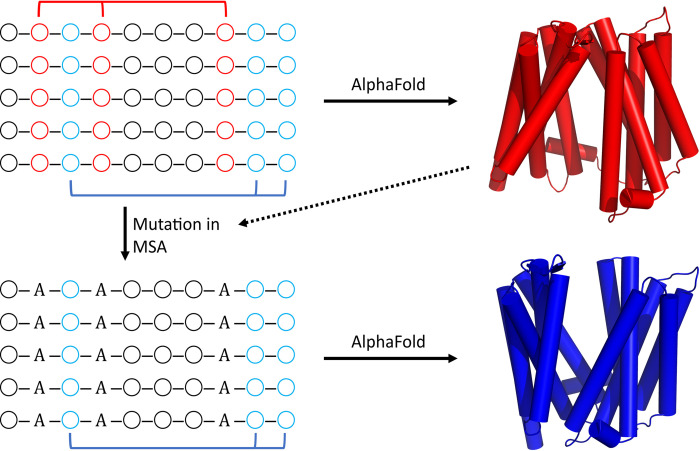
The unprecedented performance of Deepmind's Alphafold2 in predicting protein structure in CASP XIV and the creation of a database of structures for multiple proteomes and protein sequence repositories is reshaping structural biology. However, because this database returns a single structure, it brought into question Alphafold's ability to capture the intrinsic conformational flexibility of proteins. Here we present a general approach to drive Alphafold2 to model alternate protein conformations through simple manipulation of the multiple sequence alignment via in silico mutagenesis. The approach is grounded in the hypothesis that the multiple sequence alignment must also encode for protein structural heterogeneity, thus its rational manipulation will enable Alphafold2 to sample alternate conformations. A systematic modeling pipeline is benchmarked against canonical examples of protein conformational flexibility and applied to interrogate the conformational landscape of membrane proteins. This work broadens the applicability of Alphafold2 by generating multiple protein conformations to be tested biologically, biochemically, biophysically, and for use in structure-based drug design.
Overview
The claims and statistics of this paper haven’t been checked yet.
Run the check — free, no account needed. It reads the open-access text and checks the sources it cites.
Integrity signals
Registry
Cites
Statistics
Figures
Verification
Claims the paper makes
The claims and statistics of this paper haven’t been checked yet.
Run the check — free, no account needed. It reads the open-access text and checks the sources it cites.
Claims other papers make about this one
Each is checked against this paper’s own text: does it say what the citing paper says it does?
In the citing paper
“follow-up studies suggest that the tool has potential for generation of biologically relevant ensembles,266”
From Advancing Targeted Protein Degradation via Multiomics Profiling and Artificial Intelligence (2023) · cites this paper as [266]
Self-check
Percentages, sums and reported differences re-computed from the paper’s own numbers.
The self-check needs the paper’s full text.
Citations
Cites
Highly accurate protein structure prediction with AlphaFold
Jumper, J., Evans, R., Pritzel, A., Green, T., Figurnov, M., Ronneberger, O., Tunyasuvunakool, K., Bates, R., Žídek, A., Potapenko, A., et al. (2021) · Nature · doi:10.1038/s41586-021-03819-2 · Cited by 43,764
The PyMOL Molecular Graphics System
DeLano, W. L. (2002) · Medical Entomology and Zoology · Cited by 18,147
A method and server for predicting damaging missense mutations.
Adzhubei, I. A., Schmidt, S., Peshkin, L., Ramensky, V. E., Gerasimova, A., Bork, P., Kondrashov, A. S., & Sunyaev, S. R. (2010) · Nature Methods · doi:10.1038/nmeth0410-248 · Cited by 13,194
Database resources of the National Center for Biotechnology Information: update
Wheeler, D. L. (2003) · Nucleic Acids Research · doi:10.1093/nar/gkh073 · Cited by 10,695
ColabFold - Making protein folding accessible to all
Mirdita, M., Schütze, K., Moriwaki, Y., Heo, L., Ovchinnikov, S., & Steinegger, M. (2021) · doi:10.1101/2021.08.15.456425 · Cited by 9,391
Principles that Govern the Folding of Protein Chains
Anfinsen, C. B. (1973) · Science · doi:10.1126/science.181.4096.223 · Cited by 7,096
SIFT: predicting amino acid changes that affect protein function
Ng, P. C. (2003) · Nucleic Acids Research · doi:10.1093/nar/gkg509 · Cited by 6,601
Database resources of the National Center for Biotechnology Information
Agarwala, R., Barrett, T., Beck, J., Benson, D., Bollin, C., Bolton, E. E., Bourexis, D., Brister, J., Bryant, S. H., Canese, K., et al. (2017) · Nucleic Acids Res. · doi:10.1093/nar/gkx1095 · Cited by 6,277
A general framework for estimating the relative pathogenicity of human genetic variants
Kircher, M., Witten, D. M., Jain, P., O'Roak, B. J., Cooper, G. M., & Shendure, J. (2014) · Nature Genetics · doi:10.1038/ng.2892 · Cited by 6,183
MolProbity: More and better reference data for improved all‐atom structure validation
Williams, C. J., Headd, J. J., Moriarty, N. W., Prisant, M. G., Videau, L. L., Deis, L. N., Verma, V., Keedy, D. A., Hintze, B. J., Chen, V. B., et al. (2018) · Protein Science · doi:10.1002/pro.3330 · Cited by 4,599
Research works printed but not linked: 1
- Sergey Ovchinnikov UA [@sokrypton], 2021, In AF_advanced colabfold we suggest enabling dropout (is_training = True), and iterating through seeds to sample from the uncertainty. This should theoretically return multiple conformations if there is any ambiguity in coevolution, w/o the need to resample/subsample the MSA (1/3): https://t.co/MUtee9xIaX, In: Twitter
Cited by
Sorted by citations
From nature to industry: Harnessing enzymes for biocatalysis
Buller, R., Lutz, S., Kazlauskas, R. J., Šnajdrová, R., Moore, J. C., & Bornscheuer, U. T. (2023) · Science · doi:10.1126/science.adh8615 · Cited by 759
Predicting multiple conformations via sequence clustering and AlphaFold2
Wayment-Steele, H. K., Ojoawo, A., Otten, R., Apitz, J. M., Pitsawong, W., Hömberger, M., Ovchinnikov, S., Colwell, L., & Kern, D. (2024) · Nature · doi:10.1038/s41586-023-06832-9 · Cited by 545
Terwilliger, T. C., Liebschner, D., Croll, T. I., Williams, C. J., McCoy, A. J., Poon, B. K., Afonine, P. V., Oeffner, R. D., Richardson, J. S., Read, R. J., et al. (2024) · Nature Methods · doi:10.1038/s41592-023-02087-4 · Cited by 411
Systematic identification of conditionally folded intrinsically disordered regions by AlphaFold2
Alderson, T. R., Pritišanac, I., Kolarić, Đ., Moses, A. M., & Forman-Kay, J. D. (2023) · Proceedings of the National Academy of Sciences · doi:10.1073/pnas.2304302120 · Cited by 240
Modeling conformational states of proteins with AlphaFold
Sala, D., Engelberger, F., Mchaourab, H. S., & Meiler, J. (2023) · Current Opinion in Structural Biology · doi:10.1016/j.sbi.2023.102645 · Cited by 182
Self-citationHigh-throughput prediction of protein conformational distributions with subsampled AlphaFold2
Monteiro da Silva, G., Cui, J. Y., Dalgarno, D. C., Lisi, G. P., & Rubenstein, B. M. (2024) · Nature Communications · doi:10.1038/s41467-024-46715-9 · Cited by 196
AlphaFold predictions of fold-switched conformations are driven by structure memorization
Chakravarty, D., Schafer, J. W., Chen, E. A., Thole, J. F., Ronish, L. A., Lee, M., & Porter, L. L. (2024) · Nature Communications · doi:10.1038/s41467-024-51801-z · Cited by 159
Improved AlphaFold modeling with implicit experimental information
Terwilliger, T. C., Poon, B. K., Afonine, P. V., Schlicksup, C. J., Croll, T. I., Millán, C., Richardson, J. S., Read, R. J., & Adams, P. D. (2022) · Nature Methods · doi:10.1038/s41592-022-01645-6 · Cited by 140
AlphaFold2 protein structure prediction: Implications for drug discovery
Borkakoti, N., & Thornton, J. M. (2023) · Current Opinion in Structural Biology · doi:10.1016/j.sbi.2022.102526 · Cited by 140
Accelerating Cryptic Pocket Discovery Using AlphaFold
Meller, A., Bhakat, S., Solieva, S. O., & Bowman, G. R. (2023) · Journal of Chemical Theory and Computation · doi:10.1021/acs.jctc.2c01189 · Cited by 136
AI-Based Protein Structure Prediction in Drug Discovery: Impacts and Challenges
Schauperl, M., & Denny, R. A. (2022) · Journal of Chemical Information and Modeling · doi:10.1021/acs.jcim.2c00026 · Cited by 122
From interaction networks to interfaces, scanning intrinsically disordered regions using AlphaFold2
Bret, H., Gao, J., Zea, D. J., Andreani, J., & Guerois, R. (2024) · Nature Communications · doi:10.1038/s41467-023-44288-7 · Cited by 103
AlphaFold prediction of structural ensembles of disordered proteins
Brotzakis, Z. F., Zhang, S., Murtada, M. H., & Vendruscolo, M. (2025) · Nature Communications · doi:10.1038/s41467-025-56572-9 · Cited by 99
AlphaFold, allosteric, and orthosteric drug discovery: Ways forward
Nussinov, R., Zhang, M., Liu, Y., & Jang, H. (2023) · Drug Discovery Today · doi:10.1016/j.drudis.2023.103551 · Cited by 96
AFsample2 predicts multiple conformations and ensembles with AlphaFold2
Kalakoti, Y., & Wallner, B. (2025) · Communications Biology · doi:10.1038/s42003-025-07791-9 · Cited by 126
Masters, M. R., Mahmoud, A. H., & Lill, M. A. (2025) · Nature Communications · doi:10.1038/s41467-025-63947-5 · Cited by 141
Sala, D., Hildebrand, P. W., & Meiler, J. (2023) · Frontiers in Molecular Biosciences · doi:10.3389/fmolb.2023.1121962 · Cited by 80
Generative artificial intelligence for de novo protein design
Winnifrith, A., Outeiral, C., & Hie, B. (2024) · Current Opinion in Structural Biology · doi:10.1016/j.sbi.2024.102794 · Cited by 103
Ghafouri, H., Lázár, T., Conte, A. D., Tenorio, L., Aspromonte, M. C., Bernadó, P., Chaves‐Arquero, B., Chemes, L. B., Clementel, D., Cordeiro, T. N., et al. (2023) · Nucleic Acids Research · doi:10.1093/nar/gkad947 · Cited by 73
Proteins with alternative folds reveal blind spots in AlphaFold-based protein structure prediction
Chakravarty, D., Lee, M., & Porter, L. L. (2025) · Current Opinion in Structural Biology · doi:10.1016/j.sbi.2024.102973 · Cited by 76
Deep learning for protein structure prediction and design—progress and applications
Jänes, J., & Beltrão, P. (2024) · Molecular Systems Biology · doi:10.1038/s44320-024-00016-x · Cited by 76
Prediction of multiple conformational states by combining sequence clustering with AlphaFold2Preprint
Wayment-Steele, H. K., Ovchinnikov, S., Colwell, L. J., & Kern, D. (2022) · bioRxiv (Cold Spring Harbor Laboratory) · doi:10.1101/2022.10.17.512570 · Cited by 66
Casadevall, G., Duran, C., & Osuna, S. (2023) · JACS Au · doi:10.1021/jacsau.3c00188 · Cited by 70
From byte to bench to bedside: molecular dynamics simulations and drug discovery
Ahmed, M., Maldonado, A. M., & Durrant, J. D. (2023) · BMC Biology · doi:10.1186/s12915-023-01791-z · Cited by 77
Beyond static structures: protein dynamic conformations modeling in the post-AlphaFold era
Cui, X., Ge, L., Chen, X., Lv, Z., Wang, S., Zhou, X., & Zhang, G. (2025) · Briefings in Bioinformatics · doi:10.1093/bib/bbaf340 · Cited by 70
Adaptive Sampling Methods for Molecular Dynamics in the Era of Machine Learning
Kleiman, D. E., Nadeem, H., & Shukla, D. (2023) · The Journal of Physical Chemistry B · doi:10.1021/acs.jpcb.3c04843 · Cited by 70
Computational drug development for membrane protein targets
Li, H., Sun, X., Cui, W., Xu, M., Dong, J., Ekundayo, B., Ni, D., Rao, Z., Guo, L., Stahlberg, H., et al. (2024) · Nature Biotechnology · doi:10.1038/s41587-023-01987-2 · Cited by 65
Predicting protein conformational motions using energetic frustration analysis and AlphaFold2
Guan, X., Tang, Q.-Y., Ren, W., Chen, M., Wang, W., Wolynes, P. G., & Li, W. (2024) · Proceedings of the National Academy of Sciences · doi:10.1073/pnas.2410662121 · Cited by 62
Advancing Targeted Protein Degradation via Multiomics Profiling and Artificial Intelligence
Duran-Frigola, M., Cigler, M., & Winter, G. E. (2023) · Journal of the American Chemical Society · doi:10.1021/jacs.2c11098 · Cited by 50
Computational advances in discovering cryptic pockets for drug discovery
Bemelmans, M. P., Cournia, Z., Damm‐Ganamet, K. L., Gervasio, F. L., & Pande, V. (2025) · Current Opinion in Structural Biology · doi:10.1016/j.sbi.2024.102975 · Cited by 53
Evolutionary selection of proteins with two folds
(2023) · doi:10.1038/s41467-023-41237-2 · Cited by 41
Modeling protein–ligand interactions for drug discovery in the era of deep learning
Wang, Y. X., Li, Y., Chen, J., & Lai, L. (2025) · Chemical Society Reviews · doi:10.1039/d5cs00415b · Cited by 53
Brown, B. P., Stein, R. A., Meiler, J., & Mchaourab, H. S. (2024) · Journal of Chemical Theory and Computation · doi:10.1021/acs.jctc.3c01081 · Cited by 41
Self-citationRecent Advances in NMR Protein Structure Prediction with ROSETTA
Leman, J. K., & Künze, G. (2023) · International Journal of Molecular Sciences · doi:10.3390/ijms24097835 · Cited by 38
Agajanian, S., Alshahrani, M., Bai, F., Tao, P., & Verkhivker, G. M. (2023) · Journal of Chemical Information and Modeling · doi:10.1021/acs.jcim.2c01634 · Cited by 37
Challenges in bridging the gap between protein structure prediction and functional interpretation
Varadi, M., Tsenkov, M., & Velankar, S. (2025) · Proteins: Structure, Function, and Bioinformatics · doi:10.1002/prot.26614 · Cited by 36
Aranganathan, A., Gu, X., Wang, D., Vani, B. P., & Tiwary, P. (2025) · Current Opinion in Structural Biology · doi:10.1016/j.sbi.2025.103000 · Cited by 39
Lee, M., Schafer, J. W., Prabakaran, J., Chakravarty, D., Clore, M. F., & Porter, L. L. (2025) · Nature Communications · doi:10.1038/s41467-025-60759-5 · Cited by 38
A Perspective on the Prospective Use of AI in Protein Structure Prediction
Versini, R., Sritharan, S., Fas, B. A., Tubiana, T., Aimeur, S., Henri, J., Erard, M., Nüße, O., Andréani, J., Baaden, M., et al. (2023) · Journal of Chemical Information and Modeling · doi:10.1021/acs.jcim.3c01361 · Cited by 34
Lazou, M., Khan, O., Nguyen, T., Padhorny, D., Kozakov, D., Joseph‐McCarthy, D., & Vajda, S. (2024) · Proceedings of the National Academy of Sciences · doi:10.1073/pnas.2412719121 · Cited by 37
Representing structures of the multiple conformational states of proteins
Ramelot, T. A., Tejero, R., & Montelione, G. T. (2023) · Current Opinion in Structural Biology · doi:10.1016/j.sbi.2023.102703 · Cited by 26
Machine learning in RNA structure prediction: Advances and challenges
Zhang, S., Li, J., & Chen, S. (2024) · Biophysical Journal · doi:10.1016/j.bpj.2024.01.026 · Cited by 33
P2DFlow: A Protein Ensemble Generative Model with SE(3) Flow Matching
Jin, Y., Huang, Q., Song, Z., Zheng, M., Teng, D., & Shi, Q. (2025) · Journal of Chemical Theory and Computation · doi:10.1021/acs.jctc.4c01620 · Cited by 33
Carbery, A., Buttenschoen, M., Skyner, R., von Delft, F., & Deane, C. M. (2024) · Journal of Cheminformatics · doi:10.1186/s13321-024-00821-4 · Cited by 31
Artificial intelligence for medicine 2025: Navigating the endless frontier
Dai, J., Xu, H., Chen, T., Huang, T., Liang, W., Zhang, R., Xu, G.-X., Zhang, Z., Xue, L., Gao, Y. Q., et al. (2025) · The Innovation Medicine · doi:10.59717/j.xinn-med.2025.100120 · Cited by 35
Raisinghani, N., Alshahrani, M., Gupta, G., & Verkhivker, G. M. (2024) · Viruses · doi:10.3390/v16091458 · Cited by 33
Wu, T., Stein, R. A., Kao, T., Brown, B. P., & Mchaourab, H. S. (2025) · Nature Communications · doi:10.1038/s41467-025-62582-4 · Cited by 34
Self-citationEllaway, J. I. J., Anyango, S., Nair, S. S., Zaki, H. A., Nadzirin, N., Powell, H. R., Gutmanas, A., Váradi, M., & Velankar, S. S. (2024) · Structural Dynamics · doi:10.1063/4.0000251 · Cited by 28
Is the Functional Response of a Receptor Determined by the Thermodynamics of Ligand Binding?
Vögele, M., Zhang, B. W., Kaindl, J. M., & Wang, L. (2023) · Journal of Chemical Theory and Computation · doi:10.1021/acs.jctc.3c00899 · Cited by 27
AFsample2: Predicting multiple conformations and ensembles with AlphaFold2Preprint
Kalakoti, Y., & Wallner, B. (2024) · bioRxiv (Cold Spring Harbor Laboratory) · doi:10.1101/2024.05.28.596195 · Cited by 26
Vats, S., Bobrovs, R., Söderhjelm, P., & Bhakat, S. (2024) · PLoS ONE · doi:10.1371/journal.pone.0307226 · Cited by 27
Greve, J. N., Schwäbe, F. V., Pokrant, T., Faix, J., Donato, N. D., Taft, M. H., & Manstein, D. J. (2022) · European Journal of Cell Biology · doi:10.1016/j.ejcb.2022.151216 · Cited by 18
Can Protein Structure Prediction Methods Capture Alternative Conformations of Membrane Transporters?
Xie, T., & Huang, J. (2024) · Journal of Chemical Information and Modeling · doi:10.1021/acs.jcim.3c01936 · Cited by 23
Applicability of AlphaFold2 in the modeling of dimeric, trimeric, and tetrameric coiled‐coil domains
Madaj, R., Martinez‐Goikoetxea, M., Kaminski, K., Ludwiczak, J., & Dunin‐Horkawicz, S. (2025) · Protein Science · doi:10.1002/pro.5244 · Cited by 23
Emerging frontiers in protein structure prediction following the AlphaFold revolution
Rennie, M. L., & Oliver, M. R. (2025) · Journal of The Royal Society Interface · doi:10.1098/rsif.2024.0886 · Cited by 34
Artificial intelligence in pharmaceutical sciences: A comprehensive review
Kandhare, P., Kurlekar, M., Deshpande, T., & Pawar, A. (2025) · Medicine in Novel Technology and Devices · doi:10.1016/j.medntd.2025.100375 · Cited by 26
NetTCR-struc, a structure driven approach for prediction of TCR-pMHC interactions
Deleuran, S. N., & Nielsen, M. (2025) · Frontiers in Immunology · doi:10.3389/fimmu.2025.1616328 · Cited by 27
Generative AI for computational chemistry: A roadmap to predicting emergent phenomena
Tiwary, P., Herron, L., John, R., Lee, S., Sanwal, D., & Wang, R. (2025) · Proceedings of the National Academy of Sciences · doi:10.1073/pnas.2415655121 · Cited by 37
Casadevall, G., Duran, C., Estévez‐Gay, M., & Osuna, S. (2022) · Protein Science · doi:10.1002/pro.4426 · Cited by 22
AlphaFold Prediction of Structural Ensembles of Disordered Proteins
Brotzakis, Z. F., Zhang, S., & Vendruscolo, M. (2023) · doi:10.1101/2023.01.19.524720 · Cited by 22
Protein structure and dynamics in the era of integrative structural biology
Grandori, R. (2023) · Frontiers in Biophysics · doi:10.3389/frbis.2023.1219843 · Cited by 22
Raisinghani, N., Alshahrani, M., Gupta, G., Tian, H., Xiao, S., Tao, P., & Verkhivker, G. M. (2024) · Journal of Chemical Theory and Computation · doi:10.1021/acs.jctc.4c00222 · Cited by 17
Distinguishing features of fold‐switching proteins
Chakravarty, D., Schafer, J. W., & Porter, L. L. (2023) · Protein Science · doi:10.1002/pro.4596 · Cited by 19
Duran, C., Casadevall, G., & Osuna, S. (2024) · Faraday Discussions · doi:10.1039/d3fd00156c · Cited by 20
Predicting the conformational flexibility of antibody and T-cell receptor CDRs
Spoendlin, F. C., Fernández-Quintero, M. L., Raghavan, S. S. R., Turner, H. L., Gharpure, A., Loeffler, J. R., Wong, W. K., Bujotzek, A., Georges, G., Ward, A. B., et al. (2025) · doi:10.1101/2025.03.19.644119 · Cited by 20
ExEnDiff: An Experiment-Guided Diffusion Model for Protein Conformational Ensemble Generation
Liu, Y., Yu, Z., Lindsay, R. J., Lin, G., Chen, M., Sahoo, A., & Hanson, S. M. (2025) · PRX Life · doi:10.1103/prxlife.3.023013 · Cited by 28
NMR-driven structure-based drug discovery by unveiling molecular interactions
Platzer, G., Mayer, M., McConnell, D. B., & Konrat, R. (2025) · Communications Chemistry · doi:10.1038/s42004-025-01542-x · Cited by 20
Zhang, Y., Zhang, Z., Kagaya, Y., Terashi, G., Zhao, B., Xiong, Y., & Kihara, D. (2025) · Communications Biology · doi:10.1038/s42003-025-08783-5 · Cited by 19
Targeting in silico GPCR conformations with ultra-large library screening for hit discovery
Sala, D., Batebi, H., Ledwitch, K. V., Hildebrand, P. W., & Meiler, J. (2023) · Trends in Pharmacological Sciences · doi:10.1016/j.tips.2022.12.006 · Cited by 20
AlphaFold2 captures the conformational landscape of the HAMP signaling domain
Winski, A., Ludwiczak, J., Orłowska, M., Madaj, R., Kaminski, K., & Dunin-Horkawicz, S. (2023) · Protein Science · doi:10.1002/pro.4846 · Cited by 18
Amaya-Rodriguez, C. A., Carvajal-Zamorano, K., Bustos, D., Alegría‐Arcos, M., & Castillo, K. (2024) · Frontiers in Pharmacology · doi:10.3389/fphar.2023.1251061 · Cited by 21
Herrington, N. B., Li, Y. C., Li, Y. C., Pandey, G. S., & Schlessinger, A. (2024) · PLoS Computational Biology · doi:10.1371/journal.pcbi.1012302 · Cited by 27
Spoendlin, F. C., Fernández-Quintero, M. L., Raghavan, S. S. R., Turner, H. L., Gharpure, A., Loeffler, J. R., Wong, W. K., Bujotzek, A., Georges, G., Ward, A. B., et al. (2025) · Nature Machine Intelligence · doi:10.1038/s42256-025-01131-6 · Cited by 20
Advancing protein structure prediction beyond AlphaFold2
Park, S., Myung, S., & Baek, M. (2025) · Current Opinion in Structural Biology · doi:10.1016/j.sbi.2025.102985 · Cited by 18
Rational design of small‐molecule responsive protein switches
Shui, S., Buckley, S., Scheller, L., & Correia, B. E. (2023) · Protein Science · doi:10.1002/pro.4774 · Cited by 17
AlphaFold2 Predicts Whether Proteins Interact Amidst Confounding Structural Compatibility
Martin, J. (2024) · Journal of Chemical Information and Modeling · doi:10.1021/acs.jcim.3c01805 · Cited by 20
Raisinghani, N., Alshahrani, M., Gupta, G., Xiao, S., Tao, P., & Verkhivker, G. M. (2024) · The Journal of Physical Chemistry B · doi:10.1021/acs.jpcb.4c01341 · Cited by 14
An outlook on structural biology after A lpha F old: tools, limits and perspectives
Rosignoli, S., Pacelli, M., Manganiello, F., & Paiardini, A. (2024) · FEBS Open Bio · doi:10.1002/2211-5463.13902 · Cited by 21
Assessing AF2’s ability to predict structural ensembles of proteins
Riccabona, J. R., Spoendlin, F. C., Fischer, A.-L. M., Loeffler, J. R., Quoika, P. K., Jenkins, T. P., Ferguson, J. A., Smorodina, E., Laustsen, A. H., Greiff, V., et al. (2024) · Structure · doi:10.1016/j.str.2024.09.001 · Cited by 17
Ohnuki, J., & Okazaki, K.-I. (2024) · The Journal of Physical Chemistry B · doi:10.1021/acs.jpcb.4c02726 · Cited by 16
Urban, P., & Pompon, D. (2022) · Scientific Reports · doi:10.1038/s41598-022-20390-6 · Cited by 15
Do Deep Learning Models for Co-Folding Learn the Physics of Protein-Ligand Interactions?Preprint
Masters, M., Mahmoud, A., & Lill, M. A. (2024) · bioRxiv · doi:10.1101/2024.06.03.597219 · Cited by 11
Conditioned Protein Structure Prediction
(2024) · doi:10.1103/prxlife.2.043001 · Cited by 16
Hybrid computational methods combining experimental information with molecular dynamics
Mondal, A., Lenz, S., MacCallum, J. L., & Pérez, A. (2023) · Current Opinion in Structural Biology · doi:10.1016/j.sbi.2023.102609 · Cited by 14
Ohnuki, J., Jaunet-Lahary, T., Yamashita, A., & Okazaki, K.-I. (2024) · The Journal of Physical Chemistry Letters · doi:10.1021/acs.jpclett.3c03052 · Cited by 14
Utilization of AlphaFold2 to Predict MFS Protein Conformations after Selective Mutation
Xiao, Q., Xu, M., Wu, T., zhang, W., xu, Q., li, L., Qin, W., & Sun, B. (2022) · International Journal of Molecular Sciences · doi:10.3390/ijms23137235 · Cited by 15
Challenging AlphaFold in predicting proteins with large-scale allosteric transitions
Perkins-Jechow, B. H., Ahualli, J. P. I., Nhu, H. T., Omidi, A., Li, C., Holguin-Cruz, J. A., Cho, D., Na, D., Malhis, N., Bui, J. M., et al. (2025) · Communications Chemistry · doi:10.1038/s42004-025-01763-0 · Cited by 14
Metastable alpha‐rich and beta‐rich conformations of small Aβ42 peptide oligomers
Nguyen, P. H., Sterpone, F., & Derreumaux, P. (2023) · Proteins Structure Function and Bioinformatics · doi:10.1002/prot.26495 · Cited by 13
NMR tools to detect protein allostery
Gampp, O., Kadavath, H., & Riek, R. (2024) · Current Opinion in Structural Biology · doi:10.1016/j.sbi.2024.102792 · Cited by 14
Can Deep Learning Blind Docking Methods be Used to Predict Allosteric Compounds?
Chen, E. A., & Zhang, Y. (2025) · Journal of Chemical Information and Modeling · doi:10.1021/acs.jcim.5c00331 · Cited by 14
Analog epigenetic memory revealed by targeted chromatin editing
Palacios, S., Bruno, S., Weiss, R., Salibi, E., Kane, A., Ilia, K., & Del Vecchio, D. (2024) · doi:10.1101/2024.02.13.580200 · Cited by 13
Pang, Y. T., Yang, L., Kuo, K. M., & Gumbart, J. C. (2026) · Chemical Science · doi:10.1039/d5sc08253f · Cited by 13
Simpkin, A. J., Caballero, I., McNicholas, S. J., Stevenson, K., Jiménez, E., Rodríguez, F. S., Fando, M. S., Uski, V., Ballard, C. C., Chojnowski, G., et al. (2023) · Acta Crystallographica Section D Structural Biology · doi:10.1107/s2059798323006289 · Cited by 13
Raisinghani, N., Alshahrani, M., Gupta, G., Xiao, S., Tao, P., & Verkhivker, G. M. (2024) · Physical Chemistry Chemical Physics · doi:10.1039/d4cp01372g · Cited by 12
The physics-AI dialogue in drug design
Vargas-Rosales, P. A., & Caflisch, A. (2025) · RSC Medicinal Chemistry · doi:10.1039/d4md00869c · Cited by 15
Yao, H., Wang, X., Chi, J., Chen, H., Liu, Y., Jiayi, Y., Yu, J., Ruan, Y., Xiang, X., Pi, J., et al. (2024) · Molecules · doi:10.3390/molecules29050964 · Cited by 11
An agnostic analysis of the human AlphaFold2 proteome using local protein conformations
de Brevern, A. G. (2022) · Biochimie · doi:10.1016/j.biochi.2022.11.009 · Cited by 12
Best Practices of Using AI-Based Models in Crystallography and Their Impact in Structural Biology
Graille, M., Sacquin‐Mora, S., & Taly, A. (2023) · Journal of Chemical Information and Modeling · doi:10.1021/acs.jcim.3c00381 · Cited by 12
Metadata
- Authors
- Stein, R. A., & Mchaourab, H. S.
- Affiliations
- Vanderbilt University (US)
- Corresponding author
- Stein, Richard A.
- Venue
- PLOS Computational Biology
- Publisher
- Public Library of Science (PLoS)
- Published
- 2022-08-22
- Volume
- 18
- Issue
- 8
- Pages
- e1010483
- ISSN
- 1553-734X (ISSN-L)
- 1553-7358
- PMC
- PMC9436118
- OpenAlex
- W4292636432
- Cited by
- 258
- References
- 52
- Citations by year
- 2026: 55 · 2025: 64 · 2024: 76 · 2023: 51 · 2022: 12
- FWCI
- 16.65
- Type
- journal article
- Language
- en
- Update notices
- new_version (2022-09-01)
- Open access
- gold
- doi.org
- Licence
- Locations
- PLoS Computational Biology (publishedVersion, cc-by)
- bioRxiv (Cold Spring Harbor Laboratory) (acceptedVersion, cc-by-nd)
- PubMed Central (publishedVersion, cc-by)
- PubMed (publishedVersion)
- RePEc: Research Papers in Economics (submittedVersion)
- DOAJ (DOAJ: Directory of Open Access Journals) (submittedVersion, cc-by-sa)
- Funders
- National Institutes of Health (GM128087, GM077659)
- Topics
- Life Sciences › Biochemistry, Genetics and Molecular Biology › Molecular Biology › Protein Structure and Dynamics
- Life Sciences › Biochemistry, Genetics and Molecular Biology › Structural Biology › Enzyme Structure and Function
- Life Sciences › Biochemistry, Genetics and Molecular Biology › Molecular Biology › Machine Learning in Bioinformatics
- Keywords
- AlphaFold2, protein conformational heterogeneity, protein ensembles, multiple sequence alignment, in silico mutagenesis, protein flexibility, membrane proteins, conformational landscape, structure-based drug design, protein structure prediction
- MeSH terms
- Amino Acid Sequence, Protein Conformation, Proteins, Drug Design, Sequence Alignment
About these checks
Registry, retraction, Cites and statistics results are computed, not judged, with one exception: a printed reference that no index lists is read once by a model before it counts as a citation error. Claims are extracted by a model and kept only when their quote appears verbatim in the text; each cited source is then checked, with a model’s help, for whether it says what the claim relies on. Those verdicts can be wrong — read the claim’s quote and the cited source before relying on one.
Statistics and arithmetic are recomputed, not judged.
Confidence bands are shown only for fields calibrated on our annotated test set. None is calibrated yet, so no band is shown.
What counts as a claim ›How we measure confidence ›How we check this ›
Are you an author, or do you see a problem with this page? Request a review
