

The DOI matches its Crossref record; 53 of the 54 references it cites were found in a registry or an index; none of the 57 sources its claims cite is checked for support yet.
If I Were You: Perceptual Illusion of Body Swapping
Open accessAbstract
The concept of an individual swapping his or her body with that of another person has captured the imagination of writers and artists for decades. Although this topic has not been the subject of investigation in science, it exemplifies the fundamental question of why we have an ongoing experience of being located inside our bodies. Here we report a perceptual illusion of body-swapping that addresses directly this issue. Manipulation of the visual perspective, in combination with the receipt of correlated multisensory information from the body was sufficient to trigger the illusion that another person's body or an artificial body was one's own. This effect was so strong that people could experience being in another person's body when facing their own body and shaking hands with it. Our results are of fundamental importance because they identify the perceptual processes that produce the feeling of ownership of one's body.
Overview
AI snapshot
Written from the paper’s full text.
TL;DR
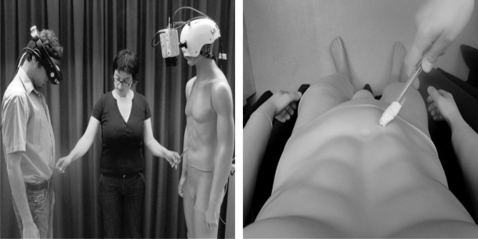
Synchronous visuo-tactile stimulation from a first-person perspective can make healthy volunteers experience a mannequin’s body, or another person’s body, as their own. The illusion is strong enough that participants can face their own body and shake hands with it while feeling located in the other body.
Key findings
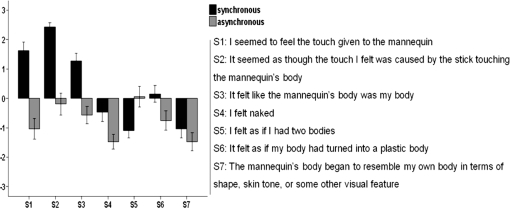
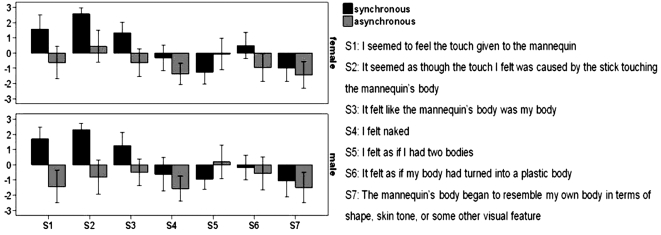
- In Experiment 1, synchronous stroking of a mannequin’s abdomen produced questionnaire evidence of whole-body ownership; illusion statements differed significantly between synchronous and asynchronous conditions (p = .000, F(1, 95) = 107.508), while asynchronous controls showed no such illusory perceptions (p = .703, F(1, 223) = 1.513).
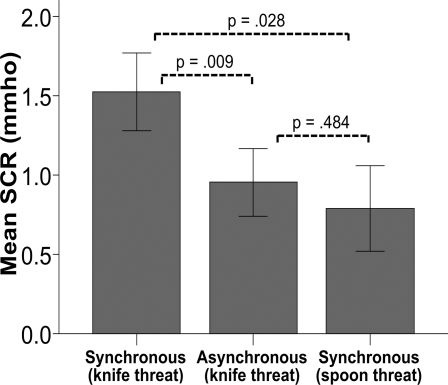
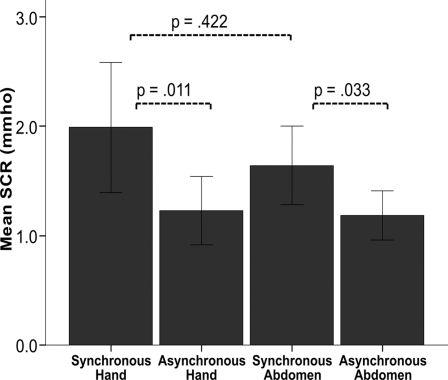
- Threat-evoked skin conductance responses (SCRs) provided physiological evidence: threatening the mannequin with a knife in the synchronous condition elicited greater SCR than control conditions (N = 10, p = .009, Z = −2.599; p = .028, Z = −2.191), and ownership generalised from stimulated hands or abdomen to the whole body (N = 13, p = .011, Z = −2.511 and p = .033, Z = −2.132).
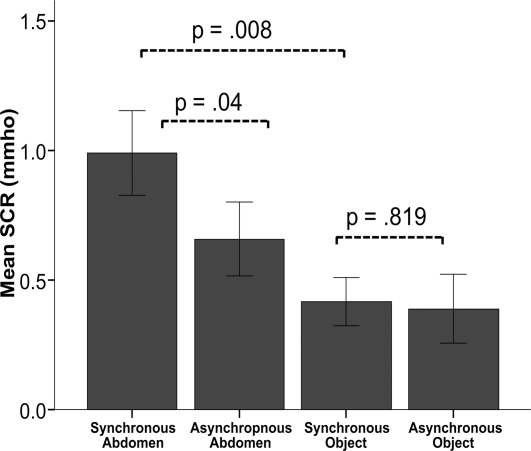
- Only human-like bodies were owned: SCR was stronger when the mannequin was threatened in the synchronous condition than when a same-sized rectangular object was threatened after synchronous stimulation (N = 12, p = .008); synchronous vs asynchronous stimulation mattered for the mannequin (p = .04) but not for the rectangular object (p = .819).
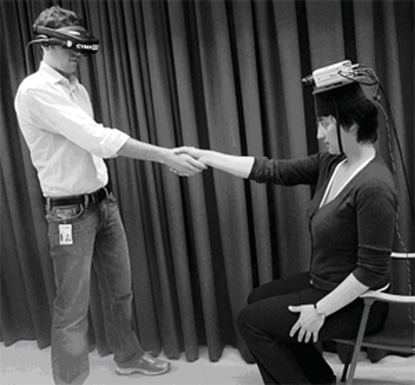
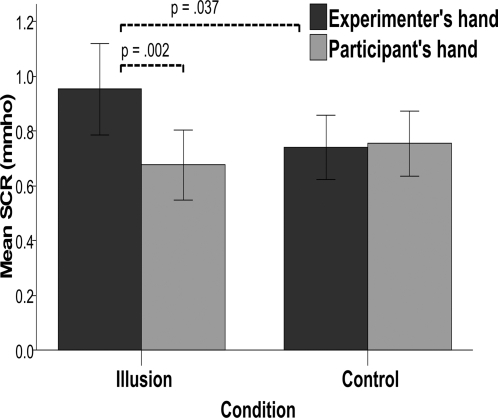
- In Experiment 5, participants facing their own body while shaking hands with the experimenter experienced the experimenter’s body as their own; SCR was greater when the experimenter’s wrist was threatened than when the participant’s own hand was threatened in the synchronous condition (N = 20, p = .0002, Z = −3.099), with no such difference in the asynchronous condition (p = .737) and a significant Hand × Condition interaction (p = .001, F(1, 19) = 17.083). Gender and body-shape differences were not significant (Experiment 1: N = 32, p = .613, F(1, 223) = .257; pooled SCR: p = .952, F = .004).
Methods
- Five experiments used separate groups of naïve healthy volunteers: Experiment 1, N = 32 (16 females, mean age 25 ± 6 years); Experiment 2, N = 10 (2 females, 25 ± 4); Experiment 3, N = 13 (8 females, 27 ± 6.5); Experiment 4, N = 12 (4 females, 29 ± 6); Experiment 5, N = 20 (13 females, 27 ± 6.5). The studies were approved by the local Ethical Committee of Karolinska Institute.
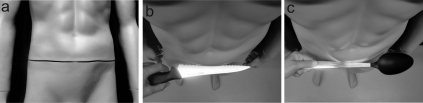
- Participants wore head-mounted displays connected to CCTV cameras mounted on a mannequin or the experimenter’s head to provide a first-person visual perspective. Experiments compared synchronous versus asynchronous visuo-tactile stimulation (stroking the abdomen or hands, or hand squeezing) and measured threat-evoked SCRs using a Biopac MP150 system with electrodes on the left index and middle fingers.
- Questionnaire ratings used a seven-point Likert scale. SCR was analysed as the peak conductance change up to 5 seconds after threat onset. Parametric tests were used for Experiments 1 and 4 (which passed normality testing), and non-parametric tests for the other experiments; alpha was set at 5%.
Limitations
- Stated limitations: Not stated in the paper.
- Evident from the text: sample sizes were small and each experiment used a separate group of healthy young adults (N = 10–32), so generalisability to clinical, older, or other populations is untested; the gender comparison pooled data from Experiments 3 and 4 to obtain sufficient males and females.
- Evident from the text: in Experiment 5, the asynchronous control did not fully abolish the illusion—several participants reported a weaker illusion, and the first-person perspective still influenced them—which the authors note likely explains the lack of SCR difference between hands in the asynchronous condition.
Model-written summary. Check it against the paper before relying on it.
Integrity signals
Registry
Cites
Statistics
Figures
Verification
Claims the paper makes
33 Own interpretation · 33 Own result · 26 Not checked yet · 7 Own method · 2 No basis given
A result the paper reports from its own data — it cites no other source for it, so there is none to check. The quote shows it is in the paper.
In the paper
“Manipulation of the visual perspective, in combination with the receipt of correlated multisensory information from the body was sufficient to trigger the illusion that another person's body or an artificial body was one's own.”
§ If I Were You: Perceptual Illusion of Body Swapping > Abstract
plaindirect- Asserted: passes — The authors put it forward as true.
- Checkable: passes — It can be checked against evidence.
- Load-bearing: passes — The paper’s conclusions depend on it.
- Based: passes — The paper gives a reason why it holds.
A result the paper reports from its own data — it cites no other source for it, so there is none to check. The quote shows it is in the paper.
In the paper
“This effect was so strong that people could experience being in another person's body when facing their own body and shaking hands with it.”
- Also stated in: § Discussion · boosted
“Particularly strong evidence for this was the counter-intuitive demonstration that one can face one's physical body and shake hands with it whilst experiencing the illusion of being within another person's body.”
§ If I Were You: Perceptual Illusion of Body Swapping > Abstract
boosteddirect- Asserted: passes — The authors put it forward as true.
- Checkable: passes — It can be checked against evidence.
- Load-bearing: passes — The paper’s conclusions depend on it.
- Based: passes — The paper gives a reason why it holds.
- Also stated in: § Discussion · boosted
A result the paper reports from its own data — it cites no other source for it, so there is none to check. The quote shows it is in the paper.
In the paper
“The results of the data analysis revealed that the threat-evoked SCRs were significantly stronger in the synchronous condition with the mannequin than in the synchronous one with the rectangular object. (N = 12, p = .008, two-tailed t-test) (Figure 5).”
§ If I Were You: Perceptual Illusion of Body Swapping > Results > Physiological evidence for owning a new body
plainn = 12- Asserted: passes — The authors put it forward as true.
- Checkable: passes — It can be checked against evidence.
- Load-bearing: passes — The paper’s conclusions depend on it.
- Based: passes — The paper gives a reason why it holds.
A result the paper reports from its own data — it cites no other source for it, so there is none to check. The quote shows it is in the paper.
In the paper
“Pilot experiments suggested that the illusion did not work with objects that do not resemble a human body, such as boxes, chairs and tables.”
§ If I Were You: Perceptual Illusion of Body Swapping > Results > Physiological evidence for owning a new body
hedged- Asserted: passes — The authors put it forward as true.
- Checkable: passes — It can be checked against evidence.
- Load-bearing: passes — The paper’s conclusions depend on it.
- Based: passes — The paper gives a reason why it holds.
A result the paper reports from its own data — it cites no other source for it, so there is none to check. The quote shows it is in the paper.
In the paper
“We observed significantly stronger skin conductance responses when the knife was moved near the experimenter's wrist than when it was moved towards the participant's own hand in the synchronous condition (N = 20, p = .0002, Z = −3.099, two-tailed Wilcoxon Signed Ranks Test) (Figure 7).”
§ If I Were You: Perceptual Illusion of Body Swapping > Results > Swapping body with another person
plaincorrelationaln = 20- Asserted: passes — The authors put it forward as true.
- Checkable: passes — It can be checked against evidence.
- Load-bearing: passes — The paper’s conclusions depend on it.
- Based: passes — The paper gives a reason why it holds.
A result the paper reports from its own data — it cites no other source for it, so there is none to check. The quote shows it is in the paper.
In the paper
“Most remarkably, the participants' sensations of the tactile and muscular stimulation elicited by the squeezing of the hands seemed to originate from the experimenter's hand, and not from their own clearly visible hand.”
§ If I Were You: Perceptual Illusion of Body Swapping > Results > Swapping body with another person
hedged- Asserted: passes — The authors put it forward as true.
- Checkable: passes — It can be checked against evidence.
- Load-bearing: passes — The paper’s conclusions depend on it.
- Based: passes — The paper gives a reason why it holds.
A result the paper reports from its own data — it cites no other source for it, so there is none to check. The quote shows it is in the paper.
In the paper
“This effect is so robust that, while experiencing being in another person's body, a participant can face his or her biological body and shake hands with it without breaking the illusion.”
§ If I Were You: Perceptual Illusion of Body Swapping > Introduction
boosted- Asserted: passes — The authors put it forward as true.
- Checkable: passes — It can be checked against evidence.
- Load-bearing: passes — The paper’s conclusions depend on it.
- Based: passes — The paper gives a reason why it holds.
A result the paper reports from its own data — it cites no other source for it, so there is none to check. The quote shows it is in the paper.
In the paper
“Finally, we registered a greater SCR when the experimenter's hand was threatened in the synchronous condition than in the asynchronous one (N = 20, p = 0.037, Z = −2.091, two-tailed Wilcoxon Signed Ranks Test).”
§ If I Were You: Perceptual Illusion of Body Swapping > Results > Swapping body with another person
plaincorrelationaln = 20 ·- Asserted: passes — The authors put it forward as true.
- Checkable: passes — It can be checked against evidence.
- Load-bearing: passes — The paper’s conclusions depend on it.
- Based: passes — The paper gives a reason why it holds.
A result the paper reports from its own data — it cites no other source for it, so there is none to check. The quote shows it is in the paper.
In the paper
“No such illusory perceptions were reported in the asynchronous control condition (p = .703, F(1, 223) = 1.513, ANOVA).”
§ If I Were You: Perceptual Illusion of Body Swapping > Results > Ownership of a body other than one's own
plain- Asserted: passes — The authors put it forward as true.
- Checkable: passes — It can be checked against evidence.
- Load-bearing: passes — The paper’s conclusions depend on it.
- Based: passes — The paper gives a reason why it holds.
- Rests on an assumption: The questionnaire statements S1–S3 validly capture the illusory experience of being the artificial body, and S4–S7 validly control for suggestibility and task-compliance.
A result the paper reports from its own data — it cites no other source for it, so there is none to check. The quote shows it is in the paper.
In the paper
“(This response was also significantly stronger than the low level control condition with the spoon threat after asynchronous stimulation; p = .017, Z = −2.395; not shown in Figure 3).”
§ If I Were You: Perceptual Illusion of Body Swapping > Results > Physiological evidence for owning a new body
plainn = 10 ·- Asserted: passes — The authors put it forward as true.
- Checkable: passes — It can be checked against evidence.
- Load-bearing: unclear — It is unclear whether the paper’s conclusions depend on it.
- Based: passes — The paper gives a reason why it holds.
- It may state two separate claims as one. 19
- Probably not a substantial claim. 12
A result the paper reports from its own data — it cites no other source for it, so there is none to check. The quote shows it is in the paper.
In the paper
“From the completed questionnaires it was evident that the participants had felt the mannequin's body to be their own body, and that they sensed the touch of the rod directly on the mannequin's abdomen in the synchronous condition (p = .000, F(1, 223) = 125.434, ANOVA).”
§ If I Were You: Perceptual Illusion of Body Swapping > Results > Ownership of a body other than one's own
plain- Asserted: passes — The authors put it forward as true.
- Checkable: passes — It can be checked against evidence.
- Load-bearing: passes — The paper’s conclusions depend on it.
- Based: passes — The paper gives a reason why it holds.
It may state two separate claims as one.
- Rests on an assumption: The questionnaire statements S1–S3 validly capture the illusory experience of being the artificial body, and S4–S7 validly control for suggestibility and task-compliance.
A result the paper reports from its own data — it cites no other source for it, so there is none to check. The quote shows it is in the paper.
In the paper
“Our experiments reveal that healthy volunteers can indeed experience other people's bodies, as well as artificial bodies, as being their own.”
- Also stated in: § Discussion · boosted
“The results of our experiments demonstrate that healthy volunteers can perceive another person's body, or an artificial humanoid body, to be their own.”
§ If I Were You: Perceptual Illusion of Body Swapping > Introduction
boosted- Asserted: passes — The authors put it forward as true.
- Checkable: passes — It can be checked against evidence.
- Load-bearing: passes — The paper’s conclusions depend on it.
- Based: passes — The paper gives a reason why it holds.
It may state two separate claims as one.
- Also stated in: § Discussion · boosted
A result the paper reports from its own data — it cites no other source for it, so there is none to check. The quote shows it is in the paper.
In the paper
“For a third time we reproduced a difference in the SCRs between synchronous and asynchronous stimulation of the humanoid body (N = 12, p = .04, two-tailed t-test), without any such difference being observed in the conditions with the rectangular object (p = .819, two-tailed t-test).”
§ If I Were You: Perceptual Illusion of Body Swapping > Results > Physiological evidence for owning a new body
plainn = 12 ·- Asserted: passes — The authors put it forward as true.
- Checkable: passes — It can be checked against evidence.
- Load-bearing: passes — The paper’s conclusions depend on it.
- Based: passes — The paper gives a reason why it holds.
It may state two separate claims as one.
A result the paper reports from its own data — it cites no other source for it, so there is none to check. The quote shows it is in the paper.
In the paper
“Even though the mean rank of the observed SCR after threatening the participants' own hand was higher than that obtained by threat to the experimenter's hand in that condition (13.71 vs. 8.77), the effect was not statistically significant (N = 20, = .737, Z = −.336, two-tailed Wilcoxon Signed Ranks Test).”
§ If I Were You: Perceptual Illusion of Body Swapping > Results > Swapping body with another person
plainn = 20- Asserted: passes — The authors put it forward as true.
- Checkable: passes — It can be checked against evidence.
- Load-bearing: unclear — It is unclear whether the paper’s conclusions depend on it.
- Based: passes — The paper gives a reason why it holds.
It may state two separate claims as one.
A result the paper reports from its own data — it cites no other source for it, so there is none to check. The quote shows it is in the paper.
In the paper
“The difference in SCR observed when threatening the experimenter's and participant's wrists in the two conditions was significant [interaction between the main factors Hands (Experimenter's vs. Participant's hand) vs. Condition (Synchronous vs. Asynchronous) was significant (p = 0.001, F(1, 19) = 17.083, Two Way Repeated Measures ANOVA on standardized variables].”
§ If I Were You: Perceptual Illusion of Body Swapping > Results > Swapping body with another person
plaincorrelationaln = 20- Asserted: passes — The authors put it forward as true.
- Checkable: passes — It can be checked against evidence.
- Load-bearing: passes — The paper’s conclusions depend on it.
- Based: passes — The paper gives a reason why it holds.
It may state two separate claims as one.
A result the paper reports from its own data — it cites no other source for it, so there is none to check. The quote shows it is in the paper.
In the paper
“This works both when the participant does not move and when he or she is executing voluntary movements.”
§ If I Were You: Perceptual Illusion of Body Swapping > Discussion
plain- Asserted: passes — The authors put it forward as true.
- Checkable: passes — It can be checked against evidence.
- Load-bearing: passes — The paper’s conclusions depend on it.
- Based: passes — The paper gives a reason why it holds.
It may state two separate claims as one.
A result the paper reports from its own data — it cites no other source for it, so there is none to check. The quote shows it is in the paper.
In the paper
“The incongruent tactile and muscular information in the asynchronous condition led to a decrease in the strength of the illusion, but could not completely abolish it, as reported by many participants.”
§ If I Were You: Perceptual Illusion of Body Swapping > Discussion
plaindirect- Asserted: passes — The authors put it forward as true.
- Checkable: passes — It can be checked against evidence.
- Load-bearing: passes — The paper’s conclusions depend on it.
- Based: passes — The paper gives a reason why it holds.
It may state two separate claims as one.
In the paper
“In this illusion, synchronous touches applied to a rubber hand in full view of the participant, and the real hand, which is hidden behind a screen, produce the sensations that the touch originates from the rubber hand and a feeling of ownership of the artificial hand.”
§ If I Were You: Perceptual Illusion of Body Swapping > Introduction
What the sources say
- Not checked yetcites [17] M Botvinick, 1998, Rubber hands ‘feel’ touch that eyes see., Nature source
plaindirect- Asserted: passes — The authors put it forward as true.
- Checkable: passes — It can be checked against evidence.
- Load-bearing: passes — The paper’s conclusions depend on it.
- Based: passes — The paper gives a reason why it holds.
It may state two separate claims as one.
None of the sources cited for this claim have been checked yet.
In the paper
“Although these neurological observations suggest that certain brain regions might be responsible for generating the habitual experience of being located within one's body and of owning it, they tell us little about the underlying processes.”
§ If I Were You: Perceptual Illusion of Body Swapping > Introduction
What the sources say
hedgedconditional- Asserted: passes — The authors put it forward as true.
- Checkable: passes — It can be checked against evidence.
- Load-bearing: passes — The paper’s conclusions depend on it.
- Based: passes — The paper gives a reason why it holds.
It may state two separate claims as one.
None of the sources cited for this claim have been checked yet.
In the paper
“Having the experience of being the owner of one's body is clearly adaptive, and its function probably relates to the problem of localising and correctly identifying oneself in the sensory environment [9], [10], a problem faced by all central nervous systems [11].”
§ If I Were You: Perceptual Illusion of Body Swapping > Introduction
What the sources say
- Not checked yetcites [9] M Graziano, 2002, How the brain represents the body: insights from neurophysiology and psychology. source
- Not checked yetcites [10] TR Makin, 2008, On the other hand: Dummy hands and peripersonal space., Behavioural Brain Research source
- Not checked yetcites [11] PS Churchland, 2002, Self-Representation in Nervous Systems., Science source
hedgedconditional- Asserted: passes — The authors put it forward as true.
- Checkable: passes — It can be checked against evidence.
- Load-bearing: unclear — It is unclear whether the paper’s conclusions depend on it.
- Based: passes — The paper gives a reason why it holds.
It may state two separate claims as one.
A conclusion the paper draws from its own results — it cites no other source for it, so there is none to check. The quote shows it is in the paper.
In the paper
“Thus, stimulation of one body part seems to produce ownership of the entire body being seen, i.e. the effect of ownership generalised to non-stimulated body parts.”
§ If I Were You: Perceptual Illusion of Body Swapping > Results > Physiological evidence for owning a new body
hedgeddirectn = 13 ·- Asserted: passes — The authors put it forward as true.
- Checkable: passes — It can be checked against evidence.
- Load-bearing: passes — The paper’s conclusions depend on it.
- Based: passes — The paper gives a reason why it holds.
It may state two separate claims as one.
A conclusion the paper draws from its own results — it cites no other source for it, so there is none to check. The quote shows it is in the paper.
In the paper
“Thus, the SCR results cannot be explained in terms of a general emotional response to seeing the knife, nor can they be explained by differences in the distance between the knife and the cameras because these effects were all controlled for in our experimental design.”
§ If I Were You: Perceptual Illusion of Body Swapping > Results > Swapping body with another person
plainn = 20 ·- Asserted: passes — The authors put it forward as true.
- Checkable: passes — It can be checked against evidence.
- Load-bearing: passes — The paper’s conclusions depend on it.
- Based: passes — The paper gives a reason why it holds.
It may state two separate claims as one.
None of the sources cited for this claim have been checked yet.
In the paper
“By changing the visual perspective, it is possible to induce the feeling of being in a different place [21], [22], [23] or, even, illusory ‘out-of-body experiences’ where people seem to lose ownership of their own body when observing it from the point of view of another person (which we refer to as the third person perspective) [6].”
§ If I Were You: Perceptual Illusion of Body Swapping > Introduction
What the sources say
- Not checked yetcites [21] M Minsky, 1980, Telepresence., Omni
- Not checked yetcites [22] MV Sanchez-Vives, 2005, From presence to consciousness through virtual reality., Nat Rev Neurosci source
- Not checked yetcites [23] M Slater, 2007, Understanding and realizing presence in the Presenccia project., IEEE Comput Graph Appl source
hedgeddirect- Asserted: passes — The authors put it forward as true.
- Checkable: passes — It can be checked against evidence.
- Load-bearing: passes — The paper’s conclusions depend on it.
- Based: passes — The paper gives a reason why it holds.
It may state two separate claims as one.
A conclusion the paper draws from its own results — it cites no other source for it, so there is none to check. The quote shows it is in the paper.
In the paper
“Thus, even though they were able to recognize their own body through the headsets and visually detect the self-produced squeezing movements of their own hand, they were still influenced by seeing the experimenter's body from the first person perspective.”
§ If I Were You: Perceptual Illusion of Body Swapping > Results > Swapping body with another person
plaindirect- Asserted: passes — The authors put it forward as true.
- Checkable: passes — It can be checked against evidence.
- Load-bearing: passes — The paper’s conclusions depend on it.
- Based: passes — The paper gives a reason why it holds.
It may state two separate claims as one.
In the paper
“and localising the arms in space [35].”
§ If I Were You: Perceptual Illusion of Body Swapping > Discussion
What the sources say
- Not checked yetcites [35] RB Welch, 1986, Intersensory interactions.
plaindirect- Asserted: passes — The authors put it forward as true.
- Checkable: passes — It can be checked against evidence.
- Load-bearing: fails — The paper’s conclusions may not depend on it.
- Based: passes — The paper gives a reason why it holds.
Probably not a substantial claim. The paper’s conclusions may not depend on it.
None of the sources cited for this claim have been checked yet.
In the paper
“Many multisensory brain areas seem to have particularly large representations of the hands and upper limbs [29], [30]”
§ If I Were You: Perceptual Illusion of Body Swapping > Discussion
What the sources say
- Not checked yetcites [29] M Graziano, 2006, Parieto-frontal interactions, personal space, and defensive behavior., Neuropsychologia source
- Not checked yetcites [30] G Rizzolatti, 1981, Afferent properties of periarcuate neurons in macaque monkeys. I. Somatosensory responses., Behavioural Brain Research source
hedged- Asserted: passes — The authors put it forward as true.
- Checkable: passes — It can be checked against evidence.
- Load-bearing: fails — The paper’s conclusions may not depend on it.
- Based: passes — The paper gives a reason why it holds.
Probably not a substantial claim. The paper’s conclusions may not depend on it.
None of the sources cited for this claim have been checked yet.
In the paper
“visual information is particularly important for guiding human hand actions [31], [32], [33], [34]”
§ If I Were You: Perceptual Illusion of Body Swapping > Discussion
What the sources say
- Not checked yetcites [31] U Castiello, 2005, The neuroscience of grasping., Nat Rev Neurosci source
- Not checked yetcites [32] MSA Graziano, 1999, Where is my arm? The relative role of vision and proprioception in the neuronal representation of limb position., Proceedings of the National Academy of Sciences of the United States of America source
- Not checked yetcites [33], [34]
plaindirect- Asserted: passes — The authors put it forward as true.
- Checkable: passes — It can be checked against evidence.
- Load-bearing: fails — The paper’s conclusions may not depend on it.
- Based: passes — The paper gives a reason why it holds.
Probably not a substantial claim. The paper’s conclusions may not depend on it.
A conclusion the paper draws from its own results — it cites no other source for it, so there is none to check. The quote shows it is in the paper.
In the paper
“This implies that visual and somatosensory signals from different body parts are analysed and interpreted together, i.e. that there are inter-dependences between the multisensory integration of different body parts.”
§ If I Were You: Perceptual Illusion of Body Swapping > Discussion
hedgedcorrelational- Asserted: passes — The authors put it forward as true.
- Checkable: passes — It can be checked against evidence.
- Load-bearing: passes — The paper’s conclusions depend on it.
- Based: passes — The paper gives a reason why it holds.
It may state two separate claims as one.
In the paper
“The SCR is the peripheral correlate of activity in brain structures related to emotions, and is, therefore, greater when an owned rubber hand is physically injured than when it is not experienced as part of one's body [24].”
§ If I Were You: Perceptual Illusion of Body Swapping > Discussion
What the sources say
- Not checked yetcites [24] KC Armel, 2003, Projecting sensations to external objects: evidence from skin conductance response., Proceedings of the Royal Society B: Biological Sciences source
plaindirect- Asserted: passes — The authors put it forward as true.
- Checkable: passes — It can be checked against evidence.
- Load-bearing: passes — The paper’s conclusions depend on it.
- Based: passes — The paper gives a reason why it holds.
It may state two separate claims as one.
None of the sources cited for this claim have been checked yet.
In the paper
“Emotional defence reactions, such as fear and autonomic arousal, have emerged in the course of evolution to enable one to protect one's own body from physical damage [26], [27].”
§ If I Were You: Perceptual Illusion of Body Swapping > Discussion
What the sources say
- Not checked yetcites [26] AD Craig, 2002, How do you feel? Interoception: the sense of the physiological condition of the body., Nat Rev Neurosci source
- Not checked yetcites [27] AD Craig, 2003, Interoception: the sense of the physiological condition of the body., Current Opinion in Neurobiology source
plaindirect- Asserted: passes — The authors put it forward as true.
- Checkable: passes — It can be checked against evidence.
- Load-bearing: passes — The paper’s conclusions depend on it.
- Based: passes — The paper gives a reason why it holds.
Probably not a substantial claim.
A conclusion the paper draws from its own results — it cites no other source for it, so there is none to check. The quote shows it is in the paper.
In the paper
“These observations suggest that gender identity, and differences in the precise shape of the bodies, are not important factors for perceiving a body as one's own.”
§ If I Were You: Perceptual Illusion of Body Swapping > Results > Body swap and gender
hedgedn = 32- Asserted: passes — The authors put it forward as true.
- Checkable: passes — It can be checked against evidence.
- Load-bearing: passes — The paper’s conclusions depend on it.
- Based: passes — The paper gives a reason why it holds.
It may state two separate claims as one.
What the paper did — it cites no source for this, so there is none to check. The quote shows it is in the paper.
In the paper
“Participants who did not show a reliable threat-evoked SCR (‘null responders’), i.e. had zero responses in more than two-thirds of the trials, were excluded from the analysis.”
§ If I Were You: Perceptual Illusion of Body Swapping > Methods > Physiological recordings
plain- Asserted: passes — The authors put it forward as true.
- Checkable: passes — It can be checked against evidence.
- Load-bearing: passes — The paper’s conclusions depend on it.
- Based: passes — The paper gives a reason why it holds.
Probably not a substantial claim.
What the paper did — it cites no source for this, so there is none to check. The quote shows it is in the paper.
In the paper
“Within each session we randomized the order of which hand was threatened (either the experimenter's hand or the participant's hand).”
§ If I Were You: Perceptual Illusion of Body Swapping > Methods > Physiological recordings
plain- Asserted: passes — The authors put it forward as true.
- Checkable: passes — It can be checked against evidence.
- Load-bearing: fails — The paper’s conclusions may not depend on it.
- Based: passes — The paper gives a reason why it holds.
Probably not a substantial claim. The paper’s conclusions may not depend on it.
A conclusion the paper draws from its own results — it cites no other source for it, so there is none to check. The quote shows it is in the paper.
In the paper
“In this framework, the body-swap illusions would arise as a result of the brain's tendency to rely heavily on a lifetime of experiences of seeing the world from the first person perspective with eyes that are fixed at a specific position on the skull, and the fact that the body typically produces certain patterns of sensory signals from the different modalities.”
§ If I Were You: Perceptual Illusion of Body Swapping > Discussion
hedgeddirect- Asserted: passes — The authors put it forward as true.
- Checkable: passes — It can be checked against evidence.
- Load-bearing: passes — The paper’s conclusions depend on it.
- Based: passes — The paper gives a reason why it holds.
It may state two separate claims as one.
- Rests on an assumption: The body typically produces certain patterns of sensory signals from the different modalities.
What the paper did — it cites no source for this, so there is none to check. The quote shows it is in the paper.
In the paper
“the type of stimulation and its location (i.e. hands vs. abdomen) were randomized across sessions and participants [e.g. (Sh Aa Ah Sa) (Aa Sa Sh Ah) (Aa Sh Ah Sa), where S and A stand for synchronous or asynchronous stimulation and h and a represent the place where the stimulation was applied, i.e., to the hands or the abdomen, respectively].”
§ If I Were You: Perceptual Illusion of Body Swapping > Methods > Physiological recordings
plain- Asserted: passes — The authors put it forward as true.
- Checkable: passes — It can be checked against evidence.
- Load-bearing: fails — The paper’s conclusions may not depend on it.
- Based: passes — The paper gives a reason why it holds.
Probably not a substantial claim. The paper’s conclusions may not depend on it.
What the paper did — it cites no source for this, so there is none to check. The quote shows it is in the paper.
In the paper
“The two sessions used in the experiment were repeated twice in a pseudo-randomized order [(1, 2, 2, 1) or (2, 1, 1, 2)] to minimize the effect of presentation order.”
§ If I Were You: Perceptual Illusion of Body Swapping > Methods > Physiological recordings
plain- Asserted: passes — The authors put it forward as true.
- Checkable: passes — It can be checked against evidence.
- Load-bearing: fails — The paper’s conclusions may not depend on it.
- Based: passes — The paper gives a reason why it holds.
Probably not a substantial claim. The paper’s conclusions may not depend on it.
In the paper
“With respect to the tele-operator literature, it is interesting to note that there are many anecdotal reports of people feeling a robotic arm to be like their own when the robot arm is viewed from a first person perspective via cameras mounted on the robot and when the movements of the robot's arms reproduce the person's movements in real time [51].”
§ If I Were You: Perceptual Illusion of Body Swapping > Discussion
What the sources say
- Not checked yetcites [51] J Cole, 2000, On the immunity principle: a view from a robot., Trends in Cognitive Sciences source
plaincorrelational- Asserted: passes — The authors put it forward as true.
- Checkable: passes — It can be checked against evidence.
- Load-bearing: fails — The paper’s conclusions may not depend on it.
- Based: passes — The paper gives a reason why it holds.
Probably not a substantial claim. The paper’s conclusions may not depend on it.
What the paper did — it cites no source for this, so there is none to check. The quote shows it is in the paper.
In the paper
“Further, the order of sessions and presentations were balanced across individuals.”
§ If I Were You: Perceptual Illusion of Body Swapping > Methods > Physiological recordings
plain- Asserted: passes — The authors put it forward as true.
- Checkable: passes — It can be checked against evidence.
- Load-bearing: fails — The paper’s conclusions may not depend on it.
- Based: passes — The paper gives a reason why it holds.
Probably not a substantial claim. The paper’s conclusions may not depend on it.
What the paper did — it cites no source for this, so there is none to check. The quote shows it is in the paper.
In the paper
“The order of the stimulation conditions and the type of object used as threat were randomized across sessions and participants [e.g. (Sk As Ak Ss) (As Ss Sk Ak) (As Sk Ak Ss), where S and A stand for synchronous or asynchronous stimulation and k and s stand for knife or spoon threat, respectively].”
§ If I Were You: Perceptual Illusion of Body Swapping > Methods > Physiological recordings
plain- Asserted: passes — The authors put it forward as true.
- Checkable: passes — It can be checked against evidence.
- Load-bearing: fails — The paper’s conclusions may not depend on it.
- Based: passes — The paper gives a reason why it holds.
Probably not a substantial claim. The paper’s conclusions may not depend on it. It may state two separate claims as one.
A conclusion the paper draws from its own results — it cites no other source for it, so there is none to check. The quote shows it is in the paper.
In the paper
“A key difference probably is that, in the body-swap illusions, the visual, tactile and proprioceptive information is mapped directly onto the multisensory neuronal populations that represent one's own body in ego-centric coordinates.”
§ If I Were You: Perceptual Illusion of Body Swapping > Discussion
hedgedconditional- Asserted: passes — The authors put it forward as true.
- Checkable: passes — It can be checked against evidence.
- Load-bearing: passes — The paper’s conclusions depend on it.
- Based: fails — The paper may give no reason why it holds.
Probably not a substantial claim. The paper may give no reason why it holds.
The paper relies on this without support.
The questionnaire statements S1–S3 validly capture the illusory experience of being the artificial body, and S4–S7 validly control for suggestibility and task-compliance.
“Three statements were designed to capture the illusory experience of being the artificial body, and the other four served as controls for suggestibility and task-compliance (Figure 2).”
The paper relies on this without support.
Earlier work on body ownership has exclusively studied a single limb, the arm, using the traditional rubber hand illusion.
“Earlier work on body ownership has exclusively studied a single limb, the arm, using the traditional rubber hand illusion.”
The paper relies on this without support.
Until now, it was not known whether the principles underlying changes in ownership would generalise to other body parts, or to an entire body.
“Thus, until now, it was not known whether the principles underlying changes in ownership would generalise to other body parts, or to an entire body.”
The paper relies on this without support.
The body typically produces certain patterns of sensory signals from the different modalities.
“the fact that the body typically produces certain patterns of sensory signals from the different modalities.”
The paper relies on this without support.
The sensory experience of one's own body from the first person perspective is different from recognising oneself in mirrors, TV screens or other image representations as observed from a third person perspective.
“The sensory experience of one's own body from the first person perspective is different from recognising oneself in mirrors, TV screens or other image representations as observed from a third person perspective.”
The paper relies on this without support.
When we recognise ourselves in a mirror, we do not have the experience that we are actually in the mirror, or that there has been a change in ownership of our body.
“When we recognise ourselves in a mirror, for example, we do not have the experience that we are actually in the mirror, or that there has been a change in ownership of our body.”
Claims other papers make about this one
Each is checked against this paper’s own text: does it say what the citing paper says it does?
The cited source says what the claim attributes to it.
In the citing paper
“The electrodermal response permits to assess the level of arousal: previous studies demonstrated its utility as an objective measure of anxiety under threatening situations or of body illusions29–31.”
From The impact of multisensory integration and perceptual load in virtual reality settings on performance, workload and presence (2021) · cites this paper as [29]
In the citing paper
“BSC includes conscious experiences such as self-identification and self-location [36,37,44,45], as well as the first-person perspective [39,46,47].”
From First-person view of one’s body in immersive virtual reality: Influence on episodic memory (2019) · cites this paper as [44]
In the citing paper
“Autonoetic consciousness is the ability to mentally travel back in subjective time and recollect one’s previous experiences [2,18–20] and the present data suggest that multisensory bodily processing during encoding and remembering are not only of relevance for the conscious bodily experiences of self-identification, self-location, and first-person perspective [36,37,39,44–47], but also autonoetic”
From First-person view of one’s body in immersive virtual reality: Influence on episodic memory (2019) · cites this paper as [44]
In the citing paper
“Illusory ownership over a physical manikin body that substituted the participant's real body was demonstrated in [23].”
From Changing bodies changes minds: Owning another body affects social cognition (2015) · cites this paper as [23]
In the citing paper
“Synchronous tapping on the manikin body and the real body led to illusory body ownership, in a similar way to the more traditional rubber hand and enfacement illusions.”
From Changing bodies changes minds: Owning another body affects social cognition (2015) · cites this paper as [23]
In the citing paper
“There is also evidence that ownership can be attributed to a manikin that appears visually to substitute the person's real body as seen through head-mounted displays coupled to a video camera oriented down at the manikin body [14].”
From First person experience of body transfer in virtual reality (2010) · cites this paper as [14]
In the citing paper
“Their main setup was to also manipulate ownership by a 1PP self-representation (a manikin) that was touched either asynchronously or synchronously – similar to our 1PP and TS′ (girl's perspective and asynchronous stroking) and 1PP and TS (girl's perspective but synchronous stroking), respectively.”
From First person experience of body transfer in virtual reality (2010) · cites this paper as [14]
In the citing paper
“In [14] there was a significantly different skin conductance response when the manikin body was threatened in the synchronous compared to the asynchronous touch condition.”
From First person experience of body transfer in virtual reality (2010) · cites this paper as [14]
In the citing paper
“Our experiment also includes that of Petkova and Ehrsson [14] as a special case.”
From First person experience of body transfer in virtual reality (2010) · cites this paper as [14]
In the citing paper
“Additionally there is a critical difference between our experiment and that of Petkova and Ehrsson [14] where cameras on the manikin's head were in a fixed position, looking down at the manikin's body, and therefore the experimental subjects had to have their head fixed in the same orientation.”
From First person experience of body transfer in virtual reality (2010) · cites this paper as [14]
In the citing paper
“We rendered our animation in this way because previous work on ownership has shown that threat-like behavior is often associated with physiological changes [2], [9], [14], [35].”
From First person experience of body transfer in virtual reality (2010) · cites this paper as [14]
In the citing paper
“When people experience ownership over a foreign body, as a result of multisensory stimulation, they also exhibit increased physiological responses to threatening stimuli approaching the body that is attributed to the self [30].”
From The other in me: interpersonal multisensory stimulation changes the mental representation of the self (2012) · cites this paper as [30]
In the citing paper
“Comparable findings have been shown after multisensory stimulation of whole bodies [26]–[29] and in the body-swap illusion [30].”
From The other in me: interpersonal multisensory stimulation changes the mental representation of the self (2012) · cites this paper as [30]
In the citing paper
“When people experience ownership over a foreign body, as a result of multisensory stimulation, they also exhibit increased arousal responses to threatening stimuli approaching this newly owned body [30].”
From The other in me: interpersonal multisensory stimulation changes the mental representation of the self (2012) · cites this paper as [30]
In the citing paper
“The observed changes in arousal for the critical test condition were consistent with those reported in comparable studies on bodily illusions (e.g., [30], [39]).”
From The other in me: interpersonal multisensory stimulation changes the mental representation of the self (2012) · cites this paper as [30]
Statistics recomputed
Every reported test result, recomputed from its test statistic and degrees of freedom. A result shows as not adding up only once an independent check has confirmed it.
- Not confirmedz = -2.599reported p = .028 · recomputed p = .009
“Z = −2.599, p = .028”
Self-check
Percentages, sums and reported differences re-computed from the paper’s own numbers.
Each contradiction between two passages listed here was confirmed by an independent check.
Rated major: it would touch a result — a value a result rests on, reported and recomputed p-values on opposite sides of the significance level, two passages that conflict with no sign which is right, or a cited work retracted before this paper was published.
In the paper
§ If I Were You: Perceptual Illusion of Body Swapping > Results > Swapping body with another person
“Finally, we registered a greater SCR when the experimenter's hand was threatened in the synchronous condition than in the asynchronous one (N = 20, p = 0.037, Z = −2.091, two-tailed Wilcoxon Signed Ranks Test).”
§ If I Were You: Perceptual Illusion of Body Swapping > Results > Swapping body with another person
“A significantly higher SRC was registered when the ‘new’ body (the experimenter's hand) was threatened with the knife in the illusion condition than when it was threatened in the control condition (p = 0.002, paired two-tailed Wilcoxon Signed Ranks Test)”
Rated minor: it would not touch a result — a value no result rests on, a p-value that stays on the same side of the significance level, or a conflict that is clerical, resolved elsewhere in the paper, or outside its own findings.
In the paper
§ If I Were You: Perceptual Illusion of Body Swapping > Results > Swapping body with another person
“We observed significantly stronger skin conductance responses when the knife was moved near the experimenter's wrist than when it was moved towards the participant's own hand in the synchronous condition (N = 20, p = .0002, Z = −3.099, two-tailed Wilcoxon Signed Ranks Test)”
§ If I Were You: Perceptual Illusion of Body Swapping > Results > Swapping body with another person
“or when the physical ‘old’ body was threatened in the illusion condition (p = .037, paired two-tailed Wilcoxon Signed Ranks Test).”
Rated minor: it would not touch a result — a value no result rests on, a p-value that stays on the same side of the significance level, or a conflict that is clerical, resolved elsewhere in the paper, or outside its own findings.
In the paper
§ If I Were You: Perceptual Illusion of Body Swapping > Results > Physiological evidence for owning a new body
“The SCR is significantly greater in the illusion condition than in either of the control conditions (p = .009 and p = .028, two-tailed t-test).”
§ If I Were You: Perceptual Illusion of Body Swapping > Results > Physiological evidence for owning a new body
“N = 10, p = .009, Z = −2.599, p = .028, Z = −2.191, two-tailed Wilcoxon Signed Ranks Test”
Rated minor: it would not touch a result — a value no result rests on, a p-value that stays on the same side of the significance level, or a conflict that is clerical, resolved elsewhere in the paper, or outside its own findings.
In the paper
§ If I Were You: Perceptual Illusion of Body Swapping > Methods > Physiological recordings
“Only the data from the first and the fourth experiments passed the normality test, therefore we used parametric statistical tests to process the data obtained in those two experiments and the data from the other three experiments were tested with non-parametric statistical tests.”
§ If I Were You: Perceptual Illusion of Body Swapping > Results > Swapping body with another person
“interaction between the main factors Hands (Experimenter's vs. Participant's hand) vs. Condition (Synchronous vs. Asynchronous) was significant (p = 0.001, F(1, 19) = 17.083, Two Way Repeated Measures ANOVA on standardized variables”
Citations
Cites
The Ecological Approach to Visual Perception
Bornstein, M. H., & Gibson, J. J. (1980) · The Journal of Aesthetics and Art Criticism · doi:10.2307/429816 · Cited by 22,935
How do you feel? Interoception: The sense of the physiological condition of the body
Craig, A. D. (2002) · Nature Reviews Neuroscience · doi:10.1038/nrn894 · Cited by 6,006
Rubber hands ‘feel’ touch that eyes see
Botvinick, M., & Cohen, J. (1998) · Nature · doi:10.1038/35784 · Cited by 4,410
Handbook of perception and human performance
Boff, K. R., Kaufman, L., & Thomas, J. P. (1986) · Wiley eBooks · Cited by 4,033
Interoception: the sense of the physiological condition of the body
(Bud) Craig, A. (2003) · Current Opinion in Neurobiology · doi:10.1016/s0959-4388(03)00090-4 · Cited by 2,556
From presence to consciousness through virtual reality.
Sanchez-Vives, M. V., & Slater, M. (2005) · Nature reviews. Neuroscience · doi:10.1038/nrn1651 · Cited by 1,831
Dawson, M. E., Schell, A. M., Filion, D. L., & Berntson, G. G. (2009) · Cambridge University Press eBooks · doi:10.1017/cbo9780511546396.007 · Cited by 1,776
Andersen, R. A., Snyder, L. H., Bradley, D. C., & Xing, J. (1997) · Annual Review of Neuroscience · doi:10.1146/annurev.neuro.20.1.303 · Cited by 1,486
Critchley, M. (1966) · Medical Entomology and Zoology · Cited by 1,416
Grasping objects: the cortical mechanisms of visuomotor transformation
Jeannerod, M., Arbib, M. A., Rizzolatti, G., & Sakata, H. (1995) · Trends in Neurosciences · doi:10.1016/0166-2236(95)93921-j · Cited by 1,399
Research works printed but not linked: 1
- M Minsky, 1980, Telepresence., Omni, 45
Cited by
Sorted by citations
Items 401–500 of 947
Lesur, M. R., Lyn, S., & Lenggenhager, B. (2020) · Frontiers in Psychology · doi:10.3389/fpsyg.2020.01861 · Cited by 19
From Virtual Reality to 360° Videos
Borghesi, F., Mancuso, V., Pedroli, E., & Cipresso, P. (2022) · Advances in human and social aspects of technology book series · doi:10.4018/978-1-6684-4854-0.ch023 · Cited by 20
Evaluating the Sense of Embodiment through Out-of-Body Experience and Tactile Feedback
Cui, D., & Mousas, C. (2022) · ACM SIGGRAPH International Conference on Virtual-Reality Continuum and its Applications in Industry (VRCAI) · doi:10.1145/3574131.3574456 · Cited by 21
Embodied Telepresent Connection (ETC): Exploring Virtual Social Touch Through Pseudohaptics
Desnoyers-Stewart, J., Stepanova, E. R., Liu, P., Kitson, A., Pennefather, P. P., Ryzhov, V., & Riecke, B. E. (2023) · CHI Conference Extended Abstracts on Human Factors in Computing Systems (CHI EA) · doi:10.1145/3544549.3585843 · Cited by 19
Johnston, T., Seinfeld, S., Gonzalez-Liencres, C., Barnes, N., Slater, M., & Sanchez-Vives, M. V. (2023) · Frontiers in Psychology · doi:10.3389/fpsyg.2022.788608 · Cited by 23
Cultivating empathy through narratives in virtual reality: a review
Hadjipanayi, C., Christofi, M., Banakou, D., & Michael‐Grigoriou, D. (2024) · Personal and Ubiquitous Computing · doi:10.1007/s00779-024-01812-w · Cited by 19
Visual feedback from a virtual body modulates motor illusion induced by tendon vibration
Fusco, G., Tieri, G., & Aglioti, S. M. (2020) · Psychological Research · doi:10.1007/s00426-020-01366-5 · Cited by 19
Embodied cognition: So flexible as to be “disembodied”?
Ianì, F. (2021) · Consciousness and Cognition · doi:10.1016/j.concog.2021.103075 · Cited by 23
Ueyama, Y., & Harada, M. (2021) · Virtual Reality · doi:10.1007/s10055-021-00562-x · Cited by 19
The network of the subjective experience in embodiment phenomena
Tosi, G., & Romano, D. (2022) · Psychological Research · doi:10.1007/s00426-022-01714-7 · Cited by 21
Empathizing Audiovisual Sense Impairments
Werfel, F., Wiche, R., Feitsch, J., & Geiger, C. (2016) · Augmented Human International Conference · doi:10.1145/2875194.2875226 · Cited by 19
Multisensory integration induces body ownership of a handtool, but not any handtool
Weser, V. U., Finotti, G., Costantini, M., & Proffítt, D. R. (2017) · Consciousness and Cognition · doi:10.1016/j.concog.2017.07.002 · Cited by 19
Kocur, M., Kloss, M., Schaufler, C., Schwind, V., & Henze, N. (2025) · CHI Conference on Human Factors in Computing Systems · doi:10.1145/3706598.3713203 · Cited by 20
Embodied time and the out-of-body experience of the self
Droit‐Volet, S., Monceau, S., Dambrun, M., & Martinelli, N. N. (2020) · PeerJ · doi:10.7717/peerj.8565 · Cited by 19
Miura, R., Kasahara, S., Kitazaki, M., Verhulst, A., İnami, M., & Sugimoto, M. (2022) · Frontiers in Computer Science · doi:10.3389/fcomp.2022.788014 · Cited by 18
Mudrik, L., Hirschhorn, R., & Korisky, U. (2024) · Neuron · doi:10.1016/j.neuron.2024.03.031 · Cited by 19
Is mediated embodiment the response to embodied cognition?
Aymerich-Franch, L. (2018) · New Ideas in Psychology · doi:10.1016/j.newideapsych.2018.02.003 · Cited by 18
Body ownership shapes self-orientation perception
Preuss, N., Brynjarsdóttir, B. L., & Ehrsson, H. H. (2018) · Scientific Reports · doi:10.1038/s41598-018-34260-7 · Cited by 18
Self-citationBeing Short, Sweet, and Sour: Congruent Visuo-Olfactory Stimulation Enhances Illusory Embodiment
Lesur, M. R., Aicher, H., Delplanque, S., & Lenggenhager, B. (2020) · Perception · doi:10.1177/0301006620928669 · Cited by 18
Individualised Virtual Reality for Supporting Depression: Feedback from Mental Health Professionals
Baghaei, N., Ahmadi, A., Khaliq, I., & Liang, H. (2021) · IEEE International Symposium on Mixed and Augmented Reality Adjunct (ISMAR-Adjunct) · doi:10.1109/ismar-adjunct54149.2021.00022 · Cited by 18
Ventura, S., Miragall, M., Cárdenas‐López, G., & Baños, R. (2022) · Frontiers in Human Neuroscience · doi:10.3389/fnhum.2022.845508 · Cited by 18
Mitigating negative emotions through virtual reality and embodiment
Sansoni, M., Scarzello, G., Serino, S., Groff, E., & Riva, G. (2022) · Frontiers in Human Neuroscience · doi:10.3389/fnhum.2022.916227 · Cited by 18
Effect of perspective change in body ownership transfer to teleoperated android robot
Ogawa, K., Taura, K., Nishio, S., & Ishiguro, H. (2012) · IEEE RO-MAN · doi:10.1109/roman.2012.6343891 · Cited by 18
Huang, H.-C., Lee, Y., Chen, W.-Y., & Liang, C. (2017) · Frontiers in Psychology · doi:10.3389/fpsyg.2017.00370 · Cited by 19
Charbonneau, P., Dallaire-Cote, M., Côté, S. S.-P., Labbé, D., Mezghani, N., Ferdous, S. M. S., Arafat, I. M., Chowdhury, T. I., Samaraweera, G., & Quarles, J. P. (2017) · International Conference on Virtual Rehabilitation · doi:10.1109/icvr.2017.8007535 · Cited by 18
Preuss, N., Coppi, S., Chancel, M., & Ehrsson, H. H. (2022) · PLoS ONE · doi:10.1371/journal.pone.0277080 · Cited by 18
Self-citationTelepresence in the Recent Literature with a Focus on Robotic Platforms, Applications and Challenges
Youssef, K., Said, S., Kork, S. A., & Beyrouthy, T. (2023) · Robotics · doi:10.3390/robotics12040111 · Cited by 17
Modeling Motor Control in Continuous Time Active Inference: A Survey
Priorelli, M., Maggiore, F., Maselli, A., Donnarumma, F., Maisto, D., Mannella, F., Stoianov, I. P., & Pezzulo, G. (2023) · IEEE Transactions on Cognitive and Developmental Systems · doi:10.1109/tcds.2023.3338491 · Cited by 18
Ventura, S., Cebolla, A., Latorre, J., Escrivá‐Martínez, T., Lloréns, R., & Baños, R. (2021) · Virtual Reality · doi:10.1007/s10055-021-00567-6 · Cited by 17
Tosi, G., Parmar, J., Dhillon, I., Maravita, A., & Iaria, G. (2020) · Experimental Brain Research · doi:10.1007/s00221-020-05874-z · Cited by 19
How a lack of haptic feedback affects eye-hand coordination and embodiment in virtual reality
Lavoie, E. B., Hebert, J. S., & Chapman, C. S. (2025) · Scientific Reports · doi:10.1038/s41598-025-10319-0 · Cited by 16
Raoul, L., & Grosbras, M. (2023) · Neuroscience & Biobehavioral Reviews · doi:10.1016/j.neubiorev.2023.105141 · Cited by 18
Liou, W.-K., Lin, W., Lee, Y., Chen, S., & Liang, C. (2023) · Virtual Reality · doi:10.1007/s10055-023-00907-8 · Cited by 18
Embodiment in episodic memory through premotor-hippocampal coupling
Meyer, N. H., Gauthier, B., Stampacchia, S., Boscheron, J., Babo-Rebelo, M., Potheegadoo, J., Herbelin, B., Lance, F., Alvarez, V., Franc, E., et al. (2024) · Communications Biology · doi:10.1038/s42003-024-06757-7 · Cited by 16
Callard, F. J., & Papoulias, C. (2010) · ENLIGHTEN (Jurnal Bimbingan dan Konseling Islam) · Cited by 16
The Influence of Visual Perspective on Body Size Estimation in Immersive Virtual Reality
Thaler, A., Pujades, S., Stefanucci, J. K., Creem-Regehr, S. H., Tesch, J., Black, M. J., & Mohler, B. J. (2019) · ACM Symposium on Applied Perception · doi:10.1145/3343036.3343134 · Cited by 19
Avatar embodiment experiences to enhance mental health
Aymerich-Franch, L. (2020) · Elsevier eBooks · doi:10.1016/b978-0-12-816958-2.00003-4 · Cited by 19
Owning a Virtual Body Entails Owning the Value of Its Actions in a Detection-of-Deception Procedure
Pyasik, M. M., & Pia, L. (2020) · Cognition · doi:10.1016/j.cognition.2021.104693 · Cited by 16
Lesur, M. R., Weijs, M. L., Nguyen, T. D., & Lenggenhager, B. (2021) · Cognition · doi:10.1016/j.cognition.2021.104769 · Cited by 16
Fribourg, R., Blanpied, E., Hoyet, L., Lécuyer, A., & Argelaguet, F. (2021) · Computers & Graphics · doi:10.1016/j.cag.2021.07.017 · Cited by 19
Flesh and bone digital sociality: On how humans may go virtual
Monti, A., & Aglioti, S. M. (2018) · British Journal of Psychology · doi:10.1111/bjop.12300 · Cited by 16
Virtually imagining our biases
Sullivan‐Bissett, E. (2023) · Philosophical Psychology · doi:10.1080/09515089.2023.2184334 · Cited by 15
Anastasiadou, D. T., Herrero, P., Garcia-Royo, P., Sebastián, J. V.-D., Slater, M., Spanlang, B., de la Campa, E. Á., Ciudin, A., Comas, M., Ramos‐Quiroga, J. A., et al. (2024) · Journal of Medical Internet Research · doi:10.2196/51558 · Cited by 16
CoplayingVR: Understanding User Experience in Shared Control in Virtual Reality
Zhou, H., Peirispulle, T. A., Fan, C., Sarsenbayeva, Z., & Withana, A. I. (2024) · Proceedings of the ACM on Interactive Mobile Wearable and Ubiquitous Technologies · doi:10.1145/3678508 · Cited by 15
Gliske, S. (2019) · eNeuro · doi:10.1523/eneuro.0183-19.2019 · Cited by 16
RetractedEffect of Sense of Embodiment on Curvature Redirected Walking Thresholds
Nguyen, A., Rothacher, Y., Lenggenhager, B., Brugger, P., & Kunz, A. M. (2020) · ACM Symposium on Applied Perception · doi:10.1145/3385955.3407932 · Cited by 15
Doubles Everywhere: Literary Contributions to the Study of the Bodily Self1
Diéguez, S. (2013) · Monographs in clinical neuroscience/Frontiers of neurology and neuroscience/Monographs in neural sciences · doi:10.1159/000345912 · Cited by 16
Ramachandran, V. S., Krause, B., & Case, L. K. (2011) · Perception · doi:10.1068/p6754 · Cited by 15
Fear reactivity to cognitive dyscontrol via novel head-mounted display perceptual illusion exercises
Capron, D. W., Norr, A. M., Albanese, B. J., & Schmidt, N. B. (2017) · Journal of Affective Disorders · doi:10.1016/j.jad.2017.03.068 · Cited by 15
Mental health in the virtual world: Challenges and opportunities in the metaverse era
del Hoyo, Y. L., Elices, M., & García‐Campayo, J. (2024) · World Journal of Clinical Cases · doi:10.12998/wjcc.v12.i17.2939 · Cited by 14
Girondini, M., Mariano, M., Stanco, G., Gallace, A., & Zapparoli, L. (2025) · Frontiers in Human Neuroscience · doi:10.3389/fnhum.2025.1553574 · Cited by 14
Healthy Avatars, Healthy People
Triberti, S., & Chirico, A. (2016) · Advances in medical diagnosis, treatment, and care (AMDTC) book series · doi:10.4018/978-1-5225-0663-8.ch010 · Cited by 14
Shared Diminished Reality: A New VR Framework for the Study of Embodied Intersubjectivity
Vuarnesson, L., Zamplaras, D., Laroche, J., Dumit, J., Lutes, C., Bachrach, A., & Garnier, F. (2021) · Frontiers in Virtual Reality · doi:10.3389/frvir.2021.646930 · Cited by 15
Effect of avatars and viewpoints on performance in virtual world: efficiency vs. telepresence
Rybarczyk, Y. P., Coelho, T., Cardoso, T., & de Oliveira, R. F. (2014) · EAI Endorsed Transactions on Creative Technologies · doi:10.4108/ct.1.1.e4 · Cited by 14
In (or outside of) your neck of the woods: laterality in spatial body representation
Hach, S., & Schütz‐Bosbach, S. (2014) · Frontiers in Psychology · doi:10.3389/fpsyg.2014.00123 · Cited by 14
Beaming into the News: A System for and Case Study of Tele-Immersive Journalism
Kishore, S., Navarro, X., Dominguez, E., de la Peña, N., & Slater, M. (2016) · IEEE Computer Graphics and Applications · doi:10.1109/mcg.2016.44 · Cited by 14
Jenkinson, P. M., & Preston, C. (2017) · Consciousness and Cognition · doi:10.1016/j.concog.2016.12.007 · Cited by 16
Desnoyers-Stewart, J., Meneghini, M. B., Stepanova, E. R., & Riecke, B. E. (2024) · Frontiers in Virtual Reality · doi:10.3389/frvir.2023.1336581 · Cited by 13
Study of Full-body Virtual Embodiment Using noninvasive Brain Stimulation and Imaging
Škola, F., & Liarokapis, F. (2021) · International Journal of Human-Computer Interaction · doi:10.1080/10447318.2020.1870827 · Cited by 13
Valori, I., McKenna-Plumley, P. E., Bayramova, R., & Farroni, T. (2021) · Frontiers in Psychology · doi:10.3389/fpsyg.2021.708229 · Cited by 16
Nilsson, M., & Kalckert, A. (2021) · European Journal of Neuroscience · doi:10.1111/ejn.15534 · Cited by 14
The influence of age on the rubber hand illusion
Ferracci, S., & Brancucci, A. (2019) · Consciousness and Cognition · doi:10.1016/j.concog.2019.05.004 · Cited by 17
Functional properties of extended body representations in the context of kinesthesia
Barra, J., Giroux, M., Métral, M., Cian, C., Luyat, M., Kavounoudias, A., & Guerraz, M. (2020) · Neurophysiologie Clinique · doi:10.1016/j.neucli.2020.10.011 · Cited by 15
The role of affective touch in whole-body embodiment remains equivocal
Carey, M., Crucianelli, L., Preston, C., & Fotopoulou, A. (2020) · Consciousness and Cognition · doi:10.1016/j.concog.2020.103059 · Cited by 13
Visual gravity contributes to subjective first-person perspective
Pfeiffer, C., Grivaz, P., Herbelin, B., Serino, A., & Blanke, O. (2016) · Neuroscience of Consciousness · doi:10.1093/nc/niw006 · Cited by 17
Anastasiadou, D. T., Slater, M., Spanlang, B., Porras, D. C., Comas, M., Ciudin, A., Parramón, G., Sebastián, J. V.-D., Ramos‐Quiroga, J. A., & Lusilla, P. (2022) · BMJ Open · doi:10.1136/bmjopen-2022-060822 · Cited by 15
Shimizu, K., Naruse, S., Nishida, J., & Kasahara, S. (2023) · CHI Conference on Human Factors in Computing Systems · doi:10.1145/3544548.3580853 · Cited by 12
Visual perspective and body ownership modulate vicarious pain and touch: A systematic review
Lisi, M. P., Fusaro, M., & Aglioti, S. M. (2024) · Psychonomic Bulletin & Review · doi:10.3758/s13423-024-02477-5 · Cited by 13
Bodily structure and body representation
Alsmith, A. (2019) · Synthese · doi:10.1007/s11229-019-02200-1 · Cited by 13
A Novel Integrated Information Processing Model of Presence
Berthiaume, M., Corno, G., Nolet, K., & Bouchard, S. (2018) · PRESENCE Virtual and Augmented Reality · doi:10.1162/pres_a_00336 · Cited by 15
Exploring Virtual Doppelgangers as Movement Models to Enhance Voluntary Imitation
Kammler-Sücker, K. I., Löffler, A., Kleinböhl, D., & Flor, H. (2021) · IEEE Transactions on Neural Systems and Rehabilitation Engineering · doi:10.1109/tnsre.2021.3120795 · Cited by 12
Falcone, S., Brouwer, A.-M., Cocu, I., Gijsbertse, K., Heylen, D., & van Erp, J. B. F. (2022) · Technology Mind and Behavior · doi:10.1037/tmb0000068 · Cited by 12
Bodily self‐recognition in patients with pathological embodiment
Candini, M., Fossataro, C., Pia, L., Vezzadini, G., Gindri, P., Galigani, M., Berti, A., Frassinetti, F., & Garbarini, F. (2022) · Journal of Neuroscience Research · doi:10.1002/jnr.25109 · Cited by 12
I'm Transforming! Effects of Visual Transitions to Change of Avatar on the Sense of Embodiment in AR
Otono, R., Genay, A., Perusquía-Hernández, M., Isoyama, N., Uchiyama, H., Hachet, M., Lécuyer, A., & Kiyokawa, K. (2023) · IEEE Conference on Virtual Reality and 3D User Interfaces (VR) · doi:10.1109/vr55154.2023.00024 · Cited by 15
Berger, C. C., Coppi, S., & Ehrsson, H. H. (2023) · Experimental Brain Research · doi:10.1007/s00221-023-06586-w · Cited by 12
Self-citationSchroeder, P. A., Gehrer, N. A., Reents, M., Reimer, N., Vagedes, J., & Svaldi, J. (2023) · Cyberpsychology Behavior and Social Networking · doi:10.1089/cyber.2022.0385 · Cited by 12
Skull-bound perception and precision optimization through culture
Paton, B. K., Skewes, J., Frith, C., & Hohwy, J. (2013) · Behavioral and Brain Sciences · doi:10.1017/s0140525x12002191 · Cited by 12
Touching Sharp Virtual Objects Produces a Haptic Illusion
Brogni, A., Caldwell, D. G., & Slater, M. (2011) · Lecture notes in computer science · doi:10.1007/978-3-642-22021-0_26 · Cited by 12
El reportaje inmersivo en vídeo en 360º en los medios periodísticos españoles
de Gracia, M. J. B., & Damas, S. H. (2018) · Revista de Comunicación · doi:10.26441/rc17.2-2018-a3 · Cited by 12
You or me? Disentangling perspectival, perceptual, and integrative mechanisms in heterotopagnosia
Bassolino, M., Bouzerda-Wahlen, A., Moix, V., Bellmann, A., Herbelin, B., Serino, A., & Blanke, O. (2019) · Cortex · doi:10.1016/j.cortex.2019.05.017 · Cited by 12
Embodied perspective-taking enhances interpersonal synchronization: A body-swap study
Rosso, M., Kerrebroeck, B. V., Maes, P., & Leman, M. (2023) · iScience · doi:10.1016/j.isci.2023.108099 · Cited by 11
A Matter of Perspective: Designing Immersive Character Transitions for Virtual Reality Games
Cmentowski, S., Karaosmanoglu, S., Kievelitz, F., Steinicke, F., & Krüger, J. (2023) · Proceedings of the ACM on Human-Computer Interaction · doi:10.1145/3611023 · Cited by 12
Effect of body-gender transfer in virtual reality on the perception of sexual harassment
Wu, L., Chen, K., & Fitts, E. P. (2021) · Proceedings of the Human Factors and Ergonomics Society Annual Meeting · doi:10.1177/1071181321651094 · Cited by 11
Anastasiadou, D. T., Herrero, P., Sebastián, J. V.-D., Garcia-Royo, P., Spanlang, B., de la Campa, E. Á., Slater, M., Ciudin, A., Comas, M., Ramos‐Quiroga, J. A., et al. (2023) · Frontiers in Psychiatry · doi:10.3389/fpsyt.2023.999656 · Cited by 12
Spatial perspective and identity in visual awareness of the bodily self-other distinction
Ciorli, T., & Pia, L. (2023) · Scientific Reports · doi:10.1038/s41598-023-42107-z · Cited by 11
Body ownership and experiential ownership in the self-touching illusion
Liang, C., Chang, S.-Y., Chen, W.-Y., Huang, H.-C., & Lee, Y. (2015) · Frontiers in Psychology · doi:10.3389/fpsyg.2014.01591 · Cited by 13
Effectiveness of the use of virtual reality for youth and adult education
Selivanov, V., & Николаевна, С. Л. (2015) · Lifelong education the XXI century · doi:10.15393/j5.art.2015.2729 · Cited by 11
Inducing Body-Transfer Illusions in VR by Providing Brief Phases of Visual-Tactile Stimulation
Ariza, O., Freiwald, J. P., Laage, N., Feist, M., Salloum, M., Bruder, G., & Steinicke, F. (2016) · Symposium on Spatial User Interaction · doi:10.1145/2983310.2985760 · Cited by 11
Doorn, G. H. V., Foe, A. D., Wood, A., Wagstaff, D., & Hohwy, J. (2018) · Cognitive Neuropsychiatry · doi:10.1080/13546805.2018.1495623 · Cited by 13
Increasing Self-Compassion in Young People through Virtual Reality
Baghaei, N., Hach, S., Khaliq, I., Stemmet, L., Krishnan, J., Naslund, J. A., Liang, H., & Sharifzadeh, H. (2019) · IEEE International Symposium on Mixed and Augmented Reality Adjunct (ISMAR-Adjunct) · doi:10.1109/ismar-adjunct.2019.00042 · Cited by 12
2 Altered, Expanded and Distributed Embodiment: the Three Stages of Interactive Presence
Riva, G., Waterworth, J. A., & Murray, D. (2014) · doi:10.2478/9783110409697.2 · Cited by 11
Giroux, M., Barra, J., Graff, C., & Guerraz, M. (2021) · Attention Perception & Psychophysics · doi:10.3758/s13414-021-02276-3 · Cited by 12
Tosi, G., Maravita, A., & Romano, D. (2021) · Quarterly Journal of Experimental Psychology · doi:10.1177/17470218211044488 · Cited by 11
Ishiguro, H. (2016) · Springer eBooks · doi:10.1007/978-4-431-54595-8_9 · Cited by 11
Hanashima, R., & Ohyama, J. (2022) · Lecture notes in computer science · doi:10.1007/978-3-031-06509-5_9 · Cited by 11
Carruthers, G. (2013) · Phenomenology and the Cognitive Sciences · doi:10.1007/s11097-013-9332-0 · Cited by 11
Designing a gesture-sound wearable system to motivate physical activity by altering body perception
Tajadura‐Jiménez, A., Cuadrado, F., Rick, P., Bianchi‐Berthouze, N., Singh, A., Väljamäe, A., & Bevilacqua, F. P. (2018) · International Conference on Movement and Computing (MOCO) · doi:10.1145/3212721.3212877 · Cited by 11
Shildrick, M. (2017) · transcript Verlag eBooks · doi:10.14361/9783839425336-010 · Cited by 11
Illusions and Perceptual Norms as Spandrels of the Temporality of Living
Morris, D. L. (2015) · Palgrave Macmillan eBooks · doi:10.1057/9781137377920_5 · Cited by 10
Empathic Skills Training in Virtual Reality: A Scoping Review
Gerry, L. J., Billinghurst, M., & Broadbent, E. (2022) · IEEE Conference on Virtual Reality and 3D User Interfaces Abstracts and Workshops (VRW) · doi:10.1109/vrw55335.2022.00054 · Cited by 10
Metadata
- Authors
- Petkova, V. I., & Ehrsson, H. H.
- Affiliations
- Karolinska Institutet (SE)
- Corresponding author
- Petkova, Valeria I.
- ORCID
- Ehrsson, H. Henrik
- Venue
- PLoS ONE
- Publisher
- Public Library of Science (PLoS)
- Published
- 2008-12-03
- Volume
- 3
- Issue
- 12
- Pages
- e3832
- ISSN
- 1932-6203 (ISSN-L)
- PMC
- PMC2585011
- OpenAlex
- W2170100837
- Semantic Scholar
- 453a41fc7b9a5c9f588699d731c0dcee1532cef4
- Cited by
- 953
- References
- 54
- Citations by year
- 2026: 59 · 2025: 54 · 2024: 52 · 2023: 56 · 2022: 71 · 2021: 90 · 2020: 85 · 2019: 67 · 2018: 65 · 2017: 47 · 2016: 61 · 2015: 46 · 2014: 54 · 2013: 49 · 2012: 30
- FWCI
- 54.56
- Type
- journal article
- Language
- en
- Open access
- gold
- doi.org
- Locations
- PLoS ONE (publishedVersion, cc-by)
- PubMed Central (publishedVersion, cc-by)
- PubMed (publishedVersion)
- RePEc: Research Papers in Economics (submittedVersion)
- DOAJ (DOAJ: Directory of Open Access Journals) (submittedVersion, cc-by-sa)
- Funders
- European Commission
- Stiftelsen för Strategisk Forskning
- National Institutes of Health
- Medical Research Council
- Topics
- Physical Sciences › Computer Science › Human-Computer Interaction › Virtual Reality Applications and Impacts
- Social Sciences › Psychology › Experimental and Cognitive Psychology › Multisensory perception and integration
- Life Sciences › Neuroscience › Cognitive Neuroscience › Tactile and Sensory Interactions
- Keywords
- body ownership, multisensory integration, visual perspective, self-localization, artificial bodies, perceptual illusions
- MeSH terms
- Analysis of Variance, Body Image, Discrimination, Psychological, Female, Gender Identity, Humans, Illusions, Male, Perceptual Distortion, Photic Stimulation, Space Perception, Touch, Visual Perception, Human Body
About these checks
Registry, retraction, Cites and statistics results are computed, not judged, with one exception: a printed reference that no index lists is read once by a model before it counts as a citation error. Claims are extracted by a model and kept only when their quote appears verbatim in the text; each cited source is then checked, with a model’s help, for whether it says what the claim relies on. Those verdicts can be wrong — read the claim’s quote and the cited source before relying on one.
A language model drew the claims from the paper on 2026-10-09, under version 3 of the claim definition (model deepseek-v4.1-flash, prompt extract-v3).
A second model labelled each claim on 2026-10-09 (model jev-1.13-20260917, definition revision gold-guideline-v0.2).
Statistics and arithmetic are recomputed, not judged.
Confidence bands are shown only for fields calibrated on our annotated test set. None is calibrated yet, so no band is shown.
What counts as a claim ›How we measure confidence ›How we check this ›
Are you an author, or do you see a problem with this page? Request a review
