

Red and Processed Meat and Colorectal Cancer Incidence: Meta-Analysis of Prospective Studies
Open accessThe DOI matches its Crossref record; 71 of the 72 references it cites were found in a registry or an index.
Abstract
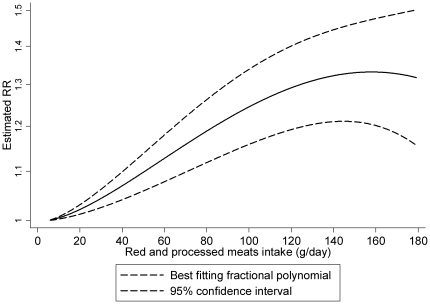
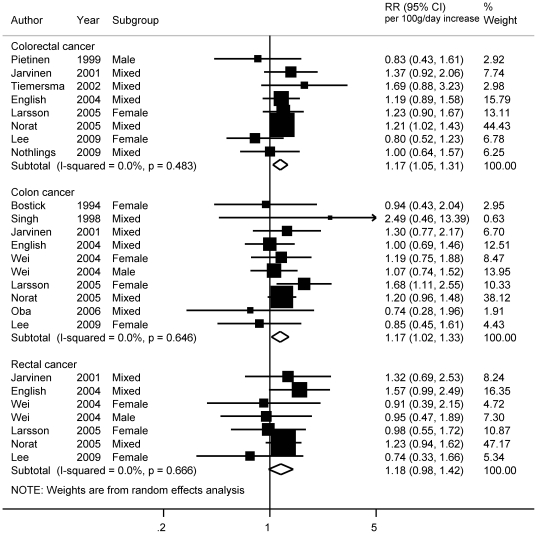
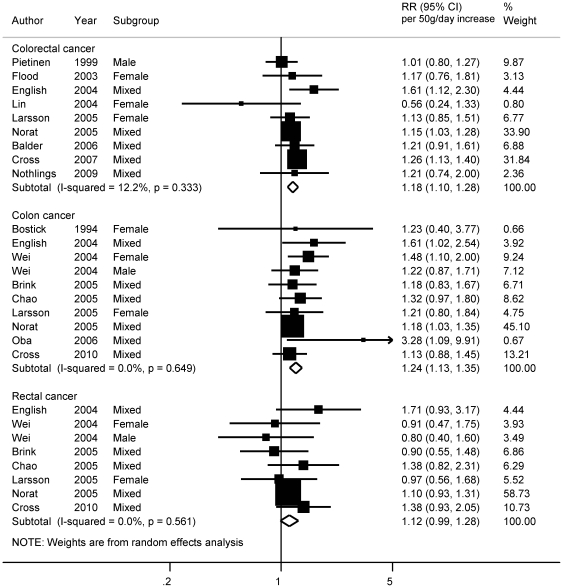
BACKGROUND: The evidence that red and processed meat influences colorectal carcinogenesis was judged convincing in the 2007 World Cancer Research Fund/American Institute of Cancer Research report. Since then, ten prospective studies have published new results. Here we update the evidence from prospective studies and explore whether there is a non-linear association of red and processed meats with colorectal cancer risk. METHODS AND FINDINGS: Relevant prospective studies were identified in PubMed until March 2011. For each study, relative risks and 95% confidence intervals (CI) were extracted and pooled with a random-effects model, weighting for the inverse of the variance, in highest versus lowest intake comparison, and dose-response meta-analyses. Red and processed meats intake was associated with increased colorectal cancer risk. The summary relative risk (RR) of colorectal cancer for the highest versus the lowest intake was 1.22 (95% CI = 1.11-1.34) and the RR for every 100 g/day increase was 1.14 (95% CI = 1.04-1.24). Non-linear dose-response meta-analyses revealed that colorectal cancer risk increases approximately linearly with increasing intake of red and processed meats up to approximately 140 g/day, where the curve approaches its plateau. The associations were similar for colon and rectal cancer risk. When analyzed separately, colorectal cancer risk was related to intake of fresh red meat (RR(for 100 g/day increase) = 1.17, 95% CI = 1.05-1.31) and processed meat (RR (for 50 g/day increase) = 1.18, 95% CI = 1.10-1.28). Similar results were observed for colon cancer, but for rectal cancer, no significant associations were observed. CONCLUSIONS: High intake of red and processed meat is associated with significant increased risk of colorectal, colon and rectal cancers. The overall evidence of prospective studies supports limiting red and processed meat consumption as one of the dietary recommendations for the prevention of colorectal cancer.
Overview
The claims and statistics of this paper haven’t been checked yet.
Free: it reads the open-access text and checks the first 5 claims that cite a source we can check. Create a free account to check every claim.
Integrity signals
Registry
Cites
Statistics
Figures
Verification
Claims the paper makes
The claims and statistics of this paper haven’t been checked yet.
Free: it reads the open-access text and checks the first 5 claims that cite a source we can check. Create a free account to check every claim.
Claims other papers make about this one
Each is checked against this paper’s own text: does it say what the citing paper says it does?
The cited source says what the claim attributes to it.
In the citing paper
“quality and obesity 54,55 , and processed meat with colorectal cancer 56 .”
From Ultra‐processed foods and the nutrition transition: global, regional and national trends, food systems transformations and political economy drivers (2020) · cites this paper as [56]
Self-check
Percentages, sums and reported differences re-computed from the paper’s own numbers.
The self-check needs the paper’s full text.
Citations
Cites
Meta-analysis in clinical trials
DerSimonian, R., & Laird, N. (1986) · Controlled Clinical Trials · doi:10.1016/0197-2456(86)90046-2 · Cited by 39,552 · cited 1×
“We present the results from the randomeffects meta-analysis that accounts for between-study heterogeneity [31] unless otherwise specified.”
MethodQuantifying heterogeneity in a meta‐analysis
Higgins, J. P. T., & Thompson, S. G. (2002) · Statistics in Medicine · doi:10.1002/sim.1186 · Cited by 36,763 · cited 1×
“To assess heterogeneity, we computed the Cochran Q test and I(2) statistic [36].”
MethodEstimates of worldwide burden of cancer in 2008: GLOBOCAN 2008
Ferlay, J., Shin, H., Bray, F., Forman, D., Mathers, C., & Parkin, D. M. (2010) · International Journal of Cancer · doi:10.1002/ijc.25516 · Cited by 21,293 · cited 1×
“Incidence rates are highest in North America, Western Europe, Australia/New Zealand, and in Asian countries that have experienced nutrition transition, such as Japan, Singapore, and North-Korea [1].”
BackgroundFood, nutrition, physical activity, and the prevention of cancer: a global perspective
(2008) · Choice Reviews Online · doi:10.5860/choice.45-5024 · Cited by 5,350
Publication and related bias in meta-analysis
Sterne, J. A. C., Gavaghan, D., & Egger, M. (2000) · Journal of Clinical Epidemiology · doi:10.1016/s0895-4356(00)00242-0 · Cited by 2,282
Lazcano-Ponce, E. C. (2009) · Salud Pública de México · Cited by 1,669
Worldwide Variations in Colorectal Cancer
Center, M. M., Jemal, A., Smith, R. A., & Ward, E. (2009) · CA: A Cancer Journal for Clinicians · doi:10.3322/caac.20038 · Cited by 1,276 · cited 1×
“carcinogenesis is indicated by the increase in colorectal cancer incidence in parallel with economic development and adoption of a western lifestyle [4], as well as by the results of migration studies that demonstrate a greater lifetime incidence of colorectal cancer among immigrants to high-incidence, industrialized…”
BackgroundWillett, W. C., Stampfer, M. J., Colditz, G. A., Rosner, B. A., & Speizer, F. E. (1990) · New England Journal of Medicine · doi:10.1056/nejm199012133232404 · Cited by 1,248 · cited 6×
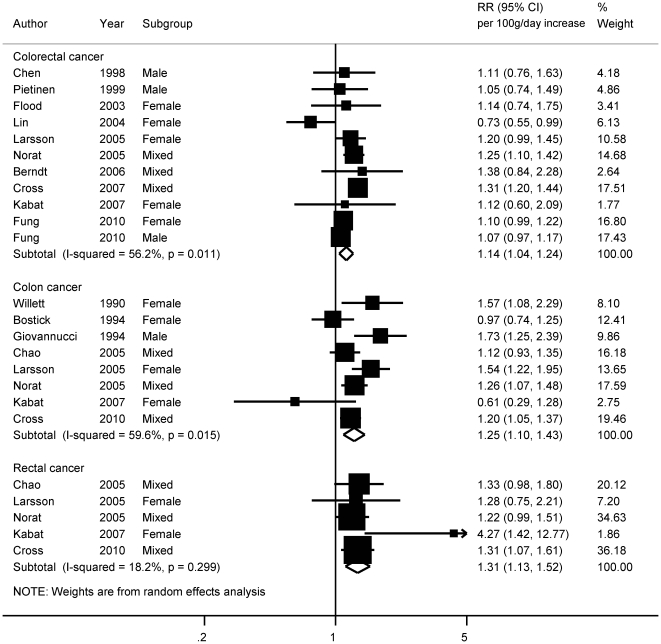
“References: Chen, 1998 [51]; Pietinen, 1999 [57]; Flood, 2003 [33]; Lin, 2004 [56]; Larsson, 2005 [34]; Norat, 2005 [50]; Berndt, 2006 [19]; Cross, 2007 [22]; Kabat, 2007 [24]; Fung, 2010 [23]; Willett, 1990 [58]; Bostick, 1994 [52]; Giovannuccci, 1994 [55]; Chao, 2005 [54]; Cross, 2010 [21].”
ResultInfluentialGeneralized Least Squares for Trend Estimation of Summarized Dose–response Data
Orsini, N., Bellocco, R., & Greenland, S. (2006) · The Stata Journal: Promoting communications on statistics and Stata · doi:10.1177/1536867x0600600103 · Cited by 1,241 · cited 1×
“In linear dose-response meta-analyses, we pooled the relative risk estimates per unit of intake increase (with its standard error) reported in the studies, or computed by us from the categorical data using generalized least-squares for trend estimation [32].”
MethodCairns, S. R., Scholefield, J. H., Steele, R. J., Dunlop, M. G., Thomas, H. J. W., Evans, G. D., Eaden, J. A., Rutter, M. D., Atkin, W. P., Saunders, B. P., et al. (2010) · Gut · doi:10.1136/gut.2009.179804 · Cited by 1,141 · cited 1×
“Screening and surveillance of adenomatous polyps, a precursor of colorectal cancer, is currently the cornerstone for primary prevention of colorectal cancer [6].”
Background
Research works printed but not linked: 2
- 2003, Food, Nutrition, Physical Activity, and the Prevention of Cancer: a Global Perspective, Systematic Literature Review Specification Manual
- A Tobias, 1999, Assessing the influence of a single study in meta-analysis., Stata Tech Bull, 47, 15
Cited by
Items 401–500 of 912
Awareness of Dietary and Alcohol Guidelines Among Colorectal Cancer Survivors
Hawkins, N. A., Berkowitz, Z., & Rodriguez, J. L. (2015) · American Journal of Preventive Medicine · doi:10.1016/j.amepre.2015.08.012 · Cited by 20
Gaab, M. E., Lozano, P. O., Ibañez, D., Manese, K. D., Riego, F. M., Tiongco, R. E., & Albano, P. M. (2022) · Laboratory Medicine · doi:10.1093/labmed/lmac072 · Cited by 23
Differences in survival associated with processed and with nonprocessed red meat consumption , ,
Bellavia, A., Larsson, S. C., Bottai, M., Wolk, A., & Orsini, N. (2014) · American Journal of Clinical Nutrition · doi:10.3945/ajcn.114.086249 · Cited by 20
Mackenzie, M., & Shanahan, L. (2018) · Nutrition & Food Science · doi:10.1108/nfs-12-2017-0266 · Cited by 18
Giesbertz, P., Brandl, B., Lee, Y., Hauner, H., Daniel, H., & Skurk, T. (2020) · Molecular Nutrition & Food Research · doi:10.1002/mnfr.201900921 · Cited by 19
Thøgersen, R., Castro-Mejía, J. L., Sundekilde, U. K., Hansen, L. H., Gray, N., Kuhnle, G., Jørgensen, N. R., Hansen, A. K., Nielsen, D. S., & Bertram, H. C. (2020) · Food Chemistry · doi:10.1016/j.foodchem.2020.127291 · Cited by 26
Shoraka, H. R., Abobakri, O., Naghibzadeh‐Tahami, A., Mollaei, H. R., Bagherinajad, Z., Afshar, R. M., & Shahesmaeili, A. (2020) · Asian Pacific Journal of Cancer Prevention · doi:10.31557/apjcp.2020.21.6.1499 · Cited by 17
“Keywords: Colorectal neoplasms- JC virus- BK virus- systematic review- meta-analysis with increased risk of CRC (Liang et al., 2009; Chan et al., 2011).”
BackgroundYang, K., Wang, Y., Zhang, F., Luo, B., Feng, D., & Zeng, Z. (2021) · Laboratory Investigation · doi:10.1038/s41374-021-00632-3 · Cited by 17
O’Connor, L., Walton, J., & Flynn, A. (2014) · British Journal Of Nutrition · doi:10.1017/s0007114514003420 · Cited by 17
SIRT1 and the Clock Gene Machinery in Colorectal Cancer
Pazienza, V., Piepoli, A., Panza, A., Valvano, M. R., Benegiamo, G., Vinciguerra, M., Andriulli, A., & Mazzoccoli, G. (2012) · Cancer Investigation · doi:10.3109/07357907.2011.640650 · Cited by 20
“Incidence rates are stable or decreasing in long-standing economically developed countries, while they continue to increase in economically transitioning countries (26, 27).”
BackgroundSattari, Z., Nielsen, T. S., & Hedemann, M. S. (2018) · International Journal of Food Sciences and Nutrition · doi:10.1080/09637486.2018.1499711 · Cited by 20
“However, a dose-dependent relationship is stablished between the red and processed meat consumption and colorectal cancer (CRC) risk (Chan et al. 2011; O’keefe 2016).”
BackgroundNew cancer cases attributable to diet among adults aged 30–84 years in France in 2015
Shield, K. D., Freisling, H., Boutron‐Ruault, M., Touvier, M., Micallef, C. M., Jenab, M., Deschamps, V., Hill, C., Ferrari, P., Margaritis, I., et al. (2018) · British Journal Of Nutrition · doi:10.1017/s0007114518002544 · Cited by 20
“0) 1·18 1·01, 1·38 100g/d increase WCRF(19) Colorectum (C18–20) 1·39 1·21, 1·64 100g/d increase Chan et al.(90) WCRF, World Cancer Research Fund.”
BackgroundInfluentialDiet, Gut Microbiome, and Their End Metabolites Associate With Acute Pancreatitis Risk
Yazıcı, C., Thaker, S., Castellanos, K., Rashdan, H., Huang, Y., Sarraf, P., Boulay, B. R., Grippo, P. J., Gaskins, H. R., Danielson, K. K., et al. (2023) · Clinical and Translational Gastroenterology · doi:10.14309/ctg.0000000000000597 · Cited by 19
Unlocking the potential of forage fish to reduce the global burden of disease
Xia, S., Takakura, J., Tsuchiya, K., Park, C. Y., Heneghan, R., & Takahashi, K. (2024) · BMJ Global Health · doi:10.1136/bmjgh-2023-013511 · Cited by 17
Estimating the incidence of colorectal cancer in South East Asia
Kokki, I., Papana, A., Campbell, H. J., & Τheodoratou, E. (2013) · Croatian Medical Journal · doi:10.3325/cmj.2013.54.532 · Cited by 16
Malcomson, F. C. (2018) · Nutrition Bulletin · doi:10.1111/nbu.12359 · Cited by 16
“A meta-analysis of 28 prospective studies concluded that a 14% increase in CRC risk was associated with each 100 g daily increase in total red and processed meat intake (Chan et al. 2011).”
MethodMøller, G., Andersen, J. R., Jalo, E., Ritz, C., Brand-Miller, J. C., Larsen, T. M., Silvestre, M. P., Fogelholm, M., Poppitt, S. D., Raben, A., et al. (2019) · European Journal of Nutrition · doi:10.1007/s00394-019-02008-2 · Cited by 16
Saito, E., Tang, X., Abe, S. K., Sawada, N., Ishihara, J., Takachi, R., Iso, H., Shimazu, T., Yamaji, T., Iwasaki, M., et al. (2020) · PLoS ONE · doi:10.1371/journal.pone.0244007 · Cited by 21
“Epidemiological studies have reported that excessive intake of meat, especially red meat and processed meat, is associated with increased risk of morbidity, including heart disease [4], cardiovascular disease [5], diabetes [6, 7] and certain types of cancer [8, 9].”
BackgroundHuman α-defensin 5 suppressed colon cancer growth by targeting PI3K pathway
Qiao, Q., Bai, R., Song, W., Gao, H., Zhang, M., Lu, J., Hong, M., Zhang, X., Sun, P., Zhang, Q., et al. (2021) · Experimental Cell Research · doi:10.1016/j.yexcr.2021.112809 · Cited by 16
Yan, F., Tu, Z., Duan, L., Wang, D., & Lin, F. (2018) · Molecular Medicine Reports · doi:10.3892/mmr.2018.8682 · Cited by 19
RetractedZhang, M., Yang, D., & Gold, B. I. (2018) · Mutation research. Fundamental and molecular mechanisms of mutagenesis · doi:10.1016/j.mrfmmm.2018.04.003 · Cited by 16
Horniblow, R. D., Latunde-Dada, G. O., Harding, S. E., Schneider, M., Almutairi, F. M., Sahni, M., Bhatti, A., Ludwig, C., Norton, I. T., Iqbal, T. H., et al. (2016) · Molecular Nutrition & Food Research · doi:10.1002/mnfr.201500882 · Cited by 19
“[5, 6, 25, 26] The ingestion of high amounts of red and processed meats, foods that contain high levels of iron, have also been implicated in gastrointestinal disease.[27, 28] Exactly how iron is mediating disease progression within the large bowel is currently unknown.”
BackgroundȘerban, R.-E., Boldeanu, M. V., Florescu, D. N., Ionescu, M., Şerbănescu, M.-S., Boldeanu, L., Florescu, M. M., Stepan, M. D., Obleagă, C. V., Constantin, C., et al. (2024) · Journal of Clinical Medicine · doi:10.3390/jcm13185616 · Cited by 17
Johnstone, A. M. (2013) · Elsevier eBooks · doi:10.1533/9780857098719.3.128 · Cited by 18
XRCC1 Gene Polymorphism, Diet and Risk of Colorectal Cancer in Thailand
Poomphakwaen, K., Promthet, S. S., Suwanrungruang, K., Chopjitt, P., Songserm, N., & Wiangnon, S. (2014) · Asian Pacific Journal of Cancer Prevention · doi:10.7314/apjcp.2014.15.17.7479 · Cited by 15
Alegría-Lertxundi, I., Aguirre, C., Bujanda, L., Fernández, J., Polo, F. J., Ordovás, J. M., Etxezarraga, M. C., Zabalza, I., Larzábal, M., Portillo, I., et al. (2020) · Nutrients · doi:10.3390/nu12082362 · Cited by 16
“However, red/processed meat [19], tobacco and alcohol consumption [20] and obesity [21] are considered risk factors for CRC.”
BackgroundSkyrud, K. D., Myklebust, T. Å., Bray, F., Eriksen, M., de Lange, T., Larsen, I. K., & Møller, B. (2017) · Cancer Epidemiology Biomarkers & Prevention · doi:10.1158/1055-9965.epi-17-0265 · Cited by 21
Meat intake and non-Hodgkin lymphoma: a meta-analysis of observational studies
Solimini, A. G., Lombardi, A. M., Palazzo, C., & Giusti, M. D. (2016) · Cancer Causes & Control · doi:10.1007/s10552-016-0745-2 · Cited by 18
“Previous research showed that increased meat consumption was associated with increased risk of many chronic diseases such as type 2 diabetes [73], stroke [74], gastric [75, 76], colorectal, colon, and rectal cancers [53], and all-cause mortality [48].”
BackgroundMethodIshak, W. R. W., Maihiza, M. S. N., & Raushan, M. (2015) · International Food Research Journal · Cited by 14
Saiken, A., & Gu, F. (2016) · Clinical Interventions in Aging · doi:10.2147/cia.s105472 · Cited by 14
Kou, Y., Qiao, L., & Wang, Q. (2014) · Tumor Biology · doi:10.1007/s13277-014-2832-x · Cited by 17
“CRC has been associated with many risk factors such as smoking [2], red and processed meat consumption [3], large amounts of alcohol consumption [4], as well as overweight and obesity [5].”
BackgroundRetractedHenríquez-Mendoza, G., de Vries, E., Quintero-Lesmes, D. C., & Herrán, O. F. (2017) · Colombia medica · doi:10.25100/cm.v48i2.2458 · Cited by 15
Huang, X., Qin, S., Liu, Y., Lin, T., & Jiang, H. (2018) · Bioscience Reports · doi:10.1042/bsr20181750 · Cited by 14
Kim, J., Park, E. Y., Park, E., Lim, M. K., Oh, J., & Kim, B. (2020) · International Journal of Environmental Research and Public Health · doi:10.3390/ijerph17228687 · Cited by 17
Puglisi, C., Giuffrida, R., Borzì, G. R., Mattia, P. D., Costa, A., Colarossi, C., Deiana, E., Picardo, M. C., Colarossi, L., Mare, M., et al. (2020) · Cancers · doi:10.3390/cancers12123672 · Cited by 14
“While specific causes of CRC insurgence have not been identified, different factors have been implicated in colorectal tumorigenesis, including genetic background, age, and different lifestyle factors, such as alcohol consumption [2], smoking [3], obesity [4], physical inactivity [5], and a dietary regimen comprising…”
BackgroundRamsing, R., Chang, K. B., Hendrickson, Z. M., Xu, Z., Friel, M., & Calves, E. (2021) · Journal of Agriculture Food Systems and Community Development · doi:10.5304/jafscd.2021.102.026 · Cited by 18
Semlali, A., Almutairi, M. H., Alamri, A. M., Parine, N. R., Arafah, M., Almadi, M. A., Aljebreen, A., Alharbi, O., Azzam, N. A., Almutairi, R., et al. (2021) · Genes · doi:10.3390/genes12091386 · Cited by 14
“Obesity [7], excessive alcohol consumption [8], excessive red meat and processed meat consumption [9], a high fat diet [10], smoking, low socioeconomic status [11], and physical inactivity are factors that might lead to the disease [12].”
BackgroundRPL27 contributes to colorectal cancer proliferation and stemness via PLK1 signaling
Park, S., Seo, D., Jeon, E.-H., Park, J., Jang, B., Kim, J. H., Im, S., Lee, J., Kim, S., Cho, C., et al. (2023) · International Journal of Oncology · doi:10.3892/ijo.2023.5541 · Cited by 15
Significant heterogeneity in the geographical distribution of diffuse grade II/III gliomas in France
Darlix, A., Zouaoui, S., Virion, J., Rigau, V., Mathieu‐Daudé, H., Blonski, M., Reyes-Botero, G., Bessaoud, F., Trétarre, B., Bauchet, F., et al. (2014) · Journal of Neuro-Oncology · doi:10.1007/s11060-014-1585-0 · Cited by 17
Detoxification of chlorella supplement on heterocyclic amines in Korean young adults
Lee, I., Tran, M., Evans‐Nguyen, T., Stickle, D. M., Kim, S.-Y., Han, J.-G., Park, J. Y., & Yang, M. (2014) · Environmental Toxicology and Pharmacology · doi:10.1016/j.etap.2014.11.015 · Cited by 14
Effects of dietary beef, pork, chicken and salmon on intestinal carcinogenesis in A/J Min/+ mice
Steppeler, C., Sødring, M. S., Egelandsdal, B., Kirkhus, B., Oostindjer, M., Alvseike, O. A., Gangsei, L. E., Hovland, E.-M., Pierre, F., & Paulsen, J. E. (2017) · PLoS ONE · doi:10.1371/journal.pone.0176001 · Cited by 16
Carr, P. R., Holleczek, B., Stegmaier, C., Brenner, H., & Hoffmeister, M. (2017) · American Journal of Clinical Nutrition · doi:10.3945/ajcn.116.148304 · Cited by 14
Vidigal, V. M., Aguiar, P. N., Silva, T. D., de Oliveira, J., Pimenta, C. A. M., Felipe, A. V., & Forones, N. M. (2017) · The International Journal of Biological Markers · doi:10.5301/ijbm.5000282 · Cited by 14
“(such as mutations in the RAS gene and microsatellite instabilities), behavioral aspects (such as obesity and ingestion of excessive amounts of meat) and inflammatory bowel diseases (3-6).”
BackgroundSEX COMPOSITION OF THE WORKPLACE AND MORTALITY RISK
Barclay, K. (2012) · Journal of Biosocial Science · doi:10.1017/s002193201200079x · Cited by 16
“It should be added, however, that research has also documented a causal relationship between both alcohol consumption and unhealthy dietary patterns and cancer (Boffetta et al., 2006; Boffetta & Hashibe, 2006; Benetou et al., 2008; Lucenteforte et al., 2008; Chan et al., 2011).”
BackgroundNutritional evaluation of lowering consumption of meat and meat products in the Nordic context
Tetens, I., Hoppe, C., Andersen, L. F., Helldán, A., Lemming, E. W., Trolle, E., Totland, T. H., & Lindroos, A. K. (2013) · doi:10.6027/tn2013-506 · Cited by 19
Modos de vida entre pessoas que tiveram câncer no Brasil em 2013
Silva, G. A. E., Rezende, L. F. M. D., Gomes, F. D. S., Souza Júnior, P. R. B. D., Szwarcwald, C. L., & Eluf Neto, J. (2016) · Ciência & Saúde Coletiva · doi:10.1590/1413-81232015211.24722015 · Cited by 13
Fusobacterium nucleatum—The Cause of Human Colorectal Cancer
Barukčić, I. (2018) · Journal of Biosciences and Medicines · doi:10.4236/jbm.2018.63004 · Cited by 23
“Over the past few decades, a number of life style and environmental factors contributing to the occurrence of colorectal cancer have been identified, including low vegetable and fruit intake [3] and tobacco smoking [4], family history of colorectal cancer [5], high consumption of red and processed meat [6], excessive…”
BackgroundThe Drivers of the Nutritional Quality and Carbon Footprint of School Menus in the Paris Area
Chiaverina, P., Raynaud, E., Fillâtre, M., Nicklaus, S., & Bellassen, V. (2022) · Journal of Agricultural & Food Industrial Organization · doi:10.1515/jafio-2021-0051 · Cited by 23
Lehr, K., Lange, U. G., Hipler, N. M., Vilchez‐Vargas, R., Hoffmeister, A., Feisthammel, J., Buchloh, D., Schanze, D., Zenker, M., Gockel, I., et al. (2024) · Scientific Reports · doi:10.1038/s41598-024-65320-w · Cited by 14
Hajifathalian, K., Tafesh, Z., Rosenblatt, R. E., Kumar, S. R., Homan, E. A., Sharaiha, R. Z., Cohen, D. E., Brown, R. S., & Fortune, B. E. (2021) · Journal of Clinical Gastroenterology · doi:10.1097/mcg.0000000000001503 · Cited by 14
Valuation of the health and climate-change benefits of healthy diets
Springmann, M., & Springmann, M. (2020) · FAO eBooks · doi:10.4060/cb1699en · Cited by 35
“…the risk factors to the disease endpoints were adopted from meta-analyses of prospective cohort studies (Afshin et al., 2014; Aune et al., 2016a, 2016b, 2016c; Bechthold et al., 2019; Chan et al., 2011; Schwingshackl et al., 2017; The Global BMI Mortality Collaboration, 2016; Zheng et al., 2012).”
MethodNine dietary habits and risk of colorectal cancer: a Mendelian randomization study
He, M., Huan, L., Wang, X., Fan, Y., & Huang, J. (2024) · BMC Medical Genomics · doi:10.1186/s12920-023-01782-7 · Cited by 16
“Chen et al. [62]showed that the linear curve of red and processed meat and colorectal cancer approached its plateau at high intakes of up to about 100 g/day.”
BackgroundWang, Y., Yang, H., Li, L., & Xia, X. (2012) · Cytokine · doi:10.1016/j.cyto.2012.09.014 · Cited by 14
“The etiology of colorectal cancer is considered to be multifactorial, and to consist of high intake of red and processed meat [4], excess body weight [5], heavy cigarette smoking [6] and heavy alcohol consumption [7].”
BackgroundCarr, P. R., Banbury, B. L., Berndt, S. I., Campbell, P. T., Chang-Claude, J. C., Hayes, R. B., Howard, B. V., Jansen, L., Jacobs, E. J., Lane, D. S., et al. (2018) · Clinical Gastroenterology and Hepatology · doi:10.1016/j.cgh.2018.11.036 · Cited by 13
Bianchi, F., Aveyard, P. N., Astbury, N. M., Cook, B., Cartwright, E., & Jebb, S. A. (2019) · BMJ Open · doi:10.1136/bmjopen-2018-027016 · Cited by 17
Wu, T., Sonoda, S., & Liu, H. (2019) · Nutrition & Dietetics · doi:10.1111/1747-0080.12555 · Cited by 13
Wedekind, R., Keski‐Rahkonen, P., Robinot, N. R., Viallon, V., Rothwell, J. A., Boutron‐Ruault, M., Aleksandrova, K., Wittenbecher, C., Schulze, M. B., Halkjær, J., et al. (2021) · Molecular Nutrition & Food Research · doi:10.1002/mnfr.202001141 · Cited by 13
Bi, H., Tian, T., Zhu, L., Zhou, H., Hu, H., Liu, Y., Li, X., Hu, F., Zhao, Y., & Wang, G. (2016) · Scientific Reports · doi:10.1038/srep29869 · Cited by 13
“NEDD4-1 is overexpressed in cancer cell lines 12,50 , animal models 56–58 , and in human cancer tissues 59–61 .”
Qi, X., Xu, H., Zhang, P., Chen, G., Chen, Z., Fang, C., & Lin, L. (2021) · Evidence-based Complementary and Alternative Medicine · doi:10.1155/2021/3905367 · Cited by 15
“Previous studies have indicated that the majority of CRC cells originate from colon stem cells, which were located at the base of colonic crypts [3, 4], and several risk factors such as smoking [5], excessive alcohol ingestion [6], and red meat consumption [7] have been identified to contribute to the genetic mutation…”
BackgroundDeciphering the impact of dietary habits and behavioral patterns on colorectal cancer
Yuan, Q., Liu, J., Wang, X., Du, C., Zhang, Y., Lin, L., Wang, C., & Hong, Z. (2025) · International Journal of Surgery · doi:10.1097/js9.0000000000002229 · Cited by 14
“However, in the non-linear dose-response analysis, CRC risk increased approximately linearly with higher red and processed meat intake, reaching a plateau around 140 grams per day [ 38 ] .”
Jabbari, M., Barati, M., Fathollahi, A., Javanmardi, F., Hemmati, F., Farahmand, F., Mirmiran, P., Eini‐Zinab, H., & Khaneghah, A. M. (2020) · Nutrition and Cancer · doi:10.1080/01635581.2020.1819349 · Cited by 12
Carvalho, C., Correia, D. M., Severo, M., Afonso, C., Bandarra, N. M., Gonçalves, S., Lourenço, H. M., Dias, M. D. G., Oliveira, L., Nabais, P. M., et al. (2021) · British Journal Of Nutrition · doi:10.1017/s0007114521004773 · Cited by 13
“Processed meat: RRCRCproc= 1·18 (95% CI: 1·10, 1·28)/50 g/d(33)”
Huang, H.-C., Shiu, B., Su, S., Huang, C., Ting, W., Chang, L., Yang, S., & Chou, Y. (2022) · Diagnostics · doi:10.3390/diagnostics12071685 · Cited by 12
Targeted policy intervention for reducing red meat consumption: conflicts and trade-offs
James, W. H. M., Lomax, N., Birkin, M. H., & Collins, L. (2022) · BMC Nutrition · doi:10.1186/s40795-022-00570-3 · Cited by 12
“[13, 36],), we classify sausages and burgers as processed meat products.”
BackgroundSalliou, N. (2023) · Frontiers in Sustainable Food Systems · doi:10.3389/fsufs.2023.1122992 · Cited by 16
“Increased red meat consumption is correlated with an increased risk of stroke, diabetes (Larsson and Orsini, 2014) and cancers (Chan et al., 2011; Bouvard et al., 2015; Farvid et al., 2021).”
BackgroundWu, Z., Wang, W., Zhang, K., Fan, M., & Lin, R. (2023) · Molecular Nutrition & Food Research · doi:10.1002/mnfr.202300144 · Cited by 14
Jouanin, I., Chevolleau, S., Canlet, C., Lorber, C. Y., Pierre, F. H. F., Guéraud, F., & Debrauwer, L. (2015) · Synthetic Communications · doi:10.1080/00397911.2015.1035791 · Cited by 12
Kassier, S. (2016) · South African Journal of Clinical Nutrition · doi:10.1080/16070658.2016.1217645 · Cited by 16
Chen, J. X., Wang, H., Liu, A., Zhang, L., Reuhl, K. R., & Yang, C. S. (2016) · Toxicological Sciences · doi:10.1093/toxsci/kfw190 · Cited by 12
Processed Meat and Colorectal Cancer Risk: A Pooled Analysis of Three Italian Case-Control Studies
Rosato, V., Tavani, A., Negri, E., Serraino, D., Montella, M., Decarli, A., Vecchia, C. L., & Ferraroni, M. (2017) · Nutrition and Cancer · doi:10.1080/01635581.2017.1310259 · Cited by 12
“28 for an increased intake of 50 g/day (2).”
BackgroundMethodResultInfluentialRibeiro, R. R. A., de Brito, I. R., Souza, K. A., Souza, L. D. C., de Oliveira, T. A., & Weller, M. (2021) · Nutrition and Cancer · doi:10.1080/01635581.2021.1926519 · Cited by 16
“unprocessed meat increased the risk of CRC (48).”
BackgroundRethinking Red Meat as a Prevention Strategy for Iron Deficiency
Agarwal, U. (2013) · ICAN Infant Child & Adolescent Nutrition · doi:10.1177/1941406413491285 · Cited by 12
The Impact of Life Style and Nutritional Components in Primary Prevention of Colorectal Cancer
Dahham, S. S., & Majid, A. M. S. A. (2016) · Journal of Applied Pharmaceutical Science · doi:10.7324/japs.2016.60935 · Cited by 12
“A recent meta-analysis of 21 prospective large-cohort studies shows that the risk of CRC increases approximately linearly with excessive red meat intake; the risk of CRC was estimated to increase about 14 % for 100 g/day increase of total red and processed meats (Chan et al. , 2011).”
Lay beliefs about risk: relation to risk behaviors and to probabilistic risk perceptions
Riley, K. E., Hay, J. L., Waters, E. A., Biddle, C., Schofield, E., Li, Y., Orom, H., & Kiviniemi, M. T. (2019) · Journal of Behavioral Medicine · doi:10.1007/s10865-019-00036-1 · Cited by 14
The Environmental Cost of Red Meat: Striking the Right Balance Between Nutrition and Nature
Smith, M. R., & Myers, S. S. (2022) · American Journal of Health Promotion · doi:10.1177/08901171221088661b · Cited by 12
Zhang, X., Wu, Z., Wang, X., Xin, B., Hu, P. F., Yin, Y., He, S., & Ren, M. (2024) · Frontiers in Nutrition · doi:10.3389/fnut.2024.1388732 · Cited by 14
“According to previous studies, alcohol intake (11), red meat intake, processed meat intake (12), vegetable intake, and fruit intake (13) were associated with the pathophysiology of CRC.”
BackgroundLiu, S., Deng, Y., Liu, H., Fu, Z., Wang, Y., Zhou, M., & Feng, Z. (2024) · Nutrients · doi:10.3390/nu16152433 · Cited by 11
Teixeira, D. C., Kokojka, F., Kolukuluri, R. S., Marks, R. S., & Naik, A. S. (2024) · Food Reviews International · doi:10.1080/87559129.2024.2428392 · Cited by 12
Micronutrient challenges across the age spectrum: Is there a role for red meat?
Ruxton, C. H. S., Derbyshire, E. J., & Pickard, R. S. (2012) · Nutrition Bulletin · doi:10.1111/nbu.12000 · Cited by 12
Nikitina, E., Burk‐Körner, A., Wiesenfarth, M., Alwers, E., Heide, D., Tessmer, C., Ernst, C., Krunic, D., Schrotz‐King, P., Chang-Claude, J. C., et al. (2023) · Molecular Oncology · doi:10.1002/1878-0261.13390 · Cited by 12
Food systems and human health and nutrition: An economic policy perspective with a focus on Africa
Pinstrup‐Andersen, P. (2012) · Cited by 16
Li, B., Huang, M., Liu, M., Wen, S., & Sun, F. (2017) · Molecular Medicine Reports · doi:10.3892/mmr.2017.7077 · Cited by 12
“The primary risk factors for CRC are age, hereditary components, obesity, excess alcohol and red meat, smoking and a lack of physical exercise (3-6).”
RetractedMorales, A. M., Mukai, R., Murota, K., & Terao, J. (2018) · Journal of Clinical Biochemistry and Nutrition · doi:10.3164/jcbn.18-38 · Cited by 11
Springmann, M. (2019) · Elsevier eBooks · doi:10.1016/b978-0-12-811660-9.00013-8 · Cited by 19
Leptin as a risk factor for the development of colorectal cancer
Rodríguez, A. J., Mastronardi, C. A., & Paz-Filho, G. (2013) · Translational gastrointestinal cancer · doi:10.3978/j.issn.2224-4778.2013.10.04 · Cited by 12
“Colon cancer is associated with many risk factors including increasing age, male sex, genetic predisposition, previous colonic polyps or previous incidence of CRC, diabetes mellitus, and inflammatory bowel disease; and with environmental risk factors such as sedentary behavior, consumption of processed red meats, inad…”
BackgroundDurmuş, S., van der Valk, M., Teunissen, S. F., Song, J., Wagenaar, E., Beijnen, J. H., & Schinkel, A. H. (2019) · Archives of Toxicology · doi:10.1007/s00204-019-02394-w · Cited by 12
Dietary patterns and the risk of colorectal cancer and adenoma: a case control study in Iran.
Bahrami, A., Houshyari, M., Jafari, S., Rafiei, P., Mazandaranian, M. R., Hekmatdoost, A., Sadeghi, A., & Hejazi, E. (2019) · Gastroenterology and hepatology from bed to bench. · Cited by 12
Kou, Y., Qiao, L., & Wang, Q. (2015) · Tumor Biology · doi:10.1007/s13277-015-3789-0 · Cited by 11
The Association Between Diet and Colorectal Cancer Risk: Moving Beyond Generalizations
Moss, A., & Nalankilli, K. (2017) · Gastroenterology · doi:10.1053/j.gastro.2017.04.025 · Cited by 13
“Processed meats result from salting, smoking, fermenting, or curing the meat, and common examples include ham, bacon, and sausage.(5) Furthermore, red meat was declared as probably carcinogenic to humans, and red meat was listed as a group 2A substance.”
BackgroundSuresh, R. S., Garcia, L. E., & Gearhart, S. L. (2024) · Advances in Surgery · doi:10.1016/j.yasu.2024.04.015 · Cited by 10
Gut microbiome and colorectal cancer: From pathogenesis to treatment
Lahouty, M., Fadaee, M., Aghaei, R., Alizadeh, F., Jafari, A., & Sharifi, Y. (2025) · Pathology - Research and Practice · doi:10.1016/j.prp.2025.156034 · Cited by 11
Ho, V., Peacock, S. D., Massey, T. E., Godschalk, R., van Schooten, F., Chen, J., & King, W. D. (2015) · Environmental and Molecular Mutagenesis · doi:10.1002/em.21950 · Cited by 10
“Evidence has provided support for the association between meat consumption and cancer risk, particularly for colorectal cancer [Sandhu et al., 2001; Norat et al., 2002; Larsson and Wolk, 2006; Chan et al., 2011; Alexander et al., 2011; Alexander et al., 2010].”
ResultLiu, Y., Li, S., Jiang, L., Zhang, Y., Li, Z., & Shi, J. C. (2021) · Frontiers in Nutrition · doi:10.3389/fnut.2021.688897 · Cited by 11
A Review of Cultured Meat and its Current Public Perception
Ahmad, N. A., Arshad, F., Zakaria, S. N. A., & Ahmed, M. U. (2023) · Current Nutrition & Food Science · doi:10.2174/1573401319666230227115317 · Cited by 10
A healthful plant-based diet can reduce the risk of developing colorectal cancer: case-control study
Yarmand, S., Rashidkhani, B., Alimohammadi, A., Shateri, Z., Shakeri, M., Sohrabi, Z., & Nouri, M. (2024) · Journal of Health Population and Nutrition · doi:10.1186/s41043-024-00605-4 · Cited by 12
“The potential mechanisms for red meats carcinogenicity include the generation of N-nitroso compounds, heme iron, sulfur-containing amino acids, and saturated fatty acids [28].”
BackgroundKarlitz, J. J., Blanton, C., Andrews, P. A., Chen, V. W., Wu, X., & Fontham, E. T. H. (2014) · Clinical and Translational Gastroenterology · doi:10.1038/ctg.2014.10 · Cited by 10
“Some studies have demonstrated an increased risk of developingCRC in thosewho have increased rates of red meat consumption.(41) However, in other studies an association has been less clear.”
BackgroundMoulahoum, H., Boumaza, B. M. A., Ferrat, M., & Djerdjouri, B. (2018) · Toxicology Research · doi:10.1039/c7tx00213k · Cited by 10
Red meat intake, CYP2E1 and PPARγ polymorphisms, and colorectal cancer risk
Kim, N.-H., Seol, J. E., Kim, J., Lee, B.-H., Hwang, D., Jeong, J., Lee, H. J., Ahn, Y., Kim, D., & Lee, J. E. (2018) · European Journal of Cancer Prevention · doi:10.1097/cej.0000000000000462 · Cited by 10
Falkowski, S., Woillard, J., Postil, D., Tubiana-Mathieu, N., Terrebonne, É., Pariente, A., Smith, D. M., Guimbaud, R., Thalamas, C., Rouguieg-Malki, K., et al. (2017) · BMC Cancer · doi:10.1186/s12885-017-3728-0 · Cited by 15
“≥ 3 portions/week) [9, 42], alcohol consumption (never vs.”
Hirai, H. W., Ching, J. Y. L., Wu, J. C. Y., Sung, J. J. �., Chan, F. K. L., & Ng, S. C. (2018) · Journal of Gastroenterology and Hepatology · doi:10.1111/jgh.14357 · Cited by 10
Metadata
- Authors
- Chan, D. S. M., Lau, R., Aune, D., Vieira, R., Greenwood, D. C., Kampman, E., & Norat, T.
- Affiliations
- Imperial College London (GB)
- University of Leeds (GB)
- Wageningen University & Research (NL)
- Corresponding author
- Norat, Teresa
- Venue
- PLoS ONE
- Publisher
- Public Library of Science (PLoS)
- Published
- 2011-06-06
- Volume
- 6
- Issue
- 6
- Pages
- e20456
- ISSN
- 1932-6203 (ISSN-L)
- PMC
- PMC3108955
- OpenAlex
- W2072090020
- Cited by
- 903
- References
- 72
- Citations by year
- 2026: 29 · 2025: 46 · 2024: 53 · 2023: 67 · 2022: 58 · 2021: 72 · 2020: 69 · 2019: 67 · 2018: 79 · 2017: 73 · 2016: 71 · 2015: 61 · 2014: 62 · 2013: 59 · 2012: 32
- FWCI
- 7.52
- Type
- journal article
- Language
- en
- Open access
- gold
- doi.org
- Locations
- PLoS ONE (publishedVersion, cc-by)
- Europe PMC (PubMed Central) (publishedVersion, cc-by)
- PubMed Central (publishedVersion, cc-by)
- PubMed (publishedVersion)
- Radboud Repository (Radboud University) (publishedVersion)
- White Rose Research Online (University of Leeds, The University of Sheffield, University of York) (acceptedVersion)
- Socio-Environmental Systems Modeling (acceptedVersion)
- RePEc: Research Papers in Economics (submittedVersion)
- DOAJ (DOAJ: Directory of Open Access Journals) (submittedVersion, cc-by-sa)
- Figshare (submittedVersion, cc-by)
- Spiral (Imperial College London) (submittedVersion, other-oa)
- Radboud Repository (Radboud University) (submittedVersion, other-oa)
- Data Archiving and Networked Services (DANS) (submittedVersion, other-oa)
- Funders
- World Cancer Research Fund International (2007/SP01)
- World Cancer Research Fund (2007/SP01)
- Wageningen University and Research
- Topics
- Health Sciences › Medicine › Public Health, Environmental and Occupational Health › Nutritional Studies and Diet
- Health Sciences › Medicine › Oncology › Colorectal Cancer Screening and Detection
- Life Sciences › Agricultural and Biological Sciences › Animal Science and Zoology › Meat and Animal Product Quality
- Keywords
- red meat, processed meat, colorectal cancer, colon cancer, rectal cancer, cancer risk, dietary intake, dose-response relationship, nonlinear relationship, colorectal cancer prevention, dietary recommendations
- MeSH terms
- Female, Food Handling, Humans, Male, Meat, Pigmentation, Prospective Studies, Colorectal Neoplasms, Publication Bias
About these checks
Registry, retraction, Cites and statistics results are computed, not judged, with one exception: a printed reference that no index lists is read once by a model before it counts as a citation error. Claims are extracted by a model and kept only when their quote appears verbatim in the text; each cited source is then checked, with a model’s help, for whether it says what the claim relies on. Those verdicts can be wrong — read the claim’s quote and the cited source before relying on one.
Statistics and arithmetic are recomputed, not judged.
Confidence bands are shown only for fields calibrated on our annotated test set. None is calibrated yet, so no band is shown.
What counts as a claim ›How we measure confidence ›How we check this ›
Are you an author, or do you see a problem with this page? Request a review
Data sources
Bibliographic data: Semantic Scholar, OpenAlex, Crossref.
Contains information from the Semantic Scholar Academic Graph Datasets, made available under the ODC Attribution License (ODC-BY 1.0).
Semantic Scholar’s data is described in: Kinney, R., et al. (2023). The Semantic Scholar Open Data Platform. arXiv:2301.10140.
