

Red and Processed Meat and Colorectal Cancer Incidence: Meta-Analysis of Prospective Studies
Open accessThe DOI matches its Crossref record; 71 of the 72 references it cites were found in a registry or an index.
Abstract
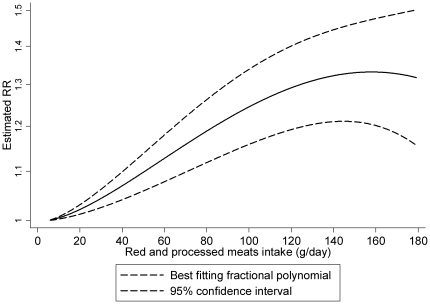
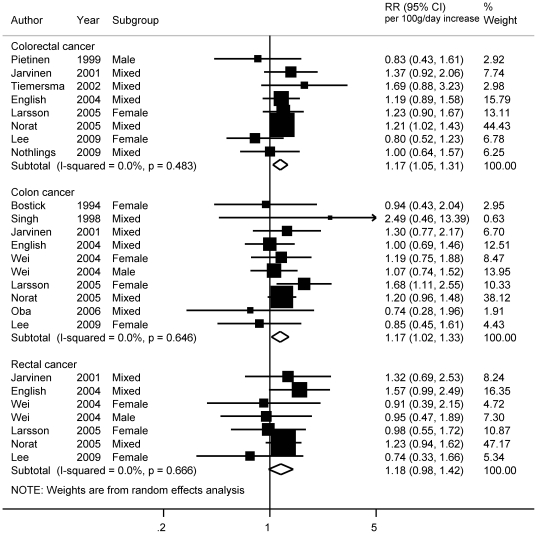
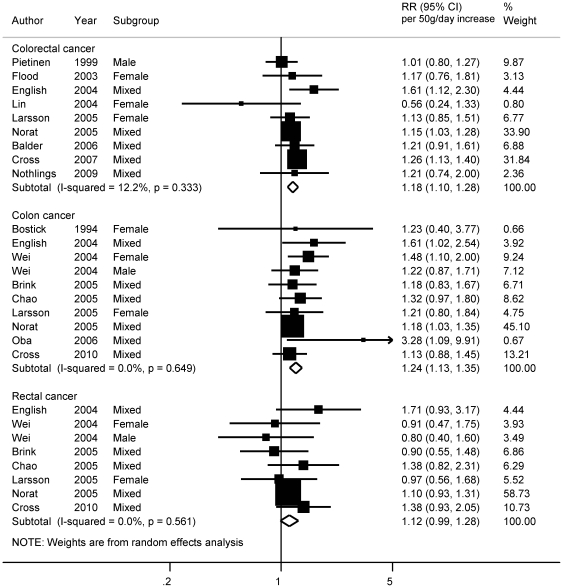
BACKGROUND: The evidence that red and processed meat influences colorectal carcinogenesis was judged convincing in the 2007 World Cancer Research Fund/American Institute of Cancer Research report. Since then, ten prospective studies have published new results. Here we update the evidence from prospective studies and explore whether there is a non-linear association of red and processed meats with colorectal cancer risk. METHODS AND FINDINGS: Relevant prospective studies were identified in PubMed until March 2011. For each study, relative risks and 95% confidence intervals (CI) were extracted and pooled with a random-effects model, weighting for the inverse of the variance, in highest versus lowest intake comparison, and dose-response meta-analyses. Red and processed meats intake was associated with increased colorectal cancer risk. The summary relative risk (RR) of colorectal cancer for the highest versus the lowest intake was 1.22 (95% CI = 1.11-1.34) and the RR for every 100 g/day increase was 1.14 (95% CI = 1.04-1.24). Non-linear dose-response meta-analyses revealed that colorectal cancer risk increases approximately linearly with increasing intake of red and processed meats up to approximately 140 g/day, where the curve approaches its plateau. The associations were similar for colon and rectal cancer risk. When analyzed separately, colorectal cancer risk was related to intake of fresh red meat (RR(for 100 g/day increase) = 1.17, 95% CI = 1.05-1.31) and processed meat (RR (for 50 g/day increase) = 1.18, 95% CI = 1.10-1.28). Similar results were observed for colon cancer, but for rectal cancer, no significant associations were observed. CONCLUSIONS: High intake of red and processed meat is associated with significant increased risk of colorectal, colon and rectal cancers. The overall evidence of prospective studies supports limiting red and processed meat consumption as one of the dietary recommendations for the prevention of colorectal cancer.
Overview
The claims and statistics of this paper haven’t been checked yet.
Free: it reads the open-access text and checks the first 5 claims that cite a source we can check. Create a free account to check every claim.
Integrity signals
Registry
Cites
Statistics
Figures
Verification
Claims the paper makes
The claims and statistics of this paper haven’t been checked yet.
Free: it reads the open-access text and checks the first 5 claims that cite a source we can check. Create a free account to check every claim.
Claims other papers make about this one
Each is checked against this paper’s own text: does it say what the citing paper says it does?
The cited source says what the claim attributes to it.
In the citing paper
“quality and obesity 54,55 , and processed meat with colorectal cancer 56 .”
From Ultra‐processed foods and the nutrition transition: global, regional and national trends, food systems transformations and political economy drivers (2020) · cites this paper as [56]
Self-check
Percentages, sums and reported differences re-computed from the paper’s own numbers.
The self-check needs the paper’s full text.
Citations
Cites
Meta-analysis in clinical trials
DerSimonian, R., & Laird, N. (1986) · Controlled Clinical Trials · doi:10.1016/0197-2456(86)90046-2 · Cited by 39,552 · cited 1×
“We present the results from the randomeffects meta-analysis that accounts for between-study heterogeneity [31] unless otherwise specified.”
MethodQuantifying heterogeneity in a meta‐analysis
Higgins, J. P. T., & Thompson, S. G. (2002) · Statistics in Medicine · doi:10.1002/sim.1186 · Cited by 36,763 · cited 1×
“To assess heterogeneity, we computed the Cochran Q test and I(2) statistic [36].”
MethodEstimates of worldwide burden of cancer in 2008: GLOBOCAN 2008
Ferlay, J., Shin, H., Bray, F., Forman, D., Mathers, C., & Parkin, D. M. (2010) · International Journal of Cancer · doi:10.1002/ijc.25516 · Cited by 21,293 · cited 1×
“Incidence rates are highest in North America, Western Europe, Australia/New Zealand, and in Asian countries that have experienced nutrition transition, such as Japan, Singapore, and North-Korea [1].”
BackgroundFood, nutrition, physical activity, and the prevention of cancer: a global perspective
(2008) · Choice Reviews Online · doi:10.5860/choice.45-5024 · Cited by 5,350
Publication and related bias in meta-analysis
Sterne, J. A. C., Gavaghan, D., & Egger, M. (2000) · Journal of Clinical Epidemiology · doi:10.1016/s0895-4356(00)00242-0 · Cited by 2,282
Lazcano-Ponce, E. C. (2009) · Salud Pública de México · Cited by 1,669
Worldwide Variations in Colorectal Cancer
Center, M. M., Jemal, A., Smith, R. A., & Ward, E. (2009) · CA: A Cancer Journal for Clinicians · doi:10.3322/caac.20038 · Cited by 1,276 · cited 1×
“carcinogenesis is indicated by the increase in colorectal cancer incidence in parallel with economic development and adoption of a western lifestyle [4], as well as by the results of migration studies that demonstrate a greater lifetime incidence of colorectal cancer among immigrants to high-incidence, industrialized…”
BackgroundWillett, W. C., Stampfer, M. J., Colditz, G. A., Rosner, B. A., & Speizer, F. E. (1990) · New England Journal of Medicine · doi:10.1056/nejm199012133232404 · Cited by 1,248 · cited 6×
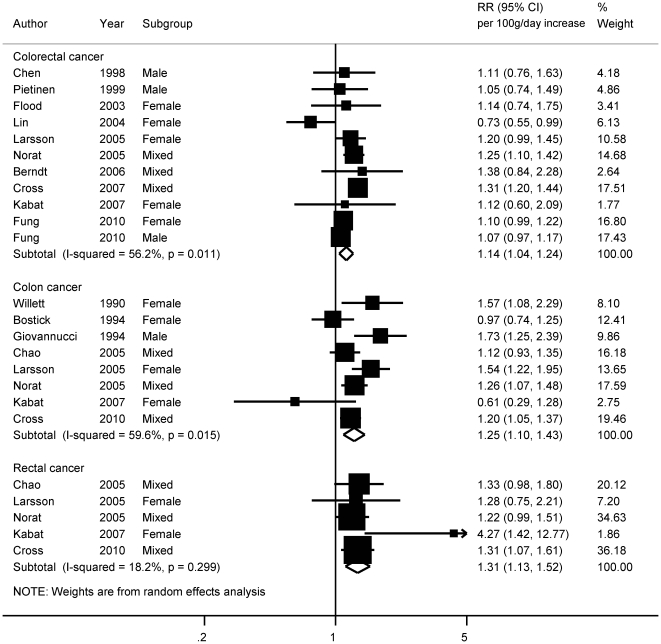
“References: Chen, 1998 [51]; Pietinen, 1999 [57]; Flood, 2003 [33]; Lin, 2004 [56]; Larsson, 2005 [34]; Norat, 2005 [50]; Berndt, 2006 [19]; Cross, 2007 [22]; Kabat, 2007 [24]; Fung, 2010 [23]; Willett, 1990 [58]; Bostick, 1994 [52]; Giovannuccci, 1994 [55]; Chao, 2005 [54]; Cross, 2010 [21].”
ResultInfluentialGeneralized Least Squares for Trend Estimation of Summarized Dose–response Data
Orsini, N., Bellocco, R., & Greenland, S. (2006) · The Stata Journal: Promoting communications on statistics and Stata · doi:10.1177/1536867x0600600103 · Cited by 1,241 · cited 1×
“In linear dose-response meta-analyses, we pooled the relative risk estimates per unit of intake increase (with its standard error) reported in the studies, or computed by us from the categorical data using generalized least-squares for trend estimation [32].”
MethodCairns, S. R., Scholefield, J. H., Steele, R. J., Dunlop, M. G., Thomas, H. J. W., Evans, G. D., Eaden, J. A., Rutter, M. D., Atkin, W. P., Saunders, B. P., et al. (2010) · Gut · doi:10.1136/gut.2009.179804 · Cited by 1,141 · cited 1×
“Screening and surveillance of adenomatous polyps, a precursor of colorectal cancer, is currently the cornerstone for primary prevention of colorectal cancer [6].”
Background
Research works printed but not linked: 2
- 2003, Food, Nutrition, Physical Activity, and the Prevention of Cancer: a Global Perspective, Systematic Literature Review Specification Manual
- A Tobias, 1999, Assessing the influence of a single study in meta-analysis., Stata Tech Bull, 47, 15
Cited by
Items 501–600 of 912
Chronic diseases associated with meat consumption: epidemiology and mechanisms
SMET, S. D., Demeyer, D. I., & HECKE, T. V. (2018) · Wageningen Academic Publishers eBooks · doi:10.3920/978-90-8686-877-3_14 · Cited by 10
Hashari, S. B. T. Z., Rahim, A. A., Goh, Y. M., & Ramiah, S. K. (2020) · Molecules · doi:10.3390/molecules25214978 · Cited by 10
“A meta-analysis study showed that consumption of unprocessed red meat (100 g/day) and processed meat (50 g/day) increased the risk of colorectal cancer by 17 percent and 18 percent, respectively [8].”
BackgroundWang, W., Chang, Y., & Chen, G. (2025) · Scientific Reports · doi:10.1038/s41598-025-88317-5 · Cited by 9
Advancing colorectal cancer research through lipidomics
Santiago, P., Melo, T., Barceló‐Nicolau, M., Barceló‐Coblijn, G., Domingues, P. M., & Domingues, M. R. (2025) · Molecular Omics · doi:10.1039/d5mo00045a · Cited by 9
Wong, M. C. S., Ching, J. Y. L., Chan, V. C. W., Tang, R. S. Y., Luk, A. K. C., Lam, T. Y. T., Wong, S. S. H., Ng, S. C., Ng, S. S. M., Wu, J. C. Y., et al. (2016) · Scientific Reports · doi:10.1038/srep20396 · Cited by 9
The Importance of Meat for Cognitive Development
Balehegn, M., Andrade, J. E., McKune, S. L., & Adesogan, A. T. (2023) · Meat and Muscle Biology · doi:10.22175/mmb.13040 · Cited by 12
Evaluation of the Quality and Lipid Content of Artisan Sausages Produced in Tungurahua, Ecuador
Pérez, L., Pincay, R., Salazar, D., Tapia, N. E. F., & Escolástico, C. (2023) · Foods · doi:10.3390/foods12234288 · Cited by 9
Colorectal cancer and its attributable risk factors in East Asia, 1990–2030
Zhang, J., Zhu, S., Liu, C., Xiao, X., Xie, H., Zhang, Y., & Hong, Y. (2024) · Journal of Gastroenterology and Hepatology · doi:10.1111/jgh.16467 · Cited by 9
Urinary Excretion of N-Nitroso Compounds in Rats Fed Sodium Nitrite and/or Hot Dogs
Zhou, L., Anwar, M. M., Zahid, M., Shostrom, V., & Mirvish, S. S. (2014) · Chemical Research in Toxicology · doi:10.1021/tx5000188 · Cited by 10
Vincent, A., Savolainen, O. I., Sen, P., Carlsson, N., Almgren, A., Lindqvist, H. M., Lind, M. V., Undeland, I., Sandberg, A., & Ross, A. B. (2016) · Molecular Nutrition & Food Research · doi:10.1002/mnfr.201600400 · Cited by 9
Processed meat and selected hormone-related cancers
Rosato, V., Negri, E., Parazzini, F., Serraino, D., Montella, M., Ferraroni, M., Decarli, A., & Vecchia, C. L. (2017) · Nutrition · doi:10.1016/j.nut.2017.10.025 · Cited by 9
Wu, T., Shinde, R., Castro, R. J., & Pierce, J. P. (2021) · Journal of Clinical Medicine · doi:10.3390/jcm10040636 · Cited by 11
“It may also miss the feature that red meat may have different impacts on people with different smoking statuses [56].”
BackgroundSchöttker, B., Gao, X. Y., Jansen, E. H. J. M., & Brenner, H. (2021) · Antioxidants · doi:10.3390/antiox10081195 · Cited by 9
“Meta-analyses of observational studies reported that high dietary intake of haem iron is associated with CRC incidence [4,22].”
BackgroundBaseline sodium nitrate and nitrite concentrations in fresh and processed meats
Bianco, A., Daguer, H., & Kindlein, L. (2021) · Journal of Food Composition and Analysis · doi:10.1016/j.jfca.2021.104227 · Cited by 10
Expression of cholecystokinin receptors in colon cancer and the clinical correlation in Taiwan
Huang, B., Lin, C.-H., Chen, Y.-C., & Kao, S. (2015) · Tumor Biology · doi:10.1007/s13277-015-4306-1 · Cited by 9
“It has been reported that individuals with obesity [2], high red meat consumption [3], and alcohol abuse [4] are at high risk of developing colon cancer.”
BackgroundRombouts, C., Meulebroek, L. V., Spiegeleer, M. D., Goethals, S., HECKE, T. V., SMET, S. D., Vos, W. H. D., & Vanhaecke, L. (2021) · Molecular Nutrition & Food Research · doi:10.1002/mnfr.202000463 · Cited by 9
Interpretation of P16 expression as a marker of HPV in colorectal cancer.
Hafez, F. S., Meckawy, G. R., Alorabi, M., & Shakweer, M. M. (2022) · PubMed · doi:10.14670/hh-18-439 · Cited by 9
“Numerous epidemiological studies have revealed lifestyle and environmental factors that contribute to the occurrence of colorectal carcinoma, such as excessive red meat consumption or tobacco use (Liang et al., 2009; Chan et al., 2011).”
BackgroundHill, B. T. (2019) · Springer eBooks · doi:10.1007/978-3-030-04489-3_2 · Cited by 34
Morgan, E. H., Schoonees, A., Faure, M. C., & Seguin‐Fowler, R. A. (2017) · Cochrane Database of Systematic Reviews · doi:10.1002/14651858.cd012547 · Cited by 19
Health Implications, Toxicity, and Safety Assessment of Functional Food Additives
Mirza, N., Mubarak, H., Haider, S., Farrukh, S., Khan, Q. U., Yasin, S., Husain, A., Qayyum, M. A., Lodhi, M. I., Ismail, Q. M., et al. (2024) · Food science and nutrition · doi:10.5772/intechopen.114357 · Cited by 12
Knowledge mapping of early-onset colorectal cancer from 2000 to 2022: A bibliometric analysis
Zhang, M., Zhu, S., Chen, L., Wu, Y., Ye, Y., Wang, G., Gui, Z., Zhang, C., & Zhang, M. (2023) · Heliyon · doi:10.1016/j.heliyon.2023.e18499 · Cited by 8
Colon Cancer Survivorship in Patients Who Have Received Adjuvant Chemotherapy
Kesireddy, M., & Tenner, L. L. (2023) · Clinical Colorectal Cancer · doi:10.1016/j.clcc.2023.07.001 · Cited by 10
Metabolite Predictors of Breast and Colorectal Cancer Risk in the Women’s Health Initiative
Navarro, S. L., Williamson, B. D., Huang, Y., Gowda, G. A. N., Raftery, D., Tinker, L. F., Zheng, C., Beresford, S. A. A., Purcell, H. J., Djukovic, D., et al. (2024) · Metabolites · doi:10.3390/metabo14080463 · Cited by 8
“Higher intakes of animal protein, especially red and processed meat, are a known risk factor for CRC [52,53].”
BackgroundActualización en la tamización del cáncer colorrectal
Ustáriz, A. C. M., Macías, S. I. G., Burgos-Sánchez, R., Pardo, J. C., Bustos-Guerrero, A. M., García, M., & Rendón-Hernández, J. (2023) · Revista Colombiana de Cancerología · doi:10.35509/01239015.931 · Cited by 10
Evaluation of Forkhead BOX M1 (FOXM1) gene expression in colorectal cancer
Rather, T. B., Parveiz, I., Bhat, G. A., Rashid, G., Wani, R. A., Khan, I. Y., & Mudassar, S. (2022) · Clinical and Experimental Medicine · doi:10.1007/s10238-022-00929-7 · Cited by 9
“Some of the risk factors include race and ethnicity [3], sex [4], age [5], hereditary [6], obesity and physical inactivity [7], diet [8] and smoking [9].”
BackgroundDwidar, M., Buffa, J. A., Wang, Z., Santos, A., Tittle, A. N., Fu, X., Hajjar, A. M., DiDonato, J. A., & Hazen, S. L. (2023) · mBio · doi:10.1128/mbio.00937-23 · Cited by 8
Survivorship Care Plans for People with Colorectal Cancer: Do They Reflect the Research Evidence?
D’Souza, V., Daudt, H., & Kazanjian, A. (2016) · Current Oncology · doi:10.3747/co.23.3114 · Cited by 9
Vitamin D supplementation reduces the occurrence of colorectal polyps in high-latitude locations
Sutherland, R. L., Ormsbee, J. J., Pader, J., Forbes, N., Town, S., Hilsden, R. J., & Brenner, D. R. (2020) · Preventive Medicine · doi:10.1016/j.ypmed.2020.106072 · Cited by 8
Do low-fat foods alter risk of colorectal cancer from processed meat?
Sneyd, M. J., & Cox, B. (2020) · Public Health · doi:10.1016/j.puhe.2020.03.026 · Cited by 10
How do lobbies and NGOs try to influence dietary behaviour?
Orset, C., & Monnier, M. (2020) · Review of Agricultural Food and Environmental Studies · doi:10.1007/s41130-020-00114-y · Cited by 14
“For example, Chan et al. (2011) found a significant 17% increase in colorectal cancer risk per 100 g of red meat eaten per day.”
BackgroundIqbal, Z., Alnuaim, L., Al-Garni, A., Alanzazi, N., AlMukhaylid, S., Qahtani, S. A., Shammas, M. A., Naeem, R. C., Taleb, Y. S., Karrar, T., et al. (2025) · medRxiv · doi:10.1101/2025.07.29.25332402 · Cited by 9
ML210 Antagonizes ABCB1- Not ABCG2-Mediated Multidrug Resistance in Colorectal Cancer
Li, Y.-C., Xiong, Y.-M., Long, Z.-P., Huang, Y., Su, Y., He, K., Sun, H., & Shi, Z. (2025) · Biomedicines · doi:10.3390/biomedicines13051245 · Cited by 8
“Processed meat and a low-fiber diet elevate the likelihood of developing CRC [4], while obesity, metabolic syndrome and intestinal bacterial imbalance can promote tumorigenesis [5].”
Comparative insights into Fusobacterium nucleatum and Helicobacter pylori in human cancers
Гусмаулемова, А., Kurentay, B., Bayanbek, D., & Kulmambetova, G. (2025) · Frontiers in Microbiology · doi:10.3389/fmicb.2025.1677795 · Cited by 10
Dietary diversity score (DDS) and odds of colorectal cancer and adenoma: a case–control study
Bahrami, A., Shirani, P., Sohouli, M. H., Nasab, S. J., Rafiee, P., Naja, F., Sheikhi, Z., & Hejazi, E. (2022) · Journal of Nutritional Science · doi:10.1017/jns.2022.30 · Cited by 7
Cheung, H. S., Lu, L. Y., So, K. W. L., Wong, H. W., Wong, S. H., & Mak, C. M. (2023) · Journal of Gastrointestinal and Liver Diseases · doi:10.15403/jgld-4778 · Cited by 8
“With reference to a meta-analysis of red and processed meat and colorectal cancer incidence [9], we adopted a standard search strategy implemented by World Cancer Research Fund.”
MethodWang, X., Cao, L., Song, X., Zhu, G., Ni, B., Ma, X., & Li, J. (2023) · Frontiers in Oncology · doi:10.3389/fonc.2023.1288086 · Cited by 8
“In addition to smoking (3), consumption of red and processed meat (4), obesity, and lack of exercise (5) are also associated with CRC.”
BackgroundMicrobiota and detrimental protein derived metabolites in colorectal cancer
González, A., Odriozola, I., Fullaondo, A., & Odriozola, A. (2024) · Advances in genetics · doi:10.1016/bs.adgen.2024.06.001 · Cited by 8
Dankner, R. S., Chetrit, A., Avraham, S. B., Agay, N., Kalter‐Leibovici, O., Goldbourt, U., Saliba, W., Keinan‐Boker, L., Shahar, D. R., & Freedman, L. S. (2024) · International Journal of Cancer · doi:10.1002/ijc.35084 · Cited by 7
Abebe, Z., Wassie, M. M., Reynolds, A. C., & Melaku, Y. A. (2025) · Nutrients · doi:10.3390/nu17081320 · Cited by 7
“Finally, increasing the awareness of the diet–CRC connection and offering practical guidance for dietary changes can aid in reducing CRC burdens [78].”
Rajabi, A. A., Siou, G. L., Akawung, A. K., McDonald, K., Price, T. R., Shen-Tu, G., Robson, P. J., Veugelers, P. J., & Maximova, K. (2021) · British Journal Of Nutrition · doi:10.1017/s0007114521001240 · Cited by 9
Prävention gastrointestinaler Tumore
Teufel, A., Quante, M., Kandulski, A., Hirth, M., Zhan, T., Eckardt, M., Thieme, R., Kusnik, A. T., Yesmembetov, K., Wiest, I., et al. (2021) · Zeitschrift für Gastroenterologie · doi:10.1055/a-1540-7539 · Cited by 8
“Primäre Prävention Als beinflussbare Risikofaktoren für das KRK werden folgende Lebensstilfaktoren diskutiert: Rauchen [186], erhöhter Alkoholkonsum [187], geringe körperliche Aktivität [188], Übergewicht [189], Verzehr von rotem und verarbeitetem Fleisch [190] sowie eine ballaststoffarme Ernährung [191, 192].”
BackgroundViral Infection in Esophageal, Gastric, and Colorectal Cancer
Yamashina, T., Shimatani, M., Takeo, M., Sasaki, K., Orino, M., Saito, N., Matsumoto, H., Kasai, T., Kano, M., Horitani, S., et al. (2022) · Healthcare · doi:10.3390/healthcare10091626 · Cited by 8
Gallaher, D. D., & Trudo, S. P. (2012) · Elsevier eBooks · doi:10.1016/b978-0-12-391884-0.00037-8 · Cited by 7
Bounaama, A., Enayat, S., Ceyhan, M. Ş., Moulahoum, H., Djerdjouri, B., & Banerjee, S. (2016) · Nutrition and Cancer · doi:10.1080/01635581.2016.1152379 · Cited by 15
“With increasing evidence of a direct correlation between diet and the development of neoplasia, colorectal cancer (CRC) has emerged as one of the top three cancers worldwide (1).”
BackgroundSex disparities in cancer incidence in Jiashan County, China, 1995–2014
Jiang, X., Cai, S., Hu, Y., Ye, D., Li, Q., Chen, K., & Jin, M. (2017) · Cancer Epidemiology · doi:10.1016/j.canep.2017.07.013 · Cited by 8
Kim, S. H., Wie, G.-A., Cho, Y.-A., Kang, H.-H., Ryu, K.-A., Yoo, M.-K., Jun, S., Kim, S.-A., Ha, K., Kim, J., et al. (2017) · Nutrients · doi:10.3390/nu9090938 · Cited by 12
Ren, Z., Yao, L., Liu, J., Qi, Z., & Li, J. (2020) · Journal of Investigative Surgery · doi:10.1080/08941939.2019.1697401 · Cited by 7
Red Meat Intake and Colorectal Cancer Risk: A Summary of Epidemiological Studies
Chan, D. S. M., Aune, D., & Norat, T. (2012) · Current Nutrition Reports · doi:10.1007/s13668-012-0035-x · Cited by 9
Self-citationColorectal cancer: features and investigation
Peravali, R., & Hall, N. R. (2015) · Medicine · doi:10.1016/j.mpmed.2015.03.006 · Cited by 8
Alimentation et cancer colorectal
Lafay, L., & Ancellin, R. (2015) · Cahiers de Nutrition et de Diététique · doi:10.1016/j.cnd.2015.03.005 · Cited by 12
The impact of pork meat and lard on human health
Bošković, M., Baltić, M. Ž., Ivanović, J., Djuric, J., Dokmanović, M., Marković, R., Šarčević, D., & Baltić, T. (2015) · Tehnologija mesa · doi:10.5937/tehmesa1501008b · Cited by 15
Two variants on T2DM susceptible gene HHEX are associated with CRC risk in a Chinese population
Sun, R., Liu, J.-P., Gao, C., Xiong, Y.-Y., Li, M., Wang, Y., Su, Y., Lin, M., Jiang, A., Xiong, L.-F., et al. (2016) · Oncotarget · doi:10.18632/oncotarget.8865 · Cited by 8
Epidemiology beyond its limits
McCullough, L. E., Maliniak, M. L., Amin, A. B., Baker, J. M., Baliashvili, D., Barberio, J., Barrera, C. M., Brown, C., Collin, L. J., Freedman, A. A., et al. (2022) · Science Advances · doi:10.1126/sciadv.abn3328 · Cited by 10
Okada, T., Odagaki, T., López-Köstner, F., Zárate, A., Ponce, A., Kronberg, U., Karelovic, S., Flores, S., Estela, R., Ito, T., et al. (2019) · European Journal of Cancer Prevention · doi:10.1097/cej.0000000000000531 · Cited by 10
Hoffmann, S., Schönbrodt, F. D., Elsas, R., Wilson, R., Strasser, U., & Boulesteix, A. (2020) · MetArXiv (OSF Preprints) · doi:10.31222/osf.io/afb9p · Cited by 8
Risk Factors for Colorectal Cancer
Y Peterson, C. (2015) · MOJ Surgery · doi:10.15406/mojs.2015.02.00015 · Cited by 6
“Meat consumption in particular, both processed and red meat, has been implicated in a multitude of studies with an increased risk estimated at 15-50% [7,38,39].”
BackgroundSPTBN2 regulated by miR-214-3p inhibits the proliferation and migration of colorectal cancer cells
Chen, C., Zhang, Q., Wang, B., Song, Y., Feng, Z., & Ren, S. (2023) · Cellular and Molecular Biology · doi:10.14715/cmb/2023.69.14.20 · Cited by 6
“The high incidence of colorectal cancer is associated with age, obesity, diet and lifestyle (2-7).”
BackgroundConnecting plant, animal, and human health using untargeted metabolomics
Fleming, A., Provenza, F. D., Leroy, F., van Vliet, S., Elliot, C., Hamlin, M. J., Garrett, K., Marshall, C. J., & Gregorini, P. (2025) · Journal of Animal Science · doi:10.1093/jas/skaf254 · Cited by 8
“Several epidemiological studies have associated increased postprandial inflammation with the consumption of red meat and dairy products (Chan et al., 2011; Micha et al., 2012).”
Emiloju, O. E., Saberzadeh-Ardestani, B., & Sinicrope, F. A. (2023) · JAMA Network Open · doi:10.1001/jamanetworkopen.2023.24038 · Cited by 8
“99b WT 30/32 (94) 34/40 (85) 43/45 (96) 33/34 (97) BMI at diagnosis, median (IQR) 26 (23-30) 24 (23-28) .”
Role of Gut Microbiota in Predisposition to Colon Cancer: A Narrative Review
Kamath, H. S., Shukla, R. K., Shah, U., Patel, S. D., Das, S., Chordia, A., Poorvikha, S., & Ghosh, D. (2024) · Indian Journal of Microbiology · doi:10.1007/s12088-024-01242-5 · Cited by 6
Nutritional composition of edible wood borer beetle larvae in Kenya
Kibet, S., Mudalungu, C. M., Ochieng, B. O., Mokaya, H. O., Kimani, N. M., & Tanga, C. M. (2024) · PLoS ONE · doi:10.1371/journal.pone.0304944 · Cited by 7
The Role of Preventive Health Care in Preventing Chronic Diseases
Fufaa, G. D. (2024) · IntechOpen eBooks · doi:10.5772/intechopen.1006694 · Cited by 14
Mason, B., Sahoo, D. K., Iennarella‐Servantez, C. A., Kathrani, A., Morgan, S., Bourgois‐Mochel, A., Bray, A. M., Gabriel, V., Zdyrski, C., Groeltz-Thrush, J. M., et al. (2025) · Journal of Veterinary Internal Medicine · doi:10.1111/jvim.70035 · Cited by 7
Kilic, T., Popov, A. N., Burk‐Körner, A., Koromyslova, A. D., Hausen, H. Z., Bund, T., & Hansman, G. S. (2019) · Acta Crystallographica Section D Structural Biology · doi:10.1107/s2059798319003991 · Cited by 6
“The consumption of bovine meat and milk is considered to be a risk factor for the development of colon and breast cancers (Chan et al., 2011; Corpet, 2011; Huxley et al., 2009).”
BackgroundChang, W., Zenser, T. V., Cooper, H. S., & Clapper, M. L. (2013) · Cancer Letters · doi:10.1016/j.canlet.2013.02.013 · Cited by 6
“Data from recent epidemiological studies [22–25] continue to confirm earlier reports of a strong association between the consumption of red meat and increased risk of colorectal cancer.”
ResultCancer incidence in Ireland—the possible role of diet, nutrition and lifestyle
McCartney, D. M. A., Byrne, D., Cantwell, M. M., & Turner, M. J. (2016) · Journal of Public Health · doi:10.1007/s10389-016-0769-9 · Cited by 6
“In relation to proteinaceous foods, high red meat and processed red meat intakes have been consistently associated with increased risk of colo-rectal (Chan et al. 2011; Aune et al. 2013; Ananthakrishnan et al. 2015) and oesophageal (Salehi et al.”
BackgroundSaber, T., Bedran, K., Ghandour, F., Khoury, M. E., Khalil, R. B., & Farhat, S. G. (2017) · BMJ Open Gastroenterology · doi:10.1136/bmjgast-2017-000167 · Cited by 6
“increase incidence of colorectal cancer.(20) A meta-analysis of 24 prospective studies found the relative risk of colorectal cancer for the highest versus the lowest intake of red or processed meat in the pooled cohort was 1.”
BackgroundUltrastructural changes induced by Solanum incanum aqueous extract on HCT 116 colon cancer cells
Al‐Emam, A., Al-Shraim, M. M., Eid, R. A., Alfaifi, M., Al‐Shehri, M., Moustafa, M., & Radad, K. (2018) · Ultrastructural Pathology · doi:10.1080/01913123.2018.1447623 · Cited by 6
Marsh, K. A., Saunders, A. V., & Zeuschner, C. L. (2018) · Advances in marketing, customer relationship management, and e-services book series · doi:10.4018/978-1-5225-4757-0.ch002 · Cited by 6
Et ve İşlenmiş Et Tüketiminin Halk Sağlığına Etkileri
Taşçı, F. (2019) · Bilge International Journal of Science and Technology Research · doi:10.30516/bilgesci.591624 · Cited by 9
Li, X., Wang, Y., He, X., Gao, Y., Lirussi, F., Zhou, Y., Garrido, C., Zhang, H., Xie, T., & Ye, X. (2023) · European Journal of Medicinal Chemistry Reports · doi:10.1016/j.ejmcr.2023.100103 · Cited by 9
Navigating the Maize between Red Meat and Oncomirs
Thompson, P. A. (2014) · Cancer Prevention Research · doi:10.1158/1940-6207.capr-14-0196 · Cited by 6
Ahmed, N., Mshaly, M. S., Madbouly, K., Shawki, M. M., Abdel-Wahab, E. A., & Mohamed, E. I. (2025) · Scientific Reports · doi:10.1038/s41598-025-27529-1 · Cited by 5
“Resulting VOC pattern variations are increasingly interpreted as reflections of gastrointestinal microenvironmental shifts, implicating gut microbiota dysbiosis in CRC pathophysiology 66 .”
Woon, J. Y., Vidanapathirana, G. U., Lam, A. K.-Y., & Gopalan, V. (2025) · Journal of Gastrointestinal Cancer · doi:10.1007/s12029-025-01247-3 · Cited by 5
“The results align with prior research, including Chan et al., who reported an increased risk of CRC with each 100 g/day increase in red meat intake [44], and other systematic reviews that identified a 13% increased risk of CC specifically [45].”
Hossain, M. Z., Patel, K. G., & Kern, S. E. (2014) · Food and Chemical Toxicology · doi:10.1016/j.fct.2014.05.002 · Cited by 5
Kotepui, M., Piwkham, D., Songsri, A., & Charoenkijkajorn, L. (2013) · Asian Pacific Journal of Cancer Prevention · doi:10.7314/apjcp.2013.14.4.2667 · Cited by 5
“Nutritional factors such as consumption of red meat, fresh red meat and processed meat were associated with risk of CRC (Larsson et al., 2006; Chan et al., 2011).”
BackgroundGeriatric approach to the treatment of senile patients with colorectal cancer
Nekoval, V. M., Efetov, S. K., & Tsarkov, P. (2022) · Meditsinskiy sovet = Medical Council · doi:10.21518/2079-701x-2021-21-2-72-79 · Cited by 5
Effects of long-term Ashtanga Yoga practice on psychological well-being
Morris, B., Jackson, J., & Roberts, A. (2023) · Mental Health and Social Inclusion · doi:10.1108/mhsi-03-2023-0033 · Cited by 8
Popescu, I., Dudau, A.-M., Dima, S., Herlea, V., Croitoru, V. M., Dinu, I. M., Miron, M. I., Lupescu, I. G., Cazacu, I. M., Dumitru, R. L., et al. (2024) · Medicina · doi:10.3390/medicina60050696 · Cited by 5
“Adjustable risk factors, organized by their relative risk from highest to lowest, encompass a diet typical of Western countries, smoking status (comparing those who currently smoke to never-smokers), intake of red and processed meats, and being overweight or obese [42,43].”
BackgroundProcopciuc, L. M., Osian, G., & Iancu, M. (2016) · Journal of Clinical Laboratory Analysis · doi:10.1002/jcla.22098 · Cited by 5
Youssef, M. R., Attia, Z. I., Elbaz, R., Roshdy, S., & Settin, A. (2017) · Familial Cancer · doi:10.1007/s10689-017-9992-y · Cited by 5
Вострикова, Н. Л., Кузнецова, О. А., Куликовский, А. В., & Minaev, M. Y. (2018) · Theory and practice of meat processing · doi:10.21323/2414-438x-2017-2-4-96-113 · Cited by 5
Kim, J. K., Gallaher, D. D., & Trudo, S. P. (2018) · Journal of Functional Foods · doi:10.1016/j.jff.2018.04.003 · Cited by 5
Yamamoto, T., Nishita, T., & Taga, A. (2019) · Oncology Letters · doi:10.3892/ol.2019.9928 · Cited by 6
“CRC risk is increased by a high intake of red and processed meats (6), as red meat is a contributing factor in the initiation of colorectal carcinogenesis (7).”
BackgroundSchacht, S. R., Lind, M. V., Mertz, K. H., Bülow, J., Bechshøft, R. L., Højfeldt, G. W., Schucany, A., Hjulmand, M., Sidoli, C., Andersen, S. B., et al. (2019) · Frontiers in Nutrition · doi:10.3389/fnut.2019.00114 · Cited by 8
“Unfortunately, intake of red and processed meats are strongly associated with increased risk of adverse health outcomes such as colorectal cancers (44).”
BackgroundDiet and Genetic Risk Factors of Colorectal Cancer in Palestine: A Case-Control Study
Ghrouz, I., & Sharif, N. E. (2021) · Nutrition and Cancer · doi:10.1080/01635581.2021.2013507 · Cited by 5
“A meta-analysis of 13 prospective studies showed an increase of 22% in CRC risk associated with high red meat consumption compared with low consumption (30).”
BackgroundYarmand, S., Abdollahi, N., Nejad, E. T., Souni, F., Vali, M., Nouri, M., Shateri, Z., & Rashidkhani, B. (2024) · Clinical Nutrition ESPEN · doi:10.1016/j.clnesp.2024.02.003 · Cited by 6
Gesundheitliche Aspekte des Fleischkonsums
Richi, E. B., Baumer, B., Conrad, B., Darioli, R., Schmid, A., & Keller, U. B. (2015) · Swiss Medical Forum ‒ Schweizerisches Medizin-Forum · doi:10.4414/smf.2015.02296 · Cited by 5
“Zwei Metaanalysen zum Zusammenhang von Fleischkonsum und dem Auftreten von kolorektalen Karzinomen wurden 2011 publiziert: Die erste Publikation [21] schloss 21 prospektive Studien ein, die den Auswahlkriterien entsprachen (Peer-Review-Publikation, Originaldaten, definierte Kohorten, Angaben über Konsummengen und Risi…”
BackgroundInfluentialde Moura, N. A., Caetano, B. F. R., Bidinotto, L. T., Rodrigues, M. A. M., & Barbisan, L. F. (2019) · Mutation Research/Genetic Toxicology and Environmental Mutagenesis · doi:10.1016/j.mrgentox.2019.07.006 · Cited by 5
Renin–angiotensin system gene polymorphisms and colorectal cancer risk: a meta-analysis
Cheng, Z., & Liu, Z. (2019) · Journal of the Renin-Angiotensin-Aldosterone System · doi:10.1177/1470320319881932 · Cited by 5
Александрович, У. Д., Куликовский, А. В., Вострикова, Н. Л., & Кузнецова, О. А. (2019) · Theory and practice of meat processing · doi:10.21323/2414-438x-2019-4-4-17-22 · Cited by 5
“Eating deep-fried meat and PhIP is associated with an increased risk of breast cancer and colon cancer [20,21,22,23,24,25,26,27].”
BackgroundGearon, E., Riesenberg, D., Backholer, K., Cameron, A. J., Sacks, G., Mhurchú, C. N., & Peeters, A. (2020) · Public Health Nutrition · doi:10.1017/s1368980020002347 · Cited by 8
“A high consumption of processed red meats is associated with an increase in the risk of death from all causes, CVD and specific cancers(29,30).”
BackgroundKuryłowicz, K., Cierniak, A., Madej, E., Skalniak, Ł., & Wolnicka-Głubisz, A. (2020) · Acta Biochimica Polonica · doi:10.18388/abp.2020_5477 · Cited by 5
“Many studies indicate that high overall consumption of red and processed meat increases the risk of colorectal cancer (Zandonai et al., 2012; Kim et al., 2011; Chan et al., 2011).”
BackgroundCohort profile: The Forzani & MacPhail Colon Cancer Screening Centre biorepository, Calgary, Alberta
Hilsden, R. J., Heitman, S. J., Lamidi, M., Diallo, M. D., English, J., Town, S., Cartwright, S., Maxwell, C. M., McGillivray, M.-E., McGregor, E. S., et al. (2020) · BMJ Open · doi:10.1136/bmjopen-2020-038119 · Cited by 5
Nutritional Habits of Cancer Patients
Pekmezci, H., & Başaran, B. (2021) · Turkiye Klinikleri Journal of Nursing Sciences · doi:10.5336/nurses.2020-78631 · Cited by 7
da Silva, M. B. D. O., & da Cunha, C. F. (2023) · ReMark - Revista Brasileira de Marketing · doi:10.5585/remark.v21i5.18560 · Cited by 5
Effects of Western Style Foods on Risk of Noncommunicable Diseases
Isaza, A. (2018) · Elsevier eBooks · doi:10.1016/b978-0-12-813148-0.00011-6 · Cited by 6
Connecting Grazing, Forage, and Milk Metabolomes to Enhance Consumer Health
Fleming, A., Wescombe, P. A., & Gregorini, P. (2025) · Dairy · doi:10.3390/dairy6040033 · Cited by 4
Cancer Risk and Vegetarian Diets
Key, T. J. (2017) · Elsevier eBooks · doi:10.1016/b978-0-12-803968-7.00019-8 · Cited by 4
Gradinarska, D., Valkova-Jorgova, K., & Danov, K. (2022) · Food Science and Technology · doi:10.1590/fst.47722 · Cited by 4
Metadata
- Authors
- Chan, D. S. M., Lau, R., Aune, D., Vieira, R., Greenwood, D. C., Kampman, E., & Norat, T.
- Affiliations
- Imperial College London (GB)
- University of Leeds (GB)
- Wageningen University & Research (NL)
- Corresponding author
- Norat, Teresa
- Venue
- PLoS ONE
- Publisher
- Public Library of Science (PLoS)
- Published
- 2011-06-06
- Volume
- 6
- Issue
- 6
- Pages
- e20456
- ISSN
- 1932-6203 (ISSN-L)
- PMC
- PMC3108955
- OpenAlex
- W2072090020
- Cited by
- 903
- References
- 72
- Citations by year
- 2026: 29 · 2025: 46 · 2024: 53 · 2023: 67 · 2022: 58 · 2021: 72 · 2020: 69 · 2019: 67 · 2018: 79 · 2017: 73 · 2016: 71 · 2015: 61 · 2014: 62 · 2013: 59 · 2012: 32
- FWCI
- 7.52
- Type
- journal article
- Language
- en
- Open access
- gold
- doi.org
- Locations
- PLoS ONE (publishedVersion, cc-by)
- Europe PMC (PubMed Central) (publishedVersion, cc-by)
- PubMed Central (publishedVersion, cc-by)
- PubMed (publishedVersion)
- Radboud Repository (Radboud University) (publishedVersion)
- White Rose Research Online (University of Leeds, The University of Sheffield, University of York) (acceptedVersion)
- Socio-Environmental Systems Modeling (acceptedVersion)
- RePEc: Research Papers in Economics (submittedVersion)
- DOAJ (DOAJ: Directory of Open Access Journals) (submittedVersion, cc-by-sa)
- Figshare (submittedVersion, cc-by)
- Spiral (Imperial College London) (submittedVersion, other-oa)
- Radboud Repository (Radboud University) (submittedVersion, other-oa)
- Data Archiving and Networked Services (DANS) (submittedVersion, other-oa)
- Funders
- World Cancer Research Fund International (2007/SP01)
- World Cancer Research Fund (2007/SP01)
- Wageningen University and Research
- Topics
- Health Sciences › Medicine › Public Health, Environmental and Occupational Health › Nutritional Studies and Diet
- Health Sciences › Medicine › Oncology › Colorectal Cancer Screening and Detection
- Life Sciences › Agricultural and Biological Sciences › Animal Science and Zoology › Meat and Animal Product Quality
- Keywords
- red meat, processed meat, colorectal cancer, colon cancer, rectal cancer, cancer risk, dietary intake, dose-response relationship, nonlinear relationship, colorectal cancer prevention, dietary recommendations
- MeSH terms
- Female, Food Handling, Humans, Male, Meat, Pigmentation, Prospective Studies, Colorectal Neoplasms, Publication Bias
About these checks
Registry, retraction, Cites and statistics results are computed, not judged, with one exception: a printed reference that no index lists is read once by a model before it counts as a citation error. Claims are extracted by a model and kept only when their quote appears verbatim in the text; each cited source is then checked, with a model’s help, for whether it says what the claim relies on. Those verdicts can be wrong — read the claim’s quote and the cited source before relying on one.
Statistics and arithmetic are recomputed, not judged.
Confidence bands are shown only for fields calibrated on our annotated test set. None is calibrated yet, so no band is shown.
What counts as a claim ›How we measure confidence ›How we check this ›
Are you an author, or do you see a problem with this page? Request a review
Data sources
Bibliographic data: Semantic Scholar, OpenAlex, Crossref.
Contains information from the Semantic Scholar Academic Graph Datasets, made available under the ODC Attribution License (ODC-BY 1.0).
Semantic Scholar’s data is described in: Kinney, R., et al. (2023). The Semantic Scholar Open Data Platform. arXiv:2301.10140.
