

The DOI matches its Crossref record; 71 of the 71 references it cites were found in a registry or an index; none of the 75 sources its claims cite is checked for support yet.
The Role of Conspiracist Ideation and Worldviews in Predicting Rejection of Science
Open accessAbstract
BACKGROUND: Among American Conservatives, but not Liberals, trust in science has been declining since the 1970's. Climate science has become particularly polarized, with Conservatives being more likely than Liberals to reject the notion that greenhouse gas emissions are warming the globe. Conversely, opposition to genetically-modified (GM) foods and vaccinations is often ascribed to the political Left although reliable data are lacking. There are also growing indications that rejection of science is suffused by conspiracist ideation, that is the general tendency to endorse conspiracy theories including the specific beliefs that inconvenient scientific findings constitute a "hoax." METHODOLOGY/PRINCIPAL FINDINGS: We conducted a propensity weighted internet-panel survey of the U.S. population and show that conservatism and free-market worldview strongly predict rejection of climate science, in contrast to their weaker and opposing effects on acceptance of vaccinations. The two worldview variables do not predict opposition to GM. Conspiracist ideation, by contrast, predicts rejection of all three scientific propositions, albeit to greatly varying extents. Greater endorsement of a diverse set of conspiracy theories predicts opposition to GM foods, vaccinations, and climate science. CONCLUSIONS: Free-market worldviews are an important predictor of the rejection of scientific findings that have potential regulatory implications, such as climate science, but not necessarily of other scientific issues. Conspiracist ideation, by contrast, is associated with the rejection of all scientific propositions tested. We highlight the manifold cognitive reasons why conspiracist ideation would stand in opposition to the scientific method. The involvement of conspiracist ideation in the rejection of science has implications for science communicators.
Overview
AI snapshot
Written from the paper’s full text.
TL;DR
In a propensity-weighted U.S. internet-panel survey (N = 1,001), conservatism and free-market worldview strongly predicted rejection of climate science but had weaker, opposing, or no effects for vaccinations and GM foods, while conspiracist ideation predicted rejection of all three scientific propositions. The authors argue conspiracist ideation is a general cognitive style antithetical to scientific reasoning and relevant to science communication.
Key findings
- Climate science rejection was strongly predicted by free-market worldview and conservatism; latent correlations with climate acceptance were −.674 for Free Market and −.730 for Conservatism (Table 4).
- GM food opposition was not predicted by worldviews: the paths were set to zero without significant loss of fit, and correlations with GM acceptance were .091 for Free Market and (.004) for Conservatism, both non-significant. Conspiracist ideation did predict GM rejection (r = −.129).
- Vaccination attitudes showed opposing worldview effects in the SEM: free-market endorsement predicted rejection, conservatism predicted acceptance, with small non-significant bivariate correlations (Free Market −.038; Conservatism .052) attributed to a suppressor effect. Conspiracist ideation was most strongly linked to vaccination rejection (r = −.521).
- Conspiracist ideation predicted rejection of all three scientific issues. Convenience conspiracies were endorsed by 200/1,001 for the climate-change hoax, 147/1,001 for the tobacco–lung cancer hoax, and 104/1,001 for the HIV–AIDS conspiracy; the climate-change hoax item explained a third of the variance in climate-science acceptance.
Methods
- Propensity-weighted internet-panel survey of 1,001 U.S. residents, recruited in early June 2012 via Qualtrics.com/uSamp.com; 1,383 entered, 74 gave no responses, and 308 failed the attention filter or did not complete all items. Median age was 43.0; 501 male and 500 female respondents.
- The survey comprised 39 items plus age, gender, and an attention-filter question, all rated on a 5-point scale. Constructs included climate science, GM foods, vaccinations, conservatism–liberalism, free-market endorsement, general conspiracist ideation, convenience conspiracies, and other science items.
- Main analysis used structural equation modeling with single-indicator latent variables in Amos 20.0, after confirming essentially unidimensional measurement models; bootstrapped confidence intervals were used because the conspiracist-ideation indicator departed from normality.
Limitations
- Stated: although the sample was representative, it may not have included enough participants at the extreme ideological spectrum, so small specific left-wing groups might still reject GM foods or vaccinations; the association between conspiracist ideation and political orientation is not firmly tied to the left or right and awaits further research.
- Evident: the design is cross-sectional and correlational, so causal direction cannot be established; all measures are self-report; and the SEM uses single-indicator composites, which the authors acknowledge can obscure multidimensionality even though they checked unidimensionality.
Model-written summary. Check it against the paper before relying on it.
Integrity signals
Registry
Cites
Statistics
Figures
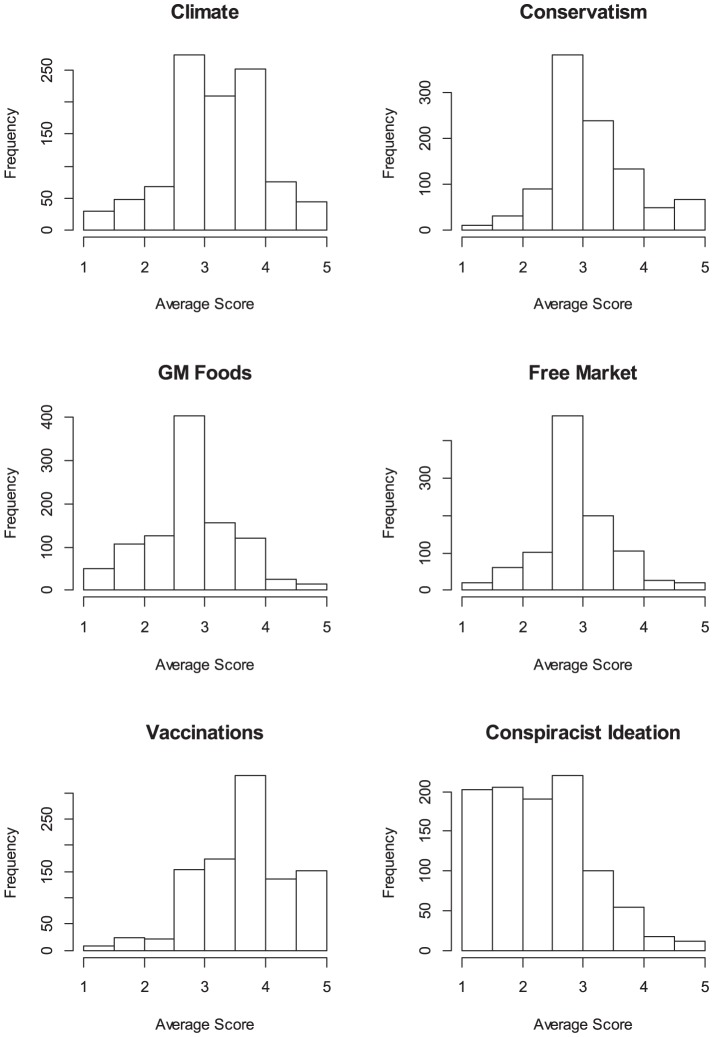
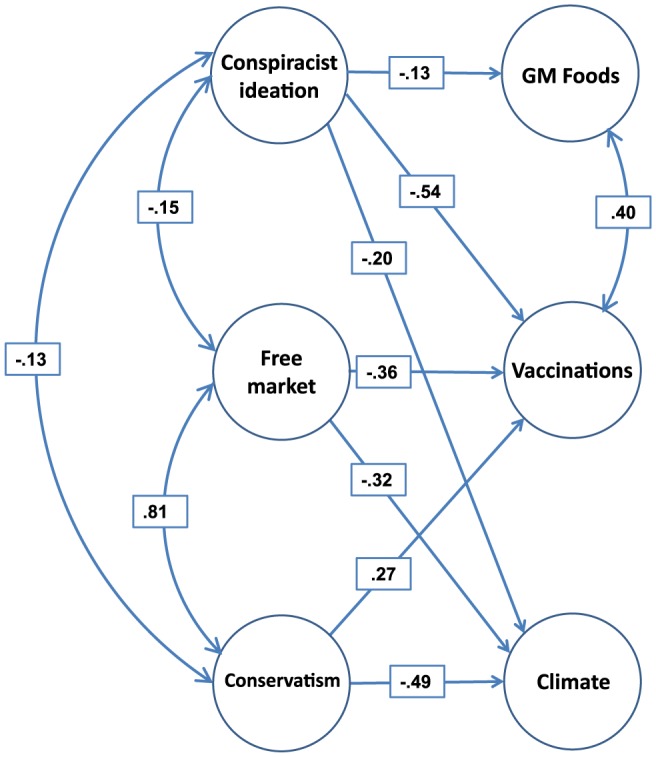
Verification
Claims the paper makes
51 Not checked yet · 25 Own result · 22 Own interpretation · 7 Own method
A result the paper reports from its own data — it cites no other source for it, so there is none to check. The quote shows it is in the paper.
In the paper
“The relationship between worldviews and attitudes towards vaccinations was more complex, with free-market endorsement predicting rejection and conservatism predicting acceptance of vaccinations, respectively.”
- Also stated in: § Worldviews and acceptance of science · plain
“Opposition to vaccinations involved a balance between two opposing forces, namely a negative association with free-market endorsement and a compensatory positive association with conservatism.”
§ The Role of Conspiracist Ideation and Worldviews in Predicting Rejection of Science > Results > Modeling of science acceptance
plaincorrelational- Asserted: passes — The authors put it forward as true.
- Checkable: passes — It can be checked against evidence.
- Load-bearing: passes — The paper’s conclusions depend on it.
- Based: passes — The paper gives a reason why it holds.
- Also stated in: § Worldviews and acceptance of science · plain
A result the paper reports from its own data — it cites no other source for it, so there is none to check. The quote shows it is in the paper.
In the paper
“The correlations confirm that rejection of scientific propositions is often accompanied by endorsement of scientific conspiracies pertinent to the proposition being rejected.”
§ The Role of Conspiracist Ideation and Worldviews in Predicting Rejection of Science > Results > Exploration of specific conspiracy theories relating to scientific propositions
plaincorrelational- Asserted: passes — The authors put it forward as true.
- Checkable: passes — It can be checked against evidence.
- Load-bearing: passes — The paper’s conclusions depend on it.
- Based: passes — The paper gives a reason why it holds.
A result the paper reports from its own data — it cites no other source for it, so there is none to check. The quote shows it is in the paper.
In the paper
“The weights involving conspiracist ideation remained virtually unchanged in these two additional models (Models 2 and 3).”
§ The Role of Conspiracist Ideation and Worldviews in Predicting Rejection of Science > Results > Modeling of science acceptance
plain- Asserted: passes — The authors put it forward as true.
- Checkable: passes — It can be checked against evidence.
- Load-bearing: unclear — It is unclear whether the paper’s conclusions depend on it.
- Based: passes — The paper gives a reason why it holds.
In the paper
“Figure 2 shows the overall SEM (Model 1) which fit very well (, , CFI , TLI = , RMSEA = ; 90% CI: , SRMR = , AIC = ) based on conventional standards (CFI and TLI .95 and RMSEA and SRMR .06; [33]).”
§ The Role of Conspiracist Ideation and Worldviews in Predicting Rejection of Science > Results > Modeling of science acceptance
What the sources say
- Not checked yetcites [33] Lt Hu, 1999, Cutoff criteria for fit indexes in covariance structure analysis: Conventional criteria versus new alternatives, Structural Equation Modeling source
boosted- Asserted: passes — The authors put it forward as true.
- Checkable: passes — It can be checked against evidence.
- Load-bearing: unclear — It is unclear whether the paper’s conclusions depend on it.
- Based: passes — The paper gives a reason why it holds.
A result the paper reports from its own data — it cites no other source for it, so there is none to check. The quote shows it is in the paper.
In the paper
“The two worldview variables do not predict opposition to GM.”
- Also stated in: § Modeling of science acceptance · plain
“Acceptance of GM foods, by contrast, was not associated with people's worldviews (weights set to zero without significant loss of fit; , ).”
- Also stated in: § Worldviews and acceptance of science · plain
“Finally, opposition to GM foods was not associated with the worldview constructs.”
§ The Role of Conspiracist Ideation and Worldviews in Predicting Rejection of Science > Abstract > Methodology/Principal findings
plain- Asserted: passes — The authors put it forward as true.
- Checkable: passes — It can be checked against evidence.
- Load-bearing: passes — The paper’s conclusions depend on it.
- Based: passes — The paper gives a reason why it holds.
- Also stated in: § Modeling of science acceptance · plain
A result the paper reports from its own data — it cites no other source for it, so there is none to check. The quote shows it is in the paper.
In the paper
“We conducted a propensity weighted internet-panel survey of the U.S. population and show that conservatism and free-market worldview strongly predict rejection of climate science, in contrast to their weaker and opposing effects on acceptance of vaccinations.”
- Also stated in: § Modeling of science acceptance · boosted
“Not unexpectedly, free-market endorsement and conservatism together strongly predicted rejection of climate science, with standardized weights of and , respectively.”
§ The Role of Conspiracist Ideation and Worldviews in Predicting Rejection of Science > Abstract > Methodology/Principal findings
boostedcorrelational- Asserted: passes — The authors put it forward as true.
- Checkable: passes — It can be checked against evidence.
- Load-bearing: passes — The paper’s conclusions depend on it.
- Based: passes — The paper gives a reason why it holds.
- Also stated in: § Modeling of science acceptance · boosted
A result the paper reports from its own data — it cites no other source for it, so there is none to check. The quote shows it is in the paper.
In the paper
“The relationship between worldviews and attitudes towards vaccinations was more complex, with free-market endorsement predicting rejection and conservatism predicting acceptance of vaccinations, respectively.”
- Also stated in: § Worldviews and acceptance of science · plain
“Opposition to vaccinations involved a balance between two opposing forces, namely a negative association with free-market endorsement and a compensatory positive association with conservatism.”
§ The Role of Conspiracist Ideation and Worldviews in Predicting Rejection of Science > Results > Modeling of science acceptance
plaindirect- Asserted: passes — The authors put it forward as true.
- Checkable: passes — It can be checked against evidence.
- Load-bearing: passes — The paper’s conclusions depend on it.
- Based: passes — The paper gives a reason why it holds.
- Also stated in: § Worldviews and acceptance of science · plain
A result the paper reports from its own data — it cites no other source for it, so there is none to check. The quote shows it is in the paper.
In the paper
“Conspiracist ideation, by contrast, predicts rejection of all three scientific propositions, albeit to greatly varying extents.”
- Also stated in: § Methodology/Principal findings · plain
“Greater endorsement of a diverse set of conspiracy theories predicts opposition to GM foods, vaccinations, and climate science.”
- Also stated in: § Modeling of science acceptance · plain
“In contrast to the clearly differentiated effects of worldview, conspiracist ideation predicted rejection of all three scientific issues, albeit to quite varying extents.”
§ The Role of Conspiracist Ideation and Worldviews in Predicting Rejection of Science > Abstract > Methodology/Principal findings
plaincorrelational- Asserted: passes — The authors put it forward as true.
- Checkable: passes — It can be checked against evidence.
- Load-bearing: passes — The paper’s conclusions depend on it.
- Based: passes — The paper gives a reason why it holds.
- Also stated in: § Methodology/Principal findings · plain
None of the sources cited for this claim have been checked yet.
In the paper
“When considered in isolation, each worldview construct on its own strongly predicted rejection of climate science (Models 2 and 3), replicating much previous research and underscoring a formidable challenge to science communicators [2]–[4], [6], [7], [27].”
§ The Role of Conspiracist Ideation and Worldviews in Predicting Rejection of Science > Discussion > Worldviews and acceptance of science
What the sources say
- Not checked yetcites [2]–[4]
- Not checked yetcites [6] DM Kahan, 2011, Cultural cognition of scientific consensus, Journal of Risk Research source
- Not checked yetcites [7] AM McCright, 2011, Cool dudes: The denial of climate change among conservative white males in the United States, Global Environmental Change source
boostedcorrelational- Asserted: passes — The authors put it forward as true.
- Checkable: passes — It can be checked against evidence.
- Load-bearing: passes — The paper’s conclusions depend on it.
- Based: passes — The paper gives a reason why it holds.
A result the paper reports from its own data — it cites no other source for it, so there is none to check. The quote shows it is in the paper.
In the paper
“it was entirely absent for GM foods”
§ The Role of Conspiracist Ideation and Worldviews in Predicting Rejection of Science > Discussion > Worldviews and acceptance of science
plain- Asserted: passes — The authors put it forward as true.
- Checkable: passes — It can be checked against evidence.
- Load-bearing: passes — The paper’s conclusions depend on it.
- Based: passes — The paper gives a reason why it holds.
- It may state two separate claims as one. 26
- The quote only partly states this claim. 2
- Probably not a substantial claim. 28
A result the paper reports from its own data — it cites no other source for it, so there is none to check. The quote shows it is in the paper.
In the paper
“Table 4 shows that the bivariate correlations between each of the worldview predictors (free market and conservatism latent variables) and the acceptance of vaccinations were in opposing directions but numerically small and non-significant.”
§ The Role of Conspiracist Ideation and Worldviews in Predicting Rejection of Science > Results > Modeling of science acceptance
plain- Asserted: passes — The authors put it forward as true.
- Checkable: passes — It can be checked against evidence.
- Load-bearing: passes — The paper’s conclusions depend on it.
- Based: passes — The paper gives a reason why it holds.
It may state two separate claims as one.
A result the paper reports from its own data — it cites no other source for it, so there is none to check. The quote shows it is in the paper.
In the paper
“In the present instance, we find that much of the suppressor effect arises from the fact that conservatism and free-market worldview are substantially and positively correlated with each other () but opposingly (positively vs. negatively, respectively) associated with vaccinations.”
§ The Role of Conspiracist Ideation and Worldviews in Predicting Rejection of Science > Results > Modeling of science acceptance
plaincorrelational- Asserted: passes — The authors put it forward as true.
- Checkable: passes — It can be checked against evidence.
- Load-bearing: passes — The paper’s conclusions depend on it.
- Based: passes — The paper gives a reason why it holds.
It may state two separate claims as one.
A result the paper reports from its own data — it cites no other source for it, so there is none to check. The quote shows it is in the paper.
In the paper
“Figure 2 shows that the link was numerically strongest for vaccinations but also significant for GM foods and climate science.”
§ The Role of Conspiracist Ideation and Worldviews in Predicting Rejection of Science > Results > Modeling of science acceptance
plaincorrelational- Asserted: passes — The authors put it forward as true.
- Checkable: passes — It can be checked against evidence.
- Load-bearing: passes — The paper’s conclusions depend on it.
- Based: passes — The paper gives a reason why it holds.
It may state two separate claims as one.
A result the paper reports from its own data — it cites no other source for it, so there is none to check. The quote shows it is in the paper.
In the paper
“The convenience conspiracies were endorsed (i.e., ratings above “Neutral”) by 200, 147, and 104 respondents (out of 1001), for Climate-Change-Hoax (CYClimChange), Tobacco-Lung Cancer-Hoax (CYTobacco), and HIV-AIDS-Conspiracy (CYAIDS), respectively.”
§ The Role of Conspiracist Ideation and Worldviews in Predicting Rejection of Science > Results > Exploration of specific conspiracy theories relating to scientific propositions
plainn = 104- Asserted: passes — The authors put it forward as true.
- Checkable: passes — It can be checked against evidence.
- Load-bearing: unclear — It is unclear whether the paper’s conclusions depend on it.
- Based: passes — The paper gives a reason why it holds.
It may state two separate claims as one.
A result the paper reports from its own data — it cites no other source for it, so there is none to check. The quote shows it is in the paper.
In the paper
“The additional model without free-market endorsement (Model 3) fit adequately, , CFI, TLI = , RMSEA; 90% CI: , SRMR = , AIC = , with the strength of the link between conservatism and rejection of climate science rising to . The link between conservatism and vaccination, by contrast, was no longer significant, .”
§ The Role of Conspiracist Ideation and Worldviews in Predicting Rejection of Science > Results > Modeling of science acceptance
plaincorrelational- Asserted: passes — The authors put it forward as true.
- Checkable: passes — It can be checked against evidence.
- Load-bearing: passes — The paper’s conclusions depend on it.
- Based: passes — The paper gives a reason why it holds.
It may state two separate claims as one.
A result the paper reports from its own data — it cites no other source for it, so there is none to check. The quote shows it is in the paper.
In the paper
“The additional model without conservatism (Model 2) also fit very well, , CFI, TLI = , RMSEA; 90% CI: , SRMR = , AIC = , with the strength of the link between free-market endorsement and rejection of climate science rising to . The link between free-market endorsement and rejection of vaccination declined in magnitude, , but retained its significance ().”
§ The Role of Conspiracist Ideation and Worldviews in Predicting Rejection of Science > Results > Modeling of science acceptance
plaincorrelational- Asserted: passes — The authors put it forward as true.
- Checkable: passes — It can be checked against evidence.
- Load-bearing: unclear — It is unclear whether the paper’s conclusions depend on it.
- Based: passes — The paper gives a reason why it holds.
It may state two separate claims as one.
A result the paper reports from its own data — it cites no other source for it, so there is none to check. The quote shows it is in the paper.
In the paper
“Conservatism and free-market endorsement were correlated but distinct constructs (Model 1 in Figure 2), each of which contributed a substantial share of variance to the rejection of climate science.”
§ The Role of Conspiracist Ideation and Worldviews in Predicting Rejection of Science > Discussion > Worldviews and acceptance of science
plaincorrelational- Asserted: passes — The authors put it forward as true.
- Checkable: passes — It can be checked against evidence.
- Load-bearing: passes — The paper’s conclusions depend on it.
- Based: passes — The paper gives a reason why it holds.
It may state two separate claims as one.
A result the paper reports from its own data — it cites no other source for it, so there is none to check. The quote shows it is in the paper.
In the paper
“Our main SEM model showed a negative association between conspiracy theorizing and conservatism (as well as with free-market endorsement)”
§ The Role of Conspiracist Ideation and Worldviews in Predicting Rejection of Science > Discussion > Worldviews and conspiracist ideation: Birds of a feather?
plaincorrelational- Asserted: passes — The authors put it forward as true.
- Checkable: passes — It can be checked against evidence.
- Load-bearing: passes — The paper’s conclusions depend on it.
- Based: passes — The paper gives a reason why it holds.
It may state two separate claims as one.
A result the paper reports from its own data — it cites no other source for it, so there is none to check. The quote shows it is in the paper.
In the paper
“When free-market worldviews are parceled out (and only then), people on the political left were less likely to endorse childhood vaccinations than people on the political right.”
§ The Role of Conspiracist Ideation and Worldviews in Predicting Rejection of Science > Discussion > Worldviews and acceptance of science
plaincorrelational- Asserted: passes — The authors put it forward as true.
- Checkable: passes — It can be checked against evidence.
- Load-bearing: passes — The paper’s conclusions depend on it.
- Based: passes — The paper gives a reason why it holds.
The quote only partly states this claim.
A result the paper reports from its own data — it cites no other source for it, so there is none to check. The quote shows it is in the paper.
In the paper
“The only exception was the conservatism construct which included two correlated error terms.”
§ The Role of Conspiracist Ideation and Worldviews in Predicting Rejection of Science > Materials and Methods > Latent variable modeling
plain- Asserted: passes — The authors put it forward as true.
- Checkable: passes — It can be checked against evidence.
- Load-bearing: fails — The paper’s conclusions may not depend on it.
- Based: passes — The paper gives a reason why it holds.
Probably not a substantial claim. The paper’s conclusions may not depend on it.
None of the sources cited for this claim have been checked yet.
In the paper
“Likewise, analyses of YouTube videos critical of HPV vaccinations [28] and anti-vaccination blogs [29] have revealed widespread conspiratorial content.”
§ The Role of Conspiracist Ideation and Worldviews in Predicting Rejection of Science > Introduction
What the sources say
plain- Asserted: passes — The authors put it forward as true.
- Checkable: passes — It can be checked against evidence.
- Load-bearing: fails — The paper’s conclusions may not depend on it.
- Based: passes — The paper gives a reason why it holds.
Probably not a substantial claim. The paper’s conclusions may not depend on it.
In the paper
“Denial of the link between HIV and AIDS frequently involves conspiracist hypotheses, for example that AIDS was created by the U.S. Government [22]–[24].”
§ The Role of Conspiracist Ideation and Worldviews in Predicting Rejection of Science > Introduction
What the sources say
- Not checked yetcites [22]–[24]
plaincorrelational- Asserted: passes — The authors put it forward as true.
- Checkable: passes — It can be checked against evidence.
- Load-bearing: fails — The paper’s conclusions may not depend on it.
- Based: passes — The paper gives a reason why it holds.
Probably not a substantial claim. The paper’s conclusions may not depend on it.
What the paper did — it cites no source for this, so there is none to check. The quote shows it is in the paper.
In the paper
“The apparent departure from normality of the conspiracist ideation indicator is considered during the SEM modeling via boot-strapping of confidence intervals for the parameter estimates.”
§ The Role of Conspiracist Ideation and Worldviews in Predicting Rejection of Science > Results > Summary of the sample
plain- Asserted: passes — The authors put it forward as true.
- Checkable: passes — It can be checked against evidence.
- Load-bearing: fails — The paper’s conclusions may not depend on it.
- Based: passes — The paper gives a reason why it holds.
Probably not a substantial claim. The paper’s conclusions may not depend on it.
In the paper
“Polarization is particularly pronounced with respect to climate change: People who embrace a laissez-faire vision of the free market are less likely to accept that anthropogenic greenhouse gas emissions are warming the planet than people with an egalitarian-communitarian outlook [2]–[7].”
§ The Role of Conspiracist Ideation and Worldviews in Predicting Rejection of Science > Introduction
What the sources say
- Not checked yetcites [2]–[7]
plaincorrelational- Asserted: passes — The authors put it forward as true.
- Checkable: passes — It can be checked against evidence.
- Load-bearing: fails — The paper’s conclusions may not depend on it.
- Based: passes — The paper gives a reason why it holds.
Probably not a substantial claim. The paper’s conclusions may not depend on it.
What the paper did — it cites no source for this, so there is none to check. The quote shows it is in the paper.
In the paper
“All items other than those targeting GM foods and vaccinations were used in previous research (see Materials for details) and have a track record of construct validity.”
§ The Role of Conspiracist Ideation and Worldviews in Predicting Rejection of Science > Introduction
plain- Asserted: passes — The authors put it forward as true.
- Checkable: passes — It can be checked against evidence.
- Load-bearing: fails — The paper’s conclusions may not depend on it.
- Based: fails — The paper may give no reason why it holds.
Probably not a substantial claim. The paper’s conclusions may not depend on it. The paper may give no reason why it holds. It may state two separate claims as one.
None of the sources cited for this claim have been checked yet.
In the paper
“Although media reports have implicated the political Left in the opposition to GM foods [10], [11], European surveys have variously associated GM-food rejection with the extreme political Right [12] as well as the political Left [13].”
§ The Role of Conspiracist Ideation and Worldviews in Predicting Rejection of Science > Introduction
What the sources say
- Not checked yetcites [10] Kloor K (2012). GMO opponents are the climate skeptics of the left. Available: http://www.slate.com/articles/health_and_science/science/2012/09/are_gmo_foods_safe_opponents_are_skewing_the_science_to_scare_people_.html. Accessed 2012 Sep 29.
- Not checked yetcites [11] ShermerM (2013). The liberals' war on science. Available: http://www.scientificamerican.com/article.cfm?id=the-liberals-war-on-science. Accessed 2013 Jan 28.
plaincorrelational- Asserted: passes — The authors put it forward as true.
- Checkable: passes — It can be checked against evidence.
- Load-bearing: fails — The paper’s conclusions may not depend on it.
- Based: passes — The paper gives a reason why it holds.
Probably not a substantial claim. The paper’s conclusions may not depend on it.
In the paper
“Media reports have ascribed an anti-vaccine stance to the political Left [14], largely based on the political leanings of spokespersons.”
§ The Role of Conspiracist Ideation and Worldviews in Predicting Rejection of Science > Introduction
What the sources say
- Not checked yetcites [14] Mooney C (2011). The science of why we don't believe science. Available: http://motherjones.com/politics/2011/03/denial-science-chris-mooney).2011 Dec 21.
plaincorrelational- Asserted: passes — The authors put it forward as true.
- Checkable: passes — It can be checked against evidence.
- Load-bearing: fails — The paper’s conclusions may not depend on it.
- Based: passes — The paper gives a reason why it holds.
Probably not a substantial claim. The paper’s conclusions may not depend on it. It may state two separate claims as one.
In the paper
“The bootstrapped confidence intervals for the model in Figure 2 did not materially alter any of the conclusions: All regression weights reported in the figure retained their significance, with the exception of the link between conservatism and acceptance of vaccinations, which failed to reach conventional significance levels ().”
§ The Role of Conspiracist Ideation and Worldviews in Predicting Rejection of Science > Results > Modeling of science acceptance
What the sources say
- Not checked yetcites [36] GW Cheung, 2008, Testing mediation and suppression effects of latent variables: Bootstrapping with structural equation models, Organizational Research Methods source
plain- Asserted: passes — The authors put it forward as true.
- Checkable: passes — It can be checked against evidence.
- Load-bearing: passes — The paper’s conclusions depend on it.
- Based: passes — The paper gives a reason why it holds.
It may state two separate claims as one.
None of the sources cited for this claim have been checked yet.
In the paper
“Popular books critical of climate science routinely refer to global warming as a “conspiracy” or “hoax” [25], and conspiracist themes have been identified in climate media coverage [26] and in people's affective imagery evoked by climate change [21].”
§ The Role of Conspiracist Ideation and Worldviews in Predicting Rejection of Science > Introduction
What the sources say
- Not checked yetcites [25] Inhofe J (2012) The Greatest Hoax: How the Global Warming Conspiracy Threatens Your Future. Washington, DC: WND Books.
- Not checked yetcites [26] E McKewon, 2012, Duelling realities: Conspiracy theories vs climate science in regional newspaper coverage of Ian Plimer's book, Heaven and Earth, Rural Society source
- Not checked yetcites [21] N Smith, 2012, The rise of global warming skepticism: Exploring affective image associations in the United States over time, Risk Analysis source
plaincorrelational- Asserted: passes — The authors put it forward as true.
- Checkable: passes — It can be checked against evidence.
- Load-bearing: unclear — It is unclear whether the paper’s conclusions depend on it.
- Based: passes — The paper gives a reason why it holds.
It may state two separate claims as one.
In the paper
“Among visitors to climate blogs, the tendency to endorse conspiracy theories has been shown to be correlated with the rejection of climate science as well as the rejection of other scientific propositions [27].”
§ The Role of Conspiracist Ideation and Worldviews in Predicting Rejection of Science > Introduction
What the sources say
- Not checked yetcites [27] S Lewandowsky, 2013, NASA faked the moon landing—therefore (climate) science is a hoax: An anatomy of the motivated rejection of science, Psychological Science source
plaincorrelational- Asserted: passes — The authors put it forward as true.
- Checkable: passes — It can be checked against evidence.
- Load-bearing: passes — The paper’s conclusions depend on it.
- Based: passes — The paper gives a reason why it holds.
It may state two separate claims as one.
A conclusion the paper draws from its own results — it cites no other source for it, so there is none to check. The quote shows it is in the paper.
In the paper
“Free-market worldviews are an important predictor of the rejection of scientific findings that have potential regulatory implications, such as climate science, but not necessarily of other scientific issues.”
§ The Role of Conspiracist Ideation and Worldviews in Predicting Rejection of Science > Abstract > Conclusions
plaincorrelational- Asserted: passes — The authors put it forward as true.
- Checkable: passes — It can be checked against evidence.
- Load-bearing: passes — The paper’s conclusions depend on it.
- Based: passes — The paper gives a reason why it holds.
It may state two separate claims as one.
None of the sources cited for this claim have been checked yet.
In the paper
“The different polarity of those associations is consonant with the notion that libertarians object to the government intrusion arising from mandatory vaccination programs [15], whereas people low on conservatism—who, by implication, are liberal or progressive—may oppose immunization because they distrust pharmaceutical companies [40].”
§ The Role of Conspiracist Ideation and Worldviews in Predicting Rejection of Science > Discussion > Worldviews and acceptance of science
What the sources say
- Not checked yetcites [15] DM Kahan, 2010, Who fears the HPV vaccine, who doesnt, and why? An experimental study of the mechanisms of cultural cognition, Law and Human Behavior source
- Not checked yetcites [40] JA Cassell, 2006, Is the cultural context of mmr rejection a key to an effective public health discourse?, Public Health source
hedgedconditional- Asserted: passes — The authors put it forward as true.
- Checkable: passes — It can be checked against evidence.
- Load-bearing: passes — The paper’s conclusions depend on it.
- Based: passes — The paper gives a reason why it holds.
It may state two separate claims as one.
In the paper
“conspiracy theories rely on isolated morsels of evidence inconsistent with an official account [31] (e.g., that Timothy McVeigh fled the Oklahoma City bombing in a car without licence plates) while ignoring overwhelming evidence to the contrary”
§ The Role of Conspiracist Ideation and Worldviews in Predicting Rejection of Science > Discussion > Conspiracist ideation vs. scientific cognition
What the sources say
- Not checked yetcites [31] BL Keeley, 1999, Of conspiracy theories, The Journal of Philosophy source
plain- Asserted: passes — The authors put it forward as true.
- Checkable: passes — It can be checked against evidence.
- Load-bearing: unclear — It is unclear whether the paper’s conclusions depend on it.
- Based: passes — The paper gives a reason why it holds.
It may state two separate claims as one.
In the paper
“The reverse association has also been found, whereby conspiratorial belief was linked to right-wing authoritarianism [52]”
§ The Role of Conspiracist Ideation and Worldviews in Predicting Rejection of Science > Discussion > Worldviews and conspiracist ideation: Birds of a feather?
What the sources say
- Not checked yetcites [52] V Swami, 2012, Social psychological origins of conspiracy theories: the case of the Jewish conspiracy theory in Malaysia, Frontiers in Psychology source
plaincorrelational- Asserted: passes — The authors put it forward as true.
- Checkable: passes — It can be checked against evidence.
- Load-bearing: fails — The paper’s conclusions may not depend on it.
- Based: passes — The paper gives a reason why it holds.
Probably not a substantial claim. The paper’s conclusions may not depend on it.
None of the sources cited for this claim have been checked yet.
In the paper
“Recent research has shown that the role of worldview may be attenuated by underscoring the breadth of consensus among scientists: When people are informed of the pervasive consensus about the fundamentals of climate change, they become more likely to endorse the basic premise of global warming, and they attribute a larger share of the observed warming trend to human CO2 emissions [37], [38].”
§ The Role of Conspiracist Ideation and Worldviews in Predicting Rejection of Science > Discussion > Worldviews and acceptance of science
What the sources say
- Not checked yetcites [37] D Ding, 2011, Support for climate policy and societal action are linked to perceptions about scientific agreement, Nature Climate Change source
- Not checked yetcites [38] S Lewandowsky, 2013, The pivotal role of perceived scientific consensus in acceptance of science, Nature Climate Change source
plaindirect- Asserted: passes — The authors put it forward as true.
- Checkable: passes — It can be checked against evidence.
- Load-bearing: passes — The paper’s conclusions depend on it.
- Based: passes — The paper gives a reason why it holds.
It may state two separate claims as one.
In the paper
“According to the system justification view, scientific findings are rejected by people high in system justification when the evidence challenges the status quo [42], rather than on”
§ The Role of Conspiracist Ideation and Worldviews in Predicting Rejection of Science > Discussion > Worldviews and acceptance of science
What the sources say
- Not checked yetcites [42] I Feygina, 2010, System justification, the denial of global warming, and the possibility of “system-sanctioned change”, Personality and Social Psychology Bulletin source
plaindirect- Asserted: passes — The authors put it forward as true.
- Checkable: passes — It can be checked against evidence.
- Load-bearing: passes — The paper’s conclusions depend on it.
- Based: passes — The paper gives a reason why it holds.
Probably not a substantial claim.
A conclusion the paper draws from its own results — it cites no other source for it, so there is none to check. The quote shows it is in the paper.
In the paper
“For the other two scientific propositions, the role of worldview was attenuated and more nuanced, or absent altogether.”
§ The Role of Conspiracist Ideation and Worldviews in Predicting Rejection of Science > Discussion > Worldviews and acceptance of science
plain- Asserted: passes — The authors put it forward as true.
- Checkable: passes — It can be checked against evidence.
- Load-bearing: passes — The paper’s conclusions depend on it.
- Based: passes — The paper gives a reason why it holds.
It may state two separate claims as one.
A conclusion the paper draws from its own results — it cites no other source for it, so there is none to check. The quote shows it is in the paper.
In the paper
“Opposition to vaccinations involved a balance between two opposing forces, namely a negative association with free-market endorsement and a compensatory positive association with conservatism.”
§ The Role of Conspiracist Ideation and Worldviews in Predicting Rejection of Science > Discussion > Worldviews and acceptance of science
plaincorrelational- Asserted: passes — The authors put it forward as true.
- Checkable: passes — It can be checked against evidence.
- Load-bearing: passes — The paper’s conclusions depend on it.
- Based: passes — The paper gives a reason why it holds.
It may state two separate claims as one.
In the paper
“endorsement of conspiracy theories is also associated with people's own willingness to engage in a conspiracy themselves when deemed necessary [46]”
§ The Role of Conspiracist Ideation and Worldviews in Predicting Rejection of Science > Discussion > Conspiracist ideation vs. scientific cognition
What the sources say
- Not checked yetcites [46] KM Douglas, 2011, Does it take one to know one? Endorsement of conspiracy theories is influenced by personal willingness to conspire, British Journal of Social Psychology source
plaincorrelational- Asserted: passes — The authors put it forward as true.
- Checkable: passes — It can be checked against evidence.
- Load-bearing: fails — The paper’s conclusions may not depend on it.
- Based: passes — The paper gives a reason why it holds.
Probably not a substantial claim. The paper’s conclusions may not depend on it.
In the paper
“the simultaneous belief in mutually contradictory theories—e.g., that Princess Diana was murdered but faked her own death—is a notable aspect of conspiracist ideation [30]”
§ The Role of Conspiracist Ideation and Worldviews in Predicting Rejection of Science > Discussion > Conspiracist ideation vs. scientific cognition
What the sources say
- Not checked yetcites [30] MJ Wood, 2012, Dead and alive: Beliefs in contradictory conspiracy theories, Social Psychological and Personality Science source
plain- Asserted: passes — The authors put it forward as true.
- Checkable: passes — It can be checked against evidence.
- Load-bearing: fails — The paper’s conclusions may not depend on it.
- Based: passes — The paper gives a reason why it holds.
Probably not a substantial claim. The paper’s conclusions may not depend on it.
A conclusion the paper draws from its own results — it cites no other source for it, so there is none to check. The quote shows it is in the paper.
In the paper
“suggesting that conspiratorial thinking is more prevalent on the political left than the right”
§ The Role of Conspiracist Ideation and Worldviews in Predicting Rejection of Science > Discussion > Worldviews and conspiracist ideation: Birds of a feather?
hedgedcorrelational- Asserted: passes — The authors put it forward as true.
- Checkable: passes — It can be checked against evidence.
- Load-bearing: unclear — It is unclear whether the paper’s conclusions depend on it.
- Based: passes — The paper gives a reason why it holds.
The quote only partly states this claim.
In the paper
“arguments against mainstream climate science are often mutually contradictory, as noted in the U.S. Environmental Protection Agency's response to comments on its endangerment finding pertaining to greenhouse gases [48]”
§ The Role of Conspiracist Ideation and Worldviews in Predicting Rejection of Science > Discussion > Conspiracist ideation vs. scientific cognition
What the sources say
- Not checked yetcites [48] EPA (2009) Endangerment and cause or contribute findings for greenhouse gases under section 202(a) of the clean air act: EPAs response to public comments. Technical report, U. S. Environmental Protection Agency, Washington, D.C.
plain- Asserted: passes — The authors put it forward as true.
- Checkable: passes — It can be checked against evidence.
- Load-bearing: fails — The paper’s conclusions may not depend on it.
- Based: passes — The paper gives a reason why it holds.
Probably not a substantial claim. The paper’s conclusions may not depend on it.
In the paper
“anti-vaccination activists ignore overwhelming statistical evidence while focusing on anecdotes or information that has been shown to be false [49]”
§ The Role of Conspiracist Ideation and Worldviews in Predicting Rejection of Science > Discussion > Conspiracist ideation vs. scientific cognition
What the sources say
- Not checked yetcites [49] RA Jacobson, 2007, A taxonomy of reasoning flaws in the anti-vaccine movement, Vaccine source
plain- Asserted: passes — The authors put it forward as true.
- Checkable: passes — It can be checked against evidence.
- Load-bearing: unclear — It is unclear whether the paper’s conclusions depend on it.
- Based: passes — The paper gives a reason why it holds.
It may state two separate claims as one.
What the paper did — it cites no source for this, so there is none to check. The quote shows it is in the paper.
In the paper
“Age turned out not to correlate with any of the indicator variables”
§ The Role of Conspiracist Ideation and Worldviews in Predicting Rejection of Science > Materials and Methods > Materials
plain- Asserted: passes — The authors put it forward as true.
- Checkable: passes — It can be checked against evidence.
- Load-bearing: fails — The paper’s conclusions may not depend on it.
- Based: passes — The paper gives a reason why it holds.
Probably not a substantial claim. The paper’s conclusions may not depend on it.
None of the sources cited for this claim have been checked yet.
In the paper
“A further 3 items queried scientific propositions that were also used in previous research [27], [38].”
§ The Role of Conspiracist Ideation and Worldviews in Predicting Rejection of Science > Materials and Methods > Materials
What the sources say
- Not checked yetcites [27] S Lewandowsky, 2013, NASA faked the moon landing—therefore (climate) science is a hoax: An anatomy of the motivated rejection of science, Psychological Science source
- Not checked yetcites [38] S Lewandowsky, 2013, The pivotal role of perceived scientific consensus in acceptance of science, Nature Climate Change source
plain- Asserted: passes — The authors put it forward as true.
- Checkable: passes — It can be checked against evidence.
- Load-bearing: fails — The paper’s conclusions may not depend on it.
- Based: passes — The paper gives a reason why it holds.
Probably not a substantial claim. The paper’s conclusions may not depend on it.
None of the sources cited for this claim have been checked yet.
In the paper
“These general and robust findings help identify communicative means by which the motivated reasoning can be attenuated or circumvented [5], [32], [38], [50].”
§ The Role of Conspiracist Ideation and Worldviews in Predicting Rejection of Science > Discussion > Worldviews and conspiracist ideation: Birds of a feather?
What the sources say
- Not checked yetcites [5] DM Kahan, 2010, Fixing the communications failure, Nature source
- Not checked yetcites [32] CR Sunstein, 2009, Conspiracy theories: Causes and cures, Journal of Political Philosophy source
- Not checked yetcites [38] S Lewandowsky, 2013, The pivotal role of perceived scientific consensus in acceptance of science, Nature Climate Change source
plaindirect- Asserted: passes — The authors put it forward as true.
- Checkable: fails — It may be too vague to check against evidence.
- Load-bearing: fails — The paper’s conclusions may not depend on it.
- Based: passes — The paper gives a reason why it holds.
Probably not a substantial claim. It may be too vague to check against evidence. The paper’s conclusions may not depend on it.
A conclusion the paper draws from its own results — it cites no other source for it, so there is none to check. The quote shows it is in the paper.
In the paper
“although our sample was representative, it may not have included a sufficiently large number of participants at the extreme end of the ideological spectrum.”
§ The Role of Conspiracist Ideation and Worldviews in Predicting Rejection of Science > Discussion > Worldviews and acceptance of science
hedged- Asserted: passes — The authors put it forward as true.
- Checkable: passes — It can be checked against evidence.
- Load-bearing: fails — The paper’s conclusions may not depend on it.
- Based: passes — The paper gives a reason why it holds.
Probably not a substantial claim. The paper’s conclusions may not depend on it.
A conclusion the paper draws from its own results — it cites no other source for it, so there is none to check. The quote shows it is in the paper.
In the paper
“Knowledge of its involvement is crucial to permit scientists and communicators to respond appropriately to the rejection of evidence by segments of the public.”
§ The Role of Conspiracist Ideation and Worldviews in Predicting Rejection of Science > Discussion > Conspiracist ideation vs. scientific cognition
plain- Asserted: passes — The authors put it forward as true.
- Checkable: fails — It may be too vague to check against evidence.
- Load-bearing: passes — The paper’s conclusions depend on it.
- Based: passes — The paper gives a reason why it holds.
Probably not a substantial claim. It may be too vague to check against evidence.
What the paper did — it cites no source for this, so there is none to check. The quote shows it is in the paper.
In the paper
“Only participants who completed all items and passed the attention-filter question were retained for analysis.”
§ The Role of Conspiracist Ideation and Worldviews in Predicting Rejection of Science > Materials and Methods > Participants and procedure
plain- Asserted: passes — The authors put it forward as true.
- Checkable: passes — It can be checked against evidence.
- Load-bearing: passes — The paper’s conclusions depend on it.
- Based: passes — The paper gives a reason why it holds.
Probably not a substantial claim.
None of the sources cited for this claim have been checked yet.
In the paper
“A more accurate estimator free of those assumptions is [69], [70], which was used here.”
§ The Role of Conspiracist Ideation and Worldviews in Predicting Rejection of Science > Materials and Methods > Latent variable modeling
What the sources say
- Not checked yetcites [69] E Komaroff, 1997, Effect of simultaneous violations of essential tau-equivalence and uncorrelated error on coefficient alpha, Applied Psychological Measurement source
- Not checked yetcites [70] T Raykov, 1997, Estimation of composite reliability for congeneric measures, Applied Psychological Measurement source
plain- Asserted: passes — The authors put it forward as true.
- Checkable: passes — It can be checked against evidence.
- Load-bearing: passes — The paper’s conclusions depend on it.
- Based: passes — The paper gives a reason why it holds.
Probably not a substantial claim.
A conclusion the paper draws from its own results — it cites no other source for it, so there is none to check. The quote shows it is in the paper.
In the paper
“climate science is primarily rejected by people on the political right because they tend to be particularly concerned with system justification and hence respond to the threat to the economic status quo that might arise from climate mitigation efforts.”
§ The Role of Conspiracist Ideation and Worldviews in Predicting Rejection of Science > Discussion > Worldviews and acceptance of science
plaindirect- Asserted: passes — The authors put it forward as true.
- Checkable: passes — It can be checked against evidence.
- Load-bearing: passes — The paper’s conclusions depend on it.
- Based: passes — The paper gives a reason why it holds.
It may state two separate claims as one.
In the paper
“As latent variables are free of measurement error, none of the estimated effects are attenuated due to measurement error [60].”
§ The Role of Conspiracist Ideation and Worldviews in Predicting Rejection of Science > Materials and Methods > Latent variable modeling
What the sources say
- Not checked yetcites [60] DL Coffman, 2005, Using parcels to convert path analysis models into latent variable models, Multivariate Behavioral Research source
plain- Asserted: passes — The authors put it forward as true.
- Checkable: passes — It can be checked against evidence.
- Load-bearing: passes — The paper’s conclusions depend on it.
- Based: passes — The paper gives a reason why it holds.
It may state two separate claims as one.
What the paper did — it cites no source for this, so there is none to check. The quote shows it is in the paper.
In the paper
“Participants were drawn from a completely bipartisan panel of more than 5.5 million U.S. residents (as of January 2013), via propensity weighting to ensure representativeness.”
§ The Role of Conspiracist Ideation and Worldviews in Predicting Rejection of Science > Materials and Methods > Participants and procedure
plain- Asserted: passes — The authors put it forward as true.
- Checkable: passes — It can be checked against evidence.
- Load-bearing: fails — The paper’s conclusions may not depend on it.
- Based: passes — The paper gives a reason why it holds.
Probably not a substantial claim. The paper’s conclusions may not depend on it. It may state two separate claims as one.
What the paper did — it cites no source for this, so there is none to check. The quote shows it is in the paper.
In the paper
“Questions were presented blocked by topic area in two different orders that were randomly assigned to participants.”
§ The Role of Conspiracist Ideation and Worldviews in Predicting Rejection of Science > Materials and Methods > Materials
plain- Asserted: passes — The authors put it forward as true.
- Checkable: passes — It can be checked against evidence.
- Load-bearing: fails — The paper’s conclusions may not depend on it.
- Based: passes — The paper gives a reason why it holds.
Probably not a substantial claim. The paper’s conclusions may not depend on it.
A conclusion the paper draws from its own results — it cites no other source for it, so there is none to check. The quote shows it is in the paper.
In the paper
“Irrespective of their statistical association (or lack thereof), they both arguably represent mechanisms of motivated reasoning.”
§ The Role of Conspiracist Ideation and Worldviews in Predicting Rejection of Science > Discussion > Worldviews and conspiracist ideation: Birds of a feather?
hedged- Asserted: passes — The authors put it forward as true.
- Checkable: fails — It may be too vague to check against evidence.
- Load-bearing: fails — The paper’s conclusions may not depend on it.
- Based: passes — The paper gives a reason why it holds.
Probably not a substantial claim. It may be too vague to check against evidence. The paper’s conclusions may not depend on it. It may state two separate claims as one.
What the paper did — it cites no source for this, so there is none to check. The quote shows it is in the paper.
In the paper
“although gender exhibited some small associations, its inclusion as a potential mediator in the SEM model (Figure 2) did not alter the outcome”
§ The Role of Conspiracist Ideation and Worldviews in Predicting Rejection of Science > Materials and Methods > Materials
plain- Asserted: passes — The authors put it forward as true.
- Checkable: passes — It can be checked against evidence.
- Load-bearing: fails — The paper’s conclusions may not depend on it.
- Based: passes — The paper gives a reason why it holds.
Probably not a substantial claim. The paper’s conclusions may not depend on it.
In the paper
“Cronbach's assumes essential -equivalence and independent error variances [68]”
§ The Role of Conspiracist Ideation and Worldviews in Predicting Rejection of Science > Materials and Methods > Latent variable modeling
What the sources say
- Not checked yetcites [68] Lord FM, Novick MR (1968) Statistical theories of mental test scores. Reading, MA: Addison-Wesley
plain- Asserted: passes — The authors put it forward as true.
- Checkable: passes — It can be checked against evidence.
- Load-bearing: passes — The paper’s conclusions depend on it.
- Based: passes — The paper gives a reason why it holds.
Probably not a substantial claim. It may state two separate claims as one.
None of the sources cited for this claim have been checked yet.
In the paper
“It is therefore possible that small specific groups on the political left do indeed reject certain scientific findings—such as GM foods or vaccinations—as is suggested by the public rhetoric of spokespersons that are identified as “left-wing” [10], [11].”
§ The Role of Conspiracist Ideation and Worldviews in Predicting Rejection of Science > Discussion > Worldviews and acceptance of science
What the sources say
- Not checked yetcites [10] Kloor K (2012). GMO opponents are the climate skeptics of the left. Available: http://www.slate.com/articles/health_and_science/science/2012/09/are_gmo_foods_safe_opponents_are_skewing_the_science_to_scare_people_.html. Accessed 2012 Sep 29.
- Not checked yetcites [11] ShermerM (2013). The liberals' war on science. Available: http://www.scientificamerican.com/article.cfm?id=the-liberals-war-on-science. Accessed 2013 Jan 28.
hedged- Asserted: passes — The authors put it forward as true.
- Checkable: passes — It can be checked against evidence.
- Load-bearing: fails — The paper’s conclusions may not depend on it.
- Based: passes — The paper gives a reason why it holds.
Probably not a substantial claim. The paper’s conclusions may not depend on it.
A conclusion the paper draws from its own results — it cites no other source for it, so there is none to check. The quote shows it is in the paper.
In the paper
“GM foods are not rejected based on ideology because they do not imperil the economic status quo, thereby eliminating system justification as a driving variable for rejection.”
§ The Role of Conspiracist Ideation and Worldviews in Predicting Rejection of Science > Discussion > Worldviews and acceptance of science
plain- Asserted: passes — The authors put it forward as true.
- Checkable: passes — It can be checked against evidence.
- Load-bearing: passes — The paper’s conclusions depend on it.
- Based: unclear — It is unclear why the paper says it holds.
It may state two separate claims as one.
In the paper
“One criticism of item parceling is that it may obscure multi-dimensionality [63].”
§ The Role of Conspiracist Ideation and Worldviews in Predicting Rejection of Science > Materials and Methods > Latent variable modeling
What the sources say
- Not checked yetcites [63] TD Little, 2002, To parcel or not to parcel: Exploring the question, weighing the merits, Structural Equation Modeling source
hedgedconditional- Asserted: passes — The authors put it forward as true.
- Checkable: passes — It can be checked against evidence.
- Load-bearing: passes — The paper’s conclusions depend on it.
- Based: passes — The paper gives a reason why it holds.
Probably not a substantial claim.
None of the sources cited for this claim have been checked yet.
In the paper
“The potential predictor constructs were all based on established instruments that have been repeatedly used in previous research”
§ The Role of Conspiracist Ideation and Worldviews in Predicting Rejection of Science > Materials and Methods > Materials
What the sources say
- Not checked yetcites [4] Y Heath, 2006, Free-market ideology and environmental degradation: The case of belief in global climate change, Environment and Behavior source
- Not checked yetcites [59] A Mehrabian, 1996, Relations among political attitudes, personality, and psychopathology assessed with new measures of Libertarianism and Conservatism, Basic and Applied Social Psychology source
- Not checked yetcites [27] S Lewandowsky, 2013, NASA faked the moon landing—therefore (climate) science is a hoax: An anatomy of the motivated rejection of science, Psychological Science source
plain- Asserted: passes — The authors put it forward as true.
- Checkable: passes — It can be checked against evidence.
- Load-bearing: fails — The paper’s conclusions may not depend on it.
- Based: passes — The paper gives a reason why it holds.
Probably not a substantial claim. The paper’s conclusions may not depend on it.
The authors state this as an assumption.
No equivalent peer-reviewed research in the U.S. on the political correlates of GM-food rejection exists.
“We are not aware of any equivalent peer-reviewed research in the U.S.”
The authors state this as an assumption.
Broad-based empirical data on the role of conspiracist ideation in science denial are lacking.
“Notwithstanding the growing prominence of conspiracist ideation in science denial, broad-based empirical data on its role are lacking.”
The authors state this as an assumption.
Reliable data on the political Left's opposition to GM foods and vaccinations are lacking.
“Conversely, opposition to genetically-modified (GM) foods and vaccinations is often ascribed to the political Left although reliable data are lacking.”
The paper relies on this without support.
The propensity weighted internet-panel survey is representative of the U.S. population.
“We conducted a propensity weighted internet-panel survey of the U.S. population”
Claims other papers make about this one
Each is checked against this paper’s own text: does it say what the citing paper says it does?
In the citing paper
“Directly relevant to the current investigation, it has recently been shown that endorsement of a variety of unrelated conspiracy theories is associated with negative attitudes toward vaccination [26].”
From The Effects of Anti-Vaccine Conspiracy Theories on Vaccination Intentions (2014) · cites this paper as [26]
Self-check
Percentages, sums and reported differences re-computed from the paper’s own numbers.
Each contradiction between two passages listed here was confirmed by an independent check.
Rated minor: it would not touch a result — a value no result rests on, a p-value that stays on the same side of the significance level, or a conflict that is clerical, resolved elsewhere in the paper, or outside its own findings.
In the paper
§ The Role of Conspiracist Ideation and Worldviews in Predicting Rejection of Science > Materials and Methods > Materials
“that the link between smoking and lung cancer is based on bogus science.”
§ The Role of Conspiracist Ideation and Worldviews in Predicting Rejection of Science > Introduction
“The alleged link between second-hand tobacco smoke and ill health is based on bogus science and is an attempt by a corrupt cartel of medical researchers to replace rational science with dogma.”
Citations
Cites
Hu, L., & Bentler, P. M. (1999) · Structural Equation Modeling A Multidisciplinary Journal · doi:10.1080/10705519909540118 · Cited by 108,788
The case for motivated reasoning.
Kunda, Z. (1990) · Psychological Bulletin · doi:10.1037/0033-2909.108.3.480 · Cited by 9,022
Rozeboom, W. W., Lord, F. M., Novick, M. R., & Birnbaum, A. (1969) · American Educational Research Journal · doi:10.2307/1162101 · Cited by 8,012
To parcel or not to parcel: Exploring the question, weighing the merits
Little, T. D., Cunningham, W. A., Shahar, G., & Widaman, K. F. (2002) · Structural Equation Modeling: A Multidisciplinary Journal · doi:10.1207/s15328007sem0902_1 · Cited by 6,552
Practical issues in structural modeling
BENTLER, P. M., & CHOU, C.-P. (1987) · Sociological Methods & Research · doi:10.1177/0049124187016001004 · Cited by 5,804
Political conservatism as motivated social cognition.
Jost, J. T., Glaser, J., Kruglanski, A. W., & Sulloway, F. J. (2003) · Psychological Bulletin · doi:10.1037/0033-2909.129.3.339 · Cited by 4,904 · cited 1×
“Initial work in this direction has been promising [41,57,58].”
BackgroundEquivalence of the Mediation, Confounding and Suppression Effect
MacKinnon, D. P., Krull, J. L., & Lockwood, C. M. (2000) · Prevention Science · doi:10.1023/a:1026595011371 · Cited by 4,188
Misinformation and Its Correction: Continued Influence and Successful Debiasing
Lewandowsky, S., Ecker, U. K. H., Seifert, C. M., Schwarz, N., & Cook, J. (2012) · Psychological Science in the Public Interest · doi:10.1177/1529100612451018 · Cited by 2,920
Self-citationThe g factor: the science of mental ability
(1998) · Choice Reviews Online · doi:10.5860/choice.36-2443 · Cited by 2,763
The Polarizing Impact of Science Literacy and Numeracy on Perceived Climate Change Risks
Braman, D., Kahan, D. M., Peters, E. M., Wittlin, M., Slovic, P., Ouellette, L. L., & Mandel, G. N. (2012) · Scholarly Commons - George Washington University Law School (George Washington University) · Cited by 2,421
Research works printed but not linked: 2
- Oreskes N, Conway EM (2010) Merchants of doubt. London: Bloomsbury Publishing.
- Lord FM, Novick MR (1968) Statistical theories of mental test scores. Reading, MA: Addison-Wesley
Cited by
Sorted by citations
Social Media and Fake News in the 2016 Election
Allcott, H., & Gentzkow, M. (2017) · Journal of Economic Perspectives · doi:10.1257/jep.31.2.211 · Cited by 6,767
Beyond misinformation: Understanding and coping with the “post-truth” era.
Lewandowsky, S., Ecker, U. K. H., & Cook, J. (2017) · Journal of Applied Research in Memory and Cognition · doi:10.1016/j.jarmac.2017.07.008 · Cited by 1,985
Self-citationSystematic Literature Review on the Spread of Health-related Misinformation on Social Media
Wang, Y., McKee, M., Torbica, A., & Stuckler, D. (2019) · Social Science & Medicine · doi:10.1016/j.socscimed.2019.112552 · Cited by 1,806
“Conspiracist ideation played a crucial role in one's belief in misinformation (Lewandowsky et al., 2013) .”
Understanding Conspiracy Theories
Douglas, K. M., Uscinski, J. E., Sutton, R. M., Cichocka, A., Nefes, T., Ang, C. S., & Deravi, F. (2019) · Political Psychology · doi:10.1111/pops.12568 · Cited by 1,511
Susceptibility to misinformation about COVID-19 around the world
Roozenbeek, J., Schneider, C. R., Dryhurst, S., Kerr, J., Freeman, A. L. J., Recchia, G., van der Bles, A. M., & van der Linden, S. (2020) · Royal Society Open Science · doi:10.1098/rsos.201199 · Cited by 1,447
Metadata
- Authors
- Lewandowsky, S., Gignac, G. E., & Oberauer, K.
- Affiliations
- The University of Western Australia (AU)
- Corresponding author
- Lewandowsky, Stephan
- Venue
- PLoS ONE
- Publisher
- Public Library of Science (PLoS)
- Published
- 2013-10-02
- Volume
- 8
- Issue
- 10
- Pages
- e75637
- ISSN
- 1932-6203 (ISSN-L)
- PMC
- PMC3788812
- OpenAlex
- W2094291381
- Semantic Scholar
- e482562eab1985e5dc37561c70277e057d8bbf2d
- Cited by
- 693
- References
- 71
- Citations by year
- 2026: 31 · 2025: 62 · 2024: 61 · 2023: 63 · 2022: 105 · 2021: 92 · 2020: 57 · 2019: 43 · 2018: 68 · 2017: 41 · 2016: 27 · 2015: 29 · 2014: 12 · 2013: 2
- FWCI
- 72.26
- Type
- journal article
- Language
- en
- Update notices
- correction (2015-08-13)
- Open access
- gold
- doi.org
- Locations
- PLoS ONE (publishedVersion, cc-by)
- Europe PMC (PubMed Central) (publishedVersion, cc-by)
- PubMed Central (publishedVersion, cc-by)
- PubMed (publishedVersion)
- Zurich Open Repository and Archive (University of Zurich) (acceptedVersion, cc-by)
- UWA Profiles and Research Repository (UWA) (submittedVersion, other-oa)
- DOAJ (DOAJ: Directory of Open Access Journals) (submittedVersion, cc-by-sa)
- Bristol Research (University of Bristol) (submittedVersion)
- Zurich Open Repository and Archive (University of Zurich) (submittedVersion, cc-by)
- Zurich Open Repository and Archive (University of Zurich)
- Topics
- Social Sciences › Sociology and Political Science › Misinformation and Its Impacts
- Social Sciences › Sociology and Political Science › Climate Change Communication and Perception
- Social Sciences › Political Science and International Relations › Science and Science Education
- Keywords
- conspiracist ideation, conspiracy theories, rejection of science, climate change skepticism, public trust in science, political ideology, conservatism, genetically modified foods, vaccine attitudes, science communication
- MeSH terms
- Attitude, Culture, Data Collection, Female, Humans, Male, Politics, Rejection, Psychology, Science, Models, Statistical
About these checks
Registry, retraction, Cites and statistics results are computed, not judged, with one exception: a printed reference that no index lists is read once by a model before it counts as a citation error. Claims are extracted by a model and kept only when their quote appears verbatim in the text; each cited source is then checked, with a model’s help, for whether it says what the claim relies on. Those verdicts can be wrong — read the claim’s quote and the cited source before relying on one.
A language model drew the claims from the paper on 2026-10-09, under version 3 of the claim definition (model deepseek-v4.1-flash, prompt extract-v3).
A second model labelled each claim on 2026-10-09 (model jev-1.13-20260917, definition revision gold-guideline-v0.2).
Statistics and arithmetic are recomputed, not judged.
Confidence bands are shown only for fields calibrated on our annotated test set. None is calibrated yet, so no band is shown.
What counts as a claim ›How we measure confidence ›How we check this ›
Are you an author, or do you see a problem with this page? Request a review
