

The DOI matches its Crossref record; 39 of the 40 references it cites were found in a registry or an index; none of the 38 sources its claims cite is checked for support yet.
Continuous and High-Intensity Interval Training: Which Promotes Higher Pleasure?
Open accessAbstract
OBJECTIVES: To compare the psychological responses to continuous (CT) and high-intensity interval training (HIT) sessions. METHODS: Fifteen men attended one CT session and one HIT session. During the first visit, the maximum heart rate, VO2Peak and respiratory compensation point (RCP) were determined through a maximal cardiopulmonary exercise test. The HIT stimulus intensity corresponded to 100% of VO2Peak, and the average intensity of both sessions was maintained at 15% below the RCP. The order of the sessions was randomized. Psychological and physiological variables were recorded before, during and after each session. RESULTS: There were no significant differences between the average percentages of VO2 during the two exercise sessions (HIT: 73.3% vs. CT: 71.8%; p = 0.779). Lower responses on the feeling scale (p≤0.01) and higher responses on the felt arousal scale (p≤0.001) and the rating of perceived exertion were obtained during the HIT session. Despite the more negative feeling scale responses observed during HIT and a greater feeling of fatigue (measured by Profile of Mood States) afterwards (p<0.01), the physical activity enjoyment scale was not significantly different between the two conditions (p = 0.779). CONCLUSION: Despite the same average intensity for both conditions, similar psychological responses under HIT and CT conditions were not observed, suggesting that the higher dependence on anaerobic metabolism during HIT negatively influenced the feeling scale responses.
Overview
AI snapshot
Written from the paper’s full text.
TL;DR
In 15 men, HIT at 100% VO2Peak and CT matched for average intensity produced different acute psychological responses: HIT felt less pleasant and more arousing/exerting during exercise, even though post-exercise enjoyment did not differ. The authors suggest greater anaerobic dependence during HIT negatively influenced feeling-scale responses.
Key findings
- Average %VO2 did not differ significantly between HIT and CT (HIT 73.3%, SD 3.5% vs CT 71.9%, SD 7.5%; p=.31), but HIT had higher average %HR (88.1% vs 80.4%; p<.001) and VCO2 (3.13 vs 2.71 L·min−1; p<.001).
- During HIT, Feeling Scale responses were lower (e.g., Q4: −2.17 vs 1.27; Q5: −2.67 vs 0.80; both p<.001), while Felt Arousal Scale and RPE were higher (e.g., Q5 FAS: 5.67 vs 4.20, p<.01; Q5 RPE: 9.67 vs 4.83, p<.001).
- Post-exercise POMS fatigue increased more after HIT (8.7 vs 4.2; p<.01), but Physical Activity Enjoyment Scale scores did not differ significantly (HIT 97.8 vs CT 96.2; p=.779).
- HIT sessions were shorter on average (19.2 vs 23.9 min; p=.01), and 8 participants could not complete the HIT session due to fatigue.
Methods
- Fifteen men from a university community in Rio de Janeiro (mean age 24 years, SD 4; mean VO2Peak 47.9 mL·kg−1·min−1, SD 7.4) attended one CT and one HIT session in a randomized, counterbalanced crossover design.
- A maximal treadmill test determined VO2Peak, maximum HR, and respiratory compensation point; HIT used 100% VO2Peak stimuli with recovery adjusted to match the CT average intensity, set 15% below RCP.
- Psychological measures included FS, FAS, CR10 RPE, POMS, and PAES; physiological variables included HR and gas exchange. Sessions were divided into quintiles; analyses used paired t-tests, repeated-measures ANOVA, effect sizes, and circumplex-model representation.
Limitations
- Stated by the authors: no lactate monitoring; HIT affective responses were recorded after stimuli but not after recovery periods; repeated scale administration could induce reactivity; laboratory testing reduces external validity, though measuring affect during HIT may increase it.
- Evident from the text: the sample was small (15 men), young, low-risk, and university-based, limiting generalizability; HIT duration was significantly shorter and 8 participants dropped out before completion, which may confound comparisons between conditions.
Model-written summary. Check it against the paper before relying on it.
Integrity signals
Registry
Cites
Statistics
Figures
Verification
Claims the paper makes
32 Not checked yet · 26 Own result · 10 Own method · 10 Own interpretation · 2 No basis given
A result the paper reports from its own data — it cites no other source for it, so there is none to check. The quote shows it is in the paper.
In the paper
“the physical activity enjoyment scale was not significantly different between the two conditions (p = 0.779).”
§ Continuous and High-Intensity Interval Training: Which Promotes Higher Pleasure? > Abstract > Results
plain- Asserted: passes — The authors put it forward as true.
- Checkable: passes — It can be checked against evidence.
- Load-bearing: passes — The paper’s conclusions depend on it.
- Based: passes — The paper gives a reason why it holds.
A result the paper reports from its own data — it cites no other source for it, so there is none to check. The quote shows it is in the paper.
In the paper
“a greater feeling of fatigue (measured by Profile of Mood States) afterwards (p<0.01)”
§ Continuous and High-Intensity Interval Training: Which Promotes Higher Pleasure? > Abstract > Results
plaindirect- Asserted: passes — The authors put it forward as true.
- Checkable: passes — It can be checked against evidence.
- Load-bearing: unclear — It is unclear whether the paper’s conclusions depend on it.
- Based: passes — The paper gives a reason why it holds.
A result the paper reports from its own data — it cites no other source for it, so there is none to check. The quote shows it is in the paper.
In the paper
“There were no significant differences between the average percentages of VO2 during the two exercise sessions (HIT: 73.3% vs. CT: 71.8%; p = 0.779).”
- Also stated in: § Descriptive results of training sessions · plain
“The average percentage of VO2 was 71.9% (SD = 7.5%) in the CT condition and 73.3% (SD = 3.5%) in the HIT condition, and no significant difference was found (t = 1.04, p = .31, η2 = .07).”
§ Continuous and High-Intensity Interval Training: Which Promotes Higher Pleasure? > Abstract > Results
plain- Asserted: passes — The authors put it forward as true.
- Checkable: passes — It can be checked against evidence.
- Load-bearing: unclear — It is unclear whether the paper’s conclusions depend on it.
- Based: passes — The paper gives a reason why it holds.
- Also stated in: § Descriptive results of training sessions · plain
A result the paper reports from its own data — it cites no other source for it, so there is none to check. The quote shows it is in the paper.
In the paper
“We observed significantly higher values for the RPE and FAS during HIT, whereas the FS values were lower during HIT.”
- Also stated in: § Results · plain
“Lower responses on the feeling scale (p≤0.01) and higher responses on the felt arousal scale (p≤0.001) and the rating of perceived exertion were obtained during the HIT session.”
§ Continuous and High-Intensity Interval Training: Which Promotes Higher Pleasure? > Results > Psychological variables
plain- Asserted: passes — The authors put it forward as true.
- Checkable: passes — It can be checked against evidence.
- Load-bearing: unclear — It is unclear whether the paper’s conclusions depend on it.
- Based: passes — The paper gives a reason why it holds.
- Also stated in: § Results · plain
A result the paper reports from its own data — it cites no other source for it, so there is none to check. The quote shows it is in the paper.
In the paper
“We observed significantly higher values for the RPE and FAS during HIT, whereas the FS values were lower during HIT.”
- Also stated in: § Results · plain
“Lower responses on the feeling scale (p≤0.01) and higher responses on the felt arousal scale (p≤0.001) and the rating of perceived exertion were obtained during the HIT session.”
§ Continuous and High-Intensity Interval Training: Which Promotes Higher Pleasure? > Results > Psychological variables
plaindirect- Asserted: passes — The authors put it forward as true.
- Checkable: passes — It can be checked against evidence.
- Load-bearing: unclear — It is unclear whether the paper’s conclusions depend on it.
- Based: passes — The paper gives a reason why it holds.
- Also stated in: § Results · plain
A result the paper reports from its own data — it cites no other source for it, so there is none to check. The quote shows it is in the paper.
In the paper
“We observed significantly higher values for the RPE and FAS during HIT, whereas the FS values were lower during HIT.”
- Also stated in: § Results · plain
“Lower responses on the feeling scale (p≤0.01) and higher responses on the felt arousal scale (p≤0.001) and the rating of perceived exertion were obtained during the HIT session.”
§ Continuous and High-Intensity Interval Training: Which Promotes Higher Pleasure? > Results > Psychological variables
plain- Asserted: passes — The authors put it forward as true.
- Checkable: passes — It can be checked against evidence.
- Load-bearing: passes — The paper’s conclusions depend on it.
- Based: passes — The paper gives a reason why it holds.
- Also stated in: § Results · plain
A result the paper reports from its own data — it cites no other source for it, so there is none to check. The quote shows it is in the paper.
In the paper
“significant interaction and time effects for fatigue (interaction, F = 9.77, p<.01; and time, F = 15.74, p<.001)”
§ Continuous and High-Intensity Interval Training: Which Promotes Higher Pleasure? > Results > Psychological variables
plain- Asserted: passes — The authors put it forward as true.
- Checkable: passes — It can be checked against evidence.
- Load-bearing: unclear — It is unclear whether the paper’s conclusions depend on it.
- Based: passes — The paper gives a reason why it holds.
A result the paper reports from its own data — it cites no other source for it, so there is none to check. The quote shows it is in the paper.
In the paper
“with a reduction in tension and an increase in fatigue after both exercise conditions.”
§ Continuous and High-Intensity Interval Training: Which Promotes Higher Pleasure? > Results > Psychological variables
plaindirect- Asserted: passes — The authors put it forward as true.
- Checkable: passes — It can be checked against evidence.
- Load-bearing: unclear — It is unclear whether the paper’s conclusions depend on it.
- Based: passes — The paper gives a reason why it holds.
A result the paper reports from its own data — it cites no other source for it, so there is none to check. The quote shows it is in the paper.
In the paper
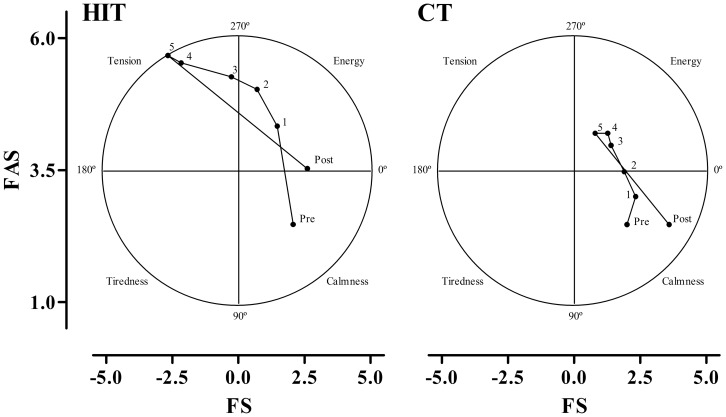
“After the HIT session, a sense of calmness was observed (quadrant 1 - 0° to 90°).”
§ Continuous and High-Intensity Interval Training: Which Promotes Higher Pleasure? > Results > Psychological variables
plain- Asserted: passes — The authors put it forward as true.
- Checkable: passes — It can be checked against evidence.
- Load-bearing: unclear — It is unclear whether the paper’s conclusions depend on it.
- Based: passes — The paper gives a reason why it holds.
A result the paper reports from its own data — it cites no other source for it, so there is none to check. The quote shows it is in the paper.
In the paper
“We observed a significant time effect only for tension (F = 5.82, p<.05)”
§ Continuous and High-Intensity Interval Training: Which Promotes Higher Pleasure? > Results > Psychological variables
plain- Asserted: passes — The authors put it forward as true.
- Checkable: passes — It can be checked against evidence.
- Load-bearing: unclear — It is unclear whether the paper’s conclusions depend on it.
- Based: passes — The paper gives a reason why it holds.
- It may state two separate claims as one. 22
- Probably not a substantial claim. 30
A result the paper reports from its own data — it cites no other source for it, so there is none to check. The quote shows it is in the paper.
In the paper
“thus, the average duration was 19.2 minutes (SD = 4.8), which was significantly lower than that of the CT condition (t = 3.71, p = .01, η2 = .49).”
§ Continuous and High-Intensity Interval Training: Which Promotes Higher Pleasure? > Results > Descriptive results of training sessions
plain- Asserted: passes — The authors put it forward as true.
- Checkable: passes — It can be checked against evidence.
- Load-bearing: unclear — It is unclear whether the paper’s conclusions depend on it.
- Based: passes — The paper gives a reason why it holds.
It may state two separate claims as one.
A result the paper reports from its own data — it cites no other source for it, so there is none to check. The quote shows it is in the paper.
In the paper
“The average percentage of the maximum HR was 80.4% (SD = 4.4%) in the CT condition and 88.1% (SD = 2.4%) in the HIT condition, resulting in a significant difference between the two conditions (t = 7.96, p<.001, η2 = .82).”
§ Continuous and High-Intensity Interval Training: Which Promotes Higher Pleasure? > Results > Descriptive results of training sessions
plain- Asserted: passes — The authors put it forward as true.
- Checkable: passes — It can be checked against evidence.
- Load-bearing: unclear — It is unclear whether the paper’s conclusions depend on it.
- Based: passes — The paper gives a reason why it holds.
It may state two separate claims as one.
A result the paper reports from its own data — it cites no other source for it, so there is none to check. The quote shows it is in the paper.
In the paper
“Significant main effects were observed for the RPE (interaction, F = 4.48, p<.01; time, F = 63.84, p<.001; and condition, F = 29.46, p<.001), FAS (interaction, F = 2.29, p<.01; time, F = 38.15, p<.001; and condition, F = 18.65, p<.001), and FS (interaction, F = 4.93, p<.001; time, F = 22.89, p<.001; and condition, F = 7.92, p<.01).”
§ Continuous and High-Intensity Interval Training: Which Promotes Higher Pleasure? > Results > Psychological variables
plain- Asserted: passes — The authors put it forward as true.
- Checkable: passes — It can be checked against evidence.
- Load-bearing: passes — The paper’s conclusions depend on it.
- Based: passes — The paper gives a reason why it holds.
It may state two separate claims as one.
A result the paper reports from its own data — it cites no other source for it, so there is none to check. The quote shows it is in the paper.
In the paper
“The average duration of a CT session was 23.9 minutes (SD = 3.2).”
§ Continuous and High-Intensity Interval Training: Which Promotes Higher Pleasure? > Results > Descriptive results of training sessions
plain- Asserted: passes — The authors put it forward as true.
- Checkable: passes — It can be checked against evidence.
- Load-bearing: fails — The paper’s conclusions may not depend on it.
- Based: passes — The paper gives a reason why it holds.
Probably not a substantial claim. The paper’s conclusions may not depend on it.
A result the paper reports from its own data — it cites no other source for it, so there is none to check. The quote shows it is in the paper.
In the paper
“The average VCO2 was 2.71 L.min−1 (SD = .36) in the CT condition and 3.13 L.min−1 (SD = .53) in the HIT condition, and the difference between the two conditions was significant (t = 5.70, p<.001, η2 = .69).”
§ Continuous and High-Intensity Interval Training: Which Promotes Higher Pleasure? > Results > Descriptive results of training sessions
plain- Asserted: passes — The authors put it forward as true.
- Checkable: passes — It can be checked against evidence.
- Load-bearing: unclear — It is unclear whether the paper’s conclusions depend on it.
- Based: passes — The paper gives a reason why it holds.
It may state two separate claims as one.
A result the paper reports from its own data — it cites no other source for it, so there is none to check. The quote shows it is in the paper.
In the paper
“In the HIT condition, the average number of stimuli performed was 6.6 (SD = 1.7), with a recovery time of 57 seconds (SD = 10) between stimuli.”
§ Continuous and High-Intensity Interval Training: Which Promotes Higher Pleasure? > Results > Descriptive results of training sessions
plain- Asserted: passes — The authors put it forward as true.
- Checkable: passes — It can be checked against evidence.
- Load-bearing: fails — The paper’s conclusions may not depend on it.
- Based: passes — The paper gives a reason why it holds.
Probably not a substantial claim. The paper’s conclusions may not depend on it. It may state two separate claims as one.
A result the paper reports from its own data — it cites no other source for it, so there is none to check. The quote shows it is in the paper.
In the paper
“The significant interaction observed indicated that the RPE and FAS scores increased more over time, whereas the FS scores decreased more over time during HIT.”
§ Continuous and High-Intensity Interval Training: Which Promotes Higher Pleasure? > Results > Psychological variables
hedgeddirect- Asserted: passes — The authors put it forward as true.
- Checkable: passes — It can be checked against evidence.
- Load-bearing: passes — The paper’s conclusions depend on it.
- Based: passes — The paper gives a reason why it holds.
It may state two separate claims as one.
A result the paper reports from its own data — it cites no other source for it, so there is none to check. The quote shows it is in the paper.
In the paper
“In the HIT condition before the exercise session, the participants ranged from a sense of calmness (quadrant 1 - 0° to 90°) to a sense of energy (quadrant 4 - 270° to 0°) in quintile 1 and a sense of tension (quadrant 3 - 180° to 270°) in quintiles 3, 4 and 5.”
§ Continuous and High-Intensity Interval Training: Which Promotes Higher Pleasure? > Results > Psychological variables
plain- Asserted: passes — The authors put it forward as true.
- Checkable: passes — It can be checked against evidence.
- Load-bearing: unclear — It is unclear whether the paper’s conclusions depend on it.
- Based: passes — The paper gives a reason why it holds.
It may state two separate claims as one.
In the paper
“It has previously been demonstrated that an increase in perceived pleasure (reported as a shift of one unit on the Feeling Scale) is associated with an additional 38 minutes of physical activity per week [6].”
§ Continuous and High-Intensity Interval Training: Which Promotes Higher Pleasure? > Introduction
What the sources say
- Not checked yetcites [6] DM Williams, 2008, Acute Affective Response to a Moderate-intensity Exercise Stimulus Predicts Physical Activity Participation 6 and 12 Months Later, Psychol Sport Exerc source
boostedcorrelational- Asserted: passes — The authors put it forward as true.
- Checkable: passes — It can be checked against evidence.
- Load-bearing: passes — The paper’s conclusions depend on it.
- Based: passes — The paper gives a reason why it holds.
Probably not a substantial claim.
In the paper
“Bartlett et al. [7] reported higher enjoyment after HIT.”
§ Continuous and High-Intensity Interval Training: Which Promotes Higher Pleasure? > Introduction
What the sources say
- Not checked yetcites [7] JD Bartlett, 2011, High-intensity interval running is perceived to be more enjoyable than moderate-intensity continuous exercise: Implications for exercise adherence, J Sports Sci source
plaindirect- Asserted: passes — The authors put it forward as true.
- Checkable: passes — It can be checked against evidence.
- Load-bearing: fails — The paper’s conclusions may not depend on it.
- Based: passes — The paper gives a reason why it holds.
Probably not a substantial claim. The paper’s conclusions may not depend on it.
In the paper
“Previous studies have reported an inverse relationship between exercise intensity and psychological responses in CT [5].”
§ Continuous and High-Intensity Interval Training: Which Promotes Higher Pleasure? > Introduction
What the sources say
- Not checked yetcites [5] P Ekkekakis, 2011, The Pleasure and Displeasure People Feel When they Exercise at Different Intensities: Decennial Update and Progress towards a Tripartite Rationale for Exercise Intensity Prescription, Sports Med source
plaincorrelational- Asserted: passes — The authors put it forward as true.
- Checkable: passes — It can be checked against evidence.
- Load-bearing: passes — The paper’s conclusions depend on it.
- Based: passes — The paper gives a reason why it holds.
Probably not a substantial claim.
In the paper
“Muller et al. [8] found positive responses in mood after a CT session, whereas no changes were found in mood responses after a HIT session.”
§ Continuous and High-Intensity Interval Training: Which Promotes Higher Pleasure? > Introduction
What the sources say
- Not checked yetcites [8] MD Muller, 2011, Mood and selective attention in the cold: the effect of interval versus continuous exercise, Eur J Appl Physiol source
plain- Asserted: passes — The authors put it forward as true.
- Checkable: passes — It can be checked against evidence.
- Load-bearing: passes — The paper’s conclusions depend on it.
- Based: passes — The paper gives a reason why it holds.
Probably not a substantial claim. It may state two separate claims as one.
In the paper
“The predominance of cognitive factors is related to pleasurable sensations, whereas the predominance of interoceptive cues is related to unpleasant sensations [11].”
§ Continuous and High-Intensity Interval Training: Which Promotes Higher Pleasure? > Introduction
What the sources say
- Not checked yetcites [11] P Ekkekakis, 2009, The dual-mode theory of affective responses to exercise in metatheoretical context: II. Bodiless heads, ethereal cognitive schemata, and other improbable dualistic creatures, exercising, Int Rev Sport Exerc Psychol source
plaincorrelational- Asserted: passes — The authors put it forward as true.
- Checkable: passes — It can be checked against evidence.
- Load-bearing: passes — The paper’s conclusions depend on it.
- Based: passes — The paper gives a reason why it holds.
Probably not a substantial claim. It may state two separate claims as one.
In the paper
“This theory postulates that the exercise intensity (especially the lactate and ventilatory threshold) is the mediator of affective responses.”
§ Continuous and High-Intensity Interval Training: Which Promotes Higher Pleasure? > Introduction
What the sources say
- Not checked yetcites [10] P Ekkekakis, 2003, Pleasure and displeasure from the body: perspectives from exercise, Cogn Emot source
plaindirect- Asserted: passes — The authors put it forward as true.
- Checkable: passes — It can be checked against evidence.
- Load-bearing: passes — The paper’s conclusions depend on it.
- Based: passes — The paper gives a reason why it holds.
Probably not a substantial claim.
In the paper
“It has been hypothesized that cognitive factors predominate at intensities below the metabolic threshold and that interoceptive cues predominate at intensities above the metabolic threshold [11].”
§ Continuous and High-Intensity Interval Training: Which Promotes Higher Pleasure? > Introduction
What the sources say
- Not checked yetcites [11] P Ekkekakis, 2009, The dual-mode theory of affective responses to exercise in metatheoretical context: II. Bodiless heads, ethereal cognitive schemata, and other improbable dualistic creatures, exercising, Int Rev Sport Exerc Psychol source
hedgedcorrelational- Asserted: fails — The authors may not put it forward as true.
- Checkable: passes — It can be checked against evidence.
- Load-bearing: passes — The paper’s conclusions depend on it.
- Based: passes — The paper gives a reason why it holds.
Probably not a substantial claim. The authors may not put it forward as true. It may state two separate claims as one.
In the paper
“which seems to be the optimal intensity for the acquisition of physiological benefits [3].”
§ Continuous and High-Intensity Interval Training: Which Promotes Higher Pleasure? > Introduction
What the sources say
- Not checked yetcites [3] VL Billat, 2000, Intermittent runs at the velocity associated with maximal oxygen uptake enables subjects to remain at maximal oxygen uptake for a longer time than intense but submaximal runs, Eur J Appl Physiol source
hedgedconditional- Asserted: passes — The authors put it forward as true.
- Checkable: passes — It can be checked against evidence.
- Load-bearing: passes — The paper’s conclusions depend on it.
- Based: passes — The paper gives a reason why it holds.
Probably not a substantial claim.
The paper states this without a source or data behind it here, so there is nothing to check it against. The quote shows it is in the paper.
In the paper
“However, the effects of HIT on psychological variables are not well understood, especially with respect to basic affect.”
§ Continuous and High-Intensity Interval Training: Which Promotes Higher Pleasure? > Introduction
plain- Asserted: passes — The authors put it forward as true.
- Checkable: passes — It can be checked against evidence.
- Load-bearing: passes — The paper’s conclusions depend on it.
- Based: fails — The paper may give no reason why it holds.
Probably not a substantial claim. The paper may give no reason why it holds.
In the paper
“According to the Dual-Mode Theory, an exercise session can have effects on cognitive factors (e.g., psychological factors such as physical self-efficacy) and interoceptive factors (e.g., physiological factors such as ventilation), and the interaction of these factors is influenced by the exercise intensity [10].”
§ Continuous and High-Intensity Interval Training: Which Promotes Higher Pleasure? > Introduction
What the sources say
- Not checked yetcites [10] P Ekkekakis, 2003, Pleasure and displeasure from the body: perspectives from exercise, Cogn Emot source
plaindirect- Asserted: passes — The authors put it forward as true.
- Checkable: passes — It can be checked against evidence.
- Load-bearing: passes — The paper’s conclusions depend on it.
- Based: passes — The paper gives a reason why it holds.
Probably not a substantial claim. It may state two separate claims as one.
What the paper did — it cites no source for this, so there is none to check. The quote shows it is in the paper.
In the paper
“the average intensity of both sessions was maintained at 15% below the RCP.”
- Also stated in: § Procedures · plain
“We used an average intensity of 85% of the RCP for both conditions”
§ Continuous and High-Intensity Interval Training: Which Promotes Higher Pleasure? > Abstract > Methods
plainn = 15- Asserted: passes — The authors put it forward as true.
- Checkable: passes — It can be checked against evidence.
- Load-bearing: passes — The paper’s conclusions depend on it.
- Based: passes — The paper gives a reason why it holds.
Probably not a substantial claim.
- Also stated in: § Procedures · plain
What the paper did — it cites no source for this, so there is none to check. The quote shows it is in the paper.
In the paper
“The equipment was calibrated before each test based on the manufacturer's instructions.”
§ Continuous and High-Intensity Interval Training: Which Promotes Higher Pleasure? > Materials and Methods > Procedures
plain- Asserted: passes — The authors put it forward as true.
- Checkable: passes — It can be checked against evidence.
- Load-bearing: fails — The paper’s conclusions may not depend on it.
- Based: passes — The paper gives a reason why it holds.
Probably not a substantial claim. The paper’s conclusions may not depend on it.
In the paper
“Considering that positive psychological responses may improve the likelihood of adherence, it is necessary to investigate which training method (CT or HIT) might result in better psychological responses.”
§ Continuous and High-Intensity Interval Training: Which Promotes Higher Pleasure? > Introduction
What the sources say
- Not checked yetcites [5] P Ekkekakis, 2011, The Pleasure and Displeasure People Feel When they Exercise at Different Intensities: Decennial Update and Progress towards a Tripartite Rationale for Exercise Intensity Prescription, Sports Med source
hedgedconditional- Asserted: passes — The authors put it forward as true.
- Checkable: passes — It can be checked against evidence.
- Load-bearing: passes — The paper’s conclusions depend on it.
- Based: passes — The paper gives a reason why it holds.
Probably not a substantial claim.
What the paper did — it cites no source for this, so there is none to check. The quote shows it is in the paper.
In the paper
“The order of the sessions was randomized.”
- Also stated in: § Procedures · plain
“The training sessions were applied in a random order during the second and third visits.”
§ Continuous and High-Intensity Interval Training: Which Promotes Higher Pleasure? > Abstract > Methods
plain- Asserted: passes — The authors put it forward as true.
- Checkable: passes — It can be checked against evidence.
- Load-bearing: fails — The paper’s conclusions may not depend on it.
- Based: passes — The paper gives a reason why it holds.
Probably not a substantial claim. The paper’s conclusions may not depend on it.
- Also stated in: § Procedures · plain
What the paper did — it cites no source for this, so there is none to check. The quote shows it is in the paper.
In the paper
“During two subsequent visits, HIT and CT sessions on a treadmill were administered in a cross over design with a counterbalanced order.”
§ Continuous and High-Intensity Interval Training: Which Promotes Higher Pleasure? > Materials and Methods > Experimental Design
plain- Asserted: passes — The authors put it forward as true.
- Checkable: passes — It can be checked against evidence.
- Load-bearing: passes — The paper’s conclusions depend on it.
- Based: passes — The paper gives a reason why it holds.
Probably not a substantial claim. It may state two separate claims as one.
In the paper
“The CR scale was adopted because it has been previously demonstrated that psychophysical ratio scales provide more accurate growth functions (positively accelerating with power output), which allows a better understanding of physiological and perceptual processes, when compared to the 6–20 RPE scales [19].”
§ Continuous and High-Intensity Interval Training: Which Promotes Higher Pleasure? > Materials and Methods > Procedures
What the sources say
- Not checked yetcites [19] E Borg, 2006, A comparison between three rating scales for perceived exertion and two different work tests, Scand J Med Sci Sports source
boosteddirect- Asserted: passes — The authors put it forward as true.
- Checkable: passes — It can be checked against evidence.
- Load-bearing: fails — The paper’s conclusions may not depend on it.
- Based: passes — The paper gives a reason why it holds.
Probably not a substantial claim. The paper’s conclusions may not depend on it.
None of the sources cited for this claim have been checked yet.
In the paper
“To determine the sample size [14], we assumed a mean difference of 1.74±1.18 on the Feeling Scale (FS) with an α = .05 and a β = .20 because similar results had been previously observed and were associated with significant differences [15].”
§ Continuous and High-Intensity Interval Training: Which Promotes Higher Pleasure? > Materials and Methods > Participants
What the sources say
- Not checked yetcites [14] WG Hopkins, 2006, Estimating sample size for magnitude-based inferences, Sportsci
- Not checked yetcites [15] EA Rose, 2007, A quantitative analysis and qualitative explanation of the individual differences in affective responses to prescribed and self-selected exercise intensities, J Sport Exerc Psychol source
plain- Asserted: passes — The authors put it forward as true.
- Checkable: passes — It can be checked against evidence.
- Load-bearing: fails — The paper’s conclusions may not depend on it.
- Based: passes — The paper gives a reason why it holds.
Probably not a substantial claim. The paper’s conclusions may not depend on it.
In the paper
“This theory is widely recognized for CT but has not previously been demonstrated for HIT.”
§ Continuous and High-Intensity Interval Training: Which Promotes Higher Pleasure? > Discussion
What the sources say
- Not checked yetcites [11] P Ekkekakis, 2009, The dual-mode theory of affective responses to exercise in metatheoretical context: II. Bodiless heads, ethereal cognitive schemata, and other improbable dualistic creatures, exercising, Int Rev Sport Exerc Psychol source
boosted- Asserted: passes — The authors put it forward as true.
- Checkable: passes — It can be checked against evidence.
- Load-bearing: passes — The paper’s conclusions depend on it.
- Based: passes — The paper gives a reason why it holds.
Probably not a substantial claim. It may state two separate claims as one.
In the paper
“The increased production of neuromodulatory substances such as anandamide, dopamine, serotonin and endorphins may be associated with decreased anxiety and increased pleasure after intervals of intense stimulation [32].”
§ Continuous and High-Intensity Interval Training: Which Promotes Higher Pleasure? > Discussion
What the sources say
- Not checked yetcites [32] A Deslandes, 2009, Exercise and mental health: many reasons to move, Neuropsychobiology source
hedgedcorrelational- Asserted: passes — The authors put it forward as true.
- Checkable: passes — It can be checked against evidence.
- Load-bearing: fails — The paper’s conclusions may not depend on it.
- Based: passes — The paper gives a reason why it holds.
Probably not a substantial claim. The paper’s conclusions may not depend on it.
In the paper
“The Dual-Mode Theory may also explain the positive rebound effect observed after exercise, with relatively larger increases in pleasure after HIT, which are possibly modulated by the magnitude of the negative perceptions during exercise [30].”
§ Continuous and High-Intensity Interval Training: Which Promotes Higher Pleasure? > Discussion
What the sources say
- Not checked yetcites [30] P Ekkekakis, 2008, The relationship between exercise intensity and affective responses demystified: to crack the 40-year-old nut, replace the 40-year-old nutcracker!, Ann Behav Med source
hedgedconditional- Asserted: passes — The authors put it forward as true.
- Checkable: passes — It can be checked against evidence.
- Load-bearing: unclear — It is unclear whether the paper’s conclusions depend on it.
- Based: passes — The paper gives a reason why it holds.
It may state two separate claims as one.
In the paper
“The opponent process theory [31], postulates that after every affective perception (pleasant or unpleasant), an opponent process occurs.”
§ Continuous and High-Intensity Interval Training: Which Promotes Higher Pleasure? > Discussion
What the sources say
- Not checked yetcites [31] RL Solomon, 1980, The opponent-process theory of acquired motivation: the costs of pleasure and the benefits of pain, Am Psychol source
plaindirect- Asserted: passes — The authors put it forward as true.
- Checkable: passes — It can be checked against evidence.
- Load-bearing: fails — The paper’s conclusions may not depend on it.
- Based: passes — The paper gives a reason why it holds.
Probably not a substantial claim. The paper’s conclusions may not depend on it.
In the paper
“activities that rely heavily on anaerobic metabolism result in negative pleasure and high arousal.”
§ Continuous and High-Intensity Interval Training: Which Promotes Higher Pleasure? > Discussion
What the sources say
- Not checked yetcites [28] M Kilpatrick, 2007, Affective responses to exercise are dependent on intensity rather than total work, Med Sci Sports Exerc source
plaindirect- Asserted: passes — The authors put it forward as true.
- Checkable: passes — It can be checked against evidence.
- Load-bearing: passes — The paper’s conclusions depend on it.
- Based: passes — The paper gives a reason why it holds.
It may state two separate claims as one.
In the paper
“The learning theory postulates that immediate affective responses should be better predictors of future exercise than the affective responses observed after the exercise session [33].”
§ Continuous and High-Intensity Interval Training: Which Promotes Higher Pleasure? > Discussion
What the sources say
- Not checked yetcites [33] DM Williams, 2008, Exercise, affect, and adherence: an integrated model and a case for self-paced exercise, Journal of Sport and Exercise Psychology source
plaincorrelational- Asserted: passes — The authors put it forward as true.
- Checkable: passes — It can be checked against evidence.
- Load-bearing: passes — The paper’s conclusions depend on it.
- Based: passes — The paper gives a reason why it holds.
Probably not a substantial claim.
A conclusion the paper draws from its own results — it cites no other source for it, so there is none to check. The quote shows it is in the paper.
In the paper
“Our study also confirmed this theory for HIT, demonstrating that an extreme increase in physiological responses during a stimulus resulted in an extreme decrease in pleasure during the activity independent of the recovery periods.”
§ Continuous and High-Intensity Interval Training: Which Promotes Higher Pleasure? > Discussion
boosteddirect- Asserted: passes — The authors put it forward as true.
- Checkable: passes — It can be checked against evidence.
- Load-bearing: passes — The paper’s conclusions depend on it.
- Based: passes — The paper gives a reason why it holds.
It may state two separate claims as one.
In the paper
“Thus, according to this theory, a feeling of pleasure can occur after an aversive stimulus or stress, which can activate the reward system and can then lead to a repetition of that stimulus.”
§ Continuous and High-Intensity Interval Training: Which Promotes Higher Pleasure? > Discussion
What the sources say
- Not checked yetcites [31] RL Solomon, 1980, The opponent-process theory of acquired motivation: the costs of pleasure and the benefits of pain, Am Psychol source
plaindirect- Asserted: passes — The authors put it forward as true.
- Checkable: passes — It can be checked against evidence.
- Load-bearing: fails — The paper’s conclusions may not depend on it.
- Based: passes — The paper gives a reason why it holds.
Probably not a substantial claim. The paper’s conclusions may not depend on it. It may state two separate claims as one.
A conclusion the paper draws from its own results — it cites no other source for it, so there is none to check. The quote shows it is in the paper.
In the paper
“the affective response seems to have been influenced by the magnitude of the stimulus intensity and, consequently, by the predominant metabolic pathway engaged by the exercise.”
§ Continuous and High-Intensity Interval Training: Which Promotes Higher Pleasure? > Discussion
hedgedconditional- Asserted: passes — The authors put it forward as true.
- Checkable: passes — It can be checked against evidence.
- Load-bearing: passes — The paper’s conclusions depend on it.
- Based: passes — The paper gives a reason why it holds.
It may state two separate claims as one.
In the paper
“Blanchard et al. [34] found no changes in affective responses based on the training condition.”
§ Continuous and High-Intensity Interval Training: Which Promotes Higher Pleasure? > Discussion
What the sources say
- Not checked yetcites [34] CM Blanchard, 2004, Does equating total volume of work between two different exercise conditions matter when examining exercise-induced feeling states?, Res Q Exerc Sport source
plain- Asserted: passes — The authors put it forward as true.
- Checkable: passes — It can be checked against evidence.
- Load-bearing: fails — The paper’s conclusions may not depend on it.
- Based: passes — The paper gives a reason why it holds.
Probably not a substantial claim. The paper’s conclusions may not depend on it.
In the paper
“it is not well known whether individuals choose to continue to engage in physical activities based on perceptions experienced during or after exercise.”
§ Continuous and High-Intensity Interval Training: Which Promotes Higher Pleasure? > Discussion
What the sources say
- Not checked yetcites [33] DM Williams, 2008, Exercise, affect, and adherence: an integrated model and a case for self-paced exercise, Journal of Sport and Exercise Psychology source
plain- Asserted: passes — The authors put it forward as true.
- Checkable: passes — It can be checked against evidence.
- Load-bearing: passes — The paper’s conclusions depend on it.
- Based: passes — The paper gives a reason why it holds.
Probably not a substantial claim.
What the paper did — it cites no source for this, so there is none to check. The quote shows it is in the paper.
In the paper
“For the HIT condition, the affective responses were not recorded after the recovery period; they were only recorded after the stimulus.”
§ Continuous and High-Intensity Interval Training: Which Promotes Higher Pleasure? > Discussion
plain- Asserted: passes — The authors put it forward as true.
- Checkable: passes — It can be checked against evidence.
- Load-bearing: passes — The paper’s conclusions depend on it.
- Based: passes — The paper gives a reason why it holds.
Probably not a substantial claim. It may state two separate claims as one.
What the paper did — it cites no source for this, so there is none to check. The quote shows it is in the paper.
In the paper
“the measurement of affect during HIT increases the external validity of the study.”
§ Continuous and High-Intensity Interval Training: Which Promotes Higher Pleasure? > Discussion
plaindirect- Asserted: passes — The authors put it forward as true.
- Checkable: fails — It may be too vague to check against evidence.
- Load-bearing: passes — The paper’s conclusions depend on it.
- Based: passes — The paper gives a reason why it holds.
Probably not a substantial claim. It may be too vague to check against evidence.
A conclusion the paper draws from its own results — it cites no other source for it, so there is none to check. The quote shows it is in the paper.
In the paper
“In summary, CT performed at an intensity below the RCP results in positive affective responses compared with HIT at 100% of VO2Peak with a short recovery time, which has a higher dependence on anaerobic metabolism even when performed at the same average intensity as that of the CT session.”
§ Continuous and High-Intensity Interval Training: Which Promotes Higher Pleasure? > Discussion
plaindirect- Asserted: passes — The authors put it forward as true.
- Checkable: passes — It can be checked against evidence.
- Load-bearing: passes — The paper’s conclusions depend on it.
- Based: passes — The paper gives a reason why it holds.
It may state two separate claims as one.
What the paper did — it cites no source for this, so there is none to check. The quote shows it is in the paper.
In the paper
“Although these tests occurred in a laboratory (which reduces the external validity), this study recorded the affective responses during a HIT session.”
§ Continuous and High-Intensity Interval Training: Which Promotes Higher Pleasure? > Discussion
plain- Asserted: passes — The authors put it forward as true.
- Checkable: passes — It can be checked against evidence.
- Load-bearing: passes — The paper’s conclusions depend on it.
- Based: passes — The paper gives a reason why it holds.
Probably not a substantial claim. It may state two separate claims as one.
In the paper
“However, consecutive application of the scales over short interval periods could have induced reactivity in the participants, which may have altered their performance due to the awareness of being observed [38].”
§ Continuous and High-Intensity Interval Training: Which Promotes Higher Pleasure? > Discussion
What the sources say
- Not checked yetcites [38] Heppner PP, Kivlighan DM, Wampold BE (2008) Research design in counseling. Belmont, CA: Thomson Learning.
hedgedconditional- Asserted: passes — The authors put it forward as true.
- Checkable: passes — It can be checked against evidence.
- Load-bearing: fails — The paper’s conclusions may not depend on it.
- Based: passes — The paper gives a reason why it holds.
Probably not a substantial claim. The paper’s conclusions may not depend on it. It may state two separate claims as one.
The paper relies on this without support.
The higher VCO2 observed during HIT reflects a greater dependence on anaerobic metabolism.
“suggesting that the higher dependence on anaerobic metabolism during HIT negatively influenced the feeling scale responses.”
“The average VCO2 was 2.71 L.min−1 (SD = .36) in the CT condition and 3.13 L.min−1 (SD = .53) in the HIT condition, and the difference between the two conditions was significant (t = 5.70, p<.001, η2 = .69).”
The paper relies on this without support.
The FS and FAS are related to basic affect, whereas the PAES is related to an emotional state.
“It is important to consider that the FS and FAS are related to basic affect, whereas the PAES is related to an emotional state”
Claims other papers make about this one
Each is checked against this paper’s own text: does it say what the citing paper says it does?
The source backs part of the claim, not all of it — or backs it for a different population, condition or comparison.
In the citing paper
“However, the current study and related investigations ([12–14] incorporated HIIT which has a lower metabolic perturbation than SIT.”
From High-Intensity Interval Training Elicits Higher Enjoyment than Moderate Intensity Continuous Exercise (2017) · cites this paper as [13]
Experimental — accuracy not yet measured
Self-check
Percentages, sums and reported differences re-computed from the paper’s own numbers.
Each contradiction between two passages listed here was confirmed by an independent check.
Rated minor: it would not touch a result — a value no result rests on, a p-value that stays on the same side of the significance level, or a conflict that is clerical, resolved elsewhere in the paper, or outside its own findings.
In the paper
§ Continuous and High-Intensity Interval Training: Which Promotes Higher Pleasure? > Abstract > Results
“There were no significant differences between the average percentages of VO2 during the two exercise sessions (HIT: 73.3% vs. CT: 71.8%; p = 0.779).”
§ Continuous and High-Intensity Interval Training: Which Promotes Higher Pleasure? > Results > Descriptive results of training sessions
“The average percentage of VO2 was 71.9% (SD = 7.5%) in the CT condition and 73.3% (SD = 3.5%) in the HIT condition, and no significant difference was found (t = 1.04, p = .31, η2 = .07).”
Rated minor: it would not touch a result — a value no result rests on, a p-value that stays on the same side of the significance level, or a conflict that is clerical, resolved elsewhere in the paper, or outside its own findings.
In the paper
§ Continuous and High-Intensity Interval Training: Which Promotes Higher Pleasure? > Results > Psychological variables
“| Fatigue | 8.7 | 4.9 | 4.2 | 2.5 | <.01 | 3.30 | −.39 (−1.11, .34) |”
§ Continuous and High-Intensity Interval Training: Which Promotes Higher Pleasure? > Results > Psychological variables
“Although we observed an increase in fatigue in both conditions, the significant interaction indicated that the HIT condition resulted in greater increases in fatigue.”
Citations
Cites
‘Small Changes' to Diet and Physical Activity Behaviors for Weight Management
Hills, A. P., Byrne, N. M., Lindstrom, R. C., & Hill, J. O. (2013) · Obesity Facts · doi:10.1159/000345030 · Cited by 9,526
A new method for detecting anaerobic threshold by gas exchange
Beaver, W. L., Wasserman, K., & Whipp, B. J. (1986) · Journal of Applied Physiology · doi:10.1152/jappl.1986.60.6.2020 · Cited by 4,103
The Neuroendocrinology of Stress: A Never Ending Story
Lightman, S. L. (2008) · Journal of Neuroendocrinology · doi:10.1111/j.1365-2826.2008.01711.x · Cited by 3,588
Borg's Perceived Exertion and Pain Scales
Borg, G. A. V. (1998) · Cited by 3,366
Generalized equations for predicting body density of men
Jackson, A. S., & Pollock, M. L. (1978) · British Journal Of Nutrition · doi:10.1079/bjn19780152 · Cited by 3,205
Wisløff, U., Støylen, A., Loennechen, J. P., Bruvold, M., Rognmo, Ø., Haram, P. M., Tjønna, A. E., Helgerud, J., Slørdahl, S. A., Lee, S. J., et al. (2007) · Circulation · doi:10.1161/circulationaha.106.675041 · Cited by 1,996
Not what, but how one feels: the measurement of affect during exercise
Hardy, C. J., & Rejeski, W. J. (1989) · Journal of Sport and Exercise Psychology · doi:10.1123/jsep.11.3.304 · Cited by 1,607
Tenenbaum, G., & Eklund, R. C. (2007) · Wiley eBooks · doi:10.1002/9781118270011 · Cited by 1,417
Physical activity enjoyment scale: Two validation studies
Kendzierski, D., & DeCarlo, K. J. (1991) · Journal of Sport and Exercise Psychology · doi:10.1123/jsep.13.1.50 · Cited by 1,329 · cited 1×
“We also used the physical activity enjoyment scale (PAES) to assess the enjoyment level for each exercise condition [23].”
Method(2002) · Choice Reviews Online · doi:10.5860/choice.39-2858 · Cited by 1,304
Research works printed but not linked: 3
- ACSM (2010) ACSM's Guidelines for Exercise Testing and Prescription. Baltimore, MD: Lippincott Williams & Wilkins.
- WG Hopkins, 2006, Estimating sample size for magnitude-based inferences, Sportsci, 10, 63
- Siri WE (1961) Body composition from fluid spaces and density. In: A BJeH, editor. Techniques of Measuring Body Composition. Washington D.C: National Academy of Science. pp. 233–244.
Cited by
Sorted by citations
Jelleyman, C., Yates, T., O'Donovan, G., Gray, L. J., King, J. A., Khunti, K., & Davies, M. J. (2015) · Obesity Reviews · doi:10.1111/obr.12317 · Cited by 588
Exercise reduces depression and inflammation but intensity matters
Paolucci, E. M., Loukov, D., Bowdish, D. M. E., & Heisz, J. J. (2018) · Biological Psychology · doi:10.1016/j.biopsycho.2018.01.015 · Cited by 461
Jung, M. E., Bourne, J. E., & Little, J. P. (2014) · PLoS ONE · doi:10.1371/journal.pone.0114541 · Cited by 331
Thum, J. S., Parsons, G., Whittle, T., & Astorino, T. A. (2017) · PLoS ONE · doi:10.1371/journal.pone.0166299 · Cited by 289
Martinez, N., Kilpatrick, M. W., Salomon, K., Jung, M. E., & Little, J. P. (2015) · Journal of Sport and Exercise Psychology · doi:10.1123/jsep.2014-0212 · Cited by 200
Stork, M., Banfield, L. E., Gibala, M. J., & Ginis, K. A. M. (2017) · Health Psychology Review · doi:10.1080/17437199.2017.1326011 · Cited by 201
Oliveira, B. R. R., Santos, T. M., Kilpatrick, M. W., Pires, F. O., & Deslandes, A. C. (2018) · PLoS ONE · doi:10.1371/journal.pone.0197124 · Cited by 205
Self-citationFrazão, D. T., Farias-Junior, L. F., Dantas, T. C. B., Krinski, K., Elsangedy, H. M., Prestes, J., Hardcastle, S. J., & Costa, E. C. (2016) · PLoS ONE · doi:10.1371/journal.pone.0152752 · Cited by 171
Decker, E. S., & Ekkekakis, P. (2017) · Psychology of Sport and Exercise · doi:10.1016/j.psychsport.2016.09.005 · Cited by 139
Shepherd, S. O., Wilson, O. J., Taylor, A. S., Thøgersen‐Ntoumani, C., Adlan, A., Wagenmakers, A. J. M., & Shaw, C. S. (2015) · PLoS ONE · doi:10.1371/journal.pone.0139056 · Cited by 149
Barathi, S. C., Finnegan, D. J., Farrow, M. T., Whaley, A., Heath, P., Buckley, J., Dowrick, P. W., Wuensche, B. C., Bilzon, J., O'Neill, E. J., et al. (2018) · CHI Conference on Human Factors in Computing Systems · doi:10.1145/3173574.3173982 · Cited by 114
Heisz, J. J., Tejada, M. G. M., Paolucci, E. M., & Muir, C. (2016) · PLoS ONE · doi:10.1371/journal.pone.0168534 · Cited by 119
Olney, N., Wertz, T., LaPorta, Z., Mora, A., Serbas, J., & Astorino, T. A. (2017) · The Journal of Strength and Conditioning Research · doi:10.1519/jsc.0000000000002154 · Cited by 120
Effects of continuous and intermittent exercise on executive function in children aged 8–10 years
Lambrick, D., Stoner, L. R., Grigg, R., & Faulkner, J. (2016) · Psychophysiology · doi:10.1111/psyp.12688 · Cited by 108
Affective Responses to Repeated Sessions of High-Intensity Interval Training
Saanijoki, T., Nummenmaa, L., Eskelinen, J., Savolainen, A., Vahlberg, T. J., Kalliokoski, K. K., & Hannukainen, J. C. (2015) · Medicine & Science in Sports & Exercise · doi:10.1249/mss.0000000000000721 · Cited by 113
Pires, F. O., Silva-Júnior, F. L., Brietzke, C., Franco‐Alvarenga, P. E., Pinheiro, F. A., de França, N. M., Teixeira, S. S., & Santos, T. M. (2018) · Frontiers in Physiology · doi:10.3389/fphys.2018.00227 · Cited by 100
Self-citationModified sprint interval training protocols. Part II. Psychological responses
Townsend, L. K., Islam, H., Dunn, E., Eys, M., Robertson‐Wilson, J., & Hazell, T. J. (2016) · Applied Physiology, Nutrition, and Metabolism · doi:10.1139/apnm-2016-0479 · Cited by 96
Niven, A. G., Laird, Y., Saunders, D. H., & Phillips, S. (2020) · Health Psychology Review · doi:10.1080/17437199.2020.1728564 · Cited by 104
Non-invasive vagus nerve stimulation boosts mood recovery after effort exertion
Ferstl, M., Teckentrup, V., Lin, W. M., Kräutlein, F., Kühnel, A., Klaus, J., Walter, M., & Kroemer, N. B. (2021) · Psychological Medicine · doi:10.1017/s0033291720005073 · Cited by 79
Batrakoulis, A., & Fatouros, I. G. (2022) · Sports · doi:10.3390/sports10050064 · Cited by 62
Poon, E. T., Little, J. P., Sit, C. H. P., & Wong, S. H. (2020) · Journal of Sports Sciences · doi:10.1080/02640414.2020.1766178 · Cited by 62
Osawa, Y., Tabata, S., Katsukawa, F., Ishida, H., Oguma, Y., Kawai, T., Itoh, H., Okuda, S., Matsumoto, H., & Azuma, K. (2014) · Open Access Journal of Sports Medicine · doi:10.2147/oajsm.s68932 · Cited by 60
Astorino, T. A., & Thum, J. S. (2016) · Journal of Spinal Cord Medicine · doi:10.1080/10790268.2016.1235754 · Cited by 56
Interval Running Training Improves Cognitive Flexibility and Aerobic Power of Young Healthy Adults
Venckūnas, T., Sniečkus, A., Trinkūnas, E., Baranauskienė, N., Solianik, R., Juodsnukis, A., Streckis, V., & Kamandulis, S. (2016) · The Journal of Strength and Conditioning Research · doi:10.1519/jsc.0000000000001322 · Cited by 53
Michael, A., & Lutteroth, C. (2020) · CHI Conference on Human Factors in Computing Systems · doi:10.1145/3313831.3376256 · Cited by 55
Physiological, Perceptual, and Affective Responses to Six High-Intensity Interval Training Protocols
Follador, L., Alves, R. C., Ferreira, S. D. S., Buzzachera, C. F., Andrade, V. F. D. S., Garcia, E. D. S. A., Osiecki, R., Barbosa, S. C., Oliveira, L. M., & da Silva, S. G. (2018) · Perceptual and Motor Skills · doi:10.1177/0031512518754584 · Cited by 52
Poon, E. T., Parco Ming-fai, S. I. U., Wongpipit, W., Gibala, M. J., & Wong, S. H. (2021) · Journal of Exercise Science & Fitness · doi:10.1016/j.jesf.2021.11.003 · Cited by 53
Commentary: Why sprint interval training is inappropriate for a largely sedentary population
Jung, M. E., Little, J. P., & Batterham, A. M. (2016) · Frontiers in Psychology · doi:10.3389/fpsyg.2015.01999 · Cited by 47
Farias-Junior, L. F., Browne, R. A. V., Freire, Y. A., Dantas, F. F. O., Lemos, T. M. A. M., Coelho, N. L. G., Hardcastle, S. J., Okano, A. H., Aoki, M. S., & Costa, E. C. (2018) · Physiology & Behavior · doi:10.1016/j.physbeh.2018.11.028 · Cited by 47
Gruet, M., SAYNOR, Z. L., Urquhart, D. S., & Radtke, T. (2021) · Journal of Cystic Fibrosis · doi:10.1016/j.jcf.2021.08.004 · Cited by 53
The Relationship between Self-Concept and Negative Emotion: A Moderated Mediation Model
Zhang, Q., Miao, L., He, L., & Wang, H. (2022) · International Journal of Environmental Research and Public Health · doi:10.3390/ijerph191610377 · Cited by 48
Exercisers’ Affective and Enjoyment Responses: A Meta-Analytic and Meta-Regression Review
Tavares, V. D. D. O., Schuch, F. B., Tempest, G. D., Parfitt, G., Neto, L. D. O., Coelho, N. L. G., & Hackett, D. A. (2021) · Perceptual and Motor Skills · doi:10.1177/00315125211024212 · Cited by 42
Khammassi, M., Ouerghi, N., Said, M. A., Feki, M., Khammassi, Y., Pereira, B., Thivel, D., & Bouassida, A. (2018) · The Journal of Strength and Conditioning Research · doi:10.1519/jsc.0000000000002737 · Cited by 38
Benítez‐Flores, S., de Sousa, A. F. M., Totó, E. C. D. C., Rosa, T. D. S., Rosso, S. D., Foster, C., & Boullosa, D. A. (2018) · Kinesiology · doi:10.26582/k.50.2.13 · Cited by 37
Effects of three low-volume, high-intensity exercise conditions on affective valence
Haines, M. R., Broom, D. R., Gillibrand, W. P., & Stephenson, J. R. (2019) · Journal of Sports Sciences · doi:10.1080/02640414.2019.1684779 · Cited by 34
Roloff, Z. A., Dicks, N. D., Krynski, L. M., Hartman, M. E., Panteleimon Ekkekakis, A., & Pettitt, R. W. (2020) · Performance Enhancement & Health · doi:10.1016/j.peh.2020.100158 · Cited by 33
Kellogg, E., Cantacessi, C., McNamer, O., Holmes, H., von Bargen, R., Ramírez, R., Gallagher, D., Vargas, S., Santia, B., Rodriguez, K., et al. (2018) · The Journal of Strength and Conditioning Research · doi:10.1519/jsc.0000000000002528 · Cited by 33
Prado, R. C. R., Silveira, R., Kilpatrick, M. W., Pires, F. O., & Asano, R. Y. (2021) · Frontiers in Psychology · doi:10.3389/fpsyg.2021.525943 · Cited by 32
Niven, A. G., Thow, J., Holroyd, J., Turner, A. P., & Phillips, S. (2018) · Journal of Sports Sciences · doi:10.1080/02640414.2018.1430984 · Cited by 33
Farhani, Z., Ghouili, H., Dhahbi, W., Ammar, A., Aissa, M. B., Bouzouraa, M. M., Trabelsi, K., Guelmami, N., Souissi, N., Dergaa, I., et al. (2025) · European Journal of Sport Science · doi:10.1002/ejsc.12208 · Cited by 29
Poon, E. T., Sheridan, S. E., Chung, A. P.-W., & Wong, S. H. (2018) · Journal of Exercise Science & Fitness · doi:10.1016/j.jesf.2018.09.002 · Cited by 32
Bottoms, L. M., Leighton, D., Carpenter, R., Anderson, S., Langmead, L., Ramage, J. K., Faulkner, J., Coleman, E., Fairhurst, C. M., Seed, M. P., et al. (2019) · PLoS ONE · doi:10.1371/journal.pone.0222060 · Cited by 32
Positive Affective and Enjoyment Responses to Four High-Intensity Interval Exercise Protocols
Marques, M., Alves, E. D., Henrique, N. R., & Franchini, É. (2020) · Perceptual and Motor Skills · doi:10.1177/0031512520918748 · Cited by 29
Weinstein, A. A., van Aert, R. C. M., Donovan, K., Muskens, L., & Kop, W. J. (2024) · Psychosomatic Medicine · doi:10.1097/psy.0000000000001321 · Cited by 32
The Effect of Acute Exercise on Affect and Arousal in Inpatient Mental Health Consumers
Stanton, R., Reaburn, P. R. J., & Happell, B. (2016) · The Journal of Nervous and Mental Disease · doi:10.1097/nmd.0000000000000510 · Cited by 27
Hoekstra, S. P., Ogawa, T., Santos, M. D., Handsley, G., Bailey, S. J., Goosey-Tolfrey, V. L., Tajima, F., Cheng, J. L., & Leicht, C. A. (2021) · Applied Physiology, Nutrition, and Metabolism · doi:10.1139/apnm-2020-0704 · Cited by 26
Martínez-Díaz, I. C., & Páez, L. C. (2021) · International Journal of Environmental Research and Public Health · doi:10.3390/ijerph18147320 · Cited by 26
Commentary: Why sprint interval training is inappropriate for a largely sedentary population
Del Vecchio, F. B., Gentil, P., Coswig, V. S., & Fukuda, D. H. (2015) · Frontiers in Psychology · doi:10.3389/fpsyg.2015.01359 · Cited by 25
Lucibello, K. M., Paolucci, E. M., Graham, J. D., & Heisz, J. J. (2020) · Mental health and physical activity · doi:10.1016/j.mhpa.2020.100327 · Cited by 25
Mood State Changes Accompanying the Crossfit Open™ Competition in Healthy Adults
Box, A. G., Feito, Y., Petruzzello, S. J., & Mangine, G. T. (2018) · Sports · doi:10.3390/sports6030067 · Cited by 29
Astorino, T. A., Clark, A., Rosa, A. B. D. L., & Revere, J. L. D. (2019) · European Journal of Sport Science · doi:10.1080/17461391.2019.1619840 · Cited by 28
Farias-Junior, L. F., Browne, R. A. V., Astorino, T. A., & Costa, E. C. (2020) · Physiology & Behavior · doi:10.1016/j.physbeh.2020.112960 · Cited by 26
Yuxiang, X., Li, Y., Wang, C., Han, T., Yue, W., Wang, S., & Wei, J. (2024) · International Journal of Clinical and Health Psychology · doi:10.1016/j.ijchp.2023.100433 · Cited by 26
Lisbôa, F. D., Salvador, A. F., Raimundo, J. A. G., Pereira, K. L., de Aguiar, R. A., & Caputo, F. (2015) · The Journal of Strength and Conditioning Research · doi:10.1519/jsc.0000000000000914 · Cited by 25
Rønnestad, B. R., Rømer, T., & Hansen, J. (2019) · International Journal of Sports Physiology and Performance · doi:10.1123/ijspp.2018-0360 · Cited by 23
That feeling I get: Examination of the exercise intensity-affect-enjoyment relationship
Greene, D. R., Greenlee, T. A., & Petruzzello, S. J. (2017) · Psychology of sport and exercise · doi:10.1016/j.psychsport.2017.10.009 · Cited by 27
Farias-Junior, L. F., Macêdo, G. A. D., Browne, R. A. V., Freire, Y. A., Dantas, F. F. O., Schwade, D., Mortatti, A. L., Santos, T. M., & Costa, E. C. (2019) · Europe PMC (PubMed Central) · Cited by 23
Self-citationMok, E., Suga, T., Sugimoto, T., Tomoo, K., Dora, K., Takada, S., Hashimoto, T., & Isaka, T. (2020) · Heliyon · doi:10.1016/j.heliyon.2020.e04745 · Cited by 23
Affective Adaptation to Repeated SIT and MICT Protocols in Insulin-Resistant Subjects
Saanijoki, T., Nummenmaa, L., Koivumäki, M., Löyttyniemi, E., Kalliokoski, K. K., & Hannukainen, J. C. (2017) · Medicine & Science in Sports & Exercise · doi:10.1249/mss.0000000000001415 · Cited by 21
High intensity interval training negatively affects mood state in professional athletes
Selmi, O., Khalifa, W. B., Zouaoui, M., Azaiez, F., & Bouassida, A. (2018) · Science & Sports · doi:10.1016/j.scispo.2018.01.008 · Cited by 21
Hedlund, M., Lindelöf, N., Johansson, B. H., Boraxbekk, C., & Rosendahl, E. (2019) · Frontiers in Physiology · doi:10.3389/fphys.2019.00590 · Cited by 21
Jones, L., Hutchinson, J., & Mullin, E. M. (2018) · Journal of Sport and Exercise Psychology · doi:10.1123/jsep.2017-0360 · Cited by 20
Bradley, C., Niven, A. G., & Phillips, S. (2019) · Journal of Sports Sciences · doi:10.1080/02640414.2019.1570590 · Cited by 23
Brown, D. M. Y., Teseo, A. J., & Bray, S. R. (2015) · Journal of Sports Sciences · doi:10.1080/02640414.2015.1119301 · Cited by 19
Kriel, Y., Askew, C. D., & Solomon, C. (2018) · PeerJ · doi:10.7717/peerj.5026 · Cited by 18
Heinrich, K. M., Crawford, D. A., Johns, B., Frye, J., & Gilmore, K. E. (2019) · Sport Exercise and Performance Psychology · doi:10.1037/spy0000159 · Cited by 20
Sagelv, E. H., Hammer, T. M., Hamsund, T., Rognmo, K., Pettersen, S. A., & Pedersen, S. (2019) · Frontiers in Psychology · doi:10.3389/fpsyg.2019.01788 · Cited by 18
Tao, Y., Lu, J., Lv, J., & Zhang, L. (2024) · Journal of Psychosomatic Research · doi:10.1016/j.jpsychores.2024.111652 · Cited by 18
Different Endurance Exercise Modalities, Different Affective Response: A Within-Subject Study
Dierkes, K., Maturana, F. M., Rösel, I., Martus, P., Niess, A. M., Thiel, A., & Sudeck, G. (2021) · Frontiers in Psychology · doi:10.3389/fpsyg.2021.686661 · Cited by 20
Affective responses to high-intensity interval training with continuous and respite music
Jones, L., Stork, M., & Oliver, L. S. (2020) · Journal of Sports Sciences · doi:10.1080/02640414.2020.1801324 · Cited by 19
Panteleimon Ekkekakis, A., Hartman, M. E., & Ladwig, M. A. (2023) · Journal of Sport and Exercise Psychology · doi:10.1123/jsep.2022-0027 · Cited by 17
Perceptual Changes in Response to Two Regimens of Interval Training in Sedentary Women
Astorino, T. A., Schubert, M. M., Palumbo, E., Stirling, D., McMillan, D. W., Gallant, R., & Dewoskin, R. (2015) · The Journal of Strength and Conditioning Research · doi:10.1519/jsc.0000000000001175 · Cited by 17
Hammer, T. M., Pedersen, S., Pettersen, S. A., Rognmo, K., & Sagelv, E. H. (2022) · Frontiers in Psychology · doi:10.3389/fpsyg.2022.825738 · Cited by 20
Filho, R. A. A., Oliveira, J. J. G., Zovico, P. V. C., Rica, R. L., Barbosa, W. A., Machado, A. F., Evangelista, A. L., Costa, E. C., Bergamin, M., Baker, J. S., et al. (2022) · Physiology & Behavior · doi:10.1016/j.physbeh.2022.113931 · Cited by 16
Kriel, Y., Askew, C. D., & Solomon, C. (2019) · PeerJ · doi:10.7717/peerj.7077 · Cited by 16
Increasing Oxygen Uptake in Cross-Country Skiers by Speed Variation in Work Intervals
Rønnestad, B. R., Bakken, T. A., Thyli, V., Hansen, J., Ellefsen, S., & Hammarström, D. (2021) · International Journal of Sports Physiology and Performance · doi:10.1123/ijspp.2021-0226 · Cited by 14
Żychowska, M., Kochanowicz, A., Kochanowicz, K., Mieszkowski, J., Niespodziński, B., & Sawczyn, S. (2017) · BioMed Research International · doi:10.1155/2017/2768546 · Cited by 14
Benítez‐Flores, S., Magallanes, C., Alberton, C. L., & Astorino, T. A. (2021) · Journal of Functional Morphology and Kinesiology · doi:10.3390/jfmk6020044 · Cited by 14
Schaun, G. Z., & Alberton, C. L. (2020) · Research Quarterly for Exercise and Sport · doi:10.1080/02701367.2020.1817293 · Cited by 13
Zhang, Y., Liao, B., Hu, S., Pan, S.-Y., Wang, G., Wang, Y., Qin, Z., & Luo, L. (2021) · Behavioural Brain Research · doi:10.1016/j.bbr.2021.113384 · Cited by 14
Marques, M., Staibano, V., & Franchini, É. (2021) · Science & Sports · doi:10.1016/j.scispo.2021.02.006 · Cited by 13
Machado, D. G. D. S., Costa, E. C., Ray, H., Beale, L., Chatzisarantis, N. L. D., Farias-Junior, L. F., & Hardcastle, S. J. (2018) · Perceptual and Motor Skills · doi:10.1177/0031512518809734 · Cited by 14
The acute effects of continuous and intermittent cycling on executive function in children
Martins, R., Duncan, M. J., Clark, C. C. T., & Eyre, E. L. J. (2021) · Acta Psychologica · doi:10.1016/j.actpsy.2021.103363 · Cited by 12
Abeln, V., Fomina, E. V., Popova, J. A., Braunsmann, L., Koschate, J., Möller, F. N., Fedyay, S. O., Vassilieva, G. Y., Schneider, S., Strüder, H. K., et al. (2022) · BMC Neuroscience · doi:10.1186/s12868-022-00723-x · Cited by 12
Ram, A., Marcos, L., Morey, R., Clark, T., Håkansson, S., Ristov, M., Franklin, A., McCarthy, C., Carli, L. D., Jones, M. D., et al. (2021) · Psychology Health & Medicine · doi:10.1080/13548506.2021.1903055 · Cited by 13
Alicea, S. K., Parrott, A. D., Manos, T. M., & Kwon, Y. S. (2020) · The Journal of Strength and Conditioning Research · doi:10.1519/jsc.0000000000003282 · Cited by 10
The benefits and physiological changes of high intensity interval training
Santoso, . I. S., & Boenyamin, H. A. (2019) · Universa Medicina · doi:10.18051/univmed.2019.v38.209-216 · Cited by 12
Fidalgo, A., Joi, S., Lattari, E., Oliveira, B. R. R., Pilon, R., Farinatti, P., & Monteiro, W. (2022) · Research Quarterly for Exercise and Sport · doi:10.1080/02701367.2022.2042463 · Cited by 10
Self-citationA Pilot Study on In-Task Affect Predicting Free-Living Adherence to HIIT and MICT
Ivanova, E. L., Sadikaj, G., Bourne, J. E., Beauchamp, M. R., Little, J. P., & Jung, M. E. (2020) · Research Quarterly for Exercise and Sport · doi:10.1080/02701367.2020.1828562 · Cited by 11
Astorino, T. A., Teske, A., Sturdy, R. E., Thomas, H., Stavrinou, P. S., & Bogdanis, G. C. (2022) · Research Quarterly for Exercise and Sport · doi:10.1080/02701367.2022.2120176 · Cited by 9
Oliveira, B. R. R., Santos, T. M., Guerreiro, R. D. C., Damorim, I. R., Lattari, E., & Deslandes, A. C. (2021) · European Journal of Sport Science · doi:10.1080/17461391.2021.1973572 · Cited by 8
Self-citationDregney, T. M., Thul, C. M., Linde, J. A., & Lewis, B. A. (2023) · Physical Activity and Health · doi:10.5334/paah.271 · Cited by 8
PENENTUAN KAWASAN SAWAH BERKELANJUTAN
Nafi, A. Y., & Basuki, Y. (2019) · Jurnal Pembangunan Wilayah dan Kota · doi:10.14710/pwk.v15i3.21570 · Cited by 8
The Effect of Well-Being and Exercise Intensity on Enjoyment in Soccer Players
Xu, W., Silva, R., Trybulski, R., Han, X., Yu, Y., & Clemente, F. M. (2025) · Journal of Sports Science and Medicine · doi:10.52082/jssm.2025.292 · Cited by 7
Courbalay, A., Brandet, Q., Girard, D., & Gillet, N. (2022) · Journal of Happiness Studies · doi:10.1007/s10902-021-00489-9 · Cited by 9
Astorino, T. A., Sherrick, S., MariscalI, M., Jimenez, V. C., Stetson, K., & Courtney, D. (2019) · Biology of Sport · doi:10.5114/biolsport.2019.85557 · Cited by 7
Fleming, A. R., Martinez, N., Collins, L. H., Ashley, C. D., Chiodini-Rinaldo, M., Waddell, B. J., & Kilpatrick, M. W. (2020) · Journal of Sport and Exercise Psychology · doi:10.1123/jsep.2019-0200 · Cited by 7
Ávila-Gandía, V., Alarcón, F., Perales, J. C., López-Román, F. J., Luque-Rubia, A. J., & Vélez, D. C. (2020) · International Journal of Environmental Research and Public Health · doi:10.3390/ijerph17155576 · Cited by 7
Thorenz, K., Sudeck, G., Berwinkel, A., & Weigelt, M. (2024) · Behavioral Sciences · doi:10.3390/bs14040317 · Cited by 6
Kwok, M. M. Y., Poon, E. T., Ng, S. S. M., Lai, M. C. Y., & So, B. C. L. (2022) · International Journal of Environmental Research and Public Health · doi:10.3390/ijerph192416761 · Cited by 7
Metadata
- Authors
- Oliveira, B. R. R., Slama, F. A., Deslandes, A. C., Furtado, E. S., & Santos, T. M.
- Affiliations
- University Gama Filho (BR)
- Universidade Federal de Pernambuco (BR)
- Corresponding author
- Santos, Tony M.
- Venue
- PLoS ONE
- Publisher
- Public Library of Science (PLoS)
- Published
- 2013-11-26
- Volume
- 8
- Issue
- 11
- Pages
- e79965
- ISSN
- 1932-6203 (ISSN-L)
- PMC
- PMC3841165
- OpenAlex
- W2126330855
- Cited by
- 161
- References
- 40
- Citations by year
- 2026: 3 · 2025: 7 · 2024: 9 · 2023: 10 · 2022: 17 · 2021: 24 · 2020: 19 · 2019: 16 · 2018: 23 · 2017: 9 · 2016: 11 · 2015: 9 · 2014: 4
- FWCI
- 18.91
- Type
- journal article
- Language
- en
- Open access
- gold
- doi.org
- Licence
- Locations
- PLoS ONE (publishedVersion, cc-by)
- Europe PMC (PubMed Central) (publishedVersion, cc-by)
- PubMed Central (publishedVersion, cc-by)
- PubMed (publishedVersion)
- RePEc: Research Papers in Economics (submittedVersion)
- DOAJ (DOAJ: Directory of Open Access Journals) (submittedVersion, cc-by-sa)
- Funders
- Conselho Nacional de Desenvolvimento Científico e Tecnológico
- Fundação Carlos Chagas Filho de Amparo à Pesquisa do Estado do Rio de Janeiro
- Topics
- Health Sciences › Medicine › Physiology (medical) › Cardiovascular and exercise physiology
- Health Sciences › Medicine › Orthopedics and Sports Medicine › Sports Performance and Training
- Health Sciences › Medicine › Public Health, Environmental and Occupational Health › Physical Activity and Health
- Keywords
- high-intensity interval training, continuous training, exercise enjoyment, perceived exertion, fatigue, anaerobic metabolism, exercise intensity, respiratory compensation point, mood states
- MeSH terms
- Adolescent, Adult, Humans, Male, Models, Theoretical, Psychological Tests, Exercise, Young Adult, Pleasure
About these checks
Registry, retraction, Cites and statistics results are computed, not judged, with one exception: a printed reference that no index lists is read once by a model before it counts as a citation error. Claims are extracted by a model and kept only when their quote appears verbatim in the text; each cited source is then checked, with a model’s help, for whether it says what the claim relies on. Those verdicts can be wrong — read the claim’s quote and the cited source before relying on one.
A language model drew the claims from the paper on 2026-10-10, under version 3 of the claim definition (model deepseek-v4.1-flash, prompt extract-v3).
A second model labelled each claim on 2026-10-10 (model jev-1.13-20260917, definition revision gold-guideline-v0.2).
Statistics and arithmetic are recomputed, not judged.
Confidence bands are shown only for fields calibrated on our annotated test set. None is calibrated yet, so no band is shown.
What counts as a claim ›How we measure confidence ›How we check this ›
Are you an author, or do you see a problem with this page? Request a review
