

The DOI matches its Crossref record; 93 of the 96 references it cites were found in a registry or an index, and 1 are not checked yet; none of the 81 sources its claims cite is checked for support yet.
Improving Executive Functioning in Children with ADHD: Training Multiple Executive Functions within the Context of a Computer Game. A Randomized Double-Blind Placebo Controlled Trial
Open accessAbstract
INTRODUCTION: Executive functions (EFs) training interventions aimed at ADHD-symptom reduction have yielded mixed results. Generally, these interventions focus on training a single cognitive domain (e.g., working memory [WM], inhibition, or cognitive-flexibility). However, evidence suggests that most children with ADHD show deficits on multiple EFs, and that these EFs are largely related to different brain regions. Therefore, training multiple EFs might be a potentially more effective strategy to reduce EF-related ADHD symptoms. METHODS: Eighty-nine children with a clinical diagnosis of ADHD (aged 8-12) were randomized to either a full-active-condition where visuospatial WM, inhibition and cognitive-flexibility were trained, a partially-active-condition where inhibition and cognitive-flexibility were trained and the WM-training task was presented in placebo-mode, or to a full placebo-condition. Short-term and long-term (3-months) effects of this gamified, 25-session, home-based computer-training were evaluated on multiple outcome domains. RESULTS: During training compliance was high (only 3% failed to meet compliance criteria). After training, only children in the full-active condition showed improvement on measures of visuospatial short-term-memory (STM) and WM. Inhibitory performance and interference control only improved in the full-active- and the partially-active condition. No Treatment-condition x Time interactions were found for cognitive-flexibility, verbal WM, complex-reasoning, nor for any parent-, teacher-, or child-rated ADHD behaviors, EF-behaviors, motivational behaviors, or general problem behaviors. Nonetheless, almost all measures showed main Time-effects, including the teacher-ratings. CONCLUSIONS: Improvements on inhibition and visuospatial STM and WM were specifically related to the type of treatment received. However, transfer to untrained EFs and behaviors was mostly nonspecific (i.e., only interference control improved exclusively in the two EF training conditions). As such, in this multiple EF-training, mainly nonspecific treatment factors - as opposed to the specific effects of training EFs-seem related to far transfer effects found on EF and behavior. TRIAL REGISTRATION: trialregister.nl NTR2728. Registry name: improving executive functioning in children with ADHD: training executive functions within the context of a computer game; registry number: NTR2728.
Checked 2026-10-06 · 1 reference not checked yet
Overview
AI snapshot
Written from the paper’s full text.
TL;DR
This randomized double-blind placebo-controlled trial tested a gamified, home-based multiple executive-function training (Braingame Brian) in 89 children aged 8–12 with ADHD combined-type. Only trained EF domains showed specific improvements, while far transfer to untrained EFs and behavior was mostly nonspecific, with broad time effects even in placebo.
Key findings
- Compliance was high: 30/31 (96.7%) in full-active, 28/28 in partially-active, and 28/30 (93.3%) in placebo met the 25-session/5-week compliance criterion; overall only 3% failed to meet compliance criteria.
- Only the full-active condition improved on visuospatial short-term memory and working memory: CBTT-forward showed a significant Treatment × Time interaction pre- to post-test after Bonferroni correction (p = .002); full-active vs placebo contrasts were F(1,59) = 11.03, p < .01, ηp² = .16 pre–post and F(1,59) = 8.35, p < .01, ηp² = .12 pre–follow-up.
- Inhibitory performance and interference control improved only in the full-active and partially-active conditions: Stop task full-active vs placebo pre–post F(1,59) = 5.73, p < .05, ηp² = .09; partially-active vs placebo pre–post F(1,56) = 4.22, p < .05, ηp² = .07; Stroop full-active vs placebo pre–follow-up F(1,59) = 6.53, p < .05, ηp² = .10. After Bonferroni correction, only CBTT-forward remained significant.
- No Treatment-condition × Time interactions were found for cognitive flexibility, verbal WM, complex reasoning, or any parent-, teacher-, or child-rated ADHD behaviors, EF behaviors, motivational behaviors, or general problem behaviors. Nonetheless, almost all measures showed main Time effects, including teacher ratings (e.g., parent DBDRS Inattention pre–post F(1,86) = 66.21, p < .001, ηp² = .44; teacher DBDRS Inattention pre–post F(1,86) = 19.27, p < .001, ηp² = .18).
Methods
- Multicenter (14 sites), double-blind, placebo-controlled, multi-arm parallel-group trial in the Netherlands. Eighty-nine children aged 8–12 with DSM-IV-TR ADHD combined-type, clinical-range parent and teacher DBDRS scores, PDISC-IV ADHD combined-type, IQ ≥ 80, and no autism spectrum disorder or conduct disorder were randomized by minimization to full-active (WM, inhibition, cognitive flexibility trained), partially-active (inhibition and cognitive flexibility trained; WM in placebo mode), or full placebo.
- Intervention: “Braingame Brian,” a gamified, home-based computerized EF training of 25 sessions over 5 weeks, with each session including WM, inhibition, and cognitive-flexibility tasks; training-mode adjusted difficulty, while placebo-mode did not.
- Outcomes assessed at pre-test, post-test, and 3-month follow-up: performance measures (Stop task SSRT, Stroop, Corsi Block Tapping forward/backward, Digit span, Trail Making Test, Raven) and rating scales (DBDRS parent/teacher, BRIEF, SPSRQ-C, PedsQL, HSQ). Analyses used intent-to-treat with stochastic regression imputation, repeated-measures MANOVAs with Bonferroni corrections, simple contrasts, within-group paired t-tests, and reliable change indices for responders.
Limitations
- Stated: no wait-list control condition was used, so the authors cannot determine the extent to which findings relate to multiple testing, passage of time, or nonspecific treatment factors. They also note that stochastic regression imputation can increase the probability of type I errors.
- Stated: the study only investigated overall group differences, children were allocated irrespective of individual EF deficits, far-transfer domains were limited to direct performance measures and indirect behavior ratings, and no direct behavior measures were included; effects of inhibition versus cognitive-flexibility training were not separated.
- Evident from the text: the placebo condition still required sustained attention and may have constituted some cognitive training; the cognitive-flexibility outcome (TMT global switch cost) may not match the trained local switch cost; and Bonferroni corrections with small subgroups may have reduced power to detect interactions.
Model-written summary. Check it against the paper before relying on it.
Integrity signals
Registry
Cites
Statistics
Figures
Verification
Claims the paper makes
65 Own result · 42 Not checked yet · 24 Own method · 24 Own interpretation · 4 No basis given
A result the paper reports from its own data — it cites no other source for it, so there is none to check. The quote shows it is in the paper.
In the paper
“Nonetheless, almost all measures showed main Time-effects, including the teacher-ratings.”
§ Improving Executive Functioning in Children with ADHD: Training Multiple Executive Functions within the Context of a Computer Game. A Randomized Double-Blind Placebo Controlled Trial > Abstract > Results
plain- Asserted: passes — The authors put it forward as true.
- Checkable: passes — It can be checked against evidence.
- Load-bearing: unclear — It is unclear whether the paper’s conclusions depend on it.
- Based: passes — The paper gives a reason why it holds.
A result the paper reports from its own data — it cites no other source for it, so there is none to check. The quote shows it is in the paper.
In the paper
“After training, only children in the full-active condition showed improvement on measures of visuospatial short-term-memory (STM) and WM.”
§ Improving Executive Functioning in Children with ADHD: Training Multiple Executive Functions within the Context of a Computer Game. A Randomized Double-Blind Placebo Controlled Trial > Abstract > Results
plaindirect- Asserted: passes — The authors put it forward as true.
- Checkable: passes — It can be checked against evidence.
- Load-bearing: passes — The paper’s conclusions depend on it.
- Based: passes — The paper gives a reason why it holds.
A result the paper reports from its own data — it cites no other source for it, so there is none to check. The quote shows it is in the paper.
In the paper
“Inhibitory performance and interference control only improved in the full-active- and the partially-active condition.”
§ Improving Executive Functioning in Children with ADHD: Training Multiple Executive Functions within the Context of a Computer Game. A Randomized Double-Blind Placebo Controlled Trial > Abstract > Results
plain- Asserted: passes — The authors put it forward as true.
- Checkable: passes — It can be checked against evidence.
- Load-bearing: passes — The paper’s conclusions depend on it.
- Based: passes — The paper gives a reason why it holds.
A result the paper reports from its own data — it cites no other source for it, so there is none to check. The quote shows it is in the paper.
In the paper
“A 3x3 (Treatment condition x Time [pre-test, post-test, follow-up]) repeated measures MANOVA with the main scores of the EF tasks (Stoptask [SSRT], STROOP [interference score], CBTT-fwd [total score], CBTT-bkw [total score], Digit recall [scaled score], TMT [scaled contrast score]) and the Raven (total score) as dependent variables (scores on all seven tasks were analyzed simultaneously), showed a”
§ Improving Executive Functioning in Children with ADHD: Training Multiple Executive Functions within the Context of a Computer Game. A Randomized Double-Blind Placebo Controlled Trial > Results > Performance Measures
plain- Asserted: passes — The authors put it forward as true.
- Checkable: passes — It can be checked against evidence.
- Load-bearing: unclear — It is unclear whether the paper’s conclusions depend on it.
- Based: passes — The paper gives a reason why it holds.
A result the paper reports from its own data — it cites no other source for it, so there is none to check. The quote shows it is in the paper.
In the paper
“and a non-significant trend towards an interaction between Treatment condition and Time, F (28,676) = 1.59, p = .027, η p 2 = .06 (after Bonferroni correction only p-values < .0125 were considered significant).”
§ Improving Executive Functioning in Children with ADHD: Training Multiple Executive Functions within the Context of a Computer Game. A Randomized Double-Blind Placebo Controlled Trial > Results > Performance Measures
plain- Asserted: passes — The authors put it forward as true.
- Checkable: passes — It can be checked against evidence.
- Load-bearing: unclear — It is unclear whether the paper’s conclusions depend on it.
- Based: passes — The paper gives a reason why it holds.
A result the paper reports from its own data — it cites no other source for it, so there is none to check. The quote shows it is in the paper.
In the paper
“There was no significant association between the conditions wherein participants were actually included and the conditions whereof parents afterwards reported (guessed) that their child was assigned to (the multinomial logistic regression model indicated a non-significant model overall, χ2(4) = 1.26, p = .868, -2LL = 18.004).”
§ Improving Executive Functioning in Children with ADHD: Training Multiple Executive Functions within the Context of a Computer Game. A Randomized Double-Blind Placebo Controlled Trial > Results > Process Measures
plain- Asserted: passes — The authors put it forward as true.
- Checkable: passes — It can be checked against evidence.
- Load-bearing: passes — The paper’s conclusions depend on it.
- Based: passes — The paper gives a reason why it holds.
A result the paper reports from its own data — it cites no other source for it, so there is none to check. The quote shows it is in the paper.
In the paper
“no main effect of Treatment condition, F (14,162) = 1.41, p = .154, η p 2 = .11”
§ Improving Executive Functioning in Children with ADHD: Training Multiple Executive Functions within the Context of a Computer Game. A Randomized Double-Blind Placebo Controlled Trial > Results > Performance Measures
plain- Asserted: passes — The authors put it forward as true.
- Checkable: passes — It can be checked against evidence.
- Load-bearing: passes — The paper’s conclusions depend on it.
- Based: passes — The paper gives a reason why it holds.
A result the paper reports from its own data — it cites no other source for it, so there is none to check. The quote shows it is in the paper.
In the paper
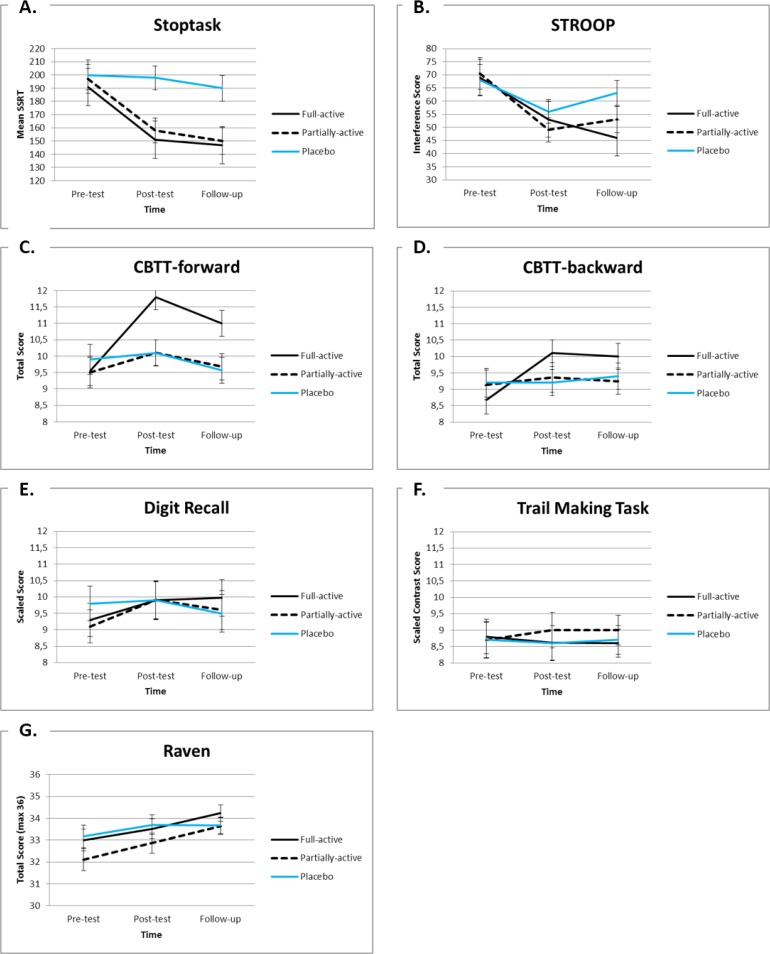
“These contrasts are presented in Table 3 and indicate that, compared to pre-test performance, post-test- and/or follow-up performance on the Stoptask, the STROOP and the CBTT forward and backward improved more in the full-active condition than in the placebo condition (p-values ranged from. 002 to. 020; effect sizes ranged from medium to large; see Table 3 and Fig 3A–3D).”
§ Improving Executive Functioning in Children with ADHD: Training Multiple Executive Functions within the Context of a Computer Game. A Randomized Double-Blind Placebo Controlled Trial > Results > Performance Measures
hedgeddirect- Asserted: passes — The authors put it forward as true.
- Checkable: passes — It can be checked against evidence.
- Load-bearing: passes — The paper’s conclusions depend on it.
- Based: passes — The paper gives a reason why it holds.
A result the paper reports from its own data — it cites no other source for it, so there is none to check. The quote shows it is in the paper.
In the paper
“Results indicated that only children in the full-active condition showed improvement on measures of visuospatial STM and WM.”
§ Improving Executive Functioning in Children with ADHD: Training Multiple Executive Functions within the Context of a Computer Game. A Randomized Double-Blind Placebo Controlled Trial > Discussion
hedgeddirect- Asserted: passes — The authors put it forward as true.
- Checkable: passes — It can be checked against evidence.
- Load-bearing: passes — The paper’s conclusions depend on it.
- Based: passes — The paper gives a reason why it holds.
A result the paper reports from its own data — it cites no other source for it, so there is none to check. The quote shows it is in the paper.
In the paper
“However, including ODD diagnosis as a covariate did not change the pattern of our main results.”
§ Improving Executive Functioning in Children with ADHD: Training Multiple Executive Functions within the Context of a Computer Game. A Randomized Double-Blind Placebo Controlled Trial > Discussion
plain- Asserted: passes — The authors put it forward as true.
- Checkable: passes — It can be checked against evidence.
- Load-bearing: passes — The paper’s conclusions depend on it.
- Based: passes — The paper gives a reason why it holds.
- Probably not a substantial claim. 37
- It may state two separate claims as one. 45
A result the paper reports from its own data — it cites no other source for it, so there is none to check. The quote shows it is in the paper.
In the paper
“During training compliance was high (only 3% failed to meet compliance criteria).”
- Also stated in: § Process Measures · plain
“Overall, compliance to treatment was high, given that this was a home-based intervention that included a substantial portion of participants with ODD (see Fig 2).”
§ Improving Executive Functioning in Children with ADHD: Training Multiple Executive Functions within the Context of a Computer Game. A Randomized Double-Blind Placebo Controlled Trial > Abstract > Results
plain- Asserted: passes — The authors put it forward as true.
- Checkable: passes — It can be checked against evidence.
- Load-bearing: fails — The paper’s conclusions may not depend on it.
- Based: passes — The paper gives a reason why it holds.
Probably not a substantial claim. The paper’s conclusions may not depend on it.
- Also stated in: § Process Measures · plain
A result the paper reports from its own data — it cites no other source for it, so there is none to check. The quote shows it is in the paper.
In the paper
“No Treatment-condition x Time interactions were found for cognitive-flexibility, verbal WM, complex-reasoning, nor for any parent-, teacher-, or child-rated ADHD behaviors, EF-behaviors, motivational behaviors, or general problem behaviors.”
§ Improving Executive Functioning in Children with ADHD: Training Multiple Executive Functions within the Context of a Computer Game. A Randomized Double-Blind Placebo Controlled Trial > Abstract > Results
plain- Asserted: passes — The authors put it forward as true.
- Checkable: passes — It can be checked against evidence.
- Load-bearing: passes — The paper’s conclusions depend on it.
- Based: passes — The paper gives a reason why it holds.
It may state two separate claims as one.
A result the paper reports from its own data — it cites no other source for it, so there is none to check. The quote shows it is in the paper.
In the paper
“Within the full-active condition, paired t-tests showed a significant difference (improvement) between the Start Index and Max Index for the Inhibition training, t (30) = -18.66, p < .001, the Cognitive flexibility training, t (30) = -19.14, p < .001, and for all the levels of the WM training (level 1, t (30) = -7.25, p < .001; level 2, t (30) = -7.90, p < .001; level 3, t (30) = -7.19, p < .001,”
§ Improving Executive Functioning in Children with ADHD: Training Multiple Executive Functions within the Context of a Computer Game. A Randomized Double-Blind Placebo Controlled Trial > Results > Process Measures
plaindirect- Asserted: passes — The authors put it forward as true.
- Checkable: passes — It can be checked against evidence.
- Load-bearing: passes — The paper’s conclusions depend on it.
- Based: passes — The paper gives a reason why it holds.
It may state two separate claims as one.
A result the paper reports from its own data — it cites no other source for it, so there is none to check. The quote shows it is in the paper.
In the paper
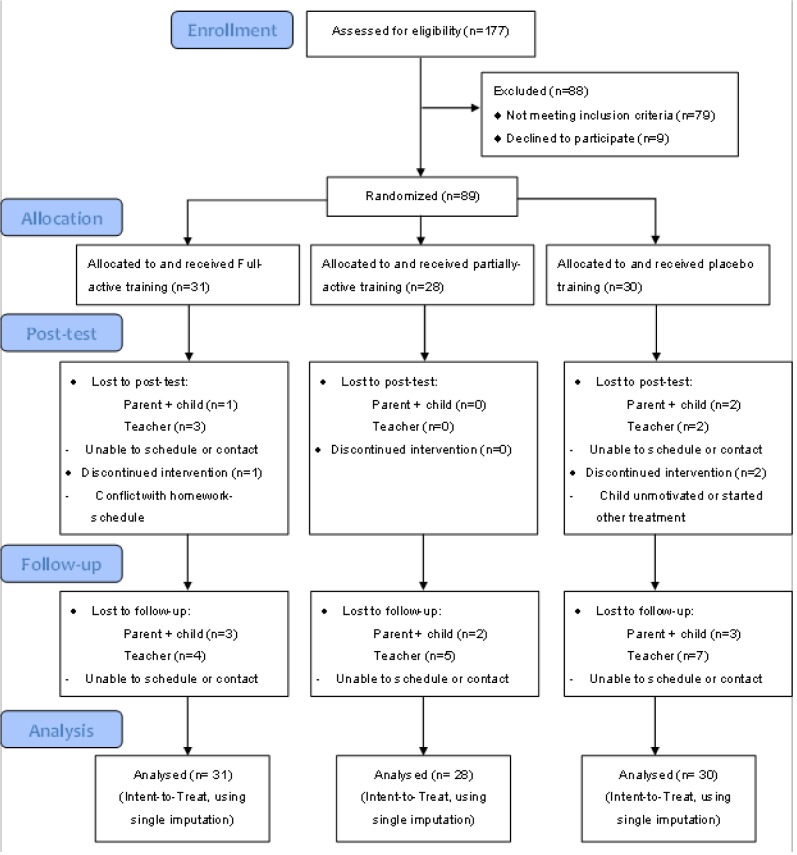
“Of the 31 participants assigned to the full-active condition, 30 (96.7%) met compliance criteria (25 training days within 5 weeks). All of the 28 participants assigned to the partially-active condition met compliance criteria. Of the 30 participants assigned to the placebo condition, 28 (93.3%) met compliance criteria.”
§ Improving Executive Functioning in Children with ADHD: Training Multiple Executive Functions within the Context of a Computer Game. A Randomized Double-Blind Placebo Controlled Trial > Results > Process Measures
plainn = 31- Asserted: passes — The authors put it forward as true.
- Checkable: passes — It can be checked against evidence.
- Load-bearing: unclear — It is unclear whether the paper’s conclusions depend on it.
- Based: passes — The paper gives a reason why it holds.
It may state two separate claims as one.
A result the paper reports from its own data — it cites no other source for it, so there is none to check. The quote shows it is in the paper.
In the paper
“Within the partially-active condition (where WM was in placebo-mode), paired t-tests showed significant difference (improvement) between the Start Index and the Max Index for both the Inhibition training, t (27) = -15.86, p < .001, and the Cognitive flexibility training, t (27) = -22.89, p < .001.”
§ Improving Executive Functioning in Children with ADHD: Training Multiple Executive Functions within the Context of a Computer Game. A Randomized Double-Blind Placebo Controlled Trial > Results > Process Measures
plain- Asserted: passes — The authors put it forward as true.
- Checkable: passes — It can be checked against evidence.
- Load-bearing: unclear — It is unclear whether the paper’s conclusions depend on it.
- Based: passes — The paper gives a reason why it holds.
It may state two separate claims as one.
A result the paper reports from its own data — it cites no other source for it, so there is none to check. The quote shows it is in the paper.
In the paper
“Eight participants (9%) of our total sample (i.e., 3 children in the full-active condition, 2 children in the partially-active condition, and 3 children in the placebo condition) were lost to post-test and follow-up testing (see Fig 2).”
§ Improving Executive Functioning in Children with ADHD: Training Multiple Executive Functions within the Context of a Computer Game. A Randomized Double-Blind Placebo Controlled Trial > Results > Process Measures
plainn = 8- Asserted: passes — The authors put it forward as true.
- Checkable: passes — It can be checked against evidence.
- Load-bearing: fails — The paper’s conclusions may not depend on it.
- Based: passes — The paper gives a reason why it holds.
Probably not a substantial claim. The paper’s conclusions may not depend on it.
A result the paper reports from its own data — it cites no other source for it, so there is none to check. The quote shows it is in the paper.
In the paper
“However, this difference was no longer significant after Bonferroni correction: as only p-values < .0063 (.05/8) were considered significant.”
§ Improving Executive Functioning in Children with ADHD: Training Multiple Executive Functions within the Context of a Computer Game. A Randomized Double-Blind Placebo Controlled Trial > Results > Partially-active condition versus placebo condition
plain- Asserted: passes — The authors put it forward as true.
- Checkable: passes — It can be checked against evidence.
- Load-bearing: passes — The paper’s conclusions depend on it.
- Based: passes — The paper gives a reason why it holds.
It may state two separate claims as one.
A result the paper reports from its own data — it cites no other source for it, so there is none to check. The quote shows it is in the paper.
In the paper
“After Bonferroni correction (p < .0024 [.05/21]) results indicate the following: after training, parents reported a significant improvement on all general problem behavior indices (effect sizes ranged from medium to large), and teachers reported a significant improvement on the ODD scale of the DBDRS (medium effect size).”
§ Improving Executive Functioning in Children with ADHD: Training Multiple Executive Functions within the Context of a Computer Game. A Randomized Double-Blind Placebo Controlled Trial > Results > Questionnaires and Rating Scales
hedgeddirect- Asserted: passes — The authors put it forward as true.
- Checkable: passes — It can be checked against evidence.
- Load-bearing: unclear — It is unclear whether the paper’s conclusions depend on it.
- Based: passes — The paper gives a reason why it holds.
It may state two separate claims as one.
A result the paper reports from its own data — it cites no other source for it, so there is none to check. The quote shows it is in the paper.
In the paper
“After Bonferroni correction (p < .0024 [.05/21]) results indicate the following: Between the pre- and post-test there was a significant Treatment condition x Time interaction for the CBTT-fwd (p = .002), and a non-significant trend for the Stoptask (p = .037) and the CBTT-bkw (p = .039; see Table 2).”
§ Improving Executive Functioning in Children with ADHD: Training Multiple Executive Functions within the Context of a Computer Game. A Randomized Double-Blind Placebo Controlled Trial > Results > Performance Measures
hedgedcorrelational- Asserted: passes — The authors put it forward as true.
- Checkable: passes — It can be checked against evidence.
- Load-bearing: passes — The paper’s conclusions depend on it.
- Based: passes — The paper gives a reason why it holds.
It may state two separate claims as one.
A result the paper reports from its own data — it cites no other source for it, so there is none to check. The quote shows it is in the paper.
In the paper
“However, these differences were no longer significant after Bonferroni correction: as only p-values < .0063 (.05/8) were considered significant.”
§ Improving Executive Functioning in Children with ADHD: Training Multiple Executive Functions within the Context of a Computer Game. A Randomized Double-Blind Placebo Controlled Trial > Results > Full-active condition versus partially-active condition
plain- Asserted: passes — The authors put it forward as true.
- Checkable: passes — It can be checked against evidence.
- Load-bearing: passes — The paper’s conclusions depend on it.
- Based: passes — The paper gives a reason why it holds.
It may state two separate claims as one.
A result the paper reports from its own data — it cites no other source for it, so there is none to check. The quote shows it is in the paper.
In the paper
“However, no Treatment-condition x Time interactions (with or without Bonferroni corrections) were found for cognitive flexibility, verbal STM and WM, non-verbal complex reasoning, or child-rated psychosocial health, nor for any parent- or teacher-rated ADHD symptoms, EF behaviors, motivational behaviors, or general problem behaviors.”
§ Improving Executive Functioning in Children with ADHD: Training Multiple Executive Functions within the Context of a Computer Game. A Randomized Double-Blind Placebo Controlled Trial > Discussion
plain- Asserted: passes — The authors put it forward as true.
- Checkable: passes — It can be checked against evidence.
- Load-bearing: passes — The paper’s conclusions depend on it.
- Based: passes — The paper gives a reason why it holds.
It may state two separate claims as one.
A result the paper reports from its own data — it cites no other source for it, so there is none to check. The quote shows it is in the paper.
In the paper
“Performance on the Stoptask, the STROOP and the CBTT-bkw also significantly improved between pre-test and follow-up (there was a trend for performance on the CBTT-fwd, p = .003).”
§ Improving Executive Functioning in Children with ADHD: Training Multiple Executive Functions within the Context of a Computer Game. A Randomized Double-Blind Placebo Controlled Trial > Results > Full-active condition versus partially-active condition
plain- Asserted: passes — The authors put it forward as true.
- Checkable: passes — It can be checked against evidence.
- Load-bearing: passes — The paper’s conclusions depend on it.
- Based: passes — The paper gives a reason why it holds.
It may state two separate claims as one.
A result the paper reports from its own data — it cites no other source for it, so there is none to check. The quote shows it is in the paper.
In the paper
“Between the pre-test and follow-up there was a non-significant trend towards a Treatment condition x Time interaction for the CBTT-fwd (p = .013) and the STROOP (p = .07; see Table 2).”
§ Improving Executive Functioning in Children with ADHD: Training Multiple Executive Functions within the Context of a Computer Game. A Randomized Double-Blind Placebo Controlled Trial > Results > Performance Measures
plain- Asserted: passes — The authors put it forward as true.
- Checkable: passes — It can be checked against evidence.
- Load-bearing: unclear — It is unclear whether the paper’s conclusions depend on it.
- Based: passes — The paper gives a reason why it holds.
It may state two separate claims as one.
A result the paper reports from its own data — it cites no other source for it, so there is none to check. The quote shows it is in the paper.
In the paper
“In the placebo condition none of the differences were significant (although there was a trend for STROOP performance between pre- and post-test, p = .043; see Table 4).”
§ Improving Executive Functioning in Children with ADHD: Training Multiple Executive Functions within the Context of a Computer Game. A Randomized Double-Blind Placebo Controlled Trial > Results > Full-active condition versus partially-active condition
plain- Asserted: passes — The authors put it forward as true.
- Checkable: passes — It can be checked against evidence.
- Load-bearing: unclear — It is unclear whether the paper’s conclusions depend on it.
- Based: passes — The paper gives a reason why it holds.
It may state two separate claims as one.
A result the paper reports from its own data — it cites no other source for it, so there is none to check. The quote shows it is in the paper.
In the paper
“The pattern of these results strongly resembles the pattern of the mean results (see Table 5; in addition see Table A in S2 Appendix).”
§ Improving Executive Functioning in Children with ADHD: Training Multiple Executive Functions within the Context of a Computer Game. A Randomized Double-Blind Placebo Controlled Trial > Results > Treatment Responders
boostedcorrelational- Asserted: passes — The authors put it forward as true.
- Checkable: passes — It can be checked against evidence.
- Load-bearing: fails — The paper’s conclusions may not depend on it.
- Based: passes — The paper gives a reason why it holds.
Probably not a substantial claim. The paper’s conclusions may not depend on it.
A result the paper reports from its own data — it cites no other source for it, so there is none to check. The quote shows it is in the paper.
In the paper
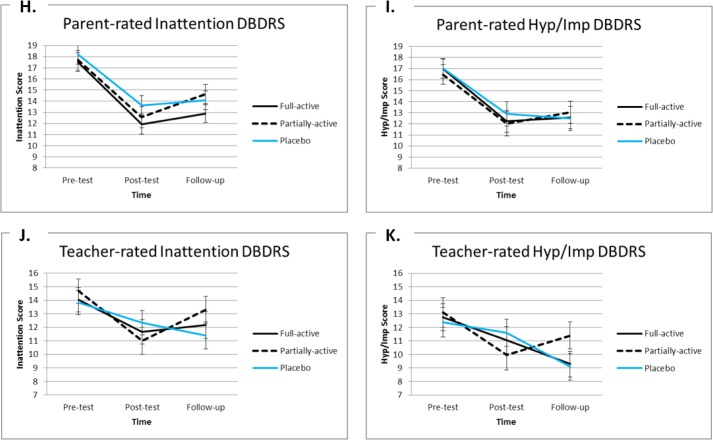
“After Bonferroni correction (p < .0042 [.05/12]) results indicate that: compared to the pre-test, both parents and teachers reported a significant decrease in ADHD symptoms at the post-test and at the follow-up (effect sizes of parent-ratings were large; effect sizes of teacher-ratings ranged from medium to large).”
§ Improving Executive Functioning in Children with ADHD: Training Multiple Executive Functions within the Context of a Computer Game. A Randomized Double-Blind Placebo Controlled Trial > Results > Questionnaires and Rating Scales
hedged- Asserted: passes — The authors put it forward as true.
- Checkable: passes — It can be checked against evidence.
- Load-bearing: unclear — It is unclear whether the paper’s conclusions depend on it.
- Based: passes — The paper gives a reason why it holds.
It may state two separate claims as one.
A result the paper reports from its own data — it cites no other source for it, so there is none to check. The quote shows it is in the paper.
In the paper
“Nonetheless, almost all measures showed significant Time-effects, including the teacher-ratings (effect sizes ranged from medium to large).”
§ Improving Executive Functioning in Children with ADHD: Training Multiple Executive Functions within the Context of a Computer Game. A Randomized Double-Blind Placebo Controlled Trial > Discussion
plain- Asserted: passes — The authors put it forward as true.
- Checkable: passes — It can be checked against evidence.
- Load-bearing: unclear — It is unclear whether the paper’s conclusions depend on it.
- Based: passes — The paper gives a reason why it holds.
It may state two separate claims as one.
A result the paper reports from its own data — it cites no other source for it, so there is none to check. The quote shows it is in the paper.
In the paper
“However, after Bonferroni correction only the Treatment x Time interactions for the CBTT-fwd remained significant (as only p-values < .0063 [.05/8] were considered significant).”
§ Improving Executive Functioning in Children with ADHD: Training Multiple Executive Functions within the Context of a Computer Game. A Randomized Double-Blind Placebo Controlled Trial > Results > Performance Measures
plain- Asserted: passes — The authors put it forward as true.
- Checkable: passes — It can be checked against evidence.
- Load-bearing: passes — The paper’s conclusions depend on it.
- Based: passes — The paper gives a reason why it holds.
It may state two separate claims as one.
The paper states this without a source or data behind it here, so there is nothing to check it against. The quote shows it is in the paper.
In the paper
“Although we used more stringent compliance criteria than most previous studies (i.e., completing 100% of the training sessions versus completing 80% of the training sessions), in our study only 3% of the participants failed to meet compliance criteria, whereas in previous studies 15–23% failed to meet compliance criteria.”
§ Improving Executive Functioning in Children with ADHD: Training Multiple Executive Functions within the Context of a Computer Game. A Randomized Double-Blind Placebo Controlled Trial > Discussion
plain- Asserted: passes — The authors put it forward as true.
- Checkable: passes — It can be checked against evidence.
- Load-bearing: passes — The paper’s conclusions depend on it.
- Based: passes — The paper gives a reason why it holds.
It may state two separate claims as one.
A result the paper reports from its own data — it cites no other source for it, so there is none to check. The quote shows it is in the paper.
In the paper
“After Bonferroni correction (p < .0014 [.05/36]) results indicate the following: after training, parents reported a significant improvement (with large effect sizes) on almost all scales of the BRIEF (EF behavior; only improvement on the Organization of Materials scale was no longer significant after Bonferroni correction) and on the Impulsivity/Fun Seeking scale of the SPSRQ-C (motivational”
§ Improving Executive Functioning in Children with ADHD: Training Multiple Executive Functions within the Context of a Computer Game. A Randomized Double-Blind Placebo Controlled Trial > Results > Questionnaires and Rating Scales
hedgeddirect- Asserted: passes — The authors put it forward as true.
- Checkable: passes — It can be checked against evidence.
- Load-bearing: passes — The paper’s conclusions depend on it.
- Based: passes — The paper gives a reason why it holds.
It may state two separate claims as one.
None of the sources cited for this claim have been checked yet.
In the paper
“Theories of ADHD suggest that deficits in executive functioning are at the core of the ADHD-syndrome, and play a pivotal role in explaining the problems children with ADHD encounter in daily life [1], [2], [3], [4].”
§ Improving Executive Functioning in Children with ADHD: Training Multiple Executive Functions within the Context of a Computer Game. A Randomized Double-Blind Placebo Controlled Trial > Introduction
What the sources say
- Not checked yetcites [1] RA Barkley, 2006, A handbook for diagnosis and treatment
- Not checked yetcites [2] JT Nigg, 2006, Understanding what goes wrong and why
- Not checked yetcites [3] MD Rapport, 2001, A conceptual model of child psychopathology: implications for understanding attention deficit hyperactivity disorder and treatment efficacy, J Clin Child Psychol source
hedgeddirect- Asserted: passes — The authors put it forward as true.
- Checkable: passes — It can be checked against evidence.
- Load-bearing: passes — The paper’s conclusions depend on it.
- Based: passes — The paper gives a reason why it holds.
It may state two separate claims as one.
In the paper
“Via dorsal frontostriatal brain circuits, executive functions (EF) allow individuals to regulate their behavior, thoughts and emotions, and thereby enable self-control [5].”
§ Improving Executive Functioning in Children with ADHD: Training Multiple Executive Functions within the Context of a Computer Game. A Randomized Double-Blind Placebo Controlled Trial > Introduction
What the sources say
- Not checked yetcites [5] S Durston, 2011, Differentiating frontostriatal and fronto-cerebellar circuits in attention-deficit/hyperactivity disorder, Biol Psychiatry source
plaindirect- Asserted: passes — The authors put it forward as true.
- Checkable: passes — It can be checked against evidence.
- Load-bearing: passes — The paper’s conclusions depend on it.
- Based: passes — The paper gives a reason why it holds.
Probably not a substantial claim. It may state two separate claims as one.
What the paper did — it cites no source for this, so there is none to check. The quote shows it is in the paper.
In the paper
“Eighty-nine children with a clinical diagnosis of ADHD (aged 8–12) were randomized to either a full-active-condition where visuospatial WM, inhibition and cognitive-flexibility were trained, a partially-active-condition where inhibition and cognitive-flexibility were trained and the WM-training task was presented in placebo-mode, or to a full placebo-condition.”
§ Improving Executive Functioning in Children with ADHD: Training Multiple Executive Functions within the Context of a Computer Game. A Randomized Double-Blind Placebo Controlled Trial > Abstract > Methods
plainn = 9- Asserted: passes — The authors put it forward as true.
- Checkable: passes — It can be checked against evidence.
- Load-bearing: passes — The paper’s conclusions depend on it.
- Based: passes — The paper gives a reason why it holds.
Probably not a substantial claim. It may state two separate claims as one.
What the paper did — it cites no source for this, so there is none to check. The quote shows it is in the paper.
In the paper
“No important changes to methods were made after trial commencement (the trial started April 2011 and ended January 2013).”
§ Improving Executive Functioning in Children with ADHD: Training Multiple Executive Functions within the Context of a Computer Game. A Randomized Double-Blind Placebo Controlled Trial > Methods > Trial Design
plain- Asserted: passes — The authors put it forward as true.
- Checkable: passes — It can be checked against evidence.
- Load-bearing: fails — The paper’s conclusions may not depend on it.
- Based: passes — The paper gives a reason why it holds.
Probably not a substantial claim. The paper’s conclusions may not depend on it.
What the paper did — it cites no source for this, so there is none to check. The quote shows it is in the paper.
In the paper
“Bonferroni corrections for multiple testing were applied to these MANOVAs: only p-values < .0125 [.05/4] were considered significant.”
- Also stated in: § Statistical Analyses · plain
“Bonferroni corrections for multiple testing were applied to these contrasts, in which the amount of dependent variables corrected for was defined per repeated measures MANOVA”
§ Improving Executive Functioning in Children with ADHD: Training Multiple Executive Functions within the Context of a Computer Game. A Randomized Double-Blind Placebo Controlled Trial > Methods > Statistical Analyses
plain- Asserted: passes — The authors put it forward as true.
- Checkable: passes — It can be checked against evidence.
- Load-bearing: passes — The paper’s conclusions depend on it.
- Based: passes — The paper gives a reason why it holds.
Probably not a substantial claim.
- Also stated in: § Statistical Analyses · plain
In the paper
“A previous waitlist-controlled study of BGB [31] showed promising results on reduction of symptoms of ADHD and improvement of EF.”
§ Improving Executive Functioning in Children with ADHD: Training Multiple Executive Functions within the Context of a Computer Game. A Randomized Double-Blind Placebo Controlled Trial > Introduction
What the sources say
- Not checked yetcites [31] Oord S Van Der, 2014, A Pilot Study of the Efficacy of a Computerized Executive Functioning Remediation Training With Game Elements for Children With ADHD in an Outpatient Setting: Outcome on Parent- and Teacher-Rated Executive Functioning and ADHD Behavior, J Atten Disord source
plaindirect- Asserted: passes — The authors put it forward as true.
- Checkable: passes — It can be checked against evidence.
- Load-bearing: passes — The paper’s conclusions depend on it.
- Based: passes — The paper gives a reason why it holds.
It may state two separate claims as one.
None of the sources cited for this claim have been checked yet.
In the paper
“Sample size was determined by a prospective power analyses for univariate testing (using G*Power) based on the effect sizes of two previous EF-treatment studies [86], [45].”
§ Improving Executive Functioning in Children with ADHD: Training Multiple Executive Functions within the Context of a Computer Game. A Randomized Double-Blind Placebo Controlled Trial > Methods > Statistical Analyses
What the sources say
- Not checked yetcites [86] T Klingberg, 2005, Computerized training of working memory in children with ADHD—a randomized, controlled trial, J Am Acad Child Adolesc Psychiatry source
- Not checked yetcites [45] PJM Prins, 2011, Does computerized working memory training with game elements enhance motivation and training efficacy in children with ADHD?, Cyberpsychol Behav Soc Netw source
plain- Asserted: passes — The authors put it forward as true.
- Checkable: passes — It can be checked against evidence.
- Load-bearing: passes — The paper’s conclusions depend on it.
- Based: passes — The paper gives a reason why it holds.
Probably not a substantial claim.
What the paper did — it cites no source for this, so there is none to check. The quote shows it is in the paper.
In the paper
“At each test-session experimenters were blind to condition.”
§ Improving Executive Functioning in Children with ADHD: Training Multiple Executive Functions within the Context of a Computer Game. A Randomized Double-Blind Placebo Controlled Trial > Methods > Procedure
plain- Asserted: passes — The authors put it forward as true.
- Checkable: passes — It can be checked against evidence.
- Load-bearing: passes — The paper’s conclusions depend on it.
- Based: passes — The paper gives a reason why it holds.
Probably not a substantial claim.
In the paper
“To date, most EF-training studies focus on the effects of WM training (e.g., see [15]), whereas very few studies investigate the unique effects (i.e. without WM training) of response inhibition- and/or cognitive flexibility training in children with ADHD.”
§ Improving Executive Functioning in Children with ADHD: Training Multiple Executive Functions within the Context of a Computer Game. A Randomized Double-Blind Placebo Controlled Trial > Introduction
What the sources say
- Not checked yetcites [15] A Chacko, 2013, Cogmed Working Memory Training for Youth with ADHD: A Closer Examination of Efficacy Utilizing Evidence-Based Criteria, J Clin Child Adolesc Psychol source
plain- Asserted: passes — The authors put it forward as true.
- Checkable: passes — It can be checked against evidence.
- Load-bearing: passes — The paper’s conclusions depend on it.
- Based: passes — The paper gives a reason why it holds.
It may state two separate claims as one.
What the paper did — it cites no source for this, so there is none to check. The quote shows it is in the paper.
In the paper
“If a coach did receive information revealing the treatment condition, he/she was replaced and could no longer have contact with the family or the teacher.”
§ Improving Executive Functioning in Children with ADHD: Training Multiple Executive Functions within the Context of a Computer Game. A Randomized Double-Blind Placebo Controlled Trial > Methods > Procedure
plaindirect- Asserted: passes — The authors put it forward as true.
- Checkable: passes — It can be checked against evidence.
- Load-bearing: passes — The paper’s conclusions depend on it.
- Based: passes — The paper gives a reason why it holds.
Probably not a substantial claim. It may state two separate claims as one.
What the paper did — it cites no source for this, so there is none to check. The quote shows it is in the paper.
In the paper
“a coach (a research assistant blind to the treatment condition) made weekly calls”
§ Improving Executive Functioning in Children with ADHD: Training Multiple Executive Functions within the Context of a Computer Game. A Randomized Double-Blind Placebo Controlled Trial > Methods > Procedure
plain- Asserted: passes — The authors put it forward as true.
- Checkable: passes — It can be checked against evidence.
- Load-bearing: passes — The paper’s conclusions depend on it.
- Based: passes — The paper gives a reason why it holds.
Probably not a substantial claim.
What the paper did — it cites no source for this, so there is none to check. The quote shows it is in the paper.
In the paper
“This study was approved by the faculty’s IRB (the Ethics Review Board of the Faculty of Social and Behavioral Sciences of the university of Amsterdam).”
§ Improving Executive Functioning in Children with ADHD: Training Multiple Executive Functions within the Context of a Computer Game. A Randomized Double-Blind Placebo Controlled Trial > Methods > Procedure
plain- Asserted: passes — The authors put it forward as true.
- Checkable: passes — It can be checked against evidence.
- Load-bearing: fails — The paper’s conclusions may not depend on it.
- Based: passes — The paper gives a reason why it holds.
Probably not a substantial claim. The paper’s conclusions may not depend on it.
In the paper
“Only Kray et al. [23] investigated effects of a cognitive flexibility training in children with ADHD; they found placebo-controlled effects on untrained EF performance (i.e., interference control), but they did not investigate effects on behavior.”
§ Improving Executive Functioning in Children with ADHD: Training Multiple Executive Functions within the Context of a Computer Game. A Randomized Double-Blind Placebo Controlled Trial > Introduction
What the sources say
- Not checked yetcites [23] J Kray, 2012, Can task-switching training enhance executive control functioning in children with attention deficit/-hyperactivity disorder?, Front Hum Neurosci source
plaindirect- Asserted: passes — The authors put it forward as true.
- Checkable: passes — It can be checked against evidence.
- Load-bearing: passes — The paper’s conclusions depend on it.
- Based: passes — The paper gives a reason why it holds.
It may state two separate claims as one.
What the paper did — it cites no source for this, so there is none to check. The quote shows it is in the paper.
In the paper
“After obtaining written informed consent from the parents (on behalf of the participating children), parents and teachers completed the DBDRS.”
§ Improving Executive Functioning in Children with ADHD: Training Multiple Executive Functions within the Context of a Computer Game. A Randomized Double-Blind Placebo Controlled Trial > Methods > Procedure
plain- Asserted: passes — The authors put it forward as true.
- Checkable: passes — It can be checked against evidence.
- Load-bearing: fails — The paper’s conclusions may not depend on it.
- Based: passes — The paper gives a reason why it holds.
Probably not a substantial claim. The paper’s conclusions may not depend on it.
What the paper did — it cites no source for this, so there is none to check. The quote shows it is in the paper.
In the paper
“No important changes to outcome measures were made after trial commencement.”
§ Improving Executive Functioning in Children with ADHD: Training Multiple Executive Functions within the Context of a Computer Game. A Randomized Double-Blind Placebo Controlled Trial > Methods > Process Measures
plain- Asserted: passes — The authors put it forward as true.
- Checkable: passes — It can be checked against evidence.
- Load-bearing: fails — The paper’s conclusions may not depend on it.
- Based: passes — The paper gives a reason why it holds.
Probably not a substantial claim. The paper’s conclusions may not depend on it.
What the paper did — it cites no source for this, so there is none to check. The quote shows it is in the paper.
In the paper
“Also, including these baseline demographics and clinical characteristics (i.e., Gender, Age, FSIQ, DBDRS parent and teacher ratings, ODD diagnosis, ADHD medication use, Computergame experience, and Dyslexia) as covariates in the main analyses did not change the pattern of our results.”
§ Improving Executive Functioning in Children with ADHD: Training Multiple Executive Functions within the Context of a Computer Game. A Randomized Double-Blind Placebo Controlled Trial > Methods > Statistical Analyses
plain- Asserted: passes — The authors put it forward as true.
- Checkable: passes — It can be checked against evidence.
- Load-bearing: fails — The paper’s conclusions may not depend on it.
- Based: passes — The paper gives a reason why it holds.
Probably not a substantial claim. The paper’s conclusions may not depend on it.
None of the sources cited for this claim have been checked yet.
In the paper
“Motivational models [34], [35], [36], [37], and subsequent research (for an overview see [38], [39]; also see [40], [41], [42], [43]) suggest that children with ADHD are less stimulated by reinforcement (i.e. reward) than typically developing children (probably due to a dopaminergic deficit)”
§ Improving Executive Functioning in Children with ADHD: Training Multiple Executive Functions within the Context of a Computer Game. A Randomized Double-Blind Placebo Controlled Trial > Introduction
What the sources say
- Not checked yetcites [34] M Haenlein, 1987, Attention deficit disorder with hyperactivity: a specific hypothesis of reward dysfunction, J Am Acad Child Adolesc Psychiatry source
- Not checked yetcites [35] JA Sergeant, 1999, Handbook of disruptive behavior disorders
- Not checked yetcites [36] T Sagvolden, 2005, A dynamic developmental theory of attention-deficit/hyperactivity disorder (ADHD) predominantly hyperactive/impulsive and combined subtypes, Behav Brain Sci source
hedgedconditional- Asserted: passes — The authors put it forward as true.
- Checkable: passes — It can be checked against evidence.
- Load-bearing: passes — The paper’s conclusions depend on it.
- Based: passes — The paper gives a reason why it holds.
It may state two separate claims as one.
What the paper did — it cites no source for this, so there is none to check. The quote shows it is in the paper.
In the paper
“Once a research assistant completed a startup session with a particular family, he/she could not test or have further contact with that family or the teacher (to preserve blinding).”
§ Improving Executive Functioning in Children with ADHD: Training Multiple Executive Functions within the Context of a Computer Game. A Randomized Double-Blind Placebo Controlled Trial > Methods > Procedure
plain- Asserted: passes — The authors put it forward as true.
- Checkable: passes — It can be checked against evidence.
- Load-bearing: passes — The paper’s conclusions depend on it.
- Based: passes — The paper gives a reason why it holds.
Probably not a substantial claim.
None of the sources cited for this claim have been checked yet.
In the paper
“However, gamification of an EF training or task (e.g., by using game mechanics and visuals) has been found to optimize both motivation and training-effects in children with ADHD [40], [45], [46].”
§ Improving Executive Functioning in Children with ADHD: Training Multiple Executive Functions within the Context of a Computer Game. A Randomized Double-Blind Placebo Controlled Trial > Introduction
What the sources say
- Not checked yetcites [40] S Dovis, 2012, Can motivation normalize working memory and task persistence in children with attention-deficit/hyperactivity disorder? The effects of money and computer-gaming, J Abnorm Child Psychol source
- Not checked yetcites [45] PJM Prins, 2011, Does computerized working memory training with game elements enhance motivation and training efficacy in children with ADHD?, Cyberpsychol Behav Soc Netw source
- Not checked yetcites [46] R Shaw, 2005, Inhibition, ADHD, and computer games: the inhibitory performance of children with ADHD on computerized tasks and games, J Atten Disord source
plaindirect- Asserted: passes — The authors put it forward as true.
- Checkable: passes — It can be checked against evidence.
- Load-bearing: passes — The paper’s conclusions depend on it.
- Based: passes — The paper gives a reason why it holds.
It may state two separate claims as one.
None of the sources cited for this claim have been checked yet.
In the paper
“Gaming increases the release of striatal dopamine [47], [48], promoting long-term potentiation of neural connections within the striatum [49], which is suggested to improve motivation and one’s ability to learn [50] (e.g., during EF training).”
§ Improving Executive Functioning in Children with ADHD: Training Multiple Executive Functions within the Context of a Computer Game. A Randomized Double-Blind Placebo Controlled Trial > Introduction
What the sources say
- Not checked yetcites [47] MJ Koepp, 1998, Evidence for striatal dopamine release during a video game, Nature source
- Not checked yetcites [48] S Kühn, 2011, The neural basis of video gaming, Transl Psychiatry source
- Not checked yetcites [49] JN Reynolds, 2001, A cellular mechanism of reward-related learning, Nature source
hedgeddirect- Asserted: passes — The authors put it forward as true.
- Checkable: passes — It can be checked against evidence.
- Load-bearing: passes — The paper’s conclusions depend on it.
- Based: passes — The paper gives a reason why it holds.
It may state two separate claims as one.
None of the sources cited for this claim have been checked yet.
In the paper
“and with associated problems such as deficient academic functioning [12], [13]”
§ Improving Executive Functioning in Children with ADHD: Training Multiple Executive Functions within the Context of a Computer Game. A Randomized Double-Blind Placebo Controlled Trial > Introduction
What the sources say
- Not checked yetcites [12] J Biederman, 2004, Impact of executive function deficits and attention-deficit/hyperactivity disorder (ADHD) on academic outcomes in children, J Consult Clin Psychol source
- Not checked yetcites [13] C Titz, 2014, Working memory and executive functions: effects of training on academic achievement, Psychol Res source
plaincorrelational- Asserted: passes — The authors put it forward as true.
- Checkable: passes — It can be checked against evidence.
- Load-bearing: fails — The paper’s conclusions may not depend on it.
- Based: passes — The paper gives a reason why it holds.
Probably not a substantial claim. The paper’s conclusions may not depend on it.
What the paper did — it cites no source for this, so there is none to check. The quote shows it is in the paper.
In the paper
“This was a multicenter (14 sites), double-blind, placebo-controlled, multi-arm parallel-group study conducted in the Netherlands (trial register: http://www.trialregister.nl/trialreg/admin/rctview.asp?TC=2728; registry name: improving executive functioning in children with ADHD: training executive functions within the context of a computer game; registry number: NTR2728).”
§ Improving Executive Functioning in Children with ADHD: Training Multiple Executive Functions within the Context of a Computer Game. A Randomized Double-Blind Placebo Controlled Trial > Methods > Trial Design
plain- Asserted: passes — The authors put it forward as true.
- Checkable: passes — It can be checked against evidence.
- Load-bearing: fails — The paper’s conclusions may not depend on it.
- Based: passes — The paper gives a reason why it holds.
Probably not a substantial claim. The paper’s conclusions may not depend on it. It may state two separate claims as one.
What the paper did — it cites no source for this, so there is none to check. The quote shows it is in the paper.
In the paper
“An Intent-To-Treat (ITT) approach, using single imputations, was used to compare treatment effects of the three treatment conditions.”
§ Improving Executive Functioning in Children with ADHD: Training Multiple Executive Functions within the Context of a Computer Game. A Randomized Double-Blind Placebo Controlled Trial > Methods > Statistical Analyses
plain- Asserted: passes — The authors put it forward as true.
- Checkable: passes — It can be checked against evidence.
- Load-bearing: fails — The paper’s conclusions may not depend on it.
- Based: passes — The paper gives a reason why it holds.
Probably not a substantial claim. The paper’s conclusions may not depend on it.
In the paper
“were independently allocated to one of the three treatment conditions using the process of randomization by minimization [82] on the basis of age, gender, IQ, medication-use (yes/no), and parent- and teacher-rated inattention and hyperactivity/impulsivity symptoms (using the 6-months DBDRS).”
§ Improving Executive Functioning in Children with ADHD: Training Multiple Executive Functions within the Context of a Computer Game. A Randomized Double-Blind Placebo Controlled Trial > Methods > Procedure
What the sources say
- Not checked yetcites [82] DG Altman, 2005, Treatment allocation by minimisation, BMJ source
plain- Asserted: passes — The authors put it forward as true.
- Checkable: passes — It can be checked against evidence.
- Load-bearing: passes — The paper’s conclusions depend on it.
- Based: passes — The paper gives a reason why it holds.
Probably not a substantial claim.
None of the sources cited for this claim have been checked yet.
In the paper
“but they only used the incongruent trials as outcome measure; baseline response times to congruent trials were not controlled for, making it impossible to calculate the interference score)”
§ Improving Executive Functioning in Children with ADHD: Training Multiple Executive Functions within the Context of a Computer Game. A Randomized Double-Blind Placebo Controlled Trial > Discussion
What the sources say
- Not checked yetcites [85] T Klingberg, 2002, Training of working memory in children with ADHD, J Clin Exp Neuropsychol source
- Not checked yetcites [86] T Klingberg, 2005, Computerized training of working memory in children with ADHD—a randomized, controlled trial, J Am Acad Child Adolesc Psychiatry source
plain- Asserted: passes — The authors put it forward as true.
- Checkable: passes — It can be checked against evidence.
- Load-bearing: passes — The paper’s conclusions depend on it.
- Based: passes — The paper gives a reason why it holds.
It may state two separate claims as one.
None of the sources cited for this claim have been checked yet.
In the paper
“This hypothesis is consistent with previous findings of increased time-on-training when EF training was gamified [45] (also see [40]), and with the finding that gaming increases the release of striatal dopamine [47], [48], which is associated with increased motivation to continue playing and performing [50].”
§ Improving Executive Functioning in Children with ADHD: Training Multiple Executive Functions within the Context of a Computer Game. A Randomized Double-Blind Placebo Controlled Trial > Discussion
What the sources say
- Not checked yetcites [45] PJM Prins, 2011, Does computerized working memory training with game elements enhance motivation and training efficacy in children with ADHD?, Cyberpsychol Behav Soc Netw source
- Not checked yetcites [40] S Dovis, 2012, Can motivation normalize working memory and task persistence in children with attention-deficit/hyperactivity disorder? The effects of money and computer-gaming, J Abnorm Child Psychol source
- Not checked yetcites [47] MJ Koepp, 1998, Evidence for striatal dopamine release during a video game, Nature source
plaindirect- Asserted: passes — The authors put it forward as true.
- Checkable: passes — It can be checked against evidence.
- Load-bearing: passes — The paper’s conclusions depend on it.
- Based: passes — The paper gives a reason why it holds.
Probably not a substantial claim. It may state two separate claims as one.
In the paper
“For example, there is evidence that video game playing can enhance various cognitive skills (e.g., attention; see [88]).”
§ Improving Executive Functioning in Children with ADHD: Training Multiple Executive Functions within the Context of a Computer Game. A Randomized Double-Blind Placebo Controlled Trial > Discussion
What the sources say
- Not checked yetcites [88] CS Green, 2003, Action video game modifies visual selective attention, Nature source
plaindirect- Asserted: passes — The authors put it forward as true.
- Checkable: passes — It can be checked against evidence.
- Load-bearing: fails — The paper’s conclusions may not depend on it.
- Based: passes — The paper gives a reason why it holds.
Probably not a substantial claim. The paper’s conclusions may not depend on it.
In the paper
“Evidence suggests that decreased negative parental discipline mediates the effect of ADHD treatment (e.g., medication and behavior therapy) on teacher-rated ADHD behavior [91].”
§ Improving Executive Functioning in Children with ADHD: Training Multiple Executive Functions within the Context of a Computer Game. A Randomized Double-Blind Placebo Controlled Trial > Discussion
What the sources say
- Not checked yetcites [91] SP Hinshaw, 2007, Moderators and mediators of treatment outcome for youth with ADHD: understanding for whom and how interventions work, J Ped Psychol source
hedgeddirect- Asserted: passes — The authors put it forward as true.
- Checkable: passes — It can be checked against evidence.
- Load-bearing: fails — The paper’s conclusions may not depend on it.
- Based: passes — The paper gives a reason why it holds.
Probably not a substantial claim. The paper’s conclusions may not depend on it.
The paper states this without a source or data behind it here, so there is nothing to check it against. The quote shows it is in the paper.
In the paper
“Further, in most placebo controlled studies differential far transfer to untrained EF tasks has been limited, and differential effects on parent- or teacher-rated behavior (e.g., ADHD or EF) are generally not found.”
§ Improving Executive Functioning in Children with ADHD: Training Multiple Executive Functions within the Context of a Computer Game. A Randomized Double-Blind Placebo Controlled Trial > Discussion
plain- Asserted: passes — The authors put it forward as true.
- Checkable: passes — It can be checked against evidence.
- Load-bearing: passes — The paper’s conclusions depend on it.
- Based: passes — The paper gives a reason why it holds.
It may state two separate claims as one.
A conclusion the paper draws from its own results — it cites no other source for it, so there is none to check. The quote shows it is in the paper.
In the paper
“Nonetheless, it may be that parents’ positive attitude towards this particular game enhanced its positive effects.”
§ Improving Executive Functioning in Children with ADHD: Training Multiple Executive Functions within the Context of a Computer Game. A Randomized Double-Blind Placebo Controlled Trial > Discussion
hedgedconditional- Asserted: passes — The authors put it forward as true.
- Checkable: passes — It can be checked against evidence.
- Load-bearing: fails — The paper’s conclusions may not depend on it.
- Based: passes — The paper gives a reason why it holds.
Probably not a substantial claim. The paper’s conclusions may not depend on it.
A conclusion the paper draws from its own results — it cites no other source for it, so there is none to check. The quote shows it is in the paper.
In the paper
“For example, sharing the joy of achievement in the game with his/her parents could have enhanced the child’s appraisal of the game’s positive feedback and its effect on his/her self-esteem beyond that of commercial video games (as many parents don’t encourage children to indulge in commercial gaming).”
§ Improving Executive Functioning in Children with ADHD: Training Multiple Executive Functions within the Context of a Computer Game. A Randomized Double-Blind Placebo Controlled Trial > Discussion
hedgedconditional- Asserted: passes — The authors put it forward as true.
- Checkable: fails — It may be too vague to check against evidence.
- Load-bearing: fails — The paper’s conclusions may not depend on it.
- Based: passes — The paper gives a reason why it holds.
Probably not a substantial claim. It may be too vague to check against evidence. The paper’s conclusions may not depend on it.
In the paper
“This suggests a difference in parent involvement between the conditions, which may have interacted with the outcome of parent-rated ADHD behavior (e.g., through expectancy effects or inequality of parent-child interactions; see [15]).”
§ Improving Executive Functioning in Children with ADHD: Training Multiple Executive Functions within the Context of a Computer Game. A Randomized Double-Blind Placebo Controlled Trial > Discussion
What the sources say
- Not checked yetcites [15] A Chacko, 2013, Cogmed Working Memory Training for Youth with ADHD: A Closer Examination of Efficacy Utilizing Evidence-Based Criteria, J Clin Child Adolesc Psychol source
hedgedconditional- Asserted: passes — The authors put it forward as true.
- Checkable: passes — It can be checked against evidence.
- Load-bearing: fails — The paper’s conclusions may not depend on it.
- Based: passes — The paper gives a reason why it holds.
Probably not a substantial claim. The paper’s conclusions may not depend on it. It may state two separate claims as one.
- Rests on an assumption: The placebo condition used in Klingberg et al. was considerably shorter in time than the training condition.
A conclusion the paper draws from its own results — it cites no other source for it, so there is none to check. The quote shows it is in the paper.
In the paper
“If children were more motivated to comply with treatment than in other EF training studies, which is consistent with the relatively high compliance rate in our study, there may have been less need for parents to discipline their children during training.”
§ Improving Executive Functioning in Children with ADHD: Training Multiple Executive Functions within the Context of a Computer Game. A Randomized Double-Blind Placebo Controlled Trial > Discussion
hedgedconditional- Asserted: passes — The authors put it forward as true.
- Checkable: fails — It may be too vague to check against evidence.
- Load-bearing: fails — The paper’s conclusions may not depend on it.
- Based: passes — The paper gives a reason why it holds.
Probably not a substantial claim. It may be too vague to check against evidence. The paper’s conclusions may not depend on it. It may state two separate claims as one.
In the paper
“However, such near transfer effects may not be surprising since many of these outcome measures are very similar to the training tasks themselves and improvement may be the result of a learned strategy instead of improved cognitive capacity [87].”
§ Improving Executive Functioning in Children with ADHD: Training Multiple Executive Functions within the Context of a Computer Game. A Randomized Double-Blind Placebo Controlled Trial > Discussion
What the sources say
- Not checked yetcites [87] TW Thompson, 2013, Failure of working memory training to enhance cognition or intelligence, PloS one source
hedgedconditional- Asserted: passes — The authors put it forward as true.
- Checkable: passes — It can be checked against evidence.
- Load-bearing: unclear — It is unclear whether the paper’s conclusions depend on it.
- Based: passes — The paper gives a reason why it holds.
It may state two separate claims as one.
In the paper
“Some have argued that EF training studies only find Time effects on parent-ratings but not on teacher-ratings because teachers, in contrast to parents, are only minimally involved in training and thus may be less biased than parents (e.g., by their expectancies of the training outcome) [31].”
§ Improving Executive Functioning in Children with ADHD: Training Multiple Executive Functions within the Context of a Computer Game. A Randomized Double-Blind Placebo Controlled Trial > Discussion
What the sources say
- Not checked yetcites [31] Oord S Van Der, 2014, A Pilot Study of the Efficacy of a Computerized Executive Functioning Remediation Training With Game Elements for Children With ADHD in an Outpatient Setting: Outcome on Parent- and Teacher-Rated Executive Functioning and ADHD Behavior, J Atten Disord source
hedgedconditional- Asserted: fails — The authors may not put it forward as true.
- Checkable: passes — It can be checked against evidence.
- Load-bearing: fails — The paper’s conclusions may not depend on it.
- Based: passes — The paper gives a reason why it holds.
Probably not a substantial claim. The authors may not put it forward as true. The paper’s conclusions may not depend on it. It may state two separate claims as one.
A conclusion the paper draws from its own results — it cites no other source for it, so there is none to check. The quote shows it is in the paper.
In the paper
“Furthermore, the gamification of BGB may also have impacted classroom functioning by enhancing children’s motivation to comply with treatment.”
§ Improving Executive Functioning in Children with ADHD: Training Multiple Executive Functions within the Context of a Computer Game. A Randomized Double-Blind Placebo Controlled Trial > Discussion
hedgedconditional- Asserted: passes — The authors put it forward as true.
- Checkable: passes — It can be checked against evidence.
- Load-bearing: fails — The paper’s conclusions may not depend on it.
- Based: passes — The paper gives a reason why it holds.
Probably not a substantial claim. The paper’s conclusions may not depend on it.
None of the sources cited for this claim have been checked yet.
In the paper
“Although there is a link between parental praise and children’s self-esteem [89], and self-esteem has been found to mediate the relationship between ADHD and classroom functioning [90], future research should investigate this further.”
§ Improving Executive Functioning in Children with ADHD: Training Multiple Executive Functions within the Context of a Computer Game. A Randomized Double-Blind Placebo Controlled Trial > Discussion
What the sources say
plaincorrelational- Asserted: passes — The authors put it forward as true.
- Checkable: passes — It can be checked against evidence.
- Load-bearing: fails — The paper’s conclusions may not depend on it.
- Based: passes — The paper gives a reason why it holds.
Probably not a substantial claim. The paper’s conclusions may not depend on it. It may state two separate claims as one.
In the paper
“Most of these studies find differential treatment effects on outcome measures of trained EFs (although Kray et al. [23], as in the present study, found no significant differences on cognitive flexibility).”
§ Improving Executive Functioning in Children with ADHD: Training Multiple Executive Functions within the Context of a Computer Game. A Randomized Double-Blind Placebo Controlled Trial > Discussion
What the sources say
- Not checked yetcites [23] J Kray, 2012, Can task-switching training enhance executive control functioning in children with attention deficit/-hyperactivity disorder?, Front Hum Neurosci source
plain- Asserted: passes — The authors put it forward as true.
- Checkable: passes — It can be checked against evidence.
- Load-bearing: unclear — It is unclear whether the paper’s conclusions depend on it.
- Based: passes — The paper gives a reason why it holds.
It may state two separate claims as one.
A conclusion the paper draws from its own results — it cites no other source for it, so there is none to check. The quote shows it is in the paper.
In the paper
“It seems unrelated to specific EF training effects, and the only nonspecific treatment factor that clearly distinguishes our study from previous studies appears to be the use of relatively strong gamification (i.e., teachers were not more involved than in previous studies).”
§ Improving Executive Functioning in Children with ADHD: Training Multiple Executive Functions within the Context of a Computer Game. A Randomized Double-Blind Placebo Controlled Trial > Discussion
hedged- Asserted: passes — The authors put it forward as true.
- Checkable: passes — It can be checked against evidence.
- Load-bearing: passes — The paper’s conclusions depend on it.
- Based: passes — The paper gives a reason why it holds.
It may state two separate claims as one.
A conclusion the paper draws from its own results — it cites no other source for it, so there is none to check. The quote shows it is in the paper.
In the paper
“Although this improvement was unrelated to specific effects of the EF training (as it was also found in the placebo condition), it is still a remarkable finding.”
§ Improving Executive Functioning in Children with ADHD: Training Multiple Executive Functions within the Context of a Computer Game. A Randomized Double-Blind Placebo Controlled Trial > Discussion
plain- Asserted: passes — The authors put it forward as true.
- Checkable: passes — It can be checked against evidence.
- Load-bearing: fails — The paper’s conclusions may not depend on it.
- Based: passes — The paper gives a reason why it holds.
Probably not a substantial claim. The paper’s conclusions may not depend on it. It may state two separate claims as one.
None of the sources cited for this claim have been checked yet.
In the paper
“In many ways our findings are similar to those of previous placebo controlled (single) EF training studies in children with ADHD [21], [84], [85], [86], [23] (but note that only one of these studies [21] corrected for multiple testing).”
§ Improving Executive Functioning in Children with ADHD: Training Multiple Executive Functions within the Context of a Computer Game. A Randomized Double-Blind Placebo Controlled Trial > Discussion
What the sources say
- Not checked yetcites [21] A Chacko, 2014, A randomized clinical trial of Cogmed Working Memory Training in school-age children with ADHD: a replication in a diverse sample using a control condition, J Child Psychol Psychiatry source
- Not checked yetcites [84] CT Green, 2012, Will working memory training generalize to improve off-task behavior in children with attention-deficit/hyperactivity disorder?, Neurotherapeutics source
- Not checked yetcites [85] T Klingberg, 2002, Training of working memory in children with ADHD, J Clin Exp Neuropsychol source
plain- Asserted: passes — The authors put it forward as true.
- Checkable: passes — It can be checked against evidence.
- Load-bearing: unclear — It is unclear whether the paper’s conclusions depend on it.
- Based: passes — The paper gives a reason why it holds.
It may state two separate claims as one.
A conclusion the paper draws from its own results — it cites no other source for it, so there is none to check. The quote shows it is in the paper.
In the paper
“The fact that far transfer was also found in the placebo condition might not (only) be explained by nonspecific treatment effects (e.g., effects of expectancies, self-fulfilling prophecies, attribution, gamification, or improved parent-child interactions), but may be the result of actual cognitive training in the placebo condition.”
§ Improving Executive Functioning in Children with ADHD: Training Multiple Executive Functions within the Context of a Computer Game. A Randomized Double-Blind Placebo Controlled Trial > Discussion
hedgedconditional- Asserted: passes — The authors put it forward as true.
- Checkable: passes — It can be checked against evidence.
- Load-bearing: fails — The paper’s conclusions may not depend on it.
- Based: passes — The paper gives a reason why it holds.
Probably not a substantial claim. The paper’s conclusions may not depend on it. It may state two separate claims as one.
A conclusion the paper draws from its own results — it cites no other source for it, so there is none to check. The quote shows it is in the paper.
In the paper
“This may be the result of the difference between the switch-cost (the index of cognitive flexibility) that was trained, and the switch-cost that was used as outcome measure of cognitive flexibility.”
§ Improving Executive Functioning in Children with ADHD: Training Multiple Executive Functions within the Context of a Computer Game. A Randomized Double-Blind Placebo Controlled Trial > Discussion
hedgedconditional- Asserted: passes — The authors put it forward as true.
- Checkable: passes — It can be checked against evidence.
- Load-bearing: passes — The paper’s conclusions depend on it.
- Based: passes — The paper gives a reason why it holds.
Probably not a substantial claim.
A conclusion the paper draws from its own results — it cites no other source for it, so there is none to check. The quote shows it is in the paper.
In the paper
“it could be argued that the requisite of the placebo tasks to focus attention for a substantial amount of time was sufficient to improve cognitive control (e.g., attention) and the behavior of our participants.”
§ Improving Executive Functioning in Children with ADHD: Training Multiple Executive Functions within the Context of a Computer Game. A Randomized Double-Blind Placebo Controlled Trial > Discussion
hedgedconditional- Asserted: passes — The authors put it forward as true.
- Checkable: passes — It can be checked against evidence.
- Load-bearing: fails — The paper’s conclusions may not depend on it.
- Based: passes — The paper gives a reason why it holds.
Probably not a substantial claim. The paper’s conclusions may not depend on it.
What the paper did — it cites no source for this, so there is none to check. The quote shows it is in the paper.
In the paper
“the domains of far transfer that were investigated in this study were limited to direct measures of performance and indirect measures of behavior (e.g., behavior as rated by parents, teachers or children).”
§ Improving Executive Functioning in Children with ADHD: Training Multiple Executive Functions within the Context of a Computer Game. A Randomized Double-Blind Placebo Controlled Trial > Discussion
plain- Asserted: passes — The authors put it forward as true.
- Checkable: passes — It can be checked against evidence.
- Load-bearing: passes — The paper’s conclusions depend on it.
- Based: passes — The paper gives a reason why it holds.
Probably not a substantial claim.
A conclusion the paper draws from its own results — it cites no other source for it, so there is none to check. The quote shows it is in the paper.
In the paper
“However, this appears inconsistent with the very limited improvement on EF performance in the placebo condition, and the lack of effects resulting from other activities that require prolonged focused attention (e.g., paying attention in school, playing [educational] video games).”
§ Improving Executive Functioning in Children with ADHD: Training Multiple Executive Functions within the Context of a Computer Game. A Randomized Double-Blind Placebo Controlled Trial > Discussion
hedged- Asserted: passes — The authors put it forward as true.
- Checkable: passes — It can be checked against evidence.
- Load-bearing: passes — The paper’s conclusions depend on it.
- Based: passes — The paper gives a reason why it holds.
It may state two separate claims as one.
What the paper did — it cites no source for this, so there is none to check. The quote shows it is in the paper.
In the paper
“Our outcome measure (the scaled contrast score on the TMT) measures global switch-cost (i.e., the difference between a block of switch-trials and blocks of non-switch trials)”
§ Improving Executive Functioning in Children with ADHD: Training Multiple Executive Functions within the Context of a Computer Game. A Randomized Double-Blind Placebo Controlled Trial > Discussion
plain- Asserted: passes — The authors put it forward as true.
- Checkable: passes — It can be checked against evidence.
- Load-bearing: passes — The paper’s conclusions depend on it.
- Based: passes — The paper gives a reason why it holds.
Probably not a substantial claim.
A conclusion the paper draws from its own results — it cites no other source for it, so there is none to check. The quote shows it is in the paper.
In the paper
“Therefore, it could be argued that our outcome measure of cognitive flexibility was in fact a measure of far transfer.”
§ Improving Executive Functioning in Children with ADHD: Training Multiple Executive Functions within the Context of a Computer Game. A Randomized Double-Blind Placebo Controlled Trial > Discussion
hedged- Asserted: passes — The authors put it forward as true.
- Checkable: passes — It can be checked against evidence.
- Load-bearing: passes — The paper’s conclusions depend on it.
- Based: passes — The paper gives a reason why it holds.
Probably not a substantial claim.
None of the sources cited for this claim have been checked yet.
In the paper
“evidence suggests that they tap somewhat different cognitive processes and can be differentiated on a neural level [94], [95].”
§ Improving Executive Functioning in Children with ADHD: Training Multiple Executive Functions within the Context of a Computer Game. A Randomized Double-Blind Placebo Controlled Trial > Discussion
What the sources say
hedgedcorrelational- Asserted: passes — The authors put it forward as true.
- Checkable: passes — It can be checked against evidence.
- Load-bearing: passes — The paper’s conclusions depend on it.
- Based: passes — The paper gives a reason why it holds.
It may state two separate claims as one.
In the paper
“a previous study investigating BGB [31] found no improvement on parent- and teacher-rated ADHD and EF behavior in a wait-list control group, whilst they did find improvement in the group that was trained.”
§ Improving Executive Functioning in Children with ADHD: Training Multiple Executive Functions within the Context of a Computer Game. A Randomized Double-Blind Placebo Controlled Trial > Discussion
What the sources say
- Not checked yetcites [31] Oord S Van Der, 2014, A Pilot Study of the Efficacy of a Computerized Executive Functioning Remediation Training With Game Elements for Children With ADHD in an Outpatient Setting: Outcome on Parent- and Teacher-Rated Executive Functioning and ADHD Behavior, J Atten Disord source
plain- Asserted: passes — The authors put it forward as true.
- Checkable: passes — It can be checked against evidence.
- Load-bearing: passes — The paper’s conclusions depend on it.
- Based: passes — The paper gives a reason why it holds.
It may state two separate claims as one.
In the paper
“a recent placebo-controlled WM training study [84] found no specific treatment effects on parent-rated behavior (teacher-rated behavior was not investigated), but found specific effects on aspects of experimenter-observed off-task behavior during an academic task.”
§ Improving Executive Functioning in Children with ADHD: Training Multiple Executive Functions within the Context of a Computer Game. A Randomized Double-Blind Placebo Controlled Trial > Discussion
What the sources say
- Not checked yetcites [84] CT Green, 2012, Will working memory training generalize to improve off-task behavior in children with attention-deficit/hyperactivity disorder?, Neurotherapeutics source
plain- Asserted: passes — The authors put it forward as true.
- Checkable: passes — It can be checked against evidence.
- Load-bearing: unclear — It is unclear whether the paper’s conclusions depend on it.
- Based: passes — The paper gives a reason why it holds.
It may state two separate claims as one.
The paper relies on this without support.
The placebo condition used in Klingberg et al. was considerably shorter in time than the training condition.
“However, the placebo condition used in Klingberg et al. was considerably shorter in time than the training condition.”
The paper relies on this without support.
Klingberg et al. did not include children with comorbid ODD.
“Another notable feature of the study of Klingberg et al. is that they did not include children with comorbid ODD.”
The paper relies on this without support.
Most previous studies also used an external reward system, a structured schedule for implementing the intervention, weekly contact with a coach, and performance feedback during training.
“Since most previous studies also used an external reward system, a structured schedule for implementing the intervention, weekly contact with a coach, and performance feedback during training”
The authors state this as an assumption.
The absence of comorbid ODD in the Klingberg et al. study is an unlikely explanation for their distinctive findings on parent-rated ADHD.
“Therefore, the absence of comorbid ODD in the Klingberg et al. study seems an unlikely explanation for their distinctive findings on parent-rated ADHD. This assumption is further substantiated by the findings we presented in Table A”
Claims other papers make about this one
Each is checked against this paper’s own text: does it say what the citing paper says it does?
The cited source says what the claim attributes to it.
In the citing paper
“Symptoms related to ADHD were targeted in one study (59).”
From Serious Games for Mental Health: Are They Accessible, Feasible, and Effective? A Systematic Review and Meta-analysis (2017) · cites this paper as [59]
In the citing paper
“Two recent studies [88,89] showed that training in one cognitive domain does not transfer to other domains”
From Linking ADHD to the Neural Circuitry of Attention (2017) · cites this paper as [89]
In the citing paper
“Results of the study build upon those reported for other computerized cognitive training programs that have demonstrated positive outcomes on executive tasks that are similar to trained tasks but have shown limited generalization to other tasks [35, 36].”
From Proof-of-concept study of an at-home, engaging, digital intervention for pediatric ADHD (2018) · cites this paper as [36]
In the citing paper
“Eight studies used serious games that were designed as such (34, 35, 58–63). Two studies used an existing entertainment game for a serious purpose (purpose-shifted) (48, 64).”
From Serious Games for Mental Health: Are They Accessible, Feasible, and Effective? A Systematic Review and Meta-analysis (2017) · cites this paper as [59]
In the citing paper
“Six studies used serious games in the cognition training genre (48, 58, 59, 61, 63, 65).”
From Serious Games for Mental Health: Are They Accessible, Feasible, and Effective? A Systematic Review and Meta-analysis (2017) · cites this paper as [59]
In the citing paper
“One study focused on ADHD (59).”
From Serious Games for Mental Health: Are They Accessible, Feasible, and Effective? A Systematic Review and Meta-analysis (2017) · cites this paper as [59]
In the citing paper
“Three studies reported that research assistants were blinded for the outcome assessment (35, 59, 60).”
From Serious Games for Mental Health: Are They Accessible, Feasible, and Effective? A Systematic Review and Meta-analysis (2017) · cites this paper as [59]
In the citing paper
“Two studies reported that both participants and personnel were blinded (59, 60).”
From Serious Games for Mental Health: Are They Accessible, Feasible, and Effective? A Systematic Review and Meta-analysis (2017) · cites this paper as [59]
In the citing paper
“Five studies reported adequate random sequence generation (34, 59, 60, 62, 63).”
From Serious Games for Mental Health: Are They Accessible, Feasible, and Effective? A Systematic Review and Meta-analysis (2017) · cites this paper as [59]
In the citing paper
“Two studies reported allocation to be concealed (59, 60).”
From Serious Games for Mental Health: Are They Accessible, Feasible, and Effective? A Systematic Review and Meta-analysis (2017) · cites this paper as [59]
In the citing paper
“The group targeting youth (≤18) (34, 35, 59–61, 63) was shown to have a moderate effect size [g = 0.70 (95% CI 0.32–1.07, NNT = 2.63)]”
From Serious Games for Mental Health: Are They Accessible, Feasible, and Effective? A Systematic Review and Meta-analysis (2017) · cites this paper as [59]
In the citing paper
“The group targeting clinical participants (with diagnosed mental disorder) (35, 59, 61, 63) showed a moderate effect size of [g = 0.59 (95% CI 0.18–0.99, NNT = 3.09)]”
From Serious Games for Mental Health: Are They Accessible, Feasible, and Effective? A Systematic Review and Meta-analysis (2017) · cites this paper as [59]
In the citing paper
“The majority of studies focused on youth and young adults especially for ASD, ADHD, and depression (34, 35, 59–61, 63).”
From Serious Games for Mental Health: Are They Accessible, Feasible, and Effective? A Systematic Review and Meta-analysis (2017) · cites this paper as [59]
Statistics recomputed
Every reported test result, recomputed from its test statistic and degrees of freedom. A result shows as not adding up only once an independent check has confirmed it.
- Consistentχ²(4) = 1.26reported p = .868 · recomputed p = .868
“χ2(4) = 1.26, p = .868”
- Consistentt(30) = -18.66reported p < .001 · recomputed p < .001
“t (30) = -18.66, p < .001”
- Consistentt(30) = -19.14reported p < .001 · recomputed p < .001
“t (30) = -19.14, p < .001”
- Consistentt(30) = -7.25reported p < .001 · recomputed p < .001
“t (30) = -7.25, p < .001”
- Consistentt(30) = -7.9reported p < .001 · recomputed p < .001
“t (30) = -7.90, p < .001”
- Consistentt(30) = -7.19reported p < .001 · recomputed p < .001
“t (30) = -7.19, p < .001”
- Consistentt(30) = -9.21reported p < .001 · recomputed p < .001
“t (30) = -9.21, p < .001”
- Consistentt(30) = -7.72reported p < .001 · recomputed p < .001
“t (30) = -7.72, p < .001”
- Consistentt(27) = -15.86reported p < .001 · recomputed p < .001
“t (27) = -15.86, p < .001”
- Consistentt(27) = -22.89reported p < .001 · recomputed p < .001
“t (27) = -22.89, p < .001”
- ConsistentF(14, 334) = 6.74reported p < .001 · recomputed p < .001
“F (14,334) = 6.74, p < .001”
- ConsistentF(14, 162) = 1.41reported p = .154 · recomputed p = .154
“F (14,162) = 1.41, p = .154”
- ConsistentF(28, 676) = 1.59reported p = .027 · recomputed p = .028
“F (28,676) = 1.59, p = .027”
- ConsistentF(8, 232) = 6.22reported p < .001 · recomputed p < .001
“F (8,232) = 6.22, p < .001”
- ConsistentF(4, 56) = 5.06reported p = .009 · recomputed p = .001
“F (4,56) = 5.06, p = .009”
The paper states a correction for multiple tests
- ConsistentF(8, 232) = 3.9reported p < .001 · recomputed p < .001
“F (8,232) = 3.90, p < .001”
- ConsistentF(8, 220) = 3.49reported p = .001 · recomputed p < .001
“F (8,220) = 3.49, p = .001”
- ConsistentF(4, 53) = 1.44reported p = .235 · recomputed p = .234
“F (4,53) = 1.44, p = .235”
- ConsistentF(8, 220) = 1.07reported p = .388 · recomputed p = .385
“F (8,220) = 1.07, p = .388”
- ConsistentF(8, 224) = 9.79reported p < .001 · recomputed p < .001
“F (8,224) = 9.79, p < .001”
- ConsistentF(4, 54) = 1.76reported p = .151 · recomputed p = .150
“F (4,54) = 1.76, p = .151”
- ConsistentF(8, 224) = 2reported p = .048 · recomputed p = .048
“F (8,224) = 2.00, p = .048”
- ConsistentF(8, 340) = 13.32reported p < .001 · recomputed p < .001
“F (8,340) = 13.32, p < .001”
- ConsistentF(8, 166) = 0.33reported p = .953 · recomputed p = .954
“F (8,166) = .33, p = .953”
- ConsistentF(16, 688) = 0.77reported p = .718 · recomputed p = .721
“F (16,688) = .77, p = .718”
- ConsistentF(30, 318) = 4.91reported p < .001 · recomputed p < .001
“F (30,318) = 4.91, p < .001”
- ConsistentF(30, 146) = 1.08reported p = .368 · recomputed p = .369
“F (30,146) = 1.08, p = .368”
- ConsistentF(60, 644) = 0.72reported p = .942 · recomputed p = .944
“F (60,644) = .72, p = .942”
- ConsistentF(14, 334) = 5.15reported p < .001 · recomputed p < .001
“F (14,334) = 5.15, p < .001”
- ConsistentF(14, 162) = 1.83reported p = .038 · recomputed p = .038
“F (14,162) = 1.83, p = .038”
- ConsistentF(28, 676) = 1.1reported p = .337 · recomputed p = .331
“F (28,676) = 1.10, p = .337”
Self-check
Percentages, sums and reported differences re-computed from the paper’s own numbers.
Each contradiction between two passages listed here was confirmed by an independent check.
Rated minor: it would not touch a result — a value no result rests on, a p-value that stays on the same side of the significance level, or a conflict that is clerical, resolved elsewhere in the paper, or outside its own findings.
In the paper
§ Improving Executive Functioning in Children with ADHD: Training Multiple Executive Functions within the Context of a Computer Game. A Randomized Double-Blind Placebo Controlled Trial > Results > Treatment Responders
“| STROOP (interfence score) | 9.7 | 22.6 | 21.4 | 10.7 | 14.6 | 6.7 |”
§ Improving Executive Functioning in Children with ADHD: Training Multiple Executive Functions within the Context of a Computer Game. A Randomized Double-Blind Placebo Controlled Trial > Results > Process Measures
“Of the 30 participants assigned to the placebo condition, 28 (93.3%) met compliance criteria.”
Rated minor: it would not touch a result — a value no result rests on, a p-value that stays on the same side of the significance level, or a conflict that is clerical, resolved elsewhere in the paper, or outside its own findings.
In the paper
§ Improving Executive Functioning in Children with ADHD: Training Multiple Executive Functions within the Context of a Computer Game. A Randomized Double-Blind Placebo Controlled Trial > Discussion
“no Treatment-condition x Time interactions (with or without Bonferroni corrections) were found for cognitive flexibility, verbal STM and WM, non-verbal complex reasoning, or child-rated psychosocial health, nor for any parent- or teacher-rated ADHD symptoms”
§ Improving Executive Functioning in Children with ADHD: Training Multiple Executive Functions within the Context of a Computer Game. A Randomized Double-Blind Placebo Controlled Trial > Results > Performance Measures
“| T-DBDRS Hyp/Imp | 12.7 | 6.4 | 11.1 | 5.5 | 9.3 | 4.9 | 13.1 | 6.6 | 10.0 | 6.2 | 11.5 | 7.0 | 12.4 | 5.1 | 11.6 | 6.0 | 9.1 | 4.0 | 13.29*** | .13 | 2.65 | .03 | 20.94*** | .20 | 1.66 | .04 | 4.77* | .10 | .93 | .02 |”
Citations
Cites
Jacobson, N. S., & Truax, P. (1991) · Journal of Consulting and Clinical Psychology · doi:10.1037/0022-006x.59.1.12 · Cited by 7,770
Varni, J. W., Seid, M., & Kurtin, P. S. (2001) · Medical Care · doi:10.1097/00005650-200108000-00006 · Cited by 5,131
Attention Deficit Hyperactivity Disorder: A Handbook for Diagnosis and Treatment
Barkley, R. A., & Poillion, M. J. (1994) · Behavioral Disorders · doi:10.1177/019874299401900205 · Cited by 4,635
SHAFFER, D., FISHER, P., LUCAS, C. P., DULCAN, M. K., & SCHWAB-STONE, M. E. (2000) · Journal of the American Academy of Child & Adolescent Psychiatry · doi:10.1097/00004583-200001000-00014 · Cited by 3,505
Action video game modifies visual selective attention
Green, C. S., & Bavelier, D. (2003) · Nature · doi:10.1038/nature01647 · Cited by 2,540
Computerized training of working memory in children with ADHD – a randomized, controlled trial
Klingberg, T., Fernell, E., Olesen, P. J., Johnson, M., Gustafsson, P., Dahlström, K., Gillberg, C. G., Forssberg, H., & Westerberg, H. (2005) · Journal of the American Academy of Child & Adolescent Psychiatry · doi:10.1097/00004583-200502000-00010 · Cited by 1,949 · cited 5×
“In many ways our findings are similar to those of previous placebo controlled (single) EF training studies in children with ADHD [21], [84], [85], [86], [23] (but note that only one of these studies [21] corrected for multiple testing).”
BackgroundMethodResultInfluentialTEST REVIEW behavior rating inventory of executive function.
Gioia, G. A., Isquith, P. K., Guy, S. C., & Kenworthy, L. (2000) · Child Neuropsychology · doi:10.1076/chin.6.3.235.3152 · Cited by 1,925
Training and plasticity of working memory
Klingberg, T. (2010) · Trends in Cognitive Sciences · doi:10.1016/j.tics.2010.05.002 · Cited by 1,585
Behavior Rating Inventory for Executive Function
Gioia, G. A., Isquith, P. Κ., & Roth, R. M. (2017) · Springer eBooks · doi:10.1007/978-3-319-56782-2_1881-2 · Cited by 1,571
Impulsivity and Inhibitory Control
Logan, G. D., Schachar, R. J., & Tannock, R. (1997) · Psychological Science · doi:10.1111/j.1467-9280.1997.tb00545.x · Cited by 1,471
Research works printed but not linked: 1
- RA Barkley, 1987, 3, 157
Cited by
Sorted by citations
Faraone, S. V., Banaschewski, T., Coghill, D., Zheng, Y., Biederman, J., Bellgrove, M. A., Newcorn, J. H., Gignac, M., Al Saud, N. M., Manor, I., et al. (2021) · Neuroscience & Biobehavioral Reviews · doi:10.1016/j.neubiorev.2021.01.022 · Cited by 1,545
“…include new medications currently in development and a stronger evidence base for novel non-medication treatments for treating ADHD symptoms or associated impairments, such as trigeminal nerve stimulation (McGough et al., 2019) and game-based treatments (Craven and Groom, 2015; Dovis et al., 2015).”
Hollis, C., Falconer, C. J., Martin, J. L., Whittington, C., Stockton, S., Glazebrook, C., & Davies, E. B. (2017) · Journal of Child Psychology and Psychiatry · doi:10.1111/jcpp.12663 · Cited by 846
Evans, S. W., Owens, J. S., & Bunford, N. (2014) · Journal of Clinical Child & Adolescent Psychology · doi:10.1080/15374416.2013.850700 · Cited by 728
Lumsden, J., Edwards, E. A., Lawrence, N. S., Coyle, D., & Munafò, M. R. (2016) · JMIR Serious Games · doi:10.2196/games.5888 · Cited by 555
Evans, S. W., Owens, J. S., Wymbs, B. T., & Ray, A. R. (2018) · Journal of Clinical Child & Adolescent Psychology · doi:10.1080/15374416.2017.1390757 · Cited by 477
Metadata
- Authors
- Dovis, S., Van der Oord, S., Wiers, R. W., & Prins, P. J. M.
- Affiliations
- University of Amsterdam (NL)
- Corresponding author
- Dovis, Sebastiaan
- Venue
- PLOS ONE
- Publisher
- Public Library of Science (PLoS)
- Published
- 2015-04-06
- Volume
- 10
- Issue
- 4
- Pages
- e0121651
- ISSN
- 1932-6203 (ISSN-L)
- PMC
- PMC4386826
- OpenAlex
- W2041411601
- Semantic Scholar
- 8f4b071523be4820d22b4d168bc6d7a121350536
- Cited by
- 272
- References
- 96
- Citations by year
- 2026: 27 · 2025: 33 · 2024: 18 · 2023: 26 · 2022: 27 · 2021: 20 · 2020: 31 · 2019: 28 · 2018: 20 · 2017: 26 · 2016: 12 · 2015: 2
- FWCI
- 16.22
- Type
- journal article
- Language
- en
- Open access
- gold
- doi.org
- Licence
- Locations
- PLoS ONE (publishedVersion, cc-by)
- Europe PMC (PubMed Central) (publishedVersion, cc-by)
- PubMed Central (publishedVersion, cc-by)
- PubMed (publishedVersion)
- UvA-DARE (University of Amsterdam) (submittedVersion, cc-by)
- Lirias (KU Leuven) (submittedVersion, other-oa)
- DOAJ (DOAJ: Directory of Open Access Journals) (submittedVersion, cc-by-sa)
- Figshare (submittedVersion, cc-by)
- Data Archiving and Networked Services (DANS) (submittedVersion, other-oa)
- Funders
- Janssen Pharmaceuticals
- Topics
- Health Sciences › Medicine › Psychiatry and Mental health › Attention Deficit Hyperactivity Disorder
- Social Sciences › Psychology › Neuropsychology and Physiological Psychology › Developmental and Educational Neuropsychology
- Social Sciences › Psychology › Experimental and Cognitive Psychology › Cognitive Abilities and Testing
- Keywords
- attention deficit hyperactivity disorder, executive function training, visuospatial working memory, inhibition, cognitive flexibility, far transfer, children, home-based exercise
- MeSH terms
- Attention Deficit Disorder with Hyperactivity, Child, Computer-Assisted Instruction, Double-Blind Method, Female, Humans, Male, Patient Compliance, Treatment Outcome, Video Games, Executive Function
About these checks
Registry, retraction, Cites and statistics results are computed, not judged, with one exception: a printed reference that no index lists is read once by a model before it counts as a citation error. Claims are extracted by a model and kept only when their quote appears verbatim in the text; each cited source is then checked, with a model’s help, for whether it says what the claim relies on. Those verdicts can be wrong — read the claim’s quote and the cited source before relying on one.
A language model drew the claims from the paper on 2026-10-06, under version 3 of the claim definition (model deepseek-v4.1-flash, prompt extract-v3).
A second model labelled each claim on 2026-10-06 (model jev-1.13-20260917, definition revision gold-guideline-v0.2).
Statistics and arithmetic are recomputed, not judged.
Confidence bands are shown only for fields calibrated on our annotated test set. None is calibrated yet, so no band is shown.
What counts as a claim ›How we measure confidence ›How we check this ›
Are you an author, or do you see a problem with this page? Request a review
