

The DOI matches its Crossref record; 17 of the 17 references it cites were found in a registry or an index.
Accuracy of Heart Rate Watches: Implications for Weight Management
Open accessAbstract
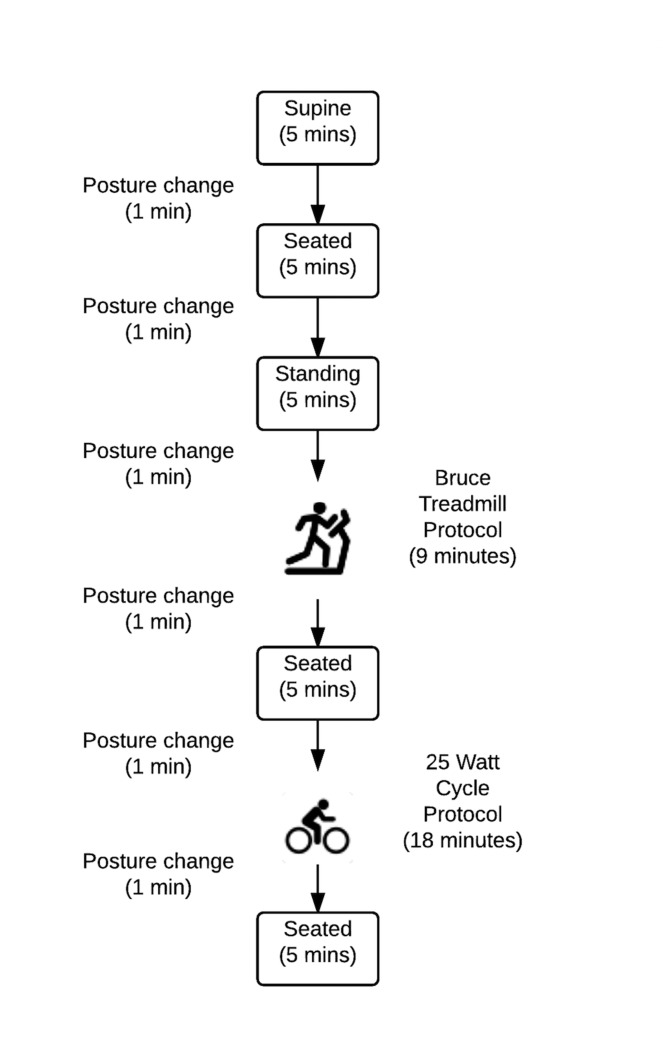
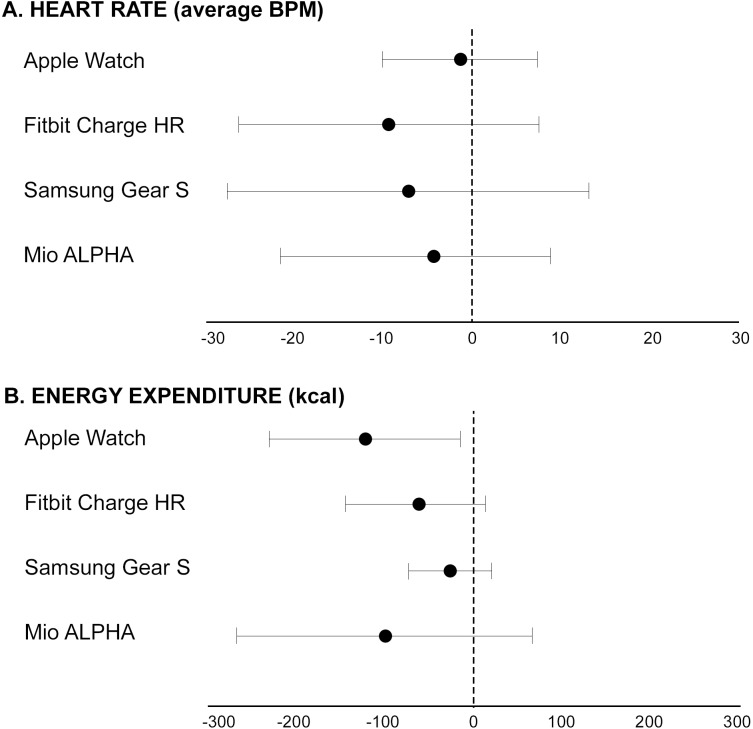
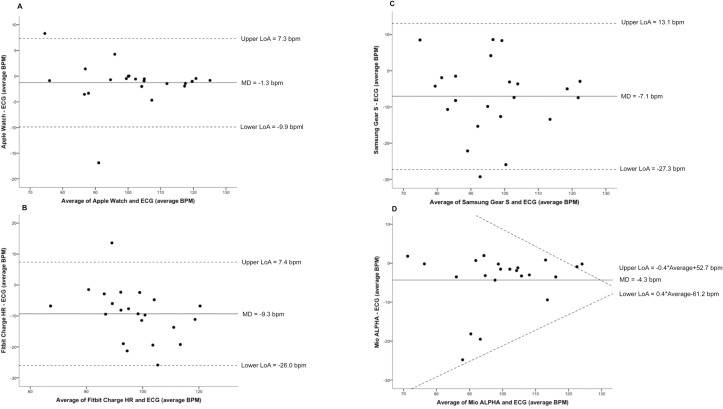
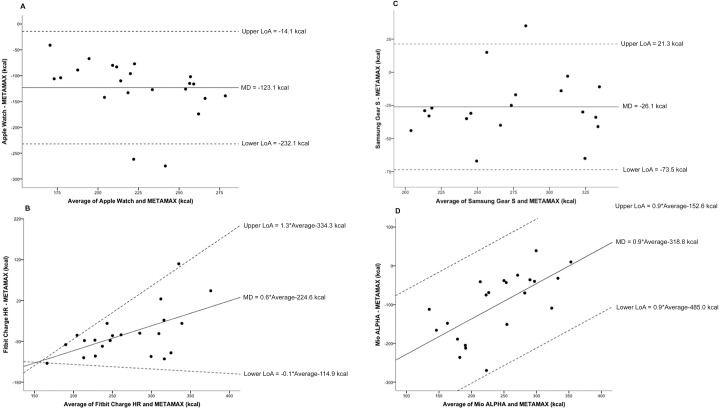
BACKGROUND: Wrist-worn monitors claim to provide accurate measures of heart rate and energy expenditure. People wishing to lose weight use these devices to monitor energy balance, however the accuracy of these devices to measure such parameters has not been established. AIM: To determine the accuracy of four wrist-worn devices (Apple Watch, Fitbit Charge HR, Samsung Gear S and Mio Alpha) to measure heart rate and energy expenditure at rest and during exercise. METHODS: Twenty-two healthy volunteers (50% female; aged 24 ± 5.6 years) completed ~1-hr protocols involving supine and seated rest, walking and running on a treadmill and cycling on an ergometer. Data from the devices collected during the protocol were compared with reference methods: electrocardiography (heart rate) and indirect calorimetry (energy expenditure). RESULTS: None of the devices performed significantly better overall, however heart rate was consistently more accurate than energy expenditure across all four devices. Correlations between the devices and reference methods were moderate to strong for heart rate (0.67-0.95 [0.35 to 0.98]) and weak to strong for energy expenditure (0.16-0.86 [-0.25 to 0.95]). All devices underestimated both outcomes compared to reference methods. The percentage error for heart rate was small across the devices (range: 1-9%) but greater for energy expenditure (9-43%). Similarly, limits of agreement were considerably narrower for heart rate (ranging from -27.3 to 13.1 bpm) than energy expenditure (ranging from -266.7 to 65.7 kcals) across devices. CONCLUSION: These devices accurately measure heart rate. However, estimates of energy expenditure are poor and would have implications for people using these devices for weight loss.
Overview
The claims and statistics of this paper haven’t been checked yet.
Run the check — free, no account needed. It reads the open-access text and checks the sources it cites.
Integrity signals
Registry
Cites
Statistics
Figures
Verification
Claims the paper makes
The claims and statistics of this paper haven’t been checked yet.
Run the check — free, no account needed. It reads the open-access text and checks the sources it cites.
Claims other papers make about this one
Each is checked against this paper’s own text: does it say what the citing paper says it does?
The source backs part of the claim, not all of it — or backs it for a different population, condition or comparison.
In the citing paper
“Similar to previous studies [13,28,30-32], we found reasonable accuracy in HR and EE estimations for these 2 devices under certain exercise conditions.”
From Accuracy of Wrist-Worn Activity Monitors During Common Daily Physical Activities and Types of Structured Exercise: Evaluation Study (2018) · cites this paper as [32]
Experimental — accuracy not yet measuredIn the citing paper
“Of those, all five found the Apple Watch to be more accurate than the other commercial devices [2, 9–12].”
From Accuracy of heart rate measurement with wrist-worn wearable devices in various skin tones: a systematic review (2023) · cites this paper as [12]
In the citing paper
“The remaining two studies showed mixed results.”
From Accuracy of heart rate measurement with wrist-worn wearable devices in various skin tones: a systematic review (2023) · cites this paper as [12]
In the citing paper
“Wallen et al. noted lower heart rate accuracy in participants with a Fitzpatrick scale score > 4 with the Apple Watch, but not in the other studied smartwatches [12].”
From Accuracy of heart rate measurement with wrist-worn wearable devices in various skin tones: a systematic review (2023) · cites this paper as [12]
In the citing paper
“Although some studies have attempted to address wearable HR accuracy using the gold-standard reference method of ECG, which directly measures HR via electrical impulses from the heart and is used for clinical accuracy38–44”
From Guidelines for wrist-worn consumer wearable assessment of heart rate in biobehavioral research (2020) · cites this paper as [43]
In the citing paper
“with the Apple Watch having slightly greater accuracy than Fitbit devices (Apple Watch: −1.3 bpm, Fitbit: −9.3 bpm42–44)”
From Guidelines for wrist-worn consumer wearable assessment of heart rate in biobehavioral research (2020) · cites this paper as [43]
In the citing paper
“lower mean difference standard deviation43, and higher agreement with ECG than Fitbit devices39,44.”
From Guidelines for wrist-worn consumer wearable assessment of heart rate in biobehavioral research (2020) · cites this paper as [43]
In the citing paper
“Evidence is starting to accumulate on the importance of skin tone when it comes to accuracy and generalizability of wrist-worn wearable studies with darker skin tone (and tattoos) being found to be associated with reduced wrist-worn HR accuracy as they absorb more green light67, yet this is not found in all studies43,50.”
From Guidelines for wrist-worn consumer wearable assessment of heart rate in biobehavioral research (2020) · cites this paper as [43]
In the citing paper
“Inaccuracy of activity trackers may also lead individuals to overestimate their level of physical activity, limiting their effectiveness for lifestyle interventions [142,143].”
From Wearables and the Medical Revolution (2018) · cites this paper as [142]
In the citing paper
“Moreover, although the Apple Watch has become very popular, it has only been used in one validation study.”
From Estimating Accuracy at Exercise Intensities: A Comparative Study of Self-Monitoring Heart Rate and Physical Activity Wearable Devices (2017) · cites this paper as [18]
In the citing paper
“The Apple Watch was found to underestimate both heart rate and EE, with a tendency to underestimate calories expended by more than 100 calories [18].”
From Estimating Accuracy at Exercise Intensities: A Comparative Study of Self-Monitoring Heart Rate and Physical Activity Wearable Devices (2017) · cites this paper as [18]
In the citing paper
“Fitbit Charge HR has been found to underestimate heart rate and EE [18]”
From Estimating Accuracy at Exercise Intensities: A Comparative Study of Self-Monitoring Heart Rate and Physical Activity Wearable Devices (2017) · cites this paper as [18]
In the citing paper
“Apple Watch has been previously found to underestimate calories by more than 100 calories [18], whereas our study found the device to overestimate calories expended.”
From Estimating Accuracy at Exercise Intensities: A Comparative Study of Self-Monitoring Heart Rate and Physical Activity Wearable Devices (2017) · cites this paper as [18]
In the citing paper
“Most studies establishing validity only assess the overall physical activity intensity for an entire bout of physical activity [18].”
From Estimating Accuracy at Exercise Intensities: A Comparative Study of Self-Monitoring Heart Rate and Physical Activity Wearable Devices (2017) · cites this paper as [18]
Self-check
Percentages, sums and reported differences re-computed from the paper’s own numbers.
The self-check needs the paper’s full text.
Citations
Cites
Health benefits of physical activity: the evidence
Warburton, D. E. R. (2006) · Canadian Medical Association Journal · doi:10.1503/cmaj.051351 · Cited by 8,007
HASKELL, W. L., LEE, I.-M., PATE, R. R., POWELL, K. E., BLAIR, S. N., FRANKLIN, B. A., MACERA, C. A., HEATH, G. W., THOMPSON, P. D., & BAUMAN, A. (2007) · Medicine & Science in Sports & Exercise · doi:10.1249/mss.0b013e3180616b27 · Cited by 4,616
The validity and practicality of sun-reactive skin types I through VI
Fitzpatrick, T. B. (1988) · Archives of Dermatology · doi:10.1001/archderm.1988.01670060015008 · Cited by 4,339
DONNELLY, J. E., BLAIR, S. N., JAKICIC, J. M., MANORE, M. M., RANKIN, J. W., & SMITH, B. K. (2009) · Medicine & Science in Sports & Exercise · doi:10.1249/mss.0b013e3181949333 · Cited by 2,658
Wearable Devices as Facilitators, Not Drivers, of Health Behavior Change
Patel, M. S., Asch, D. A., & Volpp, K. G. (2015) · JAMA · doi:10.1001/jama.2014.14781 · Cited by 808
Accuracy of Smartphone Applications and Wearable Devices for Tracking Physical Activity Data
Case, M. A., Burwick, H. A., Volpp, K. G., & Patel, M. S. (2015) · JAMA · doi:10.1001/jama.2014.17841 · Cited by 694
Ferguson, T., Rowlands, A. V., Olds, T., & Maher, C. (2015) · International Journal of Behavioral Nutrition and Physical Activity · doi:10.1186/s12966-015-0201-9 · Cited by 468
Validity of Consumer-Based Physical Activity Monitors
LEE, J.-M., KIM, Y., & WELK, G. J. (2014) · Medicine & Science in Sports & Exercise · doi:10.1249/mss.0000000000000287 · Cited by 401
Prediction of energy expenditure from heart rate monitoring during submaximal exercise
Keytel, L. R., Goedecke, J. H., Noakes, T. D., Hiilloskorpi, H., Laukkanen, R. M. T., van der Merwe, L., & Lambert, E. V. (2005) · Journal of Sports Sciences · doi:10.1080/02640410470001730089 · Cited by 336
Methods of Prescribing Relative Exercise Intensity: Physiological and Practical Considerations
Mann, T., Lamberts, R. P., & Lambert, M. I. (2013) · Sports Medicine · doi:10.1007/s40279-013-0045-x · Cited by 333
Cited by
Sorted by citations
Items 301–336 of 336
Cheng, E. M., Lim, E. A., Tan, W., Mustafa, W. A., Idrus, S. Z. S., Nasir, N. F. M., Abdulmalek, M., Beh, H.-G., Lee, Y. S., & Yusop, S. N. A. M. (2020) · Journal of Physics Conference Series · doi:10.1088/1742-6596/1529/2/022082
Parenting and Adolescent Health: Mechanisms of Stress-Disease Comorbidity
Nelson, B. W. (2020) · Scholars' Bank (University of Oregon)
Aitken, R. J. (2020) · TSpace (University of Toronto)
Hierarchical Data Integrity for IoT Devices in Connected Health Applications
Karimi, M., & Krishnamurthy, P. V. (2021) · RonPub -- Research Online Publishing (RonPub UG)
CONFIDENCE LEVEL OF A MOTION FEEDBACK SYSTEM FOR ANALYZING EXERCISE TRAINING EFFICACY
Fang, F.-L., Wu, Y.-H., Tsai, J. T., Jaw, F., Ke, Y.-S., & Hsu, C.-C. (2021) · Biomedical Engineering Applications Basis and Communications · doi:10.4015/s1016237222500053
Lui, G. Y., Loughnane, D. C., Polley, C., Jayarathna, T., & Breen, P. P. (2022) · doi:10.2196/preprints.37354
Ni, G., Cai, Y., Wang, Z., Kong, W., Jiang, J., Feng, L., Zhao, R., & Wang, D. (2022) · doi:10.2196/preprints.36726
Investigating Sources of Inaccuracy in Wearable Optical Heart Rate Sensors (Preprint)Preprint
Bent, B., Goldstein, B. A., Kibbe, W. A., & Dunn, J. (2020) · doi:10.2196/preprints.18126
O’Driscoll, R., & Stubbs, R. J. (2018) · doi:10.26226/morressier.5b1a467c3b823805c63c0048
Error Prevention in Sensors and Sensor Systems
Chacon, P. J. (2021) · doi:10.31390/gradschool_dissertations.5543
Rusterholz, F., Rodriguez, A., Ortiz, V., & Peacock, C. A. (2023) · Research Directs in Health Sciences · doi:10.53520/rdhs2023.10475
Validity of Energy Expenditure Estimation Equation using Heart Rate in Swimming
Lee, M., Lee, Y., & Park, S. (2023) · Exercise Science · doi:10.15857/ksep.2023.00178
Uluslararası Spor Organizasyonlarında Dijital Teknolojinin Kullanımı ve Etkileri
Mavibaş, M. (2023) · Özgür Yayınları eBooks · doi:10.58830/ozgur.pub222.c956
Özel Gereksinimli Bireyler İçin Spor Eğitiminde Yeni Teknolojiler
Şirinkan, A. (2023) · Özgür Yayınları eBooks · doi:10.58830/ozgur.pub222.c958
Dijital Pazarlamada Spor Sponsorluğu
Savaş, B. Ç. (2023) · Özgür Yayınları eBooks · doi:10.58830/ozgur.pub222.c953
Yao, L., Pan, X., Yang, Y., Zhong, W., Li, J., Wang, Z., & Xu, L. (2024) · Neurology Asia · doi:10.54029/2024mui
Phytomelatonin receptors and interacting protein
Oni, P. G., Olajide, P. A., Adetuyi, B. O., Oyebanjo, O. T., Ambali, O. A., & Ogunlana, O. O. (2024) · Elsevier eBooks · doi:10.1016/b978-0-443-13814-0.00002-8
Smartwatch Biometrics in the Electronic Medical Record: Time for a New Vital Sign?
Sankaran, S., & Banerjee, R. K. (2024) · JCO Clinical Cancer Informatics · doi:10.1200/cci-24-00161
Lee, M., Lee, S., & Park, S. (2024) · Exercise Science · doi:10.15857/ksep.2024.00346
Wang, C., Ližardo, O., & Hachen, D. S. (2024) · Qeios · doi:10.32388/tl5f3i
Hardon, H. J., Kerkhof, Y. N. V., Bartelds, B., Kammeraad, J. A. E., & van Deutekom, A. W. (2025) · doi:10.2196/preprints.70835
Lathauwer, I. L. J. D., van Es, V. A. A., van Leunen, M. M. C. J., Onkelinx, S., Brouwers, R. W. M., van de Sande, D. A., Funk, M., & Kemps, H. (2025) · JMIR Cardio · doi:10.2196/69343
Khushhal, A. A. (2025) · The Journal of Sports Medicine and Physical Fitness · doi:10.23736/s0022-4707.25.16270-1
Temporal Cardiovascular Dynamics for Improved PPG-Based Heart Rate Estimation
Demirel, B. U., & Holz, C. (2025) · IEEE Journal of Biomedical and Health Informatics · doi:10.1109/jbhi.2025.3617604 · Cited by 2
Miniatured In-Ear Sensor for Motion Artifact-Free Real-Time Vital Sign Monitoring
Kim, S., Park, H., Lee, M., Kim, H., Kim, J., Lee, J., Yang, Y., Lee, J., Choi, S.-M., Shin, W. H., et al. (2025) · IEEE Sensors Journal · doi:10.1109/jsen.2025.3641229
West, P. A., Palmer, K., Abery, B. H., Sender, J. S., Walsh, A., & Wyatt, G. K. (2026) · Journal of Applied Research in Intellectual Disabilities · doi:10.1111/jar.70193
Inoue, A., Soares, J. P. F., Antunes-Santos, F., Ferreira, A., Gonçalves, A., Alcântara, J. A., & dos Santos, M. R. (2025) · doi:10.2196/preprints.81917
Inoue, A., Soares, J. P. F., Antunes-Santos, F., Ferreira, A., Gonçalves, A., Alcântara, J. A., & dos Santos, M. R. (2026) · JMIR Cardio · doi:10.2196/81917
Bosoni, P., Larizza, C., Vandoni, M., Rossi, V., Gatti, A., Pellino, V. C., Lanzola, G., Quaglini, S., Zuccotti, G., & Calcaterra, V. (2026) · Journal of Pediatric Endocrinology and Metabolism · doi:10.1515/jpem-2025-0660
Madeira, R., Esteves, D., Neiva, H. P., Maia, A., Rondão, C., Pinto, N., Vercelli, A., & Pato, M. V. (2026) · JMIR Formative Research · doi:10.2196/81955
Kaplan, D. M., Kessler, N., Pozzo, N. S., Doyle, C. Y., Dickey, P., Giordano, N. A., Lehther, A., Maan, S., Mascaro, J. S., McDowall, A., et al. (2026) · PLOS Digital Health · doi:10.1371/journal.pdig.0001124
Schipper, R. M., Djibrillah, F. O., Roosink, M., Winkens, L. H. H., John, A., Hazebroek, E. J., Witteveen, A., & Berendsen, A. A. M. (2026) · JMIR mhealth and uhealth · doi:10.2196/87324 · Cited by 1
Hogue, T., Khoury, A., Njeim, P., Aswad, N., Youssef, L., Birtulescu, S., Faust, A., & Hajj‐Boutros, G. (2026) · Frontiers in Digital Health · doi:10.3389/fdgth.2026.1820224
Comparison of smartwatch-derived energy expenditure estimation during outdoor activities
Cho, H., Rodriguez, C. C., & Slade, P. (2026) · Frontiers in Digital Health · doi:10.3389/fdgth.2026.1926837
Oliveira, L. D. S., Araújo, G. K. N., Oliveira, L. A. F., Mangueira, H. N. D. L., & da Silva, J. C. G. (2026) · Revista de Investigación e Innovación en Ciencias de la Salud · doi:10.46634/riics.639
Metadata
- Authors
- Wallen, M. P., Gomersall, S. R., Keating, S. E., Wisløff, U., & Coombes, J. S.
- Affiliations
- The University of Queensland (AU)
- Norwegian University of Science and Technology (NO)
- Corresponding author
- Coombes, Jeff S.
- Venue
- PLOS ONE
- Publisher
- Public Library of Science (PLoS)
- Published
- 2016-05-27
- Volume
- 11
- Issue
- 5
- Pages
- e0154420
- ISSN
- 1932-6203 (ISSN-L)
- PMC
- PMC4883747
- OpenAlex
- W2395644623
- Cited by
- 336
- References
- 17
- Citations by year
- 2026: 12 · 2025: 20 · 2024: 18 · 2023: 28 · 2022: 30 · 2021: 30 · 2020: 41 · 2019: 54 · 2018: 62 · 2017: 35 · 2016: 6
- FWCI
- 42.08
- Type
- journal article
- Language
- en
- Open access
- gold
- doi.org
- Licence
- Locations
- PLoS ONE (publishedVersion, cc-by)
- PubMed Central (publishedVersion, cc-by)
- PubMed (publishedVersion)
- FedUni ResearchOnline (Federation University Australia) (submittedVersion, cc-by)
- DOAJ (DOAJ: Directory of Open Access Journals) (submittedVersion, cc-by-sa)
- NORA - Norwegian Open Research Archives (submittedVersion, cc-by)
- Funders
- Coca-Cola
- Topics
- Health Sciences › Medicine › Public Health, Environmental and Occupational Health › Physical Activity and Health
- Physical Sciences › Engineering › Biomedical Engineering › Non-Invasive Vital Sign Monitoring
- Health Sciences › Health Professions › General Health Professions › Mobile Health and mHealth Applications
- Keywords
- heart rate monitors, wrist-worn devices, energy expenditure, measurement accuracy, weight loss, wearable activity trackers, Apple Watch, Fitbit, physical activity, energy balance, indirect calorimetry, electrocardiogram
- MeSH terms
- Adult, Aged, Body Weight, Energy Metabolism, Female, Heart Rate, Humans, Male, Middle Aged, Monitoring, Physiologic, Wrist, Young Adult, Healthy Volunteers
About these checks
Registry, retraction, Cites and statistics results are computed, not judged, with one exception: a printed reference that no index lists is read once by a model before it counts as a citation error. Claims are extracted by a model and kept only when their quote appears verbatim in the text; each cited source is then checked, with a model’s help, for whether it says what the claim relies on. Those verdicts can be wrong — read the claim’s quote and the cited source before relying on one.
Statistics and arithmetic are recomputed, not judged.
Confidence bands are shown only for fields calibrated on our annotated test set. None is calibrated yet, so no band is shown.
What counts as a claim ›How we measure confidence ›How we check this ›
Are you an author, or do you see a problem with this page? Request a review
