

The DOI matches its Crossref record; 17 of the 17 references it cites were found in a registry or an index.
Accuracy of Heart Rate Watches: Implications for Weight Management
Open accessAbstract
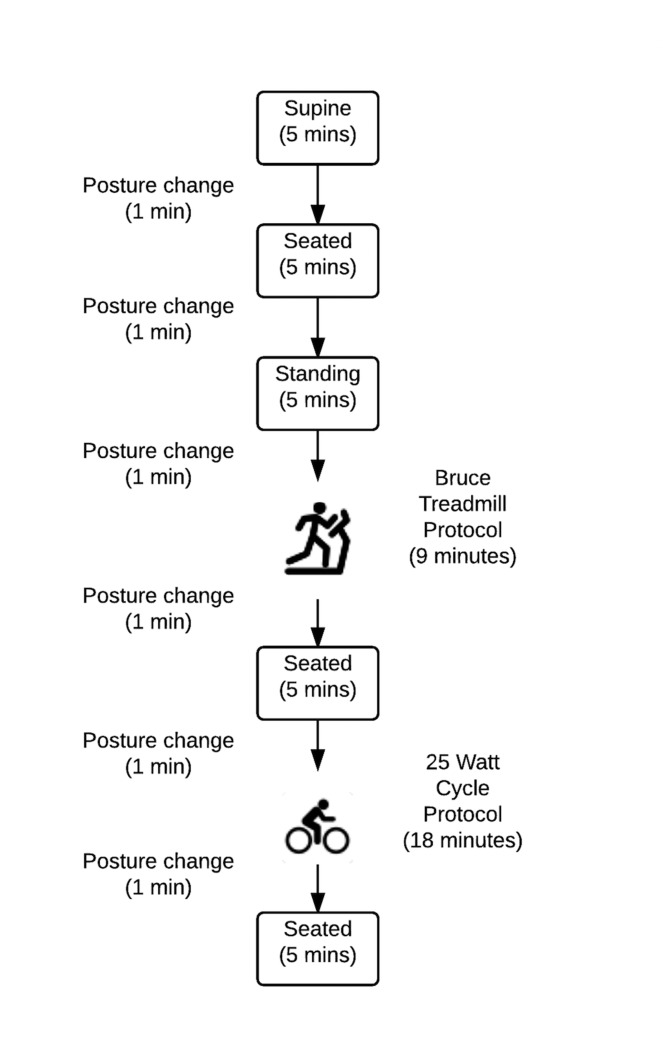
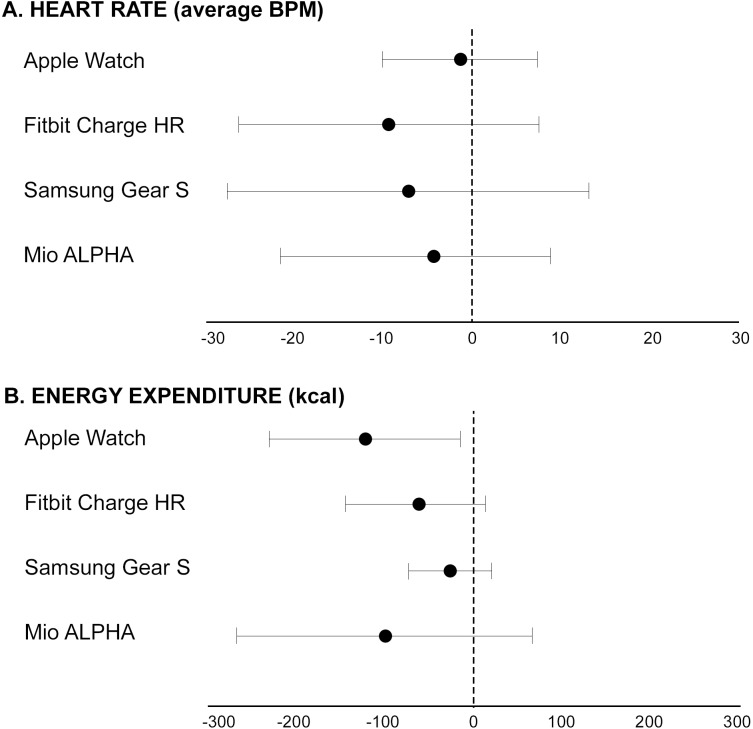
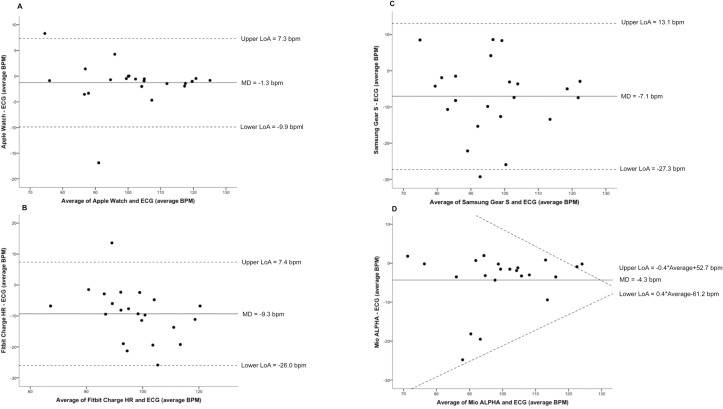
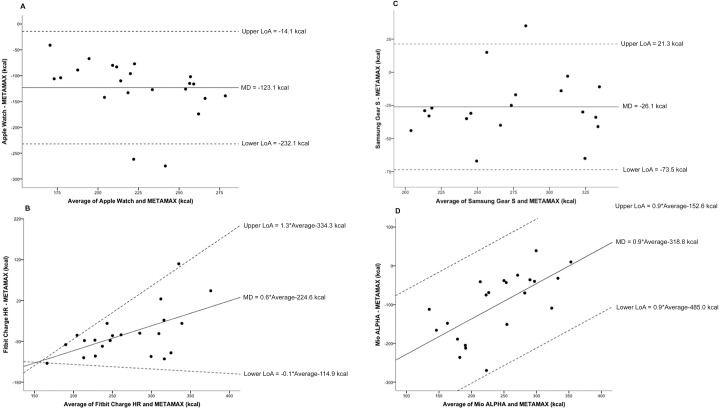
BACKGROUND: Wrist-worn monitors claim to provide accurate measures of heart rate and energy expenditure. People wishing to lose weight use these devices to monitor energy balance, however the accuracy of these devices to measure such parameters has not been established. AIM: To determine the accuracy of four wrist-worn devices (Apple Watch, Fitbit Charge HR, Samsung Gear S and Mio Alpha) to measure heart rate and energy expenditure at rest and during exercise. METHODS: Twenty-two healthy volunteers (50% female; aged 24 ± 5.6 years) completed ~1-hr protocols involving supine and seated rest, walking and running on a treadmill and cycling on an ergometer. Data from the devices collected during the protocol were compared with reference methods: electrocardiography (heart rate) and indirect calorimetry (energy expenditure). RESULTS: None of the devices performed significantly better overall, however heart rate was consistently more accurate than energy expenditure across all four devices. Correlations between the devices and reference methods were moderate to strong for heart rate (0.67-0.95 [0.35 to 0.98]) and weak to strong for energy expenditure (0.16-0.86 [-0.25 to 0.95]). All devices underestimated both outcomes compared to reference methods. The percentage error for heart rate was small across the devices (range: 1-9%) but greater for energy expenditure (9-43%). Similarly, limits of agreement were considerably narrower for heart rate (ranging from -27.3 to 13.1 bpm) than energy expenditure (ranging from -266.7 to 65.7 kcals) across devices. CONCLUSION: These devices accurately measure heart rate. However, estimates of energy expenditure are poor and would have implications for people using these devices for weight loss.
Overview
The claims and statistics of this paper haven’t been checked yet.
Run the check — free, no account needed. It reads the open-access text and checks the sources it cites.
Integrity signals
Registry
Cites
Statistics
Figures
Verification
Claims the paper makes
The claims and statistics of this paper haven’t been checked yet.
Run the check — free, no account needed. It reads the open-access text and checks the sources it cites.
Claims other papers make about this one
Each is checked against this paper’s own text: does it say what the citing paper says it does?
The source backs part of the claim, not all of it — or backs it for a different population, condition or comparison.
In the citing paper
“Similar to previous studies [13,28,30-32], we found reasonable accuracy in HR and EE estimations for these 2 devices under certain exercise conditions.”
From Accuracy of Wrist-Worn Activity Monitors During Common Daily Physical Activities and Types of Structured Exercise: Evaluation Study (2018) · cites this paper as [32]
Experimental — accuracy not yet measuredIn the citing paper
“Of those, all five found the Apple Watch to be more accurate than the other commercial devices [2, 9–12].”
From Accuracy of heart rate measurement with wrist-worn wearable devices in various skin tones: a systematic review (2023) · cites this paper as [12]
In the citing paper
“The remaining two studies showed mixed results.”
From Accuracy of heart rate measurement with wrist-worn wearable devices in various skin tones: a systematic review (2023) · cites this paper as [12]
In the citing paper
“Wallen et al. noted lower heart rate accuracy in participants with a Fitzpatrick scale score > 4 with the Apple Watch, but not in the other studied smartwatches [12].”
From Accuracy of heart rate measurement with wrist-worn wearable devices in various skin tones: a systematic review (2023) · cites this paper as [12]
In the citing paper
“Although some studies have attempted to address wearable HR accuracy using the gold-standard reference method of ECG, which directly measures HR via electrical impulses from the heart and is used for clinical accuracy38–44”
From Guidelines for wrist-worn consumer wearable assessment of heart rate in biobehavioral research (2020) · cites this paper as [43]
In the citing paper
“with the Apple Watch having slightly greater accuracy than Fitbit devices (Apple Watch: −1.3 bpm, Fitbit: −9.3 bpm42–44)”
From Guidelines for wrist-worn consumer wearable assessment of heart rate in biobehavioral research (2020) · cites this paper as [43]
In the citing paper
“lower mean difference standard deviation43, and higher agreement with ECG than Fitbit devices39,44.”
From Guidelines for wrist-worn consumer wearable assessment of heart rate in biobehavioral research (2020) · cites this paper as [43]
In the citing paper
“Evidence is starting to accumulate on the importance of skin tone when it comes to accuracy and generalizability of wrist-worn wearable studies with darker skin tone (and tattoos) being found to be associated with reduced wrist-worn HR accuracy as they absorb more green light67, yet this is not found in all studies43,50.”
From Guidelines for wrist-worn consumer wearable assessment of heart rate in biobehavioral research (2020) · cites this paper as [43]
In the citing paper
“Inaccuracy of activity trackers may also lead individuals to overestimate their level of physical activity, limiting their effectiveness for lifestyle interventions [142,143].”
From Wearables and the Medical Revolution (2018) · cites this paper as [142]
In the citing paper
“Moreover, although the Apple Watch has become very popular, it has only been used in one validation study.”
From Estimating Accuracy at Exercise Intensities: A Comparative Study of Self-Monitoring Heart Rate and Physical Activity Wearable Devices (2017) · cites this paper as [18]
In the citing paper
“The Apple Watch was found to underestimate both heart rate and EE, with a tendency to underestimate calories expended by more than 100 calories [18].”
From Estimating Accuracy at Exercise Intensities: A Comparative Study of Self-Monitoring Heart Rate and Physical Activity Wearable Devices (2017) · cites this paper as [18]
In the citing paper
“Fitbit Charge HR has been found to underestimate heart rate and EE [18]”
From Estimating Accuracy at Exercise Intensities: A Comparative Study of Self-Monitoring Heart Rate and Physical Activity Wearable Devices (2017) · cites this paper as [18]
In the citing paper
“Apple Watch has been previously found to underestimate calories by more than 100 calories [18], whereas our study found the device to overestimate calories expended.”
From Estimating Accuracy at Exercise Intensities: A Comparative Study of Self-Monitoring Heart Rate and Physical Activity Wearable Devices (2017) · cites this paper as [18]
In the citing paper
“Most studies establishing validity only assess the overall physical activity intensity for an entire bout of physical activity [18].”
From Estimating Accuracy at Exercise Intensities: A Comparative Study of Self-Monitoring Heart Rate and Physical Activity Wearable Devices (2017) · cites this paper as [18]
Self-check
Percentages, sums and reported differences re-computed from the paper’s own numbers.
The self-check needs the paper’s full text.
Citations
Cites
Health benefits of physical activity: the evidence
Warburton, D. E. R. (2006) · Canadian Medical Association Journal · doi:10.1503/cmaj.051351 · Cited by 8,007
HASKELL, W. L., LEE, I.-M., PATE, R. R., POWELL, K. E., BLAIR, S. N., FRANKLIN, B. A., MACERA, C. A., HEATH, G. W., THOMPSON, P. D., & BAUMAN, A. (2007) · Medicine & Science in Sports & Exercise · doi:10.1249/mss.0b013e3180616b27 · Cited by 4,616
The validity and practicality of sun-reactive skin types I through VI
Fitzpatrick, T. B. (1988) · Archives of Dermatology · doi:10.1001/archderm.1988.01670060015008 · Cited by 4,339
DONNELLY, J. E., BLAIR, S. N., JAKICIC, J. M., MANORE, M. M., RANKIN, J. W., & SMITH, B. K. (2009) · Medicine & Science in Sports & Exercise · doi:10.1249/mss.0b013e3181949333 · Cited by 2,658
Wearable Devices as Facilitators, Not Drivers, of Health Behavior Change
Patel, M. S., Asch, D. A., & Volpp, K. G. (2015) · JAMA · doi:10.1001/jama.2014.14781 · Cited by 808
Accuracy of Smartphone Applications and Wearable Devices for Tracking Physical Activity Data
Case, M. A., Burwick, H. A., Volpp, K. G., & Patel, M. S. (2015) · JAMA · doi:10.1001/jama.2014.17841 · Cited by 694
Ferguson, T., Rowlands, A. V., Olds, T., & Maher, C. (2015) · International Journal of Behavioral Nutrition and Physical Activity · doi:10.1186/s12966-015-0201-9 · Cited by 468
Validity of Consumer-Based Physical Activity Monitors
LEE, J.-M., KIM, Y., & WELK, G. J. (2014) · Medicine & Science in Sports & Exercise · doi:10.1249/mss.0000000000000287 · Cited by 401
Prediction of energy expenditure from heart rate monitoring during submaximal exercise
Keytel, L. R., Goedecke, J. H., Noakes, T. D., Hiilloskorpi, H., Laukkanen, R. M. T., van der Merwe, L., & Lambert, E. V. (2005) · Journal of Sports Sciences · doi:10.1080/02640410470001730089 · Cited by 336
Methods of Prescribing Relative Exercise Intensity: Physiological and Practical Considerations
Mann, T., Lamberts, R. P., & Lambert, M. I. (2013) · Sports Medicine · doi:10.1007/s40279-013-0045-x · Cited by 333
Cited by
Sorted by citations
Fuller, D., Colwell, E., Low, J., Orychock, K., Tobin, M. A., Simango, B., Buote, R., Van Heerden, D., Luan, H., Cullen, K., et al. (2020) · JMIR mHealth and uHealth · doi:10.2196/18694 · Cited by 715
Investigating sources of inaccuracy in wearable optical heart rate sensors
Bent, B., Goldstein, B. A., Kibbe, W. A., & Dunn, J. P. (2020) · npj Digital Medicine · doi:10.1038/s41746-020-0226-6 · Cited by 673
Accuracy of Fitbit Devices: Systematic Review and Narrative Syntheses of Quantitative Data
Feehan, L. M., Geldman, J., Sayre, E. C., Park, C., Ezzat, A. M., Yoo, J. Y., Hamilton, C. B., & Li, L. C. (2018) · JMIR mHealth and uHealth · doi:10.2196/10527 · Cited by 616
Wearables and the Medical Revolution
Dunn, J., Runge, R., & Snyder, M. (2018) · Personalized Medicine · doi:10.2217/pme-2018-0044 · Cited by 654
Shcherbina, A., Mattsson, C., Waggott, D., Salisbury, H., Christle, J., Hastie, T., Wheeler, M., & Ashley, E. (2017) · Journal of Personalized Medicine · doi:10.3390/jpm7020003 · Cited by 625
Henriksen, A., Haugen Mikalsen, M., Woldaregay, A. Z., Muzny, M., Hartvigsen, G., Hopstock, L. A., & Grimsgaard, S. (2018) · Journal of Medical Internet Research · doi:10.2196/jmir.9157 · Cited by 542
Lobelo, F., Rohm Young, D., Sallis, R., Garber, M. D., Billinger, S. A., Duperly, J., Hutber, A., Pate, R. R., Thomas, R. J., Widlansky, M. E., et al. (2018) · Circulation · doi:10.1161/cir.0000000000000559 · Cited by 402
Wearable Devices for Ambulatory Cardiac Monitoring
Sana, F., Isselbacher, E. M., Singh, J. P., Heist, E. K., Pathik, B., & Armoundas, A. A. (2020) · Journal of the American College of Cardiology · doi:10.1016/j.jacc.2020.01.046 · Cited by 362
Nelson, B. W., & Allen, N. B. (2019) · JMIR mHealth and uHealth · doi:10.2196/10828 · Cited by 310
Guidelines for wrist-worn consumer wearable assessment of heart rate in biobehavioral research
Nelson, B. W., Low, C. A., Jacobson, N., Areán, P., Torous, J., & Allen, N. B. (2020) · npj Digital Medicine · doi:10.1038/s41746-020-0297-4 · Cited by 241
Dooley, E. E., Golaszewski, N. M., & Bartholomew, J. B. (2017) · JMIR mHealth and uHealth · doi:10.2196/mhealth.7043 · Cited by 242
Human metabolic rate and thermal comfort in buildings: The problem and challenge
Luo, M., Wang, Z., Ke, K., Cao, B., Zhai, Y., & Zhou, X. (2018) · Building and Environment · doi:10.1016/j.buildenv.2018.01.005 · Cited by 231
Hernando, D., Roca, S., Sancho, J., Alesanco, Á., & Bailón, R. (2018) · Sensors · doi:10.3390/s18082619 · Cited by 225
Wearable Training-Monitoring Technology: Applications, Challenges, and Opportunities
Cardinale, M., & Varley, M. C. (2016) · International Journal of Sports Physiology and Performance · doi:10.1123/ijspp.2016-0423 · Cited by 255
Germini, F., Noronha, N., Debono, V. B., Philip, B. A., Pete, D., Navarro, T., Keepanasseril, A., Parpia, S., de Wit, K., & Iorio, A. (2021) · Journal of Medical Internet Research · doi:10.2196/30791 · Cited by 245
Validity of Wearable Activity Monitors during Cycling and Resistance Exercise
BOUDREAUX, B. D., HEBERT, E. P., HOLLANDER, D. B., WILLIAMS, B. M., CORMIER, C. L., NAQUIN, M. R., GILLAN, W. W., GUSEW, E. E., & KRAEMER, R. R. (2018) · Medicine & Science in Sports & Exercise · doi:10.1249/mss.0000000000001471 · Cited by 205
Current State of Commercial Wearable Technology in Physical Activity Monitoring 2015-2017
Bunn, J., Navalta, J. W., Fountaine, C. J., & Reece, J. (2018) · International Journal of Exercise Science · doi:10.70252/njqx2719 · Cited by 194
O’Driscoll, R., Turicchi, J., Beaulieu, K., Scott, S., Matu, J., Deighton, K., Finlayson, G., & Stubbs, R. J. (2018) · British Journal of Sports Medicine · doi:10.1136/bjsports-2018-099643 · Cited by 202
Quer, G., Gouda, P., Galarnyk, M., Topol, E. J., & Steinhubl, S. R. (2020) · PLOS ONE · doi:10.1371/journal.pone.0227709 · Cited by 185
Reddy, R. K., Pooni, R., Zaharieva, D. P., Senf, B., El Youssef, J., Dassau, E., Doyle III, F. J., Clements, M. A., Rickels, M. R., Patton, S. R., et al. (2018) · JMIR mHealth and uHealth · doi:10.2196/10338 · Cited by 155
Falter, M., Budts, W., Goetschalckx, K., Cornelissen, V., & Buys, R. (2019) · JMIR mHealth and uHealth · doi:10.2196/11889 · Cited by 142
Validation of Biofeedback Wearables for Photoplethysmographic Heart Rate Tracking.
(2016) · PubMed Central · Cited by 150
Assessment of the Fitbit Charge 2 for monitoring heart rate
Benedetto, S., Caldato, C., Bazzan, E., Greenwood, D. C., Pensabene, V., & Actis, P. (2018) · PLOS ONE · doi:10.1371/journal.pone.0192691 · Cited by 149
Comparative evaluation of heart rate-based monitors: Apple Watch vs Fitbit Charge HR
Bai, Y., Hibbing, P. R., Mantis, K., & Welk, G. J. (2017) · Journal of Sports Sciences · doi:10.1080/02640414.2017.1412235 · Cited by 147
Depression and cardiovascular disease: Shared molecular mechanisms and clinical implications
Shao, M., Lin, X., Jiang, D., Tian, H., Xu, Y. J., Wang, L., Ji, F., Zhou, C., Song, X., & Zhuo, C. (2020) · Psychiatry Research · doi:10.1016/j.psychres.2020.112802 · Cited by 152
Chow, H.-W., & Yang, C.-C. (2020) · JMIR mHealth and uHealth · doi:10.2196/14707 · Cited by 140
“Similar findings were also reported in previous studies [11,12] and could represent a general characteristic of optical heart rate fitness trackers.”
InfluentialStandardizing Analytic Methods and Reporting in Activity Monitor Validation Studies
Welk, G. J., Bai, Y., Lee, J. M., Godino, J., Saint‐Maurice, P. F., & Carr, L. J. (2019) · Medicine & Science in Sports & Exercise · doi:10.1249/mss.0000000000001966 · Cited by 142
Soon, S., Svavarsdottir, H. S., Downey, C. L., & Jayne, D. G. (2020) · BMJ Innovations · doi:10.1136/bmjinnov-2019-000354 · Cited by 137
Smart watches for heart rate assessment in atrial arrhythmias
Koshy, A. N., Sajeev, J., Nerlekar, N., Brown, A. J., Rajakariar, K., Zureik, M., Wong, M. C. G., Roberts, L., Street, M., Cooke, J. C., et al. (2018) · International Journal of Cardiology · doi:10.1016/j.ijcard.2018.02.073 · Cited by 127
Cosoli, G., Spinsante, S., & Scalise, L. (2020) · Measurement · doi:10.1016/j.measurement.2020.107789 · Cited by 131
Chowdhury, E. A., Western, M. J., Nightingale, T. E., Peacock, O. J., & Thompson, D. (2017) · PLOS ONE · doi:10.1371/journal.pone.0171720 · Cited by 118
A Novel Non-contact Heart Rate Monitor Using Impulse-Radio Ultra-Wideband (IR-UWB) Radar Technology
Lee, Y., Park, J.-Y., Choi, Y.-W., Park, H., Cho, S. H., Cho, S. H., & Lim, Y. (2018) · Scientific Reports · doi:10.1038/s41598-018-31411-8 · Cited by 116
Review of Validity and Reliability of Garmin Activity Trackers
Evenson, K. R., & Spade, C. L. (2020) · Journal for the Measurement of Physical Behaviour · doi:10.1123/jmpb.2019-0035 · Cited by 122
Mühlen, J. M., Stang, J. S., Skovgaard, E. L., Júdice, P. B., Molina‐García, P., Johnston, W., Sardinha, L. B., Ortega, F. B., Caulfield, B., Bloch, W., et al. (2021) · British Journal of Sports Medicine · doi:10.1136/bjsports-2020-103148 · Cited by 126
Scardulla, F., Cosoli, G., Spinsante, S., Poli, A., Iadarola, G., Pernice, R., Busacca, A., Pasta, S., Scalise, L., & D’Acquisto, L. (2023) · Measurement · doi:10.1016/j.measurement.2023.113150 · Cited by 134
Cardiac Measures of Cognitive Workload: A Meta-Analysis
Hughes, A. M., Hancock, G. M., Marlow, S. L., Stowers, K. L., & Eduardo Salas, A. (2019) · Human Factors The Journal of the Human Factors and Ergonomics Society · doi:10.1177/0018720819830553 · Cited by 110
Gorny, A. W., Liew, S. J., Tan, C. S., & Müller-Riemenschneider, F. (2017) · JMIR mHealth and uHealth · doi:10.2196/mhealth.8233 · Cited by 94
Stretchable PPG sensor with light polarization for physical activity–permissible monitoring
Lee, G. H., Kang, H., Chung, J. W., Lee, Y., Yoo, H., Jeong, S., Cho, H. K., Kim, J., Kang, S., Jung, J. Y., et al. (2022) · Science Advances · doi:10.1126/sciadv.abm3622 · Cited by 95
Jensen, M. T., Treskes, R. W., Caiani, E. G., Casado-Arroyo, R., Cowie, M. R., Dilaveris, P., Duncker, D., Di Rienzo, M., Frederix, I., De Groot, N., et al. (2021) · European Heart Journal - Digital Health · doi:10.1093/ehjdh/ztab011 · Cited by 93
Validity and Reliability of the Apple Watch for Measuring Heart Rate During Exercise
Khushhal, A., Nichols, S., Evans, W., Gleadall-Siddall, D., Page, R., O'Doherty, A., Carroll, S., Ingle, L., & Abt, G. (2017) · Sports Medicine International Open · doi:10.1055/s-0043-120195 · Cited by 92
Koerber, D., Khan, S., Shamsheri, T., Kirubarajan, A., & Mehta, S. (2023) · Journal of Racial and Ethnic Health Disparities · doi:10.1007/s40615-022-01446-9 · Cited by 91
A Bayesian Deep Learning Framework for End-To-End Prediction of Emotion From Heartbeat
Harper, R. J., & Southern, J. (2020) · IEEE Transactions on Affective Computing · doi:10.1109/taffc.2020.2981610 · Cited by 94
McMahon, D. D., Barrio, B., McMahon, A. K., Tutt, K., & Firestone, J. (2020) · Journal of Special Education Technology · doi:10.1177/0162643419836416 · Cited by 80
The Accuracy of Heart Rate Monitoring by Some Wrist-Worn Activity Trackers
Cadmus‐Bertram, L., Gangnon, R. E., Wirkus, E. J., Thraen-Borowski, K. M., & Gorzelitz, J. (2017) · Annals of Internal Medicine · doi:10.7326/l16-0353 · Cited by 80
Ajmal, Boonya-Ananta, T., Rodriguez, A. J., Du Le, V. N., & Ramella-Roman, J. C. (2021) · Biomedical Optics Express · doi:10.1364/boe.439893 · Cited by 79
Chevance, G., Golaszewski, N. M., Tipton, E., Hekler, E. B., Buman, M. P., Welk, G. J., Patrick, K., & Godino, J. (2022) · JMIR mhealth and uhealth · doi:10.2196/35626 · Cited by 83
Wearable, yes, but able…?: it is time for evidence-based marketing claims!
Sperlich, B., & Holmberg, H. (2016) · British Journal of Sports Medicine · doi:10.1136/bjsports-2016-097295 · Cited by 76
Schrack, J. A., Leroux, A., Fleg, J. L., Zipunnikov, V., Simonsick, E. M., Studenski, S. A., Crainiceanu, C. M., & Ferrucci, L. (2018) · The Journals of Gerontology Series A · doi:10.1093/gerona/gly029 · Cited by 73
Ueafuea, K., Boonnag, C., Sudhawiyangkul, T., Leelaarporn, P., Gulistan, A., Chen, W., Mukhopadhyay, S. C., Wilaiprasitporn, T., & Piyayotai, S. (2020) · IEEE Sensors Journal · doi:10.1109/jsen.2020.3046259 · Cited by 72
Using Behavioral Analytics to Increase Exercise: A Randomized N-of-1 Study
Yoon, S., Schwartz, J. E., Burg, M. M., Kronish, I. M., Alcántara, C., Julian, J., Parsons, F., Davidson, K. W., & Diaz, K. M. (2018) · American Journal of Preventive Medicine · doi:10.1016/j.amepre.2017.12.011 · Cited by 67
Sartor, F., Gelissen, J., van Dinther, R., Roovers, D., Papini, G. B., & Coppola, G. (2018) · BMC Sports Science, Medicine and Rehabilitation · doi:10.1186/s13102-018-0098-0 · Cited by 65
Muggeridge, D. J., Hickson, K. A., Davies, A. V., Giggins, O. M., Megson, I. L., Gorely, T., & Crabtree, D. R. (2021) · JMIR mhealth and uhealth · doi:10.2196/25313 · Cited by 72
Nissen, M., Slim, S., Jaeger, K. M., Flaucher, M., Huebner, H., Danzberger, N., Fasching, P. A., Beckmann, M. W., Gradl, S., & Eskofier, B. M. (2022) · JMIR Formative Research · doi:10.2196/33635 · Cited by 69
The Apple Watch for Monitoring Mental Health–Related Physiological Symptoms: Literature Review
Lui, G. Y., Loughnane, D. C., Polley, C., Jayarathna, T., & Breen, P. P. (2022) · JMIR Mental Health · doi:10.2196/37354 · Cited by 65
Serodio, P. M., McKee, M., & Stückler, D. (2018) · Public Health Nutrition · doi:10.1017/s136898001700307x · Cited by 63
Concurrent heart rate validity of wearable technology devices during trail running
Navalta, J. W., Montes, J., Bodell, N. G., Salatto, R. W., Manning, J. W., & DeBeliso, M. (2020) · PLoS ONE · doi:10.1371/journal.pone.0238569 · Cited by 68
iTCM: Toward Learning-Based Thermal Comfort Modeling via Pervasive Sensing for Smart Buildings
Hu, W., Wen, Y., Guan, K., Jin, G., & Tseng, K. J. (2018) · IEEE Internet of Things Journal · doi:10.1109/jiot.2018.2861831 · Cited by 64
Werhahn, S. M., Dathe, H., Rottmann, T., Franke, T., Vahdat, D., Hasenfuß, G., & Seidler, T. (2019) · ESC Heart Failure · doi:10.1002/ehf2.12425 · Cited by 59
Müller, A. M., Wang, N. X., Yao, J., Tan, C. S., Low, I. C. C., Lim, N., Tan, J., Tan, A. W. H., & Müller‐Riemenschneider, F. (2019) · JMIR mhealth and uhealth · doi:10.2196/14120 · Cited by 56
Use of a Smart Watch for Early Detection of Paroxysmal Atrial Fibrillation: Validation Study
Inui, T., Kohno, H., Kawasaki, Y., Matsuura, K., Ueda, H., Tamura, Y., Watanabe, M., Inage, Y., Yakita, Y., Wakabayashi, Y., et al. (2019) · JMIR Cardio · doi:10.2196/14857 · Cited by 60
Zhu, J., Hou, W., Xu, Y., Ji, F., Wang, G., Chen, C., Lin, C., Lin, X., Li, J., Zhuo, C., et al. (2019) · Psychiatry Research · doi:10.1016/j.psychres.2019.112598 · Cited by 56
Validity of wrist-worn consumer products to measure heart rate and energy expenditure
Thiebaud, R. S., Funk, M. D., Patton, J. C., Massey, B. L., Shay, T. E., Schmidt, M. G., & Giovannitti, N. (2018) · Digital Health · doi:10.1177/2055207618770322 · Cited by 56
In-Ear Pulse Rate Measurement: A Valid Alternative to Heart Rate Derived from Electrocardiography?
Passler, S., Müller, N., & Senner, V. (2019) · Sensors · doi:10.3390/s19173641 · Cited by 60
Accuracy and Acceptability of Wearable Motion Tracking for Inpatient Monitoring Using Smartwatches
Auepanwiriyakul, C., Waibel, S., Songa, J., Bentley, P., & Faisal, A. A. (2020) · Sensors · doi:10.3390/s20247313 · Cited by 56
Kinnunen, H. O., Häkkinen, K., Schumann, M., Karavirta, L., Westerterp, K. R., & Kyröläinen, H. (2019) · PLoS ONE · doi:10.1371/journal.pone.0219563 · Cited by 52
Wearable Devices for the Assessment of Cognitive Effort for Human–Robot Interaction
Villani, V., Righi, M., Sabattini, L., & Secchi, C. (2020) · IEEE Sensors Journal · doi:10.1109/jsen.2020.3001635 · Cited by 53
Methodological Shortcomings of Wrist-Worn Heart Rate Monitors Validations
Sartor, F., Papini, G. B., Cox, L. G. E., & Cleland, J. G. F. (2018) · Journal of Medical Internet Research · doi:10.2196/10108 · Cited by 51
Støve, M. P., Haucke, E., Nymann, M. L., Sigurdsson, T., & Larsen, B. T. (2018) · Journal of Sports Sciences · doi:10.1080/02640414.2018.1535563 · Cited by 51
Huang, Z., Xu, Y., Cheng, Y., Xue, M., Deng, M., Jaffrezic-Renault, N. J., & Guo, Z. (2022) · Sensors & Diagnostics · doi:10.1039/d2sd00037g · Cited by 53
Performance of an Artificial Pancreas System for Young Children with Type 1 Diabetes
DeBoer, M. D., Breton, M. D., WAKEMAN, C. A., Schertz, E. M., Emory, E. G., Robic, J. L., Kollar, L. L., Kovatchev, B. P., & Cherñavvsky, D. R. (2017) · Diabetes Technology & Therapeutics · doi:10.1089/dia.2016.0424 · Cited by 49
Validity of heart rate measurements by the Garmin Forerunner 225 at different walking intensities
Claes, J., Buys, R., Ávila, A., Finlay, D., Kennedy, A., Guldenring, D., Budts, W., & Cornelissen, V. (2017) · Journal of Medical Engineering & Technology · doi:10.1080/03091902.2017.1333166 · Cited by 49
Sañudo, B., De Hoyo, M., Muñoz-López, A., Perry, J., & Abt, G. (2019) · Journal of Medical Systems · doi:10.1007/s10916-019-1325-2 · Cited by 48
Tracking Steps on Apple Watch at Different Walking Speeds
Veerabhadrappa, P., Moran, M. D., Renninger, M. D., Rhudy, M. B., Dreisbach, S. B., & Gift, K. M. (2018) · Journal of General Internal Medicine · doi:10.1007/s11606-018-4332-y · Cited by 48
The Clinical Value of Heart Rate Monitoring Using an Apple Watch
Karmen, C. L., Reisfeld, M., McIntyre, M. K., Timmermans, R. J., & Frishman, W. H. (2019) · Cardiology in Review · doi:10.1097/crd.0000000000000243 · Cited by 47
The Polar® OH1 Optical Heart Rate Sensor is Valid during Moderate-Vigorous Exercise
Schubert, M. M., Clark, A., & Rosa, A. B. D. L. (2018) · Sports Medicine International Open · doi:10.1055/a-0631-0920 · Cited by 47
Monitoring Physical Activity Intensity During Pregnancy
Evenson, K. R., & Hesketh, K. R. (2021) · American Journal of Lifestyle Medicine · doi:10.1177/15598276211052277 · Cited by 49
Wearable devices for cardiac arrhythmia detection: a new contender?
Sajeev, J., Koshy, A. N., & Teh, A. W. (2019) · Internal Medicine Journal · doi:10.1111/imj.14274 · Cited by 49
Validity and Wearability of Consumer-based Fitness Trackers in Free-living Children
Brazendale, K., Decker, L., Hunt, E. T., Perry, M. W., Brazendale, A. B., Weaver, R. G., & Beets, M. W. (2019) · International journal of exercise science · doi:10.70252/bbtu4889 · Cited by 42
Shandhi, M. M. H., Bartlett, W. H., Heller, J. A., Etemadi, M., Young, A. J., Plötz, T., & Inan, O. T. (2020) · IEEE Journal of Biomedical and Health Informatics · doi:10.1109/jbhi.2020.3009903 · Cited by 44
Evaluating the accuracy of heart rate sensors based on photoplethysmography for in-the-wild analysis
Barrios, L., Oldrati, P., Santini, S., & Lutterotti, A. (2019) · Proceedings of the 13th EAI International Conference on Pervasive Computing Technologies for Healthcare · doi:10.1145/3329189.3329215 · Cited by 43
Recent Advances in the Wearable Devices for Monitoring and Management of Heart Failure
Odeh, V. A., Chen, Y., Wang, W., & Ding, X. (2024) · Reviews in Cardiovascular Medicine · doi:10.31083/j.rcm2510386 · Cited by 54
The validity and inter-device variability of the Apple Watch™ for measuring maximal heart rate
Abt, G., Bray, J., & Benson, A. C. (2018) · Journal of Sports Sciences · doi:10.1080/02640414.2017.1397282 · Cited by 41
Are Activity Wrist-Worn Devices Accurate for Determining Heart Rate during Intense Exercise?
Martín-Escudero, P., Cabanas, A. M., Dotor-Castilla, M. L., Galindo-Canales, M., Miguel‐Tobal, F., Fernández, C., Fuentes, M. E., & Giannetti, R. (2023) · Bioengineering · doi:10.3390/bioengineering10020254 · Cited by 41
Navalta, J. W., Davis, D. W., Malek, E. M., Carrier, B., Bodell, N. G., Manning, J. W., Cowley, J. C., Funk, M. D., Lawrence, M. M., & DeBeliso, M. (2023) · Scientific Reports · doi:10.1038/s41598-023-38329-w · Cited by 45
Predicting lying, sitting, walking and running using Apple Watch and Fitbit data
Fuller, D., Anaraki, J. R., Simango, B., Rayner, M., Dorani, F., Bozorgi, A., Luan, H., & Basset, F. A. (2021) · BMJ Open Sport & Exercise Medicine · doi:10.1136/bmjsem-2020-001004 · Cited by 41
Validity of energy expenditure estimation methods during 10 days of military training
Siddall, A. G., Powell, S. D., Needham‐Beck, S. C., Edwards, V. C., Thompson, J. E. S., Kefyalew, S. S., Singh, P., Orford, E. R., Venables, M., Jackson, S., et al. (2019) · Scandinavian Journal of Medicine and Science in Sports · doi:10.1111/sms.13488 · Cited by 44
Measure by measure: Resting heart rate across the 24-hour cycle
Speed, C., Arneil, T., Harle, R. K., Wilson, A., Karthikesalingam, A., McConnell, M. V., & Phillips, J. P. (2023) · PLOS Digital Health · doi:10.1371/journal.pdig.0000236 · Cited by 39
Montoye, A. H. K., Mitrzyk, J. R., & Molesky, M. J. (2017) · Measurement in Physical Education and Exercise Science · doi:10.1080/1091367x.2017.1331166 · Cited by 37
Chacon, P. J., Pu, L., da Costa, T. H., Shin, Y.-H., Ghomian, T., Shamkhalichenar, H., Wu, H., Irving, B. A., & Choi, J. (2018) · IEEE Transactions on Biomedical Engineering · doi:10.1109/tbme.2018.2874885 · Cited by 39
Reliability of Trail Walking and Running Tasks Using the Stryd Power Meter
Navalta, J. W., Montes, J., Bodell, N. G., Aguilar, C. D., Radzak, K. N., Manning, J. W., & DeBeliso, M. (2019) · International Journal of Sports Medicine · doi:10.1055/a-0875-4068 · Cited by 46
Tibial bone forces can be monitored using shoe-worn wearable sensors during running
Elstub, L. J., Nurse, C. A., Grohowski, L. M., Völgyesi, P., Wolf, D. N., & Zelik, K. E. (2022) · Journal of Sports Sciences · doi:10.1080/02640414.2022.2107816 · Cited by 40
Rozanski, G. M., Aqui, A., Sivakumaran, S., & Mansfield, A. (2018) · JMIR Cardio · doi:10.2196/cardio.8199 · Cited by 36
Wearables for health and fitness: Measurement characteristics and accuracy
Scalise, L., & Cosoli, G. (2018) · IEEE International Instrumentation and Measurement Technology Conference · doi:10.1109/i2mtc.2018.8409635 · Cited by 35
Leveraging Emerging Technologies and the “Internet of Things” to Improve the Quality of Cancer Care
Chung, A. E., Jensen, R. E., & Basch, E. (2016) · Journal of Oncology Practice · doi:10.1200/jop.2016.015784 · Cited by 35
Remote heart rate monitoring - Assessment of the Facereader rPPg by Noldus
Benedetto, S., Caldato, C., Greenwood, D. C., Bartoli, N., Pensabene, V., & Actis, P. (2019) · PLoS ONE · doi:10.1371/journal.pone.0225592 · Cited by 37
Mach, S., Storozynski, P., Halama, J., & Krems, J. F. (2022) · Applied Ergonomics · doi:10.1016/j.apergo.2022.103855 · Cited by 36
Parák, J., Uuskoski, M., Machek, J., & Korhonen, I. (2017) · JMIR mhealth and uhealth · doi:10.2196/mhealth.7437 · Cited by 34
Béres, S., Holczer, L., & Hejjel, L. (2019) · Measurement Science Review · doi:10.2478/msr-2019-0030 · Cited by 33
Human Digital Twin, the Development and Impact on Design
Song, Y. (2023) · Journal of Computing and Information Science in Engineering · doi:10.1115/1.4063132 · Cited by 41
Jamieson, A., Chico, T., Jones, S. H., Chaturvedi, N., Hughes, A. D., & Orini, M. (2025) · npj Cardiovascular Health · doi:10.1038/s44325-025-00082-6 · Cited by 41
Metadata
- Authors
- Wallen, M. P., Gomersall, S. R., Keating, S. E., Wisløff, U., & Coombes, J. S.
- Affiliations
- The University of Queensland (AU)
- Norwegian University of Science and Technology (NO)
- Corresponding author
- Coombes, Jeff S.
- Venue
- PLOS ONE
- Publisher
- Public Library of Science (PLoS)
- Published
- 2016-05-27
- Volume
- 11
- Issue
- 5
- Pages
- e0154420
- ISSN
- 1932-6203 (ISSN-L)
- PMC
- PMC4883747
- OpenAlex
- W2395644623
- Cited by
- 336
- References
- 17
- Citations by year
- 2026: 12 · 2025: 20 · 2024: 18 · 2023: 28 · 2022: 30 · 2021: 30 · 2020: 41 · 2019: 54 · 2018: 62 · 2017: 35 · 2016: 6
- FWCI
- 42.08
- Type
- journal article
- Language
- en
- Open access
- gold
- doi.org
- Licence
- Locations
- PLoS ONE (publishedVersion, cc-by)
- PubMed Central (publishedVersion, cc-by)
- PubMed (publishedVersion)
- FedUni ResearchOnline (Federation University Australia) (submittedVersion, cc-by)
- DOAJ (DOAJ: Directory of Open Access Journals) (submittedVersion, cc-by-sa)
- NORA - Norwegian Open Research Archives (submittedVersion, cc-by)
- Funders
- Coca-Cola
- Topics
- Health Sciences › Medicine › Public Health, Environmental and Occupational Health › Physical Activity and Health
- Physical Sciences › Engineering › Biomedical Engineering › Non-Invasive Vital Sign Monitoring
- Health Sciences › Health Professions › General Health Professions › Mobile Health and mHealth Applications
- Keywords
- heart rate monitors, wrist-worn devices, energy expenditure, measurement accuracy, weight loss, wearable activity trackers, Apple Watch, Fitbit, physical activity, energy balance, indirect calorimetry, electrocardiogram
- MeSH terms
- Adult, Aged, Body Weight, Energy Metabolism, Female, Heart Rate, Humans, Male, Middle Aged, Monitoring, Physiologic, Wrist, Young Adult, Healthy Volunteers
About these checks
Registry, retraction, Cites and statistics results are computed, not judged, with one exception: a printed reference that no index lists is read once by a model before it counts as a citation error. Claims are extracted by a model and kept only when their quote appears verbatim in the text; each cited source is then checked, with a model’s help, for whether it says what the claim relies on. Those verdicts can be wrong — read the claim’s quote and the cited source before relying on one.
Statistics and arithmetic are recomputed, not judged.
Confidence bands are shown only for fields calibrated on our annotated test set. None is calibrated yet, so no band is shown.
What counts as a claim ›How we measure confidence ›How we check this ›
Are you an author, or do you see a problem with this page? Request a review
